The holiday of Chamisha Asar b’Shevat or Tu b’Shevat is not mentioned in the Torah but makes its first appearance in the Talmud, where it is called Rosh Hashanah l’Ilan (New Year of the Tree).
Jewish literature of the sixth to 11th centuries identifies Tu b’Shevat as the day on which the fate of the trees and fruit is decided. The holiday gets its name from when it occurs. “Tu” is an acronym for the Hebrew letter tet, which in the Hebrew system of counting is nine, and the letter vav, which is six, thus adding up to 15, the day on which the holiday falls in the month of Shevat.
The date was chosen when the rabbinic schools of Hillel and Shammai (from the time of the Second Temple) argued about the dates. Hillel said it fell on the 15th of Shevat; Shammai said it began on the first. Hillel’s opinion prevailed because it was thought that, by the later date, the winter rains in Israel were almost over.
Tu b’Shevat links Jews to the land of Eretz Yisrael. In the time of the Second Temple, on the 15th of Shevat, Jewish farmers would estimate their obligatory tithes for tax collectors, as well as other contributions that Jewish law required. In effect, Tu b’Shevat was the beginning of the new fiscal year.
Part of the celebration is a seder with certain foods.
In her book The Jewish Holiday Cookbook, Gloria Kaufer Greene mentions that the drinking of four cups of wine at the seder symbolizes the changing of seasons. She suggests that the first cup is chilled, dry, white wine, to symbolize winter. The second cup of wine is pale, perhaps a rosé, and signifies spring and the early thaw. The third cup of wine is deeply coloured, like a dark rose, and represents the late spring and the blossoming trees. The fourth cup of wine is rich and red and stands for the fertility of summer.
In between drinking, one eats fruit in order of “ascending spirituality.” After the first cup of wine, one eats fruit with inedible coverings, like almonds, avocado, banana or melon, to represent the body covering the soul. After the second cup, one eats fruit with pits, such as plum, prune, date, apricot, olive or carob, to symbolize the heart being protected. After the third cup of wine, one eats fruit that can be eaten in its entirety, such as berry, apple, pear or fig, because they are closest to the pure spiritual creation.
In Encyclopedia of Jewish Food, the late Rabbi Gil Marks lists different ethnic dishes for the holiday, including borleves, Hungarian wine soup; salata latsheen, Moroccan orange salad; dimlama, Bulgarian vegetable and fruit stew; savo, Bukharian baked rice and fruit; gersht un shveml, Ashkenazi barley with mushrooms, fruit strudels and fruit kugels; and schnitzelkloese, German fried dumplings with fruit. Food customs associated with Tu b’Shevat are fruits and nuts connected to Eretz Yisrael, such as the seven species mentioned in Deuteronomy 8:7-8 – barley, wheat, figs, dates, grapes, olives and pomegranates.
Here are a couple of my fruit recipes. The first is one that a friend gave me about 40 years ago.
CREAMY FRUIT SALAD 6-8 servings
2-3 cut up apples 1-2 peeled, cut-up oranges 2-3 cut-up bananas 1/4 cup coconut 1/4 cup chopped nuts 3/8 cup sour cream or 3/4 cup lemon yogurt 1 1/2 tbsp sugar or whipped cream 1/8 cup orange juice 3/8 cup vanilla yogurt raisins (optional)
Combine apples, orange and bananas in a bowl. Add coconut and nuts. Combine sour cream or lemon yogurt, sugar or whipped cream, orange juice and vanilla yogurt. Pour over fruit and refrigerate.
I have altered this recipe at times and use pareve whipping cream to make it pareve, leaving out the sour cream/yogurt.
HOT SPICED FRUIT 4 servings
6 peaches, pears or apricots, halved 1/2 cup red wine 2 tbsp sugar dash cloves 1/8 tsp cinnamon dash cardamom 3/4 tsp grated orange peel
Combine wine, sugar, cloves, cinnamon, cardamom and orange peel in a saucepan. Add fruit and cook 15-20 minutes. Drain and reserve liquid. Chill fruit. Serve with vanilla ice cream. Spoon sauce on top.
Sybil Kaplan is a journalist, lecturer, book reviewer and food writer in Jerusalem. She created and leads the weekly English-language Shuk Walks in Machane Yehuda, she has compiled and edited nine kosher cookbooks, and is the author of Witness to History: Ten Years as a Woman Journalist in Israel.
It was heartbreaking to read Rabbi Denise Handlarski’s op-ed titled “Harris-Emhoff’s significance.” [Jewish Independent, Nov. 27] Heartbreaking, yes. Shocking, unfortunately, not at all. Almost every single Jewish family, including my own, has a relative or close friend who has intermarried or has seriously contemplated intermarriage were the opportunity to present itself. A 2017 Jewish People Policy Institute study shows that, in the United States, 60% of non-Orthodox Jews, aged 40-44, are intermarried. In the 35-39 age bracket, 73% are intermarried; the percentage rises to 75% when dealing with those between 30 and 34. We are clearly witnessing a dramatic upward trend.
Rabbi Handlarski, ordained by the International Institute for Secular Humanistic Judaism, an institution that focuses on living a life with a cultural Jewish identity through a “non-theistic philosophy of life,” expresses her excitement over this popular trend and its prevalence among families of our global leaders. She writes, “Jewish communities have spent the past several decades trying to stop intermarriage. These efforts have failed…. It’s time we embrace our pluralistic and diverse families….”
It is true: we have failed. We have failed as a people to teach about the centrality of Judaism in our lives, the impact we, as a small nation, have made upon the entire world, the destiny of our future and the need to secure our traditions, beliefs and values within our families.
However, as a believer in God and the mission that we, the Jewish People, were charged with more than 3,000 years ago, the embracement of a non-Jewish spouse is: 1) an option that is simply not on the table and 2) even if it were on the table, the acceptance of such marriages is a recipe for failure for anyone with an interest to preserve Judaism.
Why is intermarriage off the table?
There is a well-known atheist, European author and philosopher Alain De Betton, who speaks about Atheism 2.0, a version of atheism that also incorporates our human need for connection, ritual and transcendence. He believes that religion adds a great deal to the world, but he just doesn’t believe in God.
De Betton articulates a defence of the halachic system that is both true and profound. He states: “The starting point of religion is that we are children and we need guidance. The secular world often gets offended by this. It assumes that all adults are mature – and, therefore, it hates didacticism, it hates the idea of moral instruction. But, of course, we are children, big children who need guidance and reminders of how to live. And yet the modern education system denies this. It treats us all as far too rational, reasonable, in control. We are far more desperate than secular modernity recognizes. All of us are on the edge of panic and terror, pretty much all the time – and religions recognize this.”
I once heard an insightful comment from a rabbinic teacher of mine: the word “mitzvah” has two very different connotations – a good deed and an obligation. For an action to be a good deed, it just needs to embed an inherent goodness. To fulfil a commandment means that there is a Commander. As soon as I acknowledge that I am doing a mitzvah, I am metzuvah – I am commanded and there is a Commander. Therefore, God’s word comes before mine.
Even if my rationale leads me to the conclusion that intermarriage expresses the positive values of acceptance and diversity, God has already decided that other values, perhaps unbeknownst to humankind, outweigh it. Maimonides, the 12th-century leading philosopher and codifier of Jewish law, writes in his code of law: “There is a biblical prohibition when a Jew engages in relations with a woman from other nations, [taking her] as his wife or a Jewess engages in relations with a non-Jew as his wife. As [Deuteronomy 7:3] states: ‘You shall not intermarry with them. Do not give your daughter to his son, and do not take his daughter for your son.’”
In truth, the conversation should stop here; it is a law from God and there is nothing more to discuss.
Why is intermarriage destined to fail?
However, not all of us find the word of God a compelling argument, or believe in His existence to begin with. To that group, the statistics should speak for themselves.
Rabbi Handlarski admits that there are very real grounds to fear assimilation, but, she argues, Jewish pride and identity can and does exist within many intermarried families. However, a 2013 Pew Research study showed that more than one in five Americans identify themselves as without a religion, more than two-thirds do not have any affiliation with any synagogue, and more than a third believe that Jesus being the Messiah is compatible with Judaism. The average Jew in North America knows who Jesus and his mother were, but they cannot name our forefathers, foremothers and who was married to whom. The average Jew knows more about Christmas carols than they do about Jewish liturgy.
Doron Kornbluth, author of Why Marry Jewish, writes that even among intermarried families who raise their children as “Jews only,” a mere 11% of those children would be very upset if their own kids did not view themselves as Jewish. The fears of assimilation are very real indeed, and there is an undeniable and direct causal link between intermarriage and assimilation.
Former British chief rabbi Lord Jonathan Sacks, of blessed memory, in his book The Dignity of Difference, writes that the prohibition to intermarry is not racist or intolerant; just the opposite! Without diminishing our love and concern for any fellow Jew, irrespective of her choices, Rabbi Sacks explains that, in our day, global cultural homogenization threatens to
destroy all minority groups and their culture. When we have a bit of everything, we represent nothing. This global phenomenon impacts many minority cultures and limits their impact on the broader world. In order for the Jewish people to continue to spread their values and be a light onto the nations, we must secure and safeguard our tradition from the threat of homogenization. We must first ignite a light before it can shine on others. To choose “romantic” love over faith is to set the trajectory for all future descendants towards a path of Jewish annihilation.
Finally, a few years ago, a guest rabbi lecturer was speaking here in Vancouver. He told the following story. A few years back, he was speaking to university-aged students and, a few minutes into the talk, a young woman raised her hand and said: “Rabbi, we are in attendance today for you to
answer just one question: Why should we marry Jewish?” He responded, “The question is not, Why marry Jewish? The question is, Why isn’t Judaism the central and integral part of your life such that ‘Why marry Jewish?’ is not even entertained as a question?”
The real question we must ask ourselves is, What does it mean to be a Jew? Are we culturally Jewish? Are we socially Jewish? Is our Judaism the same thing as Zionism? History has proven that none of these defines Judaism. Judaism has existed for thousands of years, and the state of Israel is but 70 years old. A Jew from Eastern Europe lived a drastically different cultural life from the Iranian Jew. Judaism is a charge that we were given at Mount Sinai to live a life in service of God, to better the world, and to pass the commandments and values down from generation to generation. It is a heavy responsibility, but history has proven that we can persevere with great pride and fulfilment.
Today, Dec. 18, is the last day of Chanukah. Ironically, if we saw any beauty in intermarriage as Rabbi Handlarski views it, then there would be no holiday, no celebration. The essence of Chanukah is about strong-willed Jews and their ability to withstand the pressure of Greek culture and to retain their identity. “Maoz Tzur,” the song that we sing when lighting the menorah, is all about the survival of the Jew throughout the centuries and our ability to maintain not just some of our values and traditions, but all of them. The solution is not to accept defeat. The solution is to become more aware of our history, understand what it means to be a Jew – today and every day – and live towards a viable future.
Rabbi Ari Federgrun is associate rabbi at Congregation Schara Tzedeck.
I’ve been thinking about Caillou, a TV show for toddlers and preschoolers. It’s been on television since 1997. Caillou is a little bald French-Canadian kid. He’s broadcast in both French and English, and offers gentle lessons to kids everywhere. My twins watched a lot of Caillou.
The episode I’ve been remembering offers something basic that we should all know. The summary: Caillou’s doing art at preschool with glitter. When he finishes, he doesn’t clean up or wash his hands. The rest of the episode shows off exactly where the glitter ends up, from light switches to friends’ bodies to snack and the table and chairs. That’s why it’s so important to wash your hands after playing with glitter.
The glitter message sticks with kids. It’s also a remarkably easy way to explain germ theory – useful during a pandemic. Glitter, like germs, gets everywhere.
As an early glitter fan, I found this lesson powerful. As a kid, I had several surgeries for birth defects by the time I was 5. I was in the hospital a lot. During one recovery period, I was brought to a big sunny room in the pediatrics ward to do arts and crafts, including glitter, which I loved. My mother still jokes about this more than 40 years later – remembering the day the surgeon came to check my incisions. My mom likely hovered, anxious, as he checked my abdomen and sides. He looked up and grinned when she asked how things were healing. He said things were coming along nicely and were “very colourful!”
What does this have to do with Judaism? I’ve been studying Tractate Pesachim as part of my pursuit of Daf Yomi (a page of Talmud a day). Pesachim’s topic is Passover. In Pesachim 15, the issue is how to burn all the chametz (leavened bread) that we get rid of right before the holiday. It’s considered “impure.”
Impurity here is often defined as something “in the wrong place at the wrong time.” There are many reasons why something is considered impure. The questions the rabbis are weighing are interesting. They wonder, “Is it OK to burn two different kinds of impure things together?” They imagine the Temple priests having to get rid of all this and finish cleaning by the start of the holiday.
The other impure things brought up – and this rabbinic impurity topic is complex – are pigul and nottar, two categories of sacrificial meats that have gone wrong. Jane Shapiro, in introducing this issue on the My Jewish Learning website, explains that pigul is something sacrificed “with improper thought.” That is, something sacrificed in error; that is, the priest thought it was to be burnt or eaten at the wrong time. Nottar was an offering made at the right time and not eaten – basically, leftovers, which are then considered impure. There’s common sense in this. Sometimes we cook things incorrectly (pigul) or, lacking refrigeration, we might just have to get rid of leftovers (nottar) to avoid food poisoning. In these cases, the impurity’s a mess-up. It’s not an unclean animal, another source of impurity, but, rather, a human mistake that leads to the disposing of something.
As the rabbis sort through what can be burned together, they examine how one kind of impurity causes a first-degree impurity, which, if it touches something else, becomes a second or a third degree of impurity. Something in this discussion reminded me of glitter and, then, germ theory.
Even the most careful person can be surprised by a sneeze, or get too close to someone when they are supposed to be social distancing. In fact, keeping oneself safe from invisible germs, like the coronavirus, can be difficult. Even healthcare workers, swathed in protective equipment, can slip up. In a sense, this rabbinic concept of impurity is a lot like catching germs. If we accidently mix items or people inappropriately, we pass along impurity, or germs.
If we visualize germs like Caillou’s glitter or my preschooler hospital craft project, we better understand how tricky a time we’re in. We’re still facing a long haul.
Yes, we hear a vaccine is on its way, but we don’t yet know how long it will take for enough Canadians to be vaccinated. We don’t know how effective the vaccine will be, or if enough people will be willing to take it. Meanwhile, COVID-19 is spreading just like that glitter. It’s everywhere that we are, and it’s scary. There’s every chance that we might encounter the virus through an inadvertent slip up (like the rabbinic impurity of pigul or nottar) but, since it’s germs and not glitter, we won’t know until later. We must act as if we are impure because the virus isn’t visible.
The most poignant part of this whole complicated impurity narrative is that the rabbis just can’t figure it all out. They say more than once that we’ll just have to wait for the prophet Elijah to return to give us the right answers. Reading it, you can imagine their shoulders shrugging as they struggle with what they don’t know and can’t figure out.
Scientists and doctors everywhere are also figuring things out as they go. They have to learn to live with the mystery. We don’t know everything – about the pandemic, how it works, when it will end and about those germs that spread like glitter.
For most, 2020 has been a rocky year. As we turn towards the secular year 2021, it’s important to remember that a vaccine might not be an instant fix. We face the future much as the rabbis faced some of these difficult questions about impurity long ago, and the researchers do today. We don’t know all the answers. We must do our best, square our shoulders, and keep on keeping on.
Yet, every week, as we end Shabbat, we sing about Eliyahu (Elijah) and we welcome him to every Passover and every bris. It’s in yearning for Elijah that we find the faith to keep trying.
Wishing you a happy and healthy 2021! I hope your home celebrations are great – and without glitter!
Joanne Seiffhas written regularly for CBC Manitoba and various Jewish publications. She is the author of three books, including From the Outside In: Jewish Post Columns 2015-2016, a collection of essays available for digital download or as a paperback from Amazon. Check her out on Instagram @yrnspinner or at joanneseiff.blogspot.com.
I am one of the fortunates who has achieved the treasured time of contemplation, a time to appreciate in the profoundest way some inkling of what it has meant to be alive. I am not unique; I do not claim that. There are many around us who share, and have shared, this gift. Usually, it comes to those who have added years to their time on earth.
We have survived the birthing process in the wider sense. We have learned what it takes to live among our fellows. We have found a trade to gain the resources to provide for our creature comforts. We have succeeded in making connections with others to ensure our emotional needs are met. Hopefully, we have made a contribution to others. These things are in our past although we may carry them on for our own pleasure. They seem to be necessary elements in arriving at a time of peace within ourselves.
No matter what your religious persuasion is, or if you are agnostic or an atheist, there is room for this idea within your consciousness. We can survive “the slings and arrows of outrageous fortune,” as Shakespeare wrote in Hamlet, to arrive at this state and spend some of our time contemplating the mysteries of life. Behind us are so many things we would do differently if only we could. Behind us are the many times of terror, threatening unknowns regarding our plans and projects. Behind us are our brushes with an untimely death for which we were not ready.
If we have been incredibly lucky, we may be leaving behind some material evidence of our passage – a child, a service, some indelible scratch in the wall of time, whether remembered by others or not. Some of us may still have a file folder full of plans, a list of to-do items on our agenda. Godspeed to you! But, if you recognize that this is your Sabbath time, you are now more than willing to pass the baton to others. You are now more than willing to accept that there will always be more things to be done. And you are ready to contemplate that others will be found to carry out and complete those tasks. You are ready to sit back for awhile in the sun, enjoy the beauties of nature, the bounties of nature, the beauty of your children and your children’s children. Or the beauty of other people’s accomplishments, the beauty of other people’s children!
Much remains to be fixed in the world and some of it hurts dreadfully to contemplate. It is not surprising that we sometimes feel overwhelmed. But there are blessings we can count on our fingers. There are things you can point to that you have been responsible for, some positives that you can take credit for. You can take a deep breath and hug yourself. You did good! Real good! You deserve to celebrate the Sabbath, a rest day for your soul.
Max Roytenbergis a Vancouver-based poet, writer and blogger. His book Hero in My Own Eyes: Tripping a Life Fantastic is available from Amazon and other online booksellers.
COVID-19 changed a lot of people’s perceptions as to what types of jobs are essential. Not only doctors, nurses and other healthcare workers are on the front lines, but so are retail clerks, maintenance workers, truck drivers and many others. In this context, it is interesting to think about what occupations, if any, have been promoted or praised in Judaism.
As it turns out, Jewish scholars gave work considerable attention. Talmudic sages advocated for working rather than living off charity. Indeed, this principle provides some food for thought for modern-day Israel, where many ultra-Orthodox do live off charity. According to a January 2020 report by Dr. Lee Cahaner and Dr. Gilad Malach for the Israel Democratic Institute, between the years 2003 and 2018, about 50% of ultra-Orthodox men aged 25-64 and 76% of women in the same age bracket worked.
Scholars had a great deal of respect for labour. The Talmud abhorred idleness and argues that it leads to mental illness and sexual immorality. (See Babylonian Talmud, Tractate Ketubot 59b, at jlaw.com/articles/idealoccupa.html.)
“Rabban Gamliel the son of Rabbi Judah HaNasi would say: Beautiful is the study of Torah with the way of the world, for the toil of them both causes sin to be forgotten. Ultimately, all Torah study that is not accompanied with work is destined to cease and to cause sin.” (Pirkei Avot, Ethics of the Fathers, 2:2). Midrash Rabbah Bereshit (Vayetze chapter) goes even further, saying that practising a craft saved lives.
Yet, the sages believed that being absorbed with making money is not the ideal for an individual. Again referring to the Pirkei Avot (4:10), Rabbi Meir asserted: “Rather limit your business activities and occupy yourself with the Torah instead.”
Historically, teachers were valued – but only to a point. The high priest Joshua ben Gamla (circa the first century CE) issued an opinion that “teachers had to be appointed in each district and every city and that boys of the age of six or seven should be sent.” Where the boy had a father, it was the father’s responsibility to make sure his son had a basic education. Significantly, between the third and the fifth century CE, providing the salary of the Torah and Mishnah teacher became a communal task. Even those without children contributed to the teacher’s wages.
But teachers were not fully trusted. The Mishnah of Tractate Kiddushin 82a teaches that a single man or single woman should not become a teacher. The Gemara explains that the rabbis worried that such a teacher might have an affair with a parent of one of the students.
On torahinmotion.org, Rabbi Jay Kelman contends that the Gemara initially suggests that the Mishnah is afraid that an unmarried teacher might molest his students, but then rejects this explanation, noting that molestation is not something we need to suspect happening. Kelman, however, says, “this is something which no longer can be said with any degree of certainty. What we can say with certainty is such a fear is warranted even with those who are married and that, while rare, when it occurs, the results are devastating and tragic.”
While on the subject of sexual misconduct in certain occupations, here is an idea that might resonate with the #MeToo movement: the Talmud lists certain precarious trades that require men to often be alone with women. For example, a male goldsmith who makes jewelry for women. Talmud scholars were uneasy that such a businessman would be tempted to sin.
Curiously, harsh words were said about doctors. Tractate Kiddushin 82a ends with this statement by Rabbi Yehudah: “The best of physicians deserves Gehenna.” Why do they deserve a damned place? An article on talmudology.com contends that the opinion was based either on the belief that doctors were haughty before G-d or the fact that their treatment sometimes killed the patient.
Even though Israeli citizens highly value their army, Shalom Sabar points out in a Forward video that, in Medieval Haggadot, the “bad son” was portrayed as a soldier. This was because, at the time, non-Jewish soldiers would come to kill Jews.
Sailors, on the other hand, “are mostly pious … with many a ship sinking, sailors were in constant fear causing most to be super honest in the hope that G-d would protect them.” As Kelman summarizes, there really are no atheists in the foxhole.
On myjewishlearning.com, Rabbi Jill Jacobs states that, since Mishnah Zeraim (Seeds) deals solely with agricultural issues, we have proof that Judaism emerged from an agriculturally based community. Yet, in the Torah, farmers get off to a really bad start. Early in Genesis, we learn that Cain was the first farmer. Notwithstanding, G-d refused to accept his offering, accepting only his brother Abel’s. Cain couldn’t accept this rejection. In a jealous rage, Cain killed his brother and hid what he had done. G-d, consequently, reduced Cain to a life of wandering.
At a time when, around the globe, people are learning more about the extreme misconduct of some police officers, it is worth looking further into the Torah to see what Deuteronomy 16:18 and later commentators wrote about the police. Deuteronomy points out that both judges and police should be appointed to govern the people with due justice. Drawing on various Jewish sources, Rabbi Jacobs divides the function of the Deuteronomy-based police into several specific, but integrated parts: the patroling police person who “reminds the public to obey the law”; the roving inspector who ensures fair pricing and compliance with local ordinances; the arresting police officer who, while assuming the person is innocent until judged guilty, nevertheless begins the judgment process by arresting the suspect; the bill collector police officer who extracts payment from the obligated party to give to the aggrieved party; and the police officer who is a leader in his/her community. From Jacob’s assessment on truah.org, it would appear that today’s police have what to improve, especially when it comes to trust-building measures.
Over the centuries, Jewish scholars have taken into account the fallibility of people engaged in certain occupations. With tremendous insight into human behaviour, our sages apparently realized progress is not always in a forward direction. We have a long way to go in (re)establishing the integrity that Jewish scholars outlined for certain professions.
Deborah Rubin Fieldsis an Israel-based features writer. She is also the author of Take a Peek Inside: A Child’s Guide to Radiology Exams, published in English, Hebrew and Arabic.
***
The abstract of the article “Jewish Occupational Selection: Education, Restrictions or Minorities?” (The Journal of Economic History 65, no. 4 [2005]), Maristella Botticini and Zvi Eckstein reads: “Before the eighth-ninth centuries CE, most Jews, like the rest of the population, were farmers. With the establishment of the Muslim Empire, almost all Jews entered urban occupations
despite no restrictions prohibiting them from remaining in agriculture. This occupational selection remained their distinctive mark thereafter. Our thesis is that this transition away from agriculture into crafts and trade was the outcome of their widespread literacy, prompted by a religious and educational reform in Judaism in the first and second centuries CE, which gave them a comparative advantage in urban, skilled occupations.”
Recently, one of my twins convinced me we needed to look at an online mindfulness app. It featured ocean beaches, a sunset, a waterfall, a forest, a rainstorm …. you get the picture. The notion was that one could stare at each image, take deep cleansing breaths and feel restored. Except, with the twins crowding my iPad screen, within moments we had hopped from one view to the next. The app kicked us out, as we had “seen” all its tranquil views. What was supposed to be meditative became a crazed, erratic two-minute virtual tour of all the outdoors, at once. Oops. That didn’t work out right.
There’s a lot of discussion online and in the media about how the pandemic has caused mental health issues because people are lonely, restless and bored, and many have a hard time with restrictions and lockdown. This may well be true for many people.
For those of us with kids, it feels more like a Ferris wheel/merry-go-round mash-up, where both rides have the music playing, it’s all set on a fast speed and there’s NO. WAY. TO. GET. OFF. We’re crazy busy staying home. We chose remote schooling for safety. This gives no breaks from parenting, and no way to get all the work done. My house is a mess. The housework and cooking? – seriously out of control.
My parents, living alone in Virginia, have an opposite experience. Due to their age and health, they, too, are staying home to stay safe, with lots of time, not enough socializing in person, feeling adrift without their usual travel plans and volunteer activities.
Our extended family is far away and cannot help us in Winnipeg. We can’t support them in person either, so we’ve had a long stretch of time, including holidays, on our own. Chanukah won’t be different. My parents are sending fun toys in the mail, ordered online, to keep the kids busy during the hours and hours ahead indoors this winter, which we will appreciate, whenever they arrive.
We’ve also been planning way in advance. When you celebrate Passover, Rosh Hashanah, Yom Kippur, Sukkot, etc., on your own as a nuclear family, it takes more thought to make it special. Giving ourselves time to prepare has meant we have had some amazing meals and meaningful home-based observances, without going farther than our back deck sukkah.
My husband and I prepared for Chanukah by worrying if we had enough candles or if we had to shop for them – were Chanukah candles considered essential by the Manitoba government? To our relief, unless the kids insist on lighting all the chanukiyot at once, we’re fine. We’ve got plenty left over from last year, no need to go out and buy more. This, and internet ordering for kids, has been the extent of our preparations.
My twins, however, started the Chanukah countdown much earlier than usual. On a quiet Sunday afternoon, I discovered they were making paper chains and complicated construction paper cut-outs of dreidels, jugs of oil, a menorah, and more. The cut-outs were carefully hung up on our living room’s French doors – approximately 17 days before the first candles would be lit. Anticipation makes a holiday special.
However, the gift I love the absolute best these days won’t come on Chanukah. It’s Shabbat, which happens every week. It’s an opportunity to just sit on the couch. We stream services and I cook ahead so there’s nothing to do on Saturday. We sometimes magically find take-out appearing on the table Saturday night, when the leftovers don’t seem appealing. We’re not shomer Shabbat, and I’ve been known to disappear for a cozy chair and some knitting or to spend time with my sewing machine to deepen my relaxation, but Jewish traditional practice was really onto something with Shabbat.
Since having twins – they are now 9 years old – I’ve had people ask what would help, if I could have absolutely anything. I’d say: going to a quiet place in the country, alone, with a big bed with clean white sheets, lots of good food prepared, and time to just sleep, eat, read and hang out by myself. In reality, I felt that leaving my household for any length of time might result in worse chaos when I returned. My husband is well-intended, but an absentminded professor. He often forgets to feed the kids snack or the dog dinner if I don’t remind him over and over.
However, Shabbat at our house has become that oasis, where I get the chance to just be. It’s not the sunset, waterfall, rainfall, forest walk, ocean waves vision that the mindfulness app thinks we need. Not at all. It’s nothing idyllic – or tidy – but it’s a time to step away from social media, the chores, the craziness, and just be. Nowadays, I don’t have to get everyone dressed up for Shabbat services. I can’t invite guests or stress about getting a fancy meal made. I have many fewer work deadlines. And while, yes, there are some negatives in that, there’s a whole lot of positives, too.
We’re facing so many things that aren’t like anything we’ve experienced before. The unexpected can be scary. It can also be an amazing opportunity to let go, embrace and learn something different. Shabbat has long been my favourite holiday, but it took a pandemic for me to settle even more fully into one day a week of rest.
Turns out I don’t need to gaze at a mindfulness app to unwind. I’ll stick with making a huge Shabbat dinner, sleeping (late!) until 8 a.m., and participating in services from the couch, surrounded by the kids’ Lego and Playmobil congregation.
This year might be a chance to discover new gifts within this very challenging experience. Mine might be the best thing I could imagine – doing nothing at all.
Joanne Seiff has written regularly for CBC Manitoba and various Jewish publications. She is the author of three books, including From the Outside In: Jewish Post Columns 2015-2016, a collection of essays available for digital download or as a paperback from Amazon. Check her out on Instagram @yrnspinner or at joanneseiff.blogspot.com.
Chanukah lights on Agron Road in Jerusalem, 2012. (photo from Djampa)
History tends to repeat itself or, as Sholem Aleichem put it, The Wheel Makes a Turn. In this story, he wrote about Chanukah, depicting a proud Jew lighting the nine-branched candelabrum, celebrating this festival of dedication and liberation with warmth and affection. Later in the story, this same Jew, now old and infirm, is barely allowed to light the chanukiyah by his assimilated son, while his grandson is not even allowed to watch. The story ends when the grandson is an adult, and celebrates Chanukah with his friends to the dismay of his “modern” parents who cannot understand why their son has rejected their assimilation and returned to his Jewish roots.
Chanukah is one of Israel’s favourite festivals, widely celebrated even by secular Jews. Unlike in the Diaspora, it doesn’t have to compete with the glamour of Christmas, with its shopping frenzy, Santa Claus, carols and other Christian symbols of the holiday, which can be very seductive, even to Jews.
In Jerusalem during the Festival of Lights, you can see chanukiyot and their tiny, multi-coloured candles on almost every windowsill and, at sunset, you’ll hear voices from quivering childish soprano to deep baritone, all singing “Maoz Tzur” (“Rock of Ages”). There is a candlelighting ceremony, as well as free sufganiyot (jelly doughnuts), in my local supermarket every evening for the whole eight nights, and a giant menorah burns atop the Knesset and many public buildings and water tower reservoirs throughout the country. Gifts are exchanged, children receive Chanukah gelt, often in the form of chocolate coins, and dreidels, spinning tops inscribed with the first letters of the Hebrew words for the phrase: “A great miracle happened here.”
The Zionist movement has used Chanukah as a symbol and historical precedent of national survival. The Maccabi sports organization was named after the Maccabees, who are the stars of the holiday, and it holds the Maccabiah Games every four years, just like the Olympics.
The singing of “Maoz Tzur” is a feature of the holiday with mysterious origins. The only clue to its composer is the acrostic of the first five stanzas, spelling out the name “Mordecai”; such naming was a common practice at the time and one used in a lot of zemirot (Sabbath songs). Many scholars believe the composer to be Mordecai ben Isaac, who lived in Germany in the 13th century.
There is a Chabad saying: “Song opens a window to the secret places of the soul.” It is hard to define what makes music specifically Jewish, and many categories exist, including Chassidic, Yiddish, Yemenite, Moroccan, Kurdish, Israeli, secular, religious … the list comprises a broad range.
There is nothing in Jewish law against creating new tunes for hymns. The Gerer Rebbe once stated: “Were I blessed with a sweet voice, I would sing you new hymns and songs every day, for, with the daily rejuvenation of the world, new songs are created.”
Rebbe Nachman of Bratslav wrote: “How do you pray to the Lord? Come, I will show you a new way … not with words or sayings, but with song. We will sing and the Lord on high will understand us.”
When we sing “Maoz Tzur” as a family, grouped around the candles, there is harmony of a special kind. The harmony is not just in the song, but in the sanctity and affection that binds the family and gives it a foundation as solid as a rock.
In painful times for Israel, which has seen so much suffering and loss throughout its history, it brings a measure of comfort to be able to recite the traditional blessing: “Blessed art Thou, O Lord our G-d, King of the Universe, who has kept us in life and hast preserved us, and enabled us to reach this season.” This year, amid the pandemic, the blessing resonates even more deeply. Happy Chanukah!
Dvora Waysman is a Jerusalem-based author. She has written 14 books, including The Pomegranate Pendant, which was made into a movie, and her latest novella, Searching for Sarah. She can be contacted at dwaysman@gmail.com or through her blog dvorawaysman.com.
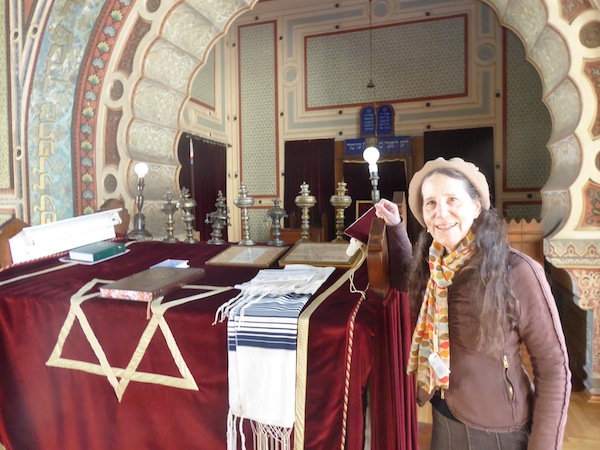
The author in the synagogue in Sarajevo, Bosnia-Herzegovina. (photo from Miri Garaway)
When I first started planning and researching our October 2017 trip to Slovenia, Croatia and Bosnia-Herzegovina, the foremost thing on my mind was learning about the Jewish history of the region. It was uncharted travel territory for me and I was curious to uncover the areas that were once vibrant Jewish communities.
Rather than being herded around by bus on a large organized tour and staying in North American-type hotels, which are far away from the pedestrian-only “Old Town” neighbourhoods of the cities, I wanted the challenge of researching centrally located, charming and historical bed and breakfasts and/or apartments and then finding private or small group Jewish heritage tours within each place. This proved to be an interesting process, whereby I delved into several possibilities. I left no stone unturned in designing this journey and it was such a feeling of exhilaration to put it all together and enjoy it.
Once I decided on accommodations in each city, I then had the task of transportation. To save time and energy, I hired a series of private drivers. This proved to be a wise decision, as 17 days does not allow for a slow pace. An added bonus was having our driver appear at the hotel, take our luggage and drop us off at our next destination, stopping to tour along the way, if we desired.
By pure chance, I had come across a U.K.-based company called mydaytrip.com – they responded promptly, were professional and easy to deal with and I had full confidence that I made the right choice. In addition to hiring a private driver, I also discovered a private tour company (based in Vancouver) called toursbylocals.com – their in-depth walking tours were excellent and I would highly recommend them.
Another option I used was Viator, a subsidiary of Tripadvisor. They offer a variety of small group (maximum eight people) tours all over the world and they liaise with local travel agencies, which provide the service. It is a great way to have various tour options at a reasonable cost.
Our first stop was Ljubljana, Slovenia, a charming university town of friendly people, exquisite Baroque architecture, a delightful cobblestoned Old Town and a vibrant café culture. Most notable is the Kaverna Zvezda, the best pastry café in town, featuring the traditional kremna rezina, also known as cremeschnitz, cream and custard between layers of puff pastry, which I had also tried in Israel. In short – divine. The gibanica (pronounced gabanitza), a delicious cake with poppy seeds, curd cheese, walnuts and apples, is another legendary cake in Slovenia and reminded me of a cake my Eastern European grandmother made. She was from Czernowitz, Austria-Hungary.
Pumpkin seed oil is “king” here and is used with the same frequency as olive oil is in Italy. Vegetarian pumpkin soup is on every menu, much to my delight. Were there any remnants of a Jewish community here? This seemed like Jewish comfort food to me.
Documents show that Jews settled in Ljubljana from the 13th century onward and worked as merchants, bankers, artisans and some as farmers. They had a synagogue, a school and a rabbinical court. In 1515, the Roman emperor Maximillian expelled the Jews and Ljubljana’s Jewish Quarter disappeared.
As I walked down the two narrow streets in the Old Town, that once housed a small Jewish community – Zidovska ulica and Zidovska steza, Jewish Street and Jewish Lane – the only sign of a Jewish presence was a vacant stone indentation on a building where a mezuzah had once stood.
Maribor, the second largest city in Slovenia, has a synagogue, but, unfortunately, it sits empty. Jews were also expelled from here, in 1496, though, eventually, both Ljubljana and Maribor regained their Jewish communities – until the Second World War. Then the Holocaust took its toll.
On a positive note, a synagogue did open in Ljubljana in 2003, but it is now part of the Jewish Cultural Centre. Ljubljana was previously the only European capital lacking a Jewish house of worship. The city does not have a rabbi, but the chief rabbi for Slovenia, Rabbi Ariel Haddad, resides in nearby Trieste, Italy.
* * *
Split, Croatia, once had a vibrant Jewish community, so, after visiting the Dalmatian coastal town of Zadar, we headed a little further south to Split, stopping first at the World UNESCO Heritage Site of Trogir.
In Split, I had arranged for a private guide, Lea Altarac, to meet us and give us a Jewish history tour as well as a general city walking tour. In 3.5 hours, we covered a lot. Lea is a teacher; extremely knowledgeable and proud of her city. Her mother is Bosnian and her father is Jewish; she has a Jewish soul, albeit one that does not practise Judaism. Nevertheless, she was eager to enlighten us with some of the Jewish history of the city.
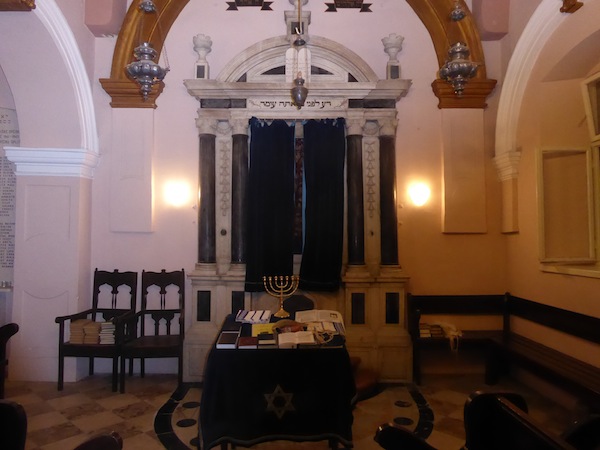
We first toured Diocletian’s Palace in the Old Town and Lea pointed out the many Magen Davids etched into the stone. Once we had finished touring the extensive palace, we walked to the edge of the Old Town. There, we came across the small synagogue of Split, no exterior decoration to distinguish it, which is maintained as a museum by Lea’s father. As we climbed the stairs to the second floor of the old stone building, I tried to visualize it teeming with congregants, sadly no more.
One of the oldest European synagogues, it was created in the 16th century. The interior dates back to 1728. That was the first restoration of several, and when the mechitzah (partition between men and women in an Orthodox shul) was added. It is interesting to note that the ark was built into the western wall of the palace.
The synagogue was plundered by fascist fanatics in 1942 and, unfortunately, many valuable ritual books, archives and silver objects were burned or stolen.
In 1996, during another restoration, a commemoration plaque of local victims of the Holocaust was given to the synagogue as a gift from the Israeli ambassador.
There is no official rabbi for the synagogue in Split, but the rabbi from Zagreb, Croatia, comes about twice a year.
The synagogue in Split, Croatia. (photo from Miri Garaway)
During archeological excavations carried out in the area of the Roman city of Salona, the capital of the Roman province of Dalmatia and the parent city of Split, traces of an established Jewish community were found. When Salona was destroyed, in the early seventh century, the surviving Jewish members took refuge within the walls of Diocletian’s Palace. This settlement was the early beginning of the city of Split.
The term Zueca is used to describe the localities where Jewish tanners and dyers lived. This was a common trade for centuries. Other Jewish occupations included weaving, tailoring, the sale of cloth, the running of a bank, as well as the food business, which was not permitted to Jews elsewhere.
Via 16th-century documents, we learned that there were Spanish and Portuguese immigrants who settled in Split, which was a port for trade between the Republic of Venice, to which Split belonged to at that time, and the Ottoman Empire. Most notably, a Spanish Jew named Daniel Rodriga, short for Rodriguez, was responsible for promoting the development of trade between Europe and the countries in the east. Caravans were also used for the exchange of goods to Turkey and Asia, which Rodriga felt was safer. He conceived the idea of building a large quarantine area, a lazaretto, in the port of Split to house men and goods from the eastern countries, before ships took them to Venice and the rest of Europe.
There was no Jewish ghetto in Split, as the members of the Jewish community enjoyed civil liberty. It was not until the late 18th century, toward the end of Venetian rule, that a ghetto was formed, due to the influence of the clergy and the decline of the Venetian economy.
Our walking tour led us up a steep hill, Marjan Hill, where we were afforded a spectacular view of Split. Overlooking the city, in a forest-like setting, is the Jewish cemetery, one of the oldest Jewish cemeteries known. It was founded in 1573 and was used until 1946.
After the collapse of fascism in 1943 and before the occupation of Split by the German army, many of the younger Jews left Split and joined the resistance movement in partisan units. Jews who did not leave were rounded up by the Nazis and sent to forced labour and concentration camps. Only one-third of the community survived and returned to Split after the liberation; others emigrated to Israel.
* * *
Sarajevo was our next stop, with a visit to Mostar on the way. Mostar, in Bosnia-Herzegovina, is a picturesque city situated on the Neretva River, only a two-hour drive from Split. I arranged a walking tour for the morning and asked the tour guide if we could visit the proposed site of a new synagogue. The small patch of land was donated by Zoran Mandlbaum, head of Mostar’s 45-member Jewish community, in the hopes that a synagogue would be built there. His vision was a building made of glass, symbolizing trust between Jews, Muslims, Orthodox Christian Serbs and Roman-Catholic Croats, and bridging ethnic gaps. For now, the only distinguishing feature of this barren piece of land is a wrought-iron Magen David carved into the gate.
Mostar originally did have a synagogue, but it was damaged during the Second World War and the communists turned it into a puppet theatre in 1952. We visited that colourful building. Today, there are only a handful of Jews living in Mostar.
Walking through the charming Old Bazaar (Kujundziluk), we reached the famous Old Bridge, a curved structure, originally built of square stones and completed by a Turkish architect in 1556. Its arch spanned nearly 29 metres and stood 20 metres above the river. Although the famous bridge was destroyed during the war in 1993, it was rebuilt in 2004. The tradition of diving contests off the bridge has been maintained.
Of notable interest is the elegant Turkish-designed Muslibegovic House and courtyard/garden, now a hotel, which we were fortunate enough to tour.
In another couple of hours, we arrived in Sarajevo, a beautiful city, surrounded by mountains. The first Jews, Sephardim, arrived in Sarajevo as early as 1541. They were mainly artisans, merchants, pharmacists and doctors. Ashkenazi Jews began arriving in the 17th century, fleeing persecution in Europe. When the Austrians occupied Sarajevo in 1697, they burned and destroyed the Jewish Quarter, including the synagogue.
When the Ottomans regained control of Sarajevo, the lot of Jews improved. Sarajevo became known as “Little Jerusalem,” having the unique feature of a synagogue, a Roman Catholic church and a mosque all within 500 metres of one another.
Jewish life changed dramatically with the rise of Nazi Germany and the Holocaust – 85% of the Jewish population perished and those who survived emigrated to Israel in the late 1940s. Before 1941, there were 12,000 Jews living in Sarajevo and 15 synagogues. In 2017, 700 Jews lived there, out of a population of 400,000. There was no official rabbi, but a rabbi, originally from Sarajevo, came in from Israel to officiate for the High Holidays.
Our Jewish heritage tour was given by a young Muslim man, the owner of Meet Bosnia travel agency. He was very proud of the fact that he was licensed to give this tour. We began at the Old Synagogue, which was originally built in 1581, but burned down and was rebuilt a couple of times. The synagogue was converted into a museum in 1965. There are historical exhibits, ritual objects, Ladino books, photographs, religious traditions and depictions of life before the Holocaust. There is a replica of the famous 14th-century Sarajevo Haggadah; the original being in the National Museum. Unfortunately, that museum was closed for renovations.
Next to the synagogue is the building called Novi Hram, or New Synagogue, now an art gallery owned by the Jewish community of Sarajevo. There was also a large, ornate Sephardi synagogue, built in 1932, but the interior was destroyed by the Nazis in 1941.
Most impressive was the grand Ashkenazi synagogue, built in Moorish style and located across the Miljacka River that runs through Sarajevo. It also serves as the Jewish community centre. We were fortunate enough to be there during Sukkot, and went to their sukkah. The synagogue also holds Friday night services.
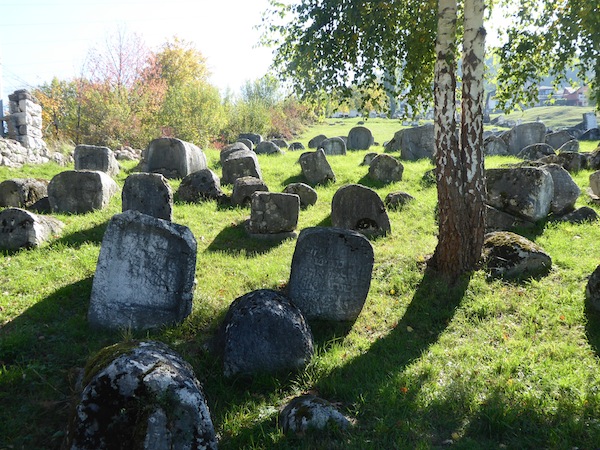
We visited the large hillside Jewish cemetery, among the oldest in Europe. It was founded by Sephardi Jews in 1630 and contains more than 3,500 uniquely shaped tombstones; some with inscriptions in Ladino. There are two Holocaust memorials: one Sephardi, one Ashkenazi. After 1959, it became a mixed cemetery and, in 1966, it closed. The cemetery was used as an artillery position by the Bosnian Serbs during the siege of Sarajevo and many of the tombstones were toppled.
The cemetery in Sarajevo, Bosnia-Herzegovina. (photo from Miri Garaway)
One thing I noticed during our stay in Sarajevo was that everyone we met was proud of the multicultural aspect of their city. One woman, in a Judaica shop we were taken to, next to a cinema that once housed a Sephardi synagogue, proudly told us that her Muslim neighbour helped her and her family build their sukkah.
It was hard to leave this fascinating, exotic city that had weathered so much, but we drove on to Dubrovnik, via the country roads. In the Serbian parts of that countryside, we saw signs in Cyrillic and I felt like I was in Russia.
What a contrast to arrive in Dubrovnik, a city inundated with tourists, even in October. Our Jewish heritage tour, which also included a walking tour of the city, was led by a Catholic woman studying for her master’s degree in archeology. In the late 1400s, early 1500s, there was a Sephardi community in Dubrovnik, with about 300 members. In the 1800s, Ashkenazi Jews arrived. Before the Second World War, Jewish property was confiscated and Jews had to wear the yellow armband. Some community members were involved in the anti-fascist movement. After the war, Jews were still registered in Dubrovnik, but most of them had immigrated to New York City.
We visited the Sephardi synagogue, located in the Old Town in a three-storey stone Baroque building; it is one of the oldest in Europe. The synagogue and museum received a direct hit from a missile during the war in the 1990s, but the Museum Foundation, the Croatian Ministry of Cultural Heritage and UNESCO, as well as private donations, helped restore it. There are fascinating displays of ritual objects in the museum and a Judaica shop next door. Sadly, there are only about 50 Jews left in Dubrovnik, all residing outside the Old City walls.
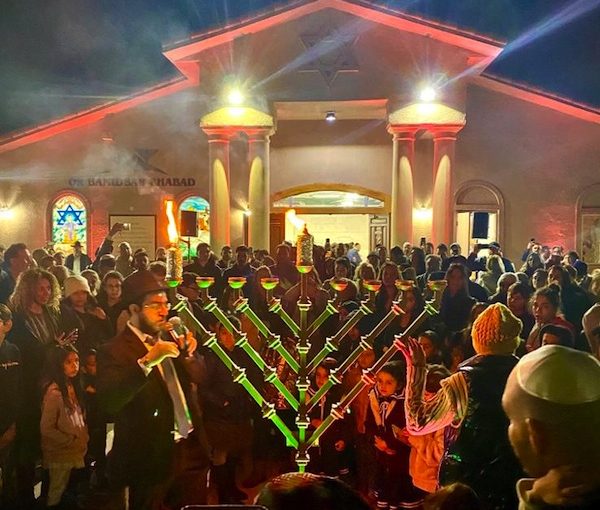
Las Vegas’s Or Bamidbar Chabad Sephardi synagogue at Chanukah. (photo from Rabbi Yossi Shuchat)
The Las Vegas Strip is where all of the action is, an endless sea of attractions and hotels with casinos, exhibits and more. These hotels cater to a tourist’s every whim. However, during my last trip to Vegas, several years ago, I spent a majority of my time off the strip, away from the bright lights and glitz.
I met up with a group of friends who I had spent a year with in Arad, Israel, in 1990-91, on a World Union of Jewish Students (WUJS) program that was for young Jewish professionals thinking of making aliyah. This was our second excursion to Las Vegas and members of our group hailed from Paris, New York, Boston, Toronto and Seattle. On our first trip, we stayed in the Egyptian-themed Luxor Hotel; this time, we stayed at Bally’s Hotel, in the heart of the strip.
We spent our first night wandering around the area near our hotel. The next day, on Friday afternoon, we ventured further afield to eat a fabulous lunch at an Israeli kosher restaurant called the Jerusalem Grill, which also offers pre-Shabbat delivery to hotels. As we dined on authentic Israeli dishes that could have come straight from the Holy Land, we reminisced about the good times we had had on our program and the many trips we took to explore Israel together.
We then explored the Palms Casino Resort and the Rio Hotel and Casino, which were near the restaurant. The Rio, where we would be going to see magicians Penn and Teller perform on Saturday night, after Shabbat, was also hosting the World Series of Poker.
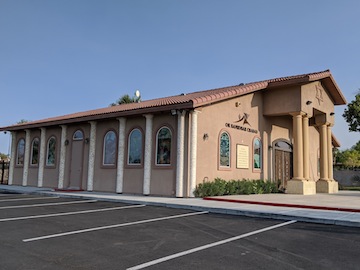
On the Friday night, a few of my WUJS friends and I went to Or Bamidbar Chabad – East Las Vegas, a unique Sephardi synagogue, whose Chassidic spiritual leader, Rabbi Yosef Yitzchok (Yossi) Shuchat, is from Venezuela. I had made arrangements with the rabbi prior to Shabbat to attend services and he graciously invited my friends and I to dinner at his house afterwards.
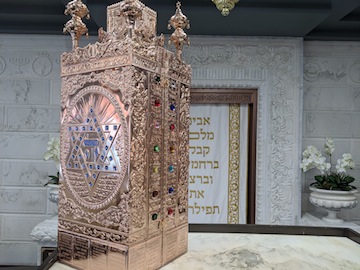
A Sephardi Torah case at Or Bamidbar Chabad. (photo from Rabbi Yossi Shuchat)
The synagogue features a picture of the Rebbe (Rabbi Menachem Mendel Schneerson) but, other than that, it is a typical Sephardi house of worship, with the bimah in the middle, and Sephardi prayer books and a Sephardi Torah case. I felt right at home, as I have prayed at Sephardi and Chassidic congregations all over the world and have an affinity for the customs and traditions of both streams of Judaism.
After some spirited davening and a great drash by the rabbi, we and a few members of the congregation followed the rabbi to his home, where we were treated to a scrumptious Shabbat meal by his wife, Miriam Bryna Shuchat, who is co-director of Or Bamidbar.
Most of the guests were Sephardi and from Las Vegas, but there was also Baruch, a visitor from New York who was in town to play at the poker tournament. There was also Walter, a Jew who had moved to Las Vegas from Boston and, at one time, was a boxer and a blackjack dealer. After great conversation and food, I retired to a recently renovated mobile home right across from the synagogue, which was reserved for guests – and I had the honour of being the first one!
Or Bamidbar Chabad – East Las Vegas. (photo from Rabbi Yossi Shuchat)
The next morning, I participated in the services and got to chant Birkat HaKohanim, the ancient priestly blessing that Sephardi shuls – including Beth Hamidrash in Vancouver – do every day, but Ashkenazi ones do not. At lunch, I had a lively discussion with a former Vancouverite who was encouraging me to leave Canada and move to Las Vegas’s thriving Jewish community, with its approximately 80,000 Jews, 20 synagogues, many Jewish schools and several kosher restaurants. When they had lived in Vancouver, both he and his mom had attended services at the Kollel and are fans of Rabbi Shmulik Yeshayahu. Interestingly, since my Vegas visit, the Pacific Torah Institute, which was located in Vancouver, has relocated to Las Vegas and merged with a local yeshivah.
After services, I was contemplating walking back to the hotel in the sweltering 32°C heat, but Walter, the former blackjack dealer, invited me to spend the afternoon at his house. It was a relaxing, enlightening and cool afternoon. Walter regaled me with stories about what Vegas was like when he arrived there in 1956. At that time in the city, which was founded by notorious Jewish gangster Bugsy Siegel, most of the hotels were owned by Jews and, so, as a blackjack dealer – at a variety of casinos, including the Flamingo and Desert Inn – Walter got to know many of them. He also got to know Frank Sinatra, Dean Martin, Sammy Davis Jr., and other members of the Rat Pack, as well as boxer Rocky Marciano. (When Walter was a boxer himself, he also met Muhammad Ali.)
After my stay at Walter’s – where I even got a Shabbat nap in – he gave me a lift to the Rio, where I met my friends to see the Penn and Teller show. The poker tournament was also in full swing, of course, but I don’t know how Baruch fared.
I spent my last night in Vegas before returning home to Vancouver with my friends at a glitzy hotel watching a magic show. However, while I enjoyed all that I did, the highlight of my trip – in addition to hanging out with friends – was the gracious hospitality of the folks in the Jewish community. I will always remember my wonderful Shabbat in Las Vegas at Or Bamidbar Chabad.
David J. Litvak is a prairie refugee from the North End of Winnipeg who is a freelance writer, former Voice of Peace and Co-op Radio broadcaster and an “accidental publicist.” His articles have been published in the Forward, Globe and Mail and Seattle Post-Intelligencer. His website is cascadiapublicity.com.
After the election of Joe Biden and Kamala Harris, many Jews were quick to celebrate that Harris’s husband Doug Emhoff is Jewish. Indeed, it is a win given the sharp rise in antisemitic expression and white supremacy we’ve seen in the United States, and which is bleeding over into Canada.
Jews often celebrate when someone like us makes it into a position of some influence. This time, it isn’t any particular achievement of Emhoff’s but, rather, his proximity to someone powerful.
Harris represents so many firsts: the first woman, the first person of South Asian and of Black heritage, and the first person married to a Jew to reach the vice-presidency. Her family is a positive representation of the dream of the United States, where anyone can become anything and where, crucially, diversity is a strength.
In open and free democracies, intermarriage is inevitable. If we are to live and work alongside each other, we will fall in love with each other. This isn’t a bad thing. Given how many people seem to hate Jews, it is nice that some people actually love us. I realize intermarriage is a perceived threat to Judaism; fears of assimilation are very real. And yet, Emhoff is proudly Jewish. His identity is not threatened by the multiple identities of his partner – they celebrate the many elements of who they are and where they come from.
Since the election, there have been many pieces published about how nice it is to see one’s intermarried family represented in the White House. Jewish communities have spent the past several decades trying to stop intermarriage. These efforts have failed and have even driven some Jews and their loved ones away from Judaism.
If we care about Jews and Judaism, including challenging the multiple threats we face, this kind of infighting really needs to stop. It’s time we embrace our pluralistic and diverse families, celebrate all those who wish to be and do Jewish, and recognize that there is so much in Judaism that is beautiful and meaningful, joys that can be experienced by all who are part of the wide web of Jewish families.
Rabbi Denise Handlarskilives in Toronto. She is the author of The A-Z of Intermarriage, published by New Jewish Press, and the leader of the online community Secular Synagogue.