Light amid darkness is a common theme in the winter festivals of many wisdom traditions. As befitting a Jewish holiday, the meanings of Hanukkah are many and varied, among these the resilience of the Jewish people and the imminence of miracles. These are welcome themes this year.
At vigil after rally after menorah lighting after social media post after dinner table conversations during Hanukkah, the theme has been reprised endlessly over the past days: in a world of darkness, we are called upon to generate light, even to be the light.
Finding the light – let alone being the light – is not easy. It is understandable to respond to events in the world today with hopelessness. A dramatic spike in antisemitic incidents locally and internationally is only an iceberg’s tip. It does not require a physical assault or desecrated property to be victimized by the tsunami of hatred sweeping over the world.
In the face of this conflict and the ensuing uptick in hatred, what have Canadian Jews done? In British Columbia and across the country, we have joined with Jews around the world to volunteer, donate and do whatever is necessary to repair, as much as it can be, the brokenness that happened on Oct. 7 and since.
This is the light we are called upon to be. This is the resilience that is not just a word, but an actualized embodiment of Jewish values.
It is worth remembering that the greatest period of growth and expansion of our own local community occurred in the late 1940s and early 1950s. Even as the magnitude of the unprecedented historic trauma was just beginning to be understood, new synagogues were constructed, new day schools opened, social service agencies launched, refugee aid groups mobilized. Hillel welcomed students for the first time at the University of British Columbia mere months after the end of the Second World War.
In the shadow of unfathomable darkness, Jews in Vancouver redoubled their commitment to nationhood. Similar epochs of regeneration took place worldwide, not least being the fulfilment of the ancient dream of Jewish self-determination as a free people in our own land.
This extraordinary burst of collective local regeneration was, of course, due in part to the influx of refugees, as well as the greatest period of sustained economic growth in human history. But, it was, first and foremost, an expression of the determination of the surviving remnant to plant for the future generations even while mourning those who had planted for them.
The chalutzim, the pioneers, who built the foundations of the community we live in today remain with us – some only in spirit, some very much still with us at advanced ages. Likewise, the founders who built the state of Israel are present, some in body but all in spirit, as we rededicate ourselves to girding the defence, strength and future of that country. Together, the examples of these forces of resilience are models for us to emulate as we struggle in these dark times.
We do not need to search hard for inspiration to get us through and embolden our commitment to carry on, to be the light. It is in the example of our families, our community and millennia of being a people that the poet Yehuda Amichai called “infected with hope.” May we merit to grow in hope, compassion, resilience and light in the coming days and weeks.
I’m that grown-up who jumps to catch a kid who is about to fall off a playground slide, even if the kid isn’t mine. I’m saying, “Hey, be careful!You don’t want to hurt your bum,” or whatever concern is applicable. Some feel I’m overprotective. Rather than using unkind words like “hovering,” I prefer “proactive worrier.”
I felt isolated with this habit. Then I got to know the contractors for our home renovation better. The brothers who worked for us were also parents. They did everything possible to keep kids, dog and parents safe as they worked on the house with us living in it. The older brother, the electrician, would spell out exactly which hazards he was trying to avoid. He would close a door, put up a sign saying “Please stay out” or another proactive way to avoid problems. The day they installed a big new bathtub was a good example. After caulking it, the tub was filled with water to weigh it down and create a good seal. We knew the kids and dog would be very tempted to check it out – we imagined kids falling in in their clothing, playing with rubber duckies, a dog jumping in and flooding the room. We strategized how to keep everyone away from the tub until the caulk hardened.
I was surprised when I started studying Bava Kamma, a Babylonian talmudic tractate dedicated to civil law, particularly the law of damages and compensation owed. In “fancy” legal vocabulary, this is tort law, which “provides damages to victims in compensation for their losses.” The rabbis of the Talmud thought through these issues. They used examples from their day. They talked about oxen that gored, camels that fell (and caused a stumbling block) and other unpredictable situations. I’d heard sermons where people laughed about this level of detail, but my brain returned to those playground moments. Perhaps others don’t take these examples seriously because they’ve never interacted with large, stubborn livestock or a fussy, heavy toddler or two.
Here’s an example of a question posed in a baraita in Bava Kamma 29: “If one’s jug broke and he did not remove its shards, or if his camel fell and he did not stand it up, Rabbi Meir deems him liable to pay for any damage they cause. The rabbis say that he is exempt according to human laws, but liable according to the laws of Heaven.” So, the understanding is, if you create a dangerous situation, you’re obligated to clean it up. If you don’t clean it up, you’re still responsible for it. You’re guilty even if you don’t owe money as compensation.
Examples like these keep popping up. This tractate is a Jewish rabbinic lesson in taking responsibility for our actions. How might something we do harm someone? What if it’s an accident, like dropped pottery? What if you purposely left broken glass or pottery that could harm others?
This ancient rabbinic text can seem dry, as law texts might be, but also relevant. In the last few days, many communities have started to use law as an excuse to exclude public acknowledgement or celebration of Hanukkah. Moncton, N.B., made a name for itself in this way. A Hanukkah candlelighting has been customary there for 20 years. Suddenly, this year, the mayor and council felt it interfered with the separation of church and state. They canceled the event, although Moncton City Hall decorates with angels, a Christmas tree and wreaths. A last-minute petition with many opposing voices succeeded in forcing a new vote that overturned this decision, so the menorah and candlelighting were reinstated.
Other communities wrestling with this include Williamsburg, in my home state of Virginia. Organizers there suggested that a menorah lighting couldn’t be allowed unless it was under a “ceasefire now” banner. In Britain, a London town council reversed their decision to cancel a public menorah lighting after an outcry. Back in Canada, in Calgary, Alta., the mayor canceled her attendance at the city’s public menorah lighting.
Suddenly, the rabbis’ detailed discussions in Bava Kamma make more sense. Their debates explore when someone is wronged by accident, and if they owed compensation. However, they also include the question of responsibility when someone is wronged “on purpose.” For example, when a government uses the law to suppress a minority religious observance, like Hanukkah. When this kind of action takes place, it does harm. It does harm beyond whether Jews are legally allowed to light a hanukkiyah in a public place. The message it sends causes bigger damage and fear.
After all, if Jews in Canada or the United States aren’t allowed to publicly celebrate their religious rituals, it feels unsafe to be Jewish in these places. Where is it safe? Most Jews would then think about Israel as being the place where it’s truly safe to be Jewish. The people who want to withdraw public observance of Jewish traditions due to the Israel/Hamas war send a message to Jews living in North America – it’s not OK with them to have a Jewish homeland in Israel. It’s also not OK with them for Jews to observe their religion openly here. They probably missed the irony, as their message is that it’s especially not OK when the Jewish holiday is about religious freedom.
Laws about compensation for damages can sound uninteresting. It becomes more intriguing when imagining an unsafe play structure, a broken piece of pottery or a camel that won’t budge. It gets even more pertinent – and uncomfortable – when the law is used to keep us from celebrating our religious traditions freely, in public, without fear, in a democracy.
While Hanukkah is ending, it’s still the time of year when many indulge in more sweets and tortes than we’d planned. Sadly, it’s a different kind of tort this year, one where we consider how to compensate for the potential loss of religious freedom.
Joanne Seiffhas written regularly for CBC Manitoba and various Jewish publications. She is the author of three books, including From the Outside In: Jewish Post Columns 2015-2016, a collection of essays available for digital download or as a paperback from Amazon. Check her out on Instagram @yrnspinner or at joanneseiff.blogspot.com.
“Jews have always turned and continue to turn to humour as a cultural touchstone and a way to make meaning,” said Dr. Jennifer Caplan, author of Funny, You Don’t Look Funny: Judaism and Humor from the Silent Generation to Millennials, which was published earlier this year.
Dr. Jennifer Caplan spoke Dec. 3, as part of the L’dor V’dor lecture series organized by Victoria’s Kolot Mayim Reform Temple. (photo from Kolot Mayim)
Caplan, who is an associate professor and the Jewish Foundation Chair in Judaic Studies at the University of Cincinnati, was the second presenter of the 2023-24 L’dor V’dor (Generation to Generation) Zoom lecture series organized by Victoria’s Kolot Mayim Reform Temple. On Dec. 3, she spoke about the past several decades of Jewish humour. Similar to the approach she took for her book, her presentation explored the changing relationship to Judaism of four generations of Jewish funny people.
According to a 2013 report by the Pew Foundation, called A Portrait of American Jews, 42% of American Jews thought that having a sense of humour was integral to their Jewish identity, said Caplan. In the survey, in terms of what American Jews deemed important to their identity, a sense of humour came out far behind Holocaust remembrance and intellectual curiosity, just under support of Israel, and well ahead of belonging to a Jewish community or eating traditional Jewish food.
“The report set off little bells in my brain which pushed me to say that there’s something here and that there’s something I want to think about,” she said.
There were Jewish commentators who pointed to the Pew survey as an alarm bell for the dangers of the rise of cultural Judaism. To Caplan, the TV show Seinfeld, which premièred in 1989, encapsulated what worried some about the culturally Jewish experience.
“It was this group of people who seemed Jewish, even though Jerry (the title character) is the only character on the show who is actually Jewish,” she said. “They all sort of felt Jewish, but they never did anything Jewish and nobody ever went to synagogue and they didn’t even have a menorah like Rachel and Monica did in their apartment on Friends.”
In Caplan’s view, this fear of cultural Judaism aligned with the way that Jews were being portrayed in popular comedy and media, as Seinfeld led to a boom in Jewish sitcom characters – in shows like Mad About You and Anything but Love, for example. She thought there was something important in the way Jewish comedians were using Judaism in their humour to think about themselves and their Jewish identity, and what it means for them to be Jewish.
Moving forward to the present and, according to Caplan, one finds that the younger generation, the millennials, are even more culturally tied to their American generational cohort and less so to being the grandchild or great-grandchild of Jewish immigrants.
“It’s a story about comedy and it’s a story about the way that Jewish comedians have related to Judaism in their comedy, but it’s also a story about Americanization. It is a story about the way that Jews in the United States became more and more embedded within their broader cultural milieu,” Caplan said, explaining the thought process that led her to write her book.
Caplan pointed out that counterculture, in Jewish comedy, was represented in the 1950s – a time generally associated in the popular sense with Leave It To Beaver and The Adventures of Ozzie and Harriet – by books like those by Philip Roth. His works, well before the broader 1960s counterculture movement, were critical of institutions but defensive of the Jewish community – viewing organized religion as something that was hurting Jews, but seeing the need for Jews to be protected.
What intrigued Caplan was that the pendulum had swung in the other direction for Generation X. “What I found was a fascinating reincorporation of Jewish ritual into the writing and the movies and the comedy of Generation X comedians. Jews themselves are being made fun of, but their engagement with Judaism is actually the thing that humanizes them,” she said.
In the 2001 film Kissing Jessica Stein, for example, the characters can be perceived as stilted, neurotic, self-absorbed Jewish caricatures, yet scenes at a Shabbat dinner and a wedding ground the characters and are not the subject of ridicule.
“It’s not that Generation X suddenly believes in God more than the previous generations did. It’s that they believe more in the power of ritual and tradition because it binds you. You’re not doing it necessarily because you have some sort of theological belief,” Caplan said.
As for millennials, among whom the oldest in the cohort is presently 42 years old, their story is still being written, she said.
“It seems as though they are willing to ridicule both Jewish identity and Jewish religious interaction at various times, depending on what suits the comedy,” she said. “They neither have a sense of oppression about their Judaism, nor do they have a sense of embarrassment about their Judaism.”
Caplan is currently researching and writing her next book, Unmasked: Jewish Identity in Comic Books.
The next speaker in the L’dor V’dor series is psychotherapist and author, and member of the second generation, Rabbi Dr. Tirzah Firestone on Jan. 14. Firestone will talk on the topic Healing Intergenerational Jewish Trauma. For more information, visit kolotmayimreformtemple.com.
Sam Margolis has written for the Globe and Mail, the National Post, UPI and MSNBC.
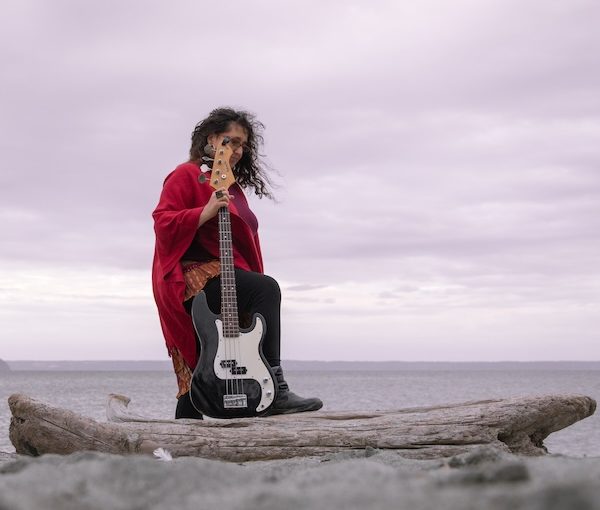
“Dear Hostages, as the world rallies to celebrate your desecration I will not forsake you,” begins the poem written by Seattle-based multimedia artist and educator Loolwa Khazzoom. Posted on her Facebook page, with a #BringThemHomeNow poster featuring photos of Israelis kidnapped on Oct. 7, it continues, “My instinct is to deprive myself of oxygen / Because you are underground / And I will not forget you // But I know that you would dance / In the sun / If given the chance / So I now rise up / And dance for you.”
Many of Khazzoom’s songs begin as poems. In this case, she told the Independent, “I felt as if I could not breathe and as if I did not even want to breathe, out of solidarity with the hostages and with all of Israel, in particular, all the victims of the Oct. 7 massacre. It’s like I wanted to physically feel their pain and suffering, as a way of physically demonstrating that I would not forsake them or forget them.”
In a traumatized mental state, Khazzoom returned to the “healing tools of poetry and music,” which was another way she could show her solidarity and do her part in keeping the issue of the hostages in frontof people.
Similarly, Khazzoom and her band, Iraqis in Pajamas, recently released another poem-turned-song, “#MahsaAmini.” They did so this past Sept. 16, the first anniversary of the death of 22-year-old Mahsa Amini at the hands of Iranian “morality police.”
Finding out about Amini’s murder soon after it took place, from TikTok videos posted by Iranian women, Khazzoom “jumped into action.” She wrote to her political representatives, raised funds for United 4 Iran and reposted Iranian women’s videos on her feed constantly, to help boost the content’s views. “In addition,” she said, “a day after I found out about what happened, a poem with my feelings poured out of me, and I posted it on social media. Months later, I put that poem to a melody, and the band developed it into a full band song, which we released on the [anniversary of the] day of Amini’s murder.”
The death affected Khazzoom deeply for many reasons.
“First, the women in my family wore the abaya, the Iraqi equivalent of the hijab – Jewish women throughout the region were subject to Muslim dress codes, so it’s a Jewish issue, too,” she said. “Second, so many people assume that Islam is indigenous throughout the Middle East and North Africa, but it’s not. Arab Muslims rose up from the Arabian Peninsula and conquered the entire region, forcibly converting masses under the threat of death. So many indigenous ethnicities and religions predated the Muslim conquest, including Jews, Persians, Berbers and Kurds. The Iranian women protesting and burning their hijabs felt to me like challenging that Muslim conquest and awakening the ancient Persian warriors. Third, Persia is central to Jewish history and the origins of the Mizrahi community, dating back nearly three millennia ago…. And, lastly, the fire of these women, and the men who joined them, and their willingness to risk their lives for their dignity and freedom was just breathtaking and profoundly inspirational.”
Another of Iraqis in Pajamas’ releases this year was also intensely personal for Khazzoom.
“I wrote ‘The Convert’s Quest’ in response to some friends on social media sharing how hurt they were, coming under attack during the process of their conversion to Judaism. I had ample experience witnessing variations on this theme throughout my life – both first-person, seeing it happen to friends, and through my research as a Jewish multicultural educator. For decades, I felt very disturbed by this seemingly growing trend.
“I am the daughter of a Jew by choice, as my mother called herself, so the matter of conversion to Judaism is very personal for me,” she said. “I remember understanding very clearly as an Orthodox Jewish child that, according to halachah (Jewish law), once you convert, you are no longer to be called ‘a convert,’ but rather, a Jew, period. So, even from a religious Jewish perspective itself, I was very distraught by the ways that Jewish leaders and communities were rejecting or harassing converts, or even all-out forbidding people from converting. It all flies in the face of Jewish history, theology and practice.”
The band released “The Convert’s Quest” on May 24, on the harvest holiday of Shavuot, which celebrates the giving of the Torah to the Jewish people and on which the Book of Ruth is read. It tells the story of Ruth, a Moabite woman who converted to Judaism, whom Jewish tradition teaches will be the ancestor of the Messiah.
“To me, Jewish converts are the lifeblood of the Jewish people,” said Khazzoom. “I have a provocative line in my song, saying that converts are ‘the most Jewish Jews of all,’ because they are intentionally and consciously practising the foundational precepts of Judaism, which so many either take for granted or do rote, as is often the case in the Orthodox Jewish world where I was raised. In addition, amidst life-threatening levels of racism and violence against Jews, converts choose Judaism…. Why would we reject, in any way, from subtle to blatant, someone with such a heroic Jewish soul?”
Even when delivered in a playful manner, Khazzoom’s song are serious to the core. The campy “Kitchen Pirate,” for example, “emerged from my choice to reject the conventional option of surgery, in the wake of a cancer diagnosis in 2010,” she said. “Instead, I chose to radically alter my diet and lifestyle. Simply by overhauling my diet, I cold-stopped the growth of the nodules, which remained stable for the next five years – neither growing nor shrinking – until I returned to my lost-love of music, following which they began shrinking.”
Khazzoom said her songs “are always questioning, always challenging, always defiant. Sometimes, it’s more explicit, other times it’s embedded in silliness, which, parenthetically, I also see as defiant. I am and forever will be a curious, playful and awe-inspired child. I think that, if and when we ‘outgrow’ that, we die inside. And I refuse to capitulate to that norm of expected behaviour once we enter adulthood. By way of example, to this day, at age 54, when I am flying in a plane, if there is nobody sitting next to me, I will stretch out my arms and pretend I’m a bird, during takeoff.”
Not everyone has appreciated this aspect of her personality. “I have constantly gotten into trouble for it and have been at odds with my family, my community and society at large,” said Khazzoom. “I have endured terrible loneliness and often even self-doubt as a result. But I always come back to my core. And all of my songs emerge from that place – that raw, gut-wrenching place of being fiercely alive and allowing the clash with everything around me, and then writing about it.”
It is this enthusiasm that Victoria-based band member Mike Deeth enjoys about being in Iraqis in Pajamas, whose third member is Chris Belin.
“Loolwa and Chris are both easy-going, creative people. The energy is very positive, which makes collaborating with them fun and organic,” Deeth told the Independent. “Further, I appreciate the passion Loolwa has for the subject matter she writes about. One thing I always struggled with as a musician is ‘What do I have to say?’ At the end of the day, I’m a privileged guy who has never had to face oppression, hate, war or genocide. I have a lot of respect for artists who have experienced darker parts of humanity and have the courage to bring that perspective into their art.”
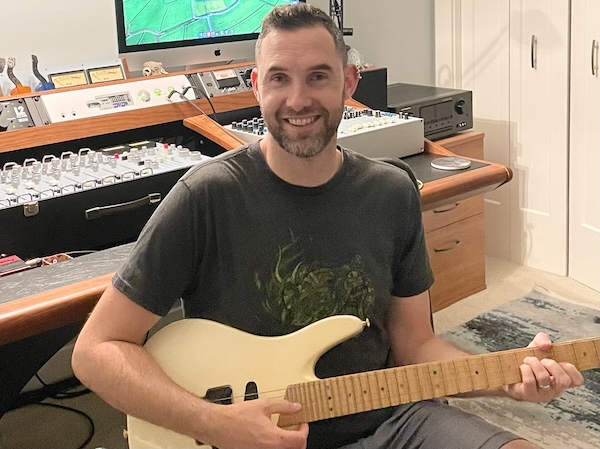
Born in Toronto, Deeth, who is not Jewish, spent most of his adolescence in Calgary, and moved to Vancouver Island when he was 18. He first picked up a guitar a few years earlier and has been playing ever since. “I was in my first band at 18 and played in bands throughout my 20s. For the past several years, I have been mainly focused on recording,” he said.
Mike Deeth (photo from Mike Deeth)
Deeth got hooked on music production in his teens, getting his first digital recorder at age 16. “I still remember pulling all-nighters with friends trying to write songs and get ideas down on tape. Production was always fascinating to me, as I could layer parts together into something bigger than I could ever play on my own.”
Deeth and Khazzoom met a couple of years ago through a Craigslist posting. “She was looking for a guitarist to contribute to an early version of her track ‘The Convert’s Quest,’” he explained, complimenting Khazzoom on the fact that she “puts her full heart into her songs.”
“I recorded some initial guitar demos and, about a year later, we reconnected and worked up the current releases,” he said.
Deeth adds guitar to the songs and completes the mix and master of the songs when they are ready for those steps. Khazzoom sings, writes and plays bass, while Belin – who lives in Pennsylvania – composes the drum parts and performs them.
Among his other music ventures, Deeth has “played the guitar with Bryce Allan, a country musician here on the island, and recorded a few tracks with him. I also work closely with Jennie Tuttle, another musician from Victoria. We have been recording together for seven or eight years now.”
For Deeth, “recording is such an interesting combination of art and science. I get to be musically creative, but I also get to play with cool machines, solve problems and think about gain staging, compression ratios and other technical aspects. I thoroughly enjoy both the artistic and scientific parts of the process – they work my mind in different ways.
“I also love how each project starts as a blank canvas and ends with a new piece of music out in the world. There are an almost infinite number of possibilities when recording a track (all the possible settings on the equipment, the subtleties of different instruments) and it always fascinates me how each song takes shape during the process.”
“Mike has an exquisite sensitivity in his musical composition, performance and recording,” said Khazzoom. “He’s not only super-talented and -skilled, but he’s warm, upbeat, enthusiastic and professional. It’s a joy to create music with him. As is the case with our drummer Chris Belin, Mike has an uncanny ability to capture the essence of the songs I write, to the point that I feel he is playing back to me the sound of my soul. I have literally sat and cried after hearing the mixes.”
For more on Khazzoom, visit khazzoom.com. For more on Deeth’s production and sound services, visit glowingwires.com.
Sufganiyot (jelly doughnuts) for Hanukkah have come a long way, and now come in countless variations. (photo by Avital Pinnick / Flickr)
In Israel, sufganiyot (jelly doughnuts) have gone through a major revolution. For years, they were injected with strawberry jelly and dusted with confectioners’ sugar. In a recent ad by a well-known Israeli bakery, there were 14 variations of sufganiyot, including the “classic strawberry jam.” Twelve are dairy and two are pareve (can be eaten with milk or meat dishes).
For the pareve offerings, there are colourful sprinkles, dairy-free chocolate and ganache (filling made from chopped chocolate and heavy cream). Among the dairy choices are “Raspberry Pavlova,” filled with sweet cream and topped with raspberry ganache, pavlova (a meringue named after the Russian ballerina, Anna Pavlova), sweet cream and Amarena cherries; “Curly,” filled with cream and topped with Belgian chocolate and milk, dark and white chocolate curls; “Mozart,” filled with nougat-flavoured sweet cream, frosted with white chocolate strips and topped with Mozart cream (a chocolate liqueur) and chocolate curls; “Cheese Crumbs,” filled with cheese mixed with white chocolate and butter cookie crumb frosting and topped with cream cheese; and “Pistachio,” filled with pistachios, frosted with white chocolate ganache, and topped with pistachio cream and pistachio shavings.
Jewish law does not prescribe any special feasting or elaborate meal for Hanukkah as it does for other holidays. Maybe this is because the origin of Hanukkah is not in the Torah but in the Apocrypha, the books of literature written between the second century BCE and the second century CE, which were not incorporated into the Hebrew Bible.
The Books of Maccabees, of which there are four separate books, only say that the hero, Judah, “ordained that the days of dedication of the altar should be kept in their season from year to year by the space of eight days from the first and 20th day of the month Kislev, with mirth and gladness.”
So, where do we get all the food we eat? It is in the Talmud, where the so-called miracle of the oil burning for eight days is written. This myth was inserted to de-emphasize the miracle of military triumph and replace it with a more palatable idea, that of the intervention of G-d, which somehow would seem more a miracle than a fight of man against man, according to the sages of the time. (By the way, it is only within the past few years that children’s books about Hanukkah dare say the oil story is a legend or a myth.)
Practically every Jewish ethnic group has the custom of making and eating a form of food prepared in oil as a reminder of the “miracle” of the jar of oil.
The late Gil Marks wrote, in The World of Jewish Desserts, that doughnuts fried in oil, ponchikot, were adopted by Polish Jews for Hanukkah. The name is taken from the Polish word paczki, which led to the nickname ponchiks, the Polish name for jelly doughnuts. Ponchiks are similar to jelly doughnuts, only larger and more rich tasting, and were traditionally served on Shrove Tuesday, the day before Lent. They were made to use up shortening and eggs, which were prohibited during Lent.
Sufganiyot have a different history. In The Jewish Holiday Kitchen, Joan Nathan, an acquaintance of mine from our Jerusalem days and noted cookbook author and maven of American Jewish cooking, noted that she learned the origins of sufganiyot from Dov Noy (z”l), former dean of Israel folklorists.
Noy related a Bukhharian fable to Nathan, which says that the first sufganiya was a sweet given to Adam and Eve as compensation after their expulsion from the Garden of Eden. Noy said the word sufganiya came from the Hebrew word sof, meaning end; gan, meaning garden; and Ya, meaning G-d. Thus, the word means, “the end of G-d’s garden.”
According to Noy, this fable was created at the beginning of the 20th century, as sufganiya is a new Hebrew word coined by pioneers. Some say sufganiyot means sponge-like and that the doughnuts are reminiscent of the sweet, spongy cookie popular along the Mediterranean since the time of the Maccabees. Hebrew dictionaries say the word actually comes from the Greek word sufgan, meaning puffed and fried.
John Cooper, author of Eat and Be Satisfied: A Social History of Jewish Food, has another theory. He says Christians in Europe ate deep-fried pastries on New Year’s Eve, and Christians in Berlin ate jelly doughnuts. In that context, German Jews started eating apricot-filled doughnuts. When they immigrated to Palestine in the 1930s, they encouraged the population to eat the jelly doughnuts for Hanukkah.
One of my favourite pieces of research is the characteristics that sufganiyot are said to have:
• they are round like the wheel of fortune;
• they have to be looked at for what is inside, not for their external qualities; and
• they cannot be enjoyed the same way twice.
My research on the internet shows the calories for one sufganiya vary from 93 to 276, and gluten-free versions with rice flour are about 165 calories.
Whatever their origin – or number of calories – sample the real thing and you won’t forget it!
Sybil Kaplan, z”l, was a Jerusalem-based journalist and author. She edited/compiled nine kosher cookbooks and was a food writer for North American Jewish publications, including the Jewish Independent. We communicated regularly, but mostly in the leadup to a holiday issue. Not having heard from her in advance of this Hanukkah paper, we reached out, getting the sad news that Sybil recently passed away. It was a pleasure working with her for these past 20+ years and we will miss her. She always provided more stories than we could use, so, in this issue, we run a few we had yet to publish, honouring her in our way. May her memory be for a blessing.
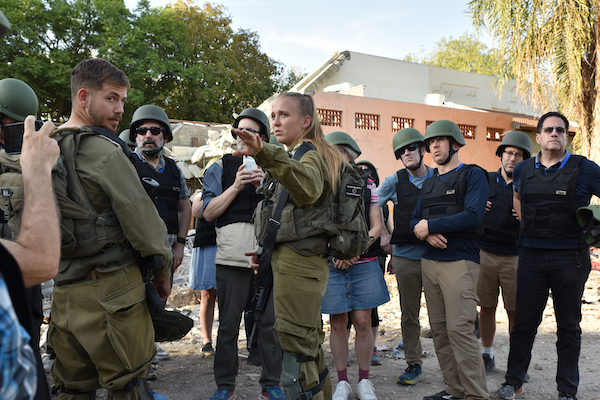
On Oct. 31, among the ruins of Kibbutz Be’eri, Israel Defence Forces personnel brief a delegation of Conservative rabbis and lay leaders from the United States, Canada and Britain, which was on a three-day solidarity mission organized by the Fuchsberg Jerusalem Centre. (photo by Boaz Pearlstein)
WARNING: Extremely graphic reporting.
Since Hamas’s Oct. 7 cross-border assault on multiple army bases, kibbutzim, cities and a music festival in the Gaza Strip periphery, staff at the Israel Defence Forces’ Shura base have been working around the clock to identify the remains of the 1,100 civilians and 315 IDF soldiers, reservists and police officers massacred by jihadi terrorists. With so many bodies, the victims were initially kept in refrigerated milk trucks in the morgue’s parking lot. Plain wooden coffins are stacked in the corridors, waiting for a positive identification so the remains may be released to their families for burial at a military or civilian cemetery. Only then can Judaism’s seven-day period of mourning begin.
A month on, the sickly smell of death lingers. Pathologists at this normally quiet IDF logistics centre and home base of the military rabbinate corps – located on the outskirts of Ramla, a mixed Jewish-Arab city not far from Ben-Gurion Airport – continue their painstaking, harrowing but holy forensic mission.
Dismembered limbs and badly decomposed bodies continue to be delivered. The human remains are sniffed out under the rubble of destroyed buildings by IDF canine units, staff told a 33-person Oct. 31 delegation of Conservative rabbis and lay leaders from the United States, Canada and Britain.
Initially, it is often impossible to determine if the remains are those of victims or perpetrators, Col. Rabbi Haim Weisberg, head of the IDF’s rabbinic division, told the religious leaders. Many are mutilated with limbs and heads dismembered, making the ghoulish jigsaw puzzle even more complex.
“We are in an abnormal situation and that is why it is taking so much time to identify the bodies. In most cases, we have had to identify people via deep tissue DNA or dental records because there is nothing left,” he explained.
The complex identification process has been compounded because so many of the victims were not Israeli residents.
Pathologists can take several hours to assess a body, photograph it and document the fatal wounds. Out of respect for the dead and their families, the IDF is not releasing those photos.
Weisberg spoke not only about whole bodies but also about charred and incomplete remains, including what in one case turned out to be a corpse so severely burned that only a CT scan revealed it was a mother and baby bound together in a final embrace.
The grisly job is complicated by uncertainty over the tally of victims. According to constantly updated data from the IDF, more than 1,400 Israelis and foreigners were murdered. Some 238 people are believed to be held hostage by Hamas inside the Gaza Strip and the fate of dozens of others is unknown. Some may be held inside Gaza by other terrorist groups, like Palestinian Islamic Jihad, or even by individuals. Others may still be among the dead, yet to be identified by the staff at Shura.
When drafted, all IDF recruits provide samples of their DNA and fingerprints, and have their teeth X-rayed. The army does not rely exclusively on identification made through a soldier’s twin dog tags kept in their combat boots and worn on a chain around the neck.
According to halachah (Jewish law), fallen soldiers are buried in a coffin in their blood-soaked uniform. They are not ritually washed in the tahara ceremony – the Jewish tradition of purification of the dead – nor are they wrapped in shrouds. The intention is that God should be angered by witnessing the fallen defenders among his Chosen People. Personal effects like a cellphone, watch or wallet are washed of blood and then returned to the family of the deceased. Artifacts that cannot be cleansed of blood are buried with the deceased.
By contrast, civilian dead are ritually washed and wrapped in shrouds. Generally, in Israel, they are interred directly in the ground without a coffin.
While dental records can allow straightforward identification of dead soldiers, that information is often unavailable for civilians. Many dental offices in the city of Sderot near Gaza were destroyed, and with them their files.
Ritual washing is tasked to male and female reservists who have volunteered for the mitzvah (commandment) of chesed shel emet (true kindness).
Women soldiers perform tahara for the hundreds of girls and women who were murdered. The team is working in shifts around the clock. Among them is Shari, an architect living in Jerusalem whose surname may not be released under IDF security regulations. She volunteered for the unit when it was established more than a decade ago to ensure that the modesty of female recruits killed in action was protected.
“We saw evidence of rape … and this was also among grandmothers down to small children,” she stated.
Shari said she and the other volunteers received specialized training from the IDF, which prepared them practically and mentally to care for the bodies of the dead. Until Oct. 7, she had not been called for active duty.
“I’ve seen things with my own eyes that no one should ever see,” she said, describing how she took care of the dead women. Many were still dressed in their pajamas. Their bodies had been booby-trapped with grenades, and the remains bore evidence of extreme brutality.
Shari’s duties begin with opening the body bags to remove the dead person’s clothes, jewelry and any other personal possessions in order to return them to the families.
“The only colour among the blood and dirt was their nails, beautiful manicures, painted the brightest colours,” Shari said, adding, “Their nails made me weep.”
“We gathered this group of 33 Jewish communal leaders from across North America to witness the horrors our brothers and sisters have suffered,” said Dr. Stephen Daniel Arnoff, chief executive officer of the Fuchsberg Jerusalem Centre – a home for Conservative and Masorti Judaism in Israel, which organized the three-day solidarity mission. Located in Jerusalem, the centre offers opportunities to study, pray and explore within an egalitarian and inclusive setting, creating multiple pathways for finding personal and communal meaning.
The solidarity group included the first civilians to tour the devastated remains of Kibbutz Be’eri, where terrorists went house to house slaughtering the inhabitants. Wearing flak vests and helmets, the clergy and communal leaders recited the El Male Rachamim and Kaddish prayers for the dead as soldiers continued their search for human remains.
“We literally saw the blood of our people crying out to us from the ground,” said Arnoff.
“It is our moral obligation to make sure that the world knows what happened there.”
Gil Zohar is a writer and tour guide in Jerusalem.
Aren X. Tulchinsky is Vancouver Public Library’s new writer in residence. (photo by Jeff Vinnick / VPL)
As this year’s writer in residence at the Vancouver Public Library (VPL), Aren X. Tulchinsky proudly represents his two cherished identities as a transgender man and as a Jewish person.
“I bring all of my lived experience into the residency,” said Tulchinsky in a Jewish Independent interview. “I am out and proud as a member of the Jewish community and the LGBTQ2S+ community, and I bring my identities with me into the residency. I guess you could say this is a very Jewish and queer residency. The library has been very supportive of me.”
Tulchinsky wears his heart on his sleeve or, at least his right bicep, which is ringed with a tattooed chai in Hebrew letters. “We celebrated the launch of my residency with an evening of words and music, during which I read from new and previous work, and was accompanied by local klezmer musicians,” he noted.
The 65-year-old Toronto native is probably best known for the award-winning 2003 novel The Five Books of Moses Lapinsky, under his former name, Karen X. Tulchinsky, which evokes the 1933 antisemitic riot at Toronto’s Christie Pits park. He has had a varied career in film and television writing, editing and directing, and penning short and long fiction, including lesbian romance, notably the novel Love Ruins Everything.
Tulchinsky came out as lesbian as a teenager, and has been writing stories since.
Tulchinsky was named in September to the VPL post, which was launched in 2005 to promote Canadian literature. Among past resident writers are Miriam Libicki (jewishindependent.ca/drawing-on-identity-judaism), Sam Wiebe, Rawi Hage and Gary Geddes. Last year’s appointee was Black Canadian writer Harrison Mooney, author of the critically applauded Invisible Boy: A Memoir of Self-Discovery.
Tulchinsky, who lives in Vancouver, responded to the VPL’s call for applications and was shortlisted. “Then I was called in for an interview with about 10 people from the programs and learning department at the VPL central branch,” he said.
“It was a bit intimidating to be interviewed by a whole group of people, but I must have impressed them because, a few days later, the manager of the department phoned to let me know that they had chosen me for the position.”
Asked if he thought his being transgender was a factor in his selection, Tulchinsky replied: “Not really. The only way my identity as a transman was significant is that in the posting the VPL was encouraging writers from under-represented groups to apply.
“Judging from most of their past writers-in-residence, I assumed they would give the position to a more mainstream writer, so I have never applied in the past. Their encouragement for writers from diverse backgrounds … is what motivated me to apply.”
One of his chief responsibilities is acting as a mentor to emerging writers, in particular, those from marginal communities.
“It is my mission to encourage writers from marginalized communities, specifically, BIPOC, Indigenous and LGBQ2S+ writers, to attend my (free public) workshops and apply for a spot on my one-on-one consultation afternoons,” Tulchinsky explained. “I think Jews, People of Colour and queer and trans writers all have a lot to teach the mainstream world about our lived experiences. I want writers from under-represented communities to feel comfortable to come forward and let their voices be heard.
“Traditionally, Canadian literature has been dominated by white, straight, cis-gendered men (and a few women). We have a lot to catch up on. We all gain from a more diverse society and more diverse voices in Canadian literature.”
The residency will also allow Tulchinsky time for his own writing, principally, the first draft of a novel entitled Second Son, a family saga that draws on events in his own past.
The main character, Charly (formerly Charlotte) Epstein-Sakamoto, is a biracial, transgender man coming to terms with PTSD resulting from a tragedy that devastated his family decades earlier.
“The heart of the novel is based on my own journey transitioning from female to male, a child’s death in my family, and my experiences in a long-term, interracial, cross-cultural (Jewish-Japanese) relationship,” said Tulchinsky.
“Charly knows he’s a boy, even though his parents, his doctor, his teachers and all the other kids at school insist he’s a girl. When Charly’s brother (the first son and his only sibling) Joshua is killed in a tragic bike accident, his dad is so devastated he sinks into a deep depression, his mother begins an affair with her sister-in-law, and Charly finally begins to assert his true gender identity.”
Tulchinsky is also developing another novel, based on family stories and beginning in Russia in 1941.
“As I was writing the novel and researching the Holocaust, I started thinking about how many Canadians think the Holocaust began in 1939, with World War II, but the reality is the oppression of Jews by Hitler and the Nazis began years before the war, within days of Hitler becoming chancellor of Germany in January of 1933.
“I began writing another novel that begins in 1932, when Germany – Berlin in particular – was one of the most progressive places in the world. In Berlin at that time there were numerous gay clubs and cabarets, safe places for gay men, lesbians and trans people to gather, and the Jewish community was also thriving.
“That all changed overnight once Hitler came to power. I ended up with two new historical novels that I am still working on.”
Tulchinsky’s CV is lengthy, and one wonders how he has been able to be so productive.
“To be honest, part of my diverse career has to do with the fact that I found it impossible to survive as a novelist, even though I had numerous books published,” he said. “I am a graduate of the Canadian Film Centre in Toronto, which provides advanced training in film and television. Since then, I have worked as a writer and video editor on numerous television series. I have found it more possible to make a living in film and TV than I could as a novelist. The downside is I rarely have time to work on novels. This residency at the VPL is affording me time to write, which is a real gift.”
His advice to aspiring writers is be disciplined and tenacious.
“You need discipline to sit in a chair and write or you will never finish a novel. And you need tenacity to get your work published. Most writers get a lot of rejections before they find a publisher. Every time you get a rejection, just send your work out again,” he said.
Being Jewish and queer, Tulchinsky looks with growing dismay at what is happening today.
Twenty years ago, The Five Books of Moses Lapinsky reminded Canadians of a shameful history. It remains among the top 10 Canadian books ever borrowed from the VPL.
The Five Books of Moses Lapinsky follows a Jewish family living in Toronto’s Kensington Market in the 1930s and ’40s and is set against the backdrop of a massive antisemitic riot.
“On Aug. 16, 1933, at an amateur league softball game in Christie Pits park – a neighbourhood filled at the time with Jewish and Italian immigrant families – members of the antisemitic Swastika Club showed up with a giant swastika flag, which set off a riot between Jews and gentiles that involved 15,000 people and lasted throughout the night and is the largest race riot in Canadian history,” Tulchinsky said. “Unfortunately, with antisemitism, racism, transphobia and homophobia back on the rise throughout the world, the themes in the novel are just as relevant today as they were when I originally wrote the book.”
Tulchinsky thinks the current polarizing, often acrimonious, debate over sexual orientation and gender identity (SOGI) issues is “an effort on the part of the political right-wing to inflate the importance of cultural wars to distract people from the real issues we should be focusing on, such as climate change, wealth inequality and homelessness.
“I once saw a bumper sticker that read: ‘If you’re against abortion – don’t have one.’ I think it is the same when it comes to SOGI. If you are heterosexual and cis-gendered, you can either be an ally to the LGBTQ2S+ community and actively support us and fight for our rights, or you can leave us in peace.
“As an out and proud transman, I am just living my authentic life. And I hope I can serve as a positive role model to trans and non-binary kids who are struggling with their identity.”
Janice Arnold is a freelance writer living in Summerland, BC.
There are no words. I’m doom-scrolling, praying and worrying, reaching out to family and friends, but nothing prepares us for seeing more than a thousand Israelis murdered and hundreds kidnapped. The images are so graphic, so many bodies desecrated. On my social media feed, the images haven’t stopped coming.
Yet, in the first days of the war, there was a silence. I realized that others weren’t seeing what I was seeing in my Instagram feed. The North American media felt sanitized, distant from the reality that was depicted on Israeli TV and media. The first day or two back at school after the Simchat Torah/Thanksgiving weekend, my kids were stunned when others asked them why they were sombre. Until this year, they attended a Hebrew/English bilingual public elementary school. With their transition to junior high, they didn’t have nearly the same number of classmates who understood the situation.
At their International Baccalaureate middle school, there are curriculum additions, such as a special lunchtime club that meets to make a difference in the world. The resource teacher advises the club. She was sensitive to the needs of the kids affected by the war in Israel and Gaza, and mine came home with fundraising brainstorms. I wrote to thank the teacher for showing support during this hard time.
Then, she asked – do you have ideas for what else we can do? It took me awhile to make a list. I thought about what mattered most for me, far from the war but also very affected by it. The hardest parts of the list are long-term things that teachers should do: teach about misinformation, and definitions of things like terrorism, “rules of engagement” and more. The easiest parts, perhaps the most meaningful ones? Conducting a kindness campaign. Asking how others are doing and listening to their responses. Active listening would help everyone, Israelis, Canadians who are Jewish or Palestinian, and concerned bystanders. So many innocent lives have been lost. We need to talk about it.
I suggested to the teacher that another way of reaching out positively would be to do cards of support. The next day, my son joined other kids from the middle school who walked to the bilingual elementary school to deliver the cards. It was on Friday, Oct. 13, the day that Hamas suggested be a global day of harm for Jews. On a positive note, my son got to share his elementary school and his Hebrew skills by translating for a non-Jewish friend. He was proud. On the other hand, most of the kids in the bilingual program were absent due to the threat. Those who did come to school, from grades 1 through 6, filled just one classroom, according to my kid. He visited with beloved grade school teachers and ate challah at the Shabbat party – but the threat was real.
Outside the school, my kid saw both an unmarked police car and a marked cruiser. My heart flooded with gratitude when I heard this, but the school is in a huge field, accessible from multiple directions. One police car? Two? I felt the fear all over again. How many police would be “safe enough”?
Meanwhile, I heard that Jewish homes in one Winnipeg neighbourhood were egged, and the police were called. A potentially violent rally in support of Palestine, using words like “genocide,” was scheduled within easy walking distance of my home.
Even though we’re far from the fighting, it’s hard to gain traction on work while feeling so emotionally undone. Massive numbers of Palestinians were asked to move and large swaths of Israelis evacuated from both the north and south regions of the country, while so many have been called up to reserve army service. For those Canadians who have lost a family member, the pain is constant. For those who have kidnapped loved ones, like Vivian Silver’s family in Winnipeg and Israel, the families work to publicize their losses and wait in dread to hear what has happened.
Twice, I felt able to rise above this emotional turmoil and felt joy. Both times, it was because of a bar mitzvah.
The first instance that stunned me took place last week, when the cantor who tutors my twins asked them to chant together for their lesson. Their lesson was short, as there was an Israel solidarity rally that she was leaving to attend. I lurked in the next room. Usually, my kids jostle for position but, during that lesson, their voices rang out together, making the rote practice of Torah and Haftorah blessings become so powerful. “Wow,” I heard the cantor say, continuing with something like, “I’m glad I didn’t cancel your lesson. Thank you for gifting me with those brachot.” An almost holy silence hung in the air afterwards.
A few days later, we attended a Chabad bar mitzvah for a kid my twins knew in preschool. Even behind a mechitzah (the barrier between the mens’ and women’s sections), the bar mitzvah boy’s voice rang out sure and strong as he absolutely shone. It was something to see: his big personality, confidence and knowledge. I was achingly proud of our Judaism, in all its diversity and strength.
Writing to deadline, I imagine what might be relevant in a few days, but the things that have helped me will still help later. I am following my own advice. Each day, I am taking time to write emails or texts to friends and reach out. How are they? Are their families safe? Do they need anything? I try to take time to pause, hear what everyone says, and listen for the moments of Jewish joy that we can create – in synagogue or at our homes, when we’re alone or together.
Many ask, “How are you doing?” I pause and say, “Well, it’s been a rough time.” I’m also trying to maintain hope for the future. One hears it – through the generational continuity of every child becoming b’nai mitzvah, through Hatikvah and one other phrase – Am Yisrael chai, the Jewish people lives. It will be my prayer as we get through the days ahead. Amen.
Joanne Seiffhas written regularly for CBC Manitoba and various Jewish publications. She is the author of three books, including From the Outside In: Jewish Post Columns 2015-2016, a collection of essays available for digital download or as a paperback from Amazon. Check her out on Instagram @yrnspinner or at joanneseiff.blogspot.com.
As a kid, I remember sitting through High Holidays with my family at our Reform congregation. We’d hit a section in the services where the English responsive reading, inspired by the Hebrew, used words like “awe,” “awesome” and “supreme.” There were smirks and stifled giggles as we passed this yearly reading. Why? Our family had discussed it at a holiday meal, and we agreed this sounded like a really big pizza special. It was hard to concentrate after that, thinking about pizza.
This moment hit me again when I heard Rabbi Jeffrey Saxe, one of the rabbis at Temple Rodef Shalom in Virginia, give a Kol Nidre sermon about awe, gratitude and wonder. It was powerful. Before I get into the details, we chose to stream services again this year from home in Winnipeg. In part, it’s so we can be a part of two worlds – my parents’ congregation in Virginia, where I grew up, and our Winnipeg synagogue, too. After the holiday, I can discuss sermons with my mom as if I had been sitting beside her during services and this is meaningful. For many people who are apart from their families during holidays, using shared moments to bond is important.
Even though I knew our choice to stay home made sense, I felt pressured to “get back to normal” and “be together again,” especially when a synagogue publication suggested that those who chose to stream did so for “mobility reasons.” (Not all those who choose to stay home have the same challenges. There are multiple reasons to stay home.)
Back to Rabbi Saxe’s sermon, which touched on the ways that the rabbis created liturgy that helps us remain grateful, and even encourages experiences of awe and wonder. If you see a rainbow, there’s a prayer for that. There are specific prayer formulas for eating fruits, snacks, and there’s even, Rabbi Saxe mentioned, a prayer for after you’ve gone to the bathroom. At this, some in the congregation laughed.
I felt shame. Not only is the bathroom prayer something I’ve written about and, yes, recited, but it’s also something I might have laughed at as a kid. Without going into details, thanking G-d for the intricacies of how our bodies work, opening and closing appropriately at the right times, can be absolutely meaningful. If you doubt this, maybe you have been very lucky and never had food poisoning or a stomach virus. Yes, we smirk and laugh when we feel uncomfortable, sure. Also, it’s when we take things like being healthy for granted.
I also felt weird guilt about not being in a congregational community over the holidays, even though we had a holiday meal with another family, dressed up, streamed services and took time off together. I felt strange checking messages over Yom Kippur. Then something happened.
Within a short period of time, two of our close family friends ended up in the hospital. One is in his 80s, in ICU, with COVID. The other friend is 5 years old, and she has a sister who is a newborn.
During Yom Kippur, the 5-year-old was admitted to Children’s Hospital after being up all night in the emergency room.
In the middle of Yom Kippur services, I got up, went to the kitchen and gathered together food for the parents for this unexpected stay. This is why we make the second round challah, I thought, as I threw it in the bag. I left my family, hopped in the car while fasting, and navigated the hospital until I found the room with one dear-to-us child with her oxygen mask, her exhausted-looking parents and their infant. I handed them the food, it wasn’t time for a visit, and rushed out again.
Somewhere on the drive home, I processed what had happened. I felt a profound sense of awe. I had been in exactly the right place. If I’d gone to services in person, I wouldn’t have been online or known that our friends’ child had been admitted to the hospital. I wouldn’t have been able to rush out and offer food, a quick bikkur holim (visiting the sick), and support her family. Leaving the twilight of their windowless hospital room, I was blinded by sunlight as I left the garage. I parked in front of our house and took a moment to cry.
Our liturgy traditionally links daily gratitude with prayer. This is an automatic check-in with nature, our bodies and the world to see and wonder at what’s around us. However, we’re all too likely to get sarcastic, cynical and, frankly, depressed. Mental health experts recommend expressing gratitude and getting into nature to improve our health, but the rabbis, like other faith traditions, prescribed it a long time ago.
It’s easy to ignore the natural world or our bodily functions. I’ve become increasingly aware of the sensory overload in our society. Some people easily manage very stimulating environments, like a dance club or even a household with the TV and radio on, a dog barking and a phone ringing, all at once. Others cannot manage this much. Sometimes, it’s diagnosed as a sensory processing disorder, but this can mean different things. There’s a person who cannot manage too much input, and the person who needs fidget toys and constant stimulation to maintain equilibrium. Nature or the trendier “forest bathing” can sometimes help us find balance.
As I head into autumn, I’m seeking fewer big events or gatherings. Here’s to quiet moments of awe. One of my kids is a new band student. His enthusiasm about his instrument is contagious. I cannot wait to play sax duets and “honk” together. The other kid has been spotting woodpeckers on our dog walks and pointing out migrating birds as the weather turns.
Rabbi Saxe closed his sermon with Genesis 28:16, when Jacob wakes up and says, “Surely, G-d is in this place and I did not know it!” Perhaps, like Jacob, we can all wake up and discover the joys of small wonders, too. We just have to slow down, open up and look for them.
Joanne Seiffhas written regularly for CBC Manitoba and various Jewish publications. She is the author of three books, including From the Outside In: Jewish Post Columns 2015-2016, a collection of essays available for digital download or as a paperback from Amazon. Check her out on Instagram @yrnspinner or at joanneseiff.blogspot.com.
Filmmaker Sam Green will narrate live his documentary 32 Sounds, which is part of the Vancouver International Film Festival. (photo by Catalina Kulczar)
“There’s a thing in documentary filmmaking where, after you’ve done an interview with someone, you need to get what’s called room tone,” shares director, writer and editor Sam Green in his film 32 Sounds. “Room tone,” he explains, “is basically just sitting still for about 30 seconds or so and recording the sound of the room; this can help out a lot with editing later. I’ve been making films, which is kind of just marveling at people in the world, for 25 years now, and there’s always something odd and wonderful about this moment. An interview takes a person to other times and places and, now, they’re just here in the present, sitting with the sound of the room.”
Watching some of his interviewees, as they struggle or embrace sitting in silence for a few seconds, is one of the many highlights of Green’s latest documentary, 32 Sounds, which screens Oct. 5, 7 p.m., at the Vancouver Playhouse, as part of the Vancouver International Film Festival’s specialty program VIFF Live. New York-based Green will be in town to narrate the screening in-person, and audience members will be given headphones to wear, to help make the experience as immersive as possible.
The film premièred in January 2022 at the Sundance Film Festival. It exists in three forms: one as described above, but sometimes also with live music by composer JD Samson, who wrote original music for the film; another designed for an immersive at-home experience; and a theatre version without the in-person performance aspect. Watching the film at home without headphones was not ideal, but it was still enjoyable and mind-opening. There are parts where it would have added understanding and had greater impact to have heard something in only the left ear or only the right one.
32 Sounds is not just auditorily stunning but a visual pleasure, and intellectually stimulating, as well. Though there are explanations of how humans hear and how sound affects our bodies, the documentary is more philosophical than scientific. It presents concepts like the idea that all the sounds that have been made in the world should still be out there somewhere, “tiny ripples vibrating,” as contemplated by mathematician Charles Babbage, who is credited with having invented the computer, in the 1800s. If we had the right device, mused Babbage, we should be able to listen again to every joke, declaration of love or angry word ever uttered, narrates Green. “The air itself is one vast library, on whose pages are forever written all that man has ever said or woman whispered,” wrote Babbage in 1837.
In 2022, Green wrote: “I’ve made many documentary films over the years, and each one has changed me in some way, but none as much as the film I just recently finished called 32 Sounds. The film weaves together 32 different recordings as well as images, music by JD Samson, and voice-over to create a meditation on sound. Or, put a different way, the film uses sound to consider some of the basic features of our experience of being alive: time and time passing, loss, memory, connection with others, and the ephemeral beauty of the present moment.”
From the sound of a womb, to a cat purring, to fog horns, to a man who captures the sound of bombs landing nearby as he’s recording his music, Green masterfully takes viewers (listeners) on an emotional journey. We get to see how movie sound magic is made by foley artists like Joanna Fang. We meet sound and visual artist Christine Sun Kim, who talks about the deaf community, as well as hearing people’s perceptions of her work. Edgar Choueriri, professor of physics at Princeton, plays part of a tape he made for his future self when he was 11 years old. And we get to know a bit about composer and academic Annea Lockwood, 81 at the time of filming, who had been recording things like the sound of rivers for more than 50 years. Lockwood fundamentally changed how Green thinks about sound, especially a point she makes in the film: “There’s something I started writing about a year ago: listening with, as opposed to listening to,” she shares. “And it’s my sense that, if I’m standing here, I’m just one of many organisms that are listening with one another within this environment … we’re within it and we’re all listening together, as it were.”
32 Sounds has much to recommend it, including the chance to get up and dance, if you choose, when Green pumps up the volume on Sampson’s music, so you can “feel the sounds in your whole body.”
Accepting oneself
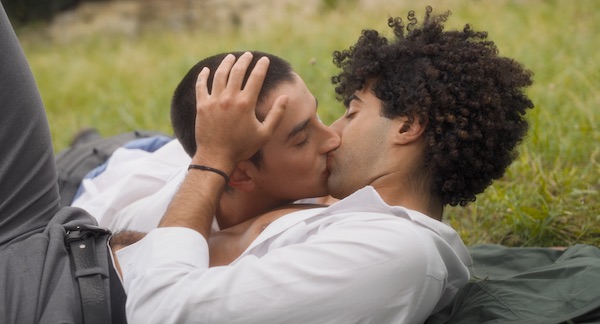
William Bartolo as Daniel, left, and Daniel Gabriel as his secret lover, Isaac, in a still from Cut, which is part of VIFF’s International Shorts: Nothing Comes Easy program. (image from VIFF)
Sound that you can feel in your whole body plays an important part in the short film Cut by Samuel Lucas Allen. In what may – or may not – be semi-autobiographical, Cut tells the story of Daniel, a high school student who tries to hide his Jewishness and his queerness. At key moments, the original score created by Sam Weiss thrums with tension, underscoring Daniel’s inner conflict.
Despite being somewhat heavy-handed – there is nothing subtle in this film, perhaps because it is only 19 minutes long – Cut is interesting, well-acted and put together. It opens with a Chassidic man holding a rooster, then shows Daniel cutting his hair, which falls onto a copy of Merchant of Venice, from which the teen will eventually have to perform, by memory, Shylock’s “If you prick us, do we not bleed?” speech. Daniel’s room has drawn images of men on his walls, in various poses, apparently his own work.
The film defines its three main elements: kapparot, as a “Jewish ritual where a chicken is blessed and slaughtered in the place of a person, to atone for their sins”; tefillin as a “pair of leather boxes containing portions of the Torah, worn by Jewish men in their morning prayers”; and cut, “a slang term for circumcision, the surgical removal of the foreskin, usually performed for religious reasons.”
It is mainly the Jewish aspect that Allen deals with in this work. Daniel is able to walk away from a gay slur, but not an antisemitic one, and, in the end, he is reconciled to himself and his Orthodox father by the mystical Chassidic man’s performing kapparot over him. We witness Daniel’s acceptance of being Jewish, but are left to wonder if he comes to accept his queerness, an aspect of his being that conflicts with Orthodox Judaism, though his soul would still be considered divine in religious circles, even if he engages in homosexual acts, which are prohibited by the Torah.
Cut is featured in VIFF’s International Shorts: Nothing Comes Easy, a program for viewers aged 18+, in which the films’ “protagonists discover that sorting out their lives can be much more difficult to achieve than they realized.” It screens Oct. 5, 6:45 p.m., and Oct. 7, 12:15 p.m., at International Village 8.
The Vancouver International Film Festival runs Sept. 28-Oct. 8. For the full schedule and tickets, visit viff.org.