Love and relationships

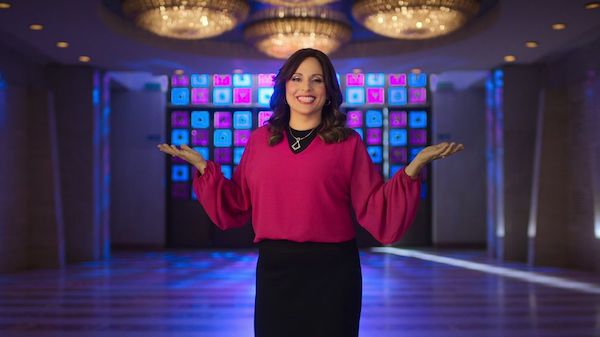
Hosted by Chabad Richmond, Aleeza Ben Shalom, star of the Netflix series Jewish Matchmaking, will take centre stage in-person for a one-night-only event on Nov. 27 at the River Rock Show Theatre. (photo from Chabad Richmond)

Remember the famous song from Fiddler on the Roof: “Matchmaker, matchmaker, make me a match, find me a find, catch me a catch”?  Well, fast forward a century, and things haven’t really changed that much. Jewish singles are still searching for their bashert, except they’re getting tired of swiping right or left to find their soulmate, so they’re turning to the ages-old tradition of matchmaking. Enter the world’s most famous Jewish matchmaker – Aleeza Ben Shalom.

Hosted by Chabad Richmond, Ben Shalom, star of the Netflix series Jewish Matchmaking, will take centre stage in-person for a one-night-only event on Nov. 27 at the River Rock Show Theatre.

Attendees will get an exclusive behind-the-scenes look at this hit TV reality show (signed for another year), discover secrets to successful relationships, and explore the intricate art of finding the perfect match. Ben Shalom – a self-described “marriage-minded mentor,” matchmaker and dating coach – will share her passion and insights into love, relationships and the basic Jewish values that inspire her to transform Jewish singles into Jewish couples.

“The time-honoured tradition of matchmaking, going back to the beginning of our people, has been central to bringing together Jewish couples and building Jewish homes. Focusing on core values that guide Jewish life, matchmaking ensures the continuity of our people for generations to come,” said Rabbi Yechiel Baitelman, director of Chabad Richmond. “In a world where everyone has spent the last three years getting very comfortable in isolation, the hurdles and opportunities for people to connect have been challenging. Never have I had so many people of all ages reach out to me asking me to make a match!”

Baitelman joked that matchmaking wasn’t covered in rabbinical school, but he views matchmaking as an emerging growth area in our community.

Ben Shalom, who has ushered at least 200 couples to the chuppah (wedding canopy) during her 15 years as a matchmaker, guides individuals of all ages on their quest for love and companionship. With her unique blend of warmth, humour and wisdom, she is committed to the matchmaking process. She adapts the model of formal Orthodox matchmaking (known as “shidduch dating”) to Jewish singles from all religious backgrounds, including secular, Reform, Conservative and Orthodox, from across Israel, Australia, the United Kingdom, the United States and Canada. She’s out to show the world that Jewish matchmaking is not some antiquated practice, but rather a relevant and successful process for lots of singles. She admits that it’s no easy task, but believes it’s worth the effort.

Born and raised in suburban Philadelphia in a secular Jewish home, Ben Shalom has been happily living in an Orthodox Jewish marriage for more than 20 years. She and her husband, Gershon, moved to Israel in 2021. They have five children and Ben Shalom entered the world of matchmaking in her 20s, when she was looking for a job that would give her a flexible schedule around childcare.

Tickets to hear Ben Shalom are $54 for general seating and $90 for preferred seating. Also, consider a VIP sponsorship opportunity at chai ($1,800), double chai ($3,600), triple chai ($5,400), $10,000 or $18,000. This inNludes a personal meet and greet with Ben Shalom over cocktails, forshpeis (appetizers) and conversation.

For more information, call 604-277-6427. Register for this exclusive event at chabadrichmond.com/matchmaker.

– Courtesy Chabad Richmond

Obligated to warn of danger

I often chat with a retired doctor neighbour as I walk by his house with my dog. When he mentioned hiking solo on the famously difficult Mantario Trail in southeastern Manitoba, it sounded risky to me. I asked him what safety precautions he was taking. Afterwards, he chided me for being overly motherly and a worrywart. While his response made me feel uncomfortable, maybe it was because he was defensive about a potentially unsafe hike. The defensiveness might be a sign that part of his brain thought I might be right.

I just studied Kiddushin 29, a page of the Babylonian Talmud, while doing Daf Yomi (a page a day of Talmud). It turns out, this scene has played out before. At the time, rabbis had their own yeshivas/schools where others came to learn and a seven-headed demon was in Rav Abaye’s “study hall.” The best advice to avoid a demon, according to the rabbis, was to travel during the day and in pairs. Demons were known to come out at night, but this situation was so dangerous that students were unsafe even during the day.

Now, it happened that Rav Aha bar Yaakov wanted to come study with Abaye, but had nowhere to stay. Instead of helping Rav Aha find a place to sleep, Abaye tells others not to accommodate him. This forces Rav Aha to stay overnight at the study hall. It’s a set up. There, Rav Aha must battle the demon and vanquish it. Abaye hopes for a miracle to take place.

When Rav Aha is faced with the demon, the text indicates that he prayed. As he prayed, he bowed to shuckle (the movement many Jews make when davening/praying), and each vigorous bow resulted in knocking off one of the demon’s heads. Rav Aha battles the demon with prayer and survives.

This storyline, according to Dr. Sara Ronis’s introduction to the page on My Jewish Learning, fits into a greater literary and historic context. There are many tales of a divine hero combating a demon in Ugarit and ancient Mesopotamia. There are Zoroastrian, Christian and Jewish holy heroes who triumph over demons through prayer.

Rav Aha was a pious and great man who came eagerly to study with Abaye. However, he wasn’t without fault. Just before this story takes place, Kiddushin 29b says that Rav Aha sent his son to study. Alas, his son’s studies weren’t sufficiently “sharp,” so Aha left his son at home to manage the household while Rav Aha went to study instead.

After his confrontation with the demon, Rav Aha says to the others, “If a miracle hadn’t occurred, you would have placed me in danger.” Rav Aha was given no warning about the demon. He had no opportunity to stay elsewhere. Abaye relied on Rav Aha pulling off a miracle to save his study hall and his students.

This is one of the talmudic stories you can “sink your teeth into.” The rabbis appear as flawed people and a product of their time. There were stories about demons floating around the wider community, and people in general worried about demons and how to fight them. In the Jewish community, you see a “pious and learned” person, Rav Aha, who chooses his own study over further opportunity for his son’s education. And Abaye is a famous scholar, but asks others to deny hospitality to a student, and chooses to endanger others.

After my concern over the Mantario Trail hike, I got to wondering. If your friend is about to be in a potentially unsafe situation, do you have an obligation to warn them, to show concern? I believe we do. I still think I have this obligation, even if I’m belittled for it. I think we have the obligation even if some see it as hovering, annoying or overly solicitous.

I think about this a lot. We live in a peaceful urban residential enclave, but it’s not unusual to hear news reports of violent crime just a few blocks away. We have a neighbourhood watch, too. It pays to be cautious to avoid “demons” that might endanger us. It isn’t just a motherly inclination to be street smart. It’s not wrong to let others know if we foresee danger ahead.

Returning to this talmudic story, I’m angry that Abaye doesn’t warn or protect his student, Rav Aha. Abaye had an opportunity to do the right thing and failed in his responsibilities as a teacher. I’m also amazed at Rav Aha’s tact and self-control. After being endangered in this way, I might have made a much bigger fuss.

This time of year, we’ve got a lot to think about in the Jewish world. On Yom Kippur, the Day of Atonement, we spend time thinking about our behaviours and failings as individuals and in community, the concept of forgiveness and our fate for the coming year. Yet we also look forward to Sukkot, grateful for the harvest, and to celebrating the Torah with joy on Simchat Torah.

Our calendar is complicated. Like the story of Abaye and Aha, we can’t find just a single obvious answer. Maybe this keeps us from getting bored as we repeat the rituals of each Jewish year. Perhaps it helps us sharpen our skills so we can perform miracles, protect and look out for one another, and slay unexpected (proverbial) demons, too.

Joanne Seiff has written regularly for CBC Manitoba and various Jewish publications. She is the author of three books, including From the Outside In: Jewish Post Columns 2015-2016, a collection of essays available for digital download or as a paperback from Amazon. Check her out on Instagram @yrnspinner or at joanneseiff.blogspot.com.

The traveling Hebrew school

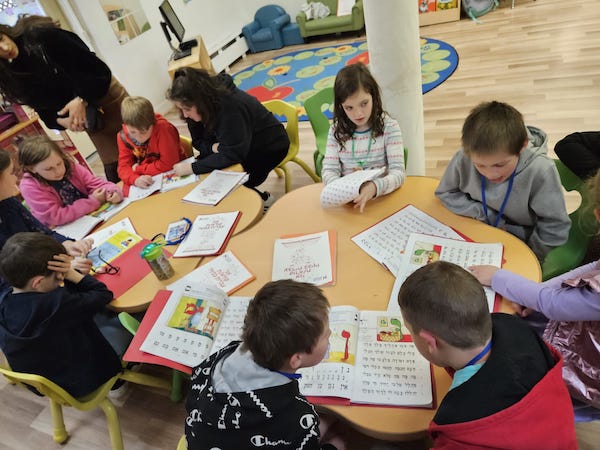
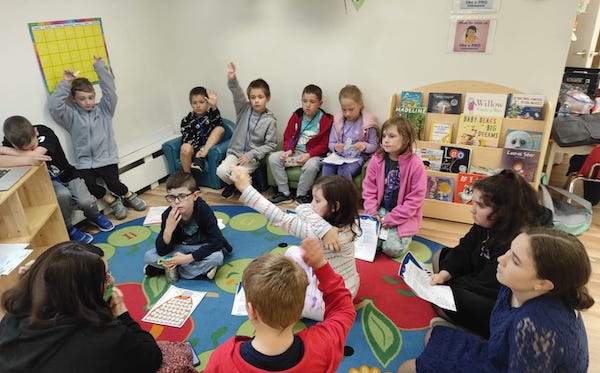
B.C. Regional Hebrew Schools currently serves more than 120 children – in Langley, Port Coquitlam, Vancouver and Whistler/Squamish. (photo from B.C. Regional Hebrew Schools)

It’s late Monday evening when Rabbi Dovid Rosenfeld loads a half dozen plastic containers of canvases, crayons, crafts and children’s Hebrew workbooks into his minivan. As directors of British Columbia Regional Hebrew Schools, he and his wife Chaya make the two-hour-long commute between Vancouver and Whistler every week so that Hebrew school parents don’t have to. “We’re the only ones crazy enough to do this,” he laughed.

When Erin Silverstein moved to Whistler from Ontario a few years ago with three children under 10, the village boasted one of North America’s largest ski resorts, glacier-capped peaks and exceptional mountain biking trails – but no Jewish community.

“Our biggest concern was that there weren’t other Jewish families and our children wouldn’t receive a Jewish education,” Silverstein said.

With Vancouver’s skyrocketing cost of living, many families have moved far beyond the city limits to small towns and suburbs. While running a summer camp and Hebrew school for Chabad Lubavitch of British Columbia in Vancouver, Rabbi Rosenfeld met families who’d left the city but returned for camp each year.

“They’d ask me, What can we do for a bat mitzvah? How can we keep our children Jewishly engaged?” he said. “Jewish families kept moving to the outlying areas but lacked access to basic Jewish resources.”

Then, in 2018, the Rosenfelds met a former Hebrew school teacher from Langley, some 50 kilometres southeast of Vancouver, and offered to fill the vacancy she left at a weekly Hebrew program for 18 local children. When the rabbi walked into the Langley program sporting a beard and a fedora, three families walked out. Six months later, they were all back.

“I think those families who stayed saw their children having positive Jewish experiences, making Jewish friends, and connecting to their traditions; they must have passed on the message,” Rabbi Rosenfeld said.

Dovid and Chaya Rosenfeld and an ever-expanding team of teachers and volunteers pack up the B.C. Regional Hebrew Schools program week after week and bring it to rented classrooms in remote communities.

“At every location, there are dozens of moving parts to keep in mind,” Chaya Rosenfeld said. “It’s immensely gratifying when the program comes together.”

photo - Rabbi Dovid and Chaya Rosenfeld and an ever-expanding team of teachers and volunteers pack up the B.C. Regional Hebrew Schools program week after week and bring it to rented classrooms in remote communities
Rabbi Dovid and Chaya Rosenfeld and an ever-expanding team of teachers and volunteers pack up the B.C. Regional Hebrew Schools program week after week and bring it to rented classrooms in remote communities.(photo from B.C. Regional Hebrew Schools)

Today, their traveling classroom serves 25 children in Langley, 50 children in Port Coquitlam, 25 children in central Vancouver and 22 children in Whistler and neighbouring Squamish – more than 120 children in all. Chaya Rosenfeld has often found that Jewish families who had lived alongside one another for years met for the first time when their children joined Hebrew school.

“There had never been any centre for the Jewish community in these towns, so we saw whole communities come together for the first time,” she said. Within three years of opening their program in Port Coquitlam, the parents and grandparents they’d met there asked for a permanent home for their community.

In November 2022, Rabbi Mottel and Nechama Gurevitz opened Chabad of Coquitlam to serve the growing community. “It started with Hebrew school, but it’s become a real community,” Rabbi Gurevitz said. Already, the couple hosts Shabbat meals for 40 local Jews and a weekly Torah class alongside the Hebrew school.

Since the opening of the Whistler location, a group of parents has asked Rabbi Rosenfeld for a weekly Torah class of their own, and many are eager to volunteer, creating a centre of Jewish community life in the once-Jewishly-isolated town.

The parent body is as diverse as Canadian Jewry at all four locations. Yet, they share a common desire to share elements of their Jewish identity with the next generation.

“We were so excited when the Hebrew school opened here,” said Julie Persofsky, whose three children attended the Whistler location this past year. “All of a sudden, our kids are getting a Jewish education alongside peers their age; it’s been wonderful.”

Like other parents here, Persofsky is delighted to see her children look forward to Hebrew school, learn Hebrew and deepen their Jewish knowledge. “It’s incredible to see them come home with crafts they’ve made, and they’re able to share their own ideas when we practise our Jewish traditions,” she said. “At the seder table this year, they all used seder plates they made in school – that was meaningful for them.”

Dan Anolik, who moved to Squamish with his wife and young daughter shortly before the 2022-2023 school year, is grateful that his child has Jewish friends.

“Moving here was tough for my daughter,” he said. “She didn’t know other Jewish kids here; she felt like the only Jew in town. When she first stepped into the Hebrew school classroom, she saw the morah teaching and doing crafts, it looked familiar, and it was like a load came off her. She jumped right in, and all three of us shed a little tear of joy.”

Moments like these make supporting B.C. Regional Hebrew Schools a source of pride for Vancouver-based philanthropist Steven Silber, a trustee of the Arnold and Anita Silber Family Foundation. “When you see the children’s faces when they’re in their classrooms, you realize it’s a blessing everyone should get to experience,” said Silber.

To find out more about B.C. Regional Hebrew Schools or to become a supporter, contact Rabbi Dovid and Chaya Rosenfeld at info@lubavitchbc.com or 604-266-1313.

– Courtesy B.C. Regional Hebrew Schools

Value of community

When we hear about addiction and recovery, most of us might think of the incredibly difficult journey to achieve and then sustain sobriety. For certain, this is one reality.

That said, it’s one thing to refrain from using, and quite another to rebuild one’s life. One of Jewish Addiction Community Services’ clients told us that, although they have been in recovery for three years, they felt that their life had little meaning. Working together, we uncovered the “missing link”: their prior lifestyle had damaged, and in some cases severed, many of their connections to family and community. More importantly, that insight led to building some practical plans for reconnecting. They now report that they feel like they have turned the corner – rediscovering motivation for work, life, and being an active member of our community.

Another client, who had been using drugs for over 25 years, is now seven months sober. They recognize that Judaism’s role in their early life was important, and reconnecting to some aspect of that former life is comforting and familiar. This client attended a seder for the first time in many years and looks forward to the High Holidays.

It is no secret that community plays a crucial role in sustained recovery. The harder part is to operationalize the insight. Our role at JACS is to meet people where they are, help them find treatment, if needed, work with them to rebuild their lives, and be a link to the greater Jewish community.  At the very practical level, we have helped clients connect with Tikva Housing, access the Jewish Food Bank and get financial help from Hebrew Free Loan Association. As well, working with rabbis and other agencies, we are helping individuals find ways to reconnect with a Jewish social network, support systems and the community at large.

JACS is proud that we are here to help our community. It is gratifying to know that, through education, counseling and connection, we are making a difference for those who need to know they have value and do indeed belong.

For more information about what we do, visit jacsvancouver.com.

Shelley Karrel is manager of counseling and community education at JACS Vancouver. She can be reached at shelley@jacsvancouver.com.

Habonim role pivotal

A recently retired rabbi who was born and raised in Vancouver is offering an insider’s look at life as a congregational leader.
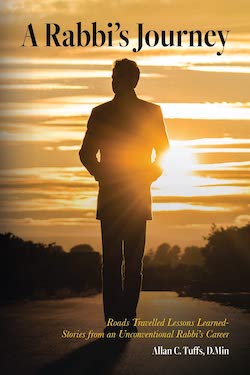
image - A Rabbi’s Journey book coverRabbi Allan Tuffs, who now lives part-time in south Florida and in the Raleigh-Durham area of North Carolina, has published A Rabbi’s Journey: Roads Traveled Lessons Learned – Stories from an Unconventional Rabbi’s Career. The 54 bite-sized chapters (coincidentally, he notes, the same number as parshas in the Torah) range from touching and hilarious to insightful and tragic.

Tuffs was born in Vancouver – he’s 10 days older than the state of Israel – and his home life was tough. His mom had a mental illness and his largely absent father had alcoholism. He and his sister would end up in the foster system.

The bookish, thoughtful Allan devoured everything he could read about Israel (among other topics) and, when he was invited to join the Labour-Zionist youth group Habonim, his life changed and everything else is as result of that connection.

“Habonim was kind of like a family to me, it really was,” he told the Independent in a telephone interview from North Carolina. “The people were warm and inviting and I was looking for my place in the Jewish community.”

Being the product of an intermarriage – “My father was not Jewish, my mother was,” he said – made the young Allan feel like an outsider.

“Intermarriage was still somewhat rare in those days,” he said. “I did not have a real religious background. I guess I was spiritual. I was very proud of my Jewish heritage and Habonim was very Jewish, very Israel-oriented, and it had a deep sense of purpose. It was kibbutz-oriented and there was this idea that the Jewish people had a role in the world, to repair the world, so to speak. That appealed to my youthful idealism.

“We had meetings almost weekly,” he added. “Here we were, these young kids.… I don’t really know if we understood what we were talking about, but we studied some of the great early socialist Zionist thinkers.”

In addition to their interest in Israel, social justice causes closer to home also drove the Habonimniks’ activism.

“We were pretty uniformly against the war in Vietnam,” he said. “We were quite disturbed by the racial injustices happening in the United States and also we were involved in fighting for Indigenous peoples’ rights in Canada. There was this sense that we are going to make the world a better place because we are Jews, because we have this ideology, because we are cognizant of the whole history of being a minority, being persecuted.”

In 1969, Tuffs headed to Israel and lived for two years at Kibbutz Menara, almost flush against the Lebanese border (and, coincidentally, now part of Vancouver’s partnership region in Israel). It was during the War of Attrition and the reality of the conflict was intense. Concentric rows of barbed wire were interspersed with landmines and German shepherd dogs patrolled the perimeter of the kibbutz.

While socialism, not Judaism, was the religion of the kibbutzniks, Tuffs notes in his book that a fortuitous meeting in Jerusalem changed the young man’s path again. Working in the holy city to earn a plane ticket home, he encountered an Orthodox rabbi from Seattle, with whom he began studying Budokan karate and Talmud. Among other things, the mix of eastern and western influences would follow Tuffs through his life. He integrates contemplative and meditative practices into his Judaism and practises yoga.

Returning to North America – and Habonim – Tuffs worked as a counselor at the movement’s camps in Pennsylvania and Washington, D.C.-adjacent Maryland. While in the D.C. suburbs, he started teaching Hebrew at a Conservative synagogue. He was hired for his language skills but the gaping holes in his Jewish knowledge – he never had a bar mitzvah – led his employer to suggest taking a few courses at Baltimore Hebrew College. This was the beginning of “a lifelong love of Jewish learning,” he writes.

Now in his mid-20s, he still wasn’t sure what to do.

“I was scholarly, but I would never be a scholar – too solitary,” he writes. “I was interested in psychology, but the thought of listening to people’s problems five days a week gave me a headache. I’m something of a ‘ham’ but would never be an actor. I’m a do-gooder – hardly a way to make a living.… What profession would allow me to do a little of all these things?”

Turns out the rabbinate fit quite nicely for 40 years. While a child of intermarriage with no early Jewish education might not seem a top candidate for the clergy, fate intervened again. Tuffs’ Hebrew language skills got him a job running a Conservative synagogue youth group in Maryland on the understanding that he would become shomer Shabbat and keep kosher. The job, in fact, put him under the wing of the rabbi and gave him more experience.

“This opportunity amounted to a rabbinic internship,” he writes.

Tuffs spent two years learning the ropes of the rabbinate. He began leading Shabbat services at a local nursing home. In 1977, he entered Hebrew Union College – Jewish Institute of Religion, spending the first year on the Jerusalem campus and four more at the institute’s New York centre.

He experienced “imposter syndrome,” partly because he had only one Jewish parent. But, he concluded, “with such a high frequency of intermarriage these days, who better than a rabbi of mixed parentage to welcome others like himself or herself into the Jewish fold? Suddenly, my rabbinate had renewed significance and purpose.”

In his book, Tuffs reflects the tumultuous and historic times he has lived through. After receiving his ordination, his first convention of the Reform movement’s Central Conference of American Rabbis, in 1983, saw the historic decision to recognize patrilineal descent.

Over the next 40 years, as he shares, he navigated synagogue politics – some comedic, some sad, including a corrupt sisterhood president and an authoritarian, bullying board president. He discusses his decision to officiate at same-sex weddings, his activism on behalf of persecuted Christians in the Middle East, and his congregation’s support of orphans in Haiti.

The tragic collapse of a condominium building in Surfside, Fla., in 2021, hit Tuffs close to home. A young couple whose marriage he had presided at just weeks earlier were killed in the disaster.

The hurricane that devastated parts of Florida and other states in 2005 ravaged his temple. The silver lining was that Tuffs was able to be part of a rebuilding project that made the sanctuary more welcoming, removing the elevated bimah that instilled “an air of un-approachability” for the rabbi and cantor.

Perhaps because he came to the Reform rabbinate with some Conservative movement experience, Tuffs considers himself on the traditional side of Reform. He wears a kippa and dons a tallit when praying, something that was unusual in some American Reform congregations when he started out.

“I embraced the growing trend in the movement toward reintegrating older, discarded ritual practices into religious life,” he writes. “At the same time, I was sold on the Reform idea of personal autonomy in matters of ritual practice.”

He would serve at congregations in Wisconsin and Pennsylvania before spending 25 years at Temple Beth El, in Hollywood, Fla., from which he retired a year ago.

Fate almost brought Tuffs back to Canada before he ever made it to Florida. Desperate to escape the Wisconsin winters, he was invited to consider a position at a synagogue in Ottawa. His mind was made up for him when a congregant enthusiastically offered: “Rabbi, you’ll be able to skate to work on the Rideau Canal four months a year.”

In addition to all else, Tuffs obtained a doctorate in ministry, for which he wrote a dissertation about masculine spirituality, which was published as a book. He was a rabbinic fellow at the Shalom Hartman Institute in Jerusalem for five years and studied at the Institute for Jewish Spirituality.

Reflecting back on his life, Tuffs can’t recall precisely where or how he first connected with Habonim. Everything that came after, though, can be traced back to that early Vancouver connection.

Tuffs’ book is available in ebook format on Amazon, though it is currently not available to order in Canada as a hardcopy.

A yearly reminder to return

Family friends in their 80s just came over to visit. It was perhaps their first time at our house in a year or so. They’ve been busy. They had a family member move back to Winnipeg, there’s been a pandemic and, well, we’ve been busy, too, with kids on summer break, work obligations, visits from relatives, and home renovation.

When they first visited, our new (to us) historic home was empty. While the house had great character, original workmanship and many good points, it also needed a ton of work. We’ve had it all, from asbestos and electricity to plumbing, insulation, and so many other repairs. It didn’t have a single bathroom that worked.

When they walked in today, they said, “Oh wow!  It looks like you’re home!  It looks like you really live here now.” My kids then took our friends on a grand tour. They were amazed and impressed by all that’s happened. They saw such big improvements and wanted to know what we’d done ourselves, what our contractors had completed, and when and how it had happened. It was wonderfully reassuring, and also strange. We hadn’t realized how long it had been.

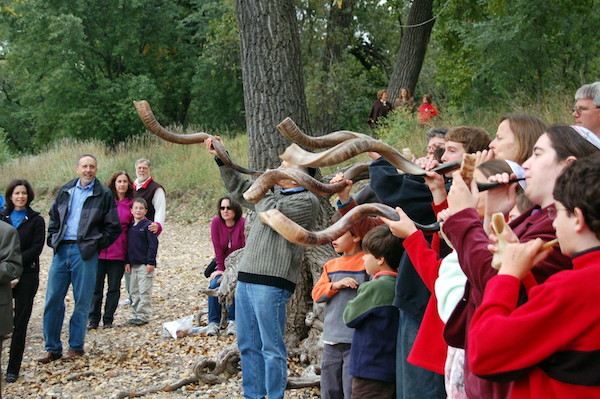
I couldn’t pin down when last they’d visited, even though I looked at the calendar. Then I also noticed that it’s Elul, the Jewish month where we’re supposed to wake ourselves up. We hear the shofar each day if going to morning minyan, a way to remind ourselves that Rosh Hashanah and Yom Kippur are coming. We need to look inward, do teshuvah, which is usually translated into English as repentance. Another way of understanding this word is to read it as return.

I have heard sermons or read things that entreat me, as a Jewish person, to start repenting – it’s time to apologize, repair relationships and become a better person. We need the reminder that repairing relationships and apologizing for things we’ve done wrong is important all the time. It’s also a specific ritual to prepare for the High Holidays.

Even as we enter this teshuvah season, I’m thinking of that other definition, the notion of return. Our household has been working hard to cope, in good humour, through an entire year of living through a house under renovation.

We’re lucky – we have a home! It’s mostly been warm and comfortable. Still, we’re all sleeping in temporary places. I’ve had my clothing “organized” in a laundry hamper for the entire year. We’ve had times with one functional bathroom and no kitchen. During this year, there have been days when getting to my chest of drawers or my oven has been an impossibility. We’ve moved and lost things multiple times. We’ve had days without water or heat. Other times, my kids are going to sleep or practising piano or doing homework with contractors working and making noise in the background.

When I see the house through my friends’ eyes, it’s a huge undertaking. This renovation is, in some ways, helping return this home to its best self. When it’s complete, we will have opened up windows and doors that were closed off for 40-some years or more. Things will be safe, full of warmth, light and air, with electricity that’s up to code and even the installation of a much-needed structural beam.

Seeing this house change through my friends’ eyes made me think about this return concept. When we return to ourselves, and hear our inner voice again, it means several things. Our teshuvah/return helps us be the best we can be. First, perhaps we’ve lost our way, but, as the morning liturgy reminds us, we were created in the divine image. It’s like an old house. We have good bones! Maybe we need to do some upkeep, work to stay up to date. Returning to our best selves might require us to listen, pay attention to our gut feelings, do some renovation.

Also, the teshuvah or returning work might be different from year to year. To make a new year a fresh start, we might well have to return to our core values and strengths, open up disused spaces that had been blocked off in ourselves. Sometimes, we start by apologizing to ourselves, too. We all underestimate how far we’ve come and how much we’ve grown and changed. I know our family is guilty of forgetting how much we’ve dealt with over the last year. Although we do remind each other of the changes we’ve experienced, change feels like the only constant right now, as walls move, windows and doors are repaired, and the light comes in again. Through this, we never know which piece of furniture will need moving or what we’ll have to clean (again) because of construction dust.

It’s also about being grateful. Having a kitchen to cook in this summer has been a celebration. How lucky it is to have all this garden produce and to have a place to cook it in. So many don’t have a kitchen or a garden. Maybe they lost it to fire or a bombing. Every day, I feel grateful even as I’m exhausted by my new garden’s potential zucchini and squash crop.

This return work must be grounded in a bigger reality. More than one person has remarked to me that they couldn’t do what we’re doing. In context, though, I’m not sure it’s such a big deal to renovate an old house. People are fleeing wildfires, losing their homes and families, and suffering from war, famine and disease across the world. Living in the middle of a renovation doesn’t feel like too much. It’s a privilege to have a home and have the resources to undertake this repair.

When I’m considering my gut feelings, I know I have high (perhaps unreasonable) expectations of myself and others. I suspect others may approach self-improvement this way, too. Perhaps the biggest teshuvah is remembering that we return to ourselves, while understanding that others might be elsewhere on this path … and that’s OK. Wishing you everything good as we begin 5784!

Joanne Seiff has written regularly for CBC Manitoba and various Jewish publications. She is the author of three books, including From the Outside In: Jewish Post Columns 2015-2016, a collection of essays available for digital download or as a paperback from Amazon. Check her out on Instagram @yrnspinner or at joanneseiff.blogspot.com.

Teshuvah: a guide to repentance

Twelfth-century Jewish thinker Moses Maimonides described the sound of the shofar at Rosh Hashanah as a wake-up call for the soul. (photo from flickr.com/photos/gsankary)

The sound of the shofar at Rosh Hashanah, the great 12th-century Jewish thinker Moses Maimonides wrote, is a wake-up call for the soul. Its message: “Arise from your slumber! Search your ways and return in teshuvah and remember your Creator!”

Teshuvah is the central theme of the time between Rosh Hashanah and Yom Kippur, known collectively as the Ten Days of Teshuvah. Typically, teshuvah is translated from the Hebrew as repentance, but it literally means return, as if turning back to something you’ve strayed or looked away from. But that begs the question: return to what? Depending on the time and place, there have been different answers – God, a state of moral purity, the Jewish people and Israel.

The Jewish Experience at Brandeis University asked Near Eastern and Judaic studies professor Yehudah Mirsky about the history of teshuvah. Mirsky, who is also a faculty member of the Schusterman Centre for Israel Studies, is the author of Rav Kook: Mystic in a Time of Revolution (Yale University Press).

Ancient Teshuvah

The Hebrew Bible sees teshuvah as principally a return to God. “Come, let us return to the Lord,” the prophet Hoshea (14:2) tells the people of Israel.

In Psalm 51, King David seeks teshuvah for committing adultery with Bathsheba. Importantly, David’s confession is addressed to God because, as he says, “Against You alone have I sinned.”

Traditional rabbinical commentators have interpreted this to mean that teshuvah requires confessing your sins to God. Part of achieving intimacy with Him involves His knowing your sins. And only in that way can you return to Him.

Talmudic teshuvah

For centuries after the destruction by Rome in 70 CE of Jerusalem’s ancient temple, where Jews would say confession and offer sacrifices for atonement, the rabbis reworked biblical ideas and practices of teshuvah into a roadmap for spiritual and moral growth.

In the Mishnah and the Talmud, the vast collections of law, theology, interpretation, folklore and more compiled roughly between 200 and 500 CE, they called for introspection, changing one’s ways, and asking others for forgiveness.

This line of thinking reached its apotheosis in Maimonides’ Hilkhot Teshuvah (The Laws of Return). He placed confession and regret at the centre of repentance so that teshuvah, according to Mirsky, became a process of “moral and spiritual self-cultivation and self-education.”

Teshuvah was no mechanical act. It had to involve genuine contrition and the individual becoming a better person. In addition to being a scholar, philosopher, jurist and communal leader, Maimonides was also a physician.

“One senses his medical sensibility was at work here, too,” said Mirsky. “Transgression sickened the soul and teshuvah is the cure, a return to full spiritual and moral health.”

Cosmic teshuvah

Already during the talmudic period, rabbis had begun talking about teshuvah as a spiritual energy flowing through the universe that was created by God when He made the earth.

The medieval mystics who wrote the great texts of the kabbalah took this even further. They said teshuvah comes not only from inside the individual but is also a dynamic force all around us. To repent, you tap into it. As Mirsky put it, “You catch the wave.”

In the 13th-century Zohar, the foundational work of Jewish mysticism, teshuvah became a way of repairing a rupture or tear in the spiritual fabric of the universe. When the varying energies at work in the world – justice and mercy, male and female, tradition and change – go out of whack, teshuvah helps to rebalance them. In other mystical texts, return is seen as a kind of rebirth and the achievement of the soul’s deepest freedom.

Some 300 years later, Rabbi Isaac Luria, the great mystic of Safed in northern Israel, famously connected teshuvah with tikkun olam (healing the world). Through teshuvah, Jews perfect God’s work, helping usher in the Messianic Age.

For Luria, this largely meant a kind of spiritual healing. But, over time, and especially in the last century, Jews have begun to connect this to ideas of social justice, adding another layer of interpretation to Jewish messianic ideals.

Teshuvah and Israel

In Mirsky’s view, the Zionist movement secularized and redefined teshuvah.

Political passivity, which the rabbis thought was anathema to the survival of the Jewish people, was now considered a sin. Repenting involved identifying with the nationalist yearnings of the Jewish people for a homeland. In this way, teshuvah returned Jews in the diaspora to Israel, and the Jews as a whole to a more vital sense of group identity.

Kook’s teshuvah

Past and present interpretations of teshuvah came together in the work of Abraham Isaac Kook, the first Ashkenazi chief rabbi of modern Palestine and the leading thinker of religious Zionism. To him, all existence is rooted in God and seeks to return to God. That return takes the form of religious practice, social and ethical commitment, art and culture – everything we consciously do to make the world better for the Jewish people and ultimately all of humanity. And, all of these elements – the ritual and ethical, material and intellectual, the Jewish and universal – all need one another to do God’s work in the world. (For more on Kook, see Mirsky’s book.)

American teshuvah

Teshuvah in the United States reflects the inescapable individualism of American life. The great American Jewish thinker Abraham Joshua Heschel linked teshuvah to the nation’s ethos of spiritual growth and renewal. He wrote:

“The sense of inadequacy ought to be at the very centre of the day [Yom Kippur].…  To put contrition another way, develop a sense of embarrassment.… We have no answer to ultimate problems. We really don’t know. In this not knowing, in this sense of embarrassment, lies the key to opening the wells of creativity.

One belief all Jewish thinkers share about teshuvah – the process only begins during the High Holidays. It’s afterward when the real work begins.

For more on teshuvah during the Middle Ages, see Mirsky’s article, “How a lover of wisdom returns” in Sources Journal (sourcesjournal.org/articles/how-a-lover-of-wisdom-returns).

– from the Jewish Experience / Brandeis University

Shattering complacency

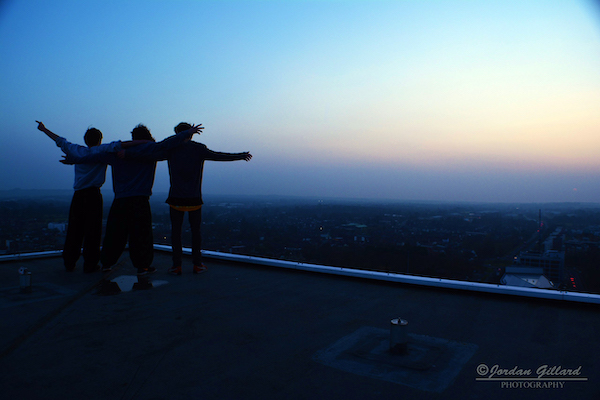
The existential themes of the High Holidays are meant to create a sensitivity and appreciation of the precious significance of everyday existence. (Jordan Gillard Photography)

The themes of death and the “thinness” of human existence recur in the liturgy of Rosh Hashanah and Yom Kippur and during the entire period, beginning with the month of Elul. This is not because of a morbid desire to undermine human confidence and autonomy or to shock us into fearing God out of a sense of helplessness and sin. The existential themes of the High Holidays are meant to create a sensitivity and appreciation of the precious significance of everyday existence.

Existentialists spoke about confronting one’s mortality as a necessary condition for achieving human authenticity. Although a preoccupation with death can create nihilism and a paralyzing sense of the futility of human initiative, nevertheless, the Jewish tradition believed that the themes of human mortality and finitude could be integrated into a constructive and life-affirming vision of life.

The language of the Rosh Hashanah and Yom Kippur prayers, such as the explicit enumeration of the different ways that a human life can be destroyed, is not meant to terrorize us into self-negating submission. The stark, evocative imagery of the liturgy is aimed primarily at shattering complacency. The impact of this experience can be life-affirming insofar as it serves as a catalyst in a process of self-creation and moral renewal.

Focusing on human mortality and the contingencies that wreak havoc upon human lives heightens our sensitivity to the deadening effects of habit and routine. People often deceive themselves into believing that they can successfully defer living the kind of lives they consider worthwhile until some future time. While not questioning the importance of reflecting on the meaning of one’s life, they believe they can postpone dealing with this issue.

“Why become confused and troubled by the meaning of my life now? I can deal with it later, when I retire, when economic realities are more favourable, when I will be free of parental responsibilities.…” This attitude is naïve and self-deceptive because it ignores the real consequences of present patterns of behaviour and learning that can weaken and that ultimately extinguishes one’s natural capacity to live life deeply and seriously.

Another theme of Yom Kippur, teshuvah, is expressed in the call to return, to renew, to re-create one’s self, and in the appeal for divine forgiveness and atonement, in the recitation of “for the sin we have sinned …” and other confessional sections of the liturgy. The essence of teshuvah – the crucial principle without which this concept would be empty of meaning – is the belief that the past need not define the future. A person can break the causal chain of habit and defy the seeming necessity of repetition that suffocates spontaneity and the joy of life.

The call to teshuvah, therefore, is expressed not only in the plea to God for forgiveness and in the affirmation of God’s gracious love and reluctance to mete out punishment and retribution, but also, and most poignantly, in the repeated attempts at convincing the individual to believe in the possibility of change. The personal significance of Yom Kippur ultimately turns on the individual’s ability to believe that his or her life can be different. The major obstacle to teshuvah is not whether God will forgive us but whether we can forgive ourselves – whether we can believe in our own ability to change the direction of our lives, even minimally.

Teshuvah is grounded in the idea of an open future, in the belief that the possibilities for human change have not been exhausted, that the final chapters of our personal narratives have not yet been written. The sense of empowerment felt on Yom Kippur reflects an underlying faith in the power of the human will to break the fixed cycles of the past and to chart new possibilities for the future.

Many scholars who take issue with translating God’s name, ehyeh asher ehyeh, which was revealed to Moses at the burning bush as “I am that I am,” insist on emphasizing the future orientation of the verb ehyeh, “I will be.” For many, the Jewish concept of God must convey the idea of newness – of new spiritual possibilities in the future, of new ways of understanding and of relating to God. To sense the presence of God in one’s life is to believe in the possibility of radical surprise and of genuine human change.

Communal forms of worship must not be allowed to degenerate into automated, mind-numbing exercises in herd conformity. Our rabbis taught that, although Jews stood as a people at Mt. Sinai, each individual personally appropriated the word of God. We must not be intimidated by the High Holiday prayer book. Although we share a common liturgy, we must be capable of appropriating its significance in terms of our individual lives and concerns. Rosh Hashanah and Yom Kippur challenge us to discover the meaning of personal authenticity and self-renewal within the context of community.

Rabbi Prof. David Hartman (1931-2013) was founder of the Shalom Hartman Institute. This article was first published in September 2009. Articles by Hartman, z”l, and other institute scholars can be found at shalomhartman.org.

Rosh Hashanah table talk

In his diaries, Franz Kafka reflected that our not knowing “the real highway” we’re on means that “we drift in doubt. But, also in an unbelievable, beautiful diversity. Thus, the accomplishment of hopes remains an always unexpected miracle.” (photo from Piotr Malecki)

The Chassidic Rebbe Haim of Tzanz told this parable: A person had been wandering about in the forest for several days, unable to find a way out. Finally, in the distance, he saw another person approaching him, and his heart filled with joy. He thought to himself: “Now, surely, I shall find a way out of the forest.” When they neared each other, he asked the other person, “Brother, will you please tell me the way out of the forest?”

The other replied: “Brother, I also do not know the way out, for I, too, have been wandering about here for many days. But, this much I can tell you. Do not go the way I have gone, for I know that is not the way. Now come, let us search for the way out together.” (Adapted from S.Y. Agnon, The Days of Awe)

Perhaps this is a story to read at your Rosh Hashanah table, to start a discussion about your – and your guests’ – hopes for new direction in life. Think about a new path you would like to explore this coming year, or let others know about an old path you have tried that they might best avoid.

In his diaries, Franz Kafka, the 20th-century Czech Jewish writer, reflected on the difficulty of finding our way and yet our eternal hope:

“If we knew we were on the right road, having to leave it would mean endless despair. But we are on a road that only leads to a second one and then to a third one and so forth. And the real highway will not be sighted for a long, long time, perhaps never. So, we drift in doubt. But, also in an unbelievable, beautiful diversity. Thus, the accomplishment of hopes remains an always unexpected miracle. But, in compensation, the miracle remains forever possible.”

The poet and Bible scholar Joel Rosenberg speaks of Rosh Hashanah as a homecoming, rather than as journeying:

“The Hebrew word for year – shana – means change. But its sense is two-fold: on the one hand, change of cycle, repetition (Hebrew, l’shanot, reiterate, from sh’naim, two), but, on the other hand, it means difference (as in the [the Pesach seder when we ask] mah nishtana? How is this night different?) We are the same, we are different. We repeat, we learn, we recapitulate. We encounter something new. ‘Shana tova!’ means, ‘Have a good change!’”

And yet, how familiar is this time! The chant, the faces, the dressed-up mood, the calling on the same God, the words, the blessings, the bread, the apples, the honey, the wine – all are the same, and yet completely new. We meet ourselves again and for the first time.

A year that begins anew is also the fruit of the year that preceded. Good or bad, it has made us wiser. It will not constrain us. We choose from it what we want and need like gifts we brought from journeys. Rosh Hashanah is always like coming home – just as Pesach was always going on a journey.

“How do we find our Divine Parent who is in Heaven? How do we find our Parent who is in Heaven? By good deeds and the study of Torah.

“How does the Blessed Holy One find us – through love, through brotherhood, through respect, through companionship, through truth, through peace, through bending the knee, through humility, through more study, through less commerce, through the personal service to our teachers, through discussion among the students, through a good heart, through decency, through No that is really No, and through Yes that is really Yes.” (Midrash Seder Eliyahu Rabbah 23)

Noam Zion is a senior fellow emeritus of the Kogod Research Centre at the Shalom Hartman Institute. He has developed study guides on Bible, holidays and rabbinic ethics. His publications and worldwide lectures have focused on “homemade Judaism” – empowering families to create their own pluralistic Judaism. This article was originally published in 2014; it is adapted from his Rosh Hashanah seder. Articles by Zion and other Hartman Institute scholars can be found at shalomhartman.org.

VHA’s new principal

“Children want to be heard and validated for what makes them unique at all ages, just like us adults. The old adage that children should be seen and not heard is exactly the opposite of what we need from kids today,” Ellia Belson told the Independent.

photo - Ellia Belson, principal of Vancouver Hebrew Academy
Ellia Belson, principal of Vancouver Hebrew Academy (photo from Ellia Belson)

Belson is the new principal of Vancouver Hebrew Academy. She comes to VHA from King David High School, where she was the director of Jewish life, and has also taught at Vancouver Talmud Torah. “The experience gives me insight into the learning process and what motivates children to learn at different stages of their lives,” she said. “While a child in Grade 2 will be motivated by classroom activities, by the time they are 11, they are already starting to differentiate themselves from their parents and looking for ways to express their individuality.”

Belson takes over from the team of Ian Mills, Shannon Brody and Rivki Yeshayahu, who supported VHA while the school “looked for a principal who can lead an Orthodox Jewish school in such a unique city as Vancouver,” said Leslie Kowarsky, VHA board president. Prior to this trio, Rabbi Barak Cohen was principal for a year, after having taken the helm from Rabbi Don Pacht, who served as the school’s head for 17 years.

“We are thrilled to have secured Ellia Belson as our new principal,” said Kowarsky, noting that Belson has a master’s in special education from the University of British Columbia. Belson attained her teacher certification and bachelor’s from Simon Fraser University, and her resumé also includes Judaic studies for teachers from Bais Rivkah Seminary and Touro College in New York and Hebrew University in Israel, as well as other education training. In addition, she has more than 10 years’ experience at Energex Energy Management Systems Inc., a company started by her husband Rami.

“She is a Vancouver native, and many of our families remember fondly that her father, Sol Pavony, was himself the founding principal of what was then Vancouver Torah Academy,” said Kowarsky. “Mrs. Belson is already hard at work and is available to any prospective parents seeking an Orthodox Jewish education for their child.”

Belson’s education philosophy is focused on student-centred and inclusive learning.

“Students need multiple modes of learning to stay engaged and motivated. By providing students with multiple avenues to the curriculum and by offering choices, students feel a sense of control over their learning,” she explained. “For instance, a student might choose to read a storybook, a news article or a Gemara text to express their analysis on how one’s actions will have consequences. Then, they might choose to express this through writing, art or a PowerPoint. By recognizing a child’s individual learning style and offering different ways to access the information, you can provide opportunities for enrichment and academic achievement.”

For the coming year, Belson said the focus will be “on increasing our school spirit and joy for learning. We will be offering a new Judaic curriculum for Hebrew and Torah learning. We will be implementing a social-emotional program for all the classrooms, with opportunities for teacher growth through additional professional development. In addition, classes will enjoy extra teacher supports for those who need it.

“We want to emphasize the positives of our Judaism through experiential learning while keeping parents in the loop with consistent streams of communication coming home,” she said. “Our view is that a child’s academic and social learning happens as a team, which includes parents, students and teachers. We need to work together to reach our goals.”

VHA is also working towards expanding its existing daycare to open spots for infants and toddlers, “as there is a huge demand,” she added.

Belson’s ties to VHA are many. As Kowarsky noted, Belson’s father was the first principal of VHA’s predecessor, Torah Academy, which was started under the auspices of Rabbi Yitzchok Wineberg, head of Chabad Lubavitch BC.

About that family connection, Belson said, “It is an incredible feeling of responsibility to our VHA community. He was my mentor in every way and my inspiration for what a person should be. Humble, wise, attentive, full of love for every person – he was a true educator and authentic to his beliefs.”

While Belson herself was too old to attend VHA by the time it started – she attended VTT as a child – all four of her kids attended VHA.

“Each of our Jewish schools has a lot to offer our children and each has its own emphasis and values,” she said. “At VHA, the feeling is for living a Jewish life that is accepting of who you are no matter where you come from, your socioeconomic status or your level of religiousness. At VHA, the emphasis is on being your best self, with kindness to others and a cultivating a strong Jewish identity. Having a place to be accepted, whether Orthodox or not, was very important to me then and now.

“VHA has historically been a school known for its academic excellence and many of its alumni are, today, successful doctors, lawyers, teachers and rabbis. I took on this position,” she said, because “having no Orthodox school for our children would have far-reaching consequences to our wider Vancouver Jewish community.”

Belson concluded, “I’m excited and positive about contributing to VHA’s sense of excitement for learning. I think we have a bright future and an opportunity to implement modern teaching strategies within our ancient traditions.”