
Mikvah at Chabad now open

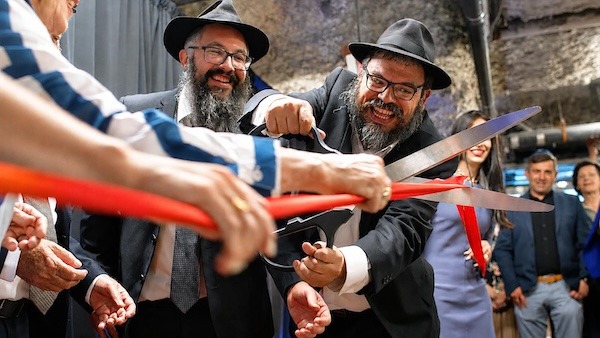
Rabbi Dovid Rosenfeld, left, and Rabbi Yechiel Oirechman cut the ribbon at the July 6 dedication of the newly completed Mikvah of Chabad. (photo by Lior Noyman)

Metro Vancouver Jewish community members gathered July 6 at Chabad Lubavitch of British Columbia to dedicate the Mikvah at Chabad, a new ritual bath that will serve Jewish women and families throughout the region. The evening marked the completion of a project first envisioned by Rabbi Yitzchok and Henia Wineberg, founders of Chabad Lubavitch of BC, when the Chabad centre on Oak Street was built more than 25 years ago.

A mikvah has long been considered one of the foundations of a Jewish community. While often associated with the laws of taharat hamishpacha (family purity), a mikvah is also connected with other moments in Jewish life, including preparation for marriage and conversion. As Vancouver’s Jewish community has continued to grow, the need for additional mikvah resources has grown as well. The Mikvah at Chabad represents an expansion of the community’s ability to support women in fulfiling this mitzvah. It builds on the foundation established by those who have been serving mikvah needs for years: Congregation Schara Tzedeck and the Bayit.

The dedication of Rabbi Dovid and Chaya Rosenfeld, together with many others, brought the Mikvah at Chabad project to completion. While the mikvah received support from individuals and organizations beyond Vancouver, most of the funding, both for the construction and the ongoing needs of the mikvah, has been raised locally, reflecting the commitment and generosity of Vancouver’s Jewish community.

The dedication ceremony took place shortly before Parshat Masei, which recounts the 42 journeys of the Jewish people through the wilderness. Rabbi Rosenfeld reflected on the connection between those journeys and the long path toward completing the mikvah.

“There were many miracles that led to this moment,” said Rosenfeld, sharing the personal journey that ultimately brought the project across the finish line. Last Simchat Torah, Rosenfeld made a public commitment that the mikvah would be completed during the coming year.

“Nobody believed me,” he recalled with a smile. “I didn’t even believe, myself!”

Several weeks later, while attending the International Kinus Hashluchim in New York, Rosenfeld visited the Ohel, the resting place of the Lubavitcher Rebbe, Rabbi Menachem M. Schneerson, of righteous memory. There, Rosenfeld wrote of his commitment and asked for assistance in making the vision a reality.

Soon afterward, an unexpected chain of events led him to Rabbi David Darli of Israel, whose encouragement provided the momentum to complete the project. Rosenfeld described the experience as a moment of renewed confidence and inspiration.

“I felt right there that the Rebbe was telling me, ‘You can do it,’” he said.
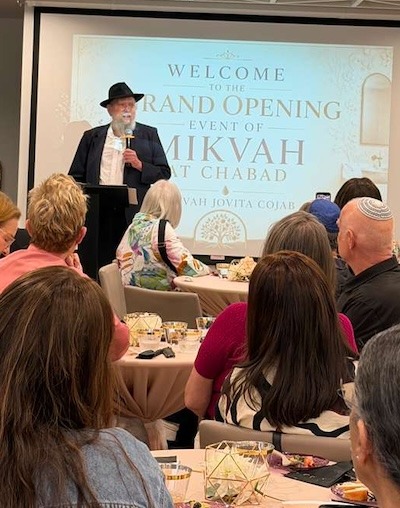
photo - Rabbi Yitzchok Wineberg speaks about seeing the 25-year-old dream of a new mikvah become reality
Rabbi Yitzchok Wineberg speaks about seeing the 25-year-old dream of a new mikvah become reality. (photo by Lior Noyman)

The July 6 evening featured reflections from Rabbi Wineberg, who spoke about seeing a dream he had envisioned decades earlier finally materialize. Riki Oirechman, who helped oversee the design of the mikvah, discussed the many people and details that came together to create the finished facility. Amanda Aron Chimanovitch shared her personal connection to mikvah and its role in Jewish life.

One of the night’s most personal presentations came from Chaya Rosenfeld, who spoke about why the mitzvah of mikvah continues to hold deep meaning for Jewish women and families.

“Every month, your marriage starts again,” she said. “The wisdom built into this mitzvah reminds us not to take each other for granted.”

She explained that mikvah creates a powerful connection: to one’s spouse, to God and to generations of Jewish women who came before.

“It connects me to my husband, it connects me to Hashem and it connects me to generations of Jewish women who came before us,” she said, emphasizing that taharat hamishpacha is not only an individual mitzvah but one of the foundations of Jewish continuity.
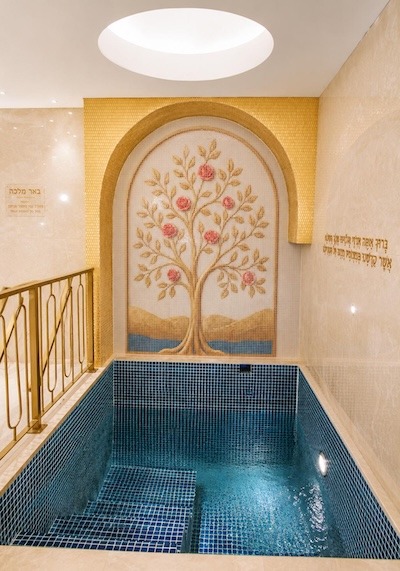
photo - The Mikvah of Chabad was designed to create a peaceful and welcoming environment
The Mikvah of Chabad was designed to create a peaceful and welcoming environment. (photo by Lior Noyman)

“A community can exist without a synagogue or even a Torah scroll,” she said, “but these mitzvot cannot be observed without a mikvah. That is why a mikvah is so essential.”

She expressed the hope that the Mikvah at Chabad will become a place where Jewish women can prepare for weddings, strengthen their marriages and deepen their connection to Judaism in an atmosphere of warmth, comfort and dignity.

Following the speeches, guests gathered for the official dedication, including the ribbon-cutting ceremony and the affixing of the mezuzah. They then toured the new facility, which features heated floors and spaces designed to create a peaceful and welcoming environment. Throughout the building, plaques recognize the many families and individuals whose generosity helped make the project possible.

The dedication came just weeks before Chabad Lubavitch of BC hosts the annual BC Kinus Hashluchim, which brings together Chabad rabbis and rebbetzins from communities throughout the province. The gathering provides an opportunity for Chabad emissaries to connect, collaborate and share ideas as they reflect on the needs of their communities and discuss how they can continue to strengthen Jewish life throughout British Columbia.

The timing of the Kinus reflects a broader story taking place across the province: the continued growth and expansion of Jewish life in communities large and small. Over the past year alone, new Chabad centres have been established serving the North Shore, the Sea-to-Sky corridor and the University of Victoria community. These initiatives join the network of Chabad centres already serving Vancouver, Richmond, the Tri-Cities, the Fraser Valley, Vancouver Island and the Okanagan.

For Rabbi Rosenfeld, the purpose of the BC Kinus is not only to celebrate what has been accomplished, but to look ahead – to ask how Chabad can continue to strengthen existing communities and reach Jews in places where new opportunities and needs are emerging.

“The idea is that no matter who you are or where you end up, Chabad is there for you,” he said. 

To find out more about the Mikvah at Chabad or Chabad in your local community, email info@lubavitchbc.com. 

David J. Litvak is a prairie refugee from the North End of Winnipeg who is a freelance writer and publicist, and a mashgiach at Louis Brier Home and Hospital. His articles have been published in the Forward, Globe and Mail and Seattle Post-Intelligencer. His website is cascadiapublicity.com.
The traveling Hebrew school

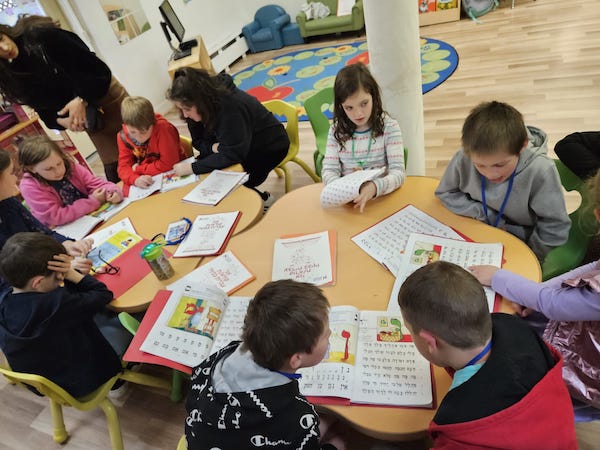
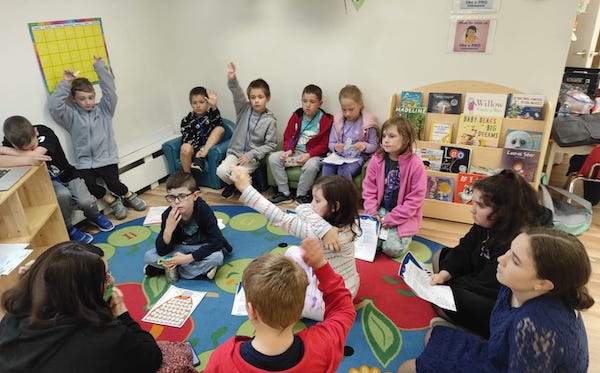
B.C. Regional Hebrew Schools currently serves more than 120 children – in Langley, Port Coquitlam, Vancouver and Whistler/Squamish. (photo from B.C. Regional Hebrew Schools)

It’s late Monday evening when Rabbi Dovid Rosenfeld loads a half dozen plastic containers of canvases, crayons, crafts and children’s Hebrew workbooks into his minivan. As directors of British Columbia Regional Hebrew Schools, he and his wife Chaya make the two-hour-long commute between Vancouver and Whistler every week so that Hebrew school parents don’t have to. “We’re the only ones crazy enough to do this,” he laughed.

When Erin Silverstein moved to Whistler from Ontario a few years ago with three children under 10, the village boasted one of North America’s largest ski resorts, glacier-capped peaks and exceptional mountain biking trails – but no Jewish community.

“Our biggest concern was that there weren’t other Jewish families and our children wouldn’t receive a Jewish education,” Silverstein said.

With Vancouver’s skyrocketing cost of living, many families have moved far beyond the city limits to small towns and suburbs. While running a summer camp and Hebrew school for Chabad Lubavitch of British Columbia in Vancouver, Rabbi Rosenfeld met families who’d left the city but returned for camp each year.

“They’d ask me, What can we do for a bat mitzvah? How can we keep our children Jewishly engaged?” he said. “Jewish families kept moving to the outlying areas but lacked access to basic Jewish resources.”

Then, in 2018, the Rosenfelds met a former Hebrew school teacher from Langley, some 50 kilometres southeast of Vancouver, and offered to fill the vacancy she left at a weekly Hebrew program for 18 local children. When the rabbi walked into the Langley program sporting a beard and a fedora, three families walked out. Six months later, they were all back.

“I think those families who stayed saw their children having positive Jewish experiences, making Jewish friends, and connecting to their traditions; they must have passed on the message,” Rabbi Rosenfeld said.

Dovid and Chaya Rosenfeld and an ever-expanding team of teachers and volunteers pack up the B.C. Regional Hebrew Schools program week after week and bring it to rented classrooms in remote communities.

“At every location, there are dozens of moving parts to keep in mind,” Chaya Rosenfeld said. “It’s immensely gratifying when the program comes together.”

photo - Rabbi Dovid and Chaya Rosenfeld and an ever-expanding team of teachers and volunteers pack up the B.C. Regional Hebrew Schools program week after week and bring it to rented classrooms in remote communities
Rabbi Dovid and Chaya Rosenfeld and an ever-expanding team of teachers and volunteers pack up the B.C. Regional Hebrew Schools program week after week and bring it to rented classrooms in remote communities.(photo from B.C. Regional Hebrew Schools)

Today, their traveling classroom serves 25 children in Langley, 50 children in Port Coquitlam, 25 children in central Vancouver and 22 children in Whistler and neighbouring Squamish – more than 120 children in all. Chaya Rosenfeld has often found that Jewish families who had lived alongside one another for years met for the first time when their children joined Hebrew school.

“There had never been any centre for the Jewish community in these towns, so we saw whole communities come together for the first time,” she said. Within three years of opening their program in Port Coquitlam, the parents and grandparents they’d met there asked for a permanent home for their community.

In November 2022, Rabbi Mottel and Nechama Gurevitz opened Chabad of Coquitlam to serve the growing community. “It started with Hebrew school, but it’s become a real community,” Rabbi Gurevitz said. Already, the couple hosts Shabbat meals for 40 local Jews and a weekly Torah class alongside the Hebrew school.

Since the opening of the Whistler location, a group of parents has asked Rabbi Rosenfeld for a weekly Torah class of their own, and many are eager to volunteer, creating a centre of Jewish community life in the once-Jewishly-isolated town.

The parent body is as diverse as Canadian Jewry at all four locations. Yet, they share a common desire to share elements of their Jewish identity with the next generation.

“We were so excited when the Hebrew school opened here,” said Julie Persofsky, whose three children attended the Whistler location this past year. “All of a sudden, our kids are getting a Jewish education alongside peers their age; it’s been wonderful.”

Like other parents here, Persofsky is delighted to see her children look forward to Hebrew school, learn Hebrew and deepen their Jewish knowledge. “It’s incredible to see them come home with crafts they’ve made, and they’re able to share their own ideas when we practise our Jewish traditions,” she said. “At the seder table this year, they all used seder plates they made in school – that was meaningful for them.”

Dan Anolik, who moved to Squamish with his wife and young daughter shortly before the 2022-2023 school year, is grateful that his child has Jewish friends.

“Moving here was tough for my daughter,” he said. “She didn’t know other Jewish kids here; she felt like the only Jew in town. When she first stepped into the Hebrew school classroom, she saw the morah teaching and doing crafts, it looked familiar, and it was like a load came off her. She jumped right in, and all three of us shed a little tear of joy.”

Moments like these make supporting B.C. Regional Hebrew Schools a source of pride for Vancouver-based philanthropist Steven Silber, a trustee of the Arnold and Anita Silber Family Foundation. “When you see the children’s faces when they’re in their classrooms, you realize it’s a blessing everyone should get to experience,” said Silber.

To find out more about B.C. Regional Hebrew Schools or to become a supporter, contact Rabbi Dovid and Chaya Rosenfeld at info@lubavitchbc.com or 604-266-1313.

– Courtesy B.C. Regional Hebrew Schools