Skip to content
  • Home
  • Subscribe / donate
  • Events calendar
  • News
    • Local
    • National
    • Israel
    • World
    • עניין בחדשות
      A roundup of news in Canada and further afield, in Hebrew.
  • Opinion
    • From the JI
    • Op-Ed
  • Arts & Culture
    • Performing Arts
    • Music
    • Books
    • Visual Arts
    • TV & Film
  • Life
    • Celebrating the Holidays
    • Travel
    • The Daily Snooze
      Cartoons by Jacob Samuel
    • Mystery Photo
      Help the JI and JMABC fill in the gaps in our archives.
  • Community Links
    • Organizations, Etc.
    • Other News Sources & Blogs
    • Business Directory
  • FAQ
  • JI Chai Celebration
  • JI@88! video

Recent Posts

  • Sharing her testimony
  • Fall fight takes leap forward
  • The balancing of rights
  • Multiple Tony n’ Tina roles
  • Stories of trauma, resilience
  • Celebrate our culture
  • A responsibility to help
  • What wellness means at JCC
  • Together in mourning
  • Downhill after Trump?
  • Birth control even easier now
  • Eco-Sisters mentorship
  • Unexpected discoveries
  • Study’s results hopeful
  • Bad behaviour affects us all
  • Thankful for the police
  • UBC needs a wake-up call
  • Recalling a shining star
  • Sleep well …
  • BGU fosters startup culture
  • Photography and glass
  • Is it the end of an era?
  • Taking life a step at a time
  • Nakba exhibit biased
  • Film festival starts next week
  • Musical with heart and soul
  • Rabbi marks 13 years
  • Keeper of VTT’s history
  • Gala fêtes Infeld’s 20th
  • Building JWest together
  • Challah Mom comes to Vancouver
  • What to do about media bias
  • Education offers hope
  • Remembrance – a moral act
  • What makes us human
  • המלחמות של נתניהו וטראמפ

Archives

Follow @JewishIndie
image - The CJN - Visit Us Banner - 300x600 - 101625

Tag: Jewish life

Many reasons for optimism

Many reasons for optimism

Given two recent murderous attacks on American synagogues, combined with terrorist missiles from Gaza landing throughout southern and central Israel, it is easy and understandable to be pessimistic. But a new study on Jews in Canada is jam-packed with reasons for optimism.

The report 2018 Survey of Jews in Canada was released recently. Produced by the Environics Institute for Survey Research, the University of Toronto and York University, the study was funded by Federation CJA and other Jewish communal organizations. To those who have followed these subjects closely, the data are not completely surprising but, brought together in a single document, it is quite a compendium of encouragement.

Inspired by a groundbreaking 2013 Pew Research Centre study on American Jewry, the report assesses a wide range of factors, including the importance of Jewishness in the lives of respondents, how they define that identity, membership in synagogues and Jewish organizations, financial support for Jewish causes, candlelighting and other religious observances, intermarriage, experiences with discrimination, connections to Israel, dedication to repairing the world, migration patterns and even federal political party support.

image - 2018 Survey of Jews in Canada coverPerhaps because of its inspiration in the American example, the study routinely compares Canadian findings with the situation to the south. This is fair, given the useful contrasts it provides – and it is especially illuminating to see that many of the differences between the Jewish communities in the two countries paint a very positive picture of the Canadian situation.

Only half of American Jews have made a financial donation to a Jewish organization or cause, compared with 80% of Canadian Jews.

Canadian Jewish kids are twice as likely to attend a Jewish day school or yeshivah and a greater proportion of Canadian Jews have attended Sunday school, Hebrew school or an overnight Jewish summer camp. The number of Canadian Jews who are bar or bat mitzvah is higher than that of Americans – 60% versus 50%. Intermarriage rates in the United States are about 50%, compared with 23% in Canada.

Canadian Jews have a much stronger connection to Israel than American Jews, with twice the likelihood of having visited the country. Nevertheless, Canadians and Americans “are similarly divided in their opinions about the political situation in Israel,” according to the report.

Rudimentary Hebrew is common among the vast majority of Canadian Jews, with 75% saying they know the aleph-bet and 40% claiming to be able to have a conversation in the language. Among the groups with the greatest proficiency in Hebrew are those under 30 years of age. These numbers are significantly higher than those of our American cousins.

Among Jewish Canadians, 64% say that being Jewish is very important in their lives, compared with 46% of Americans, while only 8% of Canadian Jews say being Jewish is not very, or not at all, important, compared with 20% of American Jews.

An astonishing 80% of Canadian Jews (or, at least, respondents to the survey) indicate an educational attainment of a bachelor’s degree or higher, compared with 29% of the general population. Similar findings two decades ago led to a major investment by Jewish communal bodies in youth-serving agencies like Hillel, which was seen as the last, best hope for reaching unaffiliated young Jews. As these numbers suggest, while many other aspects of Jewish identity may be discarded or de-emphasized, the commitment to education is among the most effectively transmitted values from generation to generation.

Among Canadian Jews, 47% belong to a Jewish communal organization other than a synagogue, compared with 18% for Jewish Americans. (In Winnipeg, this number is 57%, which helps explain why that comparatively small Jewish community is so impressively active.)

The report does not provide definitive explanations for the differences, though different factors are suggested to play a role in various scenarios. If we were to posit an overarching theory about the differences between American and Canadian Jews, it would go back to the 20th century’s very different experiences. The Canadian Jewish community was massively influenced by postwar immigration, including survivors of the Holocaust. These newcomers remade the Canadian Jewish community, to some extent, in their own image. The American Jewish community, in comparison, was already strong and had well-developed infrastructures before the

influx of survivors and other immigrants after 1945. As the report indicates, Canada also has a different approach to multiple identities, with multiculturalism being officially celebrated, whereas the American trend is to downplay difference and assume a unified Americanism.

Of course, there is no prize for being “better” Jews than our fellows from another country – even if it does satisfy our innate Canadian need to differentiate ourselves from Americans. Nonetheless, in a world with so many challenges, where is the harm in celebrating good news?

Jewish people worldwide are in a time of challenge and change. Many European Jews are questioning their futures there, and communities in Latin America, Africa and Asia are experiencing a range of external and internal challenges, including changing relationships with Israel and with the rest of the Diaspora. Some of the factors that account for the positive news in the recent report are distinctively Canadian and cannot be replicated. But the study deserves a closer look by all Diaspora Jewish communities to see if there are successes that could be replicated elsewhere. We sometimes like to flatter ourselves by declaring “the world needs more Canada.” So might the Jewish Diaspora.


Format ImagePosted on May 10, 2019May 9, 2019Author The Editorial BoardCategories NationalTags Canada, Diaspora Jews, Israel, Jewish life
Why Purim costumes?

Why Purim costumes?

Purim in Tel Aviv last year. (photo by Igor Zed)

What is the origin of wearing costumes on Purim? One theory relates to the fact that the Jews in the Purim story live in the galut (“exile,” outside of Israel). Haman says to the king: “There is a certain people scattered abroad and dispersed among the peoples in all the provinces of thy kingdom and their laws are diverse from those of every people; neither they keep the king’s laws.” One might say, these Jews in Shushan are the minority in a Christian country who disguise themselves or mask their identity by trying to dress like the majority and blend in.

Probably the closest explanation as to why we wear costumes is because Esther masqueraded as a non-Jew and dressed up as a queen. Esther also hid her assertiveness and her strength – and her Jewish identity – until she had no other choice. One source has said wearing costumes is to imitate the costume parties of the court mentioned in the story.

Another source says traditional Jews believe that G-d is hidden behind all the events of the Megillah. Although there is no mention of G-d in the Book of Esther, we believe he had a hand in the saving of the people. In a sense, he was masked or disguised and rabbis referred to G-d’s role as “hester panim,” or “hiding of the face,” which is also said to be a play on the words Megillat Hester, rather than the Hebrew name for the Book of Esther, Megillat Esther.

Philosophers and scriptural commentators believe that G-d’s name is omitted to emphasize the very point that G-d remained hidden throughout the story, but was nonetheless present and played a large role in its outcome. Megillat Esther may show that, although G-d may not be conspicuously present at times, he nevertheless plays an important role in everyone’s lives and that of the Jewish nation. In remembrance of how G-d remained hidden throughout the Purim miracle, Jews dress up on the holiday and many hide their faces.

Another explanation is in the Book of Esther’s eighth chapter, verse 17: “And many from among the peoples of the land became Jews, for the fear of the Jews was fallen upon them.” Non-Jews converted or perhaps pretended or disguised themselves as Jews for fear of Haman’s fate befalling them.

We do know for sure that the Book of Esther and the Talmud never discuss Purim costumes.

One source says the costumes and masks originated at the end of the 15th century among Italian Jews, influenced by the country’s carnivals. From there, the custom spread across Europe and to other countries where Jews lived, except perhaps the Far East.

Another source contends the custom could have originated in the medieval period in Germany and was an imitation of Christian carnivals, which took place around the same season.

Judah ben Eliezer ha-Levi Minz was a Venetian codifier of the 15th century, known as the “Mahari Minz”; he died in Padua, Italy, in 1508. In his responsa No. 17, quoted by Moses Isserles, the 16th-century rabbi and talmudist, in his book Orach Chayim (696:8), the Mahari Minz expresses the opinion that, since the purpose of the masquerade is only merrymaking, it should not be considered a transgression of the biblical law regarding dress, but he does not provide the origin of wearing Purim costumes. Furthermore, he permitted men and women to wear clothing of the opposite gender, even though this violates the biblical prohibition of cross-dressing (Deuteronomy 22:5). Some have speculated that it commemorates when Mordechai was dressed in regal clothing and escorted by Haman (Esther 6:11), a clear turning point in the plot of the story.

Although some authorities issued prohibitions against the custom of dressing up in costumes, people did not heed them and the more lenient view prevailed. Jews of the Middle East, however, did not start this custom until the 19th century.

Whatever its origins, dressing in costumes has been a tradition for many a Purim now, for adults and children alike. Purim sameach!

Sybil Kaplan is a journalist, lecturer, book reviewer and food writer in Jerusalem. She created and leads the weekly English-language Shuk Walks in Machane Yehuda, she has compiled and edited nine kosher cookbooks, and is the author of Witness to History: Ten Years as a Woman Journalist in Israel.

Format ImagePosted on March 15, 2019March 14, 2019Author Sybil KaplanCategories Celebrating the HolidaysTags costumes, history, Jewish life, Judaism, Purim

Jewish way to lend

This Shabbat (Feb. 2), in parashat Mishpatim, the Torah commands, “If you lend money to my people … do not act toward them as a creditor; you may not charge them interest.” This law, along with Maimonides’ teaching that the greatest level of tzedakah is to support a fellow Jew by endowing them with a gift or loan to strengthen their hand, are the guiding principles of the Hebrew Free Loan Association of Vancouver (HFLA).

HFLA provides interest-free loans to help Jewish individuals from British Columbia overcome financial challenges and build better lives. HFLA fosters economic stability and opportunity among low- and moderate-income members of the community by providing access to affordable credit in the form of a no-interest loan.

Over the years, the types of loans the organization has given out have evolved greatly. In the 1980s and ’90s, with a wave of immigrants from the former Soviet Union, the majority of HFLA’s loans went to helping immigrants finance vocational training. While HFLA still helps many new immigrants, its focus now also includes helping people with the rising costs of living in the Lower Mainland.

“With the bulk of people’s income going towards housing costs, many people have very little left over when unexpected bills arise,” said Joanna Wasel, executive director of HFLA. “We are able to be there for people during times of financial stress. A loan from us can help cover things like emergency dental work, physical therapy and short-term home care.”

HFLA is also here to help members of the community when they need support to start a Jewish family through fertility treatments or adoption, host a bar or bat mitzvah, finance university or start a new business. The goal of these loan programs is to help community members build better lives and avoid falling into high-interest debt.

HFLA recently unveiled a new webpage, hfla.ca. The new site is clear, concise and includes a step-by-step guide to applying for an HFLA loan. Potential borrowers can complete and submit an application online.

“We really want to make the process as easy as possible for our borrowers. Every step has been designed with great care to ensure that people’s dignity and confidentiality are respected and protected,” said Wasel.

In the past 40 years, HFLA Vancouver has made more than 1,900 loans. There is no other organization like it in the community and those in need, or with friends in need, are encouraged to seek more information about HFLA’s services by visiting its website or calling 604-428-2832.

Posted on February 1, 2019January 29, 2019Author Hebrew Free Loan AssociationCategories LocalTags Hebrew Free Loan Association, HFLA, Jewish life, loans, tikkun olam
Georgia’s Jewish history, sites

Georgia’s Jewish history, sites

Queen Tamar’s Hall at Uplistsikhe. (photo by Deborah Rubin Fields)

I would venture to say not many people know about the ancient Jewish community of Georgia. Yet, Jews have lived there since at least the fourth century CE and, according to various legends from the Second Temple period, even earlier.

Although scant written information from prior to the end of the 18th century exists, stories have it that Georgian Jews have a long history. According to one oral tradition, the community goes back to the exile of the Ten Tribes by the Assyrians. Others place its origins to the destruction of the First Temple in 586 BCE. And yet others claim that, since there was a large Jewish community in neighbouring Armenia from the first through the fourth centuries CE, it is probable that Jewish traders likewise established themselves in Georgia. These are just some of the theories.

The earliest solid evidence comes from the archeological discovery of a fourth century CE Jewish tombstone. This tombstone was found in Mtskheta, an important early Christian city located on the River Aragvi. The tombstone is dedicated to a Jew named Yosef Chazon and it features an Aramaic inscription engraved in Hebrew letters. Today, it is on display at Tbilisi’s David Baazov Museum of History of the Jews of Georgia and Georgian-Jewish Relations. (An aside: Although the sacred object is nowhere to be seen, the town’s Svetitskhoveli Cathedral claims to have the robe that Jesus wore at the time of his crucifixion. As the story goes, this robe was brought from Jerusalem by two Georgian Jews: Elioz, or Elias, and Longinoz.)

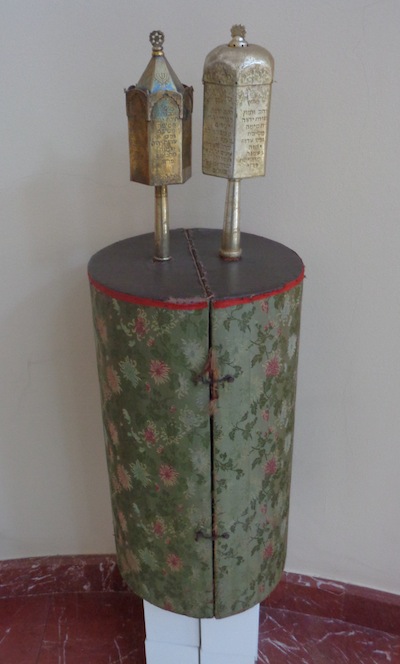
photo - A Torah scroll from the collection of the David Baazov Museum of History of Jews of Georgia in Tbilisi
A Torah scroll from the collection of the David Baazov Museum of History of Jews of Georgia in Tbilisi. (photo by Deborah Rubin Fields)

Possibly because they were viewed as unpretentious craftsmen and pedlars, Jews faced relatively little antisemitism. Under the medieval feudal system, they were considered serfs. As serfs, they were never forced to convert, although there seemed to have been some incentive: one document states that Daniel Aranashbili, an apostate serf, received a total tax exemption. (See Gershon Ben-Oren’s essay, “The History of the Jews of Georgia Until the Communist Regime” in The Land of the Golden Fleece: The Jews of Georgia-History and Culture.)

Jumping ahead to the 19th-century rule of the Russian czar, there were a handful of blood libel cases that, while admittedly painful, did not end up in the massacres that occurred in other parts of Europe. Even during the repressive Soviet era, when Jewish institutions were closed, the Tbilisi Jewish community somehow succeeded in having their cemeteries left intact – unlike the local Muslims and Armenians, whose Georgian cemeteries were desecrated.

Internally, the Jewish community had its differences. For instance, at the end of the 19th century, there was significant resistance to Zionism. Rabbi David Baazov – who the czar appointed as the official rabbi of Oni – was one of the community’s first Zionist advocates. He faced such fierce opposition from wealthy community members that he was forced to appeal for funds from early Zionist leader Menachem Ussishkin. Unfortunately, when, in 1917, no financial assistance was offered, Baazov had to close his school. (Today, the Jewish museum in Tbilisi is named after Baazov.)

But here is something amazing about this quiet community. It was “carried away” by the achievements of the Israeli Defence Forces in the Six Day War. In 1969, knowing the risks in “making waves” during Soviet rule (Stalin, for example, who hailed from Georgia, had personally signed the death penalties of 3,600 countrymen), 18 Georgian Jewish families were the first people to publicly petition the United Nations Human Rights Committee with their request to move to Israel.

Most of the 80,000 Georgian Jews (figures from 1970s) made aliyah in two recent waves: in the 1970s and again in the 1990s, when the USSR collapsed. Reportedly, 3,000 to 5,000 still live in the European (because of the Caucasus Mountains, some would say Asian) country of Georgia. Significantly, only recently has Tbilisi become the main centre for the Jewish community. In fact, until the first big aliyah, the Georgian Jewish community lived in several other locations, including Kutaisi, Batumi, Oni, Akhaltsikhe, Akhalkalak, Sarami, Kareli and Gori.

Historically, Georgia’s Mizrahi and Ashkenazi communities have remained separate. In today’s Tbilisi, Shaarei Tefillah Synagogue stands in the Old Town area. This congregation is more than 100 years old. There is also a Chabad synagogue. A kosher restaurant is located near Shaarei Tefillah.

At present, you will hear different opinions about the vitality of the current Jewish community. Some insist that, unlike other former Soviet Union countries, there is vibrant Jewish life in Georgia, with little assimilation. Others contend that, with the dwindling population, life is bleak for some of the older members of the Jewish community and tenuous for the younger generation, who are at risk of losing their Jewish identity.

Georgian Jews have been proud of their heritage. For instance, one wealthy Armenian Jew living in Tbilisi, Ghazar Sarkisian, built his wife a stunning house with stained glass windows displaying the Star of David.

And, speaking of David, everywhere you go in Georgia, you will see paintings and statues of two Georgian leaders who had Old Testament names: King David the Builder (1089-1125) and his great-granddaughter Queen Tamar (1184-1213). These two rulers are recognized for their ability to unify the nation. But, in addition, there are stories that their Bagrationi ancestors descended from the biblical King David. Hence, some believe these rulers had Jewish roots. Whatever their true origin, in today’s Georgia, these names remain popular with the general population.

When in Georgia …

  • For the adventurous, there is cycling, and mountain and hill climbing. However, travelers should note that, because of severe weather conditions, a number of roads leading to the Caucasus Mountains close for months at a time.
  • Visit the cave city of Uplistsikhe. Although there is no evidence that she was ever there, you’ll find a large space called Queen Tamar’s Hall. Either way, the caves, which first housed pagan communities, make for an interesting stop.
  • Even if you don’t drink wine, it is worth going to a traditional winery to see the unique way Georgians have historically made wine.
  • Besides wine, bread is another big part of Georgian life. Check out a bakery that makes shoti puri, a flatbread resembling a canoe in shape. It is a simple, handmade mixture of flour, water, salt and yeast. The bread is baked in a strange oven called a tone (pronounced “tone-ay”). This oven is a circular, brick-lined oven dug into the floor with a gas or wood fire at the bottom. The bread is placed onto the side of the tone. For the bakers, it is hot and strenuous work, especially when trying to reach the spaces at the bottom of the oven. The bread is ready in a matter of minutes. It is then scrapped off the sides with a paddle.
  • For those who like to take in the local scene by walking, Tbilisi is the place to be. Walk slowly through the Old Town to see how grand this city once was. From the crumbling carved wooden porches to the faded hand-painted vestibules, you can still feel the city’s architectural beauty. There are a number of rehabilitation projects underway, but much needs to be done.
  • Another way to see a bit of times past is to go to Tbilisi’s Dry Bridge Market. This flea market specializes in nostalgia, selling silverware, china and glassware. You can get a shaggy shepherd’s hat, accordions, sewing machines, cameras, record albums, hand guns and knives (!) and, of course, Soviet memorabilia. It also has a large section of new, locally made paintings and shawls.
  • Though the exhibits are not posted in English, the State Museum of Georgian Folk Songs and Instruments has a small, but nice, collection of regional musical instruments (including a shofar). While I was visiting, the curator played a European street organ, an upright organ and operated some of the early musical recording devices.

Deborah Rubin Fields is an Israel-based features writer. She is also the author of Take a Peek Inside: A Child’s Guide to Radiology Exams, published in English, Hebrew and Arabic.

Format ImagePosted on September 7, 2018September 6, 2018Author Deborah Rubin FieldsCategories TravelTags Georgia, history, Jewish life, tourism
Reaching for new audiences

Reaching for new audiences

Michael Schwartz speaks at the launch of East End Stories on June 24. (photo from JMABC)

When Louis and Emma Gold arrived in Granville, precursor to Vancouver, the merchant family from Kentucky became the first members of what would grow into the booming Jewish community in the Lower Mainland.

Like most of the first Jewish immigrants to British Columbia, the Golds moved to the eastern end of downtown, where they opened a general store. Two waves of European Jews would come to Vancouver in the late 19th century and the Strathcona neighbourhood would become their home. It was an era during which new Jewish arrivals to North America largely found employment as merchants or doing various trades and Vancouver’s East End provided affordable and accessible housing for the working class.

“So many immigrant communities passed through there,” said Michael Schwartz, director of community engagement for the Jewish Museum and Archives of British Columbia.

The Jewish history of Strathcona is no secret, and the museum has offered walking tours of the neighbourhood for decades, beginning with a self-guided one in 1986, which grew into the current monthly guided tour. But, while those familiar with Jewish Vancouver may already know about the community’s past, Schwartz is hoping that a new school curriculum and video series created by the JMABC will make that history significantly more accessible.

East End Stories, completed in June, includes six short online videos and a 43-page study guide intended for use with students in grades 7 through 9. In addition to making some of the information offered on the walking tour available to those who can’t attend in person, Schwartz said the project also unveiled new information about early Vancouver Jews.

“It gave us the opportunity to do more research, to dig deeper, to find stuff we hadn’t before,” he told the Independent.

The result is the six videos, covering the first arrivals, the early community institutions and history of philanthropy, as well as Vancouver’s second mayor – David Oppenheimer – entrepreneur and philanthropist Jack Diamond, and the Grossman family. (Among other things, Max Grossman started this community newspaper.) Each running just under five minutes and offering encyclopedia-style capsule histories, the videos feature narrators from the local community. Schwartz said the photographs used were drawn from 17 archives across the world, including ones in California, Jerusalem and Poland.

The study guide covers the material in each video but is structured slightly more broadly, wrapping the Oppenheimer and Diamond biographies into a single lesson focused on how Jews shaped Vancouver, for example.

Schwartz said the impetus for creating the educational resources came after a vice-principal in the city asked whether there was a way to bring the information from the walking tour to classrooms at his school, as the logistics of bringing dozens of students to the neighbourhood itself was too complex. The museum offered the school replicas of wall panels that appear along the tour, but the study guide goes further, and meets current provincial guidelines for social studies curricula. Schwartz said museum staff will attend the B.C. Teachers Federation Conference in October to publicize the project, which was made possible by a $50,000 grant from the Canada 150 grant program.

“That provided the anchor funding and we were able to build the rest of the budget with smaller grants,” Schwartz explained. “It had always been a wish list thing and, when this funding opportunity arose, I thought, ‘Let’s give it a shot.’”

The lesson plans are intended to be used in conjunction with other Vancouver ethnic histories and video series created by Orbit Films, the company that produced East End Stories. The other histories are Black Strathcona, Nikkei Stories, which focuses on Japanese Canadians in Vancouver and Steveston, and South Asian Stories.

“All these different communities … faced struggle, rose to the occasion and relied on each other to be able to do that,” said Schwartz.

Highlighting the Jewish community’s roots in Vancouver and the similarities that the community shares with other immigrant groups is one of the goals of East End Stories, Schwartz said, adding that it could help combat certain stereotypes about Canadian Jews.

“Jews are assumed to have always been successful and that’s just not true,” he said. As can be seen in East End Stories, “many of us are stable or in some cases successful today [but] that’s new history.”

The videos and study guide also highlight a period of Jewish history in the Lower Mainland that was different for the way in which Jews were geographically concentrated in a certain quarter of the city, a phenomenon that remained true even after Jews largely left Strathcona but which has changed in recent decades.

Schwartz said that, during the 1950s, the community left Strathcona and clustered around Oakridge and Kerrisdale. The Baby Boomer generation dispersed but would return to the community to visit parents and attend community functions. But, while community institutions like the Jewish Community Centre of Greater Vancouver remain along the Oak Street corridor, fewer Vancouver Jews are calling the area home.

“We’re in a moment of transition,” Schwartz said. “We’re seeing a decline in gathering places and institutions where people come together.”

While online resources like the East End Stories videos, which are available on the Jewish Museum’s website, jewishmuseum.ca, can help bring people together figuratively and in shared knowledge and history, Schwartz said that in-person activities like those enabled by the walking tours and the classroom guide remain essential.

“There’s Jewish history in all corners of the city and it’s important for us to be present in not particularly Jewish areas to share the history of our community and spark dialogue about diverse histories of the city,” Schwartz said.

Arno Rosenfeld is a freelance journalist based in Vancouver. He has covered Canadian Jewish issues for JTA and the Times of Israel.

Format ImagePosted on August 31, 2018August 29, 2018Author Arno RosenfeldCategories LocalTags East End Stories, education, history, Jewish life, Jewish museum, JMABC, Michael Schwartz
Okanagan celebrates 25th

Okanagan celebrates 25th

Steven Finkleman, vice-president of the Okanagan Jewish Community, takes a moment to enjoy some Israeli dancing. (photo by Misty Challmie)

When the founders of Kelowna’s fledgling Jewish community decided to open a building, they couldn’t call it a synagogue.

The B.C. government of the day would contribute a third of the construction costs toward a community centre but nothing if it were a church or synagogue. So, a small group of dedicated volunteers named it the Okanagan Jewish Community Centre and got the funding.

The building – also known as Beth Shalom Synagogue – features a sanctuary alongside a large kitchen, library and daycare. Twenty-five years after its dedication in the heart of British Columbia’s Okanagan Valley, a dozen original members and 50 supporters celebrated the milestone with Israeli dancing, humour and heartwarming stories.

Steven Finkleman, who led the event, reminisced about how a few retired couples kept the Jewish religion “alive in these boonies” by getting together at various houses. Members gathered regularly for services at a church after they formalized their community at an inaugural meeting in 1983.

“We met at St. Michael’s Anglican Church. For us, it was St. Moishe’s,” said Finkleman, who grew up in Winnipeg. “The question wasn’t, ‘Do we need a building?’ It was, ‘If someone dies, where do we put them?’ So a cemetery was most important.”

As more Jews moved into the Okanagan, momentum grew. Then-newcomer Mel Kotler, a businessman from Montreal who ran the Western division of Fabric-land, helped launch the community’s first cemetery drive. The committee bought pews, bimah artifacts and an ark from a synagogue that closed in Moose Jaw, Sask. Members contracted Emil Klein, a retired rabbi living in nearby Winfield, to lead services in houses and at St. Moishe’s.

Soon, they picked out a burial site overlooking a lake north of Kelowna, making it the only Jewish cemetery between Metro Vancouver and Calgary. After shifting the focus to establishing a centre, lawyer Robert Levin met with developers of a new subdivision in Kelowna’s North Glenmore area to negotiate a location. They agreed the Jewish community would put in a daycare to serve the neighbourhood as part of the deal.

Plans were drawn up for a $400,000 building, and a successful fundraising dinner followed. Once built, two former members of the Moose Jaw synagogue helped carry in two Torahs for the dedication in October 1992. More than 300 people attended the ceremony, which included a six-foot challah. Among the dignitaries were British Columbia’s former premier, Dave Barrett, member of the Legislative Assembly Cliff Serwa and B.C. Liberal leader Gordon Wilson.

Today, about 60 families – with Orthodox, Conservative and Reform backgrounds – support the centre. Visiting rabbis and cantors lead services, and children learn about Judaism at Hebrew school. Rabbi Shaul Osadchey and Cantor Russ Jayne of Calgary’s Beth Tzedec Congregation currently travel to Kelowna four times a year for Jewish holidays.

“They have the skill set we don’t have,” said Okanagan Jewish Community president Mondy Challmie. “When people have questions of a religious nature that we’re unable to answer, we encourage them to email or call Rabbi Osadchey.”

To celebrate the 25th anniversary, Cantor Russ sang a Hebrew-English version of Leonard Cohen’s “Hallelujah.” Israeli dancers – who have practised every week for 14 years at the centre – performed. Member of Parliament Stephen Fuhr and Kelowna Councilor Mohini Singh gave speeches. And everyone shared a nosh, a slideshow and plenty of laughs.

As the party wound down and people folded up the chairs, Finkleman reflected on the biggest challenge for this tight-knit but tiny congregation.

“Generating interest, support and commitment in a small community – distant from a major Jewish centre – was difficult. It still is a challenge, but, when the building opened, it served as a focal point for recent arrivals in the Okanagan. We were very honoured to have some of the original members present. We miss those who are no longer with us.”

For more information, visit ojcc.ca.

Don Plant is a retired journalist and member of the Okanagan Jewish Community in Kelowna. He’s now studying archeology and helped excavate an Early Bronze Age site in Israel last summer.

Format ImagePosted on February 9, 2018February 7, 2018Author Don PlantCategories LocalTags Beth Shalom, Jewish life, Judaism, OJC, Okanagan, Steven Finkleman

Money still unclaimed

Thousands and thousands of dollars belonging to Jewish institutions and individuals are sitting unclaimed at the Bank of Canada.

Banks and federally chartered trust and loan companies are required to transfer to the Bank of Canada all unclaimed bank balances maintained in Canada in Canadian currency that have been inactive for a period of 10 years. According to the Bank of Canada’s website (bankofcanada.ca), at the end of December 2016, approximately 1.8 million unclaimed balances, worth some $678 million, were on the bank’s books. More than 93% of unclaimed balances were under $1,000, representing 26% of the total value outstanding. In 2016, the bank paid out $15 million to account holders. The oldest balance dates back to 1900.

At the Bank of Canada, there are many small amounts payable to Jewish organizations, including ones that are currently active. There are also some organizations that may no longer be active, which is why money in their name is languishing at the Bank of Canada. It is unfortunate that money intended to benefit Jewish organizations, charities or other causes, should not be used for the intended purpose, but instead sits unclaimed at the bank. Many of these organizations must have successor organizations or responsible persons that, with a little effort, could prove their right to claim the funds.

To discover whether a group you are now or have previously been associated with has such a balance, you should do the following:

  1. Go to bankofcanada.ca.
  2. Type “unclaimed balance” into the search box.
  3. Once you reach the unclaimed balances registry, type one word of the organization name into the search box and scroll through the results.
  4. If you see a name that is familiar, open the link.

If there is a bank account untouched for 10 years, the organization will pop up, along with the name and address of the originating bank. Then you can make a claim for the money through a process set out on the website. You will have to prove that the account was yours, and the website explains how to do that.

You can search by province, or by “all” (of Canada). Each year, on Dec. 31, the Bank of Canada adds another year’s unclaimed bank accounts to the website.

Members of the Canadian Jewish community should try to reclaim funds that were intended for use in the community.

Here are some of the words searched that found unclaimed balances belonging to Jewish groups or institutions: Jewish, Hebrew, tikvah, congregation, Canadian friends, beth, bnai, b’nai, rabbi, synagogue, temple, Torah, Talmud, Israel, Jerusalem, Moshe, Habonim, Zionist, ohel, Na’amat, chevra, camp, JCC, eitz, beit, chaim, kosher, yeshiva, Yiddish.

For example, the Bank of Canada holds $3,311.02 for an organization called Canadian Friends of Tikvah Lay in Ontario. It also holds $256.94 for Yeshiva of the Northwest, whose last transaction date was in 1992 in Vancouver, and $108.69 for the Edmonton Jewish Women’s Baseball League, untouched since 1997.

There may be some hurdles to jump to establish the right to the $953.08 of the Yiddish Drama Company in Toronto, untouched since 1979. However, there are at least a dozen Jewish community centres and congregations in towns across the country that should have very little difficulty in obtaining their unclaimed bank balances.

Few of the amounts found were large – but should any of the money raised or donated for a Jewish cause, charitable or not, be left at the Bank of Canada? Some effort should be made by the community to locate these funds and use them as they were intended.

You should also check your own name and those of family members, especially those family members who died more than 10 years ago, as there are sometimes bank accounts that heirs were unaware of at the time of death and that show up at the Bank of Canada years later. The process for obtaining personal unclaimed funds is also quite simple, and requires establishing your identity and your right to the funds.

Not to be confused with the funds held at the Bank of Canada, the province of British Columbia has its own, government-affiliated B.C. Unclaimed Property Society. It seems to hold more funds for individuals rather than organizations. Its website (unclaimedpropertybc.ca) says:

“Each year, millions of dollars in British Columbia goes unclaimed in dormant credit union accounts, forgotten insurance payments, unclaimed wages, overpayment to debt collectors, as well as unclaimed proceeds from courts, tax offices and unadministered estates and intestates (death without a will and next of kin cannot be notified). The British Columbia Unclaimed Property Society (BCUPS) helps reunite British Columbians with their forgotten or unclaimed assets. We hold unclaimed property as the custodian for rightful owners under the Unclaimed Property Act.”

The BCUPS website also provides an easy way to search, but if you find your name, you will find no further information about the amount of funds or the source of the funds being held for you, until you contact the society. You could think of it as a form of treasure hunt, where you expend no money, but you do expend your time, and maybe there will be a treasure chest or at least a few coins at the end of the hunt.

Felicia Folk is a retired lawyer living in Vancouver.

Posted on February 9, 2018February 7, 2018Author Felicia FolkCategories NationalTags banking, charity, Jewish life, unclaimed property

In spirit of Jewish law

The other night, I sat on the couch with my husband in an attempt at togetherness. We watched an episode of Madam Secretary. It was our second attempt. On the first try, worn out, I was about to fall asleep when my spouse suggested that we save it for another time so I could go to bed. It was, he pointed out, supposed to be fun. Sticking to the initial “date time” wasn’t working. Thank goodness for the PVR.

The show we watched was full of allusions to knitting and design, which are parts of my freelance work. I cringed inwardly, preparing for derogatory comments about “women’s work.” To my surprise, the textile theme was respectful. A man with PTSD takes up knitting as part of his therapy – it helps him focus his mind. A first-year university student struggles with a design assignment – she comes away with a couture dress, but not before we hear the sounds of her sewing machine at work in the background. Best yet, when her sister begins to panic at modeling the dress, the student gives her a pep talk, saying, “Pull yourself together, be strong. Do this, I need you.” What started as a frivolous thing – “help me out at this fashion show” – became more. It became a chance to succeed academically, and to use inner strength to prevail over a trying situation. The episode showed strong women and struggling men seeking to be their best selves.

All this came to mind later, in the context of a Talmud class. I signed up for a Jewish Theological Seminary online course. With the wonders of technology, I can hear lectures by Rabbi Dr. Judith Hauptman, who is a gifted teacher and intellect. Her course has an interesting premise – looking at situations when “law meets life.”

She began with basic information, and got started studying talmudic text. Whenever I study Talmud (or any older text), I have to remember the inherent inequalities. Women were seen as subservient, with less agency than we think is appropriate today. Through careful reading, we saw lists of tasks wives are obligated to perform for their husbands (Bavli Ketubot 61a) and a discussion about how one might “wash” – sprinkle water on – a floor on Shabbat (Bavli Shabbat 95a). (This last reference was not cleaning so much as providing a form of air conditioning and reducing dust on an extremely hot Shabbat in Babylonia.)

Hauptman showed us how women’s interpretations allowed them both to obey the spirit of Jewish law, and to accomplish what needed to be done. In more than one place in these readings, the rabbis (all male) allude to the fact that women were smart and had power or agency. Even if the language of the Talmud relegates women to being “property of a man’s house,” the women in these stories shine through as being shrewd and savvy.

We think sometimes that our lives are infinitely more complicated, sophisticated and detailed than those in the nostalgic past. Yet, these talmudic texts reminded me that, more than 1,500 years ago, smart people focused on the details that make our households and lives function. We may have a way to record entertainment now (and a TV!) or access to machine-produced clothing, but our fundamental concerns are similar. How are we to balance the spirit of our commitments with the laws’ requirements? What is the intention of our roles? How do men and women balance and subvert traditional roles in order to cope? How do our household tasks make life comfortable and/or meaningful?

The first text we studied refers to tasks that wives perform for their husbands: grinding grain, baking bread, doing the laundry, cooking, nursing his babies, making his bed, and working with wool. When she has wealth and servants, she can avoid some of these household obligations. As we studied this text together, I was knitting a wool sweater I’d promised to finish for one of my kids. I thought the webcam was trained up, only on my face. No, as it turned out – a friend, also taking the class, in New York, said she could see my knitting.

That’s OK. In the end, the more things change, the more they stay the same. Regardless of your level of observance, we still wrestle with these issues. Women often interpret Jewish law and tradition when it comes to household details. If one doesn’t have enough servants or financial resources, or even enjoys knitting and finds it focuses the mind, one might still be working with wool.

A recent study indicated that, in Reform Jewish congregations, rabbis who are women are paid less than their male counterparts. Women have fewer positions “at the top” as senior or sole congregational rabbis. We continue, even in the most progressive Jewish movements, to struggle with pay equity and gender roles.

The Talmud is an essential part of Jewish oral law, but it’s also literature, with narratives that shed light on daily life. A current TV show portrays a woman as U.S. Secretary of State, and shows that interaction with fibre arts is still an important, useful and viable thing to devote time to creating, no matter your gender.

In both the show’s legal negotiations and this talmudic text, we’re taught that, sometimes, the spirit of the law, the intention, is more important than the letter of the law. Through all the big decisions, it’s sometimes the small household details that make people’s lives rich. I’ll keep knitting handmade sweaters for my kids – and studying Talmud. Even in these times, there’s a place for both.

Joanne Seiff writes regularly for CBC Manitoba and various Jewish publications. She is the author of three books, including From the Outside In: Jewish Post Columns 2015-2016, a collection of essays available for digital download or as a paperback from Amazon. See more about her at joanneseiff.blogspot.com.

Posted on February 9, 2018February 7, 2018Author Joanne SeiffCategories Op-EdTags equality, Jewish life, Judaism, Madam Secretary, Talmud, TV, women
Serving the Diaspora

Serving the Diaspora

Ayala and Ariel Wilchfort are recent arrivals to Vancouver. (photo from Ariel Wilchfort)

Two years ago, Rabbi Gideon Osher Shmueli donated a kidney to a stranger, saving that individual’s life. These days, he works at Magen David Yeshivah in Brooklyn, N.Y., teaching Hebrew and bringing with that teaching the culture and values of Judaism and eretz Yisrael, the land of Israel.

To him, teaching about Judaism is akin to donating a vital organ. “Connecting Jews to Torah and mitzvot is no different from helping someone to live,” said Shmueli, 32, who, with his wife, Leore Sachs Shmueli, was matched with the school by Ohr Torah Stone’s Beren-Amiel Practical Training Program for Educational Emissaries, which trains educators who are sent to teach Judaic studies in both Orthodox and non-Orthodox schools throughout the Diaspora. A similar initiative, the Straus-Amiel Program for Rabbinical Emissaries, trains rabbis for synagogue postings in the Diaspora.

Like Shmueli, Rabbi Ariel Wilchfort is a recent arrival to his new post. He is city director for the National Conference of Synagogue Youth in Vancouver, following his participation in the emissary training at OTS’s Israel campuses.

“They guided me and helped me choose positions,” said Wilchfort, 33, who relocated to Vancouver with his wife Ayala and their two young children.

Wilchfort, who attended the emissary training from 2015 to 2017, said he found his current job when a representative for NCSY, the youth arm of Orthodox congregations in North America, visited with him and other emissaries.

Based in Israel, OTS is a modern Orthodox network of 24 institutions on 12 campuses, founded by Rabbi Shlomo Riskin with a mission in part to demonstrate that Judaism’s “laws and traditions remain profoundly relevant to the contemporary world,” Riskin has said.

As part of that mission, OTS has some 200 emissary families serving in more than 50 countries, according to Rabbi Eliahu Birnbaum, who directs the emissary programs. Shlichim (emissaries) serve on average five to six years, with some who have been at their posts as long as 18 years.

They serve not only in large Diaspora communities but also in places that are far afield and have few Jews, such as Quito, Ecuador; Guangzhou, China; Cochin, India; and Harare, Zimbabwe. “We believe that people need to work with people, and the only way to influence other people and strengthen their Jewish identity, as well as the community itself, is by having emissaries and creating personal connections,” Birnbaum said.

OTS annually receives at least 150 applications for the program, and chooses 25. “We accept only applicants who have advanced Torah knowledge and yeshivah background, high academic level and, most important, very good people and leadership skills,” said Birnbaum.

The training program consists of weekly classes with educators, rabbis, experts in halachah (Jewish law) and advisers. Shlichim assignments range from teaching positions, to youth directors to pulpit positions.

In a smaller Jewish community like Vancouver, Wilchfort occupies several roles on the community scene, mentoring young people at Congregation Schara Tzedeck and running a religious education program called Torah High, in which Jewish students can attend afternoon classes and gain a few credits toward earning their high school degree.

Originally from Englewood, N.J., Wilchfort’s family immigrated to Israel when he was a child, and he received his rabbinic ordination from Israel’s Chief Rabbinate at the same time that he was enrolled in the Beren-Amiel program. He said he was drawn to the initiative by a desire to serve Jews in the Diaspora and help them enrich their Jewish lives.

“I entered the program out of a care for other Jews, a love for our nation, and especially a love for our fellow Jews who have not had an adequate religious education,” he said.

Wilchfort has enjoyed settling into Vancouver, which he credits for having a vibrant Jewish scene. “Our community has a great infrastructure; it’s a very pro-Israel community here,” he said. “As for the area itself, it’s beautiful. In Vancouver, we live between forests and the ocean, and everyone is so health-aware, nature-aware.”

For Wilchfort, whose wife’s first language is Hebrew, not English, it’s a true cross-cultural experience. “It’s a new city, new country, new culture. It’s really an adventure, and we feel so excited to be here.”

Format ImagePosted on February 2, 2018February 1, 2018Author Ohr Torah StoneCategories LocalTags Jewish life, Judaism, Ohr Torah Stone, OTS, Vancouver, Wilchfort
The greatest Jewish novel?

The greatest Jewish novel?

What strange quirk brought it about that what may be one of the greatest and most Jewish of Jewish novels should be written not by a Diaspora Jew, nor an Israeli Jew, nor a Diaspora Jew who had made aliyah, but rather an Israeli who relocated to New York?

Further stymying expectations, Ruby Namdar did not write this novel in English, but in Hebrew (it was recently translated by Hillel Halkin). “For who?” asked an audience member at the Cherie Smith JCC Jewish Book Festival event on Nov. 26, when I had the pleasure of interviewing Namdar in front of a small gathering. If Namdar wanted his novel, which he acknowledged to be soundly in the lineage of Bernard Malamud, Saul Bellow and Philip Roth, to be read by New Yorkers, why write it in Hebrew? If he wanted the novel to make sense to Israelis, why write it about a rootless Diaspora Jew with no connection to Israel?

“I don’t know what I was thinking,” said Namdar, “I don’t know who I was writing for, I just wrote.”

The Ruined House is not just a great Jewish novel or a great novel in modern Hebrew. It possesses a structure that is at once talmudic and kabbalistic, a structure that is deep and intricate yet carried off with such a sense of understatement and naturalness, effortlessly unfolding within Namdar’s lucid, lyrical and vivid prose, that most English-language reviewers thus far have not fully noticed it. This structure is what gives the novel its profoundly Jewish resonance, which is at once modern and ancient, rootless and anchored in the archetypal depths of Jewish experience and textuality.

Talmudic structure

The Ruined House is divided into seven books, with its seventh book being the culmination of an obviously Jewish numerical pattern. Each book follows the anti-hero, Andrew P. Cohen, over the course of one year of his life, as he enters what seems to be a midlife crisis from hell (or perhaps from heaven).

Cohen is a successful and wealthy professor of comparative culture, who lives in an idyllic Manhattan high-rise with a view of the river, a pristine Apollonian realm in the skies. He has a beautiful young lover, Ann Lee, and an adoring group of followers and acolytes. He cherishes his controlled, harmonious and detached existence, which he has gained through leaving his wife and two daughters years before.

At the end of the first six sections of the novel are a few pages of text designed to look like a blat Gemara, a page of Talmud. The central text in these inserts tells the story of a high priest preparing and executing the Yom Kippur sacrifices. While he does so, he is watched by Obadiah, a humble Levite who wonders whether the priest is truly pious or just a functionary in league with the elite. Encircling the narrative are passages from the Talmud, Mishnah and Tanakh, which describe the laws, folklore and spiritual significance of the high priest’s duty. They also feature key excerpts from Shaarei Gilgulim (The Gate of Reincarnation), a kabbalist text written by Chaim Vital (1542-1620) to expound the cosmology of his master, the Ari HaKodesh, Isaac Luria (1534-1572).

The insertion of these texts is deliberate and precise. Just as the narrative in the inserts is flanked by canonical Jewish sources, the narrative of the novel is surrounded by ancient Jewish forces. As the hidden, broken nature of Cohen’s life begins to surface, he begins to have intense, waking visions of the ancient Temple in Jerusalem. His dreams turn nightmarish, alternating between repressed guilt at his betrayal of his family and dreadful tableaus of the rape of Jerusalem by the Romans and the murder of Jews by the Nazis.

The structure of the story and the inserts are not the only mirrors in the book: Cohen’s life is cast as priest-like. His elite status; the pure harmonious realm in which he lives; his having separated from his wife like Moses to live in the skies; even the elaborate meat dinners he cooks up for his dinner guests alone in his perfect kitchen all point to it. His name, of course, highlights both the substance and the irony of his life as priestly metaphor. At one point, his daughter, Rachel, disgustedly mocks people who think that Jews named Cohen are descended from the priestly lineage: “Everyone knows they just gave out those names randomly at Ellis Island.”

As Cohen descends into apparent madness, a grotesque version of the priestly sensibility gets stronger in him. He becomes morbidly obsessed with the impure and averse to the physical, the decaying and the dead. He finds himself horrified by menstrual blood and semen. The explanation of this growing claustrophobic sensibility lies in the paragraphs of Shaarei Gilgulim, which are included in Namdar’s inserts.

Kabbalist elements

Shaarei Gilgulim describes the way that some souls, during the process of reincarnation, unite with other souls in order to complete their own tikkun (repair). In the first pages of The Ruined House, “one shining soul, the figure of a high priest” is suddenly visible above New York among the celestial machinations momentarily revealed as the veil is briefly sundered. The key to the priest’s identity lies in the kabbalist doctrine of ibbur, or impregnation, where a soul from beyond enters into an earthly person in order to help them, to complete their own mission, or some combination of the two. In Cohen’s case, as suggested in a last talmudic insert, he has been “impregnated” by the soul of the high priest in need of tikkun for feeling himself superior to Obadiah, the humble Levite. The high priest and Cohen share a sin in common: arrogance. Their collective confrontation and reckoning with it will be psychically violent and cathartic and come close to doing Cohen in.

Critique of Diaspora?

Some reviewers have read The Ruined House as a critique of the Diaspora Jew, viewing the narrative as a kind of punishment of Cohen, enacted on him by the rising tide of archaic Jewish intrusions into his life. Namdar said this is a moralistic distortion of his ambivalent, questioning text. Instead, Namdar pointed to the shatterings of the illusion of wholeness and perfection that happen in the book. “Where things are broken, there, seeds can take root and grow,” he said.

For example, Cohen’s harmonious life is an illusion that is shattered in the course of the book, leaving a “ruined house.” Yet the figure of the ruined house (bayit asher necharev in the original Hebrew, a phrase that comes from a poem by Yehuda Amichai) is also an allusion to another ruined house, that of the Beit Hamikdash, the Jerusalem Temple, whose pristine world of order and control, Namdar suggests, also was illusory.

The third ruined house is suggested by the timing of the events in the novel. The story begins in the Hebrew month of Elul (signifying its theme of repentance), on Sept. 6, 2000. After the narrative comes to a head on Tisha b’Av, the date of the destruction of the Temple, it jumps from Aug. 1, 2001, to Sept. 18, 2001, leaving a lacuna where Sept. 11, 2001, and the destruction of the Twin Towers, resides.

“I did not want Sept. 11 to appear in the narrative, thus making the novel reducible to being about that event,” said Namdar when I asked him about this. “Rather, I wanted the trajectory to point to its occurrence outside the frame.”

There is much more to talk about in this remarkable novel, which manages at once to be so Jewish, so Israeli, so American and so human. I did not touch here on the attention Namdar lavishes on the details of Cohen’s daily life or Namdar’s subversion of the lineage of Malamud, Bellow and Roth in his intense empathy with the female characters of the novel, and his unsparing deconstruction of Cohen’s narcissistic masculinity. I did not examine his vivid and hilarious slow-motion evocation of a grossly excessive bar mitzvah, or his brilliant parody of the Zionist clichés of a Birthright-like propaganda tour of Israel, and many other delights. I hope this introduction is enough to invite you to step into Namdar’s mesmerizing fusion of a talmudic-esoteric structure with an incandescent evocation of life in Manhattan, and discover what else he has hidden there, of which, I promise you on good authority, there is much.

Matthew Gindin is a freelance journalist, writer and lecturer. He writes regularly for the Forward and All That Is Interesting, and has been published in Religion Dispatches, Situate Magazine, Tikkun and elsewhere. He can be found on Medium and Twitter.

Format ImagePosted on February 2, 2018February 1, 2018Author Matthew GindinCategories BooksTags Cherie Smith JCC Jewish Book Festival, Jewish life, Judaism, kabbalah, literature, Ruby Namdar, Talmud, Torah, translation

Posts pagination

Previous page Page 1 Page 2 Page 3 Page 4 Page 5 Next page
Proudly powered by WordPress