Skip to content
  • Home
  • Subscribe / donate
  • Events calendar
  • News
    • Local
    • National
    • Israel
    • World
    • עניין בחדשות
      A roundup of news in Canada and further afield, in Hebrew.
  • Opinion
    • From the JI
    • Op-Ed
  • Arts & Culture
    • Performing Arts
    • Music
    • Books
    • Visual Arts
    • TV & Film
  • Life
    • Celebrating the Holidays
    • Travel
    • The Daily Snooze
      Cartoons by Jacob Samuel
    • Mystery Photo
      Help the JI and JMABC fill in the gaps in our archives.
  • Community Links
    • Organizations, Etc.
    • Other News Sources & Blogs
    • Business Directory
  • FAQ
  • JI Chai Celebration
  • JI@88! video

Recent Posts

  • Sharing her testimony
  • Fall fight takes leap forward
  • The balancing of rights
  • Multiple Tony n’ Tina roles
  • Stories of trauma, resilience
  • Celebrate our culture
  • A responsibility to help
  • What wellness means at JCC
  • Together in mourning
  • Downhill after Trump?
  • Birth control even easier now
  • Eco-Sisters mentorship
  • Unexpected discoveries
  • Study’s results hopeful
  • Bad behaviour affects us all
  • Thankful for the police
  • UBC needs a wake-up call
  • Recalling a shining star
  • Sleep well …
  • BGU fosters startup culture
  • Photography and glass
  • Is it the end of an era?
  • Taking life a step at a time
  • Nakba exhibit biased
  • Film festival starts next week
  • Musical with heart and soul
  • Rabbi marks 13 years
  • Keeper of VTT’s history
  • Gala fêtes Infeld’s 20th
  • Building JWest together
  • Challah Mom comes to Vancouver
  • What to do about media bias
  • Education offers hope
  • Remembrance – a moral act
  • What makes us human
  • המלחמות של נתניהו וטראמפ

Archives

Follow @JewishIndie
image - The CJN - Visit Us Banner - 300x600 - 101625

Tag: interfaith

Filming faith on No. 5 Road

Filming faith on No. 5 Road

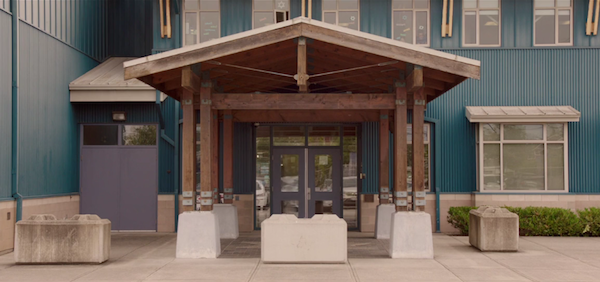
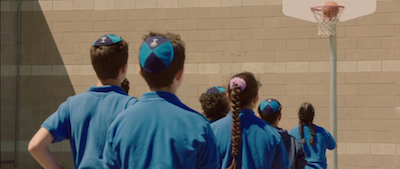
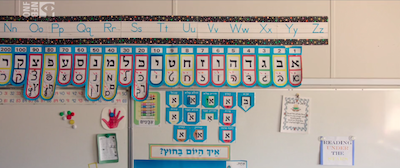
Stills from the NFB’s Highway to Heaven: A Mosaic in One Mile. Richmond Jewish Day School is one of the institutions featured in the short film, which screens at this year’s Vancouver International Film Festival.

The National Film Board short Highway to Heaven: A Mosaic in One Mile, written and directed by Sandra Ignagni, is visually striking. For the most part, it lets the images do the talking, communicating more about cultural diversity than words could.

Part of this year’s Vancouver International Film Festival, Highway to Heaven introduces viewers to the multiple faith groups and institutions along a mile-long section of No. 5 Road in Richmond, which includes Richmond Jewish Day School. In the 17-minute documentary, this strip of road – which has been called “Highway to Heaven” – appears both full of colour and action, as well as remote and removed, not just geographically but with chain link fencing and other security measures.

“We share a world grappling with ethnic and racial tensions, religious xenophobia and violence,” writes Ignagni in her director’s notes. “Such realities are not limited to the world’s conflict zones – they are a part of everyday life, even in the most advanced democracies such as Canada. It was in this context that I was drawn to the peculiar landscape of No. 5 Road … where multiple cultural and religious groups share a short stretch of suburban road. I was curious about how groups pitted against each other in so many corners of the world appeared to be living relatively peacefully with one another, and in very close proximity, in an ordinary Canadian suburb.”

image - Still from the NFB’s Highway to Heaven: A Mosaic in One Mile: classroomIn showing the beauty of the area – both in landscape and in cultural acceptance – Ignagni also captures some of the tensions that exist. The camera jumps from a lush orchard to a mansion mid-construction to a for-sale sign in front of what seems to be part of a forest. In one scene, which looks like it was filmed at RJDS, police in full gear – bulletproof vest and holstered weapons – address RJDS and Az-Zahraa Islamic Academy students, introducing themselves so that the kids should feel comfortable going to the police if they have a problem. The police then referee the kids in a game of ball hockey – boys against the boys, girls against the girls – throwing in questions about boundaries and other issues for the kids to consider.

Referring to the police presence on the road, Ignagni writes that it could “be variously interpreted as bridge-building, protection or surveillance. I learned that, for more than one decade, the Richmond Jewish Day School did not have an exterior sign for fear of antisemitic attacks against its schoolchildren. And, in recent years, the secular residential community that surrounds No. 5 Road launched a major campaign opposing the proposed expansion of a Pure Land Buddhist temple, using the pejorative moniker ‘Buddha Disneyland’ to describe the proposed building in local media and public debates. The mere fact that zoning by-laws have ordered these communities – the majority of which play a critical role in new immigrant and refugee resettlement – to the fringe of suburban land is also ripe for reflection.”

The minimal use of narration or interviews in the film was a deliberate choice. To do otherwise, Ignagni notes, “would be an exercise in public relations, reducing complex issues to soundbites and polemics. Instead, I wanted to make a film that would at once capture the remarkable – because it is truly remarkable – diversity on No. 5 Road, as it actually exists, while gesturing to some of the unresolved issues that underlie Canadian multiculturalism. The film is, therefore, constructed as a ‘mosaic’ – defined by writer and activist Terry Williams as ‘a conversation between what is broken.’”

image - Still from the NFB’s Highway to Heaven: A Mosaic in One Mile: classroomWhile she doesn’t rely on words to tell this story, sound plays an integral role in the film: calls to prayer, monks chanting, different languages being spoken (and not translated), kids playing, school bells ringing.

“My film invites audiences to sit with what is unknown, different, raw or only partially visible,” says Ignagni. “To me, a mosaic captures perfectly the subtle tensions one finds on No. 5 Road, where custom and ritual, language and cultural diversity are practised under surveillance cameras and behind locked doors and gates. In making this film, I am asking audiences to look with open eyes and hearts – with a spirit of curiosity – at themselves and their neighbours, and simply reflect on multiculturalism as an unfinished project in need of attention in Canada and around the world.”

In addition to RJDS and Az-Zahraa, the list of participating neighbours includes the Evangelical Formosan Church of Greater Vancouver, India Cultural Centre of Canada/Gurdwara Nanak Niwas, Kingswood Pub, Lingyen Mountain Temple, Mylora Executive Golf Course, Royal Canadian Mounted Police (Richmond detachment), Thrangu Tibetan Buddhist Monastery, Trinity Pacific Church, and Vedic Centre.

At VIFF, Ignagni will participate in one of a series of panel discussions presented by Storyhive on Totally Indie Day, Sept. 28, at Vancity Theatre. She will be on the hour-long panel called Not Short on Talent: The Rise of the Short Form Documentary, which starts at 3:45 p.m. For the full film festival lineup, including, eventually, the not-yet-listed screening time of Highway to Heaven – which was an Official Selection at this year’s Toronto International Film Festival – visit viff.org.

Format ImagePosted on September 6, 2019September 4, 2019Author Cynthia RamsayCategories TV & FilmTags interfaith, National Film Board, NFB, Richmond Jewish Day School, RJDS, Sandra Ignagni, Vancouver International Film Festival, VIFF
Forging interfaith friendship

Forging interfaith friendship

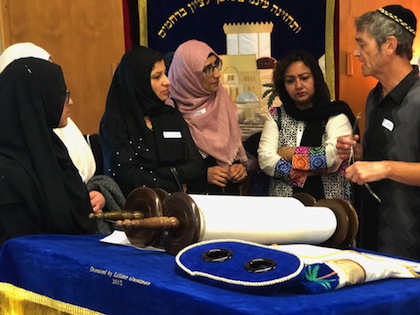
Okanagan Jewish Community Association president Steven Finkleman explains Jewish prayer books. (photo by Don Plant)

It sounds like a joke – a Muslim and a Jew walk into a Tim Hortons. But there’s no ethnic punch line in this story. As representatives of their congregations, Rehan Sadiq and Philippe Richer-Lafleche met over coffee several times to arrange a get-to-know-you gathering of their communities. After decades of living in Kelowna, B.C., but seldom rubbing shoulders, members of the Muslim and Jewish faiths decided to learn about each other’s history and culture by visiting their respective places of worship.

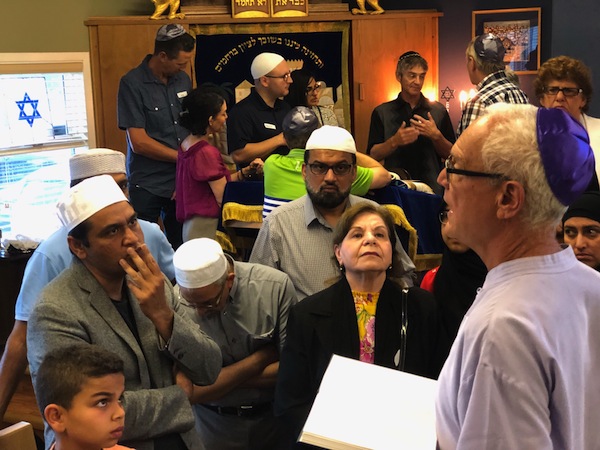
Their latest encounter in Kelowna’s main synagogue included a briefing on the Jewish faith and a close-up look at the Torah. Sixty people, more than half of them members of the Kelowna Islamic Centre, listened to a Hebrew psalm as they sat in the sanctuary of the Okanagan Jewish Community Centre in June. In exchange, board member Hassan Iqbal recited from the Holy Quran and his teenage son Musab Hassan sang prayers in Arabic.

The gathering followed a similar event in February, when Muslim members hosted a contingent of Jewish visitors at a get-to-know-you function in their new mosque in Kelowna. Both communities share the will to look past the history that divides them and forge a longstanding friendship. [See jewishindependent.ca/okanagan-interfaith-initiative.]

“The last thing I want our children to learn [about our relations] is from the news,” Sadiq, the mosque’s interfaith director, told both congregations in June. “This kind of meeting is extremely important. We should talk about building bridges.”

Organizers circulated the visitors through three stations at the synagogue to inform them about the basics of Judaism. OJC members showed them the Torah, explained the prayer books, interpreted symbols of the synagogue and demonstrated artifacts.

photo - Members of the Muslim community in Kelowna listen to Evan Orloff explain the Torah
Members of the Muslim community in Kelowna listen to Evan Orloff explain the Torah. (photo by Don Plant)

Once everyone sat down, lay leader Evan Orloff sang a psalm to the tune of Leonard Cohen’s “Hallelujah.” OJC president Steven Finkleman discussed the importance of loving your neighbour as yourself. Grant Waldman and Annik Moyal-Waldman sang Shalom Aleichem, the Hebrew phrase for “peace be upon you.”

Once Islamic Centre president Mostafa Shoranick made a few remarks, Finkleman announced, “Let’s eat,” and everyone lined up for a lavish buffet of Middle Eastern dishes. People mingled as they ate and at least one group of Muslim and Jewish women agreed to meet again. Over dessert, Sadiq and Finkleman led a discussion on which charities both faith groups could jointly support.

“I really think peace in the world will come on a one-to-one basis. It’s not governments [that generate it],” Richer-Lafleche, whose Jewish and Muslim grandparents married in Morocco, said in February. “It’s within small communities that you actually get to know people…. We make choices. We can choose to be loving or otherwise.”

The Muslim community is trying to educate the public and its own members about what true Islam is, said Shoranick, who grew up in Lebanon. Many in his Muslim community are new to Canada and want to assimilate, he said. “We come from different countries and different sects. We believe that, in this country, we’re lucky that we’re able to do our religion…. The religion is for God but the country is for everybody.”

Both groups have discovered they share several monotheistic beliefs. Among them:

  • the greetings “salaam” and “shalom” are virtually the same;
  • Islam and Judaism regard Abraham, Isaac, Jacob and Moses as prophets;
  • neither religion proselytizes or compels anyone to adopt their beliefs; and
  • both agree it’s wrong to judge people, and how you worship is up to you.

“It’s not our differences that get in the way; it’s how we perceive our differences,” Orloff said.

Don Plant is a retired journalist and member of the Okanagan Jewish Community in Kelowna. This article was originally published in the CJN, cjnews.com.

Format ImagePosted on August 30, 2019August 29, 2019Author Don PlantCategories LocalTags interfaith, Jews, Kelowna, Kelowna Islamic Centre, Mostafa Shoranick, Muslims, OJC, Okanagan Jewish Community, Philippe Richer-Lafleche, Rehan Sadiq

Prayer for reconciliation

At the recent General Synod [of the Anglican Church of Canada in July], I had the pleasure of speaking from what we in Judaism call the bimah; literally, the “stage.” I sat next to extremely kind and welcoming incoming and outgoing primates, Archbishop Linda Nicholls and Archbishop Fred Hiltz, and the Rev. Gordon Maitland, national chairman of the Prayer Book Society of Canada. As Bishop Bruce Myers stood at the podium explaining the prayer he was proposing to change, I looked out at the rapt audience at the synod and smiled.

I had spent several weeks working with Bishop Myers to plan our presentation, and I was aware that it was a truly amazing moment. A bishop inviting a rabbi to share his thoughts on a prayer “for the conversion of the Jews” – offensive content for Jews throughout our historical relationship with Christianity – and the proposed replacement: a “prayer for reconciliation with the Jews.” Wow. When I took the podium and shared some words, a few meaningful images and even a laugh or two, I felt truly welcomed by the dedicated Anglicans gathered in Vancouver.

I was there on behalf of the Canadian Rabbinic Caucus, representing my fellow rabbis from around Canada. The Canadian Rabbinic Caucus (CRC) is the only national organization that unites rabbis from across the spectrum of Jewish practice in Canada. As an affiliate of the Centre for Israel and Jewish Affairs (CIJA), the CRC plays a key role on behalf of the organized Jewish community of Canada in fostering interfaith relations – including with our Anglican friends.

During the process of seeking to replace this prayer, the CRC was approached by the national leadership of the Anglican Church of Canada to provide guidance and constructive feedback on the details of the church’s revised prayer, which we were very pleased to offer. We are humbled to have played a role in this historic development, which is a natural and logical culmination of decades of growing Jewish-Anglican ties.

The Anglican church has made a significant effort, particularly since the 1980s, to acknowledge and tackle the issue of Christian antisemitism. Examples include the removal of a supercessionist Good Friday collect from the Book of Common Prayer in 1992 and the powerful document “From Darkness to Dawn” (Christian post-Holocaust reflections on antisemitism), published in 1989 and reprinted and disseminated again in 2015 through the active leadership of Bishop Myers. The decision to transform the prayer for the conversion of Jews into a prayer for reconciliation with the Jews, which repents for historical antisemitism among Christians, is a testament to this wonderful trend.

The church has spoken out strongly about the rise of antisemitism, including the neo-Nazi rally at Charlottesville (when the Anglican church partnered with the Jewish community on an interfaith statement of solidarity against hate), as well as the horrific attack at Pittsburgh’s Tree of Life Synagogue, following which the church spoke out and stood with us to mourn the victims. That attack hit home for so many of us in the Jewish community; my synagogue’s senior rabbinic colleague is from Pittsburgh, and I have friends and colleagues who live shockingly close to where the attack took place. Interfaith support was thus all the more significant.

We were very grateful that the church’s leadership brought the upsetting prayer’s removal to a vote at the 2016 General Synod. Unfortunately, while it received majority support, it was one vote short of reaching the critical mass needed to pass that year. However, we understand the complexities involved in that vote and, in a way, it was a blessing in disguise. While the original proposal was simply to remove the older prayer, the new proposal, after a deep and fruitful process, led us to the beautiful and powerful new prayer.

The church leadership’s steadfast work in advancing this issue just goes to show how important it is to them – past and current primates, Bishop Myers, Fr. Maitland – and, for that, we are exceptionally grateful. It is incredibly heartening to see that the 2019 General Synod offered near-unanimous support for the new prayer. While this work will not be complete until the 2022 General Synod votes on a second reading of the proposed change, we are confident the new prayer “for reconciliation with the Jews” will be ratified at that time.

The timing of this decision is poignant. A recent Tel Aviv University study found that last year saw the highest number of Jews murdered in antisemitic attacks in decades. The Jewish community is experiencing a sense of vulnerability that, at least here in North America, is perhaps unprecedented – due in no small part to the two fatal shooting attacks on synagogues in the United States in the past 10 months. By replacing the prayer for conversion with one of reconciliation and acknowledgement of the history of Christian antisemitism, the Anglican church has sent a compelling message to the Jewish community that you stand with us at this worrisome time. As both a rabbi and a Jewish parent who is concerned for the kind of society in which my children will live, this is deeply appreciated.

The Anglican Church of Canada’s decision to revise this prayer in such a significant way is just one piece of evidence among many that this is a warm and growing relationship, one which will only enable our communities to further engage on other issues of common cause in a fruitful manner.

Rabbi Adam Stein is associate rabbi of Congregation Beth Israel. This article was originally published in the Anglican Journal, the national newspaper of the Anglican Church of Canada.

Posted on August 30, 2019August 29, 2019Author Rabbi Adam SteinCategories Op-EdTags Anglicans, Christianity, CIJA, interfaith, Jews, Judaism, prayer, reconciliation
Trying to make access equal

Trying to make access equal

Dr. Cheryl Rockman-Greenberg (photo from Rockman-Greenberg)

In the 1970s, when Dr. Cheryl Rockman-Greenberg was eyeing the budding field of genetics as a career, she had to become a pediatric doctor first. Now, Rockman-Greenberg counts her clinical background as a blessing, one that, today, geneticists no longer require.

“Having a strong background in clinical medicine certainly always helped me in my career, because the kind of genetics I was always interested in was in rare metabolic diseases,” said Rockman-Greenberg. “These are diseases often caused by enzyme deficiencies that go by very elaborate names. Having a good foundation in clinical medicine through pediatrics certainly helped me.”

Rockman-Greenberg, who lives in Winnipeg, was invited to speak at the city’s Congregation Shaarey Zedek Sisterhood Interfaith Luncheon on April 30.

“I learned that the luncheon was spearheaded through the sisterhood in many ways to promote information sharing between the faiths,” she said, noting that a purpose of the event is education and “to look at how we can build bridges between people of different faiths and not build walls.”

“From a global perspective,” she said, “I think it fits the themes of the interfaith luncheon. And, from a Jewish perspective, I’ve certainly been involved over the years, particularly with the National Council of Jewish Women, of increasing awareness of the importance of genes for health, and bringing together some of the advocacy groups in rare genetic disorders.

“I helped the National Council put out a brochure on carrier testing on new genetic disorders in the Ashkenazi Jewish population that has been extremely well-received worldwide. This information is always evolving.”

At the luncheon, Rockman-Greenberg was planning to discuss, among other things, Bill S-201, also known as the Genetic Non-Discrimination Act, which passed into law in Canada in 2017, though it is still being challenged by insurance companies in Quebec.

“This is a remarkable act in the sense that it does protect Canadians from the use of genetic test results outside of medical care and medical research,” Rockman-Greenberg told the Independent. “In other words, genetic test results do not have to be disclosed to insurance companies or employers. We’re one of many countries who have such legislation in place, and many people here have worked for years and years lobbying for similar legislation for Canada.”

Methods of genetic testing continue to advance, said Rockman-Greenberg. Tests that were nonexistent or very complicated to administer as recently as two decades ago can now be done quickly and inexpensively.

“The evolution has dramatically changed over the past 10 years, particularly in the sense that the techniques we use to diagnose genetic disease have dramatically changed – from studying one gene at a time, to being able to sequence the entire genome of an individual,” she explained.

When Rockman-Greenberg refers to “new genetics,” she is referring to the ability to offer state-of-the-art, revolutionary genetic testing that was not possible just 10 years ago. It is this access that Rockman-Greenberg is lobbying for now.

“Everybody doesn’t have the same access to the testing in Canada,” she said. “It’s certainly not uniform from province to province or within provinces. So, many people are very committed to ensuring there are strategies in place to promote fairness.

“Notwithstanding that, the legislation is going to protect people against disclosing information that is already in place. I think we are ahead of the game because we have this in place. But, we are not ahead of the game in making sure people are going to have access to new diagnostic testing and new therapeutics in a way that’s going to be equal across the board.”

Rockman-Greenberg’s focus on rare metabolic diseases means that she has witnessed firsthand the struggles to get specialty drugs approved through a system focused on the big diseases, such as diabetes and cancer.

“You may get a new drug for diabetes that will be approved and available for patients very quickly, whereas some of the new drugs for other diseases I treat can take years and years before they go through the approval process,” she said.

Rockman-Greenberg thought that the topic was an appropriate one for an interfaith gathering, “as everybody having the same chance to be successful is very important to me. I work with families and patient support groups to help remove barriers and help people feel empowered.”

She said, “There are many challenges in dealing with rare diseases and I try to work both sides: the patient side, as well as advocate for changes at the government level, to make sure there is fairness in access to new therapies.”

Rebeca Kuropatwa is a Winnipeg freelance writer.

Format ImagePosted on April 19, 2019April 17, 2019Author Rebeca KuropatwaCategories NationalTags Cheryl Rockman-Greenberg, equality, genetics, health, human rights, interfaith, law, NCJW, Shaarey Zedek, Winnipeg

CIJA fights online hate

“We were saddened, horrified and deeply angered by the murderous terrorist attack in Christchurch, which was clearly motivated by hatred of Muslims that was at least in part fomented online,” Martin Sampson of the Centre for Israel and Jewish Affairs (CIJA) told the Independent. “This is another disturbing example of how terrorists and mass murderers make use of social media – both before and after attacks – to spread their heinous message.”

On Friday, March 15, 50 Muslims were murdered by a white nationalist terrorist at two mosques in Christchurch, New Zealand. On Oct. 27, 2018, 11 Jews were murdered at Tree of Life Synagogue in Pittsburgh, Penn. Both perpetrators had been active in spreading hatred online. In the case of Tree of Life Synagogue, the shooter had written a post announcing his intentions hours before the attack.

“This issue has been of interest to us for some time,” said Sampson. “We included it as a core federal priority in our Federal Issues Guide, which was released in September of 2018. The horrific shooting at the Tree of Life Synagogue in late October, and the fact that the assailant had been highly active in promoting antisemitism on social media – it is reported that he posted more than 700 antisemitic messages online in the nine months or so prior to the attack – underscored the urgency of the issue and the need to increase awareness about the connection between online hate and offline violence. This is why we launched notonmyfeed.ca.”

The goal of CIJA’s #notonmyfeed campaign is to reduce the spread of online hate speech. “In any democratic society that values freedom and individual rights, no right is absolute,” said Sampson. “Striking a reasonable balance between preserving free speech and protecting Canadians from those who systematically demonize and slander entire communities is a challenging, complex task, but not an impossible one.”

CIJA is calling for a comprehensive response that addresses hate in a variety of forms, not just antisemitism, he said. “We can preserve free speech while protecting Canadians from those who deliberately promote hostility – and even glorify violence – against entire communities.”

Sampson said there is a direct link between online hate speech and violence. “In countless cases – such as in the case of individuals who have been radicalized to participate in terrorism or hate crimes – online propaganda has been a significant factor,” he said. “This is a complex issue. Understanding it and developing tools to counter it is why we are calling on the government of Canada to take the lead by launching a national strategy to tackle online hate, working in partnership with social media platforms and internet service providers.”

Some people contend that, if online hate speech foreshadows offline violence, there may be some value in monitoring it, rather than forcing it underground. As well, if kicked off one social platform, those inciting hatred can just move to another one.

“In cases of ignorance, inappropriate statements or offhand comments that are bigoted, counter-speech is clearly the best response, and these types of online behaviours are not the focus of our calls for a national strategy to tackle online hate. In cases of propaganda being systematically produced by extremists – particularly when it includes the glorification of violence – allowing it to continue can in some cases pose significant risks to public safety,” said Sampson about these concerns. “Moreover, allowing such behaviour to take place on social media platforms often violates the basic terms and conditions of those sites. Social media platforms should enforce their own existing policies.”

The movement to boycott, divest from and sanction Israel over its treatment of Palestinians is controversial, with some seeing it as a legitimate tactic opposing human rights abuses and others seeing it as a form of discrimination rooted in antisemitism. “It is neither the focus of our policy position on online hate, nor can I perceive any scenario in which BDS would be implicated or affected by a national strategy to tackle online hate,” said Sampson, when asked whether BDS was one of the intended targets of CIJA’s campaign. “To be clear – we strongly oppose BDS and work to expose and counter the real agenda of the BDS movement, but that is a very separate challenge and completely distinct from our call for a national strategy to combat online hate.”

Asked if CIJA has any plans for addressing hate speech in the Jewish community itself, Sampson said, “Our position on online hate is that a national strategy should address hate in a variety of forms, not just antisemitism. This is why we have mobilized a coalition of communities, including the Muslim community, to join us in this effort. We believe every online account should be held to the same standard, regardless of the identity of the person who runs the account. When it comes to the Jewish community, we strive to set an example in how we manage our social media accounts, allowing debate and diverse opinions in the comments section of our posts, while having a zero tolerance policy toward bigotry and hateful comments.”

Matthew Gindin is a freelance journalist, writer and lecturer. He is Pacific correspondent for the CJN, writes regularly for the Forward, Tricycle and the Wisdom Daily, and has been published in Sojourners, Religion Dispatches and elsewhere. He can be found on Medium and Twitter.

Format ImagePosted on March 29, 2019March 27, 2019Author Matthew GindinCategories NationalTags antisemitism, BDS, boycott, Centre for Israel and Jewish Affairs, Christchurch shootings, CIJA, hate, interfaith, internet, Martin Sampson, New Zealand, Pittsburgh shooting, racism, Tree of Life
Okanagan interfaith initiative

Okanagan interfaith initiative

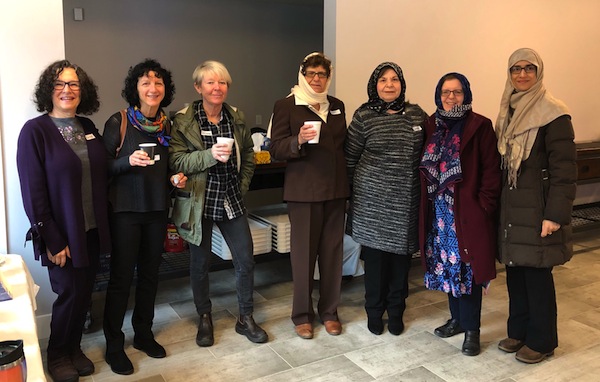
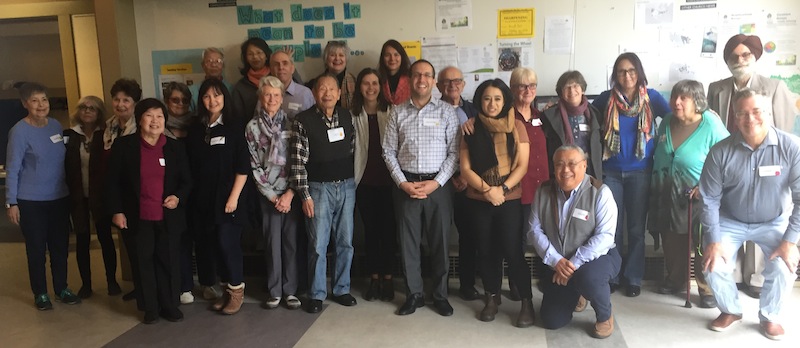
Women from the Okanagan Jewish and Muslim communities at a Feb. 9 event, which is the first of hopefully many bringing the communities together. (photo by Steven Finkleman)

The Jewish and Muslim communities of Kelowna and its surrounding areas have started celebrating their similarities with neighbourly get-togethers.

Coming from a mixed religious background, Okanagan Jewish Community member Philippe Richer-Lafleche knows well how upsetting it can be to be labeled or misunderstood. Yet, he has consciously chosen to look beyond his negative experiences.

“I feel that we’re not called to religion. God doesn’t call us to religion. He calls us to relationships,” said Richer-Lafleche. “We talk about the covenant as a relationship. We have communities, and out of communities come tradition, and out of tradition and culture comes religion. When you get hung up on the religious thing and the symbolism, and forget about the relationship, that’s when we get into trouble…. For me, what’s important is how I relate to myself, the world around me and the people I live with.”

Last summer, OJC president Steven Finkleman asked Richer-Lafleche if he would consider being part of the board and Richer-Lafleche agreed. A few months later, Finkleman and Richer-Lafleche began talking about connecting with the growing Muslim community in hopes it would provide a blueprint for connecting with the other local communities, including First Nation, Sikh, Christian, Hindu, Buddhist and others.

“We began by approaching the mosque,” Richer-Lafleche told the Independent. “Steven knew somebody who’s on their council, got in touch, and we had a meeting. We thought that the two of us would go to the mosque and meet with one or two people. We met with the entire board for the mosque – about eight people, three women, five men, I think. They said they’ve wanted to do this, too, and had been talking about how.”

The Muslim community appointed Rehan Sadiq as their lead in the initiative, and Richer-Lafleche and Sadiq began meeting at the local Tim Hortons almost every weekend for coffee and conversation, becoming friends in the process.

The first event bringing together the communities took place Feb. 9 at the Kelowna Islamic Centre, and the next one is being planned for this spring at Kelowna’s Beth Shalom Congregation.

“The concern I had was just how many people at the synagogue would be interested,” said Richer-Lafleche. “But, it worked out very well, with about two dozen people from both sides, open to families and people of all ages.

“It started with a 10-minute talk – somebody from the mosque, somebody from the synagogue, talking about the community, how the community in Kelowna or in the Okanagan developed, where the Jews or Muslims here came from … some of the challenges in the community…. There was a little bit of talk about some of the shared values, and I think a lot of the people from the synagogue were astounded that there weren’t a lot of differences, that a lot of the values were the same.”

Once the formal part of the event took place, participants had lunch together and mingled, then took a tour of the newly built mosque, which included a call to prayer.

“There was a young fellow who calls to prayer, beautiful voices in Arabic, from my perspective it was absolutely beautiful, moving,” said Richer-Lafleche. “People from both sides said this was the beginning of a relationship between the two communities, but also core for interfaith connection with other communities.”

Both Richer-Lafleche and Sadiq are working on other ways for their communities to connect with, learn about and support each other.

“I know, in the Islamic world, Jews living in the Islamic world throughout our history, there was this interchange between Muslims and Jews, with science, literature, philosophy, and even spirituality,” said Richer-Lafleche. “It’s unfortunate that, in the 20th century, it seems to have broken down. Maybe, in a small way, in a small part of the world, with a very small group of people, we can start to do something like that … and maybe peace in the world.

“I know there may be a few people at the synagogue that may be very uncomfortable with the fact that there’s this connection with Muslims … and that’s just simply fear,” he added. “We’re stepping outside that comfort zone and you progress slowly.”

“We had a very small Jewish community,” said Sadiq, referring to Pakistan, where he was born. “When I came here [in 2008], there was a very small mosque, housed in an old church. We recently built a large mosque and wanted to find ways to connect with the Jewish community.

“My children go to public school and have friends of all different faiths. I don’t want my kids to be biased. I want them to explore and appreciate. I want them to get to know our neighbours.

“I’m glad that our story is newsworthy and very important. One-on-one interaction is the best way to move forward, instead of relying on what we hear in the news.”

“There’s a saying,” added Richer-Lafleche. “‘When you look into the face of another human being, it’s wonderful when you realize you’re actually looking into yourself.’ And it’s that connection that we need in this world. I think that’s what’s important.”

For more information about the OJC, call 250-862-2305 or visit ojcc.ca.


Rebeca Kuropatwa is a Winnipeg freelance writer.

Format ImagePosted on March 22, 2019July 2, 2020Author Rebeca KuropatwaCategories LocalTags interfaith, Jews, Kelowna, Muslims, OJC, Okanagan, Philippe Richer-Lafleche, Rehan Sadiq

Complexity and perspective

I recently heard some difficult news. A good friend of mine from university has been diagnosed with a serious form of cancer. Over time, we’d moved, had children and fallen out of touch, but I was able to reach her quickly. She is well enough for emailing, and we’ve fallen right back into the dear friendship we had 20-some years ago. Some of her more recent pathology reports are slightly more hopeful. Even so, it’s a very serious diagnosis and she’s in her mid-forties with kids in elementary school.

During university, this friend and I were part of a trio of busy young women. Often the only time we could spend together was breakfast. We’d have bagels and coffee at a sunny warm spot, the Ithaca Bakery. The snow was piled high outside and the windows were steamed with humidity as we laughed and complained together. It was the third friend who told me about the brain cancer. She and I each, within moments, had come up with medical resources for our dear friend. We felt lucky to be able to say, “I know something about this,” or “I know someone if you need medical information or another opinion.” We wanted to support her from far away.

I was reminded of this when looking at the Torah portion Yitro (Exodus 18:1-20:23), which starts out with a story about Jethro, Zipporah’s father, and Moses. Jethro is Moses’ father-in-law. When Moses tells him how the Israelites have escaped Egypt and what has happened, Jethro responds in Exodus 18:9: “And Jethro rejoiced over all the kindness that the Lord had shown Israel when He delivered them from the Egyptians.”

Rashi responds to this by saying that Jethro rejoicing is the literal meaning, but that Sanhedrin 94A (a talmudic midrash) suggests that Jethro’s skin prickled, or crept with horror. He felt upset about Egypt’s destruction. Rashi explains further that “people say” that one should not speak negatively about non-Jews in front of someone who has converted to Judaism, even if the family converted 10 generations ago.

Jethro is called a Midianite priest, and is considered a “non-Hebrew.” The Druze consider Jethro an important prophet and ancestor. No matter – Moses was close with him, and married his daughter. This text and the commentary is laden with meaning. Just on its surface: Jethro celebrates and is grateful that his daughter and son-in-law and the Israelites have come through a terrible experience. Yet further still, the midrash explains that Jethro knew the ramifications of the experience. Egyptians suffered and were destroyed to bring about this event. Finally, there are valued connections between people. It doesn’t matter where you come from – we shouldn’t cause distress to those we love, if at all possible, even if they aren’t part of our “in-group.” Things in life are complex. We should celebrate and be grateful, but not cause further harm, either. Jethro intertwines these concepts.

Jethro goes on to help Moses learn to delegate and do “leadership development.” He encourages Moses to rely on the Israelites to lead and take care of one another, as well.

What does this have to do with hearing of my friend’s terrible illness?

It was a wake-up call and a reminder to be thankful, as Jethro was, and celebrate what we have – we can’t take our health for granted.

The good news is I am back in touch with someone I care about. It’s also an opportunity to look at how a third friend told me this news, and that my friend with cancer has a rich community to lean on. She can delegate, too, regarding communication, help with her family, and maybe even finding medical advice and explanations.

It’s also a reminder that we’re all connected, regardless of religion. As Rashi shows us, treating people with care extends beyond the team with which you daven (pray).

Finally, smart people realize that real-life situations are complicated. It’s simplistic to have a one-size-fits-all approach to nationalism, for example. Moses supported and shepherded the Israelites, but he also cared deeply about people who were not, strictly speaking, part of his crowd. Yes, we’re Jewish, but we often love people who aren’t, and that is part of our tradition, too.

We’re lucky to have a tradition that values complication. As Jews, we face a lot of complex concepts in the world, whether it’s our own personal observances or how we apply those values to the world at large. We could choose a simplistic response, such as a tirade or blanket objection to a view different than our own. Many people do this – face it, it’s easier. Or, we could acknowledge the complexity of our choices instead.

Jethro wasn’t Jewish, and he wasn’t a one-issue guy. He could celebrate and express gratitude while wrestling with other feelings: concern, loss, sadness and worry. I hope to be like Jethro and do the same.

Joanne Seiff has written regularly for CBC Manitoba and various Jewish publications. She is the author of three books, including From the Outside In: Jewish Post Columns 2015-2016, a collection of essays available for digital download or as a paperback from Amazon. See more about her at joanneseiff.blogspot.com.

Posted on January 25, 2019January 24, 2019Author Joanne SeiffCategories Op-EdTags interfaith, Judaism, lifestyle
Sharing holiday spirit

Sharing holiday spirit

Left to right: Archbishop JohnMichael Miller, Dr. Gregg Gardner, Fr. Nick Meisl, Dr. Jay Eidelman and RabbiJonathan Infeld. (photo by Rabbi Adam Stein)

“This is a unique opportunity to learn and growtogether. What better way to open ourselves to that holiday spirit, to welcomethe mysterious and send away the fear of the unknown,” said Congregation BethIsrael president Helen Pinsky in introducing the Dec. 5 program at thesynagogue on Chanukah and Christmas, which was co-hosted by Beth Israel and theRoman Catholic Archdiocese of Vancouver.

After the lighting of a giant electronic chanukiyah by Rabbi Jonathan Infeld, the reciting of the motzi by Archbishop of Vancouver John Michael Miller and a latke-laden dinner, the crowd moved into the sanctuary to hear three scholars: Dr. Gregg Gardner, Diamond Chair in Jewish Law and Ethics at the University of British Columbia; Fr. Nick Meisl, a professor at St. Mark’s College; and Dr. Jay Eidelman, who lectures on the Holocaust and Jewish history at UBC.

Infeld started things off with a short talk.

“The neighbourhood we grew up in, in Pittsburgh, was 50% Jewish or Catholic,” he said. “The kids did not refer to themselves as Jewish or Christian but as ‘Chanukah’ or ‘Christmas.’ We don’t love this, but it shows that the holidays have a particular power.”

Noting that, for many Jews and Christians of the past, neither Chanukah or Christmas were important as religious holidays, the rabbi quoted a documentary he had watched that argued that Charles Dickens had created Christmas, quipping that maybe Dickens “created Chanukah as well, in its modern version.”

Gardner spoke on the origins of Chanukah, noting it was a festival created by the Maccabees to mark their military successes against the Greeks in an effort to preserve traditional Jewish culture. “Ironically,” he said, “creating a holiday to honour yourself is, in fact, a very Greek thing to do.”

The “subversive” rabbis of later generations altered the holiday to downplay its militaristic elements and its focus on the Maccabees, Gardner explained, replacing that with a focus on God’s miraculous intervention in the miracle of the oil that burned for eight days in the rededicated Temple.

In his remarks, Meisl said the balloon of his “naive beliefs” about Christmas popped when, in the course of his studies, he learned that Dec. 25 was not Jesus’s birthday, but rather a date chosen for other reasons. He explored the theories linking the day to the ancient Roman Saturnalia festival of late December, or the Dec. 25 holiday of Sol Invictus (Unconquerable Sun). With humour, he quoted the ancient Christian theologian Origen, who questioned whether Jesus’s birthday should be celebrated at all, noting that, in the Hebrew Bible, only “bad people celebrate their birthdays.” In seriousness, he said it seems that it was around 336 CE that Christians began celebrating Jesus’s birthday on Dec. 25.

Eidelman took to the podium to the sound of the 1970s classic “Eight Days of Chanukah” by Sharon Jones and the Dap-Kings, while changing from his suit jacket to a tacky Chanukah sweater, in the style of the dreaded Christmas sweater. His speech covered various historical and pop-culture themes related to the two holidays, with a focus on how Jews have imagined and reimagined Chanukah “as a way to define ourselves spiritually and a way to claim space in a culture largely based on Christian customs.”

After a short question-and-answer period in which people asked about the development of certain Chanukah customs and the role the story of the Maccabees has played in the Christian tradition, among other things, the archbishop wrapped up the event.

“This has been a wonderful evening of sharing the joy we each feel in the holidays with each other,” said Miller, who made a point of thanking everyone involved in the event by name, right down to the members of the catering and kitchen staff.

“The event was a splendid manifestation of the ties that bind Christians and Jews together in an age-old spiritual heritage,” Miller told the Jewish Independent by email. “Such occasions foster friendships and mutual understanding, and my hope is that they continue. I am very grateful to Rabbi Jonathan Infeld for his leadership role in interfaith relations.”

Matthew Gindin is a freelance journalist, writer and lecturer. He is Pacific correspondent for the CJN, writes regularly for the Forward, Tricycle and the Wisdom Daily, and has been published in Sojourners, Religion Dispatches and elsewhere. He can be found on Medium and Twitter.

Format ImagePosted on December 14, 2018November 6, 2023Author Matthew GindinCategories Celebrating the HolidaysTags Chanukah, Christianity, Christmas, interfaith, Judaism
Supporting their community

Supporting their community

(photo by Rebecca Zaidi)

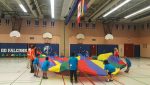
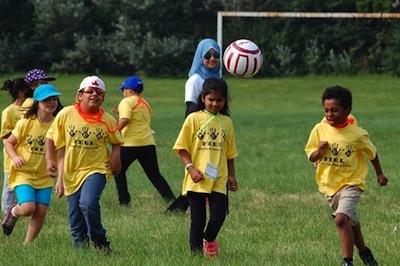
Three years ago, Rabbi Audrey Pollack of SolelCongregation in Mississauga, Ont., decided to follow the lead of Rabbi DebraDressler of Temple Israel in London, Ont., and create an interfaith peace campin Mississauga.

Pollack, who hails from the United States, moved to Canada in 2015. The Reform congregation Solel “had a tremendous reputation in the movement in terms of the education,” said Pollack, as did “the rabbi of the congregation at the time, Rabbi Lawrence Englander, who retired after 40 years here.”

As for the idea of the camp, Pollack told the Independent, “When I spoke with Rabbi Dressler, it sounded like a great opportunity to bring together interfaith dialogue and cooperation. And so, I went out there that summer for the day to see what they were doing. I thought it was a great experience for kids, adults and the teen volunteers that we have.”

As the chair of the Interfaith Council of Peel, Pollack was well-positioned to start the interfaith camp, and Solel does a lot of outreach in the Mississauga community in general.

The suburb of Toronto “has about 700,000 people and we have about 250 families in our congregation, so we’re relatively small in terms of Jewish community here,” said Pollack. “We do a lot of dialogue and conversation with the community, because we are a diverse community. It’s important for people to know who Jews are and what we are about, to make friends and to really to support each other.”

Pollack wanted to find an Islamic partner who did a lot of English-language programs, as opposed to Arabic. They found Sheikh Jaffer H. Jaffer from the Masumeen Islamic Centre in Brampton, who was excited to join, said Pollack.

“The church – Canon Jennifer Reid from Saint Peter’s Anglican Erindale – we had already been partnering with for awhile,” she said. “I knew the minister there. They run a day camp program, like a vacation Bible study program. So, that was helpful our first year, just in terms of setting up and running a day camp. They already had a few people in place that had some background.”

At first, the interfaith camp’s content was a bit of mishmash, said Pollack, but it is continually being developed and updated to meet the needs of the community. One of the bigger challenges has been to maintain a balance from each denomination; the mosque membership is much larger than that of the church and synagogue.

“The first day, we always try to do something that everyone can do together, like a get-to-know-you day,” said Pollack. “Kids need to get to know each other as kids. We do a training beforehand for our adult and teen volunteers, and, I should mention that each faith centre makes a commitment to bring a certain number of volunteers.

“The first summer we did something on tzedakah, or charity, and this summer we did something on building friendship and peace.”

Each day of camp, they go to visit a different faith centre. The campers learn a little bit more about what each group believes and how they practise their beliefs. Everyone has an opportunity to visit, have a tour and ask questions.

“We really expect the youth from each of the faith centres to do some of that explanation,” said Pollack. “It’s an opportunity for them as well.

“I remember the first time we came here [to the synagogue] with the kids for summer. Our kids were so excited, because they’d been to the mosque the day before, and they wanted to give the tour and to explain what a Torah is, why we wear kippot and things like that. So, it’s an opportunity – not only for them to learn about other faiths, but for the home faith group to be proud of who they are … and to really make the connection that there are things we share in common, and that we need to get along with each other. Basically, we need to know our neighbours.”

Most of the participating kids go to public schools around the city and may sit next to each other in class, but they rarely get to share anything about their faith in class. They may have some misconceptions or stereotypes about what someone else’s faith or culture is, said Pollack, because they don’t really discuss it.

(photo by Rebecca Zaidi)

The camp is a great opportunity to share some truth and dispel such misconceptions, she said.

The kids who have had this camp experience are already looking forward to next summer, asking when registration will be open, said the rabbi. Their parents, too, are interested in what is going on.

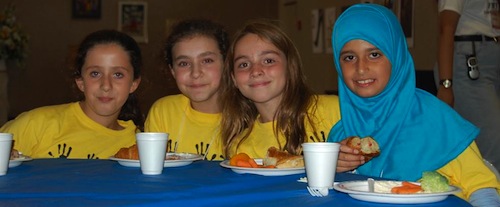
“On the last night of camp – we’ve been running this as a four-day camp, maybe five next summer –  we get together at one of the centres for a potluck meal,” said Pollack. “It is all-vegetarian, so everybody can eat. There’s a presentation and a slideshow. After the first dinner, all the parents said they wanted to go to camp and learn, so we started doing an adult session, too.

“We did a progressive dinner,” she said. “We started with appetizers at one centre, and then moved on to the next centre and had dinner. By the time they got here, at the synagogue, I could barely talk, because they were all chatting away with each other. And, it was great, because many of them, before this, didn’t know each other well.

“It was a really great day and we’re looking at doing some other programming this year. During the camp off-season, we’ll have an opportunity for dialogue and discussion, and some activities.”

With budget and space limitations, the camp is capped at 12 kids from each faith centre. While the campers pay to attend, the camp makes sure cost is not a prohibitive factor. “We want anyone who wants to, to be able to come, so we try to keep our costs low,” said Pollack.

The congregations are looking to create a couple more opportunities this coming year for people to meet, she said, “and they would like to do something for the older kids as well … to do an evening or afternoon activity where they could do a craft or cooking or something like that, and the adults could have a discussion on something that we have in common with each other.”

(photo by Rebecca Zaidi)

Because the Jewish community in Mississauga is small, said Pollack, “for our kids, when they come together at synagogue, it’s really important for them to connect with Jewish kids. For them, the opportunity to talk to their new friends from different religions and cultural backgrounds, with pride and support of each other, is important. It’s also really important for them to see that there are ideas and values and ethics that we hold in common. Often, we talk about what divides us.

“For younger kids, they just like hanging out with their new friends. They’ll talk about the activities they did together, while, for the older kids, they’ll articulate and express what they’ve learned or didn’t know before. Each time they go back, they gain something a little different.

“A very valuable part about this camp experience,” she continued, “is building relationships through intentional dialogue and intentional conversation, and the opportunity to do that in a camp setting means that people are doing it in different modalities. They are connecting with each other through play and through giving back to the community.

“One of the other things we’ve made part of our program each day, in addition to the activities we are doing, is giving back. We’ve invited representatives from the hospital to come and the kids have made cards for people in the hospital. We’ve invited people from our greening and planting area of the city to come also. So, they understand that, no matter what community you come from, there’s a value in supporting community.”

Rebeca Kuropatwa is a Winnipeg freelance writer.

Format ImagePosted on December 14, 2018December 12, 2018Author Rebeca KuropatwaCategories NationalTags Audrey Pollack, camp, interfaith, Mississauga, youth

Canada’s faith mosaic

Jewish tradition says that the chanukiyah should be illuminated in a window where it can be seen from the outside. This intersection of private celebration and public visibility is part of the holiday and, in places like Canada, where multicultural diversity is celebrated, this tradition fits nicely with the idea that we should all be proud of our various heritages.

The intersection of religiosity and public life, while not exactly parallel to this example, was addressed in a newly released study that threw a lot of accepted wisdom into doubt. The Vancouver-based Angus Reid Institute, in partnership with Cardus, a non-partisan, faith-based think tank, undertook a study on faith in the public square – and it appears almost everyone was surprised by some of the conclusions.

The study included a survey of 2,200 people across Canada, who responded to questions about their attitudes toward religion and its role in aspects of public life. The respondents divided quite neatly into thirds: the researchers identified public faith proponents (37% of the population), public faith opponents (32%) and the uncertain (32%).

Respondents were asked what they thought of the role of faith in areas such as education, social services, healthcare (such as hospitals, clinics and homes for the aged) and social justice causes (such as poverty, peace and overseas development). Overall, Canadians would like to see less faith-based involvement in these issues (56% of respondents say this), while 44% would like to see more influence. What surprised researchers, though, was who fell into the various categories.

“Notably, the results may challenge a traditional view of who Canadians within the proponent group are,” says the introduction to the study’s findings. “While one may assume this group is more likely to be made up of older and more Conservative-voting Canadians, this study finds proponents more likely to be younger, more highly educated, and largely Liberal-supporting.”

The authors continue: “This suggests that a range of Canadians – not just the highly religious – appear willing to accept certain elements of faith in public life. In fact, one-quarter of those who are most accepting of public faith have never read a religious text. Similarly, those with more strongly held religious beliefs may not necessarily be accommodating of the beliefs of others, or want to see them participating in the public discourse.”

The study’s authors seem to infer that some religious Canadians might seek to limit faith-based involvement in public life if it is extended to religious groups other than their own.

More interesting, perhaps, is the flip side: younger, more highly educated and apparently liberal (or, as the study categorized them, Liberal) Canadians who do not choose to participate in a religious tradition themselves can nevertheless see value in faith-based organizations doing good things for society. Why?

While we do not have the opportunity to probe the reasons for respondents’ answers, the surprise result might make more sense if we assume that, as multiculturalism has encouraged Canadians to recognize and celebrate difference in our heritages and traditions, a similar openness to difference has imbued itself in our attitudes to religious difference. Canadians, in general, may be less religiously affiliated, but we may, at the same time, be more open to accepting the presence of the religiosity of others – and their engagement in the delivery of public services.

Most people can probably understand that a person who has lived their lives observing Jewish traditions would, later in life, seek an assisted living or care facility that reflects their identity rather than one where the food choices, holiday celebrations and other cultural activities accentuate their difference and make them feel like outsiders. Similarly, it is natural, when in need, to seek help from an agency that is part of the community to which one belongs. Probably because we know that government cannot do all things for all people – perhaps in the roaring economy of the 1950s and ’60s we may have thought so, but those days are over – we recognize that, whatever theological differences we have, religious organizations are irreplaceable partners in caring for the sick, in-need and at-risk in our society.

Jews in North America, particularly in the United States, have been at the forefront of the movement to ensure the separation of church and state. There should certainly be vigilance against any creeping proselytization or overt theological mission within the delivery of public services. But we should recognize the difference between that and the positive impacts that people of various faith traditions have in dedicating themselves to good works. We call it tikkun olam and probably every religion has its parallel. Even as Canadians in general become less religious, it turns out we may be increasingly willing to see faith-based organizations deliver services that make our communities better.

Posted on November 30, 2018November 30, 2018Author The Editorial BoardCategories From the JITags Canada, interfaith, multiculturalism, social services, tolerance

Posts pagination

Previous page Page 1 Page 2 Page 3 Page 4 … Page 6 Next page
Proudly powered by WordPress