Skip to content
  • Home
  • Subscribe / donate
  • Events calendar
  • Business Directory
  • FAQ
  • News
    • Local
    • National
    • Israel
    • World
    • עניין בחדשות
      A roundup of news in Canada and further afield, in Hebrew.
  • Opinion
    • From the JI
    • Op-Ed
  • Arts & Culture
    • Performing Arts
    • Music
    • Books
    • Visual Arts
    • TV & Film
  • Life
    • Celebrating the Holidays
    • Travel
    • The Daily Snooze
      Cartoons by Jacob Samuel
    • Mystery Photo
      Help the JI and JMABC fill in the gaps in our archives.
  • Community Links
    • Organizations, Etc.
    • Other News Sources & Blogs
  • JI Chai Celebration
  • JI@88! video

Recent Posts

  • SFU honours Gloria Gutman
  • Lifting people’s spirits
  • Wedding a ray of light
  • Indigeneity and Zionism
  • Rule of law broken: councilor
  • Football and its roles
  • The burden of defence
  • Fish Café returns after fire
  • All right in what goes wrong
  • Nuns & mermaids at TUTS
  • Camp offers holiday retreat
  • Students and mentors inspire
  • Once-in-a-lifetime trip
  • 100 dancers, one heart
  • Money for the sciences
  • What “Jewish food” means
  • Have a cookie, schnitzel too
  • Federation now across BC
  • Israel fighting for its existence
  • Deal strengthens Iran
  • Patriotic belonging diminishes
  • A campaign to engage
  • Upstanders’ first live event
  • Responding to Carney
  • Having your own home
  • Music a family tradition
  • Musical to warm heart
  • Community milestones … June 2026
  • Sharing her passion for Israel
  • Or Shalom reopens its doors
  • JFS from past to future
  • Need holistic approach
  • Sharing stories, advice
  • Journalist shares fears
  • Skills to live together
  • Road to independence

Archives

Follow @JewishIndie
image - CJN box ad Rockowers 2026

Tag: interfaith

Jewish-Muslim unity efforts

Jewish-Muslim unity efforts

On March 13, members of Calgary’s Muslim community visited Congregation Beth Tzedec. Jewish community members had visited Green Dome Mosque the week prior. The events were part of the Our House is Your House program. (photo from Shaul Osadchey)

After a 2014 clash between Palestinian and Israeli supporters on the grounds of Calgary City Hall that ended violently, Imam Syed Soharwardy of Green Dome Mosque reached out to local rabbis and Jewish community leaders, and Rabbi Shaul Osadchey of Beth Tzedec responded by inviting Jewish and Muslim leaders to his synagogue for discussions.

The discussions helped make the next demonstrations peaceful. They also helped transform the general relationship between the Muslim and Jewish communities, which led to two unity events held this past March.

“From that conversation, we made a commitment to meet again and continue the conversation,” said Osadchey. “We continued to meet at Beth Tzedec monthly and, within about two months, we decided to form the Calgary Jewish Muslim Council.”

That council has been meeting for almost two years, discussing various issues that affect both communities. Through this, the rabbi proposed the concept of Our House is Your House, the program that hosted the recent unity events. The program’s purpose is to bring together lay members of the communities for table conversations – not for lectures about religion, but simply to come together to explore mutual commonalities.

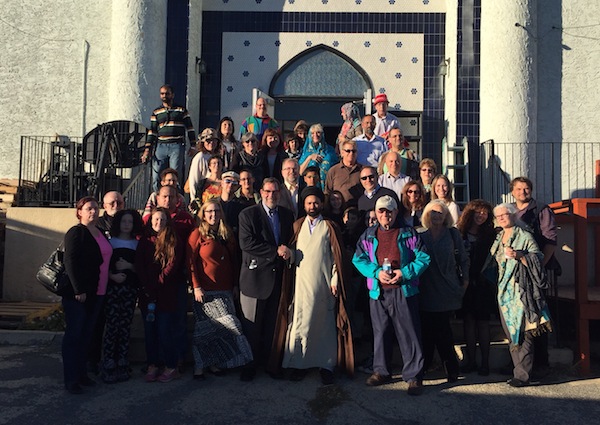
On March 6, about 50 Jewish community members made their way to Green Dome Mosque in northeast Calgary for the first of two consecutive Sunday events, the second of which took place at Beth Tzedec.

“We had a very inspiring program in which the clergy spoke at the beginning and then a lot of people were then invited to ask questions and express how they felt about doing these kinds of programs and getting to know each other,” said Osadchey. “We had refreshments and people visited with each other. It was quite a significant day.”

According to Osadchey, those who attended were impressed, finding the imams forthright in explaining how they felt the use of certain quotes from the Quran, such as, “you shouldn’t make friends with Jews or Christians,” were often used out of context and not in the true spirit of Islam.

The plan is to expand Our House is Your House with the program My House is Your House, matching people up for dinners in community members’ homes. There is also another program, funded by a Beth Tzedec member, that will see Jewish and Muslim teens (15- to 16-year-olds) engage in philanthropy.

“We’ll have six to eight Jewish youth and six to eight Muslim youth meet for six sessions, alternating between the mosque and the synagogue,” said Osadchey. “They will focus on learning about charity in each other’s traditions. They’ll identify common values, and then will go through a process of selecting and then allocating funds that have been donated to organizations in Calgary that they think reflect the values that they’ve articulated. So, it’s going to be an opportunity for the teens to get together and build a relationship, and do something constructive and positive to influence the community.”

Another initiative between the communities involved the Soup Sisters, an organization that was started by two Beth Tzedec women and has grown to include chapters in many Canadian cities, as well as one in Los Angeles. (See jewishindependent.ca/soup-ladled-with-love.)

“They make soup that is then donated to abused women in shelters and other facilities,” said Osadchey. Wanting to do a soup project for Syrian refugees, “the women came to me and asked how to get halal meat. I sent an email to several imams, asking them if they knew anyone who’d be willing to donate 86 kilograms of halal meat. Within an hour or two, I got a response from an imam saying he has the name of an individual able and happy to do that and that he’s expecting my call. Again, things are working in ways that we’re able to accomplish wonderful goals to help people in the community.”

Soharwardy, who initiated the Jewish-Muslim unity talks, is also the founder of Muslims Against Terrorism and the Islamic Association of Canada. He is a Sunni Muslim who follows the Sufi tradition.

“About three months ago, Rabbi [Osadchey] and I were chatting,” said Soharwardy. “He said, ‘Let’s do something grassroots instead of a rabbi and an imam talking. Let’s involve our families, women, children, everybody.

“I think this was the first time in the history of, at least Canada, that such a large group from the Jewish community came to the mosque. They had a dialogue, they had food … we sat together for an informal discussion…. That inspired so many Muslims. It removed misunderstanding. People realized, Jewish people are not our enemies, we have so much in common.”

photo - About 80 or 90 members of the Muslim community went to Beth Tzedec on March 13
About 80 or 90 members of the Muslim community went to Beth Tzedec on March 13. (photo from Shaul Osadchey)

About 80 or 90 members of the Muslim community went to Beth Tzedec on March 13, he said. “We sat down, we saw the Torah, we heard three rabbis there. We were so amazed. I was happy to see we have so much in common. I’m so happy and I’m still, in my mind, still in that synagogue, listening to this rabbi and the way he was performing. I can’t call him anything except a person of faith, and his Jewish faith is very close to my faith. It’s just an amazing feeling. I don’t understand why we are enemies. I don’t think we are enemies.”

Soharwardy can hardly wait for the next step of inviting some new Jewish friends to his house to share food and conversation.

“I think, at the family level, we should start engaging ourselves,” he said. “That will build the relationship among adults as well as children … so our children will get the understanding that we are not enemies, we don’t hate each other. We are normal humans, Canadians, and neighbors.”

Osadchey added, “We recognize there’s still a lot of work to be done in both communities. There’s a lot of suspicion, a lot of stereotype and misinformation that exists in our communities about the other. To further break that down really takes people-to-people contact.

“There’s a lot of anxiety and a lot of cynicism and doubt about whether these efforts are really viable,” he continued. “I think the more that we’ve done together as two communities, the more the message is emerging that, yes, this is worth doing. We’re not under any illusion that we are going to change events in the Middle East, but we are creating an alternative model that will have a ripple effect beyond Calgary, that will say to people, having good relationships and learning about each other and respecting each other is definitely possible and desirable.

“We’re doing it with people in the Jewish community and Muslim community. We all have relatives in the Middle East. We have relatives elsewhere, too. So, to be able to model what we are doing and let people know about this will put the seed of change elsewhere … so that it goes beyond our local efforts.”

Rebeca Kuropatwa is a Winnipeg freelance writer.

Format ImagePosted on May 13, 2016May 11, 2016Author Rebeca KuropatwaCategories NationalTags Beth Tzedec, Calgary, interfaith, Jews, Muslims, Osadchey, Soharwardy
Hillel BC to Rwanda, Israel

Hillel BC to Rwanda, Israel

The Hon. Jody Wilson-Raybould, minister of justice and attorney general of Canada, centre, addressed Project Tikkun participants at Hillel BC on March 13. (photo from Hillel BC)

As the academic year winds down on university campuses across the province and students gear up for exams and summer jobs, 15 student leaders from the University of British Columbia and Simon Fraser University are also preparing for a totally different experience: a 16-day experiential learning and service trip to Rwanda and Israel.

Project Tikkun was developed by Hillel BC to challenge students to “understand the essence of hate by breaking down stereotypical thinking.” It is a yearlong program of learning that allows participants to explore the root causes of racism and antisemitism, culminating in a service trip to Rwanda and Israel between May 3 and 18.

The overseas component will enable participants to bear witness to how the diverse citizenry of two relatively young nation-states have grappled with a legacy of genocide. It will provide a firsthand examination of conflict resolution and reconciliation through the humanitarian work and activism pursued in each country to build durable and bonded communities.

According to its website, Project Tikkun brings together “undergraduate students of different ethnic backgrounds, religious practices, sexual orientation and personal beliefs to establish a caring and committed community of change-makers.”

Rebecca Recant, program director at Hillel BC, noted that the intent of the project is also to “build a local community of allies that can support each other when a [hateful] incident comes up, no matter which community.”

Student interest in the program exceeded the limited number of spaces and, last fall, a diverse group of 15 participants was selected. The group includes students of Chinese, Taiwanese, Indian, Korean, Persian and Rwandan backgrounds and a mix of the Jewish, Sikh, Baha’i and Christian faiths. The religious affiliation of the Jewish students varies – some come from secular homes whereas others were raised Orthodox; some have visited Israel and, for others, this will be their first trip to Eretz Yisrael.

Over the course of the year, the participants have been getting to know each other and examining their biases through intensive group learning sessions in which they have explored the history of Canada, Rwanda and Israel. A number of guest speakers, ranging from academics to community activists, have facilitated discussions. Of note, Dr. Andrew Baron, an assistant professor of psychology at UBC whose research examines the cultural and cognitive origins of unconscious bias, structured tests for Project Tikkun participants based on the Harvard Implicit Bias Test that he helped create. Jordana Shani, managing director of Hillel BC, explained that the testing of participants’ level of bias takes place at three different intervals: at the outset of the program, prior to departure and one to two months after return to Canada. The testing provides a way “to measure what we’ve done and how effective the program has been,” she said.

Certainly, much time, effort and money has been channeled into the program, especially the service trip. The journey begins in the capital city of Rwanda, Kigali, where local guides will accompany the students on a tour that will highlight the many landmarks and memorials of the 1994 genocide. The students will then travel to the Agahozo-Shalom Youth Village (ASYV), where they will spend the bulk of their time. Established in 2008 as a residential community-home to protect and nurture Rwandan children who were orphaned during and after the genocide, ASYV now cares for approximately 500 of Rwanda’s most vulnerable high school-aged students. It is modeled after Yemin Orde, an Israeli youth village founded in 1953 to care for orphans of the Holocaust, and it provides a family-like environment for at-risk youth.

The Rwandan students “grow up in this youth village hearing about the youth aliyah village in Israel that [ASYV] was based on,” said Recant. “It’s an Israeli model that is part of the connection between the two countries. They even know Hebrew words, like tikkun olam.”

At the youth village, Project Tikkun participants will learn and live side by side with the ASYV students and volunteer in the classrooms, on the farm and in the kitchen. They will accompany the ASYV students during their foray into town to fulfil a weekly community service commitment.

Libia Niyodusenga, a second-year UBC economics and geography student who was raised at the Agahozo-Shalom Youth Village, is looking forward to returning to Rwanda as part of Project Tikkun. “I think the country itself has the best ways and methods of teaching people through so many organizations that are based in Rwanda and so many history-based sites that you can learn from,” he said.

From Rwanda, Project Tikkun participants will travel to Israel, arriving on Yom Ha’atzmaut, where they will celebrate Israel’s independence in Jerusalem. Later, they will commemorate the victims of the Holocaust at Yad Vashem, tour the Old City and observe Shabbat before moving on to explore other parts of the country, including the Yemin Orde Youth Village. All the while, participants will learn from and volunteer with Israelis who are committed to combating intolerance and inequality – political, religious, ethno-cultural and socio-economic – to effect positive change within Israeli society.

The Israel portion of the trip will demonstrate that complex issues – both regional and domestic – defy the simplistic characterizations often portrayed by the media and that “you can love the country and be critical of it at the same time,” said Shani. The participants, she added, “will meet with people who believe in the right of Israel to exist and who are engaged to make it a better place.”

Jasmeet Khosa, a fourth-year student of international relations at UBC whose Sikh parents immigrated to Canada from Punjab, India, said: “I know that this project focuses on Rwanda and Israel as case studies [for conflict resolution and activism], but what I’ve learned so far is that this extends far beyond – [the message] is universal.”

By all accounts, Hillel BC is pleased with the results of the project thus far. Participants are inspired to help create positive change both at home and abroad and have developed a profound sense of strength through their diversity. As Khosa observed, “… the great thing is that we come from such different backgrounds – academically, culturally, religiously – that everyone brings their own perspective and we get a really great mix in that everyone has something unique to contribute to discussion and friendships, in general.” Niyodusenga added that the connections between program participants are already “deep and intimate.”

In reflecting on the many experiential learning and service trips that she participated in during university and how integral they were to forming her identity, Recant said, “Trips like this are life-changing.”

Shani and Recant are grateful for a grant from the Diamond Foundation that made Project Tikkun possible. While participants will pay a fee, the cost of the program is heavily subsidized to ensure that finances do not pose any obstacles. However, because of the decrease in the value of the Canadian dollar, Hillel BC is continuing to seek financial support for the program. For more information about Project Tikkun, visit projecttikkun.hillelbc.com; to make a donation, call 604-224-4748.

Alexis Pavlich is a Vancouver-based freelance reporter.

Format ImagePosted on April 15, 2016April 13, 2016Author Alexis PavlichCategories LocalTags antisemitism, genocide, Hillel BC, interfaith, Israel, racism, Rwanda, tikkun olam
Learning about other faiths

Learning about other faiths

During mock weddings, participants learn about Jewish and Sikh rituals. (photo from Shaul Osadchey)

While Judaism is the main focus of any synagogue, and many stop there, that is not the case with Calgary’s Beth Tzedec Congregation. They have decided to take their Jewish engagement into the wider world and have hired scholars from other faiths to teach them about those faiths.

“There are a great number of religious traditions that are present in the community,” said the synagogue’s Rabbi Shaul Osadchey. “How do we learn about other people? How do we engage in conversation and interfaith relationships with people unless we know something about them? That’s the challenge.

“In thinking about that, which is fundamentally an issue of how we make Jews more religiously literate about other religions, the challenge is to do that in a way that people will come out and actually participate in the learning.”

Osadchey knew that if he left it to others to start the process, he’d be able to count participants on one hand – out of the 600 families that are a part of the synagogue.

“People aren’t going to initiate that,” said Osadchey. “People are intimidated going into other people’s houses of worship. They don’t find the time to do this on their own. The thought was, then, sanction it and bring it into the synagogue … making it ‘kosher’ in the sense that it’s acceptable for us to do. Secondly, it will be much more effective, because people will be much more comfortable coming into a familiar environment to learn about others.”

Osadchey was able to find someone in his congregation willing to support the cause, leading to the creation of the Lil Faider Interfaith Scholar in Residence Program.

“The idea was to allocate $10,000 a year for five years and pick five religions we wanted to examine, and invite a scholar or religious leader from the chosen tradition to be on our staff and teach within the synagogue for about 10 months (not over the summer).

“The first year, 2013-2014, we selected Sikhs. I thought that would be a good starting point because we know very little about Sikhs. They have a fairly significant amount of people in the Calgary community. Approximately 20,000 Sikhs live here, which is at least twice the size of the Jewish community, and they are very visible and yet kind of mysterious to us, we don’t know much about them.”

In his High Holiday sermon that launched the program, Osadchey invited attendees to learn about Sikhism. “All we know about them is they work at the airport, they

drive taxis and they wear a turban,” said Osadchey to congregants. “People kind of chuckled, and said, ‘Yeah, yeah. I know that.’ The point was, what do you know beyond that? The answer was relatively nothing. That’s not enough to engage people in conversation let alone collaborate in community activities.”

The synagogue hired Dr. Harjot Singh, a medical doctor and leader in the Sikh community. She presented lectures, followed by some experiential activities. One program was called Turban and Tefillin.

“That was pretty amazing, because it was a way in which we explored what the meaning of religious apparel is in our respective traditions,” said Osadchey. “The fact that we both cover our heads and wear identifiable religious objects was a starting point. During this program, all the Jewish participants were shown how to put on a turban and each of us was wrapped in one.

“We see turbans, but we don’t see them unwrapped … and now [we] understand how complicated it is for the novice to actually do that. Even though it only takes them three to five minutes to do, it’s quite an art. It was really quite wonderful to be wearing this turban and get a feel for what it’s like. Then, we wrapped them in a tefillin and they got an idea of what that was as a religious object.”

The congregation was invited into a gurdwara, the Sikh house of worship, and experienced a service. Then, they joined everyone in the langar, or common kitchen, where people can eat for free. Lastly, they finished the year off with a mock Sikh wedding and a mock Jewish wedding, for which they put up a chuppah, and presented the wedding rituals, acting them out and taking note of the similar and different rituals.

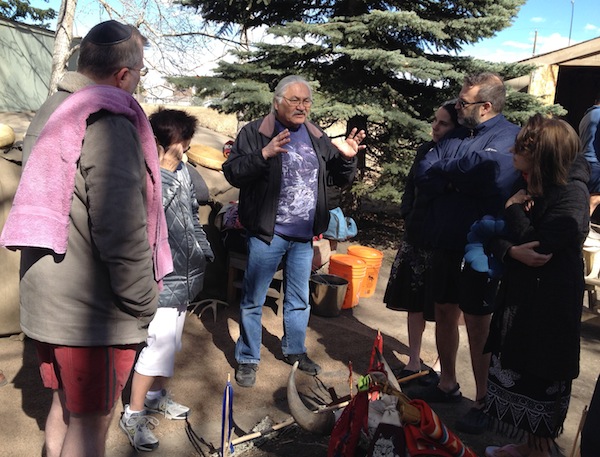
photo - Casey Eagle Speaker welcomes Beth Tzedec’s interfaith learning group to a sweat lodge
Casey Eagle Speaker welcomes Beth Tzedec’s interfaith learning group to a sweat lodge. (photo from Shaul Osadchey)

In 2014-2015, the synagogue focused on aspects of First Nations spirituality, inviting Casey Eagle Speaker and another teacher to give lessons on their culture.

“The year ended with a sweat lodge we went to, for us exclusively,” said Osadchey. “Afterwards, we sat around and passed the peace pipe together. People really learned a lot from that, as native spirituality is an oral tradition mainly. These are customs passed on and taught – sundance, sweat lodges and so forth – but they also have a very interesting perspective about the creator, nature and the role of people in terms of building community and families. That was quite eye-opening.”

This year, with all the new connections the synagogue has made with the Muslim community, they decided to focus on Islam.

“We didn’t start with Islam and we didn’t start with Christianity, because people probably would have said, ‘Oh, I know everything I need to know about Christianity, so I’m not going to show up,’” said Osadchey. But it was time to get to Islam, he said. “The next two years are going to be Hinduism and Buddhism.”

For Islam, the congregation selected Imam Syed Hadi Hasan of the Shia branch of Islam, who has a long history of interfaith work.

“What we did, however, was to respond to some of the naysayers and the skeptics by inviting a Jewish rabbi/scholar from L.A. after the imam had given about three lectures, and then we had Dr. Reuven Firestone come and speak,” said Osadchey. “He’s written books on Islam for Jews, about what Jews should know about Islam and what Muslims should know about Judaism. He’s very active in Muslim-Jewish dialogue. He came up and gave us a weekend of four lectures on different aspects of Islam and how we approach it. We invited our Islamic friends to come and many did. And, they were very impressed by his scholarship and knowledge of the Koran and so forth.”

At Chanukah time, the synagogue invited three imams to share their thoughts on religious freedom and join in the lighting of the chanukiyah, along with the rabbis. At the end, they all held up letters that spelled the phrase, “We refuse to be enemies.”

Osadchey said, “It was a powerful moment and brought Chanukah and the whole meaning of respect into a much different perspective.”

photo - Imam Syed Hadi Hasan, right centre, takes Rabbi Shaul Osadchey, left centre, and some congregants on a tour of his mosque
Imam Syed Hadi Hasan, right centre, takes Rabbi Shaul Osadchey, left centre, and some congregants on a tour of his mosque. (photo from Shaul Osadchey)

This March, the synagogue initiated the program Our House is Your House, which will be profiled in a future issue of the Independent.

Although Christianity is not one of the religions studied in the first five years of the program, the synagogue hopes to continue with a sixth year focused on Christianity. The program so far has been beneficial.

“It has given people permission to go out into the community and do things in a way they may have been hesitant to do before,” said Osadchey. “They have more confidence that they have the knowledge and the literacy to engage people.”

The scholars, too, gained much from the experience. “I was thrilled and amazed at that request and immediately accepted it,” said Hasan. “And I did my best to teach about Islam and answer all the questions from the participants of the five sessions I was part of.

“In the first session, participants were not very comfortable…. They were friendly, but they were a little bit formal in the beginning … but, gradually, we developed a friendship.”

Hasan is planning to bring Judaism into his mosque in a similar fashion, calling Beth Tzedec’s method “perfect and brilliant.”

He said, “We will be inviting Rabbi Osadchey for probably three to four sessions and he will be introducing Judaism…. When we are ignorant, when we don’t know each other, definitely, we have a lot of misconceptions. We are going to bring knowledge and awareness, and show that we are almost the same. We all work for the welfare of humanity and the universe. In this sense, we all are the same. In doing these programs, we are promoting peaceful coexistence and we are bringing harmony and unity within our communities.”

Speaker, who is a member of the Blood Tribe, which is part of the Blackfoot Confederacy in Alberta, echoed Hasan’s feelings, mentioning he found the experience very valuable.

“I enjoyed the hospitality and the openness that the people had,” said Speaker. “The congregation was very open in mind, body and spirit, very open to listening, to understanding who we are as a people, as indigenous people, and about the concerns or issues prevalent in society. They showed me a hunger to learn and to create an understanding, rather than just knowing.

“In our culture, we share openly to create an understanding and come together as human beings, rather than being separated by race, creed, color and religion. Those don’t work. We’ve seen the conflict that those create.

“They shared with me. They felt safe. They didn’t feel threatened. It felt more like family and how we do … the openness of sharing and expressing kindness, generosity and acceptance of each other was something they really came to be accustomed to. And, our style of ceremony, going into prayer and stuff like that, it’s so heart-warming.”

Rebeca Kuropatwa is a Winnipeg freelance writer.
Format ImagePosted on April 15, 2016April 13, 2016Author Rebeca KuropatwaCategories NationalTags Aeriosa Dance Society, Beth Tzedec, Calgary, interfaith
Refugee policy evolves

Refugee policy evolves

Rabbi Dan Moskovitz, left, and Dr. Harold Troper. (photo by David Berson)

The current refugee crisis – and Canada’s responses to past crises – was the topic of an interfaith panel recently, which raised issues especially relevant as Passover approaches.

Our Home and Native Land? A Multi-Faith Symposium on Refugee Settlement featured a keynote presentation by Dr. Harold Troper, co-author of None is Too Many: Canada and the Jews of Europe, 1933-1948. The event, on March 18, also included a panel discussion that featured Rabbi Dan Moskovitz of Temple Sholom. Catalina Parra brought a First Nations perspective, Imam Balal Khokhar spoke from a Muslim point of view and Rev. Dr. Richard Topping spoke as a Christian.

Troper recalled being part of a Canadian group that traveled to eastern Germany two decades ago, after the Berlin Wall fell. States in the east of the newly reunified Germany were seeing an upsurge in migration from countries further to the east. A group of Canadians was invited to listen and give advice on Canada’s experience integrating newcomers. At one point, a local official thanked Troper for his comments, but asked, “What do you do with your foreigners?”

Troper expounded on the concept of “new Canadians,” a formulation perhaps unknown in any other country, in which people arriving with the intent of making Canada their home are acknowledged not as foreigners or as migrants, but as people becoming part of our polyglot population already on a path to inclusion.

Of course, Troper acknowledged, this was not always so. None is Too Many, published in 1983, was a seminal book that has had lasting impacts on Canadian views of migration and refugees. The title comes from a quote from an anonymous Canadian immigration official who responded with these words to the question of how many post-Holocaust refugees to admit. The words have been attributed, in some tellings, to F.C. Blair, Canada’s then-director of immigration. However, while this is not provable, Blair’s actions were in line with the words.

Recounting this country’s exclusionary policies toward the desperate Jewish populations of Europe in the prewar period, but also a similar disregard after the war, the book has been held up as an object lesson in how not to respond to people in crisis. Troper said he didn’t know until years later the impact the book had had on one very significant episode in Canadian history.

In 1979, Troper and Abella sent an academic paper that preceded the book to Ron Atkey, Canada’s immigration minister. Atkey was a member of Joe Clark’s cabinet and, though that Progressive Conservative government lasted only nine months, it was during Clark’s term as prime minister that the decision was made to welcome 60,000 Vietnamese refugees, known as “boat people.” Troper said he found out later that the manuscript they sent played a role in the decision.

“We hope Canada will not be found wanting in this refugee crisis the way it was in the previous one,” the authors wrote in a note accompanying the manuscript. They expected no response and they received none. But, several years later, Troper said, Atkey told him that he had read it.

“He told us he was shocked and dismayed when he saw the political parallels between the Vietnamese and Jewish refugee crises,” Troper recalled. “Then and there, Atkey told us, he decided he was not going to go down as the F.C. Blair of the boat people.”

Already predisposed to encourage his cabinet colleagues to take a generous approach, the article stiffened his resolve to stand firm against ministers who disagreed. The government initiated a joint federal-private sponsorship program.

“It today serves as the prototype for Canada’s Syrian refugee program,” said Troper.

Now, as refugees are coming from North Africa, Asia and, most notably, the Middle East, fleeing civil war and ruin in Syria and Iraq, Troper sees parallels between the fears expressed now and those of seven decades ago.

“The fears are not only around the expenses of accommodating these refugees, but that the intake of a population of different race, religion and cultural assumptions and social expectations will destabilize destination countries,” he said.

Not dissimilar, he said, were fears that European Jews might bring socialism, communism, anarchism – even Nazism – with them.

“Foreshadowing the kind of anti-refugee arguments commonly heard today,” Troper said, “reports of persecution were dismissed as exaggerated if not bogus, fabrications designed to justify an end-run around Canadian immigration restrictions. And who were these refugees anyway? Were they really innocent victims? Surely they must have done something to turn their fellow citizens against them. Why make Europe’s problem our problem? And weren’t Jews in Canada already a pesky problem? Do we want more? And who’s to say that communists or even Nazis would not pose as refugees to infiltrate as subversives into Canada? Keeping Canada strong and united meant keeping Jews out.”

Another haunting parallel was the galvanizing photo of the 3-year-old Kurdish child who washed up on a Turkish beach and a photo Troper came across decades ago in his research for None is Too Many while going through archival boxes in the Toronto office of the Jewish Immigrant Aid Society. The boxes were filled with prewar letters from European Jewish parents who, knowing that entire families were unlikely to be granted admission to Canada, begged that their children might be taken in by a Canadian family. In each case, a terse response told the desperate parents that Canada was not admitting any Jews but that the request would be held on file in case something changed.

“Going through these files, I came across a letter that impacted me the way I imagine the photo of 3-year-old Alan Kurdi lying facedown in the sand of a Turkish beach impacted on all of us,” he said. “The letter was from a father begging for some shelter for his two daughters. A picture of two smiling children was attached. As I read this letter, my eyes began to tear; you see, I am also the father of two girls. At the time they were 3 and 5 years old. For a split moment, it was as if I was that desperate father, his children were my children and his fears were my fears.”

As part of the panel that followed, Moskovitz spoke of the bread of affliction.

“How inappropriate it might seem to hold up a matzah when we sit around a seder table filled with food, and to think that we are supposed to connect with this when we have so much,” the rabbi told the Independent after the event. “The point is to remind us that there was a time in our lives when we didn’t have so much.

“Each of the faith traditions,” he said, “spoke about that lens of empathy, of remembering historically that we once ate the bread of affliction, that we once didn’t have much and so we have to share with those who do.”

Religious perspectives are critical in this discussion, he added.

“Left to our own devices, society will often do what they think is in [their] own immediate best interest, which is often isolationism – we’re seeing that in the U.S. elections today – and fear of the other,” he said. “The role of religion is to compel us to do what is morally right and good, what is spiritually elevated, what is holy. It’s a religious foundation that is compelling us to love the stranger, because our political reality, especially in the wake of the terrorist attack in Brussels, is telling us to fear the stranger.”

For Jews, he said, the plight of refugees is not a momentary news story.

“This is not just a headline that has come and gone,” said Moskovitz. “Our Passover Haggadah makes it a headline for Jews every year, that we are reminded to see the world through the lens of a refugee every single year. It’s the most observed Jewish holiday in the Jewish calendar – that says something about how important the status of a refugee is in Jewish tradition.”

The multi-faith symposium was organized by the Inter-Religious Studies program at Vancouver School of Theology and facilitated by Rabbi Laura Duhan Kaplan, the program’s director.

Format ImagePosted on April 15, 2016April 13, 2016Author Pat JohnsonCategories LocalTags Atkey, Haggadah, Holocaust, inter-religious studies, interfaith, Passover, refugees, Syria, Troper, Vietnam, VST
Kids4Peace keeps growing

Kids4Peace keeps growing

Kids4Peace youth present religious items to friends at an interfaith session. (photo from Kids4Peace)

Kids4Peace (K4P) started in 2002 as a two-week summer retreat/camp in the United States for 12 kids: four Muslim, four Christian and four Jewish. It is now a global movement that works year-round to “break down stereotypes and foster supportive, mature friendships rooted in spiritual values of equality and respect.”

K4P was the brainchild of a Vermont Christian, Dr. Henry R. Carse, who, at 18, left the United States, not wanting to be drafted into the Vietnam War. He moved to Israel and became a citizen. Having done his mandatory service in the Israel Defence Forces (IDF), he served in the IDF during the First Intifada (1987-1993). By the time of the Second Intifada (2000), he had been in Israel for about 30 years, was married and had four children. He wanted things to change so, with the help of some American friends, he created K4P, and the first camp took place in the States though Carse lived in Israel.

In 2004, Yakir Englander joined the organization as a volunteer. He did so for a few reasons.

A student at the time, Englander had grown up in Israel’s Bnei Brak area in a modern, Chassidic family. However, he left the Orthodox community at the age of 22.

“I decided to leave my community with a lot of love … some criticism, but mostly with love, and a huge desire to find more ways to be connected to spirituality and the divine,” he said.

When he left orthodoxy, he was drafted into the IDF, serving in an educational capacity, later spending most of his reserve time in a unit that had to identify dead bodies.

In his first month of studies at Hebrew University, in Jerusalem, in 2002, a bomb exploded and he found himself carrying the bodies of students, some of whom were American. He said that he felt lost, as did “many other Israelis,” feeling that the way toward change was through meeting with Palestinians.

“I went to a few meetings with different organizations,” he told the Independent, “but what I felt was that there’s this huge criticism of Israel in words and language that blames me. Yet, I didn’t have an opinion…. I didn’t know. It wasn’t just because I was Orthodox in the past. At the end of the day, there are many things we don’t know and also life is much more complicated.

“Another thing is that religion is always blamed as the reason for the conflict. For me, my religion was a source of love, a source that gave me energy, a source that gave me courage to go meet with Palestinians.”

When Englander heard about K4P, he joined as a Jewish advisor, and then later as a director until 2012.

Englander found it intriguing that two-thirds of K4P participants are Palestinians, both Muslim and Christian. “The fact that they are the majority in K4P, in a way, gives them the first opportunity to be in the majority,” said Englander. “This created new sets of power of dynamics, which are very interesting.”

About K4P’s goal, he said, “I think, today, when we hear the word ‘Islam,’ some people hear ‘ISIS.’ When some hear the word ‘Judaism,’ some people think ‘settlements.’ We want to change that.”

The transition is difficult, however, said Englander. He said some of the kids lose their bearings after the experience. “They no longer knew what to do or how to act, as they no longer hated Israelis or Palestinians,” he said.

photo - Kids4Peace youth speak at annual Kids4Peace winter event
Kids4Peace youth speak at annual Kids4Peace winter event. (photo from Kids4Peace)

In 2006, K4P changed to a year-round model. Throughout his time there, Englander continued his studies, culminating with a PhD in gender studies, sexuality and Jewish theology. His schooling led him to Northwestern University. He became a Fulbright scholar, and spent a year as a visiting professor at Harvard Divinity School.

“During these years, I served as a vice-president for K4P International, working a lot on creating connections with many moms, rabbis, priests, government people, and doing a lot of lectures all over North America, including Canada,” said Englander.

Last year, Englander, together with the board, decided to end his term as vice-president to instead lead K4P graduates. Englander created a new program for 18-to-25-year-olds, working with them to shift from a dialogue-only model to a dialogue-to-action one.

“The idea with the kids and teenagers is we do a lot of dialogue and volunteering and other things in between, but we can’t put them at risk,” said Englander. “But, if you really want to create change, you must take some risk. So, dialogue-to-action is an answer for these needs.”

Children join K4P in Grade 6 for a six-year program with summer camps along the way. “It’s amazing to have two weeks together, but they work all through the year for six years, so it’s a very long process,” said Englander. “Because of this, it lets us dig deeper with them, step by step, in the conflict.”

For now, the program in Israel only operates in Jerusalem, due to financial constraints.

“Last year, the U.S. Institute for Peace gave us a very nice amount of money, so we have enough now for all the families who join K4P,” said Englander. “When the kids have a meeting, the parents, too, must come.

“We now have chapters in eight or nine cities around the world, with some [others] in the process of establishing chapters. Each one has two therapists, Israeli and Palestinian, who do the full journey with the parents and kids. So far, Toronto is the only Canadian chapter, but we also have [groups] in Houston, Seattle, New Hampshire, Vermont, Atlanta and a new one in Lyon, France.”

The Israeli chapter currently has about 150 kids, with the capacity to add another 65 new kids and their families this year.

“Hopefully, by next year, we’ll grow by 80 new families,” said Englander. “But, we also need to take into account that we are building a new program for 18-to-25-year-olds, with 15 amazing, serious young people. Some of them are graduates from K4P and some have parents who would never [have] consider[ed] sending them for K4P – settlers who grow up in settlements – [but] something very deep broke in them last year.

“It’s important for us that people will see Palestinians and Israelis together, hand in hand, helping in hospitals. But now, with the young adults, we want to take it further.”

Englander said that, in today’s situation, Israelis and Palestinians do not generally mix in public places. But, on Feb. 29, he said, K4P challenged that reality, having these young adults meet in a public space in Jerusalem.

“So, this group of people with a lot of courage decided they [were] going to do it,” said Englander. “Half of the meetings are going to happen in public spaces … that we choose very carefully … spaces where normal people from east Jerusalem and west Jerusalem are going to see them in their public space – Palestinians and Israelis together, body next to body, and dealing with the crucial, most important questions.

“We are planning to record and share these meetings,” he continued. “It’s very important to bring the voices and pictures to the world, to see how Muslims are opening themselves, how Jews are opening themselves – so they can see that it’s not just shalom/salaam, they care about their Jewish identities, their Muslim identities, their Christian identities … though they struggle with that, they still decide to work for peace.

“It’s a huge responsibility,” he said, “And, I will be honest and say that we feel a failure sometimes, thinking why didn’t we reach out to all the kids of Jerusalem and offer them this opportunity.”

Rebeca Kuropatwa is a Winnipeg freelance writer.
Format ImagePosted on April 15, 2016April 13, 2016Author Rebeca KuropatwaCategories IsraelTags Englander, interfaith, Israel, K4P, Palestinians, peace
Adults ruin friendship

Adults ruin friendship

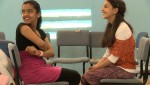
Samar, left, and Linor like each other from their first conversation. (photo from R2R)

If only adults could be as brave as children sometimes. The Israeli documentary Almost Friends screens as part of Reel 2 Real’s International Film Festival for Youth April 8-15. It shows just how insidious fear and racism can be, and how much a parent or grandparent can influence a child, for better and worse.

Bat mitzvah-age girls from two Israeli schools – a religious Jewish school in Tlamim and a mixed secular school in Lod – were brought together in a pen-pal program. For most, if not all, of the religious girls, this is their first exchange with non-Jews.

The success of the written exchanges leads to the Lod girls being bused to Tlamim to meet their pen pals. The teachers take the students through a couple of trust-building exercises and then give them time to interact. It is on this day that Arab-Israeli Samar and Jewish-Israeli Linor meet and become friends. They continue to write each other afterward, but the influence of Linor’s grandmother and mother overwhelms Linor and she stops writing. Samar’s concern for Linor’s safety, lest there be a terrorist attack if Linor visited her, consoles Samar over the loss of the friendship.

The most interesting development is Linor’s change of perspective. Initially, her mother is supportive of the pen-pal program and assures a then-worried Linor that there is nothing to fear from Arabs. Her grandmother is close-minded from the beginning, warning Linor that there will always be “a sting” in the Israeli-Arab relationship. Once Linor bonds with Samar, the ingrained distrust, racism, fear and insularity of Linor’s family presents itself. Their words sway Linor who, before the letter exchange, was calming her friends’ concerns about Arabs. After the negative reactions from her mom and grandmother, she is the one telling her friends how dangerous Arabs are, while one of her friends tries to convince her, “We’re alike. We’re brothers.”

There are many things powerful about this documentary. One is the reminder of how separate from each other most Arabs and Jews live in Israel. Another is how people who are kind and loving in so many ways can also be hateful and hurtful. But the documentary also reveals cause for hope – in both the religious girls’ reactions to their Lod peers and the friendships that do exist among Jews, Arabs and Christians in the Lod school.

Almost Friends is recommended for ages 13+. The hour-long film will be followed by a discussion with R2R artist-in-residence filmmaker Jessica Bradford and an R2R board member. It screens Wednesday, April 13, at noon, at Vancity Theatre. Tickets are $9 ($6 child/youth/senior, $5 each for groups of 10+) from 2016.r2rfestival.org or 604-224-6162.

Format ImagePosted on April 1, 2016March 31, 2016Author Cynthia RamsayCategories TV & FilmTags interfaith, Israeli-Palestinian conflict, peace, R2R, Reel 2 Real
Berlin’s House of One

Berlin’s House of One

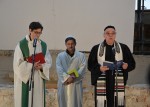
In Petriplatz, Pastor Gregor Hohberg, left, and Imam Kadir Sanci listen as Rabbi Andreas Nachama recites a prayer for peace. (photo by Frithjof Timm)

In the middle of Berlin, on the grounds of where a church was destroyed in the Second World War, a pastor, imam and rabbi are collaborating to create a new reality wherein Christianity, Islam and Judaism can be practised under the same roof.

“It seems so logical that something like this would take place, but it never has before,” said Rabbi Dr. Andreas Nachama who leads the only Reform congregation in Berlin, Sukkat Shalom (House of Peace).

Some congregations and groups of people refrain from intermingling out of fear of losing members to other groups. For Nachama and the other House of One proponents, this is not a concern.

“I think that the congregations are solid and I don’t think that this might turn out to be a problem,” he said. “We have a lot of experience from sharing a building with Catholics, Protestants and Jews, and we’ve never had that kind of problem. The problems we had were very secular and could be solved quickly with a short discussion – things like who is cleaning the toilets after congregation and so on.”

As for the risk of intermarriage, Nachama said intermarriages “take place because people are studying at the same university or classroom, sitting in the same office, or meeting in a restaurant or theatre. I haven’t had a single case where intermarriages originate from a Christian-Jewish dialogue group in all my years.”

photo - Rabbi Tovia Ben Chorin
Rabbi Tovia Ben Chorin (photo by UFA Lab)

The idea for House of One originated five or six years ago with Nachama’s predecessor, Rabbi Tovia Ben Chorin. He was working to bring the concept to life until he retired and moved back to Switzerland. Nachama has been involved with House of One since April 2015.

Nachama is no stranger to Christian, Jewish and Muslim trialogue. He has been involved in the field since 1972, starting at summer camps in western Germany, where a local school invited members of each of the three faiths to discuss common stories and problems.

As Nachama went on to take Jewish studies in university in the 1970s, he also took basic courses on Islam and Catholicism. Gaining a good understanding of these religions has enabled him to effectively introduce his congregation to interfaith interactions since 1999, bringing in his Islamic and Christian counterparts to teach in the synagogue alongside him.

The clergy meet on a regular basis, sometimes involving leaders in their respective communities, but always aiming to keep meetings to no more than 15 people. So, the interfaith groundwork began long before the excavations started in 2007 of Petriplatz, the site of the old church, among other structures, and a new House of God was being planned. The church wanted to build a house where the three religions would each have a holy space of their own.

“Each would have their own synagogue, mosque and church, working together in one building,” said Nachama. “But, everyone would follow his/her own faith tradition, so it was not about some new religion being created.

“Instead, the idea was to build a house of teaching, of worship, wherein the teaching might bring us together; the worship, everyone does for him/herself in his/her religion.

“We can do programs on some aspects of interest to many, like looking at the differences between kosher and halal. We can also offer teaching programs to the general public.”

Worship times do not seem to be an issue either, with the holy day for Muslims being Friday; for Jews, Saturday; and, for Christians, Sunday.

“But, what happens if Christmas Eve is on a Friday night or during Shabbat?” admitted Nachama. “We can always find problems in terms of holy days on the calendar. They will be solved, but it’s not so easy.”

According to Nachama, the most difficult challenge is in the area of politics. “Islam, in particular, is being taken as a hostage for Islamic fundamental brutality,” he said. “That makes it difficult, because those Muslims that we deal with are not part of that. It makes it difficult … in the public eye … to make it understandable that we, as individuals and as congregations here in Berlin, can cooperate and speak with each other, whatever happens.

“My congregation is very much involved in Christian-Jewish dialogue, and we also sometimes have teachings or panel discussions together with Muslims, so it’s not new to my congregation and, as far as I see, the other congregations have had experience in the field before as well.”

As far as reaching beyond congregational circles, Nachama understands all too well that if someone has prejudice, it is he or she who needs to be willing to open their eyes and ears to seeing the other side. “We can’t do it for them,” he said. “If they are willing, we then can try to show them how we see things.”

While the project is gaining momentum and more than a million euros have already been collected, much more is needed to even break ground on the building project.

Nachama anticipates that his congregants will have no problem with the move when the time comes. “We’ve moved already once and, when completed, either parts of the congregation will move or the whole congregation. It won’t be a problem.

“We believe this project is a result of the history in Berlin,” he continued. Given the history of antisemitism in Germany and the Holocaust, people want to create “a new page of history,” he said. “People really try to look for new ways of cooperation, coexistence and respect for other peoples and faiths.”

For more information or to join the project, visit house-of-one.org.

Rebeca Kuropatwa is a Winnipeg freelance writer.
Format ImagePosted on January 29, 2016January 26, 2016Author Rebeca KuropatwaCategories WorldTags Andreas Nachama, Christians, House of One, interfaith, Jews, Muslims, trialogue

Posts pagination

Previous page Page 1 … Page 5 Page 6
Proudly powered by WordPress