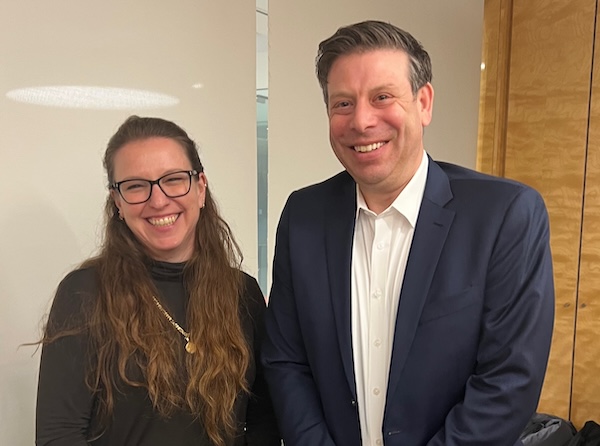
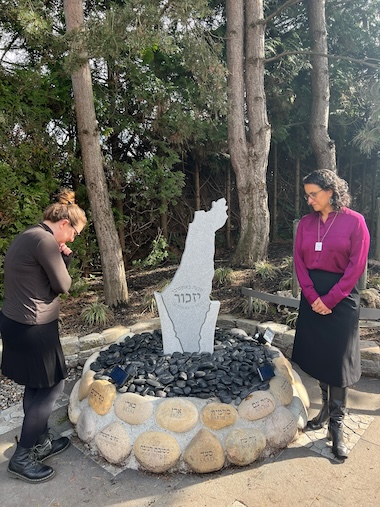
Survivor Miriam Dattel, right, with the Vancouver Holocaust Education Centre’s Ellie Lawson at the Yom Hashoah commemoration April 23. (screenshot)
Miriam Dattel was born Branka Friedman, in September 1940, in the Croatian city of Zagreb, then part of Yugoslavia. She was about six months old when the Nazis invaded and her family began a life in hiding. Fleeing ahead of the Nazis and their collaborators, the family survived together through a series of close calls, lifesaving tips from compassionate officials, luck, determination and exhausting treks through the wilderness in search of refuge.
Dattel shared her family’s story at the annual Yom Hashoah commemoration at Temple Sholom on April 23.
Upon invading Yugoslavia in April 1941, the Nazis, aided by their Croatian fascist Ustaše collaborators, immediately instituted the Nuremberg Laws and set up the first concentration camps in Yugoslavia. Dattel’s father and uncle were thrown out of the university and all Jews were forced to don the yellow star – including on young Branka/Miriam’s baby carriage.
The family was set to flee to Budapest, where they believed they would find refuge with family. When the day came, the baby Branka was ill, so her grandmother, Irma Stern, was sent on ahead. It was the last time the family saw her.
In her haste, the grandmother left behind her prayer book, which was her ubiquitous companion. Branka’s mother viewed the holy book as a fortuitous omen that all would be well in the end. At the commemoration last month, Dattel held the prayer book, now more than a century old and suffering the inevitable evidence of time.
Eventually, the family fled – but not to Hungary. Branca/Miriam, her parents, Andor and Margita Friedman, and her aunt and uncle, Lili and Fritz, were transported with the help of a friend of her uncle’s southwest to the Croatian city of Split on the Adriatic coast. Sections of the city were controlled by the Italian fascists and others by the Croatian regime.
One day, her father was tipped off by a high-ranking Italian officer that the Croatians were preparing to deport Jews from the areas of Split they controlled. He returned home in the middle of the night and evacuated the family to the Italian side. Eventually, the family’s race against fate continued, with a journey under false identities by ship to northern Italy.
“In 1943, when eventually Mussolini was finished, the Germans took over,” Dattel said in a video at the ceremony. Again, her father was tipped off by an Italian official, who warned him to disappear.
“From then on, from what I saw in my father’s diary, we went through 18 different hiding places,” she said, noting assistance from underground operatives.
As a child forced to race from one place to another, few distinct memories remain. However, in various barns where they took refuge, people would roast chestnuts and that remains an evocative taste-memory for her.
Ovaltine is another. And it is a flavour from the very moment that may have saved the life of Miriam and her family.
The group – now six with the addition of her newborn cousin Gerardo – had made their way through northern Italy, around Lake Como and toward the Swiss border. After walking for hours, crossing under fences and trudging through difficult terrain, they came to the frontier of Switzerland.
“There were two Swiss border guards there,” said Dattel. “They said the border is closed. And my father said, impossible, you are not going to let two kids be killed. My recollection is this Swiss soldier [with] a German Shepherd coming towards me, lifting me up and carrying me to the station, to the border house.”
There, the guard gave her Ovaltine and, while she has tried to recreate the flavour, it has never tasted the same.
The family members were placed in refugee camps, Miriam separated from her parents. In Switzerland, the family lived out the war, returning to Zagreb afterward before Miriam and her parents made their way to Israel.
About 1.5 million Jewish children were murdered in the Holocaust. Miriam was one of an estimated six to 11% who survived. In addition to the video screened at the event, Dattel spoke on stage with Ellie Lawson, the Vancouver Holocaust Education Centre’s education manager.
Claire Sicherman, a granddaughter of survivors, was the third-generation descendent speaker. She spoke of being consumed by grief in early life and growing up in a family filled with silences. (Sicherman shared her story of trauma and recoveryearlier this year. See jewishindependent.ca/healing-trauma-possible.)
Hannah Marazzi, acting executive director of the VHEC, noted that this year marks the 82nd anniversary of the Warsaw Ghetto Uprising, a symbol of defiance in the face of annihilation. In addition to remembering the millions of lives lost and the resilience of survivors, she said, “We remember the young Jewish fighters who rose up against the Nazis and whose courage continues to inspire us to stand against oppression in all of its forms.”
Rabbi Carey Brown, associate rabbi of Temple Sholom, welcomed attendees to the synagogue and reflected on the past’s lessons for the present.
Dr. Abby Wener Herlin, associate director of programs and community relations for the VHEC and a member of the third generation, introduced survivors, who lit candles of remembrance.
Cantor Shani Cohen chanted El Moleh Rachamim, the memorial prayer for the martyrs.
Wendy Bross Stuart was responsible for musical direction and arrangement, and played piano. Eric Wilson played cello. Cantor Michael Zoosman, Erin Aberle-Palm, Matthew Mintsis and Lorenzo Tesler-Mabe sang.
As is traditional, the annual ceremony ended with the singing of “Zog Nit Keynmol,” “The Partisan Song.”
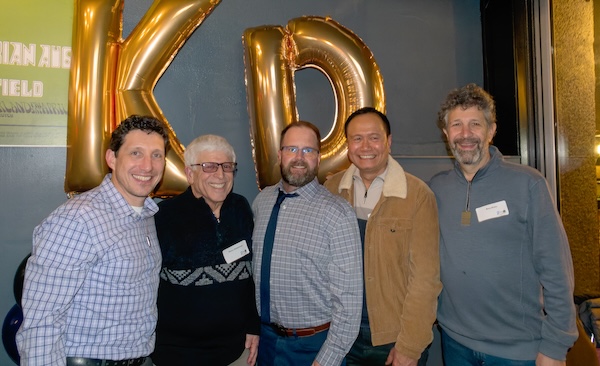
Left to right: Head of school Seth Goldsweig, former head of school Perry Seidelman, deputy head of school Alex Monchamp, head custodian and building manager Jess Sabado and former head of school Russ Klein at a February gathering of alumni to celebrate 20 years of KDHS on Willow Street. (photo from KDHS)
On May 14, with a party at Congregation Beth Israel, King David High School celebrates 20 years since it opened its doors on Willow Street.
“It’s a real blessing,” said KDHS head of school Dr. Seth Goldsweig about having a Jewish high school in the community.
“Study after study shows that the most effective way to develop and maintain Jewish identity is to go to Jewish day school,” he said. “Our students can continue to develop their Jewish identities and turn into the Jewish leaders of tomorrow.
“We have a high school that stands up to the other amazing independent schools in the area,” he added. “This means that students can have a top-notch Jewish education combined with a rigorous and enriching academic experience. They get the best of both worlds.”
Goldsweig is KDHS’s third head of school, having started the position last fall, after Russ Klein retired. Klein was at the helm from 2008 to 2024.
“In this job, I found a community that I didn’t know I had,” Klein told the Independent last year, as his tenure was winding down. “That was beyond special. I really do think of this job, this position really, as a gift.”
Klein had taken over the position after Perry Seidelman retired.
In 2001, Seidelman was hired as principal of Vancouver Talmud Torah High School – one of the iterations on the path that led from Maimonides High School, which was started in the 1980s, to KDHS. With 30 years prior experience and his approach to education, he was a key to the successful establishment of King David.
“Without Perry, there would be no school,” Larry Goldstein, president of the Jewish high school during the transition period, says in The Scribe’s Jewish Education in BC issue. “It’s as simple as that. Perry gave the credibility to other parents.”
“With growing interest in the school, a decision was made to build a permanent structure with financing from the Diamond Foundation,” Seidelman writes in The Scribe, which is the journal of the Jewish Museum and Archives of British Columbia. “It was to be built on a property at the southeast corner of 41st Avenue and Willow Street, directly across Willow Street from the Jewish Community Centre. Extensive discussions were held with the JCC administration, as intentions were to use the JCC for some programs, notably the JCC gymnasium for PE classes and the Norman [& Annette] Rothstein Theatre for drama productions.”
As enrolment grew, Alex Monchamp, who had been a teacher at the high school since its Maimonides days, was hired as vice-principal, according to The Scribe. Monchamp now holds the title of deputy head of school.
“I joined King David in July 2001,” Monchamp told the Independent. “I’d only been living in the city for a few months, and I saw a small newspaper ad for a small independent school looking for a half-time English and drama teacher. It was my first teaching job in BC!”
When asked why KDHS has proven successful, while previous versions of the high school struggled, Monchamp said, “I think the main turning point was the year I started, and the school had its biggest Grade 8 class, which I think was 25 or 26 students. Those connected to the school and who were vital in its foundation and ongoing viability made a real concerted effort to engage with the community and make a case for the importance and need for a sustainable Jewish high school. However, the real risk, the real investment, was when those Grade 8 families, and the families that came after, invested their most important resource – their children – in our school.
“When our families started to see that need and started to trust in the school, it allowed the school to grow and become more stable,” said Monchamp. “Stability turned into slow but steady growth, to more students, more teachers, and then our home on Willow Street. However, the building itself did not cement our future – it was also the school’s investment in good leadership and dedicated teachers that secured the future we enjoy today.”
Then-student Nicole Grubner and Gordon Diamond at the 2005 inauguration of the KDHS building on Willow Street. (photo from KDHS)
When Monchamp joined the high school, there were fewer than 70 students, programming was limited and there was no permanent school building, he said. Growth has occurred in multiple areas.
“There are obvious measures, like our student population is over 270 students, we have a vibrant arts program, a strong athletic program and our programming offers our students many ways to explore what they know, what they can do and who they’ll become,” said Monchamp. “All of that happens because we continue to have a team of outstanding teachers and dedicated adults who work extremely hard.
“The ultimate measure is not where our students go to university, the grades they earn or even how many of them are in the building each day,” he added. “There are bigger schools, there’s no shortage of kids going to university and no one is ever going to care what your math mark was in Grade 10. The true measure is that our students discover and develop their capabilities, figure out who they are and what it means for them to be Jewish in this world. In a world of uncertainty and change, our students have the capability to adapt and grow and the values and foundation to be a good person.”
KDHS’s director of development, Esther Mogyoros, who has worked at the school for the past 11 years, echoed Monchamp’s belief that there is more than one component to the school’s growth.
“Over the years,” she said, “King David has grown not only in student enrolment but also in its physical presence, thanks to the expansion of the east campus, made possible by the generosity of the Diamond Foundation and our supportive community. Our reputation has been built on a strong foundation of chesed programs, regular volunteer initiatives, and active participation in celebrations and community events. We take pride in nurturing students who not only excel academically but also continue their educational journeys and give back to the community long after graduation.”
Both Mogyoros and Monchamp said the best part of their jobs is when they connect with others.
“Connecting with students, parents, grandparents and the community at large,” said Mogyoros. “Building relationships and sharing my passion for Jewish education, Israel and the importance/impact of King David in the community.”
“The best part is when I can connect with a student, chat, find out more about them and then, if I can, find ways that I can support them,” said Monchamp. “It doesn’t happen nearly enough in a typical day, but I love it when it does.”
One of Monchamp’s standout moments at the school is when KDHS would take the Grade 9 students to Washington, DC, every spring to visit the US Holocaust Memorial Museum.
“We’d spend a full day at the USHMM, which is a lot, and our students always came away with information or artifacts they hadn’t encountered before and at times it was very emotive,” he said. “The trip also included a day at many of the Smithsonian Institution museums. It was always a treat to watch the kids see real historical items, like the Wright brother’s plane, the ruby shoes from The Wizard of Oz or Prince’s guitars. History is always more relevant to kids if they can get up close to it and connect to their own stories and memories.”
Over the past 20 years, there have been challenges, notably, the pandemic.
“There was so much unpredictability and an immeasurable amount of learning we had to do on the fly,” said Monchamp of that time. “Despite the numerous challenges, it is moments like that which demonstrate what our school is all about. The overarching goal was what it has always been: putting our students first. And when that was our guiding principle, we figured out the rest…. It was also vital that our families trusted us. Before, during and after COVID, we have consistently demonstrated to our families that we take our role in their children’s growth very seriously and that we always perform in ways that support and benefit their growth.”
“Throughout those difficult years,” said Mogyoros, “our school’s resilience and compassion shone through – not only in maintaining academic standards but also in supporting one another emotionally during a time of unprecedented uncertainty.”
Monchamp hopes the school continues on its current path, becoming “a student-centred learning environment.
“Learning is an active experience and is most successful when students are actively engaged and can apply what they know and can do to their own experiences and contexts,” he said. “We have already seen the tremendous benefit of this shift. It’s what is keeping our school competitive and on par with other Vancouver independent schools and it’s setting up our students for their future successes.”
The King David High School Class of 2019 celebrates graduation. (photo from KDHS)
“Our goal,” said Mogyoros, “is to empower students to be confident in their identities, excel in their chosen paths, and take pride in their Jewish heritage, traditions and love for Israel. We strive to inspire them to make a meaningful difference in the world around them.”
JWest is central to the high school’s future. The three-phase development project at 41st Avenue and Oak Street will see the construction of a much-expanded JCC, a new home for KDHS and two residential towers.
“Having a new building where we can continue to develop our programming, where we can engage our students and where we can host real ‘home games’ in our own gym in front of as many students and parents as possible is incredibly important,” said Monchamp. “The school is still very young and a new facility will allow it to continue to shape its identity. Additionally, our community can continue to take pride in the school and all of the many interconnected Jewish organizations in the city. I think the symbolism of one large, proud hub for the Jewish community sends not only a very strong message, but, more importantly, a unified message, one which the community can use as a foundation for its future.”
Mogyoros agrees.
“A larger campus will open doors to more programs, providing students with enhanced opportunities for learning, creativity and personal development,” she said. “We are especially excited about the addition of more space and new sports fields, which will enrich our athletic and extracurricular offerings and foster a vibrant, dynamic environment for our students.”
“We want to see the school continue to grow,” said Goldsweig. “Next year, we will be the biggest we have ever been. So many families have chosen to give their kids a Jewish high school education. We are so appreciative and hope that many more continue to make the same decision.”
The head of school says he has been warmly welcomed into the community, with Friday night dinner invitations every Shabbat, “an amazing staff,” a board that “has been supportive every step of the way,” and parents who “are dedicated to the success of the school and their children.
“The most impressive group of all has been the students,” Goldsweig said. “They are so inspiring, and I know our future is in good hands.”
To attend the May 14 gala, participate in the silent auction (which launches April 29), buy raffle tickets or donate to King David High School, visit goldenthreadgala.com.
Itamar Manoff and Adi Burton, co-directors of the Peretz Centre for Secular Jewish Culture, whose vision respects centre’s history. (photo from Peretz Centre)
Adi Burton and Itamar Manoff became co-directors of the Peretz Centre for Secular Jewish Culture last summer. The Independent recently spoke with them about their relatively new positions and the secular humanist Jewish organization’s 80th anniversary this year.
Both Burton and Manoff acknowledge that they arrived at their new roles last year during a tense and uncertain time in the Jewish community. Still, they are bolstered by the vibrancy, solidarity and support that have been present at Peretz for a long time.
“Learning how to do this job is learning how not to think that you need to reinvent the wheel, but actually opening up to the amazing activity and cultural richness that exists here – and finding a way to balance out the diverse needs of this fascinating and unique community while also making space for newness,” Burton said.
Burton and Manoff are simultaneously welcoming new members and ideas to Peretz and carrying on long-standing traditions, such as the focus on Yiddish culture. Further, they are sharing the history of the centre, which is steeped in a commitment to social justice, peace activism and the integration of the Jewish and broader communities.
“Like all Jewish organizations, there is always a lively debate about what Peretz is and can be,” Burton said. “As a community, we constantly rethink and renew culture through these conversations, which shows up in our celebrations of holidays, in our classes and lectures, and community events, [and] everyone is welcome to participate in this process of recreation.”
In 1945, the founders of Peretz – socialists, communists and capitalists, among them – envisaged a place where Jewish and Yiddish culture could be preserved and cultivated. The centre, in its current location on Ash Street, is a home to the riches of that history: the Kirman Yiddish Library, photographs, recipe books, music, and stories of Jewish life in Vancouver over the past eight decades.
In the last 10 years, Peretz has lost three of its pillars: Sylvia Friedman, Claire Osipov and, just this month, Gallia Chud. As well, the centre is still recovering from the pandemic, which reduced in-person participation. A main task in the eyes of Burton and Manoff is to ensure that the legacies of past generations continue.
“We’re lucky that there are so many people of different ages and backgrounds who are committed to Peretz – often working tirelessly in the background and with little to no support – and who keep us thriving,” Manoff told the Independent.
Burton and Manoff praised Donna Becker and Iosif Gershtein, two Peretz stalwarts who have been driving forces within the centre for more than 20 years.
Becker, they said, brings a deep understanding of Yiddishkeit, music, progressive politics, programs and event coordination, and extraordinary administrative skills.Gershtein provides a comprehensive knowledge of the building, an unsurpassed work ethic and a treasure trove of idioms and expressions, they said.
“We appreciate the chance to work with and learn from them,” Burton said. “Each brings a unique perspective and experience to the work that constantly inspires us to revisit our assumptions and act with greater care and respect for others.”
The Peretz Centre, according to Burton and Manoff, prioritizes diversity. It sees the LGBTQ+ community as an important part of its membership, they said, and the organization also opens its doors to interfaith and intercultural individuals and families.
“We keep a radically open definition of what it means to be a part of Jewish life, which, as a secular Jewish organization, we’re grateful to be in the position to do,” Manoff said.
The new directors say the city is entering an exciting period of growth for Jewish and Yiddish culture. There has been a marked increase in renewals and new members this past year, they said.
On the education front, Peretz offers beginning and intermediate Yiddish classes and a Yiddish history course. Musically, there are klezmer-related events, the Jewish Folk Choir, and Yiddish dance classes with Claudia Bulaievsky.There have been performances and lectures from well-known artists in the Yiddish music world.
“We’re excited to expand our arts and culture programming, including a few really innovative theatre productions and a film project on four amazing women who were among the founders of the Peretz,” said Burton. “We’re also especially enthusiastic about reviving our programs for youth. Our p’nei mitzvah program provides a pluralistic, non-dogmatic Jewish cultural education for young people aged 10-13 and helps them reimagine the traditional bar mitzvah rite of passage.”
When the Peretz Centre’s executive director position was announced last spring, Burton and Manoff applied together. Both have been involved in nonprofit, social and academic projects and organizations for many years.
“We draw confidence from each other because we hope that, together, we can bring and represent the spirit of friendship and community that has room for difference (makhloket) and strives towards peace,” Manoff said.
During this anniversary year, the relatively new leaders are striving to pay homage to and strengthen connections with those who have been at the Peretz Centre for a long time. They stress that their goal is to make sure that the longstanding traditions at Peretz flourish.
“It’s always such a wonderful experience to see how much is happening in the community and how much has been happening for such a long time, in such creative and independent ways,” Manoff said.
Both Burton and Manoff view the Peretz Centre as a place where people from different walks of Jewish life can come together and explore important questions of identity, history, culture, language, belonging and politics, in a safe and respectful environment – one, they say, that is needed in a time of disconnection and upheaval.
Sabbath Queen is a film about the life of Amichai Lau-Lavie, part of a rabbinic dynasty going back 38 generations. (still from film)
The 36th annual Vancouver Jewish Film Festival runs April 24 to May 4, beginning with opening night film Midas Man, which “offers Beatles fans a fresh look at the pivotal role Brian Epstein played in the band’s meteoric rise.” An enormous range of dramatic and documentary films, features and shorts, fill out the festival’s run, and the Independent reviews some of them here.
Tradition!
Hester Street, based on Abraham Cahan’s 1896 Lower Eastside immigrant novel Yekl, was released in 1975, about the same time as Fiddler on the Roof. The movie approaches some of the same topics of assimilation and tradition, without the song and dance.
Yankl (now Americanized Jake, played by Steven Keats) transforms from a yeshivah bocher to a shmatte sweatshop worker. Along comes Gitl, the wife who had waited behind in Russia, and young son Yossele who, payos cut off, becomes Joey.
The 50th anniversary of the film’s release reminds us that the 1970s were a time of nostalgia and of Jewish narratives that both idealized and lamented the American dream. In Hester Street, which is in black-and-white for mood, the boarder Bernstein (Mel Howard) represents tradition and continuity, contrasting with Jake in the fight of money versus learning, of getting ahead versus getting an education. Bernstein’s presence in the home of the primary couple puts Gitl in a predictable three-cornered bind both romantic and cultural.
Hester Street, which is filmed in black-and-white for mood, confronts the themes of tradition and assimilation. (still from film)
Younger viewers might take some time to recognize Gitl (Carol Kane) as the kooky landlady from Unbreakable Kimmy Schmidt. Meanwhile, the tough-talking landlady in Hester Street is recognizable as Doris Roberts, who contemporary viewers will recognize as the buttinsky mother-in-law from Everybody Loves Raymond.
There are subversive components of the film, including the role of divorce in perpetuating traditional values. Subversion twists again and indeed Gitl assimilates in her particular ways. As the last line in the film declares ambivalently, “We mustn’t be too quick to say this or that.”
Director Joan Micklin Silver was a pioneering woman in male-dominated 1970s Hollywood.
Kosher queen
Tradition, continuity and modern times are absolutely the themes of Sabbath Queen, a film by Sandi DuBowski about the life of Amichai Lau-Lavie.
The scion of a rabbinic dynasty going back 38 generations, Amichai is the son of politician, ambassador (“and we suspect a spy”) Naphtali Lau-Lavie and nephew of Israel Meir Lau, former chief rabbi of Israel. Filmed over 21 years, the documentary follows Amichai as he is ordained as a rabbi, via the Conservative movement’s Jewish Theological Seminary. But choosing the Conservative movement over orthodoxy is the least of Amichai’s rifts with his traditional family.
In 1993, Amichai was outed as a gay man in a news report and, it seems, he never looked back. After fleeing to New York a couple of years later and getting involved with the Radical Faeries, a queer, shamanistic spirituality group, “one vodka too many” leads to his alter ego emerging “out of my head like Athena.”
The drag queen Hadassah Gross – a Hungarian sex advisor, kabbalist, matchmaker and widow of six rabbis – was born. Amichai describes his drag persona as “something between channeling and performing” and it is all about exploring the intersections of feminine and masculine. (“What the goyim call the yingele and the yangele,” says Hadassah.)
“Artists are the new rabbis,” he declares, but eventually seems to decide that being an artist is not enough and he seeks his rabbinical smicha, in large part, it seems, to combat his brother and the larger establishment on Orthodox dogma.
He becomes the spiritual leader of a decidedly unorthodox congregation called Lab/Shul. And, when his officiating of interfaith partnerships clashes with the Conservative movement, the rabbi faces the consequences.
Amichai’s brother, father and mother have their reservations, to put it mildly, about Amichai’s activities.
“We’re pushing a lot of boundaries here,” he acknowledges. Or, as his Orthodox rabbi brother puts it, not entirely sympathetically, “He’s playing with Judaism.”
One feels invasive as the camera goes close up on Amichai at his father’s funeral and that sense of voyeurism repeats throughout the film, as does the feeling that the documentary’ssubject is something of an emotional exhibitionist.
The relationship between Amichai and his immediate family represents the larger cultural dissonance between queer and other nonconforming Jews and the orthodoxy of the tradition, though there is an astonishing, uplifting conclusion to some of these challenges by the film’s ending.
A family affair
I first saw A Real Pain on a flight home from Israel last month. Selecting a Hollywood treatment of two cousins doing a Holocaust road trip to their grandmother’s hometown in Poland, I girded myself for cringe-inducing, inappropriate or otherwise disappointing fare. My expectations were pleasantly upended. This is a profound, beautifully presented film that hits the right notes in so many ways.
I am not the only one impressed. Unbeknownst to me when I chose it, the script and the acting were already grabbing accolades worldwide. Costars Jesse Eisenberg (who won the BAFTA Award for best original screenplay) and Kieran Culkin (who won both an Oscar and a Golden Globe for best supporting actor) deliver moving and multidimensional characters.
David (Eisenberg) and Benji (Culkin) are the proverbial odd couple but what I had somehow anticipated to be slapstick comedy turned out to be deeply touching. As we find out more about Benji’s story, his erratic behaviour makes more sense.
Moments that could come off as didactic – almost documentary-like scenes at the Polin Museum and the Monument to the Ghetto Heroes, among others – somehow work even when you think they shouldn’t. The British tour guide James (Will Sharpe) is repeatedly challenged by Benji and acknowledges his own shortcomings as a non-Jewish facilitator, inviting viewers to ponder insider/outsider roles in the immediate and larger story.
If you ever wondered what corner Baby from Dirty Dancing ended up in, here she is – Jennifer Grey – playing a supporting role as one of the members of the cousins’ small tour group.
Spousal secrets
It is hard to write about Pink Lady without giving too much away. A seemingly ordinary religious Jerusalem couple with three happy kids and an involved extended family are upended when the husband is subjected to violence and blackmail.
Director Nir Bergman’s Hebrew-language feature film sees Lazer (Uri Blufarb) and Bati (Nur Fibak) pondering the most existential questions of how God challenges even his most dedicated adherents. A deeply serious film with both laugh-out-loud incongruities and eye-covering discomfiture, Pink Lady is a slice-of-life with deep theological questions.
Oct. 7 revisited
Of Dogs and Men, which deals directly with the attacks of Oct. 7, 2023, is a blend of fiction and documentary. (still from film)
At least two films in the festival deal directly with the attacks of Oct. 7, 2023.
Of Dogs and Men is a blend of fiction and documentary. Director Dani Rosenberg’s film follows 16-year-old Dar (Ori Avinoam, also cowriter) as she sneaks back into Nir Oz, her vacated kibbutz, in search of her missing dog Shula.
While the quest for the dog may be a stand-in for the larger search
Israelis have undertaken as individuals and collectively to discover the fate of missing people – Dar’s mother’s fate remains unknown – it is hard not to wonder if the choice to centre a (missing) dog in the story is not meant to invite dissonance among overseas viewers. Given the indifference and even celebration with which some people worldwide have responded to the Oct. 7 attacks, is the tragedy of a lost dog a statement on the qualitative value the world places on Jewish life?
Dar tags along with a woman who rescues animals in the abandoned and war-torn areas.
“Aren’t you afraid of dealing with those dogs?” she asks the woman.
“Look what human beings did. So, I should be afraid of dogs?” the woman responds. “There’s no creature more awful, crueler than human beings and I still live among you.”
Through the imagery of destruction and the litany of names of victims, the film breaks down distinctions between Israeli and Palestinian victims.
The documentary 6:30 provides a harrowing, minute-by-minute narrative of Oct. 7 events from different locations and perspectives. The interviews with survivors just a week after the attacks show raw emotion.
Some of the Nova festival-goers thought they were hallucinating as the hellish day unfolded. Several people, including first responders, speak of detachment, of a disconnect between what they were seeing and what they could believe. In retrospect, one survivor wonders if his liberation is real or if he died and that is what he is now experiencing. Others talk of the emotional burdens they will carry forever.
Linor Attias, a United Hatzalah volunteer who arrived at Kibbutz Be’eri in a mass casualty event vehicle, notes with pride that Arabs and Jews were united among the rescue workers trying to save the lives of victims. She loaded people into ambulances, where they released piercing shrieks of agony, having held them in for hours of silence in order to save their lives.
“That howl of pain cuts through the soul,” she says.
The most chilling thing about the film is realizing, amid all these horror stories, that these are the testimonies of the lucky ones.
Full details and tickets are available at vjff.org.
David Jablinowitz, opinion editor for the Jerusalem Post, answers a question at one of his March talks at Congregation Beth Israel. (photo by Pat Johnson)
The intensely emotional debate in Israel right now centres on whether the government and military should be negotiating with Hamas for release of the hostages, extending the war or finding some combination of approaches to the situation.
David Jablinowitz, opinion editor for the Israeli English-language newspaper and media platform Jerusalem Post, spoke in Vancouver March 20. He shared with audiences at Congregation Beth Israel the rock and the hard place Israelis – including Israeli media – are between in the current crisis. Beth Israel’s Rabbi Adam Stein introduced Jablinowitz and emceed the discussion. The journalist spoke again the next night, at Shabbat services.
The Israeli government estimates that there are 59 remaining hostages in Gaza, of which 24 are believed to be alive. Testimony from rescued and released hostages say Hamas terrorists are poised to murder the captives if Israel Defence Forces ground troops approach – and this danger is in addition to the possibility that Israeli military strikes could unintentionally kill or injure Israelis held in Gaza.
“This is why there is such an emotional dispute in Israel right now,” Jablinowitz said. “Are we going to lose these 24? Because some Hamas terrorists, of whatever level, the highest or the lowest, have orders that the moment the Israelis get close, you kill the hostages.”
At the same time, Hamas is unsurprisingly not negotiating in good faith, he said. Although the terror regime has been significantly weakened, they continue to behave as though they have the upper hand.
“Hamas is playing hardball,” he said. When an individual or a group is in a weakened position, rational behaviour would see them become more amenable to compromise. Hamas appears to respond otherwise, making counter-demands that Jablinowitz characterizes as “totally unacceptable.”
“Why are they doing that? Why does Hamas have the gall to do this?” he asks. “Because it plays into their own hands.”
Israeli intelligence officials, he said, know that Hamas has been using ceasefires as an opportunity to rebuild and prepare for fresh rounds of violence.
“They keep saying, ‘No, that proposal by Israel is not good.… That’s almost good, but do that, so I can do this,’” he said. “While negotiations are going on, weeks and weeks and weeks, what’s happening on the ground in Gaza is the rebuilding of infrastructure [and] recruiting terrorists. They are just building themselves up because, as far as they are concerned, if they have their way, there will be another Oct. 7 –because the dispute with Hamas is not a dispute over territory. Hamas does not want Israel anywhere. Their charter says so. They won’t accept a Jewish state – any non-Muslim state at all, but certainly not a Jewish state.”
Another reason why Hamas feels emboldened, he said, is because the international community, like the European Union, often treats Israel and Hamas as two legitimate actors on an equivalent moral plane.
The role of Qatar, which has been wrongly accepted by world leaders as a legitimate intervenor in the conflict, deserves a far more critical eye, argued Jablinowitz.
Qatar should be on the list of state sponsors of terrorism, he said. “They are pulling the wool over the eyes of the world.”
Qatar is pretending to be a constructive party, while funding Palestinian terror, providing a haven to terrorists, and flooding the world with jihadist propaganda on social media and through their funding of courses in North American and European universities, Jablinowitz said.
This support for propaganda, among other factors, helps explain the world’s approach to the conflict.
“I’m not saying Israel is all good, I’m not saying there aren’t innocent Palestinians,” said Jablinowitz. But he takes exception to the widespread expressions of concern around blameless Palestinian civilians.
“I have to tell you, soldiers who have served there, and among the [freed] hostages themselves [in] their testimony, have said, ‘Don’t give me the “civilian innocent” business. We were there, we saw the people. There was nobody, nobody, who came to our rescue.’”
Palestinian kids and other civilians came to see where the hostages are and, Jablinowitz said, “Nobody, nobody lifted a finger to do anything.”
Relatedly, the pass the world community seems to give the Palestinians is not extended to Israel’s military, even when it goes out of its way to minimize Palestinian casualties.
“What other countries say to a terrorist, or to their enemy, ‘At 4 o’clock Wednesday afternoon, I’m attacking you, and I’m attacking you here’? But that’s what we do in order to keep down the civilian deaths,” he said. “How does the world report it? What do European and other leaders say? ‘Oh, Israel is evicting the Palestinians.’ We are trying to save their lives and save our lives at the same time. We are better to Palestinian civilians in Gaza than Hamas is to Palestinian civilians in Gaza.”
The rebuilding of Gaza, if and when it occurs, must address not only the physical devastation but the indoctrination of kids, who have been taught that “Jews are bad people, the Jews were meant to be killed,” said Jablinowitz.
“As long as you’re going to have that education, there’s no point in doing anything,” he said.
Jablinowitz acknowledged at least two contesting attitudes toward Israel’s overseas PR battle.
One side, typified in a Jerusalem Post op-ed by Alan Baker, Israel’s former ambassador to Canada, is that Israel should ignore global criticism.
“Enough. There is no point,” Jablinowitz summarizes this approach. “We have to do what we have to do.
“An alternative opinion is that maybe it’s not the hasbara [PR approach] that’s a problem, but the government’s policies,” he said.
He thinks the answer may be simpler.
“I honestly think that our cause is not as appealing. The Palestinians are so good at it because they are the downtrodden,” said Jablinowitz.
Israel had good PR when they were seen in the world’s eyes as the David to the Arab world’s Goliath.
“We were doing great in 1967, when … [it would have been] so easy to just decimate our country,” he said. “We were popular.”
That changed after Israel won the Six Day War, which remains contested in terms of who started the conflict, since Israel attacked its neighbours as they were preparing an offensive.
“That’s why we preempted in 1967,” Jablinowitz said. “You see what happens when we don’t preempt? Oct. 7 happens when we don’t preempt.”
The Jewish Museum & Archives of British Columbia (JMABC) is releasing the 41st edition of The Scribe – which has a summer camps theme – on April 24, 6 p.m., at the Peretz Centre for Secular Jewish Culture.
The JMABC’s flagship publication celebrates the lives and traditions of British Columbia’s Jewish residents by focusing on one sector each edition. This year’s journal features personal memories from seven Jewish summer camps in the Pacific Northwest, highlighting the lasting impact that camp experiences have had on the development of lifelong connections to Jewish culture and community.
First published in 1989, The Scribe’s mandate is to link the Jewish community’s past with the present to inspire future generations. The publication has documented all aspects of the Jewish experience in British Columbia. Past issues have focused on prominent medical pioneers who have improved the lives of Canadians; top restaurateurs who cultivated Vancouver’s social scene; and ready-to-wear icons who helped British Columbia become an international fashion centre.
“The Scribe: Summer Camps Issue is by far one of the most endearing and nostalgic issues in [the journal’s] 41-year history,” said Daniella Givon, president of the JMABC. “Jewish summer camps have long represented a unique form of organic community-building and Jewish connection. Through the iconic summer camp experience, generations of Jewish youth have developed a sense of resilience and belonging that has strengthened their own connections to Jewish community, personal identity and cultural continuity.”
“The impact and success of Jewish communities in Canada have been significantly enhanced by the collective experiences of summer camp attendees,” said Elana Wenner, JMABC director of programming and development. “We look forward to taking a walk down memory lane with Jewish communities throughout BC with this new issue!”
The launch at the Peretz Centre will be an immersive evening of nostalgia, song and stories, as the summer camp communities of the Pacific Northwest are brought together under one roof.
Tickets are $54 each, and include dinner, a program and a keepsake T-shirt. All proceeds are in support of the JMABC. Copies of The Scribe: Summer Camps Issue will be available for purchase at the event for $20 each. (JMABC members in good standing will receive one free copy per family.) For tickets, visit tinyurl.com/ANightAtCamp.
– Courtesy Jewish Museum & Archives of British Columbia
In 2023, Ben-Gurion University of the Negev opened a new home in Sde Boker for the David Ben-Gurion archives. (photo from Ben-Gurion University)
For visitors to Israel – and for Israelis looking for an engaging getaway – there is a relatively new destination in the country’s south.
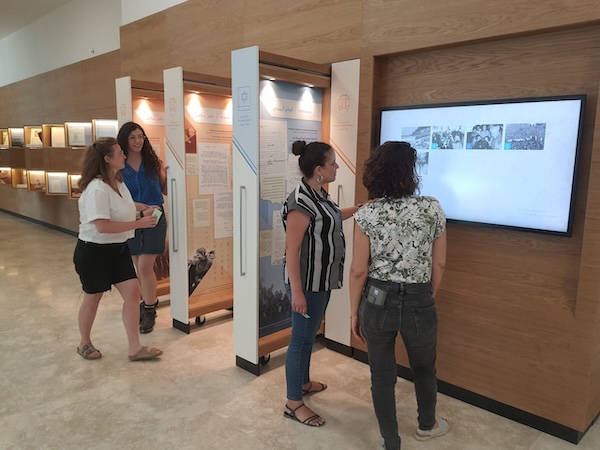
In 2023, Ben-Gurion University of the Negev opened a new home for the David Ben-Gurion archives, with a dramatic exhibition hall to attract visitors. In addition to the many artifacts and documents on display, the exhibitions include interactive activities that allow visitors to speculate how the first prime minister would have responded to various scenarios.
Ben-Gurion was Israel’s first prime minister and the dominant political figure for the country’s first decade-and-a-half, during which time he served concurrently as minister of defence. In addition, no individual is more associated than Ben-Gurion with Israel’s development of the Negev and the entire south of the country.
The new archives facility rounds out a network of Ben-Gurion-related sites in the Sde Boker area, where Ben-Gurion built a desert home and enjoyed his retirement.
David Berson, Ben-Gurion University Canada’s executive director for British Columbia and Alberta, says the facility makes Sde Boker even more of a must-see for visitors to Israel.
There had been an archive at the Sde Boker campus, allowing deep research into Ben-Gurion’s papers and other materials, but these were photocopies because the university did not have the archival capacity to accommodate the originals in the environment they required. The originals were held in Tel Aviv at an Israel Defence Forces archive.
“Everything was there, but it was a reasonable facsimile, as we like to say,” said Berson.
That changed with the opening two years ago of the purpose-built Ben-Gurion Heritage Archive, which includes a 280-square-metre (more than 10,000-square-foot) exhibition hall.
“All the real, genuine archives have been transferred there,” Berson said. “The exhibition hall is basically an interactive tale of David Ben-Gurion’s heritage and questions about things like the ultra-Orthodox serving in the army, his relationship to the diaspora, the Altalena affair, all sorts of different things, as well as his correspondence with Hebrew school students from all over the world, leaders, his perspectives on religion, etc., etc.”
The facility is a partnership between BGU and the Ben-Gurion Heritage Institute, an educational and commemorative organization committed to keeping Ben-Gurion’s ideals alive, especially his emphasis on developing the Negev. Among other things, they operate the museum at Ben-Gurion’s kibbutz home and other educational programming.
The Ben-Gurion Promenade, a project designed to honour his legacy and connect significant landmarks associated with his life, takes visitors on a 3.5-kilometre walk from his residence at Kibbutz Sde Boker to his burial site overlooking Nahal Zin, and taking in the new archives and exhibition hall. The accessible path is lined with native desert plants and interpretive signs about Ben-Gurion’s life and vision.
The David Ben-Gurion archives includes a 280-square-metre exhibition hall. (photo from Ben-Gurion University)
The archives are part of a larger complex that also houses the Ben-Gurion Research Institute for the Study of Israel and Zionism, and the Azrieli Centre for Israel Studies.
Ben-Gurion’s eponymous university has three campuses in the country’s south.
The main Marcus Family Campus, in Beersheva, is home to the university’s faculties of engineering and sciences, health sciences, humanities and social sciences, business and management, computer science and cybersecurity, among others, and several advanced research institutes. It is adjacent to the Soroka University Medical Centre, where BGU medical students train. The campus is also home to the 10-year-old Advanced Technology Park, which is a joint venture of BGU, the City of Beersheva and real estate development company Gav Yam. The park is part of a national effort to develop the Negev region into a global centre for cybersecurity, defence technologies and tech innovation.
At the Sde Boker campus, about 30 kilometres to the south of Beersheva, specialties include desert studies, environmental science, hydrology, solar energy, sustainability and climate research, and arid agriculture. It is also home to the Jacob Blaustein Institutes for Desert Research.
The Eilat campus, at the country’s southern-most tip, on the Red Sea, specializes in marine biology and biotechnology, hospitality and tourism management, regional development studies, and interdisciplinary undergraduate programs that allow students from the south to do their initial studies in the area before completing their degrees at the Beersheva campus or elsewhere.
Sde Boker has always been a sort of pilgrimage site for Ben-Gurion fans and history buffs. But, because tourism to Israel has plummeted in the past year-and-a-half, most of the visitors so far have been comparative locals, Berson said, including leaders of the security services and military, educators and other Israelis.
When tourism picks up, Berson hopes the archives will make Sde Boker even more of a destination on the visitors’ map.
“It’s a wonderful national treasure,” said Berson. “But it’s also something that’s not on people’s radar screens abroad. We really want to encourage people to come and visit there, put it on their itineraries.”
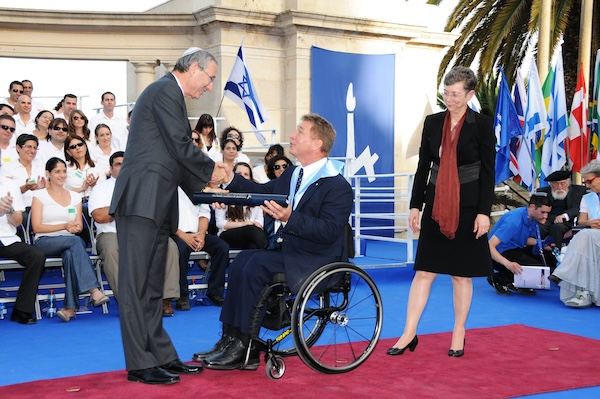
Canadian Paralympic athlete and wheelchair racer Rick Hansen, known for his work to break down barriers for people with disabilities, receives an honorary doctorate from Hebrew University from then-Hebrew U president Menahem Ben-Sasson. In December 2010, Hansen visited Hebrew U as part of the 25th anniversary celebration of his “Man in Motion” tour. (photo from Hebrew University)
The Hebrew University of Jerusalem turned 100 this month. Opening officially on April 1, 1925, the university preceded the birth of the state of Israel by more than two decades.
“There was no country yet,” said Dina Wachtel, vice-president, community affairs, for the Canadian Friends of the Hebrew University. “It’s the first daughter that gave birth to her mother.”
The history of the campus on Mount Scopus has been tumultuous, like that of the country its alumni have helped shape.
During Israel’s 1948 War of Independence, Mount Scopus became an isolated enclave, and the university was forced to relocate its main activities to facilities in West Jerusalem. In 1954, a new campus was established in the Givat Ram neighbourhood, followed by the creation of additional campuses, including at Ein Kerem, home to the institution’s medical sciences faculty, and, at Rehovot, where the agriculture department is headquartered.
Allan Bronfman, national president and founder of the Canadian Friends of the Hebrew University, with Dr. Albert Einstein, honorary president of the Hebrew University, on Sept. 19, 1954, at a Princeton conference called by Einstein to launch a $30 million dollar capital building project for the university, which was in exile from its campus on Mount Scopus in Jerusalem. (photo from Hebrew University)
After the 1967 Six Day War, Hebrew University regained access to Mount Scopus and began to restore and expand the original campus. Today, it is one of Israel’s leading research institutions, ranked among the top universities globally, and it remains a symbol of intellectual and cultural renewal in the country.
“Even the word ‘incredible’ is too small to describe the impact of the Hebrew University on the establishment of the state of Israel and on the state of Israel,” Wachtel said. “Most of the Supreme Court judges are graduates of the Hebrew University faculty of law, which was established in 1949. We have eight Nobel Prize laureates – all of them from 2000 and after.” A ninth laureate, Albert Einstein, a founder of the university, won the Nobel for physics in 1921.
The university was established by the intellectual giants of the last century, said Wachtel. These included Einstein, as well as Chaim Weizmann, the Zionist leader who would become the first president of the state; philosopher Martin Buber; American Reform Rabbi Judah Leon Magnes, who served as the first chancellor and later president of the university; founder of psychoanalysis Sigmund Freud; Ahad Ha’am, dubbed the father of cultural Zionism; poet Chaim Nachman Bialik; and Herbert Samuel, British High Commissioner for Palestine, among many others.
Einstein, Wachtel noted, left his entire intellectual estate to the Hebrew U and the university is in the process of constructing a new Daniel Libeskind-designed archive for his fonds on Givat Ram’s Edmond J. Safra Campus, adjacent to the Knesset, the Supreme Court and the Israel Museum.
“I think it will be the next tourist attraction in the city of Jerusalem,” she said.
Celebratory events will take place in Israel in June, concurrent with the Hebrew University’s board of governors meeting in Jerusalem. Happenings will include a special event at the home of Israel’s president, a special show at the Tower of David Museum, and other ceremonies.
Gail Asper, left, a Hebrew University honorary doctorate recipient and a member of the executive of the board of governors of Hebrew U, with then-Hebrew U president Menahem Ben-Sasson and guest speaker Chelsea Clinton at the 2015 CFHU Einstein Legacy Awards in Toronto. (photo from Hebrew University)
The university has been a hub for groundbreaking research, reflecting the institution’s commitment to education, scientific advancement and societal impact.
Marking the centenary, Hebrew U’s current president, Prof. Asher Cohen, credited the thinkers who initiated the school, the groundbreaking for which began in 1918.
“They and many others founded a pioneering academic institution to cultivate future leaders in research, science, public service and society – for the benefit of Israel and all humanity,” Cohen said in a statement. “From the moment this vision became a reality, the university has upheld excellence in research and education as its highest priority. Today, it continues to be a hub of knowledge, innovation and groundbreaking research across diverse fields, nurturing generations of leaders, scholars and thinkers.”
Prof. Tamir Shafer, rector of the Hebrew University, contextualized the university in Israeli society.
NBA superstar Amar’e Stoudemire visited Hebrew University in 2013, meeting with students at the Rothberg International School, and with the then-president of Israel Shimon Peres. (photo from Hebrew University)
“As a leading research institution,” Shafer said in a statement, “the Hebrew University sees itself as responsible for educating future generations, conducting groundbreaking research across nearly all fields of study, fostering extensive international engagement in both research and teaching, building strong ties with advanced industries in Israel and abroad, nurturing a diverse academic community, and maintaining deep social involvement in Jerusalem and throughout Israel.”
Diversity is a cornerstone of the institution’s success, according to Prof. Mona Khoury-Kassabri, vice-president of strategy and diversity.
“At the Hebrew University, we believe that diversity is not a substitute for excellence but a driving force that enhances it,” she said. “Our commitment to inclusion ensures that students and researchers from all backgrounds have equal opportunities to thrive, contribute and shape the future of society. By fostering a multicultural environment, we enrich both scholarship and community, proving that true innovation emerges when different voices are heard and valued.”
The centenary will also be celebrated with special events in Canada, some of which will be announced soon. Check cfhu.org for updates.
Among the activities in which Hebrew University of Jerusalem’s Dr. Shiran Reichenberg, left, took part while she was in Vancouver was a lunch and learn at Lawson Lundell LLP, hosted by Peter Tolensky. (photo from CFHU Vancouver)
Dr. Shiran Reichenberg, executive director of the Hebrew University of Jerusalem law faculty’s Clinical Legal Education Centre, was in Vancouver recently, as part of a professorship exchange with the University of British Columbia.
The exchange program started in 2010, with funding from Canadian Friends of the Hebrew University of Jerusalem and members of the local legal profession and judiciary. From 2013 to 2019, it was named in honour of Mitchell Gropper, QC, and, since 2021, in recognition of the Koffman family’s financial support, it has been formally called the Morley Koffman Memorial Allard School of Law UBC and Hebrew University Law Faculty Professor Exchange Program.
Koffman was an alum of UBC law school in 1952. He practised at Freeman, Freeman, Silvers and Koffman, and was awarded Queen’s Counsel in 1986. His firm, Koffman Kalef, was established in 1993.
One of the founders of the exchange program was Bruce Cohen, whose career has included, among other things, almost three decades as a BC Supreme Court justice. In the CFHU and UBC announcements of the Koffman family’s donation, Cohen says, “Given the high level of respect and regard for Morley’s reputation in the legal, university, Jewish and general communities as a wise counsel and recognized leader it is perfectly appropriate for the program to be named in his honour as a reflection of the importance placed by him and his family on scholarship, professionalism and tikkun olam.”
On the CFHU website, Cohen notes, “The ability of the program to operate in the initial few years of its existence was due in large measure to Morley’s assistance.”
The CFHU Vancouver organizing committee for the exchange program consisted of Cohen, Sam Hanson, Peter Hotz, Shawn Lewis, Randy Milner, Phil Switzer, Peter Tolensky, Dina Wachtel and the late Allen Zysblat. The annual exchange even operated during the pandemic, albeit virtually.
Dr. Shiran Reichenberg, left, visits Temple Sholom’s Oct. 7 memorial with the synagogue’s Associate Rabbi Carey Brown. (photo from CFHU Vancouver)
Reichenberg’s February-March visit to Vancouver was for just over two weeks, during which time she taught a course at UBC and spoke to various groups, including at Lawson Lundell LLP for a lunch and learn hosted by Peter Tolensky and at UBC’s Peter A. Allard School of Law, as well as at Temple Sholom for a lunch and learn organized by the Sisterhood, said Wachtel, vice-president, community affairs, at CFHU.
While Reichenberg regularly attends international conferences and lectures, this was her first time in Vancouver and, she said, “It was a very, very different experience to teach an intensive course for two weeks, each class three hours.”
Reichenberg, who is also the director of the Clinical Legal Education Centre’s Children and Youth Rights Clinic, said the course she gave here focused on the development of children’s rights and covered international documents, such as the Convention on the Rights of the Child, and other agreements, like the African Charter on Human and People’s Rights.
“We got very deep into several aspects of the convention and main principles, mainly best interest [of the child] and the right to participation. We talked about youth at risk, in criminal proceedings, in care proceedings,” she said.
Reichenberg graduated with her bachelor and her master of laws from the Hebrew University. She also studied in London, England, having received the Leonard Sainer Chevening Scholarship for LLM studies at University College London. She became interested in children’s rights law when she was a second-year student and participated in the Clinical Legal Education Centre’s Street Law Program, which is still part of the Children and Youth Rights Clinic she now directs.
“Each of us was put in a different residential care facility for youth at risk,” said Reichenberg, who was placed with a locked facility in Jerusalem. “When we entered this place and got an explanation about the girls and their life and what happened to them, it changed the course of my life. I stayed and I did another legal clinic in my third year of law school: representation of children’s rights, of children in court proceedings.”
In doing her PhD, Reichenberg focused on the right of youth at risk to participate in care proceedings, and her research included interviews with some of the girls from the Jerusalem care facility.
Children’s rights have their origin in labour law, Reichenberg said.
“Children, from the beginning of humanity until maybe the Industrial Revolution … died a lot, so parents didn’t get attached to them that much,” she explained. “And they were also considered as property of their parents, mostly their fathers, so they were sold, they were used to work, they were part of supporting the family; they weren’t what we consider them today. There is evidence that, in ancient times, children weren’t even given names, just numbers, because they died so much.”
But when children came to be working in mines and in factories, for example, “legislation gave them rights, to work only 12 hours a day and sleep at night, and things like that,” said Reichenberg, adding that the invention of the printing press, which meant that people needed to learn how to read, was an impetus for the establishment of schools.
The first child-related labour laws were English laws, passed in the early 1800s. The first youth court took place in the United States in 1874, and it involved the first case reported of child abuse, said Reichenberg. “[Mary Ellen McCormack] was abused by her stepmom and when the people wanted to help her, there was no law that protected children, so they used the law that protected animals from abuse.”
The Children and Youth Rights Clinic is one of nine offered by the Clinical Legal Education Centre. There are also clinics on climate change and environmental law; human rights in cyberspace; multiculturalism and diversity; representation of marginalized population groups; criminal justice; international human rights; the rights of people with disabilities; and wrongful convictions.
The centre can take a maximum of 140 students, with each clinic having, on average, 16 to 20 students.
“We have many more people who want to enrol than the places that we can give,” said Reichenberg, explaining that the clinics must be kept relatively small, given that they are working on legal cases.
“Each clinic is taught by a lawyer and there is a maximum number of cases that one person can handle, so we can’t have too many students,” she said. “Also, it allows us to have in-depth discussions in our classes with our students. And we always sit in a circle and there’s always dialogue, and it’s something that can be accomplished only in small groups.”
The Clinical Legal Education Centre takes a three-pronged approach. It handles upwards of 1,000 cases a year, providing legal aid and representation to individuals from marginalized groups. It also works for policy change, through test cases and position papers, for example, and offers public lectures and workshops to raise awareness, increase knowledge and promote discussion.
Since the Hamas terror attacks on Israel on Oct. 7, 2023, the centre has taken on an increased role in teaching and advocating for human rights. It has represented groups like the Hostages and Missing Families Forum in front of different United Nations bodies, for example, and has been operating Hamal Hevrati (War Room), a Facebook page providing legal aid to vulnerable populations, which has handled about 100 inquiries to date.
As well, the centre serves diverse clients and has a multicultural staff and student body, all of which include members of the Palestinian minority.
“We are not in war with the entire Palestinian people, we are in war with Hamas, and there is a difference,” said Reichenberg.
“So, we help those who need our help. And we work together, we study together,” she said.
It’s been hard, she admitted. “But we have to believe in working together and living together because none of us is going anywhere and we have to live together and work together for a long time … we have to find a way to do that and this is what we do.”
Reichenberg is proud of how the centre has adapted to the situation.
“In class, we have students who came from military reserves, still with their uniforms and their weapons. We have Arab students who have family in Gaza, which they haven’t heard from,” she said. “We have students who lost people they loved on the 7th of October and since. I personally have a student who I loved deeply and he died in the war, in his military reserve [service] in Gaza. And, also, in the staff, as I said, we’re a mixed staff and a lot of emotions came out on the 7th of October and we did a lot of preparation for staff, how to work with the students in this environment.”
While it’s not perfect, Reichenberg said, “it is certainly an amazing thing to see how everyone is sitting together, learning together, doing legal work together, for the same goal.”
In a March 2 lecture called Jewish Innovators Who Changed the World, Jonathan Bergwerk spoke about the lives and psychology of prominent historical figures.
“I’m especially interested in what makes these people tick,” said Bergwerk, the author of the Audacious Jewish Lives series, which covers a diverse selection of individuals who have left their mark on the world.
Jonathan Bergwerk, author of the Audacious Jewish Lives series, spoke March 2 as part of Kolot Mayim Reform Temple’s 2024/25 Zoom series Kvell at the Well. (PR photo)
Bergwerk was the latest speaker in Kolot Mayim Reform Temple’s 2024/25 Kvell at the Well Zoom webinar series. He began his talk by referencing the number of Nobel Prize winners who have been Jewish – at least 214 of 976 individuals (and 28 organizations), with Albert Einstein, Richard Feynman and Jonas Salk among them.
“They have received over 100 times the number of Nobel Prizes than might be expected. That’s astonishing,” Bergwerk said, noting that Jews comprise just 0.2% of the world’s population.
Across fields, one finds seemingly inexhaustible lists of influential Jewish contributors: literature (Franz Kafka, Arthur Miller, IB Singer), cinema (Louis Mayer, Steven Spielberg, Stanley Kubrick) and music (George Gershwin, Barbra Streisand, Leonard Cohen).
Bergwerk argued that, to understand the Jewish drive for innovation, one might have to go as far back as the Hebrew Bible and the story of Jacob encountering a “man” (angel, perhaps) who tries to stop him from returning home.
“The act of wrestling enabled Jacob to confront his stealing and lying, and to accept responsibility for who he had been,” Bergwerk said. “He learned that it was through struggle, and not by running away from conflict, that he could become the person he was meant to be.So, our life’s purpose – our Jewish challenge– is to discover who we truly are.”
In Bergwerk’s view, the Torah is replete with innovators who had a clear vision and swam against the tide of society’s expectations. Moses, though unable initially to speak clearly, became an inspired and decisive visionary, developing the fundamentals of monotheism and condemning idolatry.
Other “audacious innovators” include Judah, Jacob’s fourth son, the first person not to blame others when things went wrong; Ruth, the Moabite, who went against the norms of a patriarchal society by leaving her people and supporting Naomi; and Elijah, who discovered “that God’s presence and guidance came through quiet, intimate moments of reflection and humility.”
Bergwerk included Jesus of Nazareth in his talk.
“Jesus was an observant, but unconventional, Jew, who was driven by profound beliefs in God, ethics and social justice. He was independent, courageous, an inspirational and charismatic revolutionary, who attracted committed followers,” Bergwerk said. “His teachings challenged religious and societal norms. He tried to be a radical reformer, but always operated within the boundaries of Judaism.”
As Bergwerk moved from the Hebrew Bible through history to present times, a lengthy catalogue of Jewish innovators was provided. Baruch Spinoza, the Rothschilds, Karl Marx and Theodor Herzl were but a few, though scores of others could have been chosen.
Having researched more than 100 such people, Bergwerk suggested possible reasons for the seemingly disproportionate level of Jewish success.
First, Jews are perfectionists, he argued. Though perfectionists are often disappointed, by setting unrealistic goals and expectations, they carry the drive to improve the world in the face of setbacks.
Next, he said, finding themselves as outsiders and not fully accepted has, at times, served as an advantage.
“Oppression, migration and desperate poverty were often creative forces,” said Bergwerk. “They also led to a focus on study. Jews have often been successful in the secular world because Judaism so strongly values learning.”
His third argument was the encouragement in Judaism to challenge tradition and to think independently. Here, he shared the anecdote of Nobel Prize-winning physicist Isidor Isaac Rabi, whose mother, instead of wondering if he received good grades in school, wanted to know, “Did you ask a good question today?”
“Judaism, at its best, is a challenge to the world on how it can be improved. Many Jews dared to ask difficult questions, challenged the status quo and strove to leave the world better than they found it,” Bergwerk said. “Their story is truly inspirational. The message I take from these audacious Jews, is that we are being properly Jewish when we, like Jacob, are wrestling with our own challenges, and so contributing in ways we never thought possible.”
Bergwerk emphasized that this wrestling should not only be with ourselves, however, as that does not build community. Rather, one needs to take personal responsibility, as well as act as part of a community and take collective responsibility.
“We should live the Jewish values of learning, justice and tikkun olam – to strive to shape society for the better,” he said. “That’s what we have done for the last 3,000 years, and the world definitely needs us to carry on providing that hope today.”
The final speaker in this year’s Kvell at the Well series is Mordechai Pinchas, a scholar and scribe who serves communities in the United Kingdom and elsewhere. Pinchas will share stories from his career on April 6, 11 a.m., in a talk called Torah Tales:Adventures in Scribal Art. To register for this free Zoom webinar, visit kolotmayimreformtemple.com.
Sam Margolishas written for the Globe and Mail, the National Post, UPI and MSNBC.