Skip to content
  • Home
  • Subscribe / donate
  • Events calendar
  • News
    • Local
    • National
    • Israel
    • World
    • עניין בחדשות
      A roundup of news in Canada and further afield, in Hebrew.
  • Opinion
    • From the JI
    • Op-Ed
  • Arts & Culture
    • Performing Arts
    • Music
    • Books
    • Visual Arts
    • TV & Film
  • Life
    • Celebrating the Holidays
    • Travel
    • The Daily Snooze
      Cartoons by Jacob Samuel
    • Mystery Photo
      Help the JI and JMABC fill in the gaps in our archives.
  • Community Links
    • Organizations, Etc.
    • Other News Sources & Blogs
    • Business Directory
  • FAQ
  • JI Chai Celebration
  • JI@88! video

Recent Posts

  • Eby touts government record
  • Keep lighting candles
  • Facing a complex situation
  • Unique interview show a hit
  • See Annie at Gateway
  • Explorations of light
  • Help with the legal aspects
  • Stories create impact
  • Different faiths gather
  • Advocating for girls’ rights
  • An oral song tradition
  • Genealogy tools and tips
  • Jew-hatred is centuries old
  • Aiding medical research
  • Connecting Jews to Judaism
  • Beacon of light in heart of city
  • Drag & Dreidel: A Queer Jewish Hanukkah Celebration
  • An emotional reunion
  • Post-tumble, lights still shine
  • Visit to cradle of Ashkenaz
  • Unique, memorable travels
  • Family memoir a work of art
  • A little holiday romance
  • The Maccabees, old and new
  • My Hanukkah miracle
  • After the rededication … a Hanukkah cartoon
  • Improving the holiday table
  • Vive la différence!
  • Fresh, healthy comfort foods
  • From the archives … Hanukkah
  • תגובתי לכתבה על ישראלים שרצו להגר לקנדה ולא קיבלו אותם עם שטיח אדום
  • Lessons in Mamdani’s win
  • West Van Story at the York
  • Words hold much power
  • Plenty of hopefulness
  • Lessons from past for today

Archives

Follow @JewishIndie
image - The CJN - Visit Us Banner - 300x600 - 101625

Tag: Hamas

Facing a complex situation

Facing a complex situation

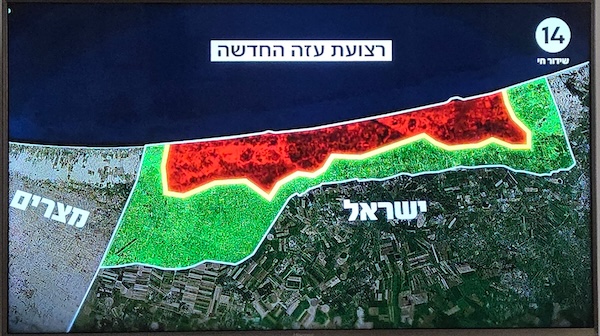
The Gaza Strip is currently divided between the Israeli-held zone (green) and Hamas territory (red). (Screenshot from Channel 14)

More than 25 months after Hamas’s Oct. 7, 2023, massacre and the consequent multi-front Middle East war, and more than one year after Israel and Hezbollah reached a ceasefire agreement on Nov. 27, 2024, Israel faces a complex geopolitical and security situation.

In the north, the Israel Defence Forces (IDF) is engaged in continuous covert and overt operations to prevent Hezbollah from rearming and regrouping. The Shi’ite terrorist militia has been dealt multiple blows, first by the Mossad’s twin attack Sept. 17-18, 2024, nicknamed Operation Grim Beeper, in which thousands of hand-held pagers and hundreds of walkie-talkies used by Hezbollah operatives exploded across Lebanon and Syria. On Sept. 27, the terror group’s secretary-general, Hassan Nasrallah, was assassinated in his Beirut bunker. On Nov. 23, the IDF eliminated Haytham Ali Tabataba’i in a missile strike on the Lebanese capital – Hezbollah’s chief of staff had been designated by the US Department of State as a Specially Designated Global Terrorist in 2016. Washington was offering a $5 million US bounty for information on him.

Though diminished, Hezbollah is not a spent force, according to Michael Rubin, a senior fellow at the Washington-based American Enterprise Institute who specializes in Iran, Turkey and the broader Middle East. Writing in the National Security Journal, Rubin notes that, notwithstanding the targeting of its senior leadership, Hezbollah’s financing – diaspora-linked laundering from Europe, Africa and South America and new backing from Turkey – remains resilient. He cautions that, unless Lebanon’s President Joseph Aoun cuts off the money supply and disarms Hezbollah by the year’s end, the country will slide into a renewed insurgency. Trained by Iran’s Islamic Revolutionary Guard Corps in guerrilla tactics and bomb-making, Hezbollah will resume its terror campaign attacking Lebanese armed forces’ vehicles with IEDs (improvised explosive devices), said Rubin.

Israel has made a huge investment to literally alter the landscape of its 120-kilometre-long northern frontier into a formidable physical barrier, and to blow up cross-border tunnels. Similarly, during the Israeli occupation of southern Lebanon from 1985 to 2000, several strategic mountain peaks were bulldozed to no longer loom over the Upper Galilee. However, the fiasco of Oct. 7 has shown that static positions provide limited deterrence against lightning strikes by well-trained guerillas.

In the Gaza Strip, Hamas – an Arabic acronym for Harakat al-Muqawama al-Islamia (the Islamic Resistance Movement) – also refuses to disarm. There, too, the situation remains unclear, complicated by Israel’s assassination of the terrorist group’s leaders: Yahya Sinwar, his brother Mohammed, Mohammed Deif, Marwan Issa and Ismail Haniyeh.
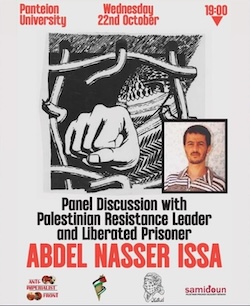
image - On Oct. 22, the terrorist-linked group Samidoun hosted a panel discussion in Athens with a newly released top Hamas operative
On Oct. 22, the terrorist-linked group Samidoun hosted a panel discussion in Athens with a newly released top Hamas operative.

In October, Israel released nearly 2,000 Palestinian prisoners and detainees as part of the first phase of a US-brokered ceasefire and hostage deal with Hamas. In exchange, Hamas released 20 living Israeli hostages. On Oct. 22, the terrorist-linked group Samidoun hosted a panel discussion in Athens with the newly released top Hamas operative Abdel Nasser Issa. Known as a student of Hamas’s notorious chief bombmaker Yayha Ayyash (1966-1996), aka “the Engineer,” Issa was serving two life sentences for his involvement in two suicide bombings in 1995 that killed 20 Israeli civilians and wounded more than 100.

On Nov. 24, Palestinian Islamic Jihad turned over a coffin with the remains of Dror Or. Staff Sgt. Ran Gvili and Sudthisak Rinthalak are the last two people murdered on Oct. 7 not yet returned. Rinthalak, an agricultural worker at Kibbutz Be’eri near the border of the Gaza Strip in southern Israel, was among the more than 40 Thais killed and 31 kidnapped in Hamas’s attack.

Also in November, a flight of 153 Gazans landed in Johannesburg, after departing from Ramon Airport near Eilat. Shimi Zuaretz, a spokesperson for Coordination of Government Activities in the Territories (COGAT) – the Israeli body that runs civil affairs in the West Bank – confirmed that the Palestinians transited through Israel “after COGAT received approval from a third country to receive them.” That third country was South Africa.

Some 200,000 Gazans are currently living in limbo in Cairo, unable to either find a destination in which to settle or to return to their homes. Together with the estimated tens of thousands of combatants and civilians killed in the Gaza war, these numbers indicate the ongoing depopulation of the destroyed coastal enclave.
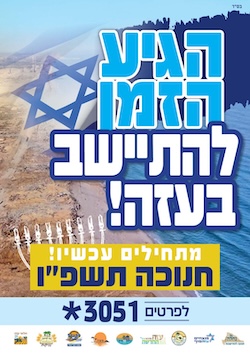
image - Israeli Prime Minister Binyamin Netanyahu’s coalition faces a mounting campaign to reestablish Jewish settlements in the Gaza Strip. The poster above reads, “It’s time to settle in Gaza! Let’s start now! Hanukkah 5786!” 
Israeli Prime Minister Binyamin Netanyahu’s coalition faces a mounting campaign to reestablish Jewish settlements in the Gaza Strip. The poster above reads, “It’s time to settle in Gaza! Let’s start now! Hanukkah 5786!”

With an election on the horizon in the first half of 2026, Israeli Prime Minister Binyamin Netanyahu’s coalition faces a mounting campaign to reestablish Jewish settlements in the Gaza Strip. Daniella Weiss, head of Nachala Movement Israel, whose stated aim is to settle further into Judea and Samaria, wants to begin Jewish settlement in Gaza within “months.” According to Weiss, more than 600 families – more than 2,500 people – had already registered for an initiative to settle in new beach towns.

Many Israelis fault Prime Minister Ariel Sharon’s unilateral withdrawal of 9,000 settlers from Gush Katif in 2005 as the catalyst that allowed Hamas to seize power from the Palestinian Authority two years later. In turn, that violent coup laid the way for the catastrophic Oct. 7, 2023, attack on cities and kibbutzim bordering Gaza.

The Gaza Strip’s 365 square kilometres are today uneasily divided into Hamas- and Israeli-controlled sectors. Israel will not allow Türkiye or Qatar to send troops to monitor the ceasefire, nor are any other countries keen to send boots on the ground. US President Donald Trump envisions a $500-million military base near Qiryat Gat, called the US Civil-Military Coordination Centre, to assist in Gaza’s future governance and patrol of the territory.
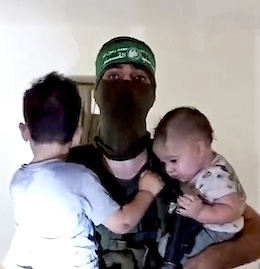
photo - The Israeli Defence Forces have killed Muhammad Abu Shaar, the Hamas terrorist who broke into Adi Vital-Kaploun’s residence on Oct. 7, 2023, and murdered her in front of her young children. He recorded himself with Adi’s babies in the same room she was killed as a Hamas propaganda video
The Israeli Defence Forces have killed Muhammad Abu Shaar, the Hamas terrorist who broke into Adi Vital-Kaploun’s residence on Oct. 7, 2023, and murdered her in front of her young children. He recorded himself with Adi’s babies in the same room she was killed as a Hamas propaganda video. (internet image)

Clan and Bedouin tribal groups in Gaza are engaged in a violent internecine struggle with Hamas. And the London-based Asharq Al-Awsat newspaper reported on Nov. 15 that IDF commandos on motorcycles are targeting Palestinians who participated in the abduction and holding of Israelis during the Oct. 7 attack. Among the Mujahideen Brigades terrorists gunned down in Khan Yunis was Mohammed Abu Mustafa, who kidnapped Shiri Bibas and her children Kfir and Ariel from Kibbutz Nirim on Oct. 7. Also recently eliminated was Muhammad Abu Shaar, who broke into Adi Vital-Kaploun’s residence at Kibbutz Holit and murdered the Canadian-Israeli woman in front of her 4-year-old son Negev and 4-month-old toddler Eshel. Shaar then recorded himself holding her children in the same safe room where Vital-Kaploun was murdered.

Troops of the elite Nahal Brigade captured six Hamas gunmen who surrendered after a 24-hour search that followed the IDF’s collapsing of the tunnel in Rafah where the terrorists were hiding, forcing them to emerge from a shaft, the military reported. The men were taken to Israel to be questioned by the Shin Bet Klali (General Security Service). A photo released by the IDF showed four of the operatives in the army’s custody, hands tied behind their backs, next to an armoured vehicle.

“At the end of a 24-hour pursuit, all 17 terrorists who attempted to flee the underground terror infrastructure in eastern Rafah were either eliminated or apprehended,” the IDF announced. At least 30 Hamas terrorists were killed trying to flee from tunnels in Rafah last month.
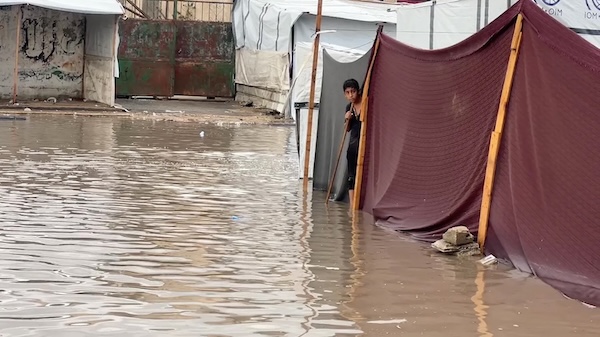
photo - Last month’s winter rain flooded Gaza’s tent encampments
Last month’s winter rain flooded Gaza’s tent encampments. (photo form IDDEF)

Environmental issues are also impacting the complex situation. Last month’s winter rain flooded Gaza’s tent encampments. In Iran, a severe drought has depleted the reservoirs that provide its capital city, Tehran, with drinking water.

Symbolizing the Ayatollah regime’s crumbling control, on Nov. 12, protesters garbed in military uniforms of the Shah’s regime unfurled the banned pre-1979 lion and sun Pahlavi national flag in a Tehran metro station. Commentators have posited that the next revolution may come soon, if the taps run dry.

Gil Zohar is a journalist and tour guide based in Jerusalem.

Format ImagePosted on December 5, 2025December 3, 2025Author Gil ZoharCategories IsraelTags Gaza, Hamas, Hezbollah, Israel, security, terrorism, war

Canada recognizes Palestine

On Sunday, Prime Minister Mark Carney issued a statement on Canada’s recognition of Palestine as a state.

“Recognizing the state of Palestine, led by the Palestinian Authority, empowers those who seek peaceful coexistence and the end of Hamas,” said Carney. “This in no way legitimizes terrorism, nor is it any reward for it. Furthermore, it in no way compromises Canada’s steadfast support for the state of Israel, its people and their security – security that can only ultimately be guaranteed through the achievement of a comprehensive two-state solution.”

photo - Prime Minister Mark Carney
Prime Minister Mark Carney announced on Sunday that Canada would recognize Palestine as a state. (photo from Office of the Prime Minister)

Carney noted: “Since 1947, it has been the policy of every Canadian government to support a two-state solution for lasting peace in the Middle East.” He said there was an “expectation that this outcome would be eventually achieved as part of a negotiated settlement,” but “this possibility has been steadily and gravely eroded” by several factors. 

In addition to other criticisms of both Hamas and Israel, Carney lists the “pervasive threat of Hamas terrorism to Israel and its people, culminating in the heinous terrorist attack of Oct. 7, 2023,” and Hamas’s rejection of Israel’s right to exist; “accelerated settlement building across the West Bank and East Jerusalem, while settler violence against Palestinians has soared”; “the E1 Settlement Plan and this year’s vote by the Knesset calling for the annexation of the West Bank”; and the “Israeli government’s contribution to the humanitarian disaster in Gaza, including by impeding access to food and other essential humanitarian supplies.”

Carney said the Palestinian Authority “has provided direct commitments to Canada and the international community on much-needed reforms, including to fundamentally reform its governance, to hold general elections in 2026 in which Hamas can play no part, and to demilitarize the Palestinian state.”

In reaction to the prime minister’s Sept. 21 statement, Noah Shack, chief executive officer of the Centre for Israel and Jewish Affairs, said, “Hamas is not an isolated phenomenon. It is a violent manifestation of the rejection of the right of the Jewish people to a state in our ancestral home – a rejection that runs deep within Palestinian society.

“As Prime Minister Carney himself has noted, a Palestinian state must be a Zionist state. Today’s announcement undermines that objective and gives Hamas and other Palestinian rejectionists a sense of victory. This will only make it harder to secure the release of hostages and build a better future for Israelis and Palestinians.”

Shack acknowledged that, while the “announcement does not come as a surprise, the details are important. The government has stated that, while it is extending recognition, normalization of relations with a ‘state of Palestine’ is an ongoing, long-term process…. We will argue that this must not proceed so long as hostages are in tunnels, Hamas remains in power and the Palestinian leadership rejects Israel’s existence as a Jewish state.

“And we will continue,” said Shack, “to make it clear that, with anti-Jewish hate escalating, our government must recognize the unintended effect foreign policy has on the climate in our own country.”

B’nai Brith Canada also issued a response to Carney’s statement.

“The PA has shown, time and again, that it cannot be trusted,” said Richard Robertson, director of research and advocacy for B’nai Brith Canada. “It is unable to govern the Palestinian Territories and has repeatedly demonstrated it is unwilling to deliver on the very commitments upon which Canada’s recognition is supposed to be predicated.

“The commitments include democratic reform, free and fair elections in 2026 without Hamas, and the full demilitarization of the Palestinian Territories.

“None of these conditions have been met. Hamas continues to arm itself, hold hostages and carry out terror attacks. Recognition under these circumstances does not bring us any closer to lasting peace, it only further compromises the prospect of a two-state solution.”

Robertson said the “government has chosen appeasement over principle.”

On Sunday, the United Kingdom, Australia and Portugal made similar announcements to that of Canada. Reaction from Israel was critical.

“After the atrocities of Oct. 7, while Hamas continues its campaign of terror, and while it continues to cruelly hold 48 hostages in the tunnels and dungeons of Gaza, the recognition of a Palestinian state by some nations today is, not surprisingly, cheered by Hamas,” wrote Israel’s President Isaac Herzog in an X post.

“It will not help one Palestinian, it won’t help free one hostage, and it will not help us reach any settlement between Israelis and Palestinians. It will only embolden the forces of darkness.

“This is a sad day for those who seek true peace,” he concluded.

Israel’s Prime Minister Binyamin Netanyahu said he will release a formal response after he returns from the United States. However, in a widely reported Hebrew-language video statement, he said, “I have a clear message to those leaders who recognize a Palestinian state after the horrific massacre on Oct. 7 – you are handing a huge reward to terror.

“It will not happen,” he added. “A Palestinian state will not be established west of the Jordan.”

According to various news reports, Hamas did indeed applaud the recognition announcements, as did the Palestinian Authority. 

Posted on September 26, 2025September 24, 2025Author Cynthia RamsayCategories NationalTags Binyamin Netanyahu, B’nai Brith Canada, Centre for Israel and Jewish Affairs, CIJA, Hamas, Isaac Herzog, Israel, Liberal Party of Canada, Mark Carney, Noah Shack, Palestine, Palestinian Authority, politics, Richard Robertson, terrorism
Working with “the enemy”

Working with “the enemy”

In the Gaza Youth Committee campaign We Live Together, We Die Together, young Gazans hold, in a show of solidarity with Israelis, photographs of Israeli children who were killed on Oct. 7, 2023. (photo from Rami Aman)

“People must understand that the people of Gaza are not victims and they are not superheroes. We are human beings, a group of people like any other society. We love life and hate death, we love singing and we hate violence. We are not terrorists. Parents pay to educate their sons and daughters in medicine, engineering, pharmacy, art, business, English and other languages. Gaza is not Hamas, and Hamas is not Gaza – Hamas is part of the Muslim Brotherhood,” Palestinian journalist Rami Aman, founder of the Gaza Youth Committee, told the Independent in a recent interview.

JI readers may have seen on social media one of the latest Gaza Youth Committee (GYC) campaigns, called We Live Together, We Die Together. Its images feature young Gazans holding, in a show of solidarity with Israelis, photographs of Israeli children who were killed on Oct. 7, 2023. The Gazans stand amid buildings and neighbourhoods destroyed in the Israel-Hamas war. The Independent was connected with Aman by Vancouver Friends of Standing Together.

“As the months of war passed, many voices increased within Israeli society opposing the killing of Gaza’s children, expressing solidarity with their families, and calling for an end to the war,” he explained about the social media campaign. “In Gaza, we saw tens of thousands of Israeli demonstrators carrying pictures of child victims in the Gaza war. Therefore, despite the killing, hunger, siege and shortages in Gaza, it was important for us to prove that, in Gaza, there are Palestinians who object to the killing of any child, and to show their solidarity with all the child victims who have fallen in the war, Israeli or Palestinian.

“We have lost a large number of Muslim, Christian and Jewish children because of this war between Hamas and the Israeli army,” he said. “This campaign emerged from Gaza to emphasize the people’s rejection of the war and the killing of children, and the need to release the Israeli hostages, end the war and provide medical treatment for the children of Gaza.”

photo - Palestinian journalist Rami Aman, founder of the Gaza Youth Committee
Palestinian journalist Rami Aman, founder of the Gaza Youth Committee, speaking at an event. One of his goals is to hold meetings between Palestinians and Israelis to help them respect one another and determine their own fate. (photo from Rami Aman)

Aman started the GYC after the first Israel-Hamas war, which he described as “a turning point” in his life.

“I began thinking about trying to do something two months after the end of the war in 2009. I decided to look for a place to establish an FM radio station in Gaza that would emphasize the voice of the peaceful people of Gaza,” said Aman, who has a bachelor’s degree in electronics and communication engineering. “At the beginning of August 2009, I received my first request from Hamas security. They interrogated me for long hours, and I was subjected to repeated assaults by Hamas members in the following days. They warned me against broadcasting any radio station or publishing any media content about Gaza without their permission.”

Realizing that Hamas wanted no other voice from Gaza than their own, Aman said, “At the beginning of 2010, I decided to form an independent youth group whose goal was to spread awareness internally and to strengthen our relations externally. Our first meeting included 30 young men and women from Gaza, and we agreed on the need to form an independent youth body that would advocate for Palestinian reconciliation and spread the voice of peace from Gaza to the entire world.”

The Gaza Youth Committee currently has more than 300 members inside and outside Gaza, said Aman, “and we are still trying to reach our goals.”

“We are all working to convey the true image of the people of Gaza and to build genuine partnerships with Israelis to help Palestinians and Israelis understand and respect each other,” he said.

Over the past 15 years of activities and meetings, Aman said he has learned a lot, “including how to influence public opinion within Gaza and how to build pressure and advocacy campaigns.

“Over these years,” he said, “I’ve realized the importance of inviting enemies to dialogue, instead of fighting, and trying to shape a different image of the other. These years have helped me differentiate between the Palestinian who wants to build their society for the better and the Palestinian who seeks to achieve their own interests from the Israelis or Palestinians at the expense of others.

“After many different activities between the Gaza Youth Committee and several Israeli movements and organizations, we have built many bridges and created a lot of connections and relations.”

GYC initiatives have included the release of 200 doves from Gaza with messages of peace, Skype calls between Gazans and Americans, and Gazans and Israelis, and a cycling marathon along the border in which both Israelis and Gazans participated.

This work has not been without risk. Aman has been arrested and tortured by Hamas more than once for his peace initiatives with Israelis, as have people with whom he has worked. After a GYC Zoom call in April 2020, he was arrested, Hamas apparently being alerted by the social media post of journalist Hind Khoudary, who was consulting for Amnesty International at the time.

According to a 2020 Jerusalem Post article, “she did not tag Hamas officials in her Facebook posts against Rami Aman to get him arrested but as a protest against normalization activities.

“‘I want all the normalization activities he is doing with Israel from Gaza to stop immediately because any joint activities, cooperation or dialogue with Israelis is unacceptable, even engaging with Israeli ‘peace activists,’” she said in an interview with the Post.

To secure his release, Aman was told he’d have to divorce his then-wife, the daughter of a Hamas official, who was also among those arrested. He eventually signed the papers in August of that year. His wife had already been released at that point, but Aman remained in prison, despite what he’d been told. He was prosecuted in September 2020 for “weakening revolutionary spirit,” and ultimately convicted. After international pressure, he was released in late October, with a suspended sentence, according to a 2021 article in the Times of Israel.

His former wife traveled with a Hamas escort to Cairo while Hamas released Aman from prison one day later. The couple kept in touch after Aman’s release from prison and subsequent move to Cairo in 2021, but have drifted apart for various reasons. Intending to return to Gaza in late 2023, the war caused Aman to change his plans.

“When I first started working for Gaza from abroad, I felt strong and free, and I regained my energy,” he said. “With the outbreak of the war, I began to feel stuck. I couldn’t call on people to demonstrate to end the war while I was on Facebook. People in Gaza trusted me because I was always the first to demonstrate against Hamas, from 2011 until before I left Gaza. If I were in Gaza, I would certainly demonstrate, even for an hour every day, to end the war. Then I would call on people to demonstrate while I was on the street.”

While he would prefer to be in Gaza, Aman said technology has helped GYC’s activism greatly, even before he had to leave his homeland.

“From 2007 until now, Israel has consistently imposed blockades on the residents of the Gaza Strip,” he explained, “while Hamas remained unaffected by any crises and received hundreds of millions of dollars with the help of the Qataris and [Israeli Prime Minister Binyamin] Netanyahu, in addition to Hamas’s control over travel through the Rafah crossing.

“The real blockade was imposed on us in the Gaza Youth Committee and the majority of Palestinians, so we used Skype and Zoom to communicate with our friends and partners outside Gaza, the most famous of which was the Skype with Your Enemy initiative in 2014.

“We also organized hundreds of meetings that helped introduce me to the world and led several organizations to extend invitations to visit them abroad. I traveled to India because of these meetings, which led to me meeting with the Dalai Lama. A few months ago, I was in Europe to speak about Gaza in several European cities.

“Most of the news coming from media outlets and news agencies will not present the truth to anyone, and it is better to communicate directly with the people in Gaza,” said Aman. “Israel has not provided us with permits to enter the West Bank and Jerusalem. Since 2010, the Israeli authorities have only granted me a 12-hour permit to attend a workshop in 2014 and permits to transit to Jordan when traveling from Gaza. For me and others, these applications have resulted in the building of a large number of personal friendships that continue to this day because they have been created between people, both Palestinians and Israelis.”

Aman has strong criticisms of the media in general, and Al Jazeera in particular, as well as UNRWA (the United Nations Relief and Works Agency for Palestine Refugees in the Near East).

“No Palestinian in Gaza watches Al Jazeera. No Palestinian in Gaza trusts in UNRWA. No Palestinian in Gaza trusts in all of these media,” Aman told UN Watch in an interview earlier this month.

In this atmosphere, the GYC continues its efforts.

“We at the Gaza Youth Committee work to strengthen the capacities of Palestinian youth, develop their skills and create a Palestinian movement from Gaza, the West Bank and the diaspora that expresses the aspirations of the independent Palestinian people,” said Aman. “At the Gaza Youth Committee, we always strive to hold meetings between Palestinians in Gaza and Israelis, helping them respect each other and determine their own fate by implementing joint initiatives and conveying their voices to the Americans and Europeans.

“Before the war,” he said, “we always tried to organize demonstrations to demand that Hamas hold elections, resolve the unemployment and electricity crises, and step back from governing Gaza. Even now, during the war, we are working to direct the people of Gaza to demand an end to the war.”

Aman contends that most Gazans want peace, despite polls that indicate the opposite.

“I don’t believe that much in polls,” he said, “but I understand Palestinian and Israeli public opinion. The two societies have been at war for years and have seen nothing but bloodshed and destruction, and wars only create enemies. Trust was lost before Oct. 7 and the distrust increased after the war.

“I have always believed in the importance of talking to enemies and engaging in dialogue instead of fighting. This is what I do through Zoom and Skype meetings. If there is one Palestinian and one Israeli who believe in a peaceful solution, then there is hope. We need courageous decision-makers who can lead their societies toward peace, not lead them toward fighting, hostage-taking and spreading hatred.”

Given his years of organizing video conferences, Aman said, “I have considerable experience, gained from speaking with thousands of Palestinians and thousands of Israelis. Their beliefs and opinions differ, but the common humanity that unites them always remains. They don’t know each other because of the media, and I believe in what I do and in every person’s right to life and safety, regardless of their religious or political beliefs.”

Working with “the enemy” has become Aman’s life mission. This, despite having been imprisoned and tortured by Hamas, having had loved ones killed or taken away from him by both Israeli forces and Hamas, and his neighbourhood in Gaza being destroyed by Israeli bombs.

“It’s true that, as a person, I suffer every day from this news and all the memories,” he admitted. “In addition to what Hamas did to me, it was horrific and psychologically and physically painful. However, there are people around me from whom I get this energy, and I always feel that I must be their partner in promoting dialogue and respect between Palestinians and Israelis.

“With every loss of a person, I always feel that they are advising me to continue my path and take care of their children,” he said. “Therefore, in my activities, I always aim to help families and individuals I know well, and I don’t want them to feel that I am far away from them. That is why I do my best to make their voices heard and that is from where my sense of responsibility for this matter comes.”

Aman is certain there are partners for peace on both sides.

“I consider myself a partner to any Israeli who seeks peace and an end to the war,” he said. “I know that there are Israelis who consider themselves peace partners with the Palestinians. I know Palestinians and Israelis who have lost their children and parents and still believe in peace, so that no more victims fall.”

He stressed the need to stand together.

“Our voices must unite to stop the war, free the Israeli hostages, protect the Palestinians in Gaza and help them rebuild their society,” he said. “We must find 50 Palestinian and Israeli leaders who will work to bring Palestinians and Israelis together.”

As Aman responded to the Independent’s questions, he said Israel Defence Forces tanks were “stationed hundreds of metres away from where my family and friends are. But I always know,” he said, “that life exists and so does death. Anyone can be the next hope and anyone can be the next victim.” 

Format ImagePosted on September 26, 2025September 26, 2025Author Cynthia RamsayCategories WorldTags Amnesty International, free speech, Gaza war, Gaza Youth Committee, GYC, Hamas, Israel, Israel-Hamas war, Israelis, journalism, media, Oct. 7, Palestinians, peace, politics, Rami Aman, solidarity, United Nations, UNRWA

Battling disinformation

Why do international media outlets seem intent on repeating the Hamas narrative? According to British military expert Maj. (ret.) Andrew Fox, there are a few key factors – including antisemitism.

“The first [factor] is a human desire not to admit when they are wrong and we don’t understand how powerful this is because it means that they have to admit that they have been wrong for the last 18 months,” he told JNS during a visit to Israel earlier this year.

Fox continued: “The second reason is the power of the narrative. Once you have achieved the dominance of your narrative, it is very, very difficult to present another narrative. The third one is antisemitism. While everything is not antisemitism – and I am really wary of saying that it is – certainly there are biases.”

Fox was a panelist at the International Conference on Combating Antisemitism hosted by the Ministry of Diaspora Affairs in Jerusalem on March 27. As a research fellow at the Henry Jackson Society who served as a top officer in the British army from 2005 to 2021, he is an authoritative voice supporting Israel, explaining how the Israel Defence Forces operates, and fighting disinformation about the Israeli military and its terrorist enemies.

In December 2024, Fox released a report under the auspices of the Henry Jackson Society titled “Questionable Counting: Analyzing the Death Toll from the Hamas-Run Ministry of Health in Gaza.” The report presented clear indications that Hamas was padding casualty numbers. Despite this, he said, many in the media repeated, without question, whatever Hamas put out.

Fox is not the only publisher of a report that backs Israeli data with empirical evidence. On March 18, he pointed out, British historian Lord Andrew Roberts presented the All-Party Parliamentary Group report on the atrocities of Oct. 7, 2023. The 318-page report lays bare the depravity of the Hamas attack in detail.

“The immediate reaction online is that it’s biased,” Fox said. “Lord Roberts is not Israeli, Israel is not his area of focus and everything is meticulously referenced. Yet, it has been utterly dismissed out of hand, and that is absolutely astonishing.”

He added: “Of course, there will be a strong counter campaign with Qatari money. I had the same thing with my report. The final aspect is that the Palestinian campaign has 10 times the supporters that Israel does. It’s a numbers game, ultimately.”

Is antisemitism in the form of anti-Zionism, or what some call “Israelophobia,” ingrained in some media institutions?

According to Fox, the answer is yes. “It is institutional with the BBC. Twice this year [as of March] they have had to put out major apologies breaching their own impartiality guidelines – when they platform Hamas royalty in a documentary about kids in Gaza or when they email the Israeli embassy asking for a speaker who is specifically anti-Netanyahu,” he said.

“There are three parts to an apology: ‘I am sorry, it’s my fault and I will do better.’ They haven’t really done that third part at all. It is endemic and institutionalized.”

While the IDF has faced criticism from journalists who are not being allowed into Gaza, with some saying this strategy has impaired Israel’s ability to present the facts on the ground, Fox backed the Israeli military’s position.

“If you give a journalist free rein in Gaza, they will either do what Hamas tells them or they will be killed – and that will be blamed on the IDF anyway. From a military perspective, you don’t want anyone filming an airstrike because they don’t have all the supporting data to report fairly without knowing what went into the targeting process.”

To illustrate his point, Fox said he had flown to Israel with Sir John McColl, a former British army four-star general who had been “very anti-IDF.”

“All week he was pushing the IDF like a hawk – and then came home and wrote an op-ed saying he was convinced Israel is doing everything it can to protect civilians, and that’s what the IDF should be showing journalists,” Fox said.

He added: “You can’t send journalists in with fighting troops; that is too dangerous. Fighting in Gaza is a 360-degree war. You have high-rise buildings, ground level, underground. As a soldier, I would probably refuse to take a journalist into that battle.”

Fox expressed concern that we are in a very dangerous information environment when many people turn to social media for information because of the 24-hour news cycle, and very often what is posted is not factual and has not been verified. In the rush to make the news cycle, journalists are also not fact-checking properly, he said.

“The fight against antisemitism is the most important thing to me,” he said. “The stories I hear from my friends are just shocking.”

When asked what communities around the world could be doing better, he said: “We are not going to stop 2,000 years of antisemitism; it is not something we can defeat. It is not easy, but I would work to bring the silent majority on to our side.”

He added: “From a British perspective, we need to make it about a community that is part of the country. The ‘Palestine’ marches are horrendous and very un-British. It’s about how we frame it.” 

Rolene Marks is a journalist and commentator specializing in Israeli advocacy, global Jewish affairs and Middle Eastern politics for JNS.org. She is a member of Media Team Israel and Truth be Told, both dedicated to promoting accurate reporting on Israel. Additionally, she serves as the chair of WIZO’s hasbara division, where she leads efforts in public diplomacy and advocacy. This article was originally published on jns.org.

* * *

Marks’s two stops here

photo - Rolene Marks
Rolene Marks (photo from CHW)

Israeli journalist, advocate, and chair of WIZO’s hasbara (communications) division Rolene Marks is touring Canada this September with Just the Facts, about the current situation in Israel, the realities of the war between Israel and Hamas (and other hostile groups), and the resilience of the Israeli people. Marks stops in Vancouver on Sept. 12 for an event hosted by CHW and the Ohel Ya’akov Community Kollel, and also helps open CHW Vancouver Centre’s new year, on Sept. 14.

At the Kollel young professionals event, Marks will talk about the United Nations, Gaza and Israel-related topics, and the Canadian government’s agenda, as it affects Israel and the Jewish diaspora. She will dispel lies, misinformation and blood libels, sharing links for where people can find accurate information and sources, stressing the need for Jews in Canada to share accurate information on social media. As well, she will discuss WIZO’s work in Israel and the importance of belonging to CHW (Canadian Hadassah-WIZO).

To join the CHW-Kollel Young Adults Shabbat experience on Sept. 12, 7:30 p.m., go to chw.ca/just-the-facts. Registration is by donation.

The CHW Vancouver Centre’s opening luncheon and fashion show on Sept. 14, 10:30 a.m., will feature fashions from After Five and Maison Labelle,  lunch and door prizes, as well as an exclusive pre-event meet-and-greet for sponsors with Marks, CHW national president Tova Train and CHW chief executive officer Lisa Colt-Kotler. Tickets ($96) are available at chw.ca/region/western-region. 

– Courtesy CHW

Posted on August 22, 2025August 21, 2025Author Rolene Marks JNS.orgCategories WorldTags Andrew Fox, antisemitism, Canadian Hadassah-WIZO, CHW, Community Kollel, Hamas, Israelophobia, Rolene Marks, Young Adults Shabbat, young professionals

ישראלים שנמאס להם מנתניהו כותבים בפייסבוק

ישראלים רבים כועסים על ממשלת נתניהו והעומד בראשה כותבים את מחאתם בפייסבוק

כבר חודשים אנחנו שומעים, מחטופים ששוחררו וממידע שמגיע ממשפחות, שדווקא פעולות צה”ל בעזה הן שמסכנות את חייהם של מי שנותרו בשבי. חלקם לא שרדו. בדיוק בגלל זה. המציאות הזו ברורה לכולנו כבר יותר מידי זמן. ובכל זאת, ממשלת ישראל ממשיכה באותה מדיניות: להילחם כאילו יש עוד מה לנצח. דובר צה”ל בעצמו מדבר על חמאס שהוכרע. אף אחד מהשרים לא יודע להסביר מה עוד נותר להשיג, אבל אף אחד מהם גם לא מוכן להניח את הנשק. אז מה כן. עוד מאותו הדבר. עוד חיילים. עוד קורבנות. עוד חטופים שלא חוזרים

אנחנו החיילים אלו שיצאו להילחם, לא מוכנים לשתוק עוד. אסור להמשיך ככה. הגיע הזמן לחדש את החוזה בין האזרחים לבין הממשלה: חוזה שבו החיים שלנו באים קודם. שבו למנהיגים יש אחריות, שבו הציבור לא שוכח ולא מסתחרר מכל ספין שהממשלה זורקת. אנחנו, בניגוד אליהם, משלמים את מחיר המלחמה הזו כל יום. יחד עם החטופים, יחד עם החפים מפשע, יחד עם משפחות שכולות שלא קיבלו שום תשובה או מזור. נקודת הרתיחה כבר כאן

העסקה היא הדרך היחידה להשיב את החטופים מבלי להקריב את מי שנשאר בחיים ומבלי לאבד את החללים בין ההריסות. זו החובה המרכזית של מדינת ישראל, זו המטרה היחידה ממטרות המלחמה שעוד בכלל נוכל להשיג בעזה לפני שגם זה יהיה מאוחר מידי

מחבלים יהודים, משיחיסטים שמאמינים בביאת המשיח, שרוב המדינה דוחה אותם על הסף, פוגעים בחיילי צהל ובאזרחי המדינה. חרדים שלא מוכנים להשתתף בהגנה על המדינה ומתעלמים מצורכי בטחון וכלכלה והקיום של מדינת ישראל, חונקים מדינה שלמה בשביל לקיים חיים פרזיטיים על חשבון ציבור הרחב, בדמו. אדלשטיין מסתמן שנכנע לנתניהו רק כדי לקבל עוד כמה חודשים בשלטון. ממשלה שמנצלת את המלחמות כדי להרגיל אותנו לדריסת זכויות יסוד שלנו. נתניהו בוחר בחרדים בזמן שאתם במילואים

ומסתבר שאפילו הבן החמוד של נתניהו אבנר, נגוע בהתנהלות ערכית מזעזעת. מחליף שם וקונה דירה בבריטניה במזומן, יאיר נתניהו שכבר עזב מזמן את הארץ וחי במיאמי, בלתי נתפס המשפחה הזאת. מזכירה לכם מה אמרה שרה נתניהו: אנחנו נעזוב את הארץ ושתשרף המדינה. ולקינוח, נתניהו ממנה שר שיכון חדש אייכלר שכינה חילונים כבהמות אדם וחיות בן גביר פונה לסמוטריץ לסכל עסקת חטופים. אין תחתית לממשלת האסון

הניסיון ליצור קשר בין שחרור החטופים לבין שחרור נתניהו ממשפטו, היא בלתי מוסרית ובלתי חוקית. רק אדם חסר עכבות ומוסר כמו ביבי יכול להפעיל אדם חסר עכבות, מוסר ושכל כמו טראמפ כדי ליצור את המשוואה הזו וגם לאיים. מיותר להזכיר מה היה אומר, או צועק, נתניהו אם היה מדובר בראש ממשלה אחר. או לחלופין, אם נשיא אמריקאי היה מתערב כדי להפסיק את ההפיכה המשטרית, למשל. אבל נתניהו מוכן למכור את הריבונות שלנו תמורת הכיסא שלו והשילטון. אולי כשלב הבא יעודד את טראמפ לקרוא לביטול הבחירות במדינת החסות ישראל. וכשמדובר בנשיא אינפנטיל חסר הבנה, מציאות הזאת קרובה מתמיד

בהתחלה הם באו לקחת את הקומוניסטים, ולא השמעתי את קולי כי לא הייתי קומוניסט. אחר כך הם באו לקחת את היהודים, ולא השמעתי את קולי כי לא הייתי יהודי. אחר כך הם באו לקחת את הסוציאליסטים ואת אנשי איגוד המקצוע, ולא השמעתי את קולי כי לא הייתי אחד מהם. בסוף הם באו לקחת אותי ולא נותר אף אחד שישמיע את קולו למעני

Posted on August 6, 2025July 4, 2025Author Roni RachmaniCategories עניין בחדשותTags Facebook, Gaza, Hamas, Netanyahu, protest, Trump, חמאס, טראמפ, מחאת, נתניהו, עזה, פייסבוק
Israel and its neighbours at an inflection point: Wilf

Israel and its neighbours at an inflection point: Wilf

Rabbi Andrew Rosenblatt speaks with Einat Wilf, Israeli author and thinker, who shared her views on the ongoing Israeli-Palestinian conflict. (photo by Adele Lewin)

Israel and its region are in a moment of danger and opportunity, according to Einat Wilf, who spoke in Vancouver April 25.

The Israeli author, commentator and former Labour Party member of the Knesset, said Israel and those who wish to destroy it have been locked in a repetitive series of disasters for almost 80 years. The current moment could alter – or enforce – that dynamic. 

“This is a moment when, if we do not do the right things, we will remain stuck in a loop,” she said at Schara Tzedeck Synagogue. 

The cycle of conflict has dragged on because of a scenario in which, she said, “the Jews are never allowed to win, the Arabs are never allowed to lose – or at least are never allowed to acknowledge defeat.”

Wilf calls this the “tragedy of ceasefires.”

The Arab world tried to prevent the creation of a Jewish state and then, since 1948, has attempted to undo the existence of that state. This is the core of the conflict, she argued. 

“When it becomes clear that they are about to fail, what people call for is a ceasefire,” she said. “But what would actually help us is not a ceasefire. What would help us is to bring back the great ideas of victory and defeat, because those are actually necessary for us to get to peace.”

Instead, the world demands that the parties go back to the negotiating table, as if nothing had happened, she said.

“People talk about the conflict constantly going on, as if it’s by some bizarre coincidence,” she said. “It’s not. It’s because the Arab side for decades has been constantly told, try again, try again. If you haven’t succeeded this time, try again.”

One of the ruptures in the dialogue, Wilf said, is the idea that the only thing standing between 

Israelis and peace is the establishment of a Palestinian state. This has been the driving force in decades of peace efforts, “only to realize that this is not what the Palestinians had ever wanted.”

The problem, she said, is that many Jews and others refuse to take the plainly stated Palestinian and Arab message at face value. Many Jews on her social media feed disagree with her, she said. Many Arabs, by contrast, are up-front. 

“The Arabs on my feed would write this: ‘You are settler-colonialist, white Europeans. Get out.’ I love that,” she said. “They’re saying there shouldn’t be a Jewish state.” And yet, the Jews who comment, she said, keep coming back to settlements, the occupation and other issues that ignore that the root of the problem is a Palestinian and larger Arab refusal to accept the existence of a Jewish state in any part of the region, said Wilf.

Two Israeli prime ministers, Ehud Barack in 2000 and Ehud Olmert in 2008, tried to negotiate a resolution, only to find that two different Palestinian leaders, Yasser Arafat in 2000 and Mahmoud Abbas in 2008, walked away and reverted to violence, she said. Between those two administrations, a different prime minister, Ariel Sharon, decided that, if the Palestinians would not sign an agreement, he would just give them land. 

“He gets out of the Gaza Strip to the last square inch, and we know what they did with that control of the territory,” said Wilf. 

The devastation experienced by Gaza and its people in the current war is a tragic moment, but also a possible turning point.

“Moments of ruin and destruction, both in personal as in collective lives, can be moments of growth and transformation,” she said. “But only if you acknowledge the possibility.”

Wilf admits that people say she speaks harshly.

“I do,” she agreed. “Because we have not benefited from people who soften the message. We try to cut corners, we don’t go to touch the molten lava that is at the core of our conflict.”

For years, long before Oct. 7, European capitals have been sending money to Palestinian regimes to feel good about themselves, she said. “But it does no good. It just extends the conflict.” 

She tells European audiences to change their approach. “You want to do good?” she asks. “You need to tell the Palestinians, given that your goal in the last century was to prevent and then to undo the existence of a Jewish state: you lost, and it’s over. You can find a dignified life next to a Jewish state but not instead of it.”

Hard truths are difficult to dislodge, said Wilf, and they can be perpetuated at the highest levels. When Joe Biden, then the US president, visited Israel after Oct. 7, Wilf said, he went out of his way to argue that Hamas does not represent ordinary Palestinians.

“It’s a lie that we often tell to comfort ourselves,” argued Wilf. “Hamas is merely the most brutal and successful executor of the ideology that we’ve come to call Palestinianism.”

The ideology, she said, does not hide its goal of eradicating the existence of Israel “from the river to the sea.” 

Terms like “right of return” hold equally brutal meanings.

“You look at Palestinian Arab texts from the ’50s, the ’60s, they are very clear about the term,” she said. “They talk about ‘We will tear their hearts out of their bodies, their fingernails from their limbs.’ That’s why you have euphoria on Oct. 7 – euphoria across the people of Gaza, euphoria across the people of the West Bank, Palestinians and their collaborators around the world. The euphoria was not [because Palestinians were] breaking out of some open-air prison…. The euphoria was that they finally saw the moment that they had been groomed for, for decades.… Hamas executed Oct. 7 on behalf of Palestinianism, on behalf of the Palestinian people – for them and of them.”

That is the only way to understand what happened, she argued, or to understand how billions of dollars in international aid have resulted not in social progress but in a militarized terror regime with hundreds of kilometres of tunnels under schools, mosques, homes and kindergartens. 

“You can only do something like that among a supportive population, when you are intent on carrying out the vision of that population,” she said. “So, the enemy is not just Hamas. That’s too easy. The enemy is Palestinianism. And that ideology has to die so that Jews and Arabs can finally live.”

An ideology can indeed be killed, she argued. “In fact, it happens all the time. We all live in a world where ideologies are constantly killed and dying and replaced by others.”

A first step, Wilf contended, is rejecting what she calls “trauma determinism” – the idea that people who are collectively traumatized can only respond with violence and stubborn resistance. This manifests in the idea that Israel’s actions will only further radicalize Palestinians. “I don’t know that there is much further to radicalize,” she noted.

Trauma determinism is not real, she said – or, at least, it need not be. “Exhibit A: the Jewish people,” she said. But she also raised the examples of Nazi Germany and imperial Japan. “They suffered violence. The issue is not the violence,” she said. “The issue is what is the story that gets told. That’s why this moment is so important. Because, just like nothing succeeds like success, nothing fails like failure. People begin to run away from failure.”

To move on and embrace peace, she said, Palestinians, like Germans and Japanese before them, have to acknowledge defeat.

“Embracing defeat is not necessarily a bad thing,” she said. “And that process needs to happen. I’m not denying that there is ruin and devastation in Gaza. The question is, how is that ruin and devastation understood? Because, if the story is big, bad evil Israel did that to you and you are just innocent Gazan victims of Israel’s evil nature, then nothing will change. What needs to happen is something that has never happened in the last century of the conflict, which is a connection between cause and effect, action and consequences.” 

Palestinians, the broader Arab polity and the world need to understand that the ruin and devastation inflicted upon Gaza is the outcome of their ideology. Some other peoples in the region have awakened to this idea and begun to give up their fruitless hostility to Israel, Wilf said.

“It is always the mark of failed societies in crisis, looking to scapegoat, looking to find someone to blame, looking to divert attention from their failures,” she said. “It’s not a coincidence, therefore, that those countries in the Arab world who are trying to forge a modern vision, a forward-looking vision of what it means to be an Arab and Muslim, are the ones that are letting go of anti-Zionism and normalizing relations with Israel. This is the only vision forward. And I’m under no illusions. It remains a minority view in the Arab and Islamic world. But, for the first time ever, it exists, vocally.”

photo - Israeli commentator and former member of the Knesset Einat Wilf, right, was thanked after her presentation by Tracy Ames
Israeli commentator and former member of the Knesset Einat Wilf, right, was thanked after her presentation by Tracy Ames. (photo by Adele Lewin)

While they might not embrace the term themselves, Wilf suggests these parties are exhibiting what she calls “Arab Zionism” – the simple acknowledgement that Israel exists and has a right to do so. 

It is voices in the West who are most resistant to change, she said.

“The tragedy of this moment is that some in the Arab world are waking up from decades of anti-Zionism as a waste and a ruin, and seeking to have a different vision,” said Wilf. “You have so many here in the West rushing to fill the void and to essentially keep fueling the conflict so that the erasure of Israel can finally be achieved. That is the tragedy. It is also, of course, remarkably dangerous. Because what’s happening now in the West, as much as it pretends to be about the conflict, it’s not.”

It’s about something more insidious, she contended. What is portrayed as anti-Zionism has historically shown itself to be something baser.

“What happens to Jews when societies allow anti-Zionism to become institutionalized?” she asked. Everywhere that anti-Zionism rises to the level of being institutionalized or legislated, the environment turns hostile to Jewish life, she said.

“In the Arab world, how did they get rid of their Jews in the two decades when anti-Zionism was at its height? They never legislated against the Jews. They legislated against Zionists. Iraq, Egypt – the legislation was against Zionists,” she said. “But the way it works is that the Jews are charged with Zionism and no Jew – I know some really try hard but no Jew – will ever be able to disavow Zionism because, heaven forbid, they just celebrated Passover and said, ‘Next year in Jerusalem.’ And that’s how it works.” If such actions are not stopped, she said, “ultimately, no Jews are left.”

“This is what happened in the Arab world, in Iran, in the history of Europe, in the Soviet Union, in Venezuela and it’s happening on American campuses as we speak,” she contended.

Now, efforts are underway in Canada and elsewhere to codify “anti-Palestinian racism,” which Wilf dismisses as a prohibition against Zionism.

On the other hand, there is, she clarified, genuine anti-Palestinian racism. “It is the racism of refusing to listen to Palestinians and take them at their word,” she said. “There is a refusal to really acknowledge them as agents in history who know what they are doing and who actually have their own rational vision of no Jewish state.”

The future depends on how Palestinians and the world interpret the destruction that has taken place in Gaza. 

“We are facing a moment that has at once great peril but also great hope,” said Wilf. “Amazingly, so much rides on whether we will ensure that the ruin and destruction in Gaza will finally be associated as the consequence, the outcome, the effect of the Palestinian choice to pursue the always-destructive vision of no Jewish state, because, if they can finally be made to embrace defeat, and to begin the slow process [toward peace] then, at the end of the day, I can assure you that, if they become Arab Zionists, it would be better for everyone.”

Rabbi Andrew Rosenblatt welcomed the audience and thanked the Hayes Family Israel Initiative for funding Wilf’s visit, in memory of Dr. Arthur and Arlene Hayes z”l. 

Format ImagePosted on May 30, 2025May 28, 2025Author Pat JohnsonCategories LocalTags anti-Zionism, antisemitism, Arab Zionism, Einat Wilf, Hamas, Israel-Hamas war, Oct. 7, Palestinianism, Palestinians, politics
War is also fought in words

War is also fought in words

David Jablinowitz, opinion editor for the Jerusalem Post, answers a question at one of his March talks at Congregation Beth Israel. (photo by Pat Johnson)

The intensely emotional debate in Israel right now centres on whether the government and military should be negotiating with Hamas for release of the hostages, extending the war or finding some combination of approaches to the situation.

David Jablinowitz, opinion editor for the Israeli English-language newspaper and media platform Jerusalem Post, spoke in Vancouver March 20. He shared with audiences at Congregation Beth Israel the rock and the hard place Israelis – including Israeli media – are between in the current crisis. Beth Israel’s Rabbi Adam Stein introduced Jablinowitz and emceed the discussion. The journalist spoke again the next night, at Shabbat services.

The Israeli government estimates that there are 59 remaining hostages in Gaza, of which 24 are believed to be alive. Testimony from rescued and released hostages say Hamas terrorists are poised to murder the captives if Israel Defence Forces ground troops approach – and this danger is in addition to the possibility that Israeli military strikes could unintentionally kill or injure Israelis held in Gaza. 

“This is why there is such an emotional dispute in Israel right now,” Jablinowitz said. “Are we going to lose these 24? Because some Hamas terrorists, of whatever level, the highest or the lowest, have orders that the moment the Israelis get close, you kill the hostages.”

At the same time, Hamas is unsurprisingly not negotiating in good faith, he said. Although the terror regime has been significantly weakened, they continue to behave as though they have the upper hand.

“Hamas is playing hardball,” he said. When an individual or a group is in a weakened position, rational behaviour would see them become more amenable to compromise. Hamas appears to respond otherwise, making counter-demands that Jablinowitz characterizes as “totally unacceptable.”

“Why are they doing that? Why does Hamas have the gall to do this?” he asks. “Because it plays into their own hands.”

Israeli intelligence officials, he said, know that Hamas has been using ceasefires as an opportunity to rebuild and prepare for fresh rounds of violence.

“They keep saying, ‘No, that proposal by Israel is not good.… That’s almost good, but do that, so I can do this,’” he said. “While negotiations are going on, weeks and weeks and weeks, what’s happening on the ground in Gaza is the rebuilding of infrastructure [and] recruiting terrorists. They are just building themselves up because, as far as they are concerned, if they have their way, there will be another Oct. 7 – because the dispute with Hamas is not a dispute over territory. Hamas does not want Israel anywhere. Their charter says so. They won’t accept a Jewish state – any non-Muslim state at all, but certainly not a Jewish state.”

Another reason why Hamas feels emboldened, he said, is because the international community, like the European Union, often treats Israel and Hamas as two legitimate actors on an equivalent moral plane.

The role of Qatar, which has been wrongly accepted by world leaders as a legitimate intervenor in the conflict, deserves a far more critical eye, argued Jablinowitz.

Qatar should be on the list of state sponsors of terrorism, he said. “They are pulling the wool over the eyes of the world.” 

Qatar is pretending to be a constructive party, while funding Palestinian terror, providing a haven to terrorists, and flooding the world with jihadist propaganda on social media and through their funding of courses in North American and European universities, Jablinowitz said. 

This support for propaganda, among other factors, helps explain the world’s approach to the conflict.

“I’m not saying Israel is all good, I’m not saying there aren’t innocent Palestinians,” said Jablinowitz. But he takes exception to the widespread expressions of concern around blameless Palestinian civilians.

“I have to tell you, soldiers who have served there, and among the [freed] hostages themselves [in] their testimony, have said, ‘Don’t give me the “civilian innocent” business. We were there, we saw the people. There was nobody, nobody, who came to our rescue.’”

Palestinian kids and other civilians came to see where the hostages are and, Jablinowitz said, “Nobody, nobody lifted a finger to do anything.”

Relatedly, the pass the world community seems to give the Palestinians is not extended to Israel’s military, even when it goes out of its way to minimize Palestinian casualties.

“What other countries say to a terrorist, or to their enemy, ‘At 4 o’clock Wednesday afternoon, I’m attacking you, and I’m attacking you here’? But that’s what we do in order to keep down the civilian deaths,” he said. “How does the world report it? What do European and other leaders say? ‘Oh, Israel is evicting the Palestinians.’ We are trying to save their lives and save our lives at the same time. We are better to Palestinian civilians in Gaza than Hamas is to Palestinian civilians in Gaza.”

The rebuilding of Gaza, if and when it occurs, must address not only the physical devastation but the indoctrination of kids, who have been taught that “Jews are bad people, the Jews were meant to be killed,” said Jablinowitz.

“As long as you’re going to have that education, there’s no point in doing anything,” he said. 

Jablinowitz acknowledged at least two contesting attitudes toward Israel’s overseas PR battle.

One side, typified in a Jerusalem Post op-ed by Alan Baker, Israel’s former ambassador to Canada, is that Israel should ignore global criticism.

“Enough. There is no point,” Jablinowitz summarizes this approach. “We have to do what we have to do.

“An alternative opinion is that maybe it’s not the hasbara [PR approach] that’s a problem, but the government’s policies,” he said.

He thinks the answer may be simpler.

“I honestly think that our cause is not as appealing. The Palestinians are so good at it because they are the downtrodden,” said Jablinowitz. 

Israel had good PR when they were seen in the world’s eyes as the David to the Arab world’s Goliath.

“We were doing great in 1967, when … [it would have been] so easy to just decimate our country,” he said. “We were popular.”

That changed after Israel won the Six Day War, which remains contested in terms of who started the conflict, since Israel attacked its neighbours as they were preparing an offensive.

“That’s why we preempted in 1967,” Jablinowitz said. “You see what happens when we don’t preempt? Oct. 7 happens when we don’t preempt.” 

Format ImagePosted on April 11, 2025April 10, 2025Author Pat JohnsonCategories LocalTags David Jablinowitz, Gaza, Hamas, hasbara, history, Israel, Israel-Hamas war, Jerusalem Post, media, PR
Pondering peace post-Oct. 7

Pondering peace post-Oct. 7

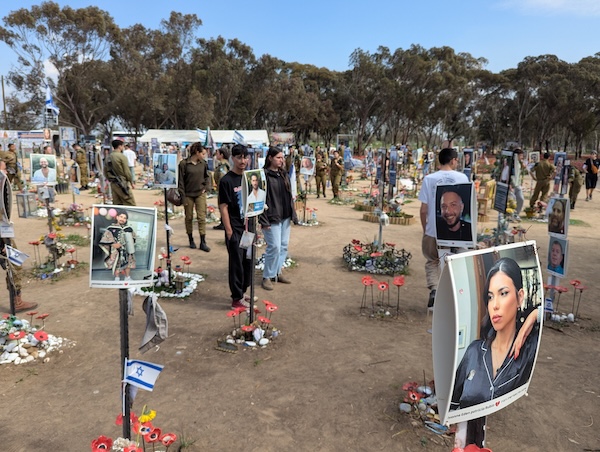
Commemorations of individuals murdered at the Nova festival. (photo by Pat Johnson)

Since I returned home to Vancouver from Israel a few weeks ago, it has taken me time to write about my reflections. There’s the usual getting over jetlag, catching up with work, dealing with the odds and ends that pile up after a five-week absence. I have also experienced a degree of avoidance. In some ways, there is so much to say I don’t know where to begin. In other ways, what can I possibly say that hasn’t been said before?

Unlike Israelis, I have had the luxury of putting my head in the sand, to some extent, in the days since I returned to my ridiculously quiet suburban home. My experiences – including a visit to the Gaza Envelope, Kibbutz Re’im and the Nova festival site, and conversations with scores of Israelis – have been percolating. In recent days, I have been immersed in video testimonies and other reports from survivors of the Oct. 7 attacks. 

One of the reasons I have avoided writing so far, I think, is that the parallel I feel compelled to make is one that I hate to invoke. I intentionally avoid making comparisons with the Holocaust, as almost any contrast cheapens the sanctity of that event’s memory. It also is unavoidably an exaggeration – nothing can compare to the Holocaust. And so, we should not be in the business of raising false equivalencies.

But not everyone subscribes to my hesitancy. More than one Israeli I spoke to referred to Kibbutz Be’eri as “Auschwitz.”

Although I was guided around the sites of the Oct. 7 atrocities by a senior Israeli military official, we were denied entry to Be’eri, which came as a relief. I didn’t want to make the choice not to go in, but I was glad that decision was made for me.

I had to ask myself – as other people asked me – why I was compelled to visit these places in the first place? I had not, for example, taken the opportunity to watch the footage that screened in Vancouver last year of the most terrible carnage from Oct. 7. I believed that I knew enough of what happened that I did not need to be exposed to the images so graphically. (There are people, on the other hand, who I think should be forced to watch such footage.)

I could say no to the video but, in Israel, I felt an obligation to bear witness in what small way I could by visiting the Nova festival site and other locations, including Highway 232. My guide, who was among the first on the scene during the morning of Oct. 7, provided (as you can imagine) a jarring play-by-play of what he witnessed, saw, heard and smelled that day.

As I watch documentaries and continue to read about the events, and hear from eyewitnesses, including those who defended their kibbutzim, and military personnel who were among the first on the scene, it is almost impossible for the mind not to go to historical parallels.

I hear stories of people pretending to be dead for hours while murderous attackers surrounded them. Testimony recounts the nonchalant murder of the elderly, babies, anyone and everyone the terrorists could kill – as   well as the collaboration of “ordinary” civilians.

The ripping apart of families. Parents shielding their children from gunshots. Families huddling as they are engulfed in flames. Survivors’ stories of screams still ringing in their ears. Jews recalling what they were sure were the last moments of their life. Acts of brutality that defy human imagination. Sadistic jubilation while perpetrating acts that make most people recoil. Residents of a village reconnoitring after the catastrophe to determine who remains alive.

The parallels are, to me at least, unavoidable.

There is, of course, a quantitative chasm between this modern horror and that of the Shoah. It is this difference that also makes comparisons so incredibly problematic. But it is the qualitative experiences, the grotesque similarities between Nazi atrocities and those of Hamas, that force the mind to go in that direction.

While visiting Jerusalem, I stumbled upon a pathway that begins at Yad Vashem, the Holocaust memorial museum and research centre, and winds through the military cemeteries in which the casualties of Israel’s successive defensive wars and endless terror attacks are buried, as are most of the country’s prime ministers, presidents and other leading figures. The pathway ends at the tomb of Theodor Herzl, the man most credited with making real the dream of a Jewish state, and adjacent to the museum that tells his life story.

The message here is that, from the moral abyss of the Holocaust to the sustaining of national self-determination as envisioned by Herzl, the path has had an unimaginable human cost.

The promise of the state of Israel, in Herzl’s mind, was that a people who were no longer stateless would not be subject to the predations of their brutalizing neighbours. Like so much else Herzl envisioned – he imagined that Jews would be welcomed for the positive contributions they bring to the region – a state has not ushered in the lasting peace for which he had hoped.

photo - An empty Shabbat table set for missing loved ones at Hostages Square in Tel Aviv
An empty Shabbat table set for missing loved ones at Hostages Square in Tel Aviv.  (photo by Pat Johnson)

We have known this since the moment Israel’s independence was declared and the new country was immediately invaded by the massed armies of its neighbouring countries. The Arab states unanimously rejected coexistence and soon Jews from across the Middle East and North Africa were expelled or otherwise forced to flee, most finding a home in the new Jewish state. The Arabs who were not within Israel’s border at the time of the 1949 ceasefire – and their generations of descendants – have been held as stateless people ever since in one of history’s most cynical acts.

What is still able to shock, even in a world where we have become inured to inhumanity, is that there are people who experience joy at Jewish death and thrill at the opportunity to torture, terrorize and kill Jews. A state has not removed that possibility from the world.

If there was one single objective for the existence of a Jewish state, this was it: the basic security of the Jewish person. On Oct. 7, that promise was broken. 

While many Israelis told me that Oct. 7 demonstrated that coexistence with Palestinians is impossible, other people told me that it merely made them redouble their commitment to building a future of peace and coexistence. If I went back to those who said Oct. 7 taught us to work harder for peace with Palestinians, would they see a cognitive dissonance in my position as I do with theirs?

If the existence of a Jewish state cannot prevent the most basic thing it was created to realize, is the entire enterprise a failure?

A Jewish state does not guarantee, obviously, that Jews will not still and again experience the atrocities that have befallen them historically. It is, nevertheless, the best defence, however imperfect.

The Israelis who told me they must work harder for peace believe that, when our ideal falls short, rather than give up, we have to do more to attain it. For them, that means doubling down on peace activism. I admire their idealism.

For me, any realistic plan for peace is worthy of consideration. But I will also double down and say that the answer to a Jewish state that fails to live up to its core mission of keeping Jewish people from reliving the horrors of the past is also not to give up – but to continue building a Jewish state that is impermeable, unparalleled in strength and impervious to the genocidal assaults of its neighbours.

Reflecting on the thousands I saw buried along the pathway between Yad Vashem and Herzl’s tomb, I believe that, until Israel’s neighbours are incapable of the sorts of atrocities we have seen, Israelis must work for peace, on the one hand, while assuming their neighbours won’t change, on the other. 

Format ImagePosted on April 11, 2025April 10, 2025Author Pat JohnsonCategories Op-EdTags Hamas, Israel, Israeli-Palestinian conflict, Oct. 7, peace, terrorism

Celebrate, share light

Hanukkah is a holiday made joyous by its origins in the victory of the Jewish people over our oppressors and the liberation by the Maccabees of the Second Temple in Jerusalem. Now, thousands of years later, over eight nights, we light candles to honour our brave ancestors and to recognize the fortitude, across the millennia, of the Jewish people.  

The meaning of Hanukkah has acquired a new relevance: the bravery demonstrated by the people of Israel – especially since Oct. 7, 2023. 

It has been more than 15 months since, in the most shameful and grievous fashion imaginable, Hamas deliberately started a war, placing the people of Israel – and of Gaza and the entire region – in jeopardy. Israel continues to defend its residents and citizens from terror on multiple fronts, facing both assaults from Hamas and unprecedented attacks by hundreds of rockets from Iran-backed Hezbollah. Israelis and the global Jewish community continue to call for the release of 101 hostages who remain captive in Gaza. Families across Israel and the world continue to adjust to life without the 1,200 Israelis – and victims from 30 other nations – systematically murdered on Oct. 7. 

Yet, amid the chaos and terror of daily rocket attacks, the spirit and fortitude of the people of Israel remains as strong as ever. 

This year, as we light our candles over the eight nights of Hanukkah, we contemplate the history and symbolism of our Jewish traditions, and we have an opportunity to consider their meanings in our current reality. Just as we light our hanukkiyah with its eight, equally proportioned candles, we remember Jews have an admirable track record in fighting for social equality, and we consider where, today, there are inequalities to be addressed. 

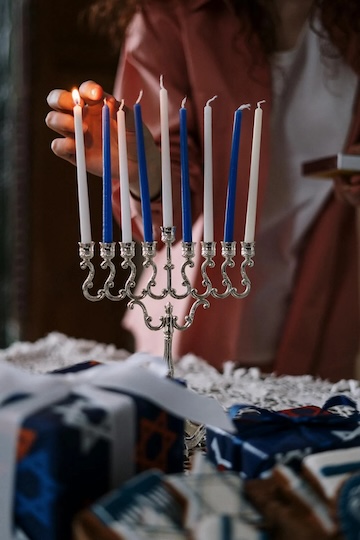
photo - This year, as we light our Hanukkah candles, we contemplate the history and symbolism of our Jewish traditions, and we have an opportunity to consider their meanings in our current reality
This year, as we light our Hanukkah candles, we contemplate the history and symbolism of our Jewish traditions, and we have an opportunity to consider their meanings in our current reality. (photo from pexels.com)

As we add candlelight to our homes, we remember our age-old obligation to bring light to our families, friends and neighbours. We encourage well-rounded education, free from hate, for all children; we advocate for a safe and welcoming learning environment for our post-secondary students and faculty; and we support the most vulnerable among us. 

There is much to do – what will your focus be over the coming year? To what cause will your efforts be directed? 

Can we hope that Gaza will be freed from the terrorist influence of Hamas? Will Lebanon emerge from under the sway of Iran-backed Hezbollah? Will Israel’s adversaries stop their war against the Jewish state?

Will our focus be on our own family, our close friends, our community, a charitable cause? Will we share the Jewish values we cherish, the triumph of light over darkness, freedom over oppression, and the importance of upholding one’s identity and beliefs?

And can we help our fellow Canadians uphold the values we hold dearest? How much light can we share this Hanukkah season? 

Let’s find out. 

Chag sameach. 

Judy Zelikovitz is vice-president, university and local partner services, the Centre for Israel and Jewish Affairs (CIJA).

Posted on December 13, 2024December 11, 2024Author Judy ZelikovitzCategories Op-EdTags candlelighting, CIJA, Gaza, Hamas, Hanukkah, Hezbollah, Israel, mourning, Oct. 7, reflections, terrorism

המשבר הגדול של מדינת נתניהו יגיע עוד יגיע

לאחרונה דיבר עם חבר מישראל דוד שטויר, כאשר בגילו המתקדם (שבעים פלוס) כבר חווה הכל במדינה. אני הכרתי את דוד בחודשים הראשונים שלי בתהליך התאקלמות בוונקובר, אליה עברתי בחודש פברואר 2005

דוד חזר וציין בפני שאני הייתי “נביא” שראה לאן פני ישראל מועדות והוא עד היום מצטער שלא עזב כמוני את המדינה בה גדלנו, למען עתיד טוב יותר לו ולילדיו. לאור המשבר הקשה בישראל ילדיו של דוד כבר הספיקו לעזוב את ישראל. ולכן שאלתי אותו מה עוד “מחזיק” אותו בישראל? הוא ענה לי כי בתו הצעירה שהשתחחרה לאחרונה ההצבא, נקראה לשירות מילואים דחוף בן מספר חודשים בחיל האוויר. לאחר שתשחרר הבת מהמילואים היא קרוב לוודאי תעבור ללמוד בחו”ל. אז גם הוא יעזוב סוף סוף את ישראל

דוד אומר כי כבר למעלה מחמישים אלף ישראלים עזבו לאחרונה את ישראל. לדבריו מספר העוזבים צפוי אף לגדול לאור המשבר הגדול שישראל נמצאת בו, והוא צפוי להחריף. תשמע רוני הוא אמר לי נחרצות: ישראל היום נשלטת על ידי משפחת פשע הלוא היא משפחת נתניהו. הם עושים מה שהם רוצים, ובעלי התפקידים לצדו של נתניהו הם נוכלים וחסרי כישורים. נתניהו יצר פילוג בעם שאי אפשר לתקנו כך שאי אפשר לגשר בין “הביסיסטים” למתנגדיו של נתניהו

כשאמרתי לדוד כי הכיצד יכול ראש ממשלת ישראל להחזיק בן כלומניק בפלורידה (יאיר נתניהו) שאפילו לא עובד, והמדינה מממנת את שירותי הביטחון שלו שעולים הון ובתקופת מלחמה? דוד קטע את דברי בחריפות: רוני זה כסף קטן לעומת מיליארדי השקלים שנשדדים מקופת המדינה על ידי נתניהו וחבורתו, בין היתר לטובת החרדים שאפילו לא משרתים בצבא.ווהוא (נתניהו) עוד טס מטוס מפואר שעלה מיליארד שקל

לאחר השיחה עם דוד ישבתי וחשבתי לעצמי על ישראל ועתידה ובמחשבותי הצטיירה תמונה עגומה מאוד. אלו שחושבים שבקרוב יפרוץ תהליך שלום חדש בין ישראל למדינות ערב ובעיקר עם סעודיה, חיים בחלום. סעודיה הודיעה כבר מפורשות! שכל תהליך שלום עימה חייבה לכלול פתרון גם לפלסטינים – והוא הקמה מדינה עצמאית עבורם. הימים שישראל תעשה הסכמי שלום בדמות הסכמי אברהם, ללא פתרון הבעייה הפלסטינית עברו מן העולם

יש בישראל כיום שמהללים את נתניהו כביכול על הצלחותיו מול החמאס והחיזבאללה, בזמן שהם שכחו את הכשלונותיו הרבים, שהביאו למחדלי השבעה באוטובר. וכן ויתור על החטופים כדי שיוכל להמשיך ולשבת על כיסא המלך. מבחינתי זה כמו להגיד שלגודלה מאיר היו הצלחות רבות במלחמת יום כיפור מול המצרים והסורים, תוך התעלמות מאחריותה למחדל הנוראי של התקפות הפתע של צבאות האויב על ישראל

בכל מדינה מתוקנת ראש ממשלה היה מתפטר מיד לאחר מחדלי השבעה באוקטובר, ונעלם מהציבור לעולמים, אך כמובן עומד למשפט העם במסגרת ועדה חקירה ממלכתית. אך את נתניהו הנוכל נורמות ויושר אינן תכונות המאפיינות אותו למרות שהוא דורש זאת מאחרים

נתניהו אחראי להעברת מיליארדי דולרים לחמאס מקטאר, והוא אחראי לפגיעה קשה ברשות הפלסטינית. נתניהו חיזק אפוא את הקיצונים בפלסטינים (חמאס) והחליש את המתונים יותר (הרשות). נתניהו אחראי גם על עיבוי והוספת ההתנחלויות בשטחים הכבושים שרק מרחיקים את ישראל מפתרון הסכסוך הממושך עם עולם הערבי והשגת שלום

בתקופת שלטונו הארוכה בת שבעה עשרה השנים של נתניהו, ישראל נחלשה מבפנים בצורה משמעותית. המדינה הפכה למושחתת, יותר דתית משיחית, יותר קפיטליסטית והרבה פחות הומנית

Posted on November 20, 2024October 22, 2024Author Roni RachmaniCategories עניין בחדשותTags Hamas, Israel, Netanyahu, Palestinians, peace, settlements, Vancouver, התנחלויות, וונקובר, חמאס, ישראל, נתניהו, שלום

Posts pagination

Page 1 Page 2 … Page 7 Next page
Proudly powered by WordPress