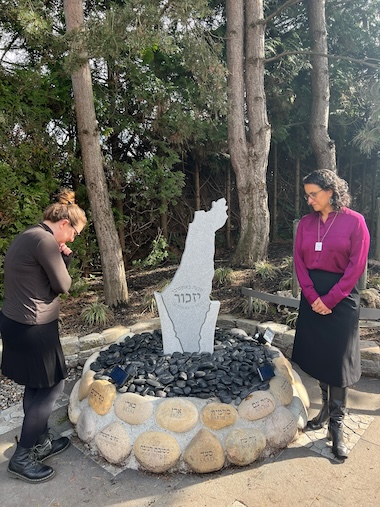
Or Shalom’s after-school program open house takes place May 28. (photo from Or Shalom)
Designed for ages 6 to 13, Or Shalom’s after-school program brings Jewish learning to life through music, storytelling, art and experiential activities. To learn more about it firsthand, check out the school’s open house on Wednesday, May 28, 5-6:30 p.m., at Cityview Church,4370 Sophia St. – Or Shalom’s temporary home while the synagogue is being renovated.
Rooted in Jewish Renewal values, Or Shalom’s educational program offers a holistic approach that nurtures curiosity, compassion and a vibrant connection to Jewish life. In addition to creative exploration, the school also teaches Hebrew, Jewish prayer and traditional skills, giving children the tools to engage meaningfully with Jewish texts, rituals and community. Children are encouraged to participate fully – mind, body and spirit – in an inclusive environment that honours both tradition and innovation.
Or Shalom invites everyone to meet its community, experience the program and explore how your child could thrive in it. Email office@orshalom.ca with any questions.
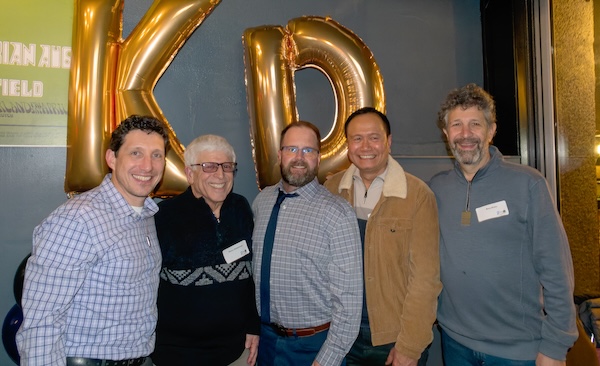
Left to right: Head of school Seth Goldsweig, former head of school Perry Seidelman, deputy head of school Alex Monchamp, head custodian and building manager Jess Sabado and former head of school Russ Klein at a February gathering of alumni to celebrate 20 years of KDHS on Willow Street. (photo from KDHS)
On May 14, with a party at Congregation Beth Israel, King David High School celebrates 20 years since it opened its doors on Willow Street.
“It’s a real blessing,” said KDHS head of school Dr. Seth Goldsweig about having a Jewish high school in the community.
“Study after study shows that the most effective way to develop and maintain Jewish identity is to go to Jewish day school,” he said. “Our students can continue to develop their Jewish identities and turn into the Jewish leaders of tomorrow.
“We have a high school that stands up to the other amazing independent schools in the area,” he added. “This means that students can have a top-notch Jewish education combined with a rigorous and enriching academic experience. They get the best of both worlds.”
Goldsweig is KDHS’s third head of school, having started the position last fall, after Russ Klein retired. Klein was at the helm from 2008 to 2024.
“In this job, I found a community that I didn’t know I had,” Klein told the Independent last year, as his tenure was winding down. “That was beyond special. I really do think of this job, this position really, as a gift.”
Klein had taken over the position after Perry Seidelman retired.
In 2001, Seidelman was hired as principal of Vancouver Talmud Torah High School – one of the iterations on the path that led from Maimonides High School, which was started in the 1980s, to KDHS. With 30 years prior experience and his approach to education, he was a key to the successful establishment of King David.
“Without Perry, there would be no school,” Larry Goldstein, president of the Jewish high school during the transition period, says in The Scribe’s Jewish Education in BC issue. “It’s as simple as that. Perry gave the credibility to other parents.”
“With growing interest in the school, a decision was made to build a permanent structure with financing from the Diamond Foundation,” Seidelman writes in The Scribe, which is the journal of the Jewish Museum and Archives of British Columbia. “It was to be built on a property at the southeast corner of 41st Avenue and Willow Street, directly across Willow Street from the Jewish Community Centre. Extensive discussions were held with the JCC administration, as intentions were to use the JCC for some programs, notably the JCC gymnasium for PE classes and the Norman [& Annette] Rothstein Theatre for drama productions.”
As enrolment grew, Alex Monchamp, who had been a teacher at the high school since its Maimonides days, was hired as vice-principal, according to The Scribe. Monchamp now holds the title of deputy head of school.
“I joined King David in July 2001,” Monchamp told the Independent. “I’d only been living in the city for a few months, and I saw a small newspaper ad for a small independent school looking for a half-time English and drama teacher. It was my first teaching job in BC!”
When asked why KDHS has proven successful, while previous versions of the high school struggled, Monchamp said, “I think the main turning point was the year I started, and the school had its biggest Grade 8 class, which I think was 25 or 26 students. Those connected to the school and who were vital in its foundation and ongoing viability made a real concerted effort to engage with the community and make a case for the importance and need for a sustainable Jewish high school. However, the real risk, the real investment, was when those Grade 8 families, and the families that came after, invested their most important resource – their children – in our school.
“When our families started to see that need and started to trust in the school, it allowed the school to grow and become more stable,” said Monchamp. “Stability turned into slow but steady growth, to more students, more teachers, and then our home on Willow Street. However, the building itself did not cement our future – it was also the school’s investment in good leadership and dedicated teachers that secured the future we enjoy today.”
Then-student Nicole Grubner and Gordon Diamond at the 2005 inauguration of the KDHS building on Willow Street. (photo from KDHS)
When Monchamp joined the high school, there were fewer than 70 students, programming was limited and there was no permanent school building, he said. Growth has occurred in multiple areas.
“There are obvious measures, like our student population is over 270 students, we have a vibrant arts program, a strong athletic program and our programming offers our students many ways to explore what they know, what they can do and who they’ll become,” said Monchamp. “All of that happens because we continue to have a team of outstanding teachers and dedicated adults who work extremely hard.
“The ultimate measure is not where our students go to university, the grades they earn or even how many of them are in the building each day,” he added. “There are bigger schools, there’s no shortage of kids going to university and no one is ever going to care what your math mark was in Grade 10. The true measure is that our students discover and develop their capabilities, figure out who they are and what it means for them to be Jewish in this world. In a world of uncertainty and change, our students have the capability to adapt and grow and the values and foundation to be a good person.”
KDHS’s director of development, Esther Mogyoros, who has worked at the school for the past 11 years, echoed Monchamp’s belief that there is more than one component to the school’s growth.
“Over the years,” she said, “King David has grown not only in student enrolment but also in its physical presence, thanks to the expansion of the east campus, made possible by the generosity of the Diamond Foundation and our supportive community. Our reputation has been built on a strong foundation of chesed programs, regular volunteer initiatives, and active participation in celebrations and community events. We take pride in nurturing students who not only excel academically but also continue their educational journeys and give back to the community long after graduation.”
Both Mogyoros and Monchamp said the best part of their jobs is when they connect with others.
“Connecting with students, parents, grandparents and the community at large,” said Mogyoros. “Building relationships and sharing my passion for Jewish education, Israel and the importance/impact of King David in the community.”
“The best part is when I can connect with a student, chat, find out more about them and then, if I can, find ways that I can support them,” said Monchamp. “It doesn’t happen nearly enough in a typical day, but I love it when it does.”
One of Monchamp’s standout moments at the school is when KDHS would take the Grade 9 students to Washington, DC, every spring to visit the US Holocaust Memorial Museum.
“We’d spend a full day at the USHMM, which is a lot, and our students always came away with information or artifacts they hadn’t encountered before and at times it was very emotive,” he said. “The trip also included a day at many of the Smithsonian Institution museums. It was always a treat to watch the kids see real historical items, like the Wright brother’s plane, the ruby shoes from The Wizard of Oz or Prince’s guitars. History is always more relevant to kids if they can get up close to it and connect to their own stories and memories.”
Over the past 20 years, there have been challenges, notably, the pandemic.
“There was so much unpredictability and an immeasurable amount of learning we had to do on the fly,” said Monchamp of that time. “Despite the numerous challenges, it is moments like that which demonstrate what our school is all about. The overarching goal was what it has always been: putting our students first. And when that was our guiding principle, we figured out the rest…. It was also vital that our families trusted us. Before, during and after COVID, we have consistently demonstrated to our families that we take our role in their children’s growth very seriously and that we always perform in ways that support and benefit their growth.”
“Throughout those difficult years,” said Mogyoros, “our school’s resilience and compassion shone through – not only in maintaining academic standards but also in supporting one another emotionally during a time of unprecedented uncertainty.”
Monchamp hopes the school continues on its current path, becoming “a student-centred learning environment.
“Learning is an active experience and is most successful when students are actively engaged and can apply what they know and can do to their own experiences and contexts,” he said. “We have already seen the tremendous benefit of this shift. It’s what is keeping our school competitive and on par with other Vancouver independent schools and it’s setting up our students for their future successes.”
The King David High School Class of 2019 celebrates graduation. (photo from KDHS)
“Our goal,” said Mogyoros, “is to empower students to be confident in their identities, excel in their chosen paths, and take pride in their Jewish heritage, traditions and love for Israel. We strive to inspire them to make a meaningful difference in the world around them.”
JWest is central to the high school’s future. The three-phase development project at 41st Avenue and Oak Street will see the construction of a much-expanded JCC, a new home for KDHS and two residential towers.
“Having a new building where we can continue to develop our programming, where we can engage our students and where we can host real ‘home games’ in our own gym in front of as many students and parents as possible is incredibly important,” said Monchamp. “The school is still very young and a new facility will allow it to continue to shape its identity. Additionally, our community can continue to take pride in the school and all of the many interconnected Jewish organizations in the city. I think the symbolism of one large, proud hub for the Jewish community sends not only a very strong message, but, more importantly, a unified message, one which the community can use as a foundation for its future.”
Mogyoros agrees.
“A larger campus will open doors to more programs, providing students with enhanced opportunities for learning, creativity and personal development,” she said. “We are especially excited about the addition of more space and new sports fields, which will enrich our athletic and extracurricular offerings and foster a vibrant, dynamic environment for our students.”
“We want to see the school continue to grow,” said Goldsweig. “Next year, we will be the biggest we have ever been. So many families have chosen to give their kids a Jewish high school education. We are so appreciative and hope that many more continue to make the same decision.”
The head of school says he has been warmly welcomed into the community, with Friday night dinner invitations every Shabbat, “an amazing staff,” a board that “has been supportive every step of the way,” and parents who “are dedicated to the success of the school and their children.
“The most impressive group of all has been the students,” Goldsweig said. “They are so inspiring, and I know our future is in good hands.”
To attend the May 14 gala, participate in the silent auction (which launches April 29), buy raffle tickets or donate to King David High School, visit goldenthreadgala.com.
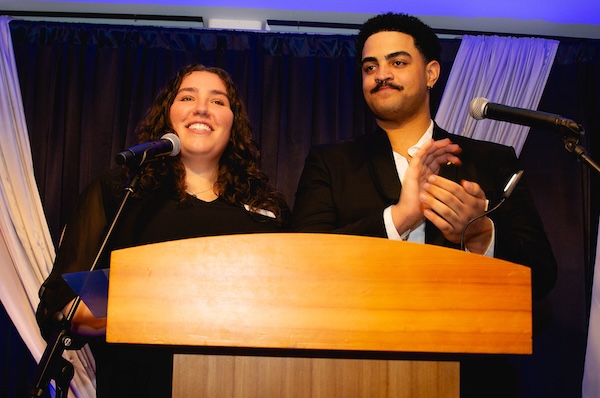
A Night of Resilience, held at UBC Hillel House March 27, was emceed by students Samantha Schwenger and Izaiah Isaac. (photo from Hillel BC)
Jewish students, allies and community members packed the second-floor social hall at the University of British Columbia’s Hillel House March 27 for A Night of Resilience. It was a celebration of the determination and tenacity of students since the Oct. 7 terror attacks and the spike in antisemitism on campuses.
The evening was emceed by Izaiah Isaac, a third-year student studying forest biology, and Samantha Schwenger, a third-year cellular and molecular neuroscience student. They expressed solidarity with the hostages and the broader Israeli population.
“Tonight, we gather here at Hillel to honour more than just achievements,” said Isaac. “We are here to pay tribute to something far deeper – to the resilience of Jewish students, their unwavering courage and their relentless pursuit of justice in a world that has felt, at times, unbearably heavy.”
“In the past year-and-a-half, Jewish students across British Columbia have been faced with an unimaginable reality,” Schwenger said. “The war in Israel, beginning on Oct. 7, brought with it a wave of violence and sorrow that impacted not only our families, but our very sense of security. And, in its wake, antisemitism surged, leaving Jewish students on campuses everywhere to bear the brunt of hatred, fear and division.”
Rabbi Kylynn Cohen, Hillel’s senior Jewish educator, spoke of the strength she has seen among students.
“We are always living Torah and our students have truly exemplified that in the past 17 months,” she said. “I have watched you grieve, pray, teach, love, protest, rally and get up every day … to fight the violence, gaslighting and antisemitism which has been coming at you from all sides. It is truly an honour to celebrate you tonight.”
Ohad Gavrieli, executive director of Hillel BC, spoke of the changed climate on campuses after Oct. 7, 2023.
“One by one, students started showing up at Hillel, some in tears, some shaken, all looking for support,” he said. “They came not only because of the violence and devastation inIsrael, but because the atmosphere on campus was already starting to change. Their [teaching assistants] were praising the massacre, their classmates were posting support for Hamas. The shift was fast and it wasn’t subtle. Now, it’s almost 18 months later and we’re still in it. It’s not over.”
Ohad Gavrieli, executive director of Hillel BC, was one of the speakers during the March 27 event. (photo from Hillel BC)
He noted that the UBC student union had endorsed a student strike for Palestine, part of a larger trend that, he said, has “left Jewish and Zionist students feeling unsafe and unwelcome.”
“Despite all of it, our students didn’t back down,” said Gavrieli. “They continue to speak up. The strength and resilience of our students should make everyone in this room proud. We have leaders here, we have a future in students who are brave, grounded and unwilling to be pushed aside. At Hillel, we do everything we can to stand with them, to be their Jewish home away from home, a place of strength, a place of safety and a place they are never alone. Tonight is about them. It’s about all of you who made this evening possible, as well, and those who stood with Hillel and our students through it all.”
Ezra Shanken, chief executive officer of the Jewish Federation of Greater Vancouver, lauded students, as well as the staff and lay leadership of Hillel.
“This is such an incredible evening that I wish we didn’t have to do,” he said. “I wish that you, as students, were not going through what you’re going through. The hostile environment that’s being created for you here on this campus and on campuses across BC is unacceptable and your courage is incredibly, incredibly inspiring.”
The event featured the presentation of Maccabee Awards to students from campuses throughout the province.
Shanken presented a Maccabee to Simon Fraser University student Yael Toyber, who Shanken noted is also the recipient of Federation’s 2024 Young Leadership Award.
“This student fights for justice not through confrontation, but through education – using their creativity and insight to create educational materials that are accessible and compelling,” he said.
Toyber’s work with StandWithUs and their leadership of the Jewish Students’ Association, Shanken said, has made her instrumental in strengthening the Jewish community at SFU.
Gavrieli presented the award to UBC student Rachel Seguin, who he credited for her contributions to the Israel on Campus group, and as “a bold voice for Jewish students, ensuring that our community stands proud.”
“This student has bravely stepped into conversations with UBC administration to address antisemitism, ensuring that Jewish students feel heard and valued,” said Gavrieli.
Gordon Brandt, president of the board of Hillel BC, recognized University of Victoria student Audrey Gaulin, who he called “a force to be reckoned with.”
“Beyond Hillel,” Brandt said, Gaulin has “stepped into leadership roles as a Common Ground Ambassador with Allied Voices for Israel and as a director-at-large with the University of Victoria Student Society.”
Ellie Sherman, Hillel BC’s director of student life, presented an award to Langara College student Ethan Doctor.
Doctor is a Canadian Jewish Political Affairs Committee (CJPAC) Fellow, an active member of Alpha Epsilon Pi fraternity, and “a champion for the Jewish community,” said Sherman. In his role as the Western Canada representative for the J7 Working Group on Campus Antisemitism, he has “amplified student voices, pushing for meaningful change at both local and national levels.”
Ishmaeli Goldstein, Hillel’s campus advocacy specialist, recognized Roman Chelyuk with an award for allyship. Chelyuk is a senior fellow with CJPAC and an Emerson Fellow with StandWithUs, treasurer of Israel on Campus (IOC) and a past executive of the Ukrainian Club, who has “shown a deep commitment to standing with the Jewish community.”
Andy Gitelson, campus support director from Hillel International, attended the event from Portland, Ore., and presented the second Allyship Award to UBC student Zara Nybo.
“As the president of IOC, a StandWithUs Emerson Fellow, a CJPAC Fellow and a Campus Media Fellow with Allied Voices for Israel and Honest Reporting Canada, this person has consistently demonstrated a strong commitment to using their voice to advocate for the Jewish community,” said Gitelson, who credited Nybo with being a powerful voice on social media, raising awareness, sparking important conversations, “and defend[ing] the Jewish community time and time again.”
Jewish students, allies and community members packed the second-floor social hall at the University of British Columbia’s Hillel House March 27 for A Night of Resilience. (photo from Hillel BC)
Yael Segal, a UBC alumna and co-founder of the Justin and Yael Segal Family Fund, presented the Kehilah Award to Jacoba Moscovitz. The award celebrates students who demonstrate leadership and dedication to the Jewish community by going above and beyond to support their fellow students, foster a sense of belonging and contribute to building a home for Jewish students on campus.
Segal credited Moscovitz as “a familiar and welcoming presence at UBC – somebody who helps others feel at ease and contributes to an inclusive atmosphere.… In many ways, this student has acted as the glue, bringing people together. As a member of the Jewish Students’ Association executive team and [as] a StandWithUs Emerson Fellow, they’ve also taken on leadership roles that strengthen Jewish life on campus. This student also bravely stepped up to be in ongoing conversations about antisemitism with UBC administration, and continues to work hard to ensure Jewish students are welcome and safe at UBC.”
Talia Chivo, Hillel’s lead campus professional at the University of Victoria, presented a second Kehilah Award to Bea Banack Tapia.
“This individual has a gentle way of listening to those around them,” said Chivo. “They take the time to connect one-on-one with so many members of our community and offer support and genuine friendship. Behind the scenes, they’ve put countless hours into making sure things run smoothly. Their dedication isn’t always loud, but it’s felt by everyone around them.”
Tina Malka, director of antisemitism research and education at Hillel International, traveled to the event from San Diego.
A Night of Resilience took place as the academic term concluded, marking the second year of unparalleled anti-Israel activism and antisemitic agitation on campuses. Speakers repeatedly credited students with the courage to confront the challenges facing them.
Alix West Lefler plays Frida in The Fast Runner, a 15-minute short from director David Bercovici-Artieda that was shot over the course of four days in the Greater Victoria area. (photo from thefastrunnerfilm.com)
The Fast Runner, a film about a young girl and a rabbi confronting the reality of the Holocaust, will be shown at the Comox Valley International Film Festival on April 5. The 15-minute short was shot over the course of four days in the Greater Victoria area and involved 260 people.
Director David Bercovici-Artieda, the son of a Holocaust survivor, described the project as both a profound responsibility and an intensely personal journey. His father’s experience, though not depicted in the story, inspired him to bring the film to fruition.
“It’s not just about telling a story. It’s about honouring the memory of those who lived through unimaginable horrors, including my own father. Every frame, every scene and every creative choice carries the weight of history – my family’s history,” he told the Independent.
“I came to understand the profound impact of survival – not just the physical endurance, but the emotional and psychological resilience that followed. His story, and those of so many others, shaped my perspective on the responsibility of storytelling and the importance of preserving these narratives for future generations.”
Bercovici-Artieda said creating a film like The Fast Runner is a balancing act between art and education. It must be compelling, engaging and cinematic, but also serve the greater purpose of preserving memory and fostering empathy. At its core, he explained, the film carries a message of compassion, hope and perseverance in the darkest moments of history.
“It is a reminder that, even in the face of cruelty, there were acts of kindness, moments of defiance and an unbreakable human spirit. These themes are as relevant today as they were then,” he said.
Bercovici-Artieda admitted that, during the process of putting the film together, he questioned whether he was doing justice to the story and honouring his father’s legacy in the right manner.
“Ultimately, telling these stories is a privilege,” he said. “It is a way to ensure that the Holocaust is never forgotten, to remind audiences that history is not just in textbooks – it lives in the voices and memories of those who came before us.”
Bercovici-Artieda stressed that the film is about choices as well: those forced upon people who suffered and those made by people who stood by, helped or betrayed. Viewers, he hopes, will recognize the weight of these decisions and that history is not just a collection of events: it is built on the actions and moral dilemmas of individuals.
“I also hope audiences see the film not just as a story about the past, but as a reflection of today’s world,” he said. “The forces of hate, intolerance and dehumanization did not disappear with the Holocaust. They persist in different forms. If we are not vigilant, history can repeat itself. And, right now, we are witnessing a dangerous rise in antisemitism, Holocaust denial and historical revisionism.”
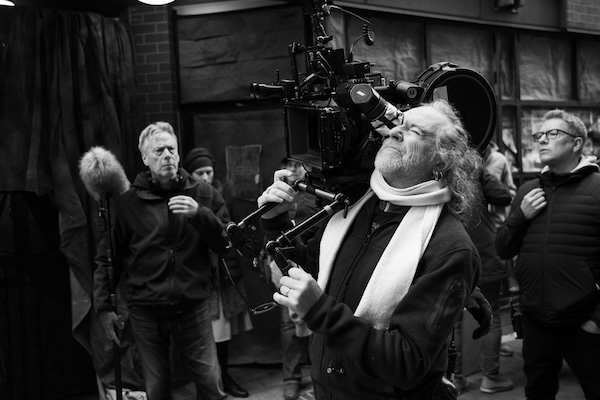
Director David Bercovici-Artieda behind the camera of The Fast Runner, which next screens at the Comox Valley International Film Festival. (photo from thefastrunnerfilm.com)
Most importantly, Bercovici-Artieda would like people to leave the theatre with a sense of empathy. Survivors like his father, he said, endured unspeakable horrors, but they carried on, rebuilt their lives and, in many cases, found a way to forgive.
“If they could move forward with hope, so can we,” he said.
Currently, Bercovici-Artieda is raising funds to support a partnership with Journeys in Film, an educational nonprofit, to help teachers bring The Fast Runner into classrooms worldwide. In addition, he would like to expand screenings, panel discussions and outreach programs to engage audiences in meaningful conversations about the Holocaust, resilience and the dangers of historical revisionism.
“My hope for educating people about the Holocaust through The Fast Runner is to provide a deeply human perspective on one of history’s darkest chapters – one that goes beyond statistics and textbooks,” he said. “I want audiences, especially younger generations, to connect emotionally with the story, to feel the weight of what was lost and to understand the consequences of hatred and intolerance.”
The Fast Runner screened at the Victoria Film Festival in February; the Shabbat Lounge, a Jewish cultural event running alongside the Sundance Film Festival in Park City, Utah, in January; and the Victoria International Jewish Film Festival last November. After Comox, it will make its Latin American debut, with three screenings in Ecuador, Bercovici-Artieda’s home country. One of the screenings will take place on Holocaust Remembrance Day (Yom Hashoah), on April 23, in Quito.
The film stars Alix West Lefler as the young girl Frida and Alex Poch-Goldin as the rabbi. Only 13 years old, West Lefler has a considerable list of acting credits, including roles in films (Speak No Evil, The King Tide) and on television (The Good Doctor, Riverdale). Poch-Goldin is a veteran stage and television actor with appearances on Nero Wolfe, Murdoch Mysteries and Queer as Folk; he is also a playwright, director and librettist.
Michael Bruce Adams wrote the screenplay for The Fast Runner. Adams has been involved in more than 150 film productions. Besides short films, he has written features and documentaries.
Bercovici-Artieda has been the cinematographer on dozens of film projects and a director of several recent television series’ episodes and movies, including the holiday film Making Spirits Bright.
Tova Krentzman’s Fire Tower is a documentary about the people stationed high above the ground in the Yukon and Alberta, who are looking for smoke or signs of a wildfire. (photo fromTova Krentzman)
Tova Krentzman’s Fire Tower, a documentary about the people stationed high above the ground checking for wildfires in the Yukon and Alberta, has been covering the film festival circuit. Most recently, it was shown in February at the Available Light Film Festival in Whitehorse, where the director resides.
The idea for the film arose when Krentzman was working as a cook at a firefighting camp one spring. Several lookouts, the people who comprise the first line of defence in battling wildfires, stayed at the camp as they were getting ready to head to their respective towers.
“I had a chance to talk to them and hear their stories. I even got to visit one of them. I was completely fascinated. The seed was planted there,” she told the Independent.
Krentzman’s diverse background includes experience as a geologist, cook, medic and merchant seafarer. She is also a photographer. Initially, she thought chronicling the stories of the lookouts would make an interesting photography book. However, when the pandemic struck, she became increasingly involved with video and turned the subject into a film.
For the documentary, she featured several different types of people who are lookouts, with ages ranging from young adults to seniors. Nonetheless, Krentzman said, they share a certain trait in common: the ability to be with themselves and thrive alone.
She was struck by the ability of the lookouts to climb a 100-foot tower every day, often many times a day, and to stay focused throughout the months they were on duty. In Alberta, where the season can last for six months, from spring to fall, lookouts work long hours without any breaks. In the Yukon, though the season is shorter, the job also requires a particular fortitude.
“It is definitely a certain kind of inner physical and mental strength to be able to do this job. When you are alone, everything you have ever done in your life comes into your mind, all your mistakes, everything,” she said. “You have to be the kind of person who can manage themselves. But these are also people who are able to feel very connected to their surroundings and derive a lot of pleasure of being connected to nature and what they are looking at.”
After spending large amounts of time with the lookouts, Krentzman observed how content they were with what they were doing. There was no drama, no breakdowns. Instead, the film raises the issue of how, in a hyper-connected world, solitude can inspire a different kind of connection with not only nature but community and one’s creativity.
“I think the film does get into what the struggles and challenges are. And so, people reflect on things and have some quiet reflective moments that they discuss and they are personal. I would say, overall, they are pretty satisfied with what they are doing,” she said.
A scene from Fire Tower. To do their fire spotting, lookouts must climb a 100-foot tower every day, often many times a day. (photo from Tova Krentzman)
Krentzman hopes that, through watching the 47-minute film, more people will realize that the towers exist. She also hopes that the film will draw attention to the dozens of people perched in the air on the lookout for potential danger. While wildfire events can blanket the news cycle during summer months, the towers are not widely known and most provinces no longer have them, she said.
“It is important to realize all the steps that go into fire protection and prevention. The lookouts spot many of the smokes and call it in when it is a little wisp of smoke – that is when you can actually prevent it from becoming bigger. The idea is to catch it before it is a big fire,” Krentzman said. “If you can see a fire from a satellite, then it is too big – that is not prevention.
“They are really there to protect, as a first line of defence, and then they call in the fire agencies and there is a back-and-forth going on. It is quite incredible what goes on behind the scenes when it comes to fires.”
In the time since the documentary was made, Krentzman said, the fire seasons have started so early that she likely would not have been able to gain as much filming access to the towers because of liability concerns.
Originally from Montreal, Krentzman has lived in different places, including Israel, where many in her family still live. Yet, she was drawn to the Yukon and has spent several years there.
“The Yukon is one of those places that, as a Canadian, you have to see what it is,” she said.
Fire Tower debuted at the Hot Docs Festival in Toronto last April and has appeared on screens in the United States, Asia and Europe. The documentary was to have been shown in British Columbia last summer at the ArtsWells Festival in Wells, but the event was postponed due to a wildfire.
For more information and to ask about a group screening of the film, visit underwirefilms.com.
Sam Margolis has written for the Globe and Mail, the National Post, UPI and MSNBC.
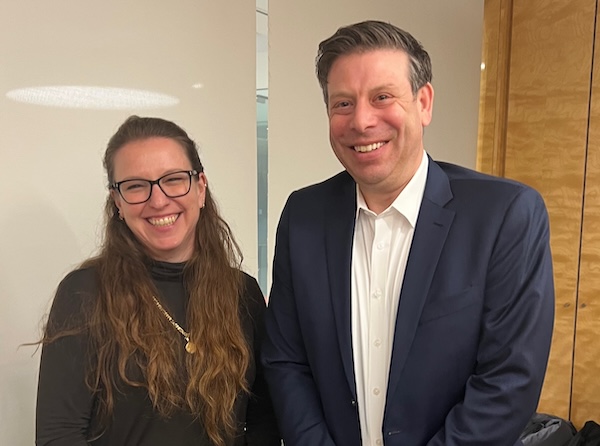
Among the activities in which Hebrew University of Jerusalem’s Dr. Shiran Reichenberg, left, took part while she was in Vancouver was a lunch and learn at Lawson Lundell LLP, hosted by Peter Tolensky. (photo from CFHU Vancouver)
Dr. Shiran Reichenberg, executive director of the Hebrew University of Jerusalem law faculty’s Clinical Legal Education Centre, was in Vancouver recently, as part of a professorship exchange with the University of British Columbia.
The exchange program started in 2010, with funding from Canadian Friends of the Hebrew University of Jerusalem and members of the local legal profession and judiciary. From 2013 to 2019, it was named in honour of Mitchell Gropper, QC, and, since 2021, in recognition of the Koffman family’s financial support, it has been formally called the Morley Koffman Memorial Allard School of Law UBC and Hebrew University Law Faculty Professor Exchange Program.
Koffman was an alum of UBC law school in 1952. He practised at Freeman, Freeman, Silvers and Koffman, and was awarded Queen’s Counsel in 1986. His firm, Koffman Kalef, was established in 1993.
One of the founders of the exchange program was Bruce Cohen, whose career has included, among other things, almost three decades as a BC Supreme Court justice. In the CFHU and UBC announcements of the Koffman family’s donation, Cohen says, “Given the high level of respect and regard for Morley’s reputation in the legal, university, Jewish and general communities as a wise counsel and recognized leader it is perfectly appropriate for the program to be named in his honour as a reflection of the importance placed by him and his family on scholarship, professionalism and tikkun olam.”
On the CFHU website, Cohen notes, “The ability of the program to operate in the initial few years of its existence was due in large measure to Morley’s assistance.”
The CFHU Vancouver organizing committee for the exchange program consisted of Cohen, Sam Hanson, Peter Hotz, Shawn Lewis, Randy Milner, Phil Switzer, Peter Tolensky, Dina Wachtel and the late Allen Zysblat. The annual exchange even operated during the pandemic, albeit virtually.
Dr. Shiran Reichenberg, left, visits Temple Sholom’s Oct. 7 memorial with the synagogue’s Associate Rabbi Carey Brown. (photo from CFHU Vancouver)
Reichenberg’s February-March visit to Vancouver was for just over two weeks, during which time she taught a course at UBC and spoke to various groups, including at Lawson Lundell LLP for a lunch and learn hosted by Peter Tolensky and at UBC’s Peter A. Allard School of Law, as well as at Temple Sholom for a lunch and learn organized by the Sisterhood, said Wachtel, vice-president, community affairs, at CFHU.
While Reichenberg regularly attends international conferences and lectures, this was her first time in Vancouver and, she said, “It was a very, very different experience to teach an intensive course for two weeks, each class three hours.”
Reichenberg, who is also the director of the Clinical Legal Education Centre’s Children and Youth Rights Clinic, said the course she gave here focused on the development of children’s rights and covered international documents, such as the Convention on the Rights of the Child, and other agreements, like the African Charter on Human and People’s Rights.
“We got very deep into several aspects of the convention and main principles, mainly best interest [of the child] and the right to participation. We talked about youth at risk, in criminal proceedings, in care proceedings,” she said.
Reichenberg graduated with her bachelor and her master of laws from the Hebrew University. She also studied in London, England, having received the Leonard Sainer Chevening Scholarship for LLM studies at University College London. She became interested in children’s rights law when she was a second-year student and participated in the Clinical Legal Education Centre’s Street Law Program, which is still part of the Children and Youth Rights Clinic she now directs.
“Each of us was put in a different residential care facility for youth at risk,” said Reichenberg, who was placed with a locked facility in Jerusalem. “When we entered this place and got an explanation about the girls and their life and what happened to them, it changed the course of my life. I stayed and I did another legal clinic in my third year of law school: representation of children’s rights, of children in court proceedings.”
In doing her PhD, Reichenberg focused on the right of youth at risk to participate in care proceedings, and her research included interviews with some of the girls from the Jerusalem care facility.
Children’s rights have their origin in labour law, Reichenberg said.
“Children, from the beginning of humanity until maybe the Industrial Revolution … died a lot, so parents didn’t get attached to them that much,” she explained. “And they were also considered as property of their parents, mostly their fathers, so they were sold, they were used to work, they were part of supporting the family; they weren’t what we consider them today. There is evidence that, in ancient times, children weren’t even given names, just numbers, because they died so much.”
But when children came to be working in mines and in factories, for example, “legislation gave them rights, to work only 12 hours a day and sleep at night, and things like that,” said Reichenberg, adding that the invention of the printing press, which meant that people needed to learn how to read, was an impetus for the establishment of schools.
The first child-related labour laws were English laws, passed in the early 1800s. The first youth court took place in the United States in 1874, and it involved the first case reported of child abuse, said Reichenberg. “[Mary Ellen McCormack] was abused by her stepmom and when the people wanted to help her, there was no law that protected children, so they used the law that protected animals from abuse.”
The Children and Youth Rights Clinic is one of nine offered by the Clinical Legal Education Centre. There are also clinics on climate change and environmental law; human rights in cyberspace; multiculturalism and diversity; representation of marginalized population groups; criminal justice; international human rights; the rights of people with disabilities; and wrongful convictions.
The centre can take a maximum of 140 students, with each clinic having, on average, 16 to 20 students.
“We have many more people who want to enrol than the places that we can give,” said Reichenberg, explaining that the clinics must be kept relatively small, given that they are working on legal cases.
“Each clinic is taught by a lawyer and there is a maximum number of cases that one person can handle, so we can’t have too many students,” she said. “Also, it allows us to have in-depth discussions in our classes with our students. And we always sit in a circle and there’s always dialogue, and it’s something that can be accomplished only in small groups.”
The Clinical Legal Education Centre takes a three-pronged approach. It handles upwards of 1,000 cases a year, providing legal aid and representation to individuals from marginalized groups. It also works for policy change, through test cases and position papers, for example, and offers public lectures and workshops to raise awareness, increase knowledge and promote discussion.
Since the Hamas terror attacks on Israel on Oct. 7, 2023, the centre has taken on an increased role in teaching and advocating for human rights. It has represented groups like the Hostages and Missing Families Forum in front of different United Nations bodies, for example, and has been operating Hamal Hevrati (War Room), a Facebook page providing legal aid to vulnerable populations, which has handled about 100 inquiries to date.
As well, the centre serves diverse clients and has a multicultural staff and student body, all of which include members of the Palestinian minority.
“We are not in war with the entire Palestinian people, we are in war with Hamas, and there is a difference,” said Reichenberg.
“So, we help those who need our help. And we work together, we study together,” she said.
It’s been hard, she admitted. “But we have to believe in working together and living together because none of us is going anywhere and we have to live together and work together for a long time … we have to find a way to do that and this is what we do.”
Reichenberg is proud of how the centre has adapted to the situation.
“In class, we have students who came from military reserves, still with their uniforms and their weapons. We have Arab students who have family in Gaza, which they haven’t heard from,” she said. “We have students who lost people they loved on the 7th of October and since. I personally have a student who I loved deeply and he died in the war, in his military reserve [service] in Gaza. And, also, in the staff, as I said, we’re a mixed staff and a lot of emotions came out on the 7th of October and we did a lot of preparation for staff, how to work with the students in this environment.”
While it’s not perfect, Reichenberg said, “it is certainly an amazing thing to see how everyone is sitting together, learning together, doing legal work together, for the same goal.”
Raphael Lemkin, a Polish-Jewish lawyer, coined the term “genocide” in 1944. (photo from Arthur Leipzig Estate, courtesy of Howard Greenberg Gallery, via ushmm.org)
Anna-Mae Wiesenthal was in the United Kingdom recently and passed a table in Dublin that was accusing Israel of perpetrating genocide against Palestinians in Gaza. She engaged the people at the table in conversation.
It was a small act of dialogue between a few individuals, but it reflects what Wiesenthal views as a vital act in mutual understanding.
Encouraging conversations like these is one of the reasons the Vancouver educator recently led a course at Temple Sholom on the definition of genocide.
Wiesenthal holds a master’s degree in Holocaust and genocide studies and is about to defend her PhD dissertation in the same discipline. Both degrees are from Gratz College, in Pennsylvania. She retired last year as a teacher at Vancouver’s King David High School.
The three-class course at Temple Sholom addressing the emotionally and academically challenging topic of genocide comes at a time when
Israel is being accused of perpetrating crimes against humanity in Gaza. The topic has immediate resonance. Wiesenthal’s intention, however, was to take a more nuanced approach to the subject.
“My goal when I retired is to continue to be an educator in different capacities,” she said. After discussions with Temple Sholom’s Rabbi Dan Moskovitz, she put together the course, which ran on three consecutive Wednesdays, ending March 19.
The focus, she said, was an examination of the concept, introducing students to when and why the term “genocide” was coined, in 1944, by Raphael Lemkin, a Polish-Jewish lawyer, and looking at its definition, examining the wording and identifying problematic components.
In 1948, the United Nations Genocide Convention defined “genocide” as: “Any of the following acts committed with intent to destroy, in whole or in part, a national, ethnical, racial or religious group, as such: killing members of the group; causing serious bodily or mental harm to members of the group; deliberately inflicting conditions intended to destroy the group in whole or in part; imposing measures to prevent births within the group; forcibly transferring children of the group to another group.”
“The word ‘intent’ in the definition is problematic,” Wiesenthal said, as an example of the exploration the class undertook. “How do you prove intent?”
The goal of the course, she said, was “to come out possibly with more questions or appreciation for the complexity of the definition.”
The small group of students analyzed the 10 Stages of Genocide, a framework developed and introduced in 1996 by Dr. Gregory H. Stanton, the founder of Genocide Watch, to help identify the warning signs of genocide and prevent it before it escalates.
These steps include classification (dividing people into “us” versus “them” based on ethnicity, race, religion or nationality); symbolization (assigning symbols or names to distinguish groups, such as the yellow Star of David for Jews in Nazi Germany); discrimination (dominant groups deny rights to a specific group, often through laws or policies); dehumanization (the targeted group is compared to animals, vermin, insects or diseases to strip them of their humanity); organization (genocidal acts are planned and coordinated, often by governments, militias or extremist groups); polarization (propaganda and hate speech are used to drive society further apart, making violence seem justified); preparation (authorities or groups begin making lists, planning logistics and even building camps or weapons for mass killing); persecution (victims are identified, isolated and deprived of rights, for example, forced deportation, concentration camps, starvation); extermination (the mass killing of the targeted group begins, often justified as “cleansing” or necessary for national security); and denial (perpetrators cover up evidence, deny crimes, blame victims or rewrite history to avoid accountability).
“It’s not always linear,” Wiesenthal said of the 10 stages. “Some of the stages can overlap, some of the stages may not necessarily be present, but it’s a way to identify and help you predict. If we see conditions of the stages unfolding then perhaps we can predict more accurately that there is groundwork being laid for genocidal actions.”
While Wiesenthal wanted to encourage depth of understanding on the topic, its immediacy – with Israel being accused of genocide by groups including Amnesty International and Human Rights Watch – led some students, and the Independent, to pressure her to comment on current events.
“What do we say when somebody says Israel is committing genocide?” Wiesenthal asked. “I could ask a question like: What is your understanding of genocide? What does that mean to you?”
If Israel wanted to commit genocide, Wiesenthal noted, they have the military capacity to have done so on the first day of the war. This is perhaps the most immediate, if not entirely nuanced, response.
“You can make all kinds of arguments about how there was or wasn’t enough humanitarian aid and food trucks entering Gaza,” she said. “The fact is there were food trucks entering.”
There could be legitimate discussions about what Hamas did with that aid once it entered Gaza. But, she said, the larger issue is that governments that plan on committing genocide do not provide victims with humanitarian aid, nor do they provide vaccines for children, as Israel has done.
Military experts, such as John Spencer, who specializes in urban warfare, has said that the civilian casualty ratio in Gaza is “historically low for modern warfare” and cites Israeli Defence Forces estimates that 50-60% of Gazans killed have been civilians, well below the 80-90% of civilian casualties typical in modern conflicts.
Spencer has praised the Israeli military’s efforts to minimize non-combatant harm, citing mass warnings to Gazan civilians, providing evacuation and relocation directives to reduce casualties, and the use of “roof knocking” techniques before airstrikes.
While Israel has been condemned for using 2,000-pound bombs in urban areas, Spencer has claimed that these are standard for penetrating fortified underground structures, like Hamas’s extensive tunnel networks, and contends that their use is not intended to cause unnecessary destruction but to legitimately and effectively serve military objectives.
Wiesenthal turns the genocide narrative around, noting that Hamas has explicitly dedicated itself to committing genocide against Israelis and Jews, both in writing and in its repeated expressed statements.
“It is part of Hamas’s charter and something they verbally repeated, that their goal is to get rid of Jews, and their readiness to commit Oct. 7 over and over again,” she said.
This goes to the challenging issue of intent on the part of both Israelis and Hamas, she added.
“If given the opportunity, Hamas [has said it] would kill every Jew in Israel and destroy Israel,” said Wiesenthal. “Israel is not targeting the Palestinian people or the Palestinian population in Gaza. Their campaign is solely directed at the terrorist organization Hamas, which is existentially threatening Israel. Israel is responding to a genocidal attack.”
For decades, conversations about antisemitism and racism have been running on separate tracks, Prof. Magda Teter told the Independent. But there is a connection, she said, and, in her March 4 talk at Congregation Beth Israel, she will explain that link.
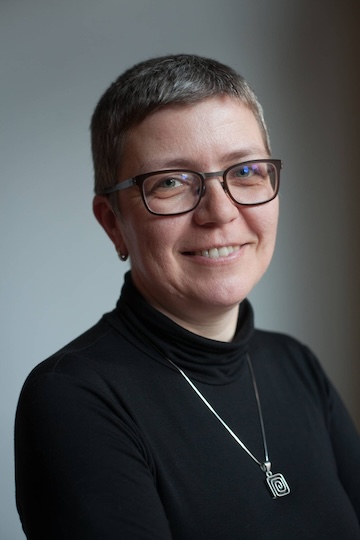
Prof. Magda Teter, author of the forthcoming book Blood Libels, Hostile Archives: Reclaiming Interrupted Jewish Lives, speaks at Congregation Beth Israel on March 4, 7:30 p.m. (photo by Chuck Fishman)
The lecture, called Reckoning with the Roots of Antisemitism and Racism, is co-presented by the synagogue and the Archdiocese of Vancouver. Teter, a professor of history and the Shvidler Chair of Judaic Studies at Fordham University, is president of the American Academy of Jewish Research. She is the author of several books, most recently Christian Supremacy: Reckoning with the Roots of Antisemitism and Racism (2023). Her book Blood Libel: On the Trail of An Antisemitic Myth (2020) won several awards, including the 2020 National Jewish Book Award. Other publications include Sinners on Trial: Jews and Sacrilege after the Reformation (2011), Jews and Heretics in Catholic Poland (2006) and many articles (in English, Hebrew, Italian and Polish).
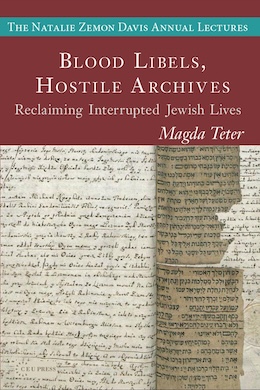
Teter has a new book coming out soon, called Blood Libels, Hostile Archives: Reclaiming Interrupted Jewish Lives, which, according to the summary, “explores two places: Trent, in northern Italy, and Sandomierz, in eastern Poland … both had been sites of anti-Jewish libels falsely accusing Jews of killing Christian children, Trent in 1475 and Sandomierz twice – in 1698 and 1710; in both, the instigators of the Jews’ persecution left unique and extensive archives, both towns have physical remnants of these deadly affairs, and, finally, neither town has an existing Jewish population. Yet, centuries later, these anti-Jewish libels have not been relegated to the past; in both towns, their legacies still reverberate today.”
“There has been a lot of scholarship about blood libels – the false accusations against Jews that emerged in the Middle Ages, charging them with killing Christian children,” said Teter. “Scholars, including myself, have analyzed the trials, the rhetoric, iconography and anti-Jewish works to understand how these anti-Jewish ideas emerged and spread. What is largely missing from this scholarship is the real, not the imagined, Jews – those Jews whose lives weredestroyed by these accusations. So, what this book is trying to do is to recover the lives of Jews who were subjects of these accusations and tell us about them, how they lived, rather than how they were imagined by their accusers. The tricky part of this is how you recover their lives from documents that were created for the purpose of showing Jews’ guilt and how cruel, heinous and hateful Jews were. So, this book is trying to do just that: to peel through the layers of hostility for the glimpses of lives that were destroyed. It matters. This allows us to wrest the story away from the Jews’ accusers.”
Teter, who isn’t Jewish, grew up in communist Poland where, she said, “Jewish topics were a taboo.” Nonetheless, Poland is “a country whose history is so tightly intertwined with Jewish history, so I was very conscious of Poland’s Jewish past,” she said. “I wanted to learn more.”
This led Teter to Columbia University, where she earned a PhD.
“One of the inspirations for me in taking on difficult topics is the arduous path of Jewish-Catholic dialogue and reconciliation in the aftermath of World War II,” she explained. “It was a process of hard and honest conversations. What these conversations and subsequent documents that emerged show is that hard truths don’t have to tear groups apart but can bring people closer together. But, I think, in the last several years, we have been losing the ability to talk to one another on difficult topics. We, as a society, tend to look for affirmation or we walk away, block or dismiss. We closed ourselves in comfortable bubbles.
“My last book picks up threads that may have been left unexamined in the history of antisemitism – the questions of power and domination,” she continued, referring to Christian Supremacy. “As for the responses, in general, people are initially taken aback by the book’s title … but then, if they are willing to read or listen, they become appreciative of my pointing to something that they had not noticed before. That’s my goal in teaching and writing – I am not looking for affirmation, I hope readers or listeners will leave with a few ‘new thoughts.’ I also hope to learn from the readers and listeners. Their questions often help me clarify my thoughts as well and often inspire ‘new thoughts,’ too.”
Teter, who became a fellow of the American Academy for Jewish Research in 2016, has served on the executive board and, at one point, as treasurer of the academy. She was elected president in 2022 for a two-year term, and is currently in her second and last term.
“It is the oldest organization of scholars in Jewish studies in North America,” she said of the academy, which was founded in 1920.
“While at the beginning it focused on amplifying the scholarship of the fellows,” she said, “since the beginning of this century, the academy has been focused on programs intended to cultivate the next generation of scholars. For example, the academy awards the annual Salo Baron Prize for the best first book in Judaic studies, runs the biennial summer graduate student workshop and the early career workshop for untenured faculty and, with the increasingly diminishing opportunities for graduate student research, the academy offers dissertation research grants.”
Last month, in an interview with The New York Review of Books – for which she has written – Teter was asked what responsibility historians have to be guided by what’s happening in the present. She cautioned, “We must allow the past to speak on its own terms, even when asking questions that are pertinent to the present.”
“We are all shaped by our own experiences and contexts,” Teter told the Independent. “We often ask questions that are relevant to our own lives. But these may be questions that people of the past did not ask. We have to try to understand their lives on their own terms. They did not know what we now know. They did not hold the same values we do. So, it’s OK to ask about how women or non-binary people were treated in the past, or how people thought about the environment, or how they responded to pandemics, but we should not try to make them feminists or environmentalists.
“Let me give you another example, the world is now animated by the Israeli-Palestinian conflict, and many ask questions about how these different peoples engaged with each other historically, how they thought about one another – if they thought of one another. To find answers, we go to historical sources, but we have to read these historical sources on their own terms, not look only for examples that confirm what we already believe. We need to let them speak in the language and the values of the time in which they were created, not through the lens of now.”
There are other lenses too, and ways of connecting the past with the present. In a 2023 interview with JTA, Teter said, “Understanding Jews’ place in history and society, on their own terms but also on the terms imposed on them from the outside, holds much relevance today.”
“There are two vantage points from which Jews’ place in history can be seen: from the outside, and how Jews experienced their own lives,” she told the Independent. “The 2023 interview took place before Oct. 7 in the context of a recognition by the New York Jewish Week of my role in giving Jewish life in the Bronx more visibility, a borough that has now one of the smallest Jewish populations in New York but one that was, in the mid-20th century, proportionally, the most Jewish borough in New York, with nearly 50% of the population being Jewish.
“But that sentence from 2023 can be illustrated in 2025 in another way. Today, we are still reeling from the aftermath of Oct. 7. One of the main topics that concerns Jewish communities around the world is the rise of antisemitism. But when we talk or write about the history of antisemitism, we typically talk about what antisemites think or do – that is, we discuss it in terms ‘imposed’ from the outside, but what I am asking us to do is to also pay attention to Jews’ lived experiences, and not to refract that experience solely through the external lens. It is something that my forthcoming book is trying to do.”
When asked whether she was, in this moment, hopeful, despondent about or resigned to what humanity is capable of, Teter said, “We live in very dark times. I am very depressed when I look at the ruling elites, whether political or corporate. I am also despondent about the role social media is playing in our society – robbing us of our ability to talk to one another, to argue and reason with one another. I am most hopeful when I am with my students, when we have time to spend together and patiently wrestle with difficult topics or texts. When humans take that time to stop, read, think and talk, things can become better. Social media and the current commercial media environment push us to react without discernment.
Prof. Magda Teter’s talk at Beth Israel is a free event, but registration is required at bethisrael.ca.
Ten Purim Bears: A Counting Book for Purim introduces kids to Purim, numbers 1-10.
Fans of Once a Bear: A Counting Book by Ron Atlas (words) and Zach Horvath (illustrations) will be happy to find that their bear friends have returned – this time, in Ten Purim Bears: A Counting Book for Purim. Both 24-page board books are published by the Collective Book Studio, which has produced several well-written and -designed books reviewed by the Independent.
Ten Purim Bears features all the same adorable bear characters as the first book, and follows the same format. Each scene spreads over two pages, with the numbers one through 10 written out on top and appearing numerically on the bottom, as borders. In the middle are 10 chairs, the first scene with mostly empty chairs, except for the one on the far left, where sits a baseball-costumed bear wondering, “Where is everyone?” As we progress through the story, we get more bear bums on seats, each dressed in a different costume. As each new bear enters, the new number of bears is highlighted in white on both the top and bottom borders.
Adi, bear #6, takes her seat in Ten Purim Bears: A Counting Book for Purim by Ron Atlas (words) and Zach Horvath (illustrations), published by the Collective Book Studio.
Directed to readers up to 6 years old, their reader-helpers will enjoy a laugh or two, as well. For example, Flor, “who lives next door,” sits down and says, “I’m saving a seat for my friend.” Turning the page, Pete, “from down the street,” has sat next to Flor, saying: “I’m the friend.” I hear him doing it in a deadpan voice and it makes me chuckle every time.
There are two short narratives for each scene – one introducing the next bear and the bears talking among themselves. It’s a nice touch, kind of like having a parent narrator and then the kids’ views on things. As we are told by the narrator that Adi’s sister, Mandy, “brought some sweets – lots and lots of Purim treats,” we see Mandy handing them out: “There’s some for everyone,” she says. “Thank you,” says her sister. The hamantaschen that Amari Bear baked to share with his friends are his favourite, he says, while Adi agrees, “Yum!”
Kids learns not only how to count, but a bit about Purim and its traditions. Sharing, politeness and a sense of community are encouraged. As is a sense of fun, with the various costumes. And the arts! The bears have all gathered to watch a Purim spiel, of course. And we get to see a scene of the play, with quadruple-threat performers – acting, dancing, singing and playing instruments – looking like they are having a good time. The 10-bear audience certainly is.
Ten Purim Bears and Once a Bear can be purchased at thecollectivebook.studio. Check out the publisher’s website further when you’re there, as there will no doubt be another book or two you’ll want to add to your collection.
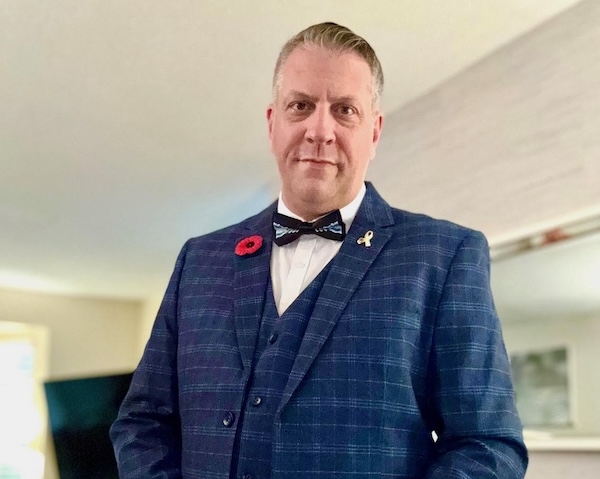
Michael Sachs is the first director of Western Canada for the Friends of Simon Wiesenthal Centre. (photo from FSWC)
The role is new, but the face is familiar. On Sept. 15 last year, Michael Sachs took the helm as the first director of Western Canada for the Friends of Simon Wiesenthal Centre. No stranger to Vancouver’s Jews, Sachs has been at the forefront of community engagement for a long time – first as a volunteer and, more recently, as a communal professional.
Jews are in a changed world since Oct. 7, 2023, Sachs contended in a recent interview with the Independent. He had already made a major career change years ago, moving from diamond wholesaling to Jewish community service. When the Hamas terror attacks happened and antisemitism skyrocketed, he found himself just where he felt he could have the greatest impact.
For more than three years, Sachs was executive director of Jewish National Fund of Canada’s Vancouver branch.
“I felt blessed and privileged to be in a role at JNF at a time when Israel faced some of its darkest times, to be able to support Israel and to be able to support the people,” he said. “Over that year, we saw and felt a change, or a progression, in what it feels like to be a Jew outside of Israel.”
The world situation hastened the opening of FSWC’s Vancouver office.
“There always was a plan to open in Vancouver,” said Sachs, “but because of the speed at which the hate rose to such a level, the need caught up to that.”
Sachs had already accepted his new role by the time JNF lost its charitable status in a conflict with Canada Revenue Agency, a legal and administrative battle that is ongoing. Sachs said JNF was “blindsided” by the federal agency’s rescinding of the crucial charity imprimatur but that it was announced after his acceptance of the FSWC job and had no impact on his decision.
Among the highlights of his time with JNF was going into the schools and sharing stories of Israeli resilience and marking holidays like Yom Ha’atzmaut and Tu b’Shevat.
“We had a lot of great events,” Sachs said, despite the limitations of the pandemic. “We did really creative and out-of-the-box thinking on how we approached fundraising.”
For example, JNF transformed the Negev Dinner, which had been a relatively exclusive annual gala, into a “Negev Event,” with far more accessible ticket prices that allowed larger audiences to see and hear Israeli actor, author and activist Noa Tishby in 2023.
Strengthening partnerships with other organizations was also central to his mission at JNF, he said. That cooperation will continue, he promises, as FSWC takes its place amid the constellation of community organizations on the West Coast.
Sachs’s priority for his new office is to maximize FSWC’s antisemitism training and workshops, which they have been delivering to businesses, law enforcement, educational institutions and others.
“Our training is the gold standard for antisemitism training in Canada,” said Sachs.
Also top of his mission is continuing to build connections with existing agencies.
“We’ve worked closely with CIJA [the Centre for Israel and Jewish Affairs], we work closely with Federation, we work closely with Hillel, to assist and provide that support,” he said.
His office may be in Vancouver, but Sachs is responsible for the organization’s programs across the four Western provinces, and he foresees much more work with non-Jewish organizations across the West, as well as supporting isolated Jewish individuals and groups.
Michael Levitt, national president and chief executive officer of FSWC, heralded the opening of the branch office and Sachs’s hiring as a sign of positive things in difficult times.
“The focus of our work in terms of building a more inclusive and respectful society by educating Canadians about the lessons of the Holocaust and advocating for human rights, standing up against antisemitism and racism in all of its forms, could not be more pertinent and critical in today’s society,” Levitt told the Independent. “One of the things that makes us unique is we have a focus and a presence both in education spaces, which is certainly a core pillar of what we’re doing, but also in advocacy spaces.”
Strengthening, rather than competing with other organizations, is the goal, Levitt said.
“To be inclusive, to not have our elbows up, to look for opportunities to add expertise, but do it in a way that is collaborative and cooperative and empowers any of the partners that we work with – that’s very much what we’ve been doing in Toronto and across the east and central Canada,” said Levitt. “We want to be working hand-in-hand with as many of these organizations as possible.”
Sachs is the ideal person for the new role, according to Levitt.
“His door is always open,” Levitt said. “From the moment I met Mike Sachs, I just knew that he was a future face for our organization on the West Coast. His experience, his commitment, his passion for the Jewish community, particularly out in Western Canada, the important work he had done with another organization we worked closely with over the years, JNF. He had the relationships, he had the drive and he had the attitude that just fit so well into our core beliefs as a team.
“I can’t think of a better individual than Mike Sachs to fly the Wiesenthal flag out in Vancouver,” Levitt said.
Flying the flag on the West Coast is also due to the support of Gordon and Leslie Diamond, and Jill Diamond and the Diamond Foundation, Levitt added.
“Gordon is a long-time board member of FSWC and the family have been very active,” said Levitt.
Ezra Shanken, chief executive officer of the Jewish Federation of Greater Vancouver, has worked with Sachs in many capacities over the years and welcomed him to the newish role.
“Mike’s energy and passion for our community and for Israel are truly inspiring, and he is a dedicated partner in combating antisemitism,” Shanken told the Independent. “He is the definition of a community leader – always going above and beyond for the benefit of others. Beyond being a trusted partner in so many initiatives, he’s also a great friend. I know he’ll continue to have an incredible impact in this new role.”
While in the private sector, Sachs was also engaged in the community, variously as president of the Bayit synagogue, in Richmond, as a board member at Jewish Family Services and Vancouver Hebrew Academy. In 2017, he received Federation’s Young Leadership Award and was one of the Jewish Independent’s 18 Under 36. Sachs is married to Shira and they are raising Izzy, 11, and Desi, 9.
Born in Stamford, Conn., Sachs moved to Vancouver with his mom Sally and stepfather Marshall Cramer in 1993, when the late business leader and philanthropist Joe Segal hired Sachs’s stepfather to run the clothing retailer Mr. Jax.
“It was only supposed to be for a couple of years, but we fell in love with the city and the community,” said Sachs.
The family purchased and ran Kaplan’s Deli. Vancouver Jews might hang out among their own shul crowd, attend different summer camps or go to different schools, but smoked meat is the ultimate equalizer.
“A lot of people know me from being behind the counter at Kaplan’s,” said Sachs. “That’s where I got my real dive into the diversity of our community.”
It was during COVID that Sachs decided to make a major life change.
“Like everybody else, we furloughed for a period of time. I said to my wife, I want to go back and do something I love,” he said.
He loved the people he worked with in the diamond sector, he stressed, but his launch of a challah delivery service during the early weeks of the pandemic reminded him of the joy of engaging with people for a good cause.
“There were times that we delivered hundreds of challahs every week. It kind of opened my eyes that this is what I want to do,” Sachs said, defying the assumption that people don’t enter the nonprofit sector for the bread.