Skip to content
  • Home
  • Subscribe / donate
  • Events calendar
  • News
    • Local
    • National
    • Israel
    • World
    • עניין בחדשות
      A roundup of news in Canada and further afield, in Hebrew.
  • Opinion
    • From the JI
    • Op-Ed
  • Arts & Culture
    • Performing Arts
    • Music
    • Books
    • Visual Arts
    • TV & Film
  • Life
    • Celebrating the Holidays
    • Travel
    • The Daily Snooze
      Cartoons by Jacob Samuel
    • Mystery Photo
      Help the JI and JMABC fill in the gaps in our archives.
  • Community Links
    • Organizations, Etc.
    • Other News Sources & Blogs
    • Business Directory
  • FAQ
  • JI Chai Celebration
  • JI@88! video

Recent Posts

  • BGU fosters startup culture
  • Photography and glass
  • Is it the end of an era?
  • Taking life a step at a time
  • Nakba exhibit biased
  • Fight for Jewish rights
  • Film festival starts next week
  • Musical with heart and soul
  • Rabbi marks 13 years
  • Keeper of VTT’s history
  • Gala fêtes Infeld’s 20th
  • Building JWest together
  • Challah Mom comes to Vancouver
  • What to do about media bias
  • Education offers hope
  • Remembrance – a moral act
  • What makes us human
  • המלחמות של נתניהו וטראמפ
  • Zionism wins big in Vegas
  • Different but connected
  • Survival not passive
  • Musical celebration of Israel
  • Shoppe celebrates 25 years
  • Human “book” event
  • Reclaiming Jewish stories
  • Bema presents Perseverance
  • CSS honours Bellas z”l
  • Sheba Promise here May 7
  • Reflections from Be’eri
  • New law a desecration
  • Resilient joy in tough times
  • Rescue dog brings joy
  • Art chosen for new museum
  • Reminder of hope, resilience
  • The national food of Israel?
  • Story of Israel’s north

Archives

Follow @JewishIndie
image - The CJN - Visit Us Banner - 300x600 - 101625

Tag: Abigail Pogrebin

Is this your moment?

Is this your moment?

Rabbi Liz P.G. Hirsch spoke on the topic Just for this Moment: Stepping Up to Lead. (screenshot)

Rabbi Liz P.G. Hirsch kicked off the fifth season of Kolot Mayim Reform Temple’s Building Bridges lecture series Nov. 3 with the topic Just for this Moment: Stepping Up to Lead, which drew on her experience and insights into leadership for women, particularly within Reform Judaism.

Hirsch, who hosts the Just For This podcast, is the chief executive officer of Women of Reform Judaism (WRJ), a position she has held since 2023. Started in 1913 as the National Federation of Temple Sisterhoods, WRJ is the women’s affiliate of the Union of Reform Judaism and it represents thousands of women in hundreds of congregations throughout North America.

Now based in Cincinnati, where WRJ was founded, Hirsch spoke about the name of the podcast. The title, Just for This, comes from the point in the Book of Esther when Mordechai tells Esther to reveal her identity and step up to lead: “Who knows, maybe it is just for this moment that you find yourself in a position of leadership.” (Esther 4:14)

In each episode, Hirsch speaks to women who stand out in their field(s) and asks her guests to describe their “just for this moment” or when they found themselves in the right place and time to take on a leadership role. 

Hirsch played excerpts from her podcast to give the Zoom audience an idea of what her program is all about. The first clip was of Abigail Pogrebin, an American writer and the president of Central Synagogue in New York City from 2015 to 2018.

Pogrebin is the author of several books, her latest – It Take Two to Torah: An Orthodox Rabbi and Reform Journalist Discuss and Debate Their Way Through the Five Books of Moses – having been released just this past September. While Pogrebin didn’t provide a specific “Esther moment” that took place in her life, she did say it is something one should think about regularly. She said perhaps the question should be asked instead as, “Where do I have a role to play?” For Pogrebin, her purpose is to be a bridge between the person who knows a lot and the person who is afraid of what they don’t know.  

“There are many smart Jews out there who have an anxiety of ignorance,” she said. “Sometimes people opt out because, though you are a smart person, you don’t want to appear in places because you don’t know the difference between Sukkot and Shavuot.”

Pogrebin addressed the reluctance at times for women to step into leadership roles out of fear of not having enough experience or expertise when, in fact, they do. She praised Hirsch’s podcast for providing female role models, women who confidently and assertively demonstrate their abilities.

A second clip spotlighted an interview with composer, instrumentalist and prayer leader Elana Arian, who delved into the power of connection. She believes that music can allow for people to connect, even in this time when there are so many issues that polarize individuals.

“It is starting to be quite countercultural to go into communities with the express purpose of bringing people together through music,” she said. “It is really not normal these days to get people to sing together to get more connected to faith, so I feel I bring something to this moment that is specific.”

The final segment Hirsch played for the audience came from a discussion with Cochav Elkayam-Levy, a post-doctoral fellow at Hebrew University in Jerusalem who specializes in gender, conflict resolution and peace. She established and leads Israel’s Civil Commission on Oct. 7th Crimes by Hamas Against Women and Children. 

Elkayam-Levy said she felt compelled to do her work, not from bravery but rather that the necessity of the moment called for it. “I wanted to give a voice to the victims and be respectful to their memories,” she said. “I felt that, despite the fact it was difficult, I just felt that this was what I needed to do. That this was my mission.”

Hirsch concluded her talk by saying that “just for this” moments happen for everyone and encouraged listeners to consider when such times have occurred in their lives.

Hirsch was ordained at the Hebrew Union College-Jewish Institute of Religion in New York. Among other things, she has been a pulpit rabbi and she was the founding co-chair of Religious Action Centre of Reform Judaism, Massachusetts. She serves on the National Council of Jewish Women’s Rabbis for Repro Rabbinic Advisory Council and played a key role in the 2020 campaign to pass the ROE Act in Massachusetts. A prolific writer on social justice, spiritual practice and trends in Jewish life, Hirsch has contributed chapters to several publications, including The Social Justice Torah Commentary. Her podcast can be heard at justforthispodcast.com.

Victoria’s Kolot Mayim synagogue titled this year’s speakers series Kvell at the Well: Celebrating the Joys of Being Jewish in response to the Oct. 7, 2023, Hamas terror attacks on Israel, believing “that it is more important than ever to highlight our proud and strong Jewish culture, history and heritage.”

The series press release also explains the symbolism of a well: “It is the source of life-giving water, a community meeting place and a place for divine revelation. Our goal with this series is to inspire and empower Jews to draw from the well of our collective experience and proudly celebrate (kvell about) our shared identity as a people.”

The second speaker in the series was Rabbi Elyse Goldstein, one of the first female Reform rabbis in Canada, and author of ReVisions: Seeing Torah Through a Feminist Lens, on Dec. 8. On Jan. 12, 11 a.m., Ben Freeman, author of the Jewish Pride trilogy, will discuss his latest book, The Jews: An Indigenous People, set to be released in February, in which he puts forward the position that Jews are unequivocally indigenous to Israel.

To register for any of the series lectures, visit kolotmayimreformtemple.com/2024-25-lecture-series. 

Sam Margolis has written for the Globe and Mail, the National Post, UPI and MSNBC.

Posted on December 13, 2024December 11, 2024Author Sam MargolisCategories LocalTags Abigail Pogrebin, Building Bridges, Cochav Elkayam-Levy, education, Judaism, Kolot Mayim, Liz P.G. Hirsch, speakers
Immersed in Judaism

Immersed in Judaism

Abigail Pogrebin, author of My Jewish Year: 18 Holidays, One Wondering Jew. (photo from Abigail Pogrebin)

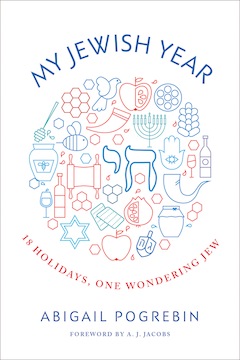
A few years ago, author Abigail Pogrebin spent an immersive year studying the Jewish calendar and attempting to observe it. She chronicled her experience in a column in the Forward and, subsequently, in the book My Jewish Year: 18 Holidays, One Wondering Jew (Fig Tree Books, 2017). On Nov. 19, she was in Winnipeg for the city’s Tarbut Festival.

“I did not approach this as a gimmick,” she told the Independent. “It was really a sincere stab at an understanding I never had, which is the origins for all of these chaggim [holidays] … and also, not just the origins, but the underpinnings, because these are obviously … human-created milestones that have endured for thousands of years. I wanted to understand both how and why they were conceived – what they’re supposed to mean for us today, not just to our ancestors. I definitely had a hunch that, for something to have endured for as long as it has, it has to resonate wherever you are in your life – at least for a large swath of people who live by this calendar.”

Pogrebin recognizes that there is a segment of the population that adheres to it simply because they inherited it, without questioning. Yet, for many people, Jewish observance, particularly of holidays, is a deliberate choice.

Pogrebin grew up in New York City. Her mother, writer and activist Letty Cottin Pogrebin, was instrumental in promoting women’s rights in the 1970s, and her writing includes analyses of what it means to be Jewish and female.

“I was not someone who celebrated nothing before this,” said Abigail Pogrebin. “I had sort of the five or six tent poles of Jewish holidays in my life…. I grew up with Shabbat…. It wasn’t enforced, but it was observed when we were together as a family. I went to synagogue on the High Holidays. We had always lit the menorah for eight nights, and I went to two seders back-to-back. Then, also, the feminine seder, which was a tradition that was started in mid-1970s by a group of women, including my mother.

“So, those were the basics that I’d grown up with. But, obviously, I was missing the majority of the signposts of the Jewish year. It bothered me that I didn’t know [them]. I also wanted to experience them in a way that might lead me to more meaning in my life.”

book cover - My Jewish Year: 18 HolidaysAs examples of what she learned on her journey, Pogrebin said she had never understood before that the process of atonement and introspection needs to start far in advance of Rosh Hashanah and Yom Kippur.

“During the month of Elul, we’re supposed to do what is called, in Hebrew, cheshbon hanefesh (accounting of the soul). And, when I asked various rabbis how I might go about that, because there’s not a clear blueprint for observance, quite a few suggested taking the middot (characteristics) and breaking them down, exploring one a day. So, I chose to do that for 40 days leading up to Yom Kippur.

“I did this with a friend, a study partner, essentially. So, my friend, Catherine, and I took these 40 middot that a rabbi had posted online. One day, you’d do anger, another you’d do courage, another envy, another humility.”

As the women went through the days, they aimed to look at themselves as deeply and honestly as they were able and to write their reflections on each characteristic at the end of each day.

“By the time I got to synagogue on Rosh Hashanah and Yom Kippur, I felt like I was in a very different zone for reflection,” said Pogrebin. “On Yom Kippur, I went to a mikvah [ritual bath] for the first time, and that was extremely meaningful.”

Pogrebin spent Sukkot in Los Angeles, interviewing four rabbis in two days, with each one discussing a different aspect of Sukkot that she never had understood before.

“One emphasized the fragility, the impermanence of our structure, and our shelters in our lives,” she explained. “How resonant that is today, with natural disasters and poverty, and all kinds of things that should shake our foundations, both literally and metaphorically.

“Another talked about the fertility, the imagery that is in Sukkot – the shaking of the lulav and etrog, which was much racier than I ever understood. Another talked about agriculture, and the land and connecting – reconnecting with the earth in ways we don’t do in other times of the year.

“Another rabbi talked about wandering, the importance of being lost and being comfortable with being lost; embracing the idea of the most important lessons and reckonings when we don’t know where we are going.”

Pogrebin also mentioned Yom Hashoah, which commemorates victims of the Holocaust. According to her, not many people know when it takes place. “I think it’s just not in the fabric of how many of us were raised, but it seems to me to be a crucial holiday, even though it could never be adequate to mark such a vast and devastating history and persecution,” she said.

“I went to B’nai Jeshurun, which is a Conservative synagogue on the Upper West Side that, in partnership with the JCC in Manhattan, does something called the naming of the names, where they have this book from Yad Vashem … devastating lists of families who perished. Starting at 10 p.m. and going all night into the next day, people tak[e] turns reading those names,” said Pogrebin.

About how the yearlong experience has changed her and her family, Pogrebin said, “In a way, it’s changed completely and, in a way, it hasn’t changed radically. I’d say it’s changed completely in the sense that I don’t look at time, relationships, obligations, the same way anymore. I think, if the holidays do anything, they are constantly reminding us to ask ourselves who we are in the world and whether we are doing what we could be doing to alleviate someone else’s suffering or pain.”

Pogrebin is always looking for ways to bring the lessons of her journey into her day-to-day life, to make them come alive in a way they didn’t for her when she was a child.

About the book, she said, “If one wants to understand the arc of the year, you will. It’s not that there are not people who might disagree with this or that, but it was researched and tested with people who live this and teach this at a very high level. So, it’s not just Abby saying it to be true. It’s me putting on my journalist hat and making sure when I explain something that it’s definitely rooted in scholarship. I hope … it’s an enjoyable and entertaining book.

“The people who read it are coming along with me and my experience with the holiday for the first time. They are also getting, I think, a fairly thorough template of what a Jewish year involves and demands. I think that, whether you’re Jewish or an interfaith family that wants to explain or introduce … some of these holidays in your own home and you’ve never done them before, it’s absolutely a door into learning how.

“There is something magical,” she said, “about not just living by someone else’s clock, but by an ancient roadmap…. I think there’s something very powerful about embracing … whether it’s Judaism or any religion, what it imposes on you, in terms of [laying out] what you should be thinking about besides your own needs and wishes – to me, that’s an important takeaway that I think other people should explore.”

Rebeca Kuropatwa is a Winnipeg freelance writer.

Format ImagePosted on December 1, 2017November 29, 2017Author Rebeca KuropatwaCategories BooksTags Abigail Pogrebin, Jewish life, Judaism
Proudly powered by WordPress