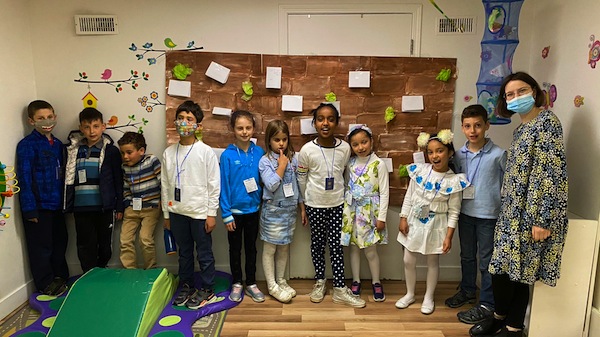
Grade 2 and 3 students of the B.C. Regional Hebrew School in Coquitlam with teacher Shifra Rabiski. (photo from Lubavitch BC)
In time for the upcoming school year, Lubavitch BC, in partnership with the Jewish Federation of Greater Vancouver, is launching a new curriculum for B.C. Regional Hebrew Schools. There is a need to engage Jewish children with a connection and pride for Israel and its central role in the Jewish past, present and future, and B.C. Regional Hebrew Schools has developed a program that does exactly this. Israel Quest is an immersive curriculum that enables children to form attachments to the Holy Land on practical, emotional and spiritual levels.
Using educational tools such as virtual reality, topography, theatre, filmmaking, STEAM activities and more, students relive the journey of the Jewish people in the land of Israel, from the time Jews entered the land, led by prophets and kings, until the untimely destruction of the Holy Temples. They discover the secret to the Jewish people’s eternal survival as a nation with tools established to keep Judaism thriving in the Diaspora.
Of the new program, Rabbi Dovid Rosenfeld, director of the Hebrew schools, said, “Education is at the core of everything. What we teach children in their formative years creates an indelible impact and foundation for their entire adult lives. And not only are the students themselves transformed, but the positive impact of their learning extends to their families, friends, classmates, communities and beyond.”
B.C. Regional Hebrew Schools is an affiliate of the Chabad Children’s Network (CKids), which has chapters in 26 countries and engages 25,000 children each year. Currently operating in three locations throughout British Columbia, it is gearing up for another year of Hebrew and Judaic learning, starting Sept. 1. Online registration is available at lubavitchbc.com/hebrewschool. More information can be found by calling 778-878-2025.
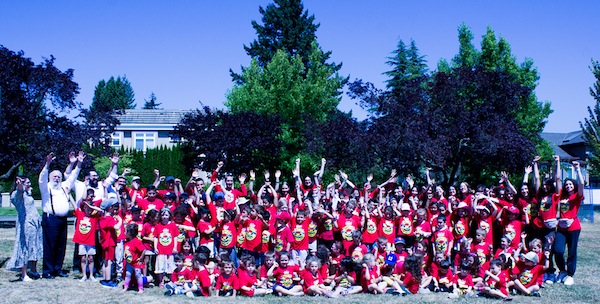
The 46th summer season of the Phyliss and Irving Snider Camp Gan Israel of British Columbia ended with tears, hugs and good resolutions. (photo from CGI)
Tears, hugs and good resolutions capped off a unique camp experience in Vancouver on an emotionally charged Friday, Aug. 13, as campers, staff and parents said farewell at the end of the 46th summer season of the Phyliss and Irving Snider Camp Gan Israel of British Columbia (CGI).
Despite two years of unprecedented challenges facing camps and schools due to COVID-19, co-director Rabbi Dovid Rosenfeld said CGI continued to grow. And he anticipated registrations to keep climbing, as families experience firsthand the positive effects of a Jewish summer camp experience. In the words of parent Danica David, “In one week, Camp Gan Israel took my son from a frightened child determined to hide his Judaism at public school, to a proud Jew who wears a kippah and takes pride in his davening prowess!”
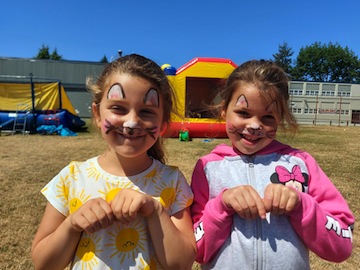
When asked which activity was their favourite, campers had a hard time narrowing it down. (photo from CGI)
“Our staff are the real secret to our success,” said co-director Chaya Rosenfeld. “They approach this job as a personal mission: to bring the warmth and love of Judaism to every child through a fun and impactful camp experience. We see each child not just as a camper, but as a special member of the tribe. We love everyone equally because inside we are all the same, defined by our Jewish soul.”
For the six weeks of camp, every activity of every day was imbued with Jewish energy and content. In addition to daily learning that brought home the message of camp, there were crafts, carnivals, shows, games and songs, all with Jewish themes that reinforced the concept of unconditional love (Ahavat Yisrael) and Jewish values. Campers were encouraged to search within themselves to find the sparks of holiness that lie within each person and object, thereby bringing more light and goodness into the world.
When asked which activity was their favourite, campers had a hard time narrowing it down. “I loved everything!” said Rose C., a 9-year-old camper who commuted from Langley every day. “But the water activities and hot lunch were my favourites!”
Other campers pointed to the art classes (which were led by professional artists) as their highlight of the summer, while still others were enthusiastic about the weekly shows that were performed over the summer, including The Magic of Yeeri, Cinemazoo Petting Zoo, Juggling with Matt and In the Company of Fairies.
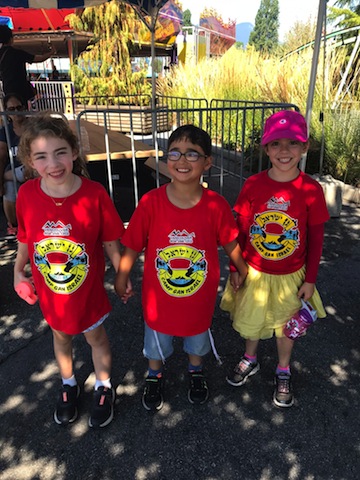
Camp Gan Israel kids (photo from CGI)
“The carnivals were the best!” said Sarah F. “I loved the face-painting, bouncy castles and races.”
A definite highlight was the trip to Playland, where campers from the youngest 3-year-olds to the oldest teen campers got to spend a day on the rides.
To end off the summer, CGI’s Rabbi Rosenfeld introduced the CGI Mitzvah Campaign. Campers chose one mitzvah that they learned at camp that they would focus on throughout the year. Submitting 10 reports to the camp office on how they’re doing in practising the mitzvah nets them a prize, carrying the camp experience of fun and Jewish values into their home and throughout the year.
“The best part of camp for me was my surroundings,” said counselor-in-training Eliana R., age 10. “I was surrounded by warmth, happiness and laughter between everyone. That’s what elevated it from just a normal, basic camp to an extraordinary experience. I can’t wait to go next year!”
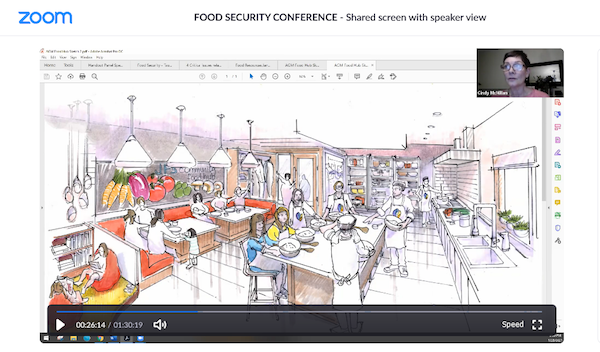
Zoom presentations became a regular affair at Beth Israel during the pandemic. Inset: JFS director of programs and community partnerships Cindy McMillan provides an overview of the new Jewish Food Bank. (screenshot from BI & JFS)
As Vancouver-area synagogues cautiously edge their way toward reinstituting in-person religious services, many rabbis are doing a rethink about the impact that the past 17 months of closure has had on their congregations.
Finding a way to maintain a community connection for thousands of Jewish families became an imperative for all of the synagogues early on in the pandemic. Not surprisingly, for many, the answer became cutting-edge technology. But careful brainstorming and halachic deliberations remained at the heart of how each congregation addressed these urgent needs.
“We immediately realized that services per se were not going to work over electronic medium,” Congregation Schara Tzedeck’s Rabbi Andrew Rosenblatt told the Independent.
He said Orthodox rabbis across the world were already discussing halachah (Jewish law) in light of the pandemic when the province of British Columbia announced the shutdown in March of last year. “We realized that we weren’t going to offer any services,” he said. “We can’t have a minyan online.”
But that didn’t mean they couldn’t offer support. Schara Tzedeck’s answer to that need was only one of many innovative approaches that would come up. For example, to help congregants who had lost family members, the Orthodox shul devised a new ritual, as the reciting of the Mourner’s Kaddish requires a minyan (10 men or 10 men and women, depending on the level of orthodoxy, gathered together in one physical location).
“What we did is immediately [start a Zoom] study session in lieu of Kaddish. [The Mourner’s] Kaddish is based on this idea of doing a mitzvah act, which is meritorious for the sake of your loved one, so we substituted the study of Torah for the saying of Kaddish,” he explained.
For many other communities, such as the Conservative synagogue Congregation Beth Israel, the deliberations over how to apply halachah in unique moments such as these were just as intense. For these instances, said BI’s Rabbi Jonathan Infeld, rabbis saw another imperative.
“This is what is called she’at had’chak, or a time of pressure,” Infeld said. “It’s a special time, it’s a unique time, and so we adapted to the time period.”
The concept allows a reliance on less authoritative opinions in urgent situations. So, for example, with respect to reciting the Mourner’s Kaddish, Infeld said, “We felt that, especially in this time period, people would need that emotional connection, or would need that emotional comfort of saying Mourner’s Kaddish when they were in mourning, and so we have not considered this [internet gathering to be] a minyan, except for Mourner’s Kaddish,” Infeld said. He noted that the Committee on Jewish Law and Standards of the Rabbinical Assembly, which reviews halachic decisions for the Conservative movement, has adopted the same position.
Rabbi Shlomo Gabay, who leads the Orthodox Sephardi synagogue Congregation Beth Hamidrash, said that although his congregation would not hold Mourner’s Kaddish online, venues like Zoom played a vital role in allowing the congregation to meet during shivah, the first seven days of mourning. Like a traditional shivah, which takes place in the mourner’s home, often with a small number of visitors, an online shivah gave community members a chance to attend and extend support as well.
“That was actually an especially meaningful [opportunity],” Gabay said. “The mourners, one after another, told me that, first of all, you don’t often get the opportunity to have so many people in the room, all together, listening.”
For members of the Bayit Orthodox congregation in Richmond, an online shivah meant family on the other side of the country could attend as well. “What was most interesting, of course, was the people from all across the world,” remarked Rabbi Levi Varnai. “You can have people who are family, friends, cousins, from many places in the world, potentially.”
Temple Sholom uses a variety of online media to provide inclusive content for those members who can’t attend in person. Pictured here are Rabbi Dan Moskovitz and Rabbi Carey Brown. (screenshot from Temple Sholom)
Vancouver’s Reform Congregation Temple Sholom also came to value the potential of blending online media with traditional venues. Rabbi Dan Moskovitz said the congregation had been streaming its services and classes as much as a decade before the pandemic arrived. But lifecycle events, he said, demanded a more personal approach, one that would still allow families to actually participate in reading from the Torah scroll, while not violating the restrictions on large public attendance.
“The big change is that we brought Torah to everybody’s home,” he said. Literally. Moskovitz or his associate, Rabbi Carey Brown, would deliver the scroll in a large, specially fitted container, along with a prayer book, instructions and other necessary accoutrements.
“We had a document camera so, when we streamed, you could look down on the Torah as it was being read on screen. Those were very special moments on a front porch when I would deliver Torah, socially distanced with a mask on, early on in the pandemic,” he said. “I had a mask and I had rubber gloves and they had a mask, and you put something down and you walked away. We got a little more comfortable with service transmission later on.”
International classes
Switching to online media also has broadened the opportunities for classes and social connections. Infeld said Beth Israel moved quickly to develop a roster of classes as soon as it knew that there would be a shutdown.
“We realized right away that we can’t shut down. We may need to close the physical building, but the congregation isn’t the building. The congregation is the soul [of Beth Israel]. We exist with or without the building,” he said. “And we realized that for us to make it through this time period in a strong way, and to emerge even stronger from it, we would have to increase our programming.”
He said the synagogue’s weekly Zoom and Learn program has been among its most popular, hosting experts from around the world and garnering up to 100 or more viewers each event. The synagogue also hosts a mussar (Jewish ethics) class that is regularly attended. “We never had a daily study session,” Infeld said. “Now we [do].”
For Chabad centres in the Vancouver area, virtual programming has been a cornerstone of success for years and they have expanded their reach, even during the pandemic. “We have had more classes and more lectures than ever before, with greater attendance,” said Rabbi Yechiel Baitelman, who runs Chabad Richmond.
Zoom and other online mediums mean that the centres don’t have to fly in presenters if they want to offer an event. Like other synagogues, Chabad Richmond can now connect their audiences directly with experts from anywhere in the world.
“We can’t go back”
All of the synagogues that were contacted for this story acknowledged that online media services had played an important role in keeping their communities connected. And most felt that they will continue to use virtual meeting spaces and online streaming after the pandemic has ended.
“As our biggest barrier to Friday night participation was the fact that many families were trying to also fit in a Shabbat dinner with small children, the convenience of the Friday livestream is worth including in the future,” said Rabbi Philip Gibbs, who runs the North Shore Conservative synagogue Congregation Har El.
“We’re scoping bids to instal a Zoom room in our classroom space so that we can essentially run a blended environment,” Rosenblatt said. “We anticipate, when restrictions are lifted, some people will still want to participate by Zoom and some people will want to be in person.”
However, some congregations remain undecided as to whether Zoom will remain a constant in their services and programming.
Rabbi Susan Tendler said that the virtual meeting place didn’t necessarily mesh with all aspects of Congregation Beth Tikvah’s Conservative service, such as its tradition of forming small groups (chavurot) during services. “We are talking about what that will look like in the future,” she said, “yet realize that we must keep this door open.”
So is Burquest Jewish Community Association in Coquitlam, which is looking at hybrid services to support those who can’t attend in person. “But these activities will probably not be a major focus for us going forward,” said board member Dov Lank.
For Or Shalom, a Jewish Renewal congregation, developing ways to bolster classes, meditation retreats and other programs online was encouraging. Rabbi Hannah Dresner acknowledged that, if there were another shutdown, the congregation would be able to “make use of the many innovations we’ve conceived and lean into our mastery of virtual delivery.”
For a number of congregations, virtual services like Zoom appear to offer an answer to an age-old question: how to build a broader Jewish community in a world that remains uncertain at times and often aloof.
The Bayit’s leader, Rabbi Varnai, suggests it’s a matter of perspective. He said finding that answer starts with understanding what a bayit (home) – in this case, a Jewish house of worship – is meant to be.
The Bayit, he said, is “a place for gathering community members and for coming together. The question, how can we still be there for each other, causes us to realize that we can’t go back to as before.” After all, he said, “community service is about caring for each other.”
Jan Lee’s articles, op-eds and blog posts have been published in B’nai B’rith Magazine, Voices of Conservative and Masorti Judaism, Times of Israel and Baltimore Jewish Times, as well as a number of business, environmental and travel publications. Her blog can be found at multiculturaljew.polestarpassages.com.
Cautious optimism. That seems to be the consensus among Jewish school administrators as students and teachers prepare to return to classes in September.
One of the key lessons of the past year-and-a-half has been that things can change swiftly and the pandemic response requires resilience and adaptiveness.
“We’ve all learned that whatever is final is only final until it changes,” joked Russ Klein, King David High School’s head of school. Despite the circumstances, he said, the last academic year was a good one. He credits students, parents and teachers for working together, being flexible and making the best of the situation.
“It sounds strange to say, but, in terms of the context, we had a really good year,” he said. “People were incredibly positive, even with a few COVID cases here and there.”
The biggest challenges were wearing masks, cancelling extracurricular activities, including inter-school sports, and the cancellation of all school trips. Grade-specific cohorts were instituted, with staggered schedules to avoid interactions between groups.
As it stands now – unless changes are announced before classes starts Sept. 13 – cohorts will no longer be required. Klein hopes that some competitive sports will also be possible.
While hoping for a school year that is as normal as can be, Klein is also confident that the experience of last year has made the entire school community more sanguine about changes to routines.
Like Klein, Emily Greenberg, head of school at Vancouver Talmud Torah, gives kudos to students, parents and teachers.
“I would say the last year was all about being flexible and understanding that we couldn’t anticipate for sure how things were going to go,” she said. “It was really a team effort. We were really appreciative of our parents and staff and everybody as regulations shifted…. This was the ultimate team effort because it would not have gone as well as it had had we not all rolled up our sleeves and done the work we had to do to get through to where we are today.”
A big remaining question is how kids under 12, who have not yet been cleared for vaccinations, will be required to behave at school.
Some people use the term “new normal,” but Greenberg prefers “near-normal.”
“I am hopeful that our near-normal will be one that we can all live with and still appreciate the liberties that we are starting to gain back,” she said.
With about 500 students set to converge on the school this year, Greenberg is confident that students, parents and staff will step up again to do whatever it takes to learn safely.
“I think the most important piece is just understanding the team mentality,” she said. “The school can’t do it alone. No business can do it alone. Everybody has to play their role.”
Shalhevet Girls High School had a different experience than most. Because of its small student body – this year 11 students will be starting classes – there was no need to form cohorts. However, Ian Mills, incoming principal at Shalhevet, noted that the confluence of Jewish holidays coinciding with the start of the school year raises concerns about kids spreading the virus to siblings, parents and grandparents.
“We are going to encourage mask use, I think, no matter what happens,” said Mills. They will also continue to have the sanitization stations to which everyone has become accustomed and disinfecting protocols will also proceed.
“We’re just really excited,” he said of the new school year. “But, also, things can change. I’m not letting my guard off.”
Vancouver Hebrew Academy also benefited last year from its relatively smaller size, being able to accommodate more of its student body within the capacity limits that were set by the government. Outgoing head of school Rabbi Don Pacht told the Independent in a June interview, “I think schools have been doing a phenomenal job overall, but it’s easier when you only have two cohorts instead of eight cohorts.”
By the time of that interview, basically all of the VHA students had returned to the classroom. Unfortunately, the JI was unable to reach VHA’s new head of school, Rabbi Barak Cohen, for an update before we went to press.
Like all administrators, Sabrina Bhojani, the new principal at Richmond Jewish Day School, will be closely watching the edicts coming from the province’s ministry of education and public health officials.
“Until we have that information, we are hoping things are going to be normal,” she said. “Right now, it’s a waiting game and things are changing minute by minute.”
“I think people are hopeful,” she said. “There is always a little bit of anxiety as well. I think it’s mixed emotions [but] I think people are optimistic for a back-to-normal start.”
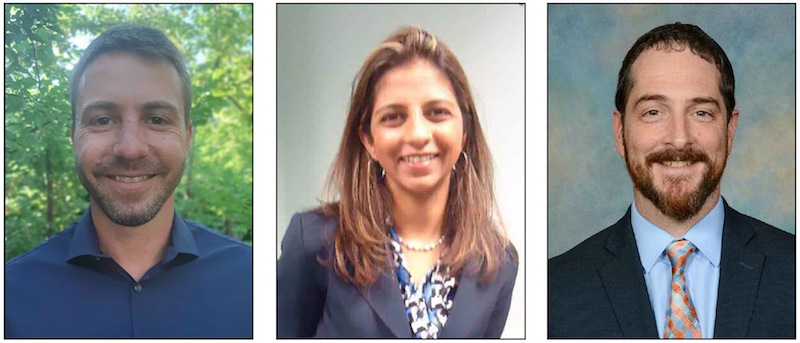
Left to right are new heads of school Ian Mills (Shalhevet Girls High School), Sabrina Bhojani (Richmond Jewish Day School) and Rabbi Barak Cohen (Vancouver Hebrew Academy). (photos from interviewees)
Three new principals will be joining the Metro Vancouver network of Jewish day schools this fall. Richmond Jewish Day School, Shalhevet Girls High School and Vancouver Hebrew Academy will all be under the helm of new administrators who bring decades of varied experience to the community.
Ian Mills, who has served as Shalhevet’s social studies teacher for the past six years, is taking over from Meira Federgrun, who has led the school for the past four years. RJDS’s new principal, Sabrina Bhojani, steps into the shoes of outgoing principal Ronit Amihude, who was at the helm for three years. And Rabbi Barak Cohen will be VHA’s new head of school this fall, replacing Rabbi Don Pacht, who served as the school’s head for 17 years.
* * *
Mills, who was born and raised in Dundas, Ont., received his bachelor of arts from McMaster University and his bachelor in education from the University of British Columbia. This past spring, he was accepted into a two-year master’s program at Simon Fraser University.
He also has a broad teaching background, having served as a substitute teacher in Melbourne, Australia, as well as at King David High School. Even when he was studying at UBC, Mills said teaching wasn’t far from his life. He supported himself as a ski and snowboard instructor at Grouse Mountain, garnering both awards and promotions for his work.
“I want students to be true to themselves and recognize what is special about who they are and what they bring to the table,” Mills told the Independent. “Sometimes in education, the grade you receive on a project or test becomes the measuring stick of who you are as a student. Instead, I want students to realize that skill sets come in a wide variety of forms.”
He said the recent updates to the provincial curriculum will help teachers lend support to students’ individual strengths, including “interpersonal skills, social/personal responsibility, leadership, and a host of other ways people are valued – I applaud the fact teachers now have more opportunity to foster these aspects of students.”
* * *
Bhojani, who was born in Ontario, grew up in Metro Vancouver and considers it her home. She received a bachelor of science and a bachelor of education from UBC, as well as a master’s in educational leadership and training from SFU. She served as faculty in the teacher education programs of both SFU and UBC, and worked for the B.C. Ministry of Education, where she developed curriculum and testing methodologies. As a school-based educator for the B.C. Agriculture in the Classroom Foundation, she taught teachers about the importance of agricultural and food knowledge.
“I believe learning about agriculture is an essential component of being a global citizen in the 21st century,” Bhojani said.
She has also worked as an educational consultant for Canadian School Bahrain, a nonprofit whose mandate is to empower children with confidence and the “moral values of integrity, responsibility, respect and courage,” in addition to academic excellence.
“Character education is an important part in developing the whole child and is essential in helping all members of the school community to learn, understand and practise behaviours that reflect universal ethical values,” said Bhojani. “It is essentially what guides us to do the right thing, even when it’s difficult to do so. I believe this is true of all faith-based education, and these kinds of enriching values certainly apply to Jewish education today and tomorrow.”
* * *
Cohen was born in Davenport, Iowa, and studied at Ohr Somayach and the Mir Yeshiva in Jerusalem while completing his smichah (rabbinic ordination). He holds a bachelor’s in behavioural science and a master’s in educational leadership from Bellevue University in Nebraska.
Cohen is no stranger to British Columbia’s Jewish community. He served as rabbi for Aish Hatorah in Victoria before taking a rabbinical position in St. Ives, a suburb of Sydney, Australia. As rabbi for the local Masada College, he launched an enriched Jewish studies program called Torah Stream that became fundamental to teaching elementary school children Hebrew and giving them the building blocks and confidence to study Torah.
“The curriculum was based on standard religious studies programs and outcomes found in religious schools worldwide, and accompanied Masada College’s outstanding general studies offering,” Cohen explained. The program meant that congregants no longer had to bus their elementary school-aged children an hour each way to Sydney to attend Hebrew classes. Cohen was later appointed head of Masada’s elementary school.
“I would define my outlook in Jewish education as one of looking at our incredible history of Jewish scholarship and recognizing that we don’t need to reinvent the wheel,” Cohen told the Independent. “At the same time, there’s always room to better our practice.”
For Cohen, that means “finding ways to more fully engage our students in the depth and breadth of Jewish wisdom, translating that wisdom into 21st-century know-how and building strong foundations in meaningful and relevant knowledge and practice.”
Jan Lee’s articles, op-eds and blog posts have been published in B’nai B’rith Magazine, Voices of Conservative and Masorti Judaism, Times of Israel and Baltimore Jewish Times, as well as a number of business, environmental and travel publications. Her blog can be found at multiculturaljew.polestarpassages.com.
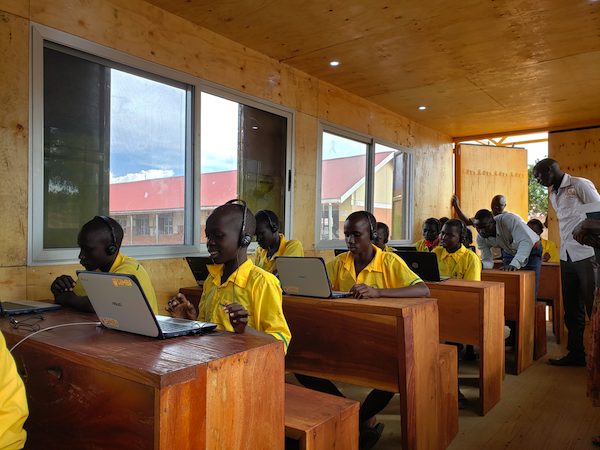
Students in Uganda at work in a BrightBox, a solar-powered classroom. (photo from Simbi Foundation)
This year’s graduating class at Vancouver Talmud Torah made a significant impact to the lives of thousands of refugees in the Bidibidi refugee settlement in Uganda. Their connection to the refugees on the African continent is a story that goes back to two young Jewish men who grew up in Vancouver and are determined to enhance education and create lifelong change in the lives of displaced people.
As co-founders of the Simbi Foundation, Ran Sommer and Aaron Friedland have established a template for BrightBoxes, which are sustainable solar-powered classrooms that are shipped to refugee settlements in Uganda and other countries. Each box costs $55,000 Cdn and includes a shipping container with solar panels, laptops, projectors and digital aids, as well as all the installation costs at its destination.
The foundation has installed five BrightBoxes in the Bidibidi settlement, where 240,000 refugees reside, and one in the Palorinya settlement, where there are 170,000 refugees. Each week, a BrightBox serves 6,000 learners.
“We’re able to reach that many learners because we connect the solar energy from the BrightBox to other classrooms in the area. They all become connected by the electricity and wi-fi generated by the BrightBox, which means the entire school population is connected simultaneously. The power of this 40-foot shipping container is its ability to connect the surrounding school blocks,” Sommer explained.
Back at VTT, the school established the Grade 7 Mitzvah of Valuing Philanthropy program in 2008. Each year, the graduating class chooses charities or causes that are meaningful to the group and fundraises to support those causes. This year, the school decided to fundraise exclusively for the Simbi Foundation.
“After learning about the power of a BrightBox to dramatically transform lives in the Bidibidi refugee camp in Uganda, we decided to go bold and big by dedicating all money raised to this one cause only,” said Jennifer Shecter, director of communications and admissions at VTT. “We wanted to make a giant impact this one time.”
The Grade 7 class dedicates several months of study and exploration to the MVP program and Shecter said the students become emotionally invested and feel genuine pride in their fundraising efforts. “In years past, students ran bake sales, garage sales, babysitting services, movie screenings at VTT and other initiatives to boost their MVP contributions,” she said. “This year, all those options were not available due to COVID so several of our students passionately worked the phones (or texted) family members and friends to donate.”
Several students contributed in excess of $1,000 each to the program, with the average donation ranging between $180 and $250 per student. A total of $38,000 was raised.
Shecter said the students’ connection to Friedland and Sommer, and their understanding of the scope of this project, enabled them to convince others to jump on board and donate to the cause.
The two co-founders spent time in the classroom with the Grade 7 students, explaining the purpose of the BrightBoxes and the extent of the research that motivates the Simbi Foundation’s decisions. The students were assigned to groups to study solar energy, the BrightBox curriculum and other topics relevant to education in the refugee settlements.
“We had two elements happening in parallel: the students were learning about our program and fundraising for it,” said Sommer. “So, they knew exactly what their fundraising efforts were contributing to. Because of that, they were able to surpass their fundraising goal. We were extremely impressed and honoured with VTT and the students’ efforts.”
Shecter added that VTT has had a relationship with Friedland for the past five years.
“VTT students meet with Aaron every year to learn about new initiatives and participate in his programs, like the Simbi reading and literacy program, and they find Aaron and Ran to be enthusiastic, approachable and relatable,” she said. “Our students thoroughly enjoyed each interaction with them and felt a sense of pride knowing members of their community are creating avenues for real change for individuals with many barriers to education and prosperity.”
Lauren Kramer, an award-winning writer and editor, lives in Richmond. To read her work online, visit laurenkramer.net.
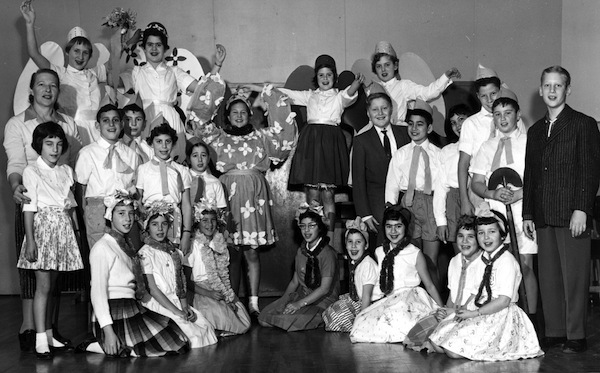
Congregation Beth Israel, children in costume, 1965. (photo from JMABC L.09778)
The 2020/21 education-themed issue of The Scribe will be launched on Aug. 26.
The launch of the Jewish Museum and Archives of British Columbia’s latest edition of The Scribe will be held virtually on Aug. 26, at 7 p.m. This year’s book features stories, photos and some almost-forgotten details about Jewish education in British Columbia. Join the Zoom to hear from local leaders in Jewish education both past and present who will give context to this significant subject.
Anne Andrew, past principal of Temple Sholom Hebrew School, and Emily Greenberg, current head of school at Vancouver Talmud Torah, will lead the discussion. Andrew will focus on her long involvement with the Jewish education scene in Vancouver and Greenberg will share her perspectives on where Jewish education is headed. Considering the impact teachers, educational institutions and curricula have on the continuity and cohesion of a community, both this panel discussion and this issue of The Scribe speak to important issues.
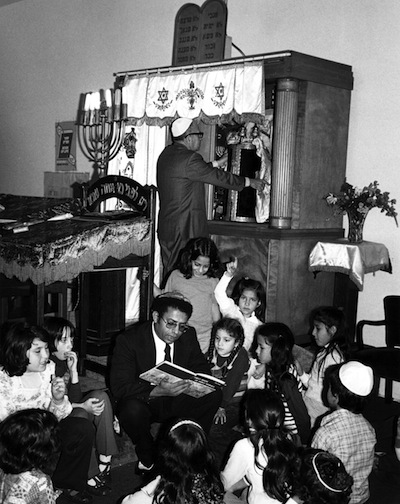
Story time, conducted by Gamliel Aharon, Beth Hamidrash B’nai Jacob, 1976. (photo from JMABC L.00155)
The 2020/21 Scribe features information from the community archives about Jewish education around the province, spanning some 100 years. In addition, there are oral history excerpts from dozens of community members about various programs that have been offered over those years. Even in the very early days of the Jewish community in British Columbia, no matter where Jews settled in the province, there were all kinds of arrangements for the transmission of Jewish knowledge, culture and identity.
Zoom attendees will hear about iconic educators who instilled a love of Judaism and community spirit. Those who attended Jewish school here will take a trip down memory lane, being reintroduced to teachers from their past.
For more information or to register for the free online book launch event or to get your own copy of The Scribe, visit jewishmuseum.ca/publications/the-scribe or call the museum office at 604-257-5199.
– Courtesy Jewish Museum and Archives of British Columbia
Chabad Richmond’s Hebrew school teaches kids to read Hebrew, explore Jewish history, revel in hands-on Jewish living through holiday experiences and traditions, and pray. Plus, students learn a new mitzvah each week.
The Hebrew school – which is for kids in kindergarten through Grade 7 and geared for students not attending Jewish day schools – welcomes all Jewish children who want to join, and enrolment has doubled in the past year. Classes take place on Sundays from 10 a.m. to 12:15 p.m. and no synagogue membership is required. The new school year begins on Sunday, Sept. 12, and registration is now open for the 2021-2022 year.
“For many children, this is their weekly dose of Judaism and we want it to be associated with joy,” said Rabbi Yechiel Baitelman, director of Chabad Richmond. “Our goal is that the education we provide will inspire them to bring our traditions into their homes in a practical way. We provide kids with a joyful sense of religious pride, identity and belonging, which is fundamental to spiritual growth and emotional health.”
“We believe that the Hebrew school experience should be fun, inspiring, and something the kids look forward to each week,” said Hebrew school director Chana Gordon. “Our goal is for the children to love learning Torah and be proud of their Jewish heritage. We hope to instil in your child a love of Israel and a desire to live by and celebrate our faith.”
The curriculum aims to give children a broad knowledge of Judaism in a stimulating, fun and challenging environment; an environment that highlights the joys, values and traditions of their Jewish heritage. The curriculum focuses on tzedakah (charity); Hebrew; Jewish history, holidays and values; arts and crafts; and Israel.
Students’ parents attest to the impact it’s had on their children. One mom, Deborah Butterman, said: “My son really enjoyed every aspect of the Aleph Champ [Hebrew learning] program at Hebrew school. It made him very positive and he’s having a lot of fun, and meeting a lot of other people in the Jewish community that we never had a chance to connect with before. It has motivated him to be proud of his Jewish heritage. He learned how to read from a siddur already. He’s learning about praying and how to do many things for the holidays…. It’s an exciting part of his week, every week.”
Another Hebrew school mother said, “The teachers at Chabad Hebrew school have worked hard to create a wonderful learning environment. They have encouraged my children to learn at their own level, and made them feel comfortable asking pertinent questions regarding Judaism. This positive environment offers convenience of location and a fun social network, in a nurturing environment. The fact that my children are eager to take time away from their weekends to go to Hebrew school each Sunday morning speaks volumes.”
Irina Sanders said about her daughter’s experience: “Rona loves coming to Hebrew school. She learned to read Hebrew, [and] loves participating in different activities and learning more about traditions.”
“It’s not all Torah learning and Hebrew,” noted Baitelman. “It’s also thematic arts and crafts, making holiday decorations, challah baking, singing and interacting with other children. It’s the whole Jewish experience, packaged into an interactive, warm and inspiring environment, led by enthusiastic, devoted teachers.”
I’ve dealt with all kinds of conflicts as an Israel educator the past 25 years, from the mad parent who storms in and says, “Why do you have that map on your wall and not this map?” to the parents who get into fights in the carpool line because they don’t agree about something taking place or what somebody posted on Instagram.
Israel education could face even more pitfalls and political pressure this fall after May’s conflict in Gaza. A new survey of American Jewish voters that found 22% of all respondents believe that Israel is committing genocide against the Palestinians and that 20% of respondents under age 40 don’t believe that Israel has a right to exist.
It’s challenging to make the classroom a safe environment for such conversations if the home and community are not. That’s why we think it’s important to take the stance we have adopted at the Centre for Israel Education: educators should not use their podiums to spread their political views or launch polemics. Our job is not to tell students what to think, but rather to train them how to think, an effort best accomplished by incorporating as many primary sources and as many different voices as possible.
Taking that apolitical stance, checking your biases at the classroom threshold, is an empowering approach to the education about Israel for teachers and students. Educators can explain to parents that their job is to enable students to think critically for themselves, to assess sources, to understand the differences between history and narrative and between competing narratives, and to appreciate the ideals of a Jewish state and its realities, which are messy, complex and imperfect.
Israel educators should establish a tone of respectful discourse, incorporating listening and critical thinking at the beginning of the school year. It’s OK to disagree with somebody else’s opinions and ideas, as long as the discussion is based on stated sources.
That’s how we teach every other subject. A literature student, for example, who wants to assert that Nietzsche or Sartre was a nihilist has to provide evidence from texts, not just cite a parent, a teacher or a social media influencer.
Educators also must help students understand the vagaries of vocabulary? What words are laden and to whom? “Occupation” means different things to different people, and there are reasons some people talk of Judaea and Samaria while others speak of the West Bank.
Understanding vocabulary is a skill that needs to be taught, as are map reading and literary analysis. When we teach students these skill sets, we enable them to reach and defend conclusions based on documents they’ve examined themselves.
This educational approach is far different from the advocacy model: “If you hear X, you should say Y.” My two kids, who are now in college, would have rebelled if I had told them that. They would have done the opposite just because they were teens.
We can’t engage, empower and prepare students for tricky conversations by teaching them automatic answers or avoiding the complexities altogether. That path leads to students concluding that their teachers lied to them and to believing the worst accusations against Israel.
Instead, we educators must tackle these difficult topics by modeling respectful, informed conversations regardless of personal opinions about, say, whether Israel used disproportionate force in Gaza in May. We must provide historical context and complexity to equip our students with resilience and help them become critical consumers of information so that the slogans they encounter on campus and social media don’t resonate.
This endeavour can’t be limited to one Judaic studies classroom; it has to be embedded into the daily consciousness and experiences of everyone in the school. It requires support from non-Jewish educators and those teaching science and math, literature and social studies. It involves school administrators, board members, rabbis and parents engaging in the same respectful, informed conversations, and accepting that the best practice in Israel education is to treat it as education.
That’s how we can avoid the pitfalls and politicization of teaching about Israel and produce thoughtful Jewish adults who can engage with difficult questions rather than drown in competing narratives.
Tal Grinfas-Davidis the vice-president of outreach and pre-collegiate school management initiatives for the nonprofit, nonpartisan Centre for Israel Education in Atlanta and is a former Jewish day school principal.
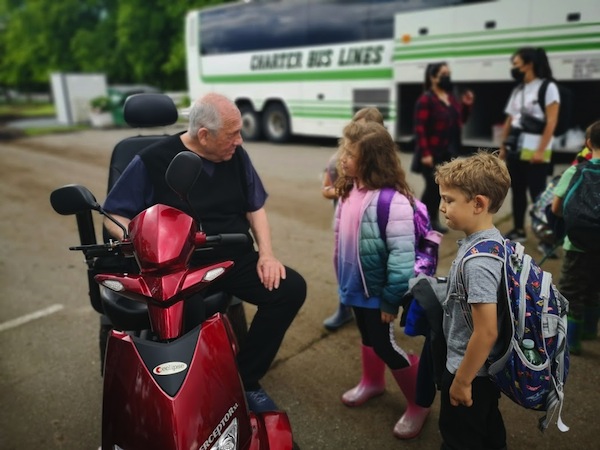
Syd Belzberg talks with Vancouver Talmud Torah kids at Stable Harvest Farm. (photo by Shira Sachs)
“The children loved to take their harvest home to share with their families. Many children helped to prepare the family meals, including washing, chopping and plating their meals. There was so much to learn – how healthy food can taste so yummy, how I can help my family make dinner, how the food can make my body feel good.”
“This is from some cute kid, and I see his picture in front of me,” Syd Belzberg told the Jewish Independent in a recent phone interview. “That’s heart-warming. That’s where it’s all at. That’s beautiful.”
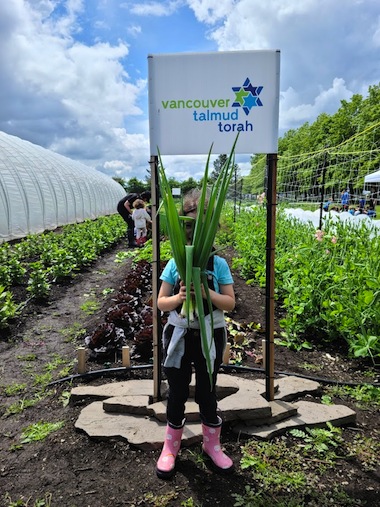
Vancouver Talmud Torah Grade 1 students have a plot on Syd Belzberg’s farm, where they grew scallions and other vegetables. (photo by Jessie Claudio)
The note came after Vancouver Talmud Torah Grade 1 students visited Belzberg’s Stable Harvest Farm in Langley last month.
Belzberg got the idea for the farm about a half dozen years ago. He read a newspaper article about Vancouver Sun reporters who had started a breakfast program for schoolchildren in the 1980s. “I got in touch with them and got involved a bit, supporting some of the schools with money,” said Belzberg.
But he wanted to have more of an impact and, after he retired a couple of years ago, he decided to reinvent his Langley acreage, which had been home to his many horses several decades ago, but had laid empty for some 17 years. He based his concept on that of Coastal Roots Farm, “a nonprofit Jewish community farm and education centre” located near the home he has in California. “They do a lot of wonderful things,” said Belzberg, “and I thought this would be a heck of a thing to try and copy in a way.”
He hired Kristjan Johannson to manage the farm and the first crop was planted in January 2020. Despite flooding on the property, they gave away about 90,000 pounds of organic vegetables to a half-dozen food banks, as well as to community meals programs.
“This year, we decided to try and double it,” said Belzberg. And they more than doubled it, giving away an estimated 250,000 pounds of food, while continuing to work on the property.
Belzberg established the Stable Harvest Farm Society, he said, “to make this a legacy for my family.” Of his five kids, only one lives in Vancouver, and that daughter, Tammi Kerzner, “has been a massive help to me to build this,” he said.
“There are many facets to what I want to do,” said Belzberg, “but I wanted to get the food thing right because I didn’t know what we’d have to go through to be successful.”
Belzberg’s approach with this project has been similar to that which he has taken with his other endeavours.
“When I started in the car business [Budget Rent a Car] in ’62, I had trucks and other things in mind, but I wanted to rent cars and learn about that first,” he said. “It’s the same thing here. I wanted to prove we can get the vegetables right before I started to do anything else.”
Educational programming is a main component of the farm. “David Bogoch had a lot to do with teaming up with TT. He is such a supporter of it,” said Belzberg about collaborating with the school. “And my children went there. I have a great-granddaughter now who goes there. So it was a natural [fit]. The part that really put us over the top was Emily [Greenberg], because she’s fantastic. She’s so on top of it, and she’s got Jessica [Claudio] there, who goes to another level.”
“Mr. Belzberg has been a very generous supporter of VTT,” said Greenberg, who met Belzberg for the first time when he first saw the school’s rooftop soccer pitch that he funded. That was in her second week as head of school, she said.
“And we’ve had close relationships with David Bogoch, who is quite close to Mr. Belzberg, and he kept talking to me about this farm that Mr. Belzberg was creating … that Mr. Belzberg had a dream to make this farm a centre for Jewish education and Jewish values and the Jewish community and that he would love to see children using this farm, in addition to how it supports the needy in Vancouver.”
Belzberg eventually invited Greenberg for a visit and they spoke about his vision and she “went away and thought about how we could make that happen from our end and, ultimately, bring kids out there.”
The first thing that happened, said Greenberg, was that Johannson came to the school and helped the kids plant seedlings. “Then we had, basically, a little nursery there at the school and watched them grow and supported them.” The plan was for the kids to plant the adolescent seedlings in April at the farm but COVID restrictions had increased, “so we weren’t able to bring the kids to Langley because it was cross-boundary.” But the planting was filmed and a multi-series educational video was made.
“Thankfully, the regulations changed again and we were able to go in the third week of June and send all of our Grade 1 kids out there,” said Greenberg. “They were able to help reap the harvest and they each brought home a bag of veggies from Mr. Belzberg’s farm and made the most amazing salads and soups and all sorts of things and we’ve got some great pictures of what they made that night. We had parents who were ecstatic, watching their kids eat raw vegetables – including scallions.”
The kids had grown the scallions, as well as lettuce and radishes, and their bags were supplemented with some other vegetables from the farm, such as tomatoes and carrots.
On their visit, the kids also got to see the part of the property that will become a bird sanctuary – “there’s a hundred and some odd different types of birds and owls that feed there and it became a natural habitat,” said Belzberg.
Another aspect of Stable Harvest is bees. Belzberg works with beekeeper Carolyn Essaunce, who owns the Honest to Goodness Farm Co. Essaunce also made a trip to VTT and spoke to each senior kindergarten class.
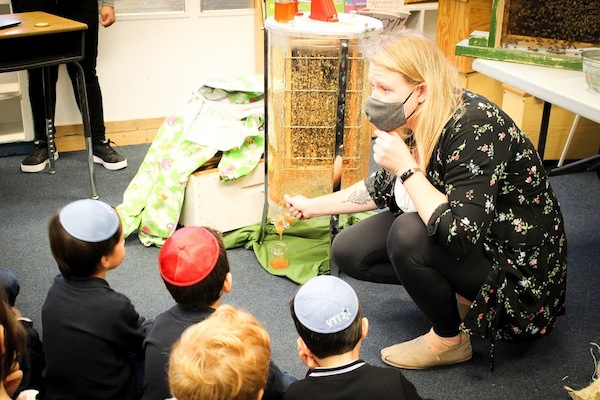
Beekeeper Carolyn Essaunce speaks to VTT senior kindergarteners about bees and honey. (photo from VTT)
“She brought a whole honeycomb with live bees,” said Greenberg. “She helped them understand how, when you take a honeycomb and you put it in a machine and spin it, how you get the honey out…. They understood what it was to produce honey and then they all went home with some of Mr. Belzberg’s honey…. That is definitely something we hope to repeat yearly.”
Experiential learning is the future of education, said Greenberg. “For us, we want to prioritize learning through nature and to exposure to nature, but also, of course, finding ways to make sure that Jewish values are part of that…. So this has been a tremendous opportunity for us. It’s only the beginning – we look forward to bringing many more of our grades out to Stable Harvest Farm next year. There’s obviously a science aspect but we also want our kids to be shomrei adamai, guardians of the earth, and understand the power of nature. There’s an empowerment that happens when they’re part of growing a plant and the excitement that happens. And the understanding of the life cycle and how that eventually nourishes us and nourishes those in need – it’s a tremendous marriage of all of the values we have as educators, but also as a Jewish day school.”
VTT has invested a lot of time in iSTEAM over the last two years, she said, “integrating the innovations that have been coming out of Israel and using that as the platform from which to explore science, technology, engineering, art and math. A great example that you have at Mr. Belzberg’s farm is drip irrigation, which is an Israeli innovation…. We love the fact that our kids can be proud of a technology that’s come out of Israel and understand how innovation can revolutionize an entire industry and, ultimately, help people live a better, healthier life.”
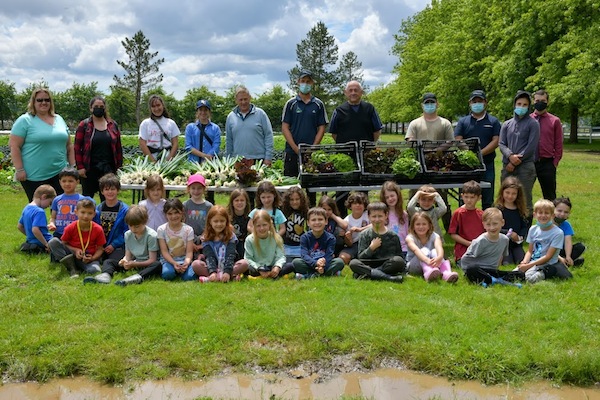
All the workers show off the produce reaped during the VTT schoolchildren’s visit to Stable Harvest Farm. (photo by Galit Lewinski)
Greenberg’s goal is to get all of the VTT students out to the farm at least once over a two-year span. “We have a lot of ideas,” she said, “and Mr. Belzberg, thankfully, is very flexible. He just says, ‘Tell me what works for you and we’ll make it happen.’ He always says that: ‘We’ll make it happen.’”
And there is lots that Belzberg plans to make happen. Next year, for example, he hopes to build a large kitchen on the farm for cooking classes, education and other activities. Already, the farm has had its first stand, on June 19, and joined its first farmer’s market, in White Rock, on June 20.
“It’s a helluva way to give back and it fills a vast need and I can afford to do it,” said Belzberg when asked why the farm is important to him. “It’ll hopefully continue forever,” he said.
“When I sat there with the TT kids, and they’re coming up to me and shaking my hand, and when I see the letters that are coming back, the salads, the fact that these kids are into food, I give TT all the credit in the world,” said Belzberg. “It was one of the 10 happiest moments of my life when I sat there a week or so back and watched the kids being in the ground, getting their hands dirty. What could be better than that? And the smiles on their faces.”