Skip to content
  • Home
  • Subscribe / donate
  • Events calendar
  • News
    • Local
    • National
    • Israel
    • World
    • עניין בחדשות
      A roundup of news in Canada and further afield, in Hebrew.
  • Opinion
    • From the JI
    • Op-Ed
  • Arts & Culture
    • Performing Arts
    • Music
    • Books
    • Visual Arts
    • TV & Film
  • Life
    • Celebrating the Holidays
    • Travel
    • The Daily Snooze
      Cartoons by Jacob Samuel
    • Mystery Photo
      Help the JI and JMABC fill in the gaps in our archives.
  • Community Links
    • Organizations, Etc.
    • Other News Sources & Blogs
    • Business Directory
  • FAQ
  • JI Chai Celebration
  • JI@88! video

Recent Posts

  • Sharing her testimony
  • Fall fight takes leap forward
  • The balancing of rights
  • Multiple Tony n’ Tina roles
  • Stories of trauma, resilience
  • Celebrate our culture
  • A responsibility to help
  • What wellness means at JCC
  • Together in mourning
  • Downhill after Trump?
  • Birth control even easier now
  • Eco-Sisters mentorship
  • Unexpected discoveries
  • Study’s results hopeful
  • Bad behaviour affects us all
  • Thankful for the police
  • UBC needs a wake-up call
  • Recalling a shining star
  • Sleep well …
  • BGU fosters startup culture
  • Photography and glass
  • Is it the end of an era?
  • Taking life a step at a time
  • Nakba exhibit biased
  • Film festival starts next week
  • Musical with heart and soul
  • Rabbi marks 13 years
  • Keeper of VTT’s history
  • Gala fêtes Infeld’s 20th
  • Building JWest together
  • Challah Mom comes to Vancouver
  • What to do about media bias
  • Education offers hope
  • Remembrance – a moral act
  • What makes us human
  • המלחמות של נתניהו וטראמפ

Archives

Follow @JewishIndie
image - The CJN - Visit Us Banner - 300x600 - 101625

Tag: cooking

Savoury, sweet and simple

Savoury, sweet and simple

Cottage cheese muffins à la Accidental Balabusta, but double the size. (photo by Cynthia Ramsay)

Looking for a couple of easy recipes to add to your repertoire? But you’re not quite sure what to try? Because sometimes you want savoury. Sometimes you want sweet. But what if you want both? I’ve got just the answer – but it doesn’t come in the form of one recipe. It comes in two. One’s a side dish and one’s a snack or breakfast food. Both punch above their weight, that’s for sure.

With very few exceptions I have neither the focus nor the patience to embark on complicated recipes that call for exotic ingredients and specialty cookware. If I can’t pronounce it and it’s not available at my local Safeway or Superstore, it ain’t happening. (Except for those lamb shanks that I made for Rosh Hashanah, which did call for loads of ingredients and which were, to use my hubby’s words: “The best lamb I’ve ever eaten!” Sorry … I just had a modesty bypass.)

Maybe I’m not the most adventurous eater/cook in the world but I never go hungry. My father, alav hashalom, used to say that I’d eat out of a puddle if push came to shove. I prefer to describe it as having simple tastes.

Good thing my husband didn’t marry me for my cooking. Although it has improved significantly since we got married 12 years ago. When we first met, my idea of dinner was a California roll and Agedashi tofu takeout. We used to eat out at restaurants maybe three or four times a week during the honeymoon phase, i.e. the first four years of our marriage. I kept telling him I knew how to cook; I just chose not to activate that skill. And what do you know. He believed me.

But I digress. Back to the savoury recipe I was going to tell you about. It’s an eggplant side dish or chunky dip and is a perfect accompaniment to just about any meal, be it meat, chicken, vegetarian or fish. It’s a bit time-consuming, but what eggplant recipe isn’t, with all that peeling, slicing and dicing? I’m not a big fan of spicy food so you can up the garlic content as you see fit. I find it’s got just that right combination of salty, spicy, sweet and tart, without being heavy or overpowering. I call it Merle’s Eggplant, after my sister’s friend who gave us the recipe decades ago. Thank you, Merle.

MERLE’S EGGPLANT

1 diced onion
1 large or 2 medium-size eggplants, peeled and cubed
2-3 cloves garlic, minced
14 oz (398 ml) can tomato sauce
a squeeze or two of lemon juice
1-2 tbsp brown sugar

  1. Peel and cube eggplant and set aside.
  2. Fry diced onion in olive oil until lightly browned.
  3. Add eggplant to onions and fry, alternating covered and uncovered, until eggplant is opaque.
  4. Add minced garlic, tomato sauce, lemon juice and brown sugar. Cook on low heat for about one hour, covered.
  5. Refrigerate then serve. Some people like to serve it hot, but I prefer it cold, because I find that the flavours meld even more when it’s been refrigerated. But that’s your call. Try it both ways.

* * *

As for the sweet recipe – cottage cheese muffins – well, it’s a favourite in our home. It’s one of those comfort foods that soothe just about any ailment, from fatigue to sore feet. Aside from being healthy (think protein), they’re filling and super-fast to make, plus it’s one of those recipes that you can make blindfolded with both hands tied behind your back. Eat them hot, eat them cold, eat them with jam, eat them plain.

The only people that won’t like these muffins are the lactose-intolerant. And that can be remedied. I recently found lactose-free cottage cheese at the local supermarket. It’s slightly more expensive, but worth it if you like dairy but not the side effects that can go with it. Knock yourself out with these fluffy, light, healthy muffins. I’ve seen all sorts of variations on this recipe, using cheddar cheese, whole wheat flour, sour cream, etc., but none of them quite matches the simplicity and yumminess of this one.

I would strongly suggest doubling the recipe, since this recipe only makes 12 small muffins. Or just eat several at one go, and explain to shocked onlookers that they’re mini-muffins. Which they’re not, but, never mind. Just look at it as muffin-envy.

COTTAGE CHEESE MUFFINS

1 1/2 cups cottage cheese
2 tbsp sugar
1/2 cup melted butter or margarine
2 tsp baking powder
2 eggs
a pinch of salt
1 cup flour

  1. Preheat oven to 400°F.
  2. Mix all ingredients by hand. Don’t be surprised if the batter is quite thick.
  3. Grease muffin tins or use paper muffin liners. Distribute batter evenly between the 12 muffin cups.
  4. Bake for about 20 minutes or until golden brown on top. They’re ready when a toothpick inserted in the centre comes out clean.
  5. Eat plain or topped with yogurt, sour cream, berries, jam or whatever. They reheat well in the microwave. But, if there are more than two people living in your home, the muffins probably won’t make it till the next day. They may sound too good and too easy to be true, but I’m here to tell you, they’re the real deal. Sometimes, the most basic recipes are the star of the show. Or at least the crowd-pleasers.

* * *

It’s not the number of ingredients or the sophistication of technique that make a recipe sing. It’s the flavour, plain and simple. So, do yourself a favour and try out these two recipes. Tell them the Accidental Balabusta sent you.

Shelley Civkin aka the Accidental Balabusta is a happily retired librarian and communications officer. For 17 years, she wrote a weekly book review column for the Richmond Review. She’s currently a freelance writer and volunteer.
Format ImagePosted on November 19, 2021November 18, 2021Author Shelley CivkinCategories LifeTags Accidental Balabusta, cooking, cottage cheese muffins, eggplant

Brisket – a Jewish  tradition!

Brisket is the boneless meat on the lower chest of beef or veal. In traditional Jewish cooking, it is most often braised as a pot roast, especially as a holiday main course. For reasons of economics and kashrut, it was historically one of the more popular cuts of beef among Ashkenazi Jews.

Brisket is also the most popular cut for corned beef, which can be further spiced and smoked to make pastrami. In the 1900s, it appeared on Jewish deli menus, particularly in Texas, where the butchers, who emigrated from Germany and Czechoslovakia, had trouble selling the slow-cooking cut and created a way to dry smoke it and preserve it.

Brisket is one of the primal cuts of beef, though the precise definition of the cut differs internationally. The brisket muscles include the superficial and deep pectorals. As cattle do not have collarbones, these muscles support about 60% of the body weight of standing or moving cattle. This requires a significant amount of connective tissue, so the resulting meat must be cooked correctly to tenderize it.

The term brisket is derived from the Middle English brusket, which comes from the earlier Old Norse brjósk, meaning cartilage. The cut overlies the sternum, ribs and connecting cartilages.

Author and food writer Stephanie Pierson wrote an homage to this cut of beef: The Brisket Book:  Love Story with Recipes was published in 2011.

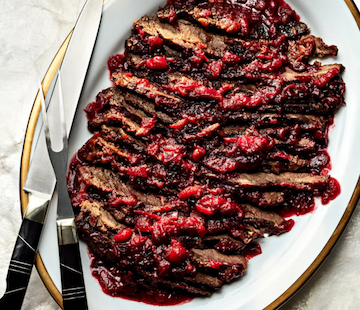
CRANBERRY-ONION CHANUKAH BRISKET
(This is Justin Chapple’s recipe from Food & Wine. It makes 8-10 servings.)

photo - Justin Chapple’s Cranberry-Onion Chanukah Brisket
Justin Chapple’s Cranberry-Onion Chanukah Brisket. (photo by Justin Walker)

8 cups fresh or thawed frozen cranberries
1 1/2 cups sugar
1 1/2-inch lemon peel strip
3 tbsp fresh lemon juice
salt and pepper to taste
2 1-ounce envelopes kosher pareve onion soup mix
1 7-pound trimmed beef brisket

The day before serving:

  1. Preheat oven to 325°F. Layer two sheets foil in a large roasting pan, letting foil hang over eight inches past each end. Repeat with two additional sheets of foil to form an X. Top with a sheet of parchment paper.
  2. In a saucepan, combine cranberries, sugar, lemon peel strip and lemon juice. Cook, crushing cranberries with a wooden spoon until mixture thickens, 10-14 minutes.
  3. Remove from heat and stir in onion soup mix. Let cool for 15 minutes.
  4. Spread a quarter of cranberry sauce on parchment. Place brisket fat side up. Spread remaining cranberry sauce over it, top with parchment and wrap foil around brisket. Place in oven for three to three-and-a-half hours. Uncover. Let cool one-and-a-half hours, then cover and refrigerate for at least eight hours.

The day of serving:

  1. Preheat oven to 325°F. Uncover brisket. Discard any fat. Scrape off cranberry sauce and place in a bowl.
  2. Slice brisket on carving board. Arrange in ovenproof dish. Spoon cranberry sauce over top, cover and bake 45 minutes to one hour.

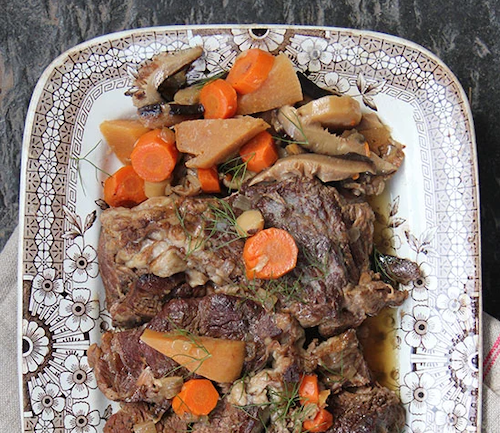
BEER-BRAISED BRISKET WITH ROOT VEGETABLES
(This recipe comes from Ian Knauer, former Gourmet Magazine editor, chef, food writer and owner of the Farm Cooking School. It makes 4-6 servings.)

photo - Ian Knauer’s Beer-Braised Brisket with Root Vegetables
Ian Knauer’s Beer-Braised Brisket with Root Vegetables. (photo by Ian Knauer)

1 2.5-to-3-pound brisket
2 tbsp olive oil
1 chopped medium onion
5 ounces sliced shiitake mushroom tops
3 finely chopped garlic cloves
3 large sliced carrots
3 sliced parsnips
1 rutabaga, peeled and cut into wedges
12 ounces beer of your choice
2 tbsp Worcestershire sauce
2 cups chicken stock
2 tbsp flour
1 tbsp dill

  1. Heat oil in a pot. Sear the brisket three to four minutes, turn, and continue searing another three to four minutes. Transfer to a plate.
  2. Stir onion, mushrooms and garlic into pot. Cook, stirring occasionally, for six minutes. Place brisket and juices back in pot.
  3. Stir in carrots, parsnips, rutabaga, beer, Worcestershire sauce and stock. Cover and simmer six hours, until meat is tender.
  4. In the meantime, stir flour and two tablespoons cold water in a bowl then whisk into the pot. Simmer until sauce thickens, about 10 minutes. Place on plate, sprinkle with dill and slice.

Sybil Kaplan is a journalist, editor of nine kosher cookbooks (working on a 10th) and a food writer living in Jerusalem. She leads English-language Shuk Walks in Machane Yehuda.

Format ImagePosted on November 19, 2021November 18, 2021Author Sybil KaplanCategories Celebrating the HolidaysTags brisket, Chanukah, cooking, Food & Wine
Minestrone warms the soul

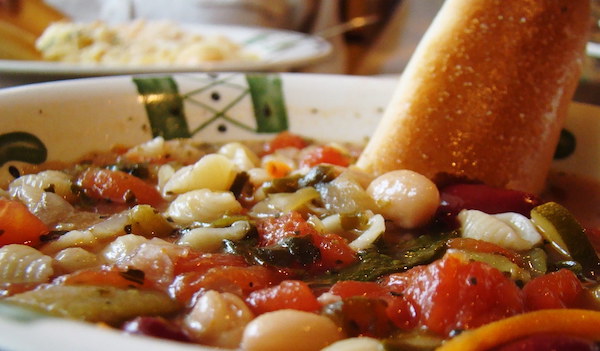
Minestrone warms the soul

(photo from flickr.com/photos/veganfeast)

Minestrone came about as early as the second century BCE, when Rome conquered Italy and new vegetables flooded the market. It was known as an Italian peasant’s dish or poor man’s soup. Originally, it contained onion, garlic, celery, tomatoes and carrots – pasta seems to have been a later addition.

MY MINESTRONE
(6-8 servings)

2 tbsp margarine
3/4 cup chopped onions
2 minced garlic cloves
1 chopped leek
1/4 cup chopped celery
1/2 cup chopped carrots
2 chopped turnips
1 1/2 cups chopped zucchini
1 1/2 cups chopped cabbage
1 cup chopped potatoes
2 tbsp beef soup bouillon
1 cup chickpeas
1 cup chopped tomatoes
8 cups water
2 tbsp tomato paste
salt and pepper to taste
2 tbsp chopped parsley
1/2 tsp basil
1/2 tsp oregano
1 chopped bay leaf
1/4 tsp marjoram
1/2 cup small pasta
Parmesan cheese (optional)

  1. In a large soup pot, heat margarine. Sauté onions, garlic and leek.
  2. Add vegetables, water and spices but not pasta. Bring to a boil, reduce heat and simmer one hour.
  3. Add pasta and cook 15 minutes. Ladle into soup bowls and add the cheese.

ROOT VEGETABLE MINESTRONE
(Adapted from a Food & Wine recipe, it makes 6 servings.)

1/4 cup olive oil
1 finely chopped onion
1 minced garlic clove
1 sprig rosemary
2 sliced carrots
2 sliced parsnips
3 broccoli stems or chopped kohlrabi
3 cups cubed peeled, cut butternut squash
6 cups pareve chicken bouillon
salt and pepper to taste
1/2 cup angel hair pasta broken into 1-inch pieces
1/2 cup grated cheese

  1. In a soup pot, heat two tablespoons olive oil. Add onion, garlic and rosemary and cook until onion is soft.
  2. Add carrots, parsnips, broccoli or kohlrabi and squash and cook for one minute. Add bouillon, salt and pepper and cook about 15 minutes.
  3. In a frying pan, heat the remaining two tablespoons olive oil. Add pasta and cook, stirring frequently, about four minutes.
  4. Add pasta to soup. Cook until tender, five to six minutes. Discard rosemary. Stir cheese into soup and serve.

Sybil Kaplan is a journalist, editor of nine kosher cookbooks (working on a 10th) and a food writer living in Jerusalem. She leads English-language Shuk Walks in Machane Yehuda.

Format ImagePosted on November 19, 2021November 18, 2021Author Sybil KaplanCategories LifeTags cooking, Food & Wine, minestrone, soup

A time for diversity training

We’re in the month of Heshvan on the Jewish calendar. Some people call it Mar-Heshvan or Marcheshvan. (Since this is transliteration, it can be spelled either “ch” or “h.”)  It’s called mar, or bitter, because, aside from Shabbat, there are no Jewish holidays during this month.

Of course, as Canadians, we had Thanksgiving in there. However, after a long stretch of Jewish holidays, many Jewish people, myself included, quite like the idea of a month off from them. Finally, I have time to start another big project. A relatively quiet Jewish month leaves more time to do “regular” work, learning and making changes.

As a kid, I was very active in my Reform congregation. I learned to lead services and read Torah and Haftarah, and did it without hesitation after becoming a bat mitzvah. Unfortunately, though, at that time, we didn’t chant in my parents’ congregation, so I never learned how to do it. I married into a family with slightly more traditional practice among some of its members and, therefore, have been attending services with chanting now for more than 20 years.

Yet, learning to chant is a tricky business as an adult. On one occasion, I asked a rabbi if I might learn and he said of course, the congregation ran a special group class for adult b’not mitzvah. (Mostly it was women who never were able to participate in a bat mitzvah service as a child.) I said no, I’d been there and done that – complete with leading the service, a reception with custom-made omelettes, and a special dress. I just wanted to learn to chant. He had no space in his imagination for someone who just wanted to learn this skill without the lifecycle event.

I also learned that there are different kinds of trope. Chanting comes along with symbols in the text of the Torah, Haftarah, Eicha and Megillat Esther. The symbols were introduced by the rabbis as a way to mark and understand the text better. It’s like punctuation. However, as an oral tradition, chanting melodies differ according to where one lives and one’s background. There are actually many different styles of chanting trope, including smaller regional differences, as well.

The trope I’ve begun learning is an Ashkenazi one, which is perhaps appropriate to my family background. (I haven’t done a DNA test, though, so I’m going by family lore.) However, parts of my family are Western European and others have been in the United States for a long time. It’s even possible that I’m learning the “wrong” trope for my background. I’ve found that several Sephardi and Mizrahi chanting styles sound clearer and make more sense to me, perhaps because I’ve learned Modern Hebrew and I lived in Israel as a teenager. It’s actually not as simple as “Learn trope!” “Chant Torah!” although it seems this way if you’ve only lived in one specific Jewish ethnic community with unified customs and traditions.

The more you know, the more complicated things seem. The best metaphor I’ve come up with springs from an odd social media interaction I had. Someone I know only online described her harvest supper menu as including “Jewish-style brisket.”  I jokingly responded, “WHAT?! There’s only one kind? What about the many varieties I’ve had over the years? Could it be that I’ve never eaten the only ‘official’ Jewish brisket recipe?”

I said maybe this was an Eastern European/Ashkenazi recipe, or her family recipe. After all, brisket is a relatively cheap cut of meat, cooked low and slow, which is perfect to make on Shabbat, when some families do not adjust oven temperatures or turn the oven on or off.

The person insisted that this was indeed the Jewish-style brisket her family made, mostly, and that, if you Google it, this exact recipe pops up. (Hint, lots of things pop up online that don’t hold up under scrutiny.) Eventually, I suggested that perhaps this was best called a family recipe or a specific geographic recipe, and wished her bon appétit.

Geography matters in cooking meat – for instance, in a Southern barbeque recipe. That is, brisket in Texas doesn’t taste like brisket made in eastern Carolina. Nothing could be more different! The same is true for Jewish trope or chanting. They don’t sound the same because, although Jews originated, long ago, in what is now called Israel, we’re now a diverse people, from all over the world. Just as Jews don’t all look the same, we all don’t eat the same foods on holidays, or sing the same melodies for Lecha Dodi, Adon Olam or myriad other prayers.

So, I begin, with baby steps, to learn one chanting/trope tradition while acknowledging there are many others out there. Like the many brisket recipes and holiday traditions out there, knowing about diversity and traveling deepens our appreciation for what we know and enjoy, and for learning more.

In the meanwhile, I joked with a non-Jewish friend I know in “real life” that, if there is really only one Jewish-style brisket recipe, we might be in trouble. “Oh no!” she replied. “I have to figure out ‘the’ Christian brisket recipe! How have I missed it after all this time?!” We snorted together with laughter. Next, I might call a Muslim friend to ask if there just one Muslim meatball – after all, the kibbe and kofte I’ve shared over many years might not be the official kind?

The best learning for Heshvan? There might not be a single “official” version of anything. That, in itself, is a lesson in diversity that might be worth learning like trope … over and over.

Joanne Seiff has written regularly for CBC Manitoba and various Jewish publications. She is the author of three books, including From the Outside In: Jewish Post Columns 2015-2016, a collection of essays available for digital download or as a paperback from Amazon. Check her out on Instagram @yrnspinner or at joanneseiff.blogspot.com.


Posted on October 22, 2021October 21, 2021Author Joanne SeiffCategories Op-EdTags brisket, cooking, diversity, education, Judaism, lifestyle, Torah
Returning to our holiday tables

Returning to our holiday tables

Planning ahead can help minimize touch points and help keep a small gathering safe. (photo by Michelle Dodek)

We all remember the days when we gathered family, friends and maybe some strangers together at our holiday table to celebrate Rosh Hashanah. For me, it feels like a distant memory but I know I loved preparing loads of food for all of us to enjoy together. And I’m looking forward to doing it again this year, albeit outside, under cover of a tent my brother luckily bought before his eldest daughter’s bat mitzvah (and has subsequently used for the bat mitzvah parties of his two younger daughters and other gatherings, particularly since COVID hit).

Dinner in my family has always a “family style” affair, where dishes are passed from one to the next and then left on the table for anyone to help themselves to seconds or thirds. Lunch on the first day of Rosh Hashanah, which is the main event in my home (aka “the Big Lunch”), has been, for the more than 20 years I’ve hosted it, a giant buffet.

For some people, reverting back to the way things were may be an easy mental step. For others, in an environment with unvaccinated children, immunocompromised loved ones and a newfound awareness about germ transmission, things will not go back to the way they were pre-pandemic. Not yet, given the latest mask mandate, and maybe not ever.

What to serve and how to serve it has always been a challenge in my family. How do we make sure everyone is comfortable with the food choices and the way they are presented? We have a few parameters since we are kosher and have those with nut allergies, dairy sensitivities, oral allergy syndrome, a few vegetarians and others who are just plain particular. Inviting upwards of 40 people, usually closer to 75, always presents some logistical fun, especially with environmental concerns ruling out disposables. All of these challenges have created an environment where thinking creatively about food is a necessity. My formal training as a chef has helped with this process.

The two parts to making sure your guests are at ease this holiday season are choosing a delicious menu (as usual) and presenting the food in a way that features as few touch points as possible. Menus can go one of two ways: traditional or modern. For traditional foods, I will defer to your family’s minhag (tradition). Some families and cooks take great pleasure in their annual interaction with time-honoured recipes. I treasure my baba’s potato knish recipe and relish the prospect of circling my challah and topping it with another small, braided crown the way my mom showed me when I was a little girl.

As a vegetarian, however, I have never presented a full array of traditional Ashkenazi foods to celebrate any holiday. Pickled tongue? Not a chance. In fact, I felt like a bit of a bad Jewish mother when my daughter was 5 years old and leaned over to me at my mother’s yontif table as the soup was served and whispered, “Chicken in soup! Weird!” My soups are seasonal, bright vegetable soups like butternut squash or carrot ginger.

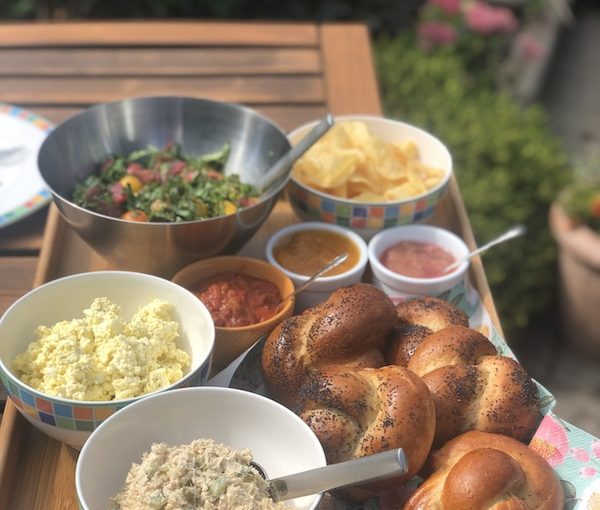
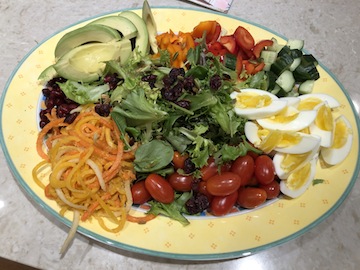
photo - Composed salads are colourful and tasty
Composed salads are colourful and tasty. (photo by Michelle Dodek)

The farmers market produce that looks most appealing is what guides my menu. I feel strongly that bringing the bounty of our local harvest to my celebration of a spiritual new year is integral to our connection with where we are and how we live. That topic, however, is for another article.

Let me suggest, if you wish to bring your offerings into 2021 and still have your food choices reflect the symbolism of our tradition, try a couple of approaches.

First, look to Israeli cuisine. The mash-up of all Jewish traditions from Austria to Addis Ababa give many tasty options that will become new staples at your family gatherings.

Second, many Sephardi foods focus on beautiful vegetables and fruits that were not available to people living in Eastern Europe. However, living as we do today, we have access to almost every possible kind of produce. Invest in a few good cookbooks, like those of Adina Sussman, Jana Gur, Einat Admony or Yotam Ottolenghi for ideas on how to up your game with some vegetable forward, delicious, holiday-worthy food.

As far as ways to serve your food, here are some options to consider in order to be considerate of your guests in this special year of our emergence from pandemic holiday isolation.

Option 1: “Modified Family Style aka Downton Abbey,” using family members as the serving staff. For this option, the cook enlists the help of a few willing family members, (in my case, my teenaged children, my sisters and my brother). Each helper is given the responsibility to serve a dish, going from guest to guest, giving a description of the delicacy and spooning out an appropriate amount. While efficient, this does lend itself to the possibility of green bean almandine on Bubbie’s shoulder or salad in Grandpa’s lap.

Option 2: “Plated Dinner aka Eat What’s On Your Plate aka Sweat Away, Host.” This is the restaurant-style plate that hasn’t been so common at home since the Starbucks revolution in dining, where everyone has to have everything their way. In this model, everyone gets the same thing, in approximately the same amounts. Similar to a restaurant but without choosing your order. This results in more food waste, because, although it hasn’t been dropped on Grandpa’s lap, some of dinner will no doubt be pushed to the perimeter of the plate and left for the compost. It also requires, as suggested in the third version of the name, for someone to toil in the kitchen to make every plate and be on call if someone wants seconds of quinoa pilaf and doesn’t have the good fortune of sitting next to a toddler who has pushed all of that mixed grain thing to the edge of her plate. One can enlist the help of volunteers to assist with the plating to speed things up and, most certainly, some people will be needed to take the finished plates to the table, but the onus of refills will almost certainly fall to the person in charge of the kitchen.

Option 3: “Staffed Buffet” is probably the easiest, depending on the set up of your house. In this iteration of food service, a couple of people serve the buffet of food to the guests as they walk by with their plates. This eliminates having everyone touch the serving utensils. It requires fewer helpers than Option 1 and is more customized than Option 2. The catch is that your house needs to be set up to accommodate a group of hungry Jews traipsing along – and staying patient long enough with their family members who are acting as servers – to get all of their food. One major recommendation is, to avoid a stampede or major butting in line, do not serve any version of smoked salmon. For some reason, the sight of thinly sliced orange fish causes many Jewish people to act like Americans at Walmart on Black Friday.

Good luck with your holiday entertaining. Keeping things small this year to ease back into the intimacy of entertaining is also probably a great idea. Remember to say a hearty Shehechiyanu with your assembled guests for, if the pandemic has taught us one lesson, it is never to take being with our loved ones for granted. Shana tova.

Michelle Dodek is a longtime contributor to the Jewish Independent and a balabusta. She shares her love of cooking and entertaining through culinary classes, both in person and on Zoom.

Format ImagePosted on August 27, 2021August 25, 2021Author Michelle DodekCategories Celebrating the HolidaysTags cooking, coronavirus, COVID-19, entertaining, lifestyle, Rosh Hashanah

Salmon for the holiday

One of the symbols of Rosh Hashanah is the fish head – “God will make you the head, not the tail” is the blessing. Fish is often served at one of the holiday meals and here are a few salmon recipes that would be nice to serve for lunch or brunch.

HOT DOG BUN SALMON SANDWICHES
(This recipe is adapted from Food & Wine. It makes 8 servings.)

1/2 cup plain yogurt
2 finely chopped celery ribs with leaves
1 tbsp chopped chives
2 tbsp chopped flat leaf parsley
1 tbsp fresh lemon juice
salt and pepper to taste
4 loose cups flaked roasted salmon
8 hot dog buns
melted unsalted butter
potato chips

  1. In a bowl, combine yogurt with celery, chives, parsley and lemon juice. Season with salt and pepper. Fold in salmon.
  2. Heat a griddle. Brush the cut sides of the buns with butter and toast.
  3. Fill the buns with salmon salad. Top with potato chips.

SALMON BURGERS
(This recipe comes from Rick Moonen of RM Seafood in Las Vegas with my changes. It makes 6 servings.)

5 coarsely chopped scallions, white and green parts only
3/4 cup coarsely chopped red pepper
3/4 cup coarsely chopped green pepper
1 1/2 pounds skinless, centre-cut salmon, cut into 1-inch cubes and frozen for 30 minutes
1/2 cup dry breadcrumbs
salt and pepper to taste
2 tbsp unsalted butter
1/4 cup olive oil
6 split and toasted brioche buns
harissa-spiced mayonnaise (optional)
cucumber relish, lettuce and tomato slices, for serving

  1. Pulse scallions and peppers in a food processor until finely chopped. Transfer to a bowl. Pulse salmon until finely chopped and with some bigger chunks. Transfer to bowl.
  2. Fold in breadcrumbs, salt and pepper and one-third cup harissa mayonnaise (to make: add two tablespoons of the North African paste to two-thirds cup mayonnaise). Oil hands and shape into six patties. Transfer to a lightly oiled plate and refrigerate 30 minutes.
  3. Light a grill. Melt one tablespoon butter and two tablespoons olive oil in a frying pan. Add three burgers, cook on both sides four to five minutes. Transfer to a plate. Add another one tablespoon butter and two tablespoons olive oil to pan and fry remaining burgers.
  4. Spread harissa mayonnaise on buns. Top with burgers, relish, lettuce and tomato slices.

SMOKED SALMON AND ONION FRITTATA MUFFINS
(This recipe comes from Foods You Want for the Life You Crave by Nealy Fischer. It makes 4 to 5 servings.)

1 1/2 tsp olive oil
1 tbsp unsalted butter
1/2 small finely chopped onion
1 1/2 ounces lox or smoked salmon
4 large beaten eggs
1/4 cup chopped chives

  1. Preheat oven to 400°F. Grease six-cup muffin pan with olive oil or vegetable spray.
  2. Heat olive oil and butter in a frying pan. Add onion and cook eight minutes.
  3. Move onions to one side of frying pan, fry smoked salmon one minute. Break into small pieces.
  4. Transfer onion and salmon to a bowl and allow to cool.
  5. Add eggs, chives, salt and pepper to bowl and combine. Pour into muffin cups. Bake for 20-25 minutes or until eggs are set in the centre. Let cool one minute then remove from pan.

Sybil Kaplan is a journalist, editor of nine kosher cookbooks (working on a 10th) and a food writer living in Jerusalem. She has written the kosher restaurant features for janglo.net since 2014 and leads weekly English-language Shuk Walks in Machane Yehuda.

Posted on August 27, 2021August 25, 2021Author Sybil KaplanCategories Celebrating the HolidaysTags cooking, recipes, Rosh Hashanah, salmon

Try new-ish dish in new year

Quinoa (keen-wah) is a plant whose seed is eaten like a grain, like wheat, originally from the Andean region of South America. However, it is not a true grain. Quinoa contains higher amounts of protein compared to true grains, and it does not contain any gluten.

Eating quinoa might make people feel fuller than wheat or rice and it might also decrease post-meal levels of blood fats called triglycerides compared to eating bread. Here are some recipes you might like to try in the new year, particularly if you are gluten-free or celiac.

BASIC QUINOA
(makes 3 cups)

2 cups water
1 cup quinoa

  1. Place quinoa and water in a saucepan. When all the grains turn white, bring to a boil.
  2. Cover and cook until all the water is absorbed (about 15 minutes).

QUINOA TABBOULEH
(This recipe is from Rancho la Puerta in Tecate, Mex. It makes 4 servings.)

2 tbsp olive oil
2 tbsp fresh lemon juice
2 tbsp chopped Italian parsley
1 minced garlic clove
salt and pepper to taste
1 cup water
1/2 cup rinsed quinoa
1/2 cup chopped cucumber
1/2 cup chopped tomatoes
1/4 cup chopped fresh mint
1/2 cup chopped parsley
8 lettuce leaves

  1. Whisk oil, lemon juice and parsley in a bowl with garlic, salt and pepper.
  2. In a saucepan, bring one cup water to boil. Add quinoa, cover, reduce heat and cook until water is absorbed, about 13 minutes. Transfer to bowl and cool.
  3. Add cucumber, tomato, mint and a half cup of parsley. Pour dressing on and toss to coat.
  4. To serve, arrange two lettuce leaves on each of four plates. Spoon quinoa tabbouleh on top and serve.

LEMONY QUINOA SALAD
(This recipe is from California Chef Jeremy Fox from a Food & Wine article on America’s best vegetarian cooking. It makes 4 servings.)

8 large red radishes
1 small black radish
1 peeled medium carrot
1 cored medium fennel bulb
1 cup quinoa
2 1/2 cups water
finely grated zest of 2 lemons
juice of 1 lemon
2 tbsp vegetable oil
salt and pepper to taste

  1. Using a mandolin grater, thinly slice radishes, carrot and fennel and transfer to a bowl of ice water. Refrigerate about one hour, until crisp.
  2. In a saucepan, bring quinoa and water to a boil. Cover and cook over low heat until water is absorbed, about 20 minutes. Let cool.
  3. Drain and dry vegetables. Combine lemon zest and lemon juice with oil in a bowl. Add quinoa and toss. Season with salt and pepper.
  4. To serve, place quinoa in salad bowls and top with vegetables.

CRISPY QUINOA SLIDERS
(This recipe is from Food & Wine by Chef Kay Chun. It makes 12 sliders.)

2/3 cup quinoa
2/3 cup water
2 1-inch slices whole wheat bread, crusts removed, bread cubed
2 large eggs
1 cup coarsely grated zucchini
1/2 cup grated Parmesan cheese
1/4 cup chopped chives
3 minced garlic cloves
salt and pepper to taste
4 tbsp vegetable oil
mini buns, lettuce, tomatoes, onions, pickles

  1. In a saucepan, cook the quinoa in boiling water until just tender, about 10 minutes. Drain and spread onto a baking sheet to cool.
  2. Pulse bread in a food processor until coarse crumbs (about one cup).
  3. Whisk eggs in a bowl. Squeeze liquid from zucchini and add to eggs. Stir in cheese, chives, garlic, salt and pepper. Add quinoa and breadcrumbs. Let stand 10 minutes.
  4. Scoop 12 mounds of mixture to form half-inch-thick patties. Heat one tablespoon oil in a frying pan. Add six patties and cook about three minutes, until golden on the bottom and crisp. Re-oil the pan and fry the remaining six patties for three minutes.
  5. Serve in mini buns with lettuce, tomatoes, onions and pickles.

Sybil Kaplan is a journalist, editor of nine kosher cookbooks (working on a 10th) and a food writer living in Jerusalem. She has written the kosher restaurant features for janglo.net since 2014 and leads weekly English-language Shuk Walks in Machane Yehuda.

Posted on August 27, 2021August 25, 2021Author Sybil KaplanCategories Celebrating the HolidaysTags cooking, quinoa, recipes, Rosh Hashanah

Add a spinach salad to menu

Spinach may have originated 2,000 years ago in Persia but it is native to central and western Asia. Now widely popular, there are many tasty ways to prepare it. In addition, its health benefits are many, especially if eaten raw, so here are a few recipes for a healthy new year.

MY FAVOURITE SPINACH SALAD
(4 servings)

4 cups fresh, chopped spinach
6-8 halved cherry tomatoes
2 medium, sliced kohlrabi
2 grated hard-boiled eggs

dressing
1/2 tsp minced onion
1 crushed garlic clove
salt and pepper to taste
1/4 tsp sugar
1/8 tsp paprika
dash dry mustard
dash celery seeds
1 tbsp red wine vinegar
1 tbsp + 1 tsp olive oil
1 1/2 tsp water

  1. In a salad bowl, combine spinach, cherry tomatoes, kohlrabi and eggs. Set aside.
  2. In a jar, combine dressing ingredients, close and shake well.
  3. Dress salad just before serving.

CRUNCHY SPINACH SALAD
(4 servings)

4 cups torn spinach
1 cup fresh bean sprouts
1/2 cup sliced and drained water chestnuts
2 chopped hard-boiled eggs

dressing
1/4 cup brown sugar
1/4 cup vegetable oil
2 1/2 tbsp red wine vinegar
2 1/2 tbsp ketchup
1 1/2 tsp Worcestershire sauce

  1. In a salad bowl, combine spinach, bean sprouts, water chestnuts and eggs.
  2. In a bottle or jar, combine dressing ingredients. Cover and shake well to mix.
  3. Before serving, pour dressing over salad and toss.

SPINACH SALAD DRESSING
(This salad dressing recipe is from P.J. Clarke’s in New York, which was founded in 1884. The bar was once a saloon owned by Patrick J. Clarke, an Irish immigrant who was hired in the early 1900s and, after about 10 years working there, bought the bar and changed the name. It has had other owners since then and now has multiple locations.)

1/4 cup fresh lemon juice
1 large egg yolk or 1 tbsp mayonnaise
3/4 tsp salt
1/2 tsp dry mustard
1/4 tsp freshly ground black pepper
1/4 tsp sugar
1 small chopped garlic clove
1 cup olive oil

  1. Blend all ingredients except oil in a food processor until smooth.
  2. With motor running, add oil in a stream and blend. Transfer to a jar, cover and keep chilled until serving.

Sybil Kaplan is a journalist, editor of nine kosher cookbooks (working on a 10th) and a food writer living in Jerusalem. She has written the kosher restaurant features for janglo.net since 2014 and leads weekly English-language Shuk Walks in Machane Yehuda.

Posted on August 27, 2021August 25, 2021Author Sybil KaplanCategories Celebrating the HolidaysTags cooking, recipes, Rosh Hashanah, salads, spinach
Lamb shanks a savoury dish

Lamb shanks a savoury dish

Lamb is a rich meal, so count on one shank per person. (photo by Arild Finne Nybø)

This year, I plan to stray from my plebian Rosh Hashanah chicken and salmon, and go all in with lamb shanks. Even as I write this column, I don’t know whether or not we’ll be able to gather with family this year for the High Holidays. But, I’m hopeful. And, after spending a year-and-a-half’s worth of Jewish holidays celebrating via Zoom (or on our own), it’s left me remarkably unfazed. We have to eat, after all. It may as well be yummy. As my father always reminded me, “I am the most important guest in my own home!” So, lamb it is.

Being a shockingly bad liar, I feel compelled to come clean right at the get-go. I have never cooked this dish before. My husband Harvey is the lamb expert at our home. But it’s high (chai) time I stretched my culinary balabusta skills. For the record, I am breaking all my own rules, by making a dish that has more than five ingredients, and which looks like it’ll take a good hour or more to prepare. But we’re worth it. The end result will be a smooth, savoury dish with extrastellar depth and gastronomic nuance. Ha! And if you believe those hyperbolic words, I have a bridge to sell you. But, in all seriousness, it’s one of my favourite meals, rich though it may be.

As you know, if you’re a hardcore carnivore like me, lamb is a very fatty meat. As well, it has a distinctive flavour that you either love or hate. There don’t seem to be many fence-sitters when it comes to lamb. Harvey and I position ourselves squarely in the love-it camp. While we don’t eat it often, we consider lamb fancy food, and usually only have it on special occasions. Like Tuesdays. It plays well with rice, couscous, noodles or potatoes, which makes it an equal opportunity meat. And that’s something I admire in my food.

MOROCCAN LAMB SHANKS

6 lamb shanks
coarse salt and pepper to taste
3 tbsp plus 1/4 cup olive oil
1 large onion, finely chopped
6 large garlic cloves, minced
4 carrots, cut crosswise into 1/2-inch pieces
4 celery ribs, cut crosswise into 1/2-inch pieces
2 tbsp packed brown sugar
1 tsp dried thyme
1 tsp ground cumin
1 tsp paprika
1/2 tsp ground cinnamon
1/4 tsp ground cloves
1/4 tsp cayenne, or to taste
1 1/2 cup dry red wine
3 cups beef broth

  1. Preheat oven to 325°F. Season the lamb with salt and pepper.
  2. Heat three tablespoons oil in a heavy pot over medium-high heat. Add the celery, carrots and onion and cook until very soft, eight to 10 minutes.
  3. Add the thyme, cumin, paprika, cinnamon, cloves, cayenne, brown sugar and garlic and cook for three minutes.
  4. Add the wine, then raise heat to high and bring to a boil. Lower heat to medium and add the beef broth. Leave on medium heat while you brown the lamb shanks.
  5. Pour the remaining 1/4 cup of olive oil into a sauté pan. Over medium-high heat, brown the lamb shanks well on all sides.
  6. Transfer the lamb shanks to the roasting pan (or Dutch oven) and pour the braising liquid on top. Cover with a lid or aluminum foil and cook for one hour. Remove the lid/foil and cook two-and-a-half to three hours more, turning the shanks over every half hour until the meat is very soft.
  7. Remove the shanks from the braising liquid and strain the liquid. Skim any fat that rises to the surface, then use the liquid as a sauce.
  8. Serve over rice, couscous or noodles, or with potatoes.

I can say with a fair degree of certainty that this is one of the tastiest lamb dishes I’ve ever had the pleasure of devouring. It’s not exactly summer food, but it’s perfect for fall or winter. If you served it for Rosh Hashanah dinner, you would undoubtedly impress the heck out of your guests. Or whomever you plan to eat with. It’s a labour-intensive recipe, no question about that. But you’ll thank me once the smell comes wafting out of your kitchen and you begin to food swoon.

Like I said, it’s a rich meal, so count on one shank per person. If you’re Israeli, you’ll probably opt to lay it gently on a mountain of rice or couscous, but maybe you’ll go rogue and settle it lovingly on a bed of noodles. We Ashkenazim like our meat and potatoes (a little too much, I’m afraid), so I’ll probably make a side of roasted baby new potatoes. If you go the traditional Ashkenazi route and start with gefilte fish and matzah ball soup, I guarantee you’ll be stuffed to the gills by the time you get halfway through the lamb. But will you stop? I think not. It’s kind of like a marathon … you don’t get halfway through only to say, “I think I’ve had enough.” Oh no, you’ll throw yourself into this Moroccan lamb like it’s a cold lake on a hot day.

As for Rosh Hashanah dessert, if you think anyone will have even a millimetre of space left in their stomach for a little something sweet, think again. I’d say there might even be a vomitorium involved, but we’re not Roman, so … no. Maybe put out some fruit for those who are really feeling gluttonous and want to ring in the New Year with a Gaviscon chaser. It’ll only be a token gesture (the fruit, not the Gaviscon), but you can always have it the next day for breakfast. Mind you, I’m usually so stuffed the following day that I can barely face food until maybe 9 a.m. Decide for yourself. Those little fruit jellies are always a nice touch, and barely take up any room.

Before you start feeling full just reading this, remember that you don’t have to eat every course that’s served during Rosh Hashanah dinner. You’re allowed to beg off the first three and save yourself for the main event. No one will be offended. In fact, probably no one will even notice. Whatever you end up doing for the High Holidays, be healthy, be safe and here’s to a sweet new year full of positive and inspiring adventures. Shana tova u’metuka.

Shelley Civkin aka the Accidental Balabusta, is a happily retired librarian and communications officer. For 17 years, she wrote a weekly book review column for the Richmond Review. She’s currently a freelance writer and volunteer.
Format ImagePosted on August 27, 2021August 25, 2021Author Shelley CivkinCategories Celebrating the HolidaysTags Accidental Balabusta, cooking, lamb shanks, recipe, Rosh Hashanah
Sweet summer dessert treats

Sweet summer dessert treats

(photo from twopeasandtheirpod.com)

They don’t make ’em like they used to. And, almost without exception, recipes from yesteryear are tastier, precisely because they’re reminiscent of gentler times. When I think Rice Krispie squares, I recall sitting on our old brown couch in the den, watching Ed Sullivan with the whole family. And I longingly remember eating Mom’s cheesy broccoli soufflé during Rosh Hashanah. Or, I’m back in 1966, enjoying a mountain of fried onions with my mother’s world-class chicken livers. And those salmon patties! And how about that creamed tuna in patty shells? Does anybody even eat this stuff anymore? If not, it’s a crying shame.

Maybe it’s a longing for those days when you could send your children out into the neighbourhood armed with only roller skates, in the certainty that they would be back, safe and unharmed, for lunch (or dinner, depending). A time when TV dinners were acceptable and ubiquitous. (I especially liked the one with fried chicken, corn, peas and tiny, unnaturally square carrots, mashed potatoes and canned pears/peaches.) I remember when an hourglass figure was desirable, and women actually ate to their fill. Of course, most of them smoked, too, but that’s a whole other column. I’m talking food right now. Uncomplicated, unapologetic, unfussy food. Anybody remember chip steaks? How about fondue? Sloppy Joes? Pineapple upside down cake? Aspic (now that’s one heinous creation)?

What’s old can always be new again. Especially if you’re willing to look the other way when it comes to nutrition, calories and cholesterol. Some of my favourite desserts are classic 1950s and ’60s numbers. In other words, any recipes that call for Jello or Dream Whip. And, preferably, have fewer than five ingredients.

My dad, alav hashalom, loved one particular dessert I made. Not that my repertoire was so enormous back then, but, still, it was always a winner with Dad. He’d take one bite and look at me like I’d just discovered fire. It was an easy (understatement of the millennium) recipe given to me by a woman I used to work with when I was a librarian at West Kildonan Library, in the North End of Winnipeg. Naturally, I just call it Liz Westlake’s Jello Dessert. I don’t make it very often, because I’m afraid of being shamed by my fancy foodie friends. But, occasionally, I break down and splurge. Let it be known, however, that no one – I repeat, no one – ever turns down a second piece of this dessert. It’s quaint, refreshing and … old-fashioned.

LIZ WESTLAKE’S JELLO DESSERT

1 can (398 ml or 14 oz) fruit cocktail (drained)
1 1/3 cup Graham cracker crumbs
1/3 cup melted butter
1/4 cup brown sugar
1 box cherry Jello

Preheat oven to 375°F. Mix the Graham cracker crumbs together with the melted butter and brown sugar and pat it into the bottom of a springform pan. Bake for five to seven minutes.

Make the Jello according to the instructions on the box and, when half congealed, but still smooth enough to stir (approximately 1 1/4 hours), add the drained fruit cocktail to the Jello and mix it together. Pour this on top of the Graham cracker crust and refrigerate until completely firm. (If you want to get really fancy shmancy, you can put whipped cream on top. I don’t – I’m a purist.)

Even the most kitchen-challenged soul can make this dessert. And I guarantee it’s a winner, especially on a hot day. Once again, you’re welcome.

Now to a sturdier sweet – the ubiquitous chocolate chip zucchini brownie. Anyone who grows zucchini knows that it can take over your entire garden. If you let it. This is all hearsay, of course, since I’m known far and wide to have a black thumb. But I read a lot. And I’ve heard of people whose gardens produce so much zucchini that they sneak out in the dead of night and drop bags of zucchini on neighbours’ doorsteps, then flee into the darkness, nary a trace of their identity to be found. Personally, I just buy mine at Safeway. But I’m getting off track. This dessert is easy, healthy (OK, let’s just say it’s in the general vicinity of health) and satisfying for those with a hankering for chocolate.

CHOCOLATE CHIP ZUCCHINI BROWNIES

1 1/2 cup white sugar
1/2 cup canola oil or vegetable oil
2 cups all-purpose flour
1/4 cup unsweetened cocoa powder
2 cups shredded zucchini (but don’t squeeze out the liquid)
2 tsp vanilla extract
1 tsp salt (or a little less)
1 1/2 tsp baking soda
1 1/4 cup semi-sweet chocolate chips

Preheat oven to 350°F. Grease a 9”x13” baking pan and set it aside.

In an electric stand mixer, or using a hand mixer, combine the sugar, oil and flour. It will look dry, but that’s OK. While mixing on low speed, add the cocoa, shredded zucchini, vanilla, salt and baking soda. Mix until well combined. Stir in the chocolate chips.

Pour the batter into the greased pan and bake for 28 to 32 minutes or until a toothpick inserted in the centre comes out clean. The brownies should look set, not mushy. Cool completely on a wire rack. Cut into squares and serve.

Don’t even consider asking me how many calories there are in one square. Think of it as a serving of vegetables. I mean, there is something green in there. Beigey-green? For goodness sake, just enjoy, and stop with the guilt. They’re a nice, moist alternative to regular brownies and you get to feel all high and mighty because they’re [semi] healthy.

If neither of these desserts float your boat, try making your own popsicles. Nothing spells old-school quite like those plastic popsicle molds with the multi-coloured tops. You can over-spend and get the molds at one of those highfalutin, hoity-toity kitchen stores, or you can rock it like it’s 1964 and buy them at your local dollar store. I chose Door #2, and it works just fine. (There’s also the ice-cube tray option, with toothpicks as the popsicle sticks.) There are a gazillion recipes for popsicles on the internet, most of them calling for Greek yogurt, frozen fruit, juice and honey. Check ’em out and keep cool.

Shelley Civkin, aka the Accidental Balabusta, is a happily retired librarian and communications officer. For 17 years, she wrote a weekly book review column for the Richmond Review. She’s currently a freelance writer and volunteer.
Format ImagePosted on July 9, 2021July 7, 2021Author Shelley CivkinCategories LifeTags Accidental Balabusta, baking, brownies, cooking, desserts, Jello, nostalgia, recipes

Posts pagination

Previous page Page 1 … Page 4 Page 5 Page 6 … Page 9 Next page
Proudly powered by WordPress