Skip to content
  • Home
  • Subscribe / donate
  • Events calendar
  • News
    • Local
    • National
    • Israel
    • World
    • עניין בחדשות
      A roundup of news in Canada and further afield, in Hebrew.
  • Opinion
    • From the JI
    • Op-Ed
  • Arts & Culture
    • Performing Arts
    • Music
    • Books
    • Visual Arts
    • TV & Film
  • Life
    • Celebrating the Holidays
    • Travel
    • The Daily Snooze
      Cartoons by Jacob Samuel
    • Mystery Photo
      Help the JI and JMABC fill in the gaps in our archives.
  • Community Links
    • Organizations, Etc.
    • Other News Sources & Blogs
    • Business Directory
  • FAQ
  • JI Chai Celebration
  • JI@88! video

Recent Posts

  • Sharing her testimony
  • Fall fight takes leap forward
  • The balancing of rights
  • Multiple Tony n’ Tina roles
  • Stories of trauma, resilience
  • Celebrate our culture
  • A responsibility to help
  • What wellness means at JCC
  • Together in mourning
  • Downhill after Trump?
  • Birth control even easier now
  • Eco-Sisters mentorship
  • Unexpected discoveries
  • Study’s results hopeful
  • Bad behaviour affects us all
  • Thankful for the police
  • UBC needs a wake-up call
  • Recalling a shining star
  • Sleep well …
  • BGU fosters startup culture
  • Photography and glass
  • Is it the end of an era?
  • Taking life a step at a time
  • Nakba exhibit biased
  • Film festival starts next week
  • Musical with heart and soul
  • Rabbi marks 13 years
  • Keeper of VTT’s history
  • Gala fêtes Infeld’s 20th
  • Building JWest together
  • Challah Mom comes to Vancouver
  • What to do about media bias
  • Education offers hope
  • Remembrance – a moral act
  • What makes us human
  • המלחמות של נתניהו וטראמפ

Archives

Follow @JewishIndie
image - The CJN - Visit Us Banner - 300x600 - 101625

Tag: cooking

Earn Frequent Fryer points

Earn Frequent Fryer points

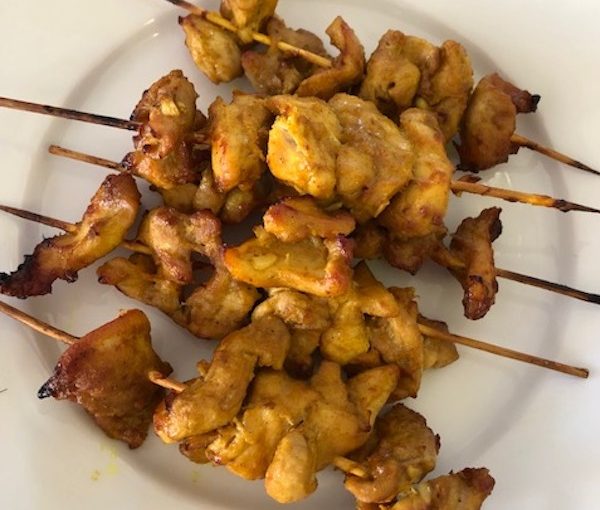
Mouthwatering air fryer chicken satay with peanut sauce. (photo by Shelley Civkin)

My father, alav hashalom, used to use the Yiddish phrase “Don’t hock me a tscheynik,” meaning, literally, don’t bang my teakettle. But, idiomatically, it means don’t bother me with nonsense. My husband Harvey has been hocking me a tscheynik for months now, in the hope that he’ll wear me down and I’ll finally give him the OK to buy an air fryer. Vos air fryer? Whenever people said air fryer, it conjured up a deep fryer filled with greasy doughnuts floating on the top. Or fatty chicken served with waffles, south of the border. It was about as appealing as an oozing wound.

I didn’t know from air fryers. But then my nephew and his wife got one, and regularly post pictures of the mouthwateringly delectable dinners they produce in their newfangled appliance. Still, I was not sold on the idea. While our apartment is a good size, our kitchen was designed for someone who’s culinarily challenged, petite in stature and not in favour of wasting space. Or, for someone like the character of Carrie Bradshaw, from Sex and the City, who only uses her oven to store sweaters. In short, it’s a galley kitchen that only fits two people, if you turn sideways and suck in your stomach. Our counter space is almost non-existent, yet we’ve managed to find a home for a Nespresso machine, waffle maker, Breville toaster oven, Breville blender and two Henckels knife blocks. I can barely fit a Vitamin C tablet on the remaining space. Still, Harvey thinks we can’t live (or at least not live well) without an air fryer.

After months of fighting him on this, I finally relented. Harvey did his due diligence, researched all air fryers known to man (and woman), then snuck out in the dead of night (notice how I made that all dramatic) and bought one. We got the Instant Vortex six-quart air fryer, which is big enough to hold a smart car. Or a baby buffalo.

As you can imagine, we had to make room for it on our aforementioned miniscule counter. The waffle maker now lives in the closet. The Nespresso machine has taken up residence in the liquor cabinet. And the Breville blender now cohabits with the Henckels Dutch oven under the butcher block. Our little family of appliances resembles a group home for wanton, headstrong youth. But still, we love them all the same.

A week has passed since we installed the air fryer into our humble abode and, well, it’s sheer bliss. I never knew it could be like this. So far, Harvey has made baked chicken thighs, carrots and broccoli, hardboiled eggs, potato wedges and hamburgers. All of which passed with flying (frying) colours, except, I’m sorry to say, the broccoli. It was a stringy, hard mess. The air fryer was literally begging us (OK, so I’m anthropomorphizing) for overtime – or at least a day off.

So, does this make us Frequent Fryers?

Meanwhile I’ve been Googling recipes for air fryer eggplant, tofu (Harvey would rather eat nails) and teriyaki salmon. Then, inspiration struck like yummy lightning – I found a bunch of mouthwatering recipes for air fryer chicken satay with peanut sauce. The deal was sealed. Note that, up to this point in time, I had not so much as touched our new appliance. I’d read the owner’s manual a dozen times though. Not wanting to challenge myself too much – you know, performance anxiety, fear of failure – I glommed onto the easiest, most appealing recipe I could find (credit goes to “Damn Delicious”). You’re welcome.

CHICKEN SATAY WITH PEANUT SAUCE

1/4 cup coconut milk
2 tbsp reduced sodium soy sauce
2 1/2 tsp yellow curry powder (I omitted this)
1 1/2 tsp turmeric
3/4 tsp cumin
3 cloves garlic, minced (I used 2 cloves)
1 tbsp freshly grated ginger
1 tbsp brown sugar
1 tbsp fish sauce (I omitted this)
2 lbs boneless, skinless chicken thighs or breasts cut into 1-inch cubes
1 tbsp canola oil (I used olive oil instead)
kosher salt and ground black pepper, to taste
rice vermicelli noodles

for the peanut sauce:
3 tbsp creamy peanut butter
1 tbsp reduced sodium soy sauce
1 tbsp freshly squeezed lime juice
2 tsp brown sugar
2 tsp chili garlic sauce (I used 1 clove garlic, minced instead)
1 tsp freshly grated ginger

  1. To make the peanut sauce, whisk together peanut butter, soy sauce, lime juice, brown sugar, chili garlic sauce (or minced garlic) and ginger in a small bowl. Whisk in two to three tablespoons water (I used coconut milk) until desired consistency is reached. Set aside in the fridge.
  2. In a medium bowl, combine coconut milk, soy sauce, curry powder (optional), oil, salt, pepper, turmeric, garlic, ginger, brown sugar and fish sauce (optional).
  3. In a large Ziploc bag or large bowl, combine chicken and coconut milk mixture, and marinate for at least two hours to overnight, stirring the mixture occasionally.
  4. Make some rice vermicelli noodles, rinse, drain and let them cool in the fridge.
  5. Soak bamboo skewers in water for 30 minutes before using.
  6. Drain the chicken from the marinade, discarding the marinade.
  7. Preheat the air fryer to 385°F for 12 to 14 minutes, or maybe a couple of minutes longer, depending on the wattage of your air fryer.
  8. Thread the chicken somewhat loosely onto the soaked skewers – don’t jam them together or they won’t cook evenly.
  9. Place the skewers into the air fryer basket, leaving room between each skewer. You may have to do a couple of batches to accommodate them all.
  10. Bake for six to seven minutes, then turn the skewers over and bake for another six to seven minutes, until they reach an internal temperature of 165°F.
  11. Serve immediately with peanut sauce over a bed of rice vermicelli noodles. Garnish with thinly sliced green onion or cilantro, and crushed peanuts.

To say that this meal was a success would be a gross understatement. In fact, I think Harvey proposed to me all over again. Then he offered to buy me a new computer. And a car. Perhaps the exhilaration of this delicious meal has gone to my head. Maybe he just said, “Thanks, it was delicious!” I can’t be sure. But my bet is on a new car.

Shelley Civkin, aka the Accidental Balabusta, is a happily retired librarian and communications officer. For 17 years, she wrote a weekly book review column for the Richmond Review. She’s currently a freelance writer and volunteer.
Format ImagePosted on October 7, 2022October 5, 2022Author Shelley CivkinCategories LifeTags Accidental Balabusta, air fryer, chicken satay, cooking, recipes

A traditional break fast recipe

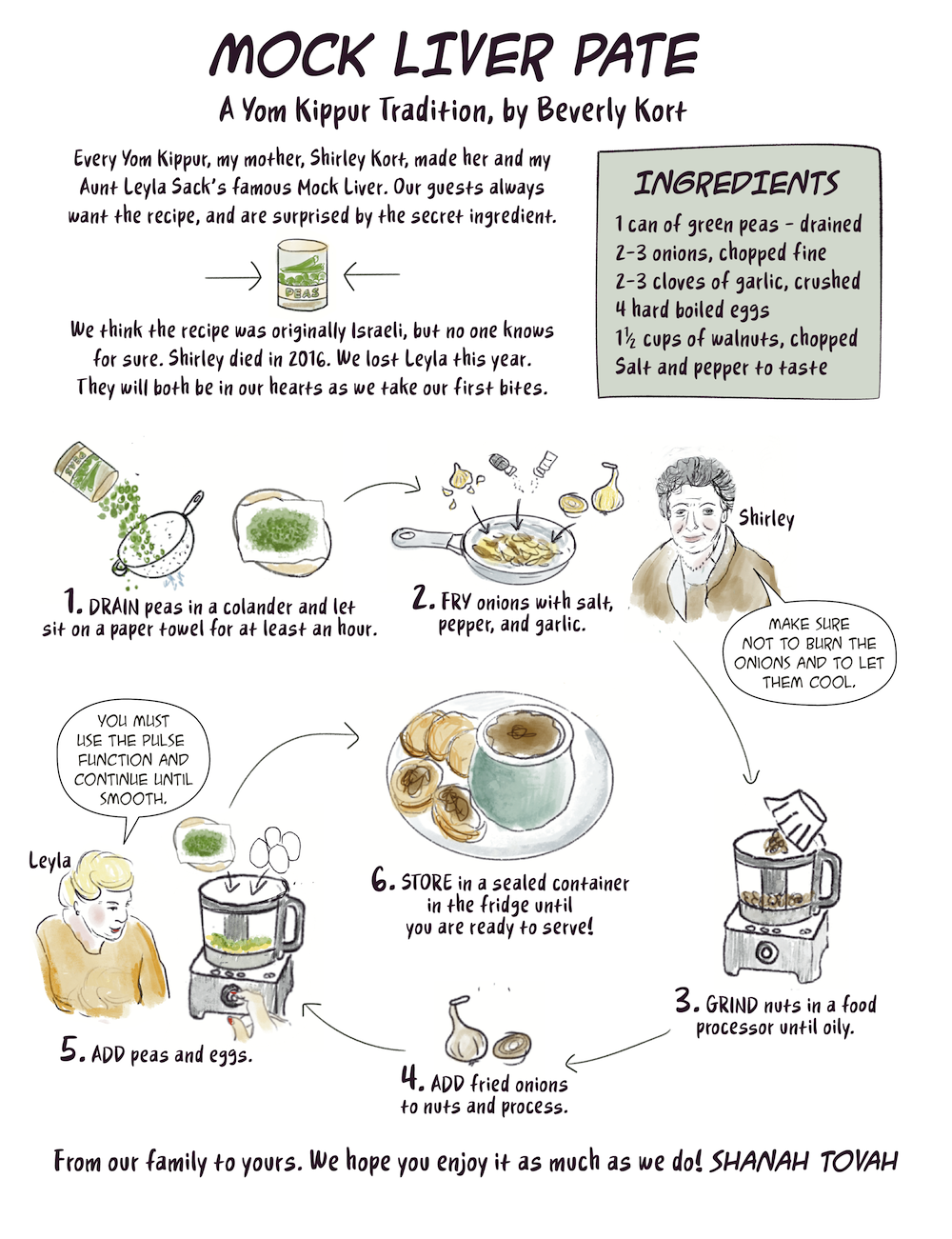
image - illustrated Mock Liver Pate recipe

Beverley Kort is a registered psychologist by day and a cartoonist in her off hours. She has a private practice in Vancouver

Posted on September 16, 2022September 14, 2022Author Beverley KortCategories Celebrating the HolidaysTags cooking, Leyla Sacks, recipes, Shirley Kort, Yom Kippur
Fish dishes for dinner, lunch

Fish dishes for dinner, lunch

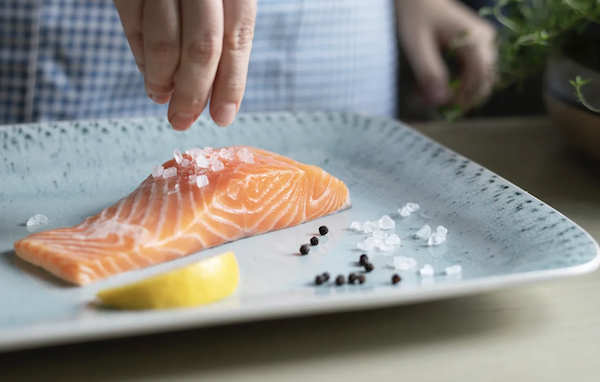
A fish head is one of the symbols of the Rosh Hashanah meal, so why not add a fish dish to the menu? (photo from rawpixel.com)

Soon we will celebrate Rosh Hashanah, for which a fish head is a symbol of leadership (be the head and not the tail) and fertility. This is reason enough, perhaps, to include fish on the holiday dinner or lunch menus. If so, here are a few recipes you could try.

TUNA AIOLI
(8 servings)

2 cups mayonnaise
4 large minced garlic cloves
2 tbsp lemon juice
1/2 tsp dry mustard
2 10-ounce packages frozen Italian green beans
4 7-ounce cans drained tuna
2 20-ounce cans drained sliced beets
8 sliced carrots
2 thinly sliced red or white onions

  1. In a bowl, blend mayonnaise with garlic, lemon juice and mustard. Cover and refrigerate.
  2. Cook green beans following package directions.
  3. Arrange tuna, beets, carrots and onions on a serving platter. Serve with mayonnaise-garlic sauce.

FISH AND ARTICHOKE SALAD
(6 servings)

1 pound fish of your choice
1 cup pareve chicken soup (or vegetable stock)
1/2 cup dry white wine
1 14-ounce can drained and quartered artichoke hearts
2 tomatoes, cut into eighths
1/2 cup halved black olives
1/4 cup olive oil
2 tbsp fresh lemon juice
1/4 cup chopped fresh parsley
salt and pepper to taste
a few lettuce leaves
4 chopped green onions

  1. Place fish, soup and wine in a saucepan. Bring to a boil. Turn off heat and let cool.
  2. Place fish in a bowl with artichoke hearts, tomatoes and olives.
  3. In a small bowl, whisk oil, lemon juice, parsley, salt and pepper. Pour over fish and toss to mix.
  4. Cover and refrigerate overnight or at least three hours.
  5. Line a bowl with lettuce leaves. Spoon in fish mixture. Garnish with green onions.

GRILLED SALMON SALAD
(8 servings)

8 centre-cut salmon fillets
1/4 cup olive oil
1/4 cup fresh lime juice
salt and pepper to taste
8 cups rinsed, dried and coarsely chopped arugula leaves
4 cups halved cherry tomatoes
1/2 cup diced red onion
salt and pepper to taste
2 tbsp olive oil
2 tbsp red wine vinegar

  1. Place salmon in a shallow dish. Combine oil, lime juice, salt and pepper and pour over salmon. Marinate in refrigerator 30 minutes, turn and continue marinating 30 minutes more.
  2. Oil a grill. Grill salmon, skin side down, 8-13 minutes, until medium rare.
  3. Meanwhile, combine arugula, tomatoes, red onion, salt, pepper, olive oil and wine vinegar.
  4. Place a salmon fillet in the centre of each dinner plate. Divide the salad equally and place each portion atop a piece of fish.

Sybil Kaplan is a Jerusalem-based journalist and author. She has edited/compiled nine kosher cookbooks and is a food writer for North American Jewish publications.

Format ImagePosted on September 16, 2022September 14, 2022Author Sybil KaplanCategories Celebrating the HolidaysTags cooking, fish, recipes, Rosh Hashanah

Hitting the high seas & citrus

Who among us enjoys using a 400°F oven during the summer? That would be: Nobody. Ever. For me, summer is synonymous with barbecuing, which is first cousin to steak, hamburgers, chicken and grilled veggies.

Recently introduced to tuna steaks, I’ve now gone over to the light side. On a recent trip to Victoria, good friends had us over for dinner and served one of the best meals we’ve eaten in years. While most of the component parts were healthy, some were deliciously questionable, in terms of caloric heft (see lemon mousse below). The star of the meal, by a long shot, however, was the marinated tuna steak, grilled on the barbecue. Even though it was more well done than I prefer, it was still juicy, incredibly flavourful and tender. I like my tuna steak with grill marks on the outside and pink rareness on the inside. Most good fish restaurants serve it like that. Despite the variance in preferences, our friend cooked it to perfection. As with all good things, I like to share my enjoyment with others. So, you’re welcome.

You can buy frozen tuna steaks at lots of stores. Fresh is even better, but not always available. For your culinary edification, did you know that Pacific bluefin tuna are approximately five feet long and weigh about 130 pounds? (Think: that’s bigger than me!) Apparently, the world record for the largest bluefin tuna caught was set in Nova Scotia in 1979. It weighed in at a whopping 1,496 pounds. How do you even land something like that? It’s like the Tuna That Ate New York. The tuna we had was cut into petite steaks of about five inches by three inches, and was one-inch-thick perfection.

MARINATED TUNA STEAKS
(serves 4)

4 4-ounce tuna steaks
1/4 cup orange juice
1/4 cup soy sauce
2 tbsp olive oil
1 tbsp lemon juice
2 tbsp chopped fresh parsley
1 clove garlic, minced
1/2 tsp chopped fresh oregano
1/2 tsp ground black pepper
salt to taste

In a large non-reactive dish (does this mean it’s even-tempered?), mix together the orange juice, soy sauce, olive oil, lemon juice, parsley, garlic, oregano and pepper. Place the tuna steaks in the marinade and turn it over to coat. Cover and refrigerate for at least 30 minutes. Bring to room temperature before grilling/frying. Preheat grill at high heat, or pan sear on high in a frying pan.

Lightly oil grill grate or frying pan. Cook the tuna steaks for approximately five minutes, then turn and baste with the marinade. Cook for an additional five minutes, or to desired doneness. I’ve read recipes that call for as little as a 45-second-per-side cooking time, so, use your own discretion. Discard any remaining marinade.

Serve it up with a side of guacamango salad (see below), and you’re sure to get a thank you note. Add some tri-coloured baby new potatoes and, voila, just like that, your guests/partner/pets will think you’re Julia Child!

Despite all evidence to the contrary, I can cook and not give people E. coli. I have been known to give my husband and I food poisoning from bad lamb. In my defence, it was a full moon and I was unsupervised. I’ve also been known to accidentally coat snapper in icing sugar instead of flour. Because Harvey and I were in our “courting” phase, he ate it nonetheless. I went out for takeout sushi. This is one of Harvey’s favourite stories. Mostly, I just cook stuff that it’s humanly impossible to screw up. Or, I let Harvey cook and, since he thinks that cooking is like doing a chemistry experiment, I say, knock yourself out Science Guy.

Never heard of my newly created gaucamango salad? Feast your tastebuds.

SHELLEY’S GUACAMANGO SALAD

2 large, ripe Ataulfo mangoes, diced
2 large, ripe avocados, diced
lime juice, to taste
olive oil
fresh mint, chopped roughly
blueberries (optional)

Mix all the ingredients together and tell me this isn’t the freshest-tasting summer salad you’ve ever eaten. Just try me.

As I’ve told you before, this accidental balabusta puts a premium on fast, easy meals, especially during the summer months. And, preferably, recipes that call for fewer than six ingredients, including spices. However, I made an exception for the lemon mousse, which breaches my boundaries for both patience and level of patchkerey. But, man, is it worth it! I usually never try recipes that involve separating eggs, because, well … it’s just dicey. Add in the double boiler element and we’re moving precariously into Ina Garten territory. But my friend’s rendition of this was just so darn good, I couldn’t not try it. If you’re a lemon lover, you won’t be disappointed. If you’re a sourpuss, you also won’t be disappointed.

LEMON MOUSSE DESSERT

2 lemons
1 pouch gelatin powder
4 eggs (separated)
60 grams (or 4 3/4 tbsp) sugar
1 pinch of salt
250 grams (or 1 cup) whipping cream

Wash the lemons. Zest the peel of one lemon and set it aside. Squeeze the juice of both lemons and set it aside.

Separate the eggs. Whisk sugar into the egg yolks.

In a double boiler, heat the egg yolk/sugar mixture and whisk continuously until very hot (but not boiling). If you’re like me and don’t own a double boiler, just set a bowl on top of a pot of hot water instead.

Slowly whisk in the gelatin powder, then add the lemon juice and zest. Put mixture into the fridge to cool, whisking occasionally.

Beat the egg whites with a pinch of salt until firm. Beat the whipping cream.

Once egg yolk/lemon mixture is cooled, gently mix in the egg whites and whipping cream until just combined. Pour into a glass serving bowl for a pretty presentation. Chill in the fridge for a few hours and then garnish with raspberries on top.

This dessert is both fluffy and light, despite all the whipping cream. And the lemon zest gives the richness a welcome bit of texture and zhuzh. This lemon mousse is a spectacular, tart addition to any meal, plus it looks über impressive. Go ahead, boldly go where no accidental balabusta has gone before. Until now. B’tayavon!

Shelley Civkin, aka the Accidental Balabusta, is a happily retired librarian and communications officer. For 17 years, she wrote a weekly book review column for the Richmond Review. She’s currently a freelance writer and volunteer.
Posted on July 8, 2022July 7, 2022Author Shelley CivkinCategories LifeTags Accidental Balabusta, baking, cooking, lemon mousse, lifestyle, recipes, tunafish
Enjoy summer treats

Enjoy summer treats

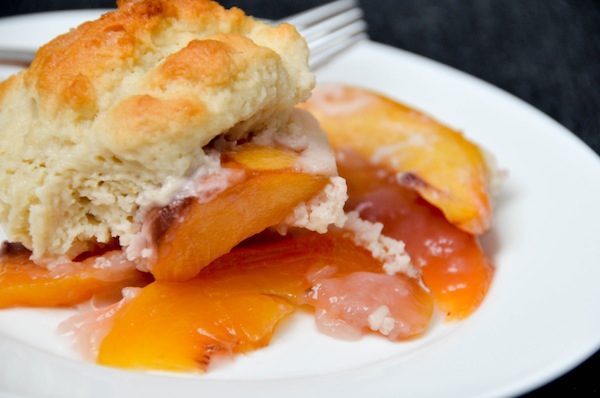
Peach cobbler (photo by sk/flickr)

Tabbouleh is such a popular Lebanese salad that the first Saturday of July is known as Lebanese National Tabbouleh Day. Although there are variations, classical tabbouleh is bulgur, parsley, tomatoes, mint and onion with olive oil, lemon juice and salt. The word tabbouleh means seasoning or dip, and bulgur, the primary ingredient, is a cereal food made from whole grains of different wheat species, said to be as healthy or healthier than quinoa and rice.

Another summer treat is cobbler, as fresh strawberries, cherries, apricots, peaches, nectarines and all kinds of apples start to appear. Cobbler is said to have originated among the American colonists, but the origin of the name – dating back at least to 1859 – is uncertain. According to Wikipedia, it may be related to cobeler, meaning “wooden bowl,” or to its top looking like a cobbled stone pathway, rather than a smoothly “paved,” i.e. rolled out, pastry top.

MY FAVOURITE TABBOULEH
(4 servings)

1 cup steamed and drained broccoli
7 tbsp water
1/2 tsp chicken soup powder
2 tbsp wine vinegar
1 tsp Dijon mustard
salt and pepper to taste
2 crushed garlic cloves
2/3 cup bulgur
5 tsp oil
4 tsp cider vinegar
chopped radishes
chopped celery
chopped green onions
chopped tomatoes
chopped red pepper

  1. In a saucepan, combine water, soup powder, wine vinegar, mustard, salt, pepper and garlic, and bring to a boil. Add bulgur, cover, and let set 15 minutes.
  2. Place broccoli in a salad bowl. Add bulgur mixture, oil, cider vinegar, radishes, celery, onions, tomatoes and red peppers and toss lightly.

TABBOULEH WITH MARINATED ARTICHOKES AND BABY SPINACH

(This recipe by Deborah Knight came from Food & Wine online. It makes 4 servings.)

4 large artichokes
1/2 tsp cumin seeds (optional)
2 tbsp sherry vinegar
2 tsp finely chopped fresh oregano
salt and pepper to taste
* * *
1 cup boiling water
1 cup coarse bulgur
3 tbsp extra virgin olive oil
3 tbsp lemon juice
2 finely chopped scallions
1/2 cup coarsely chopped curly leaf parsley
1 finely diced plum tomato
1 tbsp fresh chopped mint
salt and pepper to taste
10 halved cherry tomatoes
2 cups packed baby spinach leaves
1/4 cup crumbled feta cheese
2 tbsp toasted pine nuts

  1. Cut stems off artichokes, then steam the stems and artichokes. When cool, pull off leaves and trim fibrous outer skin. Scrape out the chokes and quarter the artichoke bottoms. Peel the stems and cut into 1/2-inch rounds.
  2. Toast cumin seeds in a skillet until fragrant, about 40 seconds. Let cool, and ground to a powder.
  3. Place artichoke bottoms and stems in a bowl. Add olive oil, sherry vinegar, oregano, salt and pepper. Let stand at room temperature one hour or refrigerate overnight.
  4. In a large bowl, pour boiling water over bulgur. Cover and let stand 40 minutes, until bulgur is tender. Fluff with a fork. Stir in olive oil, lemon juice, scallions, parsley, plum tomato and mint. Season with salt and pepper. Cover and refrigerate for one hour or until chilled.
  5. In a bowl, toss cherry tomatoes with spinach, feta and pine nuts. Spoon two tablespoons of artichoke marinade over salad and toss well. Season with salt and pepper.
  6. Spoon tabbouleh onto plates and surround with artichokes. Top with spinach salad and serve.

PEACH COBBLER
(6 servings)

1 cup flour
3/4 cup sugar
1 1/2 tsp baking powder
4 tbsp unsalted pareve margarine
1 large egg
1/4 cup non-dairy milk
5 cups pitted and sliced peaches
4 tsp cornstarch
1/4 tsp cinnamon
non-dairy vanilla ice cream

  1. Preheat oven to 400°F. Grease a shallow baking dish.
  2. In bowl, mix flour, two tablespoons sugar and baking powder. Cut in margarine until mixture resembles coarse crumbs.
  3. Beat together egg and non-dairy milk. Add to flour mixture until dry ingredients are moistened and a dough forms.
  4. Put peaches, remaining sugar, cornstarch and cinnamon in a saucepan. Cook until peaches are tender and syrup is clear, thick and boiling (five to seven minutes).
  5. Pour peach mixture into baking dish. Drop dough by heaping tablespoons in six portions over peach mixture. Bake for 20 minutes. Serve with pareve vanilla ice cream.

PAREVE REVERSE FRUIT COBBLER

1/4 cup plus 2 tbsp canola oil
1 cup non-dairy creamer
1 cup flour
1 1/2 tsp baking powder
1 cup sugar
1/4 tsp cinnamon
4 cups of fruit (strawberries, cherries, apples, peach, plums, nectarines and/or blueberries)
pareve whipping cream

  1. Preheat oven to 350°F. Grease a round glass pie plate.
  2. Pour oil into the glass dish. Add non-dairy creamer, flour, baking powder, sugar and cinnamon. Stir until blended.
  3. Add fruit.
  4. Bake for 25 minutes. Serve warm with pareve whipped cream on top.

Sybil Kaplan is a journalist, author, editor/compiler of nine kosher cookbooks. She is a food writer for North American Jewish publications, and leads English-language Shuk Walks in Machane Yehuda.

Format ImagePosted on July 8, 2022July 7, 2022Author Sybil KaplanCategories LifeTags bulgur, cobbler, cooking, fruit, recipes, tabbouleh
Pesach sweets ’n’ side dishes

Pesach sweets ’n’ side dishes

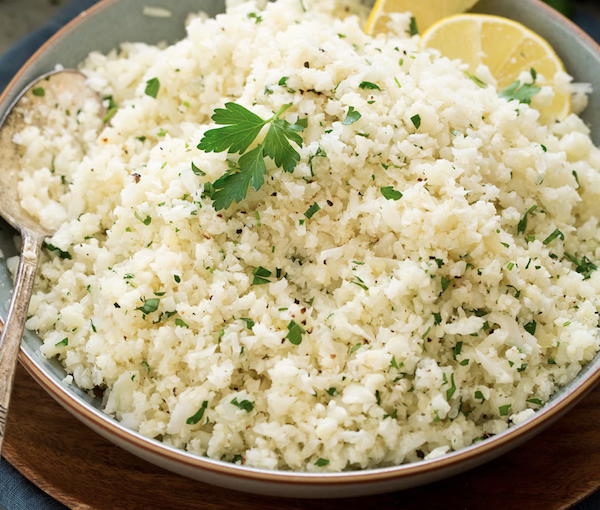
Cauliflower rice, ready to serve. (photo from cookingclassy.com)

With Passover approaching, the meal planning has begun. Looking into my Passover folder for something new to share, I found a few side dishes – and many desserts. I hope you are able to try some of them out, and that you enjoy the ones you do. Chag Pesach sameach!

CAULIFLOWER RICE
(From foodnetwork.com. Makes 4 servings.)

1 large cauliflower separated into 1-inch florets
3 tbsp olive oil
1 finely diced medium onion
1 tsp salt
2 tbsp finely chopped fresh parsley leaves
juice of half a lemon

  1. Trim cauliflower florets, cutting away as much stem as possible. In three batches, break up florets into a food processor and pulse until mixture resembles couscous.
  2. Heat oil in a large frying pan. Add onion and stir to coat. Continue cooking, stirring frequently, until onions are golden brown at the edges and have softened, about eight minutes.
  3. Add cauliflower and stir. Add salt and continue to cook and stir three to five minutes, until cauliflower has softened. Spoon into a large serving bowl. Garnish with parsley, sprinkle with lemon juice, salt to taste. Serve warm.

LEEK PATTIES
(From the Jerusalem Post, April 2015. Makes 12 servings.)

2.2 pounds leeks
1 large, peeled boiling potato
3 large beaten eggs
3 tbsp matzah meal
salt and pepper to taste
oil

  1. Wash leeks carefully, slicing then vertically to remove all the grit. Dice the white base and the palest green part of the leaves.
  2. Place water and salt in a saucepan and bring to a boil. Add leeks and cook for five minutes then drain.
  3. Place water in a saucepan and bring to a boil. Add potato and cook until it is soft. Drain.
  4. Place potato and leeks in a processor and blend. Add eggs, matzah meal, salt and pepper. Remove to a bowl and form into patties.
  5. Pour oil into a frying pan and heat. Spoon patties into the oil and fry until golden brown on each side. Drain on paper towels and serve immediately.

PASSOVER SQUASH PUDDING
(From Annice Grinberg. Makes 6 servings.)

2 pounds peeled summer squash
2 peeled carrots
1 1/2 cups matzah farfel or broken matzot
1/4 cup oil
3 eggs, separated
salt to taste

  1. Preheat oven to 350°F. Grease a casserole or baking dish.
  2. Heat oil in a frying pan. Add farfel or broken matzot and brown.
  3. Place squash and carrots in a saucepan with water, cook until soft. Drain and mash. Add farfel or browned matzot, salt and egg yolks.
  4. Beat whites in a bowl until stiff. Fold into vegetable mixture.
  5. Spoon into a greased casserole or baking dish and bake for one hour, until golden.

MOM’S CREAM PUFF BUNS
(Makes 9-12 servings.)

2/3 cup water
1/3 cup oil
1/4 tsp salt
1 tbsp sugar
3 eggs
1 cup matzah meal

  1. Preheat oven to 350°F. Spray a cookie sheet with Passover vegetable spray.
  2. Place water, oil, salt and sugar in a saucepan. Bring to a boil.
  3. Add matzah meal and one egg at a time. Blend well.
  4. Spoon dough in pieces on a cookie sheet. Bake for 30 minutes.
  5. When cool, cut a little off top of each. Fill with a favourite custard.

ALMOND CAKE WITH CITRUS SYRUP
(From Chef Peter Hoffman, in Food & Wine. Makes 6 servings.)

citrus syrup:
2 1/2 tbsp sugar
2 tbsp fresh lemon juice
finely grated zest of half a large lemon

cake:
1 1/2 tsp oil
1 tbsp matzah meal
1/2 cup sugar
1/2 cup ground almonds
1/4 cup finely chopped blanched almonds
finely grated zest of half a large lemon
4 eggs, separated
confectioners sugar (optional)

  1. Combine sugar, lemon juice and lemon zest with 1/4 cup water. Bring to a boil, stirring to dissolve sugar. Simmer over moderately low heat for two minutes. Remove from heat.
  2. Preheat oven to 325°F. Oil a springform pan bottom and sides, and line bottom with parchment paper. Oil the paper. Evenly coat bottom and sides with matzah meal. Refrigerate the pan.
  3. With a wooden spoon in a large bowl, mix sugar, almonds, lemon zest and egg yolks.
  4. In another bowl, whisk egg whites until stiff peaks form. Stir one-quarter into almond mixture. Gently fold in remaining egg whites in three additions.
  5. Pour mixture into prepared pan and bake on lowest shelf of oven for one hour or until cake tester inserted into the centre comes out dry. Cool for 10 minutes. Run a knife around the edge of the cake, remove pan sides and invert cake onto wire rack. Peel off parchment and let cake cool.
  6. Reheat and strain syrup. Transfer cake to a plate and prick all over with a fork. Pour syrup over cake and let sit at room temperature for at least three hours or overnight. Sift confectioners sugar over cake (optional).

MIRIAM’S PAREVE ICE CREAM

2 10-ounce packages frozen fruit, slightly thawed (strawberries work very well)
4 egg yolks
6 egg whites
1 cup sugar (if using frozen fruit with added sugar, decrease this amount)

  1. In a bowl, beat egg yolks. Add fruit.
  2. In a second bowl, beat egg whites until peaks are formed, gradually adding sugar.
  3. Gently add fruit and yolks to whites. Place in a container and freeze. Stir once or twice to keep fruit from settling to the bottom.

PASSOVER SORBET

4 cups strawberries or other fruit
1/2 cup sugar
1 tbsp lemon juice
1 egg white

  1. Place strawberries or fruit, sugar and lemon juice in a food processor and process until mixed. Place in a container.
  2. Whip egg white in a bowl. Add to fruit. Spoon into a container and freeze.

Sybil Kaplan is a journalist, author, editor/compiler of 10 kosher cookbooks and a food writer living in Jerusalem. She leads English-language Shuk Walks in Machane Yehuda and writes restaurant features for janglo.net.

Format ImagePosted on April 8, 2022April 7, 2022Author Sybil KaplanCategories Celebrating the HolidaysTags baking, cake, cauliflower, cooking, cream puffs, ice cream, kosher, leeks, Passover, rice, side dishes, sorbet, squash

May the force be with you

In my world, you can never have enough lamb. Or, to be more specific, lamb shanks. It used to be what I called “fancy food,” for which I splurged only on special occasions, like New Year’s Eve, or a birthday ending in zero. But since the pandemic started, up is down and right is left, and every day that you’re healthy is a day that’s meant to be celebrated. Goodness knows we could all use a little splurging. So, hubby Harvey sold a kidney and bought five pounds of lamb shanks. Lest you think we’re complete chazers, let me add that we had another couple over for dinner. For the first time in two-and-a-half years.

After two years of strict isolation and adherence to Dr. Bonnie Henry’s pandemic protocols, it was a wondrous event, to be sitting less than six feet away from two close friends, masks discarded, acting as though we did this every day. There wasn’t a shred of anxiety anywhere to be seen, and it just felt so normal. To say I felt ridiculously elated and grateful at the same time would not be an exaggeration. It was pure joy. I wondered why we hadn’t done it sooner. And then I remembered … that pesky pandemic. Oh, and my COVID anxiety, which can often be seen from space.

But back to the main event. The lamb. I’d sent Harvey to the butcher to pick up the lamb and, when he returned home, he handed me the bag-o-meat. Which weighed nearly as much as me. I asked him: “So did they throw in a ram for free?” To which he replied: “I told them I wanted the biggest lamb shanks they had.” Long story short, each shank was the size of a small country. Maybe slightly bigger. All of a sudden, my four hours of estimated cooking time was looking more like half a day. Luckily, I’m an early riser.

I hauled out my biggest roaster, proceeded to dirty every fry pan, pot and utensil in the apartment – we’re talking squeezers, mincers, graters, peelers, a multitude of various-sized knives, cutting boards and a healthy shot of Scotch (just kidding about the Scotch, but after it was all said and done, I sure could’ve used a glass) – and had at it.

The recipe, which Harvey found on the internet, is called Tom Valenti’s Lamb Shanks, and it’s spectacular! I won’t bore you with the details – Google it. Never mind that it calls for a bottle of wine, four cups of broth and a whole whack of other stuff. When it was all assembled, I couldn’t even lift the roaster, never mind take it in and out of the oven every 30 minutes for the next five hours. I happily handed over the reins to Harvey to do the heavy lifting. While I sat around and ate bonbons. Not.

All modesty aside, the lamb shanks were a huge hit. But, I was left with cups and cups of gorgeous, rich, winey braising liquid, flavoured with onions, carrots, celery, garlic and thyme, to name just a few of the players. I actually considered drinking it. Is that wrong? Of course, the thyme sprigs might get caught in my teeth.

So, I did what any self-respecting 21st-century cook with a few gallons of leftover braising liquid would do – I Googled it. Which is where I found an article by Mackenzie Stratton in The Spruce Eats, called “What to do with leftover braising liquid.” Imagine that. I learned many things, like the fact that chefs often refer to braising liquid as “liquid gold” because of its ability to transform whatever it touches into something fabulous.

I know some of you will wonder why I bothered keeping the seemingly useless flotsam and jetsam of a meal. It’s because I hate throwing stuff out that I could possibly use. Operative word here is “possibly.” My father, alav ha-shalom, always used to rib me about how thrifty I am. He’s right. I hate to waste food and, if I can repurpose it, why the heck not? When I told Harvey my plans for the braising liquid, he informed me that the army used to call that a “force multiplier.” May the force be with you, too.

If Mackenzie Stratton is to be believed, you can elevate just about any dish with leftover braising “gold.” But first you have to let the “gold” cool overnight in the fridge, then skim off the fat from the top. You’ll be left with a lovely (?) gelatinous bowl of the aforementioned “gold.” Next step requires you to sacrifice your ice cube trays. Fill each one with a big glob of “gold,” freeze them, and then put the nuggets in a Ziploc baggie or in small containers for future use. This is where the “gold” comes in, because at $16 to $18 a bottle for the wine and another $60 for the lamb and the rest of the ingredients, it’s not something you relish throwing down the sink once everyone’s had a good burp.

What all can you do with these little brown, gelatinous gems? You can incorporate them into other recipes, like soups, pasta or grain dishes; use them to poach chicken or tougher cuts of meat; or put them in stews. You can also use them as the supreme weapon of decadence: boil potatoes in the thawed braising liquid, then turn them into the ultimate side of mashed potatoes. I have no words. The drool is dribbling down my chin.

I usually like to include a photo of my culinary creations/discoveries and, well, not to be crass or anything, but Harvey says these “gold” blobs look like something people pick up with those little green baggies on their hand. Need I say more? Now just try and un-see that visual.

Like the thrifty Accidental Balabusta that I am, you might just be on the receiving end of my leftover braising “gold” next time you come for dinner. But you won’t know it. To paraphrase John F. Kennedy: ask not what your lamb shanks can do for you – ask what you can do for your lamb shanks.

Once again, you’re welcome. Bon appetit!

Shelley Civkin, aka the Accidental Balabusta, is a happily retired librarian and communications officer. For 17 years, she wrote a weekly book review column for the Richmond Review. She’s currently a freelance writer and volunteer.
Posted on April 8, 2022April 7, 2022Author Shelley CivkinCategories LifeTags Accidental Balabusta, cooking, frugality, lamb
The joys of parchment paper

The joys of parchment paper

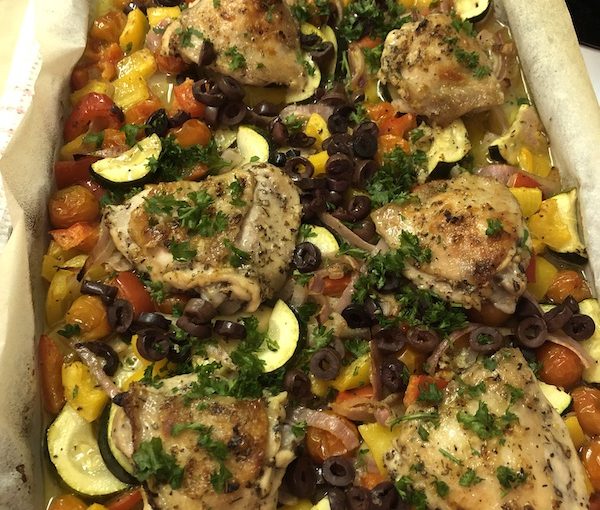
Greek sheet pan chicken, using a recipe from the website Downshiftology. (photo by Shelley Civkin)

I know it’s pretty laughable that I only discovered parchment paper a few years ago, but there’s always someone late to the party. Parchment paper is your friend, and it’s so ridiculously versatile and handy, I can’t believe I baked without it for all these years! (Although, having been single until I was 53, I must admit to not having baked much in those years.) I even turned my husband Harvey onto it. Now he uses parchment paper for everything. I caught him the other day trying to make a fruit salad on parchment paper. We buy the stuff by the truckload now. It saves on clean up, eliminates the possibility of burned pans, and withstands high heat. Plus, it contains some sort of magic that results in perfect meals every time. Seriously, I haven’t had a fail since I became a parchment paper convert. I know. Crazy, right?

My latest foray into culinary exploration using parchment paper was Greek sheet pan chicken. Harvey tried the recipe first, and it scored a 10/10. Weeks later, he asked me if I wanted to make it and, quite frankly, I couldn’t say no. After all, he’s been making me pancakes for breakfast three times a week, so I was hardly in a position to negotiate. I was just worried that I wouldn’t be able to replicate it. But I sucked it up, donned my Disclosure Diner apron and got on with it. Without a word of a lie, this recipe produces the most juicy, harmonious flavours I’ve had in eons. And there was virtually no clean up – winner, winner chicken dinner.

The recipe is from the website Downshiftology, and it’s by Lisa Bryan. Thank you, Lisa. It’s a wee bit labour-intensive, with all the chopping, mincing, dicing and marinating, but what isn’t time-consuming these days? Caveat: the original recipe calls for feta cheese, but since I don’t mix meat and milk, I omit that. Believe me when I tell you that there’s plenty of salt in this recipe already. Feta compli! Just cook up a side of rice, orzo, quinoa or bowtie pasta and you’re set. Oh, and maybe whip up a salad if you’re feeling inspired.

Now, I know that lots of people prefer the leaner white chicken meat, but thighs are just more tender and moist. You can be the judge, but I can’t be responsible for the cooking time for chicken breasts, so you’re on your own there.

Give this recipe a go, and tell me if this isn’t Mediterranean cooking at its best. I generally have a rule to not use recipes that call for more than five or six ingredients, but I made an exception here, and it paid off in spades.

GREEK SHEET PAN CHICKEN

1/2 cup olive oil
juice of 1 1/2 lemons (about 3 tbsp)
4 garlic cloves, minced
2 tsp dried oregano
1 tsp dried thyme
1 tsp Dijon mustard
1 tsp kosher salt
1/2 tsp ground black pepper
6 chicken thighs, bone-in, skin-on
1 medium zucchini, halved lengthwise and sliced
1 yellow bell pepper, chopped into 1-inch pieces
1 red bell pepper, chopped into 1-inch pieces
1/2 large red onion, thinly sliced
1 pint cherry or grape tomatoes
1/2 cup kalamata olives, pitted (more, if you love olives)
1/4 cup feta cheese (optional)
2 tbsp finely chopped fresh parsley

  1. Preheat oven to 425°F. In a small bowl, whisk together the oil, lemon juice, garlic, oregano, thyme, Dijon mustard, salt and pepper.
  2. Put chicken thighs in a bowl (or plastic bag) and pour two-thirds of the marinade on top. Then toss the chicken around in the marinade to make sure it’s well coated. Marinate the chicken for 15 minutes or more.
  3. While the chicken is marinating, put a piece of parchment paper on a baking sheet. Spread the zucchini, bell peppers, red onion and tomatoes onto the sheet and drizzle the remaining marinade on top. Toss together to coat the vegetables.
  4. Add the chicken thighs to the baking sheet and nestle the veggies around them. Bake for 30 minutes.
  5. Remove the baking sheet from the oven, add the olives (and feta, if you’re using it) and then put it back in the oven for another 10 to 15 minutes, or until the vegetables are soft and the chicken is cooked through. You can always turn on the broiler for a minute or two at the end if you like the skin crispy.
  6. Sprinkle the chicken and vegetables with finely chopped fresh parsley before serving.

Not only does this dish look gorgeous, but it’s got deep, rich flavour and the recipe is pretty easy to follow. Of course, if you’re serving it to company, it’ll take a bit of manoeuvring to transfer it to a platter because there are so many moving parts. But it’s a pandemic, so who’s having company over for dinner anyway?

Sometimes, I think to myself: do I really want to bother with all this dicing and chopping and slicing? Operative word: sometimes. This is a treat-yourself-to-a-sumptuous-dinner-and-stop-being-so-lazy kind of meal. Like my dad used to say: you’re the most important guest in your own home. Go nuts. Cook for looks. And taste. Like so many different meals, this one is just as good if not better the next day, since the flavours seem to marry overnight.

As for a pre-dinner treat, why not aim for easy but yummy. If you want to bump up the fanciness quotient a notch, make some toast points (crusts cut off), smear on some mayonnaise or egg mix, and top with caviar. I buy the inexpensive black lumpfish caviar for special occasions and it’s delish. It’ll impress the heck out of your partner, your guests, even yourself. And, you know what? You deserve it! Why should caviar be reserved just for New Year’s Eve or engagement parties? Those poor misunderstood fish roe – they deserve to be showcased all year round. If I weren’t afraid of all the judging that might accompany it, I’d eat caviar every day.

Another caveat: don’t eat this meal before you go for a blood test, because your sodium will be off the charts.

Shelley Civkin, aka the Accidental Balabusta, is a happily retired librarian and communications officer. For 17 years, she wrote a weekly book review column for the Richmond Review. She’s currently a freelance writer and volunteer.
Format ImagePosted on February 25, 2022February 23, 2022Author Shelley CivkinCategories LifeTags Accidental Balabusta, chicken, cooking, Downshiftology, parchment paper
Comfort food for dark times

Comfort food for dark times

If the thought of cooking one more boring meal is just too daunting, Google your heart out – there are gazillions of cookbooks out there.

The days are short and dark and all I seem to want to do right now is stuff my face with comfort food. Some days that manifests as peanut butter and banana sandwiches, and some days it looks like pot roast and mashed potatoes. I rarely crave a salad or a stick of celery in this chilly, wet weather. Mind you, I have been tempted (and given into) a huge piece of pumpkin pie. That’s a daily serving of vegetables, right? I’m all about the carbs at the moment. Plus, peanut butter makes my coat nice and shiny. Or so says hubby Harvey.

Like a bear, I’m looking to bulk up for my winter hibernation. Although, when you think about it, we’ve been living through almost a two-year hibernation. It’s called COVID-19. I don’t know anyone who hasn’t found some comfort in over-indulging during this pandemic. Whether the target of our ill-placed attention is food, booze or online shopping, we’ve all been guilty of overdoing it in some way or other. Oh, I forgot to include Netflix, Prime Video and Crave. I do crave my Crave. I don’t know how many hours of my life I’ve given over to this pap. Not that I’m bragging. Actually, I’m kind of embarrassed by it, but, in a way, it’s keeping me sane because it lets me focus on something other than COVID. But enough about the C-word.

My guilty pleasure is doughy, savoury foods, packed with calories. That’s where the Perogy Toss comes in. I got this recipe decades ago from the catering company at Richmond City Hall’s cafeteria, where I often ate lunch during my working days. The recipe is still a winner. Add a salad and you’ve got dinner. Add a glass or two of wine and you’ve got a date.

PEROGY TOSS

1-kg package frozen potato perogies
4 tbsp sundried tomato oil (or olive oil)
3/4 cup minced onion
1 tbsp minced garlic
2 tbsp minced black olives
12 tbsp (3/4 cup) minced and drained sundried tomatoes
4 tbsp minced capers
1 1/2-oz (14-gram) package fresh basil, chopped
light sour cream

Boil salted water in a large pot. Add frozen perogies and boil for four to five minutes (or whatever the directions say). Drain well. Rinse with hot water and drain again. Return perogies to the pot.

In a frying pan, heat the sundried tomato oil (or olive oil) until hot. Add onion and garlic and sauté until onion is soft and golden. Add olives, sundried tomatoes and capers. Stir.

When heated through, add to the cooked perogies in the pot. Heat on low for about one minute, tossing to fully coat the perogies. Add the basil and serve at once. Put sour cream on top, if desired – and who wouldn’t desire that?

Just in case this recipe doesn’t give you your year’s allotment of salt, here’s another one that will not only satisfy your craving for savoury, but holds its own as an appetizer served with pita or crackers. Some of you might be put off by the weird orange shade of this dip, but I’m sure you’ll get past that. If you’re a lazy cook like me, you’ll be happy to know that the only kitchen appliance you’ll need is a food processor.

RED PEPPER & FETA DIP

3 red bell peppers
6 oz feta cheese
2 tbsp olive oil
2 tbsp pine nuts

Cut in half and seed three red bell peppers. Place on a broiling pan, skin side up, and broil until skin is charred and blistered, turning over several times. This is what creates that smoky flavour.

Remove the skin from the peppers – some say sealing them in a brown paper bag while they’re cooling for five to 10 minutes creates steam and makes them easier to peel.

Once peeled, put the peppers in a food processor and add the feta cheese, olive oil and pine nuts. Blend till it’s nice and smooth.

Chill before serving. (I mean the dip, but you could also chill yourself with a glass or two of your favourite alcoholic beverage and a bag of chips.)

Serve with pita wedges or crackers. And don’t even think of substituting a different kind of nut. It’s just wrong. It’s got to be pine nuts.

I’ve made this dip for company loads of times and everyone likes it. It’s one of those go-to, quick-as-can-be appies that’s pretty much foolproof. Of course, your guests have to have a taste for feta cheese and pine nuts, but don’t most of us? (Maybe have an EpiPen ready just in case.) It’s definitely got a bit of an unusual flavour, but in a good way. It’s worth a try, if only to expand your repertoire … says the woman who ate the same California roll and agedashi tofu three or four times a week when she was single. However, I’ve since seen the error of my ways.

As you can tell, I’m all about the easy. And, if it tastes good too, score a win. I’ve never been one to fuss about food because it all gets eaten in a matter of minutes anyway, so why bother? I know, I know. What kind of an attitude is that for an accidental balabusta? But, like Popeye said, “I yam what I yam.”

As time wears on with this pandemic, I’m going to need to get more creative with my culinary adventures. I’ve fallen into the chicken, fish, meat, repeat, habit, and it’s getting old. I sure miss going out to restaurants on a regular basis. With the majority of us Canadians being doubly vaccinated, I think we’re moving in the right direction with this pandemic and, hopefully, it won’t be long before we embark on our “new normal.” G-d-willing, it will be an even better, more beautiful “normal.”

In the meantime, if the thought of cooking one more boring meal is just too daunting, get out your mother’s 1970s National Council of Jewish Women cookbook, Google your heart out or visit a bookstore near you, and tackle some new recipes. You might just discover your new favourites. Or maybe try a recipe swap with your close friends. You never know what tricks they might have up their sleeves. Caveat: choose friends whose culinary realm most resembles yours; otherwise, you may find yourself spending hours in the kitchen making some exotic breakfast, when all you really wanted was a new recipe for French toast.

Wishing you well in your hibernation. Don’t forget to turn the heat down, suspend newspaper delivery and stock up on toilet paper. I know, I know – newspaper? (Present company excepted, of course, and the JI is taking the month off, as well.)

Shelley Civkin aka the Accidental Balabusta is a happily retired librarian and communications officer. For 17 years, she wrote a weekly book review column for the Richmond Review. She’s currently a freelance writer and volunteer.
Format ImagePosted on December 17, 2021December 16, 2021Author Shelley CivkinCategories LifeTags Accidental Balabusta, comfort food, cookbooks, cooking, COVID, entertaining, pandemic
Beautiful Persian cookbook

Beautiful Persian cookbook

While my Barbari bread (above) looked nothing like the photo from the book (below), as my dough was too wet to allow for the requisite creation of vertical ridges, it tasted really good nonetheless. (photo by Cynthia Ramsay)

I was very excited to try out Persian Delicacies: Jewish Foods for Special Occasions by Angela Cohan. Living on the North Shore, I have met several people whose heritage is Iranian, though not Jewish, and I’ve eaten Persian food, but never made it. The idea that I could make my own “delicacies” was enticing.

Cohan is a Los Angeles-based writer and editor, so it’s no wonder that her cookbook reads well and looks fabulous. The layout is pretty and logical. The colour photos are beautiful. This is a great gift for a seasoned cook, or a cook that’s willing to have a few misadventures and so-so meals before they get the hang of things.

photo - Barbara bread as it’s supposed to look
Barbara bread as it’s supposed to look. (photo from Persian Delicacies)

In the preface, Cohan, who moved to the United States with her family in 1979, writes, “I was inspired to compile the specialty recipes of my mother, my late grandmothers, and other family members and friends in this cookbook. This book is as much theirs as it is mine. It is a tribute to my heritage as a Persian woman as well as an evolution of recipes since living and cooking in the United States for the past three decades.”

I remember watching my grandmother cooking. She seemed to randomly toss in this, shake in that. It appeared to the uneducated eye that measurements were not measured at all. I get the feeling that this is somewhat the case with this cookbook. Guesstimates in many cases rather than meticulously precise cups, teaspoons, etc. And the assumption that one knows how long to knead dough, for example.

image - Persian Delicacies book coverThe recipes I tried – dolmeh (stuffed peppers), Barbari bread and sesame brittle – seemed easy enough. I chose them because I was on a deadline and had all the ingredients at hand. I will continue to explore this cookbook, as my first foray was promising but not that successful, in part because, instead of adapting the measures, I decided to follow the instructions come what may. So, even though I knew that my pepper stuffing was too bland, my dough was too sticky and my brittle too bendy, I made them as per the recipes. Everything was edible but nothing was delicious. Next time, I will use, respectively, another pinch of salt or another clove of garlic, more flour (or less water) and less honey. I can’t wait to try my hand at making kuku seeb zamini(potato frittata), tahdig (crispy rice), turmeric chicken, lavash bread and more.

Each recipe in Persian Delicacies comes with a brief description, either of what it is, from where or whom it came, and other useful tidbits. At the end of the book, there is some information on special occasions, with the examples of Norouz, the start of the Persian New Year, and Shabbat, and traditions associated with them, in particular as they relate to foods. A glossary of many of the ingredients and their health benefits is an interesting component.

DOLMEH
(serves 3)

3 or 4 bell peppers
1/4 cup olive oil
1 cup diced yellow onion
1/2 cup scallions, chopped
2 cloves garlic, peeled and finely chopped or minced
1 cup quinoa, cooked
1/2 cup fresh dill, finely chopped
1/2 cup fresh tarragon or parsley, finely chopped
1 tsp ground cinnamon (optional)
salt and pepper to taste

  1. Preheat the oven to 350°F.
  2. Cut the top of the bell peppers and remove the seeds and veins.
  3. Heat the oil in a skillet or a saucepan. Add the onions, scallions, and garlic and cook until soft, about four minutes.
  4. Add the quinoa, dill and tarragon and season with salt and pepper. Remove from heat.
  5. Spoon the quinoa mixture into the peppers. Place the stuffed peppers on a baking tray or baking dish and bake for 45 minutes. Add salt and pepper to taste. Top with chopped parsley and cinnamon (optional).

BARBARI BREAD
(serves 4)

1 1/2 cups warm water
1/2 tsp active dry yeast
3 cups all-purpose flour plus 1 tbsp additional flour
1 tsp salt
3 tbsp water
1/4 cup sesame seeds

  1. Add the yeast to the warm water, stir, and set aside.
  2. In a large bowl, combine the flour and salt. Add the yeast mixture. Knead the dough on a flat surface.
  3. Place the dough in a bowl and cover with plastic wrap. Let it rise for an hour.
  4. Preheat the oven to 325°F.
  5. In a small saucepan, stir one tablespoon flour and three tablespoons water over a medium-low heat.
  6. Uncover the risen dough, cut into four pieces, and roll out in an oval shape using a rolling pin.
  7. Place the dough on a cookie sheet. Using your finger or a small knife, create vertical ridges on the dough. Brush with the flour and water mixture. Sprinkle with sesame seeds.
  8. Bake for 25 to 30 minutes.
Format ImagePosted on November 19, 2021November 18, 2021Author Cynthia RamsayCategories BooksTags Angela Cohan, cooking, culture, Iran, Persian Delicacies, recipes

Posts pagination

Previous page Page 1 … Page 3 Page 4 Page 5 … Page 9 Next page
Proudly powered by WordPress