Skip to content
  • Home
  • Subscribe / donate
  • Events calendar
  • News
    • Local
    • National
    • Israel
    • World
    • עניין בחדשות
      A roundup of news in Canada and further afield, in Hebrew.
  • Opinion
    • From the JI
    • Op-Ed
  • Arts & Culture
    • Performing Arts
    • Music
    • Books
    • Visual Arts
    • TV & Film
  • Life
    • Celebrating the Holidays
    • Travel
    • The Daily Snooze
      Cartoons by Jacob Samuel
    • Mystery Photo
      Help the JI and JMABC fill in the gaps in our archives.
  • Community Links
    • Organizations, Etc.
    • Other News Sources & Blogs
    • Business Directory
  • FAQ
  • JI Chai Celebration
  • JI@88! video

Recent Posts

  • Sharing her testimony
  • Fall fight takes leap forward
  • The balancing of rights
  • Multiple Tony n’ Tina roles
  • Stories of trauma, resilience
  • Celebrate our culture
  • A responsibility to help
  • What wellness means at JCC
  • Together in mourning
  • Downhill after Trump?
  • Birth control even easier now
  • Eco-Sisters mentorship
  • Unexpected discoveries
  • Study’s results hopeful
  • Bad behaviour affects us all
  • Thankful for the police
  • UBC needs a wake-up call
  • Recalling a shining star
  • Sleep well …
  • BGU fosters startup culture
  • Photography and glass
  • Is it the end of an era?
  • Taking life a step at a time
  • Nakba exhibit biased
  • Film festival starts next week
  • Musical with heart and soul
  • Rabbi marks 13 years
  • Keeper of VTT’s history
  • Gala fêtes Infeld’s 20th
  • Building JWest together
  • Challah Mom comes to Vancouver
  • What to do about media bias
  • Education offers hope
  • Remembrance – a moral act
  • What makes us human
  • המלחמות של נתניהו וטראמפ

Archives

Follow @JewishIndie
image - The CJN - Visit Us Banner - 300x600 - 101625

Call for human “books” – share your lived experience with community members

Call for human “books” – share your lived experience with community members

(image from dirtdaubber.wordpress.com)

Do you defy a stereotype? Have you faced prejudice or stigma in your life? Do you have unique life experience, or a story to tell? Apply now to be a human book for the Isaac Waldman Jewish Public Library’s Human Library event on Sunday, April 7, and share your lived experience with others. 

The Human Library originates in Denmark and has spread across the globe. The program is based on the idea of “unjudging” others, and seeks to challenge our preconceived notions of people through conversation.  

The local Sunday event will run from noon to 4 p.m. Community members will come in and ask to take out certain “books,” meaning they’ll have the opportunity to have a conversation with certain volunteers. To give an example, the library currently has three volunteer books and their titles are “Child Holocaust Survivor,” “Brain Cancer Survivor” and “Police Officer,” which indicates the facet of their lived experience/identity that they are willing to talk about. Each volunteer can expect to have four to seven sessions with “borrowers,” either one-on-one or in small groups. There will be a lot of breaks and snacks, and volunteer books are empowered to decline talking about anything that makes them uncomfortable. There will be a training session prior to the event to help everyone prepare.

A Human Library is a way for people to reach out and connect with individuals in their community with whom they might not normally engage. Human Libraries promote tolerance, celebrate differences and encourage understanding of people who come from varied cultural or lifestyle backgrounds. 

Apply to be a human book at bit.ly/WaldmanHumanLibrary2024 within a few days of March 8. Email any questions to [email protected]. 

– Courtesy Waldman Library

Format ImagePosted on March 8, 2024March 7, 2024Author Waldman LibraryCategories LocalTags Human Library, stereotypes, volunteerism, Waldman Library
Taking on care homes – Stolen Time screens in March 21

Taking on care homes – Stolen Time screens in March 21

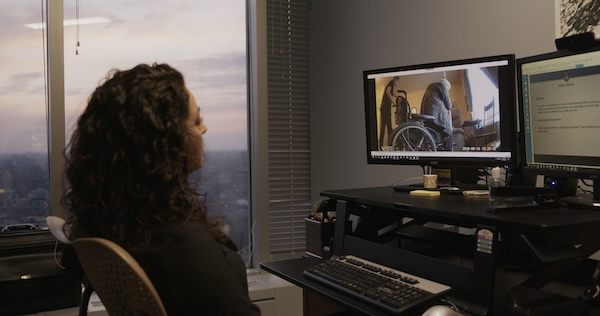
A still from the film Stolen Time: lawyer Melissa Miller reviews footage from a long-term-care room camera. (photo from National Film Board of Canada)

“I’m only at the beginning of this fight,” says lawyer Melissa Miller in the documentary Stolen Time, written and directed by Jewish community member Helene Klodawsky. Miller, of Toronto firm Howie, Sacks & Henry LLP, is lead counsel in mass tort claims against for-profit long-term-care corporations Extendicare, Revera Inc. and Sienna Senior Living.

Stolen Time will screen in Vancouver March 21 at VIFF Centre – Vancity Theatre, as part of a national release that includes Edmonton, Toronto and Montreal. The film is a joint production of Intuitive Pictures Inc. (with Jewish community member Ina Fichman at the helm) and the National Film Board of Canada (Ariel Nasr, producer).

To give readers an idea of what Miller is up against, there is a scene in the film where the private investigator she has hired, Brett Rigby, shares some financial data. According to Rigby’s documents, Extendicare had a revenue of $1.1 billion in 2019, $91 million in earnings and $42 million cash dividends declared – “and they’re locking up incontinence pads,” remarks Miller.

The film notes that “a few hundred family clients have grievances against these companies,” the most common complaints being serious dehydration, malnutrition, injuries and misdiagnoses. The homes apparently meet the requirements for staffing, but at least one person is off at any given time, so they are consistently understaffed. There seems to be no regulatory oversight, while the companies bring in record profits, the film contends.

Miller has been suing for-profit nursing home corporations in Canada and elsewhere for negligence since 2018, both in mass tort (class action) claims and independent cases against various facilities, one of which is featured in the documentary.

Video clips of residents experiencing abuse juxtaposed with family videos of the long-term-care residents when they were healthy allow viewers to see the people more fully and the depth of the injustices more clearly. Miller contends that it isn’t the staff who are to blame, generally, but rather that the staff aren’t given adequate resources by the companies, who could afford to do something but don’t. 

A complicating factor in effecting change is that, for example, Revera is owned by a Canadian Crown corporation, ie. the federal government, notes the film. As COVID ravaged nursing homes in 2020, with thousands of residents dying, “governments across North America pass[ed] legislation to protect them from lawsuits.”

“Today, nursing home chains around the world have become sites for wealth extraction by investors and shareholders,” writes Klodawsky in her director’s statement. “At its core, such financialization of care ties frail elders to overworked, racialized and predominantly female staff. When public pension fund managers, private equity and real estate companies help set the rules, compassion and dignity fall by the wayside. Nonetheless, rapidly expanding populations of the frail elderly, combined with shrinking numbers of family caregivers, ensure a steady stream of residents.”

People interviewed in Stolen Time include Dr. Pat Armstrong, a sociologist and professor at York University; Lisa Alleyne, a personal support worker who has worked in for-profit nursing homes (she is also an artist and her illustrations of what some long-term-home residents face are powerful); Rai Reece, who writes and teaches on anti-Black racism; Jackie Brown, who researches how publicly traded companies make money for investors; Jason Ward, who investigates how public pension funds are invested in for-profit nursing homes globally; Katha Fortier, who has been fighting for the rights of care workers for decades; Ayesha Jabbar, a former social worker who became a union rep; and members of a couple of the families Miller is representing.

Stolen Time is an engaging film that raises a lot of important questions about how nursing homes are run. It is unfortunate that it doesn’t include any interviews or statements from company representatives or government officials.

The post-screening panel discussion in Vancouver will feature Sara Pon, staff lawyer and researcher at Seniors First BC, and co-chair of the BC Adult Abuse and Neglect Prevention Collaborative; Bruce Devereux, a recreation therapist with three-plus decades of experience in the not-for-profit aging care sector; and Julia Henderson, assistant professor in the department of occupational science and occupational therapy at the University of British Columbia, and chair of the North American Network in Aging Studies.

More information about the March 21 event and other screenings of the documentary at VIFF Centre will be posted at viff.org. A ticket link will also be posted at events.nfb.ca/events/vancouver-theatrical-special-panel-on-march-21. 

Format ImagePosted on March 8, 2024March 7, 2024Author Cynthia RamsayCategories TV & FilmTags documentary, Helene Klodawsky, Intuitive Pictures, law, long-term care, Melissa Miller, National Film Board, NFB, VIFF
Art helps bring us together

Art helps bring us together

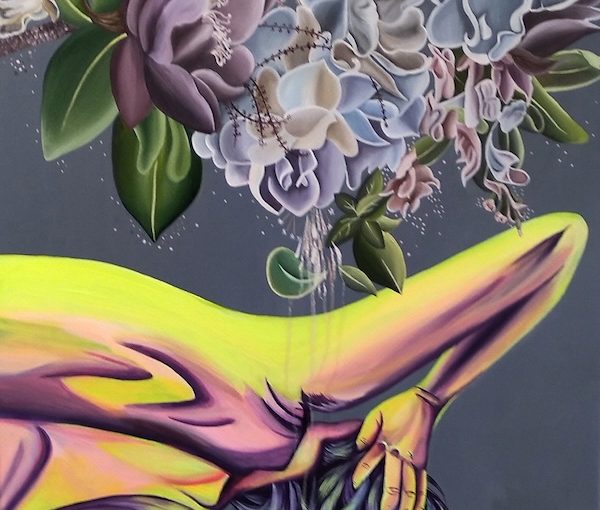
The current show at the Zack Gallery, Community Longing and Belonging, brings together a range of artists and styles. Pictured here is Alejandra Morales’s “A Landscape of Consumable Dreams.” (photo by Olga Livshin)

The current show at the Zack Gallery, Community Longing and Belonging, which opened Feb. 21, is the sixth annual exhibition in celebration of Jewish Disability Awareness and Inclusion Month. 

The exhibit was organized by the Jewish Community Centre of Greater Vancouver’s Inclusion Services and curated by Shelly Bordensky, the program’s coordinator. Most participating artists are either members of the JCC program or similar ones in other localities, like Aspire Richmond. These initiatives support people with developmental disabilities through various creative endeavours. 

The Zack show’s creative displays consist of paintings and pottery. While the size, media, colour palettes and framing of the works are all different, the underlying theme is the same: we all want to belong, we are all together on this planet.

Two paintings reflect that theme not only in their content and method of execution, but in their titles as well: “All Together 1” and “All Together 2.” Both works are cheerful and colourful, rendered with the abandon of the primitivism style. Cats and birds frolic on the canvas without regard for one another or for rules of perspective. Both list the artist as Art Hive, the visual art division of JCC Inclusion Services.

Bordensky told the Independent that both paintings were group pieces, created by several people. “Each artist added an element – a cat or a bird – and our wonderful art instructor, Kim Almond, made sure they all matched in style and colours.”  

According to Almond, 13 artists, all members of Art Hive, participated in each painting.

“Mark Li and Andrew Jackson started off the two collaborative paintings for the group, and it was a great project to work on as a class,” she said. “Colours were a huge part of the process, as the artists were always striving to create that special pop of colour.”

Another example of group art is the pottery creations – playful little animals, solemn hamsas (hands) and juicy pomegranates – crowding several stands around the gallery. 

“These ceramic pieces are all Raku ceramics by the pottery artists who are members of our Art Hive,” said Bordensky. “Together, we can create so much.”

Individual artists’ paintings are also on the theme of community.

Alex Lecce’s untitled piece is a slice of a neighbourhood street with a pie shop. The colours are realistic, and the image captures a quiet, everyday moment. We all go there, the artist seems to say. Those pies make our lives happier and more flavourful. They unite us in our humanity. 

On the other hand, Alejandra Morales’s painting, “A Landscape of Consumable Dreams,” is jarring in both the colour palette and the structure. This painting screams of discord. There are two disparate parts in the image. The top part is a tangled bunch of flowers, all in beautiful, greyish lilac hues, intertwined and elaborate. The bottom part is a vague human figure bowing to the pretty flowers. The colours of the figure are harsh, grating; they don’t fit with the flowers. But the figure obviously wants to fit, just as we all want to fit in with our surroundings. The complexity of the juxtaposition of humans versus nature is unmistakable.

Other paintings are not as complicated. Mami Zimmerman’s “Best Friends” features two ponies. Its simplicity is charming and lovely. We all want such friends. 

image - Mami Zimmerman’s “Best Friends”
Mami Zimmerman’s “Best Friends” (photo by Olga Livshin)

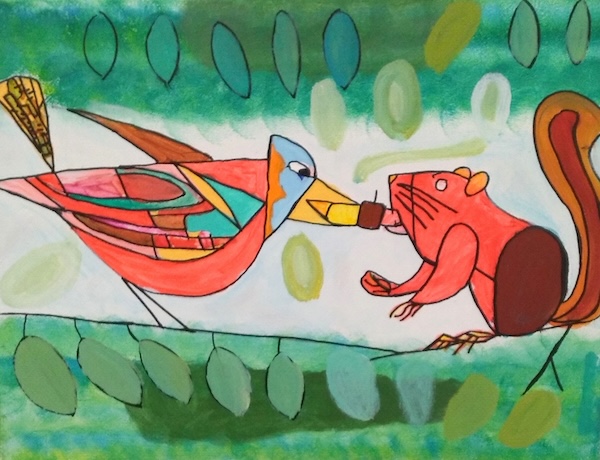
Calvin Ho’s painting “Nuts” is another example of primitivism in the show. The bright depiction of a squirrel and a woodpecker is reminiscent of picture books from our childhood. Bold lines and primary colours underscore that feeling. The two creatures are playing tug with a nut. Or maybe they are sharing it. Or fighting over it. The innocence of the picture invariably induces a smile.

image - Calvin Ho’s “Nuts”
Calvin Ho’s “Nuts” (photo by Olga Livshin)

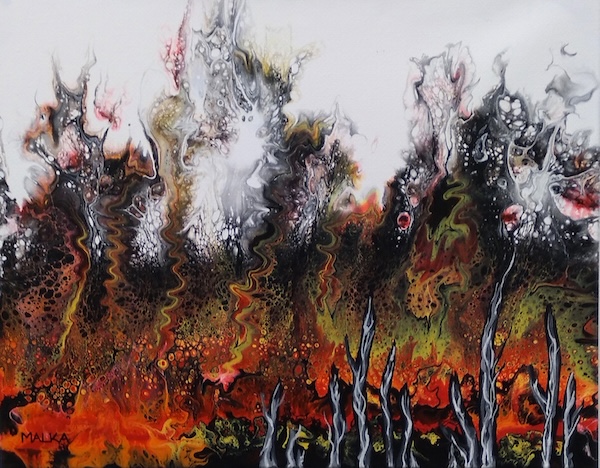
In contrast, Merle Linde’s powerful landscape – “BC Wildfire 2023” – doesn’t invite smiles. The painting, its red and black scheme grim and scary, reminds us of the horror of the wildfires that affect our forests every year. The tragedy implied in the painting unites us, just as the sweeter emotions in other images do. 

In a telephone interview with the Independent, Linde said: “I’ve always enjoyed art, from the day I could hold a pencil. I liked going to art shows, too.” Mostly self-taught as an artist, she said she only started painting seriously after she retired. 

Judaica is one of the directions she explores in her art. To date, the Independent has used two of her paintings for its cover: for the 2023 Passover issue and for the 2022 Rosh Hashanah issue. Occasionally, she teaches classes for seniors in various artistic techniques.

Merle Linde’s “BC Wildfire 2023” (photo by Olga Livshin)

“Acrylic pour is a fascinating technique,” she said. “You pour the paint and let it spread as it will without a brush, and then wait till it dries. That was what I did for the background of the ‘Wildfire’ painting. I made it a few years ago. When I saw the news about the wildfires last summer, I picked up a brush and painted the black burned-out tree skeletons on top. I have two such paintings, but there was only space for one in the Zack show.”  

Most of the paintings in the show express themselves at first view. However, Gail Rudin’s “Out for the Hunt” raises questions. It portrays four seemingly perky owls on a merry, greenish background. One could assume a light-hearted company of friends on an outing, until one notices a line of tiny mice scurrying away in terror in the very bottom of the picture. Suddenly, the entire image changes its meaning, illustrating the unavoidable conflicts within nature, where the hunters and the hunted coexist. Despite the constant danger of the wild, nature somehow always finds its balance. Maybe, as humans, we could take lessons from that.     

Community Longing and Belonging is on display at the Zack Gallery until April 2. 

Olga Livshin is a Vancouver freelance writer. She can be reached at [email protected].

Format ImagePosted on March 8, 2024March 7, 2024Author Olga LivshinCategories Visual ArtsTags Community Longing and Belonging, inclusion services, JCC, Jewish Community Centre of Greater Vancouver, Merle Linde, painting, sculpture, Shelly Bordensky, Zack Gallery
History, family & love – Vancouver Jewish Film festival starts April 14

History, family & love – Vancouver Jewish Film festival starts April 14

 A Radiant Girl (still from film)

As the Vancouver Jewish Film Festival approaches, the Jewish Independent reviews three more of the festival’s offerings: A Radiant Girl, All About the Levkovitches and One More Story.

Linking past to present?

In A Radiant Girl, 19-year-old Irene (Rebecca Marder) is an actress whose incessant theatrics get on her family’s nerves but the enthusiasm for performing that she and her diverse group of drama student friends exhibit provides a convenient distraction to the events going on around her in 1942 Paris.

A succession of Nazi policies add up, one after another, from the “Juive” stamped in red on her identity papers to the expropriation of Jewish people’s bicycles, radios and telephones, but Irene and her friends continue their thespian activities, mostly oblivious to larger events. The viewer, of course, knows that more ominous things await but the ending is both dramatic and subtly understated.

Costuming and hairstyles in the film do not always clearly situate the timeframe of events, especially early on, and a viewer beginning the film without any background might not be certain if it is set in contemporary times or another era. As the movie progresses, automobiles and more clearly discernible 1940s clothing styles make the era more specific. But is the filmmaker sending a message about the timelessness of vigilance against the slow drip of authoritarian actions that can lead to totalitarianism and catastrophe?

Shadow boxing

image - All About the Levkovitches (still from film)
All About the Levkovitches (still from film)

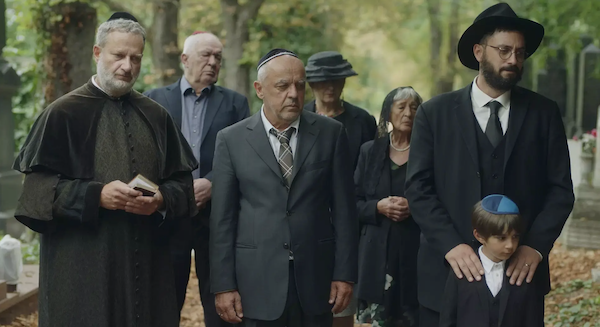
A family drama is at the heart of All About the Levkovitches, in which Tamás, an aging boxing coach in Hungary (Bezerédi Zoltán) is forced to confront his estranged son Iván (Tamás Szabó Kimmel) who, recently religious, returns from Israel for his mother’s shiva, hauling along his young son.

The decidedly unobservant father/widower has no interest in following traditional Jewish mourning rituals. “What’s a minyan?” asks one of his friends as he explains what is happening at home. “A bunch of Jews in my house,” he replies. (“When my mother died, we just drank,” the friend says.) The arrival of the local Jews to pray with the grieving son while the father goes about his business in an undershirt is a priceless vignette of worldviews colliding.

The father, who doesn’t know any Hebrew, and his grandson, who may or may not understand Hungarian, eventually find a common language. So, too, do the estranged father and son, through much fighting, boxing, arguing and wrestling demons. 

The grandfather’s disastrous attempt to assemble a Scandinavian do-it-yourself wall unit as his own ritual tribute to his late wife is a metaphor for his fumbling way of dealing with crisis, a project that is (somewhat predictably) resolved when the handy ba’al teshuvah son finally relents to helping, resolving not just the bookshelf problem but the larger issue of how things fit together.

It is a darkly hilarious and often emotionally moving drama.

Live, laugh, love

image - One More Story (still from film)
One More Story (still from film)

In One More Story, Yarden (played by Dina Sanderson) is a 20-something journalist at Israel’s largest-circulation newspaper and needs an attention-grabbing human interest series. She goes to that old standby, modern dating, and sets up doofus Adam on a series of disastrous dates, aiming for the print media version of the reality TV dating genre.

She recounts the foibles of Adam’s love life – with flashbacks to cringe-inducing interactions between the hapless Adam and a stream of mismatched potential romantic interests – while herself on a first date (with the film’s director Guri Alfi, playing the bad first date foil for Yarden’s storytelling).

The bad dates within a bad date motif provides a canvas for a variety show-style packed script of hilariously calamitous meetups. But Adam goes off script when love at first sight hits him out of the blue – literally – which does not coincide with Yarden’s journalistic requirements.

There is nothing particularly innovative in the romantic comedy department, but the witty writing and vivacious acting, plus a veritable bombardment of sight gags and more subtle facial expressions, make the film a laugh riot and a delight. 

Watch vjff.org for the full lineup and tickets for the Vancouver Jewish Film Festival, which runs April 4-14 in theatre and April 15-19 online.

Format ImagePosted on March 8, 2024March 7, 2024Author Pat JohnsonCategories TV & FilmTags movies, Vancouver Jewish Film Festival, VJFF

A creator of unique places

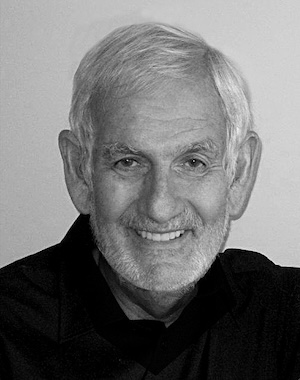
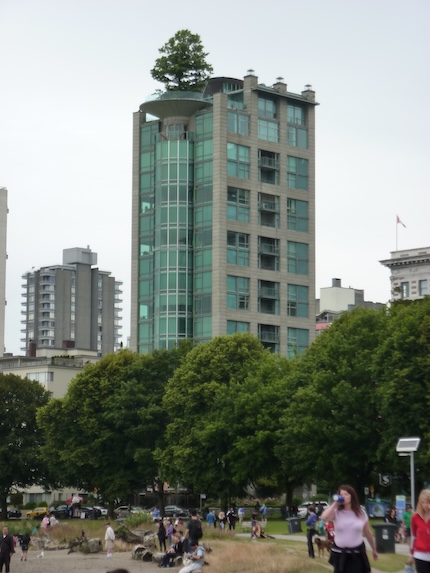
You may not know his name, but you certainly know his work. Vancouver Jewish architect Richard Henriquez has designed iconic local buildings including Eugenia Place in English Bay (the one with the pin oak on its penthouse terrace), the Sylvia Tower, the Sinclair Centre and the BC Cancer Research Centre. He designed New Westminster’s Justice Institute of BC, the UBC Michael Smith Laboratory, the UBC Recreation Centre and the Presidio. And that’s just scratching the surface of his 53 years of work in Vancouver, and well beyond. 

photo - Richard Henriquez
Richard Henriquez (photo from Richard Henriquez)

Henriquez, 83, was born in Jamaica in 1941. That same year, his father, Alfred George Henriques, aware of the danger facing the Jews of Europe, joined the Royal Air Force as a bomber pilot. He did not survive the war.

One of Richard Henriquez’s earliest childhood memories is of a powerful hurricane that brought wind speeds of 150 miles per hour, devastating Jamaica’s north coast. At the time, the 3-year-old Henriquez was living on the north coast with his mother, grandmother and sister. “I still remember the sound of the metal roofing being torn off the roof, the screaming of the wind and the crashing of crockery being blown off the kitchen shelves,” he told the Independent. “The next morning, there were fish all over the yard and trees flattened everywhere.”

With their family home ruined, Henriquez and his sister joined their grandparents on a citrus plantation in Greenwood, Jamaica. Later, they moved to Buff Bay, to a new home with their mother and stepfather. Henriquez attended boarding school and Hebrew school in Jamaica. “Over the High Holy Days, I’d go to synagogue but I was never very religious,” he said.

By age 10, Henriquez had already decided on a career in architecture, a choice influenced by his grand-uncle Dossie, an architect, engineer and artist who would take him along on building visits. Rudolph “Dossie” Henriques, whose firm was Henriques and Sons, had designed the Kingston synagogue in 1912, after the original was destroyed by a 1907 earthquake. He also won a competition to design and build Jamaica’s Ward Theatre in 1912, and worked on the structural drawings for New York City’s Grand Central Terminal. 

In 1958, after graduating from high school, Richard Henriquez left Jamaica to study architecture at the University of Manitoba. He returned to Jamaica after graduation and spent a couple of years working there before returning to North America to do a master’s degree at the Massachusetts Institute of Technology in 1967. He then settled in Vancouver.

“My wife, Carol, is from Saskatoon, and she didn’t love Jamaica. She preferred to come back to Canada,” said Henriquez, whose time in Jamaica had a lifelong influence on his architectural style.

“In Jamaica, materials are expensive and labour is cheap, so I tend to want to renovate rather than tear down a house,” he explained. “I think that’s much more interesting than creating a new building. Later on in my career, I designed a couple of buildings that look like they were built a long time ago and renovated, like the Sylvia Tower in the West End.” 

His talent as an architect has won Henriquez many accolades. In 1994, he won a Governor General’s Medal. In 2005, he won the Royal Architectural Institute of Canada’s gold medal. And, in 2017, he received an Order of Canada for his contribution to Canadian architecture.

“To me, architecture is about creating a unique place in the world,” he reflected. “Unlike West Coast modernists, who were inspired by light and connection to the outdoors, I was more interested in the specificity of a site, in researching the history of a site and incorporating it into the concept for a building.” 

photo - Richard Henriquez’s Eugenia Place, in English Bay, is topped with a 35-foot pin oak, brought to Vancouver from Oregon, representing a first-growth forest that covered the area decades ago
Richard Henriquez’s Eugenia Place, in English Bay, is topped with a 35-foot pin oak, brought to Vancouver from Oregon, representing a first-growth forest that covered the area decades ago. (photo by Andrew Bowden / flickr)

The Eugenia is a perfect example of Henriquez’s respect for the specific history and culture of a community. That 35-foot pin oak, brought to Vancouver from Oregon, represents a first-growth forest that covered the area decades ago. By incorporating it into the building, he paid homage to the landscape.

Henriquez’s son Gregory has followed in his footsteps and works alongside him at Henriquez Partners Architects in Vancouver, where Gregory Henriquez is overseeing the Oakridge Park complex in Vancouver, valued at over $5 billion. Richard Henriquez’s grandson is completing a master’s degree at the University of Toronto and will soon be joining the firm as the newest architect in the family.

Among his varied works, Henriquez designed Vancouver’s Temple Sholom Synagogue and, at one time, he had hoped to build something in Jerusalem, a goal that now seems remote.

These days, there are many projects competing for his time. A man keenly interested in genealogy, he traced his family history back more than 12 generations to Portugal, learning that his eighth-great-grandmother, Anna Rodriguez, was burned at the stake in 1643. He’s working on his second book on that family history, while also devoting time to art and sculpture, lifelong passions. Some of his work was on display at the Monica Reyes Gallery in Vancouver last month.

To learn more about Henriquez’s work, watch the 30-minute documentary Richard Henriquez: Building Stories on Shelter, an architecture streaming service. Commissioned by Marcon Developments, it celebrates his 53rd year of work in Vancouver and beyond. Also interesting to peruse is henriquezpartners.com/work. 

Lauren Kramer, an award-winning writer and editor, lives in Richmond.

Posted on March 8, 2024March 7, 2024Author Lauren KramerCategories LocalTags architecture, Eugenia Place, Jamaica, Richard Henriquez
Exploring Jamaica’s Jewish history

Exploring Jamaica’s Jewish history

Congregation Sha’are Shalom in Kingston, Jamaica. (photo from Jamaica Tourist Board)

It was a muggy Friday afternoon just hours after my family and I had touched down in Jamaica for a two-week vacation, and the plan was to attend evening services at Kingston’s only synagogue, Congregation Sha’are Shalom. Too tired to argue, my kids and spouse changed clothes, we squashed six into the rental car and ventured into the city.

Though we knew the stately synagogue on Kingston’s Duke Street had been there since 1912, it still felt surprising to go inside and find eight members of the tribe leading a Shabbat service. The two-level synagogue is a magnificent piece of architecture, with a majestic, mahogany aron hakodesh filled with Torah scrolls from other Jamaican synagogues that closed or merged over the years. The ground floor is composed of sand, making this one of just five sand-floored synagogues worldwide. One story says the sand hearkens back to when Jews were worshipping in basements in Spain and Portugal, during the Inquisition, and sandy floors silenced their footsteps. Another legend says the sand is there as a reminder that we should multiply like sand on the seashore. 

Sha’are Shalom has space for at least 300 congregants, but when we arrived, there were just the eight locals and the six of us. The deep, sonorous baritone of one member, who led the service from the mahogany bimah, filled the air with a spiritual melody and, above us, ceiling fans whirred, adding a reprieve to the humid evening. From the bimah, Stephen Henriques, the spiritual leader, spoke of the dispersal of Kingston’s Jewish community over the past four decades, adding that many of today’s members are interfaith. “Still, we are here, celebrating and living our Jewishness, as we have done for centuries,” he said.

We were warmly welcomed to the service, and happily joined in a kiddush of grape juice, challah and sweet Jamaican coco bread. I tried to imagine a time when the synagogue was brimming with Jews, its walls resonating with children’s laughter, congregants’ prayers and Jewish possibilities. There were times like this, but they happened many, many years ago.

Jamaica was occupied by the Spanish from 1494 until 1655. During that time, Jews from Spain and Portugal began trickling onto the island. With the Spanish Inquisition underway, those Jews became Marranos, practising their faith in secret. In 1655, when the British occupied Jamaica, Jews were able to practise their faith without secrecy, but they weren’t completely free from discrimination. Between 1690 and 1740, a “Jew Tax” was levied and only in 1831, the year of the largest slave rebellion in the country, were Jews allowed to vote and participate fully in public life. 

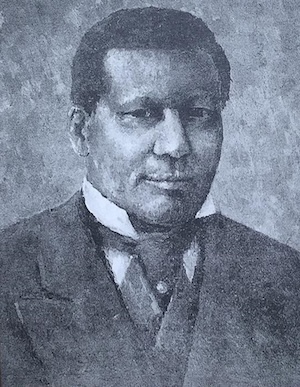
photo - Jewish businessman George Stiebel (1821-1896) was Jamaica’s first Black millionaire, in 1881
Jewish businessman George Stiebel (1821-1896) was Jamaica’s first Black millionaire, in 1881. (photo by CoCoLumps / wikimedia)

Jews had been quietly involved for years before that, but they embraced this opportunity with gusto. By 1849, eight of the members of Jamaica’s House of Assembly were Jewish. George Stiebel, a Jewish businessman who made his fortune in gold mining in Venezuela, was the country’s first Black millionaire, in 1881. He built Devon House, one of the country’s flagship mansions and a national monument today. 

We continued to nibble on coco bread in the Jewish Heritage Centre adjacent to the synagogue, wishing we had more time to peruse the walls, where there is lots of historical data on Jewish contributions to the island. It was dark by the time we left, so we didn’t have time to see the memorial garden, where tombstones dating back to the 18th century have been relocated.  

A few days into our stay, we left Kingston for Ocho Rios and Montego Bay on the north coast. When the sun shone, we explored Jamaica’s beaches, relishing the feel of the warm water on our skin. When the rain came pouring down, we drove to neighbouring parishes to explore small towns.

One such drive took us to Falmouth, a small town whose poverty and neglect is loudly revealed in its deeply potholed roads and dilapidated homes and buildings. Coming, as we did, from an all-inclusive resort just 20 minutes away, the disparity between the two environments was glaring. 

But it wasn’t always this way. The Jewish cemetery in Falmouth is filled with the graves of Jewish merchants who dominated the once-flourishing trade here in the 19th century. When I announced we were making a stop at the cemetery, there was a collective groan from the back of the car. “We went to synagogue – now we have to visit dead Jews?” my son asked. As my husband valiantly navigated through potholes the size of small swimming pools, I tried to explain how a cemetery could be a fascinating place to explore history. 

Though we were probably only a stone’s throw away from the cemetery, we never made it. After one particularly large pothole, and another ahead that threatened to drown the rental car, a decision was made. “I love you, sweetheart, but I just don’t want to get stuck out here,” my husband declared.

I couldn’t blame him.

Drive around Jamaica and safety is not a feeling that comes easily. For one, the drivers overtake with such reckless disregard for life that road accidents always feel imminent. For another, the looks you get from some locals leave your Spidey sense tingling with fear. Leave the resorts and there are few warm welcomes from the community at large it seems, with the exception of those who have something to sell. Jamaica is known for its violence, with a rate of 52.9 homicides per 100,000 people, as compared to Canada’s, at 2.5.

We turned around and headed back to the resort, where staff sweep trash off the beach daily, and food and booze are readily available day and night. Moving between the pool and the ocean, it didn’t take long to relax. As the mojitos flowed, though, my mind kept returning to those tenacious Jews who arrived in Jamaica hundreds of years ago. They came with sand in their shoes and buckets of determination to pursue their religion and build success in a new land. I wondered what they’d say if they could see Jamaica today. 

Lauren Kramer, an award-winning writer and editor, lives in Richmond. 

Format ImagePosted on March 8, 2024March 7, 2024Author Lauren KramerCategories TravelTags Congregation Sha’are Shalom, history, Jamaica, Jewish community, Judaism

Knishes and relationships

My kids came home asking about knishes. Did I know how to make them? Where do we buy them? I thought this was weird. I asked for more information. 

Their school resource teacher and International Baccalaureate coordinator, Ms. T, plays an important role in their lives. She does lunch time enrichment clubs, coaches sports, and her responsibilities include supporting kids with disabilities, and the IB program. When I say that I’m not sure how she does it all, one of my kids springs up out of his seat, showing how she crouches in front of a computer in one office, typing madly. Then he dashes across the kitchen to indicate her rush to the next office, to crouch at another desk. She is, simply, everywhere.

This is when I learned that Ms. T said knishes were not, in fact, everywhere. In Winnipeg, people buy these ethnic foods from synagogues who cater, a Jewish deli or bakery. Due to a strange confluence of events, two Winnipeg synagogues are under renovation currently and without their usual catering kitchens. Other sources for knishes apparently hadn’t worked out. As a result, one of our favourite teachers was bereft of knishes.

As a kid in Virginia, I experienced knishes in two ways: one involved a street cart vendor when visiting New York with family members. The other came from a frozen packet from a far away kosher grocery store in Maryland. I’d never made one at home. I’d never considered it. It wasn’t eaten frequently in my house. Winnipeggers eat them more often. Of course, since moving here, I have, too, but I don’t miss them when they aren’t around.

I was thinking about our relationships with knishes, teachers and community recently, when I took a class from My Jewish Learning on the Hadran prayer, taught by Rabbi Elliot Goldberg. What’s that? Funny you should ask. When a person finishes studying a tractate of Talmud, they recite this prayer. I’d never heard of it until I started studying Talmud daily. When we got to the end of the first tractate, I learned that, when one finishes this kind of thing, there is a siyyum, a celebration of one’s completion of study. I’d never heard of a siyyum as a kid at a Reform congregation. When I first attended one as an undergraduate, it seemed like something that I would never be involved in. I remember an awkward party at the Jewish Living Centre with stale cookies, juice and cheers about the gawky guy with glasses who had finished studying … I’m not sure what. In a siyyum, there’s food, there’s a public teaching of something you’ve learned, and the community cheers you on. 

With the start of the pandemic, my own siyyum events have been online, usually through My Jewish Learning. There’s no food on Zoom, so that aspect of the celebration is muted, as is the cheering and crowd. Nonetheless, I have grown to love these events. It’s an hour that I pull out of my day at random, whenever it’s held online, and even during remote school or summer break or whatever, it’s “Mom’s siyyum time.” I’m learning with rabbis online via an iPad, even while making peanut butter sandwiches for lunch or hiding from the whole household to concentrate. It’s cerebral. It’s a shared learning community. It’s oddly emotional.

The first time I heard the Hadran prayer read, I cried. I found myself wondering what was wrong with me, but this class spelled out why it feels meaningful. The Hadran is usually said after studying a seder (order) of Mishnah or a tractate of the Babylonian Talmud, but sometimes it is said at a rabbinical school graduation, a Jewish high school graduation. It’s an acknowledgement. It starts with, “We will return to you, Tractate X (whatever tractate you’re studying), and you will return to us; our mind is on you, Tractate X, and your mind is on us; we will not forget you, Tractate X, and you will not forget us – not in this world and not in the next world.” The prayer goes on to talk about the blessing and value of studying Torah, and the hope that our descendants will have the same opportunities. It’s well worth a read. (Look up “Hadran” on sefaria.org.)

The entire text creates emotional ties and intellectual relationships. I’m connected to the mysterious 10 rabbis from long ago and to unknown great-grandchildren in this text. I’m connected to a cycle of learning and a return to sacred study. I’m grateful for the opportunity, and mindful that it takes work to study, even if it’s a holy endeavour. It’s a prayer that acknowledges that readers have relationships with texts, which mimics what I learned in graduate school about some literary theory, too. That long-ago English professor taught that, when we read novels or newspapers, our life experience, reading skills and emotions bring half of the meaning to the words in front of us. We’re in relationship with texts, just like we’re in relationships with our teachers and communities.

We had an afterschool Reach for the Top trivia tournament to attend with Ms. T. I knew what to do. I figured it out in advance. I made potato knishes. As we hopped out of our car, my twins recognized Ms. T’s bright blue Jeep. They rushed towards her, with carry-out containers full of potato knishes.

I joked, saying, “Who makes knishes?! They come from a cart in New York City!” With a sombre smile, she said, “My baba.” Her grandmother used to make her knishes. Oh. I gave a flip response, saying, “OK! I’ll be your baba now.” She put the knishes in the car and we went off to the three-hour tournament. Ms. T rushed out later. That night, she sent me an email of thanks, saying it made a delicious snack when she headed to her next meeting. 

We’re in a cycle of relationships in life, with lots of connections. A siyyum is an opportunity for us to celebrate and acknowledge hard work with a closure ritual. The Hadran tells us that “we will return” to a beloved text or, perhaps, to a beloved teacher.

The trivia tournament might not be Talmud. The knishes aren’t always round, or even necessarily knishes, but the connections between text, teachers, generations of learning, eating and love are real and they’re part of making Jewish meaning, too. A siyyum’s ritual of completion is always linked to food and a sense that we’re part of a bigger family and cycle of life. We return to you – whether it’s a knish made with love or a tractate of Talmud. 

Joanne Seiff has written regularly for the Winnipeg Free Press and various Jewish publications. She is the author of three books, including From the Outside In: Jewish Post Columns 2015-2016, a collection of essays available for digital download or as a paperback from Amazon. Check her out on Instagram @yrnspinner or at joanneseiff.blogspot.com.

Posted on March 8, 2024March 7, 2024Author Joanne SeiffCategories Op-EdTags cooking, education, Judaism, lifestyle, relationships, Talmud
Sparks of joy found in downsizing

Sparks of joy found in downsizing

The City of Vancouver’s Broadway Plan includes different ideas for different areas. This image shows the general intention for Broadway’s shoulder areas. (image from vancouver.ca)

Assuming you haven’t been hiding under a rock for the past many years, you’re probably familiar with Marie Kondo. For those of you boulder-hiders, she’s the author of The Life-Changing Magic of Tidying Up: The Japanese Art of Decluttering and Organizing. I think she’s also the genius who coined the term “spark joy.” As in: “If it doesn’t spark joy, get rid of it.” While I’d bet the farm that this thought has crossed the mind of many a wife over countless years of marriage, I believe what Kondo is referring to is the stuff that clutters our home. And, by “stuff,” I don’t mean husbands. Although, if the shoe fits….

Speaking of clutter, my husband and I recently got a shock. The apartment building I’ve been living in for the past 37 years (and Harvey’s home for the past 18 years) is on the chopping block, thanks to the City of Vancouver’s Broadway Plan. The city has ever so kindly put up a huge sign on the front lawn of our building with the jazzy-looking redevelopment plan. What is currently a quaint three-storey apartment from the 1970s is soon to become two high-rise towers (19 and 20 floors, respectively) with retail below.

This whole situation is not sparking a lot of joy. If I’m being completely honest, it’s pretty much just sparking a whack load of anxiety. Currently, we are paying the lowest rent on the planet for a large two-bedroom apartment. We will soon be faced with finding a similar-sized apartment that will easily rent for two to three times as much. Did I mention that we’re both retired? This is no pity-party; it’s just a reality that is sparking the opposite of joy.

On the topic of sparking joy, though, I am now in the process of downsizing, in preparation for having to move. Frankly, I’m surprised by the dearth of joy that is sparked as I go through 37 years’ worth of stuff. Like many of my contemporaries, I was gifted loads of my parents’ old possessions when they downsized from a house to a condo to an apartment. I’m now realizing how popular teak was in the 1960s. And, surprise of surprises, it’s making a comeback. Which brings me to Facebook Marketplace, where I am divesting myself of myriad useless possessions. One man’s trash is another man’s treasure, and all that. Turns out, my trash is pretty lucrative.

What I’m learning through this experience is that there’s very little that sparks joy for me anymore. Let me clarify. My family and friends spark a great deal of joy. My community sparks a lot of joy. But does my mom’s 1958 aluminum roasting pan spark joy? Hard no. Likewise, their teak serving tray that once did yeoman’s service at cocktail parties. No joy there. However, the Gen Zs around town think it’s a new invention and are willing to pay top dollar for it. As witnessed by the bidding war it sparked on Marketplace when I listed it. I’m continually amazed by what people will buy: used barbells, wooden boxes, old clothes, eight-year-old computer keyboards and cordless mice, and on and on. I even sold the toilet riser I bought after I had knee replacement surgery last year. (All cleaned, of course.) To date, I have sold enough stuff to buy a brand-new high-end kitchen appliance. But not enough to buy a designer puppy. Or a Honda CR-V. But still.

In the process, I have acquired a new-found appreciation for simplicity and minimalism. Decluttering has become my BFF. Never thought I’d say those words. A true dyed-in-the-wool packrat, this whole experience has been eye-opening. And, believe me when I tell you that my decluttering is sparking a tremendous batch of joy for my husband Harvey, who likes things tidy. There are areas of our apartment he’s never even seen before. “We have a walk-in closet?”

As I throw myself body and soul into my new mission, I realize it’s taking a toll on my balabustaness. I’m so focused on getting rid of things that I sometimes lose track of time. “Oops, it’s dinnertime already? Guess we’ll just have to order in.” I have (in my head) committed to homemade meals at least five days a week. The other two days are catch as catch can. Read: tuna melts, scrambled eggs or takeout. OK, read: takeout. We’re supposed to be supporting the economy, right?

On the topic of balabustaness and cooking, did I mention that, due to health challenges, my husband has to be on a strict low-salt diet? And he also has to avoid high-potassium foods. Which makes being the Accidental Balabusta way less accidental. I’m practically the Intentional Balabusta now. But, oh, how I love a challenge. Think DASH diet, blah, blah, blah. Which is exactly how low-salt or no-salt food tastes. Blah, blah, blah. Consequently, I’ve enlisted countless heads of garlic, jars of spices and armloads of herbs. Onions would solve multitudinous culinary conundrums, except that onions and I are not on speaking terms. 

As I scour the internet for low-salt recipes that don’t taste like sawdust, I am truly underwhelmed. Surely, we’re not the only family who is sodium-challenged yet appreciates flavourful food. Maybe we are. If anybody out there in Balabustaland has some delicious low-sodium recipes, please feel free to share with me.

On another health-related note, my husband recently had prostate surgery, and I’ve been given to understand that high-protein foods promote healing. Thing is, his appetite has diminished quite a bit since his surgery. He’s asking for light comfort foods, like eggs and soup. When I inquired what kind of soup he fancied the day he got out of hospital, my humorous hubby replied: “Leek.” I chose not to dwell on that unfortunate pun. He may have had his prostate removed, but he certainly hasn’t had a humour bypass. I settled on chicken soup. 

But, like Harvey said, there’s a lot of humour in this whole prostate situation, if you ignore the pain. For instance, at Harvey’s first post-op visit to our GP, the doctor asked how Harvey’s was doing. To which Harvey replied: “Depends.”

Stay tuned for more on decluttering, salt-free cooking and, well, probably leakage. To those of you who have a urologist on speed dial, urine good hands.

I’ll see myself out. 

Shelley Civkin, aka the Accidental Balabusta, is a happily retired librarian and communications officer. For 17 years, she wrote a weekly book review column for the Richmond Review. She’s currently a freelance writer and volunteer.

Format ImagePosted on March 8, 2024March 7, 2024Author Shelley CivkinCategories LifeTags Accidental Balabusta, Broadway Plan, City of Vancouver, development, Facebook Marketplace, Marie Kondo

Purim sameach 2024

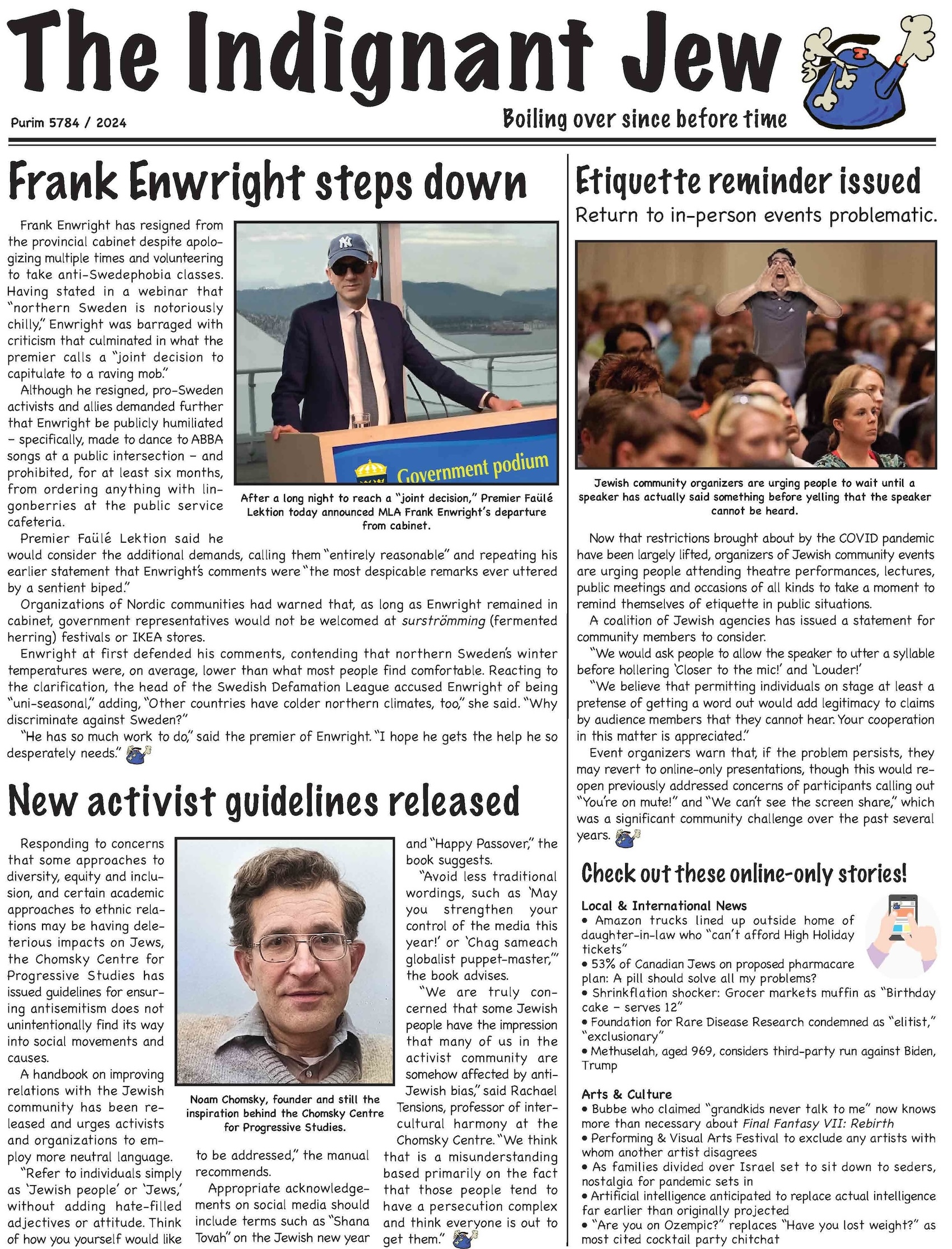
image - JI Purim Spoof 2024

Posted on March 8, 2024March 7, 2024Author JI staffCategories Celebrating the HolidaysTags politics shmolitics, Purim

Selina Robinson’s resignation letter to the BC NDP caucus: You broke my heart…. Silence is not leadership – it’s cowardice.

My colleagues,

You broke my heart – not just on February 5 when the Premier told me that after the caucus talked about me he did not see a way back, that folks were wondering why I hadn’t already resigned and that the only path forward was a resignation. Resigning was not my choice but I told the Premier that if this was what he wanted and what caucus wanted I wouldn’t fight him on it – but let’s be clear – others asked for my resignation, so I gave it.

You actually broke my heart in the days after October 7 – the day terrorists went into Israel and brutally murdered, slaughtered, raped, mutilated, killed and kidnapped 1,200 civilians. These terrorists didn’t target the military, they killed children, concert goers, grandmothers, peace activists and a young British Columbian named Ben Mizrachi.

The Jewish community was in shock – we are about 40,000 here in British Columbia and we were reeling.

I had offered to the Premier that as a member of the Jewish community, I could speak at a vigil that was being planned a few days after the massacre – this was my community and our two Premiers had tasked me with strengthening the NDP relationship with the community. I put out the call for you to join me. The community was grieving, in mourning and we needed to show them as a caucus and as a government that we are there for them.

 I sent out a group email. Two maybe three responded – that’s it. How is it that with more than 35 lower mainland/valley MLAs only three or four would be on stage with me – I had no idea how many UCP would be there and a poor showing would not reflect well on us. I did not have the emotional capacity to reach out individually, so Alissa offered to help … still not much response. My heart cracked.

In the end there were 7 or 8 of us, two came from the island but I was terribly embarrassed.

And then, within days of the massacre, Aman and Katrina decided that it was appropriate to ‘reply all’ to my initial email asking folks to stand with the Jewish community in grief and mourning, and ask that government make a public statement about the plight of the Palestinians.

We just witnessed the slaughter, rape, mutilation and murder of 1,200 mostly Jews. We watched as the terrorists celebrated this horrific act. Ben Mizrachi hadn’t yet been buried. The IDF hadn’t yet taken any action. The world was stunned. And two of my colleagues wanted to move quickly past what had happened and refocus government on a geopolitical conflict that has been going on for years.

But it wasn’t their antisemitism that broke my heart. It was your silence to their antisemitism that hurt the most. Not a single one of you responded to their insensitive, disrespectful and inappropriate email. No one.

Your silence broke my heart that day.

You abandoned me and my community that day.

I would have hoped that someone, anyone would have replied all to Aman and Katrina and suggested that their email was inappropriate – your silence spoke volumes to me and suggested that either you agreed with them or that you just didn’t want to deal with it because it’s messy.

It is messy. It’s complex. It’s emotional. It’s hard. You just want it to go away. I understand. I want it to go away too – but my community needed you in that moment to be there in their grief and in my grief and none of you were prepared or willing to stand up to colleagues who were antisemitic – minimizing the Jewish experience, the slaughter of innocent civilians by terrorists countering with mirrored message about the plight of Palestinians. In that moment it was not so complex – People were murdered because they were Jewish and people here in British Columbia were needing us to mourn with them.

How eager you all are to join in the #NeverAgain campaign – that the crime of being Jewish that resulted in the death of six million Jews at the hands of the Nazis should never happen again.  That we should fight against Jew hatred – a hatred that repeats itself over and over and over again throughout history. How eager you all are to join the few remaining Holocaust survivors as Nicholas plays Kol Nidre on the cello and we bow our heads, light candles in honour of those murdered – yet when the hordes gather and chant “from the river to the sea” – a Hamas mantra referring to their desire to destroy Israel and the Jews, you are nowhere to be found.

Holocaust survivors have been retraumatized and some have wound up in hospital in the days and weeks after the massacre as they relive the horrors they experienced some 75 years ago. They see the marches, the chanting in our streets, the threats to Jews around the world and they say “it’s happening again.”

Where are you when protesters, their faces covered, march through our campuses intimidating young Jewish adults who now hide their Jewish identity? Where are you when young Jewish students who get trapped in bathrooms on campus because the marching is happening in hallways, and they are afraid to step out into the hall for fear of becoming a target of their hate? Where are your ideals of a broad, inclusive society? How have you been standing up for your declared values?

Almost 300 Jewish physicians signed a letter calling on UBC medical school to address antisemitism on campus. Students are bringing their hate into healthcare and they were speaking on behalf of their Jewish patients and their families. In fact, it was so bad that Ted Rosenberg, a prominent physician quit, citing a toxic work environment and antisemitism in the Faculty of Medicine – I am not sure how we expect to train more physicians when almost 300 of them are refusing to work with students coming from UBC’s faculty of medicine. It was a public leaving and I heard nothing from any of you – not the Minister of Health who committed to more physicians in the system, not the Premier – no one.

In December the four Tri-Cities MLAs received a letter from the Coquitlam Teacher’s Association rife with rhetoric, misinformation and lies about the modern state of Israel. The letter was also posted on their website (which has since been taken down). Jewish parents in SD 43 are now considering pulling their children from public schools because they don’t have faith that teachers in the district will keep their Jewish children safe. I asked Fin if he received the same letter. He did and when I asked him what he was planning to do with it he said, “nothing – I am going to ignore it.” Ignore the fact that Jewish constituents feel unsafe – Is this how we stand up for our constituents?

In January the Vancouver Police Department publicly shared a startling report about the dramatic increase in antisemitic incidents since October 7. And what was government’s response to this report?

Silence.

Shortly afterward I reached out to the Attorney General, as the racism file is under her ministry. Niki had been assigned the point of contact for the Jewish community given the historical antisemitism that the Jewish community has experienced from Mable, the parliamentary secretary for antiracism.

Let me refresh your memory, in 2004 during an interview with Seven Oaks, Mable claimed “we have vocal Zionists in our work sites, and we have had to battle them” regarding her anti-war activism in her union. Carole James, as leader, had to disavow and apologize for the comments. But the Jewish community carried on noting a certain mistrust of Mable, as she never apologized for her comments and when Mable’s recent 2-minute statement in November alarmed the community again of Mable’s antisemitism and asked for her resignation the Jewish community was merely told that Niki would now be the point of contact for anti-racism work in the Jewish community.

So I reached out to Niki at the end of January, two months after she became the designated point of contact for a community that is experiencing a spike in antisemitism, a community that is grieving and fearful. It turns out that the community leadership hadn’t even heard from her. And when I asked her what she is doing about the rise in antisemitism all she could talk about what legislation she is working on, collecting data and the small amount of money that I worked on with PSSG and the PO to make available for additional security measures that the community needed.

Her response to my query was a response you would give the opposition.

There was no acknowledgement of my personal connection to the community or how my contacts and relationships could be useful. There was no sense of understanding that this community is feeling threatened, that people are afraid, that antisemitism was on display in civil society, that Jewish parents don’t want to send their children to public school, that Jewish post-secondary students are being terrorized on campus, that Jewish owned businesses need additional security, that Holocaust survivors are reliving trauma, that plays with Israeli content that actually help to provide dialogue about the conflict are being silenced, that hundreds of Jewish physicians are calling on UBC leadership to address antisemitism on campus, that members of our own public service have started incorporating the Palestinian flag in their email signature and even making a Palestinian land comment when doing a First Nation land acknowledgement at the beginning of meetings resulting in discomfort and fear. No acknowledgment and no action.

Over the past five months a few of you have reached out after caucus discussions about me without me in the room, the first right after Aman and Katrina sent their emails and then again after the February caucus meeting, offering hugs and heart emojis. My response to many of you is that I don’t need your hugs and your emojis. What my community needs however is for you to stand up to antisemitism. When I shared this with Lisa just a few weeks ago, she responded “of course, we always do.” As a government we have not been standing up to antisemitism. If you believe that then it would appear to me that you haven’t been paying attention or you don’t know what antisemitism is or what Jew hatred looks like.

Antisemitism is calling for the destruction and annihilation of Israel, where half the world’s 15.8 million Jews live. Antisemitism is making Jewish people afraid to show their identity. Antisemitism is silencing an openly identified Jewish person who is speaking out about antisemitism. Your collective decision to silence me is antisemitism and you don’t even know it.

Antisemitism is the double standard that we have consistently shown. When any of my colleagues have made antisemitic remarks it was expected that apologies should suffice. It’s not only Mable who has made antisemitic comments. In 2012 Jennifer Whiteside shared content from the anti-Israel website the electronic intifada and posts from Occupy Wall Street that attributed Israeli ‘theft’ of Palestinian land to capitalism and in 2014 shared articles that accused Israel of ‘pinkwashing’ for their acceptance of LGBTQ2S+ community and again in 2016 shared content promoting the BDS movement and was forced to apologize and distance herself from her past support of the BDS movement.

In 2017 it came to the attention of the Jewish community that Ronna Rae invited people to support Haneen Zoubi, a former Palestinian member of the Israeli Knesset who negated the existence of Israel. Ronna Rae also compared the police to Nazis in 2013.

Jagrup quoted Goebbels in 2020 when he was pushing back at the Official Opposition during a speech in the house saying “Someone has said – if you repeat a lie often enough people will believe it” – he apologized the next day for his offence, retracted his comments and that was to be sufficient.

Last year Janet Routledge apologized for comments of Holocaust minimization by comparing the criticisms by the official opposition to Nazi rhetoric when she said “the Holocaust ended in death camps, but started with words.”

I raise these examples not to humiliate or shame any of you, but to point out the double standard. When an elected person says something that harms the Jewish community whether the comments or position is intended or unintended, the expectation is that a simple apology is sufficient. But when a Jewish elected person says something she “has deep work to do” according to the Premier and is no longer trusted. This double standard is antisemitism.

The final straw came for me last week.

I pitched an idea to the Premier 10 days after I was asked to resign that perhaps government could show leadership on this hate and division we are seeing in two hurting communities by bringing these communities together. I suggested that perhaps I could work with the Jewish community and engage with the Arab Muslim community to facilitate dialogue – find a different path for two communities in agony. As part of that work all of caucus could participate in anti-Islamophobia and antisemitism training – set an example of how as leaders we could better understand their respective pain and fear. And government could show leadership by bringing people together.

Last week Matt Smith told me that this work was ‘too political’ and that government was not interested at this time. Antisemitism and anti-Muslim sentiment are at an all-time high and government doesn’t see itself as having a role in helping these communities.

This shattered what was left of my broken heart.

This is not the party I signed on with – it has become a party that is afraid to stand with people, people who are hurting. It is now a party that puts politics and re-election before people.

It is with all of this in mind that I am leaving caucus to sit as an independent. I can no longer defend the choices this government is making, and I need to mend my broken heart and I can’t do that when you simply offer me hugs and heart emojis but don’t care to educate yourselves or understand the fear and anguish of being Jewish in this moment.

Silence is not leadership – it’s cowardice.

And I cannot be silent.

Posted on March 7, 2024March 7, 2024Author Selina RobinsonCategories LocalTags BC NDP, David Eby, Israel-Hamas war, Oct. 7, politics, Selina Robinson, terrorism

Posts pagination

Previous page Page 1 … Page 96 Page 97 Page 98 … Page 667 Next page
Proudly powered by WordPress