Skip to content
  • Home
  • Subscribe / donate
  • Events calendar
  • News
    • Local
    • National
    • Israel
    • World
    • עניין בחדשות
      A roundup of news in Canada and further afield, in Hebrew.
  • Opinion
    • From the JI
    • Op-Ed
  • Arts & Culture
    • Performing Arts
    • Music
    • Books
    • Visual Arts
    • TV & Film
  • Life
    • Celebrating the Holidays
    • Travel
    • The Daily Snooze
      Cartoons by Jacob Samuel
    • Mystery Photo
      Help the JI and JMABC fill in the gaps in our archives.
  • Community Links
    • Organizations, Etc.
    • Other News Sources & Blogs
    • Business Directory
  • FAQ
  • JI Chai Celebration
  • JI@88! video

Recent Posts

  • Zionism wins big in Vegas
  • Different but connected
  • Survival not passive
  • Musical celebration of Israel
  • Shoppe celebrates 25 years
  • Human “book” event
  • Reclaiming Jewish stories
  • Bema presents Perseverance
  • CSS honours Bellas z”l
  • Sheba Promise here May 7
  • Reflections from Be’eri
  • New law a desecration
  • Resilient joy in tough times
  • Rescue dog brings joy
  • Art chosen for new museum
  • Reminder of hope, resilience
  • The national food of Israel?
  • Story of Israel’s north
  • Sheltering in train stations
  • Teach critical thinking
  • Learning to bridge divides
  • Supporting Iranian community
  • Art dismantles systems
  • Beth Tikvah celebrates 50th
  • What is Jewish music?
  • Celebrate joy of music
  • Women share experiences 
  • Raising funds for Survivors
  • Call for digital literacy
  • The hidden hand of hate
  • Tarot as spiritual ritual
  • Students create fancy meal
  • Encouraging young voices
  • Rose’s Angels delivers
  • Living life to its fullest
  • Drawing on his roots

Archives

Follow @JewishIndie
image - The CJN - Visit Us Banner - 300x600 - 101625

TEAM shares its vision

TEAM shares its vision

In Vancouver, affordable housing continues to be an issue, despite the amount of development. (photo from satanoid / flickr)

In the April 5 civic by-election, TEAM for a Livable Vancouver has nominated Colleen Hardwick, a former city councilor, and Theodore Abbott, a community organizer and urban researcher. 

TEAM is a political organization with a mandate of reversing what it sees as problems that have developed over the past decade, and prioritizing thriving, livable neighbourhoods. It promises to value the contributions of neighbourhood organizations, commit to genuine consultation with residents and put first the types of housing that residents say they need to manage the housing crunch. TEAM also promises to resist the promotion of building that maximizes developer profits.

TEAM was created in 2021 and the organization’s website notes that the name comes from the Electors’ Action Movement (TEAM), “the party that brought residents together in 1968 to save Strathcona, Chinatown, Gastown and Vancouver’s waterfront from a freeway system. Then, City Hall bureaucrats badly underestimated the desire of residents to have meaningful involvement in the face and future of their city.

“We are feeling a similar disconnect today.”

In addition to the priorities listed above, TEAM highlights evidence-based decision-making, being “realistic about Vancouver’s contribution to climate change … without overburdening already financially-stressed residents,” and helping council, school and park boards to work together more.

These are all issues that deeply concern David Fine. The Jewish filmmaker and TEAM member is working on a documentary titled Is This the City We Want to Build?, wherein he interviews renters facing the loss of their homes under the Broadway Plan. Born in Toronto, Fine lived in London, England, for 19 years before moving to Vancouver in 2004. 

“There’s a huge disconnect between earning potential and the high prices of houses here,” he said. “Our housing market is overrun by developers who want to sell to international buyers instead of locals. We’re seeing massive tower development, displacement of thousands of people from affordable housing and criticizers being called ‘anti-progress’ and ‘anti-development.’ Over the years, on a civic level, not enough has been done to address this, and I feel the civic parties have been funded by, and are acting on behalf of, the development industry – to serve their interests.”

Fine believes the city urgently needs more housing, but housing that serves a broad spectrum of needs.

“Small apartments don’t work for growing families that need space and, if you’re driving families further out, it undermines the whole notion of a walkable city,” he said. “Look around at the pace of development and the threat of towers everywhere. Some 2,000 homes a year will be demolished in favour of towers. People need to be aware of what’s going on and oppose this, and TEAM is the only party taking a position on what’s happening.”

image - The area that the City of Vancouver’s Broadway Plan comprises
The area that the City of Vancouver’s Broadway Plan comprises. (image from City of Vancouver)

Michael Geller, another member of the Jewish community, has spent the past 50 years involved with housing and more than 20 developments.

“I’ve made a living promoting high-density development, but I’m concerned about where all those existing tenants are going to go, notwithstanding tenant protection policies,” Geller said. “I just don’t think it’s fair for them to have to move to Langley or Burnaby, or out of the community, and there isn’t the available stock to relocate a lot of those tenants.”

An architect and a planner, Geller believes that proposals to treble or quadruple allowable density is a planning mistake.

“I’ll be glad if most of those existing buildings, especially those that have been well maintained, continue to operate as affordable rental buildings,” he said. “I don’t want the city’s rezoning plans to change the character of some of Vancouver’s charming neighbourhoods. “ 

The densification of Vancouver and the financialization of the housing market are polarizing issues. If you’re a tenant, you’re likely feeling the vulnerability caused by the possibility of change, and, with it, the threat that a community you’ve grown to love may become unaffordable. If you’re a property owner or a landlord, you want to maximize your investment and, if that means increasing rent or redeveloping, should that decision not be yours? 

“I’m torn,” Geller admitted. “There are several property owners who are friends of mine and members of the Jewish community, who’ve asked me to assist them in seeking approvals for redevelopment of their properties. At the same time, I feel it would be better not to completely change the character of some of our lovely streets.” 

Lauren Kramer, an award-winning writer and editor, lives in Richmond.
Format ImagePosted on March 28, 2025March 27, 2025Author Lauren KramerCategories LocalTags by-election, civic politics, elections, Vancouver

Work still left to finish

Last week, the Jewish Federation of Greater Vancouver, in conjunction with the Centre for Israel and Jewish Affairs, released the results of a community survey on antisemitism. There were, perhaps, few surprises.

Of those surveyed, 85% said that antisemitism has “increased a lot” since Oct. 7, 2023. More than 60% of respondents said they avoid displaying items that would identify them publicly as Jewish and almost two in three said they avoid particular places and events out of concern for their safety.

A public opinion poll released around the same time indicated that the often-discussed “silent majority” is on our side – most British Columbians are concerned about antisemitism. More than three-quarters of respondents to a Research Co. poll said they are concerned about “aggressive behaviour by pro-Palestinian protesters,” “protesters targeting Jewish neighbourhoods and Jewish-owned businesses” and “rising prejudice against Jewish Canadians.”

While we would appreciate if the solidarity expressed in this survey were articulated more vocally and visually, it is reassuring to know that the targeting of our community is not unnoticed or uncontested. The survey is, in any event, a rare encouraging sign.

It may seem delusional to seek rays of light amid reports of unabating antisemitism. But is one narrative of Passover not precisely to remind us that we have met and overcome suffering and subjugation in the past? When we celebrate the holiday, we are reanimating our collective experience of resistance to tyranny and oppression, the birth pangs of our peoplehood, and the victory over apathy and forgetting. An unequivocal through-line across Jewish history is resilience.

We retell the story of Exodus every year during the seder not as history but as a living, spiritual framework for Jewish identity and values.

While this is a very difficult time, it also has the capacity to bring out tenacity, determination and unity among the Jewish people.

Difficulty can also create cracks in unity. This is the night when, more than other nights, we reflect on liberation from literal or figurative slavery – in today’s situation, perhaps, freedom from violence and discrimination – and the imperative of Jews to protect and advocate for liberation. So, as we witness growing fissures in the Jewish world, let us rededicate ourselves to the project of liberation and peoplehood based on fundamental values of freedom, love, unity and community.

On Passover, we are reminded that there are pharaohs in every generation who seek to destroy and oppress. We utter the words “You shall tell your children,” because a vivid memory of the past is central to facing our present and creating our future. Every generation faces its own “Egypt.” The work of liberation is not yet finished. 

May those who are held captive in Gaza, those who are fighting to defend Israel, those experiencing violence and discrimination, or seeking freedom in any form, be redeemed. 

Posted on March 28, 2025March 27, 2025Author The Editorial BoardCategories From the JITags antisemitism, CIJA, Exodus, Jewish Federation, Passover, polls
Significance of Egyptians’ gifts

Significance of Egyptians’ gifts

“A people driven by hate are not – cannot be – free.” (Rabbi Lord Jonathan Sacks, z”l) (photo from flickr)

According to Exodus 1:8, a new Egyptian king rose to power who did not know Joseph. He did not remember, or did not care, that Joseph, as Egypt’s chief food administrator, had saved the country from famine. As such, this new pharaoh felt no special gratitude toward the Hebrews who had settled in his land so long before. But, while the Torah text deals with pharaoh’s relationship to the Hebrews, it does not address the relationship between the Hebrew slaves and their native Egyptian neighbours.

If we look deeper in the Book of Exodus, we learn that the Hebrew slaves did know the Egyptians – they lived among them. Not only that, but the Hebrews were on good terms with their Egyptian neighbours. Thus, when it was time for the Hebrews to flee from Egypt, their neighbours gave them gifts. 

The send-off was carried out in stages. In the first stage, G-d instructs Moses to tell the Hebrews that “each man should ask his neighbour for and each woman of her neighbour, jewels of silver and jewels of gold.” (11:2) It is worth noting that, depending on the context, modern Hebrew might translate neighbour as friend, buddy or colleague. Moreover, the word ask might be translated as borrow – though, since the departing Hebrews had no intention of returning to Egypt, ask is the word to use in this context. 

Perhaps G-d was not totally sure how things would work out, so, just to make sure things went as He wanted them to, “He gave the people favour in the eyes of the Egyptians.” This point is apparently so critical that it is repeated soon afterwards: “the Lord gave the people favour in the eyes of the Egyptians that they let the Hebrews have what they asked for.” 

Some commentators have said that the Egyptians could not be expected to offer gifts of their own initiative, so the departing Hebrew slaves encouraged them by saying, let us part as friends and we’ll take a parting gift. Others – like Philo in his Life of Moses – observe that the Hebrews were prompted not by love of gain, but by the desire to recoup some of the wages due to them for their slave labour.

The Egyptians, on their part, might have been only too happy to see the Hebrews go, as they were tired of suffering from the increasingly hard-to-take plagues. Thus, in the first chapter of the Book of Exodus, the Hebrews are told to ask for the jewelry and to receive the riches, then they are commanded to “put them on your sons and daughters.”

While it may seem extravagant to gift someone gold and silver, the ancient Egyptians all wore jewelry, it was more commonplace. According to the article “Egyptian Jewelry: A Window into Ancient Culture,” by Morgan Moroney of Johns Hopkins University and the Brooklyn Museum, “From the predynastic through Roman times, jewelry was made, worn, offered, gifted, buried, stolen, appreciated and lost across genders, generations and classes. Egyptians adorned themselves in a variety of embellishments, including rings, earrings, bracelets, pectorals, necklaces, crowns, girdles and amulets. Most Egyptians wore some type of jewelry during their lifetimes.”

That said, gold and silver are important “not only from an economic but also from a symbolic point of view. Gold, for instance, was regarded as a divine and imperishable substance, its untarnishing nature providing a metaphor of eternal life and its brightness an image of the brilliance of the sun…. The very bones of the gods were said to be of silver, just as their flesh was thought to be of gold,” writes Richard H. Wilkinson in his book Symbol & Magic in Egyptian Art.

Taking this point a step further, we might be able to interpret the Egyptians’ giving of silver and gold as an act of bestowing mystical characteristics on the ancient Hebrews. Certainly, it is a recognition that the Egyptian people viewed the Hebrews well.

However, Rabbi Judah, in the name of Samuel, takes a totally different approach. He claimed that the gold and silver had been collected by Joseph when he stored and then sold corn. 

Reportedly, the Hebrews took all the gold and silver when they left Egypt and it was eventually taken to the Land of Israel. It remained there until the time of Rehoboam, the son of Solomon, then changed hands many times. It came back to ancient Israel and stayed until Zedekiah. It changed hands between the various conquerors of Israel and eventually was taken by the Romans. It has stayed in Rome ever since.

While the ancient Egyptians seemingly felt comfortable bestowing gold, silver and clothing on the Hebrews, this act is seen by some as more of a taking than a giving. In 2003, Nabil Hilmy, then dean of the faculty of law at Egypt’s Zagazig University, planned to sue the Jews of the world for the trillions of dollars that he claimed the ancient Hebrews had taken from his country. He theorized: “If we assume that the weight of what was stolen was one ton” and its worth “doubled every 20 years, even if annual interest is only 5% … hence, after 1,000 years, it would be worth 1,125,898,240 million tons.… This is for one stolen ton. The stolen gold is estimated at 300 tons, and it was not stolen for 1,000 years, but for 5,758 years, by the Jewish reckoning. Therefore, the debt is very large.” 

That the Egyptians gave the Israelites gifts – willingly or not – is noteworthy. Significantly, in the article “Letting Go,” the late Rabbi Lord Jonathan Sacks notes that Deuteronomy 23:7 tells us that we should not hate Egyptians because you lived as a stranger in their land. 

“A people driven by hate are not – cannot be – free,” writes Sacks. “Had the people carried with them a burden of hatred and a desire for revenge, Moses would have taken the Israelites out of Egypt, but he would not have taken Egypt out of the Israelites. They would still be there, bound by chains of anger as restricting as any metal. To be free you have to let go of hate.” 

The gifts of gold and silver allowed the former slaves to reach some kind of emotional closure; to feel that a new chapter was beginning; to leave without anger and a sense of humiliation.

Further, Sacks cites 20th-century commentator Benno Jacob, who “translated the word venitzaltem in Exodus 3:22 as ‘you shall save,’ not ‘you shall despoil’ the Egyptians. The gifts they took from their neighbours were intended, Jacob argues, to persuade the Israelites that it was not the Egyptians as a whole, only Pharaoh and the leadership, who were responsible for their enslavement…. They were meant to save the Egyptians from any possible future revenge by Israel.”

This is something to contemplate as we read the Haggadah at our seder this year. 

Deborah Rubin Fields is an Israel-based features writer. She is also the author of Take a Peek Inside: A Child’s Guide to Radiology Exams, published in English, Hebrew and Arabic.

Format ImagePosted on March 28, 2025March 27, 2025Author Deborah Rubin FieldsCategories Celebrating the HolidaysTags Egypt, Exodus, Haggadah, Jonathan Sacks, Passover, slavery

About the 2025 Passover cover

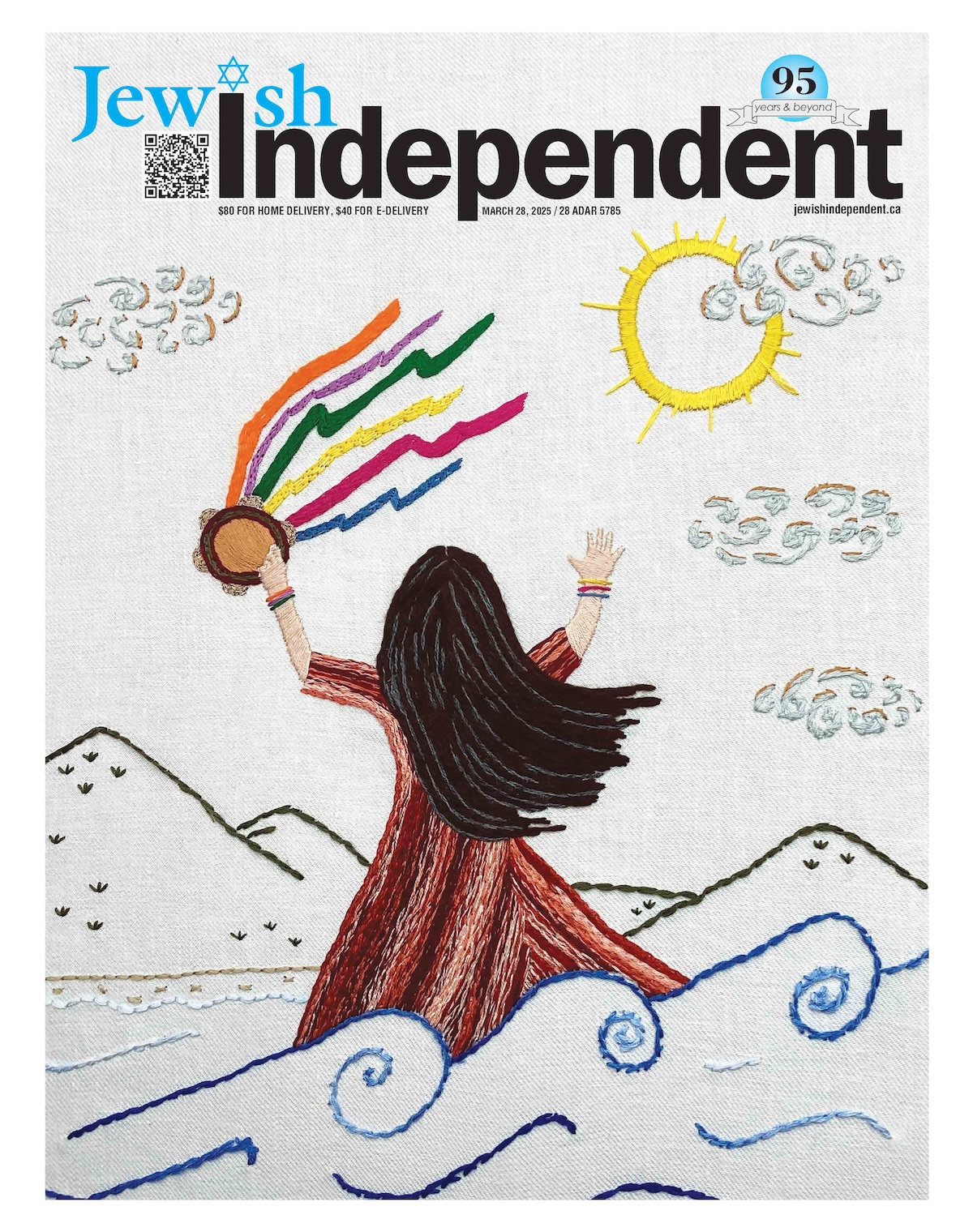
After the Israelites escape from Egypt and the Sea of Reeds has returned to its normal flow, with the enslavers either drowned or on the opposite side, Miriam leads the women in singing a song of praise. Apparently, it is the only time in the Torah where women are recorded as seinging their own song.

image - 2025 Passover cover - Miriam with her Timbrel, by Cynthia RamsayThey did so with instruments they had brought along with whatever necessities one takes when fleeing a bad situation. The women had such a strong belief that they and their people would be free, that there would be occasions to celebrate with song, music, dance, that they made room among their provisions for instruments.

Miriam is older than her brothers Moses and Aaron. “Having been born at the time when the bitter enslavement began, her parents named her ‘Miriam’ (from the Hebrew word meaning ‘bitterness’),” explains an article on chabad.org. However, she was anything but bitter. She was extraordinarily hopeful, continually thinking of the future and how it would be better.

“Miriam was about 6 years old when Pharaoh decreed that all Israelite baby boys be killed,” notes another chabad.org article. “Hearing this, Miriam’s father, Amram, divorced his wife, Yocheved, because he couldn’t bear the possibility of having a son who would be killed. Seeing the actions of Amram, one of the leaders of the generation, all of the other Israelite men followed and divorced their wives as well.

“Miriam told her father, ‘Your act is worse than Pharaoh’s! He decreed that only male children not be permitted to live, but you decreed the same fate for both male and female children!’ She then predicted that her parents would give birth to a son who would save Israel from Egypt.”

The young girl convinced her father to remarry her mother; the other men remarried their wives, as well. Moses and Aaron would not have been born, the Israelites would not have been freed, if not for Miriam.

She also looked over Moses after Yocheved placed him in a basket in the Nile to save him from Pharaoh’s decree. Miriam made sure that Pharaoh’s daughter, Batyah, who rescued Moses, chose Yocheved as his wet-nurse.

There are other stories of Miriam’s courage. Another translation of her name is “rebellion,” and she lives up to this interpretation in many ways. She and her mother were among the midwives who defied Pharaoh’s order to kill any Hebrew boys born, for example, and Miriam is said to have spoken up to Pharaoh when she was only 5 years old.

The multiple symbolisms of Miriam and the often-overlooked importance of women throughout history seemed to call for a medium of similar complexity with roots as ancient. And so, I chose embroidery as the means to express the image of Miriam, timbrel in hand, optimistic about her people’s future, the Sea of Reeds and their lives as slaves behind them.

Posted on March 28, 2025March 27, 2025Author Cynthia RamsayCategories Celebrating the HolidaysTags Exodus, Miriam, music, Passover, women

Dickinson poem reflects art

The new exhibit at the Zack Gallery, “Hope” is the Thing with Feathers, derives its name from the eponymous poem by Emily Dickinson. Gallery manager Sarah Dobbs, who curated the show, was instrumental in coming up with the name, as well as in bringing together the two artists whose works are on display: Ilze Bebris and Barbara Heller. 

“I’ve known Ilze Bebris for many years,” said Dobbs. “I saw the works she produced during COVID and said she should submit a proposal for an exhibition at the Zack Gallery. When she did, the art committee and I met and decided she should definitely have a show. But there wasn’t enough work for a solo show.”

Bebris’s submission included a series of 19 drawings, called Ballad of Hope and Despair, and a journal with her sketches of feathers. “That journal is a record of found things; of feathers shed by the gulls in my neighbourhood,” Bebris explained. “Each morning, at least one feather landed on my daily walking route.… I collected them and drew them over a period of a month.”

When Dobbs contemplated Bebris’s feathers, another artist who uses feathers extensively came to mind.

“I remembered Barbara Heller instantly,” said Dobbs. “Heller had created many tapestries with birds and feathers, and I thought their art might work well together. However, once I reflected and looked deeper, it occurred to me that they were both talking about isolation and resilience. And the poem by Dickinson, which I used for the title of the show, also speaks of resilience, hope and feathers, even though Dickinson wrote it more than 100 years earlier.”

For the current exhibit, both Bebris and Heller are presenting art that they created during the pandemic. 

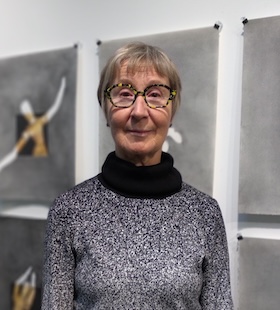
photo - Ilze Bebris
Ilze Bebris (photo by Olga Livshin)

“We have a small property on Gabriola Island, a house” Bebris told the Independent. “My husband and I were driving there one day in 2020 when the news of the COVID lockup hit. We became stuck on the island, couldn’t go home or anywhere for months.”

Bebris and several artists she knew who lived or vacationed on Gabriola got in touch with one another and decided to exchange drawings that they would create daily.

“We needed something to do,” she said. “We were all trapped. The news was horrible. My father and stepmother both died from COVID in their care home in Ontario, and I couldn’t go there, could do nothing but wait and hope for a cure or a vaccine.

“I lived in a tumult of emotions: grief, hope, anxiety, boredom,” she shared. “So, I drew. I drew flowers and twigs and rocks I saw on my daily walks; I drew feathers. But, one day, I ran out of things to draw. I had this small wooden mannequin, and I thought: what if I put it into different poses and draw it. Then the black boxes appeared in the images, reflecting our collective feelings of being trapped, isolated. I called the series ‘Ballad of Hope and Despair.’ They were all done during the first summer and fall of the pandemic.”

The 18 images, set in two rows, one above the other, are all the same size and shape. In each frame, there is the grey background, a black box of a window in the middle, and a wooden mannequin inside the window. Every pose is different, like every person is different – different experiences, ages, ethnicities – but the series unites us as human beings. We have the same general body structure and we move in similar ways as the mannequins in those windows. We all went through the pandemic.

There is one additional image beside the original 18.

photo - One of the images in Ilze Bebris’s “Ballad of Hope and Despair” series, now on display at the Zack Gallery
One of the images in Ilze Bebris’s “Ballad of Hope and Despair” series, now on display at the Zack Gallery. (photo courtesy)

“I did it a few months later,” Bebris said. “In the first 18, all the mannequins are trapped inside. But, in the last one, the mannequin is outside the window, finally looking in, reflecting beside the viewers.”

“Hope” is Bebris’s first show at the Zack, while Heller has exhibited in the gallery before. Her contribution to this show includes a series of small tapestries called “We Are All the Same….” Each tapestry shows a couple of bird bones with a feather above or below them. We don’t know what species of birds the bones belong to, and neither do we know from which birds came the feathers – they are bright and colourful but mysterious.

“The entire series includes 16 small tapestries I wove when I stayed home due to COVID,” said Heller. “They are small, because my studio on Granville Island was closed and I only had a small loom at home. The tapestries were a response to the killing of George Floyd and the chaos in the world at the time. Not that it is better now!”

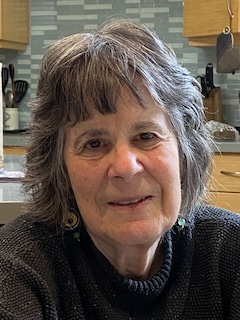
photo - Barbara Heller
Barbara Heller (photo courtesy)

She elaborated in her artist’s statement: “We are all the same under our skin, but by focusing on our differences, we have lost our sense of who we are and how we fit into our shared world. This series shows that … beneath the many colours of our skins and feathers, our bones, our organs and our blood are the same. They are what make us human, while the outward differences, no matter what kind, are invisible and irrelevant beneath our skins.”

In addition to the small tapestries, there are two other works by Heller that catch viewers’ interest. One is a big tapestry of a dead gull, called “The Shaman.” It is a skeleton and residual feathers. About 10 times larger than the small ones, the tapestry is bright with colour and infinitely sad – the memory of a bird rather than a living one.  

“It is from a series of three tapestries I wove after I found a desiccated body of a seagull with its feathers almost intact, while walking to my studio on Granville Island,” Heller explained. “To me, there was such pathos in the creature that I took it home to photograph. And I wove a tapestry to honour its spirit. ‘The Shaman’ dances to warn of our earth in peril. It has included bits of wire and plastic in its nest, and a vessel for life becomes a warning of death.”

photo - “Chance” by Barbara Heller, part of her “Hope” is the Thing with Feathers exhibit with Ilze Bebris
“Chance” by Barbara Heller. (photo courtesy)

Dead birds and feathers have been parts of Heller’s expressive pallete for several decades. They represent the artist’s appeal for change and, to Heller’s chagrin, they are still relevant today, maybe more than ever. But she keeps trying to inspire people to become less destructive, more considerate of one another.   

Heller’s other offering is a real nest abandoned by its avian makers. It is full of feathers she found during her walks. Like Bebris’s journal filled with feather sketches, the nest is a memory. They both tell the same story: the birds were here, but they are not anymore. Should we take such a message as a warning or as an inspiration – each one of us must decide for ourselves.  

“I was amazed and very pleased to see how well Ilze Bebris’s art and mine looked together,” said Heller. “We met for the first time on March 4, when we brought our works in to hang, but we explored the same themes. And the fact that we both have depicted boxes within boxes is fantastic. Both her works and mine deal with COVID and isolation and our relationship with the world. They complement each other and amplify our messages.”

“Hope” is the Thing with Feathers opened at the Zack Gallery on March 5 and will be on display until April 11.  

Olga Livshin is a Vancouver freelance writer. She can be reached at [email protected].

Posted on March 28, 2025March 27, 2025Author Olga LivshinCategories Visual ArtsTags art, Barbara Heller, drawing, Emily Dickinson, Ilze Bebris, painting, Sarah Dobbs, Zack Gallery

Sharing, listening together

photo - Alycia Fridkin leads two JQT Mental Health Support Series workshops: Facing Emotions and Healing Relationships on March 30, and Queering with Our Kids on April 6
Alycia Fridkin leads two JQT Mental Health Support Series workshops: Facing Emotions and Healing Relationships on March 30, and Queering with Our Kids on April 6. (photo from  JQT Vancouver)

JQT Vancouver is hosting two supported and spiritually grounded workshops in partnership with JFS Vancouver, as part of the JQT Mental Health Support Series: Facing Emotions and Healing Relationships on March 30, and Queering with Our Kids on April 6. Both three-hour, free gatherings will be held from noon to 3 p.m. at Little Mountain Neighbourhood House.

In the first workshop, participants will explore how they have been wrestling with some relationships since Oct. 7, 2023. Drawing on open-hearted sharing, deep listening and collective wisdom, they will process this tension and arrive at insights together for how to manage the emotions within themselves and with their families, friends, colleagues and other people in their lives. The goal of this gathering is to listen to one another, as participants share their lived experiences navigating relationships in conversation around Israel and Palestine and/or being Jewish. Come learn how to build capacity as a community to create an intentional, supportive, safe and healing space for diverse voices to be heard. 

The second workshop is for parents of queer/trans youth and queer/trans parents to share, listen and learn from one another as parents in the Jewish community. The goal of this gathering is for participants to listen and learn how they can support themselves and their children facing tensions in the Jewish and/or queer/trans communities. This could include issues related to Israel and Palestine, gender diversity and sexual orientation. The workshop aims to build capacity as a community to create an intentional, supportive, safe and healing space for families and caregivers.

Both workshops will be led by Alycia Fridkin, an experienced facilitator on equity issues and a member of the Vancouver queer Jewish community, who led JQT’s Listen & Be Heard a year ago. 

Fridkin is an equity and anti-racism consultant who supports individuals and organizations to address inequities in health care and other sectors. She has facilitated engagement sessions and workshops on systemic racism, whiteness and white fragility, meaningful involvement, stigmatized topics such as substance use and decriminalization, and the Palestine/Israel conflict. Her training includes a PhD in interdisciplinary studies and a master’s in health science, and she is a certified transformational coach. 

To register for either or both workshops, and for information on JQT, its events and activities, visit jqtvancouver.ca. 

– Courtesy JQT Vancouver

Posted on March 28, 2025March 27, 2025Author JQT VancouverCategories LocalTags Alycia Fridkin, JFS Vancouver, JQT Vancouver, mental health
Balancing education and art

Balancing education and art

Alix West Lefler plays Frida in The Fast Runner, a 15-minute short from director David Bercovici-Artieda that was shot over the course of four days in the Greater Victoria area. (photo from thefastrunnerfilm.com)

The Fast Runner, a film about a young girl and a rabbi confronting the reality of the Holocaust, will be shown at the Comox Valley International Film Festival on April 5. The 15-minute short was shot over the course of four days in the Greater Victoria area and involved 260 people. 

Director David Bercovici-Artieda, the son of a Holocaust survivor, described the project as both a profound responsibility and an intensely personal journey. His father’s experience, though not depicted in the story, inspired him to bring the film to fruition.

“It’s not just about telling a story. It’s about honouring the memory of those who lived through unimaginable horrors, including my own father. Every frame, every scene and every creative choice carries the weight of history – my family’s history,” he told the Independent.

“I came to understand the profound impact of survival – not just the physical endurance, but the emotional and psychological resilience that followed. His story, and those of so many others, shaped my perspective on the responsibility of storytelling and the importance of preserving these narratives for future generations.”

Bercovici-Artieda said creating a film like The Fast Runner is a balancing act between art and education. It must be compelling, engaging and cinematic, but also serve the greater purpose of preserving memory and fostering empathy. At its core, he explained, the film carries a message of compassion, hope and perseverance in the darkest moments of history.

“It is a reminder that, even in the face of cruelty, there were acts of kindness, moments of defiance and an unbreakable human spirit. These themes are as relevant today as they were then,” he said.

Bercovici-Artieda admitted that, during the process of putting the film together, he questioned whether he was doing justice to the story and honouring his father’s legacy in the right manner. 

“Ultimately, telling these stories is a privilege,” he said. “It is a way to ensure that the Holocaust is never forgotten, to remind audiences that history is not just in textbooks – it lives in the voices and memories of those who came before us.”

Bercovici-Artieda stressed that the film is about choices as well: those forced upon people who suffered and those made by people who stood by, helped or betrayed. Viewers, he hopes, will recognize the weight of these decisions and that history is not just a collection of events: it is built on the actions and moral dilemmas of individuals.

“I also hope audiences see the film not just as a story about the past, but as a reflection of today’s world,” he said. “The forces of hate, intolerance and dehumanization did not disappear with the Holocaust. They persist in different forms. If we are not vigilant, history can repeat itself. And, right now, we are witnessing a dangerous rise in antisemitism, Holocaust denial and historical revisionism.”

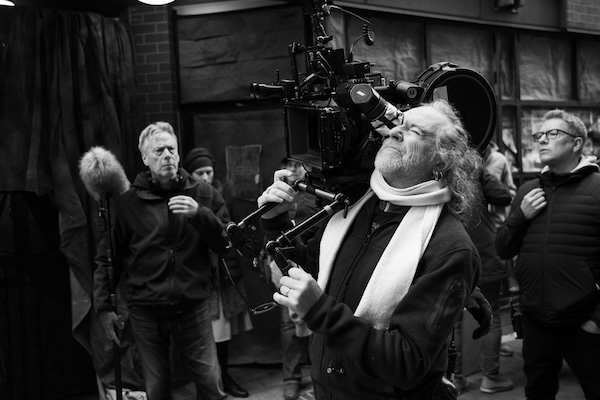
photo - Director David Bercovici-Artieda behind the camera of The Fast Runner, which next screens at the Comox Valley International Film Festival
Director David Bercovici-Artieda behind the camera of The Fast Runner, which next screens at the Comox Valley International Film Festival. (photo from thefastrunnerfilm.com)

Most importantly, Bercovici-Artieda would like people to leave the theatre with a sense of empathy. Survivors like his father, he said, endured unspeakable horrors, but they carried on, rebuilt their lives and, in many cases, found a way to forgive.

“If they could move forward with hope, so can we,” he said. 

Currently, Bercovici-Artieda is raising funds to support a partnership with Journeys in Film, an educational nonprofit, to help teachers bring The Fast Runner into classrooms worldwide. In addition, he would like to expand screenings, panel discussions and outreach programs to engage audiences in meaningful conversations about the Holocaust, resilience and the dangers of historical revisionism.

“My hope for educating people about the Holocaust through The Fast Runner is to provide a deeply human perspective on one of history’s darkest chapters – one that goes beyond statistics and textbooks,” he said. “I want audiences, especially younger generations, to connect emotionally with the story, to feel the weight of what was lost and to understand the consequences of hatred and intolerance.”

The Fast Runner screened at the Victoria Film Festival in February; the Shabbat Lounge, a Jewish cultural event running alongside the Sundance Film Festival in Park City, Utah, in January; and the Victoria International Jewish Film Festival last November. After Comox, it will make its Latin American debut, with three screenings in Ecuador, Bercovici-Artieda’s home country. One of the screenings will take place on Holocaust Remembrance Day (Yom Hashoah), on April 23, in Quito. 

The film stars Alix West Lefler as the young girl Frida and Alex Poch-Goldin as the rabbi. Only 13 years old, West Lefler has a considerable list of acting credits, including roles in films (Speak No Evil, The King Tide) and on television (The Good Doctor, Riverdale). Poch-Goldin is a veteran stage and television actor with appearances on Nero Wolfe, Murdoch Mysteries and Queer as Folk; he is also a playwright, director and librettist.

Michael Bruce Adams wrote the screenplay for The Fast Runner. Adams has been involved in more than 150 film productions. Besides short films, he has written features and documentaries.

Bercovici-Artieda has been the cinematographer on dozens of film projects and a director of several recent television series’ episodes and movies, including the holiday film Making Spirits Bright.

For more about The Fast Runner, visit thefastrunnerfilm.com. 

Sam Margolis has written for the Globe and Mail, the National Post, UPI and MSNBC.

Format ImagePosted on March 28, 2025March 27, 2025Author Holocaust, Sam MargolisCategories TV & FilmTags David Bercovici-Artieda, education, Holocaust, second generation, The Fast Runner, Victoria
On the lookout for wildfires

On the lookout for wildfires

Tova Krentzman’s Fire Tower is a documentary about the people stationed high above the ground in the Yukon and Alberta, who are looking for smoke or signs of a wildfire. (photo from  Tova Krentzman)

Tova Krentzman’s Fire Tower, a documentary about the people stationed high above the ground checking for wildfires in the Yukon and Alberta, has been covering the film festival circuit. Most recently, it was shown in February at the Available Light Film Festival in Whitehorse, where the director resides.

The idea for the film arose when Krentzman was working as a cook at a firefighting camp one spring. Several lookouts, the people who comprise the first line of defence in battling wildfires, stayed at the camp as they were getting ready to head to their respective towers.

“I had a chance to talk to them and hear their stories. I even got to visit one of them. I was completely fascinated. The seed was planted there,” she told the Independent.

Krentzman’s diverse background includes experience as a geologist, cook, medic and merchant seafarer. She is also a photographer. Initially, she thought chronicling the stories of the lookouts would make an interesting photography book. However, when the pandemic struck, she became increasingly involved with video and turned the subject into a film.

For the documentary, she featured several different types of people who are lookouts, with ages ranging from young adults to seniors. Nonetheless, Krentzman said, they share a certain trait in common: the ability to be with themselves and thrive alone.

She was struck by the ability of the lookouts to climb a 100-foot tower every day, often many times a day, and to stay focused throughout the months they were on duty. In Alberta, where the season can last for six months, from spring to fall, lookouts work long hours without any breaks. In the Yukon, though the season is shorter, the job also requires a particular fortitude.

“It is definitely a certain kind of inner physical and mental strength to be able to do this job. When you are alone, everything you have ever done in your life comes into your mind, all your mistakes, everything,” she said. “You have to be the kind of person who can manage themselves. But these are also people who are able to feel very connected to their surroundings and derive a lot of pleasure of being connected to nature and what they are looking at.”

After spending large amounts of time with the lookouts, Krentzman observed how content they were with what they were doing. There was no drama, no breakdowns. Instead, the film raises the issue of how, in a hyper-connected world, solitude can inspire a different kind of connection with not only nature but community and one’s creativity. 

“I think the film does get into what the struggles and challenges are. And so, people reflect on things and have some quiet reflective moments that they discuss and they are personal. I would say, overall, they are pretty satisfied with what they are doing,” she said.

photo - A scene from Fire Tower. To do their fire spotting, lookouts must climb a 100-foot tower every day, often many times a day
A scene from Fire Tower. To do their fire spotting, lookouts must climb a 100-foot tower every day, often many times a day. (photo from  Tova Krentzman)

Krentzman hopes that, through watching the 47-minute film, more people will realize that the towers exist. She also hopes that the film will draw attention to the dozens of people perched in the air on the lookout for potential danger. While wildfire events can blanket the news cycle during summer months, the towers are not widely known and most provinces no longer have them, she said.

“It is important to realize all the steps that go into fire protection and prevention. The lookouts spot many of the smokes and call it in when it is a little wisp of smoke – that is when you can actually prevent it from becoming bigger. The idea is to catch it before it is a big fire,” Krentzman said. “If you can see a fire from a satellite, then it is too big – that is not prevention. 

“They are really there to protect, as a first line of defence, and then they call in the fire agencies and there is a back-and-forth going on. It is quite incredible what goes on behind the scenes when it comes to fires.”

In the time since the documentary was made, Krentzman said, the fire seasons have started so early that she likely would not have been able to gain as much filming access to the towers because of liability concerns. 

Originally from Montreal, Krentzman has lived in different places, including Israel, where many in her family still live. Yet, she was drawn to the Yukon and has spent several years there.

“The Yukon is one of those places that, as a Canadian, you have to see what it is,” she said.

Fire Tower debuted at the Hot Docs Festival in Toronto last April and has appeared on screens in the United States, Asia and Europe. The documentary was to have been shown in British Columbia last summer at the ArtsWells Festival in Wells, but the event was postponed due to a wildfire. 

For more information and to ask about a group screening of the film, visit underwirefilms.com. 

Sam Margolis has written for the Globe and Mail, the National Post, UPI and MSNBC.

Format ImagePosted on March 28, 2025March 27, 2025Author Sam MargolisCategories TV & FilmTags documentary, education, environment, Tova Krentzman, wildfires
Aussie activist ignites crowd

Aussie activist ignites crowd

Australian TV personality Erin Molan at Schara Tzedeck in Vancouver March 19. (photo by Pat Johnson)

Security was tighter than usual at Congregration Schara Tzedeck when Australian media personality Erin Molan spoke to Vancouver’s Jewish community March 19.

The non-Jewish commentator has become a lightning rod for anti-Israel activists since becoming a vocal voice in support of Zionism and Jews, particularly after Oct. 7, 2023. She is dumbfounded by the controversy.

“If you said to me two years ago, there’s going to be a terror attack, Hamas will slaughter 1,200 people, they will take hostages, they will burn children … you are going to come out very strongly and publicly and condemn those actions and you’re going to support the victims of those atrocities and that’s going to be controversial and you will be in the minority, I would have said you are dreaming, there is no chance in hell,” Molan told the audience. “But here we are.”

Since that October day, Molan has lost the four jobs she held in Australian journalism – her main gig as a commentator on Sky News Australia, a radio position, a column in Sydney’s Daily Telegraph and a regular magazine spot. Molan has not explicitly said she was fired for her pro-Israel views. 

“Pure coincidence, of course,” was her response to a direct question put to her by Amir Epstein, executive director of Tafsik, the organization that brought her on a cross-Canada tour.

In February, she became host of 69 X Minutes, a news program conceived and funded by Elon Musk, which airs on X, the platform formerly known as Twitter.

Molan received a loud ovation for her comments on US President Donald Trump.

“You might love him, you might hate him,” she said. “Would I want him to marry my daughter? No. Do I think that in some ways he is the right person for this time given the alternative? Absolutely.”

She said Trump is shaking up a situation that demands new approaches.

“At least he’s throwing something different out there,” she said. “How many two-state solutions do you want to give the Palestinians? How many chances do you want to give? What are we up to, eight? Eight more chances for the same people that, at the last ceasefire, came on TV seconds after the ceasefire began and said, just FYI, we will do Oct. 7 again at the first available opportunity. 

“You can’t keep doing the same thing,” she continued. “That’s insanity.”

Her assertion that Trump’s disruptive tactics are right for the time and place come in part from watching, she said, every second of available recorded footage from Oct. 7. Many of the perpetrators wore body cameras, in some cases livestreaming their attacks.

“I thought I understood how depraved they were, well prior,” she said. “I’d seen enough, I’d heard enough, I knew that they were probably as low as you could get. Watching the raw vision [recorded footage] gave me the next-level understanding of who you are dealing with and … I left there saying, there is no way you can coexist with those people. 

“I watched a video of a dad jumping out of a window with a 4-year-old under his arm and then maybe a 6-year-old running beside him,” she recounted. “Just that fear on his face that … he knew that they were coming. He was not going to be able to do anything, but he was doing whatever he could. The terrorists killed him, then went to the fridge with two kids covered in blood, shaking, [having] just watched their dad killed and then pulling drinks out and they’re laughing. I watched their faces as they hacked the head off a young man. That, to me, is what I can’t ever forget, the joy that they derived in what they were doing. Two little girls and a little boy being burnt alive – they shot their parents and then they burnt them alive. I just don’t think you can keep pretending that this is just a dispute over land or this is just two countries that don’t really get along well. No, there are not two sides to this. They are evil, depraved, bloodthirsty murderers who will never, ever stop. So, whatever the solution is moving forward, it cannot have Hamas in existence at all and, from there, I don’t know, but I think you’ve got to try something different.”

Molan’s experiences with domestic partner violence have influenced her approach to the Oct. 7 attacks – and provided a contrast between the way she, as an Australian woman, is perceived differently from Israeli women.

“I was in a couple of very violent relationships that resulted in me being hospitalized a lot,” she said, noting that she shared the story for the first time publicly only a few months ago.

When Molan did so, she said, “all the feminists in Australia … were public and effusive in their sorrow and their praise for my bravery, for sharing.”

She said, “These were the same people who deny what happened to Israeli and Jewish women on Oct. 7, the same people who have not said a word about any of it. [They are] completely OK with Hamas raping, slaughtering, killing women.” 

She experienced firsthand the very different reactions to her, “an Irish Catholic girl,” and to the rapes and murders of Israeli women, she said.

While she said everyone should be speaking up in support of Israel and against Hamas and global antisemitism, she had particularly harsh words for Islamic community members and leaders, not least because Islamic extremism hurts Muslims, she said. 

“They should be at the forefront of this fight,” she said. “Where are they? That’s what’s really disappointed me in this space. There’s the odd one or two and they are incredible and they’re brave and they’re powerful, but … this was a perfect opportunity for [Muslim community organizations] to come out and say, ‘That’s not who we are, that doesn’t represent us or our religion.’ But, instead, they tried to downplay it, they tried to make it OK, they tried to normalize it.”

Molan has been critical of Canada’s now-former prime minister Justin Trudeau, as well as leaders in her own country and elsewhere, who she says have allowed the bar to be lowered on acceptable discourse.

She cited the example of a hate rally at the Sydney Opera House, hours after the atrocities in Israel, during which people expressed antisemitic chants and threats.

“If I were in power, if I were the leader of a nation and that had occurred on my watch, you could not have held me back in terms of what action I would have taken,” she said, adding that this was a moment when hateful and potentially violent people were gauging what would be accepted and what would not be accepted in society.

At that point, Molan said, leaders should have come down hard and police should have acknowledged that support for terrorism and incitement of violence against identifiable groups is illegal, freedom of speech notwithstanding. In Australia, Canada and elsewhere, she said, that did not happen.

She credited the Jewish community worldwide for their collective reactions to the challenges they face.

“You would be justified in being the most hateful people in history,” she said. “You would be justified in having hearts full of hate and no one could ever judge you for it. Every time you gather, all you say is, ‘Bring them home.’ That’s it. Every gathering I’ve seen of Jewish people since Oct. 7, the only focus there has been ‘Bring them home. Bring our people home.’ The other side, every gathering is ‘Intifada,’ ‘River to the sea,’ ‘Death to Jews.’ How can the world not see the stark difference between these two groups of people?”

Schara Tzedeck’s Rabbi Andrew Rosenblatt opened the event with a prayer for the hostages.

Mijal BenDori, vice-president, community planning, partnerships and innovation, of the Jewish Federation of Greater Vancouver, thanked the Vancouver Police Department, hired security and the community volunteer group Bitachon for keeping British Columbia’s Jews safe.

The event was co-sponsored by Federation, Schara Tzedeck and Tafsik, a new national organization that Epstein said targets “the Islamists, the Marxists, the communists, the keffiyeh Karens, the Jew-haters.”

His group, he said, has a number of projects in development, including an app to identify and remove anti-Jewish and anti-Israel hate graffiti; a group called LGBTJew, to provide a place for queer Zionists; and a support group for people who have been alienated by their Jewish families for their support of Israel. 

Format ImagePosted on March 28, 2025March 27, 2025Author Pat JohnsonCategories LocalTags antisemitism, Erin Molan, Israel-Hamas war, media, Oct. 7, violence against women
Exchange of expertise

Exchange of expertise

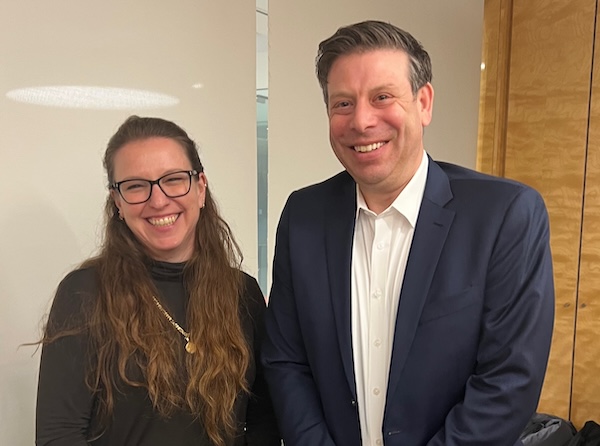
Among the activities in which Hebrew University of Jerusalem’s Dr. Shiran Reichenberg, left, took part while she was in Vancouver was a lunch and learn at Lawson Lundell LLP, hosted by Peter Tolensky. (photo from CFHU Vancouver)

Dr. Shiran Reichenberg, executive director of the Hebrew University of Jerusalem law faculty’s Clinical Legal Education Centre, was in Vancouver recently, as part of a professorship exchange with the University of British Columbia.

The exchange program started in 2010, with funding from Canadian Friends of the Hebrew University of Jerusalem and members of the local legal profession and judiciary. From 2013 to 2019, it was named in honour of Mitchell Gropper, QC, and, since 2021, in recognition of the Koffman family’s financial support, it has been formally called the Morley Koffman Memorial Allard School of Law UBC and Hebrew University Law Faculty Professor Exchange Program.

Koffman was an alum of UBC law school in 1952. He practised at Freeman, Freeman, Silvers and Koffman, and was awarded Queen’s Counsel in 1986. His firm, Koffman Kalef, was established in 1993.

One of the founders of the exchange program was Bruce Cohen, whose career has included, among other things, almost three decades as a BC Supreme Court justice. In the CFHU and UBC announcements of the Koffman family’s donation, Cohen says, “Given the high level of respect and regard for Morley’s reputation in the legal, university, Jewish and general communities as a wise counsel and recognized leader it is perfectly appropriate for the program to be named in his honour as a reflection of the importance placed by him and his family on scholarship, professionalism and tikkun olam.”

On the CFHU website, Cohen notes, “The ability of the program to operate in the initial few years of its existence was due in large measure to Morley’s assistance.”

The CFHU Vancouver organizing committee for the exchange program consisted of Cohen, Sam Hanson, Peter Hotz, Shawn Lewis, Randy Milner, Phil Switzer, Peter Tolensky, Dina Wachtel and the late Allen Zysblat. The annual exchange even operated during the pandemic, albeit virtually.

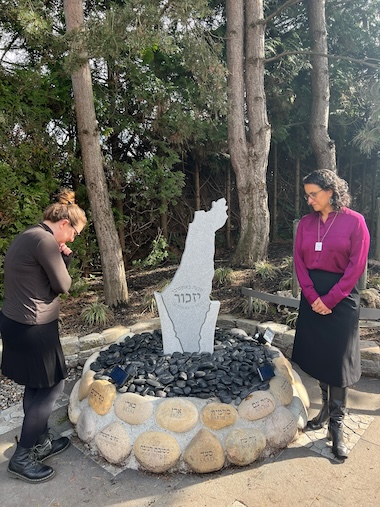
photo - Dr. Shiran Reichenberg, left, visits Temple Sholom’s Oct. 7 memorial with the synagogue’s Associate Rabbi Carey Brown
Dr. Shiran Reichenberg, left, visits Temple Sholom’s Oct. 7 memorial with the synagogue’s Associate Rabbi Carey Brown. (photo from CFHU Vancouver)

Reichenberg’s February-March visit to Vancouver was for just over two weeks, during which time she taught a course at UBC and spoke to various groups, including at Lawson Lundell LLP for a lunch and learn hosted by Peter Tolensky and at UBC’s Peter A. Allard School of Law, as well as at Temple Sholom for a lunch and learn organized by the Sisterhood, said Wachtel, vice-president, community affairs, at CFHU.

While Reichenberg regularly attends international conferences and lectures, this was her first time in Vancouver and, she said, “It was a very, very different experience to teach an intensive course for two weeks, each class three hours.”

Reichenberg, who is also the director of the Clinical Legal Education Centre’s Children and Youth Rights Clinic, said the course she gave here focused on the development of children’s rights and covered international documents, such as the Convention on the Rights of the Child, and other agreements, like the African Charter on Human and People’s Rights.

“We got very deep into several aspects of the convention and main principles, mainly best interest [of the child] and the right to participation. We talked about youth at risk, in criminal proceedings, in care proceedings,” she said.

Reichenberg graduated with her bachelor and her master of laws from the Hebrew University. She also studied in London, England, having received the Leonard Sainer Chevening Scholarship for LLM studies at University College London. She became interested in children’s rights law when she was a second-year student and participated in the Clinical Legal Education Centre’s Street Law Program, which is still part of the Children and Youth Rights Clinic she now directs.

“Each of us was put in a different residential care facility for youth at risk,” said Reichenberg, who was placed with a locked facility in Jerusalem. “When we entered this place and got an explanation about the girls and their life and what happened to them, it changed the course of my life. I stayed and I did another legal clinic in my third year of law school: representation of children’s rights, of children in court proceedings.” 

In doing her PhD, Reichenberg focused on the right of youth at risk to participate in care proceedings, and her research included interviews with some of the girls from the Jerusalem care facility.

Children’s rights have their origin in labour law, Reichenberg said.

“Children, from the beginning of humanity until maybe the Industrial Revolution … died a lot, so parents didn’t get attached to them that much,” she explained. “And they were also considered as property of their parents, mostly their fathers, so they were sold, they were used to work, they were part of supporting the family; they weren’t what we consider them today. There is evidence that, in ancient times, children weren’t even given names, just numbers, because they died so much.”

But when children came to be working in mines and in factories, for example, “legislation gave them rights, to work only 12 hours a day and sleep at night, and things like that,” said Reichenberg, adding that the invention of the printing press, which meant that people needed to learn how to read, was an impetus for the establishment of schools. 

The first child-related labour laws were English laws, passed in the early 1800s. The first youth court took place in the United States in 1874, and it involved the first case reported of child abuse, said Reichenberg. “[Mary Ellen McCormack] was abused by her stepmom and when the people wanted to help her, there was no law that protected children, so they used the law that protected animals from abuse.”

The Children and Youth Rights Clinic is one of nine offered by the Clinical Legal Education Centre. There are also clinics on climate change and environmental law; human rights in cyberspace; multiculturalism and diversity; representation of marginalized population groups; criminal justice; international human rights; the rights of people with disabilities; and wrongful convictions.

The centre can take a maximum of 140 students, with each clinic having, on average, 16 to 20 students. 

“We have many more people who want to enrol than the places that we can give,” said Reichenberg, explaining that the clinics must be kept relatively small, given that they are working on legal cases.

“Each clinic is taught by a lawyer and there is a maximum number of cases that one person can handle, so we can’t have too many students,” she said. “Also, it allows us to have in-depth discussions in our classes with our students. And we always sit in a circle and there’s always dialogue, and it’s something that can be accomplished only in small groups.”

The Clinical Legal Education Centre takes a three-pronged approach. It handles upwards of 1,000 cases a year, providing legal aid and representation to individuals from marginalized groups. It also works for policy change, through test cases and position papers, for example, and offers public lectures and workshops to raise awareness, increase knowledge and promote discussion.

Since the Hamas terror attacks on Israel on Oct. 7, 2023, the centre has taken on an increased role in teaching and advocating for human rights. It has represented groups like the Hostages and Missing Families Forum in front of different United Nations bodies, for example, and has been operating Hamal Hevrati (War Room), a Facebook page providing legal aid to vulnerable populations, which has handled about 100 inquiries to date.

As well, the centre serves diverse clients and has a multicultural staff and student body, all of which include members of the Palestinian minority.

“We are not in war with the entire Palestinian people, we are in war with Hamas, and there is a difference,” said Reichenberg.

“So, we help those who need our help. And we work together, we study together,” she said.

It’s been hard, she admitted. “But we have to believe in working together and living together because none of us is going anywhere and we have to live together and work together for a long time … we have to find a way to do that and this is what we do.”

Reichenberg is proud of how the centre has adapted to the situation.

“In class, we have students who came from military reserves, still with their uniforms and their weapons. We have Arab students who have family in Gaza, which they haven’t heard from,” she said. “We have students who lost people they loved on the 7th of October and since. I personally have a student who I loved deeply and he died in the war, in his military reserve [service] in Gaza. And, also, in the staff, as I said, we’re a mixed staff and a lot of emotions came out on the 7th of October and we did a lot of preparation for staff, how to work with the students in this environment.”

While it’s not perfect, Reichenberg said, “it is certainly an amazing thing to see how everyone is sitting together, learning together, doing legal work together, for the same goal.” 

Format ImagePosted on March 28, 2025March 27, 2025Author Cynthia RamsayCategories LocalTags Canadian Friends of Hebrew University, CFHU, children's rights, education, Hebrew University, history, Koffman family, law, Shiran Reichenberg, UBC, University of British Columbia

Posts pagination

Previous page Page 1 … Page 46 Page 47 Page 48 … Page 664 Next page
Proudly powered by WordPress