

The new exhibit at the Zack Gallery, “Hope” is the Thing with Feathers, derives its name from the eponymous poem by Emily Dickinson. Gallery manager Sarah Dobbs, who curated the show, was instrumental in coming up with the name, as well as in bringing together the two artists whose works are on display: Ilze Bebris and Barbara Heller.
“I’ve known Ilze Bebris for many years,” said Dobbs. “I saw the works she produced during COVID and said she should submit a proposal for an exhibition at the Zack Gallery. When she did, the art committee and I met and decided she should definitely have a show. But there wasn’t enough work for a solo show.”
Bebris’s submission included a series of 19 drawings, called Ballad of Hope and Despair, and a journal with her sketches of feathers. “That journal is a record of found things; of feathers shed by the gulls in my neighbourhood,” Bebris explained. “Each morning, at least one feather landed on my daily walking route.… I collected them and drew them over a period of a month.”
When Dobbs contemplated Bebris’s feathers, another artist who uses feathers extensively came to mind.
“I remembered Barbara Heller instantly,” said Dobbs. “Heller had created many tapestries with birds and feathers, and I thought their art might work well together. However, once I reflected and looked deeper, it occurred to me that they were both talking about isolation and resilience. And the poem by Dickinson, which I used for the title of the show, also speaks of resilience, hope and feathers, even though Dickinson wrote it more than 100 years earlier.”
For the current exhibit, both Bebris and Heller are presenting art that they created during the pandemic.
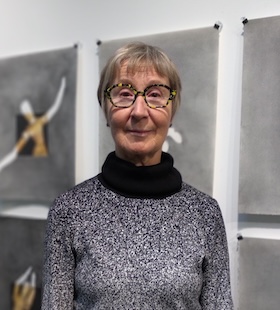
“We have a small property on Gabriola Island, a house” Bebris told the Independent. “My husband and I were driving there one day in 2020 when the news of the COVID lockup hit. We became stuck on the island, couldn’t go home or anywhere for months.”
Bebris and several artists she knew who lived or vacationed on Gabriola got in touch with one another and decided to exchange drawings that they would create daily.
“We needed something to do,” she said. “We were all trapped. The news was horrible. My father and stepmother both died from COVID in their care home in Ontario, and I couldn’t go there, could do nothing but wait and hope for a cure or a vaccine.
“I lived in a tumult of emotions: grief, hope, anxiety, boredom,” she shared. “So, I drew. I drew flowers and twigs and rocks I saw on my daily walks; I drew feathers. But, one day, I ran out of things to draw. I had this small wooden mannequin, and I thought: what if I put it into different poses and draw it. Then the black boxes appeared in the images, reflecting our collective feelings of being trapped, isolated. I called the series ‘Ballad of Hope and Despair.’ They were all done during the first summer and fall of the pandemic.”
The 18 images, set in two rows, one above the other, are all the same size and shape. In each frame, there is the grey background, a black box of a window in the middle, and a wooden mannequin inside the window. Every pose is different, like every person is different – different experiences, ages, ethnicities – but the series unites us as human beings. We have the same general body structure and we move in similar ways as the mannequins in those windows. We all went through the pandemic.
There is one additional image beside the original 18.

“I did it a few months later,” Bebris said. “In the first 18, all the mannequins are trapped inside. But, in the last one, the mannequin is outside the window, finally looking in, reflecting beside the viewers.”
“Hope” is Bebris’s first show at the Zack, while Heller has exhibited in the gallery before. Her contribution to this show includes a series of small tapestries called “We Are All the Same….” Each tapestry shows a couple of bird bones with a feather above or below them. We don’t know what species of birds the bones belong to, and neither do we know from which birds came the feathers – they are bright and colourful but mysterious.
“The entire series includes 16 small tapestries I wove when I stayed home due to COVID,” said Heller. “They are small, because my studio on Granville Island was closed and I only had a small loom at home. The tapestries were a response to the killing of George Floyd and the chaos in the world at the time. Not that it is better now!”
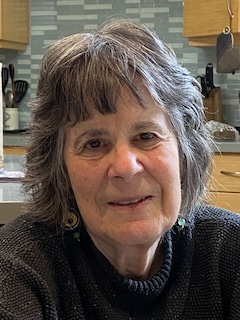
She elaborated in her artist’s statement: “We are all the same under our skin, but by focusing on our differences, we have lost our sense of who we are and how we fit into our shared world. This series shows that … beneath the many colours of our skins and feathers, our bones, our organs and our blood are the same. They are what make us human, while the outward differences, no matter what kind, are invisible and irrelevant beneath our skins.”
In addition to the small tapestries, there are two other works by Heller that catch viewers’ interest. One is a big tapestry of a dead gull, called “The Shaman.” It is a skeleton and residual feathers. About 10 times larger than the small ones, the tapestry is bright with colour and infinitely sad – the memory of a bird rather than a living one.
“It is from a series of three tapestries I wove after I found a desiccated body of a seagull with its feathers almost intact, while walking to my studio on Granville Island,” Heller explained. “To me, there was such pathos in the creature that I took it home to photograph. And I wove a tapestry to honour its spirit. ‘The Shaman’ dances to warn of our earth in peril. It has included bits of wire and plastic in its nest, and a vessel for life becomes a warning of death.”

Dead birds and feathers have been parts of Heller’s expressive pallete for several decades. They represent the artist’s appeal for change and, to Heller’s chagrin, they are still relevant today, maybe more than ever. But she keeps trying to inspire people to become less destructive, more considerate of one another.
Heller’s other offering is a real nest abandoned by its avian makers. It is full of feathers she found during her walks. Like Bebris’s journal filled with feather sketches, the nest is a memory. They both tell the same story: the birds were here, but they are not anymore. Should we take such a message as a warning or as an inspiration – each one of us must decide for ourselves.
“I was amazed and very pleased to see how well Ilze Bebris’s art and mine looked together,” said Heller. “We met for the first time on March 4, when we brought our works in to hang, but we explored the same themes. And the fact that we both have depicted boxes within boxes is fantastic. Both her works and mine deal with COVID and isolation and our relationship with the world. They complement each other and amplify our messages.”
“Hope” is the Thing with Feathers opened at the Zack Gallery on March 5 and will be on display until April 11.
Olga Livshin is a Vancouver freelance writer. She can be reached at olgagodim@gmail.com.



