Canada’s behaviour at the United Nations last week is being analyzed and found wanting by many Canadian Zionists. Canada abstained from a vote on a resolution that condemned Israel in a one-sided manner for the recent violence at the Gaza border.
The four-page resolution denounced the “excessive, disproportionate and indiscriminate force by the Israeli forces.” The resolution passed 120-8, with 45 countries, including Canada, abstaining.
An American amendment that would have condemned Hamas for sending rockets at Israeli targets was defeated 78-58, with 26 abstentions. Canada voted in favour of the failed amendment.
According to Canadian Jewish News, Canada’s ambassador to the UN, Marc-André Blanchard, said the abstention was due to the resolution’s failure to explicitly name Hamas.
“Hamas has been oppressing Palestinians. Hamas and other terrorist groups have been inciting violence and hatred and this should be clear in the resolution. The resolution explicitly names Israel, while failing to name any other groups involved,” Blanchard said.
The question, then, is why Canada did not vote against, rather than abstain, as Shimon Koffler Fogel noted.
“Ironically, Ambassador Blanchard’s explanation of the vote made the most compelling case for why Canada should have joined with the U.S., Australia and Israel in voting against the resolution,” said Koffler Fogel, chief executive officer of the Centre for Israel and Jewish Affairs.
The larger issue is that the United Nations, created with such idealism and optimism after the Holocaust and the Second World War, has become beholden to ideological blocs dominated by dictatorial regimes. In a world with no shortage of humanitarian catastrophes, the General Assembly’s time and resources are wasted with obsessive attention on Israel.
Additionally sad is that the superb, irreplaceable work done by so many subsidiary agencies of the UN suffers by association with the actions of the General Assembly.
Some have suggested, in light of the UNGA silliness, that democratic countries should withdraw and form their own alternative UN-type organization. Whatever value that might have, walking away is not the right choice. Canada and other countries with common sense foreign policies should remain as a voice of reason.
Which is all the more reason why our choice to remain silent on the latest anti-Israel resolution is the wrong one. If we are going to serve as best we can in a flawed assembly, the least we can do is stand up and be counted.
While American elected officials posted pious family-friendly Father’s Day messages on social media Sunday, about 2,300 children remained incarcerated by the U.S. government’s Immigration and Customs Enforcement branch, stolen from their parents at the southern border with Mexico.
The families are migrants from throughout Central America and the idea of tearing children from their parents is dubbed the “nuclear option” for discouraging illegal migration into the United States. Once the families are divided, children and adults begin separate legal journeys. Some parents are being deported while their children remain behind. One infant was snatched from its mother while breastfeeding.
The boys are being held in a repurposed Walmart. No one outside government knows where the girls are.
President Donald Trump, whose administration implemented the inhumane policy, blames Democratic lawmakers for the situation, in keeping with his pathological dishonesty.
Inevitably, social media is making rampant comparisons with the Holocaust. In an age when the Nazi era is invoked just about every time a disagreement arises, this parallel remains troubling. As distasteful as the analogy is though, it does reflect a laudable desire to scream injustice in the loudest way.
“We are better than this,” critics say, or “This is not America,” both of which defy the evidence. As awareness increases about this horror, if Americans are not rallying on the streets in every city and town, we will know whether this is America or whether they are better than this.
So, what’s going on inside your head? Pretty important stuff, actually, because that’s where all of us are happening.
The facts are almost unbelievable, 100 billion neurons, each connected to 10,000 other neurons, processing one trillion bits per second. There are 100 trillion synaptic connections. A synapse is just that, a connection. For comparative purposes, a home computer with a 4 GHz processor does only four billion clock cycles per second. Remember that a trillion is a million times a million.
We have almost unlimited storage space, but our short-term memory is much more limited, capable of holding only five to nine pieces of information at any one instant. We continue to learn, reshaping parts of our brains with new pathways, benefiting from the body’s redundancies. What we know is that practice does make (almost) perfect, and that our body parts can take on a life of their own. Those pathways fade if we don’t use them.
Fortunately for us, our brains have some ability to repair themselves, completely up to the age of 5 and, to a degree, during our lives, through the growth of new neurons that can take over some of the functions of damaged parts. As babies, we have the same number of neurons we do as adults, but the size of our brains triples in our first year. Brain development continues until about the age of 25.
Most of us don’t realize that our brains, making up about two percent of our weight, use 20% of our energy and are 73% water. Dehydration can affect function. Sweating for 60 minutes shrinks the brain as much as one year of aging, so be sure to drink up!
Our brains are where we find the human capacity for self-awareness (located in the prefrontal cortex), what it is that differentiates us from other animals. While chimps and dolphins also show signs of self-awareness, their brains are entirely different.
What about our feelings? There are all sorts of chemicals sloshing around inside our heads. From here on in, it gets incredibly complicated, and, so, this lecture is over. What’s really on my mind is what happens as a consequence: our exquisite sensitivity to colour, taste, smell, facial expression, emotion, music, beauty, and so much more. What is in our brains, what is on our minds, is the essence of being human.
For example, imagine what is going on in a composer’s head when writing a symphony, the harmonies to be worked out between 10, 12 or more different instruments. Can you imagine how the mind of a musician is working when their fingers are flying so fast you can hardly see them? How about the conductor, who has the whole score in their consciousness as the orchestra players are led through a piece?
Each of us has a brain box where incredible things are happening during the ordinary course of lives. Just running the machine we call our body is the product of eons of evolution and development. All of what we are is centred in our minds. We are only beginning to understand parts of it, but we have a long way to go. The explosive expansion of computing power we are witnessing is helping us roll back the mysteries behind our functioning. But the mind and its workings, repairing things when they go wrong, remain among our greatest challenges. What is marvelous is how many things go right most of the time.
Max Roytenbergis a Vancouver-based poet, writer and blogger. His book Hero in My Own Eyes: Tripping a Life Fantastic is available from Amazon and other online booksellers.
Alisa Polsky, left, and Leamore Cohen attended the Jewish Federations of Canada-United Israel Appeal’s Pushing the Boundaries: Disability, Inclusion and Jewish Community conference in Toronto April 15-17. (photo by Liora Kogan)
Jewish Federations of Canada-United Israel Appeal’s Pushing the Boundaries: Disability, Inclusion and Jewish Community conference took place in Toronto April 15-17. It was the first national Jewish conference on these topics, and two representatives of the Jewish Commmunity Centre of Greater Vancouver attended.
Leamore Cohen, inclusion services coordinator at the JCCGV, was a panelist in a discussion on vibrant, inclusive communities and recreation. She was joined at the conference by Alisa Polsky, a member of the Bagel Club, a social group for adults with diverse needs.
“The Bagel Club community is very important for social interaction with other people, and to know there are other opportunities for learning and discovery,” Polsky told the Independent. “I got to discover the Vancouver I didn’t know before.
“The club inspires me to try new things that I’d never tried before. I’ve learned a lot about myself over the years and it has pushed me out of my shell. I’m grateful for this. I’m grateful for all the opportunities the club has provided, like going to Israel with my friends and this conference.”
Polsky has been an active member of the Vancouver Jewish community for years, with volunteering being a value her parents instilled in her as a child. At the time, the educational system had dubbed her “disabled.”
“When I was going to school, I was just pushed through,” said Polsky. “This was elementary school. I didn’t get the education I deserved. I was put into a special needs class. The education system segregated me away from the regular class. The teachers only wanted to work with the ‘normal’ kids.
“I would have liked more schooling. I deserved more schooling. I deserved to be in the classroom with the ‘normal’ kids. This still hurts. I am glad that things have changed, but it’s not enough. Some kids are still segregated today. We have to work together to change that. If not, more kids will feel like I did, which is not fair or right.”
Last year, on the trip to Israel with the Bagel Club, Polsky got to meet Member of Knesset Ilan Gilon, with whom she spoke about the struggles of people with diverse needs in Canada for proper benefit rates.
Alisa Polsky at the Pushing the Boundaries: Disability, Inclusion and Jewish Community conference. (photo by Liora Kogan)
“When the Pushing the Boundaries conference came up, Leamore asked if I wanted to go,” said Polsky. “She told me that she was speaking with the Jewish Federation of Greater Vancouver about having someone from our community attend. She said the Federation believed this was very important. It’s important to see how other organizations work with people with all kinds of diverse abilities, and that people with diverse abilities get to be part of the national conversation.”
This was the first conference Polsky had ever attended. She was happy to discover that, while other organizations charge for various activities, including the Pushing the Boundaries conference, the JCCGV and Vancouver Federation take into account the financial barriers many people with diverse needs face, and do not charge for such programs.
“I loved learning more about the youth-led mentoring programs in Israel, Krembo Wings,” said Polsky. “We got to spend time with them when we visited Israel. When I was younger, I never went to programs like that. I did volunteer and helped kids with learning disabilities learn how to swim. Given the chance, I was able to show that we all have something to give. Organizations like Krembo Wings ensure that the next generation will help each other to learn and achieve their potential, no matter who they are.”
Polsky said it is very important to hear from other Jewish groups about what they offer in their communities and what their issues are. In this way, she said, she and others can be stronger self-advocates and more involved in the community.
Maybe most encouraging for Polsky was realizing that she has partners in her goal for equal rights for community participation, and also that Jewish organizations are beginning to work together across Canada to remove barriers.
“I am overcoming these barriers through my membership with the Bagel Club community, with my family, who have been there for me, through volunteering and through my spiritual community,” said Polsky. “I feel it is my time to give back to the community that has given me so much over the years.
“The conference was about the lives of Jewish people with diverse abilities – and they should be at the table. I am proud that I was at the table with Leamore.”
Polsky said there is a lot to be gained from attending gatherings like Pushing the Boundaries. In particular, there is the opportunity to “exchange ideas and share resources,” said Polsky. “It’s also important to understand our history as Jewish people, and as people with diverse needs in this country. I’d like readers to recognize that we’re all partners in making the community better.”
Some conference highlights for Polsky included the synagogue panel on creating inclusive communities and the recreation panel, in which Cohen took part. There were other topics covered, as well.
“As a Jewish woman and a woman with diverse needs, it was hard, but important to learn about the eugenics movement in Canada,” said Polsky. “This movement meant that a woman who had a pregnancy where a child who was mentally or physically challenged would be encouraged to abort the pregnancy. Families were also encouraged to institutionalize their disabled children. And they also forced sterilization.
“We learned about the denationalization movement and the development of community living.
We also learned about integration into schools and housing developments that are currently being built, which are inclusive and accessible, in Ontario.”
Polsky said she is fortunate to be living in a cooperative, and living independently. She noted that some people with diverse needs, who may require semi-independent living, are still segregated in Canada today, due to zoning laws that keep them out of certain neighbourhoods, which she describes as “horrible.”
“Having participated in this conference,” she said, “I can tell other people what I have learned and I can encourage people in my community to vote and to get active in their communities. I can remind politicians how powerful we can be when we work together and that disabilities communities are large and strong, and that we can make a difference in all aspects of community life.”
For more information about the conference, visit jewishcanada.org.
The Pacific Torah Institute’s Rabbi Noam Abramchik, left, and Rabbi Aaron Kamin. (photo from PTI)
As Vancouver’s only Orthodox yeshivah, Pacific Torah Institute (PTI) holds a unique place in the community. Since the talmudic era, when the rabbis of what is now Iraq gathered to debate Jewish law and texts and created the intense intellectual culture at the heart of traditional Judaism, the house of study (beit midrash) has been at the heart of Orthodox Jewish religious culture. In recognition of this, even non-religious Jews have long prided themselves on the presence of a yeshivah in their community and been willing to materially support it.
Located at 41st Avenue and Oak Street near a cluster of Jewish community organizations and services, PTI teaches traditional Jewish textual learning, including Talmud b’iyyun (with in-depth analytical study) and musar (the practices of ethical self-discipline and character transformation), thus carrying on the centuries-old twin focus of the Lithuanian-style yeshivah. So, when news spread that PTI, which has operated in the community since 2003, was considering relocating to Seattle, ripples of urgent concern spread throughout some quarters of the Jewish community.
A town hall meeting was organized, which took place at Schara Tzedek Synagogue. The discussion elicited strong support, both emotional and financial. Heads of school Rabbi Noam Abramchik and Rabbi Aaron Kamin left the meeting determined to save the yeshivah by attracting more students from beyond the Pacific Northwest, as well as from closer to home.
“There was never a desire to pick up and move,” Abramchik told the Independent. “There were enrolment questions, which coincided with the opening of a similar school in Seattle. Students from Seattle have been a consistent part of our student body, and we were worried – with them staying there and competition from another nearby school, we might not have enough students to be viable.”
Although PTI is affiliated with the Rabbinical Seminary of America, part of the community commonly known as the Chofetz Chaim network, it is an independent yeshivah that relies entirely on direct support from donations and fees. In recent years, enrolment has decreased because of families moving out of Vancouver, creating what Abramchik called “an existential issue” in the yeshivah’s high school program.
Kamin said affordability in Vancouver is a major factor. As well, the community is small, so, when members leave, it has a destabilizing effect. “When some families move,” he said, “you lose critical mass and it gets harder for an Orthodox Jewish community to function and have what everyone needs.”
Both rabbis talked about the opportunities and challenges that come with operating a yeshivah here.
“Vancouver’s strength is its openness,” said Abramchik. “Students here get the benefit of living a Torah lifestyle while interacting with all kinds of people and ideas, being a part of the wider world.”
Yet, the nature of the community also means “we don’t have the strength in numbers, we don’t have as many institutions and services,” said Abramchik.
One common challenge for smaller Orthodox communities is the need for young people to go elsewhere for advanced Torah study or to make a shidduch (marriage match). PTI offers higher level Torah learning until the age of 21 or 22, but those who want to continue their studies will have to move to another city, as will many of those seeking a life mate. Both Abramchik and Kamin have children who have gone to New York to find a shidduch, though some of them would like to eventually return to Vancouver with their families and make a home here.
Both rabbis are deeply embedded in the local Jewish community.
“Fifteen years of being here is fantastic,” said Abramchik. “My children couldn’t have been raised in a healthier, more wholesome environment, with such breadth of experience. As a rabbi who values religion above all else, I couldn’t be prouder of who they are as Jews and people, and directly attribute that to the incredible education they received in Vancouver through Vancouver Hebrew Academy (the Orthodox day school), PTI and Shalhevet (the Orthodox girls high school), as well as the wide range of people they’ve come into contact with, as we have hosted many diverse people at our Shabbat table over the years.”
Asked why they want to stay here, the rabbis were in agreement. “If we were looking to best serve our institution per se, the move to Seattle makes sense,” said Abramchik. “There are 300 Shomer Shabbos [Orthodox observant] families versus probably 60 here. We had a number of supporters saying we should go, but, after giving 10 years to this community, we feel it’s our home … we weren’t ready to leave it if there was any possible way to stay here.”
After the community town hall, the rabbis’ commitment to stay was strengthened, Abramchik said. “Is Vancouver a better city for having this institution or not? We heard a resounding yes, we heard this from people who do not send their children here, never will. We heard this needs to get done, we need to find a way to make this happen.”
“Our first priority is to do what we feel is God’s will,” said Kamin. “We believe this is the best thing for ourselves and our spiritual advancement, we want to do the right thing. The right thing transcends the institution, it transcends our own personalities. It was very much a feeling of this is the right thing to be doing, to make this decision to stay – the right thing for the community and the right thing for the boys now and the future boys.”
For Toviah Salfinger, a student at PTI, the news they are staying is welcome. The yeshivah plays “a huge part in my life,” he said. “It enables me to be able to really grow in terms of religious life. It would be pretty hard to have a solid foundation as a religious Jew without a yeshivah.”
Salfinger sees the challenges of Vancouver as holding a hidden blessing. “The fact that you’re in a community where there isn’t a strong Jewish religious presence, it helps you in a way,” he said, “because it puts the responsibility on you to live up to that, to be an example as religious person.”
Salfinger said he’d like to go on to study at the Rabbinical Seminary of America yeshivah in New York, and maybe become a rabbi who teaches kids. Maybe, he said, if there is an opportunity, he will one day be able to return to Vancouver.
Matthew Gindinis a freelance journalist, writer and lecturer. He is Pacific correspondent for the CJN, writes regularly for the Forward, Tricycle and the Wisdom Daily, and has been published in Sojourners, Religion Dispatches and elsewhere. He can be found on Medium and Twitter.
King David High School head of school Russ Klein. (photo by Pat Johnson)
King David High School has chosen to refund families who made a $1,000 deposit for next year but opted to send their kids to a different school. The decision ends a controversy that some parents said was a money grab.
Faced for the first time with more applicants than available positions, the school requested a non-refundable deposit of $1,000. Timing was a factor, as families were awaiting admission decisions from other private schools or space-limited specialty programs in the public system.
The idea, said KDHS head of school Russ Klein, was that families for whom King David was the first choice would pay and those for whom the school was not first choice might opt not to pay, thereby ensuring that those who most wanted in were admitted.
“It didn’t work out that way,” he said. “What we thought would happen, didn’t happen. They all just made the deposit.”
In the end, the school got what it wanted – full enrolment – and families ended up with their children in the schools of their choice.
After reflection on the process, Klein said, King David decided to refund the deposits to families who chose other schools.
“It wasn’t a cash grab,” he said. “We did it with good intentions.”
As it turned out, of the nine families offered the refund, four declined, choosing to make it a donation to the school, another donated half, two received the full refund and two others didn’t respond to the offer at all.
This year’s graduating class had 45 students, the second-largest ever. Next year’s class will be the biggest – between 55 and 60.
Klein said dealing with more applications than they have spots available was a learning opportunity.
“Now that we think we know how to handle this situation a little better, we’re hoping we get this, as we say, ‘good problem,’ where there are too many applicants again in the future,” he said. “The school next year will probably be at its biggest number ever.… We’ve just got nothing but good things to look forward to.”
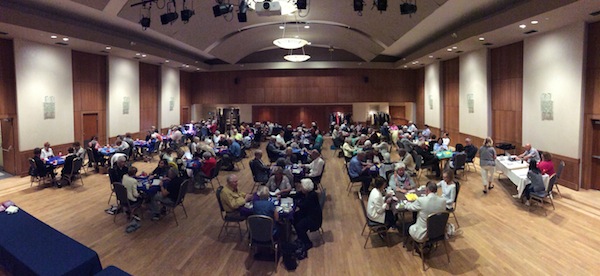
There were 28 tables of four playing on June 7 at the annual bridge event honouring Marjorie Groberman. (photos by Cynthia Ramsay)
More than 100 people gathered to play bridge at the Jewish Community Centre of Greater Vancouver on June 7 at a special annual event in honour of Marjorie Groberman, who passed away in 2011.
Leah Deslauriers is the former coordinator of JCC Seniors, which is now called Adults 55+ and headed by Lisa Quay.
“Marjorie Groberman was a driving force behind the JCC Seniors department for many years,” Deslauriers told the Independent. “She, along with some other ladies, started a duplicate bridge club at the JCC in 1995. When Marjorie passed away, [her daughter] Hildy Barnett and I created this event in her memory. We named the bridge club after Marjorie, as well.”
Barnett sponsors the meal and door prizes for the annual lunchtime event, and covers extras the club might need, said Deslauriers. For the lunch, “many players baked or brought dessert items for everyone.”
“There were 28 tables of four, so there were 112 people in attendance,” she said. “The club generally has up to 20 tables during regular play, so this was a very large event.”
The bridge club at the centre started in 1995 with four tables, explained Deslauriers. “Some of the original ladies, who still play today, subsidized the club so it would continue. The original club director was Connie Delisle, who taught many people how to play the game. Then Cathy Miller became director in 2006, when Connie had to retire. Cathy retired at the end of last year and the current director is Bryan Maksymetz, who is a Canadian bridge champion.”
Anyone who knows how to play duplicate bridge may attend. “It is very special,” said Deslauriers, “as many of its regular players are over 80, and many are over 90. I believe Ethel Bellows is the oldest player at the moment. Many of the players come 30 minutes before game time, to socialize over coffee and cookies, and it’s a very warm and friendly game, as far as bridge goes.”
The Marjorie Groberman Open Duplicate Bridge Club currently has more than 350 members, Quay told the Independent. Play takes place on Tuesdays and Thursdays. “The JCC also offers an array of bridge lessons for beginners on up, as well as practise opportunities for skill-building,” she said.
For more information, contact Quay at 604-257-5111, ext. 208.
Left to right: Laura Feldman, Dr. Deborah Toiber, Joanne Haramia, Dr. Janet Kushner Kow and Dr. Gloria Gutman. (photo from CABGU)
Alzheimer’s, Dementia and You, an event presented by Canadian Associates of Ben-Gurion University of the Negev on June 5 at the Rothstein Theatre, featured a panel of experts whose presentations and discussion provided insights to both those seeking information and those seeking support.
Keynote speaker Dr. Deborah Toiber of Ben-Gurion University’s department of life sciences, described her approach to neurodegenerative aging as the key factor in understanding diseases like Alzheimer’s. (See jewishindependent.ca/bgu-finds-key-protein.)
Moderated by Simon Fraser University professor emerita Dr. Gloria Gutman, the panel represented a wealth of experience. Dr. Janet Kushner Kow, a geriatrician associated with Providence Health Care and the University of British Columbia, answered questions from the medical perspective. Laura Feldman, with 10 years of grassroots experience at the Alzheimer Society of British Columbia, spoke about the need to seek knowledge and support. Joanne Haramia recounted how families she has cared for through Jewish Family Services have found it easier to cope when they have support from the community. People stayed after the event to mingle and talk to the panelists and ask more questions.
Prior to the event, there was a reception, catered by Nava Creative Kosher Cuisine, for sponsors and partners. Sponsors were InstaFund and Annie Du and Aeron Evans of National Bank Financial, Wealth Management; co-sponsors were the Jewish Community Centre of Greater Vancouver, Jewish Family Services, Louis Brier Home and Hospital, and Jewish Seniors Alliance, with community partners being the Alzheimer Society of B.C., SFU Gerontology Research Centre and the Jewish Independent as media partner.
– Courtesy of Canadian Associates of Ben-Gurion University of the Negev
Some of the terror weapons found by Israel Security Agency (ISA) personnel. (photos by ISA via Ashernet)
In recent months, the ISA, Israel Defence Forces and Israel Police have uncovered a large and active terrorist infrastructure that operated in the Nablus area on the West Bank from October 2017 until late April 2018, when more than 20 members of the group were detained by Israeli security forces. Most of the group’s members belonged to Hamas; some had extensive experience in terrorist operations, including the production of explosives. ISA investigations found that the group intended to carry out several attacks in various Israeli cities. Among the items seized were improvised explosive devices, including one weighing 10 kilograms; materials for the production of explosives; weapons; and instructions for the manufacture of bombs and explosive materials.
פסגת הג’-7 שהתקיימה בשרלבוקס קוויבק שבקנדה. (צילום: Shealah Craighead)
נשיא ארצות הברית, דונלד טראמפ, ממשיך להתנהג כבריון שכונתי, מאיים ומלכלך על המדינות הקרובות ובעיקר על השכנה ומי שנחשבה עד היום לידידה הקרובה ביותר – קנדה. כל בוקר מתעורר העולם וצופה בתדהמה כיצד נשיא ארה”ב מנהל את ענייניו ומגיב על כל עניין ועניין, באמצעות חשבון הטוויטר הרועש שלו. אין תקדים בעולם להתנהלות כה שערורייתית וחסרת אחריות, על מי שאמור לעמוד בראש העולם המערבי הדמוקרטי והנאור. בהתנהגותו הביזרית מצליח טראמפ לפצל את העולם המערבי ובעצם לבודד את ארה”ב, מול המחנה השני השפוי שכולל את קנדה ומדינות אירופה. מנהיגי רוסי וסין בוודאי נהנים לראות מה עושה טראמפ למערב. בחלומותיהם הוורודים ביותר הם לא היו מאמינים שנשיא אמריקני, יהיה זה שיצור אנרכיה ובלגן כה גדול בארה”ב ומחוצה לה, שתוך שהוא מבטל הסכמים מהסכמים שונים, ומראה שאין עוד תוקף לחתימתו.
פסגת הג’-7 שהתקיימה בשרלבוקס קוויבק שבקנדה, לא רק שלא הביאה להפגת המתח בין טראמפ לראשי מדינות אירופה, קנדה ויפאן, אלא אף הגבירה אותו לאור התנהלותו של נשיא ארה”ב. טראמפ הגיע באיחור לפסגת המדינות המתועשות וכיאה לו עזב לפני שהדיונים הסתיימו. תחילה הוא חתם על המסמך המסכם את הפסגה לפיו המדינות יילחמו בפרוטקציוניזם (מדיניות של הטלת מכסים על מוצרי יבוא לשם העצמת ייצור עצמי), אך לאחר מכן בדרכו לסינגפור (לפגישה עם שליט צפון קוריאה, קים ג’ונג און), הוא חזר בו ממה שהוסכם ובעצם פוצץ את פסגת הג’-7. במקביל טראמפ לא חדל להתקיף את ראש ממשלה קנדה, ג’סטין טרודו. הוא ציין שטרודו חלש, לא נאמן ובעצם תקע לו סכין בגב. על מה ולמה? אף אחד לא מבין.
גם שני יועציו הקרובים של טראמפ נקראו לעמוד לצידו והתקיפו את טרודו באופן חמור ביותר. היועץ הכלכלי של הנשיא, לארי קודלו, טען כי טרודו תקע
לנשיא סכין בגב. ואילו היועץ לענייני מסחר של הנשיא, פיטר נבארו, אמר מצידו כי יש מקום מיוחד בגיהנום לכל מנהיג שעוסק בחוסר תום לב בדיפולמטיה, כפי שטרודו עשה. לאחר מכן נבארו שכנראה נבהל מהביקורת הקשה שהוטחה בו לאור דבריו החמורים, חזר בו והתנצל על מה שאמר.
המונדיאל של 2026 יערך בקנדה-מקסיקו וארה”ב
הפעם נשיא ארה”ב, דונלד טראמפ לא הצליח להפריע ולמנוע את אחדות המדינות צפון אמריקה. שלוש המדינות של היבשת הצפונית, קנדה, מקסיקו וארה”ב נבחרו על ידי קוגנרס פיפ”א לקיים את אליפות העולם בכדורגל – המונדיאל, בעוד שמונה שנים (2026). מול הצעה משותפת של שלוש המדינות שקיבלה 134 קולות, התחרתה מרוקו שקיבלה רק 65 קולות ולא היה לה סיכוי.
המונדיאל של צפון אמריקה יהיה גדול מקודמותיו וישתתפו בו ארבעים ושמונה נבחרות. שמונים המשחקיה של האליפות יתפרשו על פני שלושים וארבעה ימים. מרבית המשחקים שישים במספר יערכו מטבע הדברים בארה”ב, עשרה מהם יערכו במקסיקו ועשרה נוספים יערכו בקנדה (ומדובר רק בשלבים המוקדמים). המשחקים כאן יתקיימו באיצטדיוני הכדורגל של הערים טורונטו (אצטדיון בי.אם.או שמכיל 30,000 מקומות והוא כנראה יורחב ל-45,000), מונטריאול (האצטדיון האולימפי שמכיל 72,000 אלף מקומות) ואדמונטון (אצטדיון הקומונוולס שמכיל 56,418 מוקומות). שלושת האצטדיונים ידרשו לעבור מקצה שיפורים כדי לעמוד בסטנדרטים הגבוהים של פיפ”א.
המונדיאל התקיים במקסיקו ב-1970 (עם השתתפות ראשונה ואחרונה של נבחרת ישראל) וב-1986, וכן במארה”ב ב-1994. קנדה לעומת זאת אירחה את אליפות העולם בכדורגל לנשים ב-2015.