Skip to content
  • Home
  • Subscribe / donate
  • Events calendar
  • News
    • Local
    • National
    • Israel
    • World
    • עניין בחדשות
      A roundup of news in Canada and further afield, in Hebrew.
  • Opinion
    • From the JI
    • Op-Ed
  • Arts & Culture
    • Performing Arts
    • Music
    • Books
    • Visual Arts
    • TV & Film
  • Life
    • Celebrating the Holidays
    • Travel
    • The Daily Snooze
      Cartoons by Jacob Samuel
    • Mystery Photo
      Help the JI and JMABC fill in the gaps in our archives.
  • Community Links
    • Organizations, Etc.
    • Other News Sources & Blogs
    • Business Directory
  • FAQ
  • JI Chai Celebration
  • JI@88! video

Recent Posts

  • Zionism wins big in Vegas
  • Different but connected
  • Survival not passive
  • Musical celebration of Israel
  • Shoppe celebrates 25 years
  • Human “book” event
  • Reclaiming Jewish stories
  • Bema presents Perseverance
  • CSS honours Bellas z”l
  • Sheba Promise here May 7
  • Reflections from Be’eri
  • New law a desecration
  • Resilient joy in tough times
  • Rescue dog brings joy
  • Art chosen for new museum
  • Reminder of hope, resilience
  • The national food of Israel?
  • Story of Israel’s north
  • Sheltering in train stations
  • Teach critical thinking
  • Learning to bridge divides
  • Supporting Iranian community
  • Art dismantles systems
  • Beth Tikvah celebrates 50th
  • What is Jewish music?
  • Celebrate joy of music
  • Women share experiences 
  • Raising funds for Survivors
  • Call for digital literacy
  • The hidden hand of hate
  • Tarot as spiritual ritual
  • Students create fancy meal
  • Encouraging young voices
  • Rose’s Angels delivers
  • Living life to its fullest
  • Drawing on his roots

Archives

Follow @JewishIndie
image - The CJN - Visit Us Banner - 300x600 - 101625

Teaching kids reading skills

Teaching kids reading skills

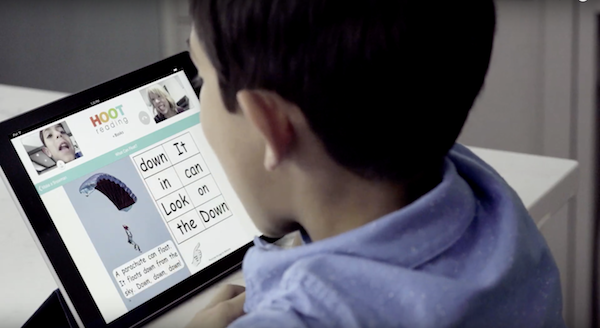
With Hoot Reading, kids and teachers can see and hear each other via video chat. (screenshot)

Hoot Reading allows kids to get in their desired screen time, while also improving their reading skills. Jewish community member Carly Shuler, co-founder and chief executive director of the online tutoring company, came up with the educational concept while working on Sesame Street.

“While I was there, I was working on a research project aimed at understanding how to help kids learn through video chat,” Shuler explained. “Fast forward a couple of years and my co-founder, Maya Kotecha, and I decided the idea was too good to stay in the lab. So, we got the rights, formed Hoot Reading, and here we are.

“Something a lot of parents don’t know is that there is a deadline for reading,” she said. “We talk a lot about the fourth-grade reading slump, which is this phenomenon that happens in Grade 4, when children need to make the leap from learning how to read to reading to learn.”

The school system is based on the assumption that, by Grade 4, kids will be reading fluently. While some kids are indeed fluent readers by then, some 60% of students are reading below grade level as they start Grade 5. And, from then on, the ability to read is needed for every single topic, from math to science to social studies to music and to health, not to mention for activities outside of school.

“What happens is that those kids, come Grade 4, that we thought were average students, fall behind,” said Shuler. “They lose confidence and they disengage from school. And so, while we don’t believe at Hoot Reading that earlier is better, we do believe that there is a deadline for becoming a fluent reader – and that deadline is Grade 4.

“Hoot Reading, in particular, is good for all kids from kindergarten through to Grade 4 and, then, also any kids who are struggling after that point,” she said. “So, we have kids up to Grade 10 reading with us. They are in that 60 percentile of kids who are reading below grade level.”

The tutoring is done online with classroom teachers, one-on-one, in 20-minute lessons, two to three times a week. The app is basically Facetime meets Kindle, said Shuler. Kids and teachers can see and hear each other via video chat, and both the teachers and the students can point to things and see where the other is pointing.

“It allows for that dialogic reading, but it’s the interactive back and forth that is so important as a child progresses as a reader,” said Shuler. “Kids can do it from the comfort of their own home, from their family car, from their sibling’s piano lesson, or wherever they are. It can really happen anywhere at any time, so parents find it very convenient.”

Weighing in on screens, Shuler said, “At Hoot Reading, we don’t believe all screens are created equal. As parents, we should be paying more attention to what our kids are doing on screens, rather than just focusing on how much time they are spending on them. There are some really great things they can do.

“We believe screens can sometimes have a real benefit to our children’s learning, such as by allowing us to offer an affordable way to do one-on-one reading tutoring. So many kids can get access to it, whereas they couldn’t before. So, we encourage parents to think about it that way.”

Further to this, Shuler encourages parents to be reading mentors and role models, showing their kids that they, too, are using their screens to read.

“It’s really important that our children know that we are reading, so that they can see that it can be a really fun part of their media world,” she said. “Whether we are reading on a Kindle or reading a hard copy book, we want to show them and do it in front of them … and talk about the books and stories at the dinner table, because it’s really important that kids see reading can be fun.”

Shuler feels strongly that parents should help their kids choose apps and games that encourage reading. The ability to comprehend what you are reading and to be able to follow instructions is an important skill. While enjoying some games that do not involve reading is OK, she recommended finding games that do provide a different medium for kids to further their love of reading.

Just like any other skill, the more you practise, the better you get at it and Shuler maintains that kids should read aloud with a grown-up for at least 10 minutes a day, five days a week.

“In the same way that, when learning to play basketball, some kids might be a little better at it than others, but the best way to improve anything is through practise,” she said. “We have to practise and we have to practise out loud, with a grown-up there. Whether that grown-up is a parent, a Hoot Reading teacher, or someone else, kids need to be practising – and that’s not what’s happening in so many households. We’re so busy nowadays, between after-school activities and all the amazing things our kids get to do. But, reading cannot fall onto the backburner, because, if kids don’t practise, they’ll probably end up in that 60% by Grade 4.”

Shuler said kids need to have what they learn in school reinforced at home and, therefore, increasing public awareness is critical.

“A lot of parents don’t know – they just think about reading in terms of literacy or illiteracy so, once their child can read, they think, ‘Great! My child can read. We’ve got this!’ But, the truth is, again, reading is a skill, and you get better at it the more you read. That’s where most parents don’t know how important it is to continue the reading out loud, even if their child is reading.”

She added that “the key is in knowing how important it is and in making sure we prioritize reading practice in the same way we prioritize brushing our teeth.”

Finding books and other material that interest kids and make them excited about reading is paramount. “Just try to keep it a positive experience as much as possible,” said Shuler, “and do what you need to do as a parent to make that happen.”

Shuler and Kotecha recently launched a new initiative, called Hoot for All, sponsored by Spin Master, that will allow them to provide reading tutoring for kids at Boys and Girls Clubs across Canada at no cost to the kids’ families.

For more information, visit hootreading.com.

Rebeca Kuropatwa is a Winnipeg freelance writer.
Format ImagePosted on February 28, 2020February 26, 2020Author Rebeca KuropatwaCategories WorldTags Carly Shuler, children, education, Hoot Reading, technology
Ketubot have a long history

Ketubot have a long history

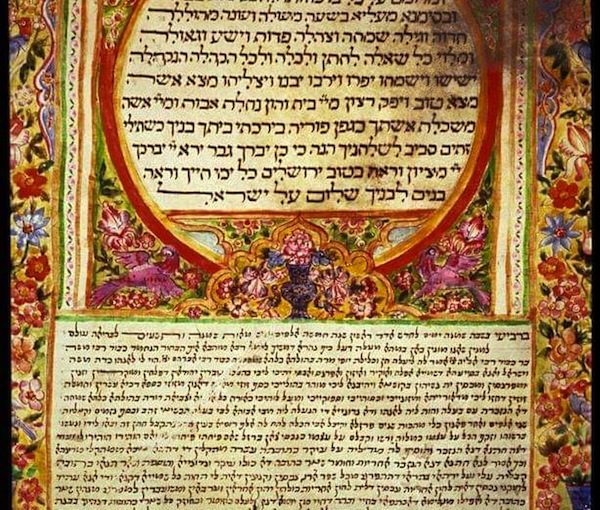
An illustrated ketubah from Mala, India, 1938. (image from Deborah Rubin Fields)

Mazal tov! So, you or someone you know is getting married. Today, Jewish weddings may be big or small, formal or informal, traditional or not. No matter the style, the ketubah, or Jewish marriage contract, is the common denominator.

The ketubah is a short, but ancient document. In his book The Ketuba: Jewish Marriage Contracts through the Ages, David Davidovitch writes: “It may be assumed that … the ketubah was first introduced at the time of the Babylonian exile.” The ketubah “testifies to the obligations undertaken by the husband towards his wife in their joint life together. The principal function of the ketuba is … to serve as a document that safeguards the position of the woman after she has entered the marital state.”

In a traditional ketubah, the groom obligates himself to pay a base amount, and perhaps additional sums that are then written into the contract. He vows to work, honour, feed and support the bride. In added phrasing, he specifically agrees to provide clothing, food (thus providing food is mentioned twice in a traditional Orthodox ketubah) and conjugal rights. The groom’s spelled-out duties are the key to the contract. The wife’s responsibilities are not spelled out, yet details of her dowry are given.

The ketubah was written in Aramaic, for many years considered the legal language of Jewish texts, records and reports, plus the lingua franca of the Middle East. Even today, many Orthodox couples continue to use the Aramaic version. As a legal document, the ketubah requires witnessing by two individuals.

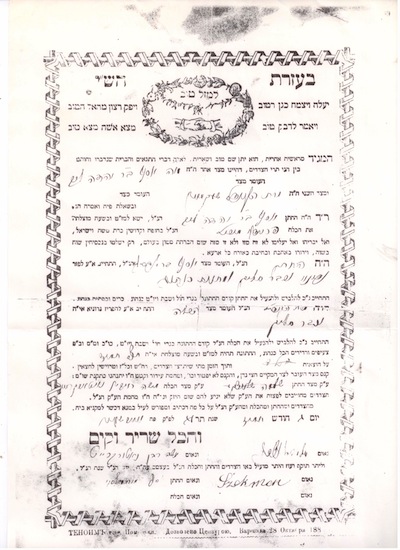
image - The ketubah of the writer’s maternal grandparents, from Warsaw, Poland, 1913
The ketubah of the writer’s maternal grandparents, from Warsaw, Poland, 1913. (image from Deborah Rubin Fields)

That Jewish couples have used ketubot since ancient times does not mean, however, that all ketubot are the same. They have differed from place to place and from period to period. Probably the most blatant difference in ketubot is that some have been illustrated while some have not. According to Davidovitch, the Italian Jewish community produced the most beautiful documents. In illustrated ketubot, common motifs have included scenes from the Torah, cherubim, flowers, birds (sometimes exotic), fish (as signs of anticipated fertility), candelabra or menorot, gates, arches, columns and even emblems of particular countries. It is hard to say with certainty if, historically, unillustrated ketubot reflected the conservative nature of various Jewish communities or if only the rich could afford artists to decorate the contract.

Sometimes, these dissimilarities appeared within one country. For instance, between the 18th and 20th centuries, the ketubot of the Indian Jewish communities consisted of two distinct sections – the opening formula, or superscription, in the upper register and the contract itself beneath. The superscription was written in square Hebrew characters, whereas the contract itself was penned in a semi-cursive Hebrew script. The superscription began with an invocation to G-d, followed by blessings and good wishes to the newlyweds and ended with biblical verses relating to marriage and fertility. Yet, within various Indian communities, there were differences: for example, while a ketubah from Kolkata (Calcutta) was illustrated, a ketubah from Pune was not.

According to Prof. Shalom Sabar, “printed Jerusalem ketubot made their way to many countries in the east, and indirectly led to the decline of the tradition of written ketubot and hand-made illustrations. The printed ketubah (with or without decorations) slowly took the place of the hand-made ketubah throughout almost the entire Jewish world, and the ancient artistic tradition died…. During the 1970s, the decorated ketubah and motifs connected to Jerusalem [were] revived. In an era where many people were ‘searching for their roots’ and acquired a renewed interest in Jewish art in its various forms, many couples began ordering hand-decorated ketubot for their weddings.” (See the National Library of Israel, web.nli.org.il/sites/NLI/English/collections/jewish-collection/ketubbot/ketexhibit/Pages/Yemen-1925.aspx.)

Today, some couples opt to write their ketubah using egalitarian language. Their vows might reflect their responsibilities to each other, as well as responsibilities to the Jewish people and to the entire world. One example of this is the ketubah devised by Rabbi Prof. Rachel Adler. Her ketubah is called a Lovers’ Covenant. It contains biblical verses about covenant, calling marriage a covenant of distinction. Other couples focus on specific vows to be carried out in their shared life.

Other examples of changing times are ketubot for interfaith couples and for same-sex couples. Regarding same-sex couples, Lynda Fishman of Jessy Judaica Shop reports that “most couples choose a ketubah first and read through the text that is offered by the artist. Most couples prefer the same-sex text, although not all artist[s] offer a same-sex text … most do offer an egalitarian text, which can be gender-neutral.” Fishman always requests the couple “speak to their rabbi/officiant first before ordering. It’s very important for the officiant to approve the text first or to let us know if they would like any changes made.”

Masorti (Conservative) Rabbi Diana Villa and the late Rabbi Monique Susskind Goldberg worked extensively to try and prevent the problem of mesoravot get, Jewish women whose husbands have refused to grant a get, or Jewish writ of divorce; this situation occurs more in Israel than in other Jewish communities. In a detailed paper on the issue, they urged couples to sign a prenuptial agreement.

For those living in Israel, they further recommend using their Agreement for Mutual Respect. “The principle guiding financial agreement is that the husband guarantees at the time of the wedding to pay his wife a large sum of money in the future should she want a divorce and should he refuse to give her a get, even though their life together has ended. The purpose of the agreement is to have the husband give the get quickly in order to be rid of the heavy debt.”(See To Learn and to Teach [2007], the fourth booklet of a series published by the Schechter Institute of Jewish Studies).

While prenuptial agreements are less common in the Orthodox world, the Orthodox organization Chupa Pratit requires couples to sign a halachic (according to Jewish law) prenup stipulating financial sanctions if one partner refuses to consent to a divorce, to prevent incidents of “chained” women, or men. (See chuppot.org.il/en.)

The National Library of Israel has an online collection of more than 4,200 ketubot from collections all over the world. Whatever direction you decide to go in when choosing yours, good luck with your preparations. And may your shared life be as hearty and as long-lived as the ketubah itself.

Deborah Rubin Fields is an Israel-based features writer. She is also the author of Take a Peek Inside: A Child’s Guide to Radiology Exams, published in English, Hebrew and Arabic.

Format ImagePosted on February 28, 2020February 26, 2020Author Deborah Rubin FieldsCategories LifeTags halachah, history, Judaism, ketubah, marriage, weddings
Couple cartoons about love

Couple cartoons about love

Yehuda and Maya Devir and their self-drawn webcomic characters in One of Those Days. (image from Devirs)

Fans always do a double take when they see Yehuda and Maya Devir at a comics convention or in a New York City subway, or wherever. The young Israeli couple looks like they jumped right out of their virally popular webcomic One of Those Days.

“I suppose it’s like meeting a real Bart Simpson in the street,” mused Yehuda. “We act exactly the same as our characters.”

Indeed, about seven million social media followers know that Maya loves super-hot showers and hates folding laundry. They know Yehuda’s a big baby when he’s sick and is willing to say “I’m sorry” after an argument. They sympathized with the couple’s struggle to get pregnant.

Most of all, fans smile at the humorous spin the webcomic puts on everyday scenes in a marriage, from dishes in the sink to kisses on the couch.

“We get lots of emails and messages from around the world about how we changed the way couples look at their relationship and how they talk to each other,” Yehuda told Israel21c. “It’s amazing that we can make such a difference for people, that our work can connect Muslim, Jewish, black, white, rich, poor … it doesn’t matter.”

One of Those Days won the Most Creative Content Maker Award at the Inflow Global Summit 2019 Awards for social media influencers.

“We dedicated our award to our followers and supporters around the world. We have fans in Brazil, Japan, Trinidad, Iran, Iraq – basically, every country,” Yehuda said. “People thank us for making them happy once a week and making them feel they are not alone. It’s an amazing journey we’ve been on.”

The Devirs’ journey began in September 2016, when they packed up their diplomas in visual communication from Jerusalem’s Bezalel Academy of Art and Design and moved to Tel Aviv.

The newlyweds hoped to find an affordable apartment in a nice neighbourhood. And they hoped to make a living in illustration and design. Neither aspiration was terribly realistic.

“A friend suggested we post a selfie on Facebook asking friends to help us find an apartment,” said Maya. “We didn’t know how to take a good selfie, but we can draw really well, so we did a cartoon of ourselves and posted that.”

Not only did that illustration help them find an affordable flat in a very expensive city, but it also formed the kernel of One of Those Days.

While working as a freelance illustrator in the fashion, music and startup industries, Yehuda posted funny snippets on social media about being a new husband.

“Very quickly I joined him because I wanted him to make me look good,” Maya said with a laugh, “and because the story belonged to both of us. The concept was to illustrate moments we both experienced.”

In May 2017, Bored Panda posted a piece about the Devirs that went viral. “After a week, we gained half a million followers on Instagram,” Maya said. “Since then, we never stopped gaining followers. We got tons of emails and Yehuda couldn’t manage by himself. So, I left my job as art director in an ad firm and joined him full-time in October 2017. This was our dream – to create something of our own.”

They take complementary roles in each cartoon. “We start the idea together and the actual illustration is Yehuda’s talented hand,” said Maya. “Then I add my suggestions about colour composition and typography. I also manage the business.”

She said, “I opened an ecommerce shop. At first, we sold only autographed A5-sized prints of One of Those Days comics and Yehuda’s other comic illustrations. People who were into art and comics appreciated that.”

The online shop now sells three One of Those Days books plus merchandise, including apparel, shower curtains, calendars, phone skins and other items imprinted with favourite cartoons.

The Devirs’ YouTube channel has 46,000 subscribers. They have a Patreon subscription content service. They’ve appeared at comic-cons in Europe, India and will soon visit the United States. They are in great demand to give talks and lectures.

“Everything we do is because our fans suggested it,” said Yehuda. “Now, they want a TV show and we are going to try to do it. We are working with a scriptwriter at a studio in the U.S.”

photo - The online shop sells three One of Those Days books, plus other merchandise
The online shop sells three One of Those Days books, plus other merchandise. (image from Devirs)

Relationships proved to be a universal kind of language for the Devirs. “When we decided to move into the stage of being parents and saw it wouldn’t be that easy for us, this was a turning point,” Yehuda confided. “Would we really talk about the unpleasant experience of trying to get pregnant? It’s a super-personal subject.”

Maya felt that Yehuda’s humorous and colourful style would put the right spin on the topic and could be supportive for other couples in a similar situation. And so they introduced comics about ovulation, periods and lovemaking on demand. Messages offering support and advice came pouring in. It was like a worldwide group therapy session, Yehuda said.

The cartoon announcing Maya’s pregnancy got 16 million likes and shares. The first illustration of baby Ariel got 13 million. As of Dec. 1, she had 219,000 Instagram followers at just six months old.

“It was unbelievable to see the amount of love we got from people we didn’t know,” said Yehuda. “As Israeli and Jewish people, it was especially unbelievable to get supportive reactions from our huge fan base in the Arab world. The Israeli part is not important. We’re just the cartoon couple about love.”

Now living on Maya’s childhood kibbutz, the couple puts Ariel in the care of her two grandmothers when they travel to shows and lectures. The difficulty of parting with their baby became another comic that went viral because it was so relatable.

“It’s hard for Maya and me to leave her,” said Yehuda, “but, when she’s older, she’ll join us.”

Israel21c is a nonprofit educational foundation with a mission to focus media and public attention on the 21st-century Israel that exists beyond the conflict. For more, or to donate, visit israel21c.org.

Format ImagePosted on February 28, 2020February 26, 2020Author Abigail Klein Leichman ISRAEL21CCategories Visual ArtsTags art, Devir, illustration, Israel, marriage, webcomics
Predicting diabetes risk

Predicting diabetes risk

A new computer algorithm can predict in the early stages of pregnancy, or even before pregnancy has occurred, which women are at a high risk of gestational diabetes. (photo from Weizmann Institute)

A new computer algorithm can predict in the early stages of pregnancy, or even before pregnancy has occurred, which women are at a high risk of gestational diabetes, according to a study by researchers at the Weizmann Institute of Science.

The study, reported recently in Nature Medicine, analyzed data on nearly 600,000 pregnancies available from Israel’s largest health organization, Clalit Health Services.

“Our ultimate goal has been to help the health system take measures so as to prevent diabetes from occurring in pregnancy,” said senior author Prof. Eran Segal of the institute’s computer science and applied mathematics, and molecular cell biology departments.

Gestational diabetes is characterized by high blood sugar levels that develop during pregnancy in women who did not previously have diabetes. It occurs in three to nine percent of all pregnancies and is fraught with risks for both mother and baby. Typically, gestational diabetes is diagnosed between the 24th and 28th weeks of pregnancy, with the help of a glucose tolerance test in which the woman drinks a glucose solution and then undergoes a blood test to see how quickly the glucose is cleared from her blood.

In the new study, Segal and colleagues started out by applying a machine learning method to Clalit’s health records on some 450,000 pregnancies in women who gave birth between 2010 and 2017. Gestational diabetes had been diagnosed by glucose tolerance testing in about four percent of these pregnancies. After processing the dataset – made up of more than 2,000 parameters for each pregnancy, including the woman’s blood test results and her and her family’s medical histories – the scientists’ algorithm revealed that nine of the parameters were sufficient to accurately identify the women who were at a high risk of developing gestational diabetes. The nine parameters included the woman’s age, body mass index, family history of diabetes and results of her glucose tests during previous pregnancies (if any).

Next, to make sure that the nine parameters could indeed accurately predict the risk of gestational diabetes, the researchers applied them to Clalit’s health records on about 140,000 additional pregnancies that had not been part of the initial analysis. The results validated the study’s findings: the nine parameters helped accurately identify the women who ultimately developed gestational diabetes.

These findings suggest that, by having a woman answer just nine questions, it should be possible to tell in advance whether she is at a high risk of developing gestational diabetes. If this information is available early on – in the early stages of pregnancy or even before the woman has gotten pregnant – it might be possible to reduce her risk of diabetes through lifestyle measures such as exercise and diet. On the other hand, women identified by the questionnaire as being at a low risk of gestational diabetes may be spared the cost and inconvenience of the glucose testing. (Visit weizmann.ac.il/sites/gd-predictor to access the self-assessment questionnaire.)

In more general terms, this study has demonstrated the usefulness of large human-based datasets, specifically electronic health records, for deriving personalized disease predictions that can lead to preventive and therapeutic measures.

The work was led by graduate students Nitzan Shalom Artzi, Dr. Smadar Shilo and Hagai Rossman from Segal’s lab at the Weizmann Institute of Science, who collaborated with Prof. Eran Hadar, Dr. Shiri Barbash-Hazan, Prof. Avi Ben-Haroush and Prof. Arnon Wiznitzer of the Rabin Medical Centre in Petach Tikvah; and Prof. Ran D. Balicer and Dr. Becca Feldman of Clalit Health Services.


Format ImagePosted on February 28, 2020February 26, 2020Author Weizmann InstituteCategories IsraelTags childbirth, diabetes, health care, pregnancy, science, women
‘הקהילה היהודית בוונקובר, חלק א

‘הקהילה היהודית בוונקובר, חלק א

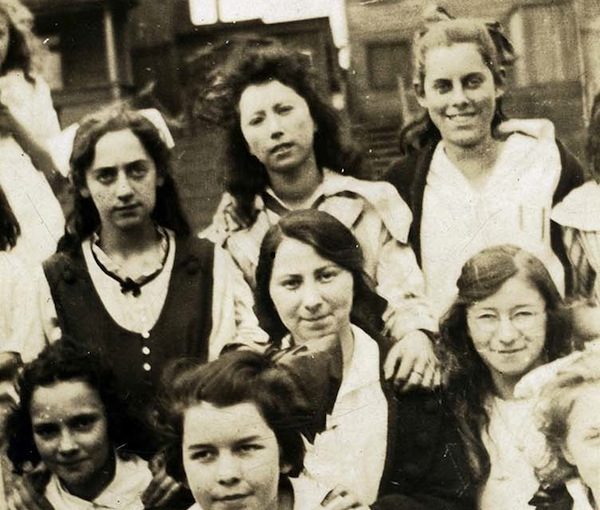
רוב המהגרים דוברי היידיש התיישב באזור הפועלים סטראטקונה, והמשיכו באורח חייהם המסורתי.

(מוזיאוןהעםהיהודי L.22046)

ונקובר, עיר בקולומביה הבריטית, העיר השלישית בגודל אוכלוסייתה בקנדה, ומקום משכנה של הקהילה היהודית השלישית בגודלה. כשבעה אחוזים מיהודי קנדה חיים בוונקובר ובסביבתה.

משנות החמישים של המאה התשע עשרה החלו מהגרים רבים להגיע אל האזור הדרומי-מערבי של מחוז קולומביה הבריטית דהיום. רבים נמשכו לאזור בשל הבהלה לזהב, אחרים בשל הזדמנויות עסקיות מגוונות, וביניהם גם יהודים ממחוזות קנדה האמריקניים במערב, במזרח ובמרכז, ומאירופה. ייסודה של הקהילה היהודית בוונקובר היה פרי מאמציהם של מספר אישים, אשר זיקתם ומסירותם ליהדות ולמתיישבים בני דתם אפשרה את גיבושם של החיים היהודים בחוף המערבי של קנדה. אחד המתיישבים היהודים הראשונים באזור היה לואיס גולד, יליד פולין, שנודע בכינוי לואיס המדלג. הוא הגיע לאזור ונקובר עם משפחתו בתחילת שנות השבעים של המאה התשע עשרה, והקים חנות כלבו וסופרמרקט ברחוב ווטר. בהמשך הרחיבה משפחת גולד את עסקיה, ורכשה אדמות. בנו של לואיס, אדוארד עשה חיל. כבר באלף שמונה מאות תשעים ושתיים היה בעליו של בנק הלוואות וביטחונות, ובשנת אלף תשע מאות וארבעה עשרה נבחר לחבר מועצת דרום ונקובר.

לרוב מזוהה ראשית תולדות היהודים בוונקובר עם פעילותם של האחים מאיר, גודפרי, יצחק, צ’לרס ודייויד אופנהיימר, שנולדו בבוואריה, גרמניה. הם באו למחוז במערב קנדה בשנת אלף שמונה מאות חמישים ושמונה, בעקבות הבהלה לזהב. האחים אופנהיימר התיישבו במחוז ונקובר באלף שמונה מאות שמונים וחמש, שנה לפני ייסודה של העיר. שנתיים לאחר מכן היו דייויד ויצחק חברי מועצת העיר ושנה אחרי כן נבחר דייויד לראשות העיר, וכיהן כראש העיר השני, במשך ארבע שנים. האחים אופנהיימר בע”מ שהוא העסק הוותיק ביותר בוונקובר, הקימו את חנות הכלבו הראשונה, במבנה הלבנים הראשון בעיר, שעדיין עומד ברובע גסטאון. בסוף המאה התשע עשרה. הם גם רכשו שטחי אדמה גדולים, והיו בעלי הקרקעות השלישיים בגודלם בוונקובר.

בשנת אלף שמונה מאות תשעים ואחת חיו בוונקובר שמונים וחמישה יהודים. בסוף המאה התשע עשרה החלו לזרום לאזור מהגרים יהודים ממזרח אירופה. רוב המהגרים דוברי היידיש התיישב באזור הפועלים סטראטקונה, והמשיכו באורח חייהם המסורתי. רובם היו בעלי חנויות או בעלי מלאכה, ועסקו במקצועות שהביאו עמם ממזרח אירופה, חייטים, סנדלרים ורוכלים.

מנהיגם הדתי הראשון של יהודי ונקובר היה זבולון פרנקס, יליד אוקראינה אשר התיישב בוונקובר בשנת אלף שמונה מאות שמונים ושבע. בחנותו התקיימו התפילות הראשונות של הקהילה האורתודוכסית בראשיתה. חברת הציוד”י. פרנקס בע”מ היא יורשתו של העסק המקורי שייסד פרנקס. אברהם דייויד גולדשטיין, יליד פולין, עסק בפיתוח ובבנייה. הפרוייקט הנודע ביותר שלו הוא”סילביה קורט, בית הדירות הגבוה הראשון בעיר. הבניין, שנקרא על שם בתו בת השתים עשרה, הוא עדיין אחד מתווי ההיכר של מערב העיר. בימי השפל הכלכלי הגדול, בשנות השלושים של המאה העשרים, הוסב לבית-מלון, ומאז אלף תשע מאות שבעים ושש הוכרז בניין לשימור.

באלף שמונה מאות שמונים ושבע הוקצתה בבית העלמין מאונטיין וויו, שנוסד זמן קצר קודם לכן, חלקה נפרדת לקבורה יהודית. אגודת אחים הייתה הקהילה הראשונה שנוסדה בוונקובר. התפילות הציבוריות הראשונות שקיימה היו בחגים הגדולים, באוקטובר אלף שמונה מאות תשעים ואחת, באולם אבירי פיתיאס שברחוב קורדובה (כיום חלק מחנות הצבא והצי). שלוש שנים לאחר מכן הגיע מוויקטוריה בקולומביה הבריטית הרב שלמה פילו, יליד גרמניה, ועם בואו נוסדה הקהילה הליברלית. בית הכנסת של הקהילה, עמנואל, נוסד שנה אחר כך.

Format ImagePosted on February 26, 2020June 30, 2020Author Roni RachmaniCategories UncategorizedTags British Columbia, history, Jewish community, Jewish museum, JMABC, Vancouver, Victoria, וויקטוריה, וונקובר, מוזיאון העם היהודי, קהילה יהודית, קולומביה בריטית, תולדות
Climate hot topic at Limmud

Climate hot topic at Limmud

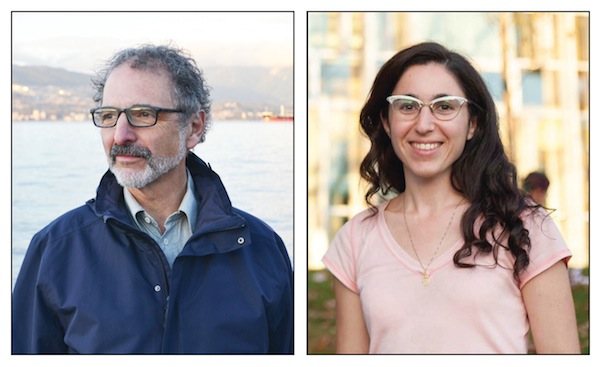
Dr. Larry Barzelai and Maayan Kreitzman will talk about environmental activism at Limmud on March 1. (photos from the interviewees)

Environmental activism is among Canada’s top news stories in recent days and the issue will be confronted from both a Jewish and a broader perspective by two leading voices at Limmud Vancouver next month.

Dr. Larry Barzelai, a Vancouver family doctor, assistant professor at the University of British Columbia’s faculty of medicine and B.C. chair of Canadian Association of Physicians for the Environment (CAPE), will present alongside Maayan Kreitzman, a PhD candidate at the Institute for Resources, Environment and Sustainability at UBC. The pair acknowledges that they come at the topic using different tactics, but aim for the same objective.

Kreitzman has been among those blockading the port and traffic.

“The actions happening in the streets right now are in response to this Coastal GasLink natural gas pipeline construction on Wet’suwet’an land,” she said. But this is only one element of the much larger picture, which is that oil and gas development is “occurring unabated and greenhouse gas emissions and ecological destruction is continuing unabated throughout the world, when we know that these activities are threatening our life-support system and are putting billions of people at risk over the next decade. People are already being impacted today.”

The issue brings together a host of concerns, she said, including “indigenous rights and sovereignty, the Canadian government’s complicity in a climate-unsafe future … as well as the business side of that from the private sector.”

Kreitzman has heard the complaints that disruptive protests may turn off potential allies and anger the general public.

“I think people’s emotions are valid and there is a valid concern about disrupting ordinary people that need to make a living and need to take care of their families,” she told the Independent. “On the other hand, I think many of the people that sometimes make these kind of complaints aren’t really the people that are struggling to feed their families. People that come from a place of privilege need to recognize that these protests inconveniencing them is a small price to pay for the types of progressive changes that will benefit all of us, including their children.”

Kreitzman said she and Barzelai will “bring a concise summary of the latest science to people so that they really understand the magnitude of the situation that we’re in.”

She said, “We’ll be speaking to a spectrum of different actions, from the personal to the more conventional campaigning type of approaches, like report-writing, research, lobbying, letter-writing, to direct-action approaches, which is what I’m most interested in, where people that have privilege start putting their bodies on the line and breaking the law on purpose, using the message of nonviolent civil resistance, which has been successful in many movements throughout history.”

Barzelai takes a more conventional approach to advocacy, but shares Kreitzman’s sense of urgency.

“Climate change, which we’re calling a climate emergency, is upon us,” he told the Independent. “It’s dramatic and we have to take big steps to do something about it. Maayan is taking a bit more radical approach to this. Myself and my group are a bit more middle-of-the-road, shall we say, but I think we both have the same endpoint in mind – that things have to change dramatically.”

CAPE, which has been around for about 25 years, focuses on the health impacts of environmental decisions and climate change.

“We see diseases that are spreading, we see cancers that are becoming more rampant, we are seeing the floods and the wildfires and the temperature changes that are dramatically affecting people’s health and we figure it’s our responsibility as doctors to look at climate change from a health perspective and to inform people of what’s going to happen unless we make dramatic changes,” he said.

Fracking is one area where he thinks British Columbia is “really going down the wrong path.”

“They’ve bought this myth that natural gas is clean energy, which it is absolutely not, and they are doing their best to increase rather than decrease global warming, and we think that’s the crucial issue that needs to be discussed in Canada and especially in B.C.,” he said.

Kreitzman and Barzelai will speak at Limmud Vancouver on March 1.

Tickets and more information can be found at limmudvancouver.com.

Format ImagePosted on February 21, 2020February 19, 2020Author Pat JohnsonCategories LocalTags climate crisis, education, environment, Larry Barzelai, Limmud Vancouver, Maayan Kreitzman, tikkun olam
Many ideas at Limmud

Many ideas at Limmud

At LimmudVan’20, Anna-Mae Wiesenthal will present on The “Othering” of Germany’s Jews and Canada’s First Nations. (photo from Anna-Mae Wiesenthal)

The latest local incarnation of the global Jewish learning festival Limmud takes place Feb. 29 and March 1. LimmudVan’20, which is being held at Congregation Beth Israel, begins with Havdalah and a few musical and intellectual appetizers on the Saturday night, followed by a day of presentations on a diverse array of topics on Sunday.

Anna-Mae Wiesenthal, a teacher at King David High School and a PhD candidate in Holocaust and genocide studies, will present on The “Othering” of Germany’s Jews and Canada’s First Nations.

Originating from Winnipeg, Wiesenthal has long had an interest in First Nations issues and has been involved in community programs there. She is aware of the sensitivities around paralleling these histories.

“There is a lot of controversy surrounding the use of the word genocide and First Nations, but I approach it from an examination of looking at different viewpoints and different research that argue both sides,” she told the Independent. “What do these two experiences of these two people have in common?” The point, she said, is not to come to any firm conclusions.

“I want to leave it open to the audience to process the information and to assess the commonalities and the differences,” Wiesenthal said. “I’m certainly there to point some of them out, but I think it’s to provide a different perspective that will engage and inspire discussion and curiosity among the participants to go further with it.”

Also not promising any proscribed conclusions is Rabbi Philip Gibbs, who will ask: Would the rabbis approve of Uber? Gibbs, who is spiritual leader of Congregation Har El, in West Vancouver, said that even issues as seemingly modern as an app that permits ride-sharing can be addressed through ancient wisdom.

Traditional arguments around fair and unfair competition have remained with him since rabbinical school and came to the fore in recent weeks as British Columbia argued over, and then slowly and somewhat clunkily implemented, ride-hailing services like Uber and Lyft. Some of the issues that could arise include whether a company keeps money in the community it serves or extracts it to some distant parent company. But don’t expect him to come down clearly on one side.

“If you’ve ever looked into a question of Jewish ethics, you know that you can make the joke of saying two Jews will have three opinions,” said Gibbs. “Maybe, through the discussion, someone else will tell me what it seems like I’m thinking, but really I think the goal is just to be more attuned to what some of the issues are so that, as we begin to make choices of who do we call up for a ride to the airport, that we’re taking into account a wider range of values than simply how little we want to pay for it.”

Other presenters will talk about crafting Jewish children’s books (see jewishindependent.ca/new-publisher-set-to-launch); how Leonard Bernstein used the music of Selichot to create West Side Story; the rich and poor among Portuguese Jews in Amsterdam’s Golden Age; building Jewish micro-communities through co-housing; healing Christian antisemitism; analyzing the Israeli smash TV show Shtisel; and many other topics.

Tickets and more information can be found at limmudvancouver.com.

Format ImagePosted on February 21, 2020February 19, 2020Author Pat JohnsonCategories LocalTags Anna-Mae Wiesenthal, children's books, education, First Nations, genocide, Holocaust, Limmud Vancouver, music, Philip Gibbs, ride-sharing

Antisemitism, Part 1 of 2

The recently released 2019 version of an ongoing Anti-Defamation League survey on global antisemitism, titled Global 100, contains predictable but still depressing confirmation of anecdotal evidence that antisemitism is growing, not receding, almost everywhere on the planet.

At a time of economic and social change and upheaval, people search for explanations and scapegoats. While so much can change, while we witness so many reversals and inversions, plus ça change, plus c’est la meme chose. The unified theory of the root of the world’s problems, for so many across continents and centuries, remains some variation of blaming the Jewish people.

If we had a solution to the challenge of antisemitism, you would have heard it. It’s easy to cite failures, noting that whatever we’ve been doing obviously isn’t working. The approach commonly used to fight both antisemitism and anti-Zionism – “Look at the great things we contribute to the world! Please like us!” – is almost certainly barking up the wrong tree, given that antisemites and anti-Zionists are driven, to a large degree, precisely by an envy of Jewish and/or Israeli success and achievement. Bigots never have doubted that Jews are clever; that’s exactly what they hate.

But overt bigots are not really our greatest threat. The sensibilities highlighted in the Global 100 report are slightly more oblique, evincing a complex of presumptions about Jewish character, power, influence, intentions and untrustworthiness. It is not so much discrimination of the we-hate-Jews variety, but a (slightly) more subtle bias that is extrapolated to conclude this or that about Jewish people. And these biases are held, as the report illustrates alarmingly, not by a small fringe group of violent haters, but by large minorities – and, in some societies, large majorities – of ordinary people. These are people who, on a wide range of human affairs, behave rationally and humanely, but not when it comes to Jews.

It also deserves to be noted that the statistics on anti-Jewish bias are almost directly inversely proportionate to the presence of Jews in a society; that is, anti-Jewish sentiment is strongest in places where there are few or no Jews. Because, to a large extent, antisemitism is not about Jews at all, but is a projection of the fears, animosities or ignorance of the carrier.

The wild-eyed Jew-haters who occasionally emerge are comparatively few, although the damage they can wreak, of course, is enormous. Their ideas and their actions are condemned by all good people. The broader swath of ideas Global 100 identifies as indicative of antisemitism in a society are more instinctual and less overt. The people who carry them are probably inclined to deny any conscious negativity toward Jews and would recoil from being called antisemitic. In many cases, they might be amenable to self-assessing and unlearning these attitudes, if approached appropriately and educated.

This is the hopeful part. These alarming numbers may not represent entrenched antisemitic ideas that are growing and cannot be effectively challenged. The majority of people who harbour such ideas, in Canadian and other Western societies we know best, are probably receptive to reason. So, why have we not succeeded?

Our likeliest allies – indeed, the people and groups with which Jewish people have consistently marched, organized and made common cause for a century or more: progressives, anti-racism advocates, social activists – have lately turned against us, either openly or more quietly, because they have decided that Israel represents an embodiment of antithetical values and that Jews, by extension, are inclined to have some degree of association with Zionism and are, therefore, either unwelcome in these movements or required to repudiate Israel.

There are other complexities that go beyond Israel. Certainly the antisemitism that permeates the British Labour party and some other parts of the Western left goes far beyond anti-Zionism and often echoes the basest medieval bigotry.

Nonetheless, these movements and the individuals who comprise them should be engaged, not cast away and dismissed. In many cases, they are ignorant or have not thought deeply about these topics, or they have not been confronted about the problems in their worldview. Since they are, in theory, our natural allies, we should be investing more effort and goodwill in building bridges, not blowing them up.

Antisemitism is distinct in many ways, but it must be viewed alongside the panoply of prejudices and bigotries being contested by progressive people and others of goodwill. By giving up on our natural allies – even if some of them don’t seem like allies right now – we risk the longer-term dangers of isolation or, possibly worse, befriending people who really are not our natural allies.

On the global stage, look at how Israel’s lack of friends has driven its leaders and diplomats into the arms of fascist-adjacent governments in Hungary, Poland, Brazil and elsewhere. Abandoned by its natural allies in the liberal democracies, Israel has been embraced by – and has embraced – those who should be its natural enemies. This is the potential for Jews in North America and Europe if we fail to protect and fortify the alliances previous generations have built with trade unions, progressive political parties, anti-racism activists and the broader pluralist societies we inhabit.

In next week’s issue, we will look at some approaches that are bearing fruit and other ideas we could consider in response to the challenges in the world generally and those presented in the Global 100 report specifically.

Posted on February 21, 2020February 26, 2020Author The Editorial BoardCategories From the JITags ADL, Anti-Defamation League, antisemitism, Global 100
Question that won’t die

Question that won’t die

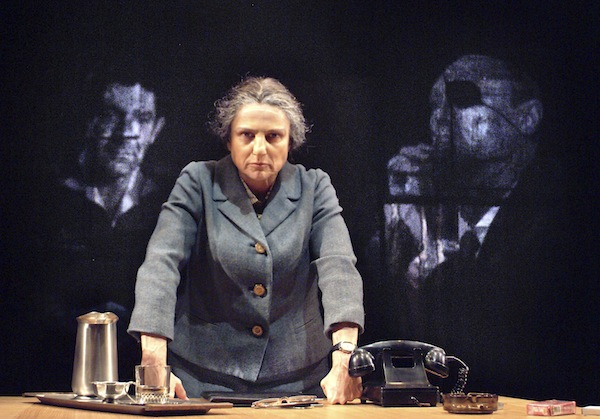
“How does a housewife decide between generals?” asks Golda Meir (played by Tovah Feldshuh) in Golda’s Balcony. In this instance, she must decide between the counsel of David (Dado) Elazar, her chief of staff, left, and Moshe Dayan, her minister of defence. (production still)

Tovah Feldshuh is incredible to watch in Golda’s Balcony, The Film. Not just in her passionate and sympathetic portrayal of Golda Meir, Israel’s prime minister from 1969 to 1974, but in her depiction of all 45 characters in William Gibson’s one-woman play. She’s Meir, David Ben-Gurion, David (Dado) Elazar, her husband Morris, Holocaust survivors and Israeli soldiers, among many others. She moves as easily between the personalities as a child raised in a multilingual household moves between languages. And with powerful effect.

Golda’s Balcony, The Film has two screenings at the Vancouver Jewish Film Festival – March 1, 1 p.m., and March 2, 3:30 p.m., at Fifth Avenue Cinemas. See it. You will have a more nuanced understanding of Meir, as well as of Israel, its origins and the struggles it has faced and will face. Gibson’s text is superb; it is engaging and insightful, with enough humour along the way that you’ll be able to breathe on occasion, as Meir deals with the existential crisis of the Yom Kippur War. Fluidly switching from wartime to other parts of her life, the play depicts, if nothing else, the stressful, heart-wrenching, thankless job that is being prime minister of a country that is constantly under threat.

The film is a recording of the play’s soldout Off-Broadway première on May 4, 2003, at the Manhattan Ensemble Theatre, presented by Issembert Productions. After a four-month soldout run at MET, the show moved to Broadway, and the Helen Hayes Theatre, where it ran for 15 months, making it, apparently, the longest-running one-woman show in Broadway history. It has won countless awards.

The set is relatively simple. A table with a couple of chairs on a tile floor. On the table, a dial telephone, a pitcher and water glass, an ashtray, cigarettes. Light shines on the table from the right, as if from a window. The backdrop is a wall of reddish stone or metal slabs of varying sizes that protrude outward. Images are projected onto the wall or chairs when relevant, giving the audience a visual of the person Meir is talking about, or that Feldshuh is portraying – though it is hard to see these images in the film version. To the side and a step down is a small piece of stage covered in dirt, with a few rocks, which acts as refugee camps in Cyprus, the kibbutz on which Meir lived for a time, Russia when Meir visits on a diplomatic tour, etc. The focal point for the entire production is Feldshuh.

The play begins in darkness, a man chants a prayer, the words “Golda’s Balcony” appear briefly on the wall. Thunder claps, lightning flashes, gunshots ring out, then darkness again, but the sound continues: guns firing, bombs exploding, planes overhead. A housecoat-garbed Golda, sitting at the head of the table, strikes a match and lights a cigarette; the lights rise a bit and calmer music prevails.

“I’m at the end of my story,” says Golda. “I’m old. I’m tired. I’m sick. Dying, the doctors tell me. The picture you have of me as Mamaleh Golde, who makes chicken soup for her soldiers, it’s a nice picture. And I do make chicken soup. But let’s empty it all out for keeps right now because, at the bottom of the pot, is blood. At the bottom of the pot is the question that won’t die. I can do without that music!” she yells. It stops. The lights come on more fully, as Golda then starts to relate the story of her first voyage to Palestine, with her husband, in 1921 – 52 years later, she would become prime minister.

“I remember, starting with a phone call, that woke me up at four o’clock in the morning. Saturday, Yom Kippur, 1973,” she says, as she closes her eyes, looking exhausted, her right arm holding up her head, the left one sliding off the table. The phone rings. Startled, she answers it, hearing the news that Egypt and Syria have attacked Israel. As she takes off the housecoat, Golda is in her familiar muted woolen skirt suit; energy, anger and fear all come to the surface as she relates her generals’ differing views as to what Israel needs to do. Dado: attack! Moshe Dayan: don’t be seen as the aggressor! “How does a housewife decide between generals?” she asks.

Of course, she does decide. But the agonizing and tension-filled process leads her – and Israel – down some very dark paths and the play masterfully depicts her sadness, anxiety and frustration; the sacrifices to her family, her health, as well as to others. Throughout the many narratives, it is the story of the Dimona nuclear facility to which she will get, the story that haunts her, that took her to hell; the story she needs to gather the strength to tell.

Thunder, lightning and gunfire divide the scenes in the whirlwind of action that Golda describes, her domestic life almost as tumultuous as her political life. We see her humanity, but also her toughness. Luckily, she never had to answer the question that “won’t die”: if Israeli forces hadn’t been able to cross the Suez Canal and if the United States had not come through with the needed military aid, would she have ordered the dropping of the nuclear bombs with which she had armed Israel’s planes?

Golda’s Balcony is a must-see in a festival with many excellent films. For the full schedule, visit vjff.org.

Format ImagePosted on February 21, 2020February 19, 2020Author Cynthia RamsayCategories TV & FilmTags Golda Meir, history, Israel, theatre, Tovah Feldshuh, Vancouver Jewish Film Festival, VJFF
Chasing elusive photo

Chasing elusive photo

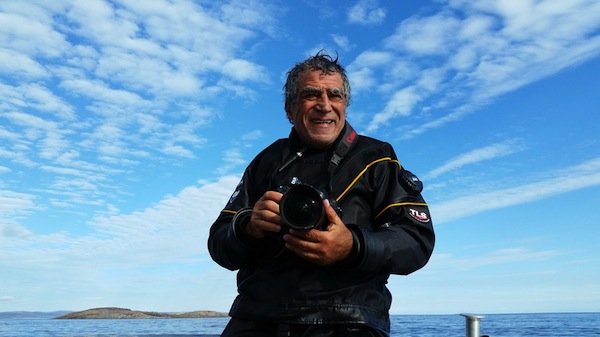
Picture of His Life follows Amos Nachoum to the Canadian Arctic, where he hopes to fulfil his dream of photographing polar bears underwater. (photo from Hey Jude Productions)

The ocean, in its vastness, suits Amos Nachoum perfectly. It’s big enough for him to hide. Not from the great white sharks, orcas, manta rays and other large sea creatures he has obsessively sought out and photographed for four decades. But from his traumatic memories of the Yom Kippur War, and from his father’s impossible expectations.

“Amos has made a decision to put the war behind him, to put violence behind him, and to use the camera to tell a different story, a beautiful story, about men and nature,” Israeli documentary filmmaker Yonatan Nir said in a phone interview while his family frolicked nearby in the kibbutz pool. “I think, in a way, he’s reframing his life with his camera.”

Nachoum’s complicated saga is rendered with gravity and grace in Nir and Dani Menkin’s Picture of His Life, which screens in the Vancouver Jewish Film Festival March 3, 8:45 p.m., at Fifth Avenue Cinemas.

Picture of His Life is structured around Nachoum’s summer 2015 expedition to the Canadian Arctic, more than 3,000 miles from his Pacific Grove, Calif., home, to try and fulfil his ultimate dream of photographing polar bears underwater. (Hence, the second meaning of the film’s title.)

The epic documentary’s executive producer is Nancy Spielberg, a nice bit of irony given that her brother made a flick called Jaws many years ago that spawned a widespread, irrational fear of sharks.

Nir and Menkin originally wanted to make a documentary about Nachoum diving in Tonga a decade ago, but that undertaking proved too expensive. Instead, they made Dolphin Boy, a redemptive portrait of a traumatized young Arab healed by swimming with dolphins in the Red Sea, which earned worldwide acclaim.

As it turned out, the extra years were essential, and not just to raise the funds for four Jews (Nachoum, the directors, and veteran underwater cinematographer Adam Ravetch) and six Inuit to trek to and film at remote Baker Lake. The filmmakers’ taciturn and enigmatic subject had to reach a point where he was willing to confide his deeply hidden feelings and memories.

“He really didn’t talk until we got to the Arctic,” Menkin recalled on the phone from his car in Los Angeles, “and that’s when he started to open up.” Nir added, “Amos needed time to open up and to be able, finally, to let us deep into his soul and to tell it for the first time.”

After the Arctic trip, Nachoum gave surprisingly candid interviews to the Israeli press about both his postwar trauma and his father, who had fought in the War of Independence. His way of dealing with his past continued – and continues – to expand.

There’s no question that the process of making Picture of His Life contributed to Nachoum’s evolution. Nir and Menkin visited his father in the hospital near the end of his life, capturing a raw, powerful moment. They subsequently showed the footage to Nachoum with the understanding that they would include it in the film only if he gave his consent.

Nachoum was touched by the scene and agreed to its inclusion. He even enacted an onscreen form of reciprocation to complete the circle.

“We were able to create this closure between the father and the son, but only through the film,” Nir said. “It never really happened face to face.”

The personal story in Picture of His Life is wrenching, but the environmental component is pretty potent, too. “I see myself as a soldier for Mother Nature,” Nachoum declares in the film, but his desperate, late-career pursuit of the polar bear goes even deeper.

“At the end of the day, Amos was looking for his family,” Menkin said. “His family is the universe. It’s Mother Nature. He found his family and lives with it in harmony, and that’s what he wants us to do.”

Michael Fox is a writer and film critic living in San Francisco.

Format ImagePosted on February 21, 2020February 19, 2020Author Michael FoxCategories TV & FilmTags Amos Nachoum, Arctic, Dani Menkin, documentary, Israel, photography, Vancouver Jewish Film Festival, VJFF, Yonatan Nir

Posts pagination

Previous page Page 1 … Page 275 Page 276 Page 277 … Page 664 Next page
Proudly powered by WordPress