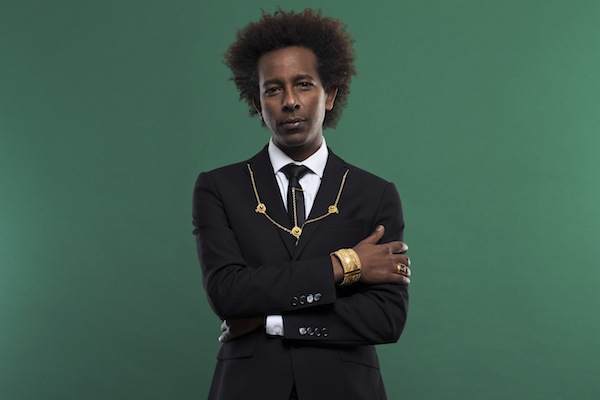
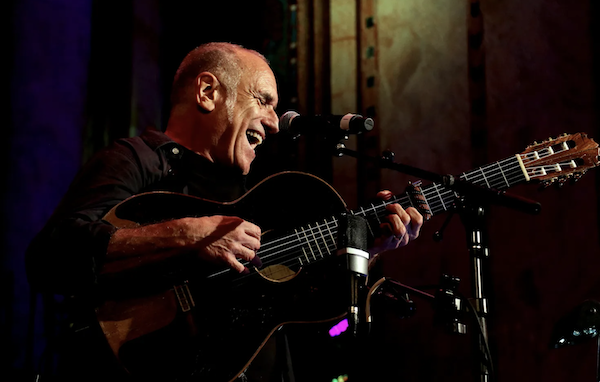
Gili Yalo performs in Vancouver on Sept. 24 for a Chutzpah! Plus event. (photo from Chutzpah!)
Israeli singer-songwriter Gili Yalo returns to Vancouver for a Chutzpah! Plus concert on Sept. 24. It’s his first time back in the city since 2015, when he was part of the band Zvuloon Dub System. Yalo said he can’t wait – “the last time at the Chutzpah! Festival was wonderful!” he told the Independent.
In 2015, Zvuloon Dub was touring the United States and other countries. “Part of the tour was the Chutzpah! Festival,” said Yalo, “and we finished the tour in Montego Bay, Jamaica, performing in the legendary festival SumFest. After being part of Zvuloon Dub for seven years, I felt that it was the right time and the right spot to start something new. I came back to Tel Aviv and started working on new songs for my solo career.”
Yalo’s eponymous first solo album, released in 2017, was very well-received and he followed it up in 2019 with the EP Made in Amharica, on which he collaborated with Dallas-based musicians in Niles City Sound, a studio in Fort Worth. He has released several singles and has played on stages and in festivals around the world.
But, even though he has been a singer his whole life and performing almost as long – including in children’s choirs and during his time in the Israel Defence Forces – Yalo resisted making music a career. Among his alternate endeavours was being a club owner.
“I opened the club for Israeli Ethiopian people, who didn’t feel safe to stand in line at Israeli clubs; back then we got a lot of refusal just because of the colour of our skin,” he explained. “At the club, there were two floors, one of R&B and reggae/dancehall music, the other one was Ethiopian music. It really affected me because I have heard and learned lots of Ethiopian music.
“After several years of running the club, I felt that I needed to do something different in my life … and I told myself, you don’t want to regret not trying to achieve your biggest dream, and I decided that I had to try and overcome my fears. It was natural for me to make a fusion of Ethiopian music and Western music such as jazz, funk, R&B and reggae, because that was my life between home and the outside.”
Born in Ethiopia, Yalo was 4 or 5 years old when he and his family fled to escape famine in 1984. Traveling by foot, it took them about two months to walk from the Gondar region, in northern Ethiopia, to refugee camps in Sudan, where they stayed for several months, until being airlifted to Israel as part of Operation Moses.
“Lots of the songs that I’m writing are talking about identity, journey and integration into society, so I think all of it came from the experience of making aliyah and the difficulty in the process,” Yalo told the Independent.
There are many things that Yalo would still like to accomplish, but, right now, he said, “I especially want to share music.” He wants to write good songs, collaborate “with musicians that I appreciate, and take my music to a place that it can inspire lots of people.”
Playing in Vancouver with Yalo will be Nadav Peled (guitar), Dor Heled (keys), Billy Aukstik (trumpet), Eran Fink (drums) and Geoffrey Muller (bass).
About coming to the city, Yalo said, “I want to say that Vancouver is one of the best places in the world. I’ve seen so many places thanks to music and, if it wasn’t so far away from my family, I would definitely consider living there.”
For tickets to the Sept. 24, 8 p.m., concert at the Rothstein Theatre, visit chutzpahfestival.com.
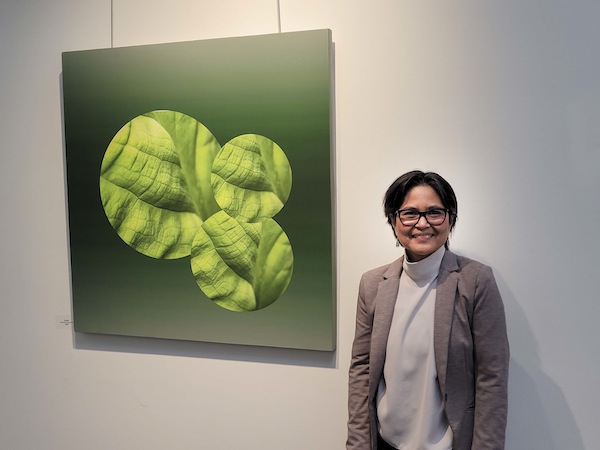
Megs Gatus’s solo exhibit, Leaves in Space, runs until Sept. 22 at the Zack Gallery. (photo from Megs Gatus)
Megs Gatus – whose solo show, Leaves in Space, opened at the Zack Gallery on Aug. 24 – unexpectedly stumbled onto an artistic path.
“It started for me when I saw a photograph of a butterfly,” she said in an interview with the Independent. “It was in 2010. I was fascinated by that picture. I thought maybe I could be a photographer too.”
She had never taken photos before that day. She came to Canada in 2002 from the Philippines and worked (and still works) for the City of Vancouver. “But there is a creative gene in my family,” she said. “My brother is a contemporary dancer. My sister sings. I decided I wanted to be a photographer.”
In 2011, Gatus signed up for a photography workshop at a local community centre. “I bought my first camera from Craigslist,” she recalled. “It was only a hundred dollars.”
After that, she started taking photos. Portraits, flowers and landscapes were among her favourite subjects.
“I joined an online photography group on meetup.com because I wanted to share my pictures with the others,” she said. “I was amazed when the group picked my photos to display on their website. It was so encouraging. Later, a friend told me I had an eye for composition. I was elated. I wanted to learn more about the photographic art, so I enrolled in the Emily Carr certificate program, evening classes.”
She kept up her daytime job through it all, even as she graduated from Emily Carr University of Art + Design in 2018.
“I never stopped taking photos,” she continued, “but, by that time, I stopped being interested in reality photography. I didn’t want my photos to reflect the objects by themselves, the way they are off camera. I wanted people to see my photographs as an art form, different from reality. I wanted my pictures to invite curiosity in viewers.”
Gatus began experimenting with her camera settings. She also tried to move the camera while taking the photos, and the results meshed perfectly with her artistic vision. No recognizable objects manifested in her images when she used the technique called intentional camera movement, combining it with multi-exposures.
Each image is a play of colours and patterns, abstract and bright. The lines and the colours dance together in her photographs, which look more like paintings. She seems to invite viewers to use their imagination, while she herself explores every possible hue and shape to convey her ideas. Her camera is her paintbrush. “I do everything inside my camera. No Photoshop,” she said.
In 2016, Gatus joined Photoclub Vancouver. Since then, she has participated in many of their group exhibitions, including those the group held annually at the Zack Gallery. She liked the energy of the gallery, so, a few months ago, put forward the idea of a solo show and it was accepted.
“This is my first solo exhibition in a gallery space,” she said. “But I had a show recently in the Britannia Art Gallery, together with another photo artist, and I often display my works in several coffee shops.”
“Edges” by Megs Gatus.
Gatus created all the work displayed in the current show during the pandemic. “We all felt so isolated, but we all occupy the same space. We are all responsible for our environment: plants, leaves, flowers. That’s why I used the shape of a circle,” she explained. “I took photos of nature: autumn leaves and spring flowers, and the circles enclose them. The circles symbolize all of us. That’s what the name of the show means: Leaves in Space.”
No image in the show looks like a standard photograph. One doesn’t see leaves or trees, but rather abstract compositions throbbing with life and fantasy. They could be science fiction illustrations of distant galaxies, visual representations of a soul or screenshots from a computer game. Or just beauty emerging from the artist’s insight.
“I like taking photos of organic matter. Leaves, plants, flowers – they are all alive,” she said. “I take photos in parks and gardens around B.C. I only enhance the colours a little inside the camera. Through my technique, the images become abstract, and I try to find ways to present them differently. I want to engage viewers.”
Besides the images hanging on the gallery walls, Gatus also offers large silk scarves for sale. All the scarves are imprinted with the photographs she used in the exhibit. The same swirls of colours in a different medium look surprisingly different, almost unrecognizable, but still pretty and vibrant.
“Sales are not my motivation,” she said. “I want to show my pictures, to share them with people.” That’s why she enjoys commissions. “A client of mine liked one of the pictures in this show so much, she asked me to enlarge it and she put it in her spa office.”
Gatus has big plans for these works after their run at the Zack Gallery.
“I’d like to exhibit this collection in other B.C. cities: Surrey, Port Moody, Langley. Later on, maybe even in Toronto and Montreal. I’m going to retire soon, and then I will dedicate all my time to my art.”
Leaves in Space continues until Sept. 22. The official opening reception will be held at the gallery on Sept. 8, at 7 p.m. To learn more, visit the website megsgatus-abstract.myportfolio.com.
Olga Livshin is a Vancouver freelance writer. She can be reached at [email protected].
Leslyn Lewis, a candidate for the Conservative Party of Canada leadership that will be decided in the coming days, made a stir last week when she invoked the Nuremberg Code, apparently with regard to coronavirus vaccines.
The Nuremberg Code is a postwar set of principles on medical ethics arising from the horrific medical experimentations of the Nazi era. Although Lewis did not explicitly mention COVID-19, the issue was clear in context. She warned of government overreach, saying, “even in modern times the tenets of informed consent and voluntary participation in scientific experiments can be easily undermined by even our modern governments.”
If for no better reason than avoiding a communications crisis, reasonable candidates for elective office should avoid comparing things to Nazism. In almost every instance, there is nothing to be gained. In this instance, where the candidate appeared to be referring to a vaccine that can prevent or seriously reduce the impacts of a potentially deadly virus, the comparison is irresponsible and base.
Around the same time as Lewis was causing controversy here in Canada, Mahmoud Abbas, the Palestinian president, stood next to the German chancellor, Olaf Scholz, and declared that Israel had perpetrated “50 holocausts” on the Palestinians. Scholz has been criticized for not immediately condemning Abbas’s atrocious act of Holocaust desecration – words that took place on German soil.
This incident was a flashback to the time, in 1999, when Hillary Clinton, then the U.S. first lady, got in trouble for standing on stage with Suha Arafat, wife of Yasser, when Mrs. Arafat accused Israel of poisoning the Palestinian water supply. This accusation, an unoriginal claim pilfered straight from antisemitic Medieval European well-poisoning canards, was akin to the latest outrage from Abbas in both form and international reaction.
About the only time the West expresses any concern about such defamations is when they are uttered in the presence of world leaders in front of less credulous media than the Palestinian leaders face at home. While Clinton and Scholz certainly deserve some censure for not speaking out instantly in the face of such overt libels, their presence is a sideshow to the main event: a narrative that is founded on grotesque demonizations.
Abbas is no newcomer to Holocaust revisionism and defilement. His PhD dissertation at a Soviet university contests the number of Jewish dead and accuses Zionists of participating in the Shoah to advance their nefarious aims.
These sorts of lies – “holocausts,” poisonings, genocide, even Zionist sharks attacking tourists – are routine fodder for Palestinian leaders, newscasters, media and even the United Nations-funded Palestinian education system. It is the nature of dictatorial leaders and undemocratic movements that they grow intellectually lazy, having groomed an audience so inured to lies and exaggerations that they will accept, or at least not contest, the most depraved allegations. After 70-plus years of exposure to increasingly preposterous conspiracies like Zionist-trained sharks snapping at European tourists at beach resorts, many are ready to accept and repeat them.
“A lie gets halfway around the world before the truth has a chance to get its pants on,” Winston Churchill colourfully said. Churchill died before the internet was born. Today, a lie gets even farther even faster.
Mix the range and speed of the internet with millennia of conspiracies about Jews and the reality that most people are inundated with Israel-Palestine news without context, and it is easier to understand why people who are overwhelmed by complexity and who seek simple solutions don’t resist or even question such lies.
For similar reasons, we must both keep a critical eye on how science evolves with coronavirus and vaccines, as well as encourage people to get vaccinated, to reduce the risks of disease. Terrible experiments have been done on marginalized populations so, as a society, we must be sensitive to these experiences and traumas. The mistrust has a real history, but some people are using this fact to sow more mistrust in institutions and governments, which adds to the fires of conspiracy, which is bad for everyone, but in particular marginalized and minority populations.
While miles apart in quality, the remarks by Lewis and by Abbas deserve condemnation. The world, especially now, tends to move on quickly from one moral atrocity to the next, from this outrage to the next. But we cannot let these things go unchallenged – whether they come from dictators or from potential leaders in a democracy. The job of decent people is to come along and clean things up. It’s a dirty job. But somebody has got to do it.
Jewish Family Services Vancouver Island will extend its hours for the Sept. 18 community resource fair that launches the Jewish Federation of Victoria and Vancouver Island’s annual campaign this year. (photo from jfsvi.ca)
The Jewish Federation of Victoria and Vancouver Island (JFVVI) is trying something a little different for its annual United Jewish Appeal campaign launch this year. On Sept. 18, they will celebrate Jewish diversity in British Columbia with a community resource fair. The event will be held at the Jewish Community Centre of Victoria, from 1 to 4 p.m., and will feature presenters from both Vancouver Island and the Lower Mainland.
“We are changing things up this year,” said Coral Grant, executive director of JFVVI. “Usually, we have a guest speaker. The past few years, it has been on Zoom. This year, we wanted to reach the wider community by having a launch we could do in person. We are really hoping that, with this fair, we can encourage people to come out and see what is available in the Jewish community in British Columbia, as well as locally.”
As it does every year, the JFVVI campaign runs from Sept. 1 to Dec. 31. Mailings and outreach through fliers to members of the community are currently underway and, soon, volunteer canvassers will continue these fundraising efforts. For 2022/23, the campaign’s objective is to raise $175,000 – or $10,000 more than it did in 2021/22. The previous year’s campaign exceeded its target, as it included a separate campaign raising funds for Ukraine.
The response to the call for fair presenters was tremendous – JFVVI quickly ran out of available display space at the Victoria JCC. The fair will take place in the main area of the building, the same location as the Lox, Stock and Bagel Deli, which ordinarily operates Tuesdays to Fridays, 11:30 a.m.-1:30 p.m.
Many of the 20 tables will be operated by representatives from Vancouver-area organizations, such as the Jewish Museum and Archives, the Jewish Federation of Greater Vancouver, the pluralistic Jewish teen movement BBYO, the Canadian Jewish Political Action Committee (CJPAC), Birthright Israel and March of the Living.
Among the local groups will be the JFVVI, the Victoria Jewish Choir, PJ Library, the Victoria Shoah Project, Canadian Hadassah-WIZO, the Centre for Israel and Jewish Affairs (CIJA), the Jewish Burial Society, the theatre group Bema Productions and the Hebrew school from Congregation Emanu-El. All of the Victoria congregations – Chabad of Vancouver Island, Congregation Emanu-El and Kolot Mayim Reform Temple – will be participating and the Mekorah Institute, co-founded by Rabbi Matt Ponak and dedicated to bringing integrated and sustainable spiritual transformation to individuals and religious lineages, will be there, too.
At the fair, the Victoria JCC will highlight the Victoria International Jewish Film Festival, now in its eighth year, which takes place both online and in person at the Vic Theatre in downtown Victoria Nov. 1-6. Jewish Family Services Vancouver Island, which sells fresh produce at wholesale prices every second Sunday in the summertime from the JCC parking lot, will extend its hours for the occasion.
Recent estimates on the size of the Jewish community in Victoria range from 1,500 to 3,000 people. One point on which most can agree, however, is that, whatever the number, it has been increasing. The city is now home to three synagogues, a secular humanist group, a kosher bakery and numerous other organizations and social and cultural activities.
“There are a lot of folks who have moved here recently, and it may be interesting for them to find out what is happening here,” Grant said. “For the locals, having some of the organizations from the Mainland may be an eye-opener. We are really hopeful that, in covering a broad spectrum of organizations, the community will find something which is new and exciting for them.
“I am really excited,” she said, “because this is an in-person gathering and I’m excited that we have been able to collaborate with people on the Mainland to showcase the diversity in the province and bring some of that to the Island. To do this as a campaign launch is kind of a novelty for us and, hopefully, it will all come together and work.”
About to embark on its 36th year of operation, JFVVI is the umbrella organization of the Jewish community in the capital region and Vancouver Island. It raises funds for local groups and supports organizations, individuals and families both regionally and in Israel with grants and scholarships and through partnerships with community leaders. It coordinates, plans and promotes social, educational, cultural, health and welfare programs and activities in the Jewish community. The JFVVI is committed to building strong, vibrant Jewish communities throughout the Island.
For more information about how to donate to the Jewish Federation of Victoria and Vancouver Island, visit jewishvictoria.ca.
Sam Margolishas written for the Globe and Mail, the National Post, UPI and MSNBC.
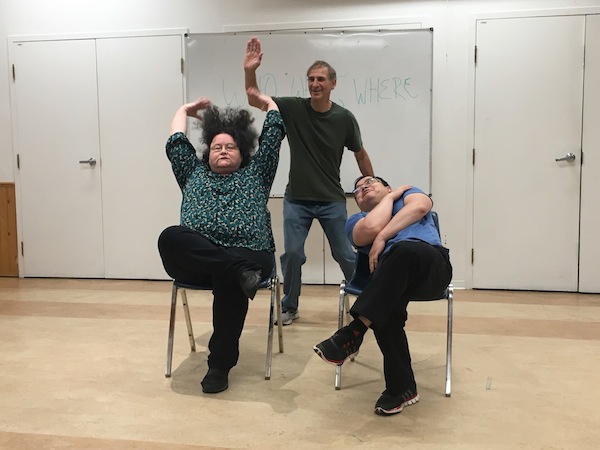
Students Adrianne Fitch and Brian Nguyen, with instructor Irwin Levin behind them. Levin and Cass Freeman teach a free workshop on Sept. 13. (photo by Adam Abrams)
“When I teach a series of eight classes, I see people who are quite scared and nervous and sometimes very shy, and watch them become daring and playful improvisers towards the last class, and that is quite satisfying,” Cass Freeman told the Independent.
Freeman and her husband, Irwin Levin, are teaching an improv workshop with a focus on teamwork at Mount Pleasant Neighbourhood House Sept. 13. As well, Freeman is teaching a series at the Roundhouse Community Arts and Recreation Centre that runs eight Tuesday nights, starting Sept. 20.
“We really care about our students’ experiences,” said Freeman, who has taught improv comedy games on and off since the early 1990s. “We really want them to enjoy themselves and relax so they can be spontaneous. We rarely put people on the spot and, when we do, we coach them, so they don’t have to struggle up there alone.”
Freeman was an injured dancer when she found Vancouver Theatresports, now called the Improv Centre. “I saw them perform one night in the 1980s,” she said, “and I thought, ‘I can do that!’ So, I took a series of classes there and ended up performing in their first-ever Rookie Night. I was terrified, but I remember the audience endowing me as embarrassed, so I just hid behind the other players for a whole scene and did OK.
“Improv is such a positive form of theatre,” she added. “The people are really great, very playful and intelligent. I was quite a negative person in some ways, during my 20s especially. Improv really turned around my life. I was much more accepting of other people’s ideas. And I found the work to be really healing.”
Levin first heard about improv from Freeman. “I was doing standup comedy when I met Cass and found out that she was doing improv,” he said. “I was attracted to both Cass and improv simultaneously! (We met in 1994 and were married in 2000.) Now I will be taking a standup course as well as assisting Cass in improv workshops, so I will be getting the best of both comedy worlds.”
The couple has recently started their own improv business.
“We’d like to spread some playfulness, laughter and joy around our little corner of the world,” said Freeman about the venture. “We’d like to teach improv games for teamwork, stress reduction and creativity or just plain fun in as many different organizations as we can. People in the Jewish community have an amazing sense of humour, so we’d love to teach anyone in the community who is interested.”
Cass Freeman teaches an eight-class improv course at the Roundhouse this month, starting Sept. 20. (photo by Irwin Levin)
Freeman has worked as a freelance journalist in radio, television and print since 1987. Her first article in the Jewish Independent, which was then called the Jewish Western Bulletin, was in 1982 – about human rights activist Judy Feld Carr and her efforts over some 30 years to bring Jews out of Syria. Her most recent article was this past April, a profile of Vancouver Playback Theatre.
Local readers may also know Freeman’s name from The World According to Keith, a 2004 documentary for Bravo TV that she co-produced, about Theatresports creator and instructor Keith Johnstone.
“Keith Johnstone created Theatresports, along with his university students in Calgary, during the late 1970s,” explained Freeman. “He has also taught improv all over the world and there are now more than 150 theatre troupes who perform Theatresports and other formats he has created, like Maestro Impro and his favourite format, called the Life Game. You can see Maestro Impro at Tightrope Theatre in Vancouver.
“Keith trusted me to make a documentary about him because after I watched his righthand man, Dennis Cahill, do a weekend workshop in Calgary, he said to me, ‘You were great, you were like a fly on the wall. We’ve had other journalists here and they were quite obnoxious.’
“Keith became like a second father to me,” said Freeman. “My dad came from England and Keith has the same wicked British sense of humour. We still keep in touch and I have an autographed book from him that says, ‘Be average, Cassandra,’ since he noticed that when I was in his workshops that I tried too hard.”
Another memorable moment in her career came when she was teaching at the Vancouver School Board night school, which she did for about five years. “One night,” said Freeman, “the administrator called me into his office and said, ‘The instructor next door to you is complaining that his students can’t concentrate because your students are laughing too much.’ It was the best insult anyone has ever given me.”
Levin recalled a private workshop he and Freeman did this past July. “One of the students was so inspired,” said Levin, “he has decided to pursue a career in acting.”
But aspirations to be an actor are not the main reason to learn improv.
“Improv can relieve stress, reduce stage fright and improve self-esteem,” said Freeman. “Improv games encourage creativity, quick thinking and communication skills, and are a great tool for breaking the ice, having fun and building team spirit.”
She described improv as a team sport, with almost all the games being about supporting the other person or people onstage with you. This is why it’s a great way to get over stage fright, she said, “because the focus will rarely be on you alone, like it is in standup comedy.”
Freeman and Levin welcome people of all ages, backgrounds and abilities to take their classes, as well as members of the LGBTQ+ community. And, as mentioned previously, fellow members of the Jewish community.
“We’d love to hear someone say ‘oy!’ on our stage. Or any other Yiddish or Hebrew phrases,” said Freeman. “There aren’t many improvisers out there who are Jewish and we’d like to change that.”
There are also not many improv instructors who are Jewish, she said. Nor instructors who have a disability.
“I’m among the many people who have an invisible disability,” she shared. “I’ve had it since I was 19. The way it affects me today, a few decades later, is that I can’t stand in line on pavement and I can’t walk at all unless I’m wearing a very shock absorbing running shoe. So, when I teach, I have to wear runners. At our last workshop, nine out of the 14 people participating said they had something physically wrong with them. We are delighted to be able to teach people with varying physical abilities.”
The free team-focused workshop on Sept. 13, 6-7:30 p.m., is part of Mount Pleasant Neighbourhood House’s Generations Moving Together (GMT) program, which “encourage[s] community involvement, movement, learning and connection between younger and older generations.” To register for the workshop, contact GMT coordinator Daniela Gunn-Doerge at [email protected] or call 604-879-8208, ext. 225. (Refreshments are provided.)
The improv classes at the Roundhouse run on Tuesdays from Sept. 20 to Nov. 8, 6:30-8:30 p.m. It’s $160, but half price for people who have a Leisure Access Card. To register, click here or call the Roundhouse on Sept. 17at 604-713-1800. Freeman and Levin can be reached at [email protected] or 604-872-4638.
After an acclaimed run at the Vancouver Fringe Festival in 2021 and the Edmonton and Montreal Fringes this year, Everybody Knows returns to its creator’s hometown and the Vancouver Fringe Festival. In this semiautobiographical, one-woman musical set to nine covers of Leonard Cohen songs, Rita Sheena creates a spiraling narrative using contemporary dance, post-modern quirk and the haunting melodies of First Aid Kit.
* * *
Jem Rolls (PR photo)
In 2015, Jem Rolls brought his one-man show about Hungarian Jewish physicist Leo Szilard, The Inventor of All Things, to the Vancouver Fringe Festival. This year, he’s back with another show about a forgotten Jewish nuclear physicist – Lise Meitner. The Walk in the Snow: The True Story of Lise Meitner explores how a shy Austrian, who only graduated high school at 23, opened so many doors and achieved so much; how she pushed against age-old sexism and murderous antisemitism; how she was the first or second woman through a whole series of doors; and how she was one of the very few physicists to refuse work on the bomb.
* * *
ira cooper (photo from spectheatre.com)
Vancouver-born, Jewish writer and performer ira cooper of Spec Theatre stars in the one-man show mr.coffeehead, which is arriving at the Vancouver Fringe Festival after a series of successful premières at the Winnipeg, Victoria, Edmonton and Montreal Fringes. In Montreal, the “foot-fueled, slapstick tragedy about bikepacking, dreaming big and giving up in your 30s,” which was written by cooper, was nominated for Outstanding Clown Show.
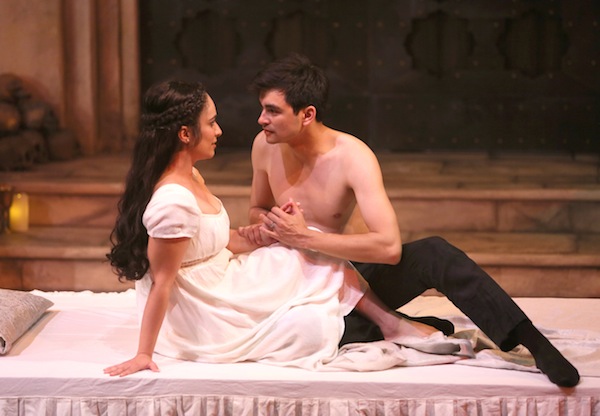
Ghazal Azarbad and Daniel Fong in Bard on the Beach’s Romeo and Juliet, which runs to Sept. 24. (photo by Tim Matheson)
William Shakespeare’s tragic love story, Romeo and Juliet, about teenaged lovers who come together despite the objections of their families, resonates with contemporary audiences as much as it did with the Elizabethan crowd.
Since it was written in 1595, ˆ has spawned countless adaptations, including the musical West Side Story, the animated feature Gnomeo and Juliet, and even a Palestinian girl meets Israeli boy version. So how do you present this well-known tale from a different angle? You do what director Anita Rochon did for this year’s Bard on the Beach production – start at the end, when Juliet wakes up in the family crypt next to dead Romeo, and flash back to the beginning. As well, tell the story from Juliet’s perspective, as she grapples with the question of how this situation came to be.
Rochon has taken some creative liberties with Shakespeare’s text, nipping and tucking here and there, and leaving out the characters of Lord Capulet and the Montague parents. Purists may not appreciate that surgery but will like that the play is set in its proper era. However, if you don’t know the story, the time line is a bit confusing, as the scenes jump around a bit, unlike the linear unfolding of the original text, so you should read the program summary beforehand.
From the minute you walk into the small tent and are met with the sight of the set, you know you’re in for a treat. Front and centre is an elevated marble-like tomb surrounded by 300 skulls strategically stacked around the macabre crypt, all bathed in flickering candlelight. The crypt’s massive iron doors open and close on an ever-changing backdrop as actors make their entries and exits. The tomb disappears into the ground on scene changes while a balustrade rises from the ground for the iconic balcony scene. Kudos to set designer Pam Johnson for a job well done.
The acting in this production is also first rate. Each and every one of the nine actors gets the job done. Daniel Fong as Romeo, Ghazal Azarbad as Juliet and Jennifer Lines as Lady Capulet are particularly strong in their roles. Fong nicely portrays the naïve confusion of the young swain while Azarbad shows strength of character and resolve not normally seen in depictions of teenage girls. The chemistry between the eponymous duo is palpable.
But it is Lines – morphing from gracious and charming party host to ferocious tiger mother when she gives Juliet the disinheritance ultimatum – who captures the essence of the play’s unspoken dilemma: Do we marry who our parents/families pick for us or do we marry who we love, no matter the consequences.
In a nod to role reversal, which seems to be the flavour of the season for Bard, Andrew McNee plays Juliet’s nurse, Sara Vickruck does double duty as the doomed Mercutio and the Apothecary and Anita Wittenberg plays Friar Laurence. McNee is one of the best comedic actors this city has, and his antics on the boards inject much-needed comic relief into an otherwise dark script.
Raising the production to sublime are the costumes (richly coloured, textured gowns for the ladies and sexy doublets and britches for the men), the dramatic lighting and the trio of choreographed sword fights – all backgrounded by the haunting tones of handheld bells that herald scene changes.
As Rochon points out in the program notes: “We know how their story ends and, in a way, we know how all our stories will end. The way we get there is where the mystery begins.”
You don’t have to be a hopeless romantic to appreciate the beauty of this production, which runs to Sept. 24 on the Howard Family Stage at Vanier Park. For tickets, visit bardonthebeach.org or call 604-739-0559.
Tova Kornfeld is a Vancouver freelance writer and lawyer.
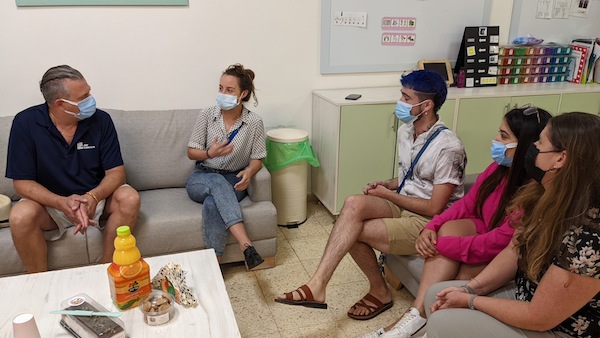
JNF Pacific region executive director Michael Sachs, left, in a meeting at Aviv House for autistic adults in Israel. (photo from JNF-PR)
Three Israeli projects supported by the Pacific region of the Jewish National Fund of Canada are advancing well, according to Michael Sachs.
Sachs, executive director of JNF Pacific region, visited the initiatives July 7-18. He was joined on the Israel trip by local JNF supporters Lisa and Mike Averbach. The trio surveyed projects in Rishon LeZion, in Jerusalem and at Nir Galim, a moshav near Ashdod.
The project in Rishon LeZion, south of Tel Aviv, is a women’s shelter that has faced challenges in reaching completion. In collaboration with the Israeli group No2Violence, the facility was supported by two Negev dinners in 2016 – one in Vancouver, honouring Shirley Barnett, and one in Winnipeg, honouring Peter Leipsic.
The shelter is envisioned to welcome 10 to 12 families and provide victims of domestic violence with a safe environment where they can access therapy, secure income and new housing.
Emergency shelter for victims of domestic violence is gravely lacking in Israel, where it is estimated that 65% to 70% of women and children escaping domestic abuse cannot access alternative housing due to lack of availability.
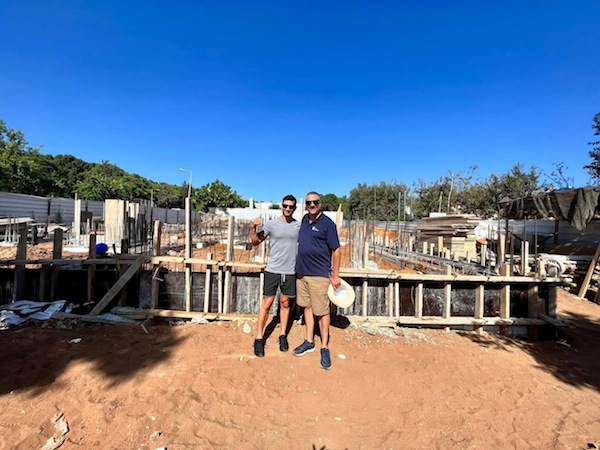
“I wanted to go and see with my eyes, with my feet on the ground, how it’s progressing,” said Sachs of the project. “Finally, shovels have started going into the ground and the foundation has been laid. This project, it had been stalled for multiple reasons, COVID included, but I wanted to go and see the progress because we have a commitment that we make to our donors in our community to fulfil the project no matter what.”
Mike Averbach, left, and Michael Sachs at the construction site of the Vancouver/Winnipeg-supported women’s shelter in Israel. (photo from JNF-PR)
One of the things that impressed Sachs most about the shelter is that it is adjacent to a community centre.
“For women and children who are in crisis, the ability to have a community centre, a place to go, a place for their kids to go, is extremely important, on top of just the safe haven,” he said.
Last year’s Negev campaign in the Pacific region raised funds for ALUT, the Israeli Society for Autistic Children, to renovate Aviv House, or Beit Aviv, in Jerusalem. This “home for life” for autistic adults was established in 1992 and is home to about 14 residents who require assistance in aspects of everyday life.
The building, more than 50 years old, was not wheelchair accessible and had infrastructural challenges. “It needed a lot of work,” said Sachs. The project, championed by honorary project co-chairs Penny Sprackman and David Goldman, saw a new roof put on the building, new bathrooms and doorways, among other upgrades.
Autism has co-morbidities and one of the residents at Aviv House has what is described as the most complex case of epilepsy in the state of Israel.
“This individual had not been able to have a real, proper shower until the renovation,” said Sachs. The renovated facility allows an assistant to accompany the resident in the new shower. “That’s just one example of how it made a difference,” he said. “The effect that we are having on the life of these individuals is immense.”
The ALUT project was especially meaningful for Sachs, he said, because it was the first initiative that took place after he became regional executive director, in April 2021. The fact that it also raised autism awareness in Canada was a bonus, he added.
A third project that Sachs and the Averbachs visited was Beit Haedut, the Testimony House Museum, on Moshav Nir Galim. The museum, located in a community founded by survivors of the Holocaust, focuses on the lives survivors made in the state of Israel.
This project is the focus of the current Pacific region Negev campaign and will involve an especially meaningful Vancouver component. In an interactive space, Vancouverite Marie Doduck, a child survivor of the Holocaust, will present virtually to visitors about her life. She will be the only English-language presenter in the virtual space, meaning that every Anglo visitor to the museum will “meet” her and hear her testimony.
Sachs has heard the question before: Why a Holocaust education centre so close to Yad Vashem, the world’s foremost education, commemoration and research centre on the topic?
“My answer is, why not?” he replied. “Why not have more places teaching people about the Holocaust, the tragedy that happened? It’s our responsibility to make sure that more and more of these centres are supported and able to function and teach a population that is starting to forget. It’s not that because you have one, you can’t have the other.”
The quality of the museum is also significant, he said: “It is a Holocaust centre that, in my eyes, punches above its weight class.”
Being close to Ashdod, where many cruise ships arrive, and near the Negev Desert, the location is also easily accessible for visitors.
Sachs hand-delivered Doduck’s recorded testimony to the museum. He credited the Vancouver Holocaust Education Centre for its assistance in making the technically complex project possible.
Returning from his first trip to Israel as JNF Pacific region executive director, Sachs was rejuvenated.
“Most people come back from Israel and they’re drained,” he said. “I came back with a newfound energy because, when you see the fingerprint JNF Canada has on the state of Israel and you see the efforts, the progress, the impact that our local community – our tiny little local community – is having on the ground there and for the people in Israel, it’s awe-inspiring. It really is. You come out of it and you are more energized than ever to continue to make a difference.”
Lance Davis, chief executive officer of JNF Canada, commended the Pacific region in a statement to the Independent.
“On behalf of JNF Canada, I am so proud that we have advanced two key projects for our organization, the Vancouver/Winnipeg women’s shelter and the renovation of the Aviv House supporting autistic individuals,” said Davis. “Thanks to the generosity of donors from the Pacific region, we are able to help build the facilities that will transform the lives of vulnerable Israelis in a profound manner. Our JNF supporters can take great pride in the fact that together we are building the foundation for Israel’s future.”
Due to COVID, JNF has not held a Negev Dinner in Vancouver since 2019, opting instead to run campaigns without the traditional gala event. Sachs hopes 2023 will see a return to normalcy.
“God willing, we’ll all be able to be back together next year for a wonderful and beautiful Negev Dinner with a wonderful honouree,” he said.
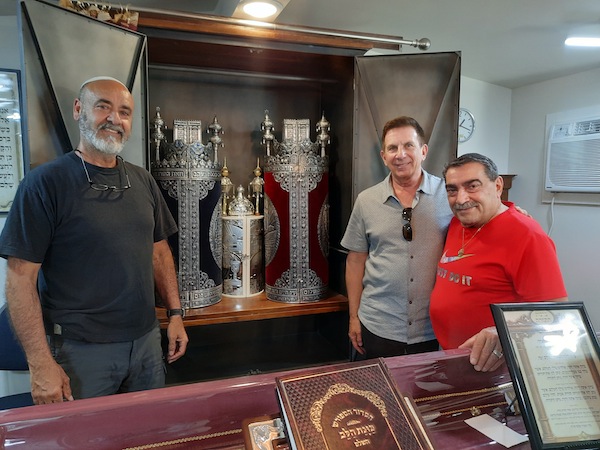
Left to right are Yoseph Hayun, Brian Libin and Shimon Kalhon, founders of Kehillat Klal Israel. (photo by Pat Johnson)
Vancouver has a new Sephardi congregation – and, while unique in the city, its structure would be familiar to plenty of Israelis and to Jews from places with a larger Orthodox population.
In recent years, alternative housing options have expanded in Vancouver, including coach houses and laneway homes. In an alley behind a home on 12th Avenue, just east of Cambie, passersby might notice a building that resembles one of these newfangled domiciles. Were it not for the mezuzah and the modest sign, they might have no idea that the space is a place for communal gatherings. According to the builder, who does triple duty as the president and leader of daily services, it is not a synagogue.
“A synagogue is a little bit tricky,” said Yoseph Hayun. “I could get [approval for] that, but it’s going to take a long time and I would have to go to a board of variance. We said this was kind of a book club.”
It’s not a lie.
“There are lots of books and we all read the books,” he said. “Then we talk about them.”
The kehillah (congregation or community), called Klal Israel, gathers in the backyard of Shimon Kalhon. The idea started after an informal group of Sephardi families, many of them Israeli, had been getting together for holidays for some time. In Israel, and in places of dense Orthodox populations like parts of the United States, intimate gathering places serving neighbourhood families are not uncommon.
Kalhon said Rosh Hashanah, Yom Kippur and other holidays have taken place under tents and they decided to make it more permanent.
The founders – Kalhon, Hayun and Brian Libin – have nothing against the existing Sephardi synagogue, Beth Hamidrash. They just enjoy the sense of family they get from their small congregation. Kalhon and Hayun also wanted something more like they were familiar with from their upbringing – Kalhon in Tripoli, Libya, and Hayun in Ramat Gan, Israel. (Libin is from Edmonton.)
“For us, we are like a family,” said Kalhon. “We don’t have any politics in the synagogue. We don’t have any membership. Every day after [services] we provide breakfast. Every Shabbat, we have lunch. We do all the holidays together.”
Hayun leads most services, unless Rabbi Yechiel (Helik) Orihman is available. Hayun does not have a rabbinic semichah (ordination), but has served as a cantor almost his entire adult life. He also leads classes and has a conversion group of five at present.
Attendance at morning minyan varies. “Sometimes we have 10, sometimes 12, sometimes 15,” Hayun said. “On the holidays, thank God, we have a beautiful minyan. Sometimes we have 30 people.”
The building itself is about 500 square feet, with air conditioning for summers like the 2021 heat dome, area heaters for winter, plumbing for a washroom and a handwashing station. There is also a fully operational kitchen in a covered patio space of about 400 square feet. There is a screen for presentations and classes, as well as room for cozy meals together.
Kalhon jokes about his family’s long walk to services – out the back door and down a few steps.
Kalhon is known to many Vancouver Jews as the owner of Sabra Kosher Restaurant and Bakery, which he opened in 1991 on arrival in the city after a lifetime in the food sector in Israel. At Klal Israel, he is the gabbai(lay leader).
For Libin, the treasurer, the new congregation has been an opportunity to improve his Hebrew skills.
“All the prayers are in Hebrew,” he said. “There’s not much English. There are times where Yossi [Hayun] will explain things, but, for the most part, I’m using a book that’s all in Hebrew. I didn’t used to. Most of us who aren’t native speakers of Hebrew, our Hebrew has improved.”
The linguistic choice is deliberate.
“This is the idea: to bring the young Israelis,” Hayun said, adding that he meets many Israelis on his soccer team, playing golf and around town who do not attend shul. “My vision is to bring them in, to try once a week, once a month, doesn’t matter. Just bring them in. That’s basically the idea and people are coming … slowly, slowly.”
Funds for the building and its operations come from the three founders and anyone else who wants to make an out-of-pocket contribution.
“We have others who are regulars who help out whenever they can,” Libin said.
While the place technically houses a book club, Hayun said it was designed following the religious laws for how a synagogue must be built.
“It’s not like you do whatever,” he said. “There are rules that you need to follow. I know the rules and I went over the books again and again to make sure that we followed the whole thing.”
The aron kodesh, the Torah ark, is the focus of the modest structure and the Torah covers were commissioned by local people for scrolls that were purchased from Israel.
The trio have already mooted what will happen if success renders the space – which seats 40 – too small. They shrug and say they’ll find a bigger place. In the meantime, Klal Israel is open for anyone who wants to join – and stay for a shmooze and refreshments after services.
David Broza has a new album out, and more. (photo from davidbroza.net)
This past spring, Israeli singer-songwriter David Broza, with the support of Temple Emanu-El in New York City, released Tefila, a collection of traditional prayers with new musical compositions by Broza and orchestral arrangements by his musical collaborator, Omer Avital.
Tefila (prayer in Hebrew) incorporates various forms: pop and jazz, gospel, folk and classical. While adhering to the intentions of the prayers themselves, the compositions attempt to recreate and re-imagine the experience of the typical Shabbat service, making it, as the album notes suggest, “contemplative, but also ecstatic and wholly engaging.”
The album’s release coincided with a monthly Kabbalat Shabbat celebration, Friday Night Hub, at Temple Emanu-El, a Reform synagogue located in Manhattan. Both the music and the event are geared to young professional Jewish adults between the ages of 21 and 39.
In a recent interview with the Independent, Broza explained how the album came about.
“I got a call from the program director of Temple Emanu-El, Gady Levy. He asked me if I would consider writing new music to the prayers of Kabbalat Shabbat,” said Broza. “I must admit that I was somewhat reluctant as I am not very familiar with the prayers, although I know them from my father. However, after a few months of quarantine, I opened the file with the prayers and started composing the melodies. It was as if the moment had arrived and what just a few months back I thought I would never be able to accomplish, here I was composing and writing a prayer a day for 14 days. Magical.”
With this project, Broza said he ventured into the journey of Kabbalat Shabbat, the receiving of Shabbat, and he fell in love “with the Hebrew scriptures that were written so many generations ago.”
“Now,” he said, “I have given them a new interpretation from someone who was born and raised in Israel. These prayers were written long before Israel existed, and long before the culture of the Hebrew language became a common language, my mother tongue. My voice and melodies blended the words and delivered the new version of these formidable and emblematic sacred verses.”
As for how the musicians came together for the album, Broza said, “I was very lucky to meet Omer, who is an incredibly talented jazz musician, on a New York City sidewalk – literally, by chance. He knew who I was, as he is Israeli, and I love his music. So, I asked him immediately to join me on the challenge of orchestrating the 14 pieces I had just composed. This was my first obstacle and Omer agreed to take it on himself.”
The pair started meeting at Avital’s studio in Brooklyn. In the process, Avital brought in musicians he performs with – all Israeli jazz musicians living in the area.
“It was so inspiring. We would play the songs, prayers, and I got to hear them interpreted in a very lively and profound way. The whole process took about a year before we were ready to record,” Broza said.
The album features 22 musicians, including string and horn sections, piano, percussion, as well as Broza on guitar and Avital on bass. Also appearing on the album is the 25-piece Moran Choir from Israel, which is conducted by Naomi Faran and with whom Broza has worked many times in his decades-long carrier. While in New York, Broza recruited gospel singers, too, as he wanted to add that fusion to the recording.
At the time Broza spoke with the Independent, he and his fellow musicians had performed the prayers from Tefila twice in front of a live audience at Temple Emanu-El.
“We have had about a thousand people attend each time. It’s been amazing. The rabbi of the synagogue, Joshua Davidson, leads the prayer and comes on stage to tell some stories and other comments in a very tasteful way so it is all a very profound experience,” Broza said.
An internationally recognized musician, Broza’s oeuvre includes songs in Hebrew, Spanish and English, with the influence of Spanish flamenco, American folk, rock and roll, and verse.
Social justice and peace advocacy are mainstays of his work, and his 1977 song “Yihye Tov” is considered an Israeli peace anthem. He has released more than 40 albums, many of which are multi-platinum.
Broza spoke highly of past visits to Vancouver and would welcome the chance to perform here again.
The album was released on Broza Records and distributed digitally by MNRK Music Group.
On Sept. 21, Broza Records will release a cover of “So Long, Marianne,” the first track in a three-song collection entitled David Broza Sings Leonard Cohen. Cover versions of Cohen’s “Famous Blue Raincoat” and “Dance Me to the End of Love” will be released on Oct. 21 and Nov. 21, respectively.