Skip to content
  • Home
  • Subscribe / donate
  • Events calendar
  • Business Directory
  • FAQ
  • News
    • Local
    • National
    • Israel
    • World
    • עניין בחדשות
      A roundup of news in Canada and further afield, in Hebrew.
  • Opinion
    • From the JI
    • Op-Ed
  • Arts & Culture
    • Performing Arts
    • Music
    • Books
    • Visual Arts
    • TV & Film
  • Life
    • Celebrating the Holidays
    • Travel
    • The Daily Snooze
      Cartoons by Jacob Samuel
    • Mystery Photo
      Help the JI and JMABC fill in the gaps in our archives.
  • Community Links
    • Organizations, Etc.
    • Other News Sources & Blogs
  • JI Chai Celebration
  • JI@88! video

Recent Posts

  • Federation now across BC
  • Israel fighting for its existence
  • Deal strengthens Iran
  • Patriotic belonging diminishes
  • A campaign to engage
  • Upstanders’ first live event
  • Responding to Carney
  • Having your own home
  • Music a family tradition
  • Musical to warm heart
  • Community milestones … June 2026
  • Sharing her passion for Israel
  • Or Shalom reopens its doors
  • JFS from past to future
  • Need holistic approach
  • Sharing stories, advice
  • Journalist shares fears
  • Skills to live together
  • Road to independence
  • Cutting grass with scissors
  • Zionism as a solution
  • Deceit, desire & the divine
  • Reclaiming sacredness
  • Creative project ideas
  • Summer squares and cobbler
  • Thou shalt … summer commandments
  • Legal help for students
  • Revisiting myth of Lilith
  • Wrong person rebuked
  • Canada’s mixed messages
  • Questions for museum
  • Symposium on antizionism
  • Making soccer political
  • CJPAC lauds Pulver’s impact
  • City recognizes Vrba’s legacy  
  • Organ donation saves lives

Archives

Follow @JewishIndie
image - CJN box ad Rockowers 2026

Category: Op-Ed

A Purim-Ramadan oasis

A Purim-Ramadan oasis

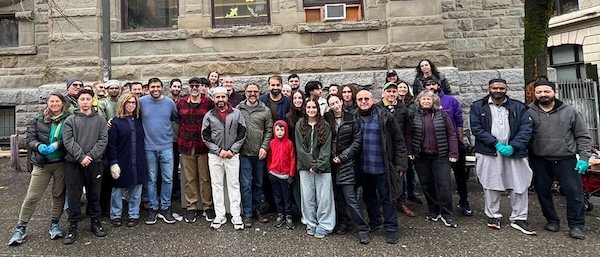
Members of the local Jewish and Muslim communities who came together in the Downtown Eastside March 16 to commemorate Shushan Purim and Ramadan by giving out food to those in need. (photo from Rabbi Philip Bregman’s Facebook page)

On Sunday, March 16, on the corner of Main and Hastings, members of the local Jewish and Muslim communities converged for a joint commemoration of Shushan Purim (the day after Purim) and the holy month of Ramadan.

Both these sacred occasions call upon their observers to feed those who are food insecure, often through charity. Muslims refer to this as “zakah,” Jews describe it as “tzedakah.” Both words denote righteousness. United in this shared charge on that day, these two Abrahamic religious traditions met at ground zero of Greater Vancouver’s mental health, addiction and housing crisis to nourish some of the residents of the Downtown Eastside. This was assuredly a “righteous” act for all participants, inspiring renewed hope for our troubled world.

The gathering was mainly the initiative of Vancouver-Granville Member of Parliament Taleeb Noormohamed, a few religious leaders of the Vancouver Muslim community and rabbis Dan Moskovitz, Philip Bregman, Jonathan Infeld and Arik Labowitz. In a social media post describing the event, Rabbi Bregman wrote: “We may not be able to solve the world’s political issues but we can come together to deal with in a small way a local issue (feeding the hungry) that affects us all.” 

It was my great honour to be a part of this group as an ordained cantor and member of the Vancouver Jewish community. My day job often places me at this street corner, serving a similar clientele. I work as a multifaith chaplain on Vancouver Coastal Health’s ACT (Assertive Community Treatment) teams, providing spiritual care to clients and staff as they navigate the existential angst, cumulative grief and moral distress that accompanies the city’s overdose crisis. Many days bring me to the same area to help provide spiritual comfort and solace through presence and song. The task often is daunting. (On the day that I wrote these words, our ACT team lost another longtime client to a preventable overdose death at the age of 29.) Standing alongside my Jewish siblings and Muslim cousins and handing out food that our respective communities had prepared and purchased brought a whole new level of hope.

I particularly needed the spiritual uplift that Sunday, which, like so many Sundays before, again witnessed my Jewish community’s impassioned rallies, calling for the release of all the remaining hostages – those alive and dead – who were taken to Gaza during the barbaric Oct. 7 pogrom that waged war against Israel’s right to exist.

I also needed the spiritual uplift that day because March 16 marked the date when 23-year-old American Jewish nonviolent human rights activist Rachel Corrie (April 10, 1979-March 16, 2003) was crushed to death by an Israeli bulldozer as she protested the demolition of Palestinian homes in Gaza. This horrific anniversary led me to spend that early morning reflecting once again on how to reconcile my abiding love of Israel with my vehement disagreement with those Israeli and American governmental policies that have violated human rights, killed innocent children and civilians and threatened ethnic cleansing.

As if to emphasize the point, earlier that same morning, I had breakfast with a Jewish friend with whom I had engaged in a book club to discuss Peter Beinart’s latest treatise, Being Jewish After the Destruction of Gaza: A Reckoning. Another Conservative cantor I know well and respect recently challenged me to open myself to voices I would not otherwise have considered regarding world affairs. I took that charge to heart and decided to read Beinart’s latest work, which I would not have been likely to peruse previously. Like the death of Corrie, reflecting on this book over breakfast proved sobering, as I continue to realize the many blind spots in my own thinking over the years.

While my mind and spirit were still reeling from navigating these concurrent realities, the Purim-Ramadan event provided me with a palpable spiritual uplift, as I witnessed Jews and Muslims standing in unity side by side with wide smiles, handing out nourishment to those deprived of food. 

The spiritual boost also came from meeting devout Muslims in their bountiful humanity.

There was Aroun, who shared with some Jewish attendees and I how members of his mosque (Al-Jamia Al-Masjid) often come downtown to provide food to the poor on Ramadan. Aroun had us all in stitches when he jokingly indicated how hard it was to handle so many edibles while observing Ramadan’s required daytime fasting. In the same breath, he  reminded us that though there are indeed extremists on both sides of the aisle, events like the present one proved that we do not have to toe their party line.

I likewise will never forget talking with another Muslim participant, Mohammed Zaid, to whom I explained the traditional duties of a cantor as a chanter of prayer. Mohammed responded by offering to demonstrate his own chanting of Quranic verses in Arabic, one of five languages that he speaks. I listened to his mellifluous voice echo the similar Middle Eastern musical modes that I employ when leading synagogue services. In his prayer, I heard words such as “Rahman,” an Arabic cognate for the Hebrew “Rachaman,” meaning Merciful One, and, of course “salaam,” which I knew as “shalom.” His singing reminded me of my late friend Imam Sohaib Sultan, z”l, who was a fellow classmate in my first chaplaincy training class years ago, and with whom I traded our traditions’ sacred melodies. 

Our spirits were raised even during the traditionally dreaded cleanup time, as we together refolded the tables we had brought, and shlepped them into vans. My friend Ben Lubinizki and I shot the breeze with young Muslim men while we waited to gain access to the trash and recycling room. At that moment, I felt inspired to pull out my recent Purim costume’s toque, on which was boldly sprawled the phrase: “Canada is not for sale.” In response to this gesture, my Muslim cousins laughed and cheered me on in solidarity. Here was another front on which we were united. 

As we said our chag sameachs, Ramadan mubaraks and salaam/shaloms, I realized that a key to interfaith dialogue – even on the most fraught issues – can occur through shared life-affirming experiences such as this one. 

The memory of that Sunday morning gathering gives me hope that our mutual striving for lovingkindness can overcome all else. As Rabbi Moskovitz reflected on the occasion, two divided communities had aligned “to feed the hungry and also to collaboratively feed our soul’s hunger for shared humanity.”

May we never forget these universal lessons for our time, lessons brought to us from a very real temporary oasis, built on the most infamous intersection in the poorest postal code in Canada. If humanity can achieve this here, of all places, we can do so in Israel, Gaza and the world. 

Cantor Michael Zoosman is a board-certified chaplain with the Canadian Association for Spiritual Care. He serves as a spiritual health practitioner for the Assertive Community Treatment teams of Vancouver Coastal Health, working with individuals in the community living with severe mental health disorders and addiction. He sits as an advisory committee member at Death Penalty Action and is the co-founder of L’chaim! Jews Against the Death Penalty. He served as cantor of Congregation Beth Israel 2008-2012. 

Format ImagePosted on March 28, 2025March 27, 2025Author Cantor Michael ZoosmanCategories Op-EdTags Downtown Eastside, interfaith, Jews, Muslims, Purim, Ramadan, spirituality, Taleeb Noormohamed, tikkun olam

Racing from Purim to Pesach

My kids were volunteering at the Purim carnival, helping younger kids do games and offering other support. My husband was there to help. I went home early “for a break.” Meanwhile, I receive “helpful” warnings from Jewish websites and other moms on social media. “Passover is coming!” they mention with cheerful purpose. Perhaps this fills some people with glee. Mostly, I feel doom in the pit of my stomach.

Following influencers who run their large observant Jewish households like a well-oiled machine actually has been useful, to some extent. Oh, if she started making chicken broth or cleaned her pantry, maybe it’s time for me to do it, too? By following these tips, sometimes I feel I can manage better.

Then, however, the system fails me. Many of these capable influencers live in large Jewish centres, surrounded by kosher grocery stores, take-out and supportive extended families. They also have the finances to travel with their families to Passover resort vacations. If they travel, they don’t have to clean their houses or cook for the holiday. If they stay home, some use catering or even disposable plates for the whole holiday, which produces mountains of trash. My environmentally conscious household would never go for that.

For those who lack a large Jewish community infrastructure, or financial and family supports, making holidays happen can feel overwhelming. We hover in between, operating in a weird middle ground that is both freeing and isolating. Our families live far away. Since public school and work don’t stop for Pesach, we don’t travel for this holiday. We care about keeping Pesach. I cook and clean for weeks in advance, but I can’t do it all. I gave up on changing the dishes the year I gave birth to twins. While I may feel some guilt, I haven’t looked back.

Facing the next holiday’s prep feels exhausting. Maybe that’s because I just finished baking dozens of cookies (hamantashen and palmiers) for our Purim mishloach manot treat bags.

I’m thinking about how successful businesses and governments work. A business that runs smoothly depends on internal systems, competent managers to keep things working and other staff at various levels. A functional government also relies on an efficient bureaucracy. Right now, we’re hearing of how President Trump’s government is “cutting bureaucracy” and creating “efficiency.” However, what has followed is chaos.

Yes, there are always cases of bloated bureaucracy or waste, but, in many contexts, efficiency can mean that only one person knows how to do something essential. If that person has an accident or falls ill or is fired? Bad things happen.

I think of this while trying to keep my Jewish household on track through our holidays and the secular calendar. It takes mental energy and organizing skill to get kids through homework, afterschool extracurriculars, volunteering, and planning for summer activities in advance. Meanwhile, the dog needs grooming and her teeth brushed. Our house could use a good vacuuming.

Running a home is historically a Jewish woman’s domain. It’s a lot of work. There are Jewish literary references to a balabusta (Jewish housewife) and even Eishet Chayil, a Woman of Valour, from the book of Proverbs, which is traditionally recited to some women on Shabbat.

Many liberal households long ago ditched the tradition of reciting Eishet Chayil on Friday nights. Neither my childhood household nor my married one has ever included this. Instead, like many other Jewish households where women are professionals, in my family, women work alongside household management. So, the historic celebration of a “women’s place” at home got scrapped, but the expectations increased.

Last night, I stayed up late after the whole household watched the movie Barbie together. Although I’m no Barbie fan, I enjoyed the subversive, witty tricks of this movie’s plot. Yet, I still had to place a grocery order afterwards. My husband was folding laundry. My twins changed their bedding before their bedtime, too. The exhaustion reminded me of one of the elements of a functional bureaucracy.

When things run smoothly, it’s because everyone has jobs – and no one’s job requires them to do everything. There is necessary duplication at work. More than one person knows how to do something, so that if a person goes away or gets sick, the system doesn’t collapse. Overlapping work roles and slack in a system are necessary. When an emergency happens, there’s extra capacity when systems overload.

Running a household smoothly, so that everyone’s well fed, valued and has their needs met, is a complicated endeavour. In the Babylonian Talmud, Tractate Sanhedrin, pages 86-88, there’s a lengthy conversation about what it means to be a “rebellious elder” and whether there are ever times when one must be executed for teaching inappropriate information. The rabbis suggest there are three different courts of appeal for these cases. Yet, there is also an understanding that some rebellious elders teach rulings based on tradition, from their teachers, and, other times, they offer a reasoned argument, based on what is “the correct understanding in my eyes.”  That is, using logic, texts and real-life examples to draw conclusions.

Historically, women oversaw their households, that’s what our texts say, but times change. Now, we also expect women to be, at least theoretically, equals in the workplace. But the research indicates that women still bear the brunt of household chores, and the mental gymnastics and emotional work related to keeping everything afloat.

It’s time to rethink business models that preach that any duplication is redundant. If we want our homes to run smoothly, we must expect that more than one person be responsible for making Passover, or even afterschool carpools, happen. We moms cannot keep this schedule up any longer.

As I wrote this, one of my children rang the doorbell. He has a key but expects me to open the door for him anyway. That same child went out this afternoon to shop for Passover foods with his dad, who also picked up the weekly grocery order and did a lot of laundry today. Like Barbie’s weird movie world, or the topsy turvy Purim story, we must keep turning things around or even upside down. We cannot expect even “women of valour” to do everything. It’s time for everybody to learn more of the jobs to make our households function. Over here in Winnipeg, this mom is tired. It’s time for everybody to pitch in. 

Joanne Seiff has written regularly for the Winnipeg Free Press and various Jewish publications. She is the author of three books, including From the Outside In: Jewish Post Columns 2015-2016, a collection of essays available for digital download or as a paperback from Amazon. Check her out on Instagram @yrnspinner or at joanneseiff.blogspot.com.

Posted on March 28, 2025March 27, 2025Author Joanne SeiffCategories Op-EdTags equality, family life, Judaism, Passover, politics, Purim, Talmud, women

In every generation …

This year, the Jewish community will greet Passover with mixed emotions. On a holiday where we celebrate the 3,500-year-old Exodus from Egyptian slavery to freedom, we also mourn the modern-day hostages held captive for so long and the loss of those who will never return to their loved ones.

Passover offers a unique opportunity for families and friends to gather around the seder table, retell the story of the Exodus, eat symbolic foods and, most challenging of all, attempt to keep the younger children engaged until the meal.

It can be difficult to explain to our children the enduring importance of Passover – a tale of survival, courage and resilience. The story of the Jewish people facing an impossible obstacle and conquering it, of our people standing up against oppression, proud of our Jewish identity, confronting and overcoming baseless hatred.

For more than a year, Jewish students have been made to feel othered, embarrassed, threatened and, sometimes, compelled to hide their Jewish identity. Since Oct. 7, 2023, online Jew-hatred and anti-Israel vitriol have become all too common. While cities, overrun by hate-filled protests, seem almost completely desensitized to the hate, we see our children suffering.

An excerpt from the Passover Haggadah reminds us that “in every generation, one must see oneself as having personally come forth from Egypt … and you will tell your child on that day.…” As we sit down at the seder table this year, we will, once again, tell the next generation the story of the Jewish people’s victory against oppression and that pride in our identity is the way to fight oppression.

The younger guests at our seder – our children, our grandchildren, our nieces and nephews – are the next generation of leaders. It will be their responsibility to challenge antisemitism head-on, and it’s our responsibility to educate them about how to do it.

The Centre for Israel and Jewish Affairs remains committed to protecting the quality of Jewish life in Canada. Our team is working with government officials to advocate for the introduction of safe access (bubble) legislation to protect schools and places of worship from the threat of violence or harassment. We are also advocating to enforce existing legislation that combats both online and real-world hate. 

We continue to demand accountability from social media platforms, institutions and organizations. We urge the government to support the provinces’ education for judges, Crown attorneys and law enforcement regarding antisemitism and hate crimes. We continue to stand by our policy priorities that include advocating for community safety, for maintaining public order and for fighting antisemitism in schools and on campus. 

The community, after a long year-and-a-half, is tired. Some of us are scared. And yet, we remain proud. We know more work must be done to protect ourselves, our children and our Jewish identity. So, this year, as we retell our ancestors’ story to our children, we are reminded that we remember the past to protect our present – and our children’s future. It starts at the seder table. But it doesn’t end there. 

Judy Zelikovitz is vice-president, university and local partner services, at the Centre for Israel and Jewish Affairs.

Posted on March 28, 2025March 27, 2025Author Judy ZelikovitzCategories Op-EdTags antisemitism, Centre for Israel and Jewish Affairs, CIJA, Exodus, Oct. 7, Passover

Leaving something behind

I am human. I share many elements of my nature with other beings on this planet. I laugh, I cry, I aspire to things, hope for things, wish for things, work for things. No different than it is for others, I am the amalgam of what I brought into this world interacting with all the stuff that has been incorporated into me through all the years since I got here.

We don’t get through life without having things stirring around inside our heads. In my head, there have always been issues struggling to get out. I long to express them, if only to myself. Gabby to a fault, I have no trouble vomiting it all out. 

But getting it right inside my head before I spit it out is the wise thing to do. I must understand what it is that’s itching, burning, stuck in my craw, before I bring it into the light of day. This process can take some time, even years, even a lifetime.

Part of the issue for me is that I am driven to share my thoughts with others. I have illusions of grandeur. I really believe it matters if my ideas are shared. I believe the ideas can change people’s lives, as they have changed mine. Ultimately, though, it is up to others to make that judgment.

We have the daily issues that are urgent, demanding our focused attention in the now. These things come back to the surface when we have the luxury of time for contemplation. Are we on the right track? The decisions we are making about our careers, our partners, our children – are they the right ones for the people concerned? Such questions rise to the surface like a bad penny. We mostly shove them away again and again, not prepared to confront them. Sometimes, they are just too challenging, disturbing the bases on which we live.

If we are fortunate, we get to enjoy our share of the wonderful things in life that give us pleasure. Something as mundane as a good meal, or even a crust of bread when we are very hungry, a glass of cold, clear water when we are very thirsty. How about realizing the achievement of a goal that we have dreamed of for a long time? How about when something that is very painful stops hurting? Isn’t that a joy and a relief?

Holding a newborn in your arms, sensing the potential of new life, how about that? How about when you feel communion with another creature, human or animal, that takes you out of yourself to a union with them? That can alleviate, at least for a while, the essential loneliness that is our fate as human beings.

So, with all the pleasures and pain we are heir to, with all the wonders and horrors arrayed before our eyes and flooding into our minds, is our function only existential, is that why we are here, simply to live? Can we find some comfort and purpose in the belief in a deity that has concern for us personally? Or are we simply another life form improbably trial-and-errored successfully on this one planet out of countless more in the cosmos. The mind reels with the possibilities if we abandon our human-centred hypothesis of a caring life-force paying attention to our minuscule spot in our galaxy.

I had such simple goals when I was younger. I was going to sacrifice myself to achieve something much larger, greater, than myself. Martyrdom was my method, blood and sweat cast upon the dry soil, watering it so that flowers would bloom. So many die for no purpose. My sacrifice would have a purpose, I thought. Wasn’t that a worthy price to pay for the gift of life? Thankfully, I grew up!

Still, surely life must have a purpose beyond just breathing in and out, shouldn’t it? Is it just to be a matter of surviving? Should it be? Don’t we have a responsibility to do something about improving the world around us? These were the thoughts in my head as a young man. So many other men and women have left something behind – invention, industry, music, art, literature, leadership. We read about them. Surely, we ourselves can make a mark upon the wall of time like they did, can’t we?

I went off, like Don Quixote, to do battle, trying to subdue all the windmills I came across for the betterment of my fellow man, and to make my mark, of course. I am looking back now, very much closer to the end of my journey than to my beginning. It is not too soon to assess the results of my crusade. I did all the ordinary things, worked at several jobs I believe contained value, got married, had children. All of these were important in their way. But have they built an immortal edifice to my passage on this earth?

I face my life partner and my children and tell them that my aspirations were elsewhere and essentially were for naught. How much of the attention that I owed to them was spent on pursuing my ego-driven drive to find the building blocks of the Giza-like edifice I was determined to construct? And how ironic! My only long-term claims to fame and immortality reside in the lives I was privileged to be a part of. All my vaunted achievements with which I had consoled myself, labeling them as being worthy of merit, have vanished like dust scattered by the wind.

I retain my nostalgia for those breathless instants at the barricades. I am one of the lucky ones. I believe I have left something worthwhile behind. 

Max Roytenberg is a Vancouver-based poet, writer and blogger. His book Hero in My Own Eyes: Tripping a Life Fantastic is available from Amazon and other online booksellers.

Posted on March 28, 2025March 27, 2025Author Max RoytenbergCategories Op-EdTags aging, ambition, family, life, memoir, reflections
Welcoming guests again

Welcoming guests again

There may not be magic at hand to prepare dinner or clean up afterwards, but the Weasleys’ home in the Harry Potter series, the Burrow, is a good model for how to welcome guests, with Mrs. Weasley’s always sharing her love, food, home, and even her motherly reprimands with others. (photo by Karen Roe / flickr)

This winter, I felt our household was in hibernation. Between endless viruses brought home from middle school and -30˚C temperatures in Winnipeg, I doubted we’d ever emerge. Then, our household caught a break. We’ve had a few weeks now where all four of us seem mostly healthy. Also, there has been a rare moment of “early spring,” where temperatures are around freezing, the sun is out and everyone seems cheerful about the deep, goopy slush.

We have started to dig ourselves out. Not from the snow, but from all the activities we piled up during the coldest time of year. One kid removed his slot car racers and a 3D printer project from the dining room. Another kid tidied up a huge set he’s building for his video production class. There are still too many books and knitting projects on the coffee table (my fault). My husband even cleaned up his piles of paper. Why all the hurry? Well, suddenly people are coming over again to visit. We’re hopefully emerging from our long retreat.

During our hibernation, we stayed home, went to work and school, and to synagogue. That was mostly it. But then I got an email out of the blue. When I walk my setter-mix dog, we often encounter a tiny dog, Lulu, and her human, and we chat. Deep into our winter sojourn, we weren’t seeing Lulu or her people much, it was just too cold. Yet Lulu’s people, thoughtful neighbours, invited us over for cheese fondue, wine and a warm chat. After a great night out a block from home, I realized how small our world had become. I decided we owed them a dinner invitation. They’re coming (probably without Lulu) for Shabbat dinner this week.

I’ve always enjoyed cooking big Shabbat and holiday dinners for friends and having great conversations at the table. I was raised with this kind of hospitality. My parents’ home was always open to my friends, who timed their visits to enjoy their favourite foods or discuss things with my parents or siblings, and their friends, too. However, over the years, I’d really cut back on these dinners. First, because my twins still go to bed early. Then, because of the pandemic. After Oct. 7, I felt wary about the outside world and wanted to feel safe at home. About a year ago, I stopped inviting people. I could say it was because I was concentrating on my twins’ b’nai mitzvah preparations or the event itself, with friends and family visiting, but that was last June. This winter, we’ve been sick and it’s been so cold.

On one Shabbat at synagogue, I heard an impromptu talk from a young adult visiting home. He was serving in the Israel Defence Forces as a lone soldier and spent part of his time at home talking to groups about what was happening in Israel, and we discussed how to combat antisemitism in Canada. At this event, a community member suggested that inviting friends and allies over, perhaps to Shabbat dinner, could help others learn about who we are and gather more support. 

What happened afterwards, along with the warmer, slushy weather, is that some of our friends began to seek us out. 

Last week, an amazing acquaintance, who used to run a gallery we loved, asked me to sign one of my books for her friend’s birthday. Of course, I said, come on over. I showed her our “new” historic house and she brought me tulips.

Then, a longtime artist friend in her 80s contacted me and decided she was coming over the next morning for muffins and coffee, so she could show off her newest marbled paper experiments.

Last week, a retired newspaper columnist that I really respect happened to spot my husband outdoors with the dog. He started to text with my husband and asked to come see how we’d renovated things. My husband said yes. Our neighbourhood’s full of old houses with interesting quirks, so visiting each other’s homes is always fun. They’re coming for coffee and cake on Sunday. It seemed like high time to pick up the dog toys from the living room carpet.

All of these encounters with warm people who sought us out and wanted to get back in touch? None of them is Jewish. All of them are people who want us to know they are safe, they care about us, and they value our company. This was an important realization, well worth the effort it takes to clean up the messy paw prints and kid fingerprints for a visit.

When I imagine how I want my home to appear to friends, or even strangers, I think of the Burrow, the Weasleys’ home in the Harry Potter series. Well, that’s not quite right. Our house doesn’t use magic to knit sweaters or stir pots of soup. Those are my hands, my knitting and my cooking, instead. However, whenever I think of the Burrow, I think of a warm, welcoming place where Mrs. Weasley feeds everybody and makes everyone feel welcome and loved, despite the normal clutter and chaos of family life.

My notion of hachnasat orchim (welcoming guests) comes from Jewish tradition, a much older playbook than the Harry Potter series. However, the meaning feels the same, even if my household menu includes hamantashen and chicken soup. Mrs. Weasley’s always sharing her love, food, home, and even her motherly reprimands with others, and it goes beyond her family. Her home, the Burrow, sounds like a retreat, but it’s not a hibernation. It’s an enthusiastic embrace.

I am hoping to get back to that safe and cheerful place, where our home is full again with fascinating friends, good food, stimulating conversation and an open heart. Our gardens are still under dirty snow here. It sometimes takes a heroic effort to rise above winter weather and the residual sadness of the war, but good things await. Things are warming up at my house in Manitoba. I’m hoping for happier days ahead. 

Joanne Seiff has written regularly for the Winnipeg Free Press and various Jewish publications. She is the author of three books, including From the Outside In: Jewish Post Columns 2015-2016, a collection of essays available for digital download or as a paperback from Amazon. Check her out on Instagram @yrnspinner or at joanneseiff.blogspot.com.

Format ImagePosted on March 14, 2025March 13, 2025Author Joanne SeiffCategories Op-EdTags antisemitism, family, friends, hachnasat orchim, Harry Potter, hibernation, Judaism, liefstyle, Oct. 7, spring, the Burrow, welcoming guests, Winnipeg, winter

Growth and change is Torah

In middle school, we studied the 1920s in English and social studies. It was a period ripe with new slang. I remember the long list of phrases we had to learn and interpret. The surprise was that I knew some of the expressions because my family still used them! Phrases like, “Aren’t you just the bee’s knees?” or “He thinks he’s the cat’s pajamas!” This weird phenomenon came to mind when I happened upon an ancient rabbinic discussion in the Babylonian Talmud, Sanhedrin 62a. 

Rabbi Zakkai taught a Baraita (an early teaching that was left out of the Mishnah, codified around 200 CE) in Rabbi Yohanan’s presence. It said that, when one did, in a lapse of awareness, a whole series of inappropriate things deemed idol worship, one was only obligated to bring one sin-offering sacrifice to wipe the slate clean.

Rabbi Yohanan responded with “Go out and teach outside.” It was the ancient equivalent of “Get out of town!” or “Get out!” This is the laughing or indignant response somebody makes when you say something unbelievable or surprising.

One can read this text in many ways. It’s possible that Yohanan earnestly thought Zakkai was teaching nonsense and that he shouldn’t teach that inside the house of study, because every action deserved its own separate offering to repent for these mistakes. 

However, as the page continues, the importance of context reveals itself. Imagine a time when idol worship was everywhere. A person could inadvertently look like they were worshipping an idol or a person when they were just bowing respectfully as a custom or doing what they had to do to get along. If surrounded by idol worship, a person may do things that everyone else does, automatically and without reflection.

We still do this. Think about the phrases “knock on wood” or “crossing one’s fingers and toes.” These aren’t Jewish concepts, but many say them anyhow, just as we might use phrases from other religions in conversation. They’re part of the culture around us.

I was thinking about these cultural shifts recently because we had our own big moment a few weeks ago. We were driving home after middle school. I remarked that I’d taken the dog on the river trail for an amazing walk at lunch time. (In Winnipeg, our rivers freeze, allowing several kilometres of walking, skiing and skating trails, along with art installations and events on the ice. It’s like a pop-up provincial park in winter.) One of my kids complained that he hadn’t gotten enough skating in yet. The weather that day was perfect  but a cold snap was coming. I suggested that they head out right away onto the ice on their own.

My kids seemed astounded by the offer, but they took me up on it. We live a block from the river and there’s a convenient ramp down the riverbank. Before we could reconsider, they were off with skates, helmets, snowpants and the loan of my cellphone so they could reach me. I told them to be back in an hour. This bought me more time to make Shabbat dinner, too.

Just before 5:30 p.m., the phone rang. My responsible kids called from the ice, saying, “We got a little too far away, we’re getting tired, but we’re coming back now. We’ll be a little late.” When they got inside, both kids were wobbly, legs rubbery from exhaustion. I had to help them get off their parkas and snowpants, but they were full of triumph. They had taken off on their own and had an adventure. At dinner, they described bumping into a classmate who was out with his mom and younger siblings. While the classmate was a better skater than them, my 13-year-olds seemed puffed up with pride that they were allowed out by themselves.

Times change. As a Gen Xer, when I was 13, I babysat for two siblings on my own. I took the Washington, DC, metro by myself. I was a latchkey kid of longstanding. As the oldest child in my family and “mature,” I had a lot of leeway, as well as responsibility. Was it always good for me? I don’t think so, but it’s just the way things were.

My kids have had a longer stretch of childhood, with more supervision. While they have always had household chores and other responsibilities, these maiden voyages of independence now happen one after the next. Since the skating experience, they’ve been on their own for a Saturday night while we went out to a neighbour’s house. They take the dog walk on their own. This week, they’re headed off to a winter camp sleepaway experience with their school.

Generational shifts often lead us to believe that things are altogether different than they used to be. Yet, when I realized that I used 1920s slang as a kid, it reminded me that, while things change, some things stay the same. We no longer do sin offerings when we’ve made a mistake as part of Jewish practice. We don’t live in a culture surrounded by physical idols and their worship. However, we still make mistakes and seek absolution. Our kids still learn and grow through graduated steps towards independence, complete with worry and insecurity. One rabbi’s “Go and teach outside” becomes “Get out of town!” – after 2,000 years, the inference isn’t that different.

For each generation, something old becomes new again, or seems new, at least. For every parent, those amazing first moments of change in their kids are important. I burst with pride, telling others about the skating adventure. I revel in being able to go out socially (down the street), while my kids put themselves to bed. These ages and stages happen for everyone, but, each time, we’re still ecstatic with the individual circumstance.

My kids told me later that they had read until 8:40 or 9 o’clock when we were out, but, when we got back, their room was silent, lights were off, with the dog on guard. It was a moment of success. I nodded, feeling impressed. Inside, I was thinking, “Get out of town! Look what we accomplished here!” “Rabbi,” I wanted to say, “check these big bar mitzvah boys out! Look at this growth! That, too, is Torah.” 

Joanne Seiff has written regularly for the Winnipeg Free Press and various Jewish publications. She is the author of three books, including From the Outside In: Jewish Post Columns 2015-2016, a collection of essays available for digital download or as a paperback from Amazon. Check her out on Instagram @yrnspinner or at joanneseiff.blogspot.com.

Posted on February 28, 2025February 26, 2025Author Joanne SeiffCategories Op-EdTags culture, history, Judaism, language, lifestyle, Talmud

Taxes, tariffs for Jewish life

In December, our federal government offered a hastily assembled tax break that lasted until mid-February. The most memorable part of it was that the Canada Revenue Agency (CRA) chose to exempt “Hanukkah trees or bushes” from taxes. Your reaction might be like my twins’ outcry when I picked them up from junior high. We discussed it on the way home.

“Did they talk to an actual Jewish person?” they wondered. “Couldn’t they have exempted Hanukkah menorahs and candles? Judaica?

“Don’t they realize,” my kids added, “that anybody who is buying a tree is not doing a Jewish thing?”

I had similar thoughts. There are Jews who, for various reasons, decorate with Christmas items, but it’s not a Jewish thing.

I often write about how Jewish traditions, laws and texts apply to us, as Canadian Jews. This time, I reflected on how Canadian law applies to us, instead. The Hanukkah bush incident on its own wouldn’t have resulted in more than momentary annoyance or a wry chuckle if it had been a one-off mistake.

I thought of this while considering the recent US hoopla around eradicating DEI (diversity, equity and inclusion) policies. Canadians consider diversity part of our strength. Of course, there are efforts to uphold our strength in diversity amid the new US presidential activity. Historically, I’ve been a fan of DEI. It uplifts minorities who deserve a fair chance in a world that touts itself as a meritocracy but, in truth, privileges some far above others. 

After Oct. 7, 2023, it became clear that Canadian DEI does nothing to support Jewish people, although we’re a minority in Canada. More than once, my husband, a professor, was forced to point out surveys, embraced by his university, that left no way to identify as Jewish. In one human resources gaffe, the survey told Jews to identify as “white European.” My husband, whose father was born in a displaced persons camp in Germany in 1946, had no intention of pretending his murdered and displaced ancestors were considered equal or “white” citizens in Europe.

There are more anecdotes that one could share. Jews are a minority in Canada. The current DEI narrative doesn’t match who we are.

All this came up when reading the newly released tariff proposal compiled by the Canadian government. You could get bogged down in the definitions of “offal,” “margarine” and other details. I skimmed quickly, wondering how this would affect our Passover grocery shopping. Then I got stuck on the following entries in the backgrounder that was proposed to go into effect Feb. 4 and then was quickly postponed for 30 days.

Specifically, I got lost in item numbers 6117.10.10, 6117.90.10, 6214.10.10, 6214.20.10 and 6214.30.10. All these objects, associated with shawls, stoles, scarves and mantillas, and parts thereof, specifically list “prayer shawls.” These numbers relate to whether the garment is made, in whole or in part, of wool, silk or synthetics, and knitted or crocheted.

In recent years, it’s true that some older Christian women, usually in church groups, have knit shawls while praying. They gift these “prayer shawls” to those they pray for in their community. There isn’t much cross-border trade in these items. These works of prayer are gifts and are rarely for sale.

It’s easier to jump to the other definition. Tallits, tallesim, tallis, tallitot – however you call it, Jewish garments with tzitzit, made of wool, silk or synthetics, are called prayer shawls in English. Having recently searched for these for my twins’ b’nai mitzvah, many of the biggest Judaica shops that sell these are in the United States. Of course, one can also buy beautiful tallits from Israel. Due to the exchange rate, slow postage times and difficulty of shopping online, we bought our kids’ tallits locally at the synagogue gift shop, but some of those items came from US suppliers.

I wove my tallit for my bat mitzvah. I’m capable of weaving others, but because my kids haven’t grown to their adult sizes, our family decided not to invest too much time and money into their current tallits. What fits now at age 13 won’t work for them as adults. However, the new tariffs indicate that, although Jews are only 1% of the Canadian population, our ritual prayer items apparently deserve “special mention” and tariff fees. Note that, if you can locate a cotton tallit, it might not fit in the tariff schedule yet, but this list and its timeline are open to revision.

Where does this leave us? I’m wondering who compiled the two-month tax break and the tariff list. Someone on these task forces feels the need to single out and “include” Jews without consulting any Jews. The effort towards “inclusion” feels downright uncomfortable. It leaves Jewish Canadians feeling othered. We’re the small minority specifically allowed to purchase “Hanukkah bushes” without tax. Our tallits are mentioned five times in the cross-border tariff battles.

While we dangle in this awkward space, it brings up other issues. How many “Hanukkah bushes” or tallits do the CRA and tariff writers think we buy each year? As a small minority, even if we all bought these items every year (which we don’t), it would amount to nothing much. Something smacks of bias. The notion that we have outsized purchasing power or large numbers is part of a greater set of antisemitic tropes.

Earlier this week, I attended an online panel on antisemitism that included MP Ben Carr, Manitoba MLA Mike Moroz, Belle Jarniewski, executive director of the Jewish Heritage Centre of Western Canada, and Avrom Charach, a longtime Winnipeg Jewish leader and activist who has been cleaning up antisemitic graffiti. Everyone on the panel concluded that education and outreach to non-Jewish Canadians helps, because eradicating ignorant hate takes education and allies. The panel also suggested that appropriate federal and provincial legislation could help bring change.

Mentioning these strange tax cuts and tariff proposals could help educate Canadian government officials. Their efforts to single out the Jewish community have backfired. Let’s hope that future legislation doesn’t create other fake Jewish rituals or charge special tariffs on Jewish ritual items. Such actions aren’t supportive of Canadian diversity. Canada can do better. 

Joanne Seiff has written regularly for the Winnipeg Free Press and various Jewish publications. She is the author of three books, including From the Outside In: Jewish Post Columns 2015-2016, a collection of essays available for digital download or as a paperback from Amazon. Check her out on Instagram @yrnspinner or at joanneseiff.blogspot.com.

Posted on February 14, 2025February 13, 2025Author Joanne SeiffCategories Op-EdTags antisemitism, Hanukkah bushes, history, Liberal party, prayer shawls, tallit, tariffs, taxes, trade policy

Leadership keeps us afloat

There are so many huge transitions lately when it comes to world leaders in the news. From impeaching the South Korean president to the fleeing of Syria’s Bashar Al-Assad, or the issues around Netanyahu, Trump or Trudeau, there’s political change afoot.

It’s natural to feel worried about uncertainty. A friend from university days tells her teen daughters in Jerusalem that we should “think globally but act locally.” This was our popular slogan as undergrads in the 1990s. I repeat this in my household as well. While we can get absorbed in political drama, there’s also a lot to do close to home.

A story I read recently reminded me of what solid leadership can mean. This story (aggadah) was in Tractate Sanhedrin, page 14, in the Babylonian Talmud. Jan. 5 marked five years since I’ve been studying Daf Yomi, a page a day of Talmud. This commitment has been both deep and superficial. Deep, because finding time to commit to this for any mom of school-aged twins is a big ask. It’s superficial because I’m only doing it for 20 minutes a day and I’m mostly reading in translation. My goal to improve my talmudic Aramaic/Hebrew reading skills fell by the wayside long ago. What has remained is a habit. I learn the page every day whether I find it interesting or not.

Sanhedrin hasn’t been the most interesting bedtime reading so far: understanding the law and administering it, and how many judges it takes to rule on different cases. Then, I read this story. The summary, with background information from Rabbi Lexie Botzum, an author at My Jewish Learning, helped me learn more. Rabbi Yehudah ben Bava was an elder during the early second century, facing a period of Roman repression. It recalls the rabbi with great respect, because there was concern that Jewish law and the enforcement of those laws would be lost due to persecution.

The rabbis recount: “… because at one time the wicked kingdom [of Rome] issued decrees of religious persecution against the Jewish people. The sages therefore said that anyone who ordains [judges] will be killed, and anyone who is ordained will be killed, and the city in which they ordain will be destroyed, and the boundaries in which they ordain judges will be uprooted.”

Rav recounts that Rabbi Yehudah ben Bava enabled the judging and enforcing of laws around fines to continue, by doing the following: “What did Rabbi Yehuda ben Bava do? He went and sat between two large mountains, between two large cities, and between two Shabbat boundaries, between Usha and Shefaram, and there he ordained five elders. And they were: Rabbi Meir and Rabbi Yehuda and Rabbi Shimon and Rabbi Yosei and Rabbi Eleazar ben Shammua. Rav Avya adds Rabbi Nehemya also.”

When the Romans discovered them, the Gemara explains that Rabbi Yehuda ben Bava told his young students (now his colleagues) to run. He was old and couldn’t run, but used his body to distract the soldiers, and was killed. The Roman soldiers “pierced his body like a sieve” with 300 iron spears. We remember Rabbi Yehudah ben Bava’s heroism during the story of the Ten Martyrs, which we recite on Yom Kippur. 

Sanhedrin concerned itself with how many people it takes to ordain a judge or rabbi. The rabbis conclude that there were other rabbis with Rabbi Yehuda ben Bava, but this story keeps Rabbi Yehudah ben Bava’s name alive and recognizes his bravery.

There’s a lot to unpack here. After all, does it matter if the Jewish laws concerning fines were taught or enforced today? Maybe not, but this is how law-making and, by extension, politics, work even now. Legislators spend lots of time on minutiae, but it’s those details that make societies function. Today, we still need laws to enforce payments of fines, otherwise governments might not have enough income to pay for infrastructure like roads or police or courts. 

Beyond administrative details, without Rabbi Yehudah ben Bava’s foresight and leadership, Jewish people might not have gathered the courage to ordain (appoint) more judges. Without those rabbi/judges, Jewish tradition might have foundered and, perhaps, died out. The Romans’ goal was to force assimilation. This approach to eradicating Jewish culture and learning has occurred multiple times throughout history. For examples, consider the Soviet Union’s repression of Jewish observance and learning, the Nazis during the Second World War, or the Inquisition in Spain and Portugal. When Jews are forced to hide, some brave souls go underground and continue to teach, learn and lead, despite great challenges. Rabbi Yehudah ben Bava’s story helps us remember this is important for survival.

I’m not worried that we’ll have to go underground to keep Jewish identity alive. At least, I hope not. In an upside-down world, this is what Jews in Israel have done – using shelters (underground bomb shelters, for instance) to stay safe. What I concluded from the Talmud story is different. It’s so important to have leaders who keep us afloat, via brave and innovative plans, during difficult times. We can’t stake our future on just one person, either. The tractate indicates that Rabbi Yehudah ben Bava was not the only one there, but he stands for all the brave leadership that followed.

In Canada, local Jewish leaders are stepping up on behalf of our communities. This leadership isn’t limited to those in paid positions but extends to courageous volunteers speaking out, too. There are social media warriors, fighting against hate online, and heads of various Jewish organizations on the radio and in the news media. Right now, we need all these advocates plus Jewish lawmakers and their allies, too, working to combat hate. Sometimes, the solutions are in the details – not in how we enforce fines, but in how we legislate bubble zones around places of worship and schools, or how to decide what’s free speech and what’s hate speech.

We shouldn’t have to risk death. Nobody wants to be skewered to death, as the Romans killed Rabbi Yehudah ben Bava, but the other rabbis are also part of the story. We must thank these unnamed people, and their named students. The defence of our identity, learning and tradition is all of our responsibility, and not just for brave leaders. Some run to safety and fight another day; others are allies; and some keep Jewish tradition alive amid changing times. We can all make an effort, and be thankful, for the chance to protect our Jewish identities in Canada, and worldwide. 

Joanne Seiff has written regularly for the Winnipeg Free Press and various Jewish publications. She is the author of three books, including From the Outside In: Jewish Post Columns 2015-2016, a collection of essays available for digital download or as a paperback from Amazon. Check her out on Instagram @yrnspinner or at joanneseiff.blogspot.com.

Posted on January 17, 2025January 14, 2025Author Joanne SeiffCategories Op-EdTags Judaism, leadership, lifestyle, politics, Talmud

Thinking the best of others

Imagine teenagers, hanging out and sharing the usual in-group slang, but they’re saying “Lashon hara? Lamed hay! Tell it to me anyway!” This sarcastic chant was new to me, when Miriam Anzovin, the famous Jewish Talmud influencer, mentioned it on Instagram, along with her thoughts on a page of Talmud about lashon hara. Lashon hara, literally “bad speech or language,” refers to gossip, speech that is hurtful. We’ve all experienced it: at summer camp, synagogue, school, work or online. It’s real. It’s painful.

I’m not any kind of expert on this, or even especially good at avoiding harmful speech. The rabbis suggest that there are three bad things that most people can’t avoid daily: sinful thoughts, lack of intention while praying, and lashon hara. In the last week, I’ve thought of this too often.

First, I had the honour of being consulted by two different elders in my Jewish community. In one case, I had to gently lead the conversation away from this kind of talk, by suggesting that it wasn’t my place to comment on something. When it continued, I paused and said that, since Oct. 7, 2023, I had decided to work on achdut (unity) and avoided these kinds of conversations. I try to focus on good things instead. Later, the person I had chatted with apologized. For many of us, we don’t even see how often we’re veering down that road towards negative comments about others.

The second time, I had to tell a person who was “talking trash” that it was lashon hara and I wouldn’t do that. I couldn’t believe it when this came out of my mouth. The person was probably 30 years my senior. I wondered, a second later, when had I become this brash or disrespectful? Well, I guess it happens when the elder in question is also treading on thin ice.

This all came up again when I studied Bava Batra 164b. This page of Talmud looks at what makes a document or contract legal, and how we behave to one another when dealing with these documents. Judah HaNasi picks up a document, finds it doesn’t have a date on it, and announces it isn’t valid, it can be discarded. His son, Rabbi Shimon, stops him, saying, “Wait! Perhaps it’s a tied document!” In some regions, people folded a document, then signed and dated it on the outside. It’s a legal document, but with dates or signatures in different places. Why create a “tied” document? It was just a different custom. 

When Judah HaNasi disapproves of the tied document custom, his son says, “I didn’t write it! Rabbi Yehuda Chayatta wrote it!” Judah HaNasi then chastises his son for his “malicious speech,” or lashon hara. He tells his son not to blame someone else for making this document or, as Miriam Anzovin says it, Rabbi Shimon rushes to throw Rabbi Yehuda Chayatta “under a bus.”

Then, a scene change: Rabbi Shimon is reading psalms to his father. The book he is using (handwritten, of course, since this was before the printing press existed) is remarkable; the writing straight and neat. Judah HaNasi comments on it. Again, Rabbi Shimon rushes to say, “I didn’t write it, Rabbi Yehuda Chayatta did!” His father responds again by asking him not to do lashon hara. 

In this second instance, you’d think, what just happened? Why would the dad say this? Rabbi Shimon is complimenting this amazing scribe. However, Rav Dimi teaches that one shouldn’t go out of their way to praise someone, as that too can attract negative attention. 

This point seems strange until it happens in real life. Imagine a teacher points out that a student has done a marvelous job on an assignment, and this results in other kids making fun of the student later, at recess. Drawing too much positive or negative attention to another person can cause problems, according to the rabbis.

I thought about these issues when I encountered another relevant educational incident. A professor creates an assignment for their students and suspects them of using ChatGPT (Open AI) to do the work. The professor thinks they are all cheating and, straight away, files paperwork to have the issue adjudicated by department heads and deans. All these students are now in big trouble. 

Since the professor suspects cheating, his colleagues evaluate the work. They run all the students’ work through another AI program to “check” it. This app accuses students of cheating – but it’s sometimes wrong. The AI checking program reportedly has at least a 4% failure rate.

This seems like another complicated case of lashon hara. Is it possible that some students cheated? Yes, it is. At the same time, why did this professor immediately think the worst? Slander against students and student mistakes are both real, but neither is helpful in a learning environment. Most students don’t want to waste their time or tuition money, so they don’t cheat. We can’t always identify malicious intention correctly.

We all complain about others. It’s common to point fingers when something isn’t going our way. There’s always enough blame to go around. Yet, perhaps by drawing attention to others, malicious or complimentary, we also draw attention away from ourselves. The lesson about lashon hara is that getting along with others, being a part of a community, is fraught with pitfalls. We fail ourselves, and others, by saying unkind, unnecessary things. At the same time, we fail others by complimenting them in ways that draw “the evil eye,” or negative attention.

Giving compliments is still important. Just like giving corrections, it must be done with care. In retrospect, I’m embarrassed that I mentioned this to my elders, but I’m also embarrassed by their words. We want to accuse someone else of being “the problem.” In the end, sometimes we are the problem, and that’s hard. A common outcome is when there’s a problem and it’s nobody’s – or everybody’s – fault. Then, we all must bring solutions, show we care about one another, and make amends. We Jews live in community. Achdut, unity, is about more than politics. It’s about caring for one another. 

Joanne Seiff has written regularly for the Winnipeg Free Press and various Jewish publications. She is the author of three books, including From the Outside In: Jewish Post Columns 2015-2016, a collection of essays available for digital download or as a paperback from Amazon. Check her out on Instagram @yrnspinner or at joanneseiff.blogspot.com.

Posted on December 20, 2024December 19, 2024Author Joanne SeiffCategories Op-EdTags Judaism, kindness, lifestyle, respect, Talmud, unity

Approaching final judgment

I know I have sinned. Haven’t we all? How then to achieve redemption when I have this whole mountain of transgressions looming over me? I can see it clearly every time I look in the mirror. Was it Yogi Berra who said, “Don’t look back, they may be gaining on ya”? Well, I do look back, and I do see the mountain of my failings. 

My problem is that I don’t really, really believe that all those things on the pile are so bad. But then I think about “the Judge,” and hope that He is a reasonable entity. Haven’t I all sorts of mitigating circumstances that I could raise to alleviate any judgment? (I know the record in history shouldn’t lead me to be so confident.)

I have read that, in ancient times, He was pretty harsh because He had to be to prove a point. Rules were immutable. Those who erred against His rules were just erased. The earth opened up and swallowed them up. Some were turned to pillars of salt, some swept away by raging waters, impaled on the swords of the righteous who were rewarded, ravaged by plagues or the Angel of Death. All manner of things of a nasty kind were visited upon those who crossed Him. He sure hated to be contradicted.

But Abraham was able to negotiate some matters with Him, and Jacob wrestled with the angel and survived. Job was restored to his honoured state, and Jonah survived his defiance of the Almighty. David was even able to mollify Him in spite of his own heinous crimes, and he retained the honour of having a descendant who would usher in the End of Days.

Surely these are good signs. Why couldn’t I negotiate a soft landing? I have written some poems, like David, and I can’t imagine that my sins approach the gravity of his biggie. What about all my good will, my good intentions, the milk of human kindness that pours from my being – they have to count for something.

OK, obviously I will not be given the right to build the Third Temple in Jerusalem – and I’m not sure that’s a very good idea right about now, anyway. I also will not likely be recognized as a light upon my nation, or any nation. Even though I think some of my doings are worthy and my writings are prophetic and of divine origin. I have tried with all my might to be a hero. (Well, most of the time!) 

I will be happy and satisfied if my grandchildren continue to speak to me, or at least say hello. I accept that mine will be a small life. It took me quite a few years to accept that the best things I ever produced were my children. And a great-grandchild! And I can’t even take all the credit for that.

I was hoping I would accomplish more, but I guess my spirit was too weak and small in size. I was hoping I would make some small mark on the wall of time. Now I would be satisfied if I could point to an unsigned abrasion. That’s how it is when reality sets in and we look around us at all the time that has flown. I ask myself, when is it that I will actually begin to do those world-shaking things that I had inwardly resolved, or foolishly promised, to do?

I will have to be content with the derring-do of my children and grandchildren. And my great-grandchild, the beautiful Shaked! Mayhap they will be blessed with those better elements of DNA that did not find their fruition in what I was able to offer.

I look forward to seeing it all when I have passed the final muster. I know I will have a real negotiating job to do. That may be my finest hour. After all, none of us knows the final outcome. Those with the strongest faith and belief carry forward what is essentially a fervent hope. I can join that congregation. I can look forward to the trial that defines my redemption. I can look forward to viewing the future that will become my children’s past. That is worth fighting for with all the heroic energy I can gather. 

Whether or not the energy I consist of returns to the vast storehouse from which new lives are dispatched, I know that the DNA I leave behind will not be relegated to dead storage. I retain the hope, as do all who came before me, and follow after, that there are redeeming qualities in what I leave behind, whatever my personal fate.

I know that whatever the outcome for me regarding redemption, there will be some part of me that is reincarnated. We are all blessed by that potentiality. What a glorious vision that presents! I shall hope it is not watered down by my sins. I shall hope that my potentials will not suffer from my bull-headed insistence on attempting to negotiate a private treaty of redemption, that they will not be diluted as a punishment. 

Yet, I do still hope to strike a better deal than I deserve for my delays, my prevarications, my impatience with the disciplines of orthodoxy, my confidence that time has tempered the rigidity of Mosaic law. No votes, please – there are so many who would speak out against me and so few to argue in my favour. I confess I have been seduced by the convenience of laxity in the face of strict religious practice.

Perhaps I can find a good lawyer. It is always a great idea to present a good case. I intend to be an active participant in my defence and to energetically press my case. I wonder what the rules are in that court of last resort. I intend to call my children and grandchildren as character witnesses. 

Max Roytenberg is a Vancouver-based poet, writer and blogger. His book Hero in My Own Eyes: Tripping a Life Fantastic is available from Amazon and other online booksellers.

Posted on December 13, 2024December 11, 2024Author Max RoytenbergCategories Op-EdTags death, end-of-life, Judaism, lifestyle, memoir, redemption, reflections, religion

Posts pagination

Previous page Page 1 … Page 5 Page 6 Page 7 … Page 56 Next page
Proudly powered by WordPress