Skip to content
  • Home
  • Subscribe / donate
  • Events calendar
  • News
    • Local
    • National
    • Israel
    • World
    • עניין בחדשות
      A roundup of news in Canada and further afield, in Hebrew.
  • Opinion
    • From the JI
    • Op-Ed
  • Arts & Culture
    • Performing Arts
    • Music
    • Books
    • Visual Arts
    • TV & Film
  • Life
    • Celebrating the Holidays
    • Travel
    • The Daily Snooze
      Cartoons by Jacob Samuel
    • Mystery Photo
      Help the JI and JMABC fill in the gaps in our archives.
  • Community Links
    • Organizations, Etc.
    • Other News Sources & Blogs
    • Business Directory
  • FAQ
  • JI Chai Celebration
  • JI@88! video

Recent Posts

  • Zionism wins big in Vegas
  • Different but connected
  • Survival not passive
  • Musical celebration of Israel
  • Shoppe celebrates 25 years
  • Human “book” event
  • Reclaiming Jewish stories
  • Bema presents Perseverance
  • CSS honours Bellas z”l
  • Sheba Promise here May 7
  • Reflections from Be’eri
  • New law a desecration
  • Resilient joy in tough times
  • Rescue dog brings joy
  • Art chosen for new museum
  • Reminder of hope, resilience
  • The national food of Israel?
  • Story of Israel’s north
  • Sheltering in train stations
  • Teach critical thinking
  • Learning to bridge divides
  • Supporting Iranian community
  • Art dismantles systems
  • Beth Tikvah celebrates 50th
  • What is Jewish music?
  • Celebrate joy of music
  • Women share experiences 
  • Raising funds for Survivors
  • Call for digital literacy
  • The hidden hand of hate
  • Tarot as spiritual ritual
  • Students create fancy meal
  • Encouraging young voices
  • Rose’s Angels delivers
  • Living life to its fullest
  • Drawing on his roots

Archives

Follow @JewishIndie
image - The CJN - Visit Us Banner - 300x600 - 101625

Category: News

Segal aims for Ottawa

Segal aims for Ottawa

Zach Segal will represent the Conservative party in the Oct. 21 federal election in the riding of Vancouver Granville. (photo from Zach Segal)

While Conservatives across Canada will spend the weeks leading up to the federal election reminding voters of Jody Wilson-Raybould’s excoriating of her former leader, Prime Minister Justin Trudeau, one Tory candidate will likely be downplaying the Vancouver MP’s star turn before a parliamentary committee.

In July, Zach Segal won the nomination to represent the Conservative party in the Oct. 21 federal election in the riding of Vancouver Granville. The incumbent, Wilson-Raybould, was elected there in 2015 and immediately was appointed minister of justice and the attorney general of Canada. In January of this year, she was shuffled to minister of veterans affairs and, less than a month later, resigned from cabinet.

Wilson-Raybould was thrown out of the Liberal caucus after testifying before the House of Commons justice committee about pressure she said she experienced from the prime minister’s office over an ongoing investigation into Quebec-based SNC-Lavalin, the largest construction company by revenue in Canada. The resulting scandal sent the governing Liberals tumbling in opinion polls, and they are now generally neck-and-neck with the Conservatives in most surveys. Wilson-Raybould is seeking reelection as an independent.

Segal said that a vote for the incumbent is a protest vote, but that a vote for him offers the chance to change the government.

“If you are upset with Justin Trudeau and you want to kick the Liberals out of Ottawa, the only way to do that is to vote for Andrew Scheer and, if you live in Vancouver Granville, to vote for Zach Segal,” he told the Independent.

The riding cuts a swath through the city, from the Fraser River almost to False Creek and roughly from West Boulevard to Cambie, also encompassing the area north of 41st Avenue west of Main Street and west of Ontario Street to 2nd Avenue. Almost all of the city’s Jewish communal organizations are located in the riding and many of the city’s Jewish residents live there.

Segal graduated from the University of British Columbia in 2011, with a major in political science and a minor in history. He went to Ottawa on an internship arranged through the Centre for Israel and Jewish Affairs.

“At the time, I was conservative-leaning, but I wasn’t partisan,” he said. “I was certainly conservative but I wasn’t affiliated like other young folks are at university.”

After the internship, Segal continued working with Manitoba Conservative MP James Bezan, who was parliamentary secretary to the minister of defence. He later became spokesperson for then-transport minister Lisa Raitt.

When the Conservatives lost the 2015 election, Segal opted to return to Vancouver. He got a job with the Canada Mortgage and Housing Corporation, which has a mandate to help Canadians access affordable housing options.

“I was very interested in housing but still interested in the government and policy world,” Segal said. “I wanted to learn more about housing so I thought a job at the Canada Mortgage and Housing Corporation would be a good opportunity because it was a Crown corporation – it wasn’t part of the federal public service, it was separate – so I thought that would be a good opportunity to get into the housing world and learn more.”

On leave since he announced his candidacy for the nomination in the spring, Segal is part of the CMHC marketing team, publicizing programs and opportunities for nonprofits, the private sector, developers and others, such as low-interest loans.

Faced with a splintered group of candidates in what will probably be one of the most closely watched races in the country, Segal is confident he can win.

“I really think I can actually win and I think that’s the most important thing,” he said, adding that the agenda in the city has largely been dominated by the left.

“I want to show that maybe we have some conservative solutions to some of these big problems that Vancouver is facing,” he said. “My big issues are all packaged into one. I think they all go together. I think everyone’s very interested in housing, in transportation, affordability and the economy. If we can solve transportation infrastructure, maybe it could help reduce pressure on housing because we could build further out and, if we could grow our economy and have better opportunities, people here could make more money and that would solve some of the issues around affordability. Certainly housing, I think we need to look at different ways of solving this, rather than the current proposals. Vancouver’s average wages are some of the lowest in Canada but we have some of the highest average home prices in Canada. I think that’s where one of the problems lies. We need to start looking at how we can grow our whole economy, and Vancouver subsequently, with better jobs and higher wages.”

He said his four years in Ottawa equip him to be an effective MP.

“A lot of people have this idea that, if you’re on the backbench, you can’t do anything, but the MP I worked for was so diligent and committed to issues that he was able to bring them to the floor of the House of Commons,” said Segal. “He was constantly tabling motions, private member’s bills, he was constantly getting his foot in the door of the prime minister’s office and he made sure that, even though he was a backbencher, he got all these prominent issues to the forefront of public policy. That was very inspiring. It’s a good message that you can accomplish things as a member of Parliament.”

As a Jewish candidate, Segal has been hearing from voters that they respected former prime minister Stephen Harper’s approach to Israel.

“Jews and non-Jews alike tell me that they deeply respected how Stephen Harper and the Conservative government stood up for Israel on the world stage,” he said. “They just liked seeing a politician stand on principle and not be bullied and stand up – quite frankly – stand up to the world, stand up to the UN. People really liked seeing that and I think they like leaders who show their true colours, and want to see that back in Ottawa.”

Segal, who attended Richmond Jewish Day School and graduated from Steveston High, went to Israel on a Birthright trip in 2008.

“You always know Israel is small but, until you’re there and you travel the country in a short period of time, you don’t realize how small it is,” he said. “When people talk about Israel’s security concerns, it’s not just a platitude. It’s a tiny country. When you visit Israel, you take tours of the Golan Heights. You can see Hezbollah outposts. Now, if you are there, you can see maybe even ISIS outposts in Syria. It’s this remarkable, tiny country, this outpost of vibrancy and Western democracy that somehow is bordering some of the most extreme elements of the world right there on its border and you really appreciate its security concerns being there.”

Back on local doorsteps, Segal said voters are asking whether they can trust their leaders.

“They see Justin Trudeau taking care of his friends. He had this big gift to Loblaws for retrofitting some fridges and they’re taking care of Irving and SNC, but, if you’re a small business owner, you’re left to fend for yourself,” said Segal.

In addition to Segal and Wilson-Raybould, Vancouver Granville voters will consider the Liberal candidate, tech entrepreneur and investor Teleeb Noormohamed, the NDP’s Yvonne Hanson, a climate activist, and Green candidate Louise Boutin, a realtor. The fledgling People’s Party of Canada has nominated Naomi Chocyk, who, at one point, was employed as a constituency assistant in Wilson-Raybould’s office. More candidates could enter the race before the close of the writ period.
Format ImagePosted on August 23, 2019August 22, 2019Author Pat JohnsonCategories LocalTags Canada, Conservative Party, elections, Vancouver Granville, Zach Segal
Belong at Bayit and beyond

Belong at Bayit and beyond

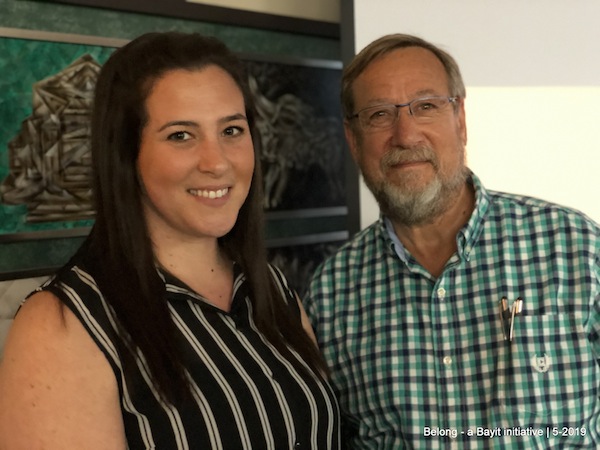
Shira Sachs and Dan Shmilovitch at the Bayit’s Belong launch May 12. (photo from facebook.com/thebayit)

Earlier this year, the Bayit in Richmond launched Belong. The goal of the program is “to create a community where belonging grows and isolation disappears.”

Belong was developed by a committee of six Bayit members: Mel Bauer, Matti Feigelstock, Shelley Goldberg, Shira Sachs, Dan Shmilovitch and Rabbi Levi Varnai.

“There are people that you know you should be connecting to, [or] they should be connecting to you as an organization, but, for whatever reason, they’re not. So, we started talking about how we could address that issue as the Bayit,” explained Shmilovitch, who has been active in the Jewish community for more than 30 years.

There is never just one reason why people feel isolated, he said. “People are isolated for a whole range of reasons – health issues, economic circumstances, mental health issues, maybe they are recently widowed or divorced.”

It is easy to assume that Jewish communities are inherently so strong as to make isolation impossible, but this is not the case. Shmilovitch spoke of the need for “deepening Jewish connections … because isolation is a huge problem in every community and it affects the Jewish community as well, for all age groups.”

There are challenges in combating isolation. “As a Jewish organization, as a synagogue, you’re always looking to invite people in,” he said. “But, when you have people who are isolated and really disconnected, your approach has to be different to get that connection because that’s not their mindset. At that moment in time, that’s not where they’re at.”

photo - Left to right: Mike Sachs, Dan Shmilovitch and Rabbi Levi Varnai at the Bayit’s Belong launch May 12
Left to right: Mike Sachs, Dan Shmilovitch and Rabbi Levi Varnai at the Bayit’s Belong launch May 12. (photo from facebook.com/thebayit)

The Belong committee started their planning by examining the obstacles that prevent people from making contact. There is more to being a community member than simply going to shul, explained Sachs, who is a teacher at Vancouver Talmud Torah.

She noted that people can still feel “uncomfortable or isolated” attending social gatherings outside regular services. She talked about how loneliness has a profound effect on a person’s health and can lead to depression. Using her own childhood story as an example, she described arriving in Canada when her mother, now deceased, was pregnant with twins; Sachs is the oldest of four.

“Community became so important to us,” she said. “We didn’t have the language and, within a couple of months, we went from a family of four to a family of six. My mom was a new mother in a new country, with twins.”

Going to shul helped the family make connections, learn about which schools the family wanted for the children. As a parent herself now, Sachs described how this ethos has shaped her own approach to family life. “When we came back from L.A., it was the number one thing to do – find a community and slowly grow with it. Now, how do we do that for others?”

The Belong committee determined multiple strategies for community development, the first of which was through Friday night dinners. The Belong team sought Bayit members who were willing to invite people to meals at home. They also reached out to Jewish Family Services for help locating people in Richmond who needed help.

“If you have a lady who is a single parent, you match them with another single parent,” said Sachs. “If you have a person who is passionate about literature, you sit them with someone who has the same passion. It was all assigned seating.” She added, “It’s comforting to know, ‘I don’t have to worry about that.’ Maybe that anxiety is why people haven’t come to a dinner.”

Belong is also working to offer food deliveries to families in need. “Food security is an issue in the Jewish community,” said Shmilovitch. The program has been running for awhile now but he hopes that deliveries will become more frequent in future.

“There are vulnerable people in the Jewish community – whether they don’t have enough food, feel isolated for a short time or in the longer term. Regardless, it’s hard to come out at the other end. That’s what drives us.”

In addition, Belong has created a support structure for new mothers. Inspired by and in partnership with Mamatefet, a support organization for Hebrew speakers in Vancouver, Mama Belong will work to diminish the feelings of isolation that often follow the birth of a baby. (See jewishindependent.ca/mothers-embrace-mamatefet.) Mama Belong started delivering baskets to Jewish mothers this summer.

The future of Belong came into focus at the May 12 launch. Current members of the Bayit were invited to learn about the new program. Guests were given a card with tear-off tabs that suggested a wide range of ways in which people could contribute, including hosting Friday night dinners, Russian language conversation groups and cash donations, among other ideas. Between 90 and 95% of the attendees folded over a tab.

From Mama Belong to food bank deliveries and Shabbat dinners, the program is striving to create a warm sense of community for those in need. “You never know what’s going to happen at what point in your life,” said Shmilovitch, but “something’s going to happen to connect you.”

Shula Klinger is an author and journalist living in North Vancouver. Find out more at shulaklinger.com.

Format ImagePosted on August 23, 2019August 22, 2019Author Shula KlingerCategories LocalTags Bayit, Dan Shmilovitch, Judaism, lifestyle, Shira Sachs, tikkun olam
Billinkoff runs in record time

Billinkoff runs in record time

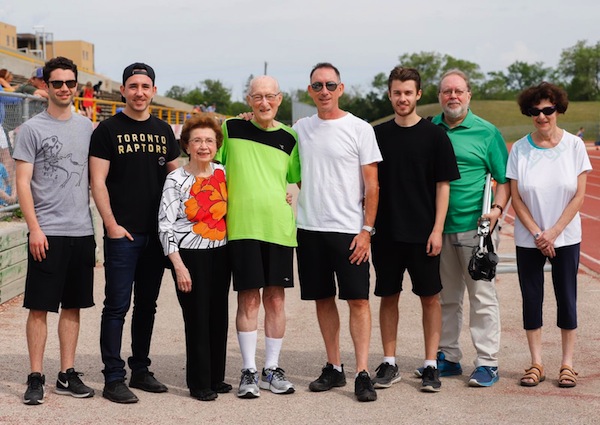
With Lou Billinkoff, fourth from the left, are, from left to right, his grandson Asher, grandson Jordan, wife Ruth, son Errol, grandson Mitchell, son Lorne and daughter-in-law Marilyn. (photo from Lou Billinkoff)

Growing up in Winnipeg’s North End, Lou Billinkoff, 96, was never into sports, though, in his 20s, he did enjoy going for a jog once in awhile. Today, he is one of the fastest short-distance runners in his age group.

“I used to do some running but I never thought of it as competitive,” Billinkoff told the Independent. “I just ran for the pleasure of it when I was younger.”

Billinkoff worked as an engineer with Winnipeg Hydro (now called Manitoba Hydro) for 40 years, designing power lines. When he was well into retirement, at the age of 89, he had a heart attack.

“When I was recovering, the doctor suggested I take some rehab physical therapy at a centre they have here, a program specially suited for people recovering from heart attacks,” said Billinkoff. “Part of the program is to walk on a track. I did that for maybe a year and, when I recalled how much pleasure I got when I ran earlier in life, I thought I’d just try it out and see what I still could do.”

The first time Billinkoff tried, he could only run 40 metres but, more importantly, he liked it. Two days later, he ran 45 metres, and kept on adding distance with each try. Eventually, he was running well over 100 metres and loving it. So, he decided to set up a training program and reached the point at which he could run 100 metres 10 times in one session – a feat he refers to as “running a kilometre.”

“I did that for about two years,” said Billinkoff. “After that, I found it was getting too hard, so I went down to five times 100. Gradually, I found this too was getting too hard, so this past year or two, I’ve been running 50 metres.

“When I was running the 100 metres, my son, Errol, clocked me and said, ‘You know, you’re running in championship speed rankings?’ This was a surprise to me. Errol suggested I get into competition. I wasn’t really interested to pursue it, but Errol entered me into a competition here and, the first time I ran, I ran quite well.”

Nowadays, Billinkoff runs 50 metres three times per workout session at the Reh-Fit Centre, where he goes three times a week. While he ran outdoors when he was younger, he feels that, at his age, it is wiser to run at the centre.

“Going outside has limitations,” he said. “The weather is not always good. You can fall and break your neck and nobody would see you. It’s not a good idea to be running outside.”

Once Billinkoff hit the competitive circuit, he began sending his running times to Athletics Canada.

“The way the rankings work is that age groups go in five-year periods,” he explained. “So, when I started out, I was in the age group of 90-94. They call that the M90. Now that I’m 96, for the last year and this year, I’m in the M95 group, which is 95 to 99.

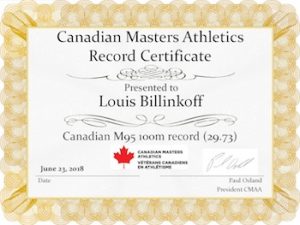
“In the M90 group, I had the fastest time in Canada, at 29.73 seconds. And, in the M95 group, in the 50-metre record, my time indoors was 14.58 seconds; a good speed. Later, I ran the outdoor in 15.68 seconds, and I had strong wind against me. It took me a second longer and I attribute that to the wind.”

image - Lou Billinkoff has set running records
Lou Billinkoff has set running records. (images from Lou Billinkoff)

In most races, Billinkoff has been the only runner in his age category, often running with people half his age.

“There are so few people my age running that you very seldom – unless you live in New York or Chicago – get more than three or four people running in my age group,” said Billinkoff. “I don’t think it’s worth the effort for me to spend several days of discomfort and hardship [traveling] to run for a couple of seconds. They have a Canadian registry where all the Canadians who are competitors send in their results and they set up their rankings. Then, they send it to a world organization that sets up the rankings throughout the world.”

A few years ago, Billinkoff hired a coach for a few months. “He gave me some tips about getting away fast from the start,” said Billinkoff. “And he explained that running is just as much psychological as it is physical. He helped me, psychologically, to have confidence, and that’s very important.”

For now, Billinkoff is keeping up with his training, hoping to compete again next summer. He will continue to do so, he said, “as long as I’m able, and I get pleasure out of it.”

Rebeca Kuropatwa is a Winnipeg freelance writer.

Format ImagePosted on August 23, 2019August 22, 2019Author Rebeca KuropatwaCategories NationalTags health, Lou Billinkoff, Winnipeg
Tolerance via playing soccer

Tolerance via playing soccer

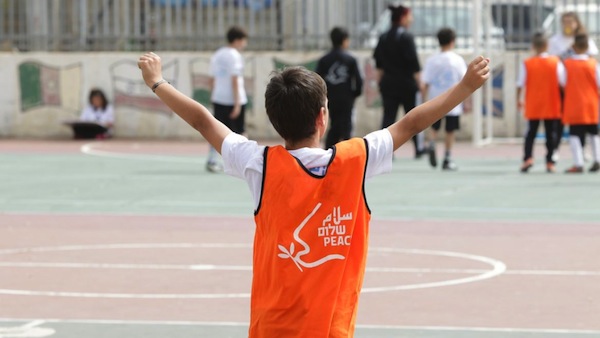
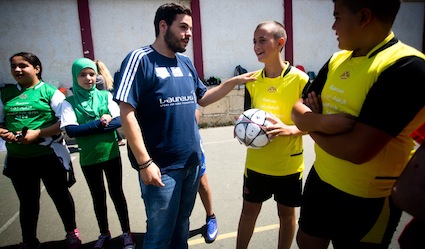
A participant in Playing Fair, Leading Peace in Jaffa. (photo from Peres Center)

“I did not know I could play with Jews or talk to them. Now I want to and I can,” wrote an Arab middle school student whose school was one of 10 – five Jewish, five Arab – to participate in Playing Fair, Leading Peace, created by the Jaffa-based Peres Center for Peace and Innovation to unite Jewish and Arab Israeli children through soccer.

In 2018-2019, Playing Fair, Leading Peace engaged 300 fifth- to seventh-graders in Arab and Jewish sectors of Jerusalem, Tel Aviv, Jaffa, Kalansua, Kfar Saba, Beersheva and Tel Sheva. In each participating school, one class is matched with one class from the corresponding nearby school. Kids and their teachers are guided by two specially trained university students (one Jewish, one Arab) in five tolerance education and prep sessions held at their own school, and in five joint soccer matches on one another’s turf.

In these games, Arabs don’t play against Jews; each team mixes children from the hosting and visiting schools. And there are no referees; the children are given the responsibility of determining rules and mediating disputes.

“They need to communicate to solve issues during the game by themselves. This is a smart component of the program,” said Tamar Hay-Sagiv, director of the education for peace and innovation department at the Peres Center.

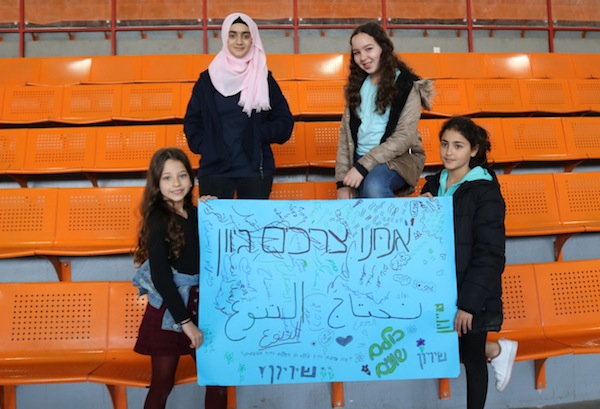
photo - Children in the Arab village of Kalansua with a poster stating, “We need diversity” and “We are all equal” in Hebrew and Arabic
Children in the Arab village of Kalansua with a poster stating, “We need diversity” and “We are all equal” in Hebrew and Arabic. (photo from Peres Center)

But it’s not an easy component, because one side speaks Hebrew and the other speaks Arabic. “We tackle the language issue by teaching through sports. They learn the language of ‘the other’ while they play,” said Hay-Sagiv.

Nor is it a simple matter to convince parents to allow cross-visits.

“There are fears and stereotypes to overcome,” acknowledged Hay-Sagiv. “We had one child in the south whose family was afraid for him to travel to a Bedouin school. It was a trust-building process between his parents and the head of the school, who gave us full support and made the family comfortable in allowing the visit. It’s always a challenge for Jewish schools to agree to travel to Arab communities, but the hospitality they receive is unbelievable.”

One child wrote on the evaluation form after the first visit: “Even after they prepared us, I was still afraid of them, but when I met them, they looked like us, only with different clothing.”

As for stereotypes, it’s not only about the Arab-Jewish divide but also about gender. “We’ve had girls thinking they are not allowed to play soccer,” said Hay-Sagiv. “We have to overcome that, too. We try to create a safe space for everyone that is fun and interactive.”

For the last 18 years, the Peres Center has used sports, specifically soccer, as a tool to break down barriers between youth, Hay-Sagiv told Israel21c.

The centre’s flagship project, Twinned Peace Sports Schools (TPSS), involves leadership training and mixed teams led by professional coaches. Britain’s Prince William kicked around a ball with the TPSS team in Jaffa during his visit to Israel last summer.

photo - Playing Fair, Leading Peace soccer match at a Jerusalem school
Playing Fair, Leading Peace soccer match at a Jerusalem school. (photo from Peres Center)

TPSS, started in 2002, is the first and longest-running initiative of its kind in the region. Hay-Sagiv said it “significantly influences Arab and Jewish, Israeli and Palestinian girls and boys to become agents of positive change in their community and around the world.”

The Peres Center sought a way to scale up this successful, but limited, peace-building-through-sports program in a more accessible and less expensive format that would also involve nonathletic children.

“Based on our experience, we thought it would be interesting to get into Jewish and Arab schools during school hours and engage full classrooms. This way, we can reach all the boys and girls, as well as their teachers,” said Hay-Sagiv. When the other children in the host school observe the mixed teams playing soccer together, “it’s unbelievable to see the reactions to this unusual sight. That also has an impact.”

Playing Fair, Leading Peace is supported by the Israel Football Association, which oversees Israel’s national football (soccer) team comprised of Jewish and Arab Israelis, and captained by Circassian-Israeli Muslim Bibras Natkho. The program also works with the National Union of Israeli Students (representing all Israeli universities) and the Laureus Sport for Good Foundation.

“Hopefully, next [school] year, we will double the number of participating schools,” said Hay-Sagiv.

She explained that fifth- to seventh-graders were chosen for the program “because we see this as a crucial age for exposing them to this type of experience. Verbally, they are well developed and they’re going into a tough age. You have enough time to work with them during school hours, and it’s still possible at this age to work with boys and girls together.”

Based on questionnaires distributed before and after the activity, Hay-Sagiv and her staff can see that the program effects changes in attitude.

“I want to feel with them exactly the way I feel with my friends,” wrote one child.

“I hope that we will become one family that does joint activities in togetherness and tolerance,” wrote another.

Hay-Sagiv isn’t surprised by this impact, having seen the inroads made over the years by Twinned Peace Sports Schools.

“We’re traveling to Poland to organize a sports tournament in Warsaw with Israelis, Poles, Germans, Hungarians and Russians to mark 80 years since World War II, hopefully in September,” she said. “We are thinking of bringing a mixed Jewish and Arab team from Israel.”

For more information, visit peres-center.org/en/the-organization/projects/sports/playing-fair.

Israel21c is a nonprofit educational foundation with a mission to focus media and public attention on the 21st-century Israel that exists beyond the conflict. For more, or to donate, visit israel21c.org.

Format ImagePosted on August 23, 2019August 22, 2019Author Abigail Klein Leichman ISRAEL21CCategories IsraelTags children, Israel, Palestine, peace, Peres Center, soccer, sports
Parrot invaders

Parrot invaders

(photos from Ashernet)

A few years ago, the sight of a parrot in the Israeli sky was a rare event but invasive species have arrived, causing agricultural and other damage and threatening native biodiversity. Brought to the Middle East and Europe as pets, escaped or released parrots have established numerous wild populations across the area. ParrotNet – a European and Middle East network of scientists, photo - a monk parrotpractitioners and policymakers dedicated to research on invasive parrots, their impacts and the challenges they present – has concluded that measures to prevent parrots from invading new areas are paramount for limiting future harm. According to lead researcher Dr. Assaf Shwartz of the Technion in Haifa, “Today in Israel there are more than 200 populations of parrot species originating in South America and India…. These populations are growing every year and, today, there are more than 10,000 ring-necked parakeets and monk parakeets in Israel.”

Format ImagePosted on August 23, 2019August 22, 2019Author Edgar AsherCategories IsraelTags birds, environment, invasive species, Israel, science
הפסיקה נגד היין מהשטחים

הפסיקה נגד היין מהשטחים

(flickr)

בית המשפט הפדרלי של קנדה קבוע בסוף יולי כי סימון יין שיוצר בהתנחליות שבשטחים הכבושים, בתוך יין תוצרת ישראל אינו מותר. זאת כיוון שמדובר בדברי שקר, הטעייה והולכת שולל של ציבור הצרכנים.

הפסיקה הקשה נגד היין מהשטחים ניתנה בעקבות עתירה של אזרח יהודי מהעיר וויניפג, בשם דיוויד קטנבורג, שהוא פעלי פרו פלסטיני. הוא טען בעתירתו כנגד ממשלת קנדה, שיינות שיוצרו בהתנחלויות שבשטחים אינם יכולים להימכר עם תווית של יין שיוצר במדינת ישראל. לדברי קטנבורג הקהילה הבינלאומית וכן גם קנדה לא מכירות בהתנחלויות שבשטחים, כחלק אינטגרלי ממדינת ישראל. העתירה של קטנבורג הוגשה נגד סוכנות הפיקוח על המזון של קנדה, שבמקור אישרה את מכירת היין מההתנחלויות בשטחים עם התווית מיוצר בישראל.

שופטת בית המשפט הפדרלי, אן מקטביץ, פרסמה את פסק הדין שלה (שמתפרש על פני ארבעים ושלושה עמודים). היא אמרה בין היתר בהחלטתה כי יש מעט מאוד דברים כה מורכבים וסבוכים בהם המדיניות במזרח התיכון. וכן קיומן של ההתנחלויות הישראליות בגדה המערבית. אלה מעלים נושאים פוליטיים מסובכים, רגישים ועמוקים. עם זאת, אחת הדרכים השלוות אשר בה יכולים בני האדם להביע את עמדותיהם, היא דרך קבלת ההחלטות שלהם, כאשר הם רוכשים מוצרים שונים. כדי שיכולו להביע את עמדתם בהקשר זה, על הצרכנים לקבל מידע מדוייק לגבי זהות המוצר שנמצא במחלוקת. עוד קבעה השופטת של בית המשפט הפדרלי כי סימון יינות שיוצרו והוכנסו לתוך בקבוקים בהתנחלויות שבשטחים, כיין שיוצר במדינת ישראל, הוא דבר שקרי, מטעה ומוליך שולל את ציבור הצרכנים. לדבריה בהתנהלות שכזו מפירים את חוקי המקור של מוצרי מזון (כולל יינות) ותרופות. ההחלטה שמאפשרת לסמן יין שיוצר בהתנחלויות הישראליות שבשטחים כיין שיוצר במדינת ישראל, לא נופלת בגדר האפשרי והמתקבל על הדעת. אגב שופטת סירבה לקבוע כיצד כן יש לפרסם מהיכן היין בשטחים הכבושים יוצר. זאת לאור חילוקי הדעות המשמעותיים בכל הנוגע למעמד החוקי של ההתנחלויות הישראליות, בשטחי הגדה המערבית. היא ציינה כי אינה מתכוונת ליישב סוגיה זו בתיק שלפניה.

השופטת מקטביץ שלחה את התביעה של קטנבורג בחזרה לסוכנות הפיקוח על המזון של קנדה, על מנת שתדון בסוגיה מחדש. יצויין כי תחילה סוכנות הפיקוח הקנדית הסכימה לאור פנייתו של קטנבורג, להסיר את הסימון תוצרת ישראל על בקבוקי יין שיוצרו בהתנחלויות בשטחים. לאחר מכן היא חזרה בה ואז הוא עתר לבית המשפט העליון במדינה.

בהתאם לחוק הקנדי מוצרי מזון, כולל יינות אשר נמכרים בקנדה, חייבים לכלול פירוט מלא על מקור המדינה בהם הם יוצרו. כמובן שחל איסור להטעות את הצרכנים המקומיים.

לא ברור בשלב זה כיצד סוכנות הפיקוח על המזון תנהג לאור הפסיקה. לא מן הנמנע שסוגיה סבוכה זו תחזור לשולחנו של בית המשפט הקנדי לאור ערורים צפויים.

המרכז לענייני ישראל היהודים בקנדה פנה רשמית לממשלת קנדה וביקש תגיש עירעור לבית המשפט על החלטת השופטת מקטביץ. לדברי המרכז נפלו מספר טעויות משמעותיות בהחלטת השופטת. זאת כיוון שהדבקת התוויות על מקור היצור של בקבוקי היין מההתנחלויות בשטחים, תואמת את רוח הסכם הסחר החופשי בין קנדה לישראל שנחתם לאחרונה. וכן תואמת את החוק הקנדי והחוק הבינלאומי.

במרכז מציינים כי אם כן יוגש ערעור הם יבקשו מבית המשפט לקבל מעמד של מתערבים בדיון המדובר, על מנת להבטיח שהחוק הקנדי והחוק הבינלאומי יפורשו ויושמו כראוי.

Format ImagePosted on August 22, 2019Author Roni RachmaniCategories עניין בחדשותTags David Kattenburg, international law, Israel, law, settlements, wine, דיוויד קטנבורג, החוק הבינלאומי, חוק, יין, ישראל, שטחים
מכבי אשדוד

מכבי אשדוד

בראד גרינברג (Orrling)

המאמן של קבוצת הכדורסל מכבי אשדוד באר טוביה, בראד גרינברג (יהודי אמריקני), מונה לעוזר מאמן נבחרת קנדה, לאליפות העולם בכדורסל, שתיערך בסין החל מסוף החודש הבא. גרינברג ישמש אחד מארבעת עוזרים של המאמן הראשי, ניק נרס. גרינברג הוא בן שישים וחמש ונולד בלונג איינלד בארה”ב.

הוא שימש במשך שתיים עשרה שנים בתפקיד עוזר מאמן של קבוצת הלוס אנג’לס קליפרס. קודם לכן הוא שימש בתפקיד הסקאוט בקבוצת הניו יורק ניקס. ולפני כן הוא החזיק במספר תפקידים מקצועיים בקבוצת הפורטלנד בלייזרס. וכן שימש בתפקיד מנהל כללי של קבוצת הפילדלפיה סיקרס. לאחר סיום אליפות העולם בסין יחזור גרינברג לאמן את מכבי אשדוד המשחקת בליגת העל בכדורסל בישראל, זו העונה השלישית ברציפות. הוא יחזור לישראל רק במהלך חודש ספטמבר (בגלל אליפות העולם) ויחמיץ לכן את תחילת האימוני הקבוצה, לעונה החדשה שפתח וכן משחקי גביע ווינר. את האימונים יעביר במקומו עוזרו בשנתיים האחרונות דני גוט. תחת שרביטו מכבי אשדוד בעונתו הראשונה הגיעה למקום למקום הרביעי בליגת העל הישראלית, וכן הגיעה לחצי הגמר בגביע המדינה. בעונה שעברה הקבוצה הגיעה למקום למקום התשיעי בלבד. בשנים האחרונות משמש גרינברג בתפקיד המאמן הראשי של נבחרת קוסבו בכדורסל. לפני שהגיע למכבי אשדוד אימן גרינברג בישראל את קבוצת הפועל ירושלים במשך שלוש שנים. ההישג הגדול ביותר שלו עם הפועל ירושלים היה הגעה לרבע גמר היורוקאפ. לפני ירושלים הוא אימן את קבוצת מכבי חיפה במשך עונה אחת.

הנבחרת הלאומית של קנדה לגברים נמצאת במקום העשרים ושלושה בעולם בדירוג של התאחדות הכדורסל הבינלאומית (פיב”א). הנבחרת הקנדית נחשבת לנבחרת ברמה בינונית בעולם. ההישג המשמעותי שלה הייה זכייה במקום השני במשחקים האולימפיים בשנת אלף תשע מאות שלושים ושש. באליפות יבשת אמריקה לכדורסל הנבחרת הקנדית הגיעה פעמיים למקום השני (באלף תשע מאות ושמונים ובאלף תשע מאות תשעים ותשע). ההישג הטוב ביותר של הקנדים היה מקום שישי באליפות העולם בכדורסל בשנת אלף תשע מאות שמונים ושתיים.

אליפות העולם בכדורסל הקרובה או כמו שהיא נקראת רשמית גביע העולם בכדורסל אלפיים ותשע עשרה, תיערך ברפובליקה העממית של סין, בין השלושים ואחד באוגוסט לחמישה עשר בספטמבר. האירוע מאורגן על ידי התאחדות הכדורסל הבינלאומית ואיגוד הכדורסל הסיני. המשחקים יערכו בשמונה ההערים הבאות: בייג’ינג, נאנג’ינג, שאנגחאי, ווהאן, פושאן, דונגגוואן, שנג’ן וגואנגג’ואו. אולמות הכדורסל בערים אלה יכולים להכיל בין שלושה עשר לשמונה עשר אלף צופים.

המכרז לבחירת המארחת של אליפות העולם בכדורסל נפתח בחודש אפריל לפני חמש שנים. שנה לאחר מכן הוחלט שהמשחקים יערכו ביבשת אסיה. על כן שתי הצעות סופיות הגיעו לגמר של המכרז: של סין ושל הפיליפינים. לאחר מספר חודשים נפל הפור והוחלט שסין תארח את משחקי האליפות לשנת אלפיים ותשע עשרה.

בחודש פברואר השנה הסתיימו הטורנירים של המוקדמות לאליפות העולם ונקבעו שלושים ושתיים הנבחרות שישתתפו בתחרות. מיבשת אירופה ישתתפו שתיים עשרה נבחרות והן: איטליה, גרמניה, טורקיה, יוון, ליטא, מונטגרו, ספרד, סרביה, פולין, צ’כיה, צרפת ורוסיה. מיבשות אסיה ואוקיאניה ישתתפו שמונה נבחרות והן: סין שמארחת את המשחקים, אוסטרליה, איראן, הפיליפינים, יפן, ירדן, ניו זינלד, ודרום קוריאה. מיבשת אמריקה ישתתפו שבע נבחרות והן: ארגנטינה, ארצות הברית, ברזיל, הרפובליקה הדומיניקנית, ונצואלה, פוארטו ריקו וקנדה. מיבשת אפריקה ישתתפו חמש נבחרות והן: אנגולה, חוף השנהב, ניגריה, סנגל ותוניסיה.

Format ImagePosted on July 31, 2019July 25, 2019Author Roni RachmaniCategories עניין בחדשותTags Ashdod, basketball, Brad Greenberg, Maccabi, sports, אשדוד, בראד גרינברג, כדורסל, מכבי, ספורט
אלפי נחשים

אלפי נחשים

(Manitoba Conservation / gov.mb.ca)

טקס ההזדווגות השנתי של נחשי בירית מצויים מצליח למשוך אליו אלפי בני אדם, בהם חובבי נחשים ושונאי נחשים כאחד. במשך ימים אחדים באביב, המבקרים מגיעים למאורות נחשים במקום שנקרא נארסיס במחוז מניטובה.

האזור מושך אליו את הנחשים בדיוק מאותן סיבות שגרמו לחקלאים רבים לנטוש אותו לפני עשרות שנים. האדמה מורכבת משכבת עפר דקה על גבי סלע גיר שהמים שחקו. כך נוצרה רשת מערות קטנות שאליהן אפשר להגיע דרך בולענים בקרקע. במקום קר כמו קנדה הנחשים מצאו להם בית מושלם לחורף.

פרץ הנחשים הנראה בכל אביב ובעשרת הימים שבהם הם עסוקים בחגיגות ההזדווגות, תלויים בעיקר מזג האוויר שקשה לחזות אותו. עננים, טמפרטורות נמוכות וגשם עשויים להשאיר את כל הנחשים מתחת לפני הקרקע. זה שנים רבות שהנחשים זוחלים החוצה בדיוק בזמן, מה שהפך את הצפייה בהם לטיול פופולרי ביום האם. האביב האחרון היה קר והנחשים הגיחו החוצה רק לקראת סוף מאי.

מן הסתם מדובר בריכוז הנחשים הגדול בעולם, אומר מרצה לביולוגיה באוניברסיטה של מדינת אורגון, פרופסור רוברט מייסון. כמעט מזה שלושים שנה הוא מגיע לנארסיס בכל אביב. מדהים אותו כמה אנשים רוצים לראות את הנחשים האלה הוא מוסיף. לדבריו הנחשים הם השגרירים המושלמים של עולם הזוחלים. אלמלא הנחשים נארסיס היתה נותרת עיירת רפאים. ומה יש בה: תחנת הדלק נטושה בסמוך להריסות של בית.

המדענים עורכים לרוב את מחקריהם באזורים קטנים של מאורות נחשים בשטחים פרטיים. אבל שירות חיות הבר של מניטובה הקים פארק סביב מאורות הנחשים, שבחורף משמשות בית לכשבעים אלף מהם. הם אמנם מסוגלים להכיש אך אין בכך סכנה לבני האדם.

בפארק השוכן מצפון לנארסיס מוצבים ספסלים ושולחנות פיקניק, שלטי הסבר ושבילי כורכר המובילים אל תוך חורשת צפצפות קטנה וגבעה. הנקודות הפופולריות ביותר הן ארבעה בולענים באזור הזה. גודלו של כל בולען הוא כשל חדר גדול, ועומקם מגיע לכשלושה עד ארבעה מטרים. תחילה, נדמה כי הבולען מכוסה בצמחייה ירוקה. מאחר שזו זזה, ניתן להבין מיד כי המקום רוחש נחשים. עוביים של מרבית הנחשים כשל מרקר והגדול ביותר עשוי להגיע לאורך של חצי מטר. במקומות שונים במאורה הנקבות שגדולות יותר מהזכרים, מתפתלות בתוך פקעות תזזיתיות של זכרים קטנים

אמנית מהעיר ווינפג, נט סוסטריק, שביקרה בפעם הראשונה במקום עם משפחתה, אמרה כי היא נגעלה קצת בהתחלה מהנחשים שהיו קלועים אחד בתוך השני. זה נראה לה תחילה כמו שטיח חלקלק ושמנוני. לאחר שאזרה אומץ והרימה את אחד הנחשים בידיה היא הבינה כי הם לא כל כך נוראיים, אלא דווקא יצורים נוחים ויפהפיים. סוסטריק פחדה מנחשים עד שהעזה להרים אחד ולהחזיק בו. בעלה של סוסטריק שהוא רופא בחדר מיון, השווה את המקום לסרט של אינדיאנה ג’ונס. אי אפשר היה לראות את הקרקע משום שהיא מכוסה בשכבה שנעה ומתפתלת ללא הרף, הוא אמר.

הפארק הוא שמורת חיות בר יוצאת דופ, שבה ההנהלה מעודדת את המבקרים לגעת בבעלי החיים, אך לא בנקבות. המבקרים הופתעו לגלות שהנחשים אינם ריריים או קשקשיים למגע, אלא רכים ומשיים כמו ארנבי אנגורה מתפתלים. לדבריהם הנחשים ממש מתמוססים לתוך היד. גם הצלילים שמשמיעים הנחשים התפתיעו את המבקרים. הם אינם מלחששים או שורקים. גוש הנחשים המתחככים זה בזה ובקרקעית המאורה מייצרים צליל שלדבריהם דומה לאוושת רוח המנשבת בין ענפי עצים בעוצמה גבוהה ביותר.

Format ImagePosted on July 25, 2019Author Roni RachmaniCategories עניין בחדשותTags Manitoba, mating, Narcisse, snakes, הזדווגות, מניטובה, נארסיס, נחשים
Good Abroad: Promoting pluralism in Israel

Good Abroad: Promoting pluralism in Israel

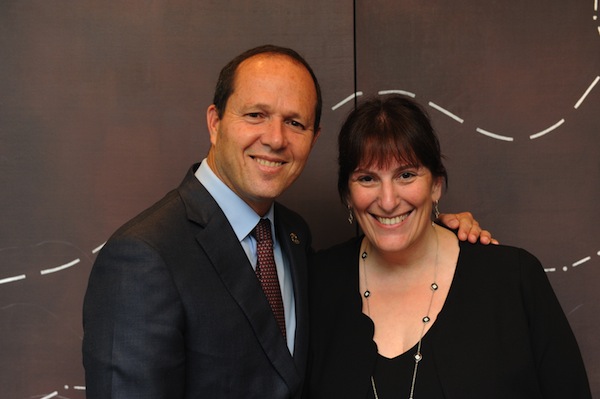
Then-mayor of Jerusalem Nir Barkat and Nomi Levin Yeshua at the Jerusalem Foundation of Canada gala in Toronto in 2014. (photo from Nomi Levin Yeshua)

This article is the first in an occasional series about people with British Columbian roots having positive impacts in Israel and elsewhere.

When Nomi Levin Yeshua went to Israel in 1990, she wasn’t committed to staying there. Almost three decades later, the Vancouver-born and -raised woman can look back on a career that has impacted the face of Jerusalem and Israel.

Thanks to a chance meeting over Shabbat lunch with her grandmother’s former neighbour’s sister – “You know Israel,” she said, laughing – Yeshua had barely arrived in Israel when she got a job as assistant to the assistant to Teddy Kollek, Jerusalem’s mayor – but the job was more than that.

Shula Eisner, Yeshua’s new boss, had been working for Kollek since 1965, just before he began his 28-year run as mayor. Kollek was chairman of the Israel Museum and, before that, had served 11 years as director general of the prime minister’s office under David Ben-Gurion. In that role, Kollek effectively created almost all of the government agencies in the new state.

“One of the things he believed was that there had to be a national museum,” Yeshua told the Independent recently while in Vancouver for a milestone birthday of her mother, Shanie Levin. “He went around raising money to start the Israel Museum. He had an office there and [Eisner] was originally hired there to work with him with all the foreign donors. Then he was elected mayor and he kept to the Israel Museum office.”

In 1966, Kollek founded the Jerusalem Foundation, where Yeshua now works.

“That was his way of creating a forum for supporters of Jerusalem around the world, to be part of creating a new vision for Jerusalem. Then, a year after that, with the Six Day War and the reunification of the city, suddenly everything was just multiplied,” she said.

Yeshua acknowledged that Kollek’s multiple roles as mayor, head of the national museum and leader of a major foundation would probably not be sustainable today, but that was a different time.

“For him, it was all fluid,” she said.

To accommodate his different hats in the era before email or even fax machines, there was a driver who shuffled between offices, taking papers back and forth.

When Eisner moved over to another foundation, she handed her baton to Yeshua, who worked with Kollek through his last years as mayor and continued until a few months before he passed away, in 2007. She continues to run all donor relations for the Jerusalem Foundation and she personally handles Canadian fundraising for the organization.

The Jerusalem Foundation was started by Kollek because he saw that Jerusalem was a very poor city.

“A lot of religious institutions that don’t pay taxes at all are in Jerusalem, so he knew that it was always going to be a challenge for the city to have a balanced budget, to expand the city, to develop the city, to provide for the citizens of the city, so he knew that he was going to need to raise money,” she said.

Kollek pioneered a fundraising model that is now almost universal across Israeli and Jewish philanthropy.

“He connected every donor to a specific project and they knew that their money went to that project and they could come – and now their grandchildren come – and see those projects. To this day, they can still track the money. The Jerusalem Foundation was really at the forefront of that movement of changing the way people were giving to Israel. Now, it’s taken for granted, but it wasn’t back in the late ’60s and early ’70s at all. That was Teddy,” she said. “He wanted people to feel personally connected to the city, to the project, to the place.”

The foundation emphasizes “shared living” and is now focused on a vision for 2030.

“This is a city that is completely about how to exist together in this space that we share. It’s not just Arabs and Jews. It’s also secular and religious, it’s poor and rich, it’s all kinds of divisions that exist in the city,” she said. “But how do we share and how do we understand each other better?”

One major project is Hand-in-Hand School for Bilingual Education.

“Bilingual education is something that Canadians completely understand but Israelis less so. This is a school that teaches in Arabic and in Hebrew, in mixed classrooms. The rest of the Israeli education system is – we don’t like to use this word but it’s the truth – segregated,” she said. “There are Jewish schools, there are Arab schools and then, even within the Jewish schools, there are religious and nonreligious. This school brings together all of the different population groups and at all times there is an Arabic-speaking and a Hebrew-speaking teacher in the classroom.” There are now six such schools around the country.

Another area of the foundation’s work is helping the most vulnerable populations in the city, through projects such as Springboard, which develops programs primarily through the education system to push gifted kids into opportunities their financial situation might not otherwise permit.

The Jerusalem Foundation is also the city’s second-largest funder to the arts, after the municipality.

“We really believe that a modern and thriving city should have a good cultural scene. Culture is not just for one population group. All members of the community should be cultural consumers. But you have to create culture that is appropriate for those people,” she said. “For example, there is a dance troupe for ultra-Orthodox women. They only perform for women, of course, because otherwise that wouldn’t work for them. But they’re really doing amazing stuff and giving these ultra-Orthodox women who want to dance an opportunity to have a really high-level, professional dance troupe within the system that works for them.”

The foundation is also building a new Hassadna Conservatory of Music.

“They help kids ages six all the way through high school with classical music education and they also provide a special program for children of Ethiopian descent who don’t necessarily have the financial means to get musical training and they have a special program for special needs kids that’s integrated,” she said.

Yeshua credits her Vancouver upbringing as foundational to her worldview and accomplishments. She grew up in the Habonim Dror Zionist youth movement and was a camper, counselor and camp director at Camp Miriam. At home, her Jewishness was nurtured in a pluralistic way.

“In terms of how my mother brought us up, Jewish identity wasn’t limited to our religious identity,” she recalled. “National identity was something that was acceptable, cultural identity was very much encouraged. I think growing up in the very open community of Vancouver – to me it always seems that way, at least – it allowed me to be Jewish in a way that I felt good with and it wasn’t only one way to be Jewish.”

Yeshua acknowledged that “many people feel somewhat alienated from Israel today.”

“I want people to understand that there is a way to engage with Israel, to support Israel, and not contradict your own value system or what you think is acceptable,” she said. “What we do with the Jerusalem Foundation is something that people can respond to, relate to, understand – to protect Jerusalem as a city that is for everyone.”

Format ImagePosted on July 19, 2019July 18, 2019Author Pat JohnsonCategories WorldTags identity, Israel, Jerusalem, Nomi Levin Yeshua, tikkun olam, Vancouver
Safe spaces, diverse voices

Safe spaces, diverse voices

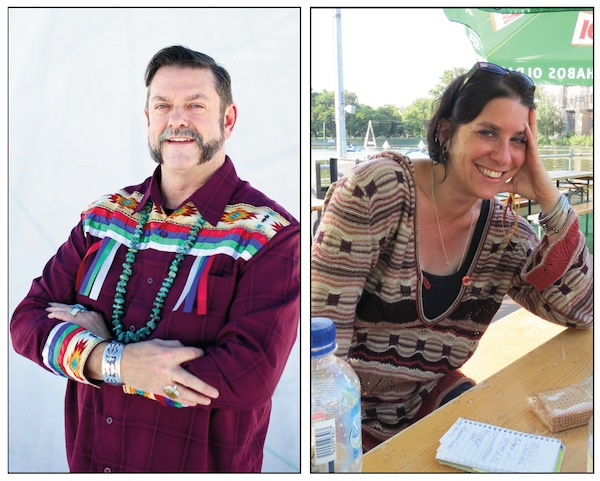
Bradley West and Shayna Plaut (photos from conference organizers)

As part of Winnipeg Pride Week in May, local organizers put on the first-ever Queer and Faithful Conference.

A grassroots event created to give voice to LGBTQ2+ people of colour and their experiences with faith and spirituality, the conference featured two panel discussions with opportunity for informal roundtable discussions. The keynote speaker at the May 25-26 conference at Robert A. Steen Community Centre was writer, facilitator and performer Jenna Tenn Yuk. She spoke about exploring identity and the intersections of race, queerness and faith through personal storytelling, spoken word poetry and facilitation; encouraging interfaith conversations around intersectionality, privilege, social location and other aspects; creating safer spaces for LGBTQ2+ people of colour in faith-based environments; and ensuring safe spaces to ask questions and explore the issues as a community.

Bradley West, who has been involved with Winnipeg’s queer community for more than 20 years, and Shayna Plaut, a former Vancouverite who now lives in Winnipeg, were part of the conference’s Jewish panel.

“I think the conference came about because there were people who had been talking about the importance of keeping their faith, while also celebrating their gender and sexual diversity, and there were some people who were finding that to be a little difficult,” West told the Independent.

Explaining that it was an uncomfortable topic for many people in the broader queer community, he said, “In fact, one of the members said, on Saturday, that, ‘because faith rejected us so soundly, we have rejected faith.’ We need to create a safe space where we can come together and have these conversations – where people from the various faith communities and also from the queer community can come together in a mutual space.”

While such conversations have been going on for some time, typically led by faith leaders and queer community organizers, the aim of the recent conference was to offer a more personal approach.

“The organizers wanted to have voices of the people who are more marginalized in our community, because of their skin tone, or religion, or spirituality, or faith,” said West. “They wanted to make sure it wasn’t just centred around white voices; white, Christian voices….. Oftentimes, when we are having conversations about faith in this Canadian landscape, we default to the dominant voice which, in our historical context, is Christian.

“So, they definitely had a lot of Christians who were there and who were involved, but, in terms of the planning and the panel speakers, and in terms of how they wanted people to think, was thinking of how we might be able to create an open dialogue with each other … to be able to, first, honour our own faith journey, but then also to understand the faith journey of others, especially when that faith journey is very different from our own.”

According to conference organizers, 70 to 80 people attended over the two-day period, with attendees coming from Winnipeg, as well as from surrounding areas, such as Morden, Selkirk, Steinbach and Portage La Prairie.

“From what I experienced, everyone … was approaching it with a spirit of reflection,” said West. “They were definitely gently challenged by the speakers to reflect on their own personal participation in terms of do you really believe your faith is the only faith or the true faith … and does that subtly reinforce this idea that those who are different are ‘less than’?”

The speakers, he continued, “were gently challenging people to think about how we interact – not only with the different denominations in our faith, but everyone of Abrahamic faiths, with different strings of denominations, and also those outside of some of the faiths … different groups practising different versions of the larger faith. Sometimes, we have a tendency to think that our journey and our view is the view that is shared by everyone in our faith … and so, there were those gentle reminders to reflect on that. Overall, as a participant, I would say there was a sense of a call to self-reflection, and there wasn’t any resistance in terms of the intent to self-reflect, for sure.”

For West, one thing that struck a chord was that, even though he was in a room full of strangers at the beginning of the event, everyone got to know one another very quickly. “I think it was very much about, yes, we have differences, but we also have commonalities and, as we move forward, we need to look at both … have a bifocal lens in honouring our differences – not minimizing or whitewashing, or asking us to abandon our differences in order to get along … just focusing on our similarities. We’re going to honour that and work together, and look at how we’ll create spaces and places within our own lives. And then maybe, by extension, our own communities will allow more of these dialogues.

“The gathering had the flavour of us coming together and having these conversations, and continuing to do so outside of this space,” he said. “That core that comes from great changers, like [Mahatma] Gandhi, talking about that idea of, if you want to change something, first, change yourself, because, wherever you go, there you are. If you change yourself, you’ll automatically change the spaces you go into, because you are no longer the same person.”

Plaut’s faith has changed over the years. Born into a Chassidic home in the United States, her family decided to follow Conservative Judaism when she was 5.

“The joke I like to say is, I’m queer, I’m Jewish, I’m a mom, I have seven tattoos, 13 earrings, and I keep a modicum of kosher,” said Plaut. “I teach at the University of Winnipeg and work in the field of human rights and journalism.”

When asked to help organize the conference, Plaut jumped at the chance. She took on the role of food coordinator and ensured all the food was vegetarian, so that everyone could eat, regardless of their religious or dietary restrictions. She also took it upon herself to make sure that not only the Abrahamic faiths were represented, but also Hindu or Sikh, by reaching out to some of her students.

“Folks would use their own experiences and explore some of the strengths that they found within their faith and also some of tensions,” said Plaut about the conference. She said that some people feel like they have to choose, in terms of their identities – religious, cultural and sexual – and that the conference encouraged an exploration of various faiths’ strengths and limitations in terms of guiding people, and what it means to find acceptance within a faith.

The conference attracted a range of attendees.

“Many of the folks who came, not all, but a good proportion, may not have identified as being queer themselves,” said Plaut. “Many of them were grandparents, actually, or parents who wanted to know how to better support their children or grandchildren. They wanted to learn.”

While organizers worked hard to share with and connect people, they left it up to the participants whether to exchange their contact information with one another. Some attendees expressed interest in continuing the conversation beyond the conference and organizers are working on determining the next steps. Many of the participants joined the nearly 50,000 marchers at the Winnipeg Pride Parade, which took place June 1.

“It was amazing, our biggest Pride ever in terms of participants in the parade,” said Plaut. “There were over 112 organizations that registered either floats or walking groups.”

Rebeca Kuropatwa is a Winnipeg freelance writer.

Format ImagePosted on July 19, 2019July 18, 2019Author Rebeca KuropatwaCategories NationalTags faith, inclusion, LGBTQ+, minorities, Pride, religion, spirituality, Winnipeg

Posts pagination

Previous page Page 1 … Page 151 Page 152 Page 153 … Page 323 Next page
Proudly powered by WordPress