Jewish media struggle, revive

Launching within hours of each other in May, the Canadian Jewish Record and TheJ.ca come at journalism from different perspectives.

Like print media as a whole, Jewish newspapers worldwide have been struggling in recent years. The coronavirus, with its economic impacts, was the last straw for Canadian Jewish News, which announced its closure in a message to readers April 13, with the words: “Everything has its season. It is time.”

From the ashes of that flagship media outlet, though, has emerged not one but two new ventures – and rumours of a possible revival of CJN itself.

Launching within hours of each other in May, the Canadian Jewish Record and TheJ.ca come at journalism from different perspectives and the people behind them think there’s room for a range of online voices, even if a national hard-copy print media option isn’t in the picture.

The Record is the brainchild of Bernie Farber, former chief executive officer of the now-defunct Canadian Jewish Congress, and Ron Csillag, a longtime reporter and editor with CJN, whose writing has appeared in the Jewish Independent. TheJ.ca, which has been in the planning stages longer, was started by Winnipeggers Marty Gold and Ron East. The editor is Dave Gordon, a Torontonian whose writing has appeared frequently in the Independent, as well as scores of other Jewish and non-Jewish publications.
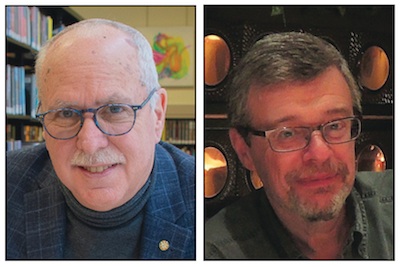
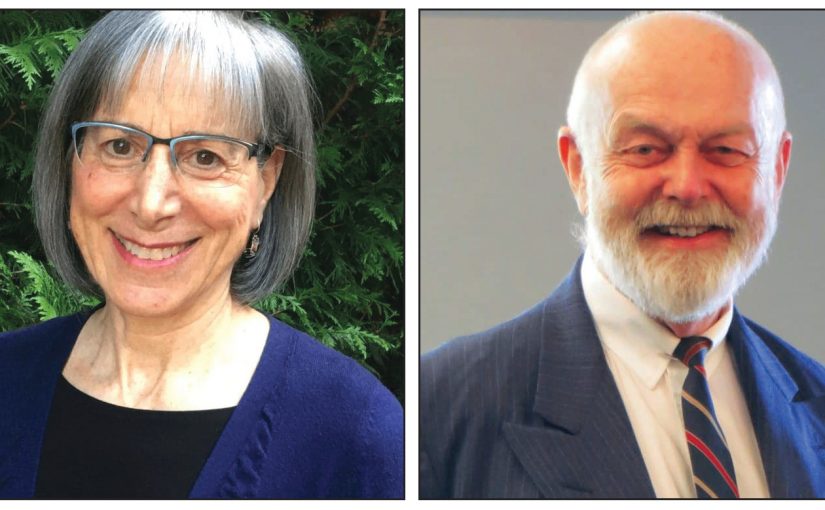
photo - The Canadian Jewish Record’s Bernie Farber, left, and Ron Csillag
The Canadian Jewish Record’s Bernie Farber, left, and Ron Csillag. (photos from the Record)

Farber and Csillag admit they don’t have a business plan beyond getting writers and editors to work for free – and they see their online venture as a stopgap that would probably cease or merge were CJN to return. The individual rumoured to be considering a rebirth of the paper opted to not comment for this story.

Farber, who was with CJC from 1984 until it was subsumed by the Centre for Israel and Jewish Affairs in 2011 and served as its head from 2006, said they launched CJR on the fly, trying to fill a need in the immediate aftermath of CJN’s demise.

“Our goal is not to become a new Canadian Jewish News,” he said. “When and if they were able to come back up … we would find some way to amalgamate. Nothing is written in stone…. We expect to continue into the fall at this point, hopefully.”

The online news and commentary site operates under the auspices of a nonprofit organization and has no money to speak of, other than enough to cover registration fees and miscellaneous costs, said Farber.

“Everybody who wrote and who is continuing to this day to write for the newspaper is doing it pro bono,” he said. “These are skilled, professional journalists who are, for the most part, people who are used to being paid for their work and have chosen to do this as a donation at this time to the community. It really is a grand mitzvah, Canadian Jewish-style, and it’s working.”

The platform got 22,000 hits in the first week, said Farber, who serves as publisher. “It’s going up from there almost exponentially.”

The model upon which their editorial approach is based is akin to CJN, he said, with a range of opinions represented.

“We’re trying to have a big tent,” he said. “We already got into some hot water because we published a piece by Dr. Mira Sucharov. She’s a wonderful writer, she’s on the edge, people don’t like what she writes, but tough shit. People are allowed to have their opinions.”

JI readers will be familiar with Sucharov’s writing. As for coverage of Israel-related topics, Farber said they will follow a similar open approach.

“It’s not that we don’t support Israel,” he said. “We’re a news source, we’re an information source. We run opinion. We’re not going to [say] you can only write good things about Israel or good things about the Jewish community. We want there to be some spark to it where people can say, no, I disagree with that. We do have an option for feedback and we do get letters to the editor. That’s the Jewish community, right? They are vibrant, they come from all over the place and we want to be able to reflect that.”

Farber and Csillag are well-known figures in the Jewish and larger Canadian scene, which is one of the reasons, they say, that the president of York University reached out to them before releasing a much-awaited report of an investigation around a violent confrontation on campus last November between pro- and anti-Israel groups. The Record got embargoed exclusive access to the report before other media. “It demonstrates how, in a short period of time, we have become a reasonable voice in the community,” Farber said.

Csillag, the editor, said they chose, at the launch on May 21, to “flood” the site with stories to keep readers engaged and coming back. Now, the aim is to post two stories a day plus any breaking news.

“People are talking about it, people are complaining about it,” he said. “I got my first bit of hate mail, which is good. That’s when you know you’re making a difference.”

Finding writers to work for free has not been a challenge. “People have been coming out of the woodwork. I never knew that pretty much everyone on the planet was a writer,” Csillag said, laughing.

Challenges they have not ironed out, they admit, include finding reliable reporters outside Ontario and a steady source of news from Israel, since they don’t have the resources to pay for a news service.

If CJN is not revived, Farber said, “I think we have to get together with serious-minded people within the community and say the CJN is gone and we are here. We don’t have a real business model to be honest. What you see is what you get…. We would have to ramp up to a real business model.”

Farber added that Canada, with the world’s fourth-largest Jewish population at 400,000, should be able to sustain at least two national Jewish media platforms.

That confidence is shared by Gordon, who equates the situation to the old joke about the Jew who, when rescued from a deserted island, was asked why he built two synagogues on the island. One, he told rescuers, was his shul; the other was the one he would never set foot in.
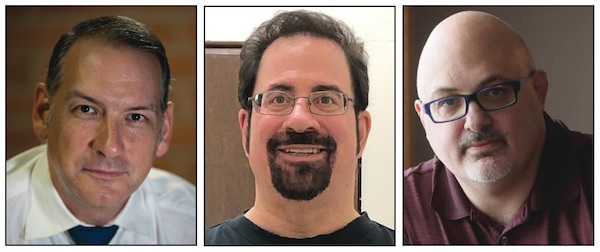
photo - Left to right, TheJ.ca’s Dave Gordon, Marty Gold and Ron East
Left to right, TheJ.ca’s Dave Gordon, Marty Gold and Ron East. (photos from TheJ.ca)

TheJ.ca has been in the planning stages for more than a year. Gordon came on a few weeks before launch. Like the Record, TheJ.ca has little overhead, since everyone associated with it works remotely. They have a few investors and some steady advertising agreements. The online nature of the platform also means no printing or distribution expenses.

Gordon touts the diversity of the large stable of writers.

“One of the things that I think is our proudest asset are individuals from the widest array possible, individuals who are liberal to conservative, Jew and Arab, religious to secular,” he said. “We have four gay columnists, we have Jews of colour who are contributing, we have coast-to-coast contributors and, in that respect, I want to say that, not only do we deliver the unexpected, but we represent the previously unrepresented.”

On Israel coverage, though, they aim to determine suitability of opinions based on the “three Ds” formulated by Natan Sharansky to determine if criticism of Israel is antisemitic: delegitimization of Israel, demonization of Israel, and subjecting Israel to double standards.

“In terms of Israel, we’re not going to make it a secret: we’re very pro-Israel, very Zionistic,” said Gordon. “It’s a good read to say that we are centre-right. We will still strive to maintain a kind of balance in terms of Israel reporting … we will tilt from time to time liberal but not left.”

Their aim is to post a batch of new content twice a week.

While Gordon is based in Toronto, TheJ.ca was born in Winnipeg. Marty Gold, a longtime broadcast journalist and publisher, and Ron East, a former pro wrestler and physical education teacher who has also been involved in publishing, are longtime friends who were critical of existing Jewish media.

East is son of the late Israeli military commander, author and counterterrorism expert Yoram Hamizrachi East. When Winnipeg saw an influx of Israeli immigrants a few years ago, the father and son launched a Hebrew-language publication to help the newcomers navigate their city. The 500 copies were routinely snapped up, he said.

The idea for the new media platform came after Gold and East felt that the established Jewish media and communal organizations in the city were not adequately confronting anti-Israel activity.

“There wasn’t really a pro-Israel, Zionistic platform out there,” said East. “We found that our local media here in Winnipeg, as well as when we started looking at Canadian Jewish News and others, were giving more and more room … and more and more credibility to what we would describe as anti-Israel, anti-Zionistic and, in some cases, pro-BDS Jewish movements. Those voices became louder and louder and the Zionistic pro-Israel voices seemed to be drowned out. We felt that it was important to provide a platform that would allow for those voices.”

While TheJ.ca is an online media platform, they are mooting a print digest that might be issued a couple of times a year. They are also working on a way to format content so that it can be easily downloaded and printed for people who prefer to hold their newspaper in their hands. Also in the hopper are plans for region-specific landing pages, so readers in Vancouver or Halifax, say, could access both items of national and international interest, as well as local news relevant to them.

The design of their site, said East, is particularly aimed at reaching younger readers. They credit Gordon’s experience in the field for bringing together a diverse group of writers from across the country.

***

The Jewish media scene has faced unprecedented challenges in recent years. The emergence of the internet more than two decades ago has undermined print media of all types, with publications for small or niche demographics experiencing particular challenges as well as advantages. The pandemic, which led to an unprecedented global economic shutdown in March, had immediate repercussions. Much of the advertising in the Independent, for example, is for upcoming community events, all of which were summarily canceled. Non-essential retailers closed, making advertising extraneous.

The Independent has continued publishing on a reduced schedule.

Winnipeg’s Jewish Post & News announced in April that it was ceasing printing, but started publishing a print edition again at the end of May.

The difficulties nearly led to the dissolution of the world’s oldest English-language Jewish newspaper, Britain’s Jewish Chronicle, which was saved by a conglomerate of philanthropists. The rival Jewish News, which had also announced its liquidation and was set to merge with the Chronicle before the surprise bailout, will, for now, continue publishing independently.

In an article recently about the state of Jewish journalism, the Times of Israel reported that New York’s Jewish Week made a dire plea for support and a leader in the American Jewish Press Association – of which the Independent is a member – acknowledged that COVID has presented a serious challenge to an already struggling sector.

The world’s third-largest Jewish community, in France, is in a different boat. In the 1980s, the French government opened radio airwaves to private groups and Jewish radio stations play a role in that country similar to the role newspapers play in most other Jewish communities.
More than $8.9 million raised

When COVID-19 hit, the Jewish Federation of Greater Vancouver quickly refocused its organizational resources on closing the annual campaign and addressing urgent community needs. Now, it is circling back to announce some terrific news, which is that the 2019 Federation annual campaign raised more than $8.9 million.

Here is a general breakdown of the funds raised:

  • $7.9 million in unrestricted funds to support programs and services locally, nationally and in Israel through the allocations process – an increase of $100,000 from last year;
  • $1 million in special project funding from donors who give above and beyond their annual campaign commitments to support programs that meet high-priority community needs; and
  • $40,000 to support the work of specific agencies from donors directing a portion of their increased gifts through Federation’s Plus Giving program.

The community’s generosity is making an impact here and around the world. Thirty-two local Jewish families will have safe, stable homes when they move into new affordable housing units this summer. Youth in Israel who were once considered at-risk are now skilled professionals whose expertise is sought after.

Federation gives a huge thank you to everyone who contributed and to everyone who volunteered to make the annual campaign a success, including the more than 250 community members who volunteered as canvassers and team captains.

Federation’s campaign chair, Jonathon Leipsic, once again demonstrated outstanding leadership, energy and passion for community as he led the Annual Campaign Working Cabinet. Kol hakavod and todah rabah to Leipsic and to each of these community leaders, who are on this dedicated team: Shay Keil, major gifts co-chair; Lana Pulver, major gifts co-chair; Michael Averbach, men’s philanthropy co-chair; Daniel Dodek, men’s philanthropy co-chair; Susan Hector, canvasser development; Al Szajman, marketing chair; Alvin Wasserman, campaign advisor; and Catherine Epstein, agency liaison.

The funds raised in this campaign will be distributed locally, nationally and in Israel during the 2021 allocations cycle, which will take place next summer. This is part of the two-year allocations cycle that Federation established after the 2008 economic downturn in order to provide greater predictability to its partners and to provide a measure of protection in the event of unanticipated fluctuations. The prudent contingency planning that Federation has been able to do as a result is part of what enabled it to provide emergency funding in April to community organizations that were hit hardest by COVID-19.

In addition, the community also depends on Jewish Federation to work with donors throughout the year to generate special project funding to meet high-priority needs. Combined with the annual campaign result, the total Jewish Federation raised this year was $10.3 million. While this strong result will help sustain the community, more resources will still be needed to address increased community needs related directly to the pandemic. A healthy annual campaign is just the start. With the challenges we’re all currently experiencing, Jewish Federation’s central role has never been more important.

Inspiring achievers honoured

Dr. Paige Axelrood and Ivan Sayers were among the 25 British Columbians honoured with a 2020 BC Achievement Community Award. (photos from BC Achievement Foundation)

On April 27, Premier John Horgan and Anne Giardini, chair of the BC Achievement Foundation, named this year’s recipients of the BC Achievement Community Award. Among those honoured were Jewish community members Dr. Paige Axelrood and Ivan Sayers. “These days more than ever, our communities are made stronger by British Columbians who go above and beyond,” said Horgan. “Thanks go to all of the BC Achievement 2020 Community Award recipients for helping build a better province for everyone.”

“It is an honour to celebrate the excellence and dedication of these 25 outstanding British Columbians,” added Giardini. “On behalf of all of us at the BC Achievement Foundation, I thank each of them for strengthening their communities and inspiring others to community action.”

As the founder of the Scientist in Residence Program, Axelrood developed and built an educational program to support teachers and help students discover their inner scientist. Elementary students across the Vancouver School District have experienced real science and discovered the natural world through the Scientist in Residence Program. Axelrood’s vision to partner teachers with scientists to facilitate hands-on, inquiry-based lessons has helped change the delivery of science education.

Sayers is the honorary curator of the BC Society for Museum of Original Costume and curator emeritus, Museum of Vancouver. Specializing in the study of women’s, men’s and children’s fashions from 1700 to the present, Sayers has produced historical fashion shows and museum exhibitions all over western North America. A lecturer and mentor, his fashion shows have supported countless nonprofits over the years.

The BC Achievement Foundation is an independent foundation established in 2003, whose mission is to honour excellence and inspire achievement. This year’s selection committee members were Mayor Lee Brain of Prince Rupert, Mayor Michelle Staples of Duncan, and past recipients Lolly Bennett, Aart Schuurman Hess and Andy Yu.

The recipients of the 2020 Community Award will be recognized in a formal presentation ceremony in Victoria, in the presence of Janet Austin, lieutenant governor of British Columbia. Each recipient receives a certificate and a medallion designed by BC artist Robert Davidson. For more information on the award and its recipients, past and present, visit bcachievement.com.

Muslim leader an ally

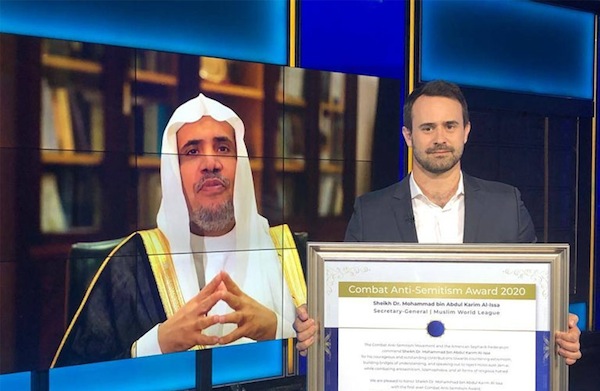
Sheikh Dr. Muhammad Al-Issa receives an award, virtually, from Sacha Roytman-Dratwa, director of the Combat Antisemitism Movement. (screenshot)

During a worldwide virtual event this month involving Jewish leaders and government officials from various countries, one of the leading figures in Sunni Islam was recognized for his work opposing antisemitism and Holocaust denial.

Sheikh Dr. Mohammed Al-Issa is the secretary-general of the Muslim World League and is a former minister of justice of Saudi Arabia. The Muslim World League is funded by the Saudi government, is based in Mecca and positions itself as a force for modernization and moderation in Saudi Arabia and the Muslim world. Earlier this year, Al-Issa led an historic trip of senior Muslim clerics and leaders to Auschwitz-Birkenau.

The online event, titled How Muslims and Jews Can Combat Anti-Semitism Together, featured Al-Issa via video from Saudi Arabia, joined by U.S. government officials including Sam Brownback, a former senator now ambassador-at-large for international religious freedom, and Elan Carr, special envoy for monitoring and combating antisemitism. The event was sponsored by the American Sephardi Federation and the Combat Antisemitism Movement, which bills itself as a non-partisan, global grassroots movement of individuals and organizations, across all religions and faiths, united to combat antisemitism. The organization’s director, Sacha Roytman-Dratwa, presented Al-Issa with the movement’s first annual award recognizing Muslim leadership against antisemitism.

“We have been reminded that, even in countries as advanced and multicultural as the United States, misunderstanding and mistrust is dangerous when allowed to fester,” Al-Issa said in an address that was translated from Arabic. “It can lead to anger, violence and social divisions that help no one. Everywhere in the world, we face challenges in building the bridges of communication, partnership and friendship. But, in a world with many complicated threats, from terrorism to global pandemics, our partnerships are more important than ever.”

He talked about the unifying global fight against coronavirus which, he said, “does not care if a person is Muslim or non-Muslim, Jew or non-Jew, Christian or non-Christian … rich or poor, educated or non-educated.”

That unity is a model for opposing the spread of hatred and intolerance, he said, even as extremists attempt to exploit the current uncertainty to push hatred and division.

He spoke of his visit in January to the death camp in Poland, as well as his numerous visits to synagogues and Jewish museums.

“I stood united alongside my Jewish brothers and said, ‘never again.’ Not for Jews, not for Muslims, not for Christians, not for Hindus, not for Sikhs, not for any of God’s children,” said Al-Issa. “History’s greatest horror, the Holocaust, must never be repeated.… The 1.1 million people murdered at Auschwitz were human beings, just like any other, just like any Muslim. And even though it has been 75 years since the gates of the Auschwitz death camp were torn down, creating a better world for future generations is a constant struggle that we must not give up on.”

He cited murders of Muslims in New Zealand, Christians in Sri Lanka and Jews in the United States as indications of the work remaining to be done.

“Whereas Jews and Muslims lived centuries together, in these last decades we have sadly grown apart,” he said. Since taking the helm of the Muslim World League in 2016, he has tried to build bridges with Jewish and Christian communities. He has also been vocal in fighting Holocaust denial in Muslim circles.

“There are those who still try to falsify history, who claim the Holocaust, the most despised crime in human history, is fiction,” he said. “We stand against these liars, no matter who they are or where they come from, for denying history can only serve to further the aims of those who perpetrate hateful ideas of racial, ethnic or religious purity.”

Continued genocides, in Darfur, Rwanda, Bosnia and now Myanmar, show that the lessons of the Holocaust are universal, he said.

“Muslims have a responsibility to learn them, heed the warning of history and stand as part of the international community to say, ‘never again,’” Al-Issa said. “We will act together to make just peace a reality for Jews and Muslims, and for all people, religions, civilizations and cultures.”

Uprising observed

The Vancouver Holocaust Education Centre and the Jewish Community Centre of Greater Vancouver were among 125 partners presenting a global commemoration of the 77th anniversary of the Warsaw Ghetto Uprising recently.

Beginning and ending with stirring renditions of the “Partisans’ Hymn,” the online event, which also commemorated the end of the Second World War 75 years ago, featured a long list of singers and performers from Hollywood, Broadway and elsewhere, including Dr. Ruth Westheimer, Mayim Bialik, Whoopi Goldberg, Adrien Brody, Lauren Ambrose and dozens more.

We Are Here: A Celebration of Resilience, Resistance and Hope, which took place June 14, was produced by the Museum of Jewish Heritage: A Living Memorial to the Holocaust, Sing for Hope, the National Yiddish Theatre Folksbiene and the Lang Lang International Music Foundation.

Zog Nit Keyn Mol” (“Never Say”) is generally called “The Partisans’ Song” or “The Partisans’ Hymn” in English and is an anthem of resilience amid catastrophe sung at Holocaust commemorative events. Written in the Vilna Ghetto by Hirsh Glik after he learned of the six-week uprising by Jews in the Warsaw Ghetto, its stirring concluding lines translate as, “So never say you now go on your last way / Though darkened skies may now conceal the blue of day / Because the hour for which we’ve hungered is so near / Beneath our feet the earth shall thunder, ‘We are here!’”

Other musical performances included a Yiddish rendition of Leonard Cohen’s “Hallelujah,” adapted and performed by pianist and singer Daniel Kahn; “Over the Rainbow,” from the 1939 film The Wizard of Oz, composed by Harold Arlen with lyrics by Yip Harburg, two friends from the Lower Eastside of Manhattan, against the spectre of a darkening Europe; and “Es Brent” (“In Flames”), a musical cri de coeur written in 1936 by Mordechai Gebirtig after what he viewed as the world’s indifference to a pogrom in the Polish town of Przycik.

Andrew Cuomo, governor of the state of New York, spoke of his father, the late former New York governor Mario Cuomo, who helped ensure the creation of the Museum of Jewish Heritage, the world’s third-largest Holocaust museum.

One of the other presenting partners, the National Yiddish Theatre Folksbiene, is the longest continuously producing Yiddish theatre company in the world, now in its 105th season. It was founded to entertain and enlighten the three million Jews who arrived in New York City between 1880 and 1920.

Sing for Hope, another partner, believes in the power of the arts to create a better world. Its mission is to “bring hope, healing and connection to millions of people worldwide in hospitals, schools, refugee camps and transit hubs.”

The Lang Lang International Music Foundation aims “to educate, inspire and motivate the next generation of classical music lovers and performers and to encourage music performance at all levels as a means of social development for youth, building self-confidence and a drive for excellence.”

The program, which runs approximately 90 minutes, is available for viewing at wearehere.live.

Women sail to Miriam’s Well

Left to right: Devorah Abramson, Yehudit Dribben and Sheva Chaya blow the shofar at Miriam’s Well on Lake Kinneret. (photo by Aviva Spiegel)

In the annals of the current COVID-19 pandemic, artist Maureen Kushner has a rare happy story – and likely the only one dating back some 3,500 years.

For the last 12 years on the anniversary of the death of Miriam the Prophetess on Nissan 10 in the Hebrew calendar, New York-born Kushner has been chartering a vessel from Tiberias-based Holyland Sailing Ltd. to bring a boat full of women to the spot on Lake Kinneret where, according to Midrash (Bamidbar Rabbah 1:1), the mystical spring known as Miriam’s Well now rests.

Typically, 126 women and children (corresponding to Miriam’s age when she died) equipped with rams horns, violins, harps, drums, flutes, guitars and tambourines have made the maritime pilgrimage. They sail on the Sea of Galilee, also called Lake of Gennesaret, to what Jewish tradition considers the exact spot where the miraculous spring that supplied the Children of Israel with drinking water during their 40 years of wandering in the Sinai Desert ended its own journey.

This year, the yahrzeit (death anniversary) of Miriam fell on Friday, April 3, immediately before Passover. Kushner – who is named in Hebrew after the miracle-working older sister of Moses and Aaron – booked the sailing for Thursday, April 2, in order to allow Sabbath-observant women from Jerusalem and other distant cities to join in the fête. All was set for this year’s celebration when Israel’s Health Ministry locked the country down in an attempt to halt the spread of the coronavirus.

photo - Many passengers short, because of COVID-19 restrictions, 40 women were still able to sail on the King David across the Kinneret to Miriam’s Well
Many passengers short, because of COVID-19 restrictions, 40 women were still able to sail on the King David across the Kinneret to Miriam’s Well. (photo by Aviva Spiegel)

Thanks to those regulations, which at their most severe restricted Israelis to remaining within 100 metres of their home and still prevent almost all non-citizens from landing at Ben-Gurion Airport, the pandemic has somewhat abated. Recently, the Health Ministry began lifting its pandemic regulations.

Without any tourists arriving, the pilgrim boats remained moored in Tiberias and at Kibbutz Ginosar for three months. But, on Wednesday, June 3, the ministry allowed Kushner and her social distancing-reduced group of 40 women and children – each bringing facemasks, water, hats, sunscreen and kosher snacks – to make their 135-minute voyage on the lyre-shaped lake. When the vessel King David raised its anchor, it was Holyland Sailing’s first boat trip since quarantine regulations went into effect.

“What a hallelujah for our beloved Kinneret!” said Kushner, who was the artist-in-residence at the Jewish Community Centre of Greater Vancouver  in 2005. “What a hallelujah in honour of our great, great, great Hakodesh Baruch Hu [the Holy One Blessed Be He], who is filled with goodness and compassion and love and blesses Am Yisrael [the Jewish people] with rain and dew and sustenance and a good life here in Eretz Israel, the good land.”

Kushner was especially excited that this past winter has seen heavy rains that filled Israel’s main freshwater reservoir to the brim, at 209 metres below sea level after five years of drought.

“The Kinneret is full! In great and abundant thanks to Hashem [God] in the zechut [merit] of Miriam Hanivia [Miriam the Prophetess], we celebrated with shofarim, drums, flutes and the harp,” she said.

Miriam the Prophetess today has become a popular figure for many Jewish women.

The Torah relates she was married to Caleb ben Yefunah. Though she died in the wilderness of Zin, her widower miraculously carried the spring named in his wife’s honour across the Jordan River on Nissan 10, the anniversary of her death, explained Kushner.

Miriam’s death is described in Numbers 20:1 and, in the next verse, the Israelites are described as complaining of the lack of water at Kadesh. The text reads, “Miriam died there, and was buried there. And there was no water for the congregation.”

In Jewish texts, this abrupt transition between her death and the lack of water was explained by postulating that a “Well of Miriam” appeared after she died. Further elaboration identified the rock that Moses struck to bring forth water in Exodus 17:5-6 with this well.

So powerful was the tradition of Miriam’s Well in Judaism that, even after the spring disappeared into Lake Kinneret some three-and-a-half millennia ago, it has occasionally miraculously appeared in the Diaspora.

According to Chassidic lore, once, just before Yom Kippur’s Kol Nidre prayer began, Yitzchak Isaac Taub (1751-1821), who was the sage of Nagykálló (Kalov in Yiddish) in eastern Hungary, called on his assistant Rabbi Yaacov Fish to harness his horse and wagon. The two set out to Fish’s fields, where they found a small pool. Immediately, the holy man disrobed and immersed himself, while Fish stood by transfixed. After the Day of Atonement, Fish returned to his fields, but the pond had disappeared. Fish asked his master, “Rabbi, as you know, despite our long friendship, I never mix into your affairs. But I beg you to enlighten me about the pool of water that appeared and disappeared so mysteriously in my fields.”

The holy man, who founded the Kaliver Chassidic dynasty, smiled: “If Rabbi Yaacov had had the sense, he would have dipped himself the same as I did, for, at that moment, Miriam’s Well passed by.”

Gil Zohar is a writer and tour guide in Jerusalem.

(Note: This article has been updated from the print version to note that Maureen Kushner was the artist-in-residence at the Jewish Community Centre of Greater Vancouver  in 2005.)

Archeological find changes perceptions

A human jawbone found in the Misliya Cave on Mount Carmel near Haifa. (photo by Israel Hershkowitz, Tel Aviv University via Ashernet)

A human jawbone and other fossils found in the Misliya Cave on Mount Carmel near Haifa indicate that human migration from Africa occurred during the Ice Age, approximately 200,000 years ago, which is contrary to the popular theory that the freezing conditions and dryness of the Ice Age periods deterred human migration between continents.

These recent findings were published in the Journal of Human Evolution by Dr. Lior Weissbrod of the Israel Antiquities Authority and Prof. Mina Weinstein-Evron of the Zinman Institute of Archeology at the University of Haifa, and they build on work previously published by Weinstein-Evron and Prof. Israel Hershkowitz of Tel Aviv University in Science.

In addition to the jawbone, Weissbrod said, “The fossils now being investigated were identified as belonging to 13 different species of rodents and small insect eaters, some of which now live in high and cold regions, in the Zagros Mountains of northwestern Iran and in the Caucasus Mountains.”

This means that, “in Israel, cold conditions prevailed that allowed such animals to survive. Finding the human jawbone in the same layer where the rodent lived, suggests that these early humans survived under these conditions,” changing existing perceptions on human evolution.

Studying the “love hormone”

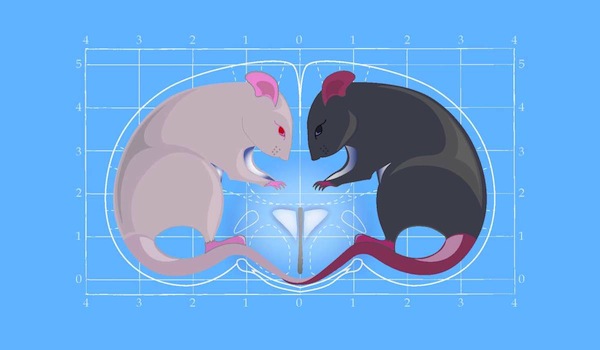
Oxytocin, a peptide produced in the brain, may bring hearts together – or it can help induce aggression. (image from Weizmann Institute)

During the pandemic lockdown, as couples have been forced to spend days and weeks in each other’s company, some have found their love renewed while others are on their way to divorce court. Oxytocin, a peptide produced in the brain, is complicated in that way: a neuromodulator, it may bring hearts together or it can help induce aggression. This conclusion arises from research led by Weizmann Institute of Science researchers in which mice living in semi-natural conditions had their oxytocin-producing brain cells manipulated in a precise manner. The findings, which were published in Neuron, could shed new light on efforts to use oxytocin to treat a variety of psychiatric conditions, from social anxiety and autism to schizophrenia.

Much of what we know about the actions of neuromodulators like oxytocin comes from behavioural studies of lab animals in standard lab conditions. These conditions are strictly controlled and artificial, in part so that researchers can limit the number of variables affecting behaviour. But a number of recent studies suggest that the actions of a mouse in a semi-natural environment can teach us much more about natural behaviour, especially when we mean to apply those findings to humans.

Prof. Alon Chen’s lab group in the institute’s neurobiology department have created an experimental setup that enables them to observe mice in something approaching their natural living conditions – an environment enriched with stimuli they can explore – and their activity is monitored day and night with cameras and analyzed computationally. The present study, which has been ongoing for the past eight years, was led by research students Sergey Anpilov and Noa Eren, and staff scientist Dr. Yair Shemesh in Chen’s lab group.

The innovation in this experiment was to incorporate optogenetics – a method that enables researchers to turn specific neurons in the brain on or off using light. To create an optogenetic setup that would enable the team to study mice that were behaving naturally, the group developed a compact, lightweight, wireless device with which the scientists could activate nerve cells by remote control. With the help of optogenetics expert Prof. Ofer Yizhar of the same department, the group introduced a protein previously developed by Yizhar into the oxytocin-producing brain cells in the mice. When light from the wireless device touched those neurons, they became more sensitized to input from the other brain cells in their network.

“Our first goal,” said Anpilov, “was to reach that ‘sweet spot’ of experimental setups in which we track behaviour in a natural environment, without relinquishing the ability to ask pointed scientific questions about brain functions.”

Shemesh added that “the classical experimental setup is not only lacking in stimuli, the measurements tend to span mere minutes, while we had the capacity to track social dynamics in a group over the course of days.”

Delving into the role of oxytocin was sort of a test drive for the experimental system. It had been believed that this hormone mediates pro-social behaviour. But findings have been conflicting, and some have proposed another hypothesis, termed “social salience,” stating that oxytocin might be involved in amplifying the perception of diverse social cues, which could then result in pro-social or antagonistic behaviours, depending on such factors as individual character and the environment.

To test the social salience hypothesis, the team used mice in which they could gently activate the oxytocin-producing cells in the hypothalamus, placing them first in the enriched, semi-natural lab environments. To compare, they repeated the experiment with mice placed in the standard, sterile lab setups.

In the semi-natural environment, the mice at first displayed heightened interest in one another, but this was soon accompanied by a rise in aggressive behaviour. In contrast, increasing oxytocin production in the mice in classical lab conditions resulted in reduced aggression.

“In an all-male, natural social setting, we would expect to see belligerent behaviour as they compete for territory or food,” said Anpilov. “That is, the social conditions are conducive to competition and aggression. In the standard lab setup, a different social situation leads to a different effect for the oxytocin.”

If the “love hormone” is more likely a “social hormone,” what does that mean for its pharmaceutical applications?

“Oxytocin is involved, as previous experiments have shown, in such social behaviours as making eye contact or feelings of closeness,” said Eren, “but our work shows it does not improve sociability across the board. Its effects depend on both context and personality.”

This implies that, if oxytocin is to be used therapeutically, a much more nuanced view is needed in research: “If we want to understand the complexities of behaviour, we need to study behaviour in a complex environment. Only then can we begin to translate our findings to human behaviour,” she said.

Participating in this research were scientists at the Max Planck Institute for Psychiatry in Munich, including research students Asaf Benjamin and Stoyo Karamihalev, staff scientist Dr. Julien Dine and postdoctoral fellow Dr. Oren Forkosh of the Chen lab; Prof. Shlomo Wagner and postdoctoral fellow Dr. Hala Harony-Nicolas of Haifa University; Prof. Inga Neumann and research student Vinicius Oliveira of Regensburg University, Germany; and electrical engineer Avi Dagan.

גזענות ואפלייה גם בקנדה

בשבועות האחרונים מפגינים רבים יוצאים לרחובות בערים שונות ברחבי קנדה כדי למחות נגד הגעזנות והאפלייה בארה”ב, קנדה ובעולם כולו.
(רוני רחמני)

קנדה התמודדה בשבוע שעבר עם פרשה הקשורה להפעלת כוח מופרז על-ידי שוטרים נגד בני מיעוטים. ראש הממשלה הקנדי, ג’סטין טרודו, הביע זעזוע עמוק מסרטון וידאו שפורסם ברבים ובו נראים שוטרים עוצרים תוך שימוש באלימות, את הצ’יף של הקהילה האינדיאנית האנדבוריג’ינית במחוז אלבטרה.

בסרטון, שאורכו שתיים עשרה דקות, נראים השוטרים בין השאר מכים את האיש, אלן אדם, בראשו. טרודו ציין לאחר שצפה בסרט כי יש לו שאלות רציניות בנוגע למה שקרה. הוא הוסיף שהחקירה העצמאית חייבת להיות שקופה ולהיעשות כך שנקבל תשובות. בה בעת שכולם יודעים שזה לא מקרה בודד. לדברי טרודו יותר מדי קנדים שחורים וילידים אינם מרגישים בטוחים בסביבת שוטרים. זה בלתי מתקבל על הדעת והממשלה חייבת לשנות את המצב הזה.

המחלקה האחראית על חקירת שוטרים במשטרת אלברטה בודקת כעת את האירוע. המשטרה הגישה נגד אדם כתב אישום בגין התנגדות למעצר ותקיפת שוטר. לדברי עורך דינו של הצ’יף, העימות כולו החל בגלל שפג התוקף של לוחית רישוי של רכבו.

בשבועות האחרונים מפגינים רבים יוצאים לרחובות בערים שונות ברחבי קנדה כדי למחות נגד הגעזנות והאפלייה בארה”ב, קנדה ובעולם כולו.

קנדה מתנגדת לתוכנית הסיפוח של ממשלת ישראל

סוכנות הידיעות הפלסטינית הרשמית (וופא) דיווחה לאחרונה כי קנדה הבהירה לרשות הפלסטינית, כי מתנגדת לתוכנית הסיפוח הישראלית של השטחים הכבושים. זאת כיוון שהסיפוח עומד בסתירה לחוק הבינלאומי.

על פי הדיווח של סוכנות הידיעות הפלסטינית, עמדת קנדה נגד הסיפוח נמסרה בשיחה בין שר החוץ של קנדה, פיליפ שמפיין, לבין שר החוץ הפלסטיני, ריאד אל-מאליכי.

שר החוץ הקנדי ציין כי אם קנדה תיבחר לחברה זמנית במועצת הביטחון של האו”ם, היא לא תחריש אלא תשמיע את קולה כדי לשמור על השלום והיציבות במזרח התיכון. וכן תפעל מול ישראל והפלסטינים כדי להשכין שלום בין הצדדים. בהקשר זה, קרא שר החוץ הפלסטיני לקנדה להמשיך בלחץ על ישראל כדי לסכל את תוכנית סיפוח השטחים, כולל באמצעות איום בסנקציות נגדה.

ראש ממשלת קנדה, ג’סטין טרודו, אמר לא מכבר כי העביר מסר ברור להנהגה בישראל בנוגע לתוכנית סיפוח השטחים הכבושים בציינו, כי קנדה סבורה שמהלך זה עלול לעכב את האפשרות להגיע לשלום בר קיימא במזרח התיכון ועל כן היא מודאגת מאוד מכך.

קנדה האריכה את איסור כניסת אוניות נוסעים לשטחה עד לסוף חודש אוקטובר

ממשלת קנדה האריכה את האיסור על פעילות אניות תענוגות בשטחה עד השלושים ואחד באוקטובר שנה זו. זאת עקב מגיפת הקורונה העולמית. שר התחבורה, מארק גארנו, הודיע על הצעדים המעודכנים בנוגע לאוניות התענוגות וספינות הנוסעים, וציין כי הממשלה מחויבת להגן על אזרחי קנדה, במיוחד בתקופה מאתגרת זאת. מסיבה זו הוא הכריז על צעדים עדכניים עבור אוניות תענוגות ואניות נוסעים אחרות בקנדה, שכוללים איסור פעילות של אוניות תענוגות גדולות במים קנדיים עד סוף חודש אוקטובר שנה זו.

על פי התקנות, אוניות נוסעים המובילות מעל למאה איש על סיפונן עם מקומות לינה לא יורשו להיכנס למים הקנדיים כאמור עד סוף אוקטובר. בנוסף אוניות נוסעים עם יותר משניים עשר איש לא יורשו גם להיכנס למימי החופים בקנדה (הארקטי, נונאציאווט, נונאוויק ולברדור) גם כן עד סוף חודש אוקטובר.

מעבורות, מוניות מים ואוניות נוסעים חיוניות אחרות צריכות ליישם התקנות חדשות, שלפיהן הן יפעלו עם מספר מופחת של נוסעים. ובנוסף עליהן לנקוט באמצעים שונים להתגוננות מפני המגיפה.

Responding to COVID

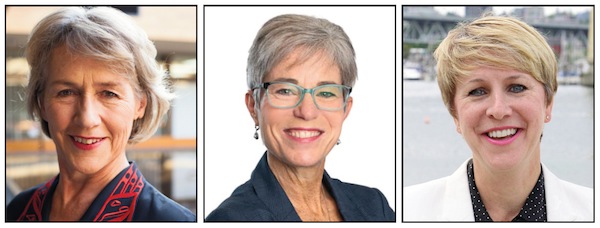
Left to right: MP Joyce Murray, MLA Selina Robinson and Vancouver Councilor Sarah Kirby-Yung spoke at a June 3 webinar hosted by the Canadian Jewish Political Affairs Committee. (photos from the internet)

“Intense” was the word used by speakers from all levels of government to describe their experiences during the pandemic emergency.

In a June 3 webinar on Zoom, federal and provincial cabinet ministers and a Vancouver city councilor addressed COVID-19: What’s the New Normal? The event was hosted by the Canadian Jewish Political Affairs Committee.

Joyce Murray, member of Parliament for Vancouver-Quadra, is Canada’s minister of digital government, a role that took on sudden significance when even Parliament began operating virtually and almost all federal civil servants are being asked to work from home.

“It’s been an incredibly intense time,” she said. “I never thought I would work harder than I do as a minister in Ottawa, but I would say these last few months have been much more intense than I expected.”

A million Canadians were able to apply for the Canada Emergency Response Benefit (CERB) on the first day, which Murray said illustrates the scope and speed of the government’s electronic mobilization.

Responding to a question from an audience member, she acknowledged that there may be some inequities in the program – some people are earning more not working than a neighbour might earn on the job – but the decision was made to ramp up immediately, knowing that anomalies were likely.

The federal government has not decided when to reopen the U.S. border, Murray said. The current, extended closure ends June 21.

“Our primary focus is the safety of Canadians,” she said. “We’ll be taking the advice of public health officials and thinking about all of the different ramifications and make a decision when the time comes.”

The discussion was moderated by James Moore, a former Conservative MP, who pressed Murray on the unanticipated federal expenditures resulting from the pandemic.

“Fortunately, Canada entered this in a very strong fiscal position compared with most of its G-20 partners,” she responded. “So we were ready and able to respond and there is now approximately $150 billion in direct support to Canadians that has been put on the table. That makes it one of the most ambitious response plans in the world. But our view is that we had fiscal firepower, it was right to use it and it will help our economy emerge more quickly and more strongly when the pandemic allows us to do that safely. Our focus right now is on helping Canadians and getting that right.… We will return to a strong fiscal position when it’s time.”

Selina Robinson, British Columbia’s minister of municipal affairs and housing, noted that the provincial government stepped up with $5 billion in emergency funding.

“It would be very, very hard coming out of this if we had people who were evicted from their homes and couldn’t put food on the table,” said Robinson, who is MLA for Coquitlam-Maillardville. “I think everybody agrees that we needed to invest in people, so that they can continue to feed their families.”

Provincial Health Officer Dr. Bonnie Henry has warned that no pandemic in history has not had a second wave. Robinson said British Columbia and other jurisdictions are ready for that potential.

“I think we’re far better prepared for any future waves, given the experience we’ve had over the last few months,” she said.

Murray lamented the sharp rise in anti-Asian hate crimes, while Moore warned that U.S. President Donald Trump “is going to run for reelection against China, and not against Joe Biden” – he fears the repercussions for Asian communities in North America as a result.

Robinson said the Jewish community is uniquely placed to be allies to those affected by this phenomenon, as well as to racialized individuals during the parallel upheavals around race, police violence and Black Lives Matter.

“I’m really proud to be part of the Jewish community and knowing that our history as a Jewish community has historically stood up for these values, to make sure that there is space for everyone and for standing up when we see injustice,” she said. “We will continue to do that and I urge everybody who is participating to make sure that you use your voice however and wherever you can.”

Sarah Kirby-Yung, a Vancouver city councilor, also spoke from a personal perspective, noting that her immediate family is of Asian descent.

“I’m incredibly distressed when I hear from members of the Asian community, seniors and vulnerable people particularly, who are afraid to leave their home or go for groceries or are changing their pattern because of who they are,” she said.

Vancouver’s budget has taken a swift kick during the pandemic, but Kirby-Yung rejected the rumour that the city is approaching bankruptcy.

“We are looking at about a $150 to $200 million projected revenue gap for Vancouver through the end of 2020,” she said. “Vancouver is not going bankrupt. We are in reasonable shape, but it doesn’t mean that we don’t have to be very thoughtful about our spending in our decisions.”