Skip to content
  • Home
  • Subscribe / donate
  • Events calendar
  • News
    • Local
    • National
    • Israel
    • World
    • עניין בחדשות
      A roundup of news in Canada and further afield, in Hebrew.
  • Opinion
    • From the JI
    • Op-Ed
  • Arts & Culture
    • Performing Arts
    • Music
    • Books
    • Visual Arts
    • TV & Film
  • Life
    • Celebrating the Holidays
    • Travel
    • The Daily Snooze
      Cartoons by Jacob Samuel
    • Mystery Photo
      Help the JI and JMABC fill in the gaps in our archives.
  • Community Links
    • Organizations, Etc.
    • Other News Sources & Blogs
    • Business Directory
  • FAQ
  • JI Chai Celebration
  • JI@88! video

Recent Posts

  • Sharing her testimony
  • Fall fight takes leap forward
  • The balancing of rights
  • Multiple Tony n’ Tina roles
  • Stories of trauma, resilience
  • Celebrate our culture
  • A responsibility to help
  • What wellness means at JCC
  • Together in mourning
  • Downhill after Trump?
  • Birth control even easier now
  • Eco-Sisters mentorship
  • Unexpected discoveries
  • Study’s results hopeful
  • Bad behaviour affects us all
  • Thankful for the police
  • UBC needs a wake-up call
  • Recalling a shining star
  • Sleep well …
  • BGU fosters startup culture
  • Photography and glass
  • Is it the end of an era?
  • Taking life a step at a time
  • Nakba exhibit biased
  • Film festival starts next week
  • Musical with heart and soul
  • Rabbi marks 13 years
  • Keeper of VTT’s history
  • Gala fêtes Infeld’s 20th
  • Building JWest together
  • Challah Mom comes to Vancouver
  • What to do about media bias
  • Education offers hope
  • Remembrance – a moral act
  • What makes us human
  • המלחמות של נתניהו וטראמפ

Archives

Follow @JewishIndie
image - The CJN - Visit Us Banner - 300x600 - 101625

Byline: The Editorial Board

Vibrant democracies

On Monday, Canada and Israel each embarked on a new adventure in governance. Here at home, Justin Trudeau’s Liberal party had a surprisingly robust showing in the federal election, winning the irrefutable right to form a minority government, or to form a coalition of some description.

The Liberals’ relatively strong showing – 157 seats to Andrew Scheer’s 121; just 13 short of a majority – opens the door for a government with Jagmeet Singh’s New Democrats holding a balance of power. Just a few days before the election, polls suggested a race so tight, and with the Bloc Quebecois and NDP taking so many seats, that any configuration to reach the magic 170 number would have required not two parties, but three. That complicated scenario was averted, leaving the Liberals free to face the House with either a formal agreement with the NDP or a tacit knowledge that the now-fourth party is in no financial position to return hastily to the election battlefield.

In Israel Monday, President Reuven Rivlin called on Blue and White leader Benny Gantz to attempt to form a government after incumbent Binyamin Netanyahu failed to do so after the second inconclusive election this year. Gantz has said he hopes to form a “liberal unity government,” but that is as challenging as Netanyahu’s failed effort to coalesce a majority. He may be hoping that, if Netanyahu is indicted in the coming days, Likud under a new leader might be a viable partner – or perhaps some MKs unfettered from Netanyahu’s long years of leadership will break away and form a faction to join Gantz. Another plan has Gantz propping up Netanyahu unless and until Netanyahu is charged, at which point Gantz would stand up as prime minister, which seems a strange compromise with a tarnished leader. As usual in Israeli politics, there are a vast number of moving parts.

Multiple moving parts is less typical of Canadian politics, where our tendency toward majority governments typically sequesters any moving parts in the all-powerful Prime Minister’s Office. Not so during a minority Parliament, when individual MPs on all sides are able to wield power in ways they can only dream of in a majority scenario.

In what must be a jagged pill for the once and future prime minister, Jody Wilson-Raybould, whose testimony about Trudeau’s treatment of her was the single most detrimental arrow in Trudeau’s reelection armour, was herself reelected as an independent in Vancouver Granville. A large number of Jewish British Columbians, now, are represented in Parliament by an individual who belongs to no party. This will be fascinating to watch in many respects, not least how she pursues politics from the opposition benches as the SNC-Lavalin affair continues to percolate.

Other sidebars in the result include the scuttled effort by a leading anti-Israel figure to re-enter Parliament. Svend Robinson, who, during 25 years in Parliament, was one of Canada’s most vociferous voices against Israel, threw his hat back in the ring but came up short in Burnaby North-Seymour – being narrowly defeated by the incumbent Liberal despite this being ground zero in the battle over the Liberals’ Trans Mountain pipeline expansion.

More notably, Maxime Bernier, leader of the nascent People’s Party, lost his own seat in Quebec. His party made effectively no impact anywhere, sending the hopeful sign that messages of populist xenophobia that seem to be resonating elsewhere in the world still fall largely on deaf ears, at least electorally, here.

Canada will almost certainly have an easier time forming a government than Israel will but, in both cases, the drama plays out against the backdrop of healthy, vibrant, disputatious democratic systems. No matter what the outcomes, we should be thankful for that.

 

Posted on October 25, 2019October 23, 2019Author The Editorial BoardCategories From the JITags Andrew Scheer, Benny Gantz, Binyamin Netanyahu, Canada, elections, governance, Israel, Jagmeet Singh, Jody Wilson-Raybould, Justin Trudeau, politics, SNC-Lavalin

Canada is not immune

Maxime Bernier’s performance at the federal leaders debate Monday night may have been unimpressive, and at times badgering, but no doubt some ears pricked up at his assertion that he is the only party leader whose position on immigration stands apart. True enough. He calls for about 150,000 immigrants annually, half the number now admitted.

The People’s Party leader was challenged at the get-go by a debate moderator who raised Bernier’s past comments about “extreme multiculturalism” and his use of the words “ghettos” and “tribes” to describe new Canadians.

Bernier will be lucky to win his own seat in Quebec and his actions in the debate probably didn’t win him a groundswell of supporters anywhere else. But the emphasis on immigration was notable. Slashing immigration in half, which could have detrimental impacts on the economy and growth of the country, would represent a huge number of people refused entry to Canada. But it’s not really about the numbers. It was the underlying message. Bernier was signaling to potential supporters that immigration is generally undesirable, with all the attendant impulses that message is intended to convey.

Hours before the debate, an Angus Reid Institute poll indicated that Canadians are split on the issue – and leaning in the direction of less immigration and tougher treatment for asylum-seekers. Forty percent of respondents said Canada takes in too many refugees, while 13% said we accept too few.

Bernier may not be the best messenger for the anti-immigration idea, but it is clear that there is a constituency in Canada for a politics that is exclusionary and plays on discriminatory tropes. All the main political parties are admirably standing firm against this impulse, for now. But it is worth keeping a close eye on this trend and reminding ourselves regularly that Canada is not immune from xenophobia.

Posted on October 11, 2019October 10, 2019Author The Editorial BoardCategories From the JITags Canada, democracy, federal election, immigration, Maxime Bernier, racism

Trump betrays Kurds

U.S. President Donald Trump stunned and confounded even his closest allies in Congress and his military advisors when he announced Monday that he would withdraw American troops that were helping safeguard Kurds who have valiantly held off ISIS and battled the blood-soaked regime of Bashar al-Assad in Syria.

Turkey’s President Recep Erdogan is threatening an incursion into Kurdish-held Syrian territory and analysts say the offensive could include massacres of Kurds, a longtime enemy. The move is a brutal betrayal of the stateless Kurdish people who have been steadfast allies of the West against the worst forces in the world today. Trump’s irrational, inhuman act could lead to mass murder of the very people who are – or were – our greatest allies in that horrific battle. His motives are opaque and suspect. He appears to be doing the bidding of Turkey, Russia and Iran and, at the same time, emboldening ISIS. Trying to understand the inner workings of his mind, in this case, as in most, is probably fruitless.

Stateless people are endangered everywhere, nowhere more than in the contentious and violent region the Kurds are condemned to live. Jews understand the perils of statelessness in a dangerous world. That was one of the lessons of the 20th century. Another lesson was to depend on no one else for survival. Repeatedly, Israel has had to defend itself alone from existential threats. The Kurdish people are in a deeply precarious position now and, in an ideal world, alternative forces would come to their aid.

Meanwhile, for those supporters of Israel who insist that moving an embassy and having a Jewish daughter make Trump a reliable friend of Jews, let this be a lesson about the capriciousness of the man’s loyalty and humanity.

Posted on October 11, 2019October 10, 2019Author The Editorial BoardCategories From the JITags conflict, ISIS, Kurds, politics, Trump, Turkey, United States
Status quo OK?

Status quo OK?

Israeli Prime Minister Binyamin Netanyahu places his vote on election day. (photo by Haim Zach/IGPO from Ashernet)

Unless something dramatic happens between when we write this and when you read this, the future of Israel’s government remains uncertain. To avert a third election in a year, the most viable option for a stable government would appear to be a “national unity” or “centrist coalition” involving both major parties, Likud and Blue and White.

This was the subject of face-to-face discussions between leaders and President Reuven Rivlin, but no agreement was reached. So Binyamin Netanyahu, the incumbent prime minister, has a few weeks to try to cobble something together. If he fails, Rivlin will probably call on Blue and White leader Benny Gantz to give it a go. Some bets are that, if it comes to that, there will be enough Knesset members desperate enough to avoid a return to the polls that some accommodation will be made. Perhaps the likeliest possibility is a Likud-Blue and White unity government without Netanyahu. (This scenario would become likelier if Netanyahu officially faces criminal charges in the next few days.)

Any broad coalition of this sort would lead to a degree of progress on some fronts – if far-right and religious parties are excluded, some policies and legislation that appeal to the secular majority are likely to advance – while progress on some other fronts would likely stall.

One example is the peace process – although there is, basically, no progress to stall at this point. There is great divergence in Israel over what the next steps should be vis-à-vis the Palestinians. In a broad-based coalition government, that uncertainty would define government policy, probably leading to inaction.

During the recent election, Netanyahu went further than previous leaders, promising to annex chunks of the West Bank to Israel. Gantz and the centre-left in Israel have been confounded by the reality that, while they seek a two-state solution and recognize a one-state situation as demographically unsustainable, until Israel sees a benefit to ending the occupation and can be certain that an independent Palestine in the West Bank will not be a launch pad for terror, independence will not come and the occupation will not end. Without that, no peace, no Palestine.

As a result, we will likely see more of the status quo, until some force acts to alter it. While Netanyahu’s provocative promise to annex areas would have altered the status quo for the worse, a precipitous end to the occupation that left a vacuum to be filled by those wishing to do Israel harm would likewise be a change for the worse. The tense status quo Israelis and Palestinians have now is definitely not great, especially for Palestinians, but it is better than outright war.

An old tale has the rabbi of a medieval Jewish community visiting the duke who has threatened to throw the Jews from his realm. The rabbi returns to his community and tells his people, “I convinced the duke to let us stay – if I can teach his dog to talk within five years.” The Jewish community is dumbfounded. “What a promise? It’s impossible!” The rabbi says, “Relax. I’ve got five years. The dog could die. The duke could die. I could die. Meanwhile, I bought us five years.”

The occupation, the statelessness of the Palestinian people, the recurring missile attacks from Gaza and the violence against civilians are not things we should understate or dismiss. But neither should we believe that any change is necessarily an improvement. The status quo is better than war and it is better than the dissolution of the Jewish state. The status quo is not ideal, but it may be better than currently available alternatives.

Format ImagePosted on October 4, 2019October 2, 2019Author The Editorial BoardCategories From the JITags Benny Gantz, Binyamin Netanyahu, elections, government, Israel, Israeli-Palestinian conflict, peace

Self-image to be tested

It was all decorum and politeness at an election forum Sunday sponsored by the Centre for Israel and Jewish Affairs and SUCCESS, the United Chinese Community Enrichment Services Society.

The comparative decorousness of the event – although interrupted at one point by an impassioned outburst related to the mistreatment of indigenous peoples – will likely be an anomaly as the neck-and-neck campaign proceeds. Desperate measures will likely be employed as Liberals and Conservatives battle for a majority – and as New Democrats and Greens spar in what seems destined to be a down-ticket race of its own.

And all of this is playing out against the potentially upending news that the People’s Party of Canada’s Maxime Bernier has been admitted to the national debates on Oct. 7 and 10 organized by the official Leaders’ Debate Commission.

The new party – started by the breakaway former Conservative from Quebec – has attracted a range of malcontents, including extremists of various sorts being involved in or peripheral to his party. While the four “mainstream” parties have all tread relatively lightly around super-charged racial issues, Bernier – and perhaps less predictably, his fellow 337 candidates across the country – seems prone to exploit and exacerbate racial divisions.

On this and many other issues that will form the meat and potatoes of the rest of the campaign, Canadians will now hear the perspective of Canada’s answer to the populism that has taken root in the United States, Europe and elsewhere. The degree to which these ideas and Bernier’s rhetoric catches on will tell us much about our country and ourselves. Canadians have liked to imagine that we are immune to the phenomenon of xenophobia that seems to be gaining ground globally. But, then, we haven’t had, in recent history, a chance to vote for a party that represents such ideas.

One of the things that has been notable during the aftermath of Prime Minister Justin Trudeau’s recently revealed repeated donning of deeply problematic costumes, including blackface/brownface, is what seems like a divergence between the official voices and the unofficial voices.

Elected officials utter pieties about respect for diversity. Representatives of multicultural and anti-racism organizations speak of challenges and opportunities. Yet, in radio call-in programs and online comments – those voices of “ordinary” people – the responses seem quite different. Many complain that the blackface controversy is all a sideshow that diminishes focus on issues like the economy and the environment. Others suggest a tempest in a teapot or political correctness run amok.

In a few days, Canadians will get our first look at all the party leaders side by side, including Andrew Scheer and Jagmeet Singh, who remain somewhat unknown quantities, and Bernier, who will bring some genuinely outside-the-establishment perspectives to the debate. How far Bernier pushes the envelope – and how Canadians respond to his ideas – will tell us just how accurate our self-perception as an open, tolerant society really is.

Posted on September 27, 2019September 24, 2019Author The Editorial BoardCategories From the JITags Bernier, democracy, federal election, politics, racism, Scheer, Singh, Trudeau

Religion and politicians

In an interview with the CBC last week, federal Green party leader Elizabeth May was asked who her personal hero is. She responded, “Jesus Christ.” Almost immediately, she apologized, saying that she had responded while failing to “self-edit.”

Canadians, by and large, are not so open to publicly discussing matters like religion, politics or other things that could be perceived as controversial. But political leaders should be prepared to discuss things in their lives that have shaped them. In fact, religion seems likely to be more central in this election than it has been in decades.

New Democratic Party leader Jagmeet Singh felt compelled to address his religion in an ad (notably aimed at Quebec voters) about how his identity as a Sikh influences his worldview.

While Quebec’s Bill 21, which bans the display of religious symbolism in the public service, means Singh would not be permitted to teach in the province or hold certain roles in the civil service, he managed to finesse the issue quite neatly. He found a sort of common ground by acknowledging that Bill 21 is an effort by Quebecers to protect and preserve their identity, the importance of which he acknowledged paralleled his own pride in his identity and the importance it holds in his life.

Over the weekend, he also managed to continue discussing the topic while having a few laughs, which rarely hurts. Singh, who has struggled to connect with voters in the pre-election period, may come out of this round a winner by making Quebec voters and other Canadians take a good look at him for the first time.

Meanwhile, Liberals are trying to portray Conservative party leader Andrew Scheer as having a hidden agenda, based on his Catholic religious beliefs, on issues like reproductive freedom and equal marriage.

Scheer and Prime Minister Justin Trudeau, both Catholics, have taken similar approaches, asserting that their religious views will not dictate party or government policies. However, there is probably a different calculation being made on each side. Trudeau’s policies are probably more liberal than the teachings of his church, so segmenting the two prevents an undesirable schism with his church. Scheer is probably calculating that his beliefs in the teachings of his church are not shared by the majority of voters; therefore, segregating his political and religious positions may have a hint of political expediency. In both cases, Trudeau and Scheer have been vague and both have attempted to move past the topic. (This is tougher for Scheer, whose grassroots supporters, in many cases, are more religiously conservative than the average voter. Working on not alienating them while courting middle-of-the-road voters places him in a bit of a bind.)

The reticence by Trudeau and Scheer to enthusiastically discuss their religious views, and May’s odd flip-flop on Jesus, may be a consequence of a root misunderstanding around the separation of church and state: the concept is that religious institutions should not unduly influence, or be influenced by, governments. It does not mean that individual elected officials should neuter their religious views as they cross the threshold into the legislature. If one’s deeply held religious beliefs and values are what make up a person’s identity, worldview and morality, these are things that should very much be on the table for people seeking the public’s trust. By example, there is plenty in biblical literature that May could have cited as motivators for her environmental priorities. That kind of openness would be refreshing. Singh tried it. We’ll see what happens.

If religious adherence is an important part of who a candidate is, it would be nice to think that they would not be embarrassed or shy to share these perspectives with us. Canadians would perhaps understand our leaders better – including when they say that they personally believe one thing but would not legislate it on the country, which is an entirely legitimate position.

What likely makes voters suspicious or skeptical is when a politician seems to be hiding something, is ambiguous about how their beliefs might guide policy positions, or is ashamed of who they are.

Posted on September 20, 2019September 17, 2019Author The Editorial BoardCategories From the JITags Andrew Scheer, Elizabeth May, federal election, Jagmeet Singh, Justin Trudeau, politics, religion
About the cover art – Rosh Hashanah 2019

About the cover art – Rosh Hashanah 2019

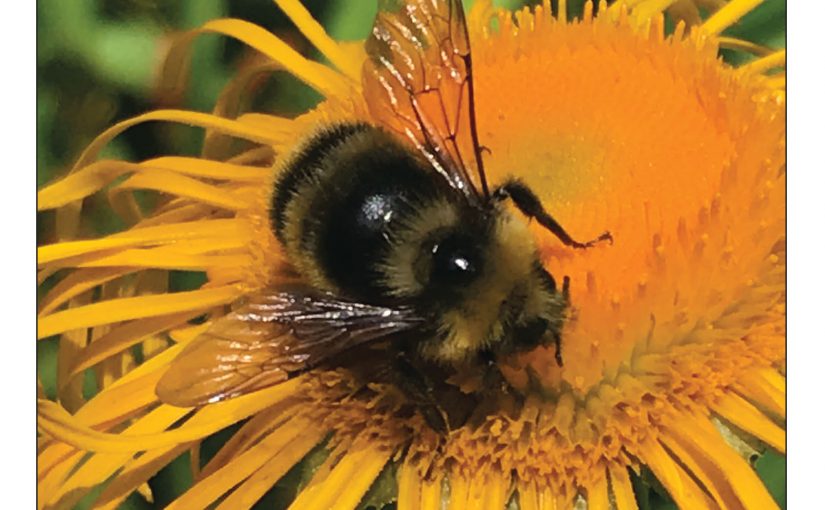
This year’s Jewish Independent Rosh Hashanah cover photo features a bumble bee on a heartleaf oxeye daisy flower – it was taken in Saanich, B.C., by David Fraser. Many native bumble bees are in decline, a concerning trend given the role they play in pollination of plants, including many food crops. Pesticides, habitat loss and introduced bee parasites and diseases are thought to play a role in this decline.

photo - Rosh Hashanah 2019 cover, by David Fraser

Apples are one of the main symbolic foods we eat on Rosh Hashanah, as we wish for a sweet year, with the help of some honey. Apples are the fruit of choice for this wish perhaps because Rosh Hashanah coincides with the sixth day of creation, when humans – Adam and Eve – were created and they ate the fruit (apple) of the Tree of Knowledge in the Garden of Eden. It could also be that apples symbolize the relationship between God and the Jewish people, as poeticized in the Song of Songs, or that the Zohar (kabbalah) describes paradise as a holy apple orchard.

Regardless of the reason for the fruit selection, apple production is dependent on bees and other pollinators. It would be fitting then for us to wish for more than a sweet, fruitful year, when we are dipping our apple slices into honey. We might consider our role in the decline of not only the bumble bee populations but of the environment at large, and what we can do to reverse it.

Format ImagePosted on September 20, 2019February 5, 2020Author The Editorial BoardCategories Visual ArtsTags bees, British Columbia, David Fraser, environment, Judaism, Rosh Hashanah, Saanich

Canada is not “broken”

An opinion poll released last week indicates that 52% of Canadians agree with the statement that our society is “broken” – a spike of 15 points over three years ago – while just 19% of respondents disagreed with the statement.

The poll, conducted by Ipsos and provided exclusively to Global News, also suggests that two-thirds of respondents believe the economy is rigged to benefit the rich, while 61% agreed with the statement that “traditional parties and politicians don’t care about people like me.” Commentary provoked by the poll has focused on the portent these results have for a surge of populist parties or ideas in the coming federal election.

It should not be a surprise, perhaps, that people think the economy benefits the rich or that politicians have at heart the best interests of people other than little-old-us. We have been complaining about our politicians since the profession was invented and probably every one of us, no matter where we fall on the income scale, thinks we’d be doing better economically if it weren’t for some systemic force or policy that prevents us from getting ahead.

The really provocative result in this poll is the perception apparently held by more than half of Canadians that our society is broken. Admittedly, the question is ill-formed. What does “broken” even mean in this context? Regardless, the idea that we live in a broken society probably says more about the individual respondents than it does about our society as a whole. Canadians are among the most privileged, advantaged, wealthiest, healthiest and least oppressed people in the world. With some grievous historical and contemporary exceptions, Canada is one of the most egalitarian societies on earth.

We may dislike our politicians or have misgivings about this or that development, but for a poll to suggest that half of Canadians think this is a broken society makes us wonder if we are a country of naïve and entitled people. It would be instructive for Canadians who feel this way to take an eye-opening trip almost anywhere else in the world.

This is not to dismiss the very real cases of injustice, inequality or other systemic problems our country faces, but this poll indicates that half of Canadians don’t have the faintest idea how fortunate most of us have it here.

It also creates the potential for some very concerning political consequences. If Canadians march into the polling booth next month certain that this is a broken society, it is anyone’s guess what kind of ideas they might be willing to support to “fix” it.

Posted on September 13, 2019September 10, 2019Author The Editorial BoardCategories From the JITags Canada, elections, lifestyle, politics, survey

Roll out welcome mat

Bill 21, Quebec’s law that forbids most public employees from displaying any religious symbols like a turban, a Magen David or a hijab, may become an issue in the federal election. On CBC Radio’s political program The House last weekend, MPs representing the Liberal, Conservative and New Democratic parties all took effectively the same position: the law is discriminatory but provinces have the right to proclaim their own laws and, what’s more, the Constitution’s notwithstanding clause means Quebec can pretty much do whatever it wants.

There is a political calculation in all this, of course. Many Quebeckers support this law and any federal party needs to appeal to a chunk of these voters in order to succeed in the province during next month’s vote. As a result, party leaders are mostly making the right noises about this discriminatory law, while hoping to move on to the next topic ASAP.

With federal leaders basically throwing up their hands on the issue, which calls into question the most fundamental rights of Canadians of all religions, what can be done?

One individual interviewed on the program is a teacher who is Sikh. Her choice was to move from Quebec to British Columbia, where she could continue her chosen profession without diminishing her religious beliefs, which include wearing a turban.

If federal leaders will not act forcefully, perhaps leaders in the provinces outside Quebec can do something. Throughout history, Canada has been enriched by refugees and immigrants who sought freedom and opportunity – our gains roughly equating the loss to their places of origin. Why not apply the same principle to inter-provincial relations?

Perhaps provinces like British Columbia should roll out the welcome mat for teachers, school administrators, wildlife officers, Crown prosecutors and other civil servants from Quebec who no longer feel welcome there. Actively recruiting these experienced professional people of different cultures and religions would strengthen our communities and send a message to Quebec that cultural difference is an asset, not a liability.

In the absence of forceful federal leadership on this front, it would be encouraging to see provincial governments stepping up where they can.

Posted on September 13, 2019September 10, 2019Author The Editorial BoardCategories From the JITags Canada, diversity, economics, employment, immigration, politics, Quebec, racism

Speak in the new year

It is the season of new beginnings: new school year, newly turning leaves and a new Jewish year. On a leisurely drive on Labour Day Monday in suburban Vancouver, bright orange pumpkins that weren’t there last time we passed had suddenly exploded into full-sized squash seemingly overnight. Summer, of course, is officially with us until Sept. 23, but, especially if your household has kids (or teachers), summer unofficially ended when the first school bell rang on Tuesday.

This is the time of year for reflecting back and looking forward. The promise and excitement of the new mixes with nostalgia and other emotions about the passage of time and memories – good or bad – of what we leave behind.

This coming Monday, we will hear from four speakers at FEDtalks, the launch of the Jewish Federation of Greater Vancouver’s annual campaign. Among them is Isaac Herzog, head of the Jewish Agency for Israel who (in last week’s Independent) acknowledged that one of the challenges our global Jewish community faces is engaging and involving young Jewish people. As students return to post-secondary campuses in British Columbia, across Canada and around the world, we can anticipate the usual challenges – some years better or worse than others – of campaigns, referenda and assorted political shenanigans that have particular impacts on Jewish students.

Understandably, young people who have grown up with connections to Judaism, Jewish peoplehood and Israel will take exception to some of the things they will face. Some will rise admirably in these encounters, as we have seen year after year, when students at Hillel, Chabad and some ad hoc Jewish and Zionist organizations have spoken out against misleading and false expressions on their campuses. Others, also understandably, will avoid such unpleasant controversies and focus on less polarized topics and activities. Those who take up the frontlines in these battles deserve our community’s support.

There are broader issues than Zionism on campus. Free expression is top of mind for many professors, students, parents and other interested parties. A particular flare-up over the summer involved the Vancouver Pride Society (VPS), which puts on the city’s largest annual event, banning the University of British Columbia and the Vancouver Public Library from participating in the Pride parade because they both provided space for presentations by speakers who are virulently vocal against the rights of transgender people. It was a rock and a hard place for many. The Pride society certainly has the right to welcome or exclude anyone they choose (although the amount of public funding and in-kind support they receive should require a degree of public accountability). But, seeing the province’s largest university and largest library system excluded from any event, for whatever reason, is upsetting. If ideas, however odious, cannot be discussed on a university campus or at a library, they cannot be openly discussed anywhere. Driving ugly ideas underground is not a solution. The answer to hate speech is anti-hate speech. And if, as critics said, the messages of the speakers were so insidious that they could lead to violence, then that was a job for the RCMP to confront, not, perhaps, the VPS.

A 2017 poll indicated that 69% of American students say that conservatives can “freely and openly” express their views on campuses, while 92% say the same about liberals. What the poll indicates, probably, is that being a conservative on campus today is more unpopular than being a liberal. Likewise, it is probably easier on most campuses to speak against Israel rather than for Israel. But does this mean an individual’s rights are being infringed? Unless there is a systematic and official injunction against the ideas someone expresses, the issue is probably not the right to speak freely and openly, but the courage and, not inconsequently, the privilege to do so.

Pro-Israel students have demonstrated courage in defending Israel against bad-faith campaigns and insinuations. In a significant number of cases, it has resulted in young adults who have become masters of community organizing and experts in responding to attacks – and, if they were not natural leaders before, they have developed skills that will advance them throughout their lives. Our instincts, as their elders, may be to shield them from the sometimes hateful ideas they will encounter. Instead, we should be supporting and encouraging them in confronting and contesting these ideas.

To all who are embarking on new adventures – and, especially at this time of year, aren’t all of us in some way? – may we be strengthened by courage, determination and the support of one another.

Posted on September 6, 2019September 4, 2019Author The Editorial BoardCategories From the JITags free speech, new year, politics, university, Zionism

Posts pagination

Previous page Page 1 … Page 19 Page 20 Page 21 … Page 49 Next page
Proudly powered by WordPress