Skip to content
  • Home
  • Subscribe / donate
  • Events calendar
  • News
    • Local
    • National
    • Israel
    • World
    • עניין בחדשות
      A roundup of news in Canada and further afield, in Hebrew.
  • Opinion
    • From the JI
    • Op-Ed
  • Arts & Culture
    • Performing Arts
    • Music
    • Books
    • Visual Arts
    • TV & Film
  • Life
    • Celebrating the Holidays
    • Travel
    • The Daily Snooze
      Cartoons by Jacob Samuel
    • Mystery Photo
      Help the JI and JMABC fill in the gaps in our archives.
  • Community Links
    • Organizations, Etc.
    • Other News Sources & Blogs
    • Business Directory
  • FAQ
  • JI Chai Celebration
  • JI@88! video

Recent Posts

  • BGU fosters startup culture
  • Photography and glass
  • Is it the end of an era?
  • Taking life a step at a time
  • Nakba exhibit biased
  • Film festival starts next week
  • Musical with heart and soul
  • Rabbi marks 13 years
  • Keeper of VTT’s history
  • Gala fêtes Infeld’s 20th
  • Building JWest together
  • Challah Mom comes to Vancouver
  • What to do about media bias
  • Education offers hope
  • Remembrance – a moral act
  • What makes us human
  • המלחמות של נתניהו וטראמפ
  • Zionism wins big in Vegas
  • Different but connected
  • Survival not passive
  • Musical celebration of Israel
  • Shoppe celebrates 25 years
  • Human “book” event
  • Reclaiming Jewish stories
  • Bema presents Perseverance
  • CSS honours Bellas z”l
  • Sheba Promise here May 7
  • Reflections from Be’eri
  • New law a desecration
  • Resilient joy in tough times
  • Rescue dog brings joy
  • Art chosen for new museum
  • Reminder of hope, resilience
  • The national food of Israel?
  • Story of Israel’s north
  • Sheltering in train stations

Archives

Follow @JewishIndie
image - The CJN - Visit Us Banner - 300x600 - 101625

Month: February 2020

Canadian refugee law study

Canadian refugee law study

Shauna Labman (photo from Shauna Labman)

Amid the world’s largest refugee crisis since the Second World War, Winnipeg-based legal scholar Shauna Labman has come out with the book Crossing Law’s Border: Canada’s Refugee Resettlement Program, an in-depth look at how national and international law and policies have shaped Canada’s resettlement programs.

After growing up in Winnipeg, Labman did her undergraduate degree in English and religion at the University of British Columbia, then went into law school at the University of Victoria.

“At the end of law school, I was called to the bar in Ontario, and then I got a contract with the United Nations High Commissioner for Refugees in New Delhi, India,” said Labman. “I went to India, knowing about refugee laws that I’d studied in law school … which meant I knew about the Canadian context of refugees – how refugee claims are made in Canada, how the Immigration and Refugee Board works. I didn’t know anything about how refugees receive protection in a country like India, which has not signed the [United Nations] Refugee Convention or anything.”

After returning to Canada, Labman accepted a consultancy with the Canadian embassy in Beijing. Realizing that the life of a diplomat was not for her, she returned to UBC in 2007 for a master of laws, which was followed by a PhD. Her graduate supervisor was the current dean of the university’s Allard School of Law, Prof. Catherine Dauvergne.

Of her master’s thesis – “The Invisibles: An Examination of Refugee Resettlement” – Labman said, “It’s about the fact that refugees waiting for resettlement don’t get seen. We only see them when they are resettled … but the program is very ad hoc and there was very little attention given to it at the time.”

As Labman was starting her PhD, the ships Sun Sea and Ocean Lady arrived off the coast of British Columbia, carrying several hundred Tamil migrants seeking asylum from civil war in Sri Lanka. She recalled how resettlement was being discussed then. “The relationship between law and refugee protection and what I call ‘the layer legality of it all,’ how different laws work to position different refugees differently, became the basis of my doctoral work and this book,” she said.

After moving back to Winnipeg 10 years ago, she worked as a law professor at the University of Manitoba. Last July, she joined the University of Winnipeg and its Global College. As a human rights professor, she teaches courses on refugees, resilience, and concepts and conventions of human rights.

“I find this really rewarding work,” she told the Independent. “I sit on the board of the Immigrant and Refugee Community Organization of Manitoba and, in that program, I meet a lot of incredible people who spend a lot of time committed to creating a place of welcome for newcomers in our community.”

Labman’s book looks at Canada’s refugee resettlement program from the 1970s, when there were large numbers of people fleeing Vietnam, Cambodia and Laos, up to the Syrian resettlement that’s been happening in the past decade. It covers the different ways that Canada resettles refugees – the government’s resettlement program and the private sponsorship program, including the newly created Blended Visa Office-Referred program, which works with refugee referral organizations to screen refugees before connecting them with private sponsors.

“One way you can think of it is that resettlement itself is a complement to Canada’s inland refugee protection program,” she explained. “Because not that many refugees are able to come to Canada to claim protection, we have a resettlement program. Within that resettlement program, the government is doing resettlement, but the private sponsorship program allows the broader Canada population, individual citizens, to complement the government resettlement program by resettling refugees as well.

“We need only to look south at the U.S. to see how a change in government can affect refugee resettlement,” she said. “We have a legal obligation to asylum-seekers, but a lot of conversation about the border-crossers right now is about whether they are illegally entering the country and whether they are coming in violation of the law when they cross a border. I would say they’re not. I’d say that part of our recognition in the Refugee Convention is that they cannot be penalized for their entry and that, even within our Immigration and Refugee Protection Act, we recognize that refugees may need to cross in a different way or manner to make their claims of asylum.

“In the same way,” she added, “refugee resettlement isn’t a legal obligation, but law still plays out … in how these refugees are selected for resettlement before they enter our borders, which means that, when they are entering our borders, they are entering with a legal document permitting their entrance. They have a legally valid means of entering the country, even though they didn’t have a legal right to enter the country until they were selected for resettlement. So, the book looks at different ways the law operates within these two programs.”

image - Crossing Law’s Border book coverOne area in which the book does not delve, but that Labman said is important, is that the required forms are becoming more complicated to fill out, forcing applicants to seek help from lawyers. “It was too complicated for me to fill out when my family did a private sponsorship application,” she said.

While Labman’s book is academic, it is accessible to a broader readership. “It’s not going to be a page-turner if you’re not interested in refugee resettlement,” she said. “But, if you’ve, say, sponsored refugees and want to understand the program in more detail, it might be of interest. If you’ve worked with refugees, whether in a medical or educational context, in a settlement context … individuals working with refugees, there’s so much history and contextual details to the program. When I was writing this book, that information didn’t exist anywhere particularly clearly. So, if you want a comprehensive understanding of what resettlement in Canada is, this book has that.”

Also, for the main target audience – academics and graduate students in history, philosophy, political science, social work, sociology, law and others – Crossing Law’s Border provides a starting point for their own research on refugee resettlement and sponsorship.

“And, as Canada in the past few years has been promoting the expansion of private sponsorship to other countries, and other countries are taking up private sponsorship models, there’s lots of international interest by governments and policy makers and NGOs in those countries, in what Canada’s resettlement program is about,” said Labman.

The Winnipeg launch of her book took place on Jan. 16, and Labman is planning a launch at the Allard School of Law sometime in May.

Rebeca Kuropatwa is a Winnipeg freelance writer.

Format ImagePosted on February 14, 2020February 12, 2020Author Rebeca KuropatwaCategories BooksTags government, immigration, law, refugees, resettlement, Shauna Labman
Drawing more women to tech

Drawing more women to tech

Jodi Kovitz, founder and chief executive officer of #movethedial. (photo by photagonist.ca)

What began as Jodi Kovitz’s personal desire to increase the technology industry’s minimal efforts to attract women leaders is now a broad movement – #movethedial.

Kovitz was born in Calgary and moved to Toronto with her mom when she was 5, while her dad remained in Calgary. Growing up, Kovitz’s role models included her grandmother, Dr. Muriel Kovitz, who served as the first female chancellor of the University of Calgary, and who today lives in Vancouver.

“I had a very loving home and was always pushed and encouraged to be true to myself, be creative and build things,” said Kovitz. “I started my first business when I was 16, which was a greeting card company. I have always pursued entrepreneurship throughout my career, in various forms.”

After graduating from the University of Western Ontario’s Ivey Business School, in London, Ont., Kovitz worked at a consulting firm over the summer. Her mentor there advised that she do something more entrepreneurial, so Kovitz joined a tech start-up.

“I ended up meeting an amazing woman leader in banking after a couple of years,” she said. “Even though I really enjoyed myself and was getting a lot out of it … I left the start-up and went to join her at the bank, where I learned a ton about leadership. I was working specifically in HR [human resources] and leadership development.”

After going to law school and a brief stint working as a lawyer, Kovitz became the chief executive officer of the nonprofit Peerscale, a peer-to-peer group for tech CEOs.

“Peerscale is when I started #movethedial, which very much started as a passion project while I was in my other role,” said Kovitz. “But, it soon became so large that it called me to create it in a formal sense and to move into it full-time.”

Since then, #movethedial has become a global movement and a social enterprise, working to advance the participation and leadership of women in technology.

“While there’s work we need to do over the long term,” Kovitz told the Independent, “we need to ask what we can do now to better engage, include and advance either women in the ecosystem in the moment, as well as those that are just graduating, even just considering going into STEM [science, technology, engineering and math]…. It’s a multifaceted approach.”

The kick off of #movethedial in 2017 was to be a cosy 30-person event posted on social media – 1,000 people came.

Kovitz asked attendees who wanted to help. Fifty people responded, she said, “and we did a whole bunch of initial pilots and experiments. After a year, there was just so much passion and excitement that I was very fortunate to be approached by someone I’ve been friends with for a long time, who cared deeply about this mission and offered to back me … so I could start and create the vision I had … and that I wouldn’t be as afraid to take the risk as a 40-year-old single mother starting something as a full-time job. He was there, supporting me, and partnered with me in many ways, in terms of his advice and experience in building a very large-scale, global, billion-dollar business, as well as tactically helping me through things and scaling the organization.”

The organization #movethedial works with tech companies to attract and recruit women – all people who identify as women, just not people born as women – as well as advance, engage and retain women in their companies. It also works with community groups on a platform called #movethedial stories, showcasing the experiences of women technology leaders around the world.

“We’ve touched thousands of people that way,” said Kovitz. “We have an annual global summit. Last year, we had 2,802 people at our summit in Toronto, where we’d brought speakers in from around the world, and we connected our audience to one another in a really profound, magical way…. We’re creating what the future of #movethedial can look like, thinking through youth and how we can really impact … the ecosystem … and create a different future.

“What really drives me is that we can’t actually build technology solutions for everyone in the population [without including everyone in the population]. And, by the way, everything is tech, right? Banks, taxis, food … everything is tech. We can’t design solutions relevant to the masses if we don’t have representation from our population at our design leadership and governance tables. We just can’t build solutions that work for all the people.

“The urgency for me is around AI (artificial intelligence). It’s really starting to dominate how we use technology. Everything is going to, if it doesn’t already have an algorithm … and AI is taught. If all humans that teach and create AI are men, these machines will develop different patterns of behaviour and algorithms. My fear, and there’s a lot of research to back this up, is that we will build our human biases right into the solutions and algorithms, and we will never be able to undo it. For me, the urgency to create teams that reflect the population is to ensure that we don’t put our bias in forever.”

For more information, visit movethedial.com.

Rebeca Kuropatwa is a Winnipeg freelance writer.

Format ImagePosted on February 14, 2020February 12, 2020Author Rebeca KuropatwaCategories NationalTags #movethedial, education, Jodi Kovitz, STEM, technology, women
Managing our potable water

Managing our potable water

Seth Siegel’s latest book is Troubled Water: What’s Wrong with What We Drink. (photo from Seth Siegel)

With approximately seven percent of the world’s renewable water resources within Canada’s borders, it would seem that we should have little to worry about when it comes to agriculture and potable needs. But our drinking water is at risk, said Seth Siegel, author of Troubled Water: What’s Wrong with What We Drink.

Siegel has spent the last half-decade studying the quality of drinking water. While his book focuses specifically on U.S. water sources, he said water quality is also a concern for Canadians and he worries that neither country is really prepared to address the threat of contaminants from our technological age: plastics, undetected chemicals and aging, inadequate infrastructure.

All of the issues that Siegel examines in his book regarding U.S. drinking water have been raised in recent years in Canada-based research. In many ways, Siegel’s exposé on the environmental impacts of toxic substances, chemicals and medication in the United States is a mirror into our own environmental dilemmas, as Canada is home to many of the same industries and technological challenges. It’s also home to its own significant problems with water purification in rural indigenous communities.

Lead in drinking water

The Flint, Mich., lead water crisis of 2014 may have faded from newspaper headlines, but researchers are still warning about the levels of lead in American and Canadian drinking water. While we are exposed to lead daily in minuscule amounts from the environment, both countries’ federal governments publish guidelines to stringently limit exposure – because lead is a neurotoxin. In Canada, old (pre-1970s or so) water pipes or solder were made with lead, while more recently made pipes do not contain the substance.

In March 2019, Health Canada tightened the guidelines for lead in potable water from a maximum of .01 micrograms (mcg) per litre to .0005 mcg/litre. The decision coincided with a yearlong investigation by Canadian journalists to determine how prevalent lead was in tap water. Some 300 homes in 11 cities were tested and, as expected, newer homes connected with updated water systems had acceptable readings but neighbourhoods with lead service lines or antiquated interior pipes had excessive lead in tap water. One older home in Whistler produced readings more than 12 times the maximum limit, and some 20 communities in Montreal were found to still have lead service lines.

What often makes things worse, Siegel told the Independent, is that updating service lines and interior water lines aren’t inexpensive undertakings and homeowners, who may not have the expertise to weigh the urgency of those changes, often have to bear the cost of upgrades.

Microplastics and more

Lead isn’t the only health risk homeowners face. Microplastic contamination, which has been traced, in part, to the use of plastic bottles, is a growing concern in Canada, home to a robust bottled water industry. Researchers at McGill University, the University of Toronto and several institutions in the United States are currently undertaking studies to determine the prevalence and effect of microplastics in the environment, including on local marine life.

While the World Health Organization states there isn’t enough evidence to confirm that ingesting microplastics is harmful to humans, Siegel and other researchers disagree. As he details in his book, there is now compelling research to suggest microplastics can actually “disrupt the human body’s hormone-related activity,” especially in children.

Becoming advocates

Still, Siegel cautions that his book isn’t an appeal to simply throw out the technology we use. “None of this is a call to ban plastic,” he said, noting that, “just more than 100 years since its first commercial use, plastic is the dominant material of our times. If one wanted to do so, it would be nearly impossible to go even a day without contact with it in some form.”

image - Troubled Water book coverThe answer, he said, is advocacy: educating ourselves and taking proactive approaches that steer both companies we invest in and the experts that oversee their products’ safety, so that materials are exhaustively tested and verified as safe for dependent, long-term use.

“Because your health and the health of your family rely upon your drinking water being of good quality, it’s important for you to get this right,” said Siegel, who said he hopes the data he has provided will help inspire a “citizen’s movement” to change the way drinking water is tested, approved and protected in the United States and elsewhere.

Troubled Water is Siegel’s second book on drinking water management. His New York Times bestseller, Let There Be Water: Israel’s Solution for a Water Starved World, published in 2015, delved deeply into Israel’s national water management system and the mechanisms that have made the country a sought-after resource on drought management in an era of climate change.

A graduate of the Hebrew University of Jerusalem and a successful entrepreneur and expert in patent law, Siegel said the book’s concept has been licensed in his name, but he is not charging royalties for its use. He said he wants to encourage other countries to use it as a template to inspire environmental change in their communities.

“[Every] country in the world is dealing with the same contaminants,” said Siegel. “They may have a different regulatory regime. Obviously, not everybody has the U.S. [Environmental Protection Agency] … but, whatever the local problems are, they are more similar than different.”

Both of Siegel’s books, as well as other resources, are available through his website, sethmsiegel.com.

Jan Lee’s articles and blog posts have been published in B’nai B’rith Magazine, Voices of Conservative and Masorti Judaism, Times of Israel, as well as a number of business, environmental and travel publications. Her blog can be found at multiculturaljew.polestarpassages.com.

Format ImagePosted on February 14, 2020February 12, 2020Author Jan LeeCategories BooksTags business, environment, government, health, policy, Seth Siegel, technology, water
מחויבים לפיתרון של שתי מדינות

מחויבים לפיתרון של שתי מדינות

בראשית החודש התקיים דיון בפרלמנט הקנדי בנושאי התוכנית החדשה של נשיא ארה”ב, דונלד טראמפ, תנועת הבי.די.אס וביטחון.

בנושא התוכנית של טראמפ שאל חבר הפלרמנט מטעם המפלגה הדמוקרטית החדשה, אלכנסדר בולריס: “הממשלה הליברלית הנוכחית מתרברבת על המונטין של קנדה על הבמה העולמית. עם זאת, הממשלה מסרבת לגנות את מדיניות המזרח התיכון החדשה של טראמפ, שתאפשר להעניק לגיטימציה לכיבוש הבלתי חוקי של שטחים פלסטינים, מחריפים המתחים בין הצדדים ומסתבכת האופציה להשגת פיתרון של שלום. במקום להוקיע את התוכנית, הליברלים רוצים ללמוד אותה. אין מה ללמוד. תוכנית זו לא תסייע לשני הצדדים לנהל משא ומתן לשלום בר-קיימא, או לשים קץ לעוולות שעומדות בפני הפלסטינים. מתי הממשלה תוקיע את המדיניות החדשה של טראמפ?”

ראש הממשלה, ג’סטין טרודו, הישיב לשאלת בולוריס: “המדיניות של קנדה ביחס למזרח התיכון נקבעה מזה זמן רב והיא ברורה מאוד. אנו מחויבים לפיתרון של שתי מדינות, באמצעות משא ומתן שיתנהל ישירות על ידי שני הצדדים המעורבים. זה לוקח בחשבון שישראל צריכה להיות בטוחה ודמוקרטית ופלסטין צריכה להיות בטוחה ודמוקרטית. אנו פועלים למען מטרה זו בצורה סבירה עם שותפינו באזור ובכל העולם”.

בנושא תנועת הבי.די.אס שאל חבר הפרלמנט מטעם המפלגה השמרנית, דיוויד סוויט: “תנועת החרם והסנקציות ממשיכה במערכה נגד ישראל בקמפוסים בערים השונות בקנדה. בחצר האחורית שלי, כשזה קרה לראשונה, כמה מתנועת הבי.די.אס קראו להטיל סנקציות נגד פרופסורים יהודים באוניברסיטת מקמאסטר בהמילטון. לאור העלייה המדאיגה של האנטישמיות בקנדה, בצפון אמריקה ובעולם, האם הממשלה הליברלית יכולה להבהיר אם היא רואה את תנועת הבי.די.אס כאנטישמית?”

שר החוץ, פרנסואה-פיליפ שמפיין, הישיב לשאלת סוויט: “אנו תמיד עומדים על הערכים הקנדיים והעקרונות הקנדיים ונמשיך לעשות זאת לא רק בקנדה אלא על הבמה הבינלאומית”.

בנושא בטיחות הציבור שאל חבר הפרלמנט מטעם המפלגה השמרנית, גראנט גנוס: “לפני כשנה וחצי הצעתי בפרלמנט לקבוע כי כוח קודס של משמרות המהפכה האיראניים הם ישות ארגונית טרוריסטית. הצעת החוק אושרה בתמיכת נציגי הממשלה הליברלית. המטוס האזרחי האוקראיני הופל על ידי משמרות המהפכה באיראן בחודש שעבר, וקנדים רבים נהרגו. אני רוצה הסבר מדוע הממשלה בחרה שלא לרשום את החוק הנ”ל?”

השר לביטון פנים ולהיערכות לשעת חירום, ביל בלייר, הישיב לשאלת גנוס: “אנו ממשיכים במחויבות שלנו לשמור על הביטחון של הקנדים. אנו ממשיכים לעבוד ביחד עם מדינות אחרות להבטיח שאיראן תישא באחראיות על תמיכתה בטרור. אנו הטלנו סקנציות על איראן ועל כוח קודס של משמרות המהפכה האיראניים, וכן על בכירים בהנהגתם. קנדה כבר עשתה מספר פעולות נגד משמרות המהפכה האיראניים ובהן רישום הארגון כארגון טרור. בשנה שעברה הוספנו שלוש קבוצות שקשורות לשלטון האיראני לחוק הפלילי, שמגדיר אותן כגופי טרור. רישום גורמים לרשימה הוא תהליך מתמשך. גורמי הממשלה ממשיכים לבדוק ולהעריך את כל קבוצות ולעקוב אחר התפתחויות חדשות”.

גנוס שאל שוב: “מדוע בחרה הממשלה שלא לרשום את כוח קודס כישות טרור, שנה וחצי לאחר שאושר החוק”.

בלייר ענה: “רישום גורמים אלה הוא תהליך מתמשך. אנו סומכים על גורמי ממשלה שימשיכו להעריך את כל הקבוצות ולעקוב אחר התפתחויות חדשות. כוח קודס כבר נרשם על ידי קנדה כישות טרוריסטית. בשנה שעברה עשינו צעד נוסף והוספנו עוד שלוש קבוצות איראניות לרשימת ארגוני טרור תחת החוק הפלילי. אנו ממשיכים לעסוק בתהליך הזה ולעקוב אחר ההתפתחויות ככל שהן מתגלות”.

Format ImagePosted on February 12, 2020June 30, 2020Author Roni RachmaniCategories UncategorizedTags Canada, Israel, Palestine, peace, security, Trudeau, Trump, two-state solution, United States, ארצות הברית, ביטחון, טראמפ, טרודו, ישראל, פיתרון של שתי מדינות, פלסטין, קנדה, שלום
New publisher set to launch

New publisher set to launch

Intergalactic Afikoman publishing house is the brainchild of children’s author and educator Brianna Caplan Sayres. (image from Intergalactic Afikoman)

A new Jewish children’s publisher is set to launch in Seattle. The brainchild of children’s author and educator Brianna Caplan Sayres, Intergalactic Afikoman will officially release its first book on Feb. 11.

Sayres is a fourth-generation Seattleite. Her bestselling series Where Do Diggers Sleep at Night has sold hundreds of thousands of copies. Illustrated by Christian Slade and published by Random House, Sayres said the series was inspired by a question from her then-2-year-old (who just celebrated his bar mitzvah) about where dump trucks sleep at night.

Her latest children’s books explore territory far from earth. Night Night, Curiosity (Charlesbridge), illustrated by Ryan O’Rourke, is about a young girl who imagines herself on board the rover Curiosity as it explores the planet Mars. Asteroid Goldberg: Passover in Outer Space, illustrated by Merrill Rainey, is one of the books to be published by Intergalactic Afikoman. In this story, a young Jewish girl gets stuck in outer space for Passover, so she plans a celestial seder.

Sayres is a graduate of Brandeis University in Massachusetts and an award-winning Jewish educator – recipient of the 2016 Grinspoon Award for Excellence in Jewish Education.

“I realized that I had a vision for what I wanted to see in Jewish children’s books,” she said about why she decided to establish the new publishing house. “One day, I sat down at my computer and a mission statement just started pouring out of me.”

Her vision includes publishing genres that are not frequently seen in the Jewish book world, including fantasy. She also wants Intergalactic Afikoman to be known for publishing humorous books – “The word zany often comes to mind,” she said.

However, the primary goal of Intergalactic Afikoman is “readability,” she said. “We are aiming to publish books that children re-read again and again.”

Of the name Intergalactic Afikoman, Sayres said it “really says a lot about our company in that it is a fun and unique name and we are a fun and unique Jewish children’s publisher.”

She added that the word “intergalactic” also “signifies the out-of-this-world quality we are going for with every one of our books – from the text to the illustrations, it all has to be absolutely stellar,” she said.

Aside from Asteroid Goldberg, Intergalactic Afikoman will be releasing Such a Library! A Yiddish Folktale Re-Imagined, written by Jill Ross Nadler and illustrated by Esther van den Berg. “Both of these books exemplify the type of fun, humorous and unique books that Intergalactic Afikoman is aiming to publish and both of them feature illustrations that are absolutely out of this world,” said Sayres.

“Make sure to look closely at Such A Library! A Yiddish Folktale Re-Imagined,” she added. “There are so many wonderful and funny details hidden in Esther’s illustrations.”

In addition to publishing these two books, Sayres said, “Intergalactic Afikoman is planning to do our own small part to help fight hunger by donating 10% of the net profits from each book sold to Northwest Harvest, Washington state’s own statewide hunger relief agency whose vision is ending hunger in Washington.” She explained that this commitment embodies the principle of feeding the hungry that is a fundamental element of the Passover seder.

Sayres, who has deep roots in Seattle, said she is “thrilled that our publishing company is based in Seattle, which is a literary hub of the Pacific Northwest, with many wonderful independent bookstores, an incredible children’s writing community and a thriving literary community.”

She said she is also “very happy to let the world know that, yes, there are Jews in Seattle.”

Sayres intends to publish just a few books a year to start and will be looking for both picture books and middle-grade novels from writers and illustrators from around the world.

“Our goal is to publish the absolutely best quality of Jewish children’s literature, so we are eager to consider all submissions,” she said, pointing out that one of Intergalactic Afikoman’s upcoming books is I Am Hava: A Song’s Story of Love, Hope and Joy by Freda Lewkowicz, who is from Quebec

“Of course, we would be thrilled to publish children’s authors from the wonderful Vancouver writing community,” she said.

Sayres also is looking forward to teaching a session at this year’s Limmud Vancouver, which takes place Feb. 29-March 1 at Congregation Beth Israel. For more on the class and the full LimmudVan schedule, visit limmudvancouver.ca.

For more information on Intergalactic Afikoman, visit intergalacticafikoman.com.

David J. Litvak is a prairie refugee from the North End of Winnipeg who is a freelance writer, former Voice of Peace and Co-op Radio broadcaster and an “accidental publicist.” His articles have been published in the Forward, Globe and Mail and Seattle Post-Intelligencer. His website is cascadiapublicity.com.

Format ImagePosted on February 7, 2020February 6, 2020Author David J. LitvakCategories BooksTags Brianna Caplan Sayres, children's books, Intergalactic Afikoman, Limmud Vancouver, publishing, Seattle
Inspiring optimism with art

Inspiring optimism with art

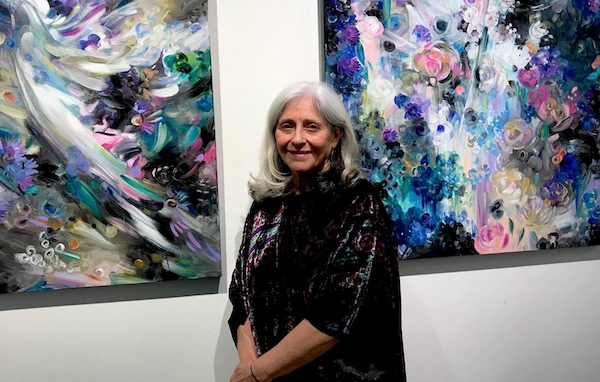
Linda Frimer’s exhibit, Beckoned by the Light, runs until Feb. 23 at the Zack Gallery. (photo from Linda Frimer)

“Since I was a child, I’ve always looked for the light – in the forest near my home and in the stories of my family. All the paintings in my show were inspired by light, the light of creation,” said Linda Frimer.

The exhibit, Beckoned by the Light, opened at the Zack Gallery on Jan 30. Originally, Frimer thought that her show would open simultaneously with the launch of her upcoming book, Connecting the Dots, and this is why the gallery exhibit opened in conjunction with the Cherie Smith JCC Jewish Book Festival. But life interfered, and the book is still a work-in-progress. Nevertheless, Frimer told the Independent, “I decided to go ahead with the show.”

Frimer’s paintings are beautiful, suffused with light. They are closer to impressionism than to realism, but every piece is unmistakably and uniquely hers. Light bathes the trees and the streams. It filters among the branches. It soars on dove’s wings over brilliant abstractions and illuminates mysterious paths winding through the woods. Light bursts into explosions of gladness and swirls like dancing fairies, inviting gallery visitors to share the luminous joy, to rejoice in the rainbow of colours.

“When I paint, I want to be positive,” the artist said. “Life is hard. That’s why I want joy in my paintings.”

To express her joy, Frimer uses bright colours, including gold and silver. “Gold and silver are great for all the recurring symbols in my paintings,” she explained. “One of my favourite symbols is wings – wings of the birds, like a dove, which is a metaphor for light.”

Another symbol that appears frequently is a tree. “Trees have wings, too. Sure, they are rooted in earth, but they reach for the sky, for the light,” Frimer said.

One more symbol populates many of her paintings – a flower, specifically a sunflower, which always strives to stretch higher, to touch the sun.

And then there are paths, roads to the light. Or to a better place. Or to someone you love. “I love people,” she said. “Love being a member of a group. I’m a member of several different groups.”

One of her groups – with five artist friends – attended her opening night and brought a gift: a wooden staff adorned with symbols of her art. Each object that was attached to the staff was created by a member of the group.

“We met through a project of the Hebrew University about 15 years ago,” Frimer said. “Now, we meet regularly, support each other in life and art. Whenever one of us has a show, the rest of us always make something symbolic for her.”

The group comprises Frimer, Nomi Kaplan, Lilian Broca, Barbara Heller, Sid Akselrod and Melenie Fleischer. “We call our group Five Hens and a Rooster,” Fleischer said with a laugh, as she presented the group’s gift to Frimer.

Music also plays a big part in Frimer’s artistic life. One could almost hear notes thrumming in her imagery. “I often listen to music when I paint,” she said. “I even dance sometimes. I love classical music, pop, all kinds, really.”

Frimer always starts a painting with an idea, but then her imagination takes over. “I follow my intuition,” she said. “Painting is a spiritual act for me. It’s like meditation. I love the process, the magic of creating. It’s wonderful to be able to express all that positive energy.”

In her opinion, everyone is an artist. Not necessarily a visual artist, but we all create in our own way. “It’s about how you feel, how you express yourself,” she said. “The process is much more important than the end result. I taught art a lot and I facilitated several healing artistic projects. It is great when I can help people tell their stories through creativity.”

Her new book is about that, too. “It’s my life story through art,” she said. “There are also creative exercises there, and some essays about different aspects of creativity. It’s about the healing power of the arts.”

Many of Frimer’s canvasses are large, expensive, fit for corporate headquarters or ballrooms, but the artist wants more than to sell her paintings for profit. “I believe in art reaching the public, being accessible. That’s why I make reproductions of my own work,” she said. “I make posters and giclée prints in different sizes. While my original paintings might not be affordable to many, anyone can afford a small print or appreciate a poster.”

In the same spirit, she often makes donations of her art to hospitals and synagogues. “When a painting hangs in a hospital,” she said, “I hope it might make someone feel better, help with their healing. In a synagogue, I hope my paintings might inspire and support. I studied colours and how they could aid in healing a body or a spirit. I even wrote about it in my book.”

Frimer’s bright paintings are permeated with hope and energy. They are celebrations of possibilities, as if the artist sees everything through the lens of optimism. And she shares that optimism freely with all of us.

Beckoned by the Light runs until Feb 23. For more information on Frimer and her work, visit lindafrimer.ca.

Olga Livshin is a Vancouver freelance writer. She can be reached at [email protected].

Format ImagePosted on February 7, 2020February 6, 2020Author Olga LivshinCategories Visual ArtsTags art, Beckoned by the Light, Linda Frimer, painting, tikkun olam, Zack Gallery

Loss-loss only solution

The parallels between the Trump impeachment trial in the U.S. Senate and the release of the Trump administration’s Israeli-Palestinian peace plan are striking. Donald Trump, a master of diversion, unveiled his incendiary proposal for the Mideast at the height of the Senate’s process. Just as the impeachment trial was, in some senses, a process whose outcome was predetermined by the Republican majority, so too is the Mideast proposal outcome predetermined in that it barrels over the Palestinian opposition and rubber-stamps almost everything the more extreme elements of the Israeli body politic have long demanded.

The approach is counterintuitive – like almost everything this U.S. president has done. Supporters might contend that, since all the rational thinking of the best diplomatic minds has not resolved this problem, a 180-degree turn that electroshocks the status quo might be better than nothing. The proposal is so one-sided that, out of sheer outrage, it has at least forced the Palestinian leadership to articulate what they will (or, rather, won’t) accept to a degree greater than they have expressed in recent years.

In the end, though, this emphasis on winning and losing – the Trump plan would be a clear win for Israel and a commensurate loss for Palestinians – is precisely the wrong approach. We may believe that the Palestinian leadership has betrayed their people by rejecting previous offers of coexistence, and conclude that what their people get is what their leaders deserve. But the Palestinian people deserve better than this.

Israel and the Zionist project have always had to contend with the realities and vagaries of coexistence – what other choice do Jews really have? Despite early warnings, coexistence with their neighbours was a widespread expectation among the early Zionists, some of whom thought (naïvely, in retrospect) that they would be welcomed with open arms by the other peoples in the region. But, even with the history of conflict and the absence of anything to give us a great deal of hope, some slow evolution that leads toward coexistence is the only realistic alternative to the status quo of suspended violence and intermittent war.

We need to recognize, above all, that a lasting resolution is not going to look like a win for one side and a loss for the other. Likewise, it is not going to resemble a win-win, as negotiators in various arenas, as well as salespeople, like to say. It will be a lose-lose proposition. An enduring peace and coexistence will almost certainly occur only when both sides are willing to accept a loss on many or most of their key demands – and accept that loss as a price for their children’s lives and well-being.

More immediately, we should be very wary of any master plan for peace that is scribbled out in the middle of an election campaign or another drama like an impeachment. The contents of such a plan are almost certainly more geared to the outcome it is trying to influence (votes for Likud or the Republican Party) or distract from (the U.S. president’s impeachment and trial or the Israeli prime minister’s loss of immunity from prosecution) than the problem it is ostensibly meant to address. Israelis and Palestinians, both, deserve self-determination and lasting peace.

Posted on February 7, 2020February 6, 2020Author The Editorial BoardCategories From the JITags impeachment, Israel, Israeli-Palestinian conflict, peace, Trump, United States
The comics rise again on Feb. 20

The comics rise again on Feb. 20

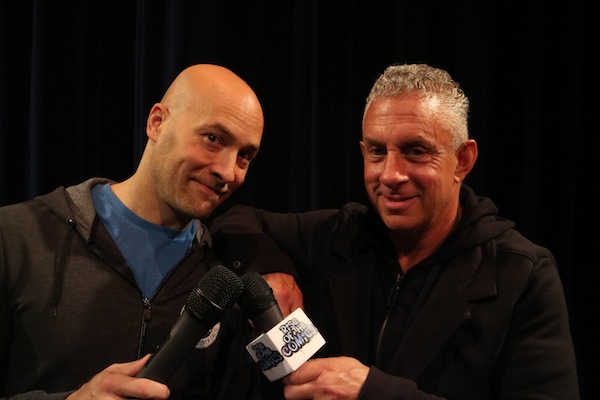
Kyle Berger, left, and Scotty Aceman, co-producers of Rise of the Comics. (photo from Rise of the Comics)

The outer limits of the laugh-o-meter will be tested on Feb. 20 at the Jewish Community Centre of Greater Vancouver’s Rothstein Theatre, when a group of Canada’s top funny people step on stage for A Night of Shticks & Giggles, presented by local comedy producer Rise of the Comics. This will be the third Shticks and Giggles show to raise money for the JCC Maccabi Games.

Headlining the event is Julie Kim, a two-time Canadian Comedy Award nominee for stand-up, who has performed at comedy festivals around the continent and appeared on CBC’s The Debaters and Laugh Out Loud. Her YouTube videos have amassed millions of views and, in 2018, she released her debut comedy album, Outside Voice.

Among other topics, Kim’s routine delves into modern parenting and various cultural issues, sometimes involving life seen from an Asian perspective. Yuk Yuk’s comedy club co-founder Mark Breslin called her “smart, funny, with enough self-awareness to deconstruct her life in a very sophisticated way.”

Other acts in the show, which Rise of the Comics describes as its “best line-up to date,” include Robert Peng, who bills himself as “an unemployed engineer who turned to stand-up comedy out of desperation”; New Zealander Sophia Johnson, “the one who keyed your car but probably shouldn’t have told you that”; Sean McDonnell, who Canadian comedy star Norm MacDonald has praised as “a fantastic talent”; and Brett Nikolic, a maven on Mountain Dew-flavoured weed.

Rise of the Comics is the brainchild of Vancouver stand-up comedian Scotty Aceman, who will also be on stage at Shticks & Giggles. Starting off as a weekly 30-minute program on Shaw Cable with the same name in 2015, the show has highlighted the work of many stand-up comedians who got their start on the local scene, such as Dino Archie and Ivan Decker, who has appeared on Late Night with Conan O’Brien.

Aceman, a University of British Columbia and B.C. Institute of Technology graduate, switched to comedy five years ago, after a 20-year stint in a sales job with Rogers in the corporate wireless phone department.

“Leaving the cellphone business after 20 years was a tough call,” he said. “But you have to chase your dreams. People would ask me, ‘What about my dignity and respect?’ I’d say dignity and respect went out the window the minute I had a Thursday morning bar mitzvah!”

In 2019, Aceman brought in Kyle Berger as co-producer of Rise of the Comics. Berger, sports coordinator at the JCCGV, will be the master of ceremonies for the Feb. 20 Shticks & Giggles.

Before joining the crew, Berger, in his role as JCC Maccabi Games delegation head, had hired Rise of the Comics for a fundraiser. He credits Aceman for allowing him to get his stand-up feet wet, with a debut performance at the Charqui Grill in Kitsilano in 2018.

“Stand-up was one of those things on my bucket list to do by the time I turned 40,” Berger told the Independent. “Scotty (and my then-girlfriend, now fiancée) were both big helpers in getting me up there on stage for a five-minute routine. My fiancée had had enough of me saying I was going to do it.”

Berger said, “Scotty’s reputation within the local comic community is a great asset. Nowadays, Rise of the Comics does all sorts of things, including parties in people’s living rooms. And, last year, we were hired by the Chutzpah! Festival to put on a show.”

Rise of the Comics currently works with a roster of more than 50 stand-up performers of all styles and experiences, and tailors its shows to any situation. They have created performances at such diverse venues as Hy’s Steak House, the Jericho Arts Centre and Ronald McDonald House, among others. Their gigs can cover everything from clean to dirty, social commentary to observational, but always, they say, with an emphasis on the funny.

Berger promises that he and fellow Shticks & Giggles comedians are likely to make mention, in one way or another, that their show is backed by the foundation created by Dr. Neil Pollock, a leading Vancouver male sexual health and circumcision expert, and his wife Michelle.

The show starts at 7:30 p.m. Tickets are $20 and can be purchased at m.bpt.me/event/4499277. For more information about Rise of the Comics, visit riseofthecomics.com.

Sam Margolis has written for the Globe and Mail, the National Post, UPI and MSNBC.

Format ImagePosted on February 7, 2020February 6, 2020Author Sam MargolisCategories Performing ArtsTags comedy, JCC, JCC Maccabi Games, Kyle Berger, Pollock, Rise of the Comics, Scotty Aceman, Shticks & Giggles, stand-up
Israel’s early days

Israel’s early days

Gloria Levi launches her most recent memoir at the Jewish Book Festival Feb. 12. (photo from Jewish Book Festival)

When local activist and writer Gloria Levi was a teenager, she was immersed in the Labour Zionist movement and “dreamed of becoming a pioneer in Israel.” In 1950, at age 19, she spent several months there. In 1957, with then-husband Norman (whom she had met on the previous trip) and two young children, she made aliyah. Her recently published memoir, Kissing An Old Dream Goodbye, honestly and succinctly relates what took her to Israel – and what brought her back just under two years later.

Levi launches her new book at the Cherie Smith JCC Jewish Book Festival on Feb. 12, 2 p.m., in the Waldman Library. Levi, who worked as a gerontologist for 30-plus years, has written a series of booklets, Challenges of Later Life, and co-wrote Dealing with Memory Changes as You Grow Older with Kathleen Gose. A lifelong student of Jewish texts and language, she translated The Life and Times of Simcha Bunim of P’shischa from Hebrew into English. She published her first memoir, My Dance with Schechina, in 2012.

Kissing An Old Dream Goodbye starts with Levi standing on the Marseilles pier, “impatient to set sail for Israel, the land of my dreams.” It was there that Norman noticed her, and the two became close over the subsequent months.

image - Kissing An Old Dream Goodbye book coverGrowing up in Brooklyn, Levi had just finished her first year at New York University – “Emotionally, socially and culturally, I was surrounded by Jews and rarely met non-Jews,” she writes. “I was fiercely independent and a bit of a rebel, and had a stormy relationship with my mother. My father had died when I was eleven. I paid my own way through university and had recently been living independently in Greenwich Village.”

Norman, then 23, had joined the British Army in 1944 and “had been with the British troops who liberated Buchenwald concentration camp. In 1947, he was “deployed to India during the bloody time of Partition.” He was traveling to Israel in 1950, intending to settle there.

While she stayed longer than the summer, Levi did return to the United States to finish her undergraduate degree, at the University of Iowa, “renowned for its child psychology department,” and Norman eventually returned to England. When a visit to Iowa City was about to extend past the deadline of his transit visa, the two decided to get married, as Levi’s career would have been jeopardized if they lived together without being married. “So much for romantic proposals!” writes Levi.

The couple ended up getting married in Canada, for various reasons, and then moved to Toronto, to Montreal and, finally, Vancouver. There, newlywed life was challenging, as they got to know each other, struggled with money and started their family. Levi writes with openness about the good and the difficult – a recurring theme is communication troubles between Norman and her. A prime example is that, when things finally began to look good for them, with secure jobs, a reasonable income, Norman suggested they move to Israel. Initially startled, Levi admits that she, too, still wanted to make aliyah, but “didn’t want to say much.”

They arrived in Israel, kids in tow, in late September 1957, heading to Kfar Daniel, a modified kibbutz. There, they adapted to yet another completely new way of life, making friends, learning the jobs they are given – Levi’s first work is cleaning outhouses – and figuring out how to live in a place with snakes, scorpions and other dangers, including possible imprisonment if you accidentally wandered into Jordan, and military service for Norman.

While they loved so many aspects of living in Israel – “the physicality of the land,” feeling like “a link to 2,000 years of history,” connecting “with the guttural, nuanced ancient mystical language of Hebrew” and feeling “that this truly was our home” – other parts of the experience, both on the kibbutz and in Akko, where they moved in 1959, were impossible to reconcile with their beliefs and moral code. Among Levi’s doubts about staying in Israel were “certain negative societal attitudes, my children’s potential education system, political injustices, corruption in the form of ‘protexia,’ and the top-heavy bureaucracy.” It is with regret and ambivalence, as well as some shame that they couldn’t make it work, that Levi and her family returned to Vancouver.

“I never felt concerned about going public,” she told the Independent of the personal nature of the book, “because I was describing my truth.”

And part of her truth is the love for the country that remains, despite the disillusion, especially regarding social justice – how kibbutz members interacted with one another at times, how citizens were treated by the state in certain instances and how Arabs were viewed. An epilogue takes readers briefly through Levi’s views of the political situation in 1964, 1967 and 2019.

“Given today’s controversies regarding Israel-Palestine, I wanted to describe the profound needs, emotions and idealism surrounding the early days of the state,” said Levi. “I wanted to convey my own journey of love and doubt, joy and conflict, idealism and human ego – the controversies inherent in communal living and the clashes of two peoples living and loving one land.”

In writing Kissing An Old Dream Goodbye, Levi said, “I hope I’m able convey the colour and beauty of the land, the strengths and limitations of people in an authentic, compassionate way.”

And Levi continues to write. Her current project is a novel called The Hotelkeeper’s Daughter, a “story about an immigrant Jewish religious family, taking place from 1938 to 1948,” she said. “It is the most exciting writing I’ve ever undertaken.”

For the book festival schedule, visit jewishbookfestival.ca.


Format ImagePosted on February 7, 2020February 6, 2020Author Cynthia RamsayCategories BooksTags aliyah, Cherie Smith JCC Jewish Book Festival, Gloria Levi, Israel, memoir
Loves making people laugh

Loves making people laugh

Esther Povitsky performs at the Biltmore Cabaret on Feb. 22 as part of JFL NorthWest. (photo from JFL NorthWest)

Chicago-born comedian, actor and writer Esther Povitsky is one of several Jewish community members performing in the Just for Laughs NorthWest comedy festival, which takes place around Metro Vancouver Feb. 13-25. Her credits include being co-creator and star of the show Alone Together, a recurring role on Crazy Ex-Girlfriend, parts on programs such as Brooklyn 99 and Parks and Recreation, stand-up on The Late Late Show and Comedy Central, as well as host of the podcast Glowing Up. The Jewish Independent spoke with her in advance of her Feb. 22 show at the Biltmore Cabaret.

JI: When did you first start doing stand-up and what motivated you to do it?

EP: I love comedy. I love watching it, I love laughing and making people laugh. I also liked the idea of being able to do something creative where I only relied on myself.

JI: Before you started stand-up, what were you working toward education- or career-wise?

EP: I thought I was going to be a professional dancer, and majored in dance in college.

JI: What is it about performing that you most enjoy, in stand-up and in acting?

EP: Having an excuse to drink too much coffee.

JI: When did you move to Los Angeles, and was it for a specific job or more opportunity for work in general?

EP: I did not have any specific jobs lined up! I moved here to pursue stand-up and worked as a babysitter, worked at a gym, a juice bar, and other random gigs.

JI: You describe your stand-up as just being you. Being Jewish on your dad’s side, where/how/does Judaism, Jewish culture or community fit into that, or your comedy series?

EP: I feel that I was raised very culturally Jewish and it’s a big part of my personality and who I am.

JI: In an interview you talk positively about the immediacy of seeing what works and what doesn’t onstage. How do you handle the highs and lows of comedy?

EP: I try to keep busy, stay active, spend quality time with friends and family, do puzzles, watch TV. I try to really focus on doing as many “normal” things as possible.

Povitsky’s Vancouver show is 19+. For tickets and the JFL NorthWest lineup, visit jflnorthwest.com.

Format ImagePosted on February 7, 2020February 6, 2020Author Cynthia RamsayCategories Performing ArtsTags comedy, Esther Povitsky, JFL NorthWest, stand-up

Posts pagination

Previous page Page 1 … Page 4 Page 5 Page 6 Next page
Proudly powered by WordPress