50 years of Jews in space

This colour image was obtained by NASA’s Galileo spacecraft early Dec. 12, 1990, when the spacecraft was about 1.6 million miles from the earth. (photo from NASA/JPL)

It’s been 50 years since Neil Armstrong became the first human to walk on the moon, on July 20, 1969. But there was another “first” six months earlier – in January 1969, the first Jew journeyed into space, Soviet cosmonaut Boris Volynov.

Since then, there have been 14 Jewish space-bound astronauts, including arguably the most famous, Israeli Ilan Ramon, who died in the explosion of the Columbia Space Shuttle, with six colleagues, in February 2003.

Like many before him, and many since, Ramon’s mission was infused with his Jewish heritage. For the voyage, he packed a pocket-sized Torah smuggled in (and out) of Bergen-Belsen, the Nazi death camp, and brought “Moon Landscape,” drawn by Petr Ginz, a 14-year-old inmate of Auschwitz. He also requested kosher food on the shuttle and NASA contacted Illinois-based My Own Meals, which makes kosher “thermo-stabilized” sealed pouches for campers. Reports say that Ramon also asked Rabbi Zvi Konikov of Satellite Beach, Fla., about keeping Shabbat in space – depending on the shuttle’s position, sunrise can happen 16 times a day.

To mark the 50-year milestone of the moon landing, the Jewish Independent interviewed three Jewish astronauts: Jeffrey Hoffman (the first Jewish male astronaut in space), David Wolf and Mark Polansky.

* * *

Hoffman was sent on five missions, the first in 1985; the last in 1996. In 1993, he repaired the Hubble Space Telescope. He logged more than 1,000 hours (the first to do so) and 21.5 million miles in space.

JI: Did you always want to be an astronaut?
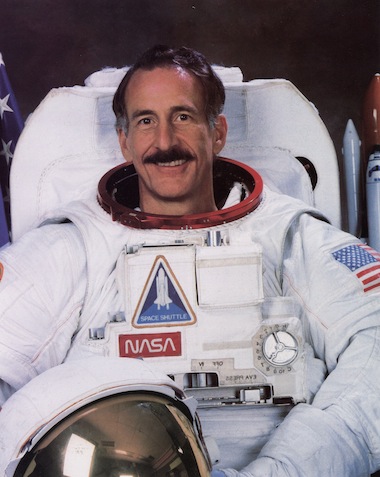
photo - Jeffrey Hoffman
Jeffrey Hoffman (photo from NASA)

JH: Well, if you asked in 1962 … any red-blooded young American boy, or probably Russian boys, for that matter, what they wanted to be when they grew up, 90% would say astronauts. I recognized that all of the early astronauts were military test pilots, and it was not a career I was interested in. I never considered it a realistic career prospect, but it was something I was always fascinated by.

In the late ’70s, NASA was developing what was then the brand new Space Shuttle, which had a crew of up to seven and they only needed two pilots. So, when they put out the first call for shuttle astronauts, all of sudden there were two types of astronauts now they were looking for. They were looking for the pilots, who were the traditional test pilot astronauts just like it had always been in the program, but they were also looking for scientists, engineers, medical doctors…. I all put in an application, and I was lucky enough to get selected.

JI: What was a highlight in space?

JH: The first highlight was riding a rocket into space, which fulfilled a childhood dream. But, the most memorable was, for every shuttle flight, two crew members were trained to use the space suits, just in case something happened. We weren’t planning on doing one on our flight, but one of our satellites malfunctioned and they sent me and my partner out to do what was, for NASA, the very first ever unplanned spacewalk. That was just an extraordinary experience.

JI: How did you get the idea to spin a dreidel in space?

JH: Before my first flight, my rabbi (Shaul Osadchey) asked me if I was interested in taking Jewish artifacts up. There were several dreidels I took up, one from the synagogue. I also took a mezuzah (donated to the Jewish Museum in New York), a Torah, both tallits from my two sons from their bar mitzvah, and a menorah, which is still at the front door of the science museum in Jerusalem. While I was in Jerusalem, I met a couple of Jewish artists who had read about me, a Jewish astronaut who took Jewish things into space. I had planned on being in space during Chanukah and one thing led to another and they presented me with a dreidel and a traveling menorah. It is a beautiful dreidel. It simply would not stop spinning!

JI: What did you do with the other Jewish stuff?

JH: There are only bunks for half the crew, with little places where you would sleep at night, and so we would share those with someone on the other crew. Well, I had a mezuzah with me. Of course, you can’t nail a mezuzah to the door when you are in a spacecraft; you have to use Velcro. So, I put it on the inside of my little sleep compartment and I would remove it every morning, because I figured this was for me and I didn’t want to impose on someone else who might not know what it is about. Fourth day of the mission, the guy who had been using my bunk at night said, “Hey, Jeff, that’s a nice idea putting the mezuzah in there!” I slapped my forehead…. It was Scott Horowitz, another Jewish astronaut. So, after that, we just left the mezuzah Velcroed to the wall for the both of us.

JI: Did you know Ilan Ramon?

JH: I knew Ilan, and had numerous contacts with his wife, Rona, since Ilan’s death. Although he was a payload specialist astronaut – a non-professional astronaut, on a crew for a special reason, for only one flight – he was totally accepted into the astronaut office culture. A large part of this is because his heroism as an Israeli Air Force pilot impressed the pilot astronauts, and another large part was because he was a genuinely likable person.

* * *

Wolf had four missions from 1993 to 2009, with more than 4,000 hours in space, 168 days in orbit on the space station Mir and seven spacewalks. He was the chief engineer for the orbital medical facility and chief scientist for the International Space Station (ISS) National Laboratory bioreactor (tissue-engineering) program. He conducted a number of experiments and studies, including advanced microgravity tissue-engineering techniques.

JI: How did you become an astronaut?
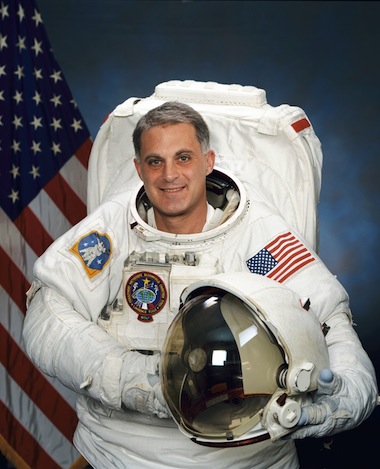
photo - David Wolf
David Wolf (photo from NASA)

DW: I’d been flying in the F4 Phantom in the international guard for many years and had that air force background; I had this mix of medicine, engineering and flying. I wound up in a very unique situation as an astronaut because I had been at NASA for nine years already, building instruments for the shuttle and the space station. Interestingly enough, I went to NASA as a bioengineer and a flight surgeon initially. I was the chief engineer for what became the health medical facility on the space station.

JI: What was terrifying about being in space?

DW: I was trapped outside the airlock on a spacewalk in a Russian space suit in a Russian spacecraft. The airlock was never recovered. It wouldn’t repressurize, so we had to ditch into another module. [It] took like 14 hours; we were [brought in] at the last second. I have had three total power failures of a spacecraft.

JI: Now tell me about the Jewish aspects.

DW: We Jewish astronauts do consider ourselves as representing the Jewish community. We take it seriously. I carried a mezuzah and it’s on my door now. I also carried a yad, a Torah pointer, and gave it to my synagogue in Indianapolis. I had a small menorah up there. I have the world-record dreidel spin.

JI: You might want to ask Hoffman about that.

DW: Hoffman and I are having a running battle, a running argument, on who has the longest dreidel spin. But I know mine went for like an hour and a half until it got sucked into an air intake. It was just floating there spinning.

JI: Did you know Ilan Ramon?

DW: We were good friends, and his office was right down the hall, a few doors down. He was one of the very finest that we ever saw come through. And Israel should be totally proud of providing that kind of quality to the astronaut office.

* * *

Polansky was sent on three missions – in 2001, 2006 and 2009 – all of which contributed to assembly of the ISS. He has logged nearly a thousand hours in space, and served as director of operations at the Gagarin Cosmonaut Training Centre in Star City, Russia. His initial flight was notable for several firsts: the first shuttle to dock with the ISS, the first time that a total of 13 crew members lived and worked onboard the ISS at the same time, and the first time that an astronaut/cosmonaut from every ISS partner agency was in orbit together.

JI: When did you decide to become an astronaut?
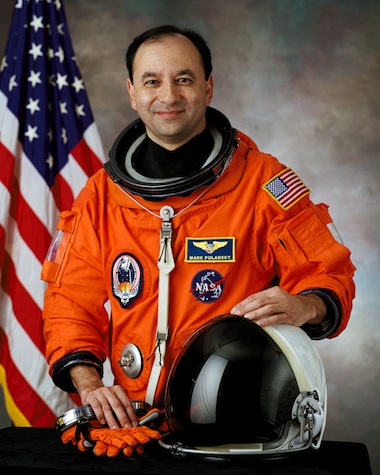
photo - Mark Polansky
Mark Polansky (photo from NASA)

MP: I was 13 when we landed on the moon and I got inspired and thought about becoming an astronaut. I’m old enough to remember that everything came to a screeching halt. The teacher would roll in a rickety old black-and-white TV on a stand and plug it in, and pull out rabbit ears….

I was a freshman in college in ’74 and I was living in a dormitory at Purdue University with, of all people, David Wolf, and Gene Cernan came to campus to give a talk. Imagine yourself as a freshman in college being about five feet away from a man who walked on the moon – I still have goosebumps about that. And that led me down a road which went to the air force and beyond to eventually get where I got.

JI: What was a highlight of being in space?

MP: You go over places, especially when you orbit around the Middle East, and you know what goes on, on the ground, and the horrible things humans can do to each other, and the suffering. You see none of that from there. You get this feeling of, it’s almost both hope and sadness. It gives you hope that we as a species can get past this.

JI: Given past disasters, were you afraid?

MP: Flying high-performance aircraft, being a fighter pilot, a test pilot, unfortunately, there are times when there are going to be aviation mishaps, and it’s usually very unforgiving. You realize that, as much as you would like to make things so safe, there is no such thing as absolute safety, where you never get hurt. You don’t want to get hurt in an aviation accident? Well, don’t fly airplanes. I always knew there was a lot of risk to it.

I got to meet a lot of the people who were working on the hardware. This was a calling for them. They could have made a lot more money working in another industry, but they were there because they just lived and breathed working on Space Shuttles, doing everything they could to make sure those Space Shuttles were as safe as they possibly could be.

JI: Did you know Ilan Ramon?

MP: I knew Ilan Ramon and, when he came over, he was flying with a couple of classmates of mine. After that tragedy, I spoke on behalf of the agency at a reception they had in Los Angeles, about Ilan. He was just a normal, great guy, and a man of peace.

** *

Other Jewish astronauts:

Jerome Apt: Four missions, 1991 to 1996. Author of Orbit: NASA Astronauts Photograph the Earth (National Geographic Society). Received the NASA Distinguished Service Medal in 1997. In 2012, the International Astronomical Union approved the name “Jeromeapt” for the main-belt asteroid 116903.

Martin Fettman: 1993 mission. Has published more than 100 articles in refereed scientific journals.

Scott J. Horowitz: three missions, 1996-2001. Four Space Shuttle flights. A retired U.S. air force colonel.

Garrett Reisman: 2008 and 2010 missions. Joined SpaceX in 2011 as a senior engineer working on astronaut safety.

Gregory Chamitoff: 2008 and 2011 missions. The Lawrence Hargrave Professor of Aeronautical Engineering at the University of Sydney, Australia; professor of engineering practice in aerospace engineering at Texas A&M University.

Ellen Louise Shulman Baker: three missions, 1989-1995, the last of which was the first Space Shuttle mission to dock with the Russian space station Mir, and involved an exchange of crews. Logged almost 700 hours in space.

Marsha Ivins: five missions, 1990-2001. Spent 55 days in orbit, on missions devoted to such diverse tasks as deploying satellites, conducting scientific research, and docking with Mir and the ISS.

John M. Grunsfeld: five missions, 1995-2002. In January 2012, returned to NASA and served as associate administrator of NASA’s Science Mission Directorate.

Judith Resnik: first Jewish American and the first Jewish woman in space. Died on Challenger, January 1986.

Dave Gordon is a Toronto-based freelance writer whose work has appeared in more than 100 publications around the world.
Goldene Medina comes here

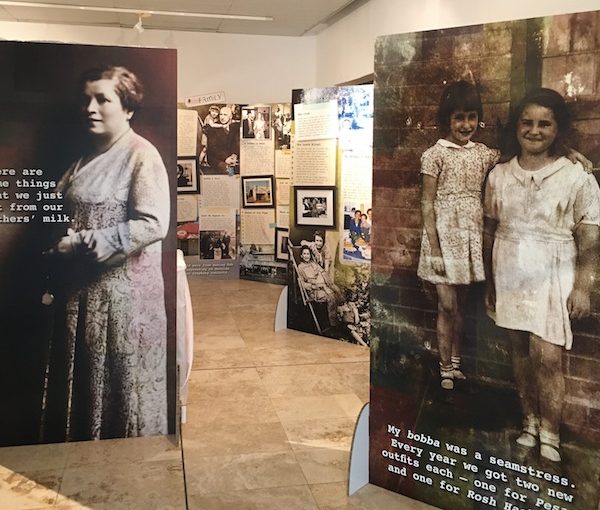
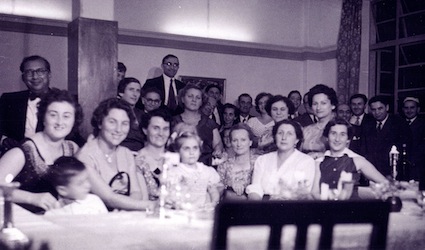
The Goldene Medina exhibit is designed to have the feel of a scrapbook album, to have come from any Jewish South African’s family memoir. (photo from South African Jewish Museum)

The Goldene Medina exhibit arrives in Vancouver July 29 for two weeks. A celebration of 175 years of Jewish life in South Africa, the exhibit was displayed in South Africa, Australia and Israel prior to arriving here, where it is making its North America debut at Congregation Beth Israel. Local Jewish community member Stephen Rom, who is from South Africa, saw it for the first time in Sydney and was instrumental in bringing it to the city.

“You need to remember your past to engage in the present,” reflected Rom. “I was struck by the level of professionalism of this exhibit, which was produced by the South African Jewish Museum in Cape Town. What’s different about it is the way the stories have been written. Nobody is named or personally identified. This is the story of all Jews in South Africa, the community as a whole.”

The Goldene Medina was the Jews’ name for Johannesburg when they arrived during the gold rush in 1886. “This exhibition has soul – it’s not a dry exhibition of facts and figures,” noted Wendy Kahn, national director of the South African Jewish Board of Deputies. “It’s one that tells real stories of families that have been living in South Africa for 175 years.”

“This is a social history,” agreed Gavin Morris, director of the museum, “the story of families and people and their experiences as South Africans and as Jews for 175 years, from our forefathers arriving to contemporary Jewish South Africa. Everything is taken from unpublished memoirs, articles and out-of-print books, to give the exhibit a sense of a scrapbook album, of any Jewish South African’s family memoirs. Our goal was for people to find their own stories in similar stories.”

The stories are excerpts written in the first person and accompanied by photographs old and new. One excerpt, titled “My Mother’s Table,” reads, “At my mother’s table, ‘being full’ was never a reason to stop eating. Some of the many reasons to have some more included: ‘I cooked this especially for you because I know you like it,’ ‘you can’t put so little leftovers back into the fridge,’ ‘it’s freshly made,’ and ‘you don’t like my cooking.’ Refusing more was to snub the generosity and abundance that was on offer. Eating was proof that you were loved and that you knew how to love back.”

Another, titled “Cubs,” reads: “After my mom realized that I only knew Jewish kids, she sent me off to Cubs – not exactly your standard Jewish activity. I came home with my first friend and said, ‘Mom, isn’t it wonderful? Here’s my first friend from Cubs and guess what – we’ve got the same Hebrew teacher!’ He was the only other Jewish kid there and we found each other. My mother gave up after that.”

A third is titled “A Surprise Guest”: “What is the epitome of Jewish chutzpah? Inviting the president of the country to attend your bar mitzvah. And what is Jewish mazel? When the president actually accepts. The bar mitzvah boy delivered his handwritten note to a security guard outside [Nelson] Mandela’s Houghton estate. He hoped to get a card from Mandela in return. Instead, his parents received an official call to say the president will attend. On the day, President Mandela arrived and sat at the main table, between the bar mitzvah boy and his father.”

The excerpts are thought-provoking, poignant, entertaining, informative and never boring. And the photographs are deeply intriguing, telling a story of their own – a timeless Jewish story that has relevance to all Jews whose ancestors have known immigration and resettlement.

Accompanying the Goldene Medina in Vancouver will be the exhibit Shalom Uganda: A European Jewish Community on the Ugandan Equator 1949-1961, curated by Janice Masur.

photo - The Kampala Jewish community gathers for visit of Chief Justice Joseph Herbstein from South Africa, 1958. Gifted by Ilsa Dokelman, in 2005
The Kampala Jewish community gathers for visit of Chief Justice Joseph Herbstein from South Africa, 1958. Gifted by Ilsa Dokelman, in 2005. (photo from Janice Masur)

“As a child, I lived in this remote European Jewish community on the shores of Lake Victoria in Kampala, Uganda, under British Imperial rule, with no rabbi or Jewish infrastructure. Yet, this tiny community of 23 families and 20 children (15 of whom were born in Kampala) identified as Jews and formed a cohesive group that celebrated all the Jewish festivals together,” explained Masur. “Now that most references to Jews in Uganda pertain to … Abayudaya Jews, I want this history – my story about my Ashkenazi Jewish community in Kampala – to be remembered in the Jewish Diaspora.”

The photos and stories that comprise the Ugandan display are, said Masur, “a testament to a determined but isolated group of Jews who were secular in a [remote] place but upheld their Jewish identity and traditions as best as was possible,” given the lack of religious, educational or cultural Jewish institutions. (For more about the Ugandan Jewish community in which Masur grew up, click here.)

The July 29 opening night of the Goldene Medina starts at 7:30 p.m. at Beth Israel, where the display will be up until Aug. 14.

Lauren Kramer, an award-winning writer and editor, lives in Richmond. To read her work online, visit laurenkramer.net.

Timeless political satire

Michael Scholar Jr. co-directs the political comedy Born Yesterday, which opens July 13 at the Jericho Arts Centre. (photo from ETC)

Garson Kanin’s comedy Born Yesterday opened on Broadway on Feb. 4, 1946, and was a hit. It has been made into a film (1950), returned to Broadway twice (1989 and 2011) and seen countless productions. About political corruption, it has a timeless quality.

“This play seems to have been written for this exact moment, when populism, corruption and bullying are an omnipresent part of our political and personal lives,” co-director Michael Scholar Jr. told the Independent.

Scholar co-directs the Ensemble Theatre Company (ETC) production with Shelby Bushell. Part of the company’s Annual Summer Repertory Festival, Born Yesterday opens July 13 at the Jericho Arts Centre.

“Kanin wrote the piece while in Europe,” said Scholar. “While he was serving in the army to defeat fascism abroad, he seemed more concerned about those same tendencies within our own democracy back home. This play and one of its central figures, Harry Brock, the bullying millionaire who tries to buy his way into power, are sadly all too familiar 80 years on.”

In Born Yesterday, junkman Harry has come to Washington, D.C., to use his money to influence legislation. Despite his own uncouthness, Harry is concerned that his girlfriend, Billie, a former showgirl, will make him look bad, so he hires a reporter, Paul, to educate her. As her newly released intelligence begins to surface, she could prove Harry’s undoing.

The Independent last spoke with Jewish community member Scholar about The Enemy, another political play, which was at the Firehall Arts Centre late last year.

“Since The Enemy, a lot has changed for me,” he said. “I spent a semester teaching acting and directing at Arizona State University in Phoenix. And now, on my summer break, I’m co-directing Born Yesterday for ETC and, a day after opening, I fly to New York to direct A Midsummer Night’s Dream for Colonial Theatre of Rhode Island, which I get to work on with my 6-year-old daughter, Alice.”

About how he came to co-direct Born Yesterday, Scholar said, “I was talking with artistic director Tariq Leslie while on a movie set here in Vancouver, and we got to talking about how ETC was hitting above its weight class and doing some powerful work in town. He had seen my production of As You Like It at Studio 58 and enjoyed my work. And so a match was made.”

Scholar described having a co-director as “a real blessing.”

“It means that we can tag team on rehearsals, and I actually get to have a day with my family each week,” he said of working with Bushell. “Also, having her perspective in the room has meant that we are covering more ground and that, together, we have fewer blind spots. This play is about a woman who is perceived to be a ditz, but whose sense of civic duty is awoken through education and intellectual stimulation. This play, written in the ’40s by Garson Kanin, is surprisingly relevant to our current political climate, but it also has some potentially problematic elements [so it is] worth having two sets of eyes looking at this material.”

One of those elements is the depiction of women.

“Brock is a bully and, without giving away too much of the plot, he is a violent character towards both men and women in his entourage,” explained Scholar. “The play deals with toxic masculinity, misogyny and stereotypes, but, in its time, it was working to subvert those ideas. So, we’ve reworked parts of the piece to highlight this intention and to not reinforce gender stereotypes, which has been another great reason to have Shelby as a collaborator on this project.”

Ensemble Theatre’s website highlights a quote from the play: “A world full of ignorant people is too dangerous to live in.” It notes, “By turns uproarious and sobering, and packed with a cast of vibrant characters throughout, Kanin’s play reminds us that a healthy democracy depends on its inhabitants to stay healthy, and that abuse of power cannot be stemmed without an informed and engaged citizenry.”

Scholar stressed that, despite the weighty issues tackled, the play is primarily a comedy. “It has a fast-pace banter and physical precision that is almost farcical,” he said. “It uses comedy as a way of dealing with challenging ideas, disarming us with laughter so that we can reflect on our situation with not just our heads, but our hearts, too. I’m sure audiences will have much to discuss afterwards, but they will also be entertained while on this poignant journey.”

ETC’s summer festival runs to Aug. 16. In addition to Born Yesterday, it features Michael Healey’s The Drawer Boy, which opened July 12, and Tracy Letts’s Superior Donuts, which opens July 19. For tickets, visit ensembletheatrecompany.ca.

Happiness thoughts

Summertime and the living is easy! Of all the seasons, probably summer is most closely associated with happiness. Vacation, camping, family time, celebrations, picnics: these are activities that we associate with happiness.

In Western culture, individual happiness is often considered the primary goal of life. What parent hasn’t begun a sentence with, “As long as you’re happy…”? In many other societies, happiness is subordinated to family needs, communal obligations or other less individualistic pursuits. But the pursuit of happiness has a long history in Western culture, codified most notably in the United States Declaration of Independence as an “unalienable right.”

Most of us probably enjoy our happiness without overthinking it. But an Israeli guru of happiness will be in Vancouver later this month and he has thought a great deal about the subject.

Prof. Yoram Yovell is a brain researcher, psychiatrist and psychoanalyst with a PhD in neurobiology. He is the author of bestselling books and is a regular face on Israeli TV.

The United Nations ranks countries on a scale of happiness, topped by the Scandinavian countries, Switzerland, the Netherlands, Canada, New Zealand, Australia – and then Israel.

For people who have not been to Israel or who lack an understanding of its culture, it may be a surprise to find that a country whose history has been so wrapped up in violence and conflict would produce a population that is collectively as happy as almost any society in the developed world. There is, however, an explanation.

Stability, basic freedoms and an economy that allows for individual financial comfort or success are among the baseline requirements for societal happiness, notes Yovell. Things like clean water, a social safety net and an effective, accessible healthcare system are also on the list. In many cases, it is also critical to have a sense of cohesion and shared purpose.

While Israelis may no longer be as united as they were in the days of the early chalutzim, the requirement of military or national service plays a factor in building social cohesion and making individuals feel part of a larger whole. For many, the ability to live in the world’s only Jewish state is another factor that leads to shared purpose and, indirectly, to happiness. (It is worth noting that, although Israeli Arabs report being less happy than Jewish Israelis, their happiness levels are higher than Arabs in neighbouring countries.)

Economic challenges in Israel – inflation, high cost of living and such – do not ultimately have a huge influence on happiness levels, Yovell maintains. Once the most basic needs are met, incremental differences in income or GDP have little impact.

We could all take some time this summer to reflect on the things that make us happy. In so many cases, the things that make us happy are precisely the things that make our society better – volunteerism, engagement and participation in our community, getting outside (especially if it’s sunny!), spending time with family and friends. These are things we could all do well to be more conscious of, be grateful for and try to consciously encourage in our lives.

Local woman inspires chesed

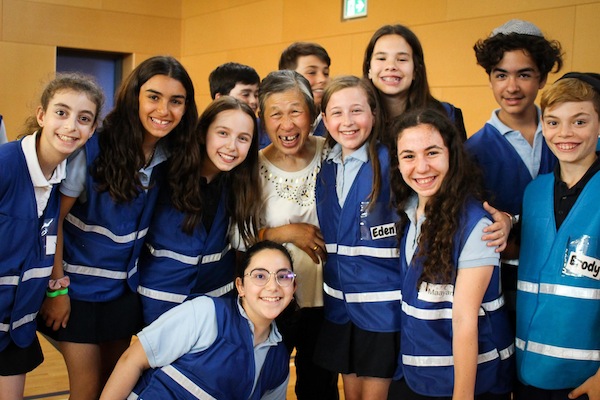
Members of Vancouver Talmud Torah’s Grade 7 chesed club with Gia Tran, a local woman who raises money for cancer research by taking refundable containers to a bottle depot. (photo from VTT)

Since 2014, Vancouver Talmud Torah has offered a chesed (kindness) program to students in grades 3 and 6. Following requests from parents, the school introduced a mandatory chesed program for Grade 7s this year, which nurtures a commitment to volunteering and social justice.

And, this year, the initiative was pursued with a particular dedication, as students mourned the recent passing of Rose Dupaya, who worked as a custodian at VTT. She took ill last fall with cancer and died suddenly, which was a tremendous shock to the school community. In response, the students – who would often greet Rose with hugs – turned their grief into action.

When the Chesed Leadership Club heard about local woman Gia Tran, who takes refundable containers to a bottle depot every day to raise money for cancer research – more than $15,000 in 22 years – they were inspired. Following in Tran’s footsteps, the kids raised $2,000 from a bottle drive for cancer research.

VTT student Julia Andison expressed her gratitude to Tran for teaching her about personal agency. “Gia taught me that even a small act like collecting cans can make a big impact on others. And, as a chesed leader, I was able to communicate this to the younger students in our school, that every little bit counts.”

Students in the chesed club do not follow a curriculum. Unlike with subjects like math or language arts, the club was founded for students to explore their values and lead a program on their own initiative. As a consequence, the program’s success lies in the development of student ideas, teamwork and leadership.

“The minute you offer something optional and student-driven, it takes on a life of its own,” said Shoshana Burton, director of Hebrew (grades 5-7) and chesed programming at VTT.

Students are not admitted automatically to the chesed club. Instead, they submit applications and sign contracts. If they do not follow up on their commitment to leadership, they can be dropped from the program, which is both an opportunity and a challenge to the students’ organizational skills and a way to exercise their moral and management muscles.

All of the students volunteer as part of the program. Some do so once a week while others volunteer their help every day. Many organizations and communities have benefitted from the support of VTT students, including the Muslim Food Bank and residents of the Downtown Eastside.

According to their teacher, the success of the club is in its spontaneous, natural development. “You can’t know the end result when you start. You can’t plan in advance,” said Burton. “The students learn how to work as part of a team, learning to commit to a project.”

Student Celia Joffe spoke of the club’s impact on her. “Helping others gives us a sense of pride and responsibility,” she said. “The project with Gia was amazing because we ended up not only helping the cancer foundation and the environment, but we also made Gia feel special and acknowledged.”

Shula Klinger is an author and journalist living in North Vancouver. Find out more at shulaklinger.com.

Series finishes on high notes

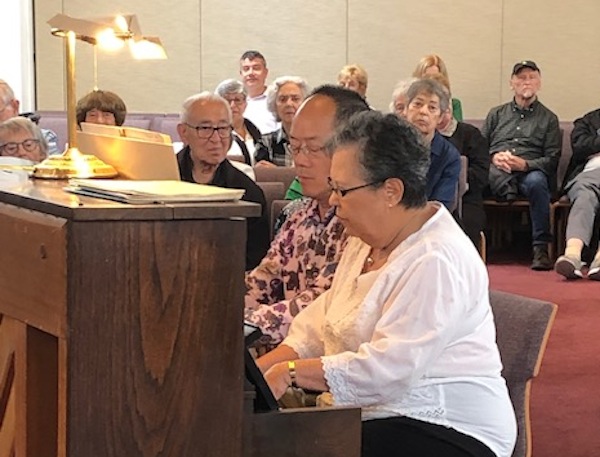
“Dueling pianists” Lester Soo and Marilyn Glazer entertain at the last Empowerment Series session of the season. (photo from JSA)

Co-sponsored by Jewish Seniors Alliance and the Kehila Society of Richmond, the fifth session of this season’s JSA Snider Foundation Empowerment Series took place at Congregation Beth Tikvah. It more than lived up to the series’ theme this year: “Renewing and Reinventing Ourselves.”

As usual, the program was preceded by a lunch provided by Stacey Kettleman. Beth Tikvah’s Rabbi Adam Rubin did the Hamotzi and Toby Rubin, co-executive director of the Kehila Society, welcomed everyone. Among the 120 or so attendees were members of the Kehila Society and of JSA, as well as a group from L’Chaim Adult Day Care.

The entertainment portion of the program took place in the sanctuary, where Ken Levitt, president of JSA, spoke briefly and Rubin introduced the “dueling pianists”: Marilyn Glazer and Lester Soo, both of whom are accomplished musicians and piano instructors. The two have known each other for 35 years and have been playing duets for much of that time – one piano, four hands. At the Empowerment Series performance, they began with four Hungarian rhapsodies and continued with Mozart’s Eine Kleine Nachtmusik. They then played a number of Gershwin tunes and ended with Cole Porter.

Rubin thanked the pianists for their wonderful performance, which was the last event of the 2018/19 Empowerment Series. The series will begin again in the fall, with a new lineup of events presented by JSA with other seniors groups in the community.

Shanie Levin is an executive board member of Jewish Seniors Alliance and on the editorial board of Senior Line magazine.

Growing mushrooms

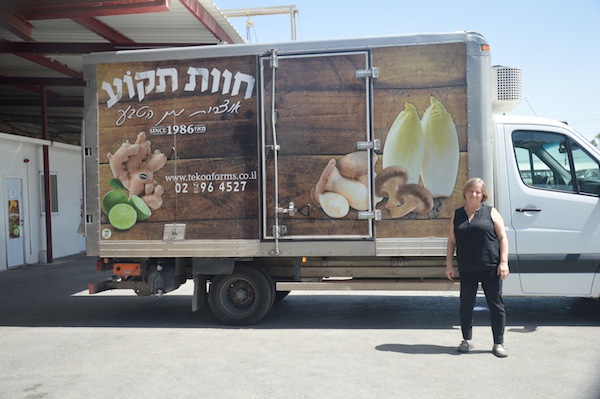
Mira Weigensberg and her husband, Oren Kessler, started Tekoa Farms in 1986. (photo by Barry A. Kaplan)

When Mira Weigensberg, who was born and raised in Montreal, and her husband, Oren Kessler, from Brooklyn, moved to Israel in 1979, she joined a research lab at Hadassah Hospital and came across research that caught her interest.

“Edible mushrooms had a potential effect on the immune system,” she explained in an interview at Tekoa Farms.

Tekoa is five miles south of Jerusalem, close to Herodium, the palace fortress and small town built by King Herod between 23 and 15 BCE. Tekoa was also the birthplace of the prophet Amos and, at the time of the Holy Temple, only olive oil produced in Tekoa was allowed in the service.

The Jewish community in Tekoa, which was established in 1978, is today a mixed religious and secular community comprised of approximately 3,000 people like Weigensberg and Kessler. The couple moved to Tekoa in 1983.

While working in the research lab, Weigensberg said to her husband, “Wouldn’t it be great if we could grow mushrooms at Tekoa?”

To learn more about the prospect, she went to the agriculture department of the Hebrew University and to Germany, while Kessler traveled to Holland.

“Ultimately, we scraped together enough money to start a mushroom farm, which began in 1986,” said Weigensberg.

Initially, they grew oyster and shiitake mushrooms, selling to chefs and specialty stores. In 1990, they started expanding their product range with items like lemongrass, asparagus, limes, snow peas, baby broccoli and baby artichokes. They have also added quick preparation goods, which only need hot water added.

“Every year, we try to add something new: a healthy product or mushroom-related or not easily available in Israel,” said Weigensberg.

Between production, sales and marketing, the farm currently employs 50 to 60 people.

The growing rooms are climate-controlled and, for example, in the room for oyster mushrooms, approximately a ton are grown on wheat straw. Other mushrooms grown and sold at Tekoa Farms include shiitake, king oyster, shimeji and shinoki.

In addition to the produce mentioned above, the farm’s vegetables and spices include ginger root, Belgian endive, red endive, turmeric root, shallots, Brussels sprouts and sundried tomatoes; fruits also include raspberries and blackberries.

Weigensberg said they are hoping to eventually have a visitor centre where people can come in for tours, but they are not set up for this now.

Sybil Kaplan is a journalist, lecturer, book reviewer and food writer in Jerusalem. She created and leads the weekly English-language Shuk Walks in Machane Yehuda, she has compiled and edited nine kosher cookbooks, and is the author of Witness to History: Ten Years as a Woman Journalist in Israel.

Quinoa, bread and date bars

Food You Want for the Life You Crave by Nealy Fischer (Da Capo Lifelong Books, 2019) is a delight to read. Not only are there at least 128 gluten-free recipes in this kosher cookbook, but there are 107 full-colour photographs, many of the author and her family sampling the recipes and enjoying them.

“These pages are designed to help you obtain a simpler recipe for success, both in and out of the kitchen,” writes Fischer, noting “these pages are infused with craveable global recipes inspired by our life in Asia and Israel.” The author started to adhere to a gluten-free diet more than 10 years ago.

The recipes have two strategies: “nail this,” the most essential elements to master for a dish’s success, and “flip it,” tips to encourage readers to be creative and to adapt the recipe to their preferences and limitations. Fischer gives readers a 10-step guide to becoming a flexible chef; a substitution chart; pantry, fridge and freezer essentials; and useful gadgets. Chapters include all-day breakfast, breads and muffins; soups and small plates; salads and dressings; fish, poultry and meat; veggies; desserts; drinks and nibbles for friends; and condiments and pantry essentials. The book concludes with a conversion cheat sheet.

One nice idea in the formating is a list of what tools to use above the list of ingredients, which is bolded and, where applicable, divided into dry and wet ingredients and toppings. She also has my favourite element in cookbooks – numbered instructions opposite the ingredients so you don’t have to keep looking up and down. My other favourite aspect is a comment about each recipe. Here are a few of the recipes to try.

SAVOURY QUINOA BOWL
4-6 servings

1/2 cup red or white quinoa (makes 2 heaping cups cooked)
2 small Persian or Kirby cucumbers, chopped (1 1/2 cups)
2 chopped tomatoes (about 1 cup)
1 peeled, chopped avocado (about 1 cup)
1 cup arugula
1/2 cup chopped green onion (about 4)
1/2 cup chopped fresh mint
1/4 cup finely chopped shallots
3 tbsp lemon juice
4 tbsp extra-virgin olive oil
salt and freshly ground black pepper to taste
6 large eggs

  1. Start by cooking the quinoa. Mix it with one cup water in a saucepan or pot over medium low heat. Bring to a simmer and cook, covered, for 10 minutes. Check to see if it is done or needs a tad more liquid. Set aside to cool.
  2. Toss the cucumbers, tomatoes, avocado, arugula, green onions, mint and shallots in a large bowl.
  3. Add the cooled quinoa to the veggie bowl then season with lemon juice, olive oil, salt and pepper.
  4. Divide the mixture between six bowls.
  5. Fry the eggs in a lightly oiled pan over medium heat until the whites have set, or to desired doneness. Season with salt and pepper to taste, then carefully slide them on top of the quinoa bowls.

HERBED EVERYDAY BREAD
2 mini loaves or 1 large loaf

1 packet active dry yeast (2 1/4 tsp)
1/4 cup warm water
1 cup all-purpose gluten-free flour
1 cup oat flour
1/4 cup almond flour
1/4 cup flax meal
2 tsp xanthan gum (omit if already in flour)
1 1/2 tsp dried rosemary
1 tsp salt
1/4 cup extra-virgin olive oil
2 large eggs + 1 beaten for brushing
2 tbsp raw honey
1/2 tsp rice vinegar

  1. In a large bowl, mix the yeast with the warm water; let stand until the yeast bubbles, about eight minutes.
  2. In a separate medium bowl, whisk together gluten-free flour, oat flour, flax meal, almond flour, xanthan gum, rosemary and salt.
  3. Stir olive oil, two eggs, honey and rice vinegar into yeast mixture. Stir dry ingredients into bowl. Mix well.
  4. Transfer dough to parchment-lined loaf pans and let stand covered in a warm place until bread rises to double in height (about 45 minutes).
  5. Preheat the oven to 350°F.
  6. Brush the top with the remaining beaten egg.
  7. Bake the bread until it is golden and set in the centre, 30 to 35 minutes for mini loaves or about 45 minutes for a larger loaf. Cool the bread completely before removing from the pans and slicing.

DATE-BAR BITES
32 to 36 squares

1 pound Medjool dates, pitted and chopped
1/4 cup maple syrup
juice and zest of 1 orange
2/3 cup coarsely chopped raw walnuts or pecans
1 tsp ground cinnamon
1 tsp vanilla extract
1 3/4 cups all-purpose gluten-free flour
1 1/2 cups old-fashioned rolled oats
1 cup packed dark brown sugar
3/4 cup coconut oil at room temperature
1/2 tsp baking soda
1/8 tsp salt

  1. In a saucepan over medium heat, combine dates with half-cup water, maple syrup and orange juice and bring to a boil.
  2. Remove the pan from the heat and stir in the orange zest, nuts, cinnamon and vanilla. Set aside.
  3. Preheat the oven to 350°F. Grease a 13-by-9-inch baking pan or line it with parchment paper.
  4. In a food processor, mix together flour, rolled oats, brown sugar, coconut oil, baking soda and salt until combination is crumbly but still holds together.
  5. Press two-thirds of the dough into the baking pan (reserve one-third for the topping).
  6. Spread the filling evenly over the crust. Sprinkle the remaining one-third of the topping over the filling. Bake for 30 minutes or until lightly golden.
  7. Cool completely then refrigerate until cold to make the cutting easier. Cut into one-and-a-half-inch squares.

Sybil Kaplan is a journalist, lecturer, book reviewer and food writer in Jerusalem. She created and leads the weekly English-language Shuk Walks in Machane Yehuda, she has compiled and edited nine kosher cookbooks, and is the author of Witness to History: Ten Years as a Woman Journalist in Israel.

Cucumber salads for summer

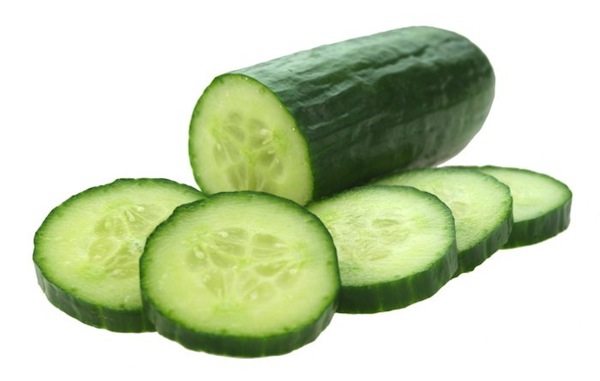
(photo by Nick Youngson/Alpha Stock Images)

Whether you go to farmers markets or elsewhere to buy your summer produce, cucumbers are a must. In Jerusalem, we have all kinds of cucumbers year-round but my favourite in Machaneh Yehudah is one with a fuzzy, pale green skin called melafafon beladi (native, urban or indigenous to the country) or, in Arabic, fauze. Much more expensive than regular cucumbers, the taste is special, but the following recipes will taste great with regular cucumbers.

CUCUMBER SALAD BOATS
This recipe came from Gourmet Magazine probably more than 30 years ago. It makes 6 servings.

2 large cucumbers, peeled and halved lengthwise
1 cup grated carrots
1 cup grated radishes
2 tbsp olive oil
2 tsp lemon juice
salt and pepper to taste

  1. In a bowl, combine grated carrots, radishes, oil, lemon juice, salt and pepper.
  2. Scoop out some of the seeds, then place cucumbers on a plate and fill with vegetables. Wrap in plastic wrap and chill for at least one hour. To serve, cut each cucumber into thirds.

SEAWEED AND CUCUMBER SALAD
4 servings

1/2 cup washed seaweed
1/2 bunch green onions
4-6 cucumbers
2 1/2 tbsp lemon juice
1/4 tsp sesame oil
3 tbsp soy sauce or teriyaki sauce
2 tbsp sesame seeds or chopped cashew nuts (optional)

  1. Chop seaweed and green onions in a bowl. Chop cucumbers coarsely and add to bowl.
  2. In a jar with a lid, mix lemon juice, sesame oil, soy sauce or teriyaki sauce. Pour over salad. Sprinkle sesame seeds or cashew nuts on top before serving.

TURKISH CUCUMBER AND YOGURT SALAD
This dish is often called cacik or jajik. Recipe makes 4-6 servings.

2 large cucumbers, sliced
salt to taste
1 crushed garlic clove
2 tsp white vinegar
1/2 tsp chopped dill
2/3 cup yogurt
1 tbsp chopped fresh mint
2 tbsp oil

  1. In a bowl, combine cucumber slices, salt, garlic, vinegar, dill and yogurt and blend.
  2. Sprinkle mint and oil on top before serving.

Sybil Kaplan is a journalist, lecturer, book reviewer and food writer in Jerusalem. She created and leads the weekly English-language Shuk Walks in Machane Yehuda, she has compiled and edited nine kosher cookbooks, and is the author of Witness to History: Ten Years as a Woman Journalist in Israel.

A little summer sangria

(photo by theculinarygeek/flickr)

When I entertain during the summer, my favourite drink is sangria, the Spanish wine punch whose name means blood. As I walk past the wine store on Agrippas Street in Jerusalem, just before entering the shuk, I marvel at the array of wines and think what great sangria they would make.

Traditional sangria is made with red wine and fruit, a little sugar to sweeten and orange juice. A version of the drink has been around since the early Greeks and Romans, who added sugar and spices to their wines. When Spain was under Moorish Islamic rule, until 1492, sangria disappeared but then returned. When the 1964 World’s Fair was held in New York City, sangria was a popular feature at Spain’s pavilion and it became popular among Americans. Here are a few recipes to try.

TRADITIONAL SANGRIA
8 servings

3 cups red wine
1 1/2 cups lemon-lime soda
1 1/2 cups orange juice
16 slices of limes
16 slices of lemons
8 slices of oranges
1/2 cup brandy
1/4 cup sugar
2 tbsp orange liqueur
2 tbsp grenadine
2 tbsp lemon juice
2 tbsp lime juice

  1. Place wine, lemon-lime soda and orange juice in a large pitcher.
  2. Add lime slices, lemon slices and orange slices.
  3. In a small bowl, combine brandy, sugar, liqueur, grenadine, lemon juice and lime juice and blend. Pour into pitcher. Add ice cubes and chill several hours before serving.

WHITE SANGRIA
6-8 servings

1 1/2 cups brandy
1 can frozen lemonade concentrate
1 thinly sliced lemon
2 cups ice cubes
2 cups dry white wine
2 cups club soda
1 cup sliced strawberries (optional)
mint sprigs

  1. Combine brandy and lemonade concentrate with lemon slices. Refrigerate one to four hours.
  2. In a pitcher, add ice cubes, brandy mixture, wine and club soda. Add strawberries, if using. Garnish with mint sprigs.

PEACH SANGRIA
6 servings

4 cups dry white wine
1/4 cup peach-flavoured brandy
peel from one large orange
ice cubes
2 cups chilled club soda
1 1/2 quartered, pitted peaches

  1. Mix wine and brandy in a large pitcher. Add orange peel and chill.
  2. When ready to serve, add ice cubes and club soda. Place a peach quarter in each glass and pour brandied wine over each.

Sybil Kaplan is a journalist, lecturer, book reviewer and food writer in Jerusalem. She created and leads the weekly English-language Shuk Walks in Machane Yehuda, she has compiled and edited nine kosher cookbooks, and is the author of Witness to History: Ten Years as a Woman Journalist in Israel.