Alex Cristall, chair of the 2017 Jewish Federation of Greater Vancouver annual campaign, with Federation board chair Karen James, centre, and Megan Laskin, women’s philanthropy chair. (photo from JFGV)
The Jewish Federation of Greater Vancouver annual campaign surpassed its 2017 goal and generated $8.7 million to meet community needs, including $850,000 in targeted funding. An additional $1.1 million in funding was generated outside the campaign for specific projects. Nearly 500 new or lapsed donors were inspired to give for the first time or to renew their giving, which is a record.
As the local community’s primary fundraising initiative, the annual campaign supports programs and services delivered by 35 partners locally and globally, reaching thousands of community members who rely on them.
Targeted funding supports specific programs that address particular community priorities. Many steadfast supporters of the campaign have the capacity and motivation to fund such projects or programs and Federation works with these donors to connect them to the priorities that align with their philanthropic interests.
Exceeding the campaign goal and growing the donor base positions Federation and its partners to continue to address the many needs identified in Federation’s 2020 Strategic Priorities. It’s a clear indication that partner agencies can continue to rely on the campaign as a consistent source of ongoing funding.
“The strong campaign achievement means we can make an impact on the issues of affordability and accessibility of Jewish life, which affect people across our community,” said Alex Cristall, chair of the 2017 Federation annual campaign.
In the emerging Jewish communities outside of Vancouver, Federation is focused on extending its reach and that of its partners to develop grassroots Jewish programming, such as its Connect Me In initiative. In Vancouver, with its very high cost of living, the focus is on keeping the cost of Jewish programs and services low, and on funding more robust subsidies for those who need additional help.
“At its heart, Jewish life is about community, and this year’s campaign reflected that. We could not have achieved this incredible result without the support of our nearly 3,000 donors. I would like to extend a huge thank you to everyone who donated,” said Cristall.
Overall, Federation generated an unprecedented $18.5 million this year. This includes a record $8.7 million in contributions to endowment funds at the Jewish Community Foundation, along with the $8.7 million campaign total and the additional $1.1 million in targeted funding.
“Diversifying the ways in which Jewish Federation generates funds is a key factor in being able to address growing and evolving community needs,” said Karen James, Federation’s board chair. “Jewish Federation is adapting to changing philanthropic trends and working proactively with donors to meet these needs. At the same time, we continue to deliver a strong annual campaign that benefits thousands of people, and that is great news for our community.”
Marie Doduck, left, receives the CHILD Foundation Inspiration Award from the foundation’s Mary McCarthy Parsons. (photo from CHILD Foundation)
On May 2, the Foundation for Children with Intestinal and Liver Disorders hosted their annual fundraising fashion show and luncheon for 250 guests at the Fairmont Hotel Vancouver. The CHILD Foundation (child.ca) raises much-needed research funds for pediatric Crohn’s disease, ulcerative colitis and liver disorders such as biliary atresia.
On presenting Marie Doduck with the CHILD Foundation Inspiration Award, Mary McCarthy Parsons, president and chief executive officer, recounted that Doduck is an active volunteer in many organizations, who has given so much back to her community. As a founding member of the Vancouver Holocaust Education Centre and, being a Holocaust survivor, the CHILD Foundation was very pleased to honour Doduck, an extraordinary ambassador of hope and courage in our world – a true inspiration.
McCarthy Parsons remarked, “You cannot underestimate Marie’s message to young people. When my children were in school, I had to take them out of school to experience hearing about significant world history. Now, because of Marie and the Holocaust Education Centre, speakers travel to schools every day. In this day and age – yes, in 2018, when some governments seem to want to rewrite history, it is important and incumbent upon us to take in and to recommit to Marie’s message of community inclusion, of education and of volunteerism.”
The CHILD Foundation Inspiration Award was presented to Doduck, “who inspires us all to become better, more involved citizens through her dedicated efforts on behalf of children and the warm, uplifting consideration she extends to everyone she meets.” Congratulations!
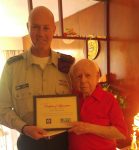
Isaac Messinger being presented with a certificate of appreciation last year for his contributions to the Jewish National Fund of Canada and Beit Halochem. (photo from JNF Pacific Region)
Isaac Messinger was born in Poland in 1929 and spent some of his early years in Siberia. Although his family tried to flee back to Poland when he was 12 years old, he ended up alone and orphaned in Russia and has spent the years since then living a very colourful life.
Among the notable moments, Messinger worked as a cowboy on horseback, chauffeur to a Polish officer, in a garage, as a prizefighter, a soccer player, a tinsmith and a traveling carnie with a roulette wheel. And he still had time to open a steakhouse and deal in diamonds, while lending money to some of the original landowners along the Las Vegas Strip.
Messinger has long been a strong supporter of Israel and he is currently focused on funding a project of JNF Canada that works with Israeli veterans, a special fitness centre at Beit Halochem Ashdod.
At first glance, the fitness centre at Beit Halochem looks like any other fitness club. There are lots of people working out on the equipment, weight training and stretching. Upon closer examination though, the difference is quite clear. Not only is much of the equipment and machinery slightly different, but the members are as well. Here, veterans young and old, with a wide spectrum of disabilities, come to improve their strength, flexibility and cardiovascular health. They exercise side by side, some on special equipment designed for wheelchair access or amputee-specific machines, and there are trainers on hand to explain and assist the veterans.
The physical rehabilitation aspects of working out in the fitness centre are clear to all. Less obvious is the psychological benefit that the disabled vets get from taking an active role in their rehabilitation.
Pinkas Kehillat Frankfurt am Main contains records of the membership dues and other payments made by the members of the Frankfurt community between 1729 and 1739. It also contains copies of records from the 17th century. The pinkas contains 384 leaves and is written in German in Hebrew letters. (photo from National Library of Israel)
Many know that Shavuot, which we just marked, commemorates the receiving of the Ten Commandments. Less well appreciated, however, is that this holiday is the Jewish people’s beginning as the People of the Book. In this regard, it should come as no surprise that, within two weeks of Shavuot, throughout Israel, we celebrate Book Week, Shavuah Hasefer. But enough about new books.
Since the 1970s, in a tucked-away corner of the National Library of Israel, a small, skilled team conserves and restores the books and documents, not just of the Jewish people’s long and complicated heritage, but those of Muslims and Christians.
Timna Elper heads this department, which currently comprises four full-time and one part-time staff. Until I visited them, I did not understand how challenging it is to physically preserve a written legacy – archival materials face a battery of foes, such as fungus, insects and rodents.
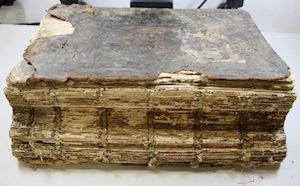
So, here is an admission: I naively believed the term bookworm just meant someone who loves to read books. While this does describe a certain kind of person, bookworms are actually an enemy of old books. Moreover, bookworms aren’t even worms – they’re the larvae of several species of beetles. And they have their preferences; that is, they generally leave newer books alone. If unchecked, they start their voracious dining on the spines of older books, moving on to feast on the pages. The sad result leaves books riddled with small holes and badly frayed covers and edges.
Pinkas Kehillat Frankfurt am Main before conservation efforts at the National Library of Israel. (photo from National Library of Israel)
The repair work carried out in Elper’s department is, in a number of ways, similar to work done in hospitals. As in a medical facility, staff members must be highly trained in a number of fields. In the case of the library, we are talking about knowledge of fibres and textiles, entomology, chemistry, etc. To avoid contagion, sanitation is constantly checked: the library, for instance, closes during Passover and Sukkot in order to carry out fumigation of the entire facility. Tests are routinely carried out for fungal and insect damage. Temperature and humidity are monitored. Special care is taken to avoid stacking books too tightly, as this could endanger their physical stability when removed from their shelves. Attention is also paid to lighting (and not just sunlight), as improper or excessive lighting likewise harms books.
As for surgical procedures, library staff members carefully choose the materials for the restoration process, so that the book will accept, rather than reject, the repairs. The staff has to match the materials composing the old texts, be they parchment, animal skin or paper. However, no staff person is engaged as a scribe, as the department does not deal with restoring the text, no matter how faded or distorted it may be.
Along the way, the staff learns a lot about the old books. They learn about the community from which a text originated. They learn about the building of a book and what might have been involved in producing it. They explore questions that deal with the book’s content, as well as its cover. Was the book covered immediately or later in its life? Was the cover added where the book was written or was it put on in another country? And, if it was added in another country, what does this tell us about cooperation between historic Jewish communities?
Sometimes, to complete the restoration process and return the book for use, the staff employs specially developed machines, such as the Leafcaster, a machine that was developed by the department’s first director, Esther Alkalai. The Leafcaster helps strengthen a page by adding pulp to it.
Once the restoration is complete, the materials are available for study or for exhibition. To a degree, this action puts the texts at risk for contamination or physical damage. Thus, when the National Library loans rare items for temporary display, the restoration and conservation lab goes into full swing with a complicated process of ensuring the articles travel safely. The condition of the items is meticulously inventoried before they leave the library and when they are returned. In addition, a staff person from the lab accompanies the items in order to review the state of the pieces with the receiving institution and to help make sure that the loaned materials are being shown in a way that will not cause harm. When the exhibit closes, a staff person returns to the hosting facility to safely bring the valuable books and manuscripts back to the library. The library also makes special security and customs arrangements. An agreement is signed stating that the loaned articles will all be returned to Israel.
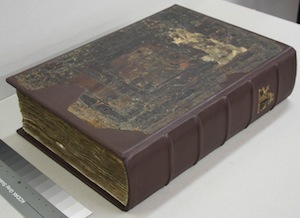
Pinkas Kehillat Frankfurt am Main after conservation efforts at the National Library of Israel. (photo from National Library of Israel)
The restoration process is expensive, and the waiting list for repairing these treasures is in the thousands. While there are donors willing to underwrite the cost of digitizing archival material, few people are willing to contribute to the cost of the restoration.
Elper would love to have people adopt archival material, so that it could undergo restoration at the National Library of Israel. Such a program, she said, has been instituted at the British Library and other institutions. Reportedly, at the British Library, the funds raised through its Adopt a Book program have supported the conservation of thousands of items – books, manuscripts, maps, photographs, stamps and works of art on paper. The possibilities are numerous; one of Elper’s suggestions is to approach different ethnic communities or individuals to adopt or sponsor the repairs needed on an article from their community of origin.
Asked what was the library’s most difficult project to date, Elper said all projects have their challenges. While difficult was not her choice of word, she admitted that preparing for the arrival of a large external (out-of-the-library) archival collection required painstaking attention to removing any known contaminants and, stage-by-stage, safely transporting these acquisitions to the National Library’s archives.
Among the most satisfying projects for the team, Elper said when asked, was the preparation for the recent exhibit at New York University’s Institute for the Study of the Ancient World, called Romance and Reason: Islamic Transformations of the Classical Past. The library lent the institute exquisitely scripted and illustrated manuscripts dealing with the story of Alexander the Great.
The repair of items (donated and purchased) creates a living testimony of history. It is the hope of the National Library of Israel that these rare and cherished books will receive even more attention when the library moves to its new facility in 2020.
As a closing note: if you have old books you love, keep them away from direct light and, to protect them from dust and other grime, store them in archival-quality, acid-free envelopes. Don’t do as yours truly had been doing, keeping them in various Ziploc bags. In closed plastic bags, the books have limited ability to breathe.
Deborah Rubin Fieldsis an Israel-based features writer. She is also the author of Take a Peek Inside: A Child’s Guide to Radiology Exams, published in English, Hebrew and Arabic.
A section of Jerusalem’s Old City, near the Jaffa Gate, is illuminated with a greeting to welcome the establishment of the new Paraguayan embassy. On May 22, the municipality welcomed the establishment of the third embassy in the capital – the United States and Guatemala moved their embassies to Jerusalem earlier in the month. The next country to make the move to the capital is thought to be Honduras.
גשם של חפצים ניתך על עוברי אורח מקומה תשעה עשרה של אחד הבניינים בווסט אנד. (צילום: Victoria Nguyen via cbc.ca)
הסצנה לקוחה מסרט – לא? מדובר בסיפור אמיתי לחלוטין. עוברי אורח שהלכו על המדרכה ברחוב הארו שבשכונת הווסט אנד, באחד מימי שבת האחרונים, בסביבות שלוש אחר הצהריים, נדהמו לראות פתאם ים של חפצים עפים לעבריהם, מאחד הבניינים (מספרו 1650). מהמרפסת בקומה תשעה עשרה נחתו החפצים אחד אחרי השני. תחילה נזרקו עשרות דפים שהתנפנפו להם להנאתם ברוח. לאחר מכן הגיע התור של החפצים הכבדים ורהיטים בהם כיסאות שעפו ללא רחם מהקומה, ונחתו במהירות על המדרכה. הרעש היה גדול ושברי חפצים וזכוכיות של רכבים עפו לכל עבר.
עוברי האורח חששו מאוד מהמראה הביזרי וחלקם אף צעקו “או מיי גוד”. ובנס אף אחד מהם לא נפגע. אך חפצים כבדים שנחתו על מספר מכוניות שחנו במקום גרמו להם נזק לא קטן. כמה מהאזרחים המבוהלים התקשרו למשטרה וניידת עם שוטרים הוזעקה למקום. השוטרים פתחו בחקירה מואצת ועצרו את הגבר (בן 56), שהשליך את החפצים מדירתו החוצה. התברר להם שהאיש היה תחת השפעת סמים קשה. לכן הוא הועבר תחילה לבדיקה מקיפה בבית החולים הסמוך. לאחר מכן הוא הוחזר לידי המשטרה ונכלא למעצר. המשטרה החליטה להגיש נגד האיש כתב אישום שיכלול מספר סעיפים, בהם גרימת נזק לרכבים ולבניין עצמו.
העורב שמשגע את ונקובר עומד להיות אבא
העורב קנאק שזכה לחשיפה גדולה לאור מעשיו יוצאי דופן, עומד להיות אבא. כך מדווח שון ברגמן שהוא חברו האנושי של קנאק. לדברי ברגמן קנאק ובת זוגתו ססייר שומרים על הביצים בקן שלהם, ויושבים עליהן לסרוגין. ברגמן לא יודע כמה ביצים בדיוק יש לזוג העורבים. הוא משקיף על הקן בפריסקופ ומשקפת שקיבל משכניו שגרים לידו במזרח ונקובר. ברגמן פרסם את המידע על קנאק שעומד להיות אבא בדף הפייסבוק המיוחד שפתח עבורו “קנאק אנד איי”.
בראשית השנה קנאק הפריע לדוור של קנדה פוסט לחלק דואר בקירבת ביתו של ברגמן. כיוון שהעורב הטריד כל הזמן את הדוור החליטה רשות הדואר להפסיק את חלוקת הדואר באזור. הדוור מצא אז דרך לשמח את קנאק והוא התחיל להביא לו בוטנים. ומאז השניים הפכו להיות חברים והדואר שוב מחולק כבעבר.
סרט תעודי שהכין ברגמן על יחסיו עם קנאק (במימון טלאס) הוקרן בפסטיבל סרטים בניו יורק בראשית השנה.
לפני כשלוש שנים בהיותו גוזל קנאק נפל מקן ונמצא על ידי ילד שגידל אותו בביתו. ברגמן שהוא דייר בביתו של אב הילד הלך ביום השחרור לטבע לצפות בעורב, ואז הציפור עפה הישר אליו והתיישבה על כתפו. מאז הם חברים ומבלים שעות. קנאק רגיל לחברת בני האדם, אינו פוחד מהם והם יכולים ללטף אותו ולגעת בו כמו כל חיית מחמד אחרת.
ברגמן התקין טבעת פלסתיק אדומה על רגלו השמאלית של העורב. עשרות אלפי גולשים עוקבים מקרוב אחרי מעשיו שמתועדים בתמונות ובסרטי וידאו. גם אמצעי החדשות מסקרים את מעשיו של העורב שזכה לחשיפה עולמית.
העורב זכה לחשיפה ראשונה בעת שהתיישב על צוואר של צעיר שרכב על אופניים בקרבת ביתו של ברגמן, שהחליט מאז לתעד את מעשיו בפייסבוק. קנאק צולם כשהוא גונב מפתחות, גונב כרטיסים של הגרלה בפארק שעשועים, נוסע ברכבת קלה ומבקר במקדונלד’ס. הוא אף גנב סכין מזירת פשע ותמונתו כשהוא עף עם הסכין והדם עליה נעוצה בפיו זכתה לסיקור עולמי.
This year’s Jewish National Fund, Pacific Region, Negev Dinner honourees are Michelle and Neil Pollock. (photo from Pollock family)
For their contributions to a diverse range of philanthropic causes, Neil and Michelle Pollock are being honoured at this year’s Negev Dinner.
“Jewish National Fund of Canada, Pacific Region, is proud to have Dr. Neil and Michelle Pollock as our 2018 Negev Dinner honourees on the occasion of the 70th anniversary of the state of Israel,” said Ilan Pilo, shaliach and executive director of JNF Pacific Region. “Their longtime contribution to the community and their leadership are widely recognized, as they are inspirational philanthropists who go above and beyond to involve the community in creative ways to fund critically important projects. We are very pleased they have chosen to work with JNF and ALEH Jerusalem on the Outdoor Terrace Project and the Hydrotherapy Pool, which will benefit seriously disabled children and youth in Israel.”
ALEH Jerusalem provides 82 children and young adults with comprehensive professional care, including special education, as well as medical, supportive and therapeutic care.
“I’m honoured, as I know Michelle is, for us to have been recognized and included in this legacy of community leaders and builders, a few of whom I have been privileged to meet, and who have been mentors and role models for myself and others in our community,” said Neil Pollock. “I look forward to having the opportunity to contribute to the cultivation of future leadership in our community in a similar way.”
The Jewish National Fund is important to the family, said Michelle Pollock, because the projects it supports focus on infrastructure in Israel.
“They’re all reflective of Jewish values and helping with the viability and integrity of the Jewish state,” she said.
Michelle Pollock is a lawyer who practised litigation in Vancouver before devoting herself full-time to their family. She is the immediate past president of the board of the Jewish Community Centre of Greater Vancouver, and has co-chaired the Jewish Federation of Greater Vancouver annual campaign’s women’s division Lion of Judah category for six years. She has been involved with Jewish education and a host of other causes.
Dr. Neil Pollock is chief surgeon and medical director of Pollock Clinics. Over more than 20 years, he has developed minimally invasive techniques for vasectomy, circumcision and frenulectomy procedures. The Pollock Technique has a greater than 99.9% success rate and results in decreased risk of post-vasectomy pain. He has undertaken teaching missions to Rwanda, Congo and Haiti, where he trains local doctors in circumcision, and said the work he has done in Africa and Haiti is among the most meaningful contributions he could make to humanity.
“Our team successfully gave our surgical colleagues in those countries the surgical training, as well as the equipment and supplies, to safely carry out surgical procedures that will save, over the years to come, thousands of lives by reducing HIV transmission,” he said. “Circumcision has been scientifically shown to reduce HIV transmission by 60%. It has been equated to providing protection equivalent to a vaccine against the disease. Sharing my technique provided the mechanism to offer in those countries, for the first time, a safe, quick, painless approach for circumcision that families would happily and readily accept. I continue to search out places around the globe where myself and my team could have similar impact for communities at risk. God willing, there will be more surgical missions in our future.”
Pollock has also developed a unique surgical training program for mohelim, who perform brit milot. He is a mohel himself and, in lieu of accepting fees for his work, advises families to donate to the
Pollock Family Philanthropy Fund at the Vancouver Foundation in honour of the lifecycle event and to support those in need in the community. The philanthropy fund supports the surgical teaching missions to the developing world, as well as organizations including the Arthritis Society, B.C. Cancer Foundation, schools, social service and community agencies.
Pollock’s involvement with the Jewish Federation of Greater Vancouver includes four years as head of the major gifts division and, in 2015, he served as chair of the general campaign, which raised $8.3 million.
“Michelle and Neil Pollock are among the most committed volunteers in our community,” said Karen James, chair of the board of Jewish Federation. “When asked to help, they step up. The Pollocks have been involved with countless initiatives we’ve undertaken at Jewish Federation to address vital community needs…. In response to his work, Neil has been recognized by Jewish Federation’s board with the Woogman Award, for his consistent and conscientious leadership by example. The Pollocks truly help to make our community stronger.”
In addition to their shared involvement with Jewish Federation, the Pollocks support Jewish Family Services. Neil Pollock has served as a board and executive member and is a Friend for Life, a category of donors with lifetime giving of $100,000 or more. The couple also provide an annual matching gift for the Innovators Lunch to inspire philanthropy; these funds are dedicated to the Jewish Food Bank.
They additionally support the Ohel Ya’akov Community Kollel, where Neil Pollock is a member of the board of governors and of the fundraising and building committee. He described the Kollel as one of the “less visible but most critical, vibrant and productive organizations in our community today, providing inspirational and educational programming through lectures, social events connecting Jewish youth, hosting Shabbat and Jewish holiday celebrations, all in a safe and accepting environment where everyone can feel comfortable – from Reform to Orthodox.
“I personally am deeply grateful to the founder of the Kollel, Rabbi [Avraham] Feigelstock, for the many hours of teaching, counseling and support that he has quietly provided for me and so many others I know,” said Pollock. “He has sought to help us develop the leadership skills and sound judgment, through both his core Jewish teachings and by cultivating menshlichkeit values, that he hopes we can be guided by in our personal, business and community work, in turn, helping us to be better equipped to meaningfully give back to our community for the years to come.”
Rabbi Shmulik Yeshayahu, director of the Kollel, said Michelle and Neil Pollock have truly embraced the concept of tikkun olam.
“They both contribute meaningfully; not only financially, but also give time, expertise and insight,” said Yeshayahu. “Their personal involvement in the Jewish community is priceless. We so appreciate their community involvement and care, vision and leadership, and wish them continued success in all that they undertake.”
“It was through the JNF, in my elementary school years, that I was given my earliest opportunities to participate in and contribute directly to the growth and well-being of the state of Israel,” said Neil Pollock. “This helped me to appreciate the importance for Jews to be interested in and responsible for doing our part for our homeland, which has remained with me to this day. And now, again through the JNF, we have been given this very gratifying opportunity to personally identify and support a phenomenal project – ALEH Jerusalem – to again help the state and its people in need, in a very meaningful way.”
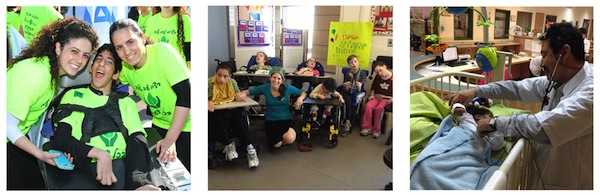
ALEH Jerusalem provides 82 children and young adults with comprehensive professional care, including special education, as well as medical, supportive and therapeutic care. (photos from JNF Pacific Region)
Michelle Pollock’s connection to JNF and Israel stem from her family’s history. Her mother’s father was sent from Poland to Canada, alone, at the age of 14, to make enough money to send for the rest of the family.
“It took him too long,” she said, “and his family was wiped out.”
Pollock’s mother, as a result, was raised in a home clouded by survivor’s guilt and where the past was not discussed. But Zionism was at its core.
“Support and survival of the Jewish state was a complete, tangible imperative because of her father’s experience,” said Pollock. “I see this now, reflecting back.”
The lessons of Jewish statelessness are embedded in her family.
“I can’t separate my Jewish sense of self from my support of Israel,” she said. “It’s all tied together. It’s one and the same.”
Neil Pollock’s philanthropic vision is both local and global.
“I have seen firsthand through my many years of volunteering with Federation, culminating in chairing the 2015 annual campaign, how critical the JFGV is for our community,” he said. “It is so important to have an organization to canvass so effectively the support of our community while carefully researching and assessing the needs of our community and its constituent organizations and thoughtfully allocating our resources in a balanced way, ensuring all facets of our diverse community needs are supported.”
Supporting JFS, and specifically the Jewish Food Bank, he added, “aligns with our core values regarding our responsibility to support those less fortunate and in need of the essentials, like food, shelter, medical care…. There is so much affluence in our community that, in our minds, there cannot and will never be, any justification for leaving anyone, any vulnerable individuals, behind.”
Most of the honourees at the Negev Dinner over the years have been older than the Pollocks, who have three children in high school. Far from approaching the end of their philanthropic endeavours, both talk enthusiastically about future plans.
Michelle Pollock has been very committed to Jewish education, originally when her kids were at Vancouver Talmud Torah and, more recently, supporting King David High School.
“The kids that go there and come out of there are so proud of their cultural heritage,” she said. “It’s an interesting thing to see in teenagers. It moves me greatly.”
Now she is turning more of her focus to Holocaust education and Israel advocacy, which her family history has taught her are closely interrelated. She plans to deepen her involvement with the Vancouver Holocaust Education Centre.
“I think Holocaust education is important. But, at this critical point, where we still have survivors, it’s imperative. Every single non-Jew that you touch with the story of a survivor, that is an invaluable experience. I think we all have a duty to do whatever we can to support Holocaust education.”
“The VHEC … all I can say is wow. For the past few years, I’ve been going to their symposium at UBC. It’s really unbelievable … being at UBC and being in this very secular place and looking at all these kids that have traveled by bus all day from all over the Lower Mainland, and watching them hear the stories of survivors and ask their questions. I think Holocaust education is important,” she said. “But, at this critical point, where we still have survivors, it’s imperative. Every single non-Jew that you touch with the story of a survivor, that is an invaluable experience. I think we all have a duty to do whatever we can to support Holocaust education. And I’m a huge fan of the [Holocaust] centre.”
She also recently joined the Israel and overseas affairs committee of Federation and hopes to advocate for Israel through that and other avenues.
“I see my focus for the next long while in those two areas because I really see them tied together,” she said. “Holocaust education and Israel advocacy. I think it will grow and change. I’ll just keep finding ways to contribute.”
As immediate past president of the JCC, she is continuing a commitment that began 14 years ago, when she first joined the board. Part of her motivation is that, coming originally from Montreal, she finds it can be more difficult to stay Jewishly connected in places like Vancouver, where the community is not as deeply rooted.
“I definitely think it’s easier in some of the older, more established Jewish communities and I think my personal passion is to do whatever we can to make it easier to be Jewish and live Jewish,” she said. “I think the JCC has all the programming and all the events that help you touch on Judaism in your daily life. But, even more than that, just walking in that building makes you smile in a uniquely Jewish way.”
Also from away, in his case, Winnipeg, Neil Pollock said he is grateful for being “so graciously welcomed and accepted in this community, and for the wonderful network of friends that we are lucky enough to be surrounded by.”
He is philosophical about his plans, hoping, he said with a laugh, to get better with age, “like the great wines in my cellar.”
“Every day we wake up, we are slightly different people, remolded and growing with all-new experiences,” he said. “Hopefully, we capture and deploy the insights we gain to allow us to be more mature and effective leaders.”
He continued: “While my kids are young and at home, they will continue to be my top priority. My business has now moved to a global level, so … I am more engaged, involved and excited now about future potential than ever.
“Often, I feel over-committed with my career, family and other things that happen in my life, but, at these moments, I try to remember that I also have a greater purpose and a greater responsibility and that is the one to my community,” he said. “I believe we all have an obligation to care for others and help those who are in need. We also must ensure that our Jewish traditions and values are maintained for generations that will follow, through our support of Jewish education and local Jewish institutions.”
He wants his experience to demonstrate that anyone can have an impact on the community.
“I hope that the great diversity of backgrounds amongst our community leaders serves as an example and inspiration to the many truly talented members of our community who may have ever questioned their ability to get involved and make a difference.”
“Some community members may believe that, in order to be an influential leader and have a meaningful impact, one must come from a family with a strong history of leadership and/or affluence,” he said. “This is not the case in our community. And I hope that the great diversity of backgrounds amongst our community leaders serves as an example and inspiration to the many truly talented members of our community who may have ever questioned their ability to get involved and make a difference.”
He added: “I want to thank all the community organizations that have welcomed us and provided us with the opportunity to become involved and give back.”
Asked about how he would like people to think of him in future, Pollock said, “I would like to be thought of and remembered in a similar way, I’m sure, to [how] most people would: as an individual concerned with things other than those that are immediately self-gratifying, and who is interested and active in doing his small part to ensure that opportunities to help others were not missed, and that meaningful efforts were undertaken to ensure the Jewish community and broader community in which we lived thrived.”
The JNF’s Negev Dinner takes place June 3. Honourary chairs of the event are Alex and Jodi Cristall and Harvey and Jody Dales. For tickets and more information, visit jnf.ca/index.php/vancouver.
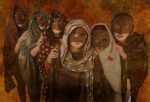
In Euripides’ play, the Phoenecian women represent the innocent who are displaced and otherwise impacted by conflict. (photo from Arts Umbrella)
Some families are, quite literally, cursed. In Euripides’ The Phoenician Women, it is brothers Eteocles and Polyneices who are condemned to fight each other to their tragic end, but they are not the only ones harmed by the curse. During their conflict, the chorus, aka the Phoenician women, are trapped in Thebes.
The brothers’ father, Oedipus, had been sent away from his parents when he was a baby, in an effort to avoid the fulfilment of the dreadful prophecy that he would kill his father and marry his mother. However, fate cannot be so easily avoided, and Oedipus unwittingly does end up marrying his mother after unknowingly killing his father. Four children later, Oedipus discovers the truth, gouges his eyes out and leaves his kingdom (Thebes) to his sons – but he also curses them for their treatment of him, pledging they would have to “draw the sword before they share this house between them.” As did their father before them, the sons try to escape their fate, but, well, that never seems to work out.
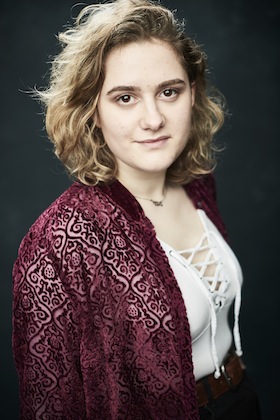
“In The Phoenician Women, I play the role of Eteocles, one of the sons (and, technically, half-brother) of Oedipus, who exiles his other brother in order to hold onto the throne,” actor Naomi Levy told the Independent. Levy is in the Arts Umbrella Senior Theatre Troupe, which is presenting The Phoenician Women as part of the Expressions Theatre Festival at the Waterfront Theatre. Two performances remain: May 19, 9 p.m., and May 24, 7 p.m.
“What I love about my character,” said Levy, “is, at first, it seems Eteocles has exiled his brother to satisfy his own lust for power; however, upon further inspection, it seems Eteocles has done this in order to protect the city of Thebes, which he rules. He knows Polyneices, his brother, is not fit to be a king.
“The Phoenician Women is such a relevant commentary on displaced people, as well as a timeless tale of greed, protection, loss and grief. It’s an incredibly beautiful story, and I am so grateful to be a part of telling it.”
Naomi Levy plays one of the warring brothers in The Phoenecian Women, which has two remaining shows at Waterfront Theatre, May 19 and 24. (photo from Arts Umbrella)
To pay homage to the play’s roots in ancient Greece, Levy said, “we are performing in mask, which is such an unique experience. The masks allow me to explore parts of myself and my character I may not have been able to without it – while the mask hides my face, it also forces me to articulate my character through my entire body and explore his unique movements.”
Levy was born in Vancouver, and has lived here all her life except for one year, when she lived in the United Kingdom. She is currently in Grade 12 at West Point Grey Academy.
“I was raised a secular Jew,” she said. “It was important to my parents that I be raised Jewish, which is one of the reasons I was given my mom’s last name, Levy. I went to Peretz community centre from a young age, and [was part of] a b’nai mitzvah there, where I did a project on Jewish stereotypes.”
She said, “Though I am not personally religious, I find that both the cultural and religious parts of Judaism are important in my life. It’s always so incredible to meet a fellow Jew, as there is this automatic connection that is derived from shared culture and experience.”
Ever since she was a young kid, Levy has loved performing. “It was my brother who initially introduced me to acting, when he participated in a Bard on the Beach summer camp, and him again who introduced me to the Arts Umbrella theatre troupe of which I am now a part. I was so jealous that he was able to perform and I wanted to be like him. I was instantly transfixed by theatre and performing.
“I have also been heavily involved in choir and musical theatre since I was young,” she said. “I have attended several years of Bard on the Beach summer camps, performed with Encore Musical Theatre, acted in my school’s plays, sung in my school’s choir and, most recently, participated in the Senior Theatre Troupe at Arts Umbrella. This troupe specifically shows me the beautiful intricacies of acting and pushes me as a performer, which I love.”
Arts Umbrella’s Senior Theatre Troupe is a yearlong program for students between 15 and 19 years old, who are selected by audition. According to Arts Umbrella’s website, successful candidates rehearse twice a week every week from September to June, exploring “professionally developed theatrical works, from the classic to contemporary.” Among other things, the troupe tours the works to secondary schools and performs at the Expressions festival.
“Music and theatre in my mind are similar, and they are the two passions of mine, which make me so incredibly happy,” said Levy. “For a long time, I had told myself that, even though acting makes me happier than anything else has in my life, I was going to explore my other academic interests. I am passionate about gender and sexuality studies and its activism, as well as the humanities, and would love to be a social worker. I had originally thought that would be the path I would follow. It still may be, as I can’t say what the future will hold, but, for the time being, I am following what I love to do most, which is acting, music and performing, and hope to make a career out of it.”
In an effort to make that happen, Levy will soon head to Montreal.
“I am very excited to be going to Concordia University next year in the theatre program with a specialization in acting,” she said, adding that she also will explore her other academic passions, as well. At the least, she is aiming for a master’s degree.
Expressions Theatre Festival runs until May 26. For tickets and information on all five productions being presented by different Arts Umbrella troupes, visit artsumbrella.com/events/expressionstheatre.
In the third of a series of articles on sexual harassment and violence in the Jewish community, the Jewish Independent speaks with lawyer Megan Ellis, Q.C.
Megan Ellis is one of the first lawyers in Canada to have devoted a significant part of her practice to pursuing claims on behalf of adult survivors of sexual assault and childhood sexual abuse.
In 1976, Ellis began volunteering at a rape crisis centre in Vancouver. This led to jobs working at rape crisis centres in Vancouver and in London, England, from the late 1970s to early 1980s.
“I was interested in law,” she said. “I always have been. It was my intention to become a lawyer eventually.”
Ellis passed the bar in 1988 and went into civil claims. In 1992, she and her partner led a successful challenge to the time limitation in Canada. As a result, in 1993, the law was changed in British Columbia, and the province became the first jurisdiction in Canada to remove the time limit for survivors to bring claims against perpetrators and institutions regarding sexual abuse.
In that groundbreaking case, an uncle was charged with sexually abusing several girls in the family over several decades from the 1950s to 1970. The girls were toddlers – as young as 2 years old – when the abuse began, and it continued into their early teens.
Many more cases have since followed.
“I have children’s parents who call me and ask what to do when their kids have been sexually abused,” said Ellis. “I discuss with them what they want their outcome to look like. Often, they haven’t decided if they want to go through a criminal process or not. So, they have to make that decision initially. If they decide they want to go through a criminal process, I ask them to wait until that is concluded before commencing a civil process – unless there are unusual circumstances, like it looks like the perpetrator might die, move all their assets to a Swiss bank account, or something like that.”
Once a decision is made to proceed through the civil system, Ellis collects all the relevant documents, such as income records, counseling records, medical records and educational records – as much information as possible. She then reviews everything and starts the process of drafting the legal documents, filing them and serving them to the perpetrator or institution.
“One thing I always discuss is whether or not that should be preceded by a demand letter,” said Ellis. “Sometimes, I collect all the information and put together a settlement letter in hopes the person will settle and pay out the claim, rather than go through the more public civil system.”
The settlement letter states what the accused did, that these are the consequences and the accuser wants X amount of dollars paid within a given time frame. The letter also states that, if the accused does not pay, the accuser will sue.
If the perpetrator does not settle, one can expect the legal cost to run between $10,000 and $15,000. Ellis advises her clients to verify that the perpetrator has assets.
“There are many people I have to tell, ‘Look, I do not doubt what you’re telling me at all, but it might appear that the perpetrator doesn’t have assets,’” said Ellis. “And there’s no point suing someone who doesn’t have assets.”
Claimants also need to take into consideration that, to date, the damages awarded for sexual abuse have been very low; in some cases, similar to what someone would get for mild whiplash from an accident.
“They don’t actually recognize the long-term effects of one incident, depending on the circumstances,” said Ellis. “They’ve been getting better over the years, but there’s still quite a long stretch before judges understand the very serious long-term implications.… There are 25-year-olds who get raped and it has a profound impact on the rest of their lives. The social reaction to being raped and the effects that it has are long-term. They are permanent. I think it’s fair to say that anyone who’s been raped has been permanently changed by that experience.”
In British Columbia, a lawsuit can take two to three years from start to finish. As for privacy, one can expect a ban on publication, though that is not guaranteed. Both the court records and courtrooms are publicly accessible.
If one is determined to confront their perpetrator, they may have a hard time finding representation. Lawyers who take on such cases are overburdened.
“My instructions for my staff are that I am booked for no more than four consultations per week,” said Ellis. “That was two or three years ago. Now, I’ve cut off … I’m not able to take more. I have enough now to keep me going for quite some time and I can’t possibly take any new cases. So, it’s gone from four per week to zero. And I’m not keeping tabs on all the people I’m turning away. I give other names, but I’m not sure of who’s taking these cases at the moment.”
Ellis has been instrumental in changing the law that allowed perpetrators to claim bankruptcy to escape paying the judgment.
“What started to happen in the first few years I was doing this is that the perpetrators would fight the cases and then spend all their money defending themselves,” said Ellis. “And then, they’d end up going bankrupt and walk away from the judgment.
“I was involved in amendments to the bankruptcy and insolvency act, which meant that you didn’t get rid of a judgment for assault or sexual assault just by going into bankruptcy – the judgment survives the bankruptcy. So, they may have gotten rid of their assets, but they haven’t lost their capacity to earn income, their inheritances … there are ways to go after them. The perpetrator’s thinking before was that they’d rather pay lawyers than pay their accusers, thinking that, then, it’ll be gone and they won’t have to worry about it.
“Funnily enough, I haven’t had a case where the perpetrator has gone into bankruptcy since.”
Since the #MeToo movement, Ellis has noticed a change in how various companies and institutions deal with their responsibility, a shift to more appropriate responses to allegations of abuse. The movement also has helped instil in people’s minds is that, typically, when it comes to sexual abuse, there is not just one victim, there are many.
“This is because there are all kinds of efforts the perpetrator makes to silence their victims,” said Ellis. “Societal mores are such that it doesn’t take a whole lot, because there’s fear and disbelief … and then, the perpetrator adds to it by saying, ‘If you ever tell anyone, you won’t be believed,’ etc.
“One thing that is particularly problematic in institutions is that they generally turn a blind eye in order to protect themselves … unless somebody’s standing on their doorstep with a picket sign.
“Essentially, what’s happened is that someone is now standing on their doorstep with a picket sign. Many of the institutions I’ve sued, there were, I believe, people, who knew but didn’t come forward, partly due to consequences for workers, teachers, social workers … for coming forward and making an accusation. They don’t want to take it on.”
Institutions are learning the hard way that it’s more cost effective for them to educate their employees about what abuse is and to report it.
“One place where there is still a lot of abuse is in the workplace,” said Ellis, giving the example of sexual harassment. “But, that’s an employment law context and I personally have never dealt with those cases.”
Prime Minister Justin Trudeau has said that he will make an apology in the House of Commons for the government of Canada’s 1939 decision to turn away the refugee ship MS St. Louis. The ship, carrying 907 German Jews, was denied entry at most North American and Caribbean ports before returning to Europe. Around half of the passengers were then accepted by the United Kingdom, the Netherlands, France and Belgium. About 500 were returned to Germany, where 254 were murdered by the Nazis.
Apologizing for the past has become common in Canada. Trudeau himself has apologized for Canada’s refusal in 1914 to allow the docking of the Komagata Maru, a ship carrying 376 migrants, mostly Sikh; apologized to gays and lesbians who were discriminated against by government in the past; exonerated six Tsilhqot’in chiefs who were hanged in 1864; and apologized to survivors of the Indian residential school system in Newfoundland and Labrador. The latter apology was necessary because this particular group was excluded from the 2008 residential schools apology made by Stephen Harper, when he was prime minister, because the schools there were not operated by the government of Canada. Harper also apologized, in 2006, for a head tax that penalized Chinese immigrants. Brian Mulroney, when he was prime minister, apologized, in 1988, for the internment of Japanese Canadians.
Such apologies are deeply important to the victimized communities, as evidenced by comments from Jewish community organizations last week.
“Canada is extraordinary not only because we strive to uphold the highest ideals,” said Shimon Koffler Fogel, chief executive officer of the Centre for Israel and Jewish Affairs, in a statement, “but also because we have the courage to address moments in our history when we failed to do so.… A formal apology will be a powerful statement to Holocaust survivors and their families, including St. Louis passengers who live in Canada today.”
Friends of Simon Wiesenthal Centre president Avi Benlolo said, “While an apology can never change the past, it can awaken the national conscience to ensure such grave mistakes are never repeated in the future.”
On the other hand, critics come from two sides: one arguing that we cannot change the past by apologizing in the present; the other contending that apologies are mere words.
The government’s recognition of past injustices is important, however. While political motivations are probably a factor in any government decision, this should not detract from the positive impacts an apology has on affected communities.
That said, if the objective is, as the prime minister and others have stated, to learn from the past and create a more just present and future, apologies should be accompanied by other undertakings, such as ongoing education, including curricula that teachers could download to contextualize issues, monuments at relevant locations marking the incidents (some of which already exist), a commitment to further commemoration or a host of other initiatives created in conjunction with affected communities.
Apologies, in other words, should not be the end of a conversation, but the start of a process.