Skip to content
  • Home
  • Subscribe / donate
  • Events calendar
  • Business Directory
  • FAQ
  • News
    • Local
    • National
    • Israel
    • World
    • עניין בחדשות
      A roundup of news in Canada and further afield, in Hebrew.
  • Opinion
    • From the JI
    • Op-Ed
  • Arts & Culture
    • Performing Arts
    • Music
    • Books
    • Visual Arts
    • TV & Film
  • Life
    • Celebrating the Holidays
    • Travel
    • The Daily Snooze
      Cartoons by Jacob Samuel
    • Mystery Photo
      Help the JI and JMABC fill in the gaps in our archives.
  • Community Links
    • Organizations, Etc.
    • Other News Sources & Blogs
  • JI Chai Celebration
  • JI@88! video

Recent Posts

  • SFU honours Gloria Gutman
  • Lifting people’s spirits
  • Wedding a ray of light
  • Indigeneity and Zionism
  • Rule of law broken: councilor
  • Football and its roles
  • The burden of defence
  • Fish Café returns after fire
  • All right in what goes wrong
  • Nuns & mermaids at TUTS
  • Camp offers holiday retreat
  • Students and mentors inspire
  • Once-in-a-lifetime trip
  • 100 dancers, one heart
  • Money for the sciences
  • What “Jewish food” means
  • Have a cookie, schnitzel too
  • Federation now across BC
  • Israel fighting for its existence
  • Deal strengthens Iran
  • Patriotic belonging diminishes
  • A campaign to engage
  • Upstanders’ first live event
  • Responding to Carney
  • Having your own home
  • Music a family tradition
  • Musical to warm heart
  • Community milestones … June 2026
  • Sharing her passion for Israel
  • Or Shalom reopens its doors
  • JFS from past to future
  • Need holistic approach
  • Sharing stories, advice
  • Journalist shares fears
  • Skills to live together
  • Road to independence

Archives

Follow @JewishIndie
image - CJN box ad Rockowers 2026

Tag: terrorism

Open letter – Jewish media outlets worldwide call for combating the surge in antisemitism

Open letter – Jewish media outlets worldwide call for combating the surge in antisemitism

The following piece, an initiative of the Jewish News in London and the Jerusalem Post, is being published simultaneously in Jewish media outlets around the world.

Two decades ago, the former British Chief Rabbi, Lord Jonathan Sacks, astutely likened antisemitism to a constantly evolving virus. One that, in the modern era, specifically targets the Jewish nation-state.

He aptly described this prejudice as a deeply ingrained malignancy, perpetually lingering beneath the surface of society. For many of us in the global Jewish community, the great man’s words were not merely a statement of truth but also a stark reminder. Until recent days, the extent and intensity of this virulent strain of hatred were tragically underestimated.

While the need for stringent security measures at schools and synagogues has long been a familiar reality, the realization that such profound levels of hatred and indifference to the threat exist on a global scale has been a devastating shock.

We dared to hope such malevolence had been relegated to the annals of history.

Today, in an unprecedented moment in Jewish history, we unite as Jewish news outlets spanning borders, continents, and religious affiliations to issue this open letter – something we never envisioned as necessary or even conceivable.

The events of recent weeks have surpassed even the somber portrayal offered by Rabbi Sacks all those years ago. Some of those who propagate hatred, concealing their prejudice under the veneer of being ‘anti-Israel,’ no longer find it necessary to obscure their malice.

We’ve witnessed raw hatred against Jews in cities across the globe.

In Dagestan, a mob ran towards planes on a runway to check passengers’ passports, hunting for disembarking Jews.

In Sydney, when authorities lit the famous Opera House in Israel’s colors, a crowd sang ‘Gas the Jews’.

In Lyon France, a woman was stabbed at her home, and a Swastika was spraypainted on her front door.

In London, red paint was daubed on Jewish school doors and the Wiener Holocaust Library.

In Berlin, Magen Davids have been spray painted on homes, a haunting echo of scenes in that German city 90 years ago.

On campuses across the United States, ‘martyrs’ who butchered Jewish children in their beds on October 7 are being celebrated, while a student at Cornell University was arrested for posting death threats against Jews.

This is not a call for two states living side by side in peace. This is not legitimate opposition to Benjamin Netanyahu and his government.

How could we have been so blind to this malignancy in our midst?

And yet, all that we have seen so far isn’t even our worst fear. Our gravest concerns lie in what the future may hold.

Meanwhile, some world leaders act as cheerleaders, sometimes inadvertently but at other times, not. Colombia’s president Gustavo Petro said: “If I had lived in Germany of 1933, I would have fought on the side of the Jewish people, and if I had lived in Palestine in 1948, I would have fought on the Palestinian side”.

Turkish President Recep Tayyip Erdogan said: “Hamas is not a terrorist organization”.

The head of the UN Antonio Guterres said 7/10 “didn’t happen in a vacuum”.

No, it didn’t, Mr Guterres. It required decades of indoctrination, years of holding up terrorists as heroes to be lionized, a sure way to fame and, often, fortune, and the presence of a terrorist organization whose central aim is to wipe Israel – and every one of our a Jewish family and friends – off the face of the earth.

Have no doubt, that Hamas is cheering those ‘from the river to the sea’ chants because a Palestine between the river to the sea leaves not a single inch for Israel.

Why do so many still seek to deny what’s in Hamas’ own charter?

And why are so many good people still silent when cheerleaders for terrorists decide the worst massacre of our co-religionists since the Holocaust is a good moment to open up a second, global front targeting Jews on campus, at work, on the streets, and at home?

Clearly not everyone marching under the Palestinian flag fantasizes about our deaths or the destruction of the world’s only Jewish state.

But please, try to understand that whether it’s one person, 100 people, or 10,000, the chilling impact of seeing so many people echo and excuse hateful chants is profound.

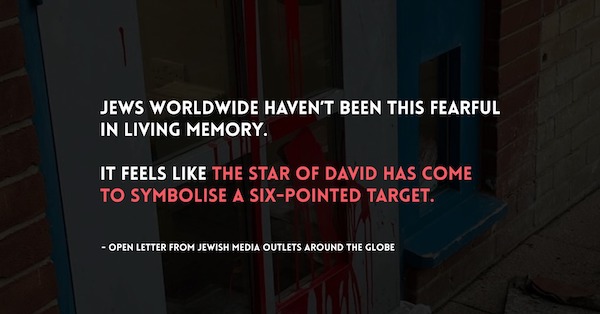
It’s not easy to speak on behalf of Jews in one country, never mind the world, nor do we purport to. As journalists, we report, opine, and comment. But the level of fear among our readers is like nothing in memory. It feels like those two equilateral triangles that combine to form our beloved Star of David represent a six-pointed target.

This is heightened by the fact there will be those who dismiss every word in this piece as having been written in bad faith, part no doubt of our supposed control of power and the media that has manipulated their warped minds. There will also be Jews who tell you this article doesn’t speak for them. Before those in the media feel the urge to put them on the airwaves in an attempt at ‘balance’, please first ask for an ounce of proof that they represent more than a tiny band of misfits. Some are more likely to stand alongside the Iranian regime that is so despised by much of the Muslim world than they would with most Jews.

Please don’t, however, mistake this growing fear for a lack of determination to fight our corner as citizens deserving of support and protection in our home nations, or doubt our solidarity as a people numbering just 16 million. In fact, we’ve never been so determined, so energized, so united and so proud, as highlighted by the huge uptick in sales of Stars of David. The incredible response in holding rallies, supporting charities, and fighting running battles on social media is something that will remain a source of pride for as long as those horrific images from Kibbutz Beeri and the peace rave.

This unity has been a light in the darkness. Another has been the support, publicly and sometimes not, of our real friends in all communities. Again, we will never ever forget this.

Our collective Jewish heart bleeds for the families of those who lost relatives in the Hamas atrocities and those facing agonizing waits for news of the kidnapped men, women, and children. Whether directly or not directly, many of our readers will be connected to these innocents. But our hearts bleed too for the innocents killed in Gaza as a result of this entirely unnecessary war launched by Hamas.

Over the unbearably painful days ahead, we – as providers of news for secular or religious Jews, those who frequently critique Israeli policy and those who don’t, those who see Israel are central to their identity, and those who are drawn nearer by crises such as this – call on the world to listen and treat us as you would want to be treated.

It shouldn’t be too much to ask.

Format ImagePosted on November 8, 2023November 8, 2023Author Jewish News & Jerusalem PostCategories Op-EdTags AJPA, American Jewish Press Association, antisemitism, Hamas, terrorism

Hope amid the conflict

We are still reeling from what happened in Israel on Oct. 7 and the war that has ensued.

Hamas carried out a brutal terror attack on Israel that targeted civilians, murdering 1,400 people and kidnapping more than 200 Israeli hostages. Jews worldwide are grief-stricken, angry and scared. It is hard to see the hope, as images of dead Israelis mix with images of dead Palestinians.

There is no doubt in our minds that Hamas needs to be incapacitated – its covenant explicitly states their intention to eliminate Israel and kill Jews. On Oct. 7, they reasserted their intention with a vengeance that cannot be ignored. Their unambiguous goal is genocide.

Posters we see around Vancouver that simultaneously accuse Israel of genocide for defending itself and call for the genocide of Israelis – “From the river to the sea, Palestine will be free!” – are abhorrent. People who support Hamas’s genocidal actions, implying, or outright stating, that Israelis deserve such cruelty do not care about humanity, do not believe in peace.

The people who are putting up the posters that ask, “Do you support indigenous rights? Then you support Palestine” are implying that Jews are colonizers and, therefore, deserve to be expelled, no matter how. But the Jewish connection to the land goes back thousands of years; we were dispossessed of it but never ceded it.

There are some two million Palestinians in Gaza, and they cannot be similarly dispossessed. More than half the population has been asked to leave their homes. Reports are that more than 4,500 have been killed from Israel’s bombing campaign.

Our hearts break at the type of war that fighting Hamas entails. The terror group uses civilians and civilian infrastructure as shields, ensuring that hundreds or thousands of innocent Palestinians die every time Israel defends itself militarily, even when it adheres to international law in its actions, including allowing humanitarian aid into Gaza.

One way or another, the people who live between the river and sea must find a way to coexist. That is quite literally the only way forward. As simplistic as this sounds, it is nevertheless true. That is impossible with Hamas as the controlling force in Gaza. But, when they are removed, what then? Replacing the figures at the top – whether in Gaza or in the Israeli government, the latter of which is something that will certainly be discussed in the aftermath of this horror – will not automatically negate deep mutual distrust among populations.

There are so many complexities and no end of theories as to how we have arrived at this point. What will happen next is less discussed, though there is the all-too-real possibility that the conflict will become regional – already the 22,000 residents of Kiryat Shmona, the largest community in the Vancouver Jewish community’s partnership region of the Upper Galilee, are being evacuated because of terrorist attacks from Hezbollah in Lebanon, which are expected to increase once Israel begins its ground offensive in the south. Some fear that the Hamas attack is less the main event than a distraction, a trap to lure Israel into an even more existential fight on multiple fronts.

Closer to home, there are security threats to Jews in the diaspora. Thankfully, Hamas’s call for a day of rage on Oct. 13 did not result in serious incidents. But the fear is real, and that is the purpose of terrorism. Jewish organizations and law enforcement agencies are working together to keep us safe. We must continue to live our lives as Jews, and not hide.

Some of our local community members have gone to Israel to fight. Other community members are rallying, marching and postering to make sure that the Israeli hostages being held captive in Gaza are returned home. More than $15 million was raised for Israel in just two weeks by the Jewish Federation of Greater Vancouver’s emergency campaign.

And, there are Israelis (Jewish, Muslim, Christian and others) and Palestinians who, despite the terrorist attacks and the war, continue against so many odds to work for peace. Groups such as Standing Together, Women Wage Peace, the Parents Circle, and others are working to shore up hope for peace, equality and coexistence. These groups deserve our support, moral and financial.

At the same time as we support our family and friends in Israel and one another here, as we call for the immediate return of the hostages and as we raise funds for aid, we must also support those activists and dreamers on the ground who advocate for a better postwar world.

Posted on October 27, 2023October 26, 2023Author The Editorial BoardCategories From the JITags evacuations, Gaza, genocide, Hamas, Israel, Kiryat Shmona, Palestinians, peace, terrorism, war
Rally and march for hostages

Rally and march for hostages

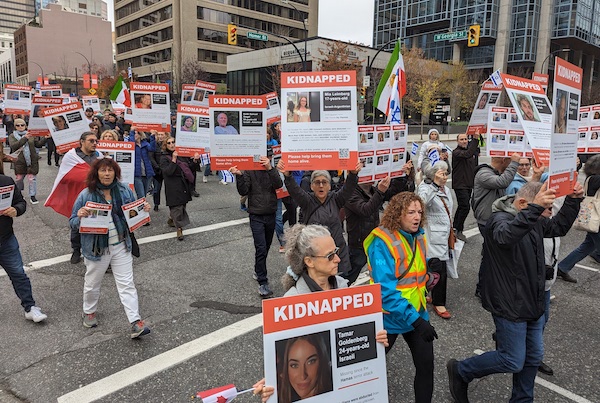
Hundreds marched on Oct. 22, calling for the release of the more than 200 Israeli hostages being held by Hamas and other terror groups in Gaza. (photo by Pat Johnson)

Erez, aged 12, and his sister Sahar, 16, had spent the night at their father’s house in Kibbutz Nir Oz when Hamas terrorists stormed the home. The kids jumped out the window and hid in the bushes while gunmen rampaged their community, shooting entire families in their beds and safe rooms. “Mom, be quiet, don’t move,” he texted his mom, Hadas. She texted back: “I love you forever. I hope you survive.”

Erez did not reply. For hours, Hadas called Erez’s cellphone repeatedly, even as she fought for her life, physically blocking terrorists from breaking down her safe room door. Then Erez’s older sister found an 18-second video circulating on social media. It showed Erez in a black T-shirt, being gripped by both arms and led into captivity.

In all, five members of the Kalderon family were taken: Erez, Sahar, their 50-year-old father, Ofer, their 80-year-old grandmother, Carmela, and 12-year-old cousin, Noya, were grabbed from another house in the community.

This was one of many individual stories shared at a vigil and march in Vancouver Sunday, Oct. 22, where hundreds of Vancouverites chanted “Bring them home!” and “Let our people go!” as they marched from the Vancouver Art Gallery, protected by a large police presence, along Georgia Street, over to Robson and back to the original site. The steps of the art gallery’s north side were packed with people holding posters of the hostages – and these posters represented only half of the total number of Israeli hostages held by Hamas and other terror groups in Gaza.

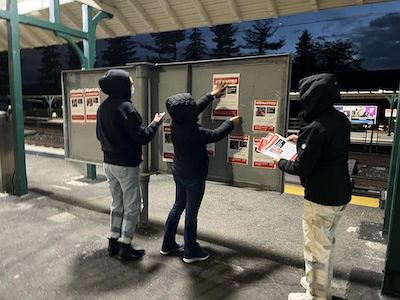
The faces are also seen on thousands of posters around Metro Vancouver and elsewhere. Activists in communities worldwide have downloaded and printed the sheets, plastering them around city streets. The Vancouver efforts – which have seen probably 20,000 posters distributed so far – are led by Daphna Kedem, who also initiated the Sunday afternoon event and an earlier vigil two days after the Oct. 7 terror attacks.

photo - About 20,000 posters – the cost of which was covered by two anonymous non-Jewish donors – have been put up by volunteers all around Metro Vancouver
About 20,000 posters – the cost of which was covered by two anonymous non-Jewish donors – have been put up by volunteers all around Metro Vancouver. (photo from Daphna Kedem)

Kedem is also a lead organizer of the local branch of UnXeptable, which, until the current crisis, was agitating against proposed Israeli government efforts to undermine responsible government there. Her current activism, she stressed, is done in her capacity as an individual, but she expressed gratitude to Rabbi Dan Moscovitz of Temple Sholom for helping organize, and to other synagogues, the Jewish Federation of Greater Vancouver and others for unhesitatingly jumping in to help.

Putting a human face to the hostages is the right thing to do, Kedem said.

“We have to bring it out to the public because it’s a humanitarian crisis,” she told the Independent. “Once you personalize it and you see that it’s an innocent baby or a child, you care more.”

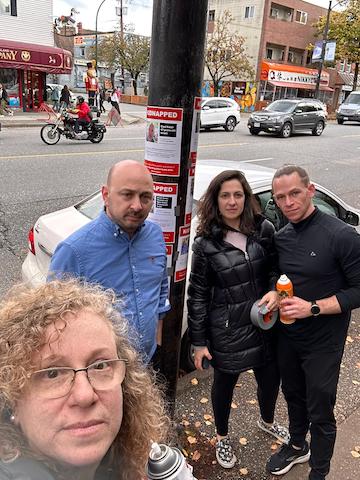
photo - Left to right: Flavia Markman, Ezra Shanken, Anet Bernadette and William Wolff. The four are among the many volunteers who have put up around the city approximately 20,000 posters with the faces, names and ages of Israelis taken hostage by the terrorist group Hamas. For more on the Bring Them Home Now effort
Left to right: Flavia Markman, Ezra Shanken, Anet Bernadette and William Wolff. The four are among the many volunteers who have put up around the city approximately 20,000 posters with the faces, names and ages of Israelis taken hostage by the terrorist group Hamas. For more on the Bring Them Home effort. (photo by Flavia Markman)

Kedem said the cost of printing the thousands of posters was covered by two anonymous non-Jewish donors and, at the rally this past Sunday, Christian clergy spoke, including a Catholic representative and two evangelical ministers.

Nevertheless, frustration over the silence of so many others was evident in the words of Moskovitz to the rally.

“Once again, Jews are being slaughtered and violently attacked and the world is silent,” he told hundreds of attendees, many carrying Israeli or Canadian flags. “Or they say, ‘Yes, but.’ There is no ‘but’ to murder. There can be no ‘but’ to hate. There can be no ‘but’ to the kidnapping of civilians, of children, of grandparents, of pregnant mothers, of disabled people. There can be no ‘but’ to that. There can be no justification for that. This is 2023, not 1943. And yet ‘Never again’ is happening again right now. The Jewish people will not be silent. You must not be silent.”

Moskovitz slammed the moral equivocation heard in commentary and seen in street rallies worldwide.

“This was not an act of resistance,” he said. “This was not a military campaign. This was not a popular uprising. This was cold, calculated and barbaric murder and rape and kidnapping of innocent civilians, the vast majority of them Jews.”

Motioning to the posters of the hostages, he added: “We call on those in our own city who cheer and celebrate what Hamas has done to these people and thousands of others on that horrible day to stop. Stop cheering the terrorists. Stop denying our grief, our human value. Stop your whataboutism. Stop tearing down pictures of children who have been kidnapped. Stop helping the terrorists. Stop justifying their brutality. Simply, stop.… Find your moral compass. Find the compassion you have for everyone and everything except Jews. Join us in this most basic of human cries: return our children to their parents, return our families to their homes.”

A WhatsApp group, “BTH – Vancouver,” is coordinating the postering activities: to join, visit bit.ly/BTH-Vancouver. Posters are downloadable by anyone at kidnappedfromisrael.com.

Format ImagePosted on October 27, 2023October 26, 2023Author Pat JohnsonCategories LocalTags Bring Them Home, Daphna Redeem, Gaza, Hamas, hostages, Israel, terrorism

First allocation of funds

In the Vancouver Jewish community’s Upper Galilee Partnership Region, thousands of residents have been evacuated. Funds raised here will provide emergency preparedness funding, which will be directed to strengthening preparedness with emergency war rooms for community centres. A week’s worth of food and other necessities will be delivered to vulnerable families in Kiryat Shmona in the event of an attack.

The initial transfer of $2.1 million from the $15 million raised by the Jewish Federation of Greater Vancouver’s Israel Emergency Campaign has gone to the following programs:

  • Jewish Agency for Israel Victims of Terror Fund provides immediate grants to assist victims within 48 hours of their homes being damaged by rocket fire, as well as long-term rehabilitation grants to allow those impacted by terrorism to receive the post-trauma care they require.
  • Respite for Olim Living in the South provides a five-day respite period for 2,000 olim, newcomers to Israel, from absorption centres in southern Israel, so they can sleep through the night without fear of running to shelters. Olim who do not want to leave their homes can benefit from respite activities within the absorption centres, including entertainment and educational programming for children and teens to take their minds off the current situation temporarily and allow parents a few moments to themselves to address their own needs.
  • Joint Distribution Committee Support for Disabled Populations of the South delivers services for people with disabilities, including a designated hotline staffed by psychologists and social workers.
  • Israel Trauma Coalition Direct Mental Health Care provides immediate, direct care to minimize the number of people who suffer from post-traumatic stress disorder. In addition to providing their usual crisis care, ITC is supporting bereaved families, families of the missing and abducted, and injured individuals and their families.
  • Israel Association of Community Centres Emergency Financial Aid funds community centres in two southern communities to help them meet needs such as buses to evacuate residents, day outings to amusement parks and nature excursions, overnight retreats, purchasing of emergency and medical equipment and provisions, electricity generators, recreational equipment for children, food parcels, diapers, toiletries, and more.
  • Dror Israel Evacuated and Hospitalized Teens and Youngsters offers therapeutic and educational programs for children and families in Rehovot, Ashdod, Kiryat Gat and Ashkelon, with more locations opening as soon as it is deemed safe. Daycare for children of hospital workers, day camp activities at hospitals for kids ages 3-12, as well as in-person and online programming are offered. Dror Israel is working with communities in which it is already embedded and with whom the counselors already have established trusting relationships.
  • Kedma Southern Student Communities works with mental health professionals to provide on-the-ground support to the shattered communities of the south and brings students there together as a community. This includes support and informal programming to fortify community resilience and minimize risk of post-traumatic stress disorder. Funds will support 10 communities over three months.
  • United Hatzalah Protective Gear for Volunteers and Helpers will receive funding for 40 protective gear units for 40 first responders.
  • Shalva – Supporting Disabled Residents of Southern Israel is assisting more than 1,000 evacuees with disabilities from southern Israel, who are expected to arrive at the Shalva National Crisis Response Centre over the coming days. Funding will ensure they have the clothing, medications and supplies they need, while providing them with the social services support they require to process the recent trauma.
  • Beit HaLochem – Supporting Veterans from Southern Israel supports senior veterans suffering from post-traumatic stress disorder as well as newly injured veterans.

Federation will continue to monitor the evolving situation and needs in Israel to prioritize the next round of grants.

To donate, visit jewishvancouver.com.

– Courtesy Jewish Federation of Greater Vancouver

Posted on October 27, 2023October 26, 2023Author Jewish Federation of Greater VancouverCategories LocalTags aid, fundraising, Israel, terrorism, war
Watch them blame Israel

Watch them blame Israel

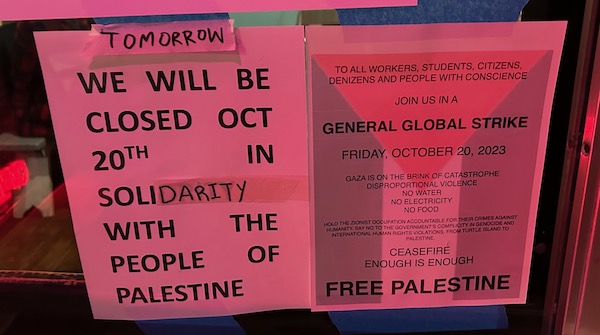
A restaurant in Vancouver closed for a day, calling for people “to hold the Zionist occupation accountable” for the war in Gaza. Writer Loolwa Khazzoom notes, “When terrorists blow up Israelis, there is often an undertone of accusation: it’s Israel’s fault, the narrative goes, that these tragedies happen…. But who truly was responsible for creating Palestinian desperation, and who is accountable for remedying it?” (photo by Larry Barzelai)

On 9/11, I was 20 blocks away from Ground Zero, sleeping in the living room of a friend when she woke me up, screaming hysterically – something about terrorists and an airplane crashing into one of the Twin Towers. As I tried to comprehend what was happening, my friend turned on the television and, right then, the second plane crashed into the second tower, as we watched in horror.

My thoughts came in this order: Now they’ll understand what it feels like to live in Israel. Watch them blame this on Israel. OMG we’re going to die.

Two decades later, on the morning of Oct. 7 – in the wake of what some are calling Israel’s equivalent of 9/11 – I felt the pain of collective Jewish agony, and promptly reached out to my friends and family in Israel, including those living close to the Gaza border.

Unbeknownst to many, those in the border towns, such as Sderot, are predominantly working-class Mizrahim and Sephardim – children and grandchildren of the 900,000 Jewish refugees from throughout the Middle East and North Africa. They are the ones predominantly getting pummeled by Hamas rocket fire, as the world yells about “white European colonist settler Israelis.”

So, it’s no surprise that, after the initial feelings of shock and outrage, grief and concern, I once again thought, “Watch them blame this on Israel.” And they did, within hours – with a BBC News interview going so far as to compare the Hamas attack to the Warsaw Ghetto Uprising.

It’s nothing new, of course. When terrorists blow up Israelis, there is often an undertone of accusation: it’s Israel’s fault, the narrative goes, that these tragedies happen. By creating Palestinian desperation, Israel has created Palestinian terrorism. But who truly was responsible for creating Palestinian desperation, and who is accountable for remedying it?

The Arab world is called just that for a reason. Beginning in the Arabian Peninsula about 1,300 years ago, Arab Muslims launched a brutal campaign of invasion and conquest, taking over lands across the Middle East and North Africa. Throughout the region, Kurds, Persians, Berbers, Copts and Jews were forced to convert to Islam under the threat of death and in the name of Allah.

Jews were one of the few indigenous Middle Eastern peoples to resist conversion to Islam, the result being they were given the status of dhimmi – legally second-class, inferior people. Jews were spared death, but forced to endure an onslaught of humiliating legal restrictions – forced into ghettos, prohibited from owning land, prevented from entering numerous professions and forbidden from doing anything to physically or symbolically demonstrate equality with Arab Muslims.

When dhimmi laws were lax and Jews were allowed to participate to a greater degree in their society, the Jewish community would flourish, both socially and economically. On numerous occasions, however, the response to that success was a wave of harassment or massacre of Jews instigated by the government or the masses. This dynamic meant that the Jews lived in a basic state of subservience: they could participate in the society around them; they could enjoy a certain degree of wealth and status; and they could befriend their Arab Muslim neighbors. But they always had to know their place.

The Arab-Israel relationship and the current crisis occur in the greater context of a history in which Arab Muslims have oppressed Jews for 1,300 years. Most recently, anti-Jewish riots erupted throughout the Arab world in the 1930s and 1940s. Jews were assaulted, tortured, murdered and forced to flee from their homes of thousands of years. Throughout the region, Jewish property was confiscated and nationalized, collectively worth hundreds of millions of dollars at the time.

Yet the world has never witnessed Middle Eastern and North African Jews blowing themselves up and taking scores of Arab innocents with them out of anger or desperation for what Arab states did to the Jewish people. Despite the fact that there were 900,000 Jewish refugees from throughout the Middle East and North Africa, we do not even hear about a Middle Eastern/North African Jewish refugee problem today, because Israel absorbed most of the refugees. For decades, they and their children have been the majority of Israel’s Jewish population, with numbers as high as 70%.

To the contrary, Arab states did not absorb refugees from the war against Israel in 1948. Instead, they built squalid camps in the West Bank and Gaza – at the time controlled by Jordan and Egypt – and dumped the refugees in them, Arabs doomed to become pawns in a political war against Israel. Countries such as Syria, Iraq, Saudi Arabia, Libya and Lebanon funded assaults against Israeli citizens instead of funding basic medical, educational and housing needs of Palestinian refugee families.

In 1967, Israel inherited the Palestinian refugee problem through a defensive war. When Israel tried to build housing for the refugees in Gaza, Arab states led votes against it in United Nations resolutions, because absorption would change the status of the refugees. But wasn’t that the moral objective?

Israel went on to give more money to the Palestinian refugees than all but three of the Arab states combined, prior to transferring responsibility of the territories to the Palestinian Authority in the mid-1990s. Israel built hospitals and educational institutions for Palestinians in the territories. Israel trained the Palestinian police force. And yet, the 22 Arab states dominate both the land and the wealth of the region. So, who is responsible for creating Palestinian desperation?

Tragically, the Arab propaganda war against Israel has been a brilliant success, laying on Israel all the blame for the Palestinian refugee problem. By refusing to hold Arab states accountable for their own actions, by feeling sympathy for Palestinian terrorists instead of outrage at the Arab propaganda creating this phenomenon, the so-called “progressive” movement continues to feed the never-ending cycle of violence in the Middle East.

Loolwa Khazzoom (khazzoom.com) is the frontwoman for the band Iraqis in Pajamas (iraqisinpajamas.com) and editor of The Flying Camel: Essays on Identity by Women of North African and Middle Eastern Jewish Heritage (theflyingcamelbook.com). She has been a pioneering Jewish multicultural educator since 1990, and her writing has been featured in the Washington Post, Marie Claire, Rolling Stone and other top media worldwide. This article was originally published in the Times of Israel.

Format ImagePosted on October 27, 2023October 26, 2023Author Loolwa KhazzoomCategories Op-EdTags 10/7, 9/11, antisemitism, Arab propaganda, Hamas, history, Israel, terrorism

Navigating the rough times

There are no words. I’m doom-scrolling, praying and worrying, reaching out to family and friends, but nothing prepares us for seeing more than a thousand Israelis murdered and hundreds kidnapped. The images are so graphic, so many bodies desecrated. On my social media feed, the images haven’t stopped coming.

Yet, in the first days of the war, there was a silence. I realized that others weren’t seeing what I was seeing in my Instagram feed. The North American media felt sanitized, distant from the reality that was depicted on Israeli TV and media. The first day or two back at school after the Simchat Torah/Thanksgiving weekend, my kids were stunned when others asked them why they were sombre. Until this year, they attended a Hebrew/English bilingual public elementary school. With their transition to junior high, they didn’t have nearly the same number of classmates who understood the situation.

At their International Baccalaureate middle school, there are curriculum additions, such as a special lunchtime club that meets to make a difference in the world. The resource teacher advises the club. She was sensitive to the needs of the kids affected by the war in Israel and Gaza, and mine came home with fundraising brainstorms. I wrote to thank the teacher for showing support during this hard time.

Then, she asked – do you have ideas for what else we can do? It took me awhile to make a list. I thought about what mattered most for me, far from the war but also very affected by it. The hardest parts of the list are long-term things that teachers should do: teach about misinformation, and definitions of things like terrorism, “rules of engagement” and more. The easiest parts, perhaps the most meaningful ones? Conducting a kindness campaign. Asking how others are doing and listening to their responses. Active listening would help everyone, Israelis, Canadians who are Jewish or Palestinian, and concerned bystanders. So many innocent lives have been lost. We need to talk about it.

I suggested to the teacher that another way of reaching out positively would be to do cards of support. The next day, my son joined other kids from the middle school who walked to the bilingual elementary school to deliver the cards. It was on Friday, Oct. 13, the day that Hamas suggested be a global day of harm for Jews. On a positive note, my son got to share his elementary school and his Hebrew skills by translating for a non-Jewish friend. He was proud. On the other hand, most of the kids in the bilingual program were absent due to the threat. Those who did come to school, from grades 1 through 6, filled just one classroom, according to my kid. He visited with beloved grade school teachers and ate challah at the Shabbat party – but the threat was real.

Outside the school, my kid saw both an unmarked police car and a marked cruiser. My heart flooded with gratitude when I heard this, but the school is in a huge field, accessible from multiple directions. One police car? Two? I felt the fear all over again. How many police would be “safe enough”?

Meanwhile, I heard that Jewish homes in one Winnipeg neighbourhood were egged, and the police were called. A potentially violent rally in support of Palestine, using words like “genocide,” was scheduled within easy walking distance of my home.

Even though we’re far from the fighting, it’s hard to gain traction on work while feeling so emotionally undone. Massive numbers of Palestinians were asked to move and large swaths of Israelis evacuated from both the north and south regions of the country, while so many have been called up to reserve army service. For those Canadians who have lost a family member, the pain is constant. For those who have kidnapped loved ones, like Vivian Silver’s family in Winnipeg and Israel, the families work to publicize their losses and wait in dread to hear what has happened.

Twice, I felt able to rise above this emotional turmoil and felt joy. Both times, it was because of a bar mitzvah.

The first instance that stunned me took place last week, when the cantor who tutors my twins asked them to chant together for their lesson. Their lesson was short, as there was an Israel solidarity rally that she was leaving to attend. I lurked in the next room. Usually, my kids jostle for position but, during that lesson, their voices rang out together, making the rote practice of Torah and Haftorah blessings become so powerful. “Wow,” I heard the cantor say, continuing with something like, “I’m glad I didn’t cancel your lesson. Thank you for gifting me with those brachot.” An almost holy silence hung in the air afterwards.

A few days later, we attended a Chabad bar mitzvah for a kid my twins knew in preschool. Even behind a mechitzah (the barrier between the mens’ and women’s sections), the bar mitzvah boy’s voice rang out sure and strong as he absolutely shone. It was something to see: his big personality, confidence and knowledge. I was achingly proud of our Judaism, in all its diversity and strength.

Writing to deadline, I imagine what might be relevant in a few days, but the things that have helped me will still help later. I am following my own advice. Each day, I am taking time to write emails or texts to friends and reach out. How are they? Are their families safe? Do they need anything? I try to take time to pause, hear what everyone says, and listen for the moments of Jewish joy that we can create – in synagogue or at our homes, when we’re alone or together.

Many ask, “How are you doing?” I pause and say, “Well, it’s been a rough time.” I’m also trying to maintain hope for the future. One hears it – through the generational continuity of every child becoming b’nai mitzvah, through Hatikvah and one other phrase – Am Yisrael chai, the Jewish people lives. It will be my prayer as we get through the days ahead. Amen.

Joanne Seiff has written regularly for CBC Manitoba and various Jewish publications. She is the author of three books, including From the Outside In: Jewish Post Columns 2015-2016, a collection of essays available for digital download or as a paperback from Amazon. Check her out on Instagram @yrnspinner or at joanneseiff.blogspot.com.
Posted on October 27, 2023October 26, 2023Author Joanne SeiffCategories Op-EdTags b'nai mitzvah, Diaspora, Israel, Judaism, parenting, terrorism

Living under fire of missiles

Working from home, it was after 6 p.m. and my global Teams meeting had just started. Comfortably settled and talking about suppliers, delivery times and prices, my smartphone beeped incessantly – the Code Red missile warning app. More than 350 missiles fired at Israel over the last couple of days.

Rehovot has managed to dodge almost all the missiles. We could see them soaring overhead and hear the guided collision with our Iron Dome anti-missiles. And the nonstop news cycles informed us in real time where rockets were being intercepted.

Since terrorist Khader Adnan died from his hunger strike at an Israeli prison, Israel had been bracing for reaction from the Islamic Jihad in Gaza. In the same way my Canadian cousins warn their loved ones about a pending blizzard – Did you hear the weather report? It’s going to be a cold one. Potential white out. Bundle up. Hurry home. We do the same here but for different reasons – Did you hear the news? Adnan died. Might be terrorist attacks or missiles from Gaza. Be aware of your surroundings. Hurry home.

Sure enough, we felt the reprisals, with about 100 missiles fired from Gaza. Israel waited, preferring to respond at a time and place of its choosing. Our reaction came about eight days later, with the targeted assassination of three Islamic Jihad leaders; their names of no consequence, each responsible for reprehensible terrorist crimes over the years. And, with that, Operation Shield and Arrow began.

Back to Teams. Another siren went off. This one not only coming from my app, but also from outside. “Bruce!” my wife yelled. “Missiles!” “Hurry!” Not sure my European and U.S. coworkers understood when I shouted into my headset, “Missile siren! Gotta go!” Abruptly exiting my meeting, I darted to our TV room … er … reinforced safe room, which doubles as a den in quieter times.

We have about 75 seconds to reach our shelter before a missile hits or, preferably, gets knocked out of the sky – as apposed to the 15 seconds for those living closer to Gaza. Can’t imagine their stress during these times.

We just managed to close the heavy steel door and fortified iron window shutter when “BOOM!” The loudest boom we ever heard. My wife and I almost hit the ceiling, knowing this was more than the reassuring and softer crash of an Iron Dome antimissile intercepting an Islamic Jihad rocket high in the sky. No. This was something much closer, much more ominous.

Numerous calls from friends and family followed. Were we OK? Amazing how quickly news travels. My son texted from the safety of his dorm in the United States – a missile had landed next to his best friend Amit’s home. Then my daughter texted from the relative safety of her work north of Tel Aviv – a missile hit near the home of her best friend (and Amit’s sister) Shira. And on it went. With more chilling calls from neighbours.

I tried rejoining my Teams meeting, to create some normalcy. But I was too hyper, too distracted. Couldn’t focus on discussions about price variances and purchasing systems. I excused myself again, advising them the precariousness of the situation.

Rehovot had suffered a direct hit, due to the malfunction of our Iron Dome system. It was just around the corner, not far from Amit and Shira’s home. Curiosity being a strange animal, I walked the two blocks into what was literally a war zone. A chill engulfed my entire body as my skin crawled.

My favourite bakery nearby became a gathering place for the shocked. I considered buying cookies and cakes for our first responders, then thought better of it – didn’t want the action to be confused with the celebrating Palestinian street, which hands out sweets after such attacks.

The smell of sulfur, carbon and potassium nitrate dominated. A flash back to younger days of playing with cap guns … my mind looking for a safer place.

Time seemed to halt. Somewhat apocalyptic. Traffic snarled and jammed. Red-and-blue flashing lights from police vans, fire trucks and ambulances. Army sappers and Israel’s 669 search-and-rescue unit moving about in their yellow vests. Local and international news crews mustering about. ZAKA – the Orthodox volunteers who collect the remains of the wounded and dead after terror or missile attacks – were scouring the area. There were five wounded, one dead.

Alas, Israelis have learned to move on quickly. Within hours, the streets were reopened, the destroyed building draped with Israeli flags. And I joined another work meeting later that evening, this time much calmer. Again, in search of normalcy and routine. Echoing Herb Keinon from the Jerusalem Post, specific memories of these military operations – whether they last weeks, days or a weekend – quickly fade into the background. It’s difficult to differentiate one from the other: Rains, Summer Rains, Autumn Clouds, Black Belt, Breaking Dawn, Cast Lead, Pillar of Defence and, now, Shield and Arrow. The list goes on, unfortunately.

Israel takes maximum precautions to avoid collateral damage. We are known for our warning methods. Sometimes a “knock on the door,” unarmed missiles skimming the roofs as a warning of incoming rockets. Sometimes dropping leaflets advising of a pending attack. Missions are even aborted when civilians are spotted nearby. But our enemies indiscriminately shoot missiles – hundreds of them – towards Israel, hoping for maximum death, maximum damage. Fortunately, our missile defence system renders much of this arsenal ineffective. Until one gets through. As it did in Rehovot. My little shtetl. Paraphrasing from the Torah – may we be blessed with peace.

Bruce Brown is a Canadian and an Israeli. He made aliyah … a long time ago. He works in Israel’s high-tech sector by day and, in spurts, is a somewhat inspired writer by night. Brown is the winner of the 2019 AJPA Rockower Award for excellence in writing, and wrote the 1998 satire An Israeli is…. Brown reflects on life in Israel – political, social, economic and personal.

Posted on May 26, 2023May 25, 2023Author Bruce BrownCategories Op-EdTags Gaza, Israel, missiles, Rehovot, terrorism

Calling out antisemitism

When news broke that a Jewish person had been shot near a Los Angeles synagogue on Wednesday a week ago, the police statement said there was “no evidence” that the shooter had been targeting Jewish people. When another Jewish person was shot the next day, near the same synagogue, police repeated that these appeared to be separate incidents and that there was again no evidence that Jews were being targeted. Both victims were injured but survived.

When a single suspect in both shootings was arrested Friday, it turned out he has a long history of bombarding Jewish acquaintances and others with violent antisemitic threats.

There is nothing to be gained by having police or anyone else speculate on motives during or in the immediate aftermath of a crime. But if police are going to venture in that direction anyway, why err on the side of randomness? Denying the possibility of antisemitic intent until evidence makes it impossible to do so is a too-common response. It has happened around the world.

In 2015, two days after terrorists murdered 12 people at the offices of the French magazine Charlie Hebdo, ISIS-affiliated extremists took hostages and murdered four people at a kosher supermarket in Paris. Then-U.S. president Barack Obama referred to the attack on an explicitly Jewish store as “a bunch of violent, vicious zealots who … randomly shoot a bunch of folks in a deli in Paris.” There was, of course, nothing random about the “deli” that was chosen.

It happened again during an antisemitic attack in Jersey City, N.J., in December 2019, when six people were murdered. Police initially said they believed the kosher market was randomly chosen and there was no evidence of terrorism. Within hours, they acknowledged that the perpetrators had “targeted the location they attacked.”

In 2022, there was an 11-hour hostage-taking at a synagogue in Colleyville, Tex., in which there were thankfully no casualties but the perpetrator. A police spokesperson said immediately after the incident that the hostage-taker’s demands were “specifically focused on issues not connected to the Jewish community” and, two days later, officials amended this to “a terrorism-related matter, in which the Jewish community was targeted.”

The reality was less oblique. The perpetrator chose that synagogue because it was closest to the federal penitentiary holding a terrorist he sought to free. He chose a synagogue because that would be the surest way to get his demands met since, as he told the hostages, the U.S. “only cares about Jewish lives” and because “Jews control the world.”

What is this instinct to deny that antisemitism is a cause of antisemitic violence until the evidence makes denial untenable?

In her book People Love Dead Jews, Dara Horn posits that efforts at Holocaust education in recent years may be having the opposite of the intended effect. Rather than making people sensitive to anti-Jewish ideas or crimes, it may set the bar too high. When a few people are murdered in Paris or shot in Los Angeles, after all, it’s not the Holocaust. If the only thing a person (or a society) knows about antisemitism is the Holocaust, then cases of hate crimes involving a couple of people are, well, nothing to get too concerned about.

There may be a denial not only of the magnitude, but of the very existence of the phenomenon itself. We are in a time of reckoning about race and racism. These issues are a central fact in our collective discourse. But antisemitism does not fit neatly into this narrative. When skin colour is the defining factor, white-passing Jews are excluded from the discourse and non-white Jews are made even more invisible than they too often already are. Moreover, the outcomes by which racism is measured are, to some extent, economic inequities. Proof of racism is seen in reduced economic outcomes: higher unemployment, lower household wealth, fewer opportunities. These are not, collectively, how antisemitism manifests. Ergo, in some eyes, this means antisemitism does not exist – or does not have the serious, quantifiable impacts other forms of racism have.

Antisemitic incidents, including violent crime, are at alarming levels, according to every survey and measure available. The least that law enforcement, media and ordinary people can do under the circumstances, when a Jewish individual or community is attacked, is avoid retrenching into a defensive position that defaults to the assumption that anything but antisemitism is at work.

Posted on February 24, 2023February 22, 2023Author The Editorial BoardCategories From the JITags antisemitism, Dara Horn, police, racism, terrorism
Living amid rocket attacks

Living amid rocket attacks

Adele Raemer lives in Kibbutz Nirim, near the border with Gaza, which means the community has had to build safe rooms for protection from rocket attacks. (photo from Adele Raemer)

Tens of thousands of rockets have been fired regularly and indiscriminately at Israel from Gaza since 2001, and they continue. Adele Raemer is a community member of Kibbutz Nirim, just two kilometres from the Gaza border – so close that, she says, “there is zero to 10 seconds’ warning” of a rocket attack on her neighbourhood.

As spokesperson for the community, Raemer moderates a Facebook group called Life on the Border, about the kibbutz. She teaches English as a foreign language, and is a counselor for the Israeli Ministry of Education. In addition, she is a trained medical clown in the pediatric ward of the hospital in Ashkelon. She was invited in November 2018 to be on an independent investigative committee for the United Nations, to discuss living at the border, and, in December 2019, she addressed the UN Security Council. She has filed stories for CNN, particularly during the Pillar of Defence conflict in 2012.

While attending the Jewish Media Summit in Jerusalem this past December, the Jewish Independent spoke with Raemer.

JI: What compelled you to move to Nirim, and when was it?

AR: I came to Nirim [from the United States] in the framework of my army service in 1975. I fell in love with the community and decided to stay.

JI: At the summit, you mentioned a joint bike marathon with Gazans. Can you talk about that?

AR: I have been in touch with Rami Aman, a Palestinian from Gaza, for a number of years. He is one of the founders of the Gaza Youth Committee, a group of people who work with youth in Gaza in order to improve their quality of life and education, and to teach them that those who live on the other side of the border [Israelis] are not their enemies. One of the activities I participated in with them was a [joint] marathon. I am not able to discuss activities happening now, for the safety of my contacts. Unfortunately, doing activities such as these, on the other side of the border, can cost one one’s freedom, even one’s life.

JI: How did you get invited to speak at the UN Security Council in 2018?

AR: In light of the map of [Gazan-initiated] fires that I put together at the time, the interviews I gave to the media, my blogging and the Facebook group Life on the Border with Gaza, people in Israel who work with the American embassy turned to me. At the time, the U.S. were the hosts of the UN Security Council, and President Trump was interested in putting the situation in Israel in the spotlight.

photo - Adele Raemer’s granddaughter stands outside a safe room
Adele Raemer’s granddaughter stands outside a safe room. (photo from Adele Raemer)

JI: Nirim began building concrete safe rooms to protect against rocket fire. What is the ratio of safe rooms to homes, and how many people typically fit in one? What is the cost of a room?

AR: Each home typically has one safe room, about the size of a small bedroom, about nine square metres, and costs about $44,000. Safe rooms in people’s houses usually have beds in them, so, depending on how much furniture is in the room, it varies how many people fit in. Certainly the entire family will fit.

JI: How many casualties have there been in your community from rocket fire?

AR: Two members were killed in 2014 and, if I am not mistaken … fewer than 10 were wounded, mostly lightly. That, of course, does not take into account the many who have suffered psychological damage.

JI: Who is your member of Knesset, and how are they involved in ensuring the safety of the community?

AR: It doesn’t work that way – we do not have regional representatives, like you do. All of the MKs should be working towards the good of our communities. The current ministry for the development of the periphery of the Negev and the Galilee is Yitzhak Wasserlauf, but he has just taken office so I cannot say what he will be doing yet. The office itself has done the following in recent years: reinforced all schools within the Gaza envelope, developed Ale Negev [a rehabilitation hospital in the Negev] and programs for developing psychological support and resilience centres.

JI: You’ve said the kibbutz was “95% heaven.” Why do you feel that way?

AR: The region is a desert that has been made to bloom, a modern miracle of development, while protecting and preserving the nature and wildlife, despite multiple challenges including, but not only, security challenges. The community in which I live is not only beautiful but it is crime-free, and [it is] safe for children to play on the lawns, without worry of being run over or kidnapped. But, above all else, it is the sense of community – our kibbutz, as well as the other communities in the region, which support each other … make it a friendly, warm environment in which to raise families.

JI: What is the main industry of the kibbutz?

AR: Our kibbutz is mainly agricultural, so we have farmers and workers in the different branches that support the agriculture, but our people also work as professionals in all different professions, just like anywhere else in the world. We have doctors, nurses, lawyers, mechanics, teachers, social workers, chief cooks and bottle washers.

Dave Gordon is a Toronto-based freelance writer whose work has appeared in more than 100 publications around the world. His website is davegordonwrites.com.

Format ImagePosted on February 24, 2023February 22, 2023Author Dave GordonCategories IsraelTags Adele Raemer, Gaza, Kibbutz Nirim, terrorism
Summit covers tough issues

Summit covers tough issues

Author and former politician Michael Oren addresses the Jewish Media Summit, which took place in Jerusalem Dec. 19-22. (photo by Dave Gordon)

The Iranian threat, the new Israeli government, BDS, terrorism, and the challenges of aliyah, were just some of the discussion topics last December, at the fifth annual Jewish Media Summit, which took place in Jerusalem Dec. 19-22.

The nearly 100 attendees hailed from Israel and across Europe, as well as from South Africa, South America and North America, and included the Jewish Independent. Most panels and keynote addresses consisted of official spokespeople, politicians (incoming and outgoing) and organizational heads. The conference was organized by the Ministry of Diaspora Affairs, Ministry of Foreign Affairs, and the Government Press Office.

Former U.S. ambassador to Israel Michael Oren spoke about one of his pet projects. Oren is a former member of the Knesset and the author of several books, including Ally: My Journey Across the Israel-American Divide.

Several years ago, when Oren was a deputy minister in the Prime Minister’s Office, he proposed to Prime Minister Binyamin Netanyahu that Israel have a blueprint leading into the state’s 100th birthday – Oren’s book Israel 2048 will be published in April.

To write the publication, Oren investigated different areas of Israel’s future: social, education, health and foreign policies; Israel-Diaspora relations; Palestinians, Arabs. “We found experts in every field. It was a tremendous undertaking,” he said. “I would not shy away from any issue, controversial, even explosive.”

About Israel, he noted “we don’t have sovereignty over large areas of our territory,” referring to the 60% of the country that is the Negev Desert. As an example of what this means in terms of governance, he said there’s no application of Israeli law regarding housing there and so there are some 400,000 illegal Bedouin structures in the Negev.

“But if I built a two-millimetre addition to my balcony in Tel Aviv, I have a police car there, within seconds, giving me a big ticket,” he said. Additionally, he said there’s “an inability to enforce [other] Israeli laws” there, so there’s no control over guns, drug or human trafficking, and polygamy is rampant, despite it being illegal.

Of concern, he said, is that more Bedouin are being influenced by Islamic extremism and the Palestinian narrative.

“It’s critical that the 2048 initiative is not the initiative of religious people, of secular people, of right-wing, left-wing, Ashkenazim, Mizrahim. It’s everybody together,” he said. “If you want Israel to have a second great century … we have to work on it. And we have to work at it by talking to one another, about real solutions.”

Oren spoke with the Jewish Independent about how he thinks Israel will ease challenges to aliyah.

“What shocked me is that large segments of the population are no longer interested in large-scale aliyah,” he said. “I couldn’t get people in Israel and [in the] Israeli government to be very interested in encouraging aliyah from France.”

The predominant reason for this lack of interest in welcoming new immigrants from France or any other country in the Diaspora, he said, is that Israelis are becoming increasingly angry at how the many costs of new olim (immigrants) are offset by the state.

“This is going to play out now with Russia and Ukraine as well,” he noted. “So, while everyone’s focused on the grandfather clause [of the Right of Return], I asked a deeper question: to what degree is aliyah still a central tenet of our raison d’être of the Jewish people? Because, from my perspective, if we are not encouraging large-scale aliyah, we’ve lost a big sense of why we are here. And I see this as a danger.”

The largest section of Oren’s new book, however, deals with the Palestinians. Oren said he was involved in one way or another with “every peace initiative since 1993.”

On another topic, Oren noted that Benny Gantz, then-minister of defence, proposed a solution to the Iranian threat: “force our international partners” into offering “military intelligence and diplomatic cooperation.”

“Our actions must be preventative, before it is too late,” said Oren.

On a tour of the Tz’elim IDF base, a 10-minute drive from Gaza, Gen. Bentzi Gruber spoke about the ethics of combat, stressing that the army makes enormous effort to minimize innocent casualties. In contrast, he said, only two Hamas rockets hit the base, while thousands hit civilian areas.

Gruber added that he fights a psychological battle, too.

“I fight all my previous wars every night in my sleep. My wife wakes me up when I’m yelling,” said the deputy commander of the IDF armoured division. “Every soldier that fought in a war carries the scars with them. If you killed a terrorist or a civilian, that never leaves you.”

The tour included a mini-Gaza mockup city, a training area for the Israel Defence Forces.

Kibbutz Nirim, a few hundred metres from Gaza, has been hit by rocket fire from Gaza in recent years. The kibbutz’s spokesperson, Adele Raemer, who addressed the United Nations Security Council in 2018, said the village had to build safe rooms, as residents have just a few seconds to get out of harm’s way. One terror tunnel discovered nearby was 75 feet deep, 1.1 miles long, and made of 500 tons of cement.

Still, she said, she “has nothing against ordinary Gazans,” and locals participate in Project Road to Recovery, where Jews shuttle Arab patients to local hospitals “because we care about our neighbours.”

President Isaac Herzog encouraged Jews around the world to fight the BDS (boycott, divestment and sanction) movement, whether espoused by foreign governments or the media, on college campuses or elsewhere. He commented on those who disagree with Israel’s new government.

“Israeli democracy is vibrant and strong,” he said. “The many voices that compose us do not point to the weakness of our democracy, but our strength. The rule of law, freedom of speech, human and civil rights, these have been and always will be the wall of our democratic state.”

In a non-political talk, Neta Riskin, who plays Giti Weiss in Shtisel, spoke about the surprise hit, which has run three seasons. At first, the show’s publicist told them “there’s nothing to work with” and it wouldn’t last, but word of mouth and good reviews bolstered the show, she said.

For her, Shtisel “has nothing to do with religion. It has to do with people – longing, hope and people’s desires. The cultural restraints of the show made it more interesting. No dead bodies. No sex.” She said she was pleased that women’s stories were also being told in the show.

Shtisel is popular in the Haredi community, with people watching it on their phones, according to Riskin. “The show managed to bridge an un-crossable bridge,” she added, noting how popular it was among all stripes of Jews and non-Jews alike.

Dave Gordon is a Toronto-based freelance writer whose work has appeared in more than 100 publications around the world. His website is davegordonwrites.com.

Format ImagePosted on January 27, 2023January 26, 2023Author Dave GordonCategories IsraelTags aliyah, BDS, Jewish journalism, Jewish Media Summit, media, Netanyahu, politics, security, terrorism

Posts pagination

Previous page Page 1 … Page 6 Page 7 Page 8 … Page 17 Next page
Proudly powered by WordPress