A story of survival and safety

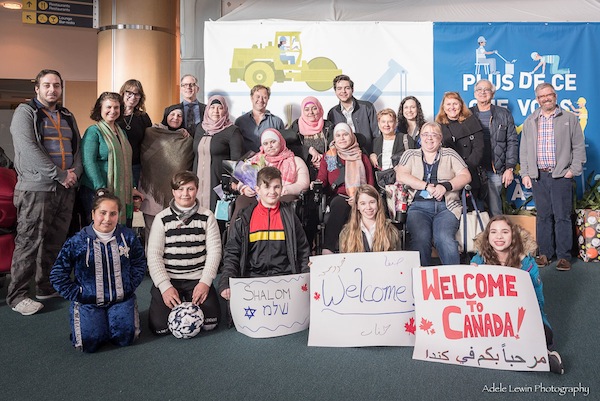
Welcomers of the Alsedawe family at Vancouver International Airport Jan. 21. (Adele Lewin Photography)

More than three years ago, Hanan Alsedawe’s family story of survival began as a waiting game on both sides of the ocean. But, on Jan. 21, 2019, the wait became a welcome as Hanan and her children stepped foot on Canadian soil.

In early 2015, congregations Beth Israel and Beth Tikvah began the long process of sponsoring and reuniting a Syrian refugee family with family who already lived in Vancouver. We worked with the government-approved sponsorship agreement holder – the Anglican Diocese – to prepare and submit our private sponsorship application to the Canadian government. It was a journey requiring perseverance by our coordinating committee, and patience and understanding from the many donors of both synagogues who demonstrated belief in our efforts regardless of the length of time it was taking.

On the Jordanian-Saudi Arabian border, in the Azraq Refugee Camp, Hanan and her two children – Mahros and Safa – shared limited resources with more than 55,000 refugees. Their extended family had made their way to Canada under government sponsorship, but Hanan had stayed behind, in Duma, Syria, because her husband, Raslan Abdulmalik, had been taken away by Syrian government forces and she had no idea of what had happened to him. She waited, she hoped, she prayed, but, eventually, with no sign of Raslan being alive, yet with no confirmation that he was either in prison or dead, Hanan decided to escape from Duma. She made her way with her two young children to Amman, Jordan, and eventually was placed in the Azraq refugee camp. There, she waited for a miracle.

Sept. 2, 2015, was a watershed moment that captured the hearts of people around the world and galvanized Canada into accepting 25,000 Syrian refugees into the country. Hanan’s mother and five siblings came to our shores under those auspices. But it would take years of work and hope to bring the last of Fayzeh Alsedawe’s daughters, with her children, to join the family here.

More than three years after initiating the sponsorship, Beth Israel and Beth Tikvah fulfilled Hanan’s dreams of joining her mother and siblings in Vancouver. On Jan. 21, representatives of both synagogues were on hand at Vancouver International Airport to welcome their sponsored family.

On any given day, at any given time, the international arrivals hall at YVR is a kaleidoscope of colours. On that Monday in January, the full spectrum was visible, augmented by the cacophony of diverse languages and a blending of bodies. Clearly, Canada is at its most multicultural in an airport setting.
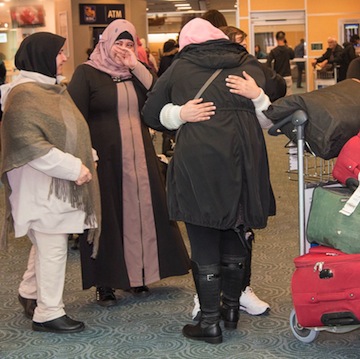
photo - Members of the Alsedawe family at YVR: Fayzeh, Hanan, Mahros and Hanadi
Members of the Alsedawe family at YVR: Fayzeh, Hanan, Mahros and Hanadi. (Adele Lewin Photography)

Also palpable was the range of emotions. There was the full gamut of human feelings on display among those awaiting families, friends and strangers to enter the hall. Contrasts abounded: joy competed with sadness, anticipation with angst, relief with uncertainty. Each person arriving searched for familiar faces, welcoming arms and handwritten signs, indicating that someone was there for them.

In this swirl of humanity were representatives of Beth Israel and Beth Tikvah, their dream to sponsor a refugee family from Syria finally reaching fruition. Sharing this moment – indeed, at the centre of this moment – was the local family: the mother, Fayzeh, and her five adult children, Hanadi, Huda, Maha, Hatem and Mohammed, who had arrived in Canada three years ago and had waited anxiously to be reunited with the remainder of their family.

There was something so surreal, yet so tangible and in the moment at that airport reunion. Words are inadequate to describe the outpouring of relief and love when Hanan and her children emerged in the arrivals hall. An invisible bubble enclosed the family, as they looked at each other for the first time in more than four years. And then, quickly, the bubble grew, as our delegation surrounded the family with our own contributions of hugs, gifts and welcome. One gift in particular seemed to unite the new family with our Canadian sponsors – a Whitecaps soccer ball given to 13-year-old Mahros. Soccer, a universal language for children and adults alike!

Every family has a history, a story that captures the essence of their character and experiences. The Alsedawes’ story is one of courage and hope. Their life in Syria was destroyed by war but their determination to escape, under circumstances almost impossible for us to comprehend, means that, today, their story is one of hope and gratefulness. In Hanan’s own words to the committee, “I thank God and I thank you.”

Settlement requires patience. Never has the Hebrew word savlanut meant so much to our small committee. Patience was required in the very lengthy process from application to arrival. Patience is required as we work to settle the children in school, the mother in English-as-a-second-language classes and the family into a way of life totally foreign to them. Within weeks of their arrival, the family had visited a family physician, dental appointments were booked, the children were enrolled in public school, bank accounts were set up and, important in this day and age, cellphones and tablets were provided to them.

Our year of sponsorship has only just begun, but this journey has been undertaken with the generosity of many people. Our donors have compassion and commitment, and understand that, “There but for the grace of God go I.”

Rosalind Karby is co-chair, with Miranda Burgess, of Beth Israel Congregation’s Committee for the Syrian Refugee Sponsorship Initiative.

Quebec’s underlying goal

Sometimes in complex or far-reaching events, a small, seemingly less significant factor can illuminate a larger understanding. Successive efforts by Quebec governments to enforce laïcité, a policy of compulsory secularism in the delivery of public services, have included a minor exception that really speaks to the inequality such efforts seek to create.

Since 1936, a not-at-all-subtle crucifix has hung above the speaker’s chair in the legislative chamber of the Quebec National Assembly. A week ago, the Quebec government voted to take down the crucifix as part of a much broader policy against religious symbolism in the province’s public life. Even as they proposed policies that would ban religiosity in the forms of Muslim, Sikh and Jewish head coverings and other items, such as pendants with stars of David or crucifixes, previous governments have contended that the legislature’s cross is exceptional. In the narrative advanced across a decade of this debate, the cross represents an indisputable aspect of Quebec history. Reading between the lines of this argument, the crucifix – the definitive symbol of Christianity – transcends its religious particularity, presumably on the idea that Christianity was an inherent part of Quebec’s history and development.

The message of this exceptionalism is clear as a bell: this place was founded on Christian principles and those of other religious traditions, despite whatever contemporary contributions they might make to Quebec society, rank below the founding religion even as we seek to erase all of them from the public eye. Christianity, in other words, is a first among unequals.

To their credit, the government of Premier François Legault is not excepting the crucifix from this latest bill aiming to impose secularism. The bill, which was introduced last week by the centre-right Coalition de l’avenir du Quebec government elected last year, has all the characteristics that have been discussed in recent years by various governments intent on erasing outward appearances of religious difference. In the provision of government services in which an employee has “coercive” influence – including police, prison guards, judges and teachers – kippot, chadors, turbans, kirpans, crucifixes and anything else that speaks to an individual’s religious affiliation will be banned.

The decision on the National Assembly’s crucifix at least pays lip service to the idea of equanimity in the crushing of religious identity. But it cannot erase the foolishness and inherent injustice of the move. The Quebec government makes absolutely no defence against the charge that the bill contravenes Canada’s and Quebec’s constitutional protections of individual and religious rights. In introducing the new law, the government stated it would use the notwithstanding clause, exempting the law from those constitutional safeguards.

The injustice is a matter of principle. The government – backed, according to public opinion polls, by most Quebecers – is fully prepared to infringe on the rights of people who heed obligations to display certain outward evidence of religiosity. Depending on interpretation and levels of observance, Jewish, Muslim, Sikh and other people are required to wear identifiably religious objects. Lay Christians, by contrast, are not. A crucifix necklace is a choice, not a requirement. For observant Jewish men, a kippah is not optional.

On a related front, it is illuminating to hear non-Muslims discuss whether a chador, hijab or niqab is a cultural or a religious requirement. Over the years, some who have justified banning head coverings have contended that Muslim law does not require them. The fact that many or most of those making this case are non-Muslims adds insult to injury: not only will we argue that we don’t want you wearing your religious garb, we will go so far as to argue that you can’t even interpret your religion correctly.

Aside from the principle of the matter, the nuts and bolts of the proposed law guarantee confusion and offence. The bill grandfathers existing employees, meaning that a currently employed teacher who wears some form of religious accoutrement will be free to continue doing so, but a new hire would not. More bizarre is that, if they were to receive a promotion – from teacher to vice-principal, say – the grandfather clause would be removed, and so would the religious article. The opportunities for mayhem abound.

Ostensibly, the bill, which is really the culmination of years of discussion around “reasonable accommodation” and similar concepts in Quebec society, is intended to preserve the importance of Quebec culture. Understandably, as an undeniably distinct cultural and linguistic minority vastly outnumbered by anglophone North Americans, Quebecers are vigilant in preserving their uniqueness. But it is tough to discern any substantive advantages this bill will grant to Quebec’s distinct culture other than to underscore assumptions of intolerance and insularity. The genuine intent of the law – and the larger ideology that drives it – is to encourage assimilation into a dominant (French, nominally Christian) population. In a visit to France last year, Legault didn’t mince words. He wants a Quebec that is more “European.”

Many Canadians outside Quebec accept that some accommodations are necessary to save what makes Quebec unique. We see this as something apart from the xenophobic nationalisms sweeping Europe. But what is inherent in Quebec society that would not also be found in Swiss or Finnish or Hungarian society to justify banning symbols of different cultures? If Quebecers have a right to “protect” their cultural identity through admittedly discriminatory laws, why wouldn’t Polish and Ukrainian people?

Ultimately, a law preventing religiously observant people from displaying the evidence of their faith will not strengthen or save pur laine Quebec society, unless by doing so it discourages such people from coming to Quebec in the first place. And there’s the key to understanding this bill.

One of the first steps Legault took as premier was to reduce Quebec’s share of immigrants by 20%. This was about the same time he went to Paris and declared he wanted more migrants who are European. With this in mind, the secularism bill is probably less about the people who are already in Quebec than about sending a message to those considering a move there. The bill says stay away, Quebec does not welcome you.

Taking principled stand

Rahaf Mohammed al-Qunun, an 18-year-old Saudi woman, was publicly welcomed to Canada Saturday. She had spent a week in a hotel in Thailand, asking for asylum in a Western country, saying that she did not want to return to her allegedly abusive family, whom she says have threatened to kill her.

Whether her family is indeed abusive has not been proven. But two factors make that issue somewhat moot. First, guardianship laws in Saudi Arabia require women to get permission from a father, husband, brother, son or other male relative in order to work, travel, marry, receive certain medical treatments and even to leave the house. This is codified inequality and abuse against about half the population of the country. In principle, that law alone should make all Saudi women eligible for refugee claims in democratic countries. Additionally, al-Qunun renounced Islam, which is an offence punishable by death in Saudi Arabia.

The teen’s arrival was a bit of a media festival, with Foreign Affairs Minister Chrystia Freeland embracing al-Qunun at Toronto’s airport.

The ostentatious greeting was extra-weighted because Canada is in an ongoing diplomatic spat with the Saudis. After Freeland tweeted a criticism of Saudi arrests of civil and women’s rights activists last year, the Saudis threw Canada’s ambassador out of the country and threatened to withdraw thousands of Saudi medical students from Canada, among other responses. The public greeting of a now-prominent Saudi dissident by a senior Canadian government official will be seen as a provocation, and perhaps it was intended as such.

Some commentators note that al-Qunun jumped the queue, not only flown to Canada to make a refugee claim, but accepted immediately as a refugee. The global visibility of her case resulted in a country – ours – leaping to accept her, even while one percent of refugees are resettled in a given year.

Also, some diplomats with Saudi experience are warning that the young woman should not be used as a political football – both because that could put her safety at risk and because it could unnecessarily enflame existing tensions.

David Chatterson, a former Canadian ambassador to Saudi Arabia, told the CBC that he worried about precedents.

“What happens the next time a teenage girl or adult woman from Saudi Arabia flees her family and declares herself to no longer be a Muslim, does that mean automatic sanctuary?” he asked.

Of course, diplomatic idealism is always tempered by economic and other realities. The CBC obtained, through an Access to Information request, evidence that the federal government heard concerns from Canadian businesses about their interests being jeopardized when Freeland’s tweets to the Saudis raised the ire of the kingdom’s rulers. On the flip side, Canada does not have as many economic ties to the Saudis as many European and other democratic countries, and this might give us a little more freedom to criticize. The U.S. president has already stated explicitly that he will not endanger American economic interests by contesting Saudi treatment of dissidents – including the murder and dismemberment of Washington Post writer Jamal Khashoggi.

Of 149 countries rated by the World Economic Forum in its annual report on gender equality, Saudi Arabia came 141st. Canada cannot free every one of the 16 million or so Saudi women, but we can ensure freedom for this one.

Yes, al-Qunun did effectively “jump the queue.” But, at the moment when the whole world was watching, that queue-jumping allowed Canada to take a principled stand for gender equality and for the freedom of – and from – religion.

Opening Pandora’s box

Maxime Bernier quit the Conservative party last week, at the precise moment that Conservatives from across the country were gathering in Halifax for their national convention, preparing for the federal election that is 13 months away.

Canadian political history would suggest that the former cabinet minister’s departure and his promise to form a new federal political party will be little more than a footnote in the history books when all is written.

The ostensible point of division between Bernier, who came a very close second to Andrew Scheer in last year’s Conservative leadership contest, is supply management. Supply management is an agricultural policy that limits supply in an attempt to stabilize prices so that Canadian farmers can make a decent living. It’s the reason we pay what we do for cheese, milk and poultry and it is prefaced on the understanding that the few extra dollars we pay weekly keeps the agricultural sector viable.

Bernier, who lambasted his former party over the issue, is correct. Support for such meddling in the economy is antithetical to conservative economic values. But it is an oddly Canadian consensus by which parties across the spectrum essentially accede to the status quo for political, if not policy, reasons. Opponents of Bernier in last year’s leadership race expressed fears that his opposition to supply management would undermine the Conservatives precisely where they are most popular: in rural Canada.

If less interventionist economic policies become the basis for Bernier’s new political party, it is hard to imagine how it will catch fire among Canadian voters. From a political standpoint, such a platform seems like a loser from the gate.

But there is a potential wild card in this scenario. Though he skirted the subject during his news conference last week, Bernier’s recent social media statements play to xenophobic, anti-immigrant sentiments. This, far more than economics, has the potential to get the attention of Canadian voters.

The Liberal government under Prime Minister Justin Trudeau likes to be associated with openness and a welcoming diversity, which contrasts nicely with developments to the south. But a recent poll suggests Canadians may not be as settled on this approach as some of us would like to believe.

The poll asked whether Canadians believed that there are too few, too many or the right number of immigrants to Canada. Overall, 18% of Canadians said there are too few immigrants coming to Canada, while 38% said there were too many and another 38% said the numbers were about right. The poll’s breakdown by party label indicates just how divisive this discussion could become. Only 12% of self-declared Liberals said that Canada has too many immigrants, while 73% of Conservatives hold that position.

Canadians, to an extent, have avoided opening a Pandora’s box in the form of a national discussion about immigration, perhaps happy in our complacency and self-image as a welcoming place. If Bernier’s new party – or, indeed, if the Conservatives – see an opening, we may be about to lift the lid somewhat on this issue.

If Bernier decides that he has nothing to lose and something to gain from upsetting accepted wisdom, it won’t necessarily prove a winning formula for his new party. However, if, by raising these topics, he forces other parties to articulate more specifically the generalized approach to multiculturalism and diversity that we take for granted, we may be headed for a reckoning on immigration, diversity and openness.

The election of Doug Ford as premier of Ontario suggests that populist messages are not anathema to Canadian voters. The Quebec provincial election, now underway, may very well provide a test case for some of these ideas that challenge our cherished notions of diversity.

When voter turnout hovers around the 50% mark, mobilizing one’s political base can be as crucial as convincing the undecided. If suspicion of outsiders appears likely to excite an identifiable core of the electorate, ambitious politicians will certainly consider how they might benefit by exploiting it.

Confronted by a heckler in Quebec last week, the prime minister shut her down by dismissing her as racist. It turns out, she may well be. But she also may not be the voice in the wilderness that some, including the prime minister, would like to believe. These people, too, will demand to be represented in Parliament and in the national discussion.

The rest of us, then, will need to have more than happy axioms and comforting self-satisfaction if we are to successfully defend diversity, inclusiveness and the social and economic value of new Canadians.

Benefits from being bilingual

Dr. Carmit Altman of Bar-Ilan University. (photo by Carmit Altman)

“Anna,” a preschooler in the Israeli city of Bat Yam, was thought to be cognitively impaired because testing her in Hebrew showed her cognitive skills lagging behind her classmates. But, when retested in her home language, Russian, she was found to be normal. About half of all Israeli children speak a different language at home than in school, making Israel possibly the world’s best “laboratory” for researching the still little-understood phenomenon of growing up with two or more spoken languages.

One important Israeli discovery is that comparing bilingual kids like Anna to monolingual children is like comparing apples to pears, according to Bar-Ilan University Prof. Sharon Armon-Lotem. For two decades, her lab has studied language-acquisition processes of Israeli preschoolers from English-, Russian- and Amharic-speaking homes.

Roughly 20% of children entering first grade in Israeli secular public schools come from immigrant homes in which the dominant language is not Hebrew. The largest cohort is Russian-speakers, numbering about 1.2 million out of an overall Israeli population of 8.7 million.

Adding more than a million Israeli households where Arabic, Yiddish or African languages are spoken, the percentage of bilingual children climbs to as high as 50% of the general population, Armon-Lotem told Israel21c.

To evaluate bilingualism properly, one must understand that children who grow up speaking two or more languages in everyday life are not using the same brain processes as do monolingual children learning a second language in school, note Armon-Lotem and other Israeli experts. And, if bilingual children like Anna initially have a smaller Hebrew vocabulary, they have better syntax and concept-generation skills in both languages. Overall, they develop language no differently than monolingual peers, unless they have developmental language disorder (DLD).

DLD, estimated to affect five to seven percent of both monolingual and bilingual children, causes dramatic delays in language acquisition not related to other impairments. DLD might manifest differently in each of a child’s two languages, but usually shows up as difficulty with word retrieval and grammar. Since these same phenomena can happen in typically developing bilingual children as they learn the majority language, bilingual children with and without DLD are often misdiagnosed.

Armon-Lotem emphasized that bilingualism does not lead to impairment. From 2009 to 2013, she led a network of researchers from 26 European and five non-European countries in formulating standards for characterizing typical bilingual development and identifying atypical bilingual development in more than 30 language pairs. Research by Natalia Meir in Armon-Lotem’s lab was the first to show that it is possible to disentangle typical and impaired language development, and with 90% accuracy.

“We’ve made a lot of progress in this area in Israel,” said Prof. Joel Walters, professor emeritus of linguistics at Bar-Ilan and now chair of the department of communication disorders at Hadassah Academic College in Jerusalem, which hosts hundreds of specialists at its annual conference on communication disorders in multilingual and multicultural populations.

Walters’ study of the processes underlying how the brain merges two or more languages into a single utterance is informed by recent brain imaging of bilinguals. One of his focuses is “codeswitching,” when a bilingual speaker starts a sentence or word in one language and switches to the other.

“Codeswitching was once thought of as a random phenomenon but actually it’s very systematic and occurs in sentences, phrases and even within words,” Walters told Israel21c. An English-Hebrew bilingual child might tell her sister “muzi,” merging the English word “move” with the Hebrew “zuzi,” for example.

Walters and two co-authors recently published in the International Journal of Bilingualism about their study of Russian-Hebrew bilingual 6-year-olds asked to retell a Russian story to a Hebrew-speaking puppet, a Hebrew story to a Russian-speaking puppet and a codeswitched story to a bilingual puppet. The children were also asked to respond to conversational questions asked in Russian, Hebrew and codeswitched speech about holidays and activities at home and in preschool. In both tasks, the children did more codeswitching from Russian to Hebrew, “because that’s the language of school and street and that’s the language that will help them integrate socially.” However, in children with impaired language development, the directionality is not as predictable, said Walters.

As Israeli researchers formulate better ways of evaluating and treating bilingual children with DLD, Armon-Lotem is planning to establish a global database of voice files sent from clinicians and preschool teachers who work with bilingual children in different language pairs. Data scientists at Bar-Ilan will use new methods in machine learning and big data to better identify existing markers of DLD and possibly find new markers.

Am I Russian or Israeli?

Carmit Altman of Bar-Ilan’s School Counseling and Child Development Programs studies the social impact of growing up bilingual, looking at family language policy – what language parents want their child to speak and how they enforce that preference.

One of her group’s frequently cited studies, published in 2014, examined the language policy of 65 Israeli families raising their children in Russian. They found three main approaches: parents with a strict policy of speaking only Russian at home; parents who don’t forbid Hebrew at home and sometimes encourage it; and those who actively promote both Hebrew and Russian at home for speaking and reading. They predicted that the strictest language policy would result in the best performance in Russian but the middle group performed just as well. Children from this group also showed an advantage in Hebrew in tasks predictive of future Hebrew literacy skills. “In syntax, all the kids did better in Hebrew than in Russian, with no group differences,” Altman said.

Altman’s lab also studies how bilingual children and their parents perceive their children’s language abilities, and their sociolinguistic identity and preferences. They invented a “magic ladder” scale on which preschoolers can attach happy and sad magnet faces to rate their agreement with statements such as “I speak Hebrew well.”

Parents of both English-Hebrew and Russian-Hebrew bilingual children think their children prefer Hebrew, but the kids say they prefer their home language, Altman found. And, while the kids consider themselves hyphenated Israelis, their parents consider them totally Israeli.

There were also differences in performance perception. “In Russian-Hebrew families, both children and parents think the children perform similarly in Russian and Hebrew. In English-Hebrew families, children feel they perform better in English, while parents think the children have similar abilities in both languages,” said Altman.

In collaboration with Armon-Lotem, Altman’s group is developing tools to help researchers understand these differences and to help preschool teachers detect which bilingual children may need a DLD evaluation.

Advantages of bilingualism

The ability to speak more than one language is widely accepted as beneficial in ways from the practical (business, academics, travel) to the medical (possibly delaying symptoms of dementia). When Altman was doing a post-doc in New York, she and her husband spoke Hebrew to their children at home. She feels that raising kids bilingually “is a gift you can give your child for life” and that cross-generational communication is one strong motivation for doing so.

“Having more than one language and more than one culture is definitely a huge advantage in life,” agreed Armon-Lotem.

It is less clear whether bilingualism sharpens “executive functions,” such as shifting attention and inhibiting instructions, as was believed in past decades.

“In one study, we found that English-Hebrew bilingual children with DLD show an advantage in executive function over monolingual children with DLD,” said Armon-Lotem. “But we didn’t find the same in Russian-Hebrew bilinguals. We might be able to find cognitive advantages for certain populations at certain age ranges and within certain tasks.”

Armon-Lotem and her colleagues are beginning to study bilingualism in children with autism and Down syndrome, and will provide tools to help bilingual preschool children, including Eritrean asylum-seekers in Jerusalem, tell coherent stories in Hebrew and their home language.

Israel21c is a nonprofit educational foundation with a mission to focus media and public attention on the 21st-century Israel that exists beyond the conflict. For more, or to donate, visit israel21c.org.

Rabbis call on Trudeau

Five local rabbis – Rabbi Lindsey bat Joseph, Rabbi Shmuel Birnham, Rabbi Laura Duhan Kaplan, Rabbi David Mivasair and Rabbi Dan Moskovitz – are among the 33 signatories to a public statement issued July 11 calling upon the Trudeau government to suspend Canada’s Safe Third Country Agreement with the United States. The 33 rabbis from across the country represent a diversity of Canadian Jewry.

The statement calls for the agreement to be suspended “until such time that Canadians can be confident that the United States is in fact a country to which refugee claimants can be returned safely.

“Our own Jewish people’s history instructs us of the necessity to find safe refuge in times of turmoil and lethal threat.

“Our people’s spiritual legacy teaches us that we must not stand idly by the blood of our sisters and brothers, regardless of where they are from.

“The Trump administration’s decision to separate children from their families seeking refuge along the U.S.-Mexican border and its neglect of a plan to reunite them seems to us to amply demonstrate that the U.S. is not a safe country to which refugees should be returned.”

The statement notes that the “agreement requires the Canadian government to review continually the human rights record of the U.S. There were calls to end the agreement in January 2017, when the Trump administration implemented its travel and immigration ban. At this time, it is clear beyond any reasonable doubt that Canada must review and re-evaluate the U.S. qualification as a safe third country.

“Nearly 2,000 children entering the U.S. for the purposes of claiming asylum between April and May have been separated from their families and are being held at detention centres. No one knows the effects of this trauma on these youth, but the human rights abuses are grotesque. According to ACLU, HRW, Amnesty International and media reports, minors are being held in metal cages, given foil blankets and, in many cases, without any visual stimuli in the format of books or toys. In some cases, parents are told their children will be taken for a bath but are not returned. Teenagers in cages are required to care for the younger children, including diaper changes. At one detention centre, staff are not allowed to console, lift or even touch the children, no matter how much agony or fear the child may express. Some children being held are still breastfeeding.”

The Canadian rabbis, “cognizant of our people’s own history as desperate refugees and our tradition of seeking justice … urge the Trudeau government to acknowledge that the United States is not a safe third country and to suspend the Safe Third Country Agreement until the U.S. meets its requirements.”

Raising funds for basics

Phillipa Friedland is trying to raise funds to sustain basic facilities at the Population and Immigration Authority in B’nei Brak, where thousands must go to renew or obtain visas to remain in the country. (photo from gofundme.com/restrooms-for-refugees-israel)

When she left Vancouver for Israel more than a year-and-a-half ago, Phillipa Friedland, 54, became involved in social activism. Today, she is trying to raise funds to sustain basic facilities like toilets and seating at the Population and Immigration Authority (PIBA) in B’nei Brak, where thousands must go to renew or obtain visas to remain in the country. The Independent interviewed Friedland recently to find out more about her involvement.

Jewish Independent: When did you learn about the work of the Population and Immigration Authority?

photo - Phillipa Friedland
Phillipa Friedland (photo courtesy)

Phillipa Friedland: I met an Eritrean refugee at the passport office when my daughter Eli and I lived in Israel in 2014, and we became friends. At the end of February, the Israeli government abruptly closed the South Tel Aviv PIBA office and left a note in Hebrew, not the first language of any refugees, stating that the PIBA office had moved to B’nei Brak, to a very large, barren parking lot in an industrial part of the city. I went with my friend to hand in his form and he waited in line six times, just to hand in the paper.

JI: You’re not happy with the facilities PIBA is providing. Why?

PB: The B’nei Brak municipality refuses to provide shade, toilets, water or seating for those who wait in line. Once refugees gain entry, there are ablution facilities and seating. However, there are approximately 40,000 refugees and the only places to apply for or renew visas are in Eilat and B’nei Brak. Knowing that thousands of people would converge on these centres, the government should have done infrastructural planning to accommodate such numbers.

Activists at the site have confided that, since the government closed the detention centres and refugee prison, they are using PIBA as a “soft” place to repel the refugees. They can no longer threaten them with prison or repatriation to a third African country, since these negotiations fell apart when it was revealed that these are not safe-haven countries for refugees. So, the goal is for the refugees to become so frustrated and disheartened by the visa process that they will voluntarily leave.

JI: How many asylum seekers are using PIBA in B’nei Brak, and where are they from?

PB: Most Sudanese have left Israel, so most of the PIBA users are from Eritrea. Some days, there are over 1,000 people there, though, in recent days [in late May], the number has dropped dramatically, as more refugees are given visas. Families are provided with six-month visas and single men are given two-month visas. They are required to take off work and are not paid when they leave to wait for a visa. By contrast, in many countries, a visa application can be obtained online.

JI: Are these asylum seekers also refugees, or a mixture of both?

PB: The Israeli government says they are all economic migrants. It has granted asylum to 11 people – a very poor showing for a country of refugees ourselves. The government … considers them infiltrators. In fact, the education minister declared openly on public TV that the migrants are infiltrators. It stuns me that a nation that promised to never forget has an education minister that has forgotten the persecution the Jews experienced.

JI: What are you doing at PIBA?

PB: After visiting the PIBA in B’nei Brak, I was compelled to take action. I was reviled by apartheid South Africa, and taught about the perils of discrimination and racism for 15 years at the Vancouver Holocaust Education Centre. I could not just watch quietly.

I decided to sponsor two toilets for a month in the barren parking lot where the refugees line up. These cost $600 per month. I also bought 10 benches, seating for only 50 people. Unfortunately, this is all that I could personally afford.

The toilets were so direly needed that, after three days at the site, I paid additional fees to have them emptied, as the company I lease them from only empties them once a week. Myself and an Eritrean lady, Sabrina, clean them when we are on-site, replenish the toilet paper and spray them with toilet spray.

I realized that I could not sustain this expense every month on my own, as I am an immigrant and earn a salary commensurate with working in a nonprofit organization. So I decided to start a GoFundMe Campaign called “Restrooms for Refugees.” So far, I have raised [almost $3,000]. The Good People Fund run by Naomi Eisenberg in New Jersey is donating $1,800 over three months. [gofundme.com/restrooms-for-refugees-israel]

The B’nei Brak site has been running very effectively thanks to amazing Eritrean volunteers who ensure the lines run smoothly and that people get a turn. One of them is Michael, who left Eritrea after 15 years in forced military conscription; he had 10 years still to complete. His back has many scars from being tortured in the military. He left his wife and four children behind and hopes to come to Canada, where his brother is living.

JI: What do you want Jewish Vancouverites to know about this? Why is it important to you personally, and why should it be important to us?

PB: I believe that, as Diaspora Jews, we have rose-coloured glasses on when it comes to Israel. I love and support Israel, however that does not mean I support racist and discriminatory government policies. Eighteen Jewish U.S. Democratic senators spoke out about Israel’s refugee policy and 400 rabbis, pilots, teachers and other groups spoke out vehemently against the deportation policy the government was adopting. Since Israel first accepted and then rejected the UN’s offer to Israel regarding the refugees, there has been no new Israeli policy. The refugees essentially live in limbo, renewing their visas and being treated with no dignity.

I believe we should treat everyone with dignity. I know that, being such a small country, Israel cannot open its doors to an unlimited number of people. However, those strangers within our Jewish borders should be treated with care, as commanded 37 times in the Torah.

Lauren Kramer, an award-winning writer and editor, lives in Richmond. To read her work online, visit laurenkramer.net.

Book has added spice

Traditions can disappear within a blink of an eye. But keeping certain practices alive is what helps us remember where we came from and shapes how we live and be Jewish today.

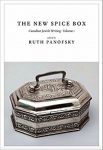
I was excited and curious to read volume 1 of The New Spice Box: Canadian Jewish Writing, edited by Ruth Panofsky, and published by New Jewish Press. I wanted to see how various writers used their family’s history in stories and poems to express their views.

The book is divided into three sections: voice, place and practice. Oppression and triumph are recurring themes throughout, and the stories exhibit strength and are endearing. Panofsky has brilliantly chosen selections that represent what it means to be Canadian in a Jewish context – overcoming difference while maintaining tradition.

The Spice Box: An Anthology of Jewish Canadian Writing was first published in 1981 by Lester and Orpen Dennys; it was edited by Gerri Sinclair and Morris Wolfe. The original book featured many authors, and brought Jewish stories to the forefront in Canada, including translations from original Yiddish texts.

For this new edition, Panofsky researched extensively writings from 1980 to the present. Material that did not make it into the original book was re-evaluated. Pieces relevant to the lives of Jews today were picked out and the contributors include authors from the first edition, such as Matt Cohen and Seymour Wayne. Current pieces were added, and they complement the other writings tremendously. This contemporary collection is intended to provoke new ideologies of culture and what Jewishness means in Canada. To do so, some of the stories refer back to a time before Jews arrived in Canada, while others relate modern-day situations. Readers can see how traditions and circumstances have changed over the years.

The collected pieces within The New Spice Box present how the writers see themselves today and how moving to Canada shaped who they are. In some stories, Canada is depicted as a haven, but also as an intimidating place for new arrivals. Moving to a new location during the war would have been difficult and somewhat terrifying, and these stories show just how much tenacity these immigrants had to begin again. Their families are what kept them going; making sure the next generations would play a role in telling their histories and keeping age-old traditions current.

One story, in particular, demonstrates how daunting moving to another country is. In “My Mother’s Luck” by Helen Weinzweig, a daughter is talking. Initially, it is written in the first person, but the narrative changes into the second person as the story continues. Esther begins, telling her story, but the mother’s perspective takes over. Lily is preparing her daughter, Esther, for her journey to Germany from the United States. Esther is very reluctant to go, even though she agreed beforehand to do so, in the pursuit of a higher education. Esther is scared about the impending changes and is nervous about fitting into a new country, as well as living with her estranged father.

Lily reassures her daughter that this is what she needs to accomplish, even though she herself is skeptical about the value of a higher education, believing that people who are more educated do not necessarily get decent paying jobs in their chosen profession. This attitude is most likely based on Lily’s terrible experiences with men. For example, Esther’s father abandoned them shortly after she was born, preferring to be around his university friends. But, even if mother and daughter fight throughout, Lily’s love for Esther shines through, and Lily assures her daughter that, if everything does not go smoothly, she has a ticket to come back home.

Meanwhile, “Pesach en Provence” by Gina Roitman highlights a duty to safeguard Jewish holiday customs. The narrator describes why making a Passover meal is particularly significant. While in Alpes-Maritimes, taking a break from her life in Montreal, she is planning a seder for a friend. Most of her family was killed in the Holocaust and, besides her brother, only distant relatives remain. In planning the seder, overwhelming memories of her mother at Passover return. Because of these recollections, the narrator adds dishes to the menu other than those she initially planned. By the end of the story, she comes to understand why the meal was so prominent in her family and why Passover is something powerful to celebrate. She realizes her mother’s importance in keeping the tradition alive, and comes to appreciate both her mother and her culture more.

Chloe Heuchert is a fifth-year history and political science student at Trinity Western University.

פורום הישראלים בקנדה

פורום אתר תפוז (בבעלות חברת אורנג’ הולדינגס) עבור הישראלים בקנדה ממשיך להיות עמוס בשאלות רבות, ובמידע רב הנדרש עבורם. כיום 15,309 איש עוקבים אחר נעשה בפורום. תפוז מפעילה בנפרד פורום עוברים לקנדה שעוסק בענייני הגירה. כיום 11,369 איש עוקבים אחר הנעשה בפורום הזה.

לפי תפוז הפורום עבור ישראלים בקנדה הוא “הבית לישראלים הגרים במדינה השנייה בגודלה בעולם, למי שמעוניין לדעת על החיים כאן, ולאלו שבדרך. זה המקום ליצירת קשרים ומתן מידע לישראלים הרבים החיים ברחבי קנדה. מסעדות, עבודה, מגורים ובילויים – הבמה פתוחה לכל נושא שמעניין אתכם ויהפוך את הפורום והחיים פה ליותר מעניינים. לאלו מכם שנמצאים בדרך, בחבלי ההגירה לקנדה, אנחנו מבקשים תשעיינו במאגרי הקישורים, המאמרים ובדף השאלות הנפוצות ותבדקו שם את המידע, כיוון שאם שאלתכם כבר נענתה שם, תקלו על הפורום מחזרה על עצמו. הפורום הזה ששואף לתמוך בקהילה גדולה של חברים, מבוסס על סובלנות ועזרה הדדית, וכמה דברים אינם מקובלים בו: אין כאן מקום לניגוח בנושא השהייה בחו”ל, לא יתקבלו כאן הטפות מוסר. הודעות מעין אלה, ובמיוחד אם יכתבו בשפה בוטה – ימחקו בשלב ראשון ויחסמו בשלב השני. התקפות אישיות על גולשים או חשיפה של פרטים אישיים על גולשים ע”י גולשים אחרים, לא יתקבלו כאן. הודעות כאלה ימחקו וכותביה יחסמו. הפורום פתוח לכל הגולשים המעוניינים להשתתף בו ולכולם ניתנת זכות ביטוי שווה. הודעות המשתיקות גולשים אחרים מכל סיבה אף הן אינן רצויות כאן. יש להקפיד על התייחסות בכבוד לכל משתתף/ת בפורום, ללא התבטאויות פוגעות במזיד, קללות וכדומה. נא לשמור על שפה נקייה ונעימה בפורום. כמו בכל קהילה, גם כאן יש מקום לידיונים וחילוקי דעות. אנא שמרו על דיון ענייני ובוגר. השתדלו לנסח את דעותכם בצורה סובלנית, תרבותית, חיובית ובונה, גם כשאתם נסערים”.

בין השאלות שהועלו לדיון בפורום לאחרונה: היבטים פסיכולוגים בגידול ילד מחונן, הגירה לקנדה, מעבר לארה”ב, מחפשים ספרים ישראלים בוונקובר, כיצד ניתן לצפות בערוצים ישראלים בחו”ל, רואי חשבון בטורונטו, ספרי ילדים ונוער מחפשים בית חם, מה דעתכם על הילודה בקנדה, הבדיקות הבטחוניות לקבלת כרטיס פי.אר, שבוע בטורונטו עם הרכב – היכן מומלץ לשהות, הוצאת רישיון נהיגה, האם יש מגבלות גיל להגירה, המלצות על סוכן נדל”ן במונטריאול, ישראלים בקולונה, המנטליות בקנדה, בית ספר יהודי בטורונטו, לימודי פסיכולוגיה בקנדה, האם יש סיכוי ששער הדולר הקנדי ירד, דמי ניהול בבניינים, מס על הכנסה, אתר לחיפוש דירות להשכרה, יציאה מישראל עם דרכון זר, מערכת הבריאות הציבורית בקנדה, מיסוי כפול וביטוח לאומי, מכירת בית בישראל, אפשרות לרילוקיישן ועוד.

אתר תפוז מפעיל גם פורום להשקעות נדל”ן בקנדה. מדובר בפורום חדש יחסית שנפתח ביולי אשתקד, ומספר העוקבים שלו עומד על 1,241 איש. בין השאלות שהועלו לדיון בפורום זה: חוזה שכירות אחיד בטורונטו, משקיעים זרים בנדל”ן בטורונטו, קניית בית והשכרה לדיירים, הזדמנויות להשקעה, עתיד בקנדה, השקעות בקנדה לא מובילות לאזרחות קנדית, מה העדיפות של קנדה על ארה”ב, השקעה של אזרח קנדי, מה התשואה שאפשר להשיג על נדל”ן בקנדה, האם יש הגירה חיובית כל כך שמצדיקה השקעה בנדל”ן, האם המיסוי של 15% על השקעות בנדל”ן לזרים לא מוחק את היתרון, קרן פנסיה קנדית תסכים להתחייב לאזרח ישראלי לפנסיה, מה דין הבנקאות בקנדה בייחס לתיירים, כיצד מובטחת ההשקעה על שם המשקיע ובאיזה אופן כדאי להשקיע בקנדה.

Horror at the border

While American elected officials posted pious family-friendly Father’s Day messages on social media Sunday, about 2,300 children remained incarcerated by the U.S. government’s Immigration and Customs Enforcement branch, stolen from their parents at the southern border with Mexico.

The families are migrants from throughout Central America and the idea of tearing children from their parents is dubbed the “nuclear option” for discouraging illegal migration into the United States. Once the families are divided, children and adults begin separate legal journeys. Some parents are being deported while their children remain behind. One infant was snatched from its mother while breastfeeding.

The boys are being held in a repurposed Walmart. No one outside government knows where the girls are.

President Donald Trump, whose administration implemented the inhumane policy, blames Democratic lawmakers for the situation, in keeping with his pathological dishonesty.

Inevitably, social media is making rampant comparisons with the Holocaust. In an age when the Nazi era is invoked just about every time a disagreement arises, this parallel remains troubling. As distasteful as the analogy is though, it does reflect a laudable desire to scream injustice in the loudest way.

“We are better than this,” critics say, or “This is not America,” both of which defy the evidence. As awareness increases about this horror, if Americans are not rallying on the streets in every city and town, we will know whether this is America or whether they are better than this.