מהצצה לאתר של קבוצת ישראלים בקנדה שמופיע בפייסבוק ניתן להבין מה הם רוצים, מה חסר להם, מה הם מחפשים ובמקביל מה יש להם להציע. קרוב לששת אלפי ישראלים חברים בקבוצת ישראלים בקנדה שנוסד בנובמבר אלפיים וחמש עשרה בטורונטו.
הנה לקט של שאלות, בקשות והצעות חברי הקבוצה השונים המתפרסמות באתר הקבוצה בפייסבוק:
לני מציעה למכירה גחנון קובנה במחיר שמונה דולר ליחידה. כולל תוספות של ביצה, סחוג ורסק במחיר שלושה עשרה דולר ליחידה.
שמעון שגר בישראל טס החודש לקנדה והוא קיבל שני חיסונים. הוא שואל האם הוא צריך לבצע בדיקת קוביד לפני הטיסה?
יובל שגם הוא גר בישראל שואל האם רישיון הנהיגה הישראלי שלו תופס גם בקנדה? או צריך להוציא רשיון נהיגה בינלאומי לפני שמגיעים לכאן?
רות שואלת את מי מבין אלה שעברו את הגבול לבאפלו ארה”ב עם רכבם: האם צריך לעשות בדיקות קוביד? האם מעבר הגבול פתוח כבעבר עשרים וארבע שעות ביממה?
סמדר שגרה בטורונטו מחפשת להשכרה בית שלם בן ארבעה חדרים באזור טורנהיל בטורונטו.
אלמוג שגר בישראל מציין שהוא נמצא במדינה כבר שלוש שנים, אחרי שגר בארה”ב במשך ארבע שנים. אלמוג מעוניין עתה להגר לקנדה והוא מחפש עבודה כטכנאי לתקן דלתות מתכת לחניות פרטיות, או כמנעולן, כשיש לו ניסיון רב בשני התחומים. הוא מציין עוד כי ישמח לקבל עזרה ומידע בדבר הגירה, הקהילה היהודית בקנדה, כשרות וכל מה שיש להוסיף בנושא.
סאו שגר בישראל שואל איך ואיפה מוציאים ויזת תייר לקנדה? מה העלויות וכמה זמן זה לוקח? הוא רוצה בחודשים ספטמבר ואוקטובר לטוס לקנדה עד חודש ימים, ושואל האם שבועיים יספיקו לטייל בוונקובר ובטורונטו, או שזה לחוץ מדי מבחינת הזמן? שאו מציין שראה גם את הרכבת השקופה ומדובר כנראה ברכבת נוסעת מוונקובר לבאנף שבאלבטרה וכידוע הכרטיסים שלה יקרים ביותר.
אלינה מישראל שואלת האם מישהו יודע אם צריך לתרגם את חוזה הגירושין לאנגלית ואת האישור של האבא שמאפשר לילדים להגר לקנדה?
עדי מישראל מספרת כי משפחתה שוקלת להגר לקנדה (באזור טורונטו והסביבה). מדובר בזוג הורים ושלושה ילדים בני שש, שמונה ושתיים עשרה. עדי במקצועה היא קוסמטיקאית ומניקוריסטית והיא שואלת האם היא יכולה בתחום הזה שלה לעבוד כעצמאית בטורונטו? או שהיא צריכה ללמוד את התחום מחדש?
ויקה מישראל אומרת כי היא בעלה וילדתם שוקלים להגר לקנדה. היא שואלת מי מכיר יועץ הגירה אמין בישראל, מבין אלה שבעזרתו הם היגרו לקנדה בשנים האחרונות?
אוריאל הוא אזרח קנדי המשרת בצה”ל ביחידה קרבית ועכשיו הוא משתחרר. הוא מחפש עבודה עם שכר טוב במונטריאול.
נינה הגרה בטורונטו מחפשת יועצת הגירה לקנדה.
לירון הגרה בישראל מספרת שהיא ואחותה מגיעות לקנדה למשך חודש ימים. היא מוסיפה שהן צריכות כרטיסים לסלולר לכדי להיות בקשר אחת עם השנייה, ושואלת על המלצות היכן לרכוש אותם במחירים מוזלים?
מוטי מחפש עורך דין מעולה המתמחה בהגירה לקנדה, ויש לו באמת ניסיון רב וידע בכל ההליכים.
דודו מישראל מחפש במונטריאול קייטרינג כשר במחיר סביר עבור חינה לפני החתונה.
ארינה שואלת היכן מומלץ לקחת חופשה בן עשרה ימים בקנדה? מבקשת לתת עדיפות למקומות עם חופים, מים ועגמים. היא כבר הייתה בקולונה וקמפלוס ומעדיפה לגלות מקומות חדשים.
יבול מישראל קיבל קבל שני חיסונים שפג תוקפם והוא שאול האם הוא יכול להיכנס לקנדה?
בדרך כלל אני זוכר היטב את היום בו נחתי בקנדה לאחר שעזבתי את ישראל, אך השנה לאור מות אמי, התאריך הזה לא בדיוק עבר בראשי. אני נחתתי בוונקובר בחמישה עשר בפברואר אלפיים וחמש ומאז אני כאן. מדובר כבר בלמעלה משבע עשרה שנים
כאמור לא “חגגתי” השנה בשבעה עשר בפברואר את יום השנה של בואי לונקובר, כיוון שאמי נפטרה בשישה בפברואר. הגעתי בטיסת חירום לישראל כדי להיות עימה בבית החולים, ולמחרת הגעתי היא נפטרה. כאילו חיכתה רק לבואי
לאחר השבעה בה הגיעו עשרות חברים, מכרים של אחי אמיר ושלי, וכמובן בני משפחה וכן חברות רבות של אמא ושכנות שלה, נזקקתי ליום מנוחה לעקל את כל מה שעבר עלי. ואז בשבוע השני והאחרון שלי בתל אביב, התחלתי לארגן את דירת אמי לקראת הפינוי. עברתי על אין סוף מסמכים, ספרים, חפצי אמנות ובגדים, כדי לבדוק מה חשוב ומה לא. מה להמשיך ולשמור ומה לתרום. לפיכך לא היה לי זמן ומקום לחשוב על השבעה עשר בפברואר – שכאמור הוא “יום השנה” שלי כאן בוונקובר
השנתיים וחצי האחרונות בוונקובר ובכלל היום קשות מנשוא ומאוד מאוד מסובכות. הקוביד שיבש לנו את החיים והפכנו כמעט לאסירים בבתים ובאזור. בראשית שנה שעברה איבדתי את אבי שמת בגיל תעשים וארבעה חודשים, מסובכים של קוביד. אבא היה חולה מאוד וידענו שהסוף מגיע. לא יכולתי להגיע להלוויתו בגלל מגבלות הקוביד, ולפיכך ראיתי אותה באמצעות זום
אחי ואני חשבנו אמא תוכל לחיות עמנו עוד שנים רבות לאור כך שמצב בריאותה היה מצויין, לאשה בגיל תעשים ושתיים. היא הצליחה להתאושש ממותו של אבא וזה דבר לא פשוט לאחר שבעים ואחת שנות נישואים. אמא חזרה לשגרת החיים שלה שכללה מפגשים עם הרבה מחברותיה, עם בני המשפחה, ספורט כמעט כל יום וקריאת ספרים
באחד הימים (בשני לפברואר) היא ירדה מדירתה לאכול סלט, נחנקה בפתאומיות מתפוח שהיה בו והסיפור שלה נגמר מהר מאוד. היא הועברה לבית החולים איכילוב ולאחר ארבעה ימים נקבע מותה
ועתה כשאני משחזר את מה שעבר עלי בשנים האחרונות ובעיקר בשנה האחרונה, בה נפרדתי תחילה מאבא ולאחר מכן מאמא, קשה לי לחזור לשגרת החיים הרגילה, ולחשוב על שבעה עשרה השנים שלי כאן – בונקובר
כל צורת החיים שלי השתנה עת עברתי מתל אביב לוונקובר. קודם כל בישראל עבדתי במשרה מלאה כעיתונאי בתחום התקשורת, וכיום כאן זה תחביב בלבד. בשמונה השנים האחרונות אני עובד בחברה שמספקת הלוואות למי שלא יכול לקבל אותן מהבנק, ותפקידי הוא המבקר
בארץ הייתי מוקף בני משפחה חברים וכמובן היו לי בנות זוג לתקופות ארוכות בחיי. השהגעתי לוונקובר היכרתי כאן רק חבר אחד שעזב את תל אביב מספר שנים לפני. לאט לאט הצלחתי להכיר אנשים וכיום יש לי גם כן (כמו בתל אביב) מספר חברים טובים, בהם ישראלים, יהודים קנדים ומקומיים
ומהיבט האישי: מזה ארבע שנים ושמונה חודשים, יש לי בת זוג קבועה שהגיעה לוונקובר מסין. וואנווי גרה כאן כשמונה שנים ובשנתיים האחרונות היא עובדת בממשלה הפדרלית. יש לנו חיי אהבה ושותפות טובה, קירבה גדולה והרבה עניין משותף – בעיקר בתחומי האמנות והתרבות. החיים שלנו ביחד טובים מאוד ואנו רק מצפים להמשך של עוד ועוד
לסיכום: אין לי על מה להתלונן בשבע עשרה השנים שאני גר בבית בוונקובר
Adi Barokas and her husband Barak during their time in Vancouver. (photo from Adi Barokas)
I read a review in an Israeli newspaper of Adi Barokas’ Hebrew-language graphic novel, the title of which translates as The Journey to the Best Place on Earth (and Back). I also read a scathing review of that review on the JI website, written by Roni Rachmani, an Israeli who lives in Vancouver. Disturbed by several aspects of the criticism, I decided to look into the book – and its author and illustrator – myself.
When I made aliyah from Canada in 1975, I had many difficulties acclimatizing to Israel. In reading Adi’s book, it was as though she had written the book I’d always wanted to write about Israel. Her experiences in Canada, which took place three decades after mine in Israel, were decidedly similar.
Aliyah is often thought of as a lofty, spiritual ascent, but, in a practical sense, it is effectively like immigrating to any other country. In the euphoria and joy of making the huge leap, this can be overlooked.
Decades before the internet, cellphones, Skype and WhatsApp, I left my home and family, strongly motivated by Zionist ideals, conveyed to me by my parents’ Israel experience of the 1950s. I longed to live a fuller Jewish life and take part in the developing history of Am Yisrael. Wrapped in a fuzzy cloak of enthusiasm, naïve and wholly unfamiliar with Israeli society, things turned out to be very different than the utopian image I’d envisioned. However, nearly half a century later, I am still grateful to be here.
Adi and her husband Barak met in the mid-2000s. Shortly after they married, Barak was called up to serve in the Second Lebanon War. They wanted to live in a quiet, peaceful society where they could just pursue their lives and careers, so they headed to Vancouver, which is often billed as one of the best places in the world to live. Unfortunately, they met with many unexpected challenges, mostly related to cultural differences. They tried to feel like they belonged, but never overcame feeling like foreigners.
For me, the in-your-face abrasiveness for which Israelis are known was an enormous shock to my more reserved, polite system. In Vancouver, Adi found those Canadian-associated traits off-putting and two-faced.
Adi and Barak were seeking a breather, serenity and space from the intense pace of life in densely populated Israel. With excessively high expectations that everything would be just so, they came to Vancouver. But for them, too, the culture shock was huge. They were not accustomed to so many rigid rules and regulations.
Adi had never lived in such a diverse society and was excited to interact with people of many ethnicities from around the world. It took a long time to catch on to the nuances, the nonverbal cues, of how people in Vancouver socialize – what topics are off limits, for example. Coming from Israel, a very liberal place, where most people freely express their unsolicited opinions, this was challenging.
Adi and Barak found it odd that everything was so quiet and calm in Vancouver. They were used to a lively, noisy society where people mix in close proximity. In Vancouver, everywhere they went, voices were barely audible and, so, they gradually adjusted and lowered their own tone of voice, and limited their conversations to certain topics.
The couple were eager to socialize, especially with their fellow foreign colleagues, with whom they felt more affinity than with Canadians. They initiated get-togethers, extended invitations, but they found everything so formal and stilted and rarely reciprocated. The only safe subjects of conversation were about hockey or the weather, nothing the couple felt was deep or of substance. This hampered their forming close friendships. Their sense of strangeness, that they would never fit in, grew.
On the flipside, schooled in the notion of appropriate table talk in Canada, I would often feel embarrassed at subjects discussed so frankly in Israel. It felt like an infringement on private matters, mostly with regards to money and personal relationships.
In Israel, people stand far less on ceremony, tell others to drop by any time, and mean it. But, to me, these invitations seemed an empty manner of speech. In Hebrew, the word for “to drop by” (tikfetzi) and a less polite version of “buzz off” (tikfetzi li) are the same!
I was baffled when people would ask why I’d come to Israel. It’s obvious to anyone imbued with Zionist and Jewish values that aliyah is a natural step, that Israel is the place to build a future. But, instead of words of praise or encouragement, Israeli peers, if they showed any interest at all, found it amusing that anyone would leave what they assumed was the easy life, to come to what was a troubled society. There was certainly no welcome wagon, no grace period to acclimatize. There were few invitations for holidays or Shabbat. The workplace, where I was often the only non-Israeli, was an even rougher scene – I wasn’t aware of how critical having connections really is, of how offices and organizations operated.
The Journey to the Best Place on Earth (and Back) was written and illustrated by Adi Barokas.
Across the ocean, Adi and Barak arrived with several science degrees under their belts, and had to swim the stormy seas of academic life in a B.C. university. There was some discrepancy between how they saw themselves – as conveying constructive criticism – and what some of their colleagues and acquaintances shared with them. This created awkward misunderstandings, a lack of candid communication and obstacles to their ability to settle in.
The couple had to wade through seemingly endless red tape through bureaucracy channels. They found it infuriating to jump hoops with indifferent, intransigent civil servants, who never saw them as individuals.
I can completely relate, as I have had to navigate mountains of paperwork, all in Hebrew, which, when I first arrived, was at an afternoon Hebrew school level. English was not widely spoken, and clerks lacked any service orientation – there was scarcely any eye contact. I miss even a perfunctory exchange of pleasantries, which, in Israel, is considered a waste of words. But Israel has come a long way and there is a marked improvement; as well, much can be done online. That’s not to say everyone is pleasant, but at least civil.
Barak and Adi became increasingly frustrated in Vancouver and it began to affect their mental and physical health. They became discouraged, falling into despondency, and their lives were out of their control. Under steadily increased pressure, their goals seemed to be slipping from their grasp, yet they were obligated to stick it out. They would have loved to have returned to Israel much sooner, but honoured their academic commitments, which were critical to enabling Barak to advance in his career in cancer research. Competition is fierce in academia but, eventually, Barak was offered a position at Ben-Gurion University, for which they are grateful.
Adi asked me why I stay in Israel. The answer is that, despite not knowing the ropes initially, having had to master Hebrew and the Middle Eastern mentality, the reasons for coming remain steadfast: unwavering belief in Zionist ideology and the privilege of fulfilling the mitzvah of settling in Eretz Yisrael. Still reserved and well-mannered at my core, I can and will tell someone off in Hebrew if they cut in front of me in line. And driving has forced me to become assertive.
Life in Israel has made me resilient, not automatically accepting of everything that’s dished out, and no longer complacent. My children and grandchildren have none of my social concerns and are rarely bothered by the things that irk me. They do recognize and understand that it hasn’t been a walk in the park for me. They greatly benefit from knowing English, which I spoke at home to my kids and which I also speak with my grandchildren.
Distance has impacted relationships with my relatives, who are all in Canada, and I miss them. But, in Canada, families commonly live far apart and visit only a few times a year. That’s just the norm and how I grew up, too. In Israel, we belong to a close-knit clan, with whom we celebrate holidays and other occasions; regularly helping one another is everything here.
Living in Vancouver, Adi was frustrated by the positive-thinking approach that was all the rage, but didn’t work for her. She needed to be able to share her concerns openly. She wanted practical advice, instead of being brushed off all the time, with people either trying to divert her attention or change the subject. At least the experience forced her to become more self-reliant.
Adi began to delve into other areas beyond academia, having been turned off the sciences for good. She tapped into her creative side, got her driver’s licence, went swimming, started writing. Both she and Barak took up yoga and meditation.
Adi sought therapy and finally found a therapist who was helpful, which contributed to Adi’s bouncing back from within. Time spent in nature, and developing her writing and artistic skills, offered solace.
It was during this process of self-discovery and self-care that the couple decided to start a family, and they had a son.
When an offer came for Barak to take up a post in Leicester, England, it meant once again picking up and leaving, and having to learn their way around a new place. But, it appealed to them, as Leicester was off the beaten track and the small city ambience appealed to them. As well, the move brought them closer to home. Instead of the 10-hour time difference, they were only two hours behind Israel time-wise and a five-hour flight away.
Outside Israel, Jews tend to belong to communities where they gather to share religious and cultural activities and strengthen their bond with Israel. For me, coming to Israel to live in a predominantly Jewish society was enlightening, yet it wasn’t easy to understand the many different customs. I enjoy the Jewish character and vibe of Israel in many facets of the public sphere. Life revolves largely around the Jewish calendar, especially the celebration of Shabbat and festivals. What binds us is our unique, incredible history and heritage.
Had I been better prepared, come with more defined goals, and more socialized in a Jewish environment, I might have fared better. Even when the going was rough, returning was never an option, however. I am living a meaningful life in Israel, where I have mostly resided in the Jerusalem area.
We have all witnessed Israel evolve into a modern, advanced country, making huge strides in every realm imaginable. On occasional visits to Canada, I enjoy the familiar scenery, the cold, the language and pleasantries, though a noticeably different mindset from the locals is apparent.
Immigration is a tremendous and profoundly complex undertaking. It entails much uncertainty and many twists and turns. No matter how much any immigrant plans, one never knows how things will unfold. It is an arduous process that demands full commitment with every fibre of one’s mind, body and soul. Fellow ex-pats can only offer so much support and help. The individual immigrating has to go through the process on their own terms.
Adi and Barak have since returned to Israel. Over a total of eight years away, they learned a great deal about themselves, individually and as a couple. Growing up in Israel, they naturally identified as Israelis, their Jewish identity cultural. While abroad, they realized that they were viewed by others not only as Israelis, but as Jewish, as a minority. This heightened their awareness, added a new dimension.
Time away has changed them, considerably, and they returned to a somewhat changed Israel. They have settled on a kibbutz 20 minutes from Be’er Sheva, where they and their now two children enjoy spectacular scenery in the Negev, a warm climate and a caring community. They have found their home right here, at home.
Adina Horwichwas born in Israel to Canadian parents. In 1960, the family returned to Canada, first living in Halifax, then in a Montreal suburb. In 1975, at age 17, Horwich made aliyah, and has lived mostly in the Jerusalem area.
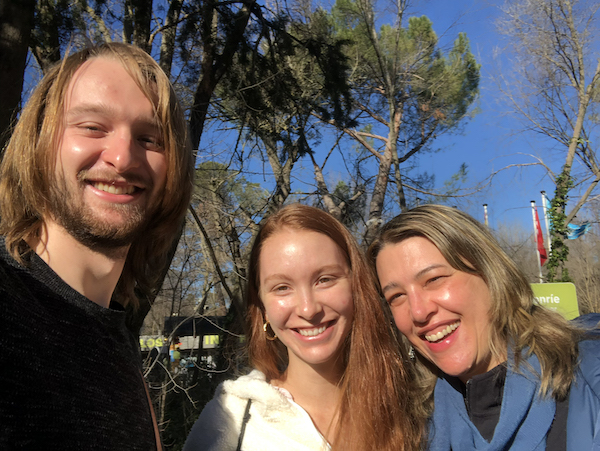
Michelle Valenzuela, centre, along with her brother, Pedro de Jesus Valenzuela Mora, and mother, Diana Mora. (photo from Michelle Valenzuela)
Almost 500 years after her Sephardi ancestors were forced out of Spain, Michelle Valenzuela is on a path back.
The 28-year-old artist and art teacher from Colombia is currently living and studying in Vancouver as the Spanish government finishes processing her citizenship application along with one from her brother. Their mother is pursuing a similar process with Portugal after both countries opened their doors to the descendants of Sephardi Jews persecuted during the Inquisition.
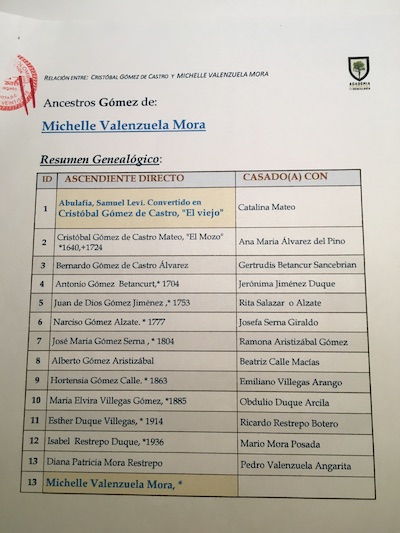
Growing up in a deeply Catholic family, Valenzuela had no inkling of a Jewish heritage until a cousin who works at the Colombian Academy of Genealogy told them what he had discovered: their family descended from Samuel Levi Abulafia, who had adopted the Christianized name of Cristobal Gomez de Castro before being expelled from Spain in 1570. He had been found guilty of sacrilege, bigamy, heretical ideas and promoting Judaism.
“We found out the Jewish background of our family story,” Valenzuela told the Independent. “For me, it was shocking. I don’t have a good relationship with Catholicism so I always felt like the black sheep of the family. It was an explanation for myself that our origins weren’t that Christian.
“There’s something particular about my mother’s family, the whole personality of the family, which is really different from other cultures in Colombia.”
Her grandmother, for instance, started a successful business that still exists, unusual at a time when most Latin American women were expected to stay home and care for children.
Although her cousin had earlier discovered the Jewish origins, he didn’t tell the rest of the family until after Spain passed legislation in 2015 to offer citizenship to members of the Sephardi diaspora.
“I think it’s related with the fact that the family became really Catholic and proud of being Catholic. One of his brothers is a priest,” explained Valenzuela.
Jews who came to Colombia hundreds of years ago had to hide their faith because the colonies of Spain carried out their own inquisitions.
As Sephardi people spread to all corners of the earth, the largest communities were established in Israel and Turkey, followed by the colonial holdings of Spain and Portugal in the New World. The expulsion of Jews followed Spain’s campaign to also rid the country of followers of Islam, known as Moors.
The 2015 law is aimed at historical redress for the descendants of about 160,000 Jews expelled on the 1492 orders of King Ferdinand and Queen Isabella. About 100 years later, another 300,000 Jews who had converted to Catholicism, but nonetheless incurred the wrath of Spanish authorities, were also expelled – including Valenzuela’s ancestor.
Remarkably, documents from the hearings that forced people into exile are accessible online due to digitization of the Catholic Church’s records.
Now, her parents face the knowledge that the church they serve – her mother as a Bible teacher and her father as a deacon in training – is the same one that forced her ancestors to convert or flee.
“I tried to ask [my mother] about her thoughts about her family being Jewish and I think she’s not able to confront it,” Valenzuela said. “Her answers are vague, evasive. I think she’s surprised as well with her Jewish roots, but she has always referred to the Jewish people as older brothers to the Christians.”
Accountant to the king
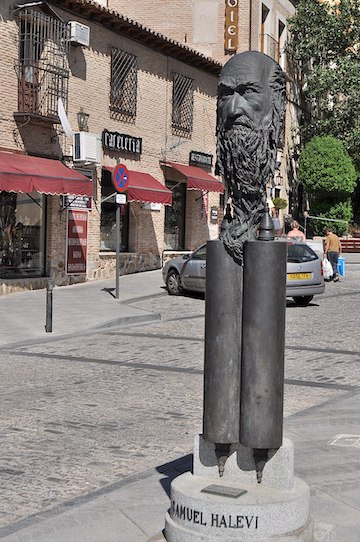
A bust of Samuel ben Meir Ha-Levi Abulafia in Toledo, Spain, near the synagogue he founded in the 14th century. (photo from Michelle Valenzuela)
Research into the family’s roots in Spain and Portugal also led to a much more famous Samuel Levi Abulafia, a 14th-century advisor and treasurer to Pedro I, the king of Castile and Léon.
Abulafia was prominent between about 1320 and 1360, first as an aide to Portuguese nobility and ultimately as a wealthy and powerful official in Toledo, where Abulafia commissioned construction of El Transito Synagogue on a street now bearing his name and statue. His nearby former palace in the city’s Jewish Quarter now houses a museum of El Greco’s paintings.
Also known as Samuel ben Meir Ha-Levi Abulafia, he fell out of favour with the king as anti-Jewish sentiment grew in the Late Middle Ages. Accused of disloyalty to the king, he was imprisoned, tortured and killed in 1360 and his assets seized by the crown.
The synagogue was converted to a Catholic Church and declared a national monument in 1877. It has since been restored as a synagogue and now includes a Sephardi museum.
Applying for citizenship
The process to gain citizenship is long and costly, requiring money and persistence to complete. Even now, two years after the deadline for applications closed in Spain, Valenzuela and her brother are waiting for final citizenship documents to arrive.
Genealogy prepared for Michelle Valenzuela for her application for Spanish citizenship. It dates back to a man exiled from Spain in 1570 for being Jewish despite his adoption of a Catholic name, Gomez de Castro. (photo from Michelle Valenzuela)
Files received by the 2019 Spanish deadline are still being reviewed, while a similar program in Portugal continues to accept applications.
About 132,000 have applied to the Spanish program and at least 34,000 new citizenships have been granted so far. Most have come from Mexico, Venezuela and Colombia, according to news reports. The program began refusing a high number of applications in 2019, saying that fraudulent cases were on the rise.
Even before the Spanish bureaucracy considers the evidence, the Federation of Jewish Communities of Spain, along with a Jewish community in countries of origin, must approve the application. Then, there is the need to show a “special connection” to Spain, which the Valenzuela family fulfilled by contributing to the Spanish Chamber of Commerce in Bogota. Applicants must also speak Spanish.
There is no requirement to be a practising Jew or give up citizenship from their home country.
New possibilities
It’s not lost on Valenzuela that the process brings cash into Spain – a 100 euro application fee, about 600 euros for notarizing original documents delivered in person to Madrid and another 80 euros to write a test on knowledge of Spanish history, society and culture. Applicants also travel to Spain at their own expense, putting it far out of reach for many applicants from Latin American countries with high unemployment and weak currencies.
It means successful petitioners will have both money and education. And many are young, bringing the possibility of adding new workers to an aging country. United Nations data indicates 10% of the Spanish population was over 60 in 1950, but that will rise to 30% in 2025.
For Valenzuela and her partner, Carlos Perdomo, a lawyer from Colombia working in Vancouver, proving Jewish roots in Spain is another chance at finding a way out of the economic difficulties in their home country. They are both also permanent residents of Canada.
“We wanted to improve our possibilities for the future [outside Colombia],” she said, and obtaining a European Union passport should help.
“It’s so great to know more about your family and have a material link. We would love to use it, maybe for a master’s degree in the future. It would be cheaper and easier for me to travel there, having citizenship.”
Valenzuela says her trip to Spain in December was her first and she was surprised at how much it is like Bogota: disorganized, loud and crowded.
“Being a Colombian is always linked to the notion that Europeans are better in every way. It’s easy to romanticize and idealize Spanish culture and art, but the reality is we’re very similar.”
Erin Ellis is a former newspaper reporter and copy editor for the Edmonton Journal and Vancouver Sun. She also contributes to Canada’s National Observer and CBC News. She’s keenly interested in history and loves telling people’s stories.
Alina Adams, author of The Nesting Dolls, spoke at a recent Zoom webinar organized by the Jewish Community Centre of Victoria. (photo from alinaadams.com)
New York City-based writer Alina Adams, author of the 2020 novel The Nesting Dolls – about three generations of Russian-Jewish women – spoke at a Jan. 27 Zoom webinar organized by the Jewish Community Centre of Victoria.
Adams began with her personal story. Born in the port city of Odessa, she spent the first seven years of her life in a communal apartment: a dwelling, including kitchen and bathroom, that was shared by two families.
“As I mention in The Nesting Dolls, these relationships were not always positive. My parents were lucky in that they got along well with the people they were assigned to share with,” said Adams.
In 1976, her parents decided to emigrate. Two years earlier, the United States had passed the Jackson-Vanik Amendment, which linked U.S. trade with the free movement of Jews and other groups in the Communist bloc.
“I like to say we were traded for wheat,” Adams quipped.
To those leaving the USSR, she said, “it was like stepping off the edge of the earth. You didn’t know where you were going, you didn’t know what life would be like when you were there, and you certainly knew you couldn’t come back.”
The family’s first stop was Vienna. From there, they took a bus to Rome, where they stayed for four months before traveling on to North America in January 1977, first to New York and then to San Francisco.
Adams recounted some of the reactions upon coming to America in the 1970s as a young child: for example, the surprise of watching a television screen in full colour. It was television, namely soap operas, that Adams later credited for helping her learn English.
The young immigrant started out in a Jewish day school, where the differences in various customs – her life in the new versus the old world – became very apparent. Parents in North America, she recalled, did not send their kids to school in the same dress every day; they used Band-Aids instead of green antiseptic to treat cuts; and, if their child had the sniffles, they did not place the child’s feet in hot water and then into socks filled with dried mustard.
Over time, Adams and her family got the hang of life in America. She graduated high school and college. All along, she knew she wanted to be a writer.
“My parents claim my first words were ‘pencil’ and ‘paper,’” said Adams. “And what’s the advice all writers get? Write about what you know. Well, what did I know? I knew about being a Soviet immigrant. I knew about living a culture that wasn’t mine.”
Publishers, at first, were not interested in those themes. Nonetheless, an editor at Avon Publishing did like her writing and contacted Adams, asking if she would write a Regency romance. This would become The Fictitious Marquis, a unique book in the Regency romance genre in that Jews are central characters.
Adams now has more than a dozen titles to her credit, including mysteries, books on figure skating (non-fiction) and other romances.
About four years ago, Adams’ literary agent told her that editors were becoming interested in Russia, and this led Adams to write The Nesting Dolls. The novel begins in the Soviet Union of the 1930s and ends in 21st-century, pre-pandemic Brighton Beach, in New York City. It focuses on the lives of three generations of Russian Jewish women in one family; the periods parallel those of Adams’ grandmother, mother and herself.
For Adams, it is the everyday events that are the most fascinating part of writing historical fiction. “Anyone can look up which date Nikita Khrushchev denounced Joseph Stalin, but it is the small details which make historical fiction compelling,” she said.
As an example, she pointed to a personal account she used in the novel. According to her mother, Adams did not want to be breastfed. This caused her mother to go to a doctor and ask him to write up a prescription for yogurt. “These are the little things, in this case how difficult it was to get regular foodstuffs in the Soviet Union, that bring a situation to life and show the reader what an era was like,” said Adams.
The novel was scheduled to be released in 2019 but was delayed to 2020, which, for Adams, turned out to be a blessing for the story’s timeline, in that she wasn’t finishing it during the pandemic. The last section of the book takes place in pre-pandemic Brooklyn in summer. “The things my characters do in the summer of 2019, they could not have done in the summer of 2020,” she said.
Adams lives in New York with her husband and their three children. She has written about her interracial, interfaith and intercultural family for Interfaith Family Magazine and the Forward, and has written columns and articles for dozens of publications.
Sam Margolishas written for the Globe and Mail, the National Post, UPI and MSNBC.
בחודש פברואר הקרוב ימלאו שבעה שנים לחיים שלי בוונקובר. קשה להאמין שבפברואר אלפיים וחמש עזבתי את תל אביב לצמיתות בדרכי לוונקובר. מאז אני חי כאן ואפילו באותה שכונה יפה – הווסט אנד
הערב סיפרתי לבת הזוג שלי (שגרה כאן למעלה משבע שנים) כי אני בעצם רציתי לעזוב את ישראל כבר בראשית שנות השמונים. אחרי שסיימתי את שירותי הצבאי והתחלתי ללמוד באיניברסיטה העברית (בחוג ליחסים בינלאומיים), החלו המחשבות לעזוב את ישראל לעלות במוחי והן לא עזבו אותי עד שאני עזבתי את המדינה
בתחילה רציתי להגר ללונדון כי זו העיר הראשונה שביקרתי בה. בפעם הראשונה זה קרה עוד לפני הגיוס לצבא, ולאחר השירות הגעתי אליה פעם נוספת. מאז ביקרתי בלונדון מספר פעמים אך לא עברתי אליה. מעניין לציין כי דווקא אחד מחברי הטובים שמע בעצתי ועזב את ירושלים ללונדון באלף תשע מאות שמונים ושש. .ומאז הוא חי שם
במשך שנים על גבי שנים – הוא זה שהציע לי לעשות כמוהו אך זה לא קרה. תמיד היו לי תרוצים מתרוצים שונים
לאחר מספר ביקורים בניו יורק חשבתי (לפחות בדימיוני) לעבור אליה וגם זה לא קרה. את ניו יורק החלפתי באמסטרדם שהיא בעצם העיר האהובה עלי עד עצם היום הזה. ביקרתי בה פעמים רבות והתחלתי לברר מה האופציות העומדות בפני כדי לאוכל להגר אליה. אך לא הייתי מספיק נחוש ורציני לבצע את הפעולות הנחוצות להגר. הפחדים והחששות ניצחו גם הפעם לצערי
בראשית שנת האלפים התחלתי בתהליך ההגירה לקנדה, כיוון שחבר טוב שלי עבר אז מתל אביב לוונקובר. התהליך כלל הרבה שלבים בהם: בדיקות רפואיות, בדיקת עבר פלילי ומבחן באנגלית. עברתי את כולם בהצלחה מרובה. ובחודש נובמבר אלפיים ובארבע קיבלתי את הניירת המיוחלת להגר לקנדה
כעבור שלושה חודשים הגעתי לוונקובר ואני כאן עד עצם היום הזה. הפעם לא נתתי לעצמי שום אפשרות לחשוב, לדון, או להרהר בנושא. פשוט סגרתי את פרק חיי בתל אביב ובעצם בישראל בשלושה חודשים קצרים, עליתי על הטיסה לוונקובר והתחלתי פרק חדש בחיי
הדבר הקשה מכל עבורי שהשארתי מאחור (בישראל) היה העבודה שכה אהבתי, בתחום המדיה. במשך שנים הייתי כתב (ובעצם גם סגן עורך) לתחום המדיה בעיתון ובאתר הראשון בישראל בנושא זה. זו העבודה שאהבתי יותר מכל בכל חיי בישראל ובקנדה כאחד. הרגשתי בה כמו דג השוחה להנאתו בים. זה היה המחיר. הכבד ביותר ששילמתי עבור עצם ההגירה מישראל לקנדה
בשנים הראשונות כאן עוד התגעגתי למדיה בישראל ולעבודתי שם. לשמחתי כיום זה מאוד רחוק ממני, ממש כמו ישראל כולה
כשאני חושב מה עבר אלי בשבע עשרה שנות חיי כאן, ממהגר חדש ועד היום, אני מתקשה להאמין. היו ימים קשים, בדידות נוראית וכל מיני צרות שונות. אני שמח שהצלחתי בכוחות עצמי להגבר על כל הקשיים ולהצליח להשתקע כאן ולצמיתות. יש לי כיום בת זוג קבועה מזה כארבע וחצי שנים, עבודה מסודרת על תקן כמנהל מזה כשבע וחצי שנים, וכן לא מעט חברים
אני שמח בחלקי ושמח על כך ששיניתי את חיי מקצה לקצה. זה לא היה קל אך זה היה משתלם וזה ממשיך להשתלם כל יום בחיי. אולי יום אחד עוד אשב ואכתוב מדריך למהגר בו אציע למי שמעוניין לשמוע, מה מומלץ לעשות כדי להתחיל בחיים חדשים במדינה חדשה
Debbie Setton Tabenkin sees travel, genealogy and fun with grandkids in her future. (photo by Jocelyne Hallé)
Debbie Setton Tabenkin, one of the most familiar faces to anyone who has frequented the Jewish Community Centre of Greater Vancouver in the past three decades, is retiring at the end of January.
Tabenkin began teaching English as a second language at the JCC in 1995. In conjunction with that role, she was instrumental in creating the drop-in child-minding program for kids of parents using the centre’s facilities or attending programs. In the succeeding quarter-century, she has served in a variety of roles and retires as director of programming and strategic initiatives, where she oversees about 10 program areas and 12 budgets.
Tabenkin’s interesting family history plays a role in her approach to her work. Her parents’ lineage is from the Syrian and Turkish Jewish communities and, in the early part of the 20th century, parts of her family migrated to Jamaica and Panama. Because there was a polio pandemic in Jamaica when her mother was pregnant, they traveled to Panama, where Tabenkin (née Setton) was born, returning to Jamaica as a babe in arms.
“I was used to what the community centre meant in Latin America,” she said of her philosophy around the work she does. “It was a social place where you came and you met people.” The “living room” of the community, she calls it. That is what she believes she has helped foster in Vancouver.
But there was a winding road before she ended up here.
The Setton home in Jamaica was the holiday destination for any Jews who happened to be on the island, whether American Peace Corps volunteers or Israelis helping the nation with agricultural infrastructure.
When she was 16, the family left Jamaica, where violence was becoming frequent, and moved back to Panama.
Her grandfather owned the kosher supermarket in Panama City, where family members – she has about 100 first cousins – still operate it. The store moved into new digs that include a kosher sushi restaurant just two weeks ago.
She was the black sheep of the family, she cheerfully admits.
“I came from a very traditional family where the girls got married,” she said. “One [sister] got married at 19 and one got married at 17 – and I knew I wanted a different lifestyle.”
She did a two-year associate’s degree at the American college in the Canal Zone and then taught Grade 2. She wanted to further her education and her parents said she could either go to New York City, where a sister had moved, or to Vancouver, where her brother, Victor Setton, had settled in 1975.
She completed her bachelor of education at the University of British Columbia, but the federal government at the time did not have a program that allowed her brother to sponsor her to remain in the country. So, she returned to Panama and taught English at the Jewish day school, Instituto Alberto Einstein.
She decided to pursue a master’s degree and, in 1980, was accepted at both Columbia and New York University. She got her MA at Columbia in the then-new field of educational technology and media.
“I lived in New York for five years and, you know, everything is for a reason,” said Tabenkin. “I’m so happy the Canadian government didn’t take me because that gave me five years in New York and those five years made me the person I am.”
She drank in the cultural offerings of the city and became very involved with the Sephardi association there.
“I became very proud of being Sephardic,” she said. “I really learned the history of the rich culture that Sephardic Jews have. I took multiple classes. I accessed everything and that’s when I learned Hebrew.”
She returned again to Panama but, then aged 30, set her sights on a new conquest.
“I really wanted to have a child and I really wanted to get married,” she said. “I decided, OK, I’m going to go to Israel. My mother was delighted when I left to Israel.”
She had taken up scuba diving in Panama and poked her head into a scuba store in Tel Aviv looking for information about opportunities to pursue the sport. She chatted with a young man named Yair Tabenkin.
A few days later, a friend invited Debbie to tag along to a Purim party and a scuba expedition in Eilat being organized by a young man. When the friend described the pal who was planning the trip, Debbie replied, “I think I met him.”
When the mutual friend told Yair who she was bringing along, he said, “Oh, is that the girl with the beautiful blue eyes?”
“He remembered my eyes – and that was it,” she said. “The rest is history. We met that Purim and we got married in August.
“On the year anniversary that I had moved to Israel, I was married and pregnant,” she said. “Let’s put it this way: I accomplished my goal.”
Before that happened, there had been some snooping. Yair Tabenkin had some family in Panama and queried about the Setton family. A similar investigation was happening in reverse.
“My mother went to the rabbi and said, look, my daughter is dating this guy named Yair Tabenkin,” she said. “And the rabbi said ‘Tabenkin? It’s like marrying a Kennedy.’”
Yair’s grandfather, Yitzhak Tabenkin, was a founder of the kibbutz movement and a leading figure in the creation of Mapai, the precursor to the modern Labour Party, along with David Ben-Gurion and Berl Katznelson, and was a member of the first Knesset.
After Debbie and Yair married, they were speaking with Debbie’s brother in Vancouver, who said he had an opportunity for the new husband. The couple moved here in 1990.
Her responsibilities at the JCC expanded quickly from that first ESL gig. She began organizing events – something she had been doing since her teenage years, when she created a Purim party in Panama.
On New Year’s Eve 2003, Tabenkin organized a multi-generational event at the JCC, where kids were entertained by camp counselors in the gym and pool while parents dined and discoed before everyone came together at midnight.
In 2004, she began Festival Ha’Rikud, a celebration of Israeli culture through music, dance, food, art, workshops, literature, family activities and marketplace. This year saw the festival’s 18th iteration.
In 2008, she spearheaded the Israel at 60 festival in Stanley Park, one of the largest and most visible public celebrations in Jewish community memory.
As director of programming and strategic initiatives, she has a finger in pretty much every pie at the centre, but a particular point of pride is the inclusion department.
“Debbie’s had a very distinct impact on many people’s lives in the community,” said JCC executive director Eldad Goldfarb. “She’s a very caring person, both to her staff and team and to the members of the community, always trying to find what she likes to call the ‘magic moment,’ basically trying to find something good out of the bad and trying to solve problems and make people happy.”
Tabenkin holds a great deal of institutional memory not only of the JCC but of the entire community, Goldfarb added.
“She’s definitely someone whose big shoes are going to be difficult to fill,” he said. “She’s someone who’s got not just the history, but the personal connection to a lot of people in the community.”
In retirement, Tabenkin may do some consulting, spend more time with her three adult children and two grandchildren and she hopes to get back to some exotic adventures. Just before COVID, she returned from Ethiopia. Before that, she visited Uzbekistan. She wants to delve deeper into genealogy and would love to spend a month in Turkey investigating that branch of her family.
She looks back with more than fondness.
“I truly love this place,” she said. “My whole family has benefited so much. I always say a membership to the JCC buys you 15 extra years of your life. You’re keeping healthy, you’re working out, you’re with people, you’re not isolated. It’s truly a place where everyone can be together, it doesn’t matter what your socioeconomic background is, it doesn’t matter your religion. It’s a place where we all get to be together. It’s our living room.”
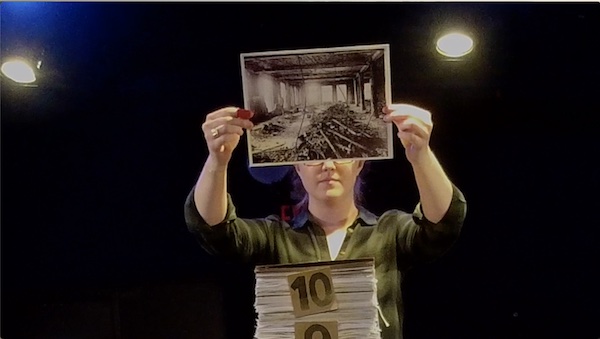
Surplus Production Unit’s Briony Merritt. (photo by Alex McLean)
No matter how well we document history, it matters little unless people are aware of it. Two very different productions at this year’s Chutzpah! Festival, which began this week, were born of personal discoveries of documents from the past – in one case, a trial transcript; in the other, Yiddish compositions. The artists’ unique interpretations help ensure that important aspects of our culture are not forgotten.
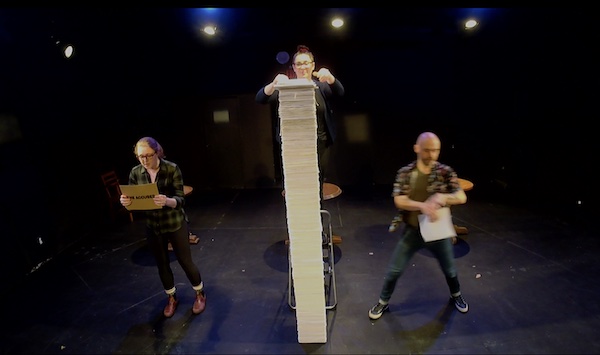
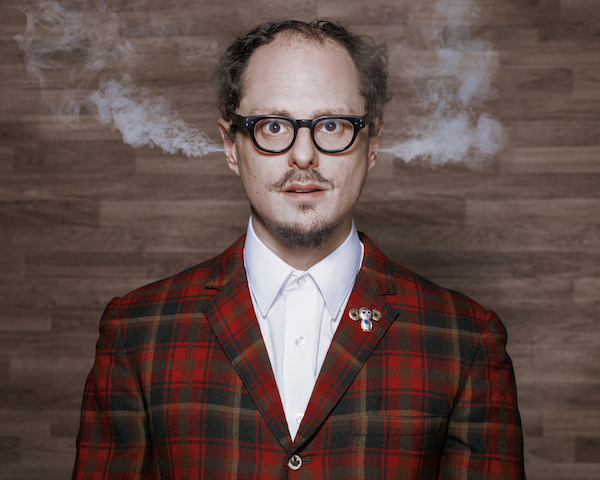
Halifax-based Surplus Production Unit, under the direction of Alex McLean, performs A Timed Speed-Read of the Triangle Shirtwaist Factory Fire Trial Transcript on Nov. 21 and 22 at the Jewish Community Centre of Greater Vancouver, in the Wosk Auditorium. Montreal’s Josh “Socalled” Dolgin performs music from his album Di Frosh with a local quartet at the JCC’s Rothstein Theatre Nov. 19 in a concert that will also be livestreamed.
“I had never heard of the Triangle Shirtwaist fire until 2010, when I was doing research for an MA in Toronto,” McLean told the Independent. “I was totally fascinated by the case and got especially swept up in the extensive trial transcript.”
Triangle Shirtwaist Company owners Max Blanck and Isaac Harris were put on trial for manslaughter after a fire at their factory on March 25, 1911, killed 146 people – mostly women and girls – in part because one of the exit doors was locked.
“I think the gender politics were what initially stood out to me – it was an all-male jury, the case hinged on the discrediting of female witnesses, and it was all taking place at a time when women weren’t able to vote in either Canada or the United States. I also knew that this was a time when the labour movement was massive globally and that the Ladies Garment Workers Union had waged its major strike just a couple years earlier. The way that this all reads as subtext in the trial transcript was fascinating to me. I knew that I wanted to work with the material somehow, but wasn’t sure how.”
In 2011, during the 100th anniversary year of the fire, McLean saw an interview with Charles Kernaghan, director of the Institute for Global Labour and Human Rights, who mentioned the Hameen factory fire in Dhaka, Bangladesh. “And then there was the Tazreen factory fire in 2012 and then the collapse of the Rana Plaza building in Dhaka in 2013,” said McLean. “It all made the record of what happened in New York in 1911 hauntingly relevant.
“Somewhere around this time,” he said, “I got a small grant to create a verbatim script from the transcript. I started work on it but it felt lifeless, like a bad ‘historical drama.’ So, I gathered a few actors who I knew and trusted and who were interested in the material. We started playing around with ways to approach the material that felt honest and the current production grew from there.”
McLean believes “it is endlessly worthwhile to think about the hidden costs in our global economy and the conditions under which so many of the products we consume are created.” At the same time, he added, “I was very aware that my life – like those of my colleagues – was radically different from the lives of the people in the trial transcript. None of us are immigrants, none of us are Jewish or Italian (as were almost all of the Triangle victims). As middle-class Canadians in the 21st century, I felt that we had to acknowledge the gulf between us and those New York factory workers in 1911. We had to build this distance into the structure of the show, and so this idea emerged that we would actually sit the trial transcript on the stage and the performance would be a group of people engaging with this historical record, rather than trying to represent it realistically. This felt like the only way we could approach the material respectfully.”
Briony Merritt, left, Kathryn McCormack and Richie Wilcox bring A Timed Speed-Read of the Triangle Shirtwaist Factory Fire Trial Transcript to the Chutzpah! Festival Nov. 21-22. (photo by Alex McLean)
Throughout the trial, said McLean, “witnesses, especially women, were treated with palpable disrespect. Max Steuer, the lawyer defending the factory owners, repeatedly tried to cast suspicion on witness testimony. This came to a head in his cross-examination of Kate Alterman, the ‘star witness’ for the prosecution. Knowing that Alterman’s English wasn’t great, Steuer had her repeat her testimony multiple times to make it appear rehearsed. This ultimately worked for him.
“There’s also a fascinating class dynamic at play: Steuer and his clients, Isaac Harris and Max Blanck, were themselves Jewish immigrants who had worked their way up in New York’s garment district. While at times they appear callous towards the victims and survivors, there is also this sense that they come from the same place. The prosecutor, on the other hand, comes across as much more of a patrician and, at times, this results in condescension. To him, the victims are helpless little girls, while the defence tries to portray them as streetwise conspirators plotting their revenge. Their actual messy humanity gets lost in the crossfire.”
Justice was not served by the trial, nor other legal measures, but there were positive changes that resulted from the tragedy.
“Part of what the case revealed was that workplace safety regulations at the time had no teeth, so the silver lining was that a host of new laws were introduced,” explained McLean. “Frances Perkins, the first woman to serve in a U.S. cabinet, actually witnessed the Triangle Shirtwaist fire and described it as a pivotal moment in her life. She became secretary of labour under FDR [Franklin D. Roosevelt] and was a major player in ushering in the New Deal.”
In terms of lessons learned, however, “we seem doomed to continually forget the inequality that animates our world,” he said. “Going to work under dangerous conditions seems like a reasonable choice to many people in impoverished conditions. As long as those conditions exist, workplace tragedies are likely to occur.”
He added, “There’s a fascinating historian of the Triangle Shirtwaist fire, Michael Hirsch, who argues that it’s a mistake focusing anger and blame on the factory owners. He uncovered the names of several bodies that were unidentified in 1911, and he makes a yearly pilgrimage to the victims’ graves…. To me, Harris and Blanck do appear negligent, but acknowledging systemic imbalances is also important. Economic inequality has proven a difficult problem to solve, but that doesn’t give us the right to forget about it. My sense is that we need a new New Deal today.”
A love of Yiddish music
Josh Dolgin has many artistic interests and musical styles – from composing to photography to puppeteering, from hip-hop to musicals to Yiddish music. As different as they may be, Dolgin said, “all the passions stem from an attraction to ‘realness,’ to things that just deeply move me, spark inspiration, speak to my soul.”
For him, the 2018 album Di Frosh “was a kind of return to a pure, more ‘traditional’ Yiddish music, even though it’s a project of ‘new’ music. I had experimented with using Jewish music sounds in contemporary ways,” he explained, “sampling, mixing, collaborating and fusing to create hip-hop, rap and funky pop music. In so doing, I became rather immersed in the form – in klezmer, in Yiddish folk, art, theatre music, cantorial sounds from the synagogue and Chassidic music – by collecting old records looking for sources. Listening to all that music, I eventually fell in love with the source material … I wanted to play and sing it! I eventually started learning the songs as a pianist, as an accordionist and singer. I wanted to just perform that music, without mixing it, without adding beats, just to play and sing it as is.
Josh “Socalled” Dolgin performs Yiddish music from his album Di Frosh with a local quartet Nov. 19 in a concert that will also be livestreamed. (photo from Chutzpah! Festival)
“In the meantime, I started getting into four-part harmony singing and collecting choral arrangements, then directing choirs at synagogues and music camps. That love of harmony mixed with my love of singing Yiddish songs and I thought, hmm, it would be cool to present this repertoire in an almost classic style, maintaining all that beautiful real harmony from arrangements from the ‘time.’ Some friends and I created new arrangements based on old sources – all the arrangements are ‘new,’ this repertoire for string quartet never existed before, so it’s ‘new’ music, but it’s more traditional than my fusion/pop experiments.”
Dolgin went to Hebrew school and was raised Jewishly. But, while he “adored” the “holidays and rituals and foods and songs,” he said, “I never was very inspired by the religious aspect of my cultural history, or the establishment ritual practice. When I started to find old records of Yiddish music looking for samples to make hip-hop music, I had stumbled on a part of my cultural identity that I could take pride in, that spoke to me, something I had never been exposed to with the more ‘mainstream,’ ‘modern,’ ‘reform’ version of Judaism I had experienced as a child.”
Musically, he started piano lessons at a young age and “was bribed and forced to keep at it, until I finally was allowed to study ‘jazz,’ i.e., not classical music. Then I got into the ‘rap music’ of my peers, and wanted to participate in that, to make a current music from today. I started looking into studio production techniques, sampling, using drum machines and computers to sequence and combine sounds and compose. Finding the Yiddish sounds and repertoire gave me a voice in hip-hop culture.”
Dolgin has always been one to seek out things that were “off the beaten path” and “a bit more hidden.”
“That led me as a teenager, in the days before the internet, to develop a real love of Brazilian music and funk, by digging and exploring,” he said. “The digging required to find sounds to sample in hip-hop led me unearth … a whole universe of Yiddish music and culture. I never heard Yiddish growing up! I had no idea! It was so fun to discover these treasures of my own cultural history, these sounds, modes, rhythms, poems and songs that were developed by my Eastern European ancestors. I dug around and really got into trying to find as much as I could, and that was more fun for me than having a whole repertoire handed to me on a silver platter.”
Dolgin chose his favourite songs for Di Frosh, ones “that weren’t the same top five Yiddish ‘chestnuts’ that everyone has already sung. Even though it’s not at all a well-known repertoire, there are a few songs that keep coming up, and they’ve been sung and presented enough, thank you very much. I wanted cool, rare repertoire. These could be things I heard from old records, or things I found as piano and choral arrangements on paper that could be brought to life in new arrangements.
“I thought it would be nice to have a range of repertoire from the various sub-genres of Yiddish music, from theatre music, from folk song, from Chassidic song, from postwar things, Holocaust songs, and even some ‘originals’ from contemporary Yiddish writers. Those ‘high concept’ factors were at the back of my mind when putting the program together, but it was mostly just a very subjective process of picking my favourite songs, the songs that blow my mind lyrically, harmonically or melodically.”
He went through another selection process when he was asked by a bass player from Vienna to do some Yiddish songs with a big band. Dolgin said he picked “out a whole new repertoire of more Yiddish songs I was interested in presenting, sent charts and recordings to them and they created arrangements for an actual 19-piece big band! I showed up in Salzburg and, after one rehearsal, performed with them to a sold-out jazz festival audience – it was magical! We have since done the show several times, including this summer with the Toronto Jazz Orchestra for the Ashkenaz Festival.”
They were about to travel with the show in Germany and Austria when COVID struck; the plan is now for a spring tour. During the lockdowns, said Dolgin, “I did manage to write quite a few more arrangements of Yiddish songs for string quartet, so hopefully a Frosh 2 is possible.”
The best part of this project, he said, has been “meeting new string quartets around the world and bringing this new repertoire to them, and then bringing the music to new audiences who may not be too familiar with these songs, with these sounds.
“After recording the music to make the Di Frosh record, with the amazing Kaiser Quartett based in Hamburg,” said Dolgin, “I’ve since presented this music all around the world with ‘local’ quartets: in Vienna, in London, in Venice, New York, Toronto, Montreal, Boston, Paris…. I’m very excited to be in Vancouver and meet Elyse Jacobson and the musicians she will put together for this program.
The Chutzpah! Festival opened Nov. 4 and runs until Nov. 24. For tickets and the full lineup, visit chutzpahfestival.com or call 604-257-5145.
A friend of mine is an essential grocery store worker. Her colleagues are a mix of international newcomers, along with a sampling of Canadian-born workers. This Canadian friend’s favourite colleagues are often the immigrants from elsewhere, who are trying hard to be kind and helpful to one another. The most difficult ones, often those born in Canada, she describes as the “mean girls.” It’s the kind of exclusionary, popular crowd many of us faced in middle or high school … not a fun work environment.
I tried to be comforting about the upcoming shift with the mean girls, but I have faced some of this myself. I’d pushed it to the back of my mind but now I wondered, was I also battling the sad adolescent feelings of being excluded or harassed by the in-crowd?
Like most of us during the pandemic, I’ve felt moments of isolation and loneliness and, as a parent, being overwhelmed. One warm morning, while walking the dog and twins (because, while I may feel lonely, as a mom these days, I’m rarely alone!), we saw that a neighbour had left out items to be picked up by a charity. On the walkway was a Singer treadle sewing machine. I just about swooned – as did my kids. They saw a summer sewing rehab project. We returned home and went out on the familiar route with our red wagon so the kids could play. We rang the doorbell to ask about the sewing machine, but got no answer. We wondered if the neighbours were home, so we walked around to the back lane. We faced only a big garage.
Next to this house was another friendly, older neighbour’s home with an apple tree. We often pick up the fallen apples, and pick the tree, making apple chips and sauce. We give the neighbour homemade applesauce and donate the rest to the foodbank. We paused, examining the tree (few apples this year due to frost and drought) and discussing it.
Suddenly, an expensive car came out of the garage behind us. We asked about the sewing machine. The woman told us disdainfully that she was already late for an appointment. She told me it would cost me $200 cash (but she was giving it away to charity?) when I offered the $60 in my pocket. She drove off in a pique. I felt shame – but my kids, while disappointed, raced up the sidewalk with the wagon. We played instead, while I hatched a plan.
In the meantime, I saw a social media announcement. Invitations had been sent to a new private Jewish women’s professional networking group to which I’d applied. “Hurray!” The announcement touted, “You were all accepted, check your email!” Except, when I checked – and re-checked – my email, I hadn’t gotten any acceptance email. Maybe there was a snafu? Nope. I wasn’t invited. Another thing where I wasn’t actually eligible for the cool club.
What’s the Jewish lesson in all this?
On one hand, we’re all part of a big family, starting with Avraham Avinu, or Abraham, our father, as my kids learn in school. We’re meant to look out for one another, supporting, networking and treating one another with love.
On the other hand, there’s this situation I just read in Tractate Sukkah, on page 38a, where the rabbis question what it means if a Jewish man cannot read and a Canaanite slave, a woman, or a minor was reciting Hallel (prayers of thanksgiving done on festivals) on his behalf. The man must repeat every word to make it valid. Then the Mishnah says, “And may a curse come to him” (for being so ignorant) and the Gemara clarifies, explaining that a son can recite for his father, a slave can recite for his master and a woman may recite a blessing on behalf of her husband, but “the sages said: ‘May a curse come to a man who, due to his ignorance, requires his wife and children to recite a blessing on his behalf.’”
Here we are again! There’s a message of belonging and obligation, as well as an opportunity to shame, curse or embarrass someone who might have less knowledge or power. Is this the Jewish way to behave?
I returned again to this because, well, I’m still wandering the neighbourhood with my kids. It’s still lonely, but, today, we had a triumph.
I remembered which charity picked up the Singer sewing machine. Winnipeg isn’t such a big place. I sent them an email, describing where and when it was picked up. Lo and behold, they tracked down the neighbour’s discarded sewing machine, which they tested. It worked perfectly. We went to the downtown nonprofit’s shop. It took me several tries to find the person I’d been emailing, but, when I did, she rolled out the truly fine antique sewing machine in its wooden cabinet. She showed it off to me.
I happily paid $150 to support the charity’s work to claim it. The loading dock workers joked to my husband. They found these all the time! If I wanted more, they’d love to help!
This journey took the sewing machine back home, just a block away from where it used to live. But I can’t rewind time to fix that uncomfortable interaction with the neighbour. I can’t erase the mean girl experiences in my friend’s work life or magically get accepted into the “very best” Jewish networking circles. However, I can turn these experiences upside down.
The sewing machine incident offered an opportunity to use my research skills and donate to a good cause. My friend found solace, during her cashier shift, in the other employees, who acknowledged what was happening and cheered her on. She got a chance to hug a cancer-survivor friend during the shift. Last but not least, another butcher colleague alerted her that some steak was going on sale so she could afford to buy it to feed her teenagers.
It’s true that our rabbinic tradition acknowledges curses as commonplace and shaming as acceptable. Yet, when we make amends this year and pray for a good 5782, we can try to turn that message on its head. We’re all children of Abraham. Let’s, as my friend suggested, “lay on the love,” kindness and inclusivity, even when there are prime insider opportunities to ostracize others.
Make a donation, network with newcomers or outsiders, and choose to treat others as beloved family.
Wishing you blessings and not curses! Wishing you a happy, healthy and meaningful new year, from my house to yours.
Joanne Seiff has written regularly for CBC Manitoba and various Jewish publications. She is the author of three books, including From the Outside In: Jewish Post Columns 2015-2016, a collection of essays available for digital download or as a paperback from Amazon. Check her out on Instagram @yrnspinner or at joanneseiff.blogspot.com.
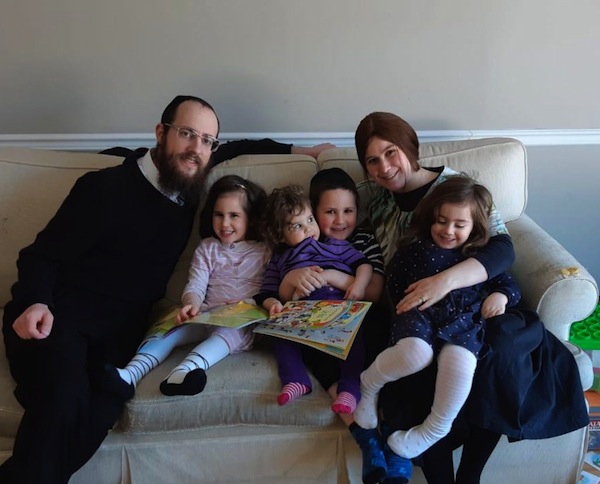
Rabbi Chanan and Tuba Chernitsky and their family before the couple had another baby this past spring. (photo from lubavitch.com)
In the fall of 2019, my husband and I traveled to Newfoundland to take in its beauty and bounty. Both of us had been to “the Rock” for work in previous years but had never had the pleasure of a real holiday in this unique part of Canada. As is always the case with our travels, we were very curious about whether, when and how there may have been Jewish life in this part of the world.
An internet search revealed that Spanish Sephardi traders began arriving in what is now Newfoundland after the English conquest of Eastern Canada in 1761. More than 100 years later, during the 1890s, Ashkenazim – peddlers, tailors, merchants and farmers – escaping Russian and Polish pogroms came to settle there. These peddlers and merchants traveled the island, trading salt fish and textiles. At one time, there was even a small textile industry in St. John’s, which attracted some of these former merchants.
By 1909, the first Hebrew congregation was incorporated. The first free-standing synagogue was built in St. John’s in 1931 but is no longer in use as a synagogue. At its peak, in the early 1970s, about 360 Newfoundlanders self-identified as Jews.
Postwar Jewish life
A 2014 article on melbourneblogger.blogspot.com, called “Canada: A History of the Jews in Newfoundland and Labrador,” speaks about various options proposed after the Second World War by the World Zionist Congress as possibilities for the settlement of Jews while the reestablishment of the Jewish homeland, Israel, was developing. Settlement in the outports of Newfoundland was apparently one of those options.
The same article refers to Robin MacGrath’s book Salt Fish and Shmattes: A History of the Jews in Newfoundland and Labrador from 1770, noting there were many missed opportunities to create a more substantial Jewish presence and contribution to the well-being of all Newfoundlanders in the 1930s and 1940s. One example was the refusal of the Newfoundland government – then ruled jointly by British and local commissioners – to address Newfoundland’s critical shortage of doctors by offering the possibility of immigration to German Jewish doctors who were willing to be housed in isolated fishing ports. The British and local Newfoundland government opposed admission of anyone who was not of British stock. One wonders how different and how much more safe outport life might have been had those who lived in these tiny hamlets had access to such medical support.
Current Jewish life
My research into Jewish connections finally led to the doors of the Chabad rabbi and rebbetzin, Chanan Chernitsky and his wife Tuba, who have made St. John’s their home for the last four years. Rabbi Chernitsky, Argentine by birth, came to St. John’s via Winnipeg, a place to which his family immigrated during one of the many economic declines in Argentina. Tuba Chernitsky is a Winnipegger by birth, raised in a religious family of 11 children. The couple married in Winnipeg, then moved to Montreal, where they spent a handful of years.
Settling in Newfoundland in 2017, with Chabad’s mission to bring Jewish life “to life,” has had its challenges but the Chernitskys – and their five children – have enjoyed a warm welcome from the community at large. Over a Shabbat meal at their home, my husband and I learned that other religious leaders in St. John’s have been generous, as well; for example, offering the rabbi office space and other supports until he can fully establish roots in the community.
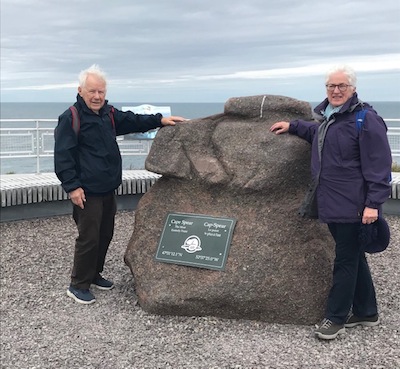
The writer and her husband, Ted Ramsay, at Cape Spear, the eastern-most point of Canada. (photo from Karen Ginsberg)
The number of Newfoundlanders who self-identify as Jewish is low. The population of Jews living in the province at any one time is partly a function of who metaphorically washes up on its shores – occasionally an academic on loan to Memorial University, a student undertaking a special course of studies, a government official working on a certain project or a businessperson with a unique product or service to develop.
Notwithstanding the relatively small Jewish community, the broader community’s interest in learning about Judaism is lively. During the Chernitskys’ first Chanukah, about 50 people came out to partake in the public candlelighting. The next year, that number trebled – some 150 people came out to get a sense of what Chanukah was all about for their Jewish neighbours.
In 2020, in order to comply with COVID restrictions, Chabad created a drive-in menorah lighting, which generated the largest turnout so far. The Chernitskys gained permission to use a local parking lot, had a radio frequency through which they could keep participants involved in the ceremony and they brought around sufganiyot (jelly doughnuts) to the cars so that families could safely enjoy this part of the celebration.
Both the rabbi and his wife make strong efforts to connect with any Jewish students studying at Memorial University. Before COVID, they also made themselves available to the occasional Jewish visitor who arrived with one of the several cruise lines that make a stop in St. John’s, and they plan to resume the practice as soon as the cruise ships once more operate.
The Chernitskys’ intention is to home school their five children, with Tuba as the teacher. In 2019, the couple started a small Hebrew school for their two eldest children and a few children from another Jewish family. During COVID, in-person activities had to stop but the school is expected to be underway again in September.
Brigus is a small fishing community located in Conception Bay. (photo by Karen Ginsberg)
In addition to home schooling their children, the Chernitskys also try to make sure that their kids attend various events, to mingle with other children and gain an appreciation for the history and culture of their new home.
The rabbi and his wife are planning for the future. A successful online fundraising activity this past year has provided sufficient financial support to move Chabad House, which is also their home, to a property closer to downtown and only a few minutes from the university. This means that observant Jews could more easily join them for Shabbat. They would like to continue to involve more of the larger community in their Chanukah celebrations.
A view on Newfoundland’s Skerwink Trail. (photo by Karen Ginsberg)
In the longer term, the Chernitskys hope to attract Jewish immigrants to Newfoundland from other parts of Canada, from Israel or elsewhere. Today’s Newfoundland is very different from pre-Confederation Newfoundland in its acceptance of newcomers. The province proudly welcomes immigrants and international students from any part of the world and sees immigration as a key component of its economic and labour market growth. Newfoundland’s relative affordability, along with the need for growth in its economy, most particularly its service sector, are reasons to be optimistic about that vision.
Beyond Jewish Newfoundland
Our car travels took us the length and breadth of the magnificent Bonavista Peninsula and the Irish Loop, another peninsula in southeastern Newfoundland, as well as to St. John’s. We enjoyed hikes on the Skerwink and East Coast trails. Everywhere we went, we enjoyed the remarkable beauty of Newfoundland’s landscapes and the warmth of our hosts. It was not until I was gazing out from the plane’s window on our return flight – when I could see more fully just how rugged the whole topography of the Rock is – that I really understood how resourceful each of the small outport communities, which lie at the end of every spit of land, has had to be. My visual from up above gave me an appreciation for how resilience has come to be bred into the DNA of Newfoundlanders.