Tackling the hatred head on

When white supremacists converged on Charlottesville, Va., four years ago chanting “Jews will not replace us,” it was the first encounter most of us had had with the conspiracy theory known as “the Great Replacement.”

In the pretzel logic of racists, immigration and multiculturalism are products of the Jewish imagination, with Jews perpetrating, through behind-the-curtains jiggery-pokery, what the tiny number of actual Jews in the world cannot do demographically: replace Aryan culture with alien races and cultures. The absurdity of the “theory” makes a lot more sense as one delves deeper into the trends and characteristics of antisemitism. Three wildly different but related books show that the projection of all that is wrong in society onto an empty vessel that happens to be Jewish recurs repeatedly. As ludicrous as the Great Replacement is, it dovetails magnificently with thousands of years of anti-Jewish prejudice and propaganda.

In Jews Don’t Count: How Identity Politics Failed One Particular Identity (TLS Books, 2021), author David Baddiel explores how the treatment of Jews is the exception to effectively everything today’s progressives espouse.

“It is a progressive article of faith – much heightened during the Black Lives Matter protests following the murder of George Floyd in 2020 – that those who do not experience racism need to listen, to learn, to accept and not challenge when others speak about their experiences,” he writes. “Except, it seems, when Jews do. Non-Jews, including progressive non-Jews, are still very happy to tell Jews whether or not the utterance about them was in fact racist.”
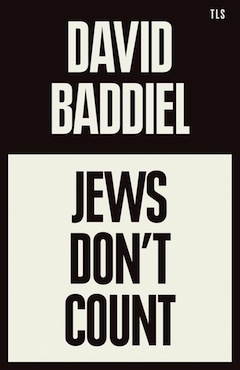
image - Jews Don’t Count book coverBaddiel discusses how racism and antisemitism are disentwined to disadvantage Jews, placing antisemitism lower on a “hierarchy of racisms” than other forms.

“Jews are stereotyped, by the racists, in all the same ways as the other minorities are – as lying, thieving, dirty, vile, stinking – but also as moneyed, privileged, powerful and secretly in control of the world,” he says. “And, if you believe, even a little bit, that Jews are moneyed, privileged, powerful and secretly in control of the world … well, you can’t put them into the sacred circle of the oppressed. Some might even say they belong in the damned circle of the oppressors.”

Baddiel confronts the canard that Jews can’t be victims of racism because they represent a religion, not a race – an audacious defining of an entire people by others who do not belong to the group, itself an example of something progressives would deign to do with no group other than Jews. By pushing antisemitism down the victimization scale, perpetrators can then accuse people who call out antisemitism as diminishing the experiences of minorities with legitimate claims to oppression.

When Baddiel called out one prominent antisemite, saying he had rarely heard so blatant a statement from someone with so large an audience, the perpetrator replied: “’Cos everyone was scared, that’s why.”

By alleging that a cabal of powerful Jews is policing the language of critics, the perpetrator, Baddiel writes, “isn’t a racist, he’s a hero, finally standing up and saying the things that need to be said even though it will bring down the wrath of this all-powerful Jewstablishment on his head.”

Similarly, when an article in the New York Times seemed like an attempt to rehabilitate the notorious antisemite Louis Farrakhan, the author replied to a critic who mooted the negative impact this could have on Jews: “Somehow, among the million concerns, you believe that yours are supposed to rise to the top.… That is called privilege.”

A recurring theme is that, unlike other minorities, Jews are not “innocent victims.” Baddiel (and the other authors mentioned here) do not explicitly say it, but it is understood that, for antisemites, Jews are not victims because, whatever the calamity, they bring it on themselves.

Another recent book, Israel: A Simple Guide to the Most Misunderstood Country on Earth by Noa Tishby (Free Press, 2021), picks up on some of Baddiel’s themes.

Tishby is an Israeli-American actor with a strong Zionist lineage. Her grandmother was a founder of the first kibbutz in Israel. Her grandfather was Israel’s first ambassador to West African countries and served on the Israeli delegation to the United Nations. Her great-grandfather was the founder of Israel’s ministry of industry and trade. Tishby served in the Israel Defence Forces entertainment troops, which she describes as, basically, “a nightly USO [United Service Organizations] tour.” She starred in an Israeli prime time soap opera – Ramat Aviv Gimmel, a sort of Israeli Melrose Place – then made the move to Hollywood.
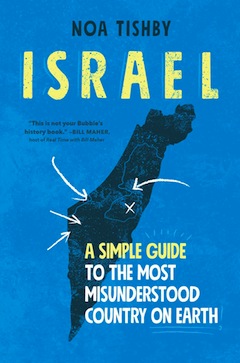
image - Israel book coverHer book is aimed at people of her demographic – young, hip, leftist (though presumably non-Jewish) readers – and she presents, through biography and history, a tidy Zionist narrative that hits the bases. She does what pro-Israel writers rarely do: she uses emotion and personal stories, rather than dogged reliance on facts, chronology and empiricism. This is not to diminish the fact-based foundation of the book, but her first-person narrative connects the reader to the land and people of Israel in a way that cold facts do not.

Tishby provides a simple but thorough overview of regional history and the development of Israel, as well as the parallel history of the Palestinian and Arab peoples in the area. She dissects the claims of the BDS movement one by one, debunking the prevailing leftist narrative in the West. She pillories the obsession of the United Nations with anything Israeli and rebuts allegations of colonialism, apartheid, ethnic cleansing, unequal warfare and occupation quite effectively.

She recounts how, in the years after the Second World War, there were roughly 11 million refugees worldwide, 700,000 of whom were Palestinian.

“The 10,300,000 non-Palestinian refugees were funneled into UNHCR (United Nations High Commissioner for refugees, created in 1951), the UN agency dedicated to resettling and integrating refugees and/or stateless peoples,” she writes. The Palestinians got their own unique refugee agency: the UN Relief and Works Agency for Palestine Refugees in the Near East (UNRWA).

“While UNHCR is constantly working on getting the global number of refugees down, with UNRWA the numbers go up, up, up,” Tishby writes. “After the 1948 war, there were approximately 700,000 displaced people. Now UNRWA has 5.6 million ‘refugees’ registered in their books. How is that possible?”

Even Palestinians living in Gaza and the West Bank are counted as refugees by UNRWA, she notes, asking: “Can you be a refugee from Palestine when you currently live in … Palestine?”

Near the end of the book, Tishby throws some questions at the reader: “How would you handle a wannabe Sharia state 30 miles from your house? How should Israel retaliate when Hamas fires thousands of rockets into southern Israeli towns? Why haven’t the Palestinians agreed to make a final peace deal? Will the PA unite with Hamas and, if so, will Hamas denounce violence, like, ever? Why is Israel singled out? What about other countries that actually do systematically abuse human rights? Why aren’t activists focused on their freedoms of religion, speech, and assembly, which Israel grants all her citizens? Where are the boycott movements of neighbouring countries that literally kill people for their beliefs, desire for freedoms and democracy, or sexual orientation?”

Tishby’s Israel is an engaging, entertaining read and an ideal primer for newbies to the subject. For those more immersed academically or through lived experience with this topic, there is little new information, but it is largely an enjoyable read although, in an effort to be hip and approachable, she routinely employs gratuitous profanities, which might grate on some readers.

Far from these two volumes on the scale of page-turning readability is the monumental tome Anti-Judaism: The Western Tradition by David Nirenberg (W.W. Norton & Co., 2013). Published eight years ago, it had somehow escaped my eye and, when I did get my hands on it, it sat for some time on my pile. Cracking the spine was daunting because the thesis is dark and unnerving.

Nirenberg undermines the received wisdom that antisemitism is characteristic of ideological extremes in Western civilization. Instead, he depicts “anti-Judaism” as absolutely central and foundational to the very identity of Western civilization. (He differentiates “antisemitism,” which is discrimination against Jews, and “anti-Judaism,” which is perhaps a more pernicious, guileful thing, attributing “Judaism” and “Jewishness” to anything undesirable, whether the object is Jewish or not.) Applying Nirenberg’s thesis to Charlottesville is a simple way of understanding it. In the eye of the racists, immigration and multiculturalism are bad, ergo, by definition, they are “Jewish,” whether actual Jews have any hand in them or not.
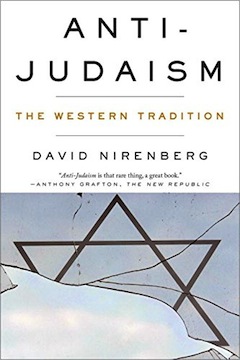
image - Anti-Judaism book coverNirenberg provides a sadly compendious recital of civilizations for whom “Jews,” “Jewishness” and “Judaism” were used as a prism through (and against) which non-Jews defined their own identities.

“Why did so many diverse cultures – even many cultures with no Jews living among them – think so much about Judaism? What work did thinking about Judaism do for them in their efforts to make sense of their world?” he asks.

In Christianity, Jews are viewed as “materialist” and earthly, which is juxtaposed with Christians’ self-image as being concerned with the spiritual and the divine. In a theology where things terrestrial are equated with all things evil, the corollary is predictable.

Nirenberg quotes Jean-Paul Sartre, who said: “if the Jew did not exist, the antisemite would invent him.” The subtext of Nirenberg’s book, one could say, is that both things are true: the Jew does exist and the antisemite invented him. There are, in effect, two different “Jews”: real Jews and the image antisemites have created and refined for millennia.

It is this latter imaginary “Jew” that has been used not only to torment generations of actual Jews, but also to contrive the self-identities of civilizations. Nirenberg includes both Christianity and Islam under the rubric of Western civilization when he writes: “anti-Judaism should not be understood as some archaic or irrational closet in the vast edifices of Western thought. It was rather one of the basic tools with which that edifice was constructed.”

Since Christianity and Islam were both founded as supercessionary religions to Judaism, juxtaposing that theological parentage with an antipathy to the descendants of the parent religion creates a cognitive dissonance that Nirenberg describes as the “truth of Jewish scripture and the falsity of the Jews.”

Somehow, adherents of both religions have intrepidly managed to accommodate the dissonance.

“The simultaneous inclusion and exclusion of Judaism became for Islam – as it had been for Christianity – a structuring principle of the world, one through which Islamic truth was explored, discovered and articulated,” he writes. Jews were “both necessary and noxious, prophetic and pernicious.”

The religious bigotry permeates Western civilization, not just its religion, he argues. Nirenberg discusses how Marx employed typical Christian perceptions of Jews as materialistic to fit his atheistic ideology. He also analyzes how it influenced the Enlightenment and the French Revolution. For example, while the Declaration of the Rights of Man and of the Citizen, the great document of the French Revolution, does not mention Jews or Judaism, “it was famously presented and represented to the people – in a painting and in print – as two new tablets of law, replacing those handed Moses on Mount Sinai.” Never mind Christianity and Islam, when it came time for what was probably the most progressive, liberal society yet in modern history to define itself, the revolutionaries took Jewish imagery and firmly demarcated themselves as “not that.”

What is striking when immersing oneself in volumes about antisemitism is the stark certainty of today’s “critics of Israel” that they are untainted with antisemitic bias. They apparently have given little, if any, thought or effort to learn the history of antisemitism and its myriad permutations.

While Nirenberg speaks very little about Israel, he packs a powerful punch when, after hundreds of dense pages excruciatingly dissecting how civilizations for thousands of years have understood their identities and their most significant beliefs in direct opposition to Judaism, he declares: “We live in an age in which millions of people are exposed daily to some variant of the argument that the challenges of the world they live in are best explained in terms of ‘Israel.’”

Coincidence? It doesn’t seem so to those have studied the history and malleability of anti-Jewish ideas.
Jewish life in Newfoundland

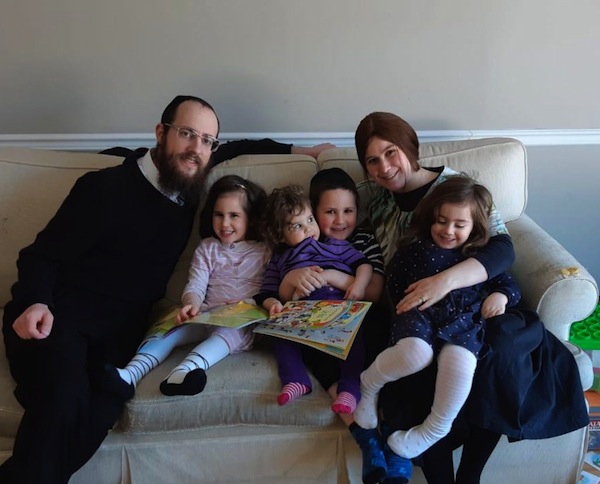
Rabbi Chanan and Tuba Chernitsky and their family before the couple had another baby this past spring. (photo from lubavitch.com)

In the fall of 2019, my husband and I traveled to Newfoundland to take in its beauty and bounty. Both of us had been to “the Rock” for work in previous years but had never had the pleasure of a real holiday in this unique part of Canada. As is always the case with our travels, we were very curious about whether, when and how there may have been Jewish life in this part of the world.

An internet search revealed that Spanish Sephardi traders began arriving in what is now Newfoundland after the English conquest of Eastern Canada in 1761. More than 100 years later, during the 1890s, Ashkenazim – peddlers, tailors, merchants and farmers – escaping Russian and Polish pogroms came to settle there. These peddlers and merchants traveled the island, trading salt fish and textiles. At one time, there was even a small textile industry in St. John’s, which attracted some of these former merchants.

By 1909, the first Hebrew congregation was incorporated. The first free-standing synagogue was built in St. John’s in 1931 but is no longer in use as a synagogue. At its peak, in the early 1970s, about 360 Newfoundlanders self-identified as Jews.

Postwar Jewish life

A 2014 article on melbourneblogger.blogspot.com, called “Canada: A History of the Jews in Newfoundland and Labrador,” speaks about various options proposed after the Second World War by the World Zionist Congress as possibilities for the settlement of Jews while the reestablishment of the Jewish homeland, Israel, was developing. Settlement in the outports of Newfoundland was apparently one of those options.

The same article refers to Robin MacGrath’s book Salt Fish and Shmattes: A History of the Jews in Newfoundland and Labrador from 1770, noting there were many missed opportunities to create a more substantial Jewish presence and contribution to the well-being of all Newfoundlanders in the 1930s and 1940s. One example was the refusal of the Newfoundland government – then ruled jointly by British and local commissioners – to address Newfoundland’s critical shortage of doctors by offering the possibility of immigration to German Jewish doctors who were willing to be housed in isolated fishing ports. The British and local Newfoundland government opposed admission of anyone who was not of British stock. One wonders how different and how much more safe outport life might have been had those who lived in these tiny hamlets had access to such medical support.

Current Jewish life

My research into Jewish connections finally led to the doors of the Chabad rabbi and rebbetzin, Chanan Chernitsky and his wife Tuba, who have made St. John’s their home for the last four years. Rabbi Chernitsky, Argentine by birth, came to St. John’s via Winnipeg, a place to which his family immigrated during one of the many economic declines in Argentina. Tuba Chernitsky is a Winnipegger by birth, raised in a religious family of 11 children. The couple married in Winnipeg, then moved to Montreal, where they spent a handful of years.

Settling in Newfoundland in 2017, with Chabad’s mission to bring Jewish life “to life,” has had its challenges but the Chernitskys – and their five children – have enjoyed a warm welcome from the community at large. Over a Shabbat meal at their home, my husband and I learned that other religious leaders in St. John’s have been generous, as well; for example, offering the rabbi office space and other supports until he can fully establish roots in the community.

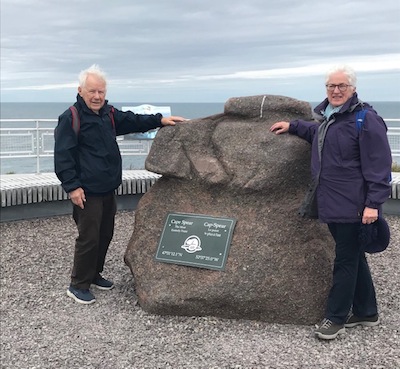
photo - The writer and her husband, Ted Ramsay, at Cape Spear, the eastern-most point of Canada
The writer and her husband, Ted Ramsay, at Cape Spear, the eastern-most point of Canada. (photo from Karen Ginsberg)

The number of Newfoundlanders who self-identify as Jewish is low. The population of Jews living in the province at any one time is partly a function of who metaphorically washes up on its shores – occasionally an academic on loan to Memorial University, a student undertaking a special course of studies, a government official working on a certain project or a businessperson with a unique product or service to develop.

Notwithstanding the relatively small Jewish community, the broader community’s interest in learning about Judaism is lively. During the Chernitskys’ first Chanukah, about 50 people came out to partake in the public candlelighting. The next year, that number trebled – some 150 people came out to get a sense of what Chanukah was all about for their Jewish neighbours.

In 2020, in order to comply with COVID restrictions, Chabad created a drive-in menorah lighting, which generated the largest turnout so far. The Chernitskys gained permission to use a local parking lot, had a radio frequency through which they could keep participants involved in the ceremony and they brought around sufganiyot (jelly doughnuts) to the cars so that families could safely enjoy this part of the celebration.

Both the rabbi and his wife make strong efforts to connect with any Jewish students studying at Memorial University. Before COVID, they also made themselves available to the occasional Jewish visitor who arrived with one of the several cruise lines that make a stop in St. John’s, and they plan to resume the practice as soon as the cruise ships once more operate.

The Chernitskys’ intention is to home school their five children, with Tuba as the teacher. In 2019, the couple started a small Hebrew school for their two eldest children and a few children from another Jewish family. During COVID, in-person activities had to stop but the school is expected to be underway again in September.

photo - Brigus is a small fishing community located in Conception Bay
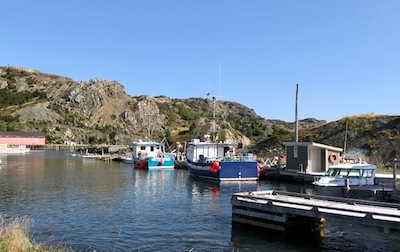
Brigus is a small fishing community located in Conception Bay. (photo by Karen Ginsberg)

In addition to home schooling their children, the Chernitskys also try to make sure that their kids attend various events, to mingle with other children and gain an appreciation for the history and culture of their new home.

The rabbi and his wife are planning for the future. A successful online fundraising activity this past year has provided sufficient financial support to move Chabad House, which is also their home, to a property closer to downtown and only a few minutes from the university. This means that observant Jews could more easily join them for Shabbat. They would like to continue to involve more of the larger community in their Chanukah celebrations.

photo - A view on Newfoundland’s Skerwink Trail
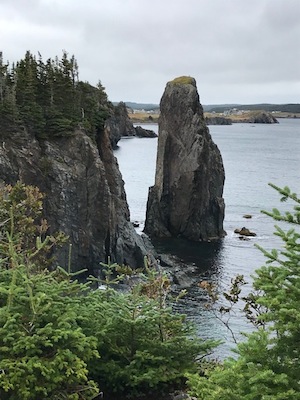
A view on Newfoundland’s Skerwink Trail. (photo by Karen Ginsberg)

In the longer term, the Chernitskys hope to attract Jewish immigrants to Newfoundland from other parts of Canada, from Israel or elsewhere. Today’s Newfoundland is very different from pre-Confederation Newfoundland in its acceptance of newcomers. The province proudly welcomes immigrants and international students from any part of the world and sees immigration as a key component of its economic and labour market growth. Newfoundland’s relative affordability, along with the need for growth in its economy, most particularly its service sector, are reasons to be optimistic about that vision.

Beyond Jewish Newfoundland

Our car travels took us the length and breadth of the magnificent Bonavista Peninsula and the Irish Loop, another peninsula in southeastern Newfoundland, as well as to St. John’s. We enjoyed hikes on the Skerwink and East Coast trails. Everywhere we went, we enjoyed the remarkable beauty of Newfoundland’s landscapes and the warmth of our hosts. It was not until I was gazing out from the plane’s window on our return flight – when I could see more fully just how rugged the whole topography of the Rock is – that I really understood how resourceful each of the small outport communities, which lie at the end of every spit of land, has had to be. My visual from up above gave me an appreciation for how resilience has come to be bred into the DNA of Newfoundlanders.

Karen Ginsberg is an Ottawa-based travel writer.

Ancient foods still popular

Dates being harvested from Hannah, a tree germinated from ancient seeds in Israel. (screenshot from arava.org)

The Mediterranean Diet is not a recent lifestyle development, but rather a form of eating going back to ancient times.

Based on the foods consumed by people living near the Mediterranean Sea, this diet contains lots of olive oil, legumes, unrefined cereals, fruits and vegetables. It includes fish and dairy products, such as cheese and yogurts. It allows for wine drinking and a bit of meat.

From the specialized field of Israeli agro-archeology, we can get an idea of what people once grew and ate – and a number of these foods are mentioned in the Torah.

In some instances, the sages understood why certain foods were healthy, as seen in this quote from Tractate Ketubot of the Babylonian Talmud: “Dates are wholesome in the morning and in the evening. They are bad in the afternoon, but, at noon, there is nothing to match them. Besides, they do away with three things: evil thoughts, sickness of the bowels and hemorrhoids.”

In September 2020, the Arava Institute harvested 111 very special dates – the first fruit of Hannah, a tree sprouted from a 2,000-year-old seed and pollinated by another ancient Judean date tree. Dr. Elaine Solowey, director of the Centre for Sustainable Agriculture of the Arava Institute, and Dr. Sarah Sallon, director of the Louis L. Borick Natural Medicine Research Centre of Hadassah Hospital, harvested these ancient dates in the culmination of a decades-long experiment to raise the biblical-era Phoenix dactylifera (date palm) from the dead. The date seeds were originally discovered in the 1960s, when Yigal Yadin excavated Masada.

And, in January 2021, Israeli archeologists published the discovery of thousands of olive pits off the southern coast of Haifa. These pits were embedded in stone and clay neolithic structures in a now-submerged area, but one that was probably once part of the northern coast. They date back to about 4600 BCE.

Tel Aviv University archeologist Dafna Langot points out that these pits were not from olives used for oil because, in the production of olive oil, the pits get crushed and, in this find, the pits were mostly still intact. The site’s proximity to the Mediterranean Sea may indicate that the seawater served to de-bitter, pickle and salt the olives. (To read the article “Early production of table olives at a mid-7th millennium BP submerged site off the Carmel coast [Israel],” visit nature.com/articles/s41598-020-80772-6. BP stands for “before the present.”)

There is no biblical reference to olive eating itself. But, at the ceremony in which Moshe’s brother Aaron and Aaron’s sons become the priests over the ancient Hebrews, they ate matzah with oil olive (Exodus 29:2). Indeed, olive oil seems to have the edge over olives as seen in R. Yohanan’s warning: olives cause one to forget 70 years of study, olive oil restores 70 years of study (Babylonian Talmud, Horayot 13b). Yet, in Numbers Rabbah 8:10, proselytes are praised using a comparison to olives: “just as there are olives for eating, preserving and for oil … so from proselytes came Bible scholars, Mishnah scholars, men of commerce and men of wisdom, men of understanding.”

Around the ancient Hula Lake – referred to by researchers as Gesher Benot Yaakov or GBY – Israeli archeologists have discovered different types of nuts, dating back to the Lower Paleolithic period (1.5 million to 200,000 years ago). Two types of pistachio nuts (Pistacia atlantica and Pistacia vera) are said to have been gathered there. (See “Nuts, nut cracking, and pitted stones at Gesher Benot Ya’aqov, Israel,” at pnas.org/content/99/4/2455.)

Pistachios are one of only two nuts mentioned in the Bible. Pistachios may have grown in the Garden of Eden (Genesis 43:11). Legend has it that the Queen of Sheba declared pistachios were to be enjoyed only by royalty, even decreeing that it was illegal for commoners to grow pistachio trees. The nuts were considered an aphrodisiac.

In the Middle East, both Muslims and Jews prepare pistachio-filled baklava for holiday celebrations.

photo - In biblical times, barley was used as fodder for donkeys and horses so, if a person ate barley, it was a sign they were poor
In biblical times, barley was used as fodder for donkeys and horses so, if a person ate barley, it was a sign they were poor. (photo by Alicja / Pixabay)

On the Gezer Calendar, which dates back to King Solomon’s era, the springtime months of Iyar and Sivan are noted as the time for harvesting barley, the first grain to ripen in Israel. On the status scale, however, barley was held in low regard. It was used as fodder for donkeys and horses (I Kings 5:8). Thus, in biblical times, if you ate barley, it was a sign you were poor. At recent Israeli archeology digs, onsite workers collected barley seeds from the epipaleolithic period, some 20,000 to 10,000 years BP.

In addition, Israeli archeologists have identified 1,000-year-old eggplant seeds. They found the seeds in cisterns located in an ancient market complex that was discovered in Jerusalem’s Givati Parking Lot dig, more or less across from the Old City’s Dung Gate. The cisterns apparently had been left behind in either cesspits or garbage pits and the eggplant seeds had neither rotted nor disintegrated. Researchers surmise that the market stall owners used garbage pits to hold their unused stock or to discard damaged produce. Eggplant seeds found in cesspits were seeds consumed and naturally eliminated.

Eggplants are well-traveled. According to the late Gil Marks, in his cookbook Olive Trees and Honey: A Treasury of Vegetarian Recipes from Jewish Communities Around the World, eggplants originated in India some 4,000 years ago. By the fourth century CE, eggplants arrived in Persia. From, there they were “picked up” by Arabs, who probably brought them to Spain in the ninth century. Claudia Roden writes in her book The Book of Jewish Food: An Odyssey from Samarkand to New York that Jews came to be associated with eggplant when they fled the Almohades and Almoravides and when the Inquisition banished them from southern Italy.

Seeing that pomegranates are part of the Rosh Hashanah table, I’ll close with some information about the ancient fruit, one of the seven species mentioned in Deuteronomy 8:8. The Roman Pliny the Elder, who died in the 79 CE eruption of Mount Vesuvius, also had something to say about this juicy fall fruit – he wrote that the wild pomegranate seed, taken in drink, is curative of dropsy (edema).

Pomegranate seed oil contains high concentrations of Omega 5, which is believed to be one of the most powerful antioxidants in nature. Prof. Ruth Gabizon and Prof. Shlomo Magdassi from Hebrew University and Hadassah Hospital are hopeful that their pomegranate seed oil research will lead to a way of slowing down or lessening the effects of degenerative brain diseases.

A 2020 report by other researchers, which was published in The American Journal of Clinical Nutrition (doi.org/10.1093/ajcn/nqz241), contends that pomegranate juice helps maintain visual memory skills in middle-aged and older adults. The authors of the study state that it could have a potential impact on visual memory issues commonly associated with aging.

The old Mediterranean diet continues to provide new promise.

Deborah Rubin Fields is an Israel-based features writer. She is also the author of Take a Peek Inside: A Child’s Guide to Radiology Exams, published in English, Hebrew and Arabic.

1,500-year-old artifacts

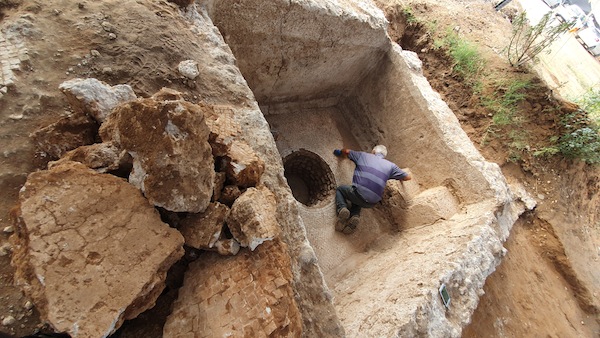
The winepress unveiled in Ramat Ha-Sharon. (photo by Yoli Schwartz, IAA)

An Israel Antiquities Authority (IAA) excavation has yielded evidence of human activity in the Ramat Ha-Sharon region from as early as 1,500 years ago. The excavation was prompted by Ramat Ha-Sharon Municipality’s plans to establish a new residential neighbourhood south of a holiday park slated to be built on the outskirts of Tel Aviv.

“The excavation unearthed evidence of agricultural-industrial activity at the site during the Byzantine period – about 1,500 years ago. Among other finds, we discovered a large winepress paved with a mosaic, as well as plastered installations and the foundations of a large structure that may have been used as a warehouse or even a farmstead,” explained Dr. Yoav Arbel, director of the excavation on behalf of the IAA. “Inside the buildings and installations, we found many fragments of storage jars and cooking pots that were evidently used by labourers working in the fields here. We also recovered stone mortars and millstones that were used to grind wheat and barley and probably also to crush herbs and medicinal plants. Most of the stone implements are made of basalt from the Golan Heights and Galilee.”

photo - A rare gold coin was unearthed in the dig
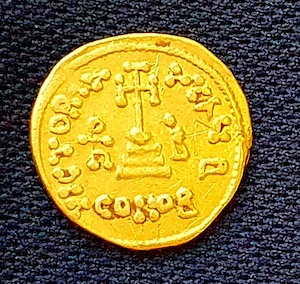
A rare gold coin was unearthed in the dig. (photo by Amir Gorzalczany, IAA)

One of the rare and unexpected finds retrieved from the excavation is a gold coin, minted in 638 or 639 CE by the Byzantine emperor Heraclius. On one side, the emperor is depicted with his two sons and the reverse shows a cross on the hill of Golgotha where, according to Christian tradition, Jesus was crucified. An interesting addition to the coin is an inscription scratched in Greek, and possibly also in Arabic. This is probably the name of the coin’s owner, who “marked” it as highly valuable property. According to Dr. Robert Kool, head of the IAA’s numismatics department, “The coin encapsulates fascinating data on the decline of Byzantine rule in the country and contemporary historical events, such as the Persian invasion and the emergence of Islam, and provides information on Christian and pagan symbolism and the local population who lived here.”

Another unusual find is a bronze chain that was used to suspend a chandelier containing glass lamp holders. Chandeliers of this type are usually found in churches.

Installations built at the site after the Muslim conquest in the seventh century CE include a glass-making workshop and a warehouse, where four massive jars were found. The jars, which were sunk into the floor, were evidently used to store grain and other products as a precaution against pests and damp conditions. “In this period, people were not only working at the site but also living there, because we discovered the remains of houses and two large baking ovens,” said Arbel. The pottery from this period includes complete pottery lamps for lighting, and local and imported serving ware, some of it decorated. Based on the assemblage of finds, the site continued to be inhabited until the 11th century CE.

Avi Gruber, mayor of Ramat Ha-Sharon, said, “I am thrilled by the finds and we have already started working with the directors of the Neve Gan North project on exactly how to integrate the current finds into the future neighbourhood…. As we plan heritage-related events for the upcoming centenary, this opens up a whole new perspective on how people once lived in this part of the country.”

“The Israel Antiquities Authority sees great importance in making the findings accessible to the public, in partnership with local and international communities,” said Eli Eskozido, director of the IAA.

“This is the first archeological excavation ever conducted at the site, and only part of it was previously identified in an archeological field survey,” added IAA Tel Aviv district archeologist Diego Barkan. “The Israel Antiquities Authority views this as an excellent opportunity to integrate the ancient remains into plans for the future municipal park.”

– Courtesy Israel Antiquities Authority

Teaching community’s kids

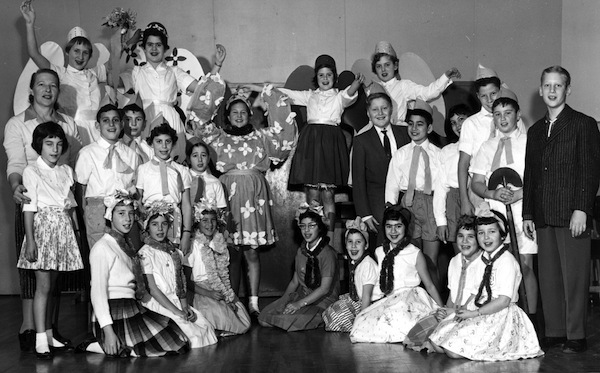
Congregation Beth Israel, children in costume, 1965. (photo from JMABC L.09778)

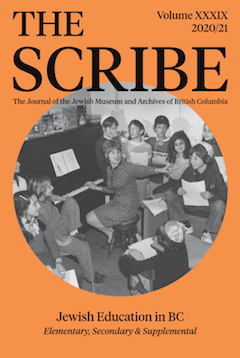
image - The Scribe book cover
The 2020/21 education-themed issue of The Scribe will be launched on Aug. 26.

The launch of the Jewish Museum and Archives of British Columbia’s latest edition of The Scribe will be held virtually on Aug. 26, at 7 p.m.  This year’s book features stories, photos and some almost-forgotten details about Jewish education in British Columbia. Join the Zoom to hear from local leaders in Jewish education both past and present who will give context to this significant subject.

Anne Andrew, past principal of Temple Sholom Hebrew School, and Emily Greenberg, current head of school at Vancouver Talmud Torah, will lead the discussion. Andrew will focus on her long involvement with the Jewish education scene in Vancouver and Greenberg will share her perspectives on where Jewish education is headed. Considering the impact teachers, educational institutions and curricula have on the continuity and cohesion of a community, both this panel discussion and this issue of The Scribe speak to important issues.

photo - Story time, conducted by Gamliel Aharon, Beth Hamidrash B’nai Jacob, 1976
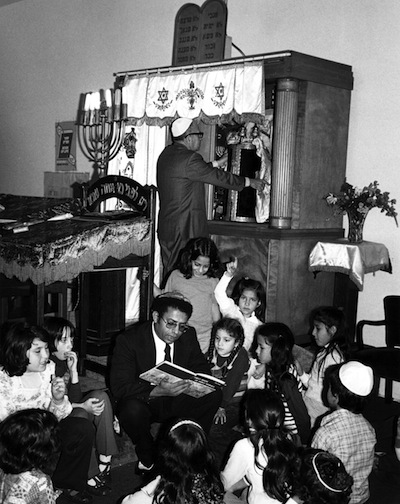
Story time, conducted by Gamliel Aharon, Beth Hamidrash B’nai Jacob, 1976. (photo from JMABC L.00155)

The 2020/21 Scribe features information from the community archives about Jewish education around the province, spanning some 100 years. In addition, there are oral history excerpts from dozens of community members about various programs that have been offered over those years. Even in the very early days of the Jewish community in British Columbia, no matter where Jews settled in the province, there were all kinds of arrangements for the transmission of Jewish knowledge, culture and identity.

Zoom attendees will hear about iconic educators who instilled a love of Judaism and community spirit. Those who attended Jewish school here will take a trip down memory lane, being reintroduced to teachers from their past.

For more information or to register for the free online book launch event or to get your own copy of The Scribe, visit jewishmuseum.ca/publications/the-scribe or call the museum office at 604-257-5199.

– Courtesy Jewish Museum and Archives of British Columbia

Love note across the divide

Eighteen years ago, when I lived in southern Israel, the region that is getting hammered by rockets as I write this, my boyfriend at the time – Muhammed – was a Bedouin Muslim, also living in the area. I went to visit my mother in Berkeley, Calif., for a month or so. During my visit, I was hanging out with a friend of mine, who had grown up a secular Jew, then married a religious Moroccan Muslim. She had been inspired by her husband’s religious devotion to explore her own religious tradition, starting to keep kosher, go to Orthodox synagogue, and so on.

She and I were driving through downtown Berkeley, when we got stopped at a red light. As it so happened, to the right of us was an anti-Israel demonstration and to the left of us was a pro-Israel demonstration. The crowds were shouting slogans, slogans that flew across the street, over our heads in the car, the two of us, Jewish women in relationships with Arab Muslim men. We turned to each other, held our gaze for a minute, then burst out laughing hysterically. When the light turned green, we took off, leaving the Arabs and Jews behind us, yelling at one another.

When we feel threatened, we can get into a defensive posture, Us-Them thinking, unproductive fact-flinging, conversations from the brain instead of from the heart. We can go around and around the same circle of thought and narrative, as, meanwhile, people’s lives are torn apart by trauma and tragedy. I believe that the path to peace is not through political conversations, but, rather, through emotionally intimate relationships with individuals – getting to know and care about them, listen to their stories, understand the complexities and nuances of their lives. So that there is no Us and Them, but rather, there is just Us, the human family.

Prior to my relationship with Muhammed, I was a very political person. I did not just attend rallies; I organized them. As an indigenous Middle Eastern Jew, the daughter of a refugee from Iraq, I certainly had a lot to yell about: I am a direct descendant of the people of ancient Israel, which was destroyed 2,600 years ago by the Babylonians, who took my ancestors as captives to Babylon – the land of today’s Iraq. My ancestors stayed on that land through the Arab-Muslim conquest of the region 1,300 years ago and up through the modern day, until shortly after the Farhud – the pro-Nazi wave of genocidal violence against Jews in Baghdad – following which, my family fled to Israel.

Despite the brutal violence, exile and traumatic uprooting my family endured, along with the material loss – all Jewish personal and communal property was confiscated and nationalized by the Iraqi government – and, despite the personal, intergenerational trauma that carried forward through the years, in Israel and the United States, my family story was invisible in public discourse about Arabs and Jews, in both the Arab and Jewish narratives. This was the case despite the fact that indigenous Middle Eastern Jews made up the majority of Israel’s Jewish population, and that there were 900,000 indigenous Middle Eastern Jewish refugees worldwide in the 20th century, with stories mirroring those of my family.

I spent 20 years of my young adult life devoted to getting these stories out there, with a mission of changing the way people think. I spoke at respected institutes, published in prestigious media, my work reaching the eyes and ears of tens of millions of people. Then, my thinking changed – not about the history or politics, which remained the same – but about what to do with the history and politics, how to interface with them.

Because Muhammed and I were together amid a volatile environment of Arab-Jewish enmity, we kept things apolitical in our relationship. Paradoxically, this led to what was perhaps the most political act of all: Arab-Jewish love, visible for others to witness. My neighbours went from cautioning me against dating Muhammed to asking if I was still with Muhammed, to asking how Muhammed was doing. They feared him at first, but then got to know him and care about him. Experiencing that transformation, in turn, made me realize that the simple things in life, the connection we feel in someone’s presence, can be more powerful and important than all the high-brow intellectual discourse in the world, the litany of things we may have to say, no matter how valid those things may be.

image - The author’s forthcoming album, Iraqis in Pajamas, includes songs in response to the violence in the Middle East
The author’s forthcoming album, Iraqis in Pajamas, includes songs in response to the violence in the Middle East.

In addition, after getting diagnosed with cancer and choosing to heal from it naturally, I radically shifted my values and priorities – with joy, peace and ease shooting up to the top of my list. As part of my transformation, I returned to my lost love of music and started writing songs that were deeply personal, from the heart, and, as far as I knew, entirely apolitical – leaving me surprised when, after a performance, a man told me not only that he loved my music but that it was very political. My music disarms people, he and others have told me, specifically because I have no agenda, no interest in persuading anyone of anything; rather, I am just sharing – my story, my life, my journey. The simplicity and space of it all allows people to open their hearts, listen and, ironically, after all those years trying to change people’s minds – transform the way people think.

I don’t know the solution to this conflict that has been raging on for decades, endangering the lives of my family and friends, Jews and Muslims alike. I do, however, know this: as individuals, we have the choice not to participate in divisive thinking, to instead use conflict as an opportunity to reach out to people across the divide and get to know one another, in the most basic human ways, whether playing basketball or playing music or going for a walk and enjoying the sunset. In our cynical world, putting love at the forefront of our consciousness may sound hokey or impractical. But, at the end of the day, I think it’s the only thing with the hope to effect change.

Loolwa Khazzoom (KHAZZOOM.com) is an Iraqi-American Jewish musician, writer and educator. Her work has been featured in top media, including the New York Times, the Washington Post and the Boston Globe. Her forthcoming album, Iraqis in Pajamas, with her band by the same name, includes songs in response to the violence in the Middle East.

A hard-earned +1 year

Every time I put together one of these special five-year anniversary issues, I am both thankful for and awed by the community’s commitment to this newspaper. Even though I have owned it now for a quarter of its existence (!) and have experienced everything it has taken to keep publishing it, I still feel like it’s a miracle that, while so many other newspapers have folded, the Jewish Independent continues.

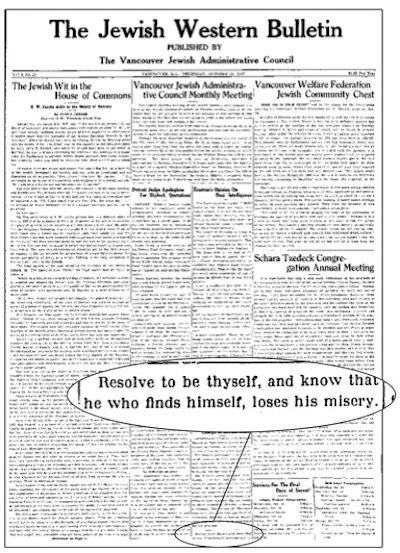
image - Cover of the Oct. 12, 1933, JWB
Cover of the Oct. 12, 1933, JWB

When I look back at old issues of the JI and the Jewish Western Bulletin, I get to see time move in almost an instant. In one sitting, I can follow the creation, the lifetime and, often, the transformation, or occasionally even the end, of a communal organization. I can see how a cohort of community members transitions into a whole new generation of dedicated volunteers and generous philanthropists. I can relate to the financial and other challenges that every former publisher and editor has gone through. I can feel the support of community leaders, readers and advertisers, who consistently have come to the rescue of a paper that has pretty much always been on the edge of solvency. I can share in so many people’s happinesses and sadnesses, their kudos and their complaints. I can appreciate the hard work of the paper’s publishers, writers and staff in every decade and that of countless community members, which has gotten us to today.

The community and the JI/JWB have survived the Great Depression, the Second World War, numerous recessions and other hardships. Currently, we are in the midst of surviving a global pandemic together. It has been a difficult year for all of us, to say the least. I’d be lying if I didn’t admit to having moments of despair and fear, and not just during COVID. I know how privileged and lucky I am, both personally and professionally, but, sometimes, I need reminding.

During this past year, as my few staff have switched to working at home or semi-retired, I have had more opportunities to speak and email with community members and others. While not a replacement for face-to-face encounters, it has been one of the pluses of this hard-earned +1 year of the newspaper, which had to postpone our special 90th anniversary issue until now. It is no exaggeration to say that we have only made it to 90+1 because of you. And not only your financial support, for which I am extremely grateful, but your indomitable spirit. We have pages to print because there are events to cover; classes, lectures and performances to attend; opinions to share; ambitious projects to promote; endeavours for which to raise funds; people offering help and people in need of assistance; people and milestones to celebrate; and losses to mourn. In this very newspaper you are holding in your hands or looking at on screen, there are stories on all of these aspects of our community.

Every time I prepare an issue of the JI, I’m buoyed by the promise that each paper holds – that there is a future, unknown as it may be, towards which we are all working. And, every time I look at past issues of the JIand the JWB, I am inspired by all that we’ve accomplished; by the no small feat that we are still here, showing up for one another and trying to make the world at large, or at least our small corner of it, a little bit better.

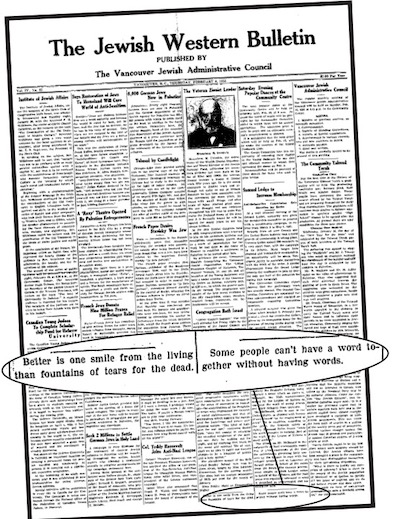
image - Cover of the Feb. 8, 1934, JWB
Cover of the Feb. 8, 1934, JWB

In my forays into the newspaper’s archives for this special edition, I came across, by chance, a few pithy sayings, no doubt intended to be motivational but, more pragmatically, to fill the small spaces that, in the olden days of typesetting, were hard to fill at the end of a column of news. From 1933 and 1934, they impart messages that could apply to any generation: “Resolve to be thyself, and know that he who finds himself, loses his misery”; “Some people can’t have a word together without having words”; “Better is one smile from the living than fountains of tears for the dead.”

I have no idea from where these aphorisms came, but they made me smile when I came across them. This newspaper never fails to surprise me. I just love it. And I thank all of you for helping me fill its pages and keep the presses rolling. May we all go from strength to strength.

A love of the school’s stories

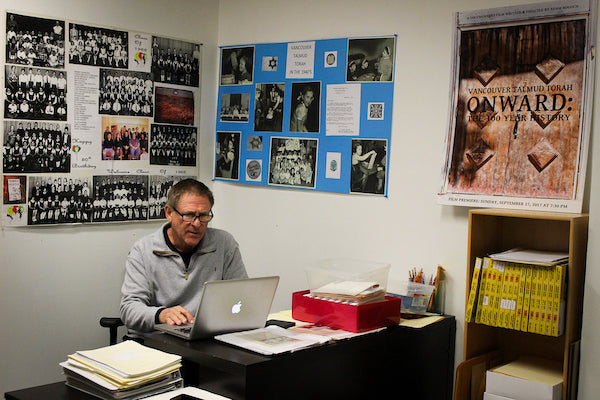
David Bogoch is keeper of the Vancouver Talmud Torah archives and chair of the school’s alumni fund. (photo from facebook.com/vttschool/photos)

David Bogoch is on the board of the Vancouver Talmud Torah Foundation. He is also the collector and keeper of the school’s archives. Previously, he was on the school’s board of directors for eight years – a position he took for a unique reason.

“At my dad’s shiva, the president of the board at that time, David Kauffman, tapped me on the shoulder and asked if I would be on the board at the school,” explained Bogoch about how he became involved. “At that time, with my father’s spirit in the room, I felt I had no choice but to say yes. Talk about timing.”

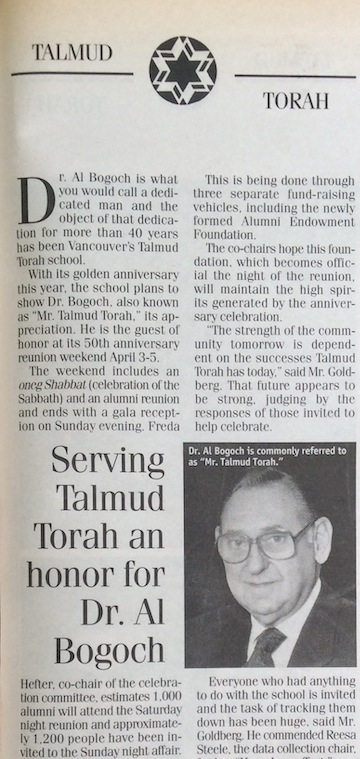
Dr. Al Bogoch was the guest of honour at Vancouver Talmud Torah’s 50th anniversary at its current location, in 1998. He was recognized for his more than 40 years of dedication to the school. He acted in many capacities over those years, including as president of the board of directors, as one of the founders of the VTT Foundation, which was established in 1974, and as a main driving force of four of the school’s expansions. On the occasion of the golden anniversary, the Alumni Endowment Foundation was launched.

In addition to his duties as archivist, David Bogoch is also chair of the school’s alumni fund.

“The board was portfolio driven, so I chose alumni,” he told the Independent. “I inherited the job from Carla van Messel. I figured it would be the least political and most fun. I knew at least 100 alum I could call and it all started from there.”

In going through the boxes in his father’s basement, Bogoch found tons of old Talmud Torah paperwork. “He had kept everything to do with his time on the board in the 1960s,” said Bogoch. “Other past presidents had given him their collections and, together, amassed a lot of what is in the archives today.

image - Vancouver Talmud Torah’s 50th anniversary, which honoured Dr. Al Bogoch, “Mr. Talmud Torah,” was the topic of this March 20, 1998, Jewish Western Bulletin article by Faith Bloomfield
Vancouver Talmud Torah’s 50th anniversary, which honoured Dr. Al Bogoch, “Mr. Talmud Torah,” was the topic of this March 20, 1998, Jewish Western Bulletin article by Faith Bloomfield.

“Today, the archive has thousands of photos and documents, from 1918 to the present,” he continued. “There are so many interesting stories which make up the 100-plus years of the school history. I looked up every issue in the library of the old Jewish Western Bulletin and the Jewish Independent to help tell the history of the school and the community of the times. Where would we be without the ability to search through the newspaper of old?”

While many stories have captured his interest, Bogoch said, “One story which caught my attention was in the board meeting minutes from 1944. The community wanted to build its own new Talmud Torah day school but were unable to because of lack of building supplies because of the world war. They also wanted to buy a school bus but couldn’t because of gas rations due to the war.

“Some people like jigsaw puzzles, others like bridge or golf,” he said. “My game of choice is the history of the school and all the people who either attended or were involved with the school. I love the good stories of friendship; I suffer when I hear the bad stories of tough times for students or parents or teachers. By knowing what has gone on in the past, I hope to impart those stories to the people of the present and the future, so we can try to avoid mistakes made before.”

Some of those stories are included in the one-hour documentary Vancouver Talmud Torah Onward: The 100-Year History. Written and directed by Bogoch’s son, filmmaker Adam Bogoch, the documentary was released in September 2017, as part of the school’s centenary celebrations. It can be viewed at youtube.com/ watch?v=ifoAqk3EKb0.

VTT obviously means a lot to David Bogoch, who also attended the school. “All of my lifelong friends came from Talmud Torah,” he said. “Most alum I come in contact with also share the same experience – our ties to the Jewish community stem from our shared experiences of school years. Between school, shul or camp, that is where we forge our community ties that bind.”

Bogoch is working toward making the VTT archives more widely accessible.

“The school,” he said, “is currently trying to put the photos and archival material on the school website so that everyone can search through and find the memories of their time, or of their family’s era.

The road of reckoning

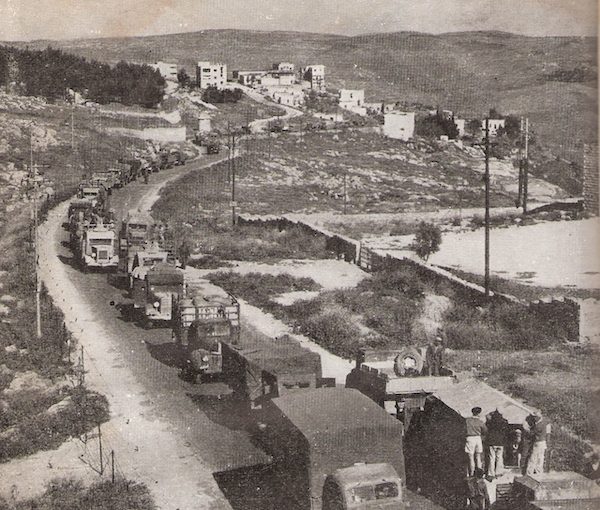
A supply convoy entering Jerusalem, 1948. (image from Shaar Hagai Heritage Museum)

Having just marked Yom Hazikaron and Israel’s 73rd anniversary, it is an appropriate time to recall a piece of Israel’s foundational history, and a new museum that commemorates it.

Seventy-four years ago, the road to Jerusalem was a site of easy ambush. Probably no part of the road was more treacherous than the area around Shaar Hagai. This spot, called Bab el Wad in Arabic, translates into English as the Gate of the Valley. As far back as 1868, French explorer Victor Guerin recognized and commented on this weak spot: he pointed out that the track was so narrow that “a determined band of men could stop an army in it with little difficulty.”

Admittedly, as you today drive on a smooth, paved, two-way, divided Jerusalem/Tel Aviv highway, it is hard to appreciate this reality. But, on Nov. 29, 1947 – the day after the vote on the United Nations Partition Plan, enabling the establishment of the Jewish state – Arab forces began blocking the route to Jerusalem. Not only were Jewish forces shot at, but, because the road curves, drivers couldn’t see where the road was blocked until they were trapped basically.

In David Dayan’s book Roadblock at Shaar Hagai: Creating a State (title translated from the Hebrew), Amos Kochavi recalled one such incident: “The time was approximately two in the afternoon. The long line entered the narrow and dangerous part. They could be anywhere…. We continued to climb … and there was a mighty explosion. The bomb under the road left a huge hole and the convoy stopped. Immediately, terrible shooting began…. We returned fire, but we couldn’t advance. Some of the drivers went into shock…. One driver with shell shock, screamed, ‘I can’t handle it anymore. I’m leaving.’ We yelled back: ‘Don’t move! You won’t come out alive!’ He didn’t hear, jumped from the car and was instantly killed.

“They tried to come down from the hills to get close to the cars, but our fire stopped them. They fire, we fire and the hours go by. No cars have air left in their tires. The number of injured grew. Shalom volunteered … he lay on the road, rolling – to avoid snipers – for a long hour … directing the drivers, one by one, until he had rescued all the cars…. An Australian captain ordered tanks that escorted us back to Gezer. The time was already two at night – 12 hours from when we entered Shaar Hagai.”

Jerusalem was under siege. Essential supplies could not reach the civilian and military population of the city. Jerusalem was dependent on supplies from the rest of the country, and was threatened with being totally cut off from the rest of the country. The only way to reach Jewish Jerusalem was to travel in convoy. (For more information, visit the National Library of Israel website, nli.org.il/en.)

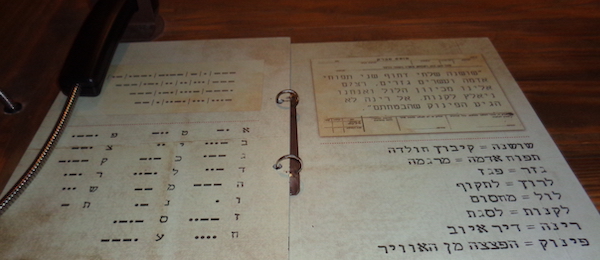
photo - A codebook for sending messages in the time of the siege of Jerusalem, on display at Shaar Hagai Heritage Museum. (photo from Shaar Hagai
A codebook for sending messages in the time of the siege of Jerusalem, on display at Shaar Hagai Heritage Museum. (photo from Shaar Hagai Heritage Museum)

According to the late Sir Martin Gilbert, by the spring of 1948, “Fewer and fewer Jewish food convoys were able to get through to Jerusalem. Towards the end of March, a food convoy failed, for the first time, to get through at all. One food convoy that did get through in March had taken 10 days to do so. By the end of the first week of April, there was only enough flour in Jewish Jerusalem to last for 30 days. Meat, fish, milk and eggs were unobtainable, except in small quantities, for children. The shortage of vegetables was such that children were sent into the fields to collect a weed … known as halamith, it tasted somewhat like spinach, and could be made into soup.” (See Jerusalem in the 20th Century.)

There was also a severe shortage of water. Three days before the state of Israel officially came into existence, the Palestine Post reported that “Jerusalem was still without water yesterday. The two pipelines from Ras el Ein, which were blown up by Arabs between Latrun and Bal el Wad on Friday, have still to be repaired. Crews are scheduled to leave under army escort this morning to continue repair work and, barring further trouble, repairs may be completed today. Water may be pumped into Jerusalem within a few days, according to one municipal official.” So grim was Jerusalem’s situation that archival photos show residents standing in long lines waiting to get their water ration and others rummaging through garbage, in the hopes of finding scraps of food.

Palmach fighters and, even more remarkable, simple truck drivers decided to do whatever they could to keep Jerusalem from being blocked. One now quite senior man, who drove a truck full of live fish for the Sabbath, was interviewed. He recalled looking out his side mirrors to see water streaming from the sides of the vehicle. The truck had been shot in numerous spots. Somehow, he managed to get to Kiryat Anavim, a kibbutz in the Jerusalem Corridor. There, women plugged up the bullet holes with rags. Probably, many of us would have considered giving up at this point, but this driver continued the slow climb to Jerusalem.

The fighters were mostly young people. A significant number were under the age of 18 (today’s conscription age). They came from all backgrounds, religious and non-religious, and from all parts of the country; some were Holocaust survivors. As a number of the fighters had been assigned the task of digging gravesites at Kiryat Anavim, they probably realized they might not survive on the road to Jerusalem.

It was crucial to find a different route for the convoys. Palmach soldiers discovered a detour that went through a hidden valley south of the heavily fortified fortress at Latrun and joined a path descending from Jerusalem. Using heavy tractors, the Palmach slowly cleared a path for vehicles. A water pipeline was also installed along it. The lifeline to the Jews in Jerusalem was secured, providing vital water and other supplies, in the summer months of 1948.

At the point where the road was most unsafe, there is a 19th-century Turkish-built travelers’ khan or inn. On March 23, 2021, Israel’s last election day, a memorial museum was opened at this historic location. The Shaar Hagai Heritage Museum is dedicated to the men and women who prevented Jerusalem from being disconnected in the days leading up to and even following Israel’s independence.

The museum deals less with the chronology of the battles and more with the physical and emotional difficulties convoy members faced, such as confronting dilemmas like whether the trucks should carry guns or food to besieged Jerusalem. There are displays of items used by the convoys, such as codebooks, handguns and rifles. And there are interviews with people who took part in the convoy operations, and part of the exhibit is animated.

Once we are again allowed to travel, the museum is worth a visit on your next trip to Israel. Allow at least an hour-and-a-half for the whole tour, which is recommended for viewers 10 years of age and older. The new museum requires visitors to make advance online reservations, and there are admission fees.

For Hebrew speakers, there’s a preview of the museum at parks.org.il/new/chan.

Deborah Rubin Fields is an Israel-based features writer. She is also the author of Take a Peek Inside: A Child’s Guide to Radiology Exams, published in English, Hebrew and Arabic.