“Jews have always turned and continue to turn to humour as a cultural touchstone and a way to make meaning,” said Dr. Jennifer Caplan, author of Funny, You Don’t Look Funny: Judaism and Humor from the Silent Generation to Millennials, which was published earlier this year.
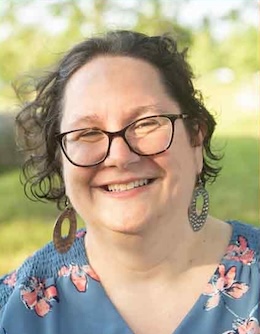
Dr. Jennifer Caplan spoke Dec. 3, as part of the L’dor V’dor lecture series organized by Victoria’s Kolot Mayim Reform Temple. (photo from Kolot Mayim)
Caplan, who is an associate professor and the Jewish Foundation Chair in Judaic Studies at the University of Cincinnati, was the second presenter of the 2023-24 L’dor V’dor (Generation to Generation) Zoom lecture series organized by Victoria’s Kolot Mayim Reform Temple. On Dec. 3, she spoke about the past several decades of Jewish humour. Similar to the approach she took for her book, her presentation explored the changing relationship to Judaism of four generations of Jewish funny people.
According to a 2013 report by the Pew Foundation, called A Portrait of American Jews, 42% of American Jews thought that having a sense of humour was integral to their Jewish identity, said Caplan. In the survey, in terms of what American Jews deemed important to their identity, a sense of humour came out far behind Holocaust remembrance and intellectual curiosity, just under support of Israel, and well ahead of belonging to a Jewish community or eating traditional Jewish food.
“The report set off little bells in my brain which pushed me to say that there’s something here and that there’s something I want to think about,” she said.
There were Jewish commentators who pointed to the Pew survey as an alarm bell for the dangers of the rise of cultural Judaism. To Caplan, the TV show Seinfeld, which premièred in 1989, encapsulated what worried some about the culturally Jewish experience.
“It was this group of people who seemed Jewish, even though Jerry (the title character) is the only character on the show who is actually Jewish,” she said. “They all sort of felt Jewish, but they never did anything Jewish and nobody ever went to synagogue and they didn’t even have a menorah like Rachel and Monica did in their apartment on Friends.”
In Caplan’s view, this fear of cultural Judaism aligned with the way that Jews were being portrayed in popular comedy and media, as Seinfeld led to a boom in Jewish sitcom characters – in shows like Mad About You and Anything but Love, for example. She thought there was something important in the way Jewish comedians were using Judaism in their humour to think about themselves and their Jewish identity, and what it means for them to be Jewish.
Moving forward to the present and, according to Caplan, one finds that the younger generation, the millennials, are even more culturally tied to their American generational cohort and less so to being the grandchild or great-grandchild of Jewish immigrants.
“It’s a story about comedy and it’s a story about the way that Jewish comedians have related to Judaism in their comedy, but it’s also a story about Americanization. It is a story about the way that Jews in the United States became more and more embedded within their broader cultural milieu,” Caplan said, explaining the thought process that led her to write her book.
Caplan pointed out that counterculture, in Jewish comedy, was represented in the 1950s – a time generally associated in the popular sense with Leave It To Beaver and The Adventures of Ozzie and Harriet – by books like those by Philip Roth. His works, well before the broader 1960s counterculture movement, were critical of institutions but defensive of the Jewish community – viewing organized religion as something that was hurting Jews, but seeing the need for Jews to be protected.
What intrigued Caplan was that the pendulum had swung in the other direction for Generation X. “What I found was a fascinating reincorporation of Jewish ritual into the writing and the movies and the comedy of Generation X comedians. Jews themselves are being made fun of, but their engagement with Judaism is actually the thing that humanizes them,” she said.
In the 2001 film Kissing Jessica Stein, for example, the characters can be perceived as stilted, neurotic, self-absorbed Jewish caricatures, yet scenes at a Shabbat dinner and a wedding ground the characters and are not the subject of ridicule.
“It’s not that Generation X suddenly believes in God more than the previous generations did. It’s that they believe more in the power of ritual and tradition because it binds you. You’re not doing it necessarily because you have some sort of theological belief,” Caplan said.
As for millennials, among whom the oldest in the cohort is presently 42 years old, their story is still being written, she said.
“It seems as though they are willing to ridicule both Jewish identity and Jewish religious interaction at various times, depending on what suits the comedy,” she said. “They neither have a sense of oppression about their Judaism, nor do they have a sense of embarrassment about their Judaism.”
Caplan is currently researching and writing her next book, Unmasked: Jewish Identity in Comic Books.
The next speaker in the L’dor V’dor series is psychotherapist and author, and member of the second generation, Rabbi Dr. Tirzah Firestone on Jan. 14. Firestone will talk on the topic Healing Intergenerational Jewish Trauma. For more information, visit kolotmayimreformtemple.com.
Sam Margolis has written for the Globe and Mail, the National Post, UPI and MSNBC.
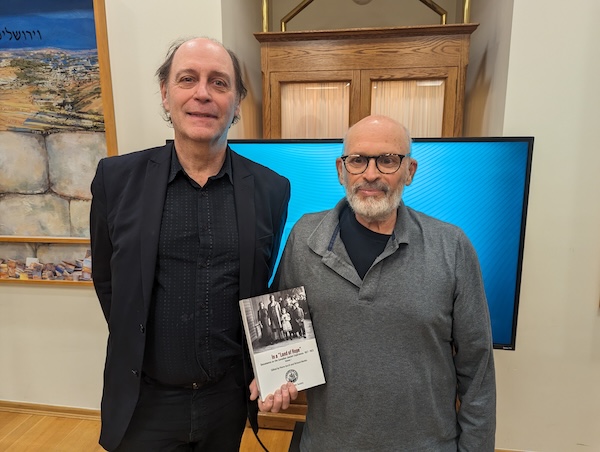
Pierre Anctil, left, and Richard Menkis with a copy of their new book, In a “Land of Hope”: Documents on the Canadian Jewish Experience, 1627-1923. (photo by Pat Johnson)
The first Jew known to have set foot in what is now Canada was Esther Brandeau, who arrived in Quebec City in 1738. Jews were forbidden from migrating to New France, but the young woman’s religion was not the only thing she was concealing. She was also dressed as a boy.
Interrogated by authorities on arrival, Brandeau was the subject of high-level consultations before she was sent back to France the following year.
Although they are certain there were Jews in the land that would become Canada before 1738, professors Richard Menkis and Pierre Anctil say Brandeau’s case is the first documented proof of a Jewish presence here.
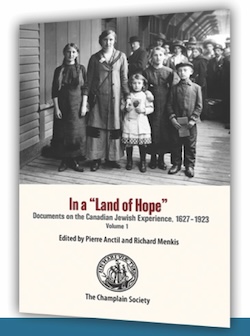
The historians shared Brandeau’s story at a book launch in Vancouver Nov. 21, following the annual general meeting of the Jewish Museum and Archives of British Columbia. Menkis, an associate professor in the departments of history, and classical, Near Eastern and religious studies at the University of British Columbia, and Anctil, a University of Ottawa history professor, co-edited In a “Land of Hope”: Documents on the Canadian Jewish Experience, 1627-1923.
The book spans three centuries through the lens of more than 150 documents, many of them never before published.
Menkis emphasized the efforts made to provide geographical diversity in the volume.
“If we want to appreciate the Canadian Jewish experience, we’ve got to move beyond – believe it or not – the borders of Quebec and Ontario,” he told the audience at Temple Sholom. “We have offered texts that represent the experiences from west to east. We offer an excerpt from the minute book of Congregation Emanu-El, in Victoria, recording a debate on whether to include the Freemasons in a cornerstone-naming ceremony. We have documents from the other ocean, from a controversy in Halifax, where the local SPCA argued that kosher slaughtering was cruel and that the local shochet (kosher slaughterer) was accordingly charged.”
Anctil, who is francophone, emphasized the uniqueness of the Jewish experience in Quebec and noted that shared interest between Catholics and Jews led to one of the first legislative acts of Jewish emancipation in pre-Confederation Canada. In 1832, the legislature of Lower Canada (later Quebec) passed a statute making British subjects who are Jewish equal under the law to all other British subjects in the jurisdiction.
“It’s a foundational document,” said Anctil. “It’s the first time that Canada and most British colonies allowed Jews to have political and civil rights.”
The motivation may have had less to do with Jewish rights – there were only about 150 Jews in colonial Canada at the time – than self-interest among French Catholics.
“They were Catholics living in a Protestant world and they knew that, if the Jews had more rights, the Catholics also had more rights,” Anctil said.
The Quebec education law of 1903 had lasting impacts on the province, especially for Jews and their place in the “distinct society.”
“The Quebec government decided that Jews would be considered Protestants for the purpose of education,” said Anctil, “and [Jews] were all sent to the Protestant school board of Montreal and did not receive a Catholic or French education, which proved problematic in the decades ahead.”
Brandeau, the young Jewish woman who tried to masquerade as a non-Jewish boy, was only the first documented case of Jews coming up hard against Canada’s explicitly or implicitly racist immigration laws. The theme runs through the 400-page book.
Canadian immigration policies reflected the agricultural dominance of the Canadian economy into the 20th century and, since most European Jewish migrants were not farmers, this was an inherent, if not unwelcome from the perspective of immigration officials, bar to many Jews.
The editors address Jewish farmers in the book – those who had experience in the Old Country as well as those who, successfully or less so, took to the land after migration – but prioritize the economic experiences of Jews in peddling, retail and the garment industry.
The preference for immigrants with farming backgrounds was an implicitly, possibly even unintentionally, anti-Jewish component of Canada’s immigration approach. Other examples were less subtle. It was not so much that legislation said Jews were not permitted to migrate, but that unwritten rules, “administrative refinements” or policies that were open to interpretation could be used to block Jews from entering the country.
There had been rumours of a deliberate anti-Jewish immigration policy, and Menkis said their research found evidence that instructions had been sent to immigration officials in Europe that Jews were to be considered undesirable applicants.
In 1923, an order-in-council was passed by the federal cabinet, which said that only farmers, farmworkers and domestic women servants would be allowed to immigrate to Canada, effectively closing the door to Jews and many other communities from the Balkans and Eastern Europe.
Anctil and Menkis pointed out that Jews were far from the only group excluded under Canada’s immigration policies.
“Asians and Africans – out completely,” said Anctil. “Almost nobody got in. In 1923, we have the Chinese Immigration Act, which made it extremely difficult for financial reasons for Chinese people to migrate to Canada. So, we had areally racist immigration policy until the ’60s, ’70s. Not just Jews.”
Many of the documents included in the book were translated into English by the editors, from the original French, Yiddish or Hebrew.
“It’s very important to work in four languages,” Anctil said. “English, French, Yiddish and Hebrew – there is no way of doing Canadian Jewish history if you leave one out. All these four languages are represented in the book and serve an essential purpose of allowing the full flavour of this story to be told.”
The pair’s decade of research for In a “Land of Hope” uncovered some unexpected treasures.
“Usually, we hear of social welfare from the minute books of established members of the community and their organizations,” said Menkis. “I was reading one of these minute books on one occasion in Toronto when a piece of paper dropped out.”
It was a desperate appeal from a woman seeking help from a Jewish women’s aid organization, specifically asking for chickens for the Passover seder.
“Please let me know if you’re going to send me the Paisez [Pesach] order and if you’re going to send me what you promised me,” read the handwritten letter. “I hope that you’re going to be kindly for my sick husband and my six little children because I just leave it to you and you should help because there is nobody to help accept [sic] you. I hope you won’t forget us and send us an answer right away. Because I could not tell you very much & That is the first time in my life that I should ask for help. But everything can happen in a lifetime. Yours […] Mrs. Green.”
The book closes in 1923 because that was a turning point in Canadian Jewish history and in the larger story of Canadian immigration. As a result of an economic depression following the First World War, nativist sentiments led to what was an effective end to large-scale immigration into Canada, itself a response to a parallel development south of the border.
“One of the reasons it happened in Canada was that they knew the Americans were closing down [open immigration] and they didn’t want to get all those Jews that the Americans weren’t accepting,” said Menkis.
A second volume of the work, picking up from 1924, is due to be released in 2026. Anctil said the unique experiences of Jews in Quebec will be even more pronounced in that book.
“The Jews living in Quebec faced a different situation than Jews living elsewhere,” he said. “The majority of [Canadian] Jews were in Quebec until the ’60s and it’s not only the French and Catholic issue, it’s the issue that the school system was separated between Catholics and Protestants and Jews could not find a place easily in the public school system.”
Bias against Jews also has a different strain in each of Canada’s official linguistic communities, Anctil added.
“Antisemitism among the French is not the same as among the British,” he said. “The logic’s not the same and the results are not the same. Often, when you read histories of Canadian Jewry, you have the impression antisemitism is all the same, whoever is antisemitic. It’s not true. [There are a] number of subtleties and complexities in that.”
In a “Land of Hope” was released by the Champlain Society, a publisher of scholarly Canadian books. This is the first book the society has published about a community that is not French or English in its 115-year history.
“I hope at least I’ve convinced you of the value of the book, without being crassly commercial,” Menkis said at the end of the presentation, adding: “Although, I do want to say that In a ‘Land of Hope’ would make a great Hanukkah gift.”
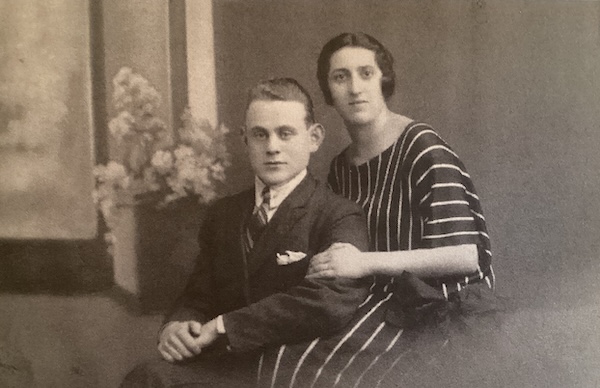
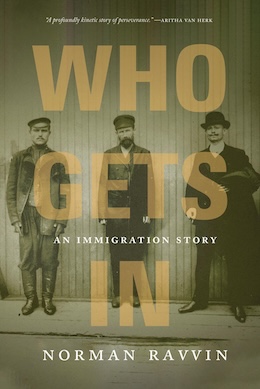
Author Norman Ravvin’s grandparents, Yehuda Yoseph and Chaya Dina Eisenstein, around the time of their engagement, in 1928. (photo from Who Gets In: An Immigration Story)
Relentless perseverance, continual pressure on select politicians and some key allies are what helped Norman Ravvin’s maternal grandfather, Yehuda Yoseph Eisenstein, finally bring his wife and two children to Canada from Poland in 1935, five years after he immigrated here. In a decade generalized as a time of “none is too many” with regards to Canada’s immigration policy towards Jews, Ravvin’s grandfather managed to get his family into the country.
In his new book, Who Gets In: An Immigration Story (University of Regina Press), Ravvin combines his novel-writing skills with his academic expertise to create an engaging memoir about his grandfather’s first years in Canada, one that is firmly situated in the larger context of what was happening at the national level at the time. An extensively researched book – with 10-and-a-half pages of sources – Ravvin’s style will make readers feel like they’ve come to know him a bit, as he allows his personality to be seen in the telling, though what is documented fact and what is conjecture or opinion is clear.
“My approach is to make nothing up. The story rides its own hard-to-believe rails,” says Ravvin on his webpage. “I present its narrative creatively, so readers relate to it on a personal level. Events and personalities from nearly a century ago remain fresh, telling and relevant to contemporary North American life.”
Ravvin does allow his imagination some space. He doesn’t know, for example, the exact reasons his grandfather left Poland, but he can surmise that rising antisemitism was one of them. Whether it was because his grandfather objected physically and publicly to a slur and became a marked man, or whether a rock was thrown into the family’s sukkah, Yehuda Yoseph Eisenstein’s response, writes Ravvin, “was to say ‘I can’t live with these people anymore.’ Or, as he would have said in Yiddish, ‘Ich ken mit zei mer nisht lebn.’ It’s good to hear some of these things in the language in which they took place. In this incident, the spoken words evoke the moment of decision with clarity and purpose.”
Eisenstein had three siblings who had already left Poland, with his younger brother Israel (Izzy) having settled in Vancouver. It was this brother who offered Eisenstein sponsorship and, while Canada was a much less welcoming place by 1930, “a single man could obtain a visa with a brother’s sponsorship.” The problem was Eisenstein had been married in 1928, without a civil licence, as he was already planning on leaving and knew that he would need to appear single to get into Canada. The illegality of the marriage and the misrepresentation of his marital status on his immigration application would cause Eisenstein much tsuris (distress) in getting his wife, Chaya Dina, and their children, Berel and Henna, to Canada as well.
Who Gets In is divided into two parts. The first is about Eisenstein finding his place in the country; the second is about his efforts to bring his family over. Ravvin wants to “paint a detailed picture of the time and place, with careful attention to Western Canada,” where his grandfather went, and he does this by talking about such things as the content of school history books in the 1920s, Canada’s immigration numbers and the country’s changingdemographics, the implications of government forms that asked immigrants to declare their “Nationality” and “Race or People,” how census data were being interpreted and used, the popularity of eugenics in Canada and beyond, the impacts of the Depression, and so much more.
Ravvin uses history not only to provide context for his grandfather’s experiences but also brings it into the present. Assimilability was a key consideration in assessing immigrants’ suitability in Eisenstein’s day and continues to be – current NDP leader Jagmeet Singh “was approached while campaigning and told that he should remove his turban to look more Canadian,” notes Ravvin.
Ravvin spends quite a lot of ink discussing various perceptions of what a Canadian should like and contemplating how his grandfather would have been considered. The cover of Who Gets In features a photo that was part of a newspaper article in 1910. The three men “appear as cutouts in a group of twelve ‘Types’ of ‘New-Comers’ from ‘Photographs Taken at Quebec and Halifax.’” From left to right, they are described as “Pure Russian, Jew, German.” As the landing form stripped Ravvin’s grandfather of his nationality – someone crossed out the typed letters “PO” and wrote in by hand “Hebrew” – so too is the Jew in this photograph stripped of his, observes Ravvin.
In setting the scene for Part 2 of the book – the bureaucratic fight his grandfather must undertake – Ravvin discusses the Indigenous peoples that inhabited the Prairies where his grandfather ended up. Eisenstein first went to Vancouver, where he hoped to stay and work as a shoichet (kosher butcher), but he was apparently seen as competition by Rev. N.M. Pastinsky, “who happened to be on the board of the Pacific Division of the Jewish Immigrant Aid Society (JIAS) and thus someone with whom one might not want to tangle.”
Eisenstein backtracked to Saskatchewan, living first in the farming town of Dysart and then in Hirsch. Ravvin talks about what Jewish life in rural Canada was like and some of the impacts that European settlement had on the Cree, Saulteaux and Assiniboine.
Ravvin starts the book with the story of the Komagata Maru – the chartered ship from India, full of immigrant hopefuls, mostly Sikhs, that was not allowed to land on the coast of British Columbia in 1914 and was instead forced to return to India, with disastrous results. He returns to the incident at the end of Part 1 to point out that one of the central (negative) figures in his grandfather’s life was A.L. Jolliffe, “who began his civil career in 1913 as an immigration agent in Vancouver,” playing a role in the handling of the Komagata Maru.
“By the 1930s,” writes Ravvin, “Jolliffe had ascended to the position of commissioner for the Department of Immigration in Ottawa. He is the closest thing to a bête noire in my grandfather’s story. If the much better-known doorkeeper, F.C. Blair, played any role in my grandfather’s struggle, he left no trace in any of the documents beyond a shared penchant for the use of pompous and hectoring language that appears in letters in my grandfather’s file.”
Jolliffe denies more than once Eisenstein’s applications for permission to bring his wife and children to Canada – in one instance, while expressly not recommending deportation, Jolliffe suggests that, if Eisenstein wants to be reunited with his family, he should return to Poland. Ultimately, Eisenstein is successful only because he has allies such as A.J. Paull, executive director of the JIAS, and Lillian Freiman who, married to influential merchant A.J. Freiman, had “remarkable access to the leaders of early-twentieth-century Canada.” She also did many amazing good works, including managing “Ottawa’s response to the flu epidemic in 1918 almost single-handedly.” Ravvin also positively differentiates the federal government, as led by R.B. Bennett, prime minister from 1930 to 1935, from that which succeeded it, the “none is too many” government led by William Lyon Mackenzie King as prime minister.
Eisenstein finally achieves his goal through an order-in-council – a decision made by the Privy Council, the prime minister’s cabinet – that “asserted its right to ‘waive’ determinations of an earlier order in which strict immigration regulations were brought into effect. This reflected an ability – understood to exist by those in the know – of the minister to ‘issue a permit in writing to authorize a person to enter Canada without being subject to the provisions’ of the Immigration Act, without interfering with the status of those provisions.”
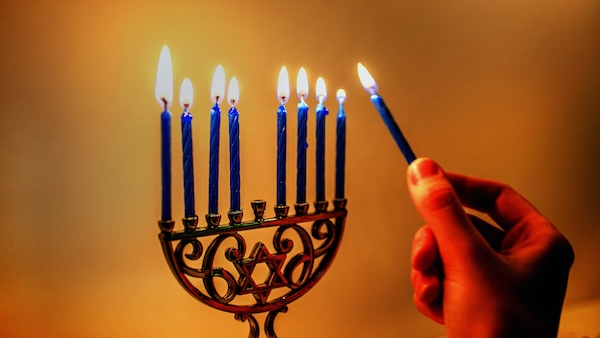
Hanukkah is a reminder that darkness can be transformed into light, and that miracles are possible.
With so much conflict, misery, anxiety and hopelessness in the world, we need some miracles.
There have been a few rays of hope in Israel in recent days – the release of hostages from Gaza has brought a world of relief to the families and friends of those freed and to Jews and others abroad. As a people, we will not rest until all those who have been kidnapped are returned home safely.
Even then, the war will likely continue, with the stated goal of eradicating Hamas. As catastrophic and heartbreaking as the war and the atrocities that sparked it have been, this is a single battle in a longer conflict that seems destined to go on, at least for the time being.
When we look at today’s events in the context of a larger history, it is understandable to conclude that things are not getting better, but worse. Silver linings in such a situation seem few and far between. To be honest, in this space we try to find something constructive and hopeful in every topic we confront, and it has rarely been more difficult than in the past two months.
As students of history, we can only offer this piece of hope: many times, in our individual lives, in the story of the world and in the 3,500 years of history of the Jewish people, seemingly intractable problems have been resolved in stunning and unexpected ways.
Consider three massive geopolitical examples that have happened in the living memory of most of us.
Many of us grew up under the shadow of nuclear catastrophe. Some of us may recall practising hiding under our desks in preparation for a nuclear explosion. All of us who are middle-aged or older certainly remember a world viewed as a binary of “us” (the capitalist West) and “them” (the communist East).
From the perspective of the child cowering under the desk, the idea that the defining global status quo would end not in a bang – the ultimate bang – but with the relatively peaceful dismantling of the Soviet Union and its client regimes, would have seemed unimaginable. The Cold War, which defined our worldview and, at times, threatened our very existence, ended peacefully more than 30 years ago. Just a short time before it did, nobody could have foreseen the unfolding of events.
Likewise, the end of the racist regime in South Africa and its apartheid institutions. One of the most venal systems ever imagined was ended not by bloody revolution, but by a relatively peaceful, collaborative transition to democratic majority rule.
A third example, the Irish conflict, understatedly referred to as the “Troubles,” largely ended with the successes of the Good Friday accords of 1998.
In all three of these instances, the resolution of what seemed like intractable, even existential, challenges were overcome with remarkably sudden and unanticipated events.
It should be noted as well that, in all three cases, events played out very much because of specific leaders who were involved, who took immense risks, were willing to compromise, and placed an immense amount of hope in the goodwill of their people to make their societies and, by extension, the world a better place.
We might say that we don’t see great figures on the horizon on either side of the conflict that presently consumes us with such intensity. But this is precisely the point. Vast historic changes have happened when least expected because movements and visionary individuals emerged and ushered in changes, upending the seemingly rigid status quo.
The Israeli leadership has promised that the current war will eliminate the terrorist autocrats who have run Gaza. The leadership in the West Bank is inevitably going to change before long as well, if only because the current president is aged 88.
Not incidentally, when this horrible war finally ends, Israelis will be undertaking a very serious review of recent events. It is entirely reasonable to expect significant changes at the top of both Israeli and Palestinian power structures in the very near future.
The truth is, in change there is hope. And, indeed, change is the only thing that is inevitable.
It might be also time to dig up an old chestnut from David Ben-Gurion, who said something that is relevant here not only because of the time of year – Hanukkah – but because of the time of history.
“In Israel, in order to be a realist, you must believe in miracles.”
If we fear “advertising” our identities, we should do everything we can to maintain our inner light and self-worth in trying times. (photo from PxHere)
Years ago, my husband lost both his grandmother and his great aunt. Several years apart, he traveled to the Lower East Side in New York to attend their funerals at the same funeral home. There was a rabbi there who officiated at both funerals. This rabbi told the same story twice. Perhaps he had only the one funeral teaching, but my husband remembered it. This rabbi suggested that a famous rabbi taught that the worst of the plagues against the Egyptians was darkness. Why was darkness the worst? It was all encompassing, overwhelming, and seemingly permanent. No one knew if the sun would ever return. This rabbi used this to talk about death, but the metaphor stayed with us.
Despite our efforts to find the source for this story, we couldn’t track down its origin. While looking for it, I thought about darkness and what we can learn from it as we celebrate Hanukkah this year.
There are parallels between the Hanukkah story and our current struggles. Before Oct. 7, Israelis were distracted by potential changes to their court system and very divided politically. While that political turmoil didn’t disappear in the face of the massacre and the war, Israelis have immediately united in the aftermath to work together. Israelis I know have said that it isn’t the government that is taking care of those who are displaced, but rather nongovernmental organizations and volunteers from every corner of Israeli society. Israelis are cooking meals for soldiers, for moms managing as single parents for long periods of time, and for those who have been evacuated or made homeless by the conflict. Israelis and the Jewish people worldwide have also worked together as a people to take care of one another.
The military conflict of Hanukkah is a story of division and unity. There were Jews at this time, around 200 BCE, who had become increasingly assimilated and Hellenized. They cooperated with the Seleucid Empire. There was societal upheaval. Others were more traditional in practice and offended by the changes made by more “liberal”-minded Jews and King Antiochus. The Maccabees represented the traditional or more orthodox Jewish tradition. They rose up against King Antiochus’s pagan practices and the more assimilated Jews who had adapted to Hellenistic practice.
We know now that the Maccabees won these battles. They rededicated the Temple in Jerusalem. This is a military victory and a story around religious or national liberation. The rabbis tried to focus the religious observance on the miracle of the light (the “ner tamid,” the holy flame in the Temple that should not go out) rather than on the military situation. However, we wouldn’t have Hanukkah without these historical cultural conflicts or the Maccabees’ wars.
The historical details of this struggle are in the books of the First and Second Maccabees, which describe the Hanukkah story. While there are many references to the holiday in the Mishnah, the detailed story has been maintained through the Catholic and Orthodox churches, which kept First and Second Maccabees as part of their Old Testament. Protestants don’t include these books in their bibles. We study these texts to understand Hanukkah, but they don’t hold any official status in Jewish tradition.
This, too, has a parallel to our modern experience. While we know our traditions around Hanukkah, some of the context comes from many historical texts preserved by others. During this war against Hamas, we are being forced to defend ourselves against antisemitism, and also to defend the existence of the state of Israel. The worldwide Jewish community doesn’t have to use our personal experiences to educate others about this. The historical contexts for understanding both antisemitism and the need for the existence of the state of Israel are embedded in world history. Learning about the historical roots of Christian antisemitism in Europe or in the dhimmi law of Islamic empires is part of the greater history. Information about when the Romans conquered Israel and destroyed the second Temple can be found in multiple sources, including on the Arch of Titus in Rome. The creation of the modern state of Israel in 1948 is also part of a much broader historical context.
The rabbis chose, in creating the rules around the holiday of Hanukkah, to focus on light and miracles rather than military victories. Rabbi Lord Jonathan Sacks (z”l) wrote in “8 Short Thoughts for 8 Hanukkah Nights” about the ways in which the light is emphasized. His fifth short thought focuses on Maimonides’ teaching about how to fulfil the mitzvah of Hanukkah. Maimonides teaches that lighting candles on Hanukkah is precious and that one must sell something or borrow to fulfil this commandment. Yet, if one finds Shabbat is coming and you have only one candle? Light it for Shabbat. In this case, Maimonides teaches: “The Shabbat light takes priority because it symbolizes shalom bayit, domestic peace. And great is peace because the entire Torah was given to make peace in the world.” Sacks suggests that, “in Judaism, the greatest military victory takes second place to peace in the home.” He points out the great victory is a spiritual and not military one.
For Israel today, too, the great victory must be the notion of continuing to pray and negotiate for peace while also navigating difficult military situations.
Sacks makes several points that could be articles on their own, but the ones I felt most drawn to remain relevant. The Hanukkah candles should be lit so that people can see them outside, but if one is afraid of inviting hate, it has long been taught that it is OK to light the candles indoors, out of public view. Still, we are meant to be public about our “light” more generally and fight for it, if necessary. If we fear “advertising” our identities, we should do everything we can to maintain our inner light and self-worth in trying times.
Finally, Sacks discusses a story in the Talmud in which Rav and Shmuel, third-century rabbis, disagree over whether you can use one Hanukkah candle to light another (if you lack an extra candle, a shamash, the helper candle, that is used to light the other eight candles). Rav suggests that you may not, as this might diminish the light of the first candle. Shmuel disagrees, and halachah (Jewish law) follows Shmuel, who teaches that you can use one Hanukkah candle to light another because it helps the light grow and brings us more light. Using your light to enlighten others is the best practice.
I bumped into a rabbi I admire who lives in Winnipeg, where I live. We were each dropping off kids at a Jewish youth group activity. He wore a ball cap, as he was “off duty.” I thanked him for his contribution to a news article about the war and local protests, and he responded, “These are dark times.”
Like the plague of darkness in Egypt, we don’t know exactly how or when things will lighten. We need Hanukkah’s message and rituals to offer that light. Maybe we won’t put our Hanukkah candles on public display this year, but we can draw wisdom and comfort from our long history and rabbinic teachings. These teach us to reach deep to find the messages of hope, faith and peace from a story about a war. This time around, we need to act individually like Hanukkah candles. We can lend our inner lights to volunteer, to speak out, to support others and to kindle others’ lights during a hard time. Even during times of war and hate, we can be the light.
Joanne Seiffhas written regularly for CBC Manitoba and various Jewish publications. She is the author of three books, including From the Outside In: Jewish Post Columns 2015-2016, a collection of essays available for digital download or as a paperback from Amazon. Check her out on Instagram @yrnspinner or at joanneseiff.blogspot.com.
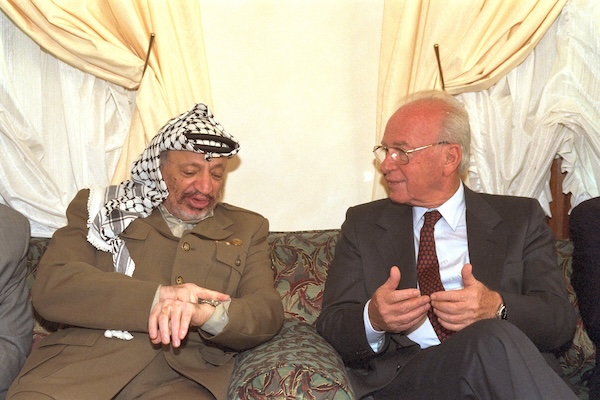
Prime Minister Yitzhak Rabin meets in Casablanca with PLO Chairman Yasser Arafat, 1994. (photo from flickr.com/photos/government_press_office/6324960139)
With all the darkness surrounding us since Oct 7, since the shattering of that tranquil Shabbat, have the people of Israel witnessed a miracle?
When Israel’s guard was fully down, when the south was under a vicious blitzkrieg by the monstrous Hamas, why did Hezbollah – with their 150,000 missiles pointed towards Israel – not exploit this excellent opportunity to open a second front? When Israel was existentially exposed, Hezbollah chose not to respond, at least not in any real-time, meaningful way. Complex geopolitical and military and conspiracy theories abound, attempting to explain why and why not. Pundits speculate and postulate and surmise. But maybe, just maybe, at some very esoteric level, the simplest and most logical answer, according to my close friend, a rabbi: it was a modern-day miracle. Pftt, pftt, pftt, as my great-grandmother would add.
***
The lights! Growing up, I was conditioned to shut the lights when leaving a room. I attempted to teach the same to my kids – and to my wife, although sometimes it seems she opens the lights when leaving a room. And then the missile sirens go off. Whoa! Slow it down. We have 90 seconds. Certainly time enough to shut the lights when racing to our shelter. My shouts muted by the screeching of the red alert, “Lights! Lights! Shut the lights!” I yell. To no avail, of course.
***
The day after … too soon to start thinking about it? That is where discussions about the war ultimately end up, each of us with our own theory, our own concerns, our own hopes. Once Israel achieves victory, in whatever form that takes, Gaza must then be rebuilt. But first it must be deradicalized – no more Hamas. Demilitarized – no more bombs hidden in schools, mosques and hospitals. And democratized – according to Winston Churchill, it’s the worst form of government … except for all others.
For this to succeed, Gaza should be divided into three cantons, similar to Germany, post-Second World War, each managed by a strong, Western or westward-looking country with enlightened self-interest for a stable and less radical Middle East. Maybe the United States. Maybe Britain. Maybe Germany. Maybe Egypt or Jordan. Escorted by a massive 21st-century Marshall-like plan. Maybe the Blinken Plan. Channeling the equivalent of $15 billion in 1948 purchasing power, that’s $191,569,917,012.48. OK, not that much, as the Gaza Strip is tiny compared to Germany, but enough funds to restore its economic infrastructure, to rebuild the Strip and rehabilitate its citizens, and make Gaza the Singapore of the Middle East – shipping, tourism, industry, maybe even offshore natural gas – like it could have become in 2005, when Israel fully withdrew. But then, what do I know.
***
Well before the day after, we need to take care of the Israeli hostages, including babies, children and octogenarians, both those still held in unknown condition by Hamas and other terrorists in Gaza, and those who have been returned. Interesting, but not necessarily surprising, is that neither the United Nations General Assembly nor UNICEF nor even the Red Cross demanded their unconditional release. Let alone a humanitarian visit.
As related by Liat Collins of the Jerusalem Post, Guelah Cohen – a 1980s right-wing parliamentarian, 2003 Israel Prize winner and mother of current senior Lukid lawmaker Tzachi Hanegbi – summarized this tragic situation best. Back during the First Lebanon War, when Tzachi was a combat solder, Cohen was asked what she would do if he were taken prisoner. She thoughtfully responded that, as a mother, she would be outside leading the protests to bring her son home, shouting with a megaphone outside the Prime Minister’s Office for the government to do anything and everything in its power to achieve his release. But, as a member of the government, she would be sitting quietly in the Prime Minister’s Office, advising him not to listen to the public.
Prime Minister Yitzhak Rabin, during the controversial days of the 1993 Oslo Peace Accords process and accompanying Palestinian terror, said, “We must fight terrorism as if there’s no peace process and work for peace as if there’s no terror.” How utterly profound.
So, with the tragic circumstances of the hostages, the government must listen to the cries of the hostages’ families. But they also must lead and not be swayed by public opinion. The government must fight the war on Hamas as if there were no hostages and must, at the same time, bring all the hostages home. Alive.
***
As for economic recovery, I share a very micro, personal anecdote. About 18 months ago, we redid our condo, buying much of our furniture from BaKatzer, a wonderful and unique boutique furniture store located in a moshav (agricultural community) just outside the Gaza periphery, not too far from Ashkelon, which receives the brunt of the rockets from Gaza. While not the easiest of customers – I can be very demanding on price and service – I recently sent the owner a WhatsApp message. “Hey!” I wrote. “Hope all is well during these difficult times and hope to be back soon for more shopping.” Given my unforgiving consumerism, maybe she saw that as another threat. Alas, I can also be a very loyal consumer.
***
And there we were, my wife and I sitting around our Shabbat table with my daughter and her best friends, one with a brother who is a paratrooper and fighting in Gaza, the other an intelligence officer whose service was just extended, and still another, who was on a weekend leave from his Golani unit stationed up north. The conversation quickly moving from the trivial and benign to questioning and
responding to issues and concerns that should be far away from them, that should not trouble the young minds of these 20-somethings, who should not deal with the complexities of miracles and hostages and day-after theories. Alas, there we were, talking of war and survival, looking hopefully to tomorrow. Am Israel chai.
Bruce Brown is a Canadian and an Israeli. He made aliyah … a long time ago. He works in Israel’s high-tech sector by day and, in spurts, is a somewhat inspired writer by night. Brown is the winner of the 2019 AJPA Rockower Award for excellence in writing, and wrote the 1998 satire An Israeli is…. Brown reflects on life in Israel – political, social, economic and personal.
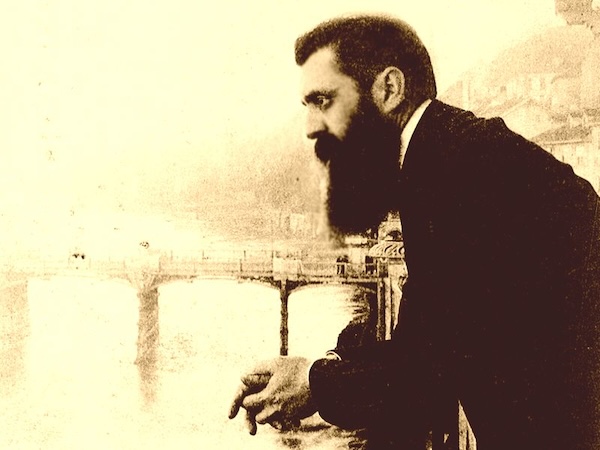
Theodor Herzl, during the First Zionist Congress, in Basel, Switzerland, 1897. (photo from mfa.gov.il)
Sometime before 1223, the first bridge spanning the Rhine River at Basel was constructed, funded through a loan to the town’s bishop by a Jewish moneylender. The bridge was a significant factor in the development of trade in the strategically located city, which is in northern Switzerland, near what are now the German and French borders.
The bridge lasted almost 800 years and was replaced between 1903 and 1905. There may be only one photograph in existence in which the original bridge can be seen – a photograph with another very significant Jewish connection. It is believed that the only place one can see the original Middle Bridge, or Mittlere Rheinbrücke, is in the famous shot of Theodor Herzl in a moment of contemplation outside the First Zionist Congress in 1897.
The bridge provides a sort of bookend to the Jewish story in Switzerland. While the bridge stood eight centuries, the history of Jews in Switzerland proved far less stable than the stone Mittlere Rheinbrücke.
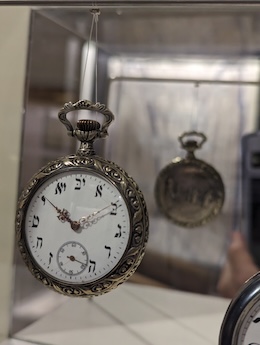
A pocketwatch with Hebrew characters and an engraving of the Western Wall on the reverse. (photo by Pat Johnson)
Switzerland has a rightful reputation for natural magnificence – rolling green meadows, massive snowcapped mountains, glacial streams and rivers – as well as political stability and neutrality that have made it home to a host of international nongovernmental organizations and United Nations agencies. The prevalence of cheese and chocolate also give it a delicious reputation. History is not so agreeable.
Some of that history is told in Basel’s small but impressive Jewish Museum of Switzerland. When the institution opened in 1966, it was the first new Jewish museum in the German-speaking world since the Holocaust.
Basel itself holds a special place in Jewish history – for better and for far worse. Herzl, credited as the founder of political Zionism, was not one for false modesty. After his debut as convenor of the 1897 conference, he declared: “At Basel, I created the Jewish state. In five years, perhaps, and certainly in 50, everyone will see it.”
Herzl himself did not see it. He died in 1904. But, indeed, 50 years on, the United Nations passed the Partition Resolution and, a year after that, the state of Israel was created.
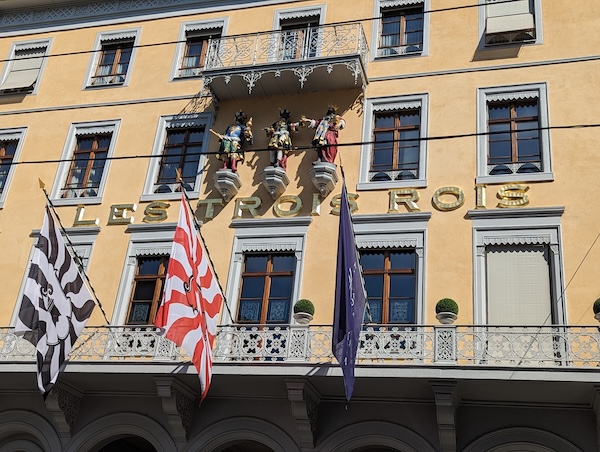
The Three Kings Hotel, Basel, site of the First Zionist Congress, 1897. (photo by Pat Johnson)
There are probably only about 1,000 Jews in Basel – there are around 20,000 in all of Switzerland – yet Basel stands out not only as the birthplace of the modern Zionist movement and home to the national museum of Jewish life and culture, but also has hosted the Zionist Congress 10 times, more than any other place.
Sadly, Basel is also on the Jewish historical map for far less rosy reasons. In 1349, an estimated 600 Jews were burned at the stake in Basel and 140 children were forcibly converted. This was just part of a series of pogroms in the 12th and 13th centuries across Switzerland, some based on blood libels or motivated by allegations of well poisonings at the time of the Black Plague.
Switzerland may have a reputation as being exceptional in Europe – neutral in foreign relations, and not a part of the European Union or most other multilateral bodies – but human-made borders and the majestic Alps seem to have done little to protect Swiss Jews from the horrors that have befallen coreligionists elsewhere on the continent across centuries.
As in other places, Swiss Jews were limited by law as to the professions they could pursue. A range of deliberately demeaning regulations were in place, including homes built with separate doors for Jews to enter. Jews were forced to pay what amounted to protection money to authorities.
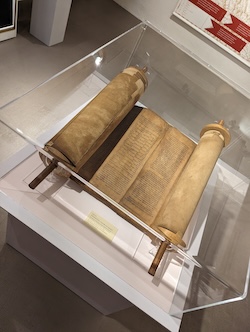
A Swiss Torah scroll at Jewish Museum of Switzerland, Basel. (photo by Pat Johnson)
Early in the 17th century, almost all Jews were expelled from Switzerland. Physicians were a professional exception and Jews were allowed to remain in just two villages.
After Napoleon invaded Switzerland, a series of political reforms began, some better and some worse for Jews.
Jews were formally permitted to settle anywhere in Switzerland after a referendum in 1866 resulted in a slight majority of Swiss endorsing equal rights for Jews. (The Swiss have a mania for referendums, even on issues of basic human rights.)
Migrants then came from middle and eastern Europe, especially after pogroms in Russia in the 1880s. More came from Germany after Hitler came to power, in 1933, but Switzerland, like the rest of the world, eventually slammed the doors shut, in 1938.
Swiss banks, with their uniquely secretive policies that protect the illegal and immoral, have been forced to reconcile, to an extent, with their complicity with the Nazis, as well as their profiteering from the assets of Jews who, because of the Holocaust, never reclaimed assets they had deposited for safekeeping as turmoil roiled their homelands.
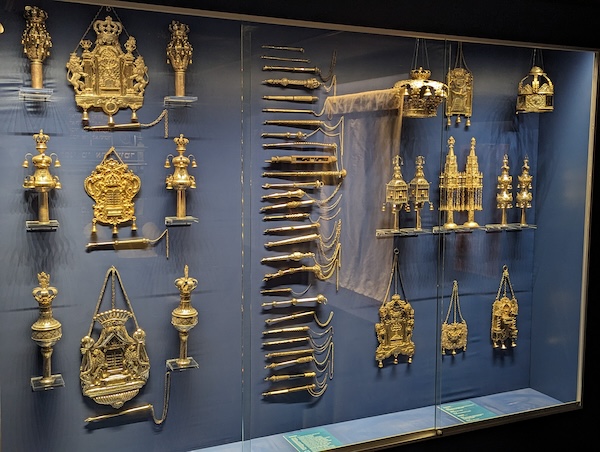
The Jewish Museum of Switzerland’s display of Torah crowns and breastplates, and yads (pointers used to help read the text). (photo by Pat Johnson)
Seemingly an oasis of stability and reason in a continent aflame in fascism, Switzerland nevertheless was steadfastly determined to prevent Jews from finding haven there. After the Anschluss, when Hitler’s army invaded and absorbed Austria, Jews from that country desperately tried to enter Switzerland, but mostly were met with rejection. Likewise, after the Nazis swamped France and the Low Countries, refugees from those places were similarly spurned.
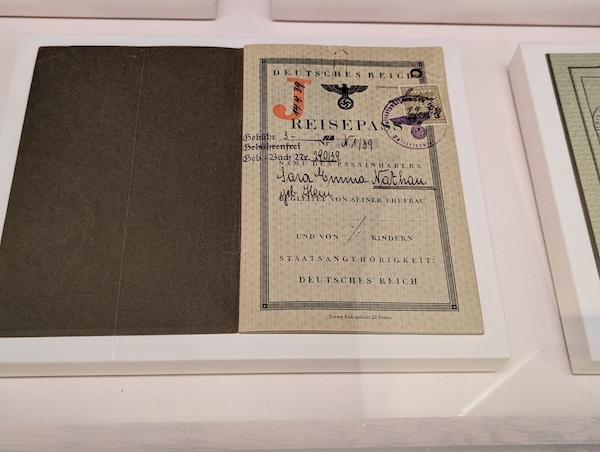
In all, about 23,000 Jews were admitted to Switzerland – but only as a country of transit. The Swiss authorities even prevailed upon the Third Reich – successfully – to stamp German passports issued to Jews with an unmistakable scarlet letter “J” to make it easier to identify and reject potential Jewish border-crossers.
Swiss authorities prevailed upon the Third Reich – successfully – to stamp German passports issued to Jews with a “J” to make it easier to identify and reject Jewish refugees. (photo by Pat Johnson)
In the 1990s, as Swiss actions during the Second World War and the Holocaust were the subject of international attention, a backlash to this critical historical assessment led to an upsurge in antisemitic rhetoric and what a study indicated was a substantial reduction in inhibitions against racist expressions toward Jews. More recent public opinion polls suggest the Swiss are among Europe’s most antisemitic populations.
An old and unresolved sticking point for Swiss Jews has been the banning of kosher slaughter, which was outlawed in 1874 and remains prohibited to this day. Since 2002, the Swiss government has allowed the importation of kosher meat, but ritual slaughter remains illegal.
For all its significance in Zionist history, Basel appears to have no commemorative plaque or similar tribute marking either its centrality in the birth of the modern Zionist movement or of Herzl’s association with it, although the museum celebrates the connection.
The Jewish Museum of Switzerland is located in a nondescript side street about a 20-minute walk from the Basel train station. It is open Monday to Thursday, 1-4 p.m., and Sundays, 11 a.m.-5 p.m. The permanent exhibition explores Jewish culture, religion and history through an impressive assemblage of ritual objects, documents, household items and testimonies. The current exhibition, Literally Jewish, which runs into next year, explores how Jews have been perceived depending on the time, language and attitude, including, as the introductory material says, “from derogatory to valourizing, ideological to idealizing.” Adult admission is 10 Swiss francs – about $15.50 Canadian – making it one of the more affordable attractions in a country where everything is gobsmackingly expensive.
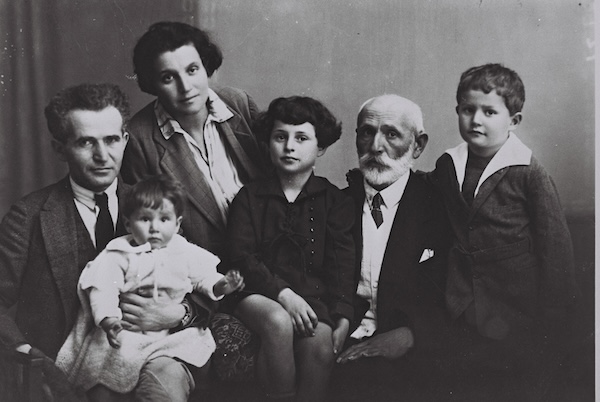
The Ben-Gurion family in their Tel Aviv home, 1929. From left: David and Paula with youngest daughter Renana on Ben-Gurion’s lap, daughter Geula, father Avigdor Grün and son Amos. (photo from National Photo Collection of Israel / Government Press Office)
David Ben-Gurion, who died 50 years ago, insisted Israelis needed Hebrew names. The process was controversial – but the outcome is clear.
The 50th anniversary of the death of David Ben-Gurion will be marked Dec. 1. The first prime minister of Israel is generally remembered in noble terms, though we live in an era when heroes are being toppled from their plinths. His actions in times of war and peace have been parsed by historians – fairly and unfairly, as seems inevitable – but Ben-Gurion’s legacy among Zionists appears generally secure. Those with ideological axes to grind will grind, but the esteem in which most Israelis and overseas Jews view “the Old Man” remains largely favourable. However, an aspect of his policy that affected people in a very personal way has come in for a reconsideration in the past couple of decades, though it is hardly the stuff that will make or break a reputation. It is the Hebraization of names.
Ben-Gurion was a fierce advocate of Israelis (or, before 1948, Palestinian Jews) adopting names that reflect their new reality and that, by extension, turn their backs on the past and the diaspora. Ben-Gurion himself was born David Grün (or Gruen), changing his name to the Hebrew Ben-Gurion (son a lion cub) in 1910. By 1920, at the latest, he had become an evangelist for Hebraizing names and, when he was in power, he insisted that leading military and political figures adopt Hebrew names.
Ben-Gurion did not start this trend – though he is perhaps most closely associated with it because he was in a position to make it the force of law and custom. He instituted an administrative order that senior military figures and diplomatic officials representing Israel abroad must have Hebrew names. Others, like Golda Meir, he browbeat into the change.
Of course, Jews – and others – have been changing their names since the dawn of migration. People have frequently altered their names when moving to a new society, in order to fit in. Iberian Jews migrating en masse to the Low Countries after the expulsions of the 1490s are an early, well-documented example. Jews arriving on North American shores routinely changed their names, but so did non-Jewish migrants. It was not necessarily (or only) antisemitism that name-changers sought to outrun, but differentness in general. There are stories of French newcomers changing from Boisvert to Greenwood.
Dara Horn, in her book People Love Dead Jews, emphatically debunks the long-held belief passed down by generations that their family names had been changed at Ellis Island (or whatever entry point was appropriate to the story). No, she argues, that didn’t happen. The changing of names by Jewish new Canadians and Americans was, she contends, done by the migrants themselves and represents a sad realization that the Goldene Medina might not be the refuge from antisemitism they had hoped.
But changing one’s name to fit into a society already in progress, like America’s, was different than the situation of arriving in the pre-state Yishuv. This was not a matter of looking around for a local-sounding name and changing Moses to Murray or Lipschitz to Lipson. This required inventing a whole new lexicon of names. It was not the act of taking a common name in the new place, but of inventing entirely fresh first and last names.
The process was a legacy, ultimately, of Eliezer Ben-Yehuda (né Perlman), who was the driving force behind the revival of Hebrew as a vernacular language. After making aliyah in 1881, he came to believe that the redemption of both the people and the land of Israel required a new language to replace Yiddish. This represented a rejection of the diaspora reality and mentality, and served to create a medium through which an eventual (hoped-for) ingathering of exiles from around the world, including places where Yiddish was not the Jewish lingua franca, could communicate. The revival of an ancient land would coincide with the revival of an ancient language, both modernized to meet the needs of a new type of Jew. Ben-Yehuda raised his son and daughter exclusively in Hebrew, which must have made for a somewhat lonely childhood, being effectively the only two people in the world to speak the language as a mother tongue.
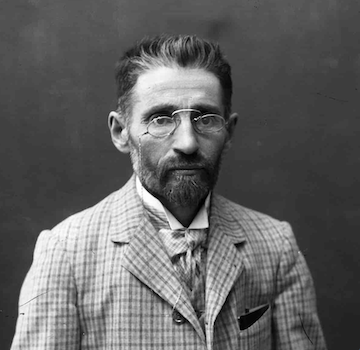
Eliezer Ben-Yehuda (né Perlman) was the driving force behind the revival of Hebrew as a vernacular language. (photo by Av Yaacov Ben Dov / Widener Library, Cambridge)
As the language spread – in large part thanks to Ben-Yehuda’s continued perseverance in promoting it and inventing modern words where the ancient language lacked them – the application of the new tongue to family and given names likewise grew.
The repudiation of the diaspora took on an entirely new relevance after the Holocaust. Some who made aliyah resisted changing their names, being attached, as is understandable, to one’s family name. Even so, no Jewish surnames were particularly long-established in the first place, since the practice of Jews adopting inheritable family names was only a century old, or a little more, at that time. The Austro-Hungarian Empire required Jews to take surnames in 1789 and in the Russian Empire and the German principalities not until the following century. At that time, choosing a name followed predictable patterns for Jews and non-Jews: a variation on “son of,” (Aronoff, son of Aron; Mendelsohn, son of Mendel), a reference to a profession (Becker for a baker; Melamed for a teacher), or a connection to the town or region (Frankel, from Franconia; Warshavski, from Warsaw; Wiener, from Vienna).
The adoption of Hebraized names in Palestine and Israel took four primary approaches.
The first was the traditional use of patronyms or matronyms, which is probably the oldest form of naming. Yiddish names, but also names that were German, Polish, Russian, English or French patronyms could be Hebraized: Davidson to Ben-David, Mendelson to Ben-Menachem, Simmons to Shimoni.
A second approach was to choose a Hebrew name that sounded like the original name. In some cases, the new name had a (sometimes remote) connotation with the original, as in the case of Lempel (little lamp) becoming Lapid (torch). Levi Shkolnik would become Israel’s third prime minister as Levi Eshkol. This was more than simply a near-homophone. It reflected another trend in the process, which was to adopt a name that spoke to the commitment of the chalutzim, the pioneers, whose Zionism was deeply informed by a back-to-the-land ethos. Eshkol means “cluster of fruit,” so it did double duty, sounding something like the original and also having a kinship with the blooming desert.
A third strategy was basic translation. Goldberg might become Har-Zahav (mountain of gold); Silver or Silverman might become Kaspi; Herbst, which in German and Yiddish means autumn, could be changed to a Hebrew equivalent, Stav or Stavi.
The fourth approach took the pioneer spirit and connection with the land to greater depths (with or without the homophonic advantage of Shkolnik/Eshkol). Flora, fauna and geography of the new homeland were attractive new names that situated the migrants linguistically and geographically. The writer Carrie-Anne Brownian cites such examples as Rotem (desert broom), Nitzan (flower bud), Yarden (Jordan), Alon (oak tree) and Tomer (palm tree). Simply adopting a place name gives us Hermoni, Eilat, Golani, Kineret and many others.
Those whose names already had a nature theme were at an advantage. The Haganah commander Moshe Klaynboym changed his family name, which meant “little tree” in Yiddish, to Sneh, Hebrew for “bush.”
Not necessarily related to nature, but to the idealization of the Zionist spirit, some took names like Amichai (my people live), Maor (light), Eyal (strength), Cherut (freedom) and Bat Or (daughter of light).
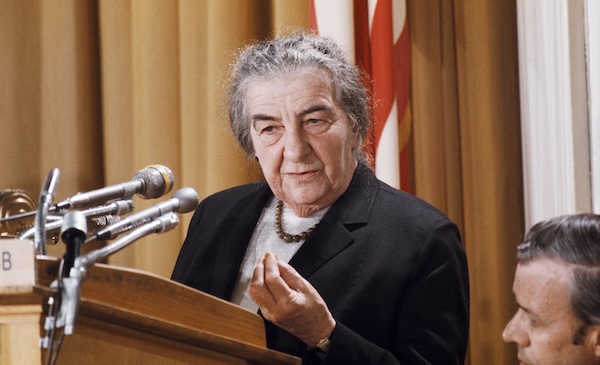
Golda Meyerson, after prodding from Ben-Gurion, became Golda Meir. Interestingly, her rather emphatically Yiddish given name she kept, presumably making Ben-Gurion half-satisfied.
Golda Meyerson, with prodding from David Ben-Gurion, became Golda Meir. (photo from mosaicmagazine.com)
As refugees from the Middle East and North Africa began pouring into Israel in the 1950s and ’60s, the Hebraization of names came to be seen as Ashkenormative, the taking of one’s ancestral name being another indignity (alongside inadequate housing and social stigmatization, among other things) that different-looking newcomers faced in their presumed Promised Land.
It seems, for example, that teachers encountering “strange” Mizrachi and Sephardi given names took it upon themselves, in some cases, to assign kids new names based not on any Zionist ideological imperative but for the same reason Canadian teachers in the early to mid-20th century dubbed kids with “foreign” names new ones the teachers could more easily pronounce. In retrospect, some have complained that this phenomenon was an insidious part of a larger (conscious, unconscious or some of both) effort to force Mizrahim and Sephardim to comport to Ashkenazi expectations even in things as intimate as a given name.
Sami Shalom Chetrit, a professor at Queens College in New York, who is of Moroccan-Israeli origin, recalled in a Forward article by Naomi Zeveloff, feeling outraged when an Israeli elementary school teacher nonchalantly renamed him, along with other non-Hebrew-named kids.
“Alif, your name from now on will be Aliza,” Chetrit recalled the teacher declaring. “Jackie, your name is Jacob, and Michele, your name is Michal. She kept going alphabetically. Then she said, ‘Sami, your name will be Shmuel Shalom.’
“I went to my father, crying.… I really felt like something was stolen from me, something precious. I said: ‘They changed my name! They changed it!’”
Chetrit’s father taught the teacher something the next day, according to the story. In Arabic, “Sami” comes from the root “samar,” the father said, meaning “heavenly superior,” and that, the father declared, is “international.”
The tendency eventually faded out. When a million migrants from the former Soviet Union arrived in Israel, after 1991, almost none chose to, or were pressured to, change their names.
There are contemporary exceptions even to this, though. Anatoly Shcharansky, one of the most famous of the Soviet “refuseniks,” became Natan Sharansky on arrival in Israel in 1986. The American historian Michael Bornstein became the Israeli politician-cum-diplomat Michael Oren, having changed his name when he made aliyah in 1979.
Newcomers to Israel today are free to change their names – and free to keep their “galut” (“exile”) names. Israel, today, is an overwhelmingly Hebrew society, though. New arrivals do not present a risk of swamping the place with Yiddish, Arabic, German, Polish or English, as might have seemed a danger 75 years ago, creating a Babel where cultural unity was desperately needed.
In addition to the psychological impacts of adopting Hebrew names (and language) as a refutation of the diaspora that had so recently been the locus of calamity, there was the practical reality of finding commonality among wildly diverse new citizens. That has been achieved. Even sorbing a million Russian-speaking new Israelis after 1990 did not dilute the ascendency of the Hebrew language. For whatever criticisms the forced (or vigorously encouraged) adoption of Hebrew names might invite, there is no doubt the intended outcome has been realized. Ben-Gurion’s dream not only of a Jewish state, but a Hebrew one, is firmly in place.
Sufganiyot (jelly doughnuts) for Hanukkah have come a long way, and now come in countless variations. (photo by Avital Pinnick / Flickr)
In Israel, sufganiyot (jelly doughnuts) have gone through a major revolution. For years, they were injected with strawberry jelly and dusted with confectioners’ sugar. In a recent ad by a well-known Israeli bakery, there were 14 variations of sufganiyot, including the “classic strawberry jam.” Twelve are dairy and two are pareve (can be eaten with milk or meat dishes).
For the pareve offerings, there are colourful sprinkles, dairy-free chocolate and ganache (filling made from chopped chocolate and heavy cream). Among the dairy choices are “Raspberry Pavlova,” filled with sweet cream and topped with raspberry ganache, pavlova (a meringue named after the Russian ballerina, Anna Pavlova), sweet cream and Amarena cherries; “Curly,” filled with cream and topped with Belgian chocolate and milk, dark and white chocolate curls; “Mozart,” filled with nougat-flavoured sweet cream, frosted with white chocolate strips and topped with Mozart cream (a chocolate liqueur) and chocolate curls; “Cheese Crumbs,” filled with cheese mixed with white chocolate and butter cookie crumb frosting and topped with cream cheese; and “Pistachio,” filled with pistachios, frosted with white chocolate ganache, and topped with pistachio cream and pistachio shavings.
Jewish law does not prescribe any special feasting or elaborate meal for Hanukkah as it does for other holidays. Maybe this is because the origin of Hanukkah is not in the Torah but in the Apocrypha, the books of literature written between the second century BCE and the second century CE, which were not incorporated into the Hebrew Bible.
The Books of Maccabees, of which there are four separate books, only say that the hero, Judah, “ordained that the days of dedication of the altar should be kept in their season from year to year by the space of eight days from the first and 20th day of the month Kislev, with mirth and gladness.”
So, where do we get all the food we eat? It is in the Talmud, where the so-called miracle of the oil burning for eight days is written. This myth was inserted to de-emphasize the miracle of military triumph and replace it with a more palatable idea, that of the intervention of G-d, which somehow would seem more a miracle than a fight of man against man, according to the sages of the time. (By the way, it is only within the past few years that children’s books about Hanukkah dare say the oil story is a legend or a myth.)
Practically every Jewish ethnic group has the custom of making and eating a form of food prepared in oil as a reminder of the “miracle” of the jar of oil.
The late Gil Marks wrote, in The World of Jewish Desserts, that doughnuts fried in oil, ponchikot, were adopted by Polish Jews for Hanukkah. The name is taken from the Polish word paczki, which led to the nickname ponchiks, the Polish name for jelly doughnuts. Ponchiks are similar to jelly doughnuts, only larger and more rich tasting, and were traditionally served on Shrove Tuesday, the day before Lent. They were made to use up shortening and eggs, which were prohibited during Lent.
Sufganiyot have a different history. In The Jewish Holiday Kitchen, Joan Nathan, an acquaintance of mine from our Jerusalem days and noted cookbook author and maven of American Jewish cooking, noted that she learned the origins of sufganiyot from Dov Noy (z”l), former dean of Israel folklorists.
Noy related a Bukhharian fable to Nathan, which says that the first sufganiya was a sweet given to Adam and Eve as compensation after their expulsion from the Garden of Eden. Noy said the word sufganiya came from the Hebrew word sof, meaning end; gan, meaning garden; and Ya, meaning G-d. Thus, the word means, “the end of G-d’s garden.”
According to Noy, this fable was created at the beginning of the 20th century, as sufganiya is a new Hebrew word coined by pioneers. Some say sufganiyot means sponge-like and that the doughnuts are reminiscent of the sweet, spongy cookie popular along the Mediterranean since the time of the Maccabees. Hebrew dictionaries say the word actually comes from the Greek word sufgan, meaning puffed and fried.
John Cooper, author of Eat and Be Satisfied: A Social History of Jewish Food, has another theory. He says Christians in Europe ate deep-fried pastries on New Year’s Eve, and Christians in Berlin ate jelly doughnuts. In that context, German Jews started eating apricot-filled doughnuts. When they immigrated to Palestine in the 1930s, they encouraged the population to eat the jelly doughnuts for Hanukkah.
One of my favourite pieces of research is the characteristics that sufganiyot are said to have:
• they are round like the wheel of fortune;
• they have to be looked at for what is inside, not for their external qualities; and
• they cannot be enjoyed the same way twice.
My research on the internet shows the calories for one sufganiya vary from 93 to 276, and gluten-free versions with rice flour are about 165 calories.
Whatever their origin – or number of calories – sample the real thing and you won’t forget it!
Sybil Kaplan, z”l, was a Jerusalem-based journalist and author. She edited/compiled nine kosher cookbooks and was a food writer for North American Jewish publications, including the Jewish Independent. We communicated regularly, but mostly in the leadup to a holiday issue. Not having heard from her in advance of this Hanukkah paper, we reached out, getting the sad news that Sybil recently passed away. It was a pleasure working with her for these past 20+ years and we will miss her. She always provided more stories than we could use, so, in this issue, we run a few we had yet to publish, honouring her in our way. May her memory be for a blessing.
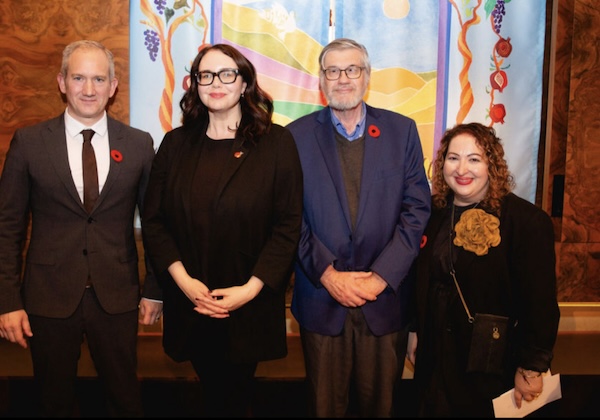
At the Nov. 9 Kristallnacht commemorative event, left to right: Dr. Janus Møller Jensen, Nina Krieger, Prof. Chris Friedrichs and Abby Wener Herlin. (photo by Rhonda Dent)
The rescue of Danish Jews during the Holocaust – an operation that mobilized almost the entire strata of Denmark’s population – is one of the bright lights in the history of that dark era. That extraordinary event, which took place 80 years ago last month, is one of the reasons Denmark had one of the highest survival rates of any country during the Shoah. Even this uplifting story, though, has its “shadows,” according to an expert who spoke in Vancouver Nov. 9.
Dr. Janus Møller Jensen, an historian and director of the Danish Jewish Museum, was the keynote speaker at the annual community-wide Kristallnacht Commemoration, presented by the Vancouver Holocaust Education Centre and held at Beth Israel Synagogue.
Denmark has an unusual history in the context of Nazi occupation. After the Nazis invaded the country with minimal opposition, in April 1940, politicians and the king, Christian X, surrendered, but managed to negotiate terms that allowed the Danish democratic system of government to continue in a so-called “peace occupation.” Importantly, one of the Danish demands was that no Dane be singled out according to their race or faith, said Møller Jensen.
This status quo fell apart in 1943, after a series of strikes and uprisings around the country. Amid the Nazi crackdown came rumours at the end of September that an action against Danish Jews was imminent. At the same time, word spread that Sweden was prepared to accept Danish Jews as refugees. A mobilization of fishing boats began – as did the Nazi mobilization – in early October. Up and down the coast of Denmark, small and larger boats carried their cargo of Jewish Danes across the straight to neutral Sweden. In all, an estimated 7,220 Jews and 686 non-Jewish spouses were transported. Of all Danish Jews, 472 were captured by the Nazis and transported to Theresienstadt, in present-day Chechia, a waystation to the extermination camps. Of these, all but 53 survived the war, in part because the Danish government persuaded the Nazis to allow food and medicine packages to be delivered to the Danish inmates.
Another stunning reality was that, when the Danish Jews who survived – estimates of survival range from 95% to 99% – returned to Denmark, almost all found their homes and possessions intact – a stark difference from what Jews elsewhere in Europe discovered if they returned to their places or origin.
Not all of Danish history is so bright for Jews, said Møller Jensen. A long history of Catholic and Lutheran theological antisemitism permeates Denmark, and immigration policies before the Second World War prevented many Jews from elsewhere from reaching refuge.
“We have letters of refusal in our collection, of people who we know later died in the camps,” said Møller Jensen.
In addition, Danish companies and agricultural producers provided materials to the German war effort, although this was required of all occupied countries, he noted.
Not all rescuers acted on altruistic motives, either, Møller Jensen added. Some fishers took money to transport Danish Jews, but he also noted that, while hindsight suggests the Nazi occupiers turned something of a blind eye to the rescue operation, those involved at the time did not know this and would likely have assumed they were risking their lives.
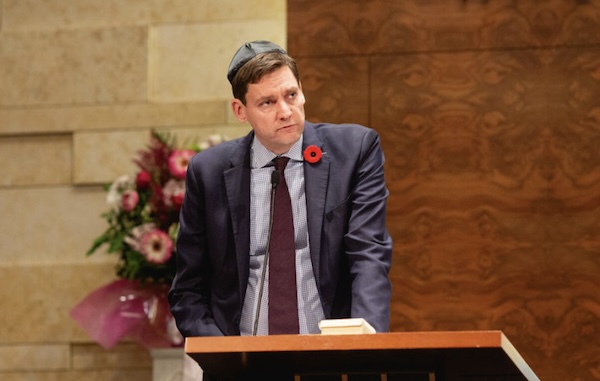
BC Premier David Eby spoke at the Kristallnacht event. (photo by Rhonda Dent)
In addition to the hands-on rescue, Danish society rose up against the Nazis’ action. “Organizations from the entire strata of society – doctors, professors, students, lawyers, industries, working unions – protested,” he said. “The Danish church promulgated a so-called ‘Shepherd’s Letter’ to be read aloud in all of the churches in Denmark the following Sunday, stating that this was an unchristian act, that all people were the same in the eyes of God and that this was wrong and the congregation should assist and protect their fellow human beings…. One of the priests remembered, having read the letter aloud, that the entire congregation spontaneously rose to its feet and shouted ‘Yes!’”
Beth Israel’s Rabbi Jonathan Infeld thanked Møller Jensen and reflected on his words.
“The Danish people,” he said, “did exactly the opposite of what happened in Poland. When the Jews came back to Poland, they were murdered and their property was stolen, and when the Jews came back to Denmark, dinner was waiting for them on their tables. That is righteousness.”
BC Premier David Eby spoke at the Kristallnacht event, saying he wanted to provide assurances that all parties in the Legislature are committed to ensuring that the Jewish community in British Columbia is protected from antisemitism and feels safe. He acknowledged the proximate anniversaries of Kristallnacht and Remembrance Day, and noted that his government had just announced that Holocaust education will become mandatory in the BC school system.
“The thing about remembering is you can’t remember something you’ve never learned, you can’t remember something you were never taught,” Eby told the audience. “I’m proud to stand with you, to support your community, to stand against antisemitism, to stand against Islamophobia, to stand against all forms of hate, for British Columbia to be a beacon of hope in the world of what is possible at a time when those who want to promote division and hate seem to be on the rise just about everywhere. We have lots to be proud of in this province and part of what I’m incredibly proud of is the strength of our Jewish community here and I’m very honoured to be with you here this evening.”
Before the keynote address, Prof. Chris Friedrichs, emeritus professor of history at the University of British Columbia, contextualized Kristallnacht and called the Danish rescue “the most spectacular episode of rescue in the entire history of the Shoah.”
The Kristallnacht gathering was presented in conjunction with Congregation Beth Israel and funded by the Jewish Federation of Greater Vancouver, with support from the Robert and Marilyn Krell Endowment Fund of the VHEC. Møller Jensen’s visit was facilitated by Norman Gladstone and Birgit Westergaard.
Corinne Zimmerman, president of the board of the VHEC, introduced a procession of Holocaust survivors, who carried memorial candles. Nina Krieger, executive director of the VHEC, opened the event and read greetings from Prime Minister Justin Trudeau. Cantor Yaacov Orzech recited El Moleh Rachamim. Councilor Sarah Kirby-Yung read a proclamation from the City of Vancouver. Taleeb Noormohamad, member of Parliament for Vancouver Granville, sent video-recorded greetings from Ottawa. BC cabinet ministers Selina Robinson and George Heyman were in attendance, as was Michael Lee, member of the Legislative Assembly for Vancouver-Langara.
The event drew a record crowd, according to organizers, of 420 in-person attendees and an additional 120 watching via livestream, including groups at the Louis Brier Home and Hospital and the Weinberg Residence.