Skip to content
  • Home
  • Subscribe / donate
  • Events calendar
  • Business Directory
  • FAQ
  • News
    • Local
    • National
    • Israel
    • World
    • עניין בחדשות
      A roundup of news in Canada and further afield, in Hebrew.
  • Opinion
    • From the JI
    • Op-Ed
  • Arts & Culture
    • Performing Arts
    • Music
    • Books
    • Visual Arts
    • TV & Film
  • Life
    • Celebrating the Holidays
    • Travel
    • The Daily Snooze
      Cartoons by Jacob Samuel
    • Mystery Photo
      Help the JI and JMABC fill in the gaps in our archives.
  • Community Links
    • Organizations, Etc.
    • Other News Sources & Blogs
  • JI Chai Celebration
  • JI@88! video

Recent Posts

  • Or Shalom reopens its doors
  • JFS from past to future
  • Need holistic approach
  • Sharing stories, advice
  • Journalist shares fears
  • Skills to live together
  • Road to independence
  • Cutting grass with scissors
  • Zionism as a solution
  • Deceit, desire & the divine
  • Reclaiming sacredness
  • Creative project ideas
  • Summer squares and cobbler
  • Thou shalt … summer commandments
  • Legal help for students
  • Revisiting myth of Lilith
  • Wrong person rebuked
  • Canada’s mixed messages
  • Questions for museum
  • Symposium on antizionism
  • Making soccer political
  • CJPAC lauds Pulver’s impact
  • City recognizes Vrba’s legacy  
  • Organ donation saves lives
  • Theodore’s March premiere
  • A healing Shabbaton
  • Supplying healthy food
  • A chime of metal tags
  • Yellowknife seder a first
  • Ishai energizes, unifies
  • A Lag b’Omer to remember
  • Expanding the healing
  • Hannah Senesh – a unique hero
  • Community milestones … May 2026
  • Sharing her testimony
  • Fall fight takes leap forward

Archives

Follow @JewishIndie
image - The CJN - Visit Us Banner - 300x600 - 101625

Tag: health

Symposium provides healing

Symposium provides healing

The Jewish Seniors Alliance fall symposium on Oct. 28 was about aging across cultures. (photo from JSA)

The Jewish Seniors Alliance fall symposium, Aging Across Cultures, took place on Oct. 28. The program dealt with inclusivity while Jews everywhere were trying to cope with the horrors of what hatred can do. Still newly mourning the victims of the shooting at the Tree Of Life synagogue in Pittsburgh, attending the symposium seemed strange, but it had healing properties.

The afternoon program was a time of unity and solidarity with other cultures. Attendees learned that loving and caring for seniors in our community and for our family elders is a universal value and touches all hearts in much the same way, as well as presenting similar challenges.

In welcoming the crowd, Ken Levitt, president of Jewish Seniors Alliance, turned the subject of the Pittsburgh shooting over to Rabbi Philip Bregman, who was the event chairperson. Bregman served as senior rabbi at Temple Sholom from 1980 to 2013. He is a founding member of Jewish Christian Dialogue (since 1995) and he now functions as Jewish chaplain for the University of British Columbia and is involved with Hillel BC.

Bregman spoke about the brutal murder of people at prayer. He highlighted the many calls he has received expressing sympathy and condolences. He recalled standing outside a mosque in Vancouver after the shootings at a Quebec City mosque in 2017, where six Muslim worshippers were murdered and 19 others wounded. Among the condolences he received after the murders in Pittsburgh was a message of sympathy from the imam in Quebec.

Bregman emphasized the difference between the word “killing,” which he categorized as meaning accidental, and the word “murder,” which is intentional.

“Where do we go from here?” he asked. “We bury our dead, we mourn and we meet as a community,” he said. “We must never allow hatred to win.”

The audience stood for a moment of silence in commemoration of the 11 murdered and those injured, including several police officers.

The afternoon’s program featured a panel consisting of three accomplished women of diverse ethnic origins.

• Zarghoona Wakil is the manager of the Settlement and Integration program at MOSAIC, a nonprofit organization that helps newcomers to Canada. She also supervises MOSAIC Seniors Club, which provides services to seniors of different cultural backgrounds.

• Sinder Kaur is the executive director of health services at SUCCESS, providing a continuum of quality, culturally appropriate care services to seniors with different needs. She has worked in different leadership roles with a passion to help seniors age in place.

• Deanna Lewis, known as Kalkalath, her ancestral name, was recently elected to the Squamish Nation Council, focusing on elders and their care. Kalkalath is a former teacher, working to preserve her Skwxwu7mesh culture, spirituality and language. Raised with the teachings of her grandfather, she knows the importance of knowing who you are and where you come from.

When Bregman introduced the three panelists, he asked them to share a little about themselves and to address the issue of how their various cultures celebrate seniors.

Wakil shared that she is originally from Afghanistan, then lived in Russia. She came to Vancouver 12 years ago and is now studying at Simon Fraser University for a master’s degree in public health. Kaur is Punjabi-born, lived for 20 years in Hong Kong and moved here 17 years ago. Kalkalath’s Squamish Nation family was removed from Khatsahlano (Kitsilano) in the early 1900s and her main efforts are to teach both adults and children the Squamish language.

Despite differing cultures and traditions, Wakil and Kaur both emphasized that it is seniors who hold history in their hands and only upon opening up their hearts are they able to tie generations together and build upon that knowledge for the future generations.

It was difficult to hear that Kalkalath had to learn about her heritage from others, as her history was erased and harshly taken from her elders. It was she who sought to learn about that past and is now feeling connected again, through the learning of her own language and the ways of her people from her grandfather.

A common thread between all the panelists was that grandparents and grandchildren have a special link that allows them to relax and truly enjoy one another while parents are occupied with the comfort and needs of both these family groups.

All three speakers provided vivid descriptions of the issues and areas of concern regarding elders in their cultures. JSA thanked them for their willingness to share personal stories and stories from their communities. The similarities between cultures superseded any differences.

Claudine Malto, director of community programs at Mount Pleasant Neighbourhood House, then spoke about the house’s new initiative: multicultural circles, where seniors share stories, food, textiles, cooking classes, dance and exercise. She noted that people generally like to sit in “pockets,” which creates a divide. The motivation for this project is to answer the question, “How can we best coexist?”

Larry Shapiro, JSA board member and second vice-president, wound up the afternoon with one of the best vocal advertisements for the Jewish Seniors Alliance that we have ever heard.

Attending the symposium made the sun come out, even on a rainy, tear-filled day.

Binny Goldman is an honorary life board member of Jewish Seniors Alliance.

Format ImagePosted on November 9, 2018November 7, 2018Author Binny GoldmanCategories LocalTags culture, health, interfaith, Jewish Seniors Alliance, JSA, multiculturalism, Pittsburgh shooting, seniors
Adversity leads to innovation

Adversity leads to innovation

Sara Raposo-Blouw, left, and Erin Goldberg taste the chocolate mocha and vanilla blueberry flavours of Thrive. (photo by Ian Blouw)

Erin Goldberg, 30, was only 5 years old when it was discovered that she had rhabdomyosarcoma in her abdomen, attached to one of her ovaries.

Rhabdomyosarcoma (RMS) is an aggressive and highly malignant form of cancer that develops from skeletal muscle cells that have failed to fully differentiate. It is generally considered to be a disease of childhood, as the vast majority of cases occur in those below the age of 18.

Growing up in Winnipeg, Goldberg spent almost 130 days at the Health Sciences Centre (HSC) receiving treatments and recovering from procedures over a two-year span before she was cleared of RMS.

Goldberg’s struggle with the cancer and her unwavering will to make the world a better place have served as a driving force in her life ever since. And her memories from that time, as a child struggling to keep food down, have led to her helping develop a liquid food replacement that would have been priceless to her when she had RMS.

“Basically, everything I ate was making me nauseous, and that was due to chemotherapy,” Goldberg told the Independent. “It sort of alters your taste. And I would also throw up anything I would eat. It was important to have as many bland foods as possible. With liquid nutrition, it’s a lot easier to consume your calories than with anything solid. It’s denser and is a better option in the hospital.”

Goldberg said she went into nutrition because she was interested in disease prevention. After meeting Sara Raposo-Blouw and Lisa Reed, dieticians at the HSC, and them sharing their experiences with one another, they came up with the idea of a liquid nutritional drink. They knew, firsthand, the lack of options people had.

“The beverage options in hospitals were really lacking,” said Goldberg. “Patients find the taste of what there is too sweet. I recently spoke to my friend’s dad, who is a psychiatrist, and he actually prescribes Boost six times a day for one of his patients, because he has a motor disorder … he’s constantly moving, so his caloric requirement is elevated so much. He needs to have six of these beverages in addition to his regular food intake. When you have that much of something that is too sweet and has ingredients that are highly processed, or if you’re vegan or have allergies, you just can’t do it. You need an alternative. And there was really nothing out there.”

Goldberg and partners have developed a new option, called Thrive, that uses local ingredients, two of them being flax oil and pea protein. The formula is completely plant-based and free of major allergens, like dairy, soy, corn and wheat.

The trio solicited the help of a Burnaby beverage developer to help them produce the drink with the necessary specialized equipment.

While competitors have come out with flavoured drinks and drinks that cater to particular groups of users, Thrive differs in that it is a basic formula that everyone can use, adding their own ingredients as desired, depending on their needs.

“Currently, we have one adult formula, but we’re working on one for children,” said Goldberg. “The main difference between the one for adults and the one for children is the protein content. It’s very easy for us to adjust the formula accordingly. And, as far as different patient populations, we don’t have other types of formulas. Basically, if a higher caloric content is necessary, then more of the beverage would be prescribed. But, at this time, we only have one formula.

“The palatability really stands out for our product compared to these other competitors,” she said. “A lot of the ingredients they use are bitter. They are trying to mask that bitter taste with the sweetness, coming up with flavours like chocolate, strawberry and vanilla.”

Because of its mild flavour, Thrive also can be used to make solid food, similarly to milk, but with a much higher nutritional punch. For those seeking a flavoured drink, they can choose to add whatever flavour they wish to the degree of sweetness they like.

A couple of months ago, Goldberg flew to Montreal to accept the Social Mitacs Entrepreneur Award and a $5,000 cheque, in recognition of what she and her partners are doing. Different levels of government have also stepped up with funding, as has North Forage.

“We’ve been receiving support from North Forage, a business incubator in Winnipeg,” said Goldberg. “They’ve helped us get off the ground and understand the business side of things, because we are coming at it from a science background. So, the three of us needed some input there.

“We are currently looking for investors,” she added. “We have a couple that are interested, but we need more to move on to our next phase and are looking at government funding. Once we are up and running, our first year, we are planning on having online sales direct to the consumer.”

Based in Winnipeg, their initial target is to partner with the Winnipeg Regional Health Authority, as well as other health authorities across Canada. Goldberg is confident that, once they taste the product and look at the nutritional information, the authorities will sign on.

The partners are also confident that their target timeline of production by next summer can be met, even with the need to do a scale-up and validation trial in Quebec because no facility in Manitoba is currently capable of doing this.

“We require very specialized equipment when it comes to the aseptic packaging that we require, because we want our product to be shelf-stable, so it doesn’t have to be in the refrigerator,” said Goldberg. “That equipment is very expensive and very specialized. They have it in Quebec. Once we scale-up, we will go to Toronto and that will be our facility to actually produce the product on an ongoing basis.”

At the moment, the partners are working with their lawyers to set up the deal structure to bring in investors for the validation tests (costing $250,000).

For more information, visit vitalfoods.ca.

Rebeca Kuropatwa is a Winnipeg freelance writer.

Format ImagePosted on October 5, 2018October 3, 2018Author Rebeca KuropatwaCategories NationalTags cancer, Erin Goldberg, health, nutrition, Winnipeg
טענות של הונאה

טענות של הונאה

(צילום: jbsa.mil)

מגפת האופיואיד הורגת אלפי קנדים: יצרניות משככי הכאבים נתבעות על הונאה ואחריות לתופעה

תקדים חשוב: יצרניות ומשווקת כדורי משככי הכאבים המבוססים על אופיואידים נתבעות לראשונה בקנדה, על ידי גורם ממשלתי. זאת לאור מגפת האופיואיד הקשה שהביאה למותם של למעלה משמונת אלפים קנדים משימוש במינון יתר בשנתיים האחרונות – מאז החל המשבר הגדול בתחום בשנת 2016. מרבית הנפטרים גרו במחוזות הגדולים של המדינה: במקום הראשון והלא סימפטי נמצא מחוז בריטיש קולומביה, במקום שני נמצא מחוז אונטריו, במקום השליש נמצא מחוז אלבטרה ובמקום הרביעי נמצא מחוז קוויבק.

מדי יום ברחבי קנדה מתים למעלה מאחד עשר איש משימוש יתר בקרב המכורים למשככי כאבים. מרבית הנפגעים משימוש היתר הם מטבע הדברים גברים. מומחים בענף הבריאות מדגישים כי הנתונים המדאיגים של משבר האופיואידים מצביעים בברור על כשלון גדול של מערכת הבריאות הקנדית.

ממשלת מחוז בריטיש קולומביה היא זו שלכן עתרה לראשונה לבית המשפט, נגד למעלה מארבעים יצרניות ומשווקות מתעשיית האופיואידים. התביעה מבוססת על הטענות של הונאה ומסירת מידע שגוי לגבי משככי הכאבים, מאז החל בהפצתם בעשרים השנים האחרונות. יצויין כי קנדה היא המדינה השנייה בעולם בצריכת אופיואידים לנפש אחרי ארצות הברית. ונתון זה לא מחמיא למדינה שנחשבת לכה מפותחת ומתקדמת.

מטרת התביעה היא בעצם כפולה: 1). להצביע מי הם האשמים בהפצת משככי הכאבים החזקים שגרמו לכך שרבים מהמשתמשים בהם התמכרו לכדורים, מבלי שידעו כלל על הסיכון הגבוה הכרוך בשימוש בהם מראש, וחלקם כאמור מתו משימוש יתר. 2). וכן לנסות ולכסות ולו חלק מהוצאות הגבוהות של כספי הציבור הכרוכות במשבר הרפואי הקשה, כולל טיפול בנפגעים, הובלתם לבתי חולים והליך שיקומם הארוך.

הפרקליט הראשי של מחוז בריטיש קולומביה, עו”ד דוויד אבי אומר: “התביעה המשפטית הזו היא צעד חשוב לטיפול בשחיתות התאגידית וברשלנות של הגורמים האחראים ביצור משככי הכאבים והפצתם ברבים”. עו”ד אבי מקווה שממשלות של פרובינציות נוספות בקנדה שיצטרפו לתביעה המדוברת והוא אמור לפנות אליהן. הוא אף מצפה שכן הממשלה הפדרלית תצרף למהלך המשפטי הכל כך חשוב הזה.

מחברת פורדו פארמה אחת מיצרניות הגדולות ביותר של משככי הכאבים בעולם, שהיא אחת הנתבעות, נמסר בתגובה לאמצעי התקשורת: “אנו מאוד מודאגים ממשבר האופיואיד בבריטיש קולומביה ובקנדה בכלל. אנו מספקים את התרופות בקנדה בהתאם לכל חוקים המקומיים ועומדים בכל התקנים הנדרשים בחוק”.

ד”ר אבן ווד מומחה בנושא אומר בתגובה לתביעה של בריטיש קולומביה: “שיטות השיווק של יצרניות משככי הכאבים מילאו תפקיד עצום מאוד בצמיחת מרשמי האופיואידים. עברנו מתקופה שבה רופאים לא העלו על דעתם לרשום מרשמים לכדורים שמיועדים לחולי סרטן, למצב שבו כיום ניתנות דוגמיות בחינם לכל אחד שיש לו אפילו דלקת פרקים קלה”. לדברי ד”ר ווד הטיפול במשבר צריך להיות מורכב משני שלבים נפרדים: הראשון – יש להגן על אלה שמעולם לא השתמשו באופיואידים כדי שגם הם לא יקבלו מרשמים לא בטוחים. השני – אלה שלצערנו כבר מכורים לכדורים צריכים לקבל בדחיפות טיפול תומך וגמילה.

בישראל מערכת הבריאות שהיא ציבורית עם רגולציה חזקה וריכוזית מאוד, כוללת ארבע קופות חולים ומערכת מיחשוב מרכזית. מערכת זו לכן מקשה מאוד לקבל בקלות משככי כאבים קשים כפי שקורה בארצות הברית, בקנדה ובאירופה. בישראל מוצעים בדרך כלל משככי כאבים קלים שאפשר להשיגם גם ללא מרשם רופא. בהם: איבופרופן, פרצמול או דיפרון. ולכן לא מפתיע שעד היום המגיפה פסחה על ישראל.

Format ImagePosted on September 30, 2018Author Roni RachmaniCategories עניין בחדשותTags health, lawsuit, opioid epidemic, בריאות, מגפת אופיואיד, תביעה משפטית
Animated therapy session

Animated therapy session

David Fine and Alison Snowden wrote, directed and animated the National Film Board of Canada animated short Animal Therapy. (photo by John Bolton)

They’re baaaack! And with another funny – and thought-provoking – National Film Board of Canada animated short. Jewish community member David Fine and wife Alison Snowden, who co-created the NFB’s Oscar-winning Bob’s Birthday 25 years ago, have returned to the genre with Animal Behaviour.

Animal Behaviour, which screened at the Toronto International Film Festival earlier this week, will be part of the Vancouver International Film Festival’s True North Shorts program, The Curtain Calls, on Oct. 1 and 8. There are further screenings scheduled for other festivals across Canada.

The 14-minute short, produced by Michael Fukushima, executive producer of the NFB’s animation studio, is written, directed and animated by Fine and Snowden, who are currently based in Vancouver. In addition to countless other projects, the pair also created, and contributed in many capacities to, the adult animated series Bob and Margaret, which was based on Bob’s Birthday.

“We had worked in series and missed making a personal film and doing the animation ourselves, directly,” Fine told the Independent about what motivated Snowden and him to make another animated short. “We really thought it would be nice to get back to the type of filmmaking we started our career with and our producer, Michael, had suggested that he would be keen to see any ideas from us and we happened to have one, so we thought, why not have a go. It’s very different to make a personal film like this than a series.”

The couple humorously tackled some of the issues of being middle age in Bob’s Birthday. In Animal Behaviour, they explore – also with much humour – some of the pros and cons of following our natural instincts versus doing what is socially acceptable. They do so using the vehicle of a weekly group therapy session led by Dr. Leonard Clement, a Labrador retriever.

Lorraine, the leech, has attachment issues and experiences panic attacks; Todd, the pig, has an eating disorder and suffers from insecurity; Cheryl, the mantis, hasn’t had a lasting relationship, and the fact that she has 1,000 kids is the lesser of her two main problems; Linda, the Tabby cat, has obsessive compulsive disorder and doesn’t ever feel clean enough, despite constantly licking herself; and Jeffrey, the blue jay, has some serious guilt issues as a result of something he did when he was a very young bird. The members of the group seem to know one another well and there is a rhythm to their session. Then walks in Victor, the ape, with his anger issues, who believes that everyone else is an idiot and that people in therapy are navel-gazers who just need to get on with their lives.

photo - In Animal Therapy, Victor aggressively takes issue with Dr. Clement’s approach to therapy
In Animal Therapy, Victor aggressively takes issue with Dr. Clement’s approach to therapy. (photo from NFB)

“The notion of going to therapy to change seems like a tall order, so we thought it would be fun to look at therapy and have a character who comes in and questions its validity,” explains Fine in an NFB interview online. “At the same time, we’re careful not to go for the low-hanging fruit or make fun of the process. We don’t want to answer the question (‘Is therapy valid?’), we want to pose the question and start the discussion.”

“It was quite a difficult script to write,” says Snowden in the NFB interview. “We thought it would be easy, because it’s in one room, there’s one conversation, but there are so many possibilities with all the animals, and if we did it wrong it would get boring.

“At first, there were a lot of characters, but you couldn’t get attached to any of them, so we honed it down. Really, it’s about the ape and Dr. Clement – that’s the showdown. Then they all came together. The others are in the room, they’re observers, and they’re there for comedy. But the key characters are those two and their drama.”

“From idea to final film was probably about five years,” Fine told the Independent, “but there was a development period, which was sporadic and took time to get to the green light. Once in production, it took about 2.5 years to make, in terms of pure working time.”

About working in animation, Fine said, “We like controlling every frame and effectively being both directors and actors, because we pose and make the characters act. We also love working with voice actors and then being able to edit the track in a way you can’t really do in live action. It’s really about all the nuance and control, which is so much fun.”

The creative process starts with the writing, he said, “with the idea and the script,” which they “work to refine…. After that, the voice record was key. We interviewed about 300 voices to cast this group. All the actors are Vancouver-based, which we are very proud of.”

Among the credits, thanks are given to the animation programs at Capilano and Emily Carr universities, and the film is dedicated “to the wonderful doctors, nurses and staff at Vancouver General Hospital.”

“During the production, near the end, Alison was struck with a very sudden, serious health crisis and was in intensive care and recovery for five months,” explained Fine. “VGH saved her life, so, when we were finally able to finish the film together, it was very important to us to make that dedication to show our appreciation.”

For tickets to The Curtain Calls and the full film festival schedule, visit viff.org.

Format ImagePosted on September 14, 2018September 12, 2018Author Cynthia RamsayCategories TV & FilmTags Alison Snowden, animation, David Fine, health, National Film Board, NFB, Vancouver International Film Festival, VIFF
Help dealing with dementia

Help dealing with dementia

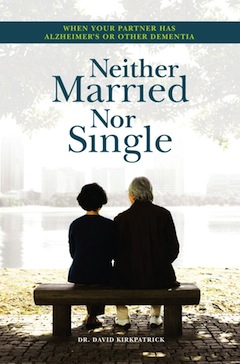
For anyone who is close to someone with Alzheimer’s disease or another form of dementia, Dr. David Kirkpatrick’s Neither Married Nor Single: When Your Partner Has Alzheimer’s or Other Dementia (Brush Education, 2018) is a must-read. There is so much in it that is critical to know, learn or come to understand about living, loving and letting go of one’s spouse, partner or friend with Alzheimer’s.

Kirkpatrick, a recently retired psychiatrist, has written a rare gem of a book and its message is needed by so many spouses of patients with these dreaded diseases. Kirkpatrick is a widower; his wife, Dr. Clair Hawes, a proponent, educator and practitioner of Adlerian therapy, died only last year from Alzheimer’s. His warm, wise and wonderful book is a map to help family members make it through what is normally uncharted, terrifying and anxiety-filled territory.

Besides the great clarity and pathos with which this book is written, it is a rare book because it is written from the dual perspectives of a psychiatrist and a loving husband in the process of watching his beloved disappear. Kirkpatrick, the psychiatrist, brings much-needed information to help the care-taking spouse understand the complicated medical condition, from getting the right diagnosis to clear descriptions of how dementia manifests, and even understandable explanations of the brain. As a loving husband, he shares the insights gained from others, as well as from his own years of confusion, anxiety, pain and suffering.

image - Neither Married Nor Single book coverThe fact of the matter is that the vast majority of the information in this book is also needed by the children of parents suffering from Alzheimer’s or other dementia. If there is no spouse to read it, then children, nephews or nieces, grandchildren or even close friends should read this book.

There are eight chapters – “The Diagnosis,” “Alzheimer’s Disease: A History and an Update,” “Finding Help and Comfort for your AD Partner,” “Care Homes,” “Improving Your AD Partner’s Quality of Life,” “Taking Care of the Caregiver,” “Sexuality and Intimacy” and “Into the Future” – followed by notes and the bibliography.

This small but powerful book takes the reader from the first stages when a spouse or other family member realizes something cognitive is happening to one’s loved one; when a family member begins to know that their loved one’s life is changing for the worse.

With humour, honesty, pathos and the strong voice of man who deeply loved his wife, Kirkpatrick takes the reader on his journey, from before, during and after the diagnosis, to a care home, and all the way to her death.

There are so many quotes that I could share, but space doesn’t allow it. In addition to Kirkpatrick’s words of insight are many important transcripts from other spouses talking with great honesty about their experiences. Every person’s experience in such a situation is partly unique, but it is also fair to say that all of the spouses in the book are on the same road, just getting off at different exits before returning yet again to the main highway leading to the same destination. Kirkpatrick’s special personal and professional voice shines a light to assist readers to see their way.

In Chapter 4, “Care Homes,” after talking about many of the heartbreaking yet life-saving choices a spouse must make on where the Alzheimer’s spouse should live, Kirkpatrick encourages the reader this way: “These are questions that are not always answered quickly or easily, but they must be asked, and the earlier in your shared experience that you do this, the better.” Yet, near the end of the chapter, he writes, “Think it through carefully. Perhaps write down pros and cons. Other than your decision to become partners in the first place, this is the most important decision in all your years together, so take all the time you need.”

One of my favourite quotes from the book is at the beginning of Chapter 6. It is a toast: “Here’s to Aloneness and her second cousin, Loneliness. May we continue to especially savour and enjoy the former without being absorbed by the latter.” And isn’t this yet another way to describe the holy and tragic dance of loving and losing?

While Kirkpatrick writes beautifully as a psychiatrist and as a husband throughout the book, in Chapter 7, “Sex and Intimacy,” he reveals to the reader even greater depths and poignancy. But, every chapter is filled with meaningful advice, guidance and hope.

Finally, a personal note that I’d like to share with you, the reader of this review, and hopefully a future reader of David Kirkpatrick’s book. Besides being a past congregant of mine, David also has been a dear friend for the past 17 years. In addition, before the onset of Alzheimer’s, my wife and I used to go out with David and Clair to dinners and plays. They were one of our favourite couples to see. Watching their dynamic relationship, their sense of humour, their deep shared mutuality and enjoyment was truly an honour. It is, of course, all the more sad knowing what they had and what they lost.

David, already an accomplished psychiatrist and therapist, certainly never wanted to experience such a loss, but he has translated that tragedy into this book. Neither Married Nor Single is a gift to anyone related or close to people with Alzheimer’s, but it is an especially meaningful and helpful gift to spouses suffering on their own.

Rabbi Shmuel Birnham was the rabbi and spiritual leader at Congregation Har El on the North Shore for 16 years. He retired two years ago. Rabbi Shmuel thoroughly loved being Har El’s rabbi and he also completely loves being retired.

Format ImagePosted on September 7, 2018September 6, 2018Author Rabbi Shmuel BirnhamCategories BooksTags aging, Alzheimer's, David Kirkpatrick, dementia, health
We are hardwired to be kind

We are hardwired to be kind

Dr. Brian Goldman is an emergency physician at Toronto’s Mount Sinai Hospital. (photo by Christopher Wahl)

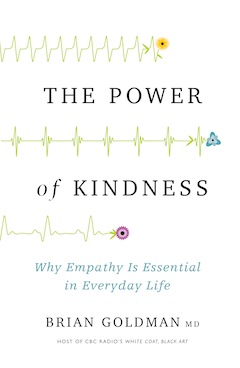
According to Dr. Brian Goldman, author of The Power of Kindness: Why Empathy is Essential in Everyday Life (HarperCollins Publishers, 2018), we all have the innate ability to be kind, gentle and to give of ourselves without the need to get anything in return.

Goldman, who works as an emergency physician at Mount Sinai Hospital in Toronto, said the idea for The Power of Kindness had been germinating in his mind for a long time.

“I had originally pitched a book on empathy and health care,” he said, “and my publisher, HarperCollins, came back to me and asked why I don’t instead aim a little broader and write a book about empathy in the world at large, not focus just on the hospital.”

About the concept, he said, “The wise physician knows how to say, ‘I don’t know.’ The book doesn’t say how it feels to say ‘I don’t know’ 17 times in a row. At some point, you’re terrified that they’re going to say, ‘Why don’t you get us someone here right now who can answer our questions?’ And you’re afraid of being unmasked as being inadequate.”

In recognizing this in himself, Goldman decided to travel the world to speak to some of the kindest people to hopefully internalize their kindness and find ways to pass their enlightenment onto others. In doing this, he said, “I found answers and, for the rest, you’re going to have to read the book. But, I will tell you one thing. I found that some people are born with empathy.

“I found one extraordinary child,” he said, by way of example, “who was nicknamed ‘Ta Ta.’ And he, at the time that I met him, was [almost] 3 years old. His mom, Shala, adopted a man on the streets of Sao Paulo who had been homeless for nearly 40 years and called him her soulmate. The striking thing about her situation is that her son, as a toddler … without ever having known what his mom had done, adopted his own homeless man. You can’t make that up.

“At a time, whatever nurturing she provided had set the stage for him to be as empathic as her. But, he [also] feels things and understands things intuitively about Adriano, the man who he befriended in the same way that Shala did.”

Goldman met people for whom empathy comes naturally and some who are gifted in empathy, but he also realized that we all share the same common experiences – adversity, disappointment, shock, loneliness, physical ailments and failure.

“I think, more often than not, it’s these experiences that are the engine for empathy,” said Goldman. “Because, after that, you can either die or you can pay it forward. And the way you pay it forward is to provide comfort and empathy for people who are going through what you went through. That was probably the common denominator that I saw again and again.

“Shame-based people tend to absorb the idea that they cannot make a mistake. If they do, it will be the end of everything.

“My intuitive guess is that a lot of health professionals feel that way and that’s why they go into the health professions … because they are hoping that, if they can do enough good works, it will make up for the one mistake they made.

“I was very much like that. I wasn’t totally like that, because, if I were more like that, I’d be unaware of all the things I’m saying right now.”

image - The Power of Kindness book coverAccording to Goldman, kindness and empathy are the ability to imagine what it is like to be somebody else, to see things through their eyes and act accordingly, to put yourself in their place.

“Unless you have a narcissistic personality disorder, in which your brain circuits will show you’re less capable of empathy, you’re capable of empathy,” said Goldman. “Everyone is hardwired for empathy. But, the thing is that, at the highest levels of executive function, empathy is a choice and we are constantly being distracted by competing priorities – my needs versus yours, my family versus your family. I’m running around like a pinball … boy, that’s a dated metaphor … but I can’t be all things to all people all the time. It’s impossible. Somebody is going to judge what I’ve delivered as unkind care.

“To become more kind in everyday life,” he said, “first of all, believe in your hardwiredness to be capable of being kind and empathic. Know that there are things that get in the way and they are very stereotypical – lack of face-to-face time, spending more time on social media, contacting people on social media, and less time on listening and face-to-face and being able to recognize cues that say that somebody’s more unhappy than their words are telling you.”

Goldman suggests learning which factors get in your way and to start creating ways that work for you to push those distractions aside. In The Power of Kindness, he talks about breathing exercises – about how we get distracted by unpleasant thoughts and feelings and how to re-centre ourselves and allow the negativity to float away.

“I use the metaphor of a parade,” he said. “There are beautiful floats and they represent nice thoughts – happy things that have happened or that I’m looking forward to – and you let them float by without judging them. Then, every once in awhile, there is a lousy float that’s ugly – the boss who is yelling at you, the coworker or somebody who you think is whispering about you behind your back, or the person who gave you the finger in traffic when you were both driving.

“The reason I like the float metaphor is that, with a lousy float, you let it go by – you imagine you’re in the stands, reviewing the floats as they go by. If it’s a parade, you let it go by, because there will be another nice one down the road in a couple of minutes.”

As for what sort of reception the book has garnered so far, Goldman said it has been very positive.

“Maybe the world is ready for a book like this because we’re all living at such a time when … people are going for kill shots on Twitter and there’s so much nastiness…. We’re watching, in the United States, kids being separated from their parents and put into cages. We need kindness.”

Rebeca Kuropatwa is a Winnipeg freelance writer.

Format ImagePosted on September 7, 2018September 6, 2018Author Rebeca KuropatwaCategories BooksTags Brian Goldman, empathy, health, lifestyle

The miracle that is our body

What do we really know about the marvelous vessel we are fortunate enough to inhabit? Don’t we mostly just take it for granted? We were popped into the world without our say so, but, in return, we inherited millions of years of human evolution in the bodies we have been bequeathed.

You will be enlightened to learn that our bodies are so filled with energy that we emit light, although our eyes are too weak to detect it. Information speeds along our nerves at 400,000 miles per hour, our brains hosting 100,000 chemical reactions per second. Blood corpuscles run through our bodies, covering 20,000 kilometres daily. We breathe 20,000 times a day to provide them with the oxygen our bodies need to function.

Our noses can differentiate three trillion different scents, and our eyes millions of different colours. Our skin has 100 pain sensors per square centimetre. Our stomachs are producing more new cells faster than those that are being destroyed by the acids of digestion. We produce one litre of saliva a day to keep things juicy. Operating all this is the work of our brains, which are actually more active when we are asleep than when we are awake.

Did we luck out or what? The most amazing thing is that, most of the time, the apparatus keeps on working for a lifetime with few or no problems. Our hearts beat away three billion times during our lives, we consume 35 tons of food on average and shed two to four kilograms of skin every year.

Women will be interested to know that their tongues are blessed with more taste buds than their male counterparts. They may be less happy to learn that we have 67 different types of bacteria in our bellybuttons and more bacteria in our mouths than the number of people on this planet.

With all of this going on in our bodies automatically, what are we in charge of? Where do we come in? Where does individual will come from? What is it that makes us the particular person we are? When do we get to be the person we think we are?

That may be where DNA comes in. That is the stuff our parents gave us, half the package from each of them. Out of the incredible hodge-podge that each of them got from their parents – millions, maybe billions, of different potentialities – chance determined the particular combination of traits we received from them. What we got influenced not just our physical heritage, but our mental and emotional elements are inherited, as well. After that, given some reasonable nurturing (something a lot of kids don’t get), each of us is on our own to make what we can of what we got.

We have five main chemicals in the brain, most of them variations of the feel-good type. We tend to pursue activities and things that make us feel good and that stimulate the flow of those chemicals in our brains.

We work because we enjoy the work, or because we enjoy having the money we will earn from that work. We pursue the company and attentions of those who make us feel good, sometimes becoming addicted (falling in love?) and desiring a permanent attachment. We strive because achieving the object of our effort will give us pleasure, be it knowledge, respect, money, power, fame, or all of them.

The vigour with which we pursue these things may arise from our DNA or from the kind of nurturing we experienced in our growing up, or both. Studies have shown that, in identical twins separated at birth, genetics accounted for 50% to 70% of outcomes and behaviours. There is little doubt that DNA programming is important, but behavioural differences between individuals can lead to different outcomes.

For some of us, all this may have relevance only to the degree it illuminates the course our own life is taking or has taken. Do we feel we got a fair shake in the lottery that landed us in the birth basket we arrived in? Did the environment we arrived in, the legacy our DNA bestowed on us, give us a fair chance to grab the golden ring(s) that satisfied our aspirations or desires? Did our grit and determination permit us to overcome the obstacles we faced in life so that we are more satisfied with where we are compared to where we started from? Are we happy?

Our lives are the body of proof.

Max Roytenberg is a Vancouver-based poet, writer and blogger. His book Hero in My Own Eyes: Tripping a Life Fantastic is available from Amazon and other online booksellers. The term “body of proof,” used in this article, is taken from the name of a television drama about a medical examiner that ran on ABC from 2011 to 2013.

Posted on September 7, 2018September 6, 2018Author Max RoytenbergCategories Op-EdTags health, philosophy

It hurts and it ain’t at all fair

Families sometimes just have a bad run when it comes to health in the household. From December onwards, it seems like somebody has been sick at our house … but, in between, there were brief periods when most of us functioned OK. It’s been challenging.

Like many folks, I’m also signed up for an exercise class, but I have had to miss it a lot because of all these illnesses. I’m usually game for a long walk with the dog, but not a big fan of exercise – I do it because I should. We need regular exercise to strengthen and care for the body. However, when a kid is home sick, or I am, I have to skip that class, too. Exercising is, in the long run, good for me, but, in the short term, there are days when I just have to sit on the couch.

Figuring out how to care for our bodies is a balancing act. On the one hand, sometimes things hurt, but, on the other, there’s no one else inside each of our bodies, telling us what to do about it.

Some people have a high pain tolerance and, more, we’ve been taught to “walk it off,” “suck it up” or cope with what comes without complaining. Is this choice, to learn to cope with discomfort without complaint, a Jewish thing?

Some might say it is the opposite. If you read the Torah portions about the Exodus from Egypt, you get multiple examples of when the Israelites complained. They wanted meat. They wanted water. They wanted better food. In Numbers 20:5, it says, “Why did you make us leave Egypt to bring us to this wretched place, a place with no grain or figs or vines or pomegranates? There is not even water to drink!”

On more than one occasion, G-d does provide for the Israelites, but there’s also punishment. People get sick, or are bitten by serpents. Complaining isn’t rewarded. It might be natural for some to complain of their lot – even the most strong among us need to let out our frustrations after awhile. However, some of us were taught that complaining too much isn’t OK; that, unless you’re dying, you need to get on with things, and save the cries of pain and complaints for when something actually really matters.

Unfortunately, if you hold the pain in and don’t act like you’re dying, sometimes you don’t get taken care of promptly. In some cases, the squeaky wheel gets the grease. Also, if you’re not a big complainer, people may forget that there might be anything wrong, though being stoic, understated and self-controlled can make life less complicated, too.

I’d like to say that folks remembered that some in our family weren’t 100% healthy, but that wasn’t always the case. Sometimes I felt a lot of pressure for us to be joiners and attempt something that I knew just wouldn’t work out – as I recovered from pneumonia, for instance. I’d have to say things like, “Well, we’re really not up to that, but thanks for inviting us.” I feel like maybe we’ve missed out, but good health is really important. It has to come first.

Jewish tradition teaches us that the body is a temple. We have to take care of it. We wish people “refuah shlemah,” or “complete healing.” We say “la bruit” (“to your health”) when someone sneezes. Midrash teaches us that we wish health to someone when they sneeze because, in the past, some saw sneezing as dangerous and deadly – the soul could leave through the nostrils. It’s a mitzvah (commandment) to do bikur cholim (visiting the sick), and many congregations have committees in place to make food and visit those who are unwell.

We have contradictions here. In our oldest stories, there are complainers and punishments for complaining. In our ritual traditions, we wish people health, help them get well, and have an obligation to take care of others and visit them. We’re also not to abandon those who are sick – when Miriam got sick, the Israelites waited for her to get well before traveling on. Yet, we’re also part of a 24/7, on-the-go culture. It’s hard to reconcile the need for good, old-fashioned rest with our modern lives, but both are necessary. When it hurts, it’s OK to say so, within reason, and to expect others to care and wish you better health.

Here’s a funny story of “it hurts.” While I was in labour with my twins, another expectant mother came in. She came with two people (family members? friends?) and made a lot of noise. It turned out that, when the people with her had to leave the room, she stopped making noise. It felt like we were listening to a performance! This lady felt that part of delivering the baby required making noise about it – and we all heard it, on cue.

It’s traditional to be supportive of someone in their time of discomfort – to support and help – but perhaps Hashem would prefer it if we saved the hysterical screaming for when it really hurts rather than just for when someone can hear us. Complaining for its own sake, it would seem, warrants punishment but, when it really hurts, we’re commanded to visit, bring food and help.

Sickness happens to the best of us, and it sure isn’t fair. But, there’s no point in making it worse for everyone by screaming louder than anyone else.

Joanne Seiff writes regularly for CBC Manitoba and various Jewish publications. She is the author of three books, including From the Outside In: Jewish Post Columns 2015-2016, a collection of essays available for digital download or as a paperback from Amazon. See more about her at joanneseiff.blogspot.com.

Posted on August 24, 2018August 22, 2018Author Joanne SeiffCategories Op-EdTags health, Judaism

The pot talk we need

Last week, Prime Minister Justin Trudeau announced that marijuana would become legal in Canada on Oct. 17. He had intended that it should be legal this Sunday – Canada Day. But the Senate, rousing itself from obsolescence just long enough to throw a wrench in the plans, delayed passage of the pot legalization bill until this month, making implementation by Canada Day impossible.

This may not seem like a particularly relevant topic for a Jewish newspaper editorial, but substance use is just as relevant in our community as it is in any. A few years ago, a panel discussion took place at Schara Tzedeck Synagogue on the topic. Prof. Raphael Mechoulam, a chemist and expert on marijuana’s medicinal uses visiting from the Hebrew University of Jerusalem, and Dr. Kathryn Selby, a University of British Columbia clinical professor in pediatric developmental neurosciences, took opposing sides.

Mechoulam said that cannabidiol (CBD), a component in marijuana, may have medical uses “in almost all diseases affecting humans.” However, little scientific research has been done.

Cannabinoid receptors are abundant in several regions of the brain, including those where movement control, learning and memory, stress, cognitive function and links between cerebral hemispheres occur. CBD can also impact appetite, blood pressure, cerebral blood flow, the immune system and inflammation. It can, in some cases, reduce or eliminate seizures and cancerous tumours.

But Selby raised an issue that has gone almost entirely ignored throughout Canada’s national discussion about marijuana legalization.

Marijuana can have deeply deleterious effects on the brains of adolescents and young adults, altering the brain’s structure and function in lifelong ways. The development of the human brain continues into the 20s, Selby said, and the prefrontal cortex, where judgment and executive functions occur, is the last to develop – thus the most likely to be affected by intensive marijuana use.

Longer-term impacts of marijuana use by adolescents have been shown to correlate with schizophrenia later in life and a 50% to 200% increase in psychoses among heavy users. Daily marijuana use during high school has been correlated with a 600% increase in depression and anxiety in later life.

Selby recommended that marijuana use, if undertaken at all, should be “as late and as little as possible.”

During the national discussion around this issue, much concern was expressed about the ability of law enforcement officials to identify and measure marijuana impairment among drivers. Almost no discussion was devoted to the effects of marijuana on developing brains.

Part of the reason for delaying legalization until October was to allow provincial and municipal governments to prepare for the related distribution, legal and other public policy issues legalization raises. While criminal law is a federal issue – marijuana legalization is on Ottawa’s plate – it is the provinces that determine where, how and to what consumers the “product” may be marketed. In Alberta and Quebec, the age will be 18; in the other provinces, 19. (Most provinces have made the decision to create equal ages of majority for alcohol and marijuana purchase.)

Alcohol has its own harmful impacts on the bodies of young (and older) people, but marijuana may have particular harms on the development of adolescent and young adult brains.

Once the brain is fully developed, by the mid-20s, the dangers of permanent damage by marijuana use are significantly reduced. This scientific evidence – not the fairly random legal decision to permit consumption at age 18 or 19 – should perhaps have received more attention than it has. Given that it did not, it now falls to parents, grandparents, trusted adults and educators to share with young people the potential harm heavy marijuana use has for adolescents and young adults.

It is time Canada moved away from prohibition and towards a compassionate model that reduces and minimizes the harm that stems from fear and a lack of evidence-based policies. Fear-mongering is a waste of time – and marijuana’s positive impacts can’t be denied.

However, for those of us with young people in our lives, a good approach is to model the moderate use of all substances, to leave open lines of nonjudgmental communication (however hard that is) and to demonstrate for one another how to make wise and healthy choices. Sharing information in a rational way and asking young people to avoid heavy use or to delay if possible is the least we can do. It is our hope, too, that pot companies will temper their impulses to capitalize on every opportunity and avoid marketing edibles made to appeal to children and teens so that we’re not fighting an uphill battle. Healthy communities with resilient kids are a group effort.

Posted on June 29, 2018June 28, 2018Author The Editorial BoardCategories From the JITags Canada, children, health, legalization, marijuana, politics, science, teens
Negev Dinner helps Israeli children

Negev Dinner helps Israeli children

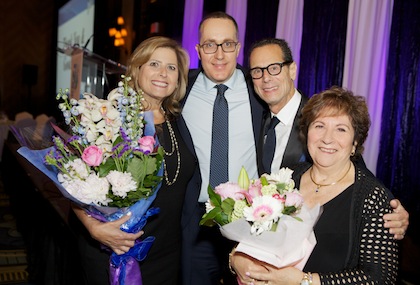
Left to right: Ilan Pilo, Michelle Pollock, Dr. Neil Pollock, Wendy Eidinger Spatzner and David Goldman. (photo by Robert Albanese)

Vancouver supporters of the Jewish National Fund (JNF) gathered in their finery at the Four Seasons Hotel Vancouver on June 3 to celebrate Israel’s 70th birthday and pay tribute to philanthropists Neil and Michelle Pollock.

Michelle Pollock is a former lawyer, the immediate past president of the board of the Jewish Community Centre of Greater Vancouver, and has co-chaired the Jewish Federation of Greater Vancouver annual campaign’s women’s division for six years, as well as supporting Jewish education, among many other causes. Dr. Neil Pollock is chief surgeon and medical director of Pollock Clinics. He has undertaken teaching missions to Rwanda, Congo and Haiti, as well as being involved in philanthropy at home and abroad.

photo - Bernice Carmeli, dinner co-chair, with Ilan Pilo, David Goldman and Ilene-Jo Bellas
Bernice Carmeli, dinner co-chair, with Ilan Pilo, David Goldman and Ilene-Jo Bellas. (photo by Robert Albanese)

JNF Pacific Region president David Goldman welcomed the crowd – who had to pass a few dozen protesters on their way into the hotel – and introduced the evening’s emcee, Michael Nemirow, a friend of the Pollocks, who is also involved in various community organizations and activities. “I’ve done the math, and we have around 11 hours of speeches and entertainment for you this evening, but we’ll try to compress it into three,” Nemirow said, eliciting laughter from the crowd.

After Maurice Moses led the audience in O Canada and Hatikvah, B.C. Lt.-Gov. Janet Austin took the stage. She praised JNF for its work in the “restoration and preservation of the Jewish homeland,” which covers everything from ecological to social to security initiatives. Austin also commented about the Pollocks, highlighting Neil Pollock’s work in Rwanda to prevent the spread of HIV.

Galit Baram, consul general of Israel for Toronto and Western Canada, focused her remarks on the 70th anniversary of Israel, “the only democracy in our region, a bastion of democracy.” She described its strengths in the areas of human rights, medicine, multiculturalism and technological innovation. She said Israel is led by people “both on the right and on the left who love their country with all their hearts” in the face of multiple existential threats. “We rely on our friends who share common values, and Canada, our ally, is among them,” she said.

photo - Honourary chairs Jodi and Alex Cristall
Honourary chairs Jodi and Alex Cristall. (photo by Robert Albanese)

“The success of Israel did not happen in a vacuum,” said Baram, citing JNF as a key organization in supporting the state, one in whose name every Israeli has a tree planted. She also spoke of JNF’s contributions in a multitude of activities, including supporting soldiers with post-traumatic stress disorder and her “personal favourite,” the building of a protected playground in Sderot in an area that has suffered shelling from Hamas and other militant groups. Baram thanked Canadians for the warm welcome and open arms with which Israeli diplomats are welcomed in the country.

After Hamotzi, chanted by the Kollel’s Rabbi Avraham Feigelstock, Ilene-Jo Bellas, former president of the JNF Pacific Region (2012-2015), was presented with the JNF Bloomfield Award by local shaliach Ilan Pilo. He described Bellas as an indefatigable servant for Israel who “bled blue and white,” a portrayal she affirmed as fact after taking the podium.

The video on the work of the JNF was introduced by JNF Canada president Wendy Eidinger Spatzner, who explained that the First Zionist Congress established a fund to purchase land in Israel and that this fund became JNF. She talked about JNF’s extensive work to “build the infrastructure of Israel,” noting that it affects the daily lives of “pretty much every Israeli citizen.”

photo - Honourary chairs Jodi and Alex Cristall
Honourary chairs Jodi and Alex Cristall. (photo by Robert Albanese)

Rabbi Dan Moskovitz then led everyone in Birkat Hamazon, before Vancouver TheatreSports performed a series of improv skits centred on the Pollocks’ life as a married couple.

The keynote speaker of the dinner was Doron Almog, a former major general in the Israel Defence Forces, who received the Israel Prize for lifetime of achievement. He discussed his role as founder of ALEH, the charity for children with developmental disabilities that the Pollocks chose to support with monies raised from the evening.

Almog spoke on the theme of commitment, as experienced throughout his life and in the work he has done for children. He shared the story of the death of his brother, a tank operator who died after being injured, left behind by his fellow IDF soldiers. Almog subsequently swore to never leave behind an injured soldier.

Almog’s son Eran, who was named after his fallen uncle, was born with a combination of autism and developmental problems, and a psychiatrist told the family that he would probably never speak, remaining at the cognitive age of an infant. “This son became the greatest teacher of my life, he taught me more than anyone about life, about commitment,” said Almog.

After his son died, Almog went to see how children like Eran are treated “in the only Jewish state in the world.” What he saw horrified him: “The first thing you saw is the stink; distorted, terrified faces; shameful things. What the hell are these places, why are they being punished more?”

photo - Keynote speaker Maj. Gen. (Res.) Doron Almog, founder of ALEH, right, with local businessman and philanthropist Gary Segal
Keynote speaker Maj. Gen. (Res.) Doron Almog, founder of ALEH, right, with local businessman and philanthropist Gary Segal. (photo by Robert Albanese)

Almog discovered that such children were objects of shame in Israeli society. Golda Meir, prime minister of Israel from 1969 to 1974, had a granddaughter with Down syndrome who, as an adult, gave interviews to the press, said Almog. In these interviews, he continued, “she said, ‘Golda never visited me, Golda never loved me, Golda told my mom, “Never mention the prime minister of Israel having a retarded granddaughter.”’ Yigal Alon [deputy prime minister of Israel, 1968-1979] had a beautiful child who, at age 5, was taken away from the kibbutz she was born in and sent away to Scotland and he never spoke about her. And inside me I heard my son screaming, ‘My dear father, I will never complain to the media, you can send me away to Scotland and never speak of me, but, if you do that, you do not deserve even the title of “father” or even the title of human. I am the ultimate test of commitment,’ he said to me, the echo box of your bleeding brother.”

After Almog left the military, he established the village of ALEH, “a paradise where the children can have a full life. We broke the walls of stigma and shame and stereotypes.”

ALEH Jerusalem, a multi-service home for children with disabilities, now receives help from more than 450 volunteers from all over the world. Some of them, said Almog, are children of Nazis, who say they are coming as atonement for Hitler’s decision to kill people with disabilities. “The social chain is always measured by its weakest link,” said Almog, receiving a standing ovation.

After a video explaining more about ALEH, there was a video tribute to the Pollocks introduced by their children, Josh, Elliot and Shoshana. The Pollocks said a few words, after which Goldman and Pilo wound up the celebration.

Matthew Gindin is a freelance journalist, writer and lecturer. He is Pacific correspondent for the CJN, writes regularly for the Forward, Tricycle and the Wisdom Daily, and has been published in Sojourners, Religion Dispatches and elsewhere. He can be found on Medium and Twitter.

Format ImagePosted on June 29, 2018June 28, 2018Author Matthew GindinCategories LocalTags ALEH, children, health, inclusion, Israel, Jewish National Fund, JNF, Negev Dinner, Pollock

Posts pagination

Previous page Page 1 … Page 16 Page 17 Page 18 … Page 24 Next page
Proudly powered by WordPress