Fostering nature’s care

Richmond Jewish Day School held a week of activities revolving around Tu b’Shevat. (photo from RJDS)

Richmond Jewish Day School held a weeklong event celebrating the holiday of Tu b’Shevat, which fell this year on Jan. 17. Tu b’Shevat has developed into an ecological holiday that reminds us of humanity’s connection to the earth and to our role as caretakers of the environment.

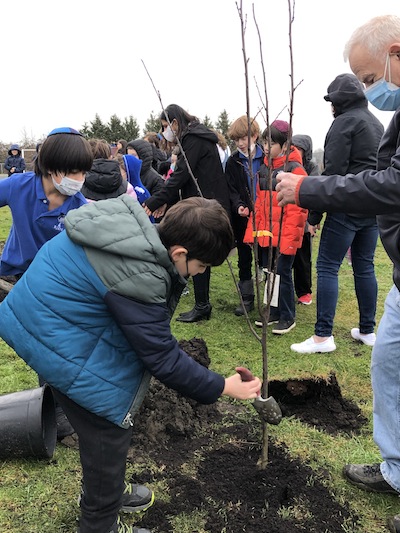
photo - Students assisted in planting several fruit trees in the school garden, sponsored by the Jewish National Fund
Students assisted in planting several fruit trees in the school garden, sponsored by the Jewish National Fund. (photo from RJDS)

On the holiday Monday, each classroom performed a model Tu b’Shevat seder, a meal that partly mirrors the Passover seder and involves eating biblical foods native to the Holy Land and drinking four cups of wine or, in the students’ case, grape juice. Additionally, all of the students assisted in planting several fruit trees in the school garden, sponsored by the Jewish National Fund.

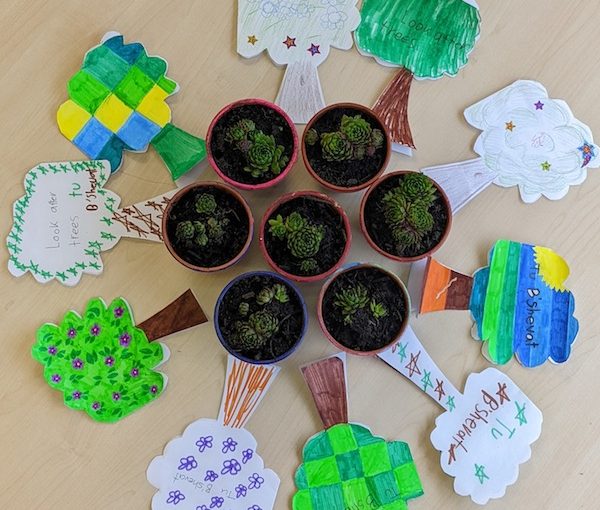
On the Tuesday of that week, students potted succulents from the garden to give away to seniors in the Richmond community. And, in the remainder of the week, classes planted parsley and other herbs for Passover, and assisted in a large-scale, school-wide garden clean-up.

When students are able to see the effort and care needed to grow plants, they develop a sense of ownership for these living organisms. Developing this awareness of how precious nature is can help children become better connected to their environment, learning to be strong community ambassadors and advocates in protecting the planet.

Judaism is not alone in advocating for environmental protection. From Buddhism to Christianity to Hinduism to Islam, various faiths acknowledge the need for environmental stewardship and their scriptures urge followers to be caretakers of the planet, looking after the natural earth and the organisms that live in it.

– Courtesy Richmond Jewish Day School

It’s been a hard two years

Last summer, given COVID’s continued presence and restrictions, campers were especially happy to be at camp. (photo from Camp Hatikvah)

Prior to 2020, Camp Hatikvah was experiencing unparalleled success. With enrolment maximized, the organization was in the position to focus not only on capital and program development but also on long-term financial planning. According to Liza Rozen-Delman, the camp’s executive director, Hatikvah’s future had never looked brighter. “It was a period of great excitement for us,” she said. “We honestly thought that nothing could get in the way of our growth and success.”

The pandemic, however, changed everything. “The impact of COVID was immediate and devastating,” Rozen-Delman said. “We went from being on top of the world to worrying about our very survival.”

photo - Boys during a service at Camp Hatikvah
(photo from Camp Hatikvah)

Luckily for Hatikvah, donors immediately stepped in to cover the camp’s mounting financial losses. “People knew we were in trouble and they rallied around us,” said Rozen-Delman, with great emotion and gratitude. “Not only did they cover our operational expenses entirely in 2020, they made it possible for us to open in 2021 by funding all of the camp’s COVID-related expenses, like testing, site upgrades and more.”

Rozen-Delman went on to share how incredible it was to welcome campers back to camp last summer. While capacity had to be dramatically reduced to adhere to government group-size limits, close to 400 children participated in Hatikvah’s program in 2021.

“We rearranged our session lengths to make sure that every single Jewish child wishing to attend our camp was able to do so,” explained Rozen-Delman. “While this meant that each camper was at camp for a little less time than is typical, everyone was just so grateful to be there.”

“Our campers are always happy to be at camp but last summer, they were elated,” added Eden Gutterman, the camp’s associate director. “They needed to socialize, to be outdoors and to be away from technology and it was just so beautiful to watch them revel in camp and each other.”

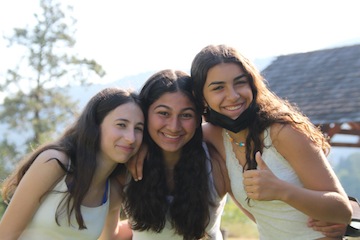
photo - Campers at Camp Hatikva give a thumbs up
(photo from Camp Hatikvah)

Gutterman shared her favourite memory from last summer. “One Shabbat, we asked all of the campers who had their bar and bat mitzvah’s over Zoom to stand in the middle of a circle made up of the rest of the campers and counselors. We then did the hora around them as a tribute to their milestone and accomplishment. None of these campers got to celebrate their simchah in person so it was incredibly touching to see them surrounded and celebrated by their friends. It is something we – and they – will never forget.”

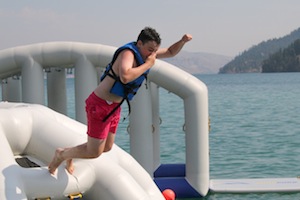
photo - Camper jumps into the water
(photo from Camp Hatikvah)

Camp Hatikvah is now busy preparing for summer 2022.

“We recognize that COVID will likely not be over by summer,” acknowledged Rozen-Delman. “And, while we wish it wasn’t the case, we feel well-prepared to deal with anything.”

Rozen-Delman shared that the Gutman family and Rockdoc Consulting Inc. have provided the funding for the camp to build a new infirmary in time for this summer.

“Given the realities of the ongoing pandemic, this gift couldn’t have come at a better time,” said Rozen-Delman. “Our new infirmary has been designed with COVID and any future infectious disease in mind and will have recovery rooms that can be used as properly ventilated isolation space if necessary. Its functional space has also been thoughtfully designed to allow us to meet and exceed current best practices in camper care. It is a gift our camp so desperately needed and we couldn’t be more grateful to Sam and Belinda and Gloria and their families for their generosity.”

Joanna Wasel, Camp Hatikvah’s board president, commented that, while she wished the world hadn’t had to experience this pandemic at all, she believes that the camp will ultimately be stronger because of it.

“We are entering 2022 with a renewed sense of purpose,” said Wasel. “Our community supported us through this challenging time because they believe in our mandate to help raise the next generation of strong, confident and resilient Jewish leaders. Their faith means everything to us and we are determined to make them proud.”

– Courtesy Camp Hatikvah

There’s no place like Miriam

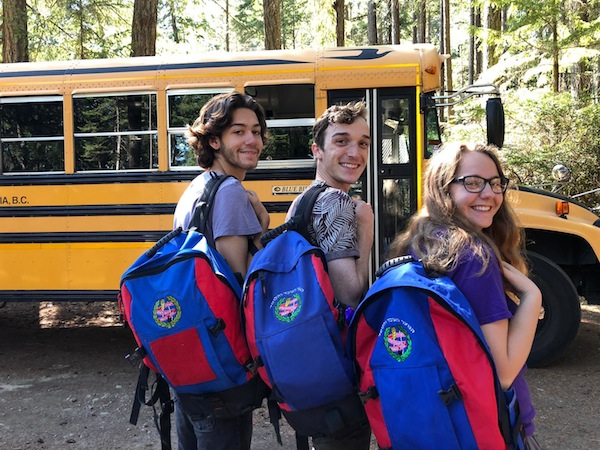
Judah Altman, left, Daniel Fine and Marina Levy all packed up for the bus. (photo from Camp Miriam)

Returning to Camp Miriam every summer is like going home. The kids shouting and laughing for joy, the bright smiles of the counselors, beautiful Gabriola Island – there’s no other place like Camp Miriam.

My first summer at Miriam was 2013. I’ve returned every summer since, more in love with the place and the people each time. I’ve grown up at Camp Miriam. I’ve grown up with the people; they are some of my best friends. I’ve grown up as a person; I’m always learning about myself and the world in ever-changing new ways. Most importantly, I’ve grown up at Camp Miriam having fun – summers at camp are what I look the most forward to most and I never want them to end.

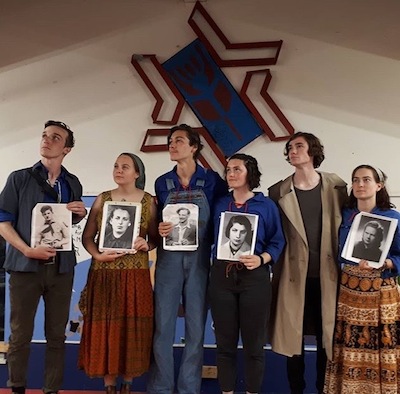
photo - Left to right are “Visionaries” Daniel Fine, Marina Levy, Judah Altman, Mira Macnair, Kieran Macnair and Mica Hastings
Left to right are “Visionaries” Daniel Fine, Marina Levy, Judah Altman, Mira Macnair, Kieran Macnair and Mica Hastings. (photo from Camp Miriam)

I’ve been a camper, a junior counselor, a counselor and, last summer, a counselor for the leadership training program. Last summer was my favourite summer yet, and I can’t wait for this coming summer. To me, Camp Miriam has always been special for two reasons: the first is the activities, and the second is the people.

This summer, as chinuch (educational director) on our youth-led executive team, or mazkirut, I will be in charge of activities for the entire camp. I could not be more excited. One of the main reasons I continue to return to Camp Miriam is the unique options it provides for campers. There are the classic undertakings – like swimming, soccer, art and music. But then there are the programs that few other summer camps have, such as special days where all camp activities run around a surprise theme, ocean swimming as the sun sets, Jewish learning, and a focus on social justice.

I’m also looking forward to seeing the new and returning campers bond with their cohorts and with their counselors. I know firsthand that Miriam friendships last forever. The people I’ve met at camp will undoubtedly remain my friends for the rest of my life. These are the deepest connections I have.

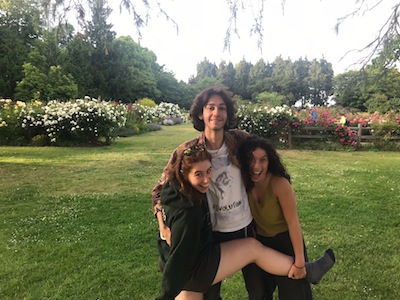
photo - Judah Altman with friends Meital Smith, left, and Rakeea Chesick Gordis
Judah Altman with friends Meital Smith, left, and Rakeea Chesick Gordis. (photo from Camp Miriam)

After two years of COVID, these connections couldn’t be more important: for counselors like me, and especially for kids. Camp Miriam empowers youth and provides a space for kids to be themselves and to continue to discover who they are. It is a place to make new friends and reaffirm old ones. It is a place to talk for hours on end about all manner of issues, and to play and be silly without fear of judgment. It is a place to learn what true friendship means.

I am excited for the summer because, once again, I will get to meet new campers and counselors and help create the community that is the essence of Camp Miriam. I also can’t wait to see all the familiar faces. I can’t wait to run memorable programming for the kids that will be fun, while also empowering them to grow as people. Camp Miriam is the most important place in the world to me – I feel so fortunate that my parents have given me the opportunity to return summer after summer.

Judah Altman is a student at Columbia University, studying philosophy and sociology. He will be chinuch, or director of education, at Camp Miriam this summer.

Back to camp, to being a kid

At summer camp, kids build community, take on challenges, become independent and develop leadership skills. (photo from Camp Solomon Schechter)

There’s a place where kids can simply be themselves. Where they build community, take on challenges, become independent and develop leadership skills. And, through it all, they think it’s just fun and friendships. That’s the magic of summer camp – a healthy dose of nature and nurture.

One year after sleepaway camps across the country were shuttered by the pandemic, many kids packed their shorts and hiking shoes once again, dug out their sleeping bags, and reunited with camp buddies to rekindle fond traditions.

We asked the directors of three Jewish summer camps in Washington state to share their perspective on the role camp plays in the social and emotional health of children, and how it was especially vital in the summer of 2021.

Welcome back to camp

“Welcoming the kids back this summer was extra special,” said Zach Duitch, director at Camp Solomon Schechter in Tumwater. “We could see it in their faces. After being online for a year-and-a-half, they were ready to be outside, with their friends, and having fun.”

Many parents were understandably concerned about sending their kids back to camp this past summer. Attendance numbers dipped somewhat, but families also recognized the value of getting their kids back to outdoor healthy summer fun, Duitch said. Away from everyday social pressures, camp staff works to create an environment that’s a safe place for kids to be their authentic selves.

“Parents trust us with their kids’ safety, security and health – and also with their spiritual and emotional needs. We take that trust incredibly seriously,” said Rabbi Ilana Mills, director at URJ Camp Kalsman in Arlington. “Camp is life-changing in so many ways. It’s an opportunity to grow as a whole person.”

Fun with lasting impact

When kids come home from one, two or three weeks at summer camp, the changes may not be immediately evident. In fact, many campers and counselors only realize as adults how much the experience has shaped them, instilling them early on with courage, compassion and independence. Kids can head off to camp as early as the summer after first grade. Many progress through the years to become counselors, taking on leadership roles as high school and college students, in what many describe as the “best job ever.”

Ask a kid and they’ll say camp is about boating, hiking, arts, sports, cookouts – and the thrill of a high-ropes course. Along with the fun, each camp has its own unique culture with familiar traditions passed down from summer to summer. Camp culture is what ties the community together with singing and celebrations, skits and games. Jewish summer camps also integrate religious observance and community into daily life.

“Camps are these bubbles – their own societies – where kids play a central role,” said Rabbi Kenny Pollack, camp director at Sephardic Adventure Camp in Cle Elum. “Our kids are immersed in the culture of camp, and it helps shape their identity.”

Healthy dose of silliness

When camp directors describe how their programs nurture kids, it can sound pretty serious. But one thing they take extremely seriously is fun.

“At Camp Solomon Schechter we do a lot of ‘shtick.’ Campers love seeing their counselors act silly,” said Duitch, as he explained a beloved trivia game that ends with participants messy and everybody laughing.

Mills described how “we really try to be as outside the box as possible. We push our counselors to teach their passion, be creative and try new things.”

She even got a chance to join the fun, playing a zombie during the culmination of their outdoor survival unit at URJ Camp Kalsman.

Leave real world behind

Kids leave their parents and their digital devices at home when they arrive at camp. There may be homesickness at first but soon their days are consumed by activities and friendships. And, since more and more camps are going device-free, campers get a break from their screens.

“Camp is a place where kids get to be their authentic selves,” said Pollack.

Each summer, as kids are reconnecting with old friends and making new ones, they’re also connecting across borders. Increasingly, camps are bringing counselors from international locations to supplement the programming with games and traditions from their home countries.

“As much as kids love their parents, camp is a great opportunity for them to learn from other role models,” said Duitch, explaining how the camp experience broadens kids’ viewpoints and connects them to lifelong friends.

Many parents, kids and camp staffers found it heartbreaking to cancel camp in 2020. That’s why camps throughout Washington banded together, lobbying the state government to make sure that camp happened in 2021 and that it would be a safe and extra-memorable summer. In the end, it may be difficult to measure the social and emotional impact of returning to camp after a trying year. But parents could no doubt see it in the hugs, the joy and the happy exhaustion as they picked their kids up at the end of camp this past year.

This article, courtesy Camp Solomon Schechter, comes from the Samis Foundation, which was established in 1994 by Samuel Israel, z”l, and is the largest Jewish philanthropy in Washington state. Grantmaking is focused on the foundation’s mission of supporting local Jewish education and initiatives in Israel. Samis is honoured to support the three Jewish overnight camps located in Washington state, working to keep Jewish children and teens engaged in their culture, religion and communities.

Educating the next leaders

King David High School student and Climate Education Reform British Columbia member Sara Bauman (photo from Sara Bauman)

Weather events like the recent floods across British Columbia and last summer’s record fire season are prompting questions about how to plan long-term for the changing environment. One King David High School senior has come up with part of the answer: create a climate curriculum that prepares tomorrow’s leaders for addressing climate change.

Sara Bauman is a member of Climate Education Reform British Columbia (CERBC), a group of approximately 20 high school students who believe that the world’s pressing environmental challenges deserve a place in the province’s education system. Bauman says lessons about the physical climate system and the science behind phenomena such as greenhouse gases and sea-level rise should be a standard part of what students learn in school.

CERBC is pushing for a new curriculum that includes mandatory courses on climate-related topics and for the subjects to be taught across K-12 grade levels. At the present time, Grade 11 and Grade 12 students have the option to take environmental sciences, which contains a certain number of units relating to climate change. But the elective aspect, Bauman explained, means that not all students are learning about climate science or its implications.

“We want to get students to understand the urgency of the climate crisis and the need to act now,” Bauman told the Independent. “[If] not every student has to take it, different students are going to be receiving different knowledge, some less than others. [We] need the whole generation to be prepared to combat climate change, not just a few.”

A 2019 study conducted by researchers at Lund University, in Sweden, found that Canadian schools as a whole fell short when it came to educating students about climate change. In British Columbia specifically, research indicated that schools often failed to teach three core concepts: that the climate is warming, that there is consensus among experts that climate change exists, and that human-driven solutions are possible. The researchers also noted that there is no consensus among provinces or school districts when it comes to teaching students about climate change.

In October, CERBC met with B.C. Minister of Education Jennifer Whiteside to discuss its proposal. The students outlined six needs that they felt would be essential to a successful K-12 climate curriculum, including enabling students to “understand the urgency of the climate crisis” and to recognize that there are ways to mitigate or slow climate change.

Bauman said the program needs to be interdisciplinary because climate change has social implications as well. “We want students to understand the relationship that climate change has with social justice issues,” she said, noting that environmental advocacy “can’t be separated from other movements, like the Black Lives Matter or Indigenous rights movements, because, at the end of the day, climate change does come down to systems and how we structure our lives. And we also want to inspire students to start to critically engage in politics and see how they can create policy change.”

KDHS head of school Russ Klein said CERBC’s call for a mandatory climate curriculum reflects a wider sentiment among today’s students that the topic needs to addressed. Even though Bauman is the only KDHS student representing CERBC at this time, other students at KDHS are finding their own ways to raise social awareness.

photo - King David High School head of school Russ Klein
King David High School head of school Russ Klein (photo from KDHS)

“[In] the last two or three years, especially with Greta Thunberg and the climate protests, we’ve had a whole bunch of students actively engaging with the school, the [administration], climate protests and [other types of] activism,” said Klein.

Students at KDHS have a variety of avenues in which to get involved, including the youth groups Sustainabiliteens and the Green Club, which are aligned with addressing social and environmental issues.

Klein said Bauman brings an important quality to this dialogue. “She lends a Jewish voice of perspective to some of what she’s been doing, which I think is also very relevant for other people,” he said. “We need more diversity in the room.”

Of course, students aren’t the only ones who want to see a curriculum that reflects today’s challenges. Many teachers do as well. The B.C. Teachers’ Federation publishes downloadable “Climate Change Heroes Lesson Plans” to help teachers develop new learning modules.

Still, Klein said, many schools want the province to lead this effort. “There are so many different things and priorities for schools to do, and I think this one has to be very high on the list. And how we do that, of course, is [we] look to government. These things must be mandated,” he said, pointing out that, until the province implemented LEED-compliant building codes requiring contractors to adhere to sustainable practices, “builders weren’t doing anything. Because why would they? But when it’s the law of the land, they have no choice.”

Last week, Whiteside’s office issued a statement acknowledging that it is working with the BCTF and the Climate Change Secretariat to increase climate-related resources for teachers. It noted, “The flexible nature of B.C.’s curriculum provides many opportunities in which topics like climate change can be explored in various levels of detail.”

The ministry maintains that both K-10 and 11-12 curricula contain resources for “possible connections” to climate change that allow teachers to introduce new study topics. The elective nature of 11 and 12 grade courses, it said, “offer[s] interested students an opportunity to delve deeper [and] encourage exploration from a local to a global scale.”

While the ministry did not say whether it will invite the students to participate in writing a new climate curriculum, Bauman said she hopes the ministry will accept CERBC’s input – “Because we are the students. We know what is best for our generation [when it comes to] learning. I think the ministry doesn’t realize what an asset we are to helping this process.

“We want to create a relationship with them,” said Bauman. “We want to partner with them [and] help the process in any way that we can.”

Bauman said it’s important for students to be part of the solution.

“The most important thing, at least for me,” she said, “is to get students to envision a better world and help them feel inspired, empowered and engaged because, a lot of the time, we hear about climate change and it’s a lot of doom and gloom. [Working] with CERBC has allowed me to put my climate anxiety into other things and channel it into meaningful action, and I want other students to have the chance to do the same.”

Jan Lee’s articles, op-eds and blog posts have been published in B’nai B’rith Magazine, Voices of Conservative and Masorti Judaism, Times of Israel and Baltimore Jewish Times, as well as a number of business, environmental and travel publications. Her blog can be found at multiculturaljew.polestarpassages.com.

Comedy and mental health

David Granirer (photo from David Granirer)

Vancouver counselor and comic David Granirer has been standing up for mental health, literally, for nearly two decades. His brainchild, Stand Up for Mental Health, is a program that has helped hundreds of people on the road towards addressing and recovering from all sorts of psychological disorders by taking to the stage and performing comedy before live audiences.

The concept came to Granirer after observing his students during a stand-up comedy clinic he taught at Langara College in the early 2000s. While the course had nothing to do with mental health, Granirer noticed that some students experienced psychological benefits by the end of the semester.

“So, in 2004, I thought, why not put this in a package for people who wanted to do comedy but also wanted that life-changing experience? And, since I work in mental health and have a mental illness, this was the natural place to start,” said Granirer, who, in addition to advocating for destigmatizing mental illness, speaks openly about his own experience with depression.

“I’ve had students overcome long-standing depressions and phobias, not to mention increasing their confidence and self-esteem. There’s something incredibly empowering about telling a roomful of people exactly who you are and having them laugh and cheer,” he added.

The idea, which was seeded in Vancouver’s Oakridge neighbourhood, has blossomed to a program that Granirer has run in 50 cities throughout Canada, the United States and Australia – in partnership with mental health organizations in each area.

Granirer has trained nearly 700 comics since Stand Up for Mental Health’s inception. In that time, there have been more than 500 shows for a range of audiences, including mental health organizations, government departments, corporations, universities, correctional facilities and the military. He even created a show for the United States Secret Service in Washington, D.C., in May 2021.

In Vancouver, the Stand Up for Mental Health course is six months long. Classes start by teaching participants how to write stand-up routines; then they spend the next part of the classes working on their acts. Each week, participants write some jokes and bring them in to try in front of the class. Most of the acts are about their mental health experiences.

Classmates do a lot brainstorming together to hone the routines. At the halfway point, each student does a five-minute set. Afterwards, the prospective comics develop a completely new set for their graduation show at the end of the program.

In terms of therapeutic benefits, Granirer said doing comedy builds a comic’s confidence and self-esteem, enabling many to tackle other challenges in their lives successfully. It also helps get rid of the shame many feel about having a mental illness.

“People transform their past trauma into great comedy material,” he said. “In therapy we call that a cognitive shift. All the bad things they’ve been through now make a great act. Instead of feeling ashamed, they now feel proud of what they’ve been able to survive.”

Granirer emphasized that, while much can be explored in the process, the humour has to be clean, and there are taboo elements, such as homophobia, racism and antisemitism, which are off limits.

When the pandemic started last year, Granirer shifted to online classes and shows on Zoom. In 2021, Stand Up for Mental Health has done about 25 virtual shows for organizations across North America. Recently, live classes have resumed.

“The pandemic has also got in the way of my traveling to other cities where I’ve trained groups,” Granirer said. “I just finished training a group in Culpeper, Va., and had to emcee the show virtually instead of in person.”

Granirer has been the recipient of numerous accolades over the years. Among the honours decorating his mantel are an Award of Excellence from the National Council for Behavioural Health, a Life Unlimited Award presented by the Depression Bipolar Support Alliance, a Rotary Shine On Award in Australia for special achievement in mental health, and a Meritorious Service Medal from the Governor General of Canada.

His work for Stand Up for Mental Health has been featured in media throughout the world, including, of course, the Jewish Independent, and also in The Passionate Eye documentary Cracking Up. Granirer is the author of the book The Happy Neurotic: How Fear and Angst Can Lead to Happiness and Success.

The new year promises a busy start for Stand Up for Mental Health. On Jan. 12, Granirer and his team of comics are organizing “an evening of stigma busting comedy” called Speaking of Normal. The Zoom event will be hosted by TSN personality Michael Landsberg. To attend, visit wellnessinstitute.org/speakingofnormal.

The next Stand Up for Mental Health Vancouver class starts on Jan. 25 and is currently recruiting students. Classes are Tuesdays from 10:45 a.m. to 1:45 p.m. More information can be found at standupformentalhealth.com or by emailing Granirer at david@smhcomedysociety.org.

As far as being able to participate, Granirer stressed, “there are no prerequisites, no auditions, and no one needs to have any comedy experience. All they need is a desire to do stand-up comedy.”

He strongly encouraged his fellow Jewish community members to take part.

Sam Margolis has written for the Globe and Mail, the National Post, UPI and MSNBC.

Wolf & lamb find peace

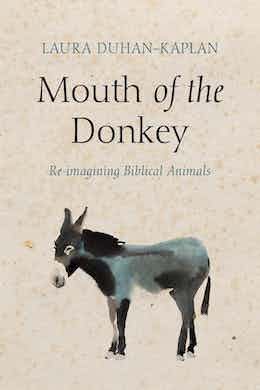
In her new book, Rabbi Dr. Laura Duhan Kaplan explores lessons for humans from the animal world.

Good things come in small packages. A thin volume by Vancouver rabbi, philosopher and academic Laura Duhan Kaplan packs ancient and modern wisdom into a delightful parcel.

Duhan Kaplan is director of inter-religious studies and professor of Jewish studies at Vancouver School of Theology, professor emerita of philosophy at University of North Carolina at Charlotte and rabbi emerita of Vancouver’s Or Shalom Synagogue. Her book Mouth of the Donkey: Re-imagining Biblical Animals was released this year. To her resumé, you might add a sort of Dr. Doolittle role, as she returns frequently to her ability to “talk” to the animals.

“I did a little research into communication,” she writes. “Observe a creature’s form of life, discern its form of communication.… I didn’t look specifically for sound, gesture or expressions of feeling. Instead, I just watched animals interact. And, bit by bit, I began to learn their languages. Since then, I’ve conversed with cats by looking at things and then back at the cat. I’ve given information to wasps and hornets by making gestures. Spoken to crows with vocal clicks and clacks arranged in sentences. (Since I have a limited crow vocabulary, it’s a string of nonsense words, but they give me credit for trying.) And, oddest of all, I’ve befriended flies through telepathy. After all, sight, sound, thought and movement are all wavelengths on which communication happens. Different creatures favour different wavelengths. A good neighbour pays attention and meets others halfway.”

(Disclosure: In the book’s acknowledgements, Duhan Kaplan notes that I critiqued some of the earliest iterations of a couple of chapters.)

image - Mouth of the Donkey book coverIn the book, Duhan Kaplan explains that she uses four kabbalistic levels of analysis: peshat, plain literal meaning; derash, exposition of recurring ethical themes; remez, hints to allegorical meanings; and sod, secret allusions to God’s true nature.

She considers both the depictions of humans as sheep in God’s “flock,” and the intertwining of the lives of the ancient Israelites with their own flocks – “Take your sheep and cattle and go!” God tells the Israelites in Exodus.

She contemplates the multiple times where the ancient literature depicts a donkey as a spiritual guide. She weaves in personal stories, such as visit to a donkey refuge here in British Columbia.

“Equines communicate well through touch. So, with my hand scratching his neck, we had a wordless conversation.” This segues into the Bible’s “most famous donkey,” that of Balaam, whose interaction with an angel sends Balaam on, so to speak, a different path.

Biblical writers, both Jewish and Christian, she writes, associate donkeys with “hope, divine guidance and messianic time.”

The blurry line between humans and other animals is a recurring theme, as is the transfiguration of one sort of creature into another. In the Book of Numbers, when Moses sends 12 scouts to tour the land of Canaan, they come back with stories of wonder and terror. Vineyards produce clusters of grapes so large that  two people are needed to carry them but the farmers are gigantic – “Next to them, we feel like grasshoppers.” But, as the story unfolds, a short 40 years later, the Canaanites come to see the Israelites not as grasshoppers but as a powerful plague of locusts: “They will lick up everything around us!” declares the king.

Isaiah’s oracle about the wolf and the lamb living in peace is seen by many as a fable of human coexistence. Lambs, on the other hand, can represent defeated nations. But Duhan Kaplan flips power dynamics, noting that, in Isaiah’s oracle, the lambs control the land and exhibit a model for coexistence: “The lambs are peaceful; they govern without a policy of revenge. Graciously and with mercy, they allow the wolves to sojourn as guests.”

The book takes a surprising turn to the immediate present with a discussion of Indigenous-settler peace and friendship treaties and how they may apply to the reconciliation process our country is currently undergoing.

“The treaties are an expression, I might say, of people committed to an ethic like the one Isaiah describes,” writes Duhan Kaplan. “Like the wolf and the lamb, they resist conquest and revenge. They welcome one another as fellow residents. Like the lion and the ox, who share a food source, they rise to the opportunity for peace. And, like the bear and the cow, they understand that the relationship must be renewed in every generation.”

Festive candlelighting

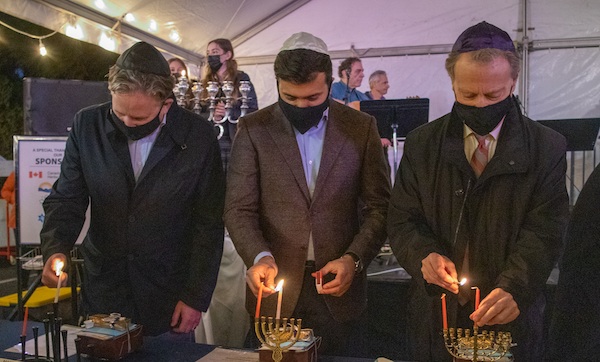
Left to right, Vancouver Mayor Kennedy Stewart,  MP Taleeb Noormohamed and MLA George Heyman light the chanukiyah. (photo by Jocelyne Hallé)

The Jewish Community Centre of Greater Vancouver (JCCGV), the Centre for Israel and Jewish Affairs (CIJA), and the Canadian Jewish Political Affairs Committee (CJPAC) welcomed elected officials representing all levels of government and political parties, as well as other distinguished guests, to light a candle on the first night of Chanukah, Nov. 28.

Member of Parliament Taleeb Noormohamed (Vancouver-Granville) spoke on behalf of the Government of Canada. Member of the Legislative Assembly George Heyman (Vancouver-Fairview) and MLA Melanie Mark (Vancouver-Mount Pleasant) were joined by MLA David Eby (Vancouver-Point Grey), and they presented remarks from the government of British Columbia, while MLA Michael Lee (Vancouver-Langara) spoke on behalf of the Official Opposition. Vancouver Mayor Kennedy Stewart also said a few words.

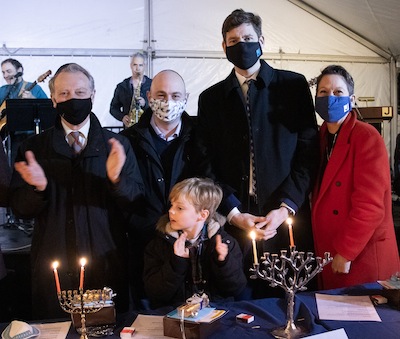
photo - Left to right: MLA George Heyman, Jewish Federation CEO Ezra Shanken, MLA David Eby and MLA Melanie Mark
Left to right: MLA George Heyman, Jewish Federation CEO Ezra Shanken, MLA David Eby and MLA Melanie Mark. (photo by Jocelyne Hallé)

JCCGV board chair Alvin Wasserman led the ceremony, with Rabbi Stephen Berger and two students from King David High School guiding the candlelighting. Vancouver klezmer band Tzimmes performed classic Chanukah music, with people of all ages singing and clapping along.

The celebration took place under one of the tents of the JCCGV Chanukah Market. A highlight was singing the blessings with each of the guests, many of whom were lighting a chanukiyah for the first time.

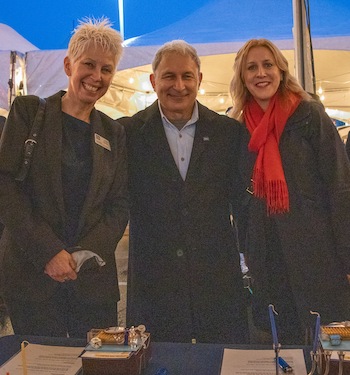
photo - Vancouver Park Board commissioner Tricia Barker, left, CIJA Pacific Region chair Geoffrey Druker and Vancouver city councilor Sarah Kirby-Yung
Vancouver Park Board commissioner Tricia Barker, left, CIJA Pacific Region chair Geoffrey Druker and Vancouver city councilor Sarah Kirby-Yung. (photo by Jocelyne Hallé)

The evening was geared around sharing the Chanukah experience with neighbours, bringing light to darkness and sharing Jewish customs. It was also a way to join together with others at the JCCGV, as it continues to plan for its redevelopment. Many of the leaders lighting candles with the Jewish community on Nov. 28 – both at the JCCGV and at the Lubavitch BC chanukiyah lighting in downtown Vancouver – share in the work and support of this community project.

Debbie Setton Tabenkin and the JCCGV programming and leadership teams created the Chanukah Market’s festive space and the JCCGV’s Chanukah programs were financially supported by a Canada Heritage grant. Many volunteers helped CIJA and CJPAC organize the candlelighting ceremony.

For more information, visit cija.ca, cjpac.ca and jccgv.com.

– Courtesy CIJA, CJPAC and JCCGV

BGU advances in rankings

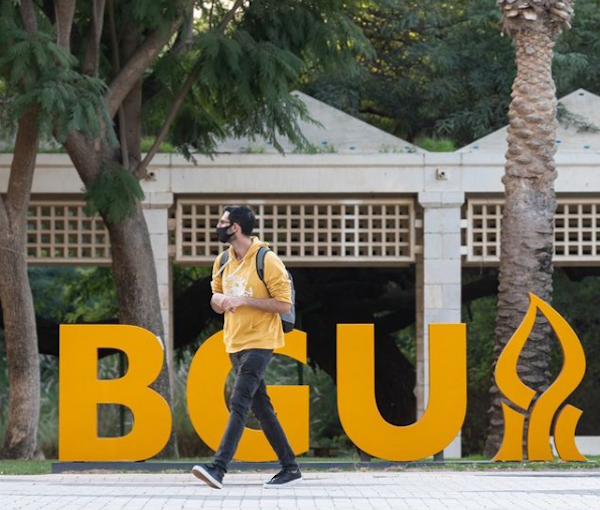
(photo from CABGU)

Ben-Gurion University of the Negev ranks among the top 50 universities graduating successful entrepreneur company founders from its undergraduate programs, according to Pitchbook, a financial data firm that publishes annual data. BGU moved up two spots from last year’s rankings, marking its third consecutive year on the top 50 list.

BGU has graduated 314 founders whose companies have raised a total of $8.3 billion, according to Pitchbook. Among the top five companies led by BGU entrepreneurs in capital raised are Deel ($630m), Fireblocks ($492m), Exaware ($420m), Fabric ($336m) and Hibob ($277m).

BGU’s entrepreneurial focus is led by Yazamut 360°, a suite of program offerings designed to enhance BGU’s academic curriculum and infuse entrepreneurship into the DNA of a BGU student. Yazamut 360° established Cactus Capital – Israel’s first student-run venture capital fund. It has also created two accelerators, one focused on technology entrepreneurship (Oazis) and one on e-commerce. Oazis pairs faculty members with chief executive officers to create companies through BGN Technologies. The accelerators serve as a resource for all entrepreneurs on campus through professional mentoring, financial consulting and technological consulting.

The 2021 Pitchbook university rankings are based on the number of founders whose companies received a first round of venture funding between Jan. 1, 2006, and Oct. 31, 2021.

– Courtesy Canadian Associates of BGU, B.C. and Alberta Region

King David is set to expand

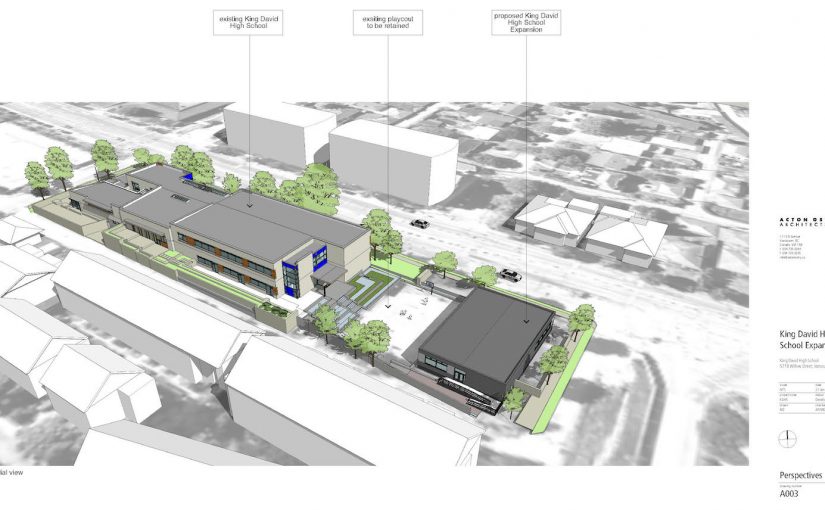
An illustration of the proposed King David High School expansion, as designed by Acton Ostry Architects Inc.

King David High School is slated for a whole new home in the redeveloped Jewish Community Centre of Greater Vancouver campus. However, that move could be eight, 10 or even a dozen years away. In the meantime, the continually growing student body needs more space – and that is why a new component is now being added, with intended completion this coming September.

Russ Klein, King David’s head of school, said the existing building, which opened in 2005, is at near-total capacity.

“Our room utilization rate is 98% for our regular classrooms,” he said. “There is zero wiggle room. Typically, a school’s utilization rate would be around 80%.”

This means that the school cannot increase course offerings, such as new Judaic studies programs or electives. The trend in secondary education is to offer a diversity of options to encourage students to explore their interests and passions. In addition, education is increasingly moving away from large group class lessons toward collaborations between pairs or small groups of students. That demands a greater number of more flexible spaces.

The new structure is a “modular unit addition,” Klein said, rejecting the term “portables.” The difference, he said, is that portables were inflexible, prefabricated buildings, while the new modular options can be adapted to whatever configuration an institution requires.

In King David’s case, it is expected to feature four classrooms, a small teachers’ work room, student changing rooms and a physical education office. In all, it will add about 3,500 square feet of space to the 40,000-square-foot school. The new building will be located at the east end of the property, adjacent the new Oakridge redevelopment, where a grassy hill now exists. Although this will result in a loss of that outdoor area, Klein said the hill is a nice place for kids to hang out in September and for a couple of months in the spring, but, for most of the year, it is not really usable space.

In addition to the changing expectations driven by educational trends, the school has been on a steady trajectory of growth. Enrolment is now at 240, up from 139 students 11 years ago.

The modular nature of the new facility slashes the time from conception to completion. It will take two or three months to prepare the site and another five or six months to construct the building. Acton Ostry, an architecture firm that has done many developments in the Jewish community, including KDHS, is leading the project.

While Klein acknowledges that the new building is a “stopgap” intended to allow the school to function adequately as they await the development of its new home in the JCC complex across the street, he adds that this is no chump-change endeavour.

“It’s an almost $3 million project,” he said. The funding is coming from the Diamond Foundation.

The Diamond Foundation – a family foundation directed by Leslie and Gordon Diamond and daughters Jill Diamond and Lori Glotman – purchased the land where the school is located and spearheaded construction of the building. The school pays rent to the foundation and then the foundation donates that money back to the school each year.

“I always think everybody should just recognize how generous the Diamonds are in everything they’re doing,” said Klein.

Examples of some of the new initiatives the space might accommodate are an expanded robotics program, as well as applied design and coding courses. Rabbi Stephen Berger, King David’s head of Judaic studies, would like to see more text-based education, where students can engage in chavruta-style learning, traditional, intense small group talmudic study, said Klein.

Comparative religions and other courses geared toward social action initiatives that inspire many students are other things Klein can envision growing thanks to the new space.

All of this is taking place as the JCC, in partnership with the Jewish Federation of Greater Vancouver and their constituent partners, proceed full-steam-ahead on the biggest capital project ever undertaken by British Columbia’s Jewish community. The two-phase redevelopment will see a 200,000-square-foot, state-of-the-art, multigenerational community centre constructed where the existing JCC parking lot is located. This will include expanded childcare, seniors’ services, arts and cultural spaces and amenities for all Vancouver residents, as well as becoming the home for more than 15 not-for-profit organizations, including a theatre and more space for the Vancouver Holocaust Education Centre.

Once that is completed, a second phase will commence on the site of the existing JCC building. This will include mixed-use rental housing, with units expected to be offered at or below market value and open to everyone. Beneath these residential floors, at street level, will be a “podium,” where the high school will be located.

Plans foresee a 60,000-square-foot school, which is a 25 to 30% increase over the existing structure – but Klein stresses those numbers don’t tell the entire story.

“The JCC is going to be built with two gymnasiums,” he said. “One of them will be dedicated to King David’s use, so we can use it whenever we want to, and then the JCC will be able to use it when we are not using it.” This is a reversal, of sorts, from the existing situation, where the high school can use the JCC’s gym when it is not otherwise occupied.

“That probably is as exciting to us as the extra learning spaces,” said Klein. “The other lovely thing for us is there going to be a small field, which is [currently] a real problem for King David.”

The field will be constructed behind the building, where the property juts out with an asymmetrical wedge at its southwest corner. The field will not be legal size, and so will not be suitable for competitive games, but will allow the school to hold practices at any time, unlike at present, where they have to rent fields, which are expensive and much in demand.

The redevelopment project has received $25 million commitments from each of the federal and British Columbia governments but a massive fundraising campaign is required to complete the project. When the school will be able to move into its new digs depends on a large number of variables.

“I’d say, best case scenario in my mind – and everyone will give you a different case – I think the best case is eight years,” said Klein. “Probably 10 to 12 is more realistic.”