Skip to content
  • Home
  • Subscribe / donate
  • Events calendar
  • News
    • Local
    • National
    • Israel
    • World
    • עניין בחדשות
      A roundup of news in Canada and further afield, in Hebrew.
  • Opinion
    • From the JI
    • Op-Ed
  • Arts & Culture
    • Performing Arts
    • Music
    • Books
    • Visual Arts
    • TV & Film
  • Life
    • Celebrating the Holidays
    • Travel
    • The Daily Snooze
      Cartoons by Jacob Samuel
    • Mystery Photo
      Help the JI and JMABC fill in the gaps in our archives.
  • Community Links
    • Organizations, Etc.
    • Other News Sources & Blogs
    • Business Directory
  • FAQ
  • JI Chai Celebration
  • JI@88! video

Recent Posts

  • BGU fosters startup culture
  • Photography and glass
  • Is it the end of an era?
  • Taking life a step at a time
  • Nakba exhibit biased
  • Film festival starts next week
  • Musical with heart and soul
  • Rabbi marks 13 years
  • Keeper of VTT’s history
  • Gala fêtes Infeld’s 20th
  • Building JWest together
  • Challah Mom comes to Vancouver
  • What to do about media bias
  • Education offers hope
  • Remembrance – a moral act
  • What makes us human
  • המלחמות של נתניהו וטראמפ
  • Zionism wins big in Vegas
  • Different but connected
  • Survival not passive
  • Musical celebration of Israel
  • Shoppe celebrates 25 years
  • Human “book” event
  • Reclaiming Jewish stories
  • Bema presents Perseverance
  • CSS honours Bellas z”l
  • Sheba Promise here May 7
  • Reflections from Be’eri
  • New law a desecration
  • Resilient joy in tough times
  • Rescue dog brings joy
  • Art chosen for new museum
  • Reminder of hope, resilience
  • The national food of Israel?
  • Story of Israel’s north
  • Sheltering in train stations

Archives

Follow @JewishIndie
image - The CJN - Visit Us Banner - 300x600 - 101625

Tag: economics

United by challenges

After two inconclusive elections in Israel, incumbent Prime Minister Binyamin Netanyahu appears certain to form a government after elections Monday, ending an unprecedented period of political instability.

Whether Netanyahu himself, under indictment and slated for a trial this month on corruption charges, will remain prime minister for long, the right-wing is certainly poised to govern for the near future. Israel’s Supreme Court explicitly refused to offer an opinion on whether a convicted prime minister could continue in office, a question that may now go from theoretical to very real.

Jews in the Diaspora, including a great many here in British Columbia, follow politics in Israel casually or closely, as many of us do the machinations of American politics that are also roiling this week. Canadian politics and those in British Columbia, around issues of environmental policy, disruptive protests and a host of other topics, have people here at home fired up about politics even without elections on the near horizon.

While there are countless issues and contests vying for our attention, there is also an undercurrent of less immediate yet possibly more ominous peril facing our democracies. Threats of external influence from bad actors, like a repetition of the Russian interference in U.S. elections in 2016, are cause for serious concern. The rise of domestic extremism – in mainstream politics as well as in the form of underground and sometimes violent movements – also deserves close attention. So does apathy.

All of these influences and attitudes present dangers to our democracies – in Canada, in the United States, in Europe and Israel. Newer democracies in Central and Eastern Europe have demonstrated how fragile the tissue of open, accountable and responsive government can be. It is alarming to witness the path that Hungary, Russia, Turkey and Poland have been on recently. Our democracies – in the United States and Canada, even Israel – may be somewhat older, but these countries are still warnings of how things that we take for granted can be snatched away. Democracy is less an enormous oak with deep and broad roots than it is a delicate flower that requires nurturing and constant attention.

For this reason, when there are government policies or election outcomes with which we disagree, we should remind ourselves that democracy may be the ultimate win-some-lose-some proposition and recommit ourselves to respect for the institutions of our democracy, not just when they serve our interests but even – especially – when they deliver outcomes that we find disagreeable. At the same time, we should be identifying and calling out every instance when a political leader or movement threatens the institutions or norms of our democracy.

Amid all of these political dramas, very daunting situations that recognize no geographic or ideological boundaries are challenging each and every one of us. This week, again, coronavirus is spreading and causing panic. Meanwhile, the dangers posed by climate change escalate every day. The economic impacts of these global concerns are blaring across the business pages: pandemic fears are causing wild stock market fluctuations, while the measures necessary to alter the course of climate change demand fundamental economic shifts. All of these threaten to exacerbate existing inequalities locally, nationally and internationally, threatening our morality and the stability of our world.

In the face of existential issues like these, the differences in our ideologies in countries like Canada, Israel or the United States fade into shades of grey. This is perhaps optimistic: that the differences between us are minimal in comparison to the difficulties we face together. That should motivate us to look beyond or to bridge our differences and recognize both the humanity in those with whom we disagree and the challenges to humankind that we must overcome together or succumb to apart.

Posted on March 6, 2020March 4, 2020Author The Editorial BoardCategories From the JITags Canada, coronavirus, democracy, economics, Israel, Netanyahu, politics, United States
Promoting fair trade in Israel

Promoting fair trade in Israel

Raz Frogel (photo from Fair Trade Israel)

Raz Frogel, 23, has taken it upon himself to increase the number of fair trade items on Israeli store shelves.

Frogel, who lives in Dror Israel commune in Haifa, first read about child labour and improper working conditions when he was 16 years old. The article was about people working in cocoa fields and, after reading it, he announced to his parents that he would no longer eat chocolate, and explained why. He then spent the next two years in search of a solution.

“When I was 18 years old, I found fair trade and started doing research about it and looked into where I could find fair trade products,” Frogel told the Independent. “When I was released from the army, I started the fair trade movement in Israel.”

In his research, Frogel came across a 2016 article in the Independent: jewishindependent.ca/many-benefits-of-fair-trade.

“I realized nobody in Israel tried to promote fair trade or was trying to change the situation,” said Frogel. So, he took on the responsibility “and started to spread word of fair trade in Haifa, trying to make Haifa the first Fair Trade City in Israel. There are 2,000 cities in the world with the designation of fair trade towns,” he said, “but none in Israel.”

Frogel said many people try to shame companies into becoming fair trade employers, but he sees this as a wrongheaded approach, akin to movements and groups promoting the boycott of Israeli companies and products.

“We try to focus on the good companies and give them our support, and not on companies with what we see as wrong or bad practices,” he said. “I don’t want to shame anybody. I just want everybody to go fair trade.”

As a first step to achieve this goal, Frogel is trying to raise awareness.

“When you walk on a street in Israel, you can ask 10 people what fair trade is and maybe one will know,” he said. “So, before we can go to the companies and ask for fair trade products and change behaviour, we need to educate the public, create awareness.

“Ten years ago, there were no vegan products in Israel, but, when the community and demand grew and grew … there is now no coffee shop without soy milk or something like that. So, with fair trade, we need to copy this process. We need to raise awareness, create demand, and create communities that create demand. Then, we need to go to companies and ask for fair trade products.”

About 20% of Israelis live in poverty, the majority of whom are women, some of whom are paid less than minimum wage and suffer from other unfair labour practices. With this in mind, Frogel connected with an organization working to empower women. So far, Achoti (My Sister) is the only business in Israel that uses fair trade.

While fair trade in the food industry is a relatively known issue, Frogel pointed out that the fashion industry is also problematic.

If workers need to be paid more, that extra cost could be added to the price of the product. But, the extra money paid to the workers could come from another part of the industry chain. And, while investors want the highest possible return, it is up to us – the end users – to determine the value of a product by voting with our dollars or shekels, said Frogel. If the demand is high enough, more producers could be encouraged to enter the market, thereby increasing supply and placing a downward pressure on prices.

“I think there is no price to pay,” contended Frogel, “because, when you look at the U.K., the cheapest products in the store are fair trade, like Cadbury or Nestle … and Starbucks. When you look at fair trade in places where it’s common, it’s cheaper than non-fair trade products. When we talk to people, we try to explain to them that, when there is a demand, the prices of products will come down and everybody can support it.

“Right now, it’s very expensive to buy fair trade in Israel,” he admitted. “I can’t lie. But, we’re working on it and I don’t think fair trade should be more expensive.”

While Frogel is working on bringing fair trade to Israel, he hopes that readers will join the global movement, wherever they are, and join a local fair trade initiative to promote it in their communities.

Currently, Fair Trade Israel has a Facebook presence and the organization can offer tax receipts to donors through Achoti.

“We are trying to raise Friends of Fair Trade, wanting to raise a lot of support from all over the world, to show that fair trade is part of Jewish values,” said Frogel. He wants to see Israel become “a fair trade movement leader.”

Starting by focusing on Haifa, and Israel in general, Frogel is organizing events and doing advocacy work in schools and businesses. As far as getting Haifa recognized as a Fair Trade City, he is working to fulfil the requirements for such recognition, such as attaining a high level of fair trade awareness and product availability. “We have a lot of support from the city council and have a group of great people leading this project,” said Frogel. “We have stores with fair trade products, but not in every neighbourhood. We started programs in schools in the last month and we have special programs on campuses to raise fair trade awareness and product availability.”

For more information, visit achoti.com (which is in Hebrew) or contact Frogel at [email protected].


Rebeca Kuropatwa is a Winnipeg freelance writer.

Format ImagePosted on January 31, 2020January 28, 2020Author Rebeca KuropatwaCategories IsraelTags economics, free trade, justice, Raz Frogel, tikkun olam

Roll out welcome mat

Bill 21, Quebec’s law that forbids most public employees from displaying any religious symbols like a turban, a Magen David or a hijab, may become an issue in the federal election. On CBC Radio’s political program The House last weekend, MPs representing the Liberal, Conservative and New Democratic parties all took effectively the same position: the law is discriminatory but provinces have the right to proclaim their own laws and, what’s more, the Constitution’s notwithstanding clause means Quebec can pretty much do whatever it wants.

There is a political calculation in all this, of course. Many Quebeckers support this law and any federal party needs to appeal to a chunk of these voters in order to succeed in the province during next month’s vote. As a result, party leaders are mostly making the right noises about this discriminatory law, while hoping to move on to the next topic ASAP.

With federal leaders basically throwing up their hands on the issue, which calls into question the most fundamental rights of Canadians of all religions, what can be done?

One individual interviewed on the program is a teacher who is Sikh. Her choice was to move from Quebec to British Columbia, where she could continue her chosen profession without diminishing her religious beliefs, which include wearing a turban.

If federal leaders will not act forcefully, perhaps leaders in the provinces outside Quebec can do something. Throughout history, Canada has been enriched by refugees and immigrants who sought freedom and opportunity – our gains roughly equating the loss to their places of origin. Why not apply the same principle to inter-provincial relations?

Perhaps provinces like British Columbia should roll out the welcome mat for teachers, school administrators, wildlife officers, Crown prosecutors and other civil servants from Quebec who no longer feel welcome there. Actively recruiting these experienced professional people of different cultures and religions would strengthen our communities and send a message to Quebec that cultural difference is an asset, not a liability.

In the absence of forceful federal leadership on this front, it would be encouraging to see provincial governments stepping up where they can.

Posted on September 13, 2019September 10, 2019Author The Editorial BoardCategories From the JITags Canada, diversity, economics, employment, immigration, politics, Quebec, racism

Intolerance is growing

A recent study indicates that Americans are increasingly tolerant of the idea that businesses should be able to refuse service to customers based on the customer’s identity.

Of those polled, 19% said that a business should be able to refuse to serve Jews, an increase from 12% the last time the question was asked five years earlier. Twenty-two percent believe that Muslims could be legally denied services, 24% said atheists should be able to be turned away and slightly fewer than one in three believe that gay, lesbian or transgender people could be denied service. Fifteen percent of respondents said that a business should have the right to refuse to serve African-Americans, an increase from 10% in 2014. Most notable is that these numbers have increased over the past five years. For example, the number of people who said gays or lesbians could be denied service almost doubled, to 30% from 16%. (The question did not include Muslims five years ago.)

The issue has come to a head on a couple of occasions, such as when bakeries have refused to provide cakes for same-sex weddings. But it is the increase in the feelings of exclusion that have grown over the past half-decade that indicate we are not in a period of unfettered progress in our acceptance of diversity.

Some economists would suggest that the market should decide the matter – a business that turns away customers may have more trouble surviving, or it may benefit from an increase in like-minded clients, but that is of concern only to its owner. Others would say, if a baker doesn’t want to bake your wedding cake because they are prejudiced against your sexual orientation, why on earth would you want to patronize them? Of course, the principle of equality goes beyond economics. Court decisions in Canada and the United States have indicated that the law will not tolerate the refusal of service to identifiable groups by a business or service that otherwise is available to the general public.

There are nuances to the discussion, though.

This year, the White Rock Pride Society claimed discrimination after the Star of the Sea Catholic church refused to rent a venue to the LGBTQ organization. Here is where things get a little more complicated. A Catholic individual – or a Muslim, or a Jew or anyone – operating a business aimed at the general public does not have the right to discriminate based on a customer’s identity. But a church – or a synagogue or a mosque – is not on par with a business that is open to the public. One has to wonder about the motivation of a gay organization approaching a Catholic church to rent space, which seems like a bit of a set-up for a discrimination complaint. But the larger issue here is that religious organizations should certainly have the right to determine who can use its facilities. Imagine, for example, an overtly antisemitic organization asking to rent space in a Jewish community centre. There is a substantial difference, of course, between one’s beliefs (being anti-Zionist or even antisemitic is a choice) as opposed to an immutable characteristic of one’s personality, such as sexual orientation.

The issue is at once simple and complex. Businesses are not individuals with human rights. They are entities created under laws and they must adhere to the laws and norms of the jurisdiction in which they operate. We might be thankful to know that, if a particular pizza maker or café owner holds antisemitic views, we can choose not to patronize them. This is an entirely different scenario than the flip side of that coin, in which a business refuses to serve Jews.

There has been a lot of commentary in recent years that the American president and others in high-profile positions have given permission to people to air their prejudices openly. A study like this is welcome because it puts quantifiable numbers to the perception of growing intolerance. This is a wake-up call to those who would ignore the warning signs of our current era of discontent. The evidence has arrived. Now, what are we going to do about it?

Posted on July 5, 2019July 3, 2019Author The Editorial BoardCategories From the JITags antisemitism, culture, discrimination, economics, Jews, LGBTQ, Muslims, racism, tolerance, United States
Consul general speaks with JI

Consul general speaks with JI

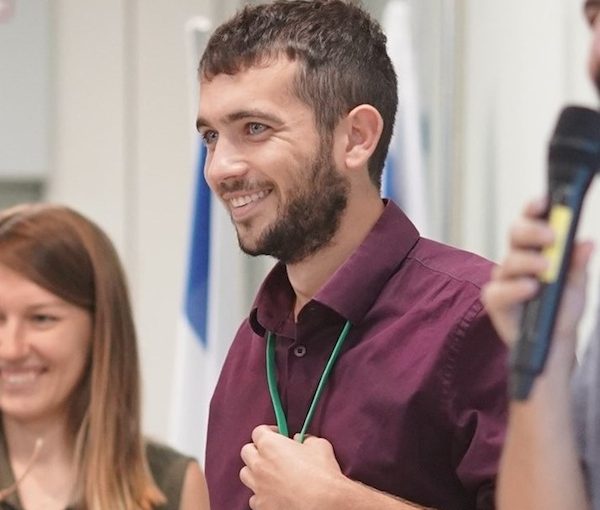
Consul General Galit Baram was in Vancouver last month. (photo from Consulate of Israel)

Galit Baram, consul general of Israel to Toronto and Western Canada, was in Vancouver last month.

“The visit was very good,” she told the Independent in a phone interview. “It included some political meetings and an academic meeting and I addressed the Jewish community and I attended the Negev Dinner of the JNF…. I had the opportunity to see the city, which is beautiful, and the weather was nice.”

Baram will be returning to Vancouver in November, when the late Dirk Pieter and Klaasje Kalkman will be honoured as Righteous Among the Nations for the assistance they provided to Jews during the Holocaust. The ceremony will be held in conjunction with Yad Vashem Canada and the Jewish Federation of Greater Vancouver.

Baram’s June meetings explored the opportunities of expanding cooperation between Israel and British Columbia in innovation and entrepreneurship.

“I believe that there is great potential in economic cooperation between Israel and British Columbia,” she said.

The provincial government, she said, “is making its initial steps now…. There is interest, there is curiosity, there is awareness of what Israel has to offer in innovation, in the medical field. When it comes to pharma, when it comes to cybersecurity, Israel is a leading country in the international arena in many of these fields.

“We had very good relations with the previous government and we hosted a mission … in November of 2016, a mission that was led by then-minister of finance [Michael] de Jong; there were representatives of different business sectors in British Columbia…. [It] is our intention to work very closely with the current government as well.”

The change in the federal government in 2015 also hasn’t affected Canada-Israel cooperation. On May 28, in Montreal, François-Phillippe Champagne, minister of international trade, and Eli Cohen, Israel’s minister of the economy and industry, announced the signing of the modernized Canada-Israel Free Trade Agreement.

Cohen spent two days in Canada, said Baram, adding, “I hope that Minister Champagne will soon reciprocate and visit Israel as well.

“I believe this is very important to have visits on such a high level … because I believe that governments can contribute greatly to bringing countries together. But we have to remember that, at a certain point, governments have to take a step back and leave it up to the business sector and the private sector to build bridges and to bring the countries together, but, as governments on both sides, Israel and Canada, we do as much as we can in order to strengthen and broaden our bilateral relations.”

Baram also sees the possibility of building a groundwork for peace in Israel through business and trade.

“I believe that economic mobility plays an integral role in bringing communities together,” she said, “and we are watching with pride the growing high-tech sector in the Israeli-Arab community, especially in the Greater Haifa area, in cities such as Nazareth…. We would like to see more Israeli-Arab students concentrating on science, concentrating on business, in business management and innovation and entrepreneurship.

“When it comes to building social bridges between Israelis and Palestinians, not necessarily Jews and Arabs, there are many activities that concentrate on that … and they are conducted by civil societies in Israel and it is heartwarming to see that. I would like to mention the activity of an organization such as Save a Child’s Heart … [which] brings children to Israel [for cardiac care] from Arab countries, from the Middle East, from Muslim countries in general, and they do wonderful, wonderful things in building bridges…. Another example I can give you is the upcoming visit of Dr. Yossi Leshem, one of Israel’s greatest experts on bird migration – he is going to be in Vancouver towards the end of August and he will be accompanied by his friends from [elsewhere in] the Middle East, and they are going to present beautiful regional projects in a conference that will be held in Vancouver…. Two other organizations that I would like to mention … are Ultimate Peace, that organizes Frisbee tournaments for youth … and another project, by Danny Hakim – Budo for Peace – teaches martial arts to Israeli Jews and Arabs, Palestinians, Jordanians and others, and they have instructors coming to Israel from Japan and from other countries…. I believe that such organizations can do so much good for Israeli society in general, for the Palestinians and for neighbouring countries in the Middle East.”

Of course, there are significant obstacles to peace, not the least of which are the ongoing altercations at the Gaza border.

“When it comes to the situation on the Gaza border, we are facing some very serious challenges,” admitted Baram. “It is an uphill battle. We see that there is sometimes a deterioration, sometimes the situation stabilizes a little bit and then there is another deterioration, the situation changes constantly.

“There are many, many challenges on a daily basis that are facing not only IDF [Israel Defence Forces] soldiers and the Palestinian civilian populations, but also the civilian population on the Israeli side of the border. Sometimes there is a tendency to forget about them but there are families, there are entire communities, that raise their children on the Israeli side of the border and because of this intifada of burning kites and balloons, they have to deal with arson cases on a daily basis, with a loss of crops and forest in the south of Israel, and it’s heartbreaking to see that because so much work has been put into making the desert bloom, especially in those regions.”

She added, “The one very disappointing thing for me to see as a former director of the department for Palestinian affairs was the fact that the Kerem Shalom border crossing that was built in the first place to enable trucks to enter Gaza was burned down by Hamas activists and by other terrorists and it’s a shame to see that because so much money was invested in that, so much effort was done in order to make trade between Israel and the Palestinian Authority, and especially Gaza, easier and simpler for us but especially for the civilian population in Gaza. And it’s difficult to see a civilian population that is being held captive by a terror organization…. Of course, there is awareness of the situation in Israel and understanding that the main enemy that has to be dealt with is definitely Hamas and not the people of Gaza.”

As for the Canadian government’s initial statements after the violent March of Return protests – in which Canada admonished Israel, saying its “use of excessive force and live ammunition is inexcusable,” and called “for an immediate independent investigation to thoroughly examine the facts on the ground” – Baram said, “I would like to mention that, after Hamas started attacking Israel, [with] renewed rocket attacks to the south of Israel, there were statements that were released by Prime Minister [Justin] Trudeau and by Minister of Foreign Affairs [Chrystia] Freeland condemning Hamas for this activity and I believe we should concentrate on these statements.”

And Canada’s reluctance to move its embassy to Jerusalem?

“When it comes to Jerusalem,” said Baram, “we believe that all countries should move their embassies to the capital of Israel and the capital of Israel is Jerusalem. Every sovereign country has the right of defining and choosing its own capital and we believe that we don’t have to prove over and over again the story connecting the people of Israel and the land of Israel, between the people of Israel and its eternal capital, Jerusalem.”

With respect to the almost 40,000 Eritrean and Sudanese asylum seekers in Israel, Baram said, “We have to remember that the first Western country that these people from Africa, from Eritrea, from Sudan, asylum seekers, work migrants – define them as you wish – the first Western country they encounter is Israel. And, several years ago, many of them came to Israel…. This is never an easy issue to deal with because the personal stories are very emotional and very difficult, and these people, many of them have been through terrible ordeals, until they reached Israel.

“The issue of migration in general … is an issue that is dealt with in Europe and in other parts of the world,” she said. “In the Middle East, for example, the issue of Syrian refugees is a very big issue that many countries deal with and, now, Syrian refugees, for example, are coming knocking on the doors of European countries, as well, but this is a problem that many Middle Eastern countries have dealt with for quite awhile, a long time now.

“With the African refugees or asylum seekers or work migrants, definitely a solution must be found in order to protect them, protect their rights. On the other hand, we have to keep the sovereignty of the state of Israel and we cannot allow floods of refugees entering Israel because we have to think about our population and … providing an answer that would satisfy all parties involved. This is not easy,” she said.

And neither is Israel’s relationship with Diaspora Jews always easy.

“When you look at Israeli society, you see that the public debate in Israel is very heated and emotional,” said Baram. “This is how we do things in Israel. People are very opinionated … they don’t hide their views and opinions, and I think this is wonderful. This is the strength of Israeli democracy.”

She recalled a statement made by Israeli President Reuven Rivlin about a year ago. “He talked about the four tribes of Israeli society, and he referred to secular Jews, to Orthodox Zionists Jews, to the ultra-Orthodox community in Israel and to Israeli Arabs…. And he called for these four tribes to join hands to discuss the future of Israeli society for the benefit of the country. Later on, he added the fifth tribe … and I believe this is very important to mention that the fifth tribe is Diaspora Jews because Israel is the homeland of the Jewish people…. I am actually very encouraged when I visit Jewish communities throughout Canada and people ask me sometimes challenging questions … about the nature of Israel and about the nature of Israeli society, and what should be done and what is done correctly, or what should be corrected in Israel. I encourage that and I welcome it, because it shows love and devotion and interest in Israel.

“And I encourage people to come visit Israel and express their opinions and to keep us Israeli diplomats on our toes … and I thank Jewish communities for participating in this ongoing discussion. I think this is vital not only for Israel by the way – this ongoing discussion is vital for Diaspora Jews as well.”

To participate in and to follow some of that discussion, follow the consulate on Facebook and Twitter.

Format ImagePosted on July 20, 2018July 18, 2018Author Cynthia RamsayCategories WorldTags asylum seekers, British Columbia, Canada, consul general, Diaspora, economics, Galit Baram, Gaza, Israel, trade
Local office open again

Local office open again

Yael Levin, executive director, Israel Bonds Vancouver. (photo from Israel Bonds)

For more than two years, the local Israel Bonds office was closed, and anyone wishing to contact Bonds had to go through Toronto. But, last July, the local office started to open again, initially for a few hours a week. By September 2017, it was open two days a week. Finally, on Feb. 1 this year, it reopened fully, with Yael Levin in the role of executive director.

Levin will be spearheading an effort not only to raise the profile of Israel Bonds here and find more investors, but she will also form a strategic plan and host a number of events each year for the community.

The reopening was championed by Israel Bonds Canada chief executive officer Raquel Benzacar Savatti, who wanted to ensure that Vancouver’s Jewish community is served.

“I know that smaller communities do feel the loss when organizations close their offices…. Although we kept in touch with our Vancouver clients through our other offices, it’s not the same as having a presence,” said Savatti. “Vancouver is a wonderful community, our third largest, and it’s important that we have an office to serve investors in this savvy financial hub.”

Savatti was hired in December of 2016 and had a number of other priorities to deal with before searching for the appropriate executive director for the Vancouver office. She credits Nadine Katz – who is still working in client services at the local office – with connecting her to Levin.

Levin comes to the job ready to work in English, Hebrew or Spanish. Born in Mexico City, Levin made aliyah in 2002. She lived and worked in Israel for four years and then moved to Vancouver for a couple of years before returning to Israel until 2012, when she came back to Vancouver with her family to stay.

“I love to work in my community,” said Levin when asked what appealed to her about joining Israel Bonds.

Since her return to Vancouver in 2012, Levin has worked for Jewish National Fund and, most recently, for the Centre for Israel and Jewish Affairs, Pacific Region. At CIJA, she worked with members of the non-Jewish community and welcomes the chance to share the investment tool that Israel Bonds has to offer both within and outside of the Jewish community.

Having never defaulted on a loan since its establishment in 1951, Israel Bonds has a notable track record and a better interest rate than other comparable fixed-term investments. One of the highest-profile investors in the world, Warren Buffett, has been a vocal supporter of Israel Bonds. Savatti shared a story of a recent event that Buffett headlined for Bonds. In order to attend the event, investors needed to buy a minimum of $1 million in bonds. In the first three minutes of his address, Buffett challenged those in attendance to buy five more $1 million bonds, which he would match. She said the crowd responded.

While not everyone can invest so much, obviously, Savatti was clear that the mission of Israel Bonds offices throughout Canada, the United States, Mexico, Brazil and Europe is to raise awareness in the Diaspora of needs in Israel. In the early days of the state’s existence, funds were needed for basic infrastructure like roads and schools. Now, the money, which goes directly to Israel’s finance ministry, is used for projects such as high-speed trains and water desalination.

Savatti was quick to point out that, while things are going well with Israel’s economy at the moment, when the chips are down, it’s friends of Israel, both Jewish and non-Jewish, around the world who continue to support and invest in the state of Israel.

Another important job for local Israel Bonds offices like the one in Vancouver is to educate investors. Levin is actively engaged in the planning of two programs scheduled for this fall. One will be a financial literacy seminar for women and the other will be a larger community event with a keynote speaker of note.

Anyone who is interested in becoming involved as a volunteer for Israel Bonds can contact the local office, which is located on the third floor of the Jewish Community Centre of Greater Vancouver, at 604-266-1210. The hours are Monday through Thursday from 9 a.m. to 5 p.m., and Fridays from 9 a.m. to 3 p.m.

Michelle Dodek is a freelance writer living in Vancouver.

Format ImagePosted on July 20, 2018July 19, 2018Author Michelle DodekCategories LocalTags economics, investment, Israel Bonds, Raquel Benzacar Savatti, Vancouver, Yael Levin

Neighbourly relations

The lineups at local border crossings to the United States over the Canada Day long weekend suggest rhetoric about Canadians avoiding visits to our neighbour have been largely overblown. We may be repulsed by the Trump administration’s treatment of would-be refugees, especially children, but cheap gas, cheese and milk – as well as the plethora of delights at Trader Joe’s – mean many of us just can’t stay away.

Ironically, it is partly because our dairy products are so expensive – because of our supply management system – that the U.S. president is raging at Canada in the first place and why we amped up our tariffs July 1 in a trade war Trump launched.

At the same time, most of us know that our immediate neighbours are much like ourselves. The places we are most likely to drive to – Bellingham, Seattle and smaller centres dotting the American Pacific coast – are inhabited by some of the most liberal voters in that country. These are not places where Trump bumper stickers or MAGA caps are widely prevalent.

Likewise, if we jump on a plane, the destinations we choose tend to be similar in attitudes: the beaches, amusement parks or golf resorts of Southern California, the wine country of Northern California, oases in Arizona that are likely to have as many Albertans as native-born Arizonans. Punishing businesses in these locations because their president has xenophobic views doesn’t seem particularly sensible.

On the other hand, we might have more reticence about stepping out of these familiar spots. We might rethink road-tripping across the country; that generations-tested means of memorable family bonding, backseat battles and boredom. Almost anyone who has traveled through rural America returns with stories of salt-of-the-earth kindness and folksy friendliness. Yet, knowing that some counties in the most picturesque parts of the United States voted for Trump – and still support him by huge margins – one might be forgiven for looking askance at the family in the next booth at the roadside diner. What is behind the smiles and extroverted affability that can turn so mean in the ballot box and when responding to public opinion polls about immigrants and minorities?

Leaving aside whether we would feel personally comfortable in some locations, there is the larger issue of whether Canadians should boycott American products. On social media this week, you can find suggested product choices that make it easier to buy Canadian instead. It’s a matter of individual choice whether this is a productive use of energy, but, if it makes people feel better and helps the Canadian economy in a time of challenge, it seems like a fine enough gesture.

It is notable, though, to compare the nascent cross-border boycott to the BDS movement against Israel. Admittedly, the U.S.-Canada clash is mere weeks old, while the Israeli-Arab conflict has been in high gear for seven decades, giving sides more time to organize. But, while a significant number of Canadians seem to think that a boycott of Israeli products, ideas and people is a legitimate tactic, it is doubtful that a similarly organized movement will coalesce around the idea of boycotting Americans.

Some BDS supporters have maintained that their boycott targets Israeli “policies,” although the founder of the movement, Omar Barghouti, has no qualms about his position that Israel should cease to exist as a Jewish state. In any event, how bad would American “policies” need to become before BDS advocates devoted their substantial energies to boycotting U.S. products? Certainly we are unlikely to see a Canadian consensus that suggests a total economic, cultural, academic and social boycott of America, as the BDS movement promotes with Israel. It would be impossible, of course, given the interconnectedness of our countries, but the question remains: Why do some take the hard line with Israel but not with other countries?

Indeed, consider the approach held by most people, even those who are likely to support BDS: with North Korea, Iran and anyone else with whom we have not insubstantial differences, the consensus approach is engage, mediate, negotiate. It’s the approach we are pursuing with the United States on one hand, while retaliating with tariffs on the other. Yet, when it comes to Israel, in economic matters, academic interactions, sporting competitions and every level of human interface, a sizeable group demands that we make Israel an international pariah, isolate it in every way, exclude it from the global community. What can that possibly be about?

Posted on July 6, 2018July 5, 2018Author The Editorial BoardCategories From the JITags antisemitism, boycott, Canada, economics, racism, travel, United States
Praise for whistleblowers

Praise for whistleblowers

Alan Le Fevre, president of the Wallenberg-Sugihara Civil Courage Society, and Acting Mayor Raymond Louie, right, with the City of Vancouver’s proclamation of Raoul Wallenberg Day. (photo by Masumi Kikuchi)

“If we had a society that was free from embezzlement, free of theft, free of dishonesty, free of unethical conduct, we wouldn’t need whistleblowers. But, unfortunately, we are not a perfect society,” said Ujjal Dosanjh in his keynote address at the 13th annual Raoul Wallenberg Day event, which was held on Jan. 14 at the H.R. MacMillan Space Centre.

Dosanjh, a former federal cabinet minister, B.C. attorney general and the province’s 33rd premier, was, in 2015, the inaugural recipient of the Wallenberg-Sugihara Civil Courage Society’s Civil Courage Award. He was recognized for “his great courage in the face of escalating violence by extremists in the Indo-Canadian community that arose from conflicts that had erupted in India,” said WSCCS board member Ana Policzer in her remarks on Sunday.

The society hosts the annual Wallenberg Day event and, this year, they honoured Vancouver-based lawyer Alayne Fleischmann with the Civil Courage Award.

Fleischmann was born in Terrace, B.C. She got her bachelor’s degree in philosophy from the University of British Columbia, her master’s in international and comparative law from the Institute of International and Comparative Law, Cornell Law School and Université Paris (Sorbonne), and her juris doctor degree from Cornell. In 2006, she was working in quality control at JPMorgan Chase in New York. There, she discovered and tried to stop what she described as “massive criminal securities fraud” – mortgage operations similar to those of many other financial institutions, which led to the 2008 economic collapse. Her efforts resulted in a $9 billion fine being levied on JPMorgan Chase, but no one from the bank was ever prosecuted. She moved back to British Columbia in 2008.

In a 2014 Rolling Stone article, writer Matt Taibbi goes into great detail about Fleischmann’s experiences, the difficulties she faced in bringing the truth to light and the limited impact the truth played in whatever minor justice was carried out against all the banks guilty of mortgage-related wrongdoings. In effect, Taibbi argues, the U.S. department of justice “struck a series of historic settlement deals with Chase, Citigroup and Bank of America. The root bargain in these deals was cash for secrecy. The banks paid big fines, without trials or even judges – only secret negotiations that typically ended with the public shown nothing but vague, quasi-official papers called ‘statements of facts,’ which were conveniently devoid of anything like actual facts.”

The full Rolling Stone article can be accessed via wsccs.ca/wallenberg-days/2018. At the Wallenberg Day event, organizers screened a 2014 interview with Taibbi and Fleischmann by Democracy Now! WSCCS president Alan Le Fevre also spoke briefly about Fleischmann’s actions and why she was chosen to receive the Civil Courage Award. Unfortunately, Fleischmann could not accept the award in person because of the ongoing litigation.

In his remarks, Dosanjh saluted whistleblowers. “In Canada,” he said, “we don’t know too many of our own heroes…. But we have them. One that we have amongst us in Canada is the honouree tonight, Alayne Fleischmann.”

There are monetary costs to illegitimate or immoral actions, Dosanjh said, but such actions also “jeopardize the health, safety and well-being of the employees, the customers and the society of the institutions.”

Whistleblowers like Fleischmann set out to right a wrong, he said. They are morally compelled to the point where they take the “risk of losing their careers,” “being ostracized” and having rumours spread about them to “delegitimize the truth that they’re trying to tell.”

After such individuals come forward, he said, “life is never the same. You lose friends, you lose relationships, obviously you lose a job possibly, or you’re not promoted or you’re demoted…. And, sometimes, it can be dangerous physically. People have been known to be killed, at least across the border, for trying to expose the truth. Karen Silkwood comes to mind.”

Dosanjh warned that whistleblowers aren’t always correct, however, giving the example of eight B.C. health ministry workers who were found to have been wrongly dismissed in 2012, amid allegations of wrongdoing. “It’s a risky business,” he said. “You’re playing with your own life but you’re also playing with the lives of others you’re trying to expose.” So, you have to not only have the courage to speak up, he said, but the wisdom to know when to not do so, or when to investigate further before doing so.

Several audience members gave their take on corporate and government corruption in the question-and-answer period. Dosanjh said people need to get more vocal about these issues. “There is no silver bullet to deal with any particular issue,” he said. “It’s just a matter of becoming more active politically and raising your voices.”

To an audience member who decried greed as criminal, Dosanjh said, “If you say greed is the basic urge to make more money, that shouldn’t be a crime…. You want to make money, you want to work more … that’s what keeps the world going…. Illegal greed should be a crime – and it already is! The fact is we’re not prosecuting criminals, we’re not apprehending them, we’re not investigating them as much as we should, and we’re falling down in some respects.”

The afternoon event also included the reading by Acting Mayor Raymond Louie of the City of Vancouver proclamation of Jan. 14 as Raoul Wallenberg Day. He thanked event organizers and attendees for taking the time “to remember and to also recommit … with this ongoing effort to have a better world overall.”

The WSCCS is continually “seeking to identify people who, at significant personal risk, have helped to improve or save the lives of others by going against unjust laws or conventions.” For more information, visit wsccs.ca.

Format ImagePosted on January 19, 2018January 17, 2018Author Cynthia RamsayCategories LocalTags Alayne Fleischmann, Civil Courage Award, corruption, economics, finance, law, Ujjal Dosanjh, Wallenberg Day
Ever-changing job landscape

Ever-changing job landscape

Prof. Ilana Gershon’s latest book is Down and Out in the New Economy. (photo from Ilana Gershon)

An increasing number of people in their 50s and 60s are needing or wanting to find work – and are finding that next job elusive.

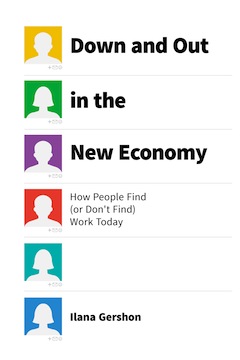
Indiana University anthropology professor Ilana Gershon has been researching the (often unsuccessful) ways in which job seekers look for work. One result of this research is her latest book: Down and Out in the New Economy: How People Find (or Don’t Find) Work Today (University of Chicago Press, 2017).

Long gone are the days that employers just want an extra pair of hands to do a job, said Gershon.

“We used to have an idea of ourselves as workers, in which we imagined we owned ourselves, as if we were property,” she explained. “This was the metaphor – that we were renting ourselves to an employer for a certain period of time and, when the time was over, we’d get ourselves back. The idea of renting ourselves as though we were property really affected the ways you could have particular ideas, of what was a just work relationship.

“So, you thought you could have arguments about whether you should have a 40-hour work week or not, about how much time you should be able to rent yourself to an employer … and people would have legal cases and legislation around the boundaries of work. Should people be paid for putting on a uniform that would make them be work ready or should they put on a uniform in their own time, and should employers only pay for them once they put on the uniform?”

Gershon said this metaphor very much shaped how people thought about what was appropriate and what was not.

“One of the other consequences of that is that unions were able to argue that, in fact, people were not just renting a portion of their day,” she said. “Unions argued that they were renting a portion of their lives and, as a result, the companies owed them health insurance or a pension … that they should be reimbursed for giving over a portion of their lives to the company.”

On the other side of the equation were the companies, which were very interested in ensuring there was some form of company loyalty.

According to Gershon, in the United States and the United Kingdom, after Ronald Reagan and Margaret Thatcher took power, respectively, things began to change. People began to imagine themselves as though they were a business – as a bundle of skills, assets, qualities, experiences and relationships that had to be consciously managed like a business. And, as a business, continual enhancement was required.

“When people are entering into an employment contract, that now means they are entering into a business-to-business contract, in which they are offering temporary solutions for market-specific problems a company experiences,” explained Gershon. “So, now you have all these self-help articles that talk about being the CEO of Me Incorporated.

“One of the other consequences of this is people now talk a lot about having a personal brand. Because, if you imagine yourself as a business, then you should have a personal brand, as businesses have brands. So, a lot of the ways in which people understand what the employment contract can now offer them is being shaped by this change in metaphor.”

book cover - Down and Out in the New EconomyGershon’s research on the topic began in 2012, with the interviewing of people around Indiana University and her attending one or two job search workshops available to undergrad students. In 2013/2014, while being a fellow at Stanford’s Centre for Advanced Study in the Behavioural Sciences, she did field work in the Bay Area in California.

Not everything regarding the job market is new, she said. “People already know a lot about hiring, because they participated in hiring in their previous workplaces … and they shouldn’t ignore everything that they already know.

“I was trying very hard not to make it a Silicon Valley project,” she said of her research. “I was very concerned about that, because, what I wanted to do was think about the hiring ritual in general. I interviewed people in the Midwest and East Coast about this – not as many people as I interviewed in the Bay Area, but I wanted to check if I saw any difference.

“The major difference I saw was that the people had a very different idea of how much time you should spend at a job. People in the Bay Area thought the ideal time you spend at a job was two to three years. And, in the Midwest, it was something more like seven to 10. On the East Coast, it was more like five to eight.”

According to Gershon, she worked hard to produce an “anti-advice book.” Her aim was to focus the book on the implications of thinking of yourself as a business and how that has changed hiring and affected what employment contracts have become. Further, she wanted to explore how one should present themselves as an employee, and what employers feel are desirable traits in candidates.

One of Gershon’s findings is that the new concepts are now standard fare in all job search workshops.

“People are being told to do this, but people in the trades and blue collar workers don’t seem to find this way of thinking terribly useful yet,” she said. “So, the people for whom it fits their situation best are going to be white collar workers for the most part.”

But, whether or not everyone finds the ideas useful, they are being encouraged.

“People working retail are constantly being told they have to brand themselves,” said Gershon by way of example. “I don’t think this particular way of trying to brand yourself constantly or imagine yourself as a business is making all that many people happy.

“If you haven’t been in the workforce for 15 to 20 years and you’re suddenly going to these job search places where they’re telling you everything is new and the ways you used to look for jobs no longer make sense … it’s all very confusing. I’m offering the context for that, explaining why things might seem new, and what’s genuinely new and what isn’t.

“I think figuring out how to get a job is actually something you have to do specifically for your particular industry,” she added. “People offer a lot of standardized advice, as though there’s a magic bullet that works in every context. What I’m talking about is how not to engage with that kind of standardized advice. Instead, figure out how to do the research so that you can understand those communities on your own.”

Rebeca Kuropatwa is a Winnipeg freelance writer.

Format ImagePosted on January 19, 2018January 17, 2018Author Rebeca KuropatwaCategories BooksTags economics, employment, Ilana Gershon
טרנד חדש

טרנד חדש

טרנד חדש: גידול משמעותי במספר המהגרים מישראל לקנדה. (צילום: DrRandomFactor)

מספר מבקשי המקלט יוצאי אפריקה שעזבו את ישראל ועברו לקנדה עלה משמעותית מתחילת שנה זו (2017), לעומת שנת 2016. זאת לפי נתוני רשות האוכלוסין וההגירה של ישראל. כך מפרסם עיתון הארץ.

בהתאם לנתוני הרשות בחלק הראשון של שנת 2017 היגרו לקנדה מישראל קרוב לאלף אפריקאים. רובם המוחלט (כתשעים אחוז) הם יוצאי אריתראה והשאר מסודן (כשישה אחוזים) וממדינות נוספות (גם כן כשישה אחוזים). זאת לעומת כתשע מאות יוצאי שתי המדינות שעזבו את ישראל ועברו לקנדה בכל שנת 2016.

המהגרים מישראל לקנדה מקבלים כאן מעמד חוקי במסגרת התוכניות לקליטת פליטים. ממשלת קנדה מעניקה להם תושבות קבע מיד עם נחיתתם באחד משדות התעופה הבינלאומיים המקומיים, כולל זכויות סוציאליות מלאות וכן גם ביטוח בריאות (מדובר ביתרון משמעותי על פני מי שמהגר לארה”ב). לאחר שלוש שנים מלאות של מגורים בקנדה מהגרים אלה יכולים להתחיל בהליך לקבל בקשה לקבלת אזרחות מקומית קבועה.

כיום קנדה היא יעד מספר אחד של מבקשי מקלט שמבקשים להגר מישראל לאחת ממדינות המערב. אחריה במרחק רב נמצאות: הולנד, שוודיה, ארה”ב ונורבגיה. בסך הכל במחצית השנה הראשונה של 2017 כאלף שלוש מאות יוצאי אפריקה עברו מישראל לאחת ממדינות המערב. לעומת זאת יש ירידה במספר יוצאי אפריקה שחוזרים לגור בארצות המוצא שלהם.

קנדה הפכה ליעד מספר אחד למהגרים האפריקאים בשל מדיניותה הנוחה לאפשר להם להגיע לכאן, להיקלט ולקבל עזרה ואף להשתקע במדינה באופן קבוע. בין התנאים לקבלת המהגרים שמציבה ממשלת קנדה כיום: 1. מתברר שהמהגר לא יכול לחזור יותר לארצו 2. המהגר עובר בדיקות רפואיות מלאות 3. המהגר מפקיד עשרים וחמישה אלף שקל ערבות שיבטיחו כי הוא יוכל להתקיים בקנדה בשנה הראשונה (גם אם לא ימצא עבודה). 4. הגוף שמסייע להמהגר להיקלט מחוייב לדאוג לצרכים הבסיסיים שלו בשנה הראשונה.

לעומת קנדה מספר מבקשי המקלט בישראל ירד משמעותית בחמש השנים האחרונות, מאז 2012 – שהיתה שנת שיא במספר המהגרים האפריקאיים שהגיעו לארץ (מספרם נאמד אז בלמעלה מחמישים ושישה אלף איש). כיום חיים בישראל לפי הערכה באופן מורשה כשלושים ושמונה אלף מהגרים אפריקאים. ממשלת ישראל לוחצת בשנים האחרונות על המהגרים אלה לעזוב את המדינה ולחזור לארצם. מי שעוזב מקבל מענק מיוחד מהמדינה בגובה שלושת וחמש מאות דולר. ישראל כידוע מקשיחה את החוקים והתקנות נגד אזרחי היבשת השחורה בשנים האחרונות.

הקלות בוצעו בהסכמי היצוא והיבוא בין ישראל וקנדה

ישראל וקנדה חתמו לאחרונה על הסכם חדש להכרה הדדית בין התוכנית “גורם כלכלי מאושר” שמפעיל המכס בישראל, לבין תוכנית מקבילה שמפעילה רשות המכס הקנדית ונקראת “שותפים בהגנה”. על פי ההסכם החדש גורמים מאושרים ישראלים, מדובר מלמעלה ממאה גופים שעומדים בקריטריונים פיננסיים, בקריטריונים ביטחוניים ובתנאי החוק (בהם יצואנים, יבואנים, סוכני מכס, שמלחים בינלאומיים, נמלים ימיים, מסופים לוגיסטיים ועוד), שיזכו להקלות בהליכי כניסת טובין ושחרור הסחורות שלהם בקנדה. בנוסף מטעניהם יזכו לסיכון נמוך ובידוק דבר שיגרום לחסכון משמעותי הן בזמן והן בכסף. במקביל גורמים מאושרים קנדיים יזכו אף להקלות דומות בדומה לגורמים הישראליים.

יצוין כי זה ההסכם הרביעי שמדינת ישראל חותמת מאז שנת 2011 בתחום הקלות ביצוא וביבוא. לישראל יש כבר הסכמים דומים עם שלוש המדינות הבאות: ארה”ב, דרום קוריאה וטייוואן. מנהל המכס הישראלי נמצא בימים אלה בהליכים מתקדמים לחתום על הסכמים דומים עם מדינות נוספות בהן סין.

Format ImagePosted on July 26, 2017Author Roni RachmaniCategories עניין בחדשותTags Africa, Canada, economics, immigration, Israel, אפריקה, הגירה, ישראל, כלכלי, קנדה

Posts pagination

Previous page Page 1 Page 2 Page 3 Page 4 Next page
Proudly powered by WordPress