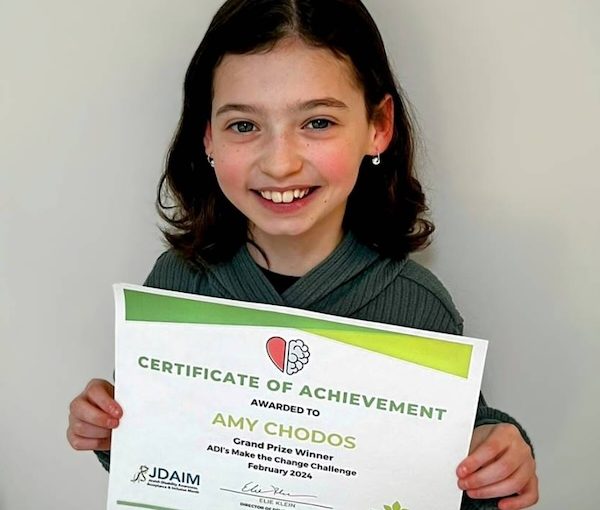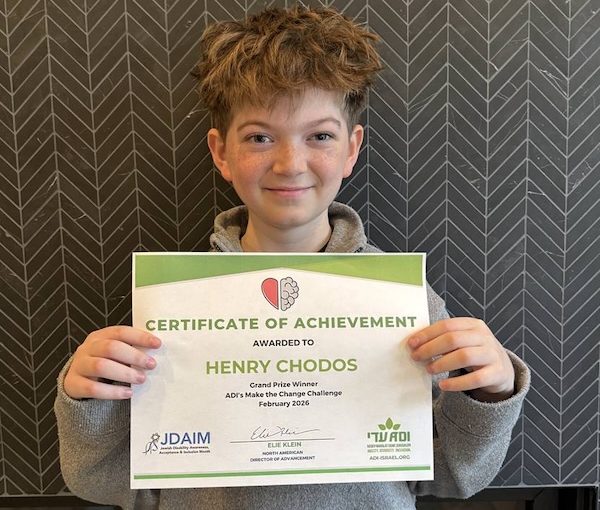
Henry Chodos, a Grade 6 student from Vancouver Talmud Torah, won ADI’s sixth annual Make the Change Challenge and received the $1,000 grand prize. (photo from ADI)
In its sixth year, ADI’s Make the Change Challenge STEM accessible design contest drew more than 379 entries from students across North America – and Vancouver Talmud Torah sixth grader Henry Chodos won the contest’s $1,000 grand prize.
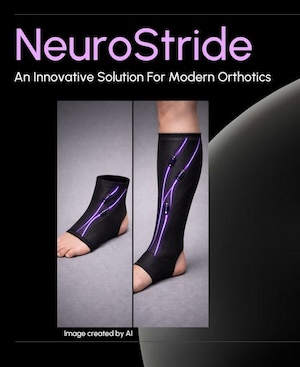
Chodos’s award-winning vision is a lightweight and slim-fitting orthopedic brace that automatically adjusts to provide users with rigidity and flexibility as needed.
Having struggled for years with chronic inflammatory demyelinating polyneuropathy (CIDP), a rare autoimmune disorder that causes muscular weakness and sensory loss in the limbs, Chodos set out to help himself and others by designing NeuroStride, an orthotic with built-in micro sensors that would intuitively correct gait irregularities and allow users to make adjustments via an easy-to-use app, with no medical professional required.
The Make the Change Challenge is run by ADI (adi-israel.org), Israel’s network of specialized rehabilitative care for those touched by and living with disability, to mark Jewish Disability Awareness, Acceptance and Inclusion Month. The contest promotes “selfless STEM” (science, technology, engineering and mathematics) and encourages students to hack the modern world to help people with disabilities overcome the challenges that hinder their independence and inclusion.
Instead of developing prototypes, entrants were asked to prepare compelling presentations that clearly explain how their solutions would solve the persistent accessibility issues they chose to tackle. In his contest submission, Chodos, who wears braces 24 hours a day, noted that the orthotics currently available are very uncomfortable, take a long time to mold to one’s body, don’t allow for growth and are prohibitively expensive. What’s more, they spotlight his condition and keep him from doing the things he loves.
“When my CIPD flares up, I can’t ride or play basketball with my friends, and I can never sit on the ground in class or during assemblies, because I can’t stand back up in my braces,” he explained. “I don’t like feeling different, and I wanted to create an orthotic that would provide me and others living with CIPD, cerebral palsy, muscular dystrophy, spina bifida and other conditions with the support we need, just without all of the unwanted strain and attention.”
Upon reading Chodos’s presentation, the contest’s judges – which included members of ADI’s professional staff, innovation journalists and specialists in the field of accessible design – were overwhelmed by the young inventor’s maturity, creativity and attention to detail, and inspired by his desire to draw from his own experiences to change the world.
“To be honest, Henry’s presentation left us speechless. We work so hard promoting our ADI Bechinuch disability inclusion programming and helping students develop an empathetic worldview, but Henry flipped the script and became our teacher. His life experience has molded a passionate and compassionate educator and innovator, and he put on a masterclass in perseverance, perspective and vision throughout this competition,” said ADI’s North American director of advancement . “We are thrilled that we were able to provide Henry with a stage upon which to shine, and we truly believe that his brilliant design has the potential to become a reality and make the world a kinder and more accessible place.”
Nearly 50 Jewish schools across North America – including many affiliated with JNF-USA – used the ADI Bechinuch programming last year, employing the in-class activities and disability simulations, virtual tours and STEM contest to encourage the next generation of Jewish leaders to see the world through the eyes of others.
As February ended, ADI’s panel of experts met with the contest’s top five finalists, their parents and their teachers via Zoom to discuss the entries in greater detail. Following some discussion, the proceedings concluded with Chodos being crowned the contest winner and presented with the $1,000 grand prize, a gift from the Avraham and Esther Klein Young Entrepreneurs Fund.
The “Final 5” also included entries from students at the Ramaz School in New York, NY; Brauser Maimonides Academy in Fort Lauderdale, Fla.; Hochberg Lower School (Posnack East) in Hallandale, Fla.; and the Bornblum Community School in Memphis, Tenn.
To learn more about ADI and to donate, visit adi-israel.org.
– Courtesy ADI Negev-Nahalat Eran