Skip to content
  • Home
  • Subscribe / donate
  • Events calendar
  • News
    • Local
    • National
    • Israel
    • World
    • עניין בחדשות
      A roundup of news in Canada and further afield, in Hebrew.
  • Opinion
    • From the JI
    • Op-Ed
  • Arts & Culture
    • Performing Arts
    • Music
    • Books
    • Visual Arts
    • TV & Film
  • Life
    • Celebrating the Holidays
    • Travel
    • The Daily Snooze
      Cartoons by Jacob Samuel
    • Mystery Photo
      Help the JI and JMABC fill in the gaps in our archives.
  • Community Links
    • Organizations, Etc.
    • Other News Sources & Blogs
    • Business Directory
  • FAQ
  • JI Chai Celebration
  • JI@88! video

Recent Posts

  • Sharing her testimony
  • Fall fight takes leap forward
  • The balancing of rights
  • Multiple Tony n’ Tina roles
  • Stories of trauma, resilience
  • Celebrate our culture
  • A responsibility to help
  • What wellness means at JCC
  • Together in mourning
  • Downhill after Trump?
  • Birth control even easier now
  • Eco-Sisters mentorship
  • Unexpected discoveries
  • Study’s results hopeful
  • Bad behaviour affects us all
  • Thankful for the police
  • UBC needs a wake-up call
  • Recalling a shining star
  • Sleep well …
  • BGU fosters startup culture
  • Photography and glass
  • Is it the end of an era?
  • Taking life a step at a time
  • Nakba exhibit biased
  • Film festival starts next week
  • Musical with heart and soul
  • Rabbi marks 13 years
  • Keeper of VTT’s history
  • Gala fêtes Infeld’s 20th
  • Building JWest together
  • Challah Mom comes to Vancouver
  • What to do about media bias
  • Education offers hope
  • Remembrance – a moral act
  • What makes us human
  • המלחמות של נתניהו וטראמפ

Archives

Follow @JewishIndie
image - The CJN - Visit Us Banner - 300x600 - 101625

Tag: cooking

Enter focaccia, stage right

Enter focaccia, stage right

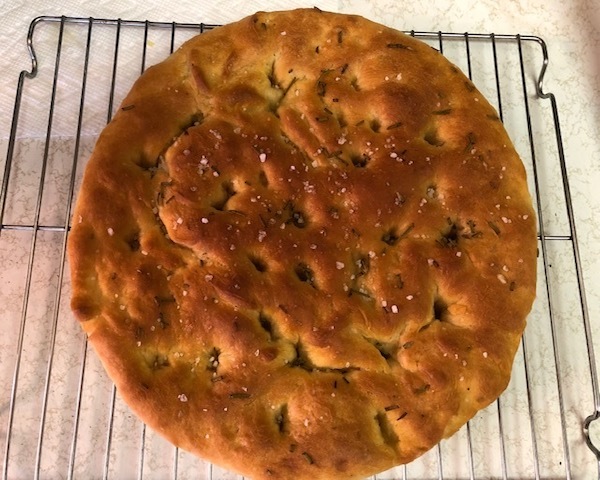
Focaccia straight from the oven. (photo by Shelley Civkin)

Ladies and gentlemen, start your engines, please. Or, in this case, your yeast. From zero to focaccia in one hour.

My unpremeditated transformation from water-burner to bread-baker is shocking even to me. Or especially to me. When hubby Harvey came home one day with a cast-iron pan, I got über excited, thinking I could now fry like my father used to. Though, when frying became a dirty word in the 1990s, he called it sautéeing. But, somehow, sautéeing seemed too prosaic for the mighty cast iron, so I started investigating what else I could do with the skillet.

Thanks to Google and Pinterest’s cookies, they now know that I like baking bread. I automatically get links to recipes for cast-iron bread-baking. Every. Five. Minutes. Enter focaccia, stage right. Or, if you’re Italian … entra nella scena della focaccia a destra.

I perused the myriad recipes and took a few of them on a test drive. Or test bake, as it were. The following recipe overtook the others by a mile, and won in the finest focaccia category. Here’s a link to the winning One-hour Rosemary Focaccia Bread I’ve come to love: flavorthemoments.com/one-hour-rosemary-focaccia-bread. (It actually takes an hour-and-a-half, if you include the time it takes to preheat your oven.)

It’s my go-to quick bread recipe. It’s truly no-fail. Feel free to ditch the garlic and Parmesan, or add more rosemary. You can’t screw up this bread. After my first try, I was hooked. I let the gorgeously golden focaccia cool, sliced it into small rectangles, like they do in Italian restaurants, and dipped it in EVOO (shorthand for extra virgin olive oil). Which made me wonder what an “extra virgin” is? Something to ponder another time. Never mind. Not relevant. Anyway, I’ve made this focaccia several times. Needless to say, I am not getting thinner. But my Italian is improving.

Now that I’ve pretty much nailed down challah and focaccia, I decided to branch out and try making a no-knead round crusty bread. You know, like sourdough. Minus the sour. The kind that requires you to have a Dutch oven. Google and Pinterest are way ahead of me, so they’ve been sending me nonstop recipes and pix of Dutch oven bread. All I had to do was think about crusty bread and they were on it.

I recently learned that not all Dutch ovens are created equal. They’re mostly made from cast iron covered in enamel, but not all of them can withstand the high heat you need to use. Thing is, for crusty bread, you have to heat the Dutch oven to about 450 degrees – empty. Then you put the dough in it. You don’t want to ruin a fancy shmancy Dutch oven over a loaf of bread. Even though my Dutch oven isn’t one of those $400 Le Creuset ones – it’s a $65 one from Costco, which works perfectly for pot roast, chicken and everything in between – I’m loathe to risk ruining it over bread. Sure, I could go buy one of the fancy Dutch ovens but, seriously, $400 for a crusty loaf? Not in this lifetime. I worked too hard to fritter my money away like that. And, like I always say, just because you can afford to buy something, doesn’t mean you should.

So, I improvised and used an ancient Magnalite aluminum-magnesium alloy Dutch oven that belonged to my friend’s late mother. I’m hoping I don’t get Alzheimer’s, what with the aluminum connection, but it’s not like I’m going to be making every single meal in it. Anyway, the bread was a marginal success. The outside looked gorgeously crusty but, once I cut into it, parts were doughy and uncooked. Bake and learn. I’ll try it a few more times, tweaking the temperature, increasing the rising time, etc., and hope for the best. If at first you don’t succeed, well, suck it up and try again.

I can hear some readers wondering why I would want to waste half a day baking bread from scratch, when I could just go out and buy a loaf. Well, there’s something indescribable about the smell of fresh baked bread wafting through my home. It’s a little like a comestible aphrodisiac. It makes me weak at the knees, thinking about the butter melting slowly over the hot bread, as I sniff it lovingly with anticipation. Wait, this is becoming a little X-rated. I need to get a grip. Sorry. Suffice to say that my husband and I adore fresh bread and appreciate the effort it takes to make it. And, since I’m a notorious multi-tasker, I busy myself with other things while the dough is rising, so there’s no wasted time. Like now, for instance. I’m writing this article while waiting for my rosemary and Kalamata olive bread dough to double in size.

Never having been one to let grass grow under my feet, my next culinary foray will be gravlax. Ever since tasting my friend Roxanne’s heavenly gravlax last Pesach, I’ve been itching to give it a go. Since salmon season is upon us, there’s no time like the present. Harvey’s on board too, but not as a cook as much as a taste-tester. From what I can tell, it’s a ridiculously easy thing to make, as long as you have truckloads of salt, sugar, dill and time. No, not thyme. Once I perfect the recipe, I’ll share it with you. But not until then.

You can try till you’re blue in the face to convince me that store-bought food is just as good as homemade, but I’m not buying it. Literally or figuratively. There’s just something about the laying on of hands, the investment of love and effort, and the satisfaction at the end of it all, that makes homemade food so very worth it.

I suspect I might have made a very dedicated homesteader. As long as I had an electric stove and oven, and a good refrigerator. Oh, and maybe somewhere close by where I could get a good decaf, low-foam, lactose-free latte while I was growing my own food, baking bread and churning butter. Am I country girl at heart? Hell, no! I am about as cityfied as they come. To wit, my idea of camping is a Motel 8. And outhouses? They should be outlawed.

Enough said.

Shelley Civkin, aka the Accidental Balabusta, is a happily retired librarian and communications officer. For 17 years, she wrote a weekly book review column for the Richmond Review, and currently writes a bi-weekly column about retirement for the Richmond News.

Format ImagePosted on August 23, 2019April 2, 2020Author Shelley CivkinCategories LifeTags Accidental Balabusta, baking, bread, challah, cooking, focaccia, lifestyle
Cucumber salads for summer

Cucumber salads for summer

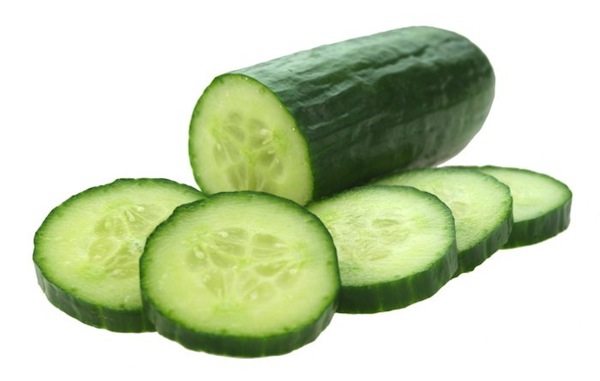
(photo by Nick Youngson/Alpha Stock Images)

Whether you go to farmers markets or elsewhere to buy your summer produce, cucumbers are a must. In Jerusalem, we have all kinds of cucumbers year-round but my favourite in Machaneh Yehudah is one with a fuzzy, pale green skin called melafafon beladi (native, urban or indigenous to the country) or, in Arabic, fauze. Much more expensive than regular cucumbers, the taste is special, but the following recipes will taste great with regular cucumbers.

CUCUMBER SALAD BOATS
This recipe came from Gourmet Magazine probably more than 30 years ago. It makes 6 servings.

2 large cucumbers, peeled and halved lengthwise
1 cup grated carrots
1 cup grated radishes
2 tbsp olive oil
2 tsp lemon juice
salt and pepper to taste

  1. In a bowl, combine grated carrots, radishes, oil, lemon juice, salt and pepper.
  2. Scoop out some of the seeds, then place cucumbers on a plate and fill with vegetables. Wrap in plastic wrap and chill for at least one hour. To serve, cut each cucumber into thirds.

SEAWEED AND CUCUMBER SALAD
4 servings

1/2 cup washed seaweed
1/2 bunch green onions
4-6 cucumbers
2 1/2 tbsp lemon juice
1/4 tsp sesame oil
3 tbsp soy sauce or teriyaki sauce
2 tbsp sesame seeds or chopped cashew nuts (optional)

  1. Chop seaweed and green onions in a bowl. Chop cucumbers coarsely and add to bowl.
  2. In a jar with a lid, mix lemon juice, sesame oil, soy sauce or teriyaki sauce. Pour over salad. Sprinkle sesame seeds or cashew nuts on top before serving.

TURKISH CUCUMBER AND YOGURT SALAD
This dish is often called cacik or jajik. Recipe makes 4-6 servings.

2 large cucumbers, sliced
salt to taste
1 crushed garlic clove
2 tsp white vinegar
1/2 tsp chopped dill
2/3 cup yogurt
1 tbsp chopped fresh mint
2 tbsp oil

  1. In a bowl, combine cucumber slices, salt, garlic, vinegar, dill and yogurt and blend.
  2. Sprinkle mint and oil on top before serving.

Sybil Kaplan is a journalist, lecturer, book reviewer and food writer in Jerusalem. She created and leads the weekly English-language Shuk Walks in Machane Yehuda, she has compiled and edited nine kosher cookbooks, and is the author of Witness to History: Ten Years as a Woman Journalist in Israel.

Format ImagePosted on July 12, 2019July 2, 2020Author Sybil KaplanCategories LifeTags cooking, cucumber, recipes, salad
Wonders of asparagus

Wonders of asparagus

(photo from pixnio.com)

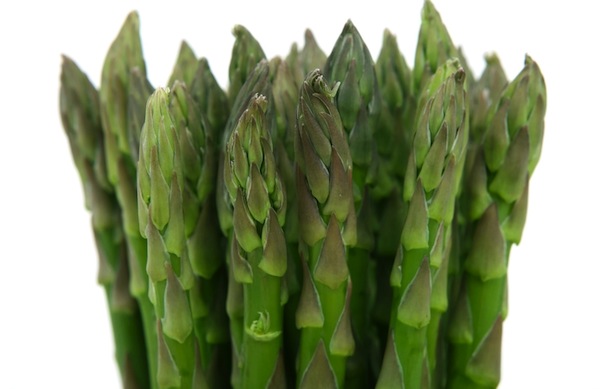
In Israel, asparagus is not widely seen in the outdoor markets but, when it is, I am always happy to buy it. There are at least 10 reasons why we should eat more asparagus.

  1. It contains lots of fibre, making it a good choice if you’re trying to lose weight, because your body digests fibre slowly, which keeps you feeling full in between meals. (It is also low in fat and calories: one cup is a mere 32 calories.)
  2. It contains high levels of the amino acid asparagine, making it a natural diuretic. In other words, eating more of the spears can help flush excess fluid and salt from your body, which may help prevent urinary tract infections.
  3. It is full of antioxidants that could help your body fight free radicals.
  4. It contains vitamin E, another important antioxidant, which helps strengthen your immune system and protects cells from the harmful effects of free radicals.
  5. It is a natural aphrodisiac, thanks to vitamin B6 and folate.
  6. The minerals and amino acids in asparagus extract may help ease hangovers and protect liver cells from the toxins in alcohol.
  7. It beats bloating by promoting overall digestive health – another benefit of all that fibre. And, thanks to prebiotics, which encourage a healthy balance of good bacteria, or probiotics, in your digestive tract, it can also reduce gas. Relatedly, since asparagus is a diuretic, it helps flush excess liquid, combating belly bulge.
  8. It’s a rich source of folic acid, providing 22% of the recommended daily allowance of folic acid.
  9. It’s filled with vitamin K, crucial for coagulation, which helps your body stop bleeding after a cut, as well as bone health.
  10. It boosts your mood because it is full of folate, a B vitamin that could lift your spirits and help ward off irritability. Asparagus also contains high levels of tryptophan, an amino acid that has been similarly linked to improved mood.

Need I say more? Buy asparagus with straight stalks, closed compact tips and good green colour. Keep refrigerated and use within one or two days. Bend the stalk near the bottom to snap off the part that is too tough to eat. Cook in one inch of boiling salt water. Let the water boil again and cover. Cook whole stalks about five minutes and cut-up pieces about three minutes. Here are some ways to use asparagus.

VINAIGRETTE

1/4 cup olive oil or canola oil
1 tbsp red wine vinegar
1 tbsp Dijon mustard
1/2 tsp sugar
salt and pepper to taste

Combine all ingredients in a blender and mix for one minute. Pour over cooked asparagus.

MICROWAVED IN LEMON BUTTER DIJON SAUCE
(3-4 servings)

2 1/2 tbsp canola or olive oil
1 tbsp lemon juice
2 tsp Dijon mustard
1/2 tsp low-sodium soy sauce
1/2 tsp minced garlic
2 tbsp minced white onion
salt and pepper to taste
1/2 pound asparagus
chives or green onions for garnish

Arrange asparagus in a microwave steaming bag. Add oil, lemon juice, mustard, soy sauce, garlic, onion, salt and pepper. Microwave four to five minutes; let stand one minute. Place in serving bowl and garnish with chives or green onion.

FLAMANDE SAUCE
6 servings

4 mashed hard-boiled egg yolks
1/4 cup + 2 tbsp olive or canola oil or 1/2 cup melted margarine or butter
1/4 cup minced fresh parsley

Whisk oil or butter or margarine into egg yolks in a saucepan. Add parsley and heat sauce. Pour over cooked asparagus.

STEAMED WITH TARRAGON SAUCE
(6 servings)

1 1/2 pounds trimmed asparagus
2 tsp olive oil
6 thinly sliced scallions
1 1/2 tbsp chopped fresh tarragon or 3/4 tsp dry tarragon
3 tbsp lemon juice or cider vinegar
dash sea salt
3 tbsp water

Steam asparagus two to five minutes, rinse, drain and place in serving bowl. Heat oil in a pan and sauté scallions one to two minutes. Add tarragon, lemon juice or vinegar, salt and water; cook one to two minutes. Pour over asparagus.

Sybil Kaplan is a journalist, lecturer, book reviewer and food writer in Jerusalem. She created and leads the weekly English-language Shuk Walks in Machane Yehuda, she has compiled and edited nine kosher cookbooks, and is the author of Witness to History: Ten Years as a Woman Journalist in Israel.

Format ImagePosted on June 14, 2019June 12, 2019Author Sybil KaplanCategories LifeTags asparagus, cooking, health

Why dairy on Shavuot? Oh, and cheescake recipes

On the second day of Passover, we begin to count the omer (sheaves of a harvested crop). The counting concludes seven weeks later, with Shavuot (the Feast of Weeks), which has different names, but is associated with one type of food: dairy products. Hence, my sharing a few cheesecake recipes.

Song of Songs Chapter 4 reads, “honey and milk are under thy tongue,” a reference to the Torah being as nourishing as milk and as sweet as honey. Thus, on the holiday celebrating the giving of the Torah, it became traditional to eat foods with milk and honey.

Interpreters of the Tanach liked to use gematria (Jewish system of assigning numerical values to words and phrases, based on their letters). For example, Psalm 68 is read on Shavuot and, in verse 16, it reads: “A mount of G-d is the mountain of Bashan.” The Hebrew for peaks is gavnuneem, which sounds like gveeneh (cheese). One could interpret this to mean that, on Shavuot, we should eat mountains of cheese.

Another example: the values of the Hebrew letters in chalav (milk) sum to 40. Moses spent 40 days on Mount Sinai, so we eat foods with milk.

As well, there is a legend that says, until Moses descended with the Torah, kashrut was unknown so, rather than prepare the meat as per the new rules, the people ate dairy. Pragmatically, since Shavuot is a summer festival and Israel is hot, it was logical to eat light, dairy foods. Also, sheep give birth around this time, so milk and cheese are plentiful.

In the Shulchan Aruch (code of Jewish law), Rabbi Moses Isserles wrote: “It is a universal custom to eat dairy food on the first day of Shavuot.”

CRUSTLESS CHEESECAKE

1 cup cream cheese
1 1/2 cups creamed cottage cheese
1/2 cup sugar
2 eggs
1 tsp vanilla
1 cup sour cream

  1. Preheat oven to 350°F. Spray vegetable shortening in a nine-inch round cake pan.
  2. Mix together cream cheese, creamed cottage cheese, sugar, eggs and vanilla. Pour into pan.
  3. Bake 35-40 minutes or until centre firm.
  4. Remove from oven and spread with sour cream while cake is hot. Cool then refrigerate.

BLENDER CHEESECAKE

crust:
15 graham crackers
1 tbsp sugar
1/2 tsp cinnamon
1/4 cup melted margarine or 3 tbsp vegetable oil

filling:
1 envelope unflavoured gelatin
1 tbsp lemon juice
grated peel of 1 lemon
1/2 cup hot water or milk
1/3 cup sugar
2 egg yolks
1 package cream cheese
1 heaping cup crushed ice
1 cup sour cream

  1. Break five crackers into quarters, blend to crumbs. Empty into bowl. Repeat twice more.
  2. Stir in sugar and cinnamon. Add melted margarine or oil and mix until crumbs are moist. Grease a spring form pan. Press crust against sides and chill.
  3. Mix in blender gelatin, lemon juice, lemon peel, hot water or milk 40 seconds.
  4. Add sugar, egg yolks and cream cheese and blend 10 seconds. Add ice and sour cream and blend 15 seconds.
  5. Pour onto crumb crust and chill.

MY MOM’S (Z”L) SCRUMPTIOUS CHEESE CAKE

crust:
2 cups graham cracker crumbs
1/2 cup butter or margarine or 1/4 cup plus 2 tbsp oil
1/4 cup sugar
dash cinnamon

filling:
1 1/2 cups cream cheese
2 eggs
1/2 cup sugar
1/4 tsp vanilla

topping:
2 cups sour cream
2 tbsp sugar
1/2 tsp vanilla

  1. Preheat oven to 350°F.
  2. Combine crushed crackers, butter, margarine or oil, sugar and cinnamon and press into spring form pan.
  3. Bake 10 minutes.
  4. Combine the filling’s cream cheese, eggs, sugar and vanilla with a mixer until fluffy. Pour into crust and bake 30 minutes.
  5. Beat topping’s sour cream, sugar and vanilla. When cake is done, remove from oven and spread topping on it. Return to oven and bake 10 minutes.
  6. Serve with cherries, crushed pineapple or strawberries on top.

 Sybil Kaplan is a journalist, lecturer, book reviewer and food writer in Jerusalem. She created and leads the weekly English-language Shuk Walks in Machane Yehuda, she has compiled and edited nine kosher cookbooks, and is the author of Witness to History: Ten Years as a Woman Journalist in Israel.
Posted on May 31, 2019May 30, 2019Author Sybil KaplanCategories Celebrating the HolidaysTags cheesecake, cooking, Judaism, recipes, Shavuot
JCC celebrates Israeli culture

JCC celebrates Israeli culture

The outdoor fair features live entertainment. (photo by Galit Lewinski)

The Jewish Community Centre of Greater Vancouver invites the entire community to its annual JCC Festival Ha’Rikud. The theme this year is “Seasons of Israel,” with a variety of programs to inspire, inform and entertain visitors. The highlight of the month-long celebration, which runs May 9-26, will be the outdoor community fair.

Beginning at noon on Sunday, May 12, the JCC parking lot will be transformed into an Israeli street fair with food trucks offering shwarma, falafel, vegan Middle Eastern choices and other popular treats; a marketplace (shuk); live music performances; family activities; dancing and more. Admission is free and everyone is welcome.

photo - Israeli culinary journalist Gil Hovav will give a presentation
Israeli culinary journalist Gil Hovav will give a presentation. (photo from JCC)

For Israeli dance lovers, there will be two shows in the Rothstein Theatre, at 1 and 3 p.m., featuring Orr Vancouver dancers and visiting performers from Mexico and Miami. For foodies, there will be a presentation at 5 p.m. by Gil Hovav, a leading Israeli culinary journalist, author, TV personality and speaker.

Other festival events include a group art exhibition in the Zack Gallery, which opens May 9; Israeli recreational dance workshops May 10-12, hosted by the Vancouver Israeli Folk Dance Society; an evening of poetry inspired by the artwork in the gallery, on May 16; and an Israeli song sing-along on May 26. Visit israelifestival.com for the complete schedule.


Format ImagePosted on May 3, 2019May 1, 2019Author Jewish Community Centre of Greater VancouverCategories Arts & CultureTags cooking, dance, Festival Ha’Rikud, Gil Hovav, Israeli culture, JCC
Learn from a cooking master

Learn from a cooking master

I don’t do it often, but I like cooking. Actually, I cook almost every day, but rarely cook with a capital C. My mother taught me the basics, and I appreciate not only good food, but the company that generally goes with it. When a close friend took a cooking class and shared some of the science behind what makes an excellent meal versus a mediocre one, I was fascinated.

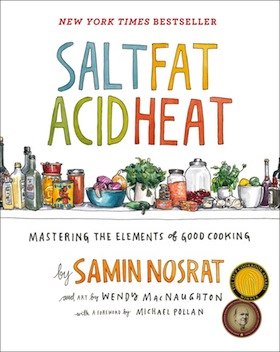
In looking for more in-depth information than is normally in a cookbook, I came across the bestseller and multiple-award-winner Salt Fat Acid Heat by Samin NosratSamin Nosrat, which was published by Simon & Schuster in 2017. The timing of my discovery was not coincidental. Nosrat’s Netflix series by the same name had recently premièred, in October 2018.

I knew there was a small Jewish connection to the book – author and food expert Michael Pollan had written the foreword. But then, the same friend who inspired my interest in the technical aspects of cooking told me she thought the illustrator might be Jewish. And, she was right! Wendy MacNaughton – whose clients include the New York Times, Wall Street Journal, Time Magazine, Bon Appetit, Gastronomica and many others, including Simon & Schuster – is Jewish. (With a name like Ramsay, I should have looked into it further right away; next time, I will.) With this added information, I could easily justify asking for a review copy from the publisher, and did.

book cover - Salt Fat Acid HeatSalt Fat Acid Heat is not a cookbook that you just pop open, pick a recipe and make it, though you could do that. There are plenty of recipes for salads, pasta, fish, chicken, meat, sweets and more. Shaved carrot salad with ginger and lime, garlicky green beans, beer-battered fish (which also contains vodka, apparently), and fresh ginger and molasses cake are top of my list to try. There are a couple hundred pages of recipes, plus some suggested menus, chefs and authors to look for online or in books, a four-page bibliography, an index and an illustrated list of kitchen and pantry essentials.

In this latter part of the cookbook, there is also a Cooking Lessons section based on the enormous amount of information Nosrat imparts in the first 200 pages about salt, fat, acid and heat. So, for example, to put what you learned about seasoning from within (salt), make spicy brined turkey breast; about emulsions (fat), pasta Alfredo; about layering acid, balsamic vinaigrette; and about preserving tenderness (heat), some scrambled eggs. Other lessons focus on timing, knife skills and improvising with leftovers.

What makes this cookbook a must-have for foodies and cooks of any level, is not only the detail into which Nosrat goes about the four elements that make for good cooking, but that, in discussing the details, she communicates and almost transfers her love of and excitement about food and cooking to the reader. It’s hard to read this book and not be tempted to head to the store to buy the umpteen types of salt that exist (who knew?) or a selection of olive oils to taste, to the market for the freshest of fruits and vegetables, or to the butcher for the best cuts of meat.

Nosrat is all about the experience of cooking – taste and taste again, and don’t be afraid to experiment. As Pollan writes in the foreword, “Even though it contains plenty of excellent recipes, this is a book concerned foremost with principles…. Master these principles, [Nosrat] promises, and you will be able to cook delicious food of any kind, in any tradition, whether a salad dressing or braise or a galette.”

illustration - Salt Fat Acid Heat caesar salad made by Samin Nosrat, illustrated by Wendy MacNaughton
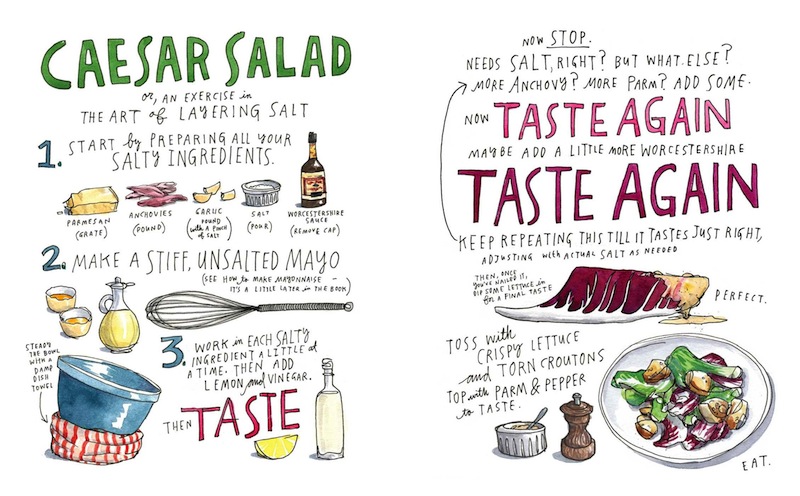
A Caesar salad, as made by Samin Nosrat and illustrated by Wendy MacNaughton in Nosrat’s Salt Fat Acid Heat.

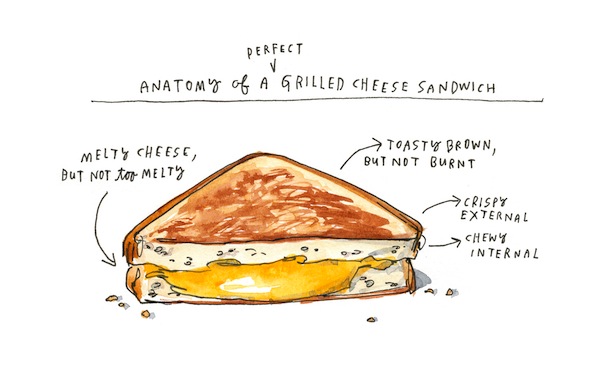
The full-colour illustrations are critical to what makes Salt Fat Acid Heat such an incredible resource and enjoyable read. From drawings of things that don’t lend themselves easily to depiction, such as grains of salt, a chemical reaction and saffron, to making tables, charts, Venn diagrams, frying instructions, etc., more fun and easy to understand, MacNaughton helps Nosrat explain the art and science of cooking.

The size and weight of Salt Fat Acid Heat is daunting, until you open it. As Nosrat writes about how to use the book, “Pay attention to the techniques, the science and stories, but don’t worry too much about committing it all to memory. Come back again later to revisit the concepts that are relevant to you.” But, most importantly, she emphasizes, “Don’t forget to enjoy the pleasures, both small and large, implicit to cooking and eating with people you love!”

Format ImagePosted on April 12, 2019April 10, 2019Author Cynthia RamsayCategories BooksTags cooking, Samin Nosrat, Wendy MacNaughton

Balabusta preps for Pesach

Harvey’s charoset pyramid. (photo by Shelley Civkin)

As the Torah commands us, we tell the story of Passover and the Israelites’ exodus from slavery in Egypt to our children and ourselves every year, by reading from the Haggadah. Coming from a secular home, I don’t recall our family owning a single Haggadah. Instead, my father had a little black notebook in which he wrote down the story of Passover and the Jews’ exodus from Egypt. It took about five minutes for Dad to read it, and then we had our seder. It wasn’t particularly traditional, but it was meaningful nonetheless.

On the all-encompassing journey called Yiddishkeit, preparing for Passover scores about an 18/10 on the commitment scale. Between the feathers and flashlights, flourless sponge cakes and briskets, a balabusta has her work cut out for her. And then some.

As an accidental balabusta and relative neophyte to traditional Passover preparations, I want to get with the program as much as possible. I scared myself the other day though, by reading articles about what goes into getting ready for this significant holiday. One such article – called “Cook your Pesach while you sleep” – was particularly troubling. It seems to me that a Pesadik balabusta requires at least 36 hours in every day to prepare her food for the seder, a month ahead of time. She might also require a housekeeper to do all the laundry and clean the house while she’s tethered to the kitchen, cutting, peeling, blanching, baking and roasting the eight-course meals she’ll serve to her 42 guests over the two nights of Passover. Oh, and did I mention the other two minor meals she needs to organize daily for her family during the eight days of the holiday? Holy flourless kugel, Batman!

And then there’s the issue of finding and removing all the chametz from your home. Let me confess something right from the get-go: I am not an observant Jew in the strict sense of the word. I do observe certain things, like going to synagogue every Shabbat, lighting Shabbat candles, doing the odd mitzvah, and studying a little Torah. That’s about the extent of it. I refrain from eating chametz during Pesach, but I have never actually removed all the chametz from my home before the holiday. And I don’t keep kosher. However, I do eat matzah religiously during Pesach. And I kind of have a crush on shmurah matzah.

As for that age-old shmurah versus Manischewitz matzah debate … I wholeheartedly throw my vote behind shmurah. Yes, it’s expensive, but it’s so worth it. Having visited Kfar Chabad on our trip to Israel last year, we went to their shmurah matzah factory and witnessed how the matzah is made by hand. Seeing the meticulous precision with which everything is measured, timed and baked, it was a fascinating and educational experience. And did I mention its unique flavour and round shape? Sure, parts of it can be burnt, but that just enhances the taste. Once you go shmurah, you’ll never go back.

I’m the kind of accidental balabusta that, instead of making matzah ball soup, brisket, tzimmes and macaroons for Pesach, I’m inclined to make hotel reservations in Whistler and call it a day. There’s no need for me to be Jewish Wonder Woman. Gal Godot has that covered. I know, not every woman who prepares for Pesach considers herself Wonder Woman. But, given the magnitude of preparation that must get done in advance – and done to rigorous standards – I’m pretty sure that devotedly observant women qualify for that title. As for me, I’ll do the best I can to honour the traditions, prepare a welcoming and tasty seder for my family, then enjoy a plotzfest.

Preparing for Pesach can be dangerous though. A couple of years ago, I decided to forgo the store-bought chrain (horseradish) and make my own. I found a recipe, then went out and bought the fresh horseradish root. It looked innocent enough. From a distance. Nobody told me that taking a close-up whiff of newly pulverized horseradish root is akin to inhaling mustard gas. I thought I’d burned my lungs. Sure, it produced that unrivaled heat I always admire in a memorable horseradish. However, it almost knocked me out. This Pesach, I plan to simplify the process by buying horseradish. And saving my lungs for more important things … like breathing.

On the topic of food … my husband Harvey makes the ultimate Passover crowd-pleaser: a visually stunning, delicious pyramid-shaped charoset. He got the recipe decades ago from the L.A. Times. It never fails to impress guests. Here’s the recipe.

HARVEY’S CHAROSET PYRAMID

1 unpeeled pear, cored and chopped roughly
1 unpeeled apple, cored and chopped roughly
1 cup chopped walnuts
1 cup chopped almonds
1 cup chopped hazelnuts
1 cup chopped pistachios
1 cup chopped pitted dates
1 cup chopped raisins
2 tsp ground cinnamon
2 tsp grated fresh ginger
1 tbsp apple cider vinegar
sweet wine, preferably Manischewitz (about 1/4 cup)
extra dates to decorate the plate

  1. Put all the nuts in food processor and chop, but not too finely. Place in a bowl.
  2. Put dates and raisins in food processor and chop, but not too finely. Place in separate bowl.
  3. Core and roughly chop apple and pear by hand, then put in the food processor, along with the nuts, and the raisin and date mixture. Add cinnamon, ginger, apple cider vinegar and wine. Chop till it’s all mixed together. Be careful not to overdo it – you don’t want it mushy.
  4. Remove it all from the food processor and shape it into a pyramid with a spatula. Then use a small, sharp knife to lightly make “brick” shapes in the pyramid. Refrigerate. Put whole dates around the outside before serving.

For another Passover culinary experience, check out Jamie Geller’s recipe for potato kugel cups at joyofkosher.com/recipes/potato-kugel-cups. You can YouTube it, too. If you’re not afraid of hot oil in a 425°F oven, this recipe will knock your Pesach socks off. Personally, scorching hot oil makes me a bit skittish. But the result is potato heaven.

As Pesach approaches, it’s a time to clean house, both literally and spiritually. It’s a time to remember how blessed we are in our freedom as Jews today. And it’s a time to hold close our traditions, pass along the story of our exodus from Egypt to the younger generation, and be thankful for where we are now.

So, eat the matzah and bitter herbs and drink those four cups of wine. Then go out and buy lots of Metamucil. Because you’re going to need it after eight days of matzah. But check with your rabbi first to make sure Metamucil is kosher for Pesach.

Wishing you all a meaningful and freilach Pesach.

Shelley Civkin, aka the Accidental Balabusta, is a happily retired librarian and communications officer. For 17 years, she wrote a weekly book review column for the Richmond Review, and currently writes a bi-weekly column about retirement for the Richmond News.

Format ImagePosted on April 12, 2019April 2, 2020Author Shelley CivkinCategories Celebrating the Holidays, LifeTags cooking, Judaism, lifestyle, Passover

The great matzah ball debate

What food eaten during Pesach causes the most debates? If you guessed matzah balls, you’re right. Should they be hard or light? Big or small? What secret ingredient should be added to them?

From where did matzah balls, or kneidlach, originate? German Jews had a dumpling that they put into their soup called knodel. From this came the Yiddish term kneydl, singular, or kneydlach, in the plural. In Czech, it is known as knedliky. Dumplings have been in Central European cookery since the Middle Ages and then they came to Germany and Eastern Europe later.

So, just how many ways are there to make matzah balls?

Joan Nathan, a friend of mine, who has written a number of cookbooks and is considered a maven of American Jewish cooking, proposes adding chicken fat or vegetable oil plus seltzer, club soda or chicken broth, to make them light and airy. In Jewish Cooking in America, she also relates that some matzah balls, originating in Lithuania, use chicken fat or vegetable shortening and contain a filling made of onion, oil or chicken fat, matzah meal, egg yolk, salt, pepper and cinnamon. The filling is then placed in the middle of the matzah ball before they are cooked in salt water. After cooking in salt water, they are baked 30 minutes then placed in the soup for serving. Joan also has a recipe for matzah balls made in the southern United States, using pecans. In my research, I discovered that some Louisiana Jews add green onions and cayenne pepper.

In her cookbook Quiches, Kugels and Couscous: My Search for Jewish Cooking in France, Joan explains that, in France, matzah balls are called boulettes de paque, krepfle or kneipflich. They are the size of walnuts and not fluffy. They are made from stale bread or matzah soaked in water and dried, and they contain rendered goose fat, vegetable oil or beef marrow, eggs, water or chicken broth, matzah meal, salt, pepper, ginger and nutmeg.

In The New York Times Passover Cookbook, edited by Linda Amster, among the recipes for matzah balls is one by Mimi Sheraton, Times food critic at the time, who used chicken fat and cold water. Another is from Joan’s cookbook Jewish Holiday Kitchen, and she uses ginger and nutmeg. The winning recipe for the first Matzah Bowl contest in New York at the time the Times cookbook was published used vodka and club soda. A low-fat, low-salt version is made with egg whites and vegetable oil. Another style, which is airy, is made with beef marrow, instead of chicken fat, plus nutmeg.

Refrigeration and the temperature of the liquid seem to be key common denominators in many recipes.

Nina Rousso, an Israeli, in her book The Passover Gourmet, uses beaten egg yolks, lukewarm water, melted margarine, salt, parsley, matzah meal and stiffly beaten egg whites folded in. The mixture is refrigerated two hours before making.

In Passover Lite, Gail Ashkenazi-Hankin, an American, combines egg yolks, onion powder, salt, pepper, matzah meal, water and beaten egg whites and chills the mixture 30 minutes.

Zell Schulman, the American author of Let My People Eat, says the key to making light, melt-in-your-mouth, floating matzah balls is to beat egg whites until stiff then fold into the yolks with salt, pepper, cinnamon, matzah meal and optional parsley and refrigerate 15 minutes. A second version combines matzah meal with only the beaten egg whites until they hold peaks, plus parsley, cinnamon, grated carrot and oil, but no egg yolks.

Susan Friedland, the American author of The Passover Table, combines whole eggs with seltzer, salt, pepper, matzah meal and schmaltz, which she refrigerates for one hour. The schmaltz adds the flavour.

Marlene Sorosky, American author of Fast and Festive Meals for the Jewish Holidays, provides a recipe using ground almonds, ginger and chopped parsley. She chills the matzah balls for one hour.

Edda Servi Machlin, whose family has 2,000-year-old roots in Italy, says her family serves a mix between Italian Passover soup and Ashkenazi chicken soup. Her matzah balls are made of chopped chicken, egg, broth, olive oil, salt, pepper, nutmeg and matzah meal. The batter is refrigerated one hour before making.

Other Italian Jews, who call the matzah balls gnocchi di azzaima, add onions or mashed potatoes to the dough or grated lemon rind.

An aside: In 2001, Ariel Toaff, a professor at Bar-Ilan University, who is the son of Rome’s chief rabbi, came out with a book called Mangiare alla Giudia (Eating the Jewish Way). He devotes a chapter to Passover traditions, and writes that matzah was so popular that the Catholic authorities banned Jews from selling matzah to non-Jews and banned Christians from eating it.

Italian bakers also baked different kinds of matzah: plain for intermediate days, shmurah matzah for the sederim, and matzah made with white wine, eggs, sugar, anise and goose fat for those with more rich tastes.

Jews of Italy even developed sfoglietti or foglietti, a kosher-for-Passover pasta made with flour and eggs, which was then quickly dried and baked in a hot oven and served in soup or with a sauce.

Joyce Goldstein, an American fascinated by Italian Jewish cuisine, describes, in Cucina Ebraica, a combination of ground chicken, egg, matzah meal, salt, pepper and cinnamon, which she refrigerates before cooking in soup, but she does not say for how long.

Sonia Levy, a native of Zimbabwe, wrote a cookbook of her community, called Traditions. She describes luft kneidlach, light matzah balls, made with matzah meal, water, salt, nutmeg, cinnamon or ginger, eggs and oil. These must be refrigerated at least half a day. She adds that you can also make a pit with a finger and insert chopped meat that has been mixed with fried onions and spices. Another Zimbabwe version uses egg, cold water, chicken fat, salt, pepper, ginger and matzah meal.

Ruth Sirkis, an Israeli, in A Taste of Tradition, says “air” matzah balls have eggs, matzah meal, salt, chicken soup and chicken fat and are refrigerated two hours.

Another version, by Anya von Bemzen and John Welchman in Please to the Table: A Russian Cookbook, has walnut balls for soup, which are made by the Georgian Jews using ground walnuts, onion, egg, matzah meal, oregano, salt, pepper and a froth egg white.

A couple of last pieces of matzah ball trivia. In 2008, a New York kosher delicatessen held its annual matzah ball-eating competition to raise money for a shelter for the homeless. The winner ate 78 matzah balls in eight minutes. Although not in the Guinness Book of World Records, a few years ago, the largest matzah ball was measured at 17.75 inches across and weighed more than 33 pounds.

And, lastly, among some ultra-Orthodox Jews, matzah balls are not eaten because they expand when they cook, and they consider this reaction a form of leavening.

Regardless of the style of matzah balls you prefer, just make plenty for your guests!

Sybil Kaplan is a journalist, lecturer, book reviewer and food writer in Jerusalem. She created and leads the weekly English-language Shuk Walks in Machane Yehuda, she has compiled and edited nine kosher cookbooks, and is the author of Witness to History: Ten Years as a Woman Journalist in Israel.
Posted on April 12, 2019April 10, 2019Author Sybil KaplanCategories Celebrating the HolidaysTags books, cooking, culture, history, matzah, Passover
Alternatives to potato latkes

Alternatives to potato latkes

(photo from Joy/flickr.com)

An old folk proverb says, “Chanukah latkes teach us that one cannot live by miracles alone.”

Jewish food writer and cookbook author Joan Nathan contends that the word latke is not Yiddish, as everyone presumes, but stems from “a Russian word, latka, and a pastry, from obsolete Russian, oladka, or flat cake of leavened wheat dough.” This, in turn, probably came from a Middle Greek word, eladion, or oil cake, stemming from elaion, meaning olive oil.

Potato pancakes do seem to have originated among poor Eastern European Jews, but potatoes did not become a staple until the mid-19th century. John Cooper, in Eat and Be Satisfied: A Social History of Jewish Food, comments that Jews from Lithuania ate pancakes made from potato flour for Chanukah and had borrowed the idea from the Ukrainians, who made a potato pancake dish with goose fat called kartoflani platske, which they ate for Christmas. Since Chanukah fell about the same time, and there were plenty of geese to provide goose fat or schmaltz, we could conclude that schmaltz became a substitute for oil. Jews living in the Pale of Settlement in the 17th century probably adapted it for Chanukah as a way to dress potatoes differently for the holiday. Cooper also states that many Eastern European Jews ate buckwheat latkes for Chanukah, while Polish Jews made placki (pancakes) from potato flour and fried them in oil.

But what happens when you get tired of potato latkes? Here are some variations for Chanukah.

OLD JERUSALEM ZUCCHINI PANCAKES
Adapted from The Delights of Jerusalem by Rena Valero (Steimatzky, 1985). Recipe makes 20 patties.

6 zucchini
salt, to taste
salt and pepper to taste
1 diced onion
2 tbsp chopped parsley
2 tbsp chopped dill
2 large eggs
1/2 cup matzah meal
1 tbsp vegetable oil
oil for frying

  1. Grate unpeeled zucchini into a strainer. Sprinkle with salt and drain for 30 minutes. Squeeze to remove remaining liquid.
  2. In a mixing bowl, combine zucchini, salt, pepper, onion, parsley, dill, eggs and matzah meal and one tablespoon oil.
  3. Heat oil in a frying pan. Form zucchini mixture into patties. Fry for a few a minutes on each side. Drain on paper towels.

CARROT-PARSNIP LATKES
makes 16 patties

5 grated parsnips
2 grated carrots
1/4 cup flour
2 eggs
1 tsp dry chives or onion
1 tsp dry parsley
1/2 tsp salt
oil

  1. Grate parsnips and carrots into a mixing bowl and toss with flour.
  2. Add eggs, chives or onion, parsley and salt and mix.
  3. Heat oil in a frying pan. Make latkes by hand, add to oil, and fry until brown on both sides. Drain on paper towels.

VEGETABLE FETA LATKES
makes 10 to 12 patties

1 cup grated carrots
2 1/2 cups grated zucchini
1 cup grated potatoes or grated kohlrabi
1/2 tsp salt
3 eggs
salt and pepper to taste
3/4 cup flour
1/2 cup chopped fresh parsley
1/2 cup crumbled feta cheese
1/5 cup vegetable oil

  1. Place carrots, zucchini and potato (or kohlrabi) in a colander. Cover with cheesecloth or paper towels and squeeze out as much liquid as possible. Sprinkle salt and let them drain 15 minutes, then squeeze in paper towels.
  2. Place vegetables in a mixing bowl. Add eggs, salt and pepper, flour, parsley and cheese.
  3. Heat oil in a frying pan. Form mixture into patties. Fry in hot oil until brown on both sides. Drain on paper towels.

Applesauce & sour cream

Recently, someone asked me, why applesauce and sour cream for latkes? I wrote to my American Jewish food expert friend, Joan Nathan, but she didn’t know, so I Googled latkes and applesauce, found a blogger who voiced an idea, and I thought it made sense.

He suggested that, maybe, one year before Chanukah, a shopkeeper somewhere in Eastern Europe placed his annual order for potatoes to his dry goods provider. He wrote potatoes in Hebrew as tapuah adama. Somehow, the word adama was inadvertently erased and ended up being tapuach, the Hebrew word for apple. The supplier read the order and scratched his head, wondering why the shopkeeper didn’t want potatoes for Chanukah. But, due to the limits of communication back in those days, he couldn’t check with him in time, so he went ahead and filled the order, sending a bushel of apples.

When the shopkeeper saw the apples instead of potatoes, he wondered what to do with them but then figured, surely they would be a treat for Chanukah. He was able to sell the idea to the townspeople to buy apples, and some clever women decided to cook the apples – hence, applesauce. By the end of the holiday, everyone was raving about the apples and apple dishes.

In the Encyclopedia of Jewish Food, Gil Marks wrote that Greek Jews had a tradition that the Maccabees ate duck with apples to celebrate their victory, and that this was extended to serving apple rings, apple fritters and applesauce.

John Cooper, in Eat and Be Satisfied, reasons that the only fat for frying latkes was schmaltz, so the only topping could be applesauce.

Another source says apples were eaten on Rosh Chodesh, the start of a new month. Hungarian Jews made apple cake and strudel or tart for Rosh Hashanah, while Indian Jews dip apple in honey and rose water and Sephardi Jews make apple compote. Ashkenazi Jews serve apple strudel on Sukkot, and children place apples at the end of a flag stick for Simchat Torah.

As for sour cream, well, made in its fermented form, it was popular in the Slavic region. The idea of boiled potatoes eaten with sour cream was associated with Eastern European Jews, so, if they found a substitute for the schmaltz when frying their latkes, they could well have used sour cream as an accompaniment.

Sybil Kaplan is a journalist, author, compiler/editor of nine kosher cookbooks and a food writer for North American Jewish publications, who lives in Jerusalem where she leads weekly walks of the Jewish food market, Machaneh Yehudah, in English.

Format ImagePosted on November 30, 2018November 30, 2018Author Sybil KaplanCategories Celebrating the HolidaysTags Chanukah, cooking, Jewish culture, latkes
Hot pancakes for breakfast

Hot pancakes for breakfast

(photo by Brandon Martin-Anderson)

According to my research, some type of pancakes was made by ancient Greeks and Romans, or even earlier; Christians made them before Lent to use up foods they could not otherwise consume. The earliest pancakes were made with spelt flour and the word “pancake” first appears in a 15th-century English document. North American-style pancakes likely began in the form of Johnnycakes, a savoury flatbread made with cornmeal, which are at least 500 years old.

Given their long history, and because they are fried, perhaps during Chanukah, a few pancake breakfasts would be appropriate – and tasty. Here are a few recipes to try.

BASIC BREAKFAST PANCAKES
makes 12 pancakes

1/2 cup flour
1/2 tsp baking powder
1 tbsp sugar
1 egg
1 tbsp melted margarine or butter
1/3 cup milk
cinnamon (optional)
vanilla (optional)
oil for frying

Combine flour, baking powder, sugar, egg, melted margarine or butter and milk in a mixing bowl and blend. Heat oil in a frying pan. Spoon batter around pan and fry until brown on both sides. Keep warm in an oven until ready to serve.

LEMON RICOTTA PANCAKES
Adapted from a Food &Wine recipe from 2002. Makes four servings.

1 cup part-skim ricotta cheese
2 large eggs
2 large egg whites
1/2 cup flour
1 tbsp vegetable oil
1 tsp finely grated lemon peel
2 tsp honey
oil for frying

Blend cheese, egg, egg whites, flour, oil, lemon peel and honey until smooth. Heat griddle or frying pan with oil. Spoon the batter around pan for pancakes. Cook until golden on both sides. Keep warm until ready to serve.

BANANA PANCAKES
makes four servings

3 sliced bananas
2 tbsp orange juice
1 tbsp sugar
1 cup flour
1/2 tsp baking powder
1 egg
1/2 cup milk
2 tbsp melted butter or margarine
1/4 tsp vanilla
1 tsp orange peel
vegetable oil

  1. In a bowl, combine orange juice and sugar. Add banana slices and let stand.
  2. In a mixing bowl, combine flour, baking powder, egg, milk, melted butter or margarine, vanilla and orange peel.
  3. Drain banana slices and add to batter.
  4. Heat oil in a frying pan. Spoon the batter around pan for pancakes. Cook until brown on both sides. Keep warm until ready to serve.

Sybil Kaplan is a journalist, author, compiler/editor of nine kosher cookbooks and a food writer for North American Jewish publications, who lives in Jerusalem where she leads weekly walks of the Jewish food market, Machaneh Yehudah, in English.

Format ImagePosted on November 30, 2018November 30, 2018Author Sybil KaplanCategories Celebrating the HolidaysTags Chanukah, cooking, pancakes

Posts pagination

Previous page Page 1 … Page 7 Page 8 Page 9 Next page
Proudly powered by WordPress