Skip to content
  • Home
  • Subscribe / donate
  • Events calendar
  • News
    • Local
    • National
    • Israel
    • World
    • עניין בחדשות
      A roundup of news in Canada and further afield, in Hebrew.
  • Opinion
    • From the JI
    • Op-Ed
  • Arts & Culture
    • Performing Arts
    • Music
    • Books
    • Visual Arts
    • TV & Film
  • Life
    • Celebrating the Holidays
    • Travel
    • The Daily Snooze
      Cartoons by Jacob Samuel
    • Mystery Photo
      Help the JI and JMABC fill in the gaps in our archives.
  • Community Links
    • Organizations, Etc.
    • Other News Sources & Blogs
    • Business Directory
  • FAQ
  • JI Chai Celebration
  • JI@88! video

Recent Posts

  • Sharing her testimony
  • Fall fight takes leap forward
  • The balancing of rights
  • Multiple Tony n’ Tina roles
  • Stories of trauma, resilience
  • Celebrate our culture
  • A responsibility to help
  • What wellness means at JCC
  • Together in mourning
  • Downhill after Trump?
  • Birth control even easier now
  • Eco-Sisters mentorship
  • Unexpected discoveries
  • Study’s results hopeful
  • Bad behaviour affects us all
  • Thankful for the police
  • UBC needs a wake-up call
  • Recalling a shining star
  • Sleep well …
  • BGU fosters startup culture
  • Photography and glass
  • Is it the end of an era?
  • Taking life a step at a time
  • Nakba exhibit biased
  • Film festival starts next week
  • Musical with heart and soul
  • Rabbi marks 13 years
  • Keeper of VTT’s history
  • Gala fêtes Infeld’s 20th
  • Building JWest together
  • Challah Mom comes to Vancouver
  • What to do about media bias
  • Education offers hope
  • Remembrance – a moral act
  • What makes us human
  • המלחמות של נתניהו וטראמפ

Archives

Follow @JewishIndie
image - The CJN - Visit Us Banner - 300x600 - 101625

Tag: cooking

Trio of favourite potato soups

Everyone has their favourite soup when the fall weather turns into winter. Mine is potato soup. I don’t remember who made this for me, whether it was my grandmother or my mother, or when or how it became my favourite. In sharing these recipes with readers, I hope to share some of the warmth and comfort they have given me over the years.

The first mention of potatoes in the Americas seems to be in the journals of Magellan and Columbus, where they are called “batatas.” They were brought to southern and central America when Pizarro conquered Peru, and spread via Spanish forts and ships.

In Ireland, the potato was introduced in 1565, and it quickly became the main element of the Irish diet – to the extent that, when the Irish potato crop failed in 1847, one-and-a-half million Irish died, with another million emigrating, mostly to America.

The potato also helped feed the starving masses of Europe when famine struck in 1770. The French leader Parmentier set up potato soup kitchens to feed people and, to this day, potato soup bears his name in the French language. Here are some recipes from my files.

POTAGE FERMIÈRE (FARMERS SOUP)
makes three to four servings

1 small finely chopped onion
1 1/2 tsp butter or margarine
1 diced potato
3 cups water
3 tsp pareve chicken powder
1 sliced leek
1/4 tsp dry tarragon
salt and pepper to taste
3 tbsp non dairy creamer or milk
1 1/2 tsp finely chopped parsley
grated Parmesan cheese

  1. Sauté onion in butter or margarine in a soup pot.
  2. Add potato, water and chicken soup powder; cover and bring to a boil. Reduce heat and simmer 15 minutes.
  3. Add leek, tarragon, salt and pepper and pareve cream or milk. Cover and simmer 10 minutes longer or until leeks are tender.
  4. Mash with potato masher or puree in blender. Garnish with parsley. Have Parmesan cheese in a bowl for each person to sprinkle over soup.

CREAMY POTATO SOUP
This recipe comes from The Kosher Palette (Joseph Kushner Hebrew Academy), edited by Susie Fishbein and Sandra Blank. It makes 24 servings.

3 tbsp oil
8 peeled, cubed potatoes
6 peeled, thinly sliced carrots
3 tbsp flour
1 tsp salt
1 tsp paprika
8 cups water
1 cup non-dairy creamer
1 peeled onion
2 ribs sliced celery
2-3 bay leaves
finely chopped parsley

  1. Heat oil in a soup pot. Add potatoes and sauté three to five minutes, stirring constantly.
  2. Add carrots and stir. Stir in flour, salt and paprika. Add water, creamer, onion, celery and bay leaves. Bring to a boil. Reduce heat, cover and simmer one-and-a-half hours, stirring occasionally. Remove onion, celery and bay leaves.
  3. Serve with warm, crusty bread. Garnish with parsley. Soup may be served chunky or smooth processed in a blender.

POTATO CUCUMBER SOUP
This recipe is adapted from a magazine but I don’t know which one or when. Its origins are Polish, Russian or Ukrainian. It makes nine servings.

6 peeled, quartered potatoes
2 cups water
1 1/2 tsp chicken soup powder
1 tbsp minced onion
2 tsp salt
1/8 tsp pepper
2 cups pareve creamer or milk
2 1/2 cups peeled cucumbers
1 tsp dill weed

  1. In soup pot, heat potatoes, water, chicken soup powder, onion, salt and pepper. Reduce, cover and simmer 15 minutes or until potatoes are fork tender.
  2. Mash potatoes. Add creamer or milk and cucumbers. Bring to a boil. Reduce heat and simmer 10 minutes. Stir in dill.

Sybil Kaplan is a journalist, author, compiler/editor of nine kosher cookbooks and a food writer for North American Jewish publications, who lives in Jerusalem where she leads weekly walks of the Jewish food market, Machaneh Yehudah, in English.

Posted on November 30, 2018November 30, 2018Author Sybil KaplanCategories LifeTags cooking, potato soup, winter
Enjoy summer’s many fruits

Enjoy summer’s many fruits

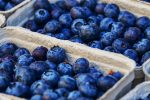
Who doesn’t look forward to summer’s bounty? Not only are fruits healthy – blueberries, for example, are low in calories but high in fibre, Vitamin C, Vitamin K and have a high antioxidant capacity – and delicious on their own but they make for great desserts, salads and spreads. Here are some recipes for a few of my favourite fruits: blueberries, peaches and apricots.

REVERSED BLUEBERRY COBBLER
six to eight servings

base:
2 cups blueberries
1/2 cup sugar
1 tbsp flour
2 tsp grated lemon peel
1/8 tsp nutmeg
2 tbsp pareve unsalted margarine

cake:
1 1/3 cups flour
3/4 tsp baking soda
3/4 tsp baking powder
1/4 tsp nutmeg
6 tbsp unsalted pareve margarine
1/2 cup sugar
2 eggs
1/2 tsp vanilla
1 1/2 tsp grated lemon peel
2/3 cup non-dairy creamer

1. Preheat oven to 350°F. Grease a baking dish.
2. Combine blueberries, sugar, flour, grated lemon peel, nutmeg and margarine for base. Bake 10 minutes.
3. In a bowl, combine flour, baking soda, baking powder and nutmeg for cake.
4. In another bowl, cream margarine with sugar and eggs. Add vanilla and lemon peel.
5. Mix in dry ingredients with non-dairy creamer. Drop batter atop blueberry mixture. Bake for 40 minutes. Serve warm with pareve whipped cream or ice cream.

BLUEBERRRY YOGURT CAKE 1

1/2 cup butter or margarine
1 cup brown sugar
1 egg
1 tsp vanilla
2 cups flour
1 tsp baking soda
1/2 tsp baking powder
1 cup blueberry yogurt

1. Preheat oven to 350°F. Grease a cake pan.
2. Cream butter or margarine and brown sugar.
3. Add egg and vanilla and blend.
4. Stir in flour, baking soda, baking powder, alternately with yogurt.
5. Pour into a cake pan. Bake for 50 minutes.

BLUEBERRY YOGURT CAKE 2

1 cup brown sugar
1/2 cup butter or margarine
3 eggs
2 cups flour
1 tsp baking powder
1 tsp baking soda
2 cups blueberry yogurt
1 tsp vanilla
1 tsp cardamom

1. Preheat oven to 325°F. Grease a cake pan.
2. Cream half cup sugar and butter or margarine. Add eggs.
3. Gradually add flour, baking powder and baking soda.
4. Stir in one cup blueberry yogurt. Add vanilla and cardamom. Pour half of batter into cake pan.
5. Spread remaining sugar and yogurt on the batter. Add rest of batter. Bake for 45-50 minutes.

SPICED PEACHES

4 cups sliced peaches
1/4 cup brown sugar
2 tsp lemon juice
12 cinnamon sticks
2 tsp brandy

1. Place peaches, sugar, lemon juice, cinnamon sticks and two cups water in a saucepan.
2. Bring to a boil. Reduce heat and simmer 20 minutes.
3. Cool and add brandy. Pour into a jar with a lid or a bowl.

WALDORF PEACH SALAD
four servings

1/2 cup chopped celery
1/2 cup sliced grapes
1/2 cup chopped apples
1/4 cup chopped nuts
4 sliced peaches
4 pieces Romaine lettuce
1 tbsp brown sugar

dressing:
1/2 cup mayonnaise
1 cup whipped cream
1 tsp grated orange peel

1. In a bowl, combine celery, grapes, apples and nuts. Toss lightly.
2. Place a piece of lettuce on each salad plate with a sliced peach on top. Fill with a quarter of the salad.
3. Sprinkle with brown sugar. Refrigerate.
4. In a bowl or jar with a lid, combine mayonnaise, whipped cream and orange peel. Spoon over each peach salad serving.

PEACH UPSIDE DOWN CAKE

1 cup brown sugar
1 cup chopped nuts
2 cups chopped peaches
1 cup brown sugar
1/4 pound butter or margarine
1 egg
1 cup milk or non-dairy creamer or pareve almond milk
1 tsp vanilla
2 cups flour
1 tsp baking powder
1/2 tsp cinnamon
1/2 tsp nutmeg

1. Preheat oven to 350°F. Grease a cake pan.
2. Toss together one cup brown sugar, nuts and peaches. Sprinkle on the bottom of a cake pan.
3. In a bowl, cream one cup brown sugar and butter or margarine. Add egg, milk and vanilla and stir.
4. Add flour, baking powder, cinnamon and nutmeg and blend. Spoon into cake pan. Bake for one hour or until a cake tester comes out clean. Allow to cool before turning out onto a cake plate.

APRICOT JAM
This is a Grace Parisi recipe taken from Food & Wine Magazine’s online recipe pages. It makes three half-pint jars.

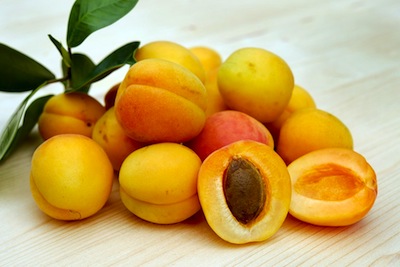
photo - apricots2 pounds pitted apricots, cut into 1/2-inch pieces
1 1/2 cups sugar
2 tbsp fresh lemon juice

1. In a nonreactive saucepan, toss the apricots with sugar and let stand, stirring until the sugar is mostly dissolved, about one hour.
2. Add lemon juice and bring to a boil until sugar is dissolved. Simmer until the fruit is glassy and the liquid runs off the side of a spoon in thick, heavy drops, 20-25 minutes. Skim off scum that rises to the surface.
3. Spoon into three half-pint jars, leaving a quarter of an inch at top. Close and let jam cool to room temperature. Store in refrigerator for up to three months.

SPICED APRICOTS

2 cups apricots cut into halves
2 tbsp brown sugar
1 tsp lemon juice
6 pieces stick cinnamon
1 tsp brandy

1. Place apricots, sugar, lemon juice and cinnamon in a saucepan with a little water. Simmer until soft.
2. Add brandy and heat. Cool and spoon into a jar.

APRICOT BUTTER

five cups
2 pounds halved apricots
1/4 cup sugar
1 tsp cinnamon
1/2 tsp cloves
1/4 tsp allspice
2 tsp lemon peel
1 tbsp lemon juice

1. Place apricots in a saucepan. Cook over low heat in their own juices until soft.
2. Puree in a blender and measure. Return to sauce pan, adding a quarter cup sugar for each cup of pulp.
3. Add cinnamon, cloves, allspice, lemon peel and lemon juice. Bring to a boil. Spoon into jars, close and refrigerate.

APRICOT LEATHER

2 cups pitted apricots, cut into pieces
1 tsp lemon juice
1/2 cup sugar

1. Preheat oven to 175-200°F.
2. Drop apricot pieces into a blender and puree. Add lemon juice and sugar.
3. Spray a cookie sheet with vegetable spray. Spread pureed apricots evenly, quarter-inch thick on a cookie sheet. Place sheet in oven and keep door open. Bake until dry, three to six hours. Let cool.
4. Cut crosswise once, lengthwise three times, so you have six pieces.
5. Cover with plastic wrap and roll up.

Sybil Kaplan is a journalist, lecturer, book reviewer and food writer in Jerusalem. She created and leads the weekly English-language Shuk Walks in Machane Yehuda, she has compiled and edited nine kosher cookbooks, and is the author of Witness to History: Ten Years as a Woman Journalist in Israel.

Format ImagePosted on July 13, 2018July 11, 2018Author Sybil KaplanCategories LifeTags baking, cooking, fruit, summer
Mystery photo … Jan. 26/18

Mystery photo … Jan. 26/18

The Vancouver Jewish Community Centre doing a children’s baking program, Jan. 18, 1974. (photo from JWB fonds, JMABC L.11635) 

If you know someone in this photo, please help the JI fill the gaps of its predecessor’s (the Jewish Western Bulletin’s) collection at the Jewish Museum and Archives of B.C. by contacting [email protected] or 604-257-5199. To find out who has been identified in the photos, visit jewishmuseum.ca/blog.

Format ImagePosted on January 26, 2018January 24, 2018Author JI and JMABCCategories Mystery PhotoTags arts, children, cooking, JCC, Jewish Community Centre
The incredible power of soup

The incredible power of soup

Soup is not just food. It’s an experience, a sustenance, a simple yet magnificent meal, if done right, which is generally easy. Probably every culture on earth has a signature variation and, in the Jewish tradition, there is nothing more iconic than chicken soup.

When Sharon Hapton, a Jewish woman in Calgary, had the idea eight years ago to make a great vat of soup and carry it to a shelter for women escaping domestic abuse, she defaulted to that dependable chicken soup recipe. As reported in the Independent in 2014 (jewishindependent.ca/soup-ladled-with-love), that act elicited a deeply moving reaction. The chef at the shelter broke into tears when she saw the offering. There were Jewish women in the shelter and the chef knew the emotional significance and comfort the simple soup would bring.

The nonprofit social enterprise – a movement, really – that emerged from that first gesture is called Soup Sisters and it is a network of more than 40,000 people who have created one million servings of soup since the program began in March 2009. Each month, more than 10,000 servings are delivered to women, children and youth in shelters across Canada and in a couple of nascent cities in the United States. Hapton has been recognized by Chatelaine, CityTV and the YWCA for her vision.

In the interest of gender equality, there is also now Broth Brothers. And, a new iteration of the program, called Souper Kids, encourages young people from age 8 to 17 to participate in helping families and individuals who need it most.

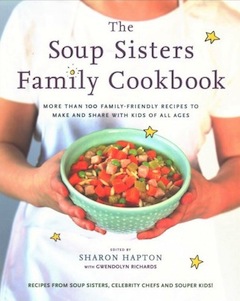
book cover - Soup Sisters Family Cookbook

The Soup Sisters Family Cookbook is the third in a series of publications the group has compiled, and it is aimed directly at this next generation. Edited by Hampton, with Gwendolyn Richards, and subtitled “More than 100 Family-friendly Recipes to Make and Share with Kids of All Ages,” it is a great addition to the shelf. Most recipes have only a few ingredients and are ideal for young people first venturing into the kitchen (with supervision from an adult of even limited cooking capabilities).

The volume includes contributions from celebrities, including Ruth Reichl, David Hawksworth, Nigella Lawson, Michael Smith and Elizabeth Baird, as well as from children from across Canada.

In addition to several variations on chicken soup (the B.C.-based singer and songwriter Jann Arden offers up a Kitchen Sink Chicken Soup), there are classics like Grandma’s Russian Borscht and Easy Creamy Tomato Soup. Kid-invented recipes include Every Bunny Loves Carrot Soup, Posh-tasting Red Pepper and Coconut Soup and Attack of the Killer Tomatoes. Dragon Soup was contributed by a Grade 2 Class in West Kelowna, B.C. Many or most recipes can be made kosher, Cheeseburger Soup notwithstanding.

Jerusalem/London food superstar Yotam Ottolenghi offers Chickpea, Tomato and Bread Soup. Vancouver chef and cookbook author Vikram Vij contributed Indian Comfort Food Soup, sometimes called “Indian Mac-and-cheese,” not because it contains macaroni or cheese, the introduction explains, “but because it’s value-for-money comfort food, and a favourite with kids.” Earls Restaurants contributed their Tortilla Soup recipe.

I made to the Roman “Egg Drop” Soup with ingredients around the house on a cold, rainy autumn afternoon. There is almost nothing to it, but it turns out surprisingly revitalizing and a little bit fancy. It’s really nothing but eight cups of chicken stock (kosher cooks could substitute vegetable stock), four cups of packed spinach leaves (I didn’t want to leave the house, so I used frozen – it would benefit from fresh), 1 1/4 teaspoons of salt, four eggs, and one third of a cup freshly grated Padano cheese (I used the Parmesan I had on hand and it added more salt than ideal).

Once the broth is simmering and the spinach is added, the eggs, cheese and quarter of a teaspoon of the salt are whisked together in a bowl, then slowly whisked into the soup in a traditional egg drop motion more commonly associated with Chinese cooking.

The book includes a preface about making your own stock, as well as basics on slicing, chopping, peeling and prepping – good for kitchen newbies as well as a refresher for oldsters who still slash ourselves too frequently in the kitchen.

The Soup Sisters Family Cookbook is meant for families to come together and cook as a group, which is, of course, what Soup Sisters (and Broth Brothers) is all about. Founded on the simple belief in the power of soup “as a nurturing and nourishing gesture that could make a tangible difference,” Soup Sisters holds year-round programs where participants, who have paid a registration fee, join a soup-making event in a professional kitchen under the guidance of a chef. The social process produces 150 to 200 servings of soup that are then delivered to local shelters.

“Events are social evenings with lively conversation, chopping, laughter and warm kitchen camaraderie that culminate in a simple, sit-down supper of soup, salad, bread and wine for all participants,” says the website.

Vancouver has two Soup Sisters chapters. One is in partnership with the Pacific Institute of Culinary Arts and supports Kate Booth House, a Salvation Army-associated agency that has provided a safe refuge for more than 4,000 women and children from 83 nationalities fleeing domestic abuse. It offers up to 30 days of housing in a supportive atmosphere that includes support services. This chapter also supports Imouto Housing for Young Women, which provides supportive housing in the Downtown Eastside for girls and young women who are homeless or in unsafe housing and who face risks including violence and abuse, exploitation, substance use, racism and other dangers.

Another chapter is in partnership with the Northwest Culinary Academy of Vancouver and supports Sereenas House for Women, a residential support program in the Downtown Eastside that allows women to live independently of violence, abuse and substance use and to access services and become involved in their community.

There are also Soup Sisters chapters in Burnaby, Surrey, the Tri-Cities, Victoria, Penticton and two in Kelowna, among other locations in Canada and the United States.

This recipe will become a cold-weather regular in my kitchen:

WHITE BEAN, CABBAGE AND SAUSAGE SOUP
Contributed to The Soup Sisters Family Cookbook by Laura Keogh and Ceri Marsh, cookbook authors and bloggers at sweetpotatochronicles.com.

2 tbsp olive oil
3 Italian sausages, cut into bite-size pieces
one onion, finely chopped
3 cloves garlic, minced
half a Savoy or green cabbage, cored and thinly shredded (4 to 5 cups)
4 cups chicken stock
one can (15 ounces) cannellini beans, drained and rinsed
1 tbsp fresh thyme leaves
2 bay leaves
salt and pepper to taste
1/2 cup fresh grated Parmesan cheese [easily omitted in kosher kitchens]

1. In a large pot, heat the oil over medium heat. Add the sausages and allow them to brown, pushing them around so they get colour all over. Remove the sausages from the pot and set aside on a clean plate.

2. Add the onion and garlic to the pot and cook, stirring often, until the onion starts to soften, around four minutes. Add the cabbage and stir it around for a couple of minutes.

3. Add the stock, beans, thyme and bay leaves. Return the sausages to the pot and allow everything to come to a simmer over medium heat. Reduce the heat to medium-low and simmer, uncovered, until the vegetables are tender, about 20 minutes. Fish out and discard the bay leaves. Season with salt and pepper to taste.

4. Ladle the soup into warm bowls and serve with a generous sprinkling of Parmesan cheese. [Or not.]

Format ImagePosted on December 1, 2017November 29, 2017Author Pat JohnsonCategories LifeTags Broth Brothers, cooking, Soup Sisters, Souper Kids

Food with long history

What food, served with cooked beef, is an essential component of a traditional wedding dinner in southern Germany? It is also used in salad served with lamb dishes at Easter in Transylvania and other Romanian regions. In Serbia, it is an essential condiment with cooked meat, including roasted pig. In Slovenia, it is a traditional Easter dish, grated and mixed with sour cream, hard-boiled eggs or apples. And, in southern Italy, it is a main course with eggs, cheese and sausage. It is probably indigenous to eastern Europe but has been cultivated since antiquity and was known in Egypt in 1500 BCE.

One final hint, and you will know immediately. According to the Haggadah, we are to eat it to symbolize the bitterness of slavery in Egypt. “And they made their lives bitter with hard labour, in mortar and in brick, and in all manner of work in the field….” (Exodus 1:14)

Maror is one of the foods on the seder plate, which we bless then dip into charoset to symbolize the mortar the Israelites used to bind the bricks. Shaking off the charoset, we eat the minimum amount of maror, the volume of an olive.

Horseradish. The English word, coined in the 1590s, combined horse, meaning coarse or strong, and the word radish.

According to John Cooper in Eat and Be Satisfied: A Social History of Jewish Food, “the Mishnah enumerated five vegetables that could be utilized as the bitter herb for the seder service, all of which should have leaves. The five are chazeret, ilshin, tamchah, charchavina and maror.”

Chazeret refers to lettuce; ulshin is either endive or chicory or both; tamchah was a leafy, dull green herb also known as horehoud, which is used in cough medicine and liqueur; charchavina was either field or sea eryngo; and maror possibly a wild lettuce or type of cilantro. Sephardim interpret chazeret as Romaine lettuce.

Rabbi Alexander Suslin of Frankfurt, who died in 1394, was the first authority to permit the use of horseradish where lettuce was not available, although this vegetable was primarily a fleshy root that did not strictly conform with the halachic requirement of eating leaves. The Talmud also says, besides leaves, maror should have white sap and dull green foliage, neither of which is in horseradish. The medieval German rabbinic authorities appear to have identified horseradish incorrectly: merretich, in German, with merirta, the Aramaic form of maror, the Hebrew for bitter.

Prior to this, according to Gil Marks in the Encyclopedia of Jewish Food, Eliezer ben Nathan of Mainz, who lived from 1090 to 1170, mentions chrain (paste made with horseradish). Rabbi Eleazar ben Judah of Worms in Sefer ha-Rokeach (published around 1200) included it in his charoset ingredients.

It was not until Rabbi Yom Tov Lipman Ben Nathan Heller (1579-1654) of Moravia, in his commentary on the Mishnah, considered horseradish to be the tamchah mentioned in the Talmud. In Hebrew, it is called chazeret, which is on the talmudic list of accepted types of maror.

Horseradish is a root vegetable in the same family as mustard, wasabi, broccoli and cabbage. When the plant grows, it can reach 4.9 feet and is cultivated for its root, which has hardly any aroma. When the root is cut or grated, cells break down and produce an oil, which irritates the nose and eyes.

German immigrants in the late 1800s began growing horseradish in Collinsville, Ill., a Mississippi River basin area adjacent to St. Louis. This self-proclaimed horseradish capital of the world – this is where most of the world’s supply is grown, some six millions gallons annually – has been hosting the Horseradish Festival since 1988.

The first American Jewish cookbook, Jewish Cookery (1871), included a recipe for horseradish stew. When the Settlement Cookbook was published in 1901, horseradish sauce, beer and relish were included.

H.J. Heinz processed and bottled horseradish in 1869. In 1932, Hyman Gold and his wife, Tillie, processed and bottled horseradish in their Brooklyn apartment.

Today, Gold’s and other private labels produce 90,000 bottles a day of the classic plain and grated beet horseradish without sugar.

My husband likes to tell the story of coming home from school one day before Passover, at the age of 8, and going into the kitchen where his grandmother was grating the horseradish; she made horseradish almost every week. He jumped up on a chair, took one big whiff and fell over backwards! Thank goodness his father was in the room and caught him.

Sybil Kaplan is a journalist, lecturer, book reviewer and food writer in Jerusalem. She created and leads the weekly English-language Shuk Walks in Machaneh Yehudah, she has compiled and edited nine kosher cookbooks, and is the author of Witness to History: Ten Years as a Woman Journalist in Israel.

Posted on March 31, 2017March 31, 2017Author Sybil KaplanCategories Celebrating the HolidaysTags cooking, food, Passover
Balin wins Chopped

Balin wins Chopped

Justine Balin had to think quickly on her feet to win Chopped Teen Canada. (photo from Chopped Teen Canada)

Vancouver Grade 12 student Justine Balin recently walked off with the top prize at Chopped Teen Canada, leaving the reality television show with a $10,000 award for dishes she prepared at the studio kitchen last June. “I’ve watched the show forever, so to be on it was a dream come true, and winning was the cherry on top,” the King David High School student admitted.

Balin entered the competition last summer at the encouragement of Hilit Nurick, her food instructor at school, and had to pass a series of interviews before learning she’d be one of 16 teen contestants accepted on the Food Network program.

Balin and her mother, Jennifer Shecter-Balin, flew to Toronto for the taping of the show, which consisted of three rounds in which each contestant was given a mystery basket of ingredients and asked to prepare a dish of their own creation.

Balin’s first basket contained canned flaked ham, gorgonzola cheese, dried tart cherries and chocolate mint cookies. “The ham threw me off a bit!” the 17-year-old said. “I’ve never had that before. But I made a salad and used the ham, cookies, herbs and egg in a patty to go with it.”

That dish sent her to the second round, where her ingredient basket included clams, wasabi cocktail sauce, dehydrated vegetables and watermint. Her resulting concoction was a seafood soup with watermint pesto and grilled bread.

“They knew she was Jewish,” said Shecter-Balin, “and when they presented her with tinned ham and gorgonzola, I thought to myself, she’s lost it. But to see her think quickly on her feet and come up with a flaked ham fritter – I was beyond impressed!”

Balin’s dessert dish was cookies and cream ice cream with June plum compote and caramel brittle.

Cooking has been a passion since she was a child, Balin said. “Even at age 2, I was helping my mom, stirring the pots. At 5, I started cooking with my mom and grandma, Linda Shecter, and I never stopped. Even now, I’m always in the kitchen, often making dinner for the family if I come home earlier than my mom. And, every year, I host thanksgiving for 20 girls in my grade.”

In her application, Balin made it clear she was Jewish-Italian and communicated her pleasure in attending a small, independent Jewish day school that also offered a foods program.

“Being Jewish is a strong part of who she is and we weren’t going to gloss over it,” Shecter-Balin said. “But dietary restrictions mean nothing on this show – they spare no one. I’ve seen vegetarians being forced to work with protein and people of different cultures being forced to prepare foods they’d never usually prepare.”

Balin said she would recommend the show to any teens who can perform well under pressure, who love to cook and who feel confident in front of a camera. “It’s scary to be on national television cooking but it was such an incredible experience,” she said. “The best part was seeing how a show like that operates. They build a story and want you to stick to it. I found it really interesting to see how the show runs.”

Balin is saving her prize money to travel the world after she completes her university studies in public health.

Lauren Kramer, an award-winning writer and editor, lives in Richmond. To read her work online, visit laurenkramer.net. This article was originally published in CJN.

Format ImagePosted on February 24, 2017February 21, 2017Author Lauren KramerCategories LocalTags Balin, Chopped, cooking, reality TV
Sharing Muller’s table

Sharing Muller’s table

Our Table is a beautiful hostess gift for that special occasion or that friend who loves cooking and never tires of inspiring culinary reads.

There are cookbooks you whip out of your kitchen cupboard 45 minutes before dinner in search of something easy, bright and new, and there are cookbooks you take to bed with you for reading pleasure. Our Table (Artscroll, 2016) by Renee Muller falls into the latter category, not because you won’t want to try her recipes, but because there’s a lot of reading involved in many of them.

Muller is a Swiss native who moved to the United States in 2002 and, by winning a recipe contest, landed a regular column in Whisk, a pullout food feature of the national Jewish weekly Ami Magazine. Our Table is a compendium of her favorite kosher recipes, “a cuisine that is heimish yet laced with aromas of my youth,” she writes in the introduction.

The dishes encompass all the usual categories – soups, salads, appetizers, fish and dairy, meat, chicken, snacks, desserts and breads. Many of them are laced with stories about family secrets related to the particular recipe, or how the recipe came into being. For her fragrant standing rib roast recipe, for example, there’s an essay on how and why she created the recipe, as well as tips on how far in advance to make it and how to prevent it from drying out. Her Sugo Della Nonna (Italian-style tomato sauce) contains a half page on the definition of comfort food and the feeling it delivers when she makes it. “I see myself, sitting at Nonna’s table, as a child, feeling nourished and happy,” she writes.

Muller’s insights are written in a conversational style with lots of anecdotes about her family thrown in. By the time you’re finished reading this book, you feel like you know her personally – and you can’t help but like this impassioned chef who adores cooking for her family and friends. That’s because Muller’s enthusiasm is contagious, but also because some of her dishes go way beyond the usual suspects. There is a recipe for onion crisps, a whole page on the art of roasting chestnuts, one on toffee apples, one titled “Really, really good whole wheat challah” and another for brown buttered pear salad. And the pictures? Whoa. They are amazing, mouthwatering bites of full-page color that will leave you salivating as you plan your next dinner party. Most of the recipes are not terribly complex either, they’re just new combinations of ingredients most of us know well and use regularly.

Muller is that friend we all want in our lives – the one whose cooking is fabulous, who isn’t shy about sharing her recipes and whose conversation is full of funny stories, notes from her past and sage bits of wisdom. There are times when the essays feel perhaps a tad too long but, nonetheless, Our Table is a 270-page hardcover recipe book worth having, a beautiful hostess gift for that special occasion (Chanukah?) or that friend who loves cooking and never tires of inspiring culinary reads.

Lauren Kramer, an award-winning writer and editor, lives in Richmond. To read her work online, visit laurenkramer.net.

Format ImagePosted on December 2, 2016December 1, 2016Author Lauren KramerCategories BooksTags Chanukah, cooking, kosher
Secrets from best chefs

Secrets from best chefs

Leah Schapira and Victoria Dwek work together often. Instalments of their Made Easy cookbook series have been featured in the Jewish Independent, with positive reviews. And now, the pair have co-authored Everyday Secret Restaurant Recipes (ArtScroll/Mesorah Publications, 2015).

Here are not just 103 recipes, but they all come from restaurants, many from across the United States, but also from Australia, Austria, Brazil, Canada, China, England, Israel, Panama, Thailand and Uruguay. For each recipe, there is information on the restaurant, a large introduction and photo(s), ingredients, instructions, tidbits or hints for the home cook, and sometimes comments from the chef.

There is also an essay on kosher food trends by Elan Kornblum, founder of Great Kosher Restaurants Magazine, and an interview with him, followed by some basics that prep cooks do. Another essay covers the topic of sweets in the prep kitchen, and yet another, the smoking of foods.

There are 21 starters and sides, like avocado egg rolls from Bocca Steakhouse in Los Angeles; 16 soups and salads, such as a green salad from Milk N Honey in Melbourne; 12 sandwiches, including Philly steak sandwich from Retro Grill in Brooklyn; 17 chicken and meat recipes, such as gong bao chicken from Dini’s in Beijing; 10 fish recipes, like a salmon from Fresko in Aventura, Fla.; 14 brunch and lunch suggestions, including fettuccine with pesto from Deleite in Rio de Janeiro; and 12 baked goods and desserts, such as a halva from Lula by Darna in Panama City.

There are 148 mouth-watering color photographs, both full-page and stamp-size. Whereas a previous version of the cookbook focused on upscale restaurants, this cookbook’s subtitle is “From Your Favorite Kosher Cafés, Takeouts & Restaurants.”

If you know someone who enjoys traveling and eating, or just trying new recipes, this would make a great gift. The cookbook is more than just recipes, it is also a wealth of information.

ARTICHOKES, ROMAN-STYLE
Tevere 84, New York City, Lattanzi brothers (owners/chefs)

6 medium or 2 pounds baby artichokes
juice of 1 lemon
1/4 cup extra virgin olive oil
additional oil for frying
12 minced garlic cloves
sea salt 

  1. Cut off the top of each artichoke just above the middle. Remove some of the outer leaves and the interior immature and hair-like leaves.
  2. Using a peeler, peel the stems of each artichoke.
  3. In a bowl, toss artichokes with lemon juice.
  4. Heat olive oil in a large sauté pan over medium heat. Add garlic. Add artichokes and sprinkle with sea salt. Cook, side by side, stem side up.  Cook until artichokes are tender, turning several times for overall browning, 15-20 minutes. Using a wooden spoon, press each artichoke firmly to the bottom of the pan so that the leaves flatten out. Cook for 10 minutes. (Optionally, for very soft and hot artichokes, you can also transfer to the oven and bake at 400˚F for an additional 10 minutes.
  5. Before serving, heat additional oil in a sauté pan. Flatten artichokes to the flower shape and fry for two to four minutes before serving. Makes one to two servings.

ISRAELI BREAKFAST
Café Tamara, Jerusalem Technology Park, Ohad Vansuv (chef)

2 finely diced Persian cucumbers
2 finely diced tomatoes
1/2 finely diced red onion
handful chopped parsley
2 tbsp olive oil
1 1/2 tbsp lemon juice
salt to taste
pepper to taste
olive oil for frying
4 beaten eggs
1 tbsp preserved lemon/lemon spread
1 tbsp harissa
1 cup yogurt
2 tbsp tahini 

  1. In a bowl, combine cucumbers, tomatoes, onion, parsley, olive oil and lemon juice. Season with salt and pepper.
  2. Heat olive oil in a skillet over medium heat. Add eggs, preserved lemon, harissa, salt and pepper. Scramble eggs until cooked.
  3. Place salad onto a plate. Top with eggs, yogurt and tahini. Garnish with parsley. Makes two servings. Serve immediately.

Sybil Kaplan is a journalist, foreign correspondent, lecturer, food writer and book reviewer who lives in Jerusalem. She also does the restaurant features for janglo.net and leads weekly walks in English in Jerusalem’s market.

Format ImagePosted on April 15, 2016April 13, 2016Author Sybil KaplanCategories BooksTags cookbook, cooking, Dwek, restaurant, Schapira
Cookbook resurfaces

Cookbook resurfaces

Having received letters asking for copies of her 40-year-old cookbook, the author has had it reprinted, and it is available for purchase. (photo by Barry A. Kaplan)

In the 1970s, when I made aliya, I discovered that Israel was a bit behind the United States and, when renting an apartment, chances are you would not find a stove but, rather, two burners instead. Many of my friends rented apartments with the same problem, and one of them introduced me to a gadget that looked like an angel food cake pan with a lid and holes to release the heat; it had a base to place over a burner and the lidded pot went on top. It had been used in Israel for years. It was called a “wonder pot.”

I soon wrote a cookbook called The Wonders of a Wonder Pot: Cooking in Israel Without an Oven. To my surprise, it became a bestseller among students, new immigrants and people on sabbaticals, as well as those who loved the nostalgia.

In recent years, it somehow resurfaced, and I began receiving letters asking for copies of the 40-year-old cookbook. After depleting the supply my husband Barry and I brought with us, I decided to have it reprinted. Anyone in the United States or Canada who would like a copy can now have one for $25 including postage; those in Israel can have one for 100 NIS. For more details, email me at [email protected].

Sybil Kaplan is a journalist, foreign correspondent, lecturer, food writer and book reviewer who lives in Jerusalem. She also does the restaurant features for janglo.net and leads weekly shuk walks in English in Jerusalem’s Jewish food market.

Format ImagePosted on April 17, 2015April 16, 2015Author Sybil KaplanCategories IsraelTags cooking, Israel, wonder pot

Posts pagination

Previous page Page 1 … Page 8 Page 9
Proudly powered by WordPress