The holiday of Chamisha Asar b’Shevat or Tu b’Shevat is not mentioned in the Torah but makes its first appearance in the Talmud, where it is called Rosh Hashanah l’Ilan (New Year of the Tree).
Jewish literature of the sixth to 11th centuries identifies Tu b’Shevat as the day on which the fate of the trees and fruit is decided. The holiday gets its name from when it occurs. “Tu” is an acronym for the Hebrew letter tet, which in the Hebrew system of counting is nine, and the letter vav, which is six, thus adding up to 15, the day on which the holiday falls in the month of Shevat.
The date was chosen when the rabbinic schools of Hillel and Shammai (from the time of the Second Temple) argued about the dates. Hillel said it fell on the 15th of Shevat; Shammai said it began on the first. Hillel’s opinion prevailed because it was thought that, by the later date, the winter rains in Israel were almost over.
Tu b’Shevat links Jews to the land of Eretz Yisrael. In the time of the Second Temple, on the 15th of Shevat, Jewish farmers would estimate their obligatory tithes for tax collectors, as well as other contributions that Jewish law required. In effect, Tu b’Shevat was the beginning of the new fiscal year.
Part of the celebration is a seder with certain foods.
In her book The Jewish Holiday Cookbook, Gloria Kaufer Greene mentions that the drinking of four cups of wine at the seder symbolizes the changing of seasons. She suggests that the first cup is chilled, dry, white wine, to symbolize winter. The second cup of wine is pale, perhaps a rosé, and signifies spring and the early thaw. The third cup of wine is deeply coloured, like a dark rose, and represents the late spring and the blossoming trees. The fourth cup of wine is rich and red and stands for the fertility of summer.
In between drinking, one eats fruit in order of “ascending spirituality.” After the first cup of wine, one eats fruit with inedible coverings, like almonds, avocado, banana or melon, to represent the body covering the soul. After the second cup, one eats fruit with pits, such as plum, prune, date, apricot, olive or carob, to symbolize the heart being protected. After the third cup of wine, one eats fruit that can be eaten in its entirety, such as berry, apple, pear or fig, because they are closest to the pure spiritual creation.
In Encyclopedia of Jewish Food, the late Rabbi Gil Marks lists different ethnic dishes for the holiday, including borleves, Hungarian wine soup; salata latsheen, Moroccan orange salad; dimlama, Bulgarian vegetable and fruit stew; savo, Bukharian baked rice and fruit; gersht un shveml, Ashkenazi barley with mushrooms, fruit strudels and fruit kugels; and schnitzelkloese, German fried dumplings with fruit. Food customs associated with Tu b’Shevat are fruits and nuts connected to Eretz Yisrael, such as the seven species mentioned in Deuteronomy 8:7-8 – barley, wheat, figs, dates, grapes, olives and pomegranates.
Here are a couple of my fruit recipes. The first is one that a friend gave me about 40 years ago.
CREAMY FRUIT SALAD 6-8 servings
2-3 cut up apples 1-2 peeled, cut-up oranges 2-3 cut-up bananas 1/4 cup coconut 1/4 cup chopped nuts 3/8 cup sour cream or 3/4 cup lemon yogurt 1 1/2 tbsp sugar or whipped cream 1/8 cup orange juice 3/8 cup vanilla yogurt raisins (optional)
Combine apples, orange and bananas in a bowl. Add coconut and nuts. Combine sour cream or lemon yogurt, sugar or whipped cream, orange juice and vanilla yogurt. Pour over fruit and refrigerate.
I have altered this recipe at times and use pareve whipping cream to make it pareve, leaving out the sour cream/yogurt.
HOT SPICED FRUIT 4 servings
6 peaches, pears or apricots, halved 1/2 cup red wine 2 tbsp sugar dash cloves 1/8 tsp cinnamon dash cardamom 3/4 tsp grated orange peel
Combine wine, sugar, cloves, cinnamon, cardamom and orange peel in a saucepan. Add fruit and cook 15-20 minutes. Drain and reserve liquid. Chill fruit. Serve with vanilla ice cream. Spoon sauce on top.
Sybil Kaplan is a journalist, lecturer, book reviewer and food writer in Jerusalem. She created and leads the weekly English-language Shuk Walks in Machane Yehuda, she has compiled and edited nine kosher cookbooks, and is the author of Witness to History: Ten Years as a Woman Journalist in Israel.
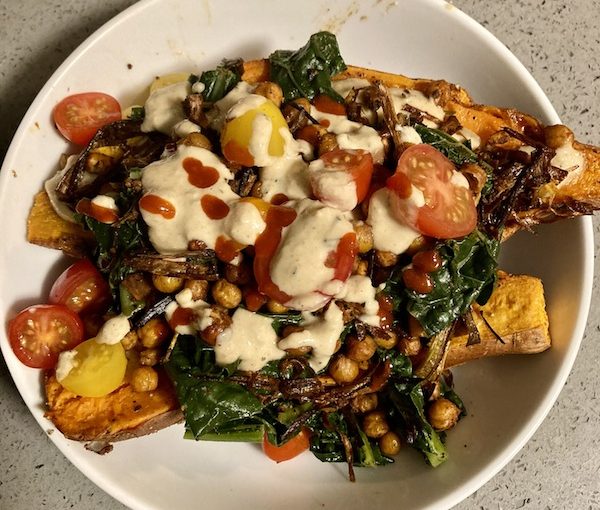
These loaded sweet potatoes were satisfyingly filling. (photo by Ingrid Weisenbach)
In a word: yum. I tried out four recipes in The Tahini Table: Go Beyond Hummus with 100 Recipes for Every Meal by Amy Zitelman with Andrew Schloss. All were delicious. All worth making. I will definitely bring more tahini into my life, but not every day, as the meals are somewhat complicated to make; at least they were for me.
Published by Surrey Books, an imprint of Agate Publishing, the cookbook is gorgeous. The colour photos by Jillian Guyette and the overall look and layout make The Tahini Table as much eye-candy as cooking guide. The first chapter is all about tahini – what it is, how to use and store it, with a foray into hummus and halvah and ingredients one should have close at hand, such as avocados, various oils, garlic and onion, yogurt, different vinegars, date syrup, etc. There is a relatively helpful instruction on how to mince garlic and a section on herbs and spices. Each recipe is labeled with the diets with which it is aligned; vegan or gluten-free or Paleo, for example.
There are six chapters, covering sauces, dips, breakfasts, lunch-type food and sides, main courses and, finally, desserts. While Zitelman promises easy and quick recipes – and perhaps they are if you do as recommended and stock up on the sauces, dressings and dips – I was starting from scratch. The two mains – the benedict and the sweet potatoes – each took almost two hours to make. Only once I started did I see, for example, that one of the benny recipe ingredients was pickled red onion, carrot or radish … go to page 127. So, off to make that before I could proceed. Oh, and don’t be fooled, as I was, by the directions for the pickles – for the benedict, you only need to make pickled onions, so adjust accordingly, unless you’re also wanting to have the carrots and radishes for other purposes. (In the end, I was happy to have made all three, but I was quite hangry while making them.)
Zitelman, who is a co-founder with her sisters of Soom Foods, writes in the introduction, “we founded Soom Foods with a vision that tahini would be a staple pantry item in the American market simply because it is a delicious, nutritious and versatile ingredient. Although this ambition was somewhat far-fetched at the time, tahini is increasingly recognized as a superfood that is rich in omega-6 fatty acids, protein and calcium.” More reason, if I needed it, to experiment further with the recipes in The Tahini Table. Here are the ones I’ve kitchen-tested so far, sans Zitelman’s informative and delightful preambles or suggestions, because of space limitations.
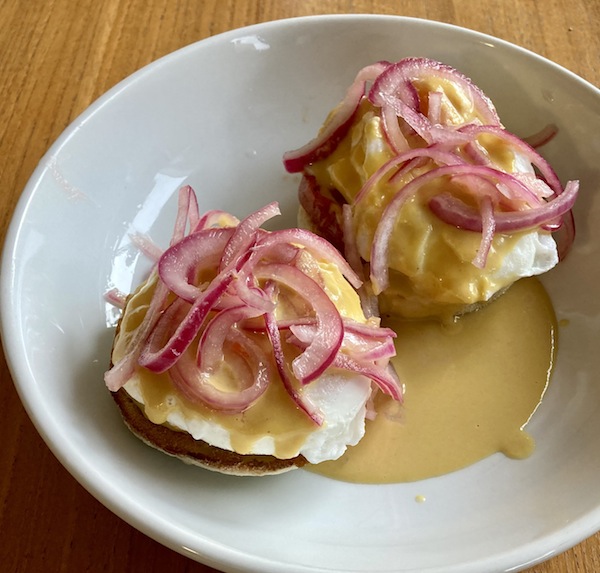
The Tahini Benedict was very tasty. (photo by Ingrid Weisenbach)
TAHINI BENEDICT (serves two)
sauce 2 large egg yolks 1 tbsp freshly squeezed lemon juice 1⁄4 cup premium tahini paste 1⁄2 garlic clove, chopped 1⁄4-1⁄2 tsp sea salt 2-3 tbsp boiling water
eggs 1 tomato, cut into 4 rounds 3 tsp extra virgin olive oil, divided fine sea salt and freshly ground black pepper, to taste 1⁄2 tsp ground cumin 1 tbsp white vinegar 4 large eggs
assembly 2 English muffins, split and toasted 1⁄2 cup pickled red onion, carrot or radish (see below)
To make the sauce: Fill a blender with very hot tap water to warm up the container. Wait five minutes, then drain. Add the egg yolks, lemon juice, tahini, garlic, salt and two tablespoons boiling water. Blend on medium speed until just combined, about 30 seconds. If the sauce is too thick, add the remaining one tablespoon of boiling water and blend to combine. Set aside.
To make the eggs: Turn on the broiler to high and position the broiler rack as close to the heating element as it will go.
Coat the tomato rounds with two teaspoons of the oil and set on a broiler pan. Season with salt and pepper and sprinkle on the cumin. Broil until the surface is speckled but the tomato is still firm, about three minutes.
Meanwhile, fill a 10- to 12-inch skillet with water and bring to a boil over medium heat. Add the vinegar.
Crack each egg into a separate cup or ramekin. Gently slip each egg from its cup into the water. Turn the heat to medium-low so that the water in the pan barely simmers.
Poach the eggs until the whites are set and the yolks remain creamy, about two minutes.
To assemble: Put an English muffin on each plate. Top each half with a broiled tomato. Use a slotted spatula to remove each egg from the water, wait a few seconds to let any extra water drain back into the pan, then place it on the tomato. Top each with sauce and a little pile of pickled red onion. Serve immediately.
QUICK PICKLES (makes about three cups)
6 carrots, peeled and julienned 1 red onion, peeled and very thinly sliced 12 red summer radishes, trimmed and thinly sliced 1 1⁄2 cups apple cider vinegar 1 1⁄2 cups water 6 tbsp honey 1 tbsp fine sea salt 1⁄2 tsp crushed red pepper
Put each of the cut veggies in their own pint container.
In a small saucepan, combine the vinegar, water, honey, salt and crushed red pepper and bring to a boil over medium-high heat. Pour a third of the pickling mixture over each of the veggies. Let cool for about 30 minutes before serving.
Store in closed containers in the refrigerator for up to two weeks.
LOADED TAHINI SWEET POTATOES (serves four)
1 leek, trimmed, halved lengthwise, thinly sliced (white and pale green parts) 1 (15-ounce) can chickpeas, rinsed and drained 2 tbsp extra-virgin olive oil, divided 1 garlic clove, minced with coarse sea salt 1 tsp ground coriander 1⁄2 tsp ground cumin 1⁄2 tsp smoked paprika pinch ground cinnamon fine sea salt and freshly ground black pepper, to taste 4 medium sweet potatoes, halved lengthwise 1 bunch lacinato kale, coarsely chopped 1 cup orange-rosemary tahini sauce (see below) 12 cherry tomatoes, quartered 1⁄4 cup chopped fresh flat-leaf parsley hot sauce, to taste
Turn the oven to 400ºF.
Toss the leek and chickpeas with one tablespoon of the olive oil on a rimmed sheet pan. Add the garlic, coriander, cumin, paprika, cinnamon, salt and pepper and toss to coat everything evenly. Push the leek and chickpea mixture to the edges of the sheet pan.
Rub the cut surfaces of the sweet potatoes with the remaining one tablespoon of olive oil and season with salt and pepper. Put the sweet potatoes, cut-side down, in the centre of the sheet pan. Bake until the potatoes are fork-tender, about 45 minutes.
While the potatoes are baking, boil the kale in a good amount of salted water until tender, about 10 minutes.
When the potatoes are tender, put two halves on each plate and flatten them with the back of a large fork. Transfer the kale to the sheet pan and toss with the chickpeas and leeks. Drizzle some of the tahini sauce over the potatoes and pile the veggies on top. Top with more tahini sauce and the tomatoes, parsley and hot sauce.
ORANGE-ROSEMARY TAHINI SAUCE (makes about 2 cups)
1 tbsp extra-virgin olive oil 2 tbsp finely chopped fresh rosemary leaves 2 garlic cloves, minced with coarse sea salt grated zest and juice of 1 orange (about 1⁄3 cup) 2 tbsp freshly squeezed lemon juice 1 cup premium tahini paste 1 tsp ground cumin 3⁄4 cup ice-cold water
Heat the olive oil in a small skillet over medium heat just until warm, less than a minute. Stir in the rosemary, remove from the heat and give it 10 minutes or so to cool down and get flavourful.
Meanwhile, combine the garlic, orange juice and lemon juice in a medium bowl. Let it sit for one to two minutes. Whisk the orange zest, tahini and cumin into the garlic mixture until just combined. Don’t worry if it gets thick and grainy. Whisk in the water, a quarter cup at a time, until the sauce is smooth and creamy. It should be the consistency of a creamy salad dressing, like ranch.
Stir the cooled rosemary oil into the tahini.
Store in a closed container in the refrigerator for up to three days.
TEHINA REGINA COOKIES (makes about 40 cookies)
1⁄2 cup premium tahini paste 1 cup granulated sugar 3 large eggs 1 1⁄2 tsp vanilla extract 1⁄8 tsp almond extract [optional, I’d say, as I could barely taste it] 2 1⁄4 cups all-purpose flour 2 1⁄2 tsp baking powder 1⁄2 tsp fine sea salt 1⁄4 tsp ground cardamom 1 cup white sesame seeds
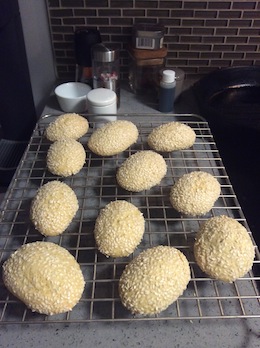
Tehina Regina Cookies – a few never made it to the cooling rack. (photo by Cynthia Ramsay)
Mix the tahini and sugar in a large bowl until well combined. Beat in the eggs, vanilla and almond extract until the mixture is smooth.
Mix the flour, baking powder, salt and cardamom in a medium bowl, then stir the flour mixture into the batter just until there are no visible dry spots. The dough will be very stiff. Wrap it in plastic and refrigerate for at least one hour or as long as 24 hours.
Set two oven racks near the centre of the oven. Turn the oven to 350ºF. Line two sheet pans with parchment paper or silicone baking mats.
Put the sesame seeds in wide bowl. Scoop the dough with a one-tablespoon measure and arrange as mounds on a big sheet of aluminum foil, plastic wrap or parchment. Wet your hands and roll the mounds into egg-shaped ovals. As each one is made, coat all over with sesame seeds and place on the prepared pans, about one inch apart. You will probably get 13 to 14 cookies per pan.
Bake until golden brown, about 10 minutes. Cool the cookies for two minutes on the pans, then transfer them to wire racks to cool completely. When the pans are at room temperature again, form the remaining batter into cookies and bake in the same way.
Store in a closed container at room temperature for up to two weeks.
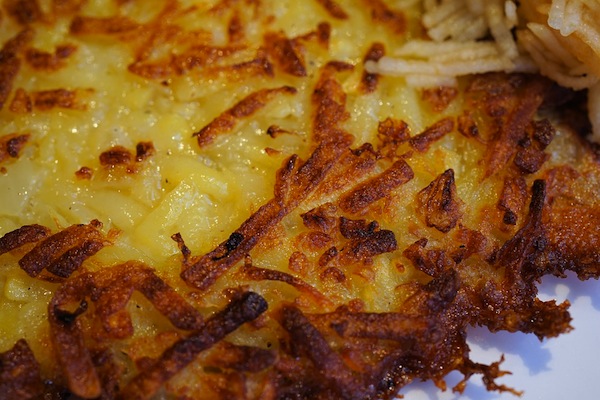
With all the oil used for frying Chanukah potato pancakes – otherwise known as latkes, in what we think is Yiddish, or as levivot in Hebrew – they may be considered an unhealthy food. Yet, each Chanukah, many of us, who are staunch-hearted and old-fashioned, spend time grating potatoes by hand, always accidentally suffering at least one scraped finger. The more modern among us risk coming out with liquid mush by using a food processor or blender.
Why do we keep making these little pancakes year after year? Why do we eat them for Chanukah in the first place? An old folk proverb says: “Chanukah latkes teach us that one cannot live by miracles alone.”
Jewish food writer and cookbook author Joan Nathan contends that the word latke is not in fact Yiddish but rather stems from “a Russian word, latka, and a pastry, from obsolete Russian, oladka, or flat cake of leavened wheat dough.” This, in turn, probably came from a Middle Greek word, eladion, or oil cake, stemming from elaion, meaning olive oil.
Potato pancakes seem to have originated among poor Eastern European Jews, but potatoes did not become a staple until the mid-19th century. John Cooper, in Eat and Be Satisfied: A Social History of Jewish Food, comments that Jews from Lithuania ate pancakes made from potato flour for Chanukah and had borrowed the idea from Ukrainians, who made a potato pancake dish with goose fat called kartoflani platske, which they ate for Christmas. Since Chanukah fell about the same time, and there were plenty of geese to provide goose fat or schmaltz, we could conclude that schmaltz became a substitute for oil. Jews living in the Pale of Settlement in the 17th century probably adapted it for Chanukah as a way to dress potatoes differently for the holiday. Cooper also states that many Eastern European Jews ate buckwheat latkes for Chanukah, while Polish Jews made placki, pancakes, from potato flour and fried them in oil.
Here are a few types of latkes that would be nice to serve during Chanukah.
ROMANIAN ZUCCHINI POTATO LATKES (six to eight servings)
2 pounds zucchini, peeled and grated down to the seeds 2 large potatoes, grated 1 medium onion, grated 3 eggs 1 tsp vegetable oil (I use canola) 3/4 cup matzah meal (I use flour) salt and pepper to taste vegetable oil for frying
Grate zucchini down to the seeds, discard the seeds and squeeze out the liquid.
Peel potatoes and grate. Remove liquid.
Grate onion and add to zucchini-potato mixture.
Add eggs, oil and half a cup of matzah meal or flour. Add more if necessary.
Season with salt and pepper.
Heat oil in a frying pan. Spoon mixture into pan and brown on both sides.
Serve hot with sour cream or applesauce. You can add carrots, parsley and dill.
TUNA LATKES This recipe came from Starkist Tuna, with adaptations. It makes 16 latkes.
2 cans drained tuna 2 grated potatoes 1 chopped onion 2 eggs 2 tbsp breadcrumbs 3 tsp dry parsley flakes 3 tsp dry chives salt and pepper to taste 2/3 cup flour oil
dressing 1 cup sour cream 3 crushed garlic cloves 4 tbsp olive oil 6 tsp dry herbs such as chives, thyme or dill or mixed 1 tbsp sugar salt to taste
In a bowl or jar with a lid, mix sour cream, garlic, oil, herbs, sugar and salt. Refrigerate.
Heat oil in a frying pan and fry onions until golden.
Crumble tuna in a bowl. Add potatoes, onion, eggs, breadcrumbs, parsley, chives, salt and pepper.
Place flour in a shallow plate. Form round patties and dip in flour. Add oil to frying pan. Fry patties until golden. Drain on paper towels.
Serve on a platter with dressing on the side.
HERBED ZUCCHINI FETA LATKES With a few changes, this recipe is from Food & Wine and is by Didem Senol, a chef from Istanbul, Turkey, who trained at the New York French Culinary Institute. It makes four to six servings.
4 medium grated zucchini 1 tbsp kosher salt 2 large eggs 1/2 cup flour 1/2 cup chopped dill 1/4 cup chopped parsley 1/2 cup crumbled feta cheese
sauce 1 seeded chopped, peeled cucumber 1 cup sour cream salt and pepper to taste vegetable oil
Place zucchini in a colander, sprinkle with salt, toss and let stand five minutes. Squeeze out liquid and transfer to a bowl.
Add eggs, flour, dill, parsley and feta. Refrigerate 10 minutes.
Puree cucumber in food processor and transfer to a bowl. Stir in sour cream, salt and pepper.
Preheat oven to 350°F. Heat oil in a frying pan and then, working in batches, drop tablespoons of batter into the hot oil and fry until brown and crisp. Transfer to a baking sheet and keep warm in oven.
Serve with sour cream-cucumber sauce.
Sybil Kaplanis a journalist, lecturer, book reviewer and food writer in Jerusalem. She created and leads the weekly English-language Shuk Walks in Machane Yehuda, she has compiled and edited nine kosher cookbooks, and is the author of Witness to History: Ten Years as a Woman Journalist in Israel.
It was really a hot summer, and I was trying to think of creative ways to make and serve food. I took the idea of making savoury items in my muffin tins from the online Food & Wine magazine, koshering some of the recipes they have posted. These hand-size meals should delight children and adults alike, though it may take more than one portion to sate the older crowd.
The word muffin is first found in print in 1703, possibly from the German word muffen, meaning small cake. It may also have originated in a British magazine in 1851. In 10th- or 11th-century Wales, however, there existed an English muffin made with yeast and cooked on a griddle. American-style muffins in individual molds are from the 18th century. It is uncertain which came first, the cupcake cups or muffin pans. Regardless, here are some recipes to try out.
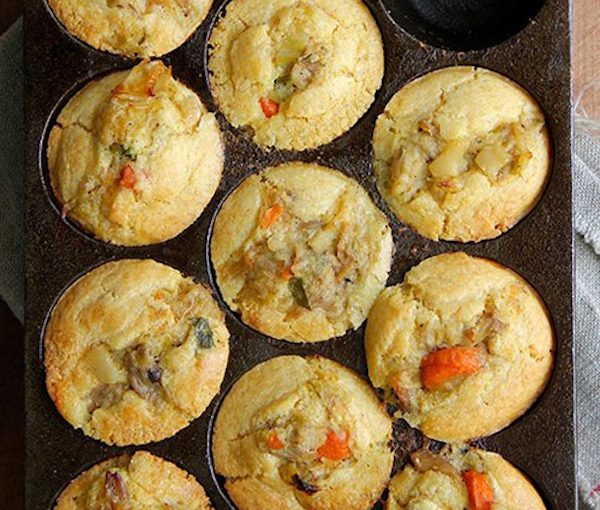
CHICKEN POT PIE CORNBREAD MUFFINS
The original recipe was created by Scott Hocker, editor-in-chief of liquor.com, a writer, editor, recipe developer and cookbook author, and his recipe can be found at foodandwine.com/recipes/chicken-pot-pie-cornbread-muffins. Both his and the kosher recipe serve six.
3/4 cup cornmeal 1/4 cup flour salt to taste 1/4 tsp baking powder 1/4 tsp baking soda 1 egg 3/4 cup non-dairy creamer or pareve milk *** 1 tbsp olive oil 1/2 chopped onion or green onions or shallot 1 finely chopped clove garlic 1/2 carrot cut into chunks salt and pepper to taste 1 1/2 tsp flour 3/8 cup chicken soup 1/4 cup shredded cooked chicken
Preheat oven to 350°F. Grease six muffin tins.
Stir together in a bowl cornmeal, flour, salt, baking powder and baking soda.
Whisk in egg and liquid. Fill greased muffin tins two-thirds full with batter.
Heat oil in a frying pan and stir in onion, garlic, carrots, salt and pepper. Cook, stirring occasionally, eight to 10 minutes. Stir in flour and cook two minutes.
Add soup and bring to a boil then add chicken.
Place one to two tablespoons filling on top of each batter-filled muffin tin. Bake for 25 minutes or until muffins are golden around the edges.
“HOGS” IN A BLANKET
This is a kosher adaptation of a recipe by Grace Parisi, who grew up in a family of cooks and is a cookbook author who headed several test kitchens. The original recipe can be found at foodandwine.com/recipes/hogs-in-blanket. Both recipes make 18 hors d’oeuvres.
3 1/3 ounces pareve puff pastry cut into 2 5-inch squares 1 egg yolk mixed with 1 tbsp water 2 3-ounce beef hot dogs or sausages 1/8 cup chutney 1 tbsp whole grain mustard
Preheat oven to 375°F.
Arrange puff pastry squares on a work surface and brush with egg wash.
Place sausages or hot dogs on bottom edges and roll up pastry, pressing edges to seal. Freeze for 10 minutes or until firm.
Cut logs into half-inch slices and place cut side up in mini-muffin pans. Bake for 25 minutes until golden and sizzling. Cool on a paper towel-lined rack.
Pulse chutney and mustard in food processor until chutney is chopped. Spoon a dollop on each slice and serve.
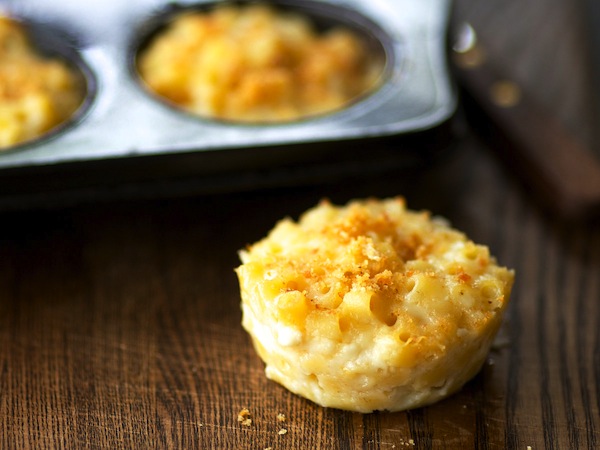
This recipe is adapted from one by Kate Winslow, former Gourmet magazine editor, writer, recipe developer and cookbook author. The original recipe can be found at foodandwine.com/recipes/muffin-cup-macaroni-and-cheese. The kosher and original versions are both for 12 mini-muffins.
2 tbsp unsalted butter or margarine 1 tbsp flour 1 cup milk 4 ounces shredded cheddar cheese salt and pepper to taste 4 ounces macaroni 2 1/2 tbsp breadcrumbs
Preheat oven to 350°F. Grease a mini-muffin pan.
In a saucepan, heat one tablespoon butter or margarine. Add flour and stir for one minute. Add milk and cook over low heat for 10 minutes or until thick.
Add cheese and stir until it is melted and the sauce is smooth.
Cook pasta in boiling, salted water. Drain and add to cheese sauce. Spoon into 12 muffin cups.
Melt remaining one tablespoon of butter or margarine. Stir in breadcrumbs and cook three to five minutes. Sprinkle over macaroni and cheese muffins.
Bake for 15 minutes. Let macaroni cool five to 10 minutes before removing from the pan, so the muffins will hold together.
Sybil Kaplan is a journalist, lecturer, book reviewer and food writer in Jerusalem. She created and leads the weekly English-language Shuk Walks in Machane Yehuda, she has compiled and edited nine kosher cookbooks, and is the author of Witness to History: Ten Years as a Woman Journalist in Israel.
I’m here to boldly encourage you to try something entirely different at your Rosh Hashanah table this year. No, not a pony. A new food. Serve it, to non-vegetarians. And, if anybody asks what they’re eating, confidently tell them it’s a family secret. Don’t forget to mention that, if you tell them, you’ll have to kill them. That generally stops people in their nosy tracks. Let me be perfectly transparent: the food I’m about to suggest is on the meat spectrum. Alright, meat adjacent.
Isn’t it enough that everyone’s oohing and ahhing over the unparalleled tenderness of the dish? The specifics are strictly on a need-to-know basis. And no one needs to know. Except your butcher. OK, enough. It’s beef tongue. You heard correctly. I’m aware it’s not politically correct – after all, some farmer is clearly stifling free speech. Even if it only belongs to a cow. (And, technically, they can’t speak anyway. So moot point.)
Just so we’re clear, beef tongue is definitely not vegan. Or vegetarian-friendly. Not by a New York mile. I’m simply providing you with an alternative to screaming chicken, Coca-Cola brisket and mayo-slathered, onion soup-mix salmon.
I know that beef tongue screams old school (and Council cookbook). But so do I. And, if we’re going to be honest about it, people are still enthusiastically scarfing down ketchup-glazed meatloaf and baked salami filled with French’s mustard. They’re just not yelling it from the rooftops. So, loosen up and try thinking of beef tongue as a distant relative. Second cousin twice removed. Only maybe a little farther. But, still, meat mishpachah.
Before you pooh-pooh it, give it a shot. At least Google it and see what other Jews have to say about it. Most delis sell it pickled. But, believe me, pickled tongue has nothing on the sweet and sour version. Personally, I prefer to just boil it, cool it and eat it in a sandwich. With yellow mustard. On white bread. I can see the lynch mob in the distance.
The cooking part is where it gets tricky. If you’re a man, chances are you can’t relate to what I’m about to describe. You ladies, on the other hand, will understand perfectly. The cooking per se is easy (see recipe below). The next part is where it gets awkward. Once it’s cooked, you need to peel off the rubbery outside skin: think of taking off a pair of too-thick, too-tight pantyhose. That are wet. And it’s a hot, humid day. Not a particularly appealing visual, but it’s fairly accurate hyperbole.
Trust me when I tell you that your family/guests will be drooling all over themselves, demanding the recipe – if they can get past the sordid cooking details. Without further ado, here goes. And don’t be fooled by the simplicity of the recipe. You’re welcome.
SWEET AND SOUR BEEF TONGUE
1 beef tongue 2 onions, peeled and quartered 3 cloves garlic, peeled and halved 2 bay leaves *** 15 oz can of tomato sauce 15 oz water 3/4 cup brown sugar juice of 1 lemon 1/2 cup sultana or dark raisins dash of Worcestershire sauce (optional) salt and pepper
Put the tongue and the rest of the ingredients into a deep pot with enough water to cover it well. Bring to a boil and simmer partly covered for about three-and-a-half hours, until tender when pierced with a fork. As it’s cooking, skim off the shmootz that forms on top. When tender, remove from the water. While it’s still warm, remove the skin (see detailed, gross description above), bones and stem. Slice and serve as is, or slice and serve with the sweet and sour sauce.
At the end of the day, a well-cooked beef tongue is all you need and nothing you don’t. But, I get that some of you are disgusted at the thought of eating tongue. So, for you finicky folks, I offer up another old school recipe – short ribs. This one is decades old and was handed down from my father’s cousin, Bertha Bloom. Nobody said it was diet food, so, if you’re not fussy about calories, go for it. Short ribs are notorious for being fatty, but therein lies most of their charm. Alright, all of their charm. You’ll diet tomorrow. And, hopefully, not die of clogged arteries tonight. But, have your cardiologist on speed dial, just in case.
BERT BLOOM’S BARBEQUE SHORT RIBS
Season two pounds of short ribs with salt, pepper and garlic salt then broil them until brown and half cooked. Transfer them to a covered Dutch oven (or similar deep roasting pan). For the sauce:
1 cup chili sauce 1/4 cup ketchup 4 tsp dry mustard 1/2 cup brown sugar 1 clove garlic, crushed 1 tbsp soy sauce small tin of crushed pineapple
Mix the ingredients together – including the juice from the pineapple tin, but not the pineapple – put in a pot and bring to a boil. Pour the sauce over the ribs and cook covered at 300°F to 325°F for one-and-a-half to two hours, basting occasionally. Add the crushed pineapple 20 minutes before it’s finished cooking and leave uncovered. Prepare to be awed by the yumminess factor.
For your guests who prefer healthy food, you may want to direct them elsewhere for Rosh Hashanah dinner. Or, if you’re a really nice and accommodating host, make them a marinated tofu mock-roast. Or a Tofurkey. But, for those of you indulging in the short ribs, now might be a good time to loosen your belt or unzip your skirt, and prepare to stuff your belly. It’s Rosh Hashanah. Celebrate with some new arterial stents! Tell Dr. Saul I sent you.
Shelley Civkin, aka the Accidental Balabusta, is a happily retired librarian and communications officer. For 17 years, she wrote a weekly book review column for the Richmond Review. She’s currently a freelance writer and volunteer.
Yerushalmi kugel by Jamie Geller. (photo from jamiegeller.com)
If I’d known the world was going to be locked down because of the COVID-19 pandemic, I would have stocked up on toilet paper, disinfecting wipes and pasta much sooner. Of course, only one of those is edible.
Desperate measures call for desperate times and, when so many restaurants have closed, cooking has become mandatory. As has self-isolation. Sure, we could order takeout, but I’m still slightly paranoid about who cooks my food. After all, you’re only as healthy as the last person you were in contact with. I rest my case.
I’ve tried to be creative in the kitchen, but, when you’re used to eating sushi at least once a week and shopping for fresh food every day, it gets challenging during a lockdown. Now we eat more pasta. Way more pasta. My husband Harvey loves it. Me, not so much.
Harvey does a Costco run every so often to stock up, but I’m loathe to send him out into the dangerous spittle-filled world of COVID coughs right now. And the regular stores are often out of the basics, at least until recently. To be completely frank, I’m sick of cooking. So, what’s an accidental balabusta to do?
I’ll tell you what I did. I handed Harvey my mother’s tattered Jewish Council Cookbook the other day and pronounced: “Make something!” So, what does he choose from all those geshmak recipes? Tuna noodle casserole. You know the one – it’s composed of Campbell’s cream of mushroom soup, Kraft Dinner and a can or two of tuna. If you want to get really fancy shmancy, you can grate some aged cheddar cheese on top. It’s the quintessential comfort food. Minus the sushi. Or, in Harvey’s case, minus the tuna.
My first dip of the fork into the ooey-gooey goodness of the tuna noodle casserole elicited a squeal of surprise. It was actually delicious. Processed deliciousness, but nonetheless yummy in the extreme. The tummy wants what the tummy wants. After a few bites, I expressed my perplexity that I didn’t taste the tuna. Harvey said it had probably sunk to the bottom, so I did a deep dive to the base of the casserole dish, and … bupkis. Harvey had a go at it and, likewise, nada. He humbly walked over to the fridge, opened it, and sheepishly admitted that he’d forgotten to put in the tuna. So, we were eating KD with mushroom soup and a crusty topping of melted cheddar. It was still superb, in a plebian sort of way. Does this count as accidental balabatishness? I didn’t think so. Even if it did, I wasn’t the balabusta who made it.
I’m not proud of what we ate. But I’m sure other people have eaten worse. Much worse. Think fried Spam. Or headcheese (whatever that is). Nobody is going to raise their hand and cop to either of those atrocities, but, trust me, I know where the bodies are buried.
In the end, a casserole that I thought was going to feed us for two nights lasted three. Kind of like a tuna-based Chanukah miracle – the “excess” tuna gave its life for a couple of sandwiches, to boot. The real victory was that I didn’t have to cook for three whole nights.
Don’t think I can’t hear you yelling, “What’s the matter with you people? Haven’t you ever heard of salads?!” Well, yes, as a matter of fact, I have. And, as much as I love salads, it’s not a mutual admiration alliance. Harvey buys pre-bagged salads for himself as a side dish, but rarely do we eat a jacked-up salad for the main course. It could very well land me in the hospital, and I choose not to take that chance. Digestion issues.
By rights, I should probably have scurvy by now, but I have thankfully dodged that bullet. To get some colour in my food, I put steamed or roasted carrots in everything. Sometimes, I even eat broccoli. Is my diet restrictive? Sure. Am I relatively healthy, nonetheless? Yes – the operative word being relatively. My body happens to do well on protein. Lots and lots of protein. Animal protein. I’ll own it: I’m a card-carrying carnivore. Don’t judge me. In case you care, I used to switch things up with more varied restaurant food before COVID-19 came calling. But now that I’m relegated to my own culinary wits, things have gotten kind of serious. And not in a good way.
I am jonesing pretty bad for some agedashi tofu and salmon sashimi, but I don’t dare eat that now. I heard that, if you get takeout food, the first thing you should do is transfer it to your own dishes and reheat it in the microwave to kill off any viruses or bacteria. That’s fine for cooked food, but I believe that eating sashimi during a COVID-19 pandemic is like sticking a hand grenade in your mouth and hoping to have a pleasant day.
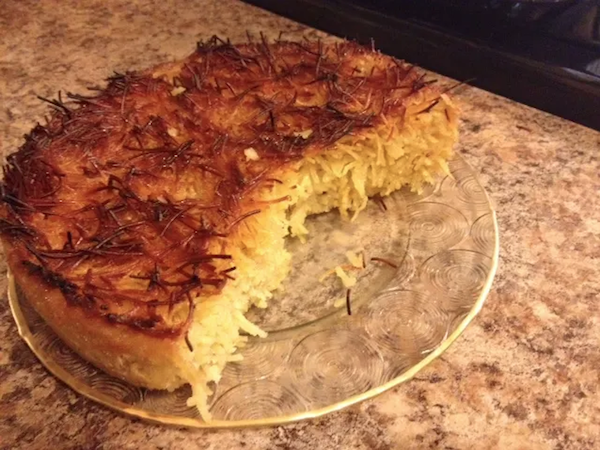
Desperate for some variety, I dug through my recipes and came across one for Jerusalem kugel. It still counts as pasta, but I view it as a more cultured, genteel pasta. Usually a side dish, I knew I could convince Harvey that it’s a main (especially if I served him enough of it). I figure I’ll follow it up with a roasted carrot/yam chaser. This particular kugel is satisfyingly savoury and sweet, and the recipe is by Jamie Geller.
SWEET AND PEPPERY JERUSALEM KUGEL
1 (12 ounce) package thin egg noodles 1 cup sugar 1/3 cup oil 4 eggs 1 tsp salt 1/4 tsp to 1 tsp ground pepper
Preheat oven to 350˚F.
Bring a pot of water to a boil. Cook noodles according to package instructions. Strain and set aside.
Add the sugar and oil to a large pot on low heat. Stir until sugar is dissolved and a deep golden caramel colour, but not burnt. This can take 20 minutes or more.
Turn off the heat and add the noodles into the pot of sugar. Immediately stir with a big spoon until the noodles are coated in the caramel. Don’t worry if the sugar hardens into blobs – it will melt in the oven.
Allow the mixture to cool for about 10 minutes. Mix in the eggs, salt and pepper. (Make sure it’s cool so the eggs don’t cook.)
Pour the mixture into a greased springform pan or baking dish. Bake for one hour.
May this COVID-19 pandemic be over with soon. In the meantime, as Dr. Bonnie Henry says: “Be kind. Be Calm. Stay safe.” As for the Accidental Balabusta, figuring out what to cook every night should be my worst problem. Ever.
Shelley Civkin, aka the Accidental Balabusta, is a happily retired librarian and communications officer. For 17 years, she wrote a weekly book review column for the Richmond Review. She’s currently a freelance writer and volunteer.
Tori Avey’s Mediterranean Olive Chicken is one of those guest-worthy dishes – impressive, yet easy to prepare and sure to please. (photo by Shelley Civkin)
It’s Thursday afternoon and I’m wondering what the maid is going to make for dinner. Or how I’m going to spend that $70 million Lotto Max I just won. Or when I’ll fly to Mars. See my quandary? I guess you could say I’m in a rut: fish, chicken, steak. Not being a big pasta fan, I seem to fall back on my old regulars every week. If I let him, my husband Harvey would eat pizza and pasta every night.
I remember the ’60s, when my mom had an unwritten weekly dinner schedule. Sundays were prime rib roast with Yorkshire pudding, roast potatoes and salad. The salad was only ever iceberg lettuce (hadn’t farmers discovered romaine, butter lettuce or kale yet??), mixed with cucumbers, tomatoes and green onions. Bottled dressing. The rest of the week’s dinners consisted of chicken livers with onions, salmon, meatloaf or hamburgers, or chicken. Each main was accompanied by the same weekly side dishes. And I mean the same. There was little, if any, variation from week to week. There’s something to say for consistency. With the exception of salad, every other vegetable mom served was frozen and came pre-chopped in a plastic bag. It was the ’60s after all. Occasionally, we’d go to the White Spot on Granville and 67th for a treat, and eat in the car, with the long tray spread across the front seat, attached to the window edges. Exciting times!
It’s funny that the ’60s and ’70s were a time of instant everything – Carnation Instant Breakfast, Pop-Tarts, Shake ’n Bake, Swanson TV Dinners, Nestle’s instant chocolate milk. Even though lots of women were stay-at-home moms and had time on their hands. Not to diminish the hard work they did raising their kids and keeping the house spotless. But let’s face it, lots of women today work outside the home and still do the majority of the childrearing and house chores. There were those privileged few who also had live-in housekeepers (yes, my family was one of them), and still my mother used lots of instant, pre-made foods. She was a good cook, for sure, but had to have a recipe in front of her. I’m like her in that regard. But I digress.
When we got married 10-and-a-half years ago, Harvey and I used to eat out at restaurants three to four times a week. So cooking was easy. Now, not so much. Sure, retirement provides me with more time to explore recipes. But my heart’s just not in it. Actually, that’s not true. I’m usually so busy volunteering that I simply don’t have the time (or inclination) to sit in front of a computer looking for culinary inspiration. Harvey thinks of cooking like a chemistry experiment, so he enjoys it. But as we get older (and sleep way less), we’ve kind of lost the fire in our bellies for cooking.
My father, alav hashalom, used to describe me as a human garbage disposal, because I would pretty much eat anything. He used to say that I’d “eat out of a puddle.” I was the “Give-it-to-Mikey-he’ll-eat-it” daughter. Admittedly, as long as someone else cooks it, I’ll eat it. That was then.
I am still a very easy-to-please eater – as long as the food isn’t too spicy, doesn’t contain too much roughage and doesn’t have nuts, corn, celery or raw vegetables in it. Well-seasoned food is nice, but, at heart, I’m a purist. With a bad gut. Bland food doesn’t bother me; in fact, I’ve been known to enjoy hospital food. After my recent three-month stomach illness, during which I ate only bland food, and very little, I’ve been a bit apprehensive about trying anything different. But, lately, as I’ve been feeling better, I figure it’s time to branch out. Caution to the wind!
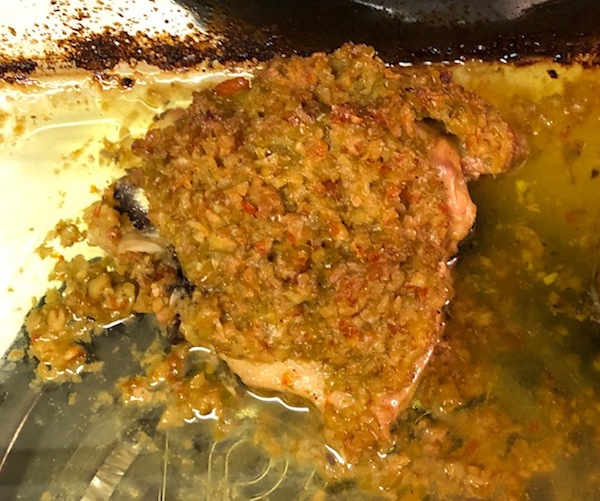
As I strolled the culinary landscape that is the internet, I came across a particular chicken recipe by Tori Avey, whose recipes I’ve enjoyed before. Best thing about this recipe is that it’s easy. And, turns out, it’s stunningly delicious. Feast your taste buds. Find it online at toriavey.com/toris-kitchen/mediterranean-olive-chicken.
TORI AVEY’S MEDITERRANEAN OLIVE CHICKEN (tweaked by me slightly)
3/4 cup chopped green olives (I used queen Manzanilla) 1/3 cup extra virgin olive oil 2 tbsp fresh lime juice 1 tbsp crushed garlic 2 tsp honey 1/2 tsp lime zest salt and pepper 4-5 lbs chicken pieces, bone in, skin on (I use 6 chicken thighs, as we’re dark meat fans, but white meat would be fine, too)
The recipe also called for red pepper flakes and dried oregano, which I omitted, plus wine to make a sauce afterwards, which I also omitted.
In a mixing bowl, whisk together the chopped olives, olive oil, lime juice, garlic, honey and lime zest. Season the marinade with salt and pepper to taste.
Sprinkle the chicken pieces lightly with salt and pepper. Place chicken pieces in a nine-by-13-inch baking dish. Brush the pieces evenly with olive marinade, using all of the marinade to coat.
Cover the baking dish with plastic wrap and place in the refrigerator for at least two hours (or up to overnight).
Preheat oven to 375˚F. Remove the plastic wrap and cover the baking dish with foil. Pierce a few vents with a sharp knife around the outer edges.
Place the covered dish in the oven. Let the chicken bake for 60 minutes, then remove the foil and bake for an additional 15 to 30 minutes, basting periodically, until well cooked and tender. At the end of cooking, you can broil it for a minute or two to brown the skin (I didn’t bother with this step).
After two bites, my husband pronounced this the best chicken I had ever made. Bar none. And we eat a lot of chicken. Since I usually bake chicken uncovered and it turns out dry, this was a surprising treat – extremely moist, über-flavourful and just as yummy the next day. I’ll probably double the recipe next time around, since it’s worth having enough left for a second dinner. This is one of those guest-worthy dishes – impressive, yet easy to prepare and sure to please. And it makes a nice Shabbat meal, too. I also realized the versatility of the marinade when I tried it on pasta. I’d place bets that it goes well with steak, too. One marinade, three uses. Now that’s a masterful marinade!
You’re welcome. Beteavon!
Shelley Civkinaka the Accidental Balabusta, is a happily retired librarian and communications officer. For 17 years, she wrote a weekly book review column for the Richmond Review. She’s currently a freelance writer and volunteer.
After eating all our wonderful family tradition seder dishes, I find it fun to try out meals that I haven’t before and that are not from my cultural background. Here are some you might want to try.
MATZAH MEAT PIE
(Egyptian-born Claudia Roden is the master of Middle Eastern food and author of 20 cookbooks. Now 84 years old, she lives in London. I met her in the 1970s, when she came to Israel and we had a wonderful visit. This is her recipe from the New York Times Passover Cookbook, adapted from The Book of Jewish Foods, which she wrote. It makes four to six servings.)
1 large chopped onion 3 tbsp vegetable oil 1 1/2 pounds ground lamb or beef salt and pepper to taste 1 tsp cinnamon 1/2 tsp allspice 2 tbsp raisins 2 tbsp pine nuts or walnuts 1 cup warm beef stock 5-6 matzot 1 small egg, beaten
Preheat oven to 375˚F. Spray a pie plate with vegetable spray.
Heat two tablespoons oil in a frying pan and fry onion over medium heat for 10 minutes, until golden. Add ground meat, salt, pepper, cinnamon and allspice. Cook, stirring until meat has browned but is still moist, about 10 minutes. Add raisins.
In another pan, fry the nuts in one tablespoon oil for one minute, stirring until nuts are lightly coloured. Add to meat mixture and stir.
Place beef stock in a large, shallow rectangular pan. Soak matzot one at a time, pressing them gently to absorb the liquid.
Press two or three softened matzot into a pie plate. Place meat mixture on top of matzot. Cover pie with remaining matzot. Brush top with beaten egg. Bake for 30 minutes or until top is golden.
KABSAH (This recipe comes from It Tastes Too Good to be Kosher by Peter A. Weissenstein and is a Lebanese dish, good for using up leftover lamb or chicken.)
In a bowl, combine lamb, chicken, garlic, salt, onions, tomato, cumin and parsley and blend.
Heat oil in a frying pan. Spoon mixture into frying pan and fry until well heated. Serve with Israeli salad.
BRISKET MEATBALLS IN TOMATO PASSATA (Passata is Italian for “go through,” i.e. the cooked tomato puree goes through a special machine. This Italian-influenced dish was created by Hillary Sterling for Vic’s, her New York City restaurant. It makes four servings.)
Meatballs: 1 1/2 cups crumbled, unsalted matzah 2 1/2 tbsp water 1 1/4 pounds ground brisket 1 large egg 1 tbsp olive oil salt to taste 1 1/2 tsp ground fennel seeds (optional) 1/2 tsp crushed red pepper pepper to taste
Passata: 1/4 cup sliced garlic 1 1/2 tbsp olive oil 1 28-ounce can crushed, drained plum tomatoes 1/8 cup fresh marjoram leaves 2 1/2 four-by-one-inch orange peel strips salt and pepper to taste
Preheat oven to 425˚F. Set a wire rack inside a large baking sheet and spray with vegetable oil.
Combine crumbled matzah and water in a bowl. Add brisket, egg, oil, salt, fennel (if using), red pepper and black pepper. Mix with hands until combined. Shape into eight meatballs. Arrange meatballs on sprayed wire rack. Bake until browned, about 22 minutes.
Meanwhile, in a frying pan, cook garlic and oil for passata, stirring often, a minute and a half. Add crushed tomatoes, marjoram leaves, orange peel strips, salt and red pepper. Bring to a boil then remove from heat.
Transfer meatballs to tomato passata in frying pan. Garnish with crumbled matzot, fresh marjoram leaves and chile oil. Serve warm.
Sybil Kaplan is a journalist, lecturer, book reviewer and food writer in Jerusalem. She created and leads the weekly English-language Shuk Walks in Machane Yehuda, she has compiled and edited nine kosher cookbooks, and is the author of Witness to History: Ten Years as a Woman Journalist in Israel.
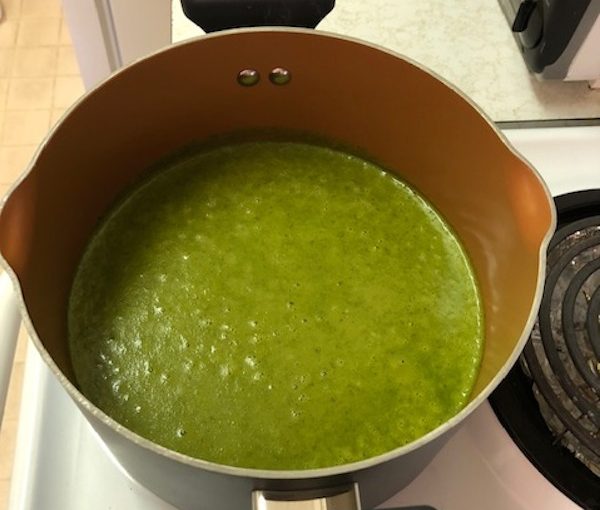
Kermit Soup, ready to serve. (photo by Shelley Civkin)
Treat your friends to one little taste of my Kermit Soup (aka kale-and-potato soup) and I guarantee they’ll be green with envy. Granted, it’s an unholy colour, which could be off-putting to some, but don’t dismiss it out of spoon. Even those who vigorously eschew kale (and aren’t partial to green) will be begging for seconds.
During these seemingly endless, dark days of fall and winter, there’s nothing more comforting than a thick, hearty soup. (Unless of course it’s a healthy serving of 15-year-old Balvenie, but that’s just wasted calories.) To me, soups are the bait-and-switch of mealtimes. If you haven’t been shopping in awhile, and all you’re planning for dinner is tuna sandwiches, then a good, substantial soup can easily step up to the plate and take on the starring role. After all, soup has got so much going for it: it’s filling, scrumptious and everything else pales by comparison. Especially if it’s Kermit Soup (you’ll see what I’m talking about soon enough). Don’t feel you need to apologize for its aberrant tint. I mean, just take a look around at the freakish hair colours you see on the streets. Kermit Soup has absolutely nothing to be embarrassed about. Nor do you.
It does help if you have a really good blender to make this soup. In fact, it’s rather essential. I’ve got a Breville at home and that sucker could crush rocks. (I’m pretty sure my blender has a bigger engine than my car.) Yams? No problem. Acorn squash? A joke. Carrots? In its sleep. Not that my recipe calls for any of those. Just saying. So, without further ado – meet the star of the dinner show.
KERMIT SOUP
2 cloves garlic 3 small/medium Yukon gold potatoes, diced half a large yellow onion 6 cups baby kale, chopped and lightly packed (the store wouldn’t let me take it without parental permission, so I used adult kale instead) 4 tbsp unsalted butter 1 quart (4 cups) chicken (or mushroom) broth Salt and pepper to taste
Mince the garlic.
Peel and chop the onion.
Peel and cube the potatoes.
Rinse kale and drain it well. Remove the thick stems then chop it up.
Melt butter over medium heat in a heavy soup pan.
Add garlic, onion, potatoes, and salt and pepper to taste.
Stir and cook for several minutes over medium heat.
Add the broth and bring it to a boil. Skim off fat from the top.
Gently simmer with the lid on for about 15 minutes or until potatoes are tender.
Add the kale and cook without the lid for about three to five minutes or until tender.
Transfer the soup to a blender a few cups at a time and puree. You might want to remove the little circle part of the blender lid to let some of the steam escape (but not while the blender is running). As each pureed batch is ready, pour it into another saucepan.
Ready to serve! It’s even better reheated the next day, and it’s good cold, too. If you’re not too hungry, have some bread with it and you’ve got yourself a light, yet filling fall meal. You’re welcome.
So, by now you’ve devoured your Kermit Soup and tuna sandwiches. To great acclaim. The soup, that is. An hour-and-a-half goes by and you’re jonesing for something sweet. Now what? You could get in your car and drive to some overpriced, hipster dessert restaurant that charges $12.95 for a two-inch purple yam, all-vegan crème brulée. Or, you could rock it old school. In the comfort of your own home. With Weetabix Chocolate Chip Cookies.
Yes, Virginia, Weetabix is more than just a breakfast cereal. Plus, it adds a nice crunchy texture to your cookies that you won’t soon forget (unless you overdo it with that 15-year-old Balvenie I referenced earlier. But that’s on you, not me). I always keep a box of Weetabix around, just in case of a cookie emergency. Which seems to happen with increasing frequency. And there are always chocolate chips hidden in my freezer (as if I don’t know where they are). So, go ahead, don your apron, pretend you’re Suzie Homemaker or Donna Reed and bake your family some irresistible cookies.
WEETABIX CHOCOLATE CHIP COOKIES
4 Weetabix, crushed 1 cup all-purpose flour 1/2 tsp baking soda 1/2 tsp salt 3/4 cup soft butter or margarine 1/2 cup firmly packed brown sugar 1/4 cup granulated white sugar 1 1/2 tsp vanilla extract 1 egg 1 cup semi-sweet chocolate chips
Mix together crushed Weetabix, flour, baking soda and salt in medium bowl. Set aside.
In a large bowl, using a hand mixer, cream together butter/margarine and sugars. Beat in vanilla and egg.
Add dry ingredients and mix well. Stir in chocolate chips.
Drop dough by tablespoonsful onto an ungreased baking sheet (or line with parchment paper).
Bake at 350°F for 12 minutes (or slightly longer for a crispier cookie).
Eat and repeat. Or eat ’em and weep. I’ll leave that to your discretion. These are so popular that you might want to make two batches at once. Just to be on the safe side. One batch never lasts more than half a day in my home, and there are only two of us. Again, you’re welcome.
These aren’t exactly balabatish recipes. More like nouveau accidental balabusta. But I do stand behind them. You see, I’m channeling my inner balabusta while I make them, and that’s good enough for me. I’ll leave the rugelach, kichele and komish broit to some other ambitious balabusta. On some other day. It just goes to show that food doesn’t need some fancy Yiddish name to taste geshmak. One bite of these Weetabix cookies and one spoonful of this Kermit Soup and you’ll be kvelling all over the place. Just clean up after all that kvelling, OK? Bottom line: it’s all about the heart and soul of the cook.
So, stop kvetching and get thee into the kitchen. Those cookies and soup aren’t going to make themselves. Just promise me one thing – you won’t ask for a refund if you don’t love the Kermit Soup.
Shelley Civkin, aka the Accidental Balabusta, is a happily retired librarian and communications officer. For 17 years, she wrote a weekly book review column for the Richmond Review. She’s currently a freelance writer and volunteer.
In traditional Jewish cooking, brisket is most often braised as a pot roast, especially as a holiday main course, usually served at Rosh Hashanah, Passover and on the Sabbath. For reasons of economics and kashrut, it was historically one of the more popular cuts of beef among Ashkenazi Jews. Brisket is also the most popular cut for corned beef, which can be further spiced and smoked to make pastrami. But why not try it for Chanukah? It’d make a great holiday main dish.
First, some background. Brisket is a cut of meat from the breast or lower chest of a cow. It is one of the nine primal cuts of beef, though the precise definition of the cut differs internationally. The brisket muscles include the superficial and deep pectorals. As cattle do not have collarbones, these muscles support about 60% of the body weight of standing or moving cattle. This requires a significant amount of connective tissue, so the resulting meat must be cooked correctly to tenderize the connective tissue. The term brisket is derived from the Middle English brusket, which comes from the earlier Old Norse brjósk, meaning cartilage.
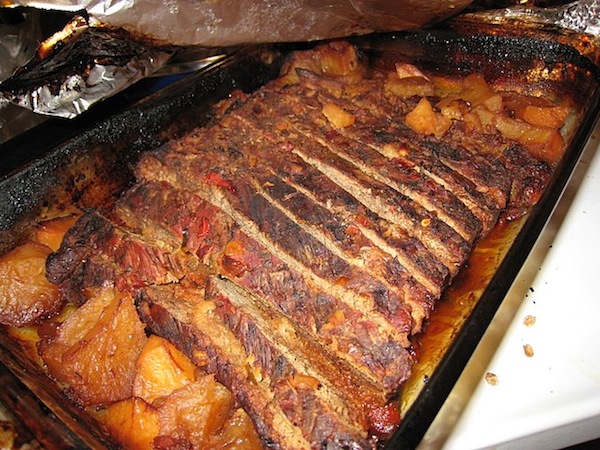
Place the brisket in a foil-line baking pan. Sprinkle onion soup mix, paprika, parsley flakes and dill on top. Add carrots and potatoes. Seal in foil.
Bake for one hour per pound of meat.
BRISKET AND FRUIT 8-10 servings
2 sliced onions 1 3- to 4-pound brisket 1 1/2 cups beer or wine 1 cup pitted prunes 1 cup dry apricots 3 tbsp brown sugar 2 tbsp orange marmalade 1 tsp brandy 1 tsp grated lemon peel juice of 1 lemon 3/4 tsp ground ginger 1/2 tsp cinnamon 1/2 tsp Worcestershire sauce
Preheat oven to 350°F. Line a baking pan with foil to cover brisket.
Sprinkle half the onions on foil, place brisket on top; place remaining onions on top of brisket and seal. Roast three hours.
Combine beer or wine, prunes, apricots, sugar, marmalade, brandy, lemon peel, lemon juice, ginger, cinnamon and Worcestershire sauce in a bowl and blend.
Spread mixture on top of brisket. Reduce heat to 300°F. Cover pan and cook one hour, adding more beer or wine if sauce appears dry.
Sybil Kaplan is a journalist, lecturer, book reviewer and food writer in Jerusalem. She created and leads the weekly English-language Shuk Walks in Machane Yehuda, she has compiled and edited nine kosher cookbooks.