Skip to content
  • Home
  • Subscribe / donate
  • Events calendar
  • News
    • Local
    • National
    • Israel
    • World
    • עניין בחדשות
      A roundup of news in Canada and further afield, in Hebrew.
  • Opinion
    • From the JI
    • Op-Ed
  • Arts & Culture
    • Performing Arts
    • Music
    • Books
    • Visual Arts
    • TV & Film
  • Life
    • Celebrating the Holidays
    • Travel
    • The Daily Snooze
      Cartoons by Jacob Samuel
    • Mystery Photo
      Help the JI and JMABC fill in the gaps in our archives.
  • Community Links
    • Organizations, Etc.
    • Other News Sources & Blogs
    • Business Directory
  • FAQ
  • JI Chai Celebration
  • JI@88! video

Recent Posts

  • Sharing her testimony
  • Fall fight takes leap forward
  • The balancing of rights
  • Multiple Tony n’ Tina roles
  • Stories of trauma, resilience
  • Celebrate our culture
  • A responsibility to help
  • What wellness means at JCC
  • Together in mourning
  • Downhill after Trump?
  • Birth control even easier now
  • Eco-Sisters mentorship
  • Unexpected discoveries
  • Study’s results hopeful
  • Bad behaviour affects us all
  • Thankful for the police
  • UBC needs a wake-up call
  • Recalling a shining star
  • Sleep well …
  • BGU fosters startup culture
  • Photography and glass
  • Is it the end of an era?
  • Taking life a step at a time
  • Nakba exhibit biased
  • Film festival starts next week
  • Musical with heart and soul
  • Rabbi marks 13 years
  • Keeper of VTT’s history
  • Gala fêtes Infeld’s 20th
  • Building JWest together
  • Challah Mom comes to Vancouver
  • What to do about media bias
  • Education offers hope
  • Remembrance – a moral act
  • What makes us human
  • המלחמות של נתניהו וטראמפ

Archives

Follow @JewishIndie
image - The CJN - Visit Us Banner - 300x600 - 101625

End the war: surrender

This week’s suggestion of a time-limited ceasefire that would free remaining hostages in Gaza and return the bodies of the dead to their families seems, in the context of a bleak historical moment, encouraging. The optics of bartering for the lives (and dead bodies) of Jews is something that should (but won’t) make the world recoil in revulsion. Nonetheless, anything that brings the hostages home is worthy of consideration. 

A comprehensive agreement brokered by third parties could have positive results, even as it includes the releasing of Palestinians imprisoned in Israel, including those who are guilty of terrorism. At a minimum, it would not be the vague “ceasefire” some have been calling for, which others might view as letting Hamas off the hook for their atrocities. A blanket ceasefire without a release of hostages is, and should be, out of the question.

All this talk of ceasefire, though, should raise a question almost no one seems to be asking. With so many calls for Israel to declare a ceasefire, why is no one – seemingly no one, including Israel-supporting voices – calling for Hamas to surrender?

Conceivably, this particular war could end tomorrow if Hamas conceded. Why aren’t the voices who want to end this war now calling for the one step that could realize that goal?

Certainly, the idea of Hamas surrendering and their leaders facing justice is unpalatable to sympathizers in the West. There is a not-negligible number of activists and commentators who not only support the Palestinian “resistance” in theory, but support it at its most brutal, celebrating the kidnappings, rapes and murders as “amazing” and “brilliant” (in the words of just one college instructor on the steps of the Vancouver Art Gallery in October).

There is also the slightly more convincing idea that, while a democratic government like Israel’s may be swayed by overseas public opinion, a terror regime will not be. As fair as this assumption may seem on its face, evidence debunks it. Millions of people marching worldwide, dressings-down by the United States’ president and top diplomat, a show trial over “genocide” at the International Court of Justice and what seems like a world aligned against it seems to have altered the Israeli resolve not a gram. 

The inevitable fallback position in these discussions is that Israel is the powerful party here and so holds the cards. The power differential does not mean, though, that Israelis either are not vulnerable or that they are to blame for the war. For the families of those murdered on Oct. 7 and the Israeli soldiers killed in this conflict, power differentials are a pile of dirt next to empty chairs at their tables. For whatever power discrepancies might exist, Hamas has shown its ability to breech Israel’s defences, and its resolve to do so again, if it can. Hamas has the one card up its sleeve that could end this war: surrender.

Calls for a ceasefire imply that Israel should surrender itself to a future of perpetual terror, because Hamas has repeatedly expressed the determination to fight until Israel is eliminated – setting up a zero-sum situation in which anything short of the complete eradication of Hamas is a defeat for Israel. On the other hand, Israel has made unilateral moves in the past – disengaging from Gaza in 2005, for example – and will likely be forced to do so again as perpetual war is untenable on several levels.

As numerous commentators recently have suggested, total de-Hamas-ification of Gaza is probably unlikely. Perhaps the endpoint will be a situation in which Israel has achieved a position of unequivocal strength, with the likelihood of a repeat of Oct. 7 eliminated, and some as-yet-unimagined political structure in place in Gaza. While street activists and diplomats worldwide think they have all the answers to what Israel should do, not one group has stepped up to suggest they would serve as peacekeepers or otherwise oversee Gaza’s transition away from Hamas’s regime. There are, of course, larger geopolitical imperatives, including the maintenance and expansion of the Abraham Accords, which Saudi Arabia has said depend on a two-state solution. Prime Minister Binyamin Netanyahu, to the consternation of American and other officials, is insisting Palestinian statehood is off the table for now.

Another realistic reason why Western observers may not be calling on Hamas to give up is the understanding – intuitive, if not conscious – that Hamas will never surrender because it is determined to continue this fight regardless of cost and futility. Their stated goal is the eradication of Israel even if that takes generations. Hamas leaders have indicated that thousands upon thousands of dead Palestinians are a small price to pay for a centimetre’s advance toward that ultimate goal. The embedding of terror infrastructure in civilian areas, the use of human shields and child combatants are evidence that Hamas will fight to the last person.

In Jewish cyberspace and in Israel-minded media, there have been millions of words spilled in recent weeks about the necessity of victory, the justness of the war even in the face of the mounting casualties and much more. There also have been calls for a ceasefire as a way to get the beloved hostages back home with their families and their hurting nation.

Given what’s at stake, we hope and pray for what seems impossible, a Hamas surrender. We also hope and pray for the possible – that Israel will be victorious in achieving its security, that there will be a world in which both Israel and Palestine coexist in peace. And, more immediately, that the hostages will be returned. 

Posted on January 26, 2024January 24, 2024Author The Editorial BoardCategories From the JITags ceasefire, Hamas, Israel, Israel-Hamas war
Protests, picketing alarm Jews

Protests, picketing alarm Jews

Screenshot of Nelson City Council’s Oct. 22, 2023, meeting. Left to right, Topaz Zafrir, Yael Finer and Judy Banfield of the Kootenay Jewish Community Association present their concerns about the rise in anti-Israel and antisemitic events to the council.

Last October, as tensions in Canada were mounting over the Israel-Hamas war, three members of the Kootenay Jewish Community Association in Nelson paid a visit to the city council meeting to convey a request: that the council refrain from taking sides when it came to the emotionally charged protest rally that had taken place the day before. Nelson residents Judy Banfield, Yael Finer and Topaz Zafrir said they were also there to ask the police to continue its protection of Jewish community events, as it had in previous years. “We are very grateful for that,” Banfield said. “Right now, our community is frightened.” 

The week before the meeting, Hamas had called to its supporters for a “day of rage.” The response was swift in Nelson, a college town that has seen an escalation of pro-Palestinian sentiment and anti-Israel demonstrations in recent years. About a hundred people turned out to hear speakers who gave accounts of what they believed was happening in Gaza. According to Kootenay Jewish community leader Yael Finer, the presentations included assertions about Israel’s role in Gaza that had already been debunked. The purpose of the rally, she felt, was to incite antisemitism and anti-Israel sentiment in the city. Finer, an Israeli-Canadian who moved to Nelson in 2016, told the council that one of the speakers also made a pitch on behalf of Hamas.

“A final speaker said, ‘Don’t hate Hamas. They’re our brothers, our sons, our fathers,’” Finer recounted.

“The event was supposed to be about peace and education,” she said. “I actually reached out to the organizer, asking to speak at the event as one of the Israeli or Jewish [residents].”

Finer told the council that she empathizes with the Palestinian people and shares concern over the current situation in Gaza. She had gone to the rally to learn. She said her request to speak at the event was denied. 

Finer added that one of the speakers was a city council member, “creating a perception of legitimacy” for the demonstration. The mayor later released a statement clarifying that only the mayor’s office represented the views of the city government, including at public events.

Not a new phenomenon

Banfield, who is a former Selkirk College instructor and has lived in Nelson since 1990, said antisemitism isn’t a new phenomenon in the city. She said the planned speech in 2013 of Greta Berlin, an accused antisemite, put the community on edge. Eventually, the Nelson library rescinded the offer for her to speak, but she was later offered a venue at the United Church. Although the gathering remained peaceful, Banfield said anti-Israel and antisemitic behaviour have only grown more evident.

“I have been in Nelson a long time and we’ve always been very open that we’re here and inviting,” she told the Jewish Independent about the local Jewish community. She said that, until recently, religious celebrations used to be open to the Nelson public. However, a couple of years ago, demonstrators picketed a Jewish holiday celebration.

“People were picketing us, basically as being Jews, being responsible for what is going on in the Middle East,” said Banfield. Since then, she said, the community has had to ask for police protection at religious and other community events and to conceal their locations from the public. “We do not feel safe gathering together in an announced venue,” she told the Nelson council.

Last November, demonstrators held another rally, this time calling on the city to formally advocate for a ceasefire. According to several attendees, there were also calls for boycotting local businesses that were assumed or known to do business in or with Israel.

Jeff Shecter, another long-time resident and one of the Jewish community’s first leaders, said even more people turned out for that rally. He said the protests and “river to the sea” chants have unnerved the Israeli members of the community.  “[They] were more shocked than the rest of us who were maybe used to it,” Shecter observed. While he said he is not afraid, “to have a demonstration supposedly in support of Palestine without anyone, not a single soul, denouncing what happened on Oct. 7 was a travesty.”

Zafrir, one Nelson’s most recent arrivals from Israel, told the council that the community isn’t trying to stifle anyone’s voice. “We’re not asking you to take sides,” she said. “The Palestinians and whoever supports them have the right to protest, as we have to do so, and still feel safe in our community. Any person in Nelson should feel safe, despite disagreement or place of origin.” 

On Dec. 5, acknowledging that it had received numerous calls for action, the city issued a formal letter “calling for peace in Gaza” and appealing for a “cessation of hostilities from all involved parties.” While the information shared among council members briefly mentioned the Oct. 7 attack by Hamas, the letter that was disseminated to the public did not. Nor did it mention the death toll from the terror attack or that more than 240 people had been abducted by Hamas and most were still missing.

Banfield said she is sympathetic of the pressure that the city council is under. “I mean, they did end up passing a resolution promoting a ceasefire. And I know there was a lot of discussion about it on council and they made it as lukewarm as possible,” she said. “And I guess at this point, the biggest thing for us is that they have given us protection.”

Asked whether she felt the city council understands the Jewish community’s concerns about safety at this time, Finer shook her head. “No,” she said, adding that she had hoped others would understand that anti-Israel protests and picketing of Jewish sites is alarming. “[Even] though there was no direct threat to the Jewish people in the town, it was implied. And that makes me feel terrified,” Finer told the council.

Still, Finer hasn’t given up hope that things could change in Nelson. As the new leader of the Kootenay Jewish Community Association, she’s already thinking about ways to bridge differences and enhance dialogue with those who don’t know, or don’t understand, Nelson’s small Jewish community. 

Jan Lee is an award-winning editorial writer whose articles and op-eds have been published in B’nai B’rith Magazine, Voices of Conservative and Masorti Judaism and Baltimore Jewish Times, as well as a number of business, environmental and travel publications. Her blog can be found at multiculturaljew.polestarpassages.com.

Format ImagePosted on January 26, 2024January 24, 2024Author Jan LeeCategories LocalTags anti-Israel, antisemitism, British Columbia, city council, Nelson, Oct. 7, protests
Help vs antisemitism

Help vs antisemitism

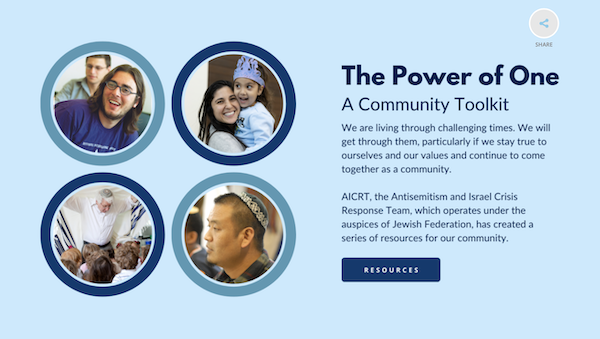
The Antisemitism and Israel Crisis Response Team’s hands-on guide can be found at jewishvancouver.com/toolkit.

Since Jewish Federation of Greater Vancouver launched the Antisemitism and Israel Crisis Response Team (AICRT) in November 2023, the team has been dedicated to helping Jewish community members navigate the challenges of a post-Oct. 7 world.

Last week, AICRT – co-chaired by Rabbi Dan Moskovitz and Nico Slobinsky – launched a hands-on guide for community members. It covers everything from tips on engaging in social media, to reporting an antisemitic incident, to hosting neighbours at events so non-Jewish friends can connect with the Jews in their lives in positive ways.

On the day before Federation launched this guide, the Vancouver Police Department released a report that the Vancouver Jewish community experienced a 62% increase in police-reported antisemitic hate incidents in 2023 compared to 2022 – and 33 of 47 incidents occurred after the Oct. 7 terrorist attacks perpetrated by Hamas. (See vpd.ca/news/2024/01/16/israel-hamas-war-fuels-increase-in-hate-crimes-protests-in-2023.)

Antisemitism is a real and present threat, and it’s a growing problem. That’s why Federation, the response team and the Jewish community are coming together to push back against it.

The toolkit is a guide to help people take meaningful actions – as well as advice on where to turn if you need help. All of it is based on two key factors – what the response team has heard from community members about what they need to navigate these dark times, and professional polling of the broader community.

The guide at jewishvancouver.com/toolkit is a living document and will be updated as the situation changes, and new resources are needed. Right now, the contents include:

• Information on well-being and mental health
• Key messages
• Engaging on social media
• How to be a grassroots organizer
• Dealing with antisemitism in K-12 schools
• University resources
• How to write a letter to the editor
• How to engage BC MLAs and MPs
• How to report an antisemitic incident
• How to have difficult conversations with family and friends

The toolkit is designed to help people stand up when needed, and to draw in those who are already inclined to support the community. Write to the Antisemitism and Israel Crisis Response Team at [email protected] with any ideas or comments.

Antisemitism Legal Helpline

The Antisemitism Legal Helpline aims to connect those facing antisemitism with legal information and resources. It is being hosted through Access Pro Bono, a nonprofit providing referrals and legal assistance. Their newly hired coordinator, Dan Rothwell, is a Vancouver lawyer with experience in the public, private and nonprofit sectors. He is keen to connect with community partners to help make this project a valuable tool in the fight against antisemitism, and he can be reached by email: [email protected].

The helpline can be reached at 778-800-8917. 

– Courtesy Jewish Federation of Greater Vancouver

Format ImagePosted on January 26, 2024January 24, 2024Author Jewish Federation of Greater VancouverCategories LocalTags AICRT, Antisemitism and Israel Crisis Response Team, antisemitism toolkit, Dan Moskovitz, Jewish Federation, Nico Slobinsky

Artist’s threat sees PuSh cave

At the weekly rally Jan. 14, Ezra Shanken, chief executive officer of the Jewish Federation of Greater Vancouver, called on attendees to take action around the latest flashpoint of anti-Israel activism locally.

Earlier in the week, the PuSh International Performing Arts Festival announced they were canceling the scheduled presentation of The Runner, a play by a Canadian playwright Christopher Morris. The move followed an earlier decision to cancel the play at Victoria’s Belfry Theatre after a chaotic public meeting and vandalism of the theatre building. (See jewishindependent.ca/canceled-play-should-not-be-canceled.)

The PuSh decision, according to a Jan. 11 statement, was the result of pressure from another festival artist, Basel Zaraa, who threatened to pull his installation, Dear Laila, rather than have it appear at the same festival as a play that he describes as not depicting the “fundamental context of Israel’s occupation, apartheid and ethnic cleansing of the Palestinian people.”

“As a Festival, we respect Basel’s perspective,” wrote the festival organizers. “We will honour the artist whose work reflects their lived experience and cancel the presentations of The Runner by Canadian playwright Christopher Morris, whose work is rooted in years of research but who has no religious or cultural ties to the region.”

In the same dispatch, Morris released a statement.

While saying, “If removing The Runner is the only way Canadians can hear Basel’s crucial voice, then there is value in stepping aside,” Morris concluded, “It’s unsettling when Canadian theatres cannot be a space for the public to engage in a dynamic exchange of ideas. I believe theatre must be a place where contrasting perspectives are programmed and celebrated. Now more than ever, we need to listen to each other, engage in different viewpoints, and find our shared humanity.”

The Runner is, Shanken said, “an acclaimed play by a non-Jewish playwright, one that actually talks about the challenge of what’s going on on the ground.”

He told attendees at the Sunday rally that the PuSh Festival’s decision is “a new front” in which “they are trying to silence other voices.”

“When you don’t have the facts on your side, you silence the opposition,” said Shanken. “Each one of us should take a moment today when we get home, write an email to the PuSh Festival. Tell them enough is enough. We ask not for the other play to be canceled but just for our own equal billing. We allow for their voices to be heard, all we ask is for peaceful voices of ours to be heard, too. We ask for nothing but equality.”

The PuSh Festival receives funding from the City of Vancouver, the Province of British Columbia and the Canada Council for the Arts, as well as numerous businesses and foundations. Sponsors of the event can be found on the festival’s website – pushfestival.ca – under “Partnerships.”

Posted on January 26, 2024January 24, 2024Author Pat JohnsonCategories Performing ArtsTags Basel Zaraa, censorship, Christopher Morris, Ezra Shanken, Israel-Hamas war, PuSh Festival
Mission endorses Canada’s Antiracism Strategy

Mission endorses Canada’s Antiracism Strategy

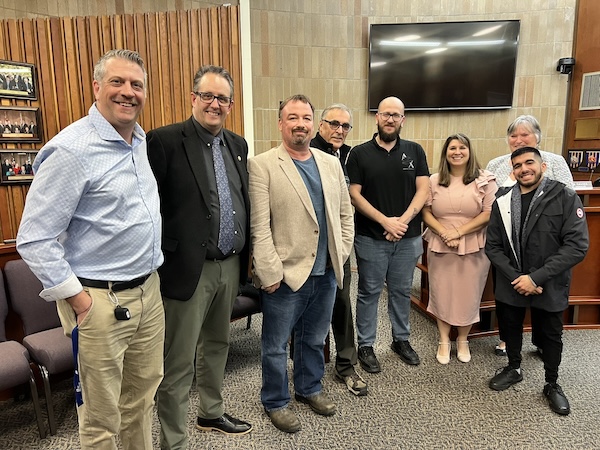
Left to right: Michael Sachs, director of JNF Pacific Region, with Mission Mayor Paul Horn and city councilor Mark Davies, councilor Danny Plecas, Mission resident Eitan Israelov, councilor Angel Elias, councilor Carol Hamilton (back) and councilor Jag Gill. (photo from Michael Sachs)

At its Jan. 22 meeting, Mission city councilors voted on a motion moved by Mayor Paul Horn: “That the City of Mission Council endorses Canada’s Antiracism Strategy and refers the strategy to the newly formed Accessibility, Inclusion and Diversity Committee as a tool in their work.” The motion passed unanimously. Canada’s Antiracism Strategy uses the International Holocaust Remembrance Alliance “Working Definition of Antisemitism,” which defines antisemitism as “a certain perception of Jews, which may be expressed as hatred toward Jews. Rhetorical and physical manifestations of antisemitism are directed toward Jewish or non-Jewish individuals and/or their property, toward Jewish community institutions and religious facilities.” 

Format ImagePosted on January 26, 2024January 24, 2024Author The Editorial BoardCategories LocalTags antiracism, IHRA, International Holocaust Remembrance Alliance, mission
What happens after the war?

What happens after the war?

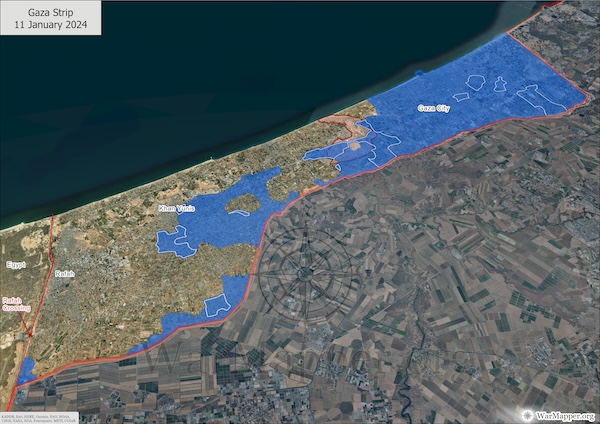
Area of Gaza controlled by the Israeli Defence Forces on Jan. 11, 2024.

While the war in the Gaza Strip continues between Hamas guerillas and the Israel Defence Forces (IDF) in the labyrinth of tunnels burrowed beneath Khan Yunis and in the alleys of the devastated city (population 205,000), another battle is being fought across Israel over the postwar fate of the coastal enclave.

Ultra-nationalist members of Knesset Bezalel Smotrich, leader of the National Religious Party, and Itamar Ben Gvir, head of Otzma Yehudit (Jewish Power), recently called for Gaza’s 2.2 million residents to be voluntarily resettled elsewhere. Congo was cited as a destination for the exodus. U.S. State Department spokesman Matthew Miller called the statements by Smotrich and Ben Gvir “inflammatory and irresponsible.”

Egypt is adamantly opposed to allowing the two million displaced Gazans to shelter in the Sinai Peninsula, lest Israel prevent the refugees from returning. Similarly, the Jewish state is no more likely to allow them to pass through its territory to fly out of Ben-Gurion Airport than it is to resettle those refugees who fled their nearby villages in the Arab-Israeli War of 1948.

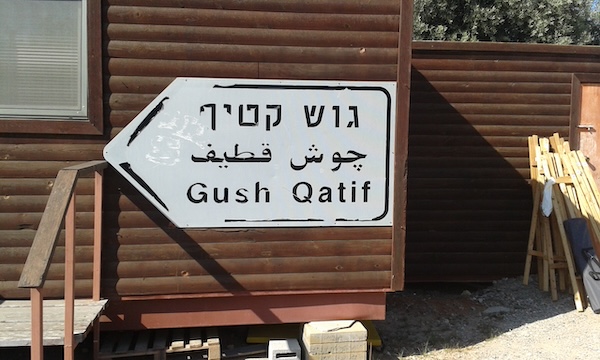
photo - One controversial postwar scenario is for Israel to rebuild some of the post-1967 Gaza Strip settlements from which it unilaterally  withdrew in August 2005
One controversial postwar scenario is for Israel to rebuild some of the post-1967 Gaza Strip settlements from which it unilaterally  withdrew in August 2005. (photo by Gil Zohar)

Further limiting the options, Israel’s high-tech Erez Crossing at the north end of the Gaza Strip – similar in scale to a massive airport terminal – was destroyed during Hamas’s Oct. 7 rampage in which some 1,200 Israelis and other nationals living in cities and kibbutzim near the Gaza frontier were massacred and 240 kidnapped.

Concurrently, the black market is burgeoning for fixers with links to Egyptian intelligence; they are making a fortune in “fees” extorted from Gazans desperate to exit through the Rafah Crossing at Gaza’s south end. The bribe for being placed at the head of the legal exit list for passage across the Rafah border into Egypt and on to Cairo International Airport has now soared to $10,000.

In the face of the vast human suffering, staggering damage to infrastructure and environmental catastrophe caused by the conflict, which marked its 100th day on Jan. 14, another controversial postwar scenario is for Israel to rebuild some of the post-1967 Gaza Strip settlements from which it unilaterally withdrew in August 2005. The forcible evacuation of 8,600 Jewish residents from Gush Katif (the Harvest Bloc) – a cluster of 17 villages in the southern Gaza Strip – set the stage for Hamas’s 2007 coup d’état when it seized power from Mahmoud Abbas’s Palestinian Authority, based in Ramallah in the West Bank.

On Dec. 22, 2023, a group of settlers held an organizational meeting at the agricultural village of Kfar Maimon near the Gaza Strip demarcation fence to launch their plan to create a beachfront community on the barren dunes at Gaza’s southern edge. The day was symbolic since Asarah b’Tevet (the 10th of the Hebrew month of Tevet) is a fast day in the Hebrew calendar, marking the date 26 centuries ago when Nebuchadnezzar II of Babylon began his six-month siege of Jerusalem, which resulted in the destruction of Solomon’s Temple and the downfall of the Kingdom of Judah.

Though Gaza was allocated to the Tribe of Judah in the Hebrew Bible, the ancient Israelites never vanquished their Philistine nemesis who dwelt there and in the cities of Ashkelon, Ashdod, Gat and Ekron. Jewish and Samaritan communities intermittently flourished in the territory of Gaza over many centuries. Shaken by the riots of 1929, however, the Gazan Jewish community ended in 1948. In Gaza City’s historic Zaytoun quarter, the Ottoman-style Hammam al-Sammara (the Samaritan bathhouse) bears witness to the ancient Samaritan community that was exiled in 1917 by the Turkish army during the battles of the First World War.

The group of would-be settlers – who staged a car rally just outside Gaza on Jan. 11 – are encouraged by the report that Israel’s Knesset will be hosting a conference Jan. 28 on rebuilding settlements in Gaza after the war, and will offer precise maps and plans. The news site mako.co.il says that Knesset members and other public figures are expected to speak, and thousands of Israelis have already applied to join the settlement nuclei in Gaza.

The organizers of the event stated, “We are working both on the political level and on the practical side towards the moment when they can get on the ground. There is a great demand in the public that the victory of the war includes within it Jewish settlement in the Gaza Strip.”

Meanwhile, senior ministers among Prime Minister Binyamin Netanyahu’s right-wing allies have criticized the IDF over its plans to probe Oct. 7 intelligence failures. And Israel’s future may be hurtling backward to the widespread protests over judicial reform that divided the country in the months that preceded Hamas’s devastating surprise attack. Such is public anger that calls for a spring election are becoming vociferous.

Were Netanyahu and Abbas to both step down, and Saudi Arabia and Israel to establish ties, a postwar scenario of regional integration – including high-speed trains whisking cargo from Haifa to Riyadh and Abu Dhabi – could emerge. The trauma of the Gaza War could give birth to Mideast peace.

More than 50,000 Israelis responded to the Ashkenazi and Sephardi chief rabbis’ call for a day of prayer at the Western Wall in Jerusalem to mark the new moon of Shevat.

In Judaism, the full moon of Shevat is celebrated as the New Year of the Trees. Besides the pink-white almond blossoms, which mark the beginning of spring, the blood-red anemones also carpet the fields of the western Negev by the Gaza Strip. Like the poppies in Flanders Fields, this year those wildflowers will symbolize the tragedy of war. 

Gil Zohar is a writer and tour guide in Jerusalem. A longer version of this article can be found at religionunplugged.com/gil-zohar.

Format ImagePosted on January 26, 2024January 24, 2024Author Gil ZoharCategories IsraelTags Gaza, Hamas-Israel war, postwar, settlements

Critical thinking a vital skill

As a 20-something in the mid-1990s, I taught high school English. Part of my course load was a collaborative Grade 10 World Civilizations course that I co-taught with a social studies teacher. One day, I flippantly advertised our next assignment to a room of 16-year-olds, saying, “Oh, hey, we’re going to start reading Candide by Voltaire next week! You’ll love it! It’s full of sex, drugs and violence.”  

To my surprise, many of those students talked to their parents. I received a flurry of concerned phone calls, messages and emails. Parents were worried about the curriculum. In the end, my explanations were successful. Yes, it’s true that Candide is probably rated R, but this fantastical satire was first published in 1759. It’s a famous classic, it’s definitely “literature,” with lots of intrigue and ideas we can learn from – and, oh yeah, it’s not true. 

Literature teachers often speak of the great truths found in the classics, but fiction isn’t “the truth.” It’s complicated to untangle, and that’s why we study it to develop our critical thinking skills. In our multi-discipline history and English course, we had opportunities to discuss how history evolved, how we could examine primary sources to draw conclusions, and more. Literature was just a part of our opportunity to read and analyze important texts.

All this came to mind recently when some antisemitic posts came my way via social media concerning the Talmud. People started quoting the Talmud and inferring from brief quotations that Jews did all sorts of evil things. This was something of a modern blood libel approach; using brief snippets out of the huge body of law and literary work to condemn an entire ethnoreligious group. What followed was both a lot of nonsense and some deep belly laughs from Jews and scholars who study Talmud. Now, if you want to understand this text, buy all the tractates of the Babylonian (and don’t forget the Jerusalem) Talmud. You’re looking at a several-thousand-dollar purchase, which you can’t read unless you know Aramaic and Mishnaic Hebrew, as well as Rashi script, to read his commentary.

In recent years, Sefaria, an online database, has offered access to Talmud and many other Jewish texts, both in the original and in translation, for free. It’s been a tremendous gift and democratization of these ancient texts. However, having access doesn’t mean you have understanding. Like reading Candide for the first time, it’s helpful to have a teacher, some historical context, and lots of support to aid in your comprehension. These online X commenters, taking short rabbinic quotes out of context, had no idea what they were talking about. In many cases, the Talmud’s rabbinic musings explore arbitrary legal situations that never happened in order to explore and define the minutiae of Jewish law.

Also online, I saw others bemoaning how learning historical “facts” seemed solid and unquestionable – dates and events – but that, with modern events, it seemed hard to define what had happened and what was true as compared to misinformation. This anecdotal experience is common but it’s misleading. It takes a long time to establish a common narrative around a historical event, and “the winners” of war or political events create their version of history. Using multiple primary sources, as well as multiple historians’ accounts, helps learners see how historians lend their biases to their interpretation of what happened. We only get a full picture of “what happened” through exploring many perspectives from multiple sources. Even then, it’s hard to know if the history we’ve learned is “true,” or not.

Developing a mature understanding of literature and world events requires us to be critical thinkers. As F. Scott Fitzgerald wrote in 1936, “… the test of a first-rate intelligence is the ability to hold two opposed ideas in the mind at the same time, and still retain the ability to function.”

I’d say that, often, intelligent people explore complex political, historical, social or literary scenarios that hold multiple opposing ideas at once. But this kind of learning takes time and energy. It does not happen automatically. Our society loves binaries, where we get a quick yes/no answer.

My kids aren’t in high school. Yet, as a parent, I look forward to the day they come home excited about a “mature” literature assignment full of “sex, drugs and violence.” Each new milestone achieved fills me with hope. This year, for the first time, I have two kids who skate on their own, and I don’t always have to lace them up. At the same time, we’re trying to get to complex, but age-appropriate understandings of the Hamas-Israel war. We explore what is happening along with how the media depicts the situation. Who shapes our understanding of what’s happening? How? Most difficult is exploring the questions around whether anyone “wins” in a war when there is so much suffering involved. 

The world is complicated. We can use literature and ideas for enjoyment, but also as tools to help think about big issues. Thinking critically about complex issues is a sign of intelligence and maturity. We must cultivate this skill. I hope it’s something my kids achieve as those long-ago high school students did. 

Critical thinking is also a lens through which to examine the multiple simplistic social media and news narratives we’re facing every day. One can ask why the description of an event is so simplistic or who is consistently blamed in the narrative. Often, a short take on Talmud doesn’t demonstrate a deep understanding. A news article that fails to include the back story isn’t going to cut it. A view that always blames only one country – Israel – or one ethnoreligious group – Jews – might be similarly flawed.

Developing our thinking skills enables us to understand complexity. It also helps us discern an argument’s flaws. Let’s nurture smart thinkers so they can recognize and discard the nonsense, misinformation and hate that pops up so frequently now online and in the news. 

Joanne Seiff has written regularly for the Winnipeg Free Press and various Jewish publications. She is the author of three books, including From the Outside In: Jewish Post Columns 2015-2016, a collection of essays available for digital download or as a paperback from Amazon. Check her out on Instagram @yrnspinner or at joanneseiff.blogspot.com.

Posted on January 26, 2024January 24, 2024Author Joanne SeiffCategories Op-EdTags antisemitism, Candide, critical thinking, education, Israel-Hamas war, literature, social media, Talmud, Voltaire

Nuance is vital path to empathy

On the morning of Oct. 7, 2023, I was in Vancouver, celebrating the holiday of Simchat Torah with my family. We woke up, my father went to synagogue, and I lay on the couch sipping coffee and reading a book. Four hours later, I was sitting on the couch of the Mizrachi family. Ben Mizrachi z”l was one of my brother’s closest childhood friends, a pillar of joy in our community, and an attendee of the Nova Music Festival in Israel on Friday evening. I watched for two days in helpless disbelief as his parents waited to hear whether their son was alive. On the third day, his body was identified.

By Oct. 9, I had already unfollowed one of my friends on Instagram. By Oct. 19, the number had become too many to count. I opened my friends’ Instagram stories with a pit of dread in my stomach, wishing I could stop looking, but feeling compelled to know where they stood. Ignorance may be bliss, but knowledge is safety. I watched, feeling resentful and hopeless as friends with no lived experience in this conflict posted comparisons between the Israeli government and Nazi Germany, tokenized anti-Zionist Jewish voices, spread demonizing misinformation, labeled Israelis “European settler-colonialists” and justified sexual violence in the name of “resistance” and “liberation.”

Humans crave consistency. We naturally gravitate towards narratives with a clear villain and an undeniable victim. Research on cognitive dissonance theory has demonstrated that we experience intense psychological discomfort when faced with information that conflicts with a preconceived belief. In response, we can either change the preconceived belief, which requires us to admit we were previously wrong, or we can discount and discredit the new information to protect our self-image. The dominant narrative in liberal North American circles has become that Jews and Israelis are colonizers in a land stolen from Palestinians. In accordance with cognitive dissonance theory, if Jews and Israelis are oppressors, we cannot also be victims. So, we must not be victims, after all. This narrative feeds into classic stereotypes about Jews as powerful, wealthy, manipulative and, in modern parlance, privileged.

Prejudice and discrimination have psychological benefits. Research shows that the act of derogating a member of a stereotyped group has positive implications for self-esteem. One foundational study by Fein and Spencer (1997) found discriminating against a woman who fit the stereotype of a “Jewish American Princess” dramatically improved participants’ self-esteem after receiving negative feedback. In other words, putting others down makes us feel better. Many in my social circles would balk at the mere thought of discriminating against a marginalized group. Yet, if you can convince yourself that a marginalized group is privileged, you can reap the self-esteem benefits of derogation without suffering cognitive dissonance. If Jews are oppressors and not victims, then discrimination is not only warranted, it feels good.

In the study conducted by Fein and Spencer in 1997, research participants enacted their discrimination in private, by degrading the Jewish subject’s personality and job qualifications. Today, we can perform our discrimination publicly through social media. Public discrimination maintains the self-esteem benefits of private discrimination, with the bonus of entrenching belonging within a social in-group. Humans have a fundamental need to belong. We fulfil this need by affiliating ourselves with social in-groups based on race, ethnicity, disability, music preference and TV-show character fandoms. Posting socio-political stances on social media is not simply about sharing information, it is a means of signalling affiliation with a valued in-group of social justice advocates. The opportunity to simultaneously derive a self-esteem boost from the derogation of Jews is a heady combination.

Despite our pursuit of certainty in the face of cognitive dissonance, certainty is the enemy of knowledge, nuance and, in the context of the Israel-Hamas war and other conflicts or social divisions, empathy. Research in social psychology has shown that the more certain we feel about our socio-political opinions, the less likely we are to seek out information that might challenge our beliefs. Those who feel certain in their characterization of the current Israel-Hamas war as morally unambiguous cannot cave to nuance, lest their psychological well-being suffer. Yet, the embrace of two opposing truths is at the core of seeing each other as human, capable of being both villain and victim in the same breath. Sitting with cognitive dissonance is painful, but it is the only path to true empathy. 

Shira Mattuck, MA, is a clinical child psychology doctoral student in the Genetics and Neurobehavioural Systems: Interdisciplinary Studies (GENESIS) Lab at the University of Houston. She was born and raised in Vancouver and is a graduate of Vancouver Hebrew Academy and York House School.

Posted on January 26, 2024January 24, 2024Author Shira MattuckCategories Op-EdTags antisemitism, cognitive dissonance, derogation, discrimination, empathy, Fein and Spencer, Israel-Hamas war, psychology, self-esteem, social media, stereotypes
Past trauma can help us

Past trauma can help us

Rabbi Dr. Tirzah Firestone spoke in a Zoom webinar hosted by Victoria’s Kolot Mayim Reform Temple on Jan. 14. (PR photo)

Rabbi Dr. Tirzah Firestone unraveled intergenerational trauma, and offered solutions to help remedy it, in a Zoom webinar hosted by Victoria’s Kolot Mayim Reform Temple on Jan. 14. Firestone, the author of the award-winning 2019 book Wounds into Wisdom: Healing Intergenerational Jewish Trauma, is a Jungian psychotherapist and a leader in the Jewish Renewal movement.

“When I was first approached by Kolot Mayim last year to present this talk, nobody had any idea of the life-changing events that we would be experiencing,” Firestone began, acknowledging the geopolitical developments on and after Oct. 7. “Nor did I ever fathom when I wrote Wounds into Wisdom that it would be so very painfully relevant today in the midst of historical traumas in the making.”

An objective of the January talk was to address traumas experienced by one’s ancestors that get transmitted onto future generations in the form of fears, anxieties and hopelessness. Firestone’s goal is to help current generations “metabolize life better” so that the damaging psychological effects of trauma are not extended to future generations. In other words, those who come after should experience life from a position of resilience and hopefulness.

Firestone, who currently lives in Boulder, Colo., spoke about her own parents, who were deeply impacted by the Shoah – her mother as a German survivor and her father as an American soldier stationed in Germany.

“The past does not disappear. The painful histories our ancestors endured, along with their warmth, resilience and all their good resources, are intertwined within us, both psycho-spiritually as well as physically and physiologically,” said Firestone. “And they create the patterns of who we are and who we are becoming.”

Along these lines, the pain from trauma can be unspoken over the course of generations, yet becomes part of the individual nonetheless. Or, as in a quote from Israeli psychologist Dan Bar-On, cited by Firestone: “Untold stories often pass on more powerfully from generation to generation than stories that can be recounted.”

Ongoing patterns, whether ones of heroism and activism or depression and anxiety,  are transmitted across generations.  A young woman Firestone worked with, for example, became an activist, not knowing it ran in the family – her grandmother and great-aunt, neither of whom she had ever met, were rebels in their shtetl decades earlier.  

Another example involved a woman whose very first memories as a young child were nightmares. One night, she explained to her concerned mother why she would wake up crying so often. The image in the young child’s mind was of an old wooden town where a man at the train station would jump from the platform to the train tracks. The man would run along the tracks yelling, “Stop! Stop!”  The train would go on with the young man unable to catch it. 

When the mother heard her child’s story, she cried and asked in disbelief, “How could you possibly have known this?” It was the story of the child’s grandfather who, in the Second World War, found out belatedly that Jews in his town, including his young family, had been rounded up and deported by train. He ran after the train, but never caught up and never saw his family again. The man survived the Holocaust and started a new life and family in the United States.

Traumas can happen collectively.  Firestone noted that Israeli journalist Chemi Shalev wrote, “I am a Jew, and there are scenes of the Holocaust that are indelibly etched in my mind, even though I was not alive at the time.”

Firestone also outlined research conducted by Rachel Yehuda of New York’s Mount Sinai Hospital, which showed that the children of Holocaust survivors were three times more likely to develop post-traumatic stress disorder symptoms when exposed to traumatic events than the children of other Jews.

In the latter part of her talk, Firestone focused on what can be done towards healing trauma. Every family has its own ruptures and resources, no matter who or where it is, she said. Whether through intelligence, resilience or good fortune, every family today is a survivor. Thus, she asked, “What family resources can you tap to assist you in this current moment in history?”

Among some of the keys she highlighted for healing trauma, and which are discussed in greater depth in her book, is being aware of family legacies. This awareness, she asserts, will hinder the transmission of trauma to succeeding generations.

Another is to face one’s losses. “When we face our grief, we can start to feel our grief. When we don’t feel our grief, it becomes pathogenic. It makes disease on the inside of us,” she said.

A third technique for healing, according to Firestone, is “to harness the power of one’s pain.” That is, one can use the tremendous power contained in pain to bring on more destruction and further pain or to bring light, warmth and hope.

Firestone advised taking action. Here she employed a saying from Midrash: “Had I not fallen, I would not have arisen. Had I not been subject to darkness, I would not have seen the light.”

In concluding her remarks, Firestone said, “We have a mandate to draw on our ancestors’ greatest traits – their survival skills, their courage, their ingenuity – to apply to circumstances now. There are so many people who are suffering. What can we do from our own pain by harnessing its power and going places that we could not have gone before we endured [it]?”

For more on Firestone and her writings and ideas, visit tirzahfirestone.com. 

To register for future Kolot Mayim speaker series Zooms, the next of which takes place Feb. 4, click here.

Sam Margolis has written for the Globe and Mail, the National Post, UPI and MSNBC.

Format ImagePosted on January 26, 2024January 24, 2024Author Sam MargolisCategories LocalTags healing, intergenerational trauma, Kolot Mayim, resilience, Tirzah Firestone, wisdom
Celebrating in Victoria

Celebrating in Victoria

Left to right at Chabad of Vancouver Island’s 20th anniversary gala last November: Rabbi Meir Kaplan; Iddo Moed, Israel’s ambassador to Canada; Dr. Elior Kinarthy and Leah Kinarthy, founders of Kineret Tamim Academy of Victoria; and Rebbetzin Chani Kaplan. (photo from Chabad of Vancouver Island)

Chabad of Vancouver Island, led by Rabbi Meir and Rebbetzin Chani Kaplan, ended last year by marking a few milestones. The centre celebrated its 20th anniversary in November with a gala that included many dignitaries from across North America, including the Israeli ambassador to Canada. The centre – which is officially called the Verrier Family Chabad Centre for Jewish Life and Learning – marked eight years since the opening of its own building, which was the first new synagogue built on Vancouver Island in more than 150 years. And, Dec. 22-23, the centre hosted Cantor Yaacov Orzech and the Kol Simcha Singers for a community Shabbaton in solidarity with Israel, marking the first time a choir has ever sung at the Chabad synagogue.

My own connection with the Kaplans and Chabad of Victoria began several years ago, when the Kaplans hosted me at their home for Rosh Hashanah. At the time, services were being conducted in the annex of a nearby school. I was impressed at the dedication of the members of the synagogue in their little makeshift shul and even more impressed when I learned that a new Chabad Centre would be built. 

At the 20th anniversary event, which I unfortunately couldn’t attend, a future milestone was announced – the establishment of a new Jewish elementary school in Victoria. Kineret Tamim Academy will be the first new Jewish day school on the island in 160 years. It will be part of the Tamim Academies network, which operates 15 schools across North America, including locations in Toronto, Portland, New York and Miami. Opening in September, it will complement the existing CTots Childhood Education Centre at the Chabad Centre, which has a preschool and kindergarten.

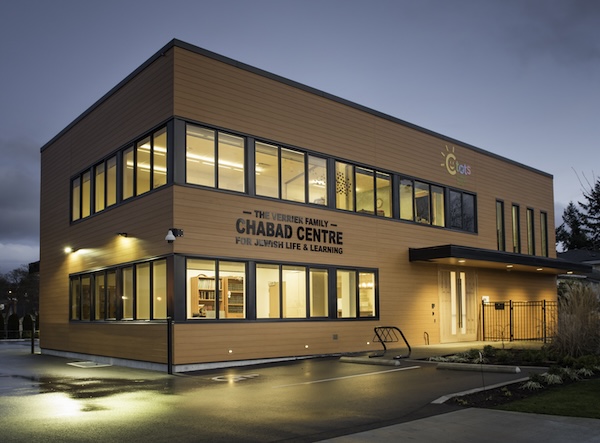
photo - The Verrier Family Chabad Centre for Jewish Life and Learning first opened its doors eight years ago
The Verrier Family Chabad Centre for Jewish Life and Learning first opened its doors eight years ago. (photo from Chabad of Vancouver Island)

A spontaneous day trip to Victoria several months ago led to the December milestone at Chabad of Vancouver Island. I called Rabbi Kaplan from the ferry, and he told me to drop by the synagogue and say hello. When I arrived, the rabbi gave me a tour of the two-storey building which houses the kindergarten, a mikvah, offices, a meeting/study room, a Judaica store and a social hall. The building was light and spacious, and the acoustics were impeccable. I mentioned to Rabbi Kaplan that the Kol Simcha Singers, with whom I sing, would appreciate the great sound in the shul. He was intrigued and suggested that perhaps the shul could host an evening for the choir. On a subsequent visit, I brought Cantor Orzech and, after that meeting with Rabbi Kaplan, the stage was set for the community Shabbaton.

The choir – which includes Matanya Orzech, Sydney Goldberg, Maurice Moses, Hirschel Wasserman, Geoffrey Goldman, Edward Lewin, Terry Barnett and me – made our way from Vancouver to Victoria to lead the Friday night and Shabbat morning services. We were joined for this special occasion by a Kol Simcha singer who grew up in Victoria, as well as a chorister who is originally from Manchester but is now a resident of Qualicum Beach. As we crowded around Cantor Orzech on the bima to chant, in harmony, ancient Shabbat melodies, the shul’s acoustics enhanced our voices and made for a heavenly sound. After services, we enjoyed a Shabbat dinner made by Chef Menajem. We ate downstairs in the bright and cheery social hall, which features paintings from local artists. It was a joyous evening, with Rabbi Kaplan leading some spirited singing interspersed with inspiring words of Torah.

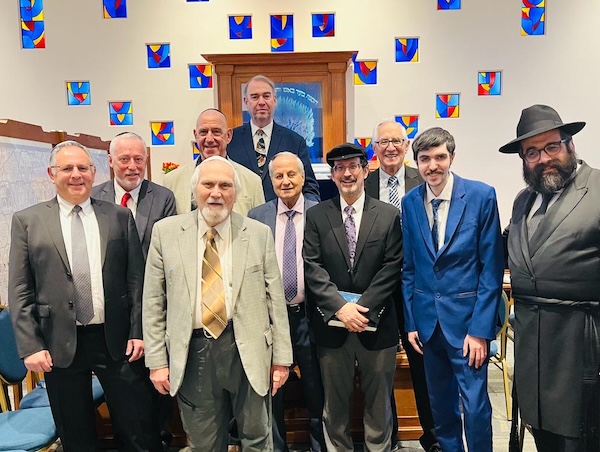
photo - Rabbi Meir Kaplan, far right, with Cantor Yaacov Orzech (back) and the Kol Simcha Singers at Chabad of Victoria prior to the Dec. 22-23 Shabbaton
Rabbi Meir Kaplan, far right, with Cantor Yaacov Orzech (back) and the Kol Simcha Singers at Chabad of Victoria prior to the Dec. 22-23 Shabbaton. (photo from Chabad of Vancouver Island)

Shabbat morning was more of the same, with the choir singing, under the cantor’s direction, songs to honour Shabbat and Israel. During the service, Rabbi Kaplan acknowledged several members of the congregation who have family members serving in the Israel Defence Forces. At lunch afterwards, the choir sang Shehecheyanu, a prayer that commemorates a milestone, because singing at the centre was a new experience for both the choir and Chabad of Vancouver Island. 

At the lunch, Rabbi Kaplan shared that one of our choir members, Terry Barnett, was born in Victoria and had lived there until the 1980s. After the meal, I took a walk with Terry along Cook Road to Dallas Road for a view of the ocean and the Olympic Mountains. For Terry, it was nostalgic being back in Victoria. For me, it was a pleasure to be in the city, too – I had almost moved there several years ago. Terry and I got back to synagogue just in time for ma’ariv, the evening service, and then most of the choir returned to Vancouver.

I stayed over a few extra days and, on Sunday morning, attended services and watched a video of the Lubavitcher Rebbe, Rabbi Menachem Mendel Schneerson (1902-1994), who stressed the need for education in a Jewish community. There were several new programs announced for 2024, including a six-week series entitled Advice for Life, which offers the Rebbe’s guidance for leading a more purposeful life. Registration for the series, which is also held at other Chabad centres, can be made via chabadvi.org or myjli.com. The new program complements the Shabbat and Sunday morning services, weekly classes and adult education and holiday celebrations that the centre offers throughout the year. 

Later that Sunday, I took a walk to some familiar places in Victoria and checked out the Fernwood General Store, which is in the neighbourhood I would have moved to. It’s a small grocery store that used to be owned by South African Jews and that still features a kosher section, with kosher chicken, blintzes, bourekas, gefilte fish, tuna, matzah and grape juice, among other things.

My visit to the island for the December Shabbaton reminded me of how much Jewish Victoria has to offer and brought back memories of another milestone I had the privilege of witnessing, the 150th anniversary commemoration of the Conservative Congregation Temple Emanu-El, the oldest synagogue in continuous use in Canada. Hopefully, I will be able to return to Victoria again to celebrate and perhaps write about another Jewish milestone in British Columbia’s beautiful capital city. 

David J. Litvak is a prairie refugee from the North End of Winnipeg who is a freelance writer, former Voice of Peace and Co-op Radio broadcaster, “accidental publicist,” and “accidental mashgiach” at Louis Brier Home and Hospital. His articles have been published in the Forward, Globe and Mail and Seattle Post-Intelligencer. His website is cascadiapublicity.com.

Format ImagePosted on January 26, 2024February 14, 2024Author David J. LitvakCategories LocalTags Chabad of Vancouver Island, Chani Kaplan, choir, Jewish day school, Kineret Tamim Academy, Kol Simcha Singers, Meir Kaplan, milestones

Posts pagination

Previous page Page 1 … Page 101 Page 102 Page 103 … Page 667 Next page
Proudly powered by WordPress