Skip to content
  • Home
  • Subscribe / donate
  • Events calendar
  • Business Directory
  • FAQ
  • News
    • Local
    • National
    • Israel
    • World
    • עניין בחדשות
      A roundup of news in Canada and further afield, in Hebrew.
  • Opinion
    • From the JI
    • Op-Ed
  • Arts & Culture
    • Performing Arts
    • Music
    • Books
    • Visual Arts
    • TV & Film
  • Life
    • Celebrating the Holidays
    • Travel
    • The Daily Snooze
      Cartoons by Jacob Samuel
    • Mystery Photo
      Help the JI and JMABC fill in the gaps in our archives.
  • Community Links
    • Organizations, Etc.
    • Other News Sources & Blogs
  • JI Chai Celebration
  • JI@88! video

Recent Posts

  • Federation now across BC
  • Israel fighting for its existence
  • Deal strengthens Iran
  • Patriotic belonging diminishes
  • A campaign to engage
  • Upstanders’ first live event
  • Responding to Carney
  • Having your own home
  • Music a family tradition
  • Musical to warm heart
  • Community milestones … June 2026
  • Sharing her passion for Israel
  • Or Shalom reopens its doors
  • JFS from past to future
  • Need holistic approach
  • Sharing stories, advice
  • Journalist shares fears
  • Skills to live together
  • Road to independence
  • Cutting grass with scissors
  • Zionism as a solution
  • Deceit, desire & the divine
  • Reclaiming sacredness
  • Creative project ideas
  • Summer squares and cobbler
  • Thou shalt … summer commandments
  • Legal help for students
  • Revisiting myth of Lilith
  • Wrong person rebuked
  • Canada’s mixed messages
  • Questions for museum
  • Symposium on antizionism
  • Making soccer political
  • CJPAC lauds Pulver’s impact
  • City recognizes Vrba’s legacy  
  • Organ donation saves lives

Archives

Follow @JewishIndie
image - CJN box ad Rockowers 2026

Category: Op-Ed

Don’t wait to tell story

The other day, I went looking for a friend I met during my university days, one I had lost touch with after years of companionship. I looked him up on the internet and discovered to my dismay that he had passed away some 11 years ago. I was too late to hear his story from his own lips. I was too late to tell him my story from my own lips to his conscious mind. I felt robbed of something I felt I was entitled to. Up until the moment I learned of his fate, he was very much alive for me.

Recently, an acquaintance of my Bride’s, someone I had gotten to know through her, a person we had been visiting because of an illness, died in hospital. She unexpectedly took a turn for the worse and, in the space of seven days, had changed from someone we had been conversing with, to a mere body. I am not a stranger to this phenomenon, having lost a spouse similarly to a lingering disease, but I was shocked at this sudden transition.

I am long since retired from being an active presence in an enterprise. I recently gave up being an active manager of my own financial affairs. What I have evolved into during the last decade or so is being a teller of stories. I am still very busy at that. One of my greatest pleasures is to hear from one of my correspondents that I have expressed for them their very thoughts, if only they had put a pen to them.

All of us have stories we want to tell. We all have lots to say, lots we wish to say. Often, we do not go to the trouble of communicating our thoughts and experiences. Too often, our stories die with us. I think that is a pity. I am trying my best to ensure I am not guilty of that.

It has been a long time since my thoughts have been shared with millions of listeners. It has been many years since mine was a household name. Little matter! Though my stories, as of late, have been shared with only a few, my pleasure is gained in the telling. And in the rare responses of some of my fellows. And in the continuing hope that I leave some residues of thought here and there. That is my immortality. (Not true, of course, as I have been blessed with progeny, but you know what I mean.)

These days, death stalks us with every breath we take. The “us” I speak of are those among us who often have more stories to tell than our younger companions, by virtue of our having been around longer. We seem to be more vulnerable to the rampant virus seeking a place for replication in the air we breathe, and this vulnerability is a reminder of how important it is to take the trouble to share some of the riches many of us have dearly accumulated. The stories we have not yet told die with us.

I am highlighting this part of our mission in life. We have held a job and hopefully it contributed something. It gave us a livelihood, which may have allowed us to raise a family and accumulate something material to pass on. We may have shared things and thoughts with others, publicly and privately. We may have enriched our own lives and the lives of others. We have stories to tell. Wouldn’t it be a pity not to share them with others? Surely there are valuable secrets in that treasure chest! Even the things you may not be proud of may have paid off in valuable lessons that you made good use of.

There is a reason for us to survive the dangers around us a little longer. So, please, more masks, more handwashing, more social distancing! We need to hear your stories before you go. You owe it to your public. You owe it to yourself.

Max Roytenberg is a Vancouver-based poet, writer and blogger. His book Hero in My Own Eyes: Tripping a Life Fantastic is available from Amazon and other online booksellers.

Posted on August 21, 2020August 20, 2020Author Max RoytenbergCategories Op-EdTags aging, coronavirus, COVID-19, identity, lifestyle, storytelling

Let’s restore ancient holiday

It is time for Jews to restore and transform the ancient and largely forgotten Jewish holiday of Rosh Hashanah l’Ma’aser b’Heimot (the New Year for Tithing Animals) into a day devoted to considering how to improve our relationships with animals. The holiday occurred on the first day of the month of Elul (Aug. 21 this year) and was initially devoted to counting domesticated animals intended for sacrificial offerings (Mishnah, Seder Moed, Tractate Rosh Hashanah 1:1).

There is a precedent for such a transformation. Rosh Hashanah l’Ilanot (New Year for Trees), a day intended for tithing fruit trees for Temple offerings, was reclaimed in the 17th century by mystics as a day – Tu b’Shevat – for appreciating nature and its beauty and bounty.

It is important that Rosh Hashanah la’b’Heimot (the New Year for Animals) becomes a day devoted to increasing awareness of Judaism’s powerful teachings on the proper treatment of animals and to a tikkun (healing) for the horrible ways that animals are treated today on factory farms and in other settings.

Currently, with regard to animals, Jewish religious services, Torah readings and education are primarily focused on the biblical sacrifices, animals that are kosher for eating, and laws about animal slaughter. This emphasis on animals that are to be killed should be balanced with a greater emphasis on Judaism’s more sympathetic teachings; for example, “God’s compassion is over all his works [including animals]” (Psalms 145:9) and “the righteous person considers the lives of his or her animals” (Proverbs 12:10). Another example is that farmers are not to yoke a strong and a weak animal together, nor to muzzle an animal while the animal is threshing in the field. As well, the Ten Commandments indicates that animals, as well as people, are to rest on the Sabbath day and there are many parts in the Torah mandating that Jews are to avoid tsa’ar ba’alei chaim, causing any unnecessary “sorrow to animals.” Moses and King David were deemed suitable to be leaders because of their compassionate care of sheep when they were shepherds.

Despite these and additional teachings, most Jews ignore the widespread abuses of animals. For example, egg-laying hens are kept in cages so small that they can’t raise even one wing, and they are debeaked – without the use of anesthetics – to prevent them from harming other birds by pecking them, due to their natural instincts being thwarted. More than 150 million male chicks are killed annually, shortly after birth, at egg-laying hatcheries because they can’t lay eggs and haven’t been genetically programmed to have much flesh. Dairy cows are artificially inseminated annually so that they will be able to continually produce milk, and then their babies are taken away almost immediately after birth, often to be raised for veal, under very cruel conditions.

Renewing and transforming the ancient holiday is especially important today because a shift away from animal-based diets, in addition to lessening the mistreatment of animals, would reduce the number of diet-related diseases that are afflicting Jewish and other communities. A shift would also reduce environmental and climate change threats to humanity that are greatly increased by the massive exploitation of animals for food. And it would encourage Jews to consider plant-based diets that are more consistent with Jewish mandates to preserve human health, treat animals with compassion, protect the environment, conserve natural resources, help hungry people, and pursue peace and justice.

Transforming the holiday would show that Judaism is applying its eternal teachings to today’s important issues, and improve the image of Judaism in the eyes of people concerned about animals, vegetarianism, the environment and related issues, by reinforcing a compassionate side of Judaism. The holiday might even bring back some Jews who are currently alienated to some extent from Judaism, especially those who are concerned about animal welfare, and strengthen the commitment of vegetarian and vegan Jews who are already involved in Jewish life, but feeling somewhat outside the Jewish mainstream, as they are often among a small minority in their congregations.

The first day of the Hebrew month of Elul is an appropriate time for this renewed holiday because this date is the beginning of the month-long period of introspection during which Jews are to examine their deeds before the High Holidays of Rosh Hashanah and Yom Kippur. Starting on that date and for the entire month of Elul (except on Shabbat), the shofar (ram’s horn) is blown in synagogues during morning services to awaken people to their responsibilities, and that is an appropriate time to consider how we can improve conditions for animals. It is significant that, for chiddur mitzvah, to enhance mitzvot (commandments), the shofar and other ritual objects should ideally come from animals that have been raised without cruelty and have died natural deaths.

A coalition of Jewish groups is leading a campaign to make this renewed holiday an important part of Jewish life today and I was part of recent Zoom events in the United States, United Kingdom and Israel, at which rabbis, Jewish vegetarian and vegan activists, and environmentalists discussed many issues related to the renewal initiative and answered questions about it. The group is also compiling lists of Jewish organizations, rabbis and other influential Jews who support the initiative. And it is planning to use the next year to create sample holiday haggadot, outlines of sample holiday seders, and other materials that can help expand holiday activities in the coming years.

Working to renew an ancient Jewish holiday that most Jews are completely unaware of may seem audacious, but it is essential, in my opinion, to helping revitalize Judaism, improving the health of Jews, sharply reducing the massive mistreatment of animals, and shifting our precious but imperiled planet onto a sustainable path.

Richard H. Schwartz, PhD, is professor emeritus, College of Staten Island, president emeritus of Jewish Veg and president of Society of Ethical and Religious Vegetarians. He is the author of several books, including Judaism and Vegetarianism and Who Stole My Religion? Revitalizing Judaism and Applying Jewish Values to Help Heal Our Imperiled Planet, and more than 250 articles at jewishveg.org/schwartz. He was associate producer of the documentary A Sacred Duty: Applying Jewish Values to Help Heal the World.

Posted on August 21, 2020August 20, 2020Author Richard H. SchwartzCategories Op-EdTags animal protection, environment, Judaism, New Year for Animals, Rosh Hashanah la’b’Heimot, Rosh Hashanah l’Ma’aser b’Heimot

Stay home for the High Holidays

At its best, the Jewish community does amazing things in the spirit of pikuach nefesh, to save a life. At services, if someone faints, there’s silent networking. Within seconds, multiple medical professionals surge forward silently to attend those medical emergencies. I heard that one crack team included a gynecologist, a neurologist and a dermatologist – and a nurse who managed better than all the specialists together. In these situations, the Jewish priority is clear. It’s taking care of health and well-being first.

I was recently studying a page of Talmud, Shabbat 129a. It examines healthcare issues through a Jewish lens of 1,500-plus years ago. The rabbinic commentaries throughout the ages update medical practice as time passes.

There’s a section discussing when a woman in childbirth needs Shabbat to be desecrated. When a baby is born, it’s a potentially life-threatening situation. Therefore, halachah (Jewish law) is lenient. The people near a woman giving birth must do what she needs, even if it breaks the Sabbath. Depending on which rabbi you consult, this leniency can last awhile: from three to 30 days.

On the same page, the rabbis discuss bloodletting. We recognize today that this ancient medical treatment is almost never advisable. Bloodletting was seen then, though, as being both medically necessary and very dangerous. There’s acknowledgement in the Talmud that this is a difficult experience. Different scholars recommend how to recover best with food, wine, rest or being in the sun. It sounds awful. Over time, different commentators reflected their views on limiting this scary treatment. Maimonides advised against it in Mishneh Torah, aside from “when there is an extraordinary need for it.”

I thought about this as I read an online forum about High Holidays this year. It won’t be surprising to hear that, in many congregations, there will be services streamed online; brief, outdoor services; or some kind of limited, small group get-together. In the COVID-19 era, we know that social distancing, wearing masks and avoiding large gatherings are all important ways to avoid getting sick.

Jewish tradition emphasizes our need to gather as a community. For many, this is why we attend services. However, as I heard on this forum, congregations sought input from their communities, and some of the questions struck me as absurd.

What would you miss about High Holiday services? The list was long: hearing speeches from the synagogue board, receiving aliyot, seeing friends, saying Yizkor with the community, hearing the rabbi’s sermon, breaking fast together, doing Tashlich, and more. There were awkward questions: If only a small, socially distanced group (of 10, 25, 50, etc.) can gather, will you be upset if you aren’t included?

The questions, asked in various ways, were, “What will make this holiday meaningful for you? How can the congregation provide that?”

Everyone thinks something different is meaningful. If only one thing were meaningful, we could all do it and be done with services in 10 minutes. (Or whatever ritual event we’re considering.) For me? I would say “meaningful” is when your congregation doesn’t become a contagious hotspot for coronavirus.

For those who feel slighted about not being in synagogue, consider if only a small congregation is allowed. Think about what is more meaningful: experiencing the High Holidays differently, streaming services at home and knowing your congregation hasn’t endangered a single person’s health, or being there in person and risking everyone’s health by spreading the virus through the congregation?

To me, the most important thing we – as individuals and as a congregation – could do is to help everyone have a healthy, happy, meaningful year. If that means avoiding groups, we should pay for our customary tickets or synagogue dues and stay home.

If streaming doesn’t work because of your observance level or because you’re “Zoomed out,” you have options. Perhaps bake some honey cake, call up friends and family to catch up before the holiday, ask forgiveness, and wish them happy New Year. Then, pray alone or with your immediate family. Find some relevant books to read, take a hike in nature, etc. There are other ways to observe these holidays.

As a new mother, I explored this issue previously, when I had my twins and had no child care. Babies need what they need. They don’t care what day it is. I streamed some very good services and sermons while juggling twins through infancy, toddlerhood and preschool.

We’ve already observed a long series of holidays – many Shabbats, Passover and Shavuot – at home by now. Pre-pandemic, I found meaning in different ways: a summer Shabbat service, Shavuot ice cream, Simchat Torah dancing or sitting in my backyard sukkah.

Sometimes, just sitting still is the point. My twins are 9 now. They will “attend” services with us in our living room this year, just as we do on most Shabbats these days.

Watching my kids sing along at home as they set up Lego minyanim in preparation also has meaning. They debate where all their animals and robots should sit in their made-up congregation, directly in front of the iPad streaming services.

No one scenario has the market cornered on “meaning.” However, that Talmud page, Shabbat 129a, offers a window through which we can study how medical care changes and evolves. We no longer think bloodletting is a necessary procedure, but rather just a dangerous one. The underlying message about childbirth and health care is that the rabbis teach us to be lenient about any life-threatening situation.

We’ll learn more about this coronavirus as time passes. Meanwhile, while we need to acknowledge our feelings, we can’t let our personal upset be what’s important – that’s just selfish. I, too, miss being in the physical congregation space, but not enough to endanger a single immune-compromised or elderly person who might attend. Choosing a lenient position about how to fulfil our religious obligations in this dangerous time is key.

For some, it’s early to be dwelling on the fall holidays, but it’s not too soon to buy your “virtual services” ticket. Invest in your community’s future financial health and make a plan for how to make your observance special. Knowing we’ve prioritized pikuach nefesh first? That’s priceless.

Joanne Seiff has written regularly for CBC Manitoba and various Jewish publications. She is the author of three books, including From the Outside In: Jewish Post Columns 2015-2016, a collection of essays available for digital download or as a paperback from Amazon. Check her out on Instagram @yrnspinner or at joanneseiff.blogspot.com.

Posted on July 24, 2020July 22, 2020Author Joanne SeiffCategories Op-EdTags coronavirus, COVID-19, High Holidays, Judaism, lifestyle, pikuach nefesh
No Silence on Race

No Silence on Race

An open letter from Black Jews, non-Black Jews of colour and our allies to Jewish congregations, federations, foundations, organizations, nonprofits and initiatives, dated June 30, 2020.

We write this letter as proud members of the Canadian Jewish community. We are Black Jews and non-Black Jews of colour. We are Jewish community board members, educators and leaders. We write from a place of love for our Jewish identities and community, while also grappling with the cultural erasure, exclusion and structural racism that we experience in Jewish spaces. Nevertheless, we are compelled to be in Jewish community because it is who we are.

Over the past month, we have witnessed a racial reckoning within Canadian institutions. Police violence against Black and Indigenous people has continued unabated, with numerous deaths, including that of D’Andre Campbell, Eishia Hudson, Jason Collins, Regis Korchinski Paquet, Everett Patrick, Chantel Moore, Rodney Levi, Ejaz Ahmed Choudry and countless others. In the United States, the tragic murders of Ahmaud Arbery, Tony McDade, Breonna Taylor, Sean Reed, George Floyd, David McAtee and Rayshard Brooks have gripped the collective consciousness and have been the catalyst for a global call to action. We have witnessed and participated in protests and in conversations for structural change across all sectors and our Jewish community is not exempt from this dialogue.

No Silence on Race is born out of the necessity for inclusivity and racial equity in Jewish spaces. We acknowledge and are grateful for the longstanding work that Jews of colour and Jewish allies in Canada and the United States have dedicated themselves to in addressing structural racism within the Jewish community.

In this letter, we call on our Jewish community to uphold the tenets of justice and equality and to commit to the creation of a truly anti-racist, inclusive and equitable Jewish community.

The work that needs to be done to achieve this vision must happen collectively and systematically. To guide its implementation, we have devised nine pillars outlined below. These pillars are intended to support Jewish congregations, federations, foundations, organizations, nonprofits and initiatives in their transformation towards greater inclusivity and equity.

If you are aligned with the creation of an anti-racist, inclusive and equitable Jewish community, we ask that you sign this letter in support [at nosilenceonrace.ca]. If you are an organization, we ask that, in addition to signing your name, you write a public statement expressing your commitment to achieving this vision.

The nine pillars are:

1) Allyship: creating anti-racist, inclusive and equitable Jewish spaces begins with each individual. We call on everyone within their organizations to make a personal pledge to the work of allyship and to devise a personal plan of 10-15 comprehensive ways they will work towards becoming strong allies and leaders in the creation of more inclusive and equitable Jewish spaces.

2) Education: engage external facilitators for organization-wide anti-racism and anti-oppression education and training led by Black Jews, Jews of colour or people of colour consultants or consulting organizations.

3) Indigenous education and relationship building: engage in education about Indigenous peoples in Canada and cultural competency training. Build meaningful relationships with local Indigenous communities.

4) Equity consultancy: work with an equity consultant with a specialization in anti-racist work to formulate a multi-year strategic plan for your organization to create a roadmap towards inclusion, equity and anti-racist practices. This includes implementing non-discrimination policies, equitable hiring policies, anti-racist frameworks for organizational decision-making and a procedure to report and investigate any breaches of this policy.

5) Employment and recruitment: implement strategies to ensure equitable representation in your staffing, as well as development and retention planning to ensure these practices are adequately conducted.

6) Equity, inclusion, anti-racism advisory: accountability is essential. Create an advisory group to ensure that the equity-and-inclusion policy and strategies implemented are upheld at all levels of the organization. Create metrics to track ongoing anti-racism work.

7) Jews of colour leadership strategy: invest in a leadership strategy to ensure that Jews of colour are poised to be adequately represented in leadership roles in the community. This can include mentorships, educational scholarships and project grants.

8) Programming/events/partnerships: commit to more programming and partnerships with cultural institutions, with the goal of engaging in and elevating a diverse range of Jewish diasporas and histories.

9) Amplify the voices of Jews of colour in Canada: demonstrate explicit support for Jews of colour community groups and active initiatives. Engage in substantial outreach efforts.

We acknowledge that change takes time and recommend Jewish organizations create their own timelines for achieving the nine proposed pillars. We have designed these pillars as a guideline and we encourage all organizations to be intentional and creative in their implementation. While organizational priorities may have shifted amidst the realities of COVID-19, it is imperative that our community does not remain silent about how racial inequity plagues Jewish spaces. We look to the entire Jewish community in Canada to challenge ourselves to do more and to envision the path forward.

Jewish scholars as far back as Rabbeinu Bachya ben Asher, a significant rabbi and scholar from 13th-century Spain, call us to seek “Justice whether to your profit or loss, whether in word or action, whether to Jew or non-Jew.” So, we set our sights on July 9, which this year mark[ed] the fast of the 17th of Tammuz, where we begin the three-week period of mourning leading up to Tisha b’Av.

Tisha b’Av commemorates the destruction of the Temple. It is a time where we reflect on the divisions within our community. But, more importantly, it is a time to reflect on the cost of allowing those divisions to persist. During this holiday, we recognize the importance of taking a more active role in challenging each other and of doing more to make amends. It is in this spirit that we invite Jewish organizations across the country to engage in listening, introspection and action.

Creating anti-racist, inclusive and equitable Jewish spaces will require deep self-reflection, difficult conversations and an ongoing commitment to reimagining what the Jewish community can look like. Above all, it must be guided by the celebration of Jewish culture and a love for one another.

For individuals and organizations who believe in this movement, we invite you to join us in action by adding your name to this letter. We call on organizations to sign their name with the intention to issue a public statement by July 29, outlining your commitment to the vision of creating a more inclusive Jewish community.

The ground is shifting beneath us in ways that are undeniable and it is incumbent on each of us to play a role in shaping our collective future. When we honour our commitment to each other as Jews, our communities will reflect the beauty and diversity that truly exists within our culture.

Sara Yacobi-Harris, Akilah Allen-Silverstein and Daisy Moriyama

Format ImagePosted on July 10, 2020July 9, 2020Author No Silence on RaceCategories Op-EdTags Akilah Allen-Silverstein, anti-racism, Daisy Moriyama, education, equality, inclusion, Judaism, Sara Yacobi-Harris, tikkun olam
Misappropriation of Israeli flag

Misappropriation of Israeli flag

According to the Associação Scholem Aleichem, in Rio de Janeiro, right-wing religious groups are misappropriating the Israeli flag in their show of support for Brazilian President Jair Bolsonaro. (photo from ASA)

This article is a response to the continuing misappropriation of the Israeli flag by right-wing religious groups, followers of a certain Christian belief known as “progressive dispensationalism” (no political connotation), whose adherents support Brazilian President Jair Bolsonaro.

Bolsonaro and his stalwarts have consistently raised the Israeli flag while promoting their reactionary views and hate-mongering. Most recently, several Israeli flags were displayed at a public rally in support of Bolsonaro and his policies regarding COVID-19, including his stance against preventive measures such as social distancing and stay-at-home orders, and the championing of hydroxychloroquine as a sufficient means of treatment and prevention.

Within any nation, there may be contention over its symbols. Two Brazilians may wield the same flag in favour of two different ideals. Such a case is restricted to members of the same country. Likewise, as the state of Israel was created to take in and represent Jews, the only non-Israelis who may claim its flag are Jews from other countries. If non-Jews raise an Israeli flag, for whatever reason, they appropriate a symbol that is not theirs. This is all the more serious in a prejudice-filled world in which various peoples have been losing the right to tell their own story.

It is only natural – indeed, healthy – that Jews, in Israel or elsewhere, should discuss the meaning of a Jewish state. Debate has always been part of our culture, and we have never felt the need to agree on everything. But the spokesperson of another people, by seizing another nation’s symbol, makes it the hostage of their own political agenda. It is one thing to raise the Soviet flag, conceived by a party as an emblem of an international revolution. It is not so much an appropriation of a national symbol as it is an endorsement of Bolshevik ideology. The Israeli flag, by contrast, was meant to rally a people in the Diaspora. Jews outside Israel may brandish it; a non-Jew would be overrunning someone else’s realm.

Throughout history, we Jews have constantly encountered non-Jews ready to ascertain if we are a religion, a race or a nation. The consequences have always been tragic. Yet, just as it is for every people to define itself, it is a Jew’s prerogative to determine the depths of his or her Jewishness and, likewise, to determine his or her relationship with Israel. Nowadays, many Christian groups believe that the Second Coming of Jesus will be ushered in by the regrouping of all Jews in the “Holy Land.” It is no gesture of goodwill toward Jews, just another of the many ways of inserting us into a foreign narrative.

Strains of thought within dispensationalism grant Israel an importance peculiar to their religious aspirations, but the country was not established for this reason. Christian dispensationalism sees history as a series of specific stages (“dispensations”) of the “administration” of the “divine plan.” In this scheme, the prevalent trend has imputed a particular role to “the ethnic nation of Israel” – “Israel,” the people chosen for Jesus’s divine revelation. Its fulfilment entails “the end of disobedience,” namely, the embracing of Jesus as our saviour. This entails a kind of eschatological glorification of the Israeli state. Let it be said that this is no favour for Jews. Indeed, were that “dispensation” to come to pass, it would be the effective end of Judaism. Not a single architect of the state of Israel could have entertained such a notion.

But that is not all. To blur the purpose of the Jewish state with the myth of “Israel’s salvation” is to cloud public opinion and impair its perception of what Israel can – and should – represent. Far more troubling, however, is that these very same groups that preach the aforementioned Christian theory and misappropriate the Israeli flag also polarize the political climate wherever they live. In Brazil, they hold considerable sway, and their conduct is extremely controversial, to say the least. The improper use of Israeli symbols links us Jews to these controversies in a wholly detrimental fashion. And regardless of the collaboration between the current Brazilian and Israeli governments – the current Brazilian government has a strong ideological identity with the Netanyahu government, and its members seek to establish profitable commercial relations with Israeli companies – flags symbolize states, not governments.

Brazilian Jews may and should oppose “bolsonarism,” but a delusion under which Bolsonaro links his policies to a universe as complex and diverse as Israel’s will always be harmful. For starters, there is a cultural element to the issue: Bolsonaro is Brazil’s representative, and a disgraceful one at that, but he does not represent Israel in any shape or form, disgracefully or otherwise. It requires immense ignorance on his part to equate the Israeli experience with his political project.

And there is another level, of a more political note. Israelis have their own problems and, regardless of the kind of society they wish to make, it would be detrimental to link it to Bolsonaro’s administration, with all the dire misfortunes the latter casts upon Brazil.

Finally, there is a matter of principle. By parading his submissiveness towards the United States, saluting its flag and playing the lackey to its president, Bolsonaro undermines the sovereignty of his country and degrades his own authority. By juxtaposing Israel’s flag with those of Brazil and the United States, he seizes someone else’s authority and, above all, affronts the sovereignty of someone else’s country. He transgresses the complexities of Israel’s society to subject it to the same submissiveness he expects for Brazil. The United States has a long history of interference in Brazilian affairs and in those of Latin America in general. This – and the specific perversity of the current U.S. president – adds further weight to Bolsonaro’s folly.

The misappropriation of the Israeli flag effectively represents a transgression of the meaning of Israel, regardless of its government, a disdain for the liberty of the Israelis, regardless of their religious tradition and ethnic identity, and a hindrance to the personal choices of Jews, regardless of our country. As Brazilians, we assert that Bolsonaro lacks standing to uphold national sovereignty. As Jews, we maintain that he lacks legitimacy to wield the Israeli flag – and that he is both fraudulent and destructive when he does.

Esther Kuperman submitted this article, which was written by the Associação Scholem Aleichem, in Rio de Janeiro ([email protected]). ASA is a century-old institution founded in Brazil by Jews who came from Europe in search of security and survival, fleeing persecution and wars. Its main mission is the cultivation of Jewish culture, without losing sight of Brazilian cultural manifestations and the defence of human rights.

Format ImagePosted on July 10, 2020July 9, 2020Author Esther Kuperman ASACategories Op-EdTags Associação Scholem Aleichem, Brazil, culture, Israel, Jair Bolsonaro, politics, religion

Hospitality & social distancing

Last weekend, one of my kids and I decided to make bourekas. Made with filo dough, ours were stuffed with two fillings: spinach and cheese, and mushroom and cheese. They were such a success that the family ate all of them in a couple days.

We marveled at how hard it was to make the filo dough into the perfect triangles we remembered, as my sister-in-law’s family holiday events often feature these. Her family is part Turkish and no Jewish holiday would be complete without some of her specialities.

We won’t be eating Aunt Jenn’s bourekas any time soon, however. She lives (with the rest of our families) in the United States and the border’s closed. Even if it were open, it’s not a safe time to travel, due to the pandemic. But, my son and I really miss her and, in our recent cooking foray, we realized that she has a lot of filo dough skills!

If you’re like us, you may be reminiscing about birthday parties or neighbourhood block parties, a backyard barbeque with friends, or even a big family get together at a picnic shelter. It seems like a really crucial part of our Jewish identities is wrapped up in food and feeding others and making them feel welcome. It’s modeled first in Abraham and Sarah’s tent, as they welcome strangers, wash their feet and feed them, but most of us have friends and family who continue to show us how to do the mitzvah of hachnasat orchim, welcoming guests.

Back in March, when our family realized that we would be home schooling for some time to come, we moved around the dining room furniture. We fit in two side tables as desks for the kids. We shifted the dining room table so that the four of us have ample room. It was the first time in my married life (22 years) that we didn’t have extra chairs at the table, “just in case” we had guests.

This definite lack of company sometimes feels sad and lonely. I’m not the only person struggling with this. However, some of the COVID-19 research seems to indicate that the virus isn’t spread via socially distanced street protests (with masks) but rather, at parties. That’s it – when we gather to eat and drink, when we forget to social distance or when we mingle with others for extended periods, we have a greater risk of getting sick.

Where does this leave us? A much less commonly known part of Jewish tradition is that of “giving people space.” Whether it’s the time that married couples spend apart each month, among those who observe the family purity laws, or the notions around tzinut (modesty) or treating your body with respect (as a temple, in fact), these aren’t the most commonly observed Jewish mitzvot these days. The notion of “space” as part of Jewish time is not very popular. However, this is precisely what I thought about as I took a long walk with my twins and one of our dogs.

It was hot. My kids know to hold hands when crossing a street and to stick close to me, but, on summer days in Winnipeg, we may stretch out a bit on the sidewalk. There’s one kid trying to catch a bug on the grassy boulevard, while another one wanders along beside me, chatting about dinosaurs. Our Gordon Setter mix, attached by a sturdy leash, doesn’t let that stop her when she sees a squirrel or bunny, and my arm shoots out across the walkway. You can imagine it – we take up room.

Our streets are wide. Most Winnipeggers aren’t wearing masks to take a walk because it’s rarely necessary to be anywhere near others unless they are relatives. When I see someone coming, I call everyone together. We gather closer to social distance from whomever is passing.

On this morning, the first adults who passed us, strangers who went by one at a time, made no effort to social distance, they didn’t greet or acknowledge us. I herded all four of us to the side, quickly. It is somehow always my job each time to create social distance. (I’ll note here that these adults were in the 60-and-up category. None of them was a young adult, the age group blamed in the media for being lax when it comes to taking care during a pandemic.)

By the time a third person came by, I was wary, already organizing kids and dog to swerve into someone’s front walk way. To my surprise, this person saw what I was doing. She smiled and walked in an arc onto the grass to give us room. I thanked her, we chatted briefly. We all smiled. I was so grateful.

Then something struck me. True hospitality is anticipating someone’s needs and graciously trying to meet those needs. Hospitality doesn’t have to be about feeding others or welcoming them in. Yes, we need to feed those who are less fortunate but, probably, we don’t need to insist on cooking for other gatherings personally in order to provide everybody food and drink.

Also, welcoming and greeting others, treating them graciously, doesn’t require bringing anyone into our houses (or, in Abraham’s case, a tent). It might mean ceding the sidewalk, smiling and saying hello to others as you pass – at a distance. It might include trimming your hedge so that there’s room on that sidewalk for a wheelchair or stroller to pass.

These are Jewish concepts: in protecting a life, treating bodies respectfully and giving others the right amount of space, we practise a kind of hospitality. This means caring about others and anticipating their needs.

So, please, when you see that mom with several kids, a person using a wheelchair, someone carrying a heavy load or someone pushing a double stroller on the sidewalk, give way and step aside. It’s the right – and the kind, hospitable – thing to do.

Joanne Seiff has written regularly for CBC Manitoba and various Jewish publications. She is the author of three books, including From the Outside In: Jewish Post Columns 2015-2016, a collection of essays available for digital download or as a paperback from Amazon. Check her out on Instagram @yrnspinner or at joanneseiff.blogspot.com.


Posted on July 10, 2020July 9, 2020Author Joanne SeiffCategories Op-EdTags coronavirus, COVID-19, hospitality, Judaism, lifestyle

The complex skin we’re in

As a young adult, I was often criticized for being too blunt. I didn’t always behave the way that my family wished I would. I would call people out when they were being inappropriate. This got me into trouble. And, to be honest, that didn’t always bother me enough to stop doing it.

Others made me feel embarrassed – because my job, throughout my teen years, was to behave properly, say the right things and “act like a lady.” In Virginia, this was necessary. My mother served the Jewish community as a director of education and, later, as a temple administrator, and her children’s behaviour was sometimes a reflection on her.

Though my mom was in charge of a $6 million renovation the year before she retired, she was often slighted in her professional life because of her gender, which affected me, too. My body and behaviour were policed, for example. I was told that I shouldn’t be running by the temple in my leggings (running clothing), as “people” looked at me. What was meant by that?

I looked like my mom, and my (in today’s view, entirely appropriate) exercise clothes caused men to look at me – and, therefore, were an embarrassment. Even as a Reform Jewish professional, my mom was a woman. That was problematic. As her daughter, my body and presence could be embarrassing, too.

Being Jewish in Virginia meant there weren’t many Jewish kids in my public school classes. Even weirder, it was being the daughter of a Jewish professional in what was then a small Jewish community that made me understand what it felt like to feel “othered.” People looked at me differently.

It also made me see those who were always treated “differently” – like people of colour. I saw how much harder things were for them. This isn’t ancient history. I graduated from high school in 1991.

After I finished university, I went into a special inner-city accelerated teacher’s program. This allowed new graduate students earning their master’s in education a chance to do their student teaching by replacing teachers who “needed training” in the Washington, D.C., public schools. This program supported an ailing inner-city school system where the (largely African-American) teachers worked longer to earn their retirement pension than anywhere else. These tired and burnt-out high school teachers lacked opportunities for continuing education and basic classroom supplies. They often just needed a break. Most of the students’ families struggled financially and, yes, most of the kids that I taught were African-American or from immigrant families.

In those classrooms, I saw how privileged I’d been in the suburbs. The D.C. public schools were underfunded and in terrible disrepair. Imagine magnificent historic buildings with high ceilings and real slate chalkboards – but it rained inside, the copiers were broken and there were no class sets of books to assign.

When there were fires, the fire trucks didn’t show up. In Anacostia High School, the African-American principal put out the fires himself. These communities weren’t offered basic city services. Instead, there were frequent arrests, for things like “driving while black,” as my friends put it.

I’ve been sad, angry and frustrated about this racial injustice for a long time. I’ve witnessed it – and Jewish tradition tells us to speak out, to pursue justice and to try to fix the world’s wrongs.

Yet, just as Judaism teaches us what it means to be set apart, or even discriminated against, ostracized and singled out, our (mostly male, white, privileged) culture has pushed us to behave according to its norms.

“Being a lady” often meant not embarrassing our families by calling out people who said racist or inappropriate things. It meant that I shouldn’t run by, entirely covered up, because my female body might be a distraction.

Being ladylike? It’s learning that how one looks is distracting, offends others, is reason enough to stay home, or feel ashamed. It’s struggling between speaking out and keeping quiet, so as not to pick a fight.

Sometimes, I’ve just chosen to keep my mouth shut, because it’s not worth the fight, it’s not ladylike, or “Honey, now’s not the time.” But it was wrong to stay quiet when I heard people making others “less” or demeaning them. It’s wrong to say nothing as someone uses degrading language, tells racist stories or implies that someone “deserved what he got” essentially by being a black person or an indigenous person in the wrong place at the wrong time.

Growing up as a Jewish person in a non-Jewish area, and as a female, gave me some insights into this discrimination, but, if I behaved the “right way,” or didn’t act “too Jewish,” (?!) I could pass where I grew up and where I live now, in Winnipeg.

In the Talmud, in Shabbat 95a, there’s a discussion about how to properly sprinkle the floor of a room on Shabbat. It’s a way of cooling a hot space, but it isn’t allowed by the rabbis on Shabbat if the floor is dirt because a dirt floor could be changed by water remolding it. If the floor were stone, it might provide cooling and still be allowed. One sage concludes that a wise woman would know how to do this and avoid breaking Shabbat rules.

The rabbis gave credit to smart women for knowing how to follow the rules and make a change for the better.

This pandemic year has been about colossal change. It might also be time to ditch the “ladylike” models in favour of those talmudic wise women, who make change happen, “cool things down” during a hot summer and find ways to do it while mostly abiding by the rules.

The rules themselves, whether talmudic or modern, are still largely made by men. It’s time to recognize that the “others” – Jews and members of other minority faiths, women, those in the LGBTQ+ community, people of colour and everyone who still faces discrimination and racism – deserve the equality and justice we are all due.

It’s time. In fact, it’s long overdue. Our history as Jewish people, as Canadians and North Americans, requires us to own this injustice and fix it. It’s time to change ingrained, prejudiced habits and speak out.

Jewish tradition teaches that we’re all made in the Divine Image, in every colour and gender. Now we must step up, say so and act as if we mean it.

Joanne Seiff has written regularly for CBC Manitoba and various Jewish publications. She is the author of three books, including From the Outside In: Jewish Post Columns 2015-2016, a collection of essays available for digital download or as a paperback from Amazon. Check her out on Instagram @yrnspinner or at joanneseiff.blogspot.com.


Format ImagePosted on June 26, 2020June 24, 2020Author Joanne SeiffCategories Op-EdTags anti-racism, Judaism, lifestyle, racism

Rabbinic planting advice

My family plants a garden every summer. We live in a city and don’t have lots of room. Since our house is more than 100 years old, we created small raised beds, filled with compost and soil, to avoid growing veggies in what is potentially contaminated soil.

Although my husband and I have gardened together for years, when our twins were younger, we developed a haphazard technique. Before twins, we might have studied companion plants, figuring out what would grow best and where, but all that disappeared after two babies came on scene. Since then, every year, right around their birthday on June 1, we’d throw a planting party with some friends. First, we had the birthday ice cream cake and, then, we’d dig together. Within an hour, the entire garden was planted.

Sometimes, a retired history professor was in charge of bean planting. Our actor friend, who also worked as a mother’s helper for us when the kids were small, was in charge of squash. It was sometimes a surprise to see what the garden produced. We left it all to chance – what grows and what fails would be a surprise.

This year, no parties, of course. With two kids home from elementary school in mid-March, we started seeding. We planted lettuce, radish and spinach outdoors. We followed the advice of Winnipeg’s mayor, who suggested people “plant an extra row” for the food bank, as so many are out of work. We planted sprouting potato peelings as one of our home-school science projects, and filled every extra pot with potato plants.

In the Babylonian Talmud, in Tractate Shabbat, starting page 84b, the rabbis discuss how to plant a garden. What is an acceptable plan for a garden bed, which avoids the prohibition of sowing diverse kinds of seeds together, they ask? The rabbis engage in a level of landscaping planning that my gardens have never seen. In the Vilna edition, there are even illustrations and sketches provided.

This year in our garden, for the first time in awhile, we know where everything is and who planted what. I don’t have to call any of our friends to find out which variety of squash seeds they used and if they will be close enough to the others to pollinate properly!

What struck me though was that, unlike past years, we had time to spread out and enjoy the gardening experience. Yes, we’ve had virtual meetings for school and work, but the summer unfurls before us with practically nothing on the calendar – no traveling, no festivals, no big obligations. We’re still waiting to hear, but suspect there will be no summer camp or swim lessons at the lake either. Staying home is where it’s at.

Long, unplanned stretches of weekend time and summer evenings spool out ahead. We can stream services or watch a Jewish music concert from home, play on the porch or water the garden. True, we may not be able to travel to see grandparents or have big Shabbat dinners. We do miss our friends and family. However, we’ll have leisurely morning dog walks to explore new places and greet neighbours, long afternoons to help our kids learn to bike, fly kites, or just scooter up and down the block.

This scary coronavirus is stressful, don’t get me wrong. We’ve already felt its serious effects on relatives in New York and New Jersey. It continues to affect us in many ways and, even if summer’s a reprieve, the danger hasn’t passed. Yet, in the virus’s shadow, we’ve been offered a moment to adjust and experience an entirely different pace, and it’s a surprising gift on its own.

Yes, our garden is more orderly this year than it has been in at least 10 years, but it’s nothing as tidy or thoughtful as the rabbis’ landscaping guides. I suspect, if the rabbis were to see our garden beds, they would be upset. We squish way too many varieties of tomatoes, beans, peas, lettuces, cucumbers, herbs and more into these small spaces.

At the same time, our pandemic-enforced break may offer us the chance for longer conversations, more time off to enjoy family and Shabbat, and more learning, too. I can’t pretend the rabbis’ advice made us plant more tidy rows of beans, carrots or nasturtiums, but the pandemic likely gave me the time and space to read their advice, and actually think about it.

We’ve eaten two salads full of microgreens and herbs, straight from the garden, and I got to share with you what I’ve learned about 1,500-year-old planting advice. That’s not a bad start to the season. It’s also a reminder: get out in the sunshine! (With sunscreen and social distancing, of course.) Summer lies ahead – with newfound time to enjoy it.

Joanne Seiff has written regularly for CBC Manitoba and various Jewish publications. She is the author of three books, including From the Outside In: Jewish Post Columns 2015-2016, a collection of essays available for digital download or as a paperback from Amazon. Check her out on Instagram @yrnspinner or at joanneseiff.blogspot.com.


Posted on June 12, 2020June 11, 2020Author Joanne SeiffCategories Op-EdTags coronavirus, COVID-19, gardening, gratitude, Judaism, lifestyle, Talmud
Kugel comforts during COVID

Kugel comforts during COVID

Yerushalmi kugel by Jamie Geller. (photo from jamiegeller.com)

If I’d known the world was going to be locked down because of the COVID-19 pandemic, I would have stocked up on toilet paper, disinfecting wipes and pasta much sooner. Of course, only one of those is edible.

Desperate measures call for desperate times and, when so many restaurants have closed, cooking has become mandatory. As has self-isolation. Sure, we could order takeout, but I’m still slightly paranoid about who cooks my food. After all, you’re only as healthy as the last person you were in contact with. I rest my case.

I’ve tried to be creative in the kitchen, but, when you’re used to eating sushi at least once a week and shopping for fresh food every day, it gets challenging during a lockdown. Now we eat more pasta. Way more pasta. My husband Harvey loves it. Me, not so much.

Harvey does a Costco run every so often to stock up, but I’m loathe to send him out into the dangerous spittle-filled world of COVID coughs right now. And the regular stores are often out of the basics, at least until recently. To be completely frank, I’m sick of cooking. So, what’s an accidental balabusta to do?

I’ll tell you what I did. I handed Harvey my mother’s tattered Jewish Council Cookbook the other day and pronounced: “Make something!” So, what does he choose from all those geshmak recipes? Tuna noodle casserole. You know the one – it’s composed of Campbell’s cream of mushroom soup, Kraft Dinner and a can or two of tuna. If you want to get really fancy shmancy, you can grate some aged cheddar cheese on top. It’s the quintessential comfort food. Minus the sushi. Or, in Harvey’s case, minus the tuna.

My first dip of the fork into the ooey-gooey goodness of the tuna noodle casserole elicited a squeal of surprise. It was actually delicious. Processed deliciousness, but nonetheless yummy in the extreme. The tummy wants what the tummy wants. After a few bites, I expressed my perplexity that I didn’t taste the tuna. Harvey said it had probably sunk to the bottom, so I did a deep dive to the base of the casserole dish, and … bupkis. Harvey had a go at it and, likewise, nada. He humbly walked over to the fridge, opened it, and sheepishly admitted that he’d forgotten to put in the tuna. So, we were eating KD with mushroom soup and a crusty topping of melted cheddar. It was still superb, in a plebian sort of way. Does this count as accidental balabatishness? I didn’t think so. Even if it did, I wasn’t the balabusta who made it.

I’m not proud of what we ate. But I’m sure other people have eaten worse. Much worse. Think fried Spam. Or headcheese (whatever that is). Nobody is going to raise their hand and cop to either of those atrocities, but, trust me, I know where the bodies are buried.

In the end, a casserole that I thought was going to feed us for two nights lasted three. Kind of like a tuna-based Chanukah miracle – the “excess” tuna gave its life for a couple of sandwiches, to boot. The real victory was that I didn’t have to cook for three whole nights.

Don’t think I can’t hear you yelling, “What’s the matter with you people? Haven’t you ever heard of salads?!” Well, yes, as a matter of fact, I have. And, as much as I love salads, it’s not a mutual admiration alliance. Harvey buys pre-bagged salads for himself as a side dish, but rarely do we eat a jacked-up salad for the main course. It could very well land me in the hospital, and I choose not to take that chance. Digestion issues.

By rights, I should probably have scurvy by now, but I have thankfully dodged that bullet. To get some colour in my food, I put steamed or roasted carrots in everything. Sometimes, I even eat broccoli. Is my diet restrictive? Sure. Am I relatively healthy, nonetheless? Yes – the operative word being relatively. My body happens to do well on protein. Lots and lots of protein. Animal protein. I’ll own it: I’m a card-carrying carnivore. Don’t judge me. In case you care, I used to switch things up with more varied restaurant food before COVID-19 came calling. But now that I’m relegated to my own culinary wits, things have gotten kind of serious. And not in a good way.

I am jonesing pretty bad for some agedashi tofu and salmon sashimi, but I don’t dare eat that now. I heard that, if you get takeout food, the first thing you should do is transfer it to your own dishes and reheat it in the microwave to kill off any viruses or bacteria. That’s fine for cooked food, but I believe that eating sashimi during a COVID-19 pandemic is like sticking a hand grenade in your mouth and hoping to have a pleasant day.

Desperate for some variety, I dug through my recipes and came across one for Jerusalem kugel. It still counts as pasta, but I view it as a more cultured, genteel pasta. Usually a side dish, I knew I could convince Harvey that it’s a main (especially if I served him enough of it). I figure I’ll follow it up with a roasted carrot/yam chaser. This particular kugel is satisfyingly savoury and sweet, and the recipe is by Jamie Geller.

SWEET AND PEPPERY JERUSALEM KUGEL

1 (12 ounce) package thin egg noodles
1 cup sugar
1/3 cup oil
4 eggs
1 tsp salt
1/4 tsp to 1 tsp ground pepper

  1. Preheat oven to 350˚F.
  2. Bring a pot of water to a boil. Cook noodles according to package instructions. Strain and set aside.
  3. Add the sugar and oil to a large pot on low heat. Stir until sugar is dissolved and a deep golden caramel colour, but not burnt. This can take 20 minutes or more.
  4. Turn off the heat and add the noodles into the pot of sugar. Immediately stir with a big spoon until the noodles are coated in the caramel. Don’t worry if the sugar hardens into blobs – it will melt in the oven.
  5. Allow the mixture to cool for about 10 minutes. Mix in the eggs, salt and pepper. (Make sure it’s cool so the eggs don’t cook.)
  6. Pour the mixture into a greased springform pan or baking dish. Bake for one hour.

May this COVID-19 pandemic be over with soon. In the meantime, as Dr. Bonnie Henry says: “Be kind. Be Calm. Stay safe.” As for the Accidental Balabusta, figuring out what to cook every night should be my worst problem. Ever.

Shelley Civkin, aka the Accidental Balabusta, is a happily retired librarian and communications officer. For 17 years, she wrote a weekly book review column for the Richmond Review. She’s currently a freelance writer and volunteer.

Format ImagePosted on May 29, 2020May 28, 2020Author Shelley CivkinCategories Op-EdTags Accidental Balabusta, baking, comfort food, cooking, coronavirus, COVID-19, Jamie Geller, kugel
Jewish surety in Shabbat ritual

Jewish surety in Shabbat ritual

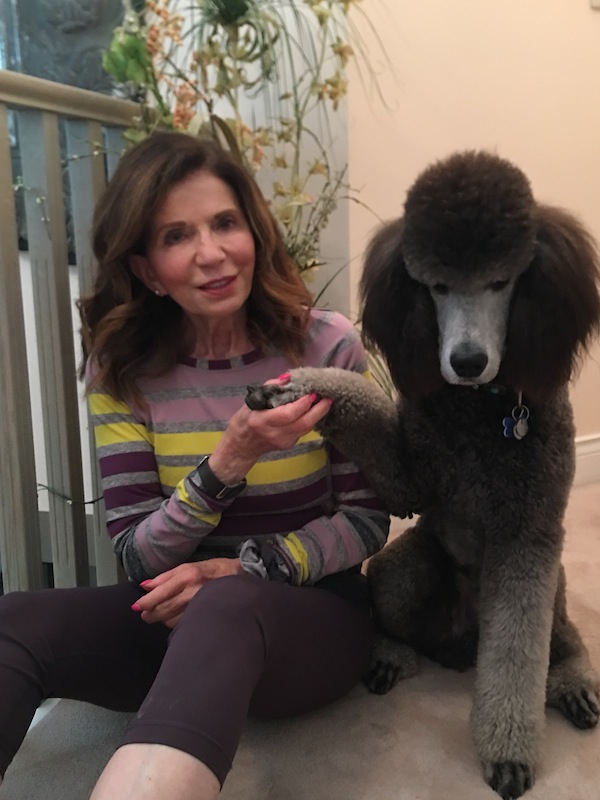
We have two Jewish dogs. When we sing Shabbat blessings, our dogs come over, sit politely, and wait until we’re done with the Hamotzi, the blessing over the bread. Then, they each get a small chunk of challah. This is the only people food they get. We don’t feed them while we eat and they don’t beg. However, when they hear us start to sing blessings, they know what to do!

On Chanukah or Passover, we are ready with alternative treats. Every night after we light Chanukah candles, they get dog biscuits. On Passover, they get matzah.

Our lab/pointer mix, Sally, who is more than 15 years old, has been doing poorly. Bigger dogs don’t usually live this long. She’s had a good life. We love her dearly. When she started having trouble eating, despite pandemic vet visits and several medicines, we were ready to try anything. She vomited and would eat only sparingly.

Then I had an idea. We had leftover homemade challah after Shabbat ended last week. I took out a piece, broke it into smaller bits, and started reciting brachot (blessings). I sang the Hamotzi. She moved her sore joints and sat near me. She ate challah. I did it again. She ate a little more challah. I kept going. In my happy blessing voice, I sang the Shehecheyanu (“Who has given us life”) blessing, feeling grateful for having reached this moment. Challah eaten. I thanked the Almighty for making me in the divine image. Challah eaten. I sang the blessing about giving tired people the strength to go on, from the morning blessings. She ate more challah.

My husband had small luck with this approach. In the end, she ate more for me. Was it my singing? My happy fake-out training technique, after 15 years of dog training to sit for blessings? We don’t know why it worked. After a day or two, we ran out of challah and switched to dog biscuits. Now, she is eating a weird mixture of special canned dog food diet, chicken and kibble again. Things are better, for now.

I want to tell one of our relatives, Ann, in New York City, about this success – about our old Jewish dog, her many blessings and the challah – but I can’t call her. She died May 3rd from a blood disorder. Once she was admitted to the hospital in New York, she was alone. Although she didn’t die from COVID-19, she died alone because of it. Ann, may her memory be a blessing, loved dogs and Jewish tradition. She would have laughed to hear about how Sally regained her appetite because of those blessings and challah.

It feels right now like we’re wandering in the wilderness. There’s so much uncertainty surrounding the COVID-19 pandemic. Every day, things change. Many news sources refer to this virus as “the novel coronavirus.” Yes, it’s new, unlike all the other coronaviruses. Yet, in some ways, this situation, where we’re faced by terrible illness or challenge, arises repeatedly throughout the Torah, rabbinic texts and our history. It may be new to us, but it’s the same old story. How do we face these challenges? How can we behave in Jewish ways when the challenges seem so huge? We study what worked in the past – our history and traditions can help.

How do we make Shabbat (or make anything special) in a time when all the days seem hard and the same? In the Talmud, Tractate Shabbat 69, “Rav Huna said: ‘If someone was walking on the road or in the desert and he does not know when Shabbat is, he counts six days and then keeps Shabbat for one day.’ Hiya the son of Rav said: ‘He keeps one day and counts six.’ What is this dispute really about? One bases his opinion on the creation of the world, and one bases his opinion on Adam.”

The rabbis discuss whether we celebrate Shabbat after the six days of creation so, when we don’t know which day is Shabbat, we count six days and then observe one. But Rav Hiya starts with Adam, the first person, and recognizes that one starts with our creation story. Without humans, there would be no way to make Shabbat, so we celebrate first, and then we count six until the next Shabbat.

Rav Hiya’s approach reminds us that we humans are central to this Jewish observance narrative. Our family had to remember that, even if burials and shivah aren’t done normally now, Zoom memorial services and shivahs are for us, the living, to help us navigate through this uncertainty.

Sally the dog is still with us for now, thank goodness. She reminds me, every day, to keep counting (and reciting!) my blessings. Whether you count six days and then celebrate, or celebrate and then count six days, we have these very human routines to help in navigating the unknown – the road, the desert, or a global pandemic.

So, please, grab some challah, say a brachah and train your Jewish dog. Somehow, I can still hear Ann (z”l) laughing as I tell this story. Ahad Ha’am said, “More than the Jewish people have kept Shabbat, Shabbat has kept the Jews.” Our dog Sally has reminded us, too, that, once we say those blessings, a delicious treat always follows. It’s up to us to keep making the blessings and finding those Shabbat treats.

Joanne Seiff has written regularly for CBC Manitoba and various Jewish publications. She is the author of three books, including From the Outside In: Jewish Post Columns 2015-2016, a collection of essays available for digital download or as a paperback from Amazon. Check her out on Instagram @yrnspinner or at joanneseiff.blogspot.com.

Format ImagePosted on May 29, 2020May 28, 2020Author Joanne SeiffCategories Op-EdTags blessings, dogs, Judaism, lifestyle, Shabbat, spirituality

Posts pagination

Previous page Page 1 … Page 27 Page 28 Page 29 … Page 56 Next page
Proudly powered by WordPress