Skip to content
  • Home
  • Subscribe / donate
  • Events calendar
  • Business Directory
  • FAQ
  • News
    • Local
    • National
    • Israel
    • World
    • עניין בחדשות
      A roundup of news in Canada and further afield, in Hebrew.
  • Opinion
    • From the JI
    • Op-Ed
  • Arts & Culture
    • Performing Arts
    • Music
    • Books
    • Visual Arts
    • TV & Film
  • Life
    • Celebrating the Holidays
    • Travel
    • The Daily Snooze
      Cartoons by Jacob Samuel
    • Mystery Photo
      Help the JI and JMABC fill in the gaps in our archives.
  • Community Links
    • Organizations, Etc.
    • Other News Sources & Blogs
  • JI Chai Celebration
  • JI@88! video

Recent Posts

  • Or Shalom reopens its doors
  • JFS from past to future
  • Need holistic approach
  • Sharing stories, advice
  • Journalist shares fears
  • Skills to live together
  • Road to independence
  • Cutting grass with scissors
  • Zionism as a solution
  • Deceit, desire & the divine
  • Reclaiming sacredness
  • Creative project ideas
  • Summer squares and cobbler
  • Thou shalt … summer commandments
  • Legal help for students
  • Revisiting myth of Lilith
  • Wrong person rebuked
  • Canada’s mixed messages
  • Questions for museum
  • Symposium on antizionism
  • Making soccer political
  • CJPAC lauds Pulver’s impact
  • City recognizes Vrba’s legacy  
  • Organ donation saves lives
  • Theodore’s March premiere
  • A healing Shabbaton
  • Supplying healthy food
  • A chime of metal tags
  • Yellowknife seder a first
  • Ishai energizes, unifies
  • A Lag b’Omer to remember
  • Expanding the healing
  • Hannah Senesh – a unique hero
  • Community milestones … May 2026
  • Деньги до зарплаты на карту Займ до зп онлайн за 5 минут 2026
  • Микрокредит онлайн в Казахстане Микрозайм в Акшамат

Archives

Follow @JewishIndie
image - The CJN - Visit Us Banner - 300x600 - 101625

Category: World

Understanding dyslexia

Understanding dyslexia

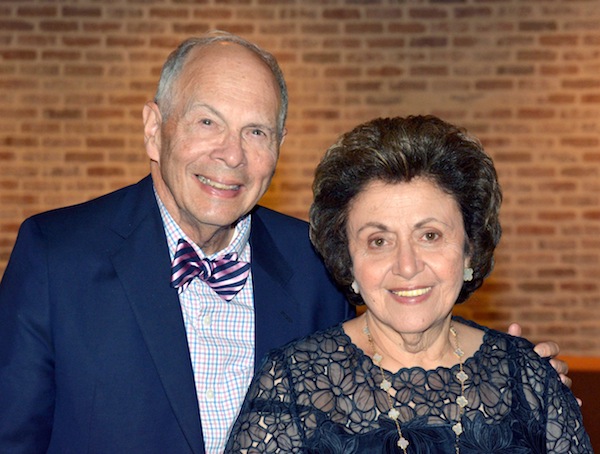
Bennett and Sally Shaywitz co-founded the Yale Centre for Dyslexia and Creativity. (photo from the Shaywitzes)

One out of five people has dyslexia. Yet, even with this many people affected, not every school tests for it. This can lead to feelings of self-doubt and frustration for the child who has dyslexia but doesn’t know it. Parents and teachers may also become frustrated and the result can be children losing confidence in themselves.

Sally and Bennett Shaywitz, both academic physicians, say there is a simple test available for anyone to use to see if they have dyslexia.

Bennett Shaywitz was chief of child neurology at Yale for approximately 40 years, before stepping down a couple of years ago to devote all of his energy to dyslexia. “I’m the Charles and Helen Schwab Professor in Dyslexia at Yale,” he said. “Charles Schwab is very philanthropic and very dyslexic, so I’m very fortunate that I’m his name share.”

“Together, Bennett and I founded the Yale Centre for Dyslexia and Creativity,” Sally Shaywitz told the Independent. “I also wrote the bestselling book on dyslexia, called Overcoming Dyslexia.”

It all began when she was asked by Yale to work with children with learning disabilities, as none of the other faculty wanted to do it. “They thought it was beneath them,” she said. “I said, ‘Sure, I’ll do it part-time.’ And then I became intrigued with these children I saw who weren’t reading and whose parents were beside themselves and very worried. So, I began looking into it. Bennett was studying more basic science in attention. He got intrigued, so we worked together.”

As the research progressed, she discovered that there were many children who had problems with their reading yet seemed bright.

image - Overcoming Dyslexia book cover“Also, when I looked into it, they were studying children in schools and things, but there wasn’t a general study of a large population,” she said. “So, I started with the Connecticut Longitudinal Study. What differentiates that study is that it’s of a population, we work with a population statistician. We selected children from all over Connecticut and broke it into 14 towns. We invited all the children in kindergarten and, lo and behold, 95% of the ones we invited actually participated. That study is still going on. We are seeing those same people, about 375 of them, as adults, as 40-year-olds.”

The study started with 455 kids and 20% turned out to have dyslexia, while the schools had been under the impression that hardly any students were dyslexic.

“It taught me a lesson that I testified to the U.S. House of Representatives and the U.S. Senate,” she said. “It was that, to be counted, you had to be identified. Schools are not identifying kids, so they didn’t think they had any. Our data is very strong, and it goes along with data from the federal government that they’ve collected over the years. Dyslexia involves one out of five people – and we also discovered that it affects girls as well as boys.

“People used to say that it was just boys. What happens when people say that is that they only study boys. What we were able to do in the longitudinal study is we made up different instruments and validated them. One was a teacher instrument…. What we found was that, when boys and girls were tested, there were virtually equal numbers. But, when you ask the teacher about the child’s behaviour in class, they would say, oh, the boys were rowdy, pulling the girls’ hair, playing across the room, etc. And, the girls, they are so well behaved, but they never read a word. So, it was the boys that were sent for evaluation, because the teachers wanted to get them out of the room.

“We were able to show that dyslexia affects not only boys, but girls as well,” she said. “And, also, that it is persistent. It doesn’t go away. This study has made many major advancements.”

The Shaywitzes also found that, while, with non-dyslexics, reading and IQ are connected, with dyslexics, that correlation does not exist. This was in line with the very first description of dyslexia, in 1896, when a British physician referred to a young man who would have been the smartest in the class, if not for reading.

“People at the turn of the century really got it. They understood it,” said Sally Shaywitz. “But, over time, people stopped understanding it – deciding that, if you’re really smart, you can’t be dyslexic. So, what we were able to demonstrate is that, in fact, you can be very smart as well as dyslexic. The definition incorporates that dyslexia is an unexpected difficulty – unexpected, in that you can be very bright and yet read at a much lower level.”

The Shaywitzes said, due to such misconceptions, testing should be done as early as possible, around Grade 1.

“We developed a screener, called the Shaywitz Dyslexia Screen,” said Sally Shaywitz. “We gave it to Pearson Publishers, who I’ve worked with, wanting to involve teachers, as they know the child best and have mostly been ignored in a lot of these processes.

“There’s a kindergarten, Grade 1, Grade 2 or Grade 3 screening that has about 10 lead questions that the teacher responds to on a tablet. It takes five to seven minutes to get an answer as to whether or not the child is at-risk or not at-risk. You don’t have to test a kid and pull him out of his class or anything like that.

“So, the boys and girls start school and the parents say, ‘Oh, you’re gonna love it. You’ll learn to read. It’s going to be so much fun.’ Then, children enter school, waiting for this magical moment, and it doesn’t come. And, when they are called on to read aloud in class, the other kids giggle and make fun of them … and the teacher says, ‘How can you not know that?’ The kids lose confidence in themselves and begin to believe they are not very smart. That’s why children need to be screened and identified as at-risk very early on.”

Schools are way behind, she said. “Not every school identifies children with dyslexia.”

While the symptoms might improve, the person will always be dyslexic, she said. But, by identifying kids who have dyslexia early, parents and teachers can help the kids overcome their dyslexia in various ways.

The Shaywitzes have developed one tool, called the Key of Strength Model: Dyslexia and Creativity.

“They have almost an isolated island of weakness surrounded by a sea of a higher level of cognitive functions like reasoning, problem solving and critical thinking,” said Sally Shaywitz. “So, you want to identify the weakness and intervene. And, you want to identify the strengths and make sure kids can connect them.

“If they are not identified, they don’t know how smart they are and teachers mistakenly say, ‘Why don’t you try harder? Why didn’t you do that? Why didn’t you do your homework?’… things like that.

“In the case of dyslexia,” she said, “we have enough knowledge to do better. So, rather than a knowledge gap, we have an action gap. They have to implement the knowledge we have. It’s amazing that, in the 21st century, there is still so much misunderstanding of dyslexia that is harming so many.”

For more information on universal screening, dyslexia and more, visit dyslexia.yale.edu.

Rebeca Kuropatwa is a Winnipeg freelance writer.

Format ImagePosted on November 16, 2018November 15, 2018Author Rebeca KuropatwaCategories WorldTags dyslexia, health, Shaywitz
Politicon’s Jewish voices

Politicon’s Jewish voices

Ben Stein and Ann Coulter at Politicon in Los Angeles on Oct. 20. (photo by Rich Polk-Getty Images for Politicon)

From pundits to Hollywood types, there were many Jewish names on the speaker roster at this year’s Politicon, the fourth annual two-day convention in Los Angeles that ropes in high-wattage names from the left, right and centre. This year’s gathering took place Oct. 20-21.

In the panel called The Deep State, discussion revolved around the allegations of U.S. President Donald Trump’s collusion with Russia. Speakers included Dr. Vince Houghton (curator at the International Spy Museum), Dan Bongino (former U.S. secret service for George W. Bush and Barack Obama), Dr. Jason Johnson (professor at Morgan State University in Baltimore), former Trump aide David Urban and former George W. Bush speechwriter David Frum, a member of the Jewish community.

While Frum outlined some of the evidence on meetings and correspondences between Trump aides and various Russians, he also conceded that “there are things in collusion that are utterly reprehensible, which are not illegal.”

He said, “To what extent there was cooperation back and forth, remains unclear,” but he is convinced that the facts are quite damning.

photo - David Frum at Politicon in Los Angeles on Oct. 21
David Frum at Politicon in Los Angeles on Oct. 21. (photo by Phillip Faraone-Getty Images for Politicon)

As a counterpoint, Johnson said: “I don’t think the president has such discipline or organization to pull off this kind of thing. Hillary [Clinton] lost because she ran a bad campaign, not because of a meeting with the Russians.”

Two right-wing pundits – Ann Coulter and Ben Stein – took the stage in a session called Ask Ann Anything.

Stein, the Jewish actor whose politics date back to serving as a Richard Nixon aide, said that, if he could change any numbers about America, it would be to increase the number of better-educated individuals, as well as the number of fathers marrying the women they’ve had children with.

Coulter, often appearing on media to represent the far-right, is the bestselling author of Slander: Liberal Lies About the American Right, Treason: Liberal Treachery from the Cold War to the War on Terrorism and Godless: The Church of Liberalism, among others. Her key complaint was that Trump had yet to build the wall between the United States and Mexico, as he had promised, and she holds the left responsible for the immigration crisis.

Three generations ago, she said, “immigrants would come and 30 or 40% of them wouldn’t make it, and [would] go back home. Now, they all go on welfare. The Democrats pushed the bill that promised to [enshrine this],” she said.

The biggest surprise, she said, was that “despite all the race-baiting, Trump, as I thought he would, got more of the black and Hispanic votes than either [Mitt] Romney or [George W.] Bush … considering all of the racial incitement of the campaign.”

Three different questioners harshly criticized Coulter for avoiding debate with liberals, but Coulter dismissed them outright – “they couldn’t find a New York Times bestselling author to debate me?”

Yarmulke-wearing Ben Shapiro – who was in Vancouver for talks on Oct. 30 and 31 – covered the topics of free speech, constitutional rights and racism in America in his keynote address at Politicon.

“If my speech is violence,” said Shapiro, “and the government can shut down violence, then the government can shut down speech. This is ugly stuff.”

On the #MeToo movement and abortion, he paraphrased his opponents: “Men, sit down, shut up, you don’t know anything.” But, he said, “We can’t have a conversation if you’re simply going to assume I can’t understand you because of dint of birth … identity politics throws up a roadblock in the way of it. It prevents you from having these conversations.”

He said, “If you’re going to make a pro-choice argument, then make a pro-choice argument. An argument cannot be based on a woman knows better what constitutes life than a man.”

A questioner asked why, on YouTube, Shapiro appears to fume at ideological challengers.

“There are many more examples of me talking to the left in a respectful manner than there are tapes of me ‘destroying’ anybody,” noted Shapiro. “Those are the ones we like to watch because they’re more fun, but it’s not happening on a day-to-day basis.”

In a session called The Russian Menace, Jewish actor, director and author Henry Winkler interviewed author, terrorism expert and naval expert in cryptology Malcolm Nance. This year, Nance published The Plot to Destroy Democracy: How Putin and His Spies Are Undermining America and Dismantling the West.

After Obama was elected, said Nance, Trump and a representative of Russian intelligence exchanged private Twitter messages, with the latter expressing interest in helping the U.S. change governments. “Trump responded with a picture of double thumbs up,” noted Nance.

Winkler retorted, “Not mine!” – a reference to his Happy Days character the Fonz’s signature symbol.

According to Nance, a week after this Twitter exchange, Trump registered the trademark “Make America Great Again.” Subsequently, Trump met with Russian oligarchs in Moscow for two hours, something that should raise suspicions, Nance insisted.

At one time, he said, Russians wanted the “money and luxury” that the West had, but now they employ “an old KGB strategy” of propaganda to tear down the United States.

“You don’t go at the people by invading it,” but rather, through “fake news stories,” said Nance. “You co-opt their mind; you create a new reality for them. In the old days, they used to call that brainwashing. Today, they call it Facebook.”

Evan Sayet, who has written two speeches for Trump and is the author of Kindergarden of Eden: How the Modern Liberal Thinks, told the Jewish Independent that the panel he was on, 13 Reasons Why Not to be a Liberal, could be summed up thusly:

“Everybody in America – every ethnic group in America – blacks, Asians, Hispanics, they should all be conservative. They’re family-centric, church-goers, entrepreneurs. The left has done such a great job via the entertainment industry, schools and media, of villainizing the right. Those who vote for Democrats, don’t vote Democrats. They vote against Republicans. They are so in fear of what’s been portrayed as the right.”

Other Jews to appear as speakers or panelists at Politicon included Joel Pollak (Breitbart), Jennifer Rubin (Washington Post), author Eric Golub, NBC’s Ari Melber, comedian Ben Gleib, Bill Kristol (journalist and former chief-of-staff to vice-president Dan Quayle), TV host David Pakman, TV’s Drew Pinsky, commentator Sally Kohn, mayor of Knox County in Tennessee and former wrestler Glenn Jacobs, comedian Sam Seder, actor Richard Schiff, comedian Elayne Boosler, NBC’s Jacob Saboroff, writer Jamie Kilstein, actor Josh Malina, NBC’s Gadi Schwartz and entrepreneur Fred Guttenberg.

Dave Gordon is a Toronto-based freelance writer whose work has appeared in more than 100 publications around the world.

Format ImagePosted on November 9, 2018November 7, 2018Author Dave GordonCategories WorldTags Politicon, politics, United States
Bennett makes official visit

Bennett makes official visit

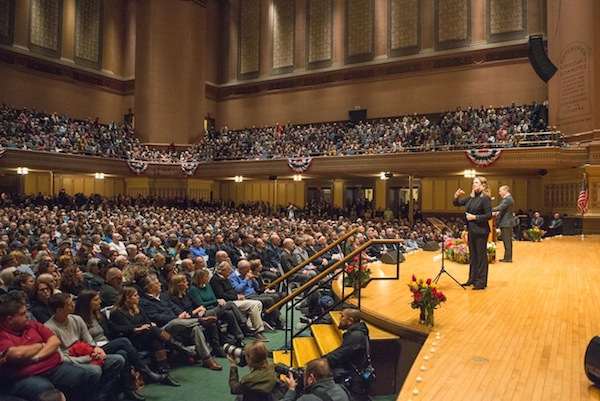
Israeli Minister of Jews in the Diaspora and Minister of Education Naftali Bennett addresses a memorial in Pittsburgh on Oct. 28. (Alexi Rosenfeld courtesy Ashernet)

On Sunday, Oct. 28, Israeli Minister of Jews in the Diaspora and Minister of Education Naftali Bennett addressed a memorial vigil at the Soldiers and Sailors Memorial Hall and Museum in Pittsburgh, for the 11 members of the Jewish community murdered in the shooting attack at the Tree of Life synagogue the day before.

Bennett was visiting the city as an official emissary of the Government of Israel, to offer strength and support to the Jewish community following the tragedy. The minister met during the day with leaders of the Pittsburgh Jewish community, and wider American Jewry, as well as with Pennsylvania Governor Tom Wolf, Pittsburgh Mayor Bill Peduto and members of Congress representing the state.

In an emotional meeting, Bennett sat with Rabbi Jeffrey Myers, spiritual leader of the Tree of Life congregation. During the attack, Myers had led many of his congregants to safety.

“Our whole nation is feeling the pain you are feeling here after this heinous hate crime,” Bennett told the leaders of the Pittsburgh community. “I want to extend my condolences to the families of the victims. People who have seen so much in their lives could not imagine they would be gunned down in Shabbat prayer.”

The minister visited the site of the attack and met with ZAKA (Israel’s volunteer emergency response force) and other emergency crews, who had helped the local police, who he also thanked for their great bravery.

Addressing the memorial vigil – attended by more than 4,000 people from the Jewish and non-Jewish communities in the city, including the governor and mayor, senators and members of Congress, President Donald Trump’s Special Envoy Jason Greenblatt, Israeli Ambassador Ron Dermer and New York Israel Consul General Danny Dayan – he said, “Today, we stand in the shadow of death, in the shadow of evil, in the shadow of a cowardly terror attack on Jews who were in synagogue to pray – the deadliest antisemitic attack in the history of the United States.”

He added, “But, today, I met the people and the leaders of the community here in Pittsburgh and I didn’t see death. I saw life, strength. I saw a warm community of love and unity. I saw the Tree of Life, which will never be uprooted by hatred.”

He said, “We stand together, as Jews from all communities united, as well as members of all faiths. Together we stand. Americans and Israelis. People who are, together, saying no to hatred. The murderer’s bullet does not stop to ask, Are you Conservative or Reform, are you Orthodox? Are you right-wing or left-wing? It has one goal, and that is to kill innocent people. Innocent Jews.”

Bennett told the thousands at the memorial that he came to offer the support and condolences of all the Israeli people.

“Nearly 80 years since Kristallnacht, when the Jews of Europe perished in the flames of their houses of worship, one thing is clear,” he said. “Antisemitism, Jew-hating, is not a distant memory. Antisemitism is a clear and present danger. From Sderot [in southern Israel] to Pittsburgh, the hands that fire missiles are the same hands that shoot worshippers. We will fight against the hatred of Jews and antisemitism wherever it raises its head, and we will prevail.”

Stressing the shared values that bond the American and Israeli peoples together, Bennett concluded, “Freedom will overcome. Unity will defeat division. Love will defeat hatred. Light will defeat darkness. Am Yisrael Chai.”

Format ImagePosted on November 2, 2018November 1, 2018Author Edgar Asher ASHERNETCategories WorldTags antisemitism, memorial, Pittsburgh shooting
We must focus on justice

We must focus on justice

(photo by Alan Katowitz)

Hundreds of Vancouverites came together Sunday night, driven by the need for community after the news that 11 congregants were murdered during services at a Pittsburgh synagogue a day earlier.

The attack – the deadliest terror act against a Jewish community in North American history – devastated the Pennsylvania Jewish community and elicited grief, alarm and solidarity among Jews across the continent and beyond. As some commentators have said, shock may not have been a foremost response. The very fact that we in Vancouver and Jews almost everywhere else pass by security personnel and infrastructure every time we enter a Jewish facility conditions us to expect that something like this might happen.

The assembly at the Jewish Community Centre of Greater Vancouver, convened by the Rabbinical Association of Vancouver, drew hundreds of people, mostly Jews but also members and clergy of other faith communities, as well as elected officials and other individuals. The words from the speakers – mostly rabbis – were powerful and thoughtful, though perhaps the words were less significant than the simple sense of commonality of emotion among those assembled.

In the hours and days since the incident, so many of us have tried to somehow assimilate the meaning and implications of the violence.

Extremism has been growing worldwide. Antisemitism, racial supremacism, nativism and other dangerous tendencies have infiltrated societies throughout the Western world. We have seen political successes for once-fringe parties in Europe and, most recently, in South America. In the online and general discourses in North America, extremist commentary has become so commonplace that it approaches the mainstream, if that is not an oxymoron. Words have consequences. All actions, good and evil, begin as ideas, move into language and ultimately manifest in behaviours.

This raises the matter of free expression. While some seek to smother the expression of hateful and other repugnant ideas, the events of last weekend present an argument for more, not less, discussion. Open dialogue of all ideas, including appalling ones, is not just a theoretical value. It allows us to monitor antisocial ideas, rather than pushing them under rocks. The perpetrator’s long record of deranged rants about Jews did not prevent this tragedy. But knowledge of such ideas and those who hold them represent our best chance for preventing repetition of such terror acts. (This sort of knowledge is critical to intelligence-gathering services. In Israel, recent reports indicate, 10 potential attacks are thwarted for every one that is successfully executed.)

Americans’ access to guns is also raised as an issue when things like this happen. We have little optimism of seeing this matter resolved in our lifetimes. It is notable, though, that, in what should be a moment of national mourning, the U.S. president has aimed to score political points by advancing the idea that the synagogue should have been, essentially, an armed defensive encampment. This idea is not a solution. It is a capitulation to a dystopic reality. A better president would have had words of national unity and consolation.

While we seek healing as a community, welcome condolences from so many allies, and wish blessings on the murdered and comfort for the survivors, we also now enter unfamiliar realms. In many mass murder incidents, the perpetrator does not survive the attack. In this case, he has. We will watch as the victims’ families confront this terrible act through the justice system, hoping for something approaching closure. Some people are already calling for vengeance, and the death penalty is a possible punishment for the perpetrator, which raises additional quandaries for those among us for whom state-sanctioned killing is an evil unto itself.

The larger issue facing us in the coming weeks is that true justice, in a practical sense, must convey to all people that this is a society that rejects and condemns not only the act that took place Saturday, but the ideas that inspired it and other heinous hate crimes. The mantra of Simon Wiesenthal’s life, which was devoted to as proper a response as possible to the greatest crime perpetrated against the Jewish people, was “justice, not vengeance.” This was in keeping with the ancient obligation of Judaism – justice, justice, you shall pursue.

We grieve, we mourn, we console. But, through these processes and after, we continue what our tradition has demanded for millennia, the ultimate bulwark to this and every other wrong: we seek justice.

Format ImagePosted on November 2, 2018November 1, 2018Author The Editorial BoardCategories WorldTags antisemitism, Judaism, memorial, Pittsburgh shooting
China’s increasing Israeli ties

China’s increasing Israeli ties

Israel’s IVC Research Centre concludes that, with each passing year, some 16% more companies have at least one Chinese investor. (photo by Dave Gordon)

With headlines proclaiming the largest trade war in history, the United States and China began dueling tariffs July 6, and the ongoing row threatens hundreds of billions of dollars of product distribution. But, while China has locked horns with our neighbours to the south, it is partnering more and more with Israel.

According to Thomson Reuters data, Chinese investment in Israeli corporations tripled in the past few years to $16 billion, with about $600 million directed specifically to startups. Israel’s IVC Research Centre concludes that, with each passing year, some 16% more companies have at least one Chinese investor. The Jerusalem Post has stated that it will be no time before China surpasses the United States as Israel’s main foreign investor.

The Chinese “are leveraging Israeli tech to fuel their economy. Israel is held in high esteem as a hub of innovation,” said Hagai Tal, chief executive officer at Tel Aviv-based Taptica, an Israeli mobile advertisement company. “Many Israeli companies also see important opportunities in the East, and the meeting point of these two approaches is what produces such successful business partnerships.”

Israeli Shimi Azar, who runs mobile advertising Spotad’s Asia-Pacific operations, said he has seen “China becoming an innovation power in only a few years.”

China has 232 of the world’s 2,000 largest companies, up from 43 in 2003, according to Forbes magazine. Of the top 20 technology giants, China has nine, including Alibaba, Tencent, Ant Financial, Baidu and Didi. (The United States has 11.) C-Trip International is larger than Expedia, and China produces more online sales than anywhere else, says Market Watch.

“Big cities like Shanghai or Shenzhen already feel quite Western in almost every respect so, culturally, we are becoming closer every year,” said Azar. “The younger generation is eager to learn English and travel the world, so I’m convinced that any significant cultural differences to speak of will soon be a thing of the past.”

Ronen Mense is vice-president of Asia for AppFlyer, a mobile marketing analytics and attribution platform, which went to market with an Asia-first model. “In today’s digital and mobile-first world,” he said, “the Chinese mobile market is like no other. The numbers are staggering: about 800 million mobile users, nearly 500 million users making payments with their phones, nearly $2 billion quarterly revenue in the Chinese iOS App Store – more than any other country in the world.”

Lee Branstetter, professor of economics and public policy at Carnegie Mellon University’s Heinz College, said Israel is “doing truly world-class research” in microchips, security and machinery. Adding to the reasons why China and Israel are collaborating more is the political clampdown sweeping through the United States; notably, concerns over security, trade, foreign debt and foreign corporate control.

The bilateral cooperation was echoed at the political level when Chinese President Xi Jinping and Israeli Prime Minister Binyamin Netanyahu signed a memorandum in 2015, agreeing to partner in the technology sector.

For the past four years, the China-Israel Innovation Summit has taken place with the support of their respective countries’ governments. In the past two years, two Israeli companies entered the Chinese stock exchange for the first time: Alma Lasers (bought out by XIO Group in 2013) and Sisram Medical, in part owned by China’s Fosun Pharmaceutical. Major acquisitions are now legion.

In 2016, a Chinese consortium, led by Giant Network Group, paid $4.4 billion to acquire Playtika, an Israeli video game company. A year prior, China’s XIO Group ponied up $510 million for medical device firm Lumenis.

Last year, Kuang-Chi Group – whose stated aim is to “invest in and collaborate with innovative technology projects worldwide” – announced it was looking to base its headquarters in Tel Aviv. Its chairman, Dr. Ruopeng Liu, told Forbes that it all had to do with Israel’s “global reputation for innovation,” coupled with China’s strength in the global market.

Forbes also has reported that Ogawa, a healthcare leader in China, is earmarking $10 million for wellness technology investments in Israel.

Peggy Mizrahi, a Chinese citizen who now lives in Israel, sees two nations who have a similar view of the world. Mizrahi is vice-president of Indigo Global, an Israeli boutique investment advisory firm, with activities and operations in Africa, Asia and the Middle East. She said the “Chinese are [known for] long-term planning, conservative and hierarchical, unlike the commonly recognized Israeli mindset as fast, innovative, impatient, flexible and [with a] lack of respect for authority. However, paradoxically, both countries share something deeper than that: the refugee mindset – a people suffered for decades in wars, exiles, and Holocaust, massacres; struggled for independence and peace; respect of culture, history and the power of knowledge; and, most importantly, both Israelis and Chinese believe that economic progress and technological advancement will ultimately bring peace and prosperity to the world.”

David Maman, chief executive officer and co-founder of Binah.ai, recently sold one of his companies, HexaTier, to Chinese conglomerate Huawei. According to Maman, it’s not unusual for scores of delegations each month to visit Israel from the biggest corporations in China – including Fosun, Huawei, Alibaba, Tencent and Baidu – to explore investments and other ventures with Israeli startups.

Just as sure as tech can be used for the good, one expert had concerns about increasing collaboration.

Branstetter, who served as the senior economist for international trade and investment for the U.S. President’s Council of Economic Advisers, added there must be care ensuring technology isn’t misused.

“If an American pilot were ever shot down by a Chinese missile powered by Israeli technology, it would be a real problem for the Israeli government.”

Dave Gordon is a Toronto-based freelance writer whose work has appeared in more than 100 publications around the world.

Format ImagePosted on October 5, 2018October 3, 2018Author Dave GordonCategories WorldTags business, China, high-tech, Israel, trade, United States
A personal perspective

A personal perspective

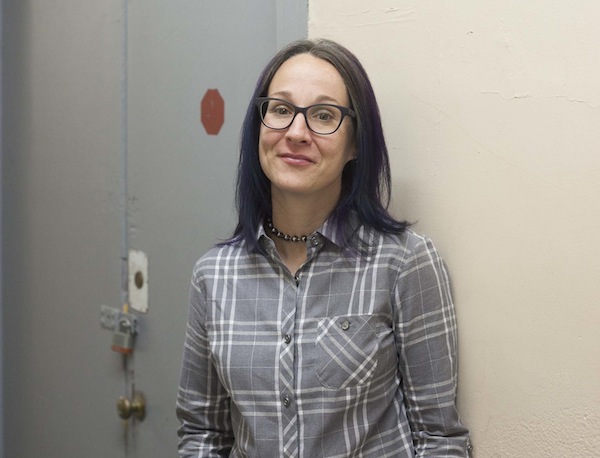
April Ford (photo by Antonella Fratino)

In the fifth and final articles of a series on sexual harassment and violence, the Jewish Independent speaks with Montreal writer April Ford.

As the late Maya Angelou wrote in I Know Why the Caged Bird Sings, “There is no greater agony than bearing an untold story inside you.”

Montreal-born fiction writer and essayist April Ford, who has been working as associate publisher for Southern Fried Karma, a literary press in Atlanta, Ga., since December 2017, knows this all too well.

“I’m honoured to stand alongside any woman who’s been mistreated, whether or not there’s a hashtag appended to her experience,” said Ford, a bold, heart-on-her-sleeve survivor of abuse. “The #MeToo movement, like any grassroots quest for equality, is one of unleashed compassion, controversy and confrontation … and, right now, it’s a mess. Sometimes, it seems more interested in the public shaming du jour of a celebrity sexual predator than in collective healing, and that frustrates me.”

Ford said she is not a believer in public shaming. “Black Mirror brilliantly depicts this nastiness in White Bear, season 2, episode 2,” she said.

“I’m even skeptical about how much the #MeToo movement can help women who’ve been abused, but who don’t have Twitter accounts, blogs or access to other popular venues for the dissemination of dark secrets to the masses … in exchange for emoticons and the chance to go viral,” she added.

In terms of some of the stories that have come out of the movement and how they have affected her, Ford said, “The story I’ve followed most closely is that of Concordia University in Montreal, where I completed the undergraduate creative writing program in 2007. Throughout the course of my degree, I spent a lot of time on campus as an aspiring but uncertain writer, and I sought mentorship from a handful of professors. I was consistently treated very, very well – there were no strings, pressures or consequences attached to the help and encouragement I received. That said, thanks to rumours, I knew to stay away from certain individuals within that concentrated world.

“Also, I started the program when I was 23 and, I think, being a few years older than the typical undergraduate student buffered me against harassment. Or maybe the negative experiences in my life outside of the program had trained me how to get through a situation as cleanly as possible, without giving anything away that wasn’t part of the experience I had signed on for, or having it taken from me without my consent.”

Regarding some of the high-profile people who have been outed as abusers via the #MeToo movement, Ford said, “I certainly have an opinion about how to cope with the abusive actions of people, whether family members, friends, mentors, celebrities or demi-gods. First, you have to be clear on your definition of abuse … and consistent. If you’re going to accuse one person of abusing you, then you can’t switch to a sliding scale when some actor or comedian you love is proven guilty of the same offence. And, no, I don’t believe you can separate the teacher, leader or artist from the abuser. That’s like saying you can separate all the white fur from the cream fur in a cat the colour of sand. It’s ridiculous.”

Ford was adopted as a child and only discovered after marrying a Jewish man (they have since divorced) – that her birth family may have Jewish roots.

When she was 15 years old, her adoptive parents, who had been fighting for years, decided to call it quits. Her mother left their home. Not long after, Ford lost her virginity to Bruce, a 34-year-old man. Up until then, she said, she “had hardly kissed a boy.”

Bruce instructed her to start taking birth control, “which I did,” said Ford, “as soon as I found a clinic that would dispense the pill to me for free and without questions like, ‘Where are your parents?’

“While my parents were dealing with the failure of their marriage, I was dealing with the euphoria and confusion that come with being a 15-year-old girl with no adult in her life to anchor her to a safe place. My mother, in trying to move forward from the damage my father’s abuse had caused her, was unable to be a mother to me. My father, in trying to hold his world together with rage, essentially fast-tracked me into the hands of a man who … [abused] me. I did my best to keep quiet – to hide the fact that this man I had rebelliously told everyone that I loved more than life itself was raping me every weekend.

“A lot of people in my life at the time could sense there was more to the story,” she said. “But, instead of getting involved or simply buying me a hot chocolate and asking how I was doing, they stopped being my friends.”

At that time, the mothers of Ford’s former friends insulted her with terms like “slut” and “whore” and said she had no business being anywhere near their daughters, sons and husbands. Ford went from being a decent student at a private Catholic high school for girls, a horse-lover and aspiring Olympic rider, to being what she referred to as “someone to be ashamed of, an afterthought.”

Ford can still vividly recall the whispers that, to her ears, were like screams of “all-knowing” grownups predicting that she was – at that young age – already done for; that she would end up pregnant, hooked on drugs and collecting welfare.

“None of that happened,” said Ford. “Not even close. Over the years, I’ve occasionally reconnected with people from that period. And, after they express exaggerated delight to see how well I’ve done for myself, they’d defensively stammer things like, ‘You seemed so mature and into your own thing … we just figured that’s how it was…. You said you were happy. Anyway, look at you now. Everything happens for a reason, right?’ No, it doesn’t.

“I’m sure some survivors can relate to my next statement: Bruce didn’t abuse me all the time. Not every time we had sex was rape, and there were times when he tried to initiate and I refused, and my wish was granted.” But there were several instances, as well as other types of abuse, that are too graphic to describe here.

Ford finds the whole concept of “moving on” troubling.

“It’s not a tidy process and it takes time,” said Ford. “It takes a lifetime. For me, moving on involved a lot of self-injurious behaviour in my late teens through to my 20s, and a lot of self-hate that I eventually learned to disguise as wit.

“My ‘disguise’ actually helped me push forward, to appear exponentially more confident than I was, so that I could create opportunities for myself. I’ve found there’s an expectation of real-life survivors of abuse to tell our tales demurely, to dab our eyes and conclude with, ‘But that was then, and I am stronger for it.’”

One message Ford has for other survivors is to not assume that people, including family and friends, will protect the deeply personal stories and truths you tell them. She advised that survivors tell their stories to the authorities and to people in positions to protect them, physically and legally. Most importantly, Ford stressed that survivors take charge of their emotional safety.

“In the years immediately following my break up with Bruce, I felt constantly in need of confessing my unworthiness to anyone who didn’t know the story, from new acquaintances to college professors to bartenders,” said Ford. “Thankfully, there haven’t been many cases where someone I’d confided in judged me unfairly. Mostly, people are compassionate and kind. But then, just last year, a pair of colleagues at the university where I had taught for eight years ‘profiled’ me, let’s call it … because they disagreed with a choice I’d made in my private life. They accused me of victimhood, based on what I’d shared with them in our friendships. We are no longer friends.”

As a self-described atheist, when in need of support, Ford prefers systems she can interact with directly, such as “proper nutrition, regular exercise and sleep hours, close friends and cuddly animals, work and pastimes that light joyful fires in her belly, and the occasional double shot of rum with a splash of Coke on the side. These things I can trust to always be available to me, and I am free to adjust and readjust their proportions to fit my always in-flux needs.

“What has not worked for me, in terms of healing, is writing about my experiences for the sole purpose of healing. I am a fiction writer to the bone. Sure, I graft details from my life onto the stories I write. But, actually, I use fiction to explore other people’s nightmares, so that I can take a break from my own. I need one kind of noise in my head to cancel out the survivor noise, if that makes sense.”

While Ford hopes that sharing her story here will do some good in the world, she would rather not impose her story on anyone. Further, she feels strongly that no one who has been abused is obligated to become a spokesperson for others.

“Sometimes,” she said, “the abuse a person experiences is so extreme that she needs the rest of her life just to learn how to step outside of her house without fear.”

Rebeca Kuropatwa is a Winnipeg freelance writer.

Format ImagePosted on September 7, 2018September 6, 2018Author Rebeca KuropatwaCategories WorldTags #MeToo, abuse, April Ford, culture, harassment, women
World without prisons?

World without prisons?

Prof. Liat Ben-Moshe teaches disability studies at the University of Toledo. (photo from Liat Ben-Moshe)

University of Toledo assistant professor Liat Ben-Moshe moved to the United States in 2002 to do her doctorate in disability studies at Syracuse University, as the field was not offered in Israel at the time.

Ben-Moshe describes the field as one “that looks at disability as an identity and a culture.”

“So,” she said, “we read things about mad culture – ‘mad’ as in ‘crazy’ – deaf culture and a variety of disability histories, disability laws and social movements related to disabilities … as well as representation [of] people with disabilities and disability, in general, in films and in literature.”

Ben-Moshe is a member of and has been a leading voice in the disability community. She works to educate anyone who will listen about disability rights, to change the outlook.

“We are not asking for charity,” said Ben-Moshe. “We are asking for what is rightfully ours, like an increase in disability stipends and things of that nature. At that time, there was also no kind of formulated disability law.” Now, there is, and there are both similarities and differences between such laws in Canada, the United States and Israel, she said, noting, “They are all rights-based laws, discrimination-based laws.”

As Ben-Moshe was developing her understanding of disability law and how society began looking differently at people with disability, she started seeing correlations between how people with disabilities were being treated in institutions and how prisoners were being treated.

Society has dismantled many large institutions for people with mental and intellectual disabilities. “People don’t really understand how massive these institutions were,” said Ben-Moshe. “Some of them housed 3,000 people with intellectual disabilities in the heyday.

“Closures of these facilities came out of a desire to really change the way that we understand what disability means and how to react to it on a social level,” she explained. “We don’t need to be segregated in order for the civility to be viable in our communities. And the reason I’m connecting it to the prison arena is because there has been – and, today, for sure – a vibrant, although quite small, social movement that advocates for the closure of prisons…. By that, I mean prison abolition.”

Ben-Moshe contends that people should not be locked away as punishment.

“It’s really a radical framework – to understand how we can react to each other differently and how we can respond to harm that’s done to us differently … without segregation, without locking people away,” she said. “When you take this [locking up] idea of out of sight, out of mind, [something] that only exacerbates the root of the harm, you can see a lot of connections between this [non-segregating] framework and the framework of deinstitutionalization.”

Just as some people thought that deinstitutionalization could not work, there are those who don’t believe that decarceration is achievable. But Ben-Moshe said we can learn from how deinstitutionalization took place in most American states and in Canada, and how well it has worked, in general.

“How do we learn from it, as a historical precedence?” she said. “A lot of my work is about bridging those two ideas – frameworks and social movements.”

Ben-Moshe mentioned the 128-page ebook called Are Prisons Obsolete? by Angela Davis (Penguin Random House, 2003). In it, says the description online, Davis argues that “American life is replete with abolition movements and, when they were engaged in these struggles, their chances of success seemed almost unthinkable. For generations of Americans, the abolition of slavery was sheerest illusion. Similarly, the entrenched system of racial segregation seemed to last forever, and generations lived in the midst of the practice, with few predicting its passage from custom…. Davis expertly argues how social movements transformed these social, political and cultural institutions, and made such practices untenable.”

There is no short answer to the question of how to abolish prisons. But, according to Ben-Moshe, the answer has to come from communities. The prison abolition movement in the United States, she said, is led by the black feminist movement and, in Canada, it is led by indigenous groups, as these communities are most impacted by the prison system.

Insofar as the movement’s success in both countries, Ben-Moshe said, “I’d say, definitely, there is, in Canada, a pretty vibrant prison abolition movement. As it is in the U.S., it’s pretty varied. Some of it does come from the indigenous perspective. For example, the idea of sentencing circles.

“In many indigenous communities, there has never been a prison. So, we don’t necessarily need to go back in time to see what it means to live in a world without a prison. We can talk to the indigenous people who have never bonded to this idea of prison. Not to romanticize it. I mean, harm has been done in those communities, but how did they deal with it? That’s definitely something that’s going on in Canada, as well.”

Ben-Moshe pointed to the somewhat new concept of using ankle bracelets, as opposed to imprisonment, as a misguided move. The way she sees it, by doing this, instead of reducing incarceration, the prison walls become endless.

“These are for-profit things that people who are incarcerated have to pay for,” said Ben-Moshe. “And what we see is that people who would have not even been incarcerated before now get ankle bracelets.”

In the same way that disability can’t exist in a place with no barriers, prisons can cease to exist if people are taught how to better work within society’s limits.

“If everyone spoke sign language, those who are deaf wouldn’t even be categorized as disabled, because they would just be a linguistic minority,” said Ben-Moshe. “Disability is not something in people. It’s something in the interaction between people and their environment.

“In disability studies, we talk about ‘ablism’ (able-ism), which is oppression that people with disabilities face. But, I also connect that to racism, sexism and other forms of oppression, to say that we’re always living simultaneous forms of privilege and oppression.”

Rebeca Kuropatwa is a Winnipeg freelance writer.

Format ImagePosted on September 7, 2018September 6, 2018Author Rebeca KuropatwaCategories WorldTags decarceration, deinstitutionalization, disability, mental health, prison reform
Consul general speaks with JI

Consul general speaks with JI

Consul General Galit Baram was in Vancouver last month. (photo from Consulate of Israel)

Galit Baram, consul general of Israel to Toronto and Western Canada, was in Vancouver last month.

“The visit was very good,” she told the Independent in a phone interview. “It included some political meetings and an academic meeting and I addressed the Jewish community and I attended the Negev Dinner of the JNF…. I had the opportunity to see the city, which is beautiful, and the weather was nice.”

Baram will be returning to Vancouver in November, when the late Dirk Pieter and Klaasje Kalkman will be honoured as Righteous Among the Nations for the assistance they provided to Jews during the Holocaust. The ceremony will be held in conjunction with Yad Vashem Canada and the Jewish Federation of Greater Vancouver.

Baram’s June meetings explored the opportunities of expanding cooperation between Israel and British Columbia in innovation and entrepreneurship.

“I believe that there is great potential in economic cooperation between Israel and British Columbia,” she said.

The provincial government, she said, “is making its initial steps now…. There is interest, there is curiosity, there is awareness of what Israel has to offer in innovation, in the medical field. When it comes to pharma, when it comes to cybersecurity, Israel is a leading country in the international arena in many of these fields.

“We had very good relations with the previous government and we hosted a mission … in November of 2016, a mission that was led by then-minister of finance [Michael] de Jong; there were representatives of different business sectors in British Columbia…. [It] is our intention to work very closely with the current government as well.”

The change in the federal government in 2015 also hasn’t affected Canada-Israel cooperation. On May 28, in Montreal, François-Phillippe Champagne, minister of international trade, and Eli Cohen, Israel’s minister of the economy and industry, announced the signing of the modernized Canada-Israel Free Trade Agreement.

Cohen spent two days in Canada, said Baram, adding, “I hope that Minister Champagne will soon reciprocate and visit Israel as well.

“I believe this is very important to have visits on such a high level … because I believe that governments can contribute greatly to bringing countries together. But we have to remember that, at a certain point, governments have to take a step back and leave it up to the business sector and the private sector to build bridges and to bring the countries together, but, as governments on both sides, Israel and Canada, we do as much as we can in order to strengthen and broaden our bilateral relations.”

Baram also sees the possibility of building a groundwork for peace in Israel through business and trade.

“I believe that economic mobility plays an integral role in bringing communities together,” she said, “and we are watching with pride the growing high-tech sector in the Israeli-Arab community, especially in the Greater Haifa area, in cities such as Nazareth…. We would like to see more Israeli-Arab students concentrating on science, concentrating on business, in business management and innovation and entrepreneurship.

“When it comes to building social bridges between Israelis and Palestinians, not necessarily Jews and Arabs, there are many activities that concentrate on that … and they are conducted by civil societies in Israel and it is heartwarming to see that. I would like to mention the activity of an organization such as Save a Child’s Heart … [which] brings children to Israel [for cardiac care] from Arab countries, from the Middle East, from Muslim countries in general, and they do wonderful, wonderful things in building bridges…. Another example I can give you is the upcoming visit of Dr. Yossi Leshem, one of Israel’s greatest experts on bird migration – he is going to be in Vancouver towards the end of August and he will be accompanied by his friends from [elsewhere in] the Middle East, and they are going to present beautiful regional projects in a conference that will be held in Vancouver…. Two other organizations that I would like to mention … are Ultimate Peace, that organizes Frisbee tournaments for youth … and another project, by Danny Hakim – Budo for Peace – teaches martial arts to Israeli Jews and Arabs, Palestinians, Jordanians and others, and they have instructors coming to Israel from Japan and from other countries…. I believe that such organizations can do so much good for Israeli society in general, for the Palestinians and for neighbouring countries in the Middle East.”

Of course, there are significant obstacles to peace, not the least of which are the ongoing altercations at the Gaza border.

“When it comes to the situation on the Gaza border, we are facing some very serious challenges,” admitted Baram. “It is an uphill battle. We see that there is sometimes a deterioration, sometimes the situation stabilizes a little bit and then there is another deterioration, the situation changes constantly.

“There are many, many challenges on a daily basis that are facing not only IDF [Israel Defence Forces] soldiers and the Palestinian civilian populations, but also the civilian population on the Israeli side of the border. Sometimes there is a tendency to forget about them but there are families, there are entire communities, that raise their children on the Israeli side of the border and because of this intifada of burning kites and balloons, they have to deal with arson cases on a daily basis, with a loss of crops and forest in the south of Israel, and it’s heartbreaking to see that because so much work has been put into making the desert bloom, especially in those regions.”

She added, “The one very disappointing thing for me to see as a former director of the department for Palestinian affairs was the fact that the Kerem Shalom border crossing that was built in the first place to enable trucks to enter Gaza was burned down by Hamas activists and by other terrorists and it’s a shame to see that because so much money was invested in that, so much effort was done in order to make trade between Israel and the Palestinian Authority, and especially Gaza, easier and simpler for us but especially for the civilian population in Gaza. And it’s difficult to see a civilian population that is being held captive by a terror organization…. Of course, there is awareness of the situation in Israel and understanding that the main enemy that has to be dealt with is definitely Hamas and not the people of Gaza.”

As for the Canadian government’s initial statements after the violent March of Return protests – in which Canada admonished Israel, saying its “use of excessive force and live ammunition is inexcusable,” and called “for an immediate independent investigation to thoroughly examine the facts on the ground” – Baram said, “I would like to mention that, after Hamas started attacking Israel, [with] renewed rocket attacks to the south of Israel, there were statements that were released by Prime Minister [Justin] Trudeau and by Minister of Foreign Affairs [Chrystia] Freeland condemning Hamas for this activity and I believe we should concentrate on these statements.”

And Canada’s reluctance to move its embassy to Jerusalem?

“When it comes to Jerusalem,” said Baram, “we believe that all countries should move their embassies to the capital of Israel and the capital of Israel is Jerusalem. Every sovereign country has the right of defining and choosing its own capital and we believe that we don’t have to prove over and over again the story connecting the people of Israel and the land of Israel, between the people of Israel and its eternal capital, Jerusalem.”

With respect to the almost 40,000 Eritrean and Sudanese asylum seekers in Israel, Baram said, “We have to remember that the first Western country that these people from Africa, from Eritrea, from Sudan, asylum seekers, work migrants – define them as you wish – the first Western country they encounter is Israel. And, several years ago, many of them came to Israel…. This is never an easy issue to deal with because the personal stories are very emotional and very difficult, and these people, many of them have been through terrible ordeals, until they reached Israel.

“The issue of migration in general … is an issue that is dealt with in Europe and in other parts of the world,” she said. “In the Middle East, for example, the issue of Syrian refugees is a very big issue that many countries deal with and, now, Syrian refugees, for example, are coming knocking on the doors of European countries, as well, but this is a problem that many Middle Eastern countries have dealt with for quite awhile, a long time now.

“With the African refugees or asylum seekers or work migrants, definitely a solution must be found in order to protect them, protect their rights. On the other hand, we have to keep the sovereignty of the state of Israel and we cannot allow floods of refugees entering Israel because we have to think about our population and … providing an answer that would satisfy all parties involved. This is not easy,” she said.

And neither is Israel’s relationship with Diaspora Jews always easy.

“When you look at Israeli society, you see that the public debate in Israel is very heated and emotional,” said Baram. “This is how we do things in Israel. People are very opinionated … they don’t hide their views and opinions, and I think this is wonderful. This is the strength of Israeli democracy.”

She recalled a statement made by Israeli President Reuven Rivlin about a year ago. “He talked about the four tribes of Israeli society, and he referred to secular Jews, to Orthodox Zionists Jews, to the ultra-Orthodox community in Israel and to Israeli Arabs…. And he called for these four tribes to join hands to discuss the future of Israeli society for the benefit of the country. Later on, he added the fifth tribe … and I believe this is very important to mention that the fifth tribe is Diaspora Jews because Israel is the homeland of the Jewish people…. I am actually very encouraged when I visit Jewish communities throughout Canada and people ask me sometimes challenging questions … about the nature of Israel and about the nature of Israeli society, and what should be done and what is done correctly, or what should be corrected in Israel. I encourage that and I welcome it, because it shows love and devotion and interest in Israel.

“And I encourage people to come visit Israel and express their opinions and to keep us Israeli diplomats on our toes … and I thank Jewish communities for participating in this ongoing discussion. I think this is vital not only for Israel by the way – this ongoing discussion is vital for Diaspora Jews as well.”

To participate in and to follow some of that discussion, follow the consulate on Facebook and Twitter.

Format ImagePosted on July 20, 2018July 18, 2018Author Cynthia RamsayCategories WorldTags asylum seekers, British Columbia, Canada, consul general, Diaspora, economics, Galit Baram, Gaza, Israel, trade

Rabbis call on Trudeau

Five local rabbis – Rabbi Lindsey bat Joseph, Rabbi Shmuel Birnham, Rabbi Laura Duhan Kaplan, Rabbi David Mivasair and Rabbi Dan Moskovitz – are among the 33 signatories to a public statement issued July 11 calling upon the Trudeau government to suspend Canada’s Safe Third Country Agreement with the United States. The 33 rabbis from across the country represent a diversity of Canadian Jewry.

The statement calls for the agreement to be suspended “until such time that Canadians can be confident that the United States is in fact a country to which refugee claimants can be returned safely.

“Our own Jewish people’s history instructs us of the necessity to find safe refuge in times of turmoil and lethal threat.

“Our people’s spiritual legacy teaches us that we must not stand idly by the blood of our sisters and brothers, regardless of where they are from.

“The Trump administration’s decision to separate children from their families seeking refuge along the U.S.-Mexican border and its neglect of a plan to reunite them seems to us to amply demonstrate that the U.S. is not a safe country to which refugees should be returned.”

The statement notes that the “agreement requires the Canadian government to review continually the human rights record of the U.S. There were calls to end the agreement in January 2017, when the Trump administration implemented its travel and immigration ban. At this time, it is clear beyond any reasonable doubt that Canada must review and re-evaluate the U.S. qualification as a safe third country.

“Nearly 2,000 children entering the U.S. for the purposes of claiming asylum between April and May have been separated from their families and are being held at detention centres. No one knows the effects of this trauma on these youth, but the human rights abuses are grotesque. According to ACLU, HRW, Amnesty International and media reports, minors are being held in metal cages, given foil blankets and, in many cases, without any visual stimuli in the format of books or toys. In some cases, parents are told their children will be taken for a bath but are not returned. Teenagers in cages are required to care for the younger children, including diaper changes. At one detention centre, staff are not allowed to console, lift or even touch the children, no matter how much agony or fear the child may express. Some children being held are still breastfeeding.”

The Canadian rabbis, “cognizant of our people’s own history as desperate refugees and our tradition of seeking justice … urge the Trudeau government to acknowledge that the United States is not a safe third country and to suspend the Safe Third Country Agreement until the U.S. meets its requirements.”

Posted on July 20, 2018July 18, 2018Author Rabbi David MivasairCategories WorldTags Canada, immigration, refugees, Trudeau, United States
Kick scooting for a school

Kick scooting for a school

Gil Drori and Bex Band are kick scooting down the West Coast to raise money to build a school in Tanzania. (photo from Gil Drori)

Gil Drori and Bex Band are en route to the Mexican border. They left from Vancouver last month. What’s newsworthy is how and why. They will be making the journey entirely by way of kick scooter – that’s right, not electric scooter, but kick scooter, the glorified skateboard with safety rails, and they will be doing so to raise money for a school in Africa. They are calling their adventure Kicking the States.

“We decided to do a charity challenge like no other that would help raise money to build a school in a poor village in Tanzania. We visited the village and the half-built school last year and saw the reality and hardship that the children are living in,” Drori told the Jewish Independent in an email interview. “It wasn’t easy to see but we wanted to do something positive, which is how the idea for Kicking the States came about.”

The journey is about 2,500 kilometres long and will take the couple three months. It is, as they say, “entirely muscle-powered.” Drori and Bend have had to pack very lightly to fit all their gear into their modified front pannier, so they are carrying just a tent, sleeping bags and a spare change of clothes.

“When we first thought of the idea, it seemed an impossible challenge, which is exactly why we went for it,” Drori told the JI.

Drori was born in Jerusalem and grew up in Zichron Yaakov. He met Bend while traveling in Guatemala. He’d recently finished his army service and Bend, university. Despite having completely different backgrounds, they “instantly clicked.” They now both live in the United Kingdom, where Bend comes from, and call London home, although they still visit Israel regularly. They recently celebrated their third wedding anniversary.

A kick scoot journey of this kind has never been attempted before, so there are no precedents, and Drori and Bend are learning as they go. “It’s a real adventure!” said Drori.

They hope to raise a total of $10,000 along the way, through sponsorships and by delivering free talks at events for which admission is by donation.

Two years ago, Drori and Bend were working regular jobs, Drori in IT and Bend in teaching. They decided to leave the city life to hike the Israel National Trail, having never done anything like it before. It took two months to complete and, from that point, they have been attracted to adventure as a way of exploring and seeing of what they are capable. They now both work as digital nomads, which gives them the flexibility to keep taking on new challenges, like Kicking the States.

“I think the simplicity of traveling with just a bag with everything you need and working your body each day is really appealing,” said Drori.

Before taking on their latest adventure, they did a four-day mini-trip on scooters, which showed them that it was possible.

“We’ve had a tough but great first two weeks on the expedition,” said Drori. “Physically, it has been very demanding and we have been scooting distances of 30 to 50 miles a day [50 to 80 kilometres], so are left achy and tired. Hills also pose a challenge and we have to get off and push the scooters uphill, which is not easy with all our gear attached.”

Most days, Drori and Bend have no idea of where they’ll be sleeping that night. They have been reliant on people offering to host them, as well as staying at campsites and even sleeping in the yards of strangers. “It has been quite tiring sometimes, living with that uncertainty each day,” said Drori, “but we are trying to embrace the excitement that that also brings.”

The two have faced setbacks every day so far, from road blockages, wrong turns, running low on food and fatigue. Drori said focusing on the money they have raised is what gets them through.

“The children we met in Tanzania are living in real hardship and their only hope of escaping is by getting an education,” said Drori. “They are fed two meals a day at the school, learn to read and write, leave with qualifications and, more important than that, confidence in themselves. We believe that every child should have a right to an education no matter what their circumstances, which is why we are so passionate.”

Drori said they have been surprised by the amazing people they have met along the way. “It’s been the absolute highlight,” he said. “Such kind and wonderful people who, despite us being strangers, have hosted us for a night, fed us or made generous donations to the charity. We’ve met people from all walks of life and have heard so many interesting stories. It sounds cliché, but it restores your faith in humanity. People really are good!”

Drori stressed that 100% of the money raised goes directly to the school. “We really hope that people will support us and get behind this cause,” he said.

People can donate at justgiving.com/kickingthestates.

Matthew Gindin is a freelance journalist, writer and lecturer. He is Pacific correspondent for the CJN, writes regularly for the Forward, Tricycle and the Wisdom Daily, and has been published in Sojourners, Religion Dispatches and elsewhere. He can be found on Medium and Twitter.

Format ImagePosted on June 15, 2018June 14, 2018Author Matthew GindinCategories WorldTags Africa, fundraising, Gil Drori, kick scooting, tikkun olam

Posts pagination

Previous page Page 1 … Page 12 Page 13 Page 14 … Page 33 Next page
Proudly powered by WordPress