Skip to content
  • Home
  • Subscribe / donate
  • Events calendar
  • Business Directory
  • FAQ
  • News
    • Local
    • National
    • Israel
    • World
    • עניין בחדשות
      A roundup of news in Canada and further afield, in Hebrew.
  • Opinion
    • From the JI
    • Op-Ed
  • Arts & Culture
    • Performing Arts
    • Music
    • Books
    • Visual Arts
    • TV & Film
  • Life
    • Celebrating the Holidays
    • Travel
    • The Daily Snooze
      Cartoons by Jacob Samuel
    • Mystery Photo
      Help the JI and JMABC fill in the gaps in our archives.
  • Community Links
    • Organizations, Etc.
    • Other News Sources & Blogs
  • JI Chai Celebration
  • JI@88! video

Recent Posts

  • Or Shalom reopens its doors
  • JFS from past to future
  • Need holistic approach
  • Sharing stories, advice
  • Journalist shares fears
  • Skills to live together
  • Road to independence
  • Cutting grass with scissors
  • Zionism as a solution
  • Deceit, desire & the divine
  • Reclaiming sacredness
  • Creative project ideas
  • Summer squares and cobbler
  • Thou shalt … summer commandments
  • Legal help for students
  • Revisiting myth of Lilith
  • Wrong person rebuked
  • Canada’s mixed messages
  • Questions for museum
  • Symposium on antizionism
  • Making soccer political
  • CJPAC lauds Pulver’s impact
  • City recognizes Vrba’s legacy  
  • Organ donation saves lives
  • Theodore’s March premiere
  • A healing Shabbaton
  • Supplying healthy food
  • A chime of metal tags
  • Yellowknife seder a first
  • Ishai energizes, unifies
  • A Lag b’Omer to remember
  • Expanding the healing
  • Hannah Senesh – a unique hero
  • Community milestones … May 2026
  • Деньги до зарплаты на карту Займ до зп онлайн за 5 минут 2026
  • Микрокредит онлайн в Казахстане Микрозайм в Акшамат

Archives

Follow @JewishIndie
image - The CJN - Visit Us Banner - 300x600 - 101625

Category: World

Cassini’s view of Saturn

Cassini’s view of Saturn

Saturn’s main rings, along with its moons, are much brighter than most stars. As a result, much shorter exposure times (10 milliseconds, in this case) are required to produce an image and not saturate the detectors of the imaging cameras on Cassini. A longer exposure would be required to capture the stars as well. (photo from NASA/JPL-Caltech/Space Science Institute)

Grand Finale was the official name of Cassini’s last act: a risky orbit between Saturn’s rings and atmosphere in an attempt to explore the planet up close, right before the craft went up in flames.

Prof. Yohai Kaspi and Dr. Eli Galanti of the Weizmann Institute’s earth and planetary sciences department led one of the studies on Cassini’s final mission, revealing the depth of Saturn’s jet streams – the strongest measured in the solar system, with winds of up to 1,500 kilometres per hour – and found them to reach a depth of around 9,000 kilometres. Teaming up with research partners in Italy and the United States, their study also helped reveal the age of the planet’s rings. The findings of these studies were published this month in Science.

Cassini was one of the more successful planetary missions, orbiting and returning information on Saturn and its moons for the last 20 years. As the mission was approaching its end, it was decided to end its life with a non-circular orbit swinging in very close to the planet, followed by a final plunge into the gaseous mass. Kaspi and Galanti joined the Cassini team following their work as part of NASA’s Juno science team, which had employed a similar orbit to produce the most reliable measurements yet of Jupiter’s atmospheric depth. The Cassini scientists thought it would be possible to do the same for Saturn, and the Weizmann scientists were called in to apply their methodology to the Saturn measurements.

Kaspi described the challenge: “We detect small variations in the gravity field as the craft orbits Saturn, and translate these into the atmospheric wind that produces them. There was no guarantee it would work for Saturn, as the gravity signal on Saturn is more difficult to interpret than what we had on Jupiter. We discovered that not only did it work for both planets, but that same physical processes control the depth of the flows on these two planets.”

To calculate the depth of the winds, the gravity measurements undertaken by Cassini were analyzed with the theoretical model developed by the Weizmann researchers. “We also teamed up with a second group investigating the internal structure of the planet,” said Galanti. “Together, we calculated that the depth of the atmosphere is up to around 9,000 kilometres. That is three times deeper than that of Jupiter. We also found that, just as on Jupiter, a strong internal magnetic field is what limits the depth of this layer of the atmosphere. Our theory worked twice, which provides strong support for its validity.”

In the same study, the researchers analyzed the Grand Finale data from Saturn’s rings, finding they are at most 100 million years old. That is quite recent in the 4.5-billion-year history of the solar system. The planet in the night sky at the time of the first dinosaurs was, apparently, without the rings we know today.

For more on the research being conducted at the Weizmann Institute, visit wis-wander.weizmann.ac.il.

– Weizmann Institute

Saturn losing its rings

New NASA research confirms that Saturn is losing its iconic rings at the maximum rate estimated from Voyager 1 and 2 observations made decades ago. The rings are being pulled into Saturn by gravity as a dusty rain of ice particles under the influence of Saturn’s magnetic field.

photo - Saturn’s northern hemisphere in 2016, as that part of the planet nears its northern hemisphere summer solstice in May 2017. Since NASA’s Cassini spacecraft arrived at Saturn in mid-2004, the shifting angle of sunlight as the seasons march forward has illuminated the giant hexagon-shaped jet stream around the north polar region, and the subtle bluish hues seen earlier in the mission have continued to fade
Saturn’s northern hemisphere in 2016, as that part of the planet nears its northern hemisphere summer solstice in May 2017. Since NASA’s Cassini spacecraft arrived at Saturn in mid-2004, the shifting angle of sunlight as the seasons march forward has illuminated the giant hexagon-shaped jet stream around the north polar region, and the subtle bluish hues seen earlier in the mission have continued to fade. (photo from NASA/JPL-Caltech/Space Science Institute)

“We estimate that this ‘ring rain’ drains an amount of water products that could fill an Olympic-sized swimming pool from Saturn’s rings in half an hour,” said James O’Donoghue of NASA’s Goddard Space Flight Centre in Greenbelt, Md. “From this alone, the entire ring system will be gone in 300 million years, but add to this the Cassini-spacecraft measured ring-material detected falling into Saturn’s equator, and the rings have less than 100 million years to live. This is relatively short, compared to Saturn’s age of over four billion years.” O’Donoghue is lead author of a study on Saturn’s ring rain appearing in Icarus Dec. 17.

Scientists have long wondered if Saturn was formed with the rings or if the planet acquired them later in life. The new research favours the latter scenario, indicating that they are unlikely to be older than 100 million years, as it would take that long for the C-ring to become what it is today assuming it was once as dense as the B-ring. “We are lucky to be around to see Saturn’s ring system, which appears to be in the middle of its lifetime. However, if rings are temporary, perhaps we just missed out on seeing giant ring systems of Jupiter, Uranus and Neptune, which have only thin ringlets today,” O’Donoghue added.

Various theories have been proposed for the ring’s origin. If the planet got them later in life, the rings could have formed when small, icy moons in orbit around Saturn collided, perhaps because their orbits were perturbed by a gravitational tug from a passing asteroid or comet.

– NASA Goddard Space Flight Centre

Format ImagePosted on January 25, 2019January 24, 2019Author Weizmann Institute and NASACategories WorldTags Cassini, NASA, Saturn, science, Weizmann Institute
A rewarding trip to Siberia

A rewarding trip to Siberia

Several Vancouverites traveled to Siberia to see members of the Jewish community, which the Jewish Federation of Greater Vancouver helps support. (photo from Michael Moscovich)

Last September, a group of seven travelers representing the Jewish Federation of Greater Vancouver set off on an expedition to the far east of Siberia. Jews going to Siberia? Had to be a very good reason. And there was.

For more than a decade, the Jewish Federation, in partnership with the American Jewish Joint Distribution Committee (JDC), has been contributing to the support of Jews in need, wherever they may live in the world. Federation’s Israel and overseas committee chose to help the closest Jewish communities in abject poverty and those are in Siberia’s far east. Khabarovsk is the main city in the area and Birobidzhan is the capital of the Jewish republic, or oblast, of Russia. Jewish republic! Long story.

photo - The Russian city of Khabarovsk
The Russian city of Khabarovsk. (photo from Michael Moscovich)

Khabarovsk is about the size of Winnipeg and the winters are about the same, only a little colder – when we were there in the fall, it was generally above 20°C. Birobidzhan has a population of only about 75,000 and both cities are located by very large rivers. Each has a new synagogue/community centre.

photo - The synagogue in Birobidzhan
The synagogue in Birobidzhan. (photo from Michael Moscovich)

In Siberia, the younger people have jobs and seem to do well, but the pensioners are lost. Their pensions may have been adequate 20 years ago but the ruble has fallen to two cents. Their income is maybe $20 to $40 a month. Their choice is to feed themselves, heat their home or buy their medicines. Through the JDC, Federation makes it possible to do all three by supplementing their monthly income. It also supports people with disabilities who are unable to work.

I am a founding member of Federation and its Israel and overseas committee, and have visited Jewish communities in Poland, western Russia, Austria, Morocco and Cuba. No Vancouver representative had visited our Siberian partners before to see what we’re helping to accomplish. The trip was very rewarding. We saw signs of the rebirth of Siberian Jewish life.

The Russian city of Khabarovsk. (photo from Michael Moscovich)
photo - Biribojan, in Yiddish
Biribojan, in Yiddish. (photo from Michael Moscovich)

Most of the people we met were not English speakers, but we had enough interpreters that language was never a problem. We were also bonded by Yiddishkeit, though the community had had no Jewish education or ceremonies for decades, since Stalin decided to ban the Jewish part of the Jewish republic. No one even spoke a word of Yiddish – this in a place where there was a thriving Yiddish-based culture until the 1950s. But the street signs in Birobidzhan are still written in Yiddish and there are other symbols of Jewish life, such as a menorah on the monument at the train station.

During our visit, we joined in baking challot and delivered them to elderly widows. Upon entering one home, our hostess staggered and almost collapsed. Subsequently, whenever she looked at me she blanched and teared up. I asked what was the matter and she said I looked so much like her father it was like seeing a ghost. She showed me pictures of him and, indeed, he was a handsome devil and doppelgänger.

There are maybe 15,000 Jews left in the area. All have the option of relocating to Israel and most have. However, one guy returned, as there was no ice fishing in Israel. Another returned as a Chabad rabbi to lead the Birobidzhan congregation. A young woman came back to be with her grandmother. So many stories.

The elderly spoke to us of the war and survival. I asked what happens to the non-Jewish people in similar circumstances with no outside support. They just died, was the reply. We are truly saving lives.

Format ImagePosted on January 11, 2019January 9, 2019Author Michael MoscovichCategories WorldTags former Soviet Union, FSU, JDC, Jewish Federation, Joint Distribution Committee, philanthropy, Siberia, tikkun olam
Some things better in person

Some things better in person

Union for Reform Judaism will be closing down their summer camp for teen leadership development: Kutz Camp, in Warwick, N.Y. (photo from onehappycampernj.org)

It’s that time of year again – when it’s too cold in Winnipeg sometimes to go to synagogue. For many folks, this never happens! For others, they never intended to go in the first place. Others would like to attend, but aren’t well enough to leave home when it’s frigid.

Once, my twins, age 2, wanted to go to a Shabbat family service when the temperature was ridiculously cold. With wind chill, it was below -40. We bundled them up, got outside (we don’t have a garage), seat belted them in and, though the cars were plugged in, car #1 wouldn’t start.

Our hands were stiff with cold as we took off our mitts, got the twins out of their car seats and into the other car, and then? Car #2 wouldn’t start either. Dang.

We grabbed the kids, rushed back indoors, and they screamed. No services. What would we do? We streamed a service from my parents’ Virginia congregation online. The screaming stopped. The kids were transfixed.

Sometimes, streaming services at home is the only answer. However, it’s not the same as being there. No one knows whether you stand up and sit down. And if you sing along? You’re all alone doing it. If the streaming has a hiccup, well, I’ve been known to give up. (I’d only “give up” in person if my kids disrupted things.)

So, it’s fair to say that technology offers amazing benefits, but it’s not being there in the flesh. There are rabbinic discussions on why streaming doesn’t fulfil certain mitzvot and, of course, it certainly doesn’t abide by the traditional things you can “do” on Shabbat.

Why bring this up? I recently learned that the Union for Reform Judaism will be closing down their summer camp for teen leadership development: Kutz Camp, in Warwick, N.Y. In the press release announcing its reluctant close, the Reform movement noted that, in its 54 years, the camp has been a living laboratory. Some of the best and most innovative Reform Jewish experiences happen there. However, today’s teens seek experiences closer to home, and at different times during the year.

As a camper for two years and a staff member for one, Kutz offered me the opportunity both to learn a marketable skill and to wrestle deeply with Jewish music, texts and tradition. The marketable skill, song leading, allowed me to earn money teaching music at summer camps, at religious schools and in adult education classes for years. It helped cover expenses during my undergraduate and graduate degrees. It offered me a great deal of joy and spiritual meaning. I helped create kid communities who sang their way right through services together.

I also joined a program called Torah Corps, which allowed me to study and learn Torah and commentary every camp day with other similarly motivated teenagers. It was a meaningful endeavour, and it gave me an opportunity to feel less alone about my passion for both Jewish text and prayer.

The people who attended Kutz Camp over the years went on to be real leaders, not just in their congregations, but also in the larger Jewish community and beyond. Every so often, I hear a name pop up and I remember someone from summer camp. These are people who make change in the world far beyond a single summer experience. For instance, Debbie Friedman (z”l), the famous song leader and Jewish musician, got her start at Kutz Camp.

Dr. Andy Rehfeld, the newly appointed president for the Reform movement’s seminary and graduate school, HUC-JIR, was an admired mentor and song leader of mine at Kutz Camp. For years, I toted around cassette tapes that recorded the entire NFTY Chordster, an encyclopedic “real book” for Reform Jewish song leaders. I used a Walkman, boom box and car stereo. I learned every single melody that Andy sang into that recording.

When I Googled Andy’s name, three or four other names from camp popped up – all are now rabbis, cantors, educators or other leaders. Kutz Camp was an incubator. It attracted teenagers from all over the United States, Canada, England, Israel and elsewhere. Through Kutz Camp, I had contacts all over the continent (and beyond) for quite awhile. When I went far away from home to attend Cornell University in upstate New York, I wasn’t alone! I went with several dear friends from camp.

I’m sad that Kutz Camp will close. It’s sited in a beautiful place, though the buildings were falling down even when I was there, around 30 years ago. However, just as online streaming has changed our options when it comes to attending services or Jewish learning online, it has also taken away the need for some families to send their kids away to camp.

But those face-to-face leadership incubators – Jewish summer camps – are priceless. I met people from all over the world at Kutz, just as I knew teenagers who did the same at USY, Habonim Dror and other camps.

We give up some things when we stay home. Maybe it’s the casual exchanges at shul that we miss. Or that we can’t hear everyone singing harmonies around us in the Kutz Camp congregation. Or perhaps it’s missing a lifelong friendship or even a spouse you might have met at camp. Sometimes, it’s just better to be there in person. (Assuming your car will start!)

Joanne Seiff has written for CBC Manitoba and various Jewish publications. She is the author of three books, including From the Outside In: Jewish Post Columns 2015-2016, a collection of essays available for digital download or as a paperback from Amazon. See more about her at joanneseiff.blogspot.com.

Format ImagePosted on January 11, 2019January 9, 2019Author Joanne SeiffCategories WorldTags camp, Judaism, leadership, technology
Wilderness helps youth heal

Wilderness helps youth heal

BaMidbar students hike in all weather conditions, learning to live and care for themselves in outdoor environments. (photo from BaMidbar)

When she was 15 years old, now-camp director Jory Hanselman had some family members who were struggling with mental illness and addiction. At the same time, a couple of close friends passed away in pretty quick succession. Hanselman was struggling to cope, until her parents sent her to a wilderness therapy program.

“It was an extremely transformative experience for me,” Hanselman told the Independent. “I was there over Passover and so, while the program I was at was not in the least bit Jewish, my identity as a Jew was really central to what I experienced and got from it.

“I really connected it to the narrative, and thinking about finding my freedom from narrow places and overcoming obstacles I’ve faced in life. So, I looked into how I could become more involved in wilderness programs.”

In college, Hanselman spent summers at Ramah in the Rockies and saw firsthand the beautiful integration of Jewish learning via meaningful, outdoor-based experiences. And, when Ramah in the Rockies started exploring the idea of opening a Jewish wilderness therapy program, their director reached out to Hanselman, knowing that she had been working in the field. Hanselman was asked to provide input on how to build a therapy program.

“They decided they would move forward and officially create BaMidbar and so I came on board at that time, in September 2016, to help move the program from a space of ideas to implementation and actuality,” she said.

One great thing about its location – literally, in the wilderness – is that it’s only an hour-and-a-half drive from Denver, Colo. However, said Hanselman, “To give you a perspective, we are an hour drive from cell service in any direction.”

The therapy retreat is for Jews from 18 to 28 years old who are struggling with mild to moderate social and behavioural challenges, including depression, general anxiety, social anxiety and more. The young adults in the program have reached the tipping point where the issues are getting in the way of their being able to fully engage with the people and things around them in life.

“We also see lots of folks who have co-occurring substance abuse disorders, who are also using substances in addition to working through challenges associated with other mental health challenges,” said Hanselman.

photo - Staff member Cliff Stockton teaches primitive fire building skills to students at BaMidbar
Staff member Cliff Stockton teaches primitive fire building skills to students at BaMidbar. (photo from BaMidbar)

“The idea of wilderness therapy (WT) is using wilderness- and adventure-based experiences as the vehicle for therapy, to grow. So, we joke a lot in the WT industry that it’s not about doing therapy in the wilderness, it’s about doing wilderness-based therapy. It’s not just going out and meeting with a clinician in a wilderness-based setting; it’s really using that experiential environment as a vehicle for working through different therapeutic concepts.”

The BaMidbar program involves the whole family. While students work with an individual therapist, their family is having weekly phone meetings with the therapist who, in turn, also works with the field staff to implement a treatment plan.

“So, our students are learning how to, for example, build a fire with friction, and they use this opportunity to build primitive skills to challenge themselves,” said Hanselman. “They learn what tools they need to work through and understand what they’re capable of.

“Wilderness-based experiences are used as metaphors and storytelling to support our students in connecting what is happening in the wilderness environment to life outside the program.”

The small-group environment at the camp is used as a way to help campers learn and rebuild communication skills and other tools.

“We provide feedback and strong support for them, as they determine how to have healthy emotional responses to different stressful situations, or anger management strategies, and things like that,” said Hanselman.

While there are many WT camps, BaMidbar is possibly the only one that uses a Jewish lens and framework in everything they do, including using the Jewish calendar as an opportunity to look at topics that are thematically relevant to campers.

“To give an example, for Passover last year, every day we had a theme we focused on that tied to the Passover narrative, as well as our student therapeutic journey,” said Hanselman. “Day One, we focused on our narrow place. Day Two, we talked about the story of Nachshon Ben Aminadav … jumping into the unknown and what it might look like to take a leap of faith and know that you need to change your situation, even if you don’t know what the future holds. Day Three, we looked at manna in the desert and talked about what sustains you physically, metaphorically, spiritually. Day Four, we talked about receiving the Torah on Mount Sinai and did a summit hike, talking about our personal value systems, what we live by, things like that.”

With BaMidbar being a kosher camp, Shabbat is a break from the routine, which, in this case, is wilderness. On Shabbat, they spend time in a cabin, while still studying texts through the lens of how they are relevant to one’s life. This is the perfect time, said Hanselman, to talk about family. For instance, “because, throughout Genesis, that revolves around challenging family dynamics…. I always joke that Abraham was the first wilderness therapy participant. He leaves everything he’s familiar with and goes off into the wilderness on this journey of self-discovery. So, we do a lot of programming around Shabbat.”

photo - BaMidbar’s program is rooted in Jewish ritual. Here the BaMidbar community celebrates Havdalah
BaMidbar’s program is rooted in Jewish ritual. Here the BaMidbar community celebrates Havdalah. (photo from BaMidbar)

BaMidbar (which means “in the desert” in Hebrew) is non-denominational and the organizers are dedicated to meeting every student where they are in their unique journey, recognizing and honouring that it can be very different for each individual.

“We are very dedicated to making sure that students understand that our goal is to explore meaning, values and purpose through a Jewish lens – not to tell them how to live Jewishly or what that ideal Jewish life might look like,” said Hanselman. “That’s not our goal. Our goal is to look at the wisdom Jewish tradition provides and to support students for whole health wellness.”

Participants can expect 10 to 12 weeks in the wilderness (Shabbat in a two-room cabin). Groups are small, with a current maximum of eight individuals, and the program runs year-round.

In winter, said Hanselman, “We fully outfit our students, so they receive all their gear from us. We make sure they have what they need to be safe and warm in a wilderness environment. We have a lot of staff practices around safety and support in that winter environment, and then we have tents that have wood stoves in them when it gets below a certain temperature.”

The camp fee is around $3,500 US per week. A nonprofit, the BaMidbar program offers scholarships and works with every family, regardless of their financial situation. Currently, about 75% of students receive scholarships provided mainly by private donors and foundations.

While BaMidbar has received many inquiries from Canadian families, they have not had any Canadian participants. “But, we can work with them – from Canada, or Israel, or other countries,” said Hanselman. “We just haven’t yet.”

For more information, visit bamidbartherapy.org.

Rebeca Kuropatwa is a Winnipeg freelance writer.

Format ImagePosted on January 11, 2019January 9, 2019Author Rebeca KuropatwaCategories WorldTags addiction, camp, healthcare, Judaism, wilderness therapy
Health for the workers

Health for the workers

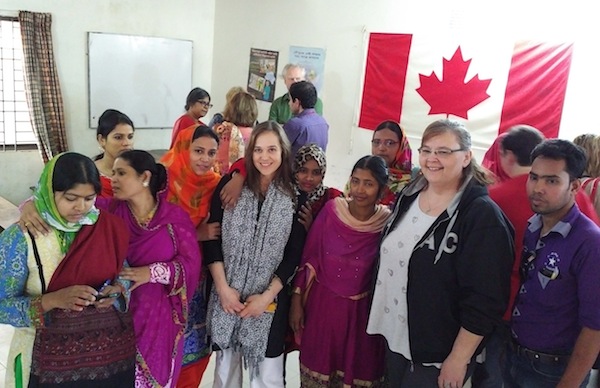
Marianne Hladun, second from the right, and fellow delegation member Melanie McConnell (chair of Women of Steel committee for USW Local 7619, Kamloops, B.C.), fifth from the right, at the Bangladesh Centre for Worker Solidarity in 2016. The other women are volunteers who work to promote unions in the factories, and health and safety. (photo from NCJWC Winnipeg)

The Winnipeg section of National Council of Jewish Women of Canada is opening Canadians’ eyes to yet another critical, yet often overlooked, worldwide dilemma – that of garment workers’ working conditions.

Part of its focus on fair trade, NCJWC partnered with Congregation Shaarey Zedek Sisterhood to bring a national expert on the topic to Winnipeg for a speaking engagement on Dec. 13 at the synagogue. Event organizer Sharon Graham and guest speaker Marianne Hladun, regional executive vice-president of the Public Service Alliance of Canada, spoke with the Jewish Independent before that talk.

Originally from Toronto, Graham moved to Winnipeg 12 years ago, and joined the local NCJWC in 2016, serving as the volunteer secretary.

“I became interested in this topic around 2017,” she said. “There were a lot of reports in the news and radio about a new union-led report on supply chain transparency in the garment and footwear industry.”

Large retailers like Canadian Tire, Sport Chek and many others have made it hard for consumers to know where the products they sell are made, said Graham. It is a common tactic of most large retailers, so that individual manufacturers can’t dictate prices and product availability. However, there are other impacts.

A factory in downtown Dhaka, Bangladesh, in 2016. (photo from NCJWC Winnipeg)

“This way, you don’t really know where their items are made. And, because you don’t know which factory they’re made in, there’s no way to tell under what conditions they’re made,” said Graham. “So, I wrote a letter to Canadian Tire and, to their credit, they sent me the name and I looked them up online. There are websites you can look up online to see manufacturers – what kind of record they have for labour rights, or for transparency about labour rights, like, if they allow outsiders into their factory.”

For Graham, the subject is also personal. “If you’re an Ashkenazi Jew,” she said, “you probably have an ancestor or ancestors who’ve worked in the garment trade. For me, it was my grandfather and great-grandfather on different sides. And, for both those men, the garment trade brought them a good living. My great-grandfather did really well in furs and my grandfather had a good living as a patterner in the garment trade.”

In her capacity at PSAC, which is a federal union representing about 180,000 members across Canada, Hladun said, “I represent about 21,000 members in the Prairies and, as part of that responsibility, I was able to participate in a mission to Bangladesh in February 2016, following the Savar plant collapse disaster, which was on April 24, 2013.”

The Savar building was a workplace for thousands of garment workers. In the collapse, 1,134 people died and approximately 2,500 were injured.

Following the tragedy, a legally binding accord was drawn up on fire and building safety in Bangladesh. The accord was an agreement between global brands, retailers and trade unions, and set for five years, after which time, the operations and oversight would be transferred to the government.

“Coming from a country like Canada, where we do have a true democracy, corruption doesn’t come to our mind first and foremost when we’re talking about government and workers,” said Hladun. “But, when you go to a country like Bangladesh, you realize very quickly that their parliament is basically garment manufacturer factory owners. So, there seems to be no one that’s working for the workers. That was something that a lot of us had a hard time really comprehending – that no one has your back.”

During the visit in 2016, Hladun found that, in factories of brands that had signed the accord, changes were being made. But, the factories that had not signed it were continuing with business as usual.

“Keep in mind that very few factories are actually part of the accord,” said Hladun. “But, the ones that were part of it had started remediation. They had done the inspections and, basically, if the certified building inspector there on behalf of the accord says a factory doesn’t have a fire sprinkler system and needs to instal one, they will tell them so.

“Then, the brand is responsible to work with the factory owner, and the brand is actually taking responsibility by funding the remediation. And, we’re starting to see some of that work happening. It was slow, as it took awhile to get the inspections done. But, it was starting to happen [in 2016]. I think there were about 1,400 factories covered, out of about 5,000, at that time.”

According to Hladun, the Bangladesh high courts are now forcing the accord to close their main office in Dhaka. The plan was to have a transition accord wherein, over the next couple of years, the office would aim to transfer everything to the government and a national agency would continue this work. But, as a result of a lot of political pressure, it appears that the government would rather eliminate the accord.

“There is a lot of pressure,” said Hladun. “Canada’s high commissioners sent a letter in October to several of the ministers in the Bangladesh government, urging them to override the court and to legislate that the accord stay in place until the transition to the government body is done … because the work is nowhere near ready.”

If the accord is eliminated, she said, the situation would return “to conditions pre-Savar building collapse.”

The accord’s website, bangladeshaccord.org, shows the brands that have signed onto the accord. Hladun urged Canadians to contact the brands and ask them to advocate with the government to continue with the program. She also suggested that interested Canadians contact their federal MP and ask them to pressure the Bangladesh government to continue the accord.

Hladun strongly advised against lobbying for a boycott, saying “that is the worst thing we can do. Basically, the garment industry is 4.2 million workers in Bangladesh. That industry is the only thing that provides income for workers in Bangladesh. They do not want to see a boycott. They want to see support for better working conditions.”

Another way to show support is with your wallet, by shopping and supporting factories and brands that have signed onto the accord or are treating their workers ethically regardless.

Rebeca Kuropatwa is a Winnipeg freelance writer.

Format ImagePosted on December 14, 2018December 12, 2018Author Rebeca KuropatwaCategories WorldTags Bangladesh, human rights, Marianne Hladun, PSAC, Sharon Graham, unions
Bellingham’s new shul

Bellingham’s new shul

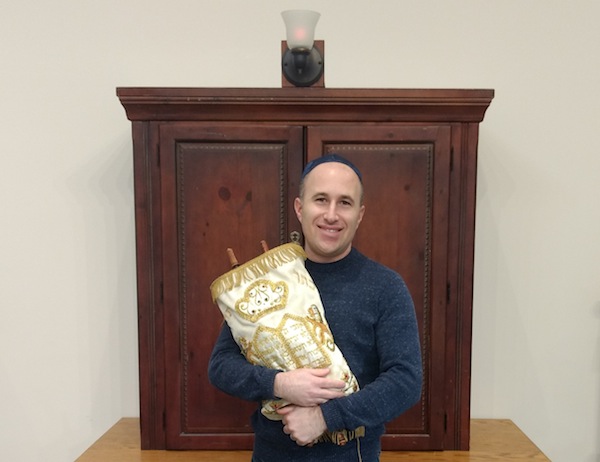
Rabbi Joshua Samuels holds thecongregation’s Torah from Lithuania. (photo by David J. Litvak)

Congregation Beth Israel in Bellingham, Wash.,started out its life as a Lithuanian Orthodox shul in 1908. Today, thecongregation is housed in a stunning building in the woods, on 20 acres ofland.

The newly constructed synagogue opened its doors in March of this year to serve the spiritual and cultural needs of Reform and Conservative Jews of Bellingham and Whatcom County, Mount Vernon and the Skagit Valley, the San Juan Islands and even Jews from Metro Vancouver.

Several weeks ago, for instance, the congregation hosted a screening of a film about Israel, The Original Promise, which was produced by Fraser Valley resident Bill Iny (who is a member of Vancouver’s Congregation Beth Hamidrash) in conjunction with the Northwest chapter of StandWithUs, an advocacy group for Israel that has chapters in the United States, Canada and Israel. The screening, which attracted more than 100 Jewish and non-Jewish attendees, featured a panel discussion moderated by Beth Israel’s spiritual leader, Rabbi Joshua Samuels.

This event is one of many that the Pacific Northwest synagogue has hosted since relocating. However, while the synagogue building may be new, it houses a nearly 300-year-old miniature Torah from Lithuania that was commissioned in the mid-1700s by a czar of Russia.

Samuels said the czar gave the Torah to his doctor, one of Samuels’ Lithuanian ancestors, and the Torah has remained in his family ever since. His great-grandmother – hiding the Torah in a big coat – fled Lithuania with her children to the United States, joining her husband in Fargo, N.D., where he had found work.

The tiny Torah, said Samuels, has “lived in Fargo, Long Beach, California, San Francisco (I read from it for my bar mitzvah) and then it followed me after my ordination to Los Angeles and now is with me here in Bellingham.”

A Torah is meant to be chanted and studied, he noted. And, in Bellingham, he has used it on special occasions, such as on the second day of Rosh Hashanah and for the Shabbat of Bereishit (his Torah portion), as well as for b’nai mitvzah studies, and he has taken it to Bellingham high schools and to Western Washington University. He wants students “to see the beauty of a Torah scroll and to hear it chanted.”

“It’s the highlight of any visit,” he added.

Samuels also took the Torah to a cousin’s bar mitzvah in California and will take it to Jerusalem next month for his niece’s bat mitzvah, he said, “so that she can read from as it as her mother did 33 years ago.”

When he travels with the Torah, said Samuels, “I feel like I am a concert musician traveling with a Stradivarius – I think about it all the time, even if it is in a cushy case right above my seat.”

Bellingham’s Congregation Beth Israel. (photo by David J. Litvak)

Samuels, who is a fifth-generation San Franciscan – his family arrived in San Francisco during the gold rush – worked in the stock brokerage business in Los Angeles and San Francisco before deciding to make a major life change. “I felt a gentle nudging to take another path in life and, after some soul-searching for about three years, I applied to rabbinical school at Hebrew Union College-Jewish Institute of Religion,” he said.

After studying in Jerusalem and Los Angeles for five years, Samuels was ordained in 2010. He began his new career at Temple Beth Hillel in Valley Village, Calif., before coming to Bellingham to become Beth Israel’s spiritual leader in July 2012.

Congregation Beth Israel was established in 1908 with 30 families, including Jews from Germany and Lithuania. The synagogue was Orthodox until 1986, when it became a Reform shul and joined the Union for Reform Judaism, which, at that time, was called the Union of American Hebrew Congregations.

The congregation has grown to include 275 families and moved to its new building from a synagogue on Broadway that was built in 1925 (and was recently sold). The new building was built to accommodate the congregation’s growing community, drawing worshippers throughout the region and from as far away as Surrey, White Rock and Chilliwack, to attend services and the Sunday school. (For the Canadian congregants, there is the added bonus of being able to shop at Trader Joe’s after Sunday school.) The synagogue also hosts a Conservative minyan on the fourth Saturday of every month.

While the new synagogue opened its doors in March, Samuels said the construction began after he arrived in Bellingham in 2012. “The reason it took so long to build was to avoid incurring any debt,” he said. “Just as the early Bellingham Jews bought the Broadway building outright, we wanted to do the same with the new space.

“The state-of-the-art facility that we built can accommodate our needs for at least the next 100 years.”

Bellingham’s Congregation Beth Israel is set on 20 acres. (photo by David J. Litvak)

The sanctuary can seat more than 500 congregants, and there is an outdoor patio overlooking the woods that can accommodate almost as many. The building has 10 classrooms, two kitchens, a preschool, library, study space and tons of storage.

Since March, the congregation has hosted a variety of activities, including several StandWithUs events, a concert featuring Seattle musician Chava Mirel and one with Bellingham klezmer band What the Chelm (who performed at the synagogue’s grand opening in August), a Purim party and a second-night Passover seder. In addition to being able to host holiday parties, Samuels said, “We were finally able to host the High Holy Days in our own shul after years of renting space around the city.”

And the congregation continues “to look for opportunities to host events, speaker series, movies, classes, etc.,” he added. As well, they would like to participate in more cross-border collaborations, he said.

Samuels believes that his Lithuanian ancestors would be happy to see their tiny Torah in its new Bellingham home, at the shul in the woods. He said the Torah reminds him of his grandfather Jack (Yaacov), a real mensch who died when Samuels was 7. His grandfather – whose mother had brought the Torah to the United States – helped build a synagogue in Fargo.

“He is present every time I see the Torah,” said Samuels. “I wish I could travel back and meet my family and tell them that everything is going to turn out just fine. Their legacy is alive and well.”

David J. Litvak is a prairie refugee from the North End of Winnipeg who is a freelance writer, former Voice of Peace and Co-op Radio broadcaster and an “accidental publicist.” His articles have been published in the Forward, Globe and Mail and Seattle Post-Intelligencer. His website is cascadiapublicity.com.

Format ImagePosted on December 14, 2018December 12, 2018Author David J. LitvakCategories WorldTags Bellingham, Joshua Samuels, Judaism, synagogues
Significant shifts in thinking

Significant shifts in thinking

(photo from jewishcamp.org)

Today’s world requires camp to adapt to an unprecedented pace of change. Through innovation and building “adaptive capacity,” the Foundation for Jewish Camp, which works with more than 180 Jewish summer camps, will be better suited to help Jewish camps evolve and ensure long-term, sustainable results.

Adaptive capacity, as defined by Ronald Heifetz – co-founder of Cambridge Leadership Associates and author of numerous books – is “the practice of mobilizing people to tackle tough challenges and thrive.” It requires the ability to be reflective; to be open and curious to changes in the environment; to use data and evaluation to determine the best path forward; to innovate where new approaches are required; to work collaboratively and leverage diverse experiences and perspectives; and to successfully lead systemic change.

Foundation for Jewish Camp executive summary cover

FJC is challenging what it means to be a Jewish camp. This evolution has resulted in significant shifts in how FJC thinks about the field and its work. “Camp” is now framed as a year-round continuum of immersive, meaningful experiences beginning at the earliest ages and continuing through the teen years, college, and into adulthood and family life, delivered through day camps, overnight camps, family camps and year-round offerings.

Looking ahead, FJC has identified three strategic priorities for the field that include investments in new initiatives and in existing areas of proven impact: develop adaptive talent, deepen immersive learning and drive field growth. These priorities are designed to amplify one another, and the success in any one area is co-dependent on success in the others.

1. Adaptive talent

Talent development is critical to grow and enhance the field of Jewish camp. FJC has long invested in field professionals. As Jewish camp evolves, FJC must now take an adaptive approach to leadership development, both professional and lay, that meets the needs of current and future Jewish leaders.

Counselors

Counselors are the linchpin of the Jewish camp experience. These Jewish role models inspire campers to return year after year. Additionally, when a camper returns as a counselor, the impact of the camping experience is amplified, as staff internalize the lessons of their own experience to create similar (or better) ones for their campers. At the same time, it has become more challenging to recruit and retain counselors due to competition from internships and parental pressures.

FJC will uncover and create new staffing and supervision structures that create a learning framework for these future leaders as well as recognition of the purpose-driven nature of their work. The new models will seek flexibility in camp schedules and create new modalities of training staff to enhance college, career and life-readiness skills.

Other leadership

Jewish camps are experiencing ever-increasing turnover of executive leadership, which is expected to continue over the next five years. FJC seeks to increase investment in the leadership and talent pipeline of camps, cultivating new and refreshed opportunities to engage with and propel Jewish camp and lay leaders at every stage of their development. These initiatives represent opportunities to retain and accelerate the careers of outstanding young talent, build crucial networks among the field and provide high-level, skill-building professional development opportunities. Rather than focus on one single cohort program or development workshop, FJC will ensure attention to the entire talent pipeline.

Envisioned outcomes

• Increase retention rates by 25% or more over current benchmark; easier recruitment of seasonal staff.

• Improve quality of leadership that will drive retention rates and satisfaction scores for campers and staff.

2. Immersive learning

Jewish camps must adapt, expand and evolve in response to societal changes and the manner in which families belong and engage Jewishly. FJC is prioritizing initiatives that will bring the “magic” of camp further into the community by helping camps articulate their Jewish missions, develop programs and ensure the entire camp community is safe and secure for both campers and staff.

Year-round activities

As participation in traditional Jewish activities has declined, camp has become a primary immersive and educational experience for many children. Camp is often the preferred Jewish brand for these families, where their children feel a profound sense of belonging. With summer participation in experiential, immersive learning as the anchor, Jewish camps can and should play a greater role in the community, supplementing the summer with year-round experiences that ensure campers have opportunities to connect with peers through Jewish activities and educational experiences. FJC will invest in year-round programs to maximize the impact of the camp experience.

(photo from jewishcamp.org)

Amplify education

From FJC’s inception, ensuring that summers at Jewish camp translate into a robust Jewish future has been central to the mission. To do so effectively, FJC takes a holistic approach – working closely with camps and their various stakeholders, giving them a framework to help them enrich and refresh how they articulate and realize their unique Jewish vision. Investing in the enrichment of senior camp professionals, as well as attracting and recruiting talented Jewish educators, will bring this vision to life, and are critical to a strong Jewish educational program.

Envisioned outcomes

• 30% of camps have increased their year-round engagement opportunities.

• Higher-quality Jewish and Israel learning opportunities for campers and staff have been put into action.

3. Field growth

Over the past 10 years, camp enrolment has grown 22% in an era of overall declining participation in the traditional Jewish institutions. To accelerate this growth, FJC is prioritizing initiatives that will both increase the pipeline of Jewish campers and ensure accessibility for campers from all backgrounds. To this end, FJC’s initiatives will focus on how to attract families with young children by engaging them at an earlier and highly formative time; continue the work of increasing competitiveness of Jewish camps through the development of specialty programs; expand access through financial incentives; and promote full physical, social, educational and spiritual access for all campers and staff, irrespective of their abilities.

Younger children

Families are seeking meaningful connection and community in new ways. Building an earlier entry point to the Jewish camp experience will increase the number of campers and families making Jewish summer choices. The focus will include incubating, expanding and strengthening intentional Jewish day camps and family camps in order to engage children at the earliest ages along with their families.

Enrolment, participation

FJC’s core growth programs, including One Happy Camper and new specialty camps and tracks, have driven growth in the field. Diversity and inclusion, as well as community care, must endure and evolve so that the Jewish camp field continues to increase enrolment and improve both retention and camper satisfaction. Continual investment in physical facilities will also increase overall enrolment and ensure that camp is a welcoming and safe environment for all.

Envisioned outcomes

• Grow the field by 20%, reaching 215,000 annual camp participants.

• Year-over-year increases in family participation in camp experiences.

• Increase training, application and family visibility for diversity, equity and inclusion initiatives.

• Increase diversity at camp.

For more on FJC and its strategic plan, visit jewishcamp.org.

Format ImagePosted on December 14, 2018December 12, 2018Author Foundation for Jewish CampCategories WorldTags camps, diversity, FJC, strategic plan, youth
Training local doctors

Training local doctors

Prof. Mark Eidelman, director of the pediatric orthopedics unit at Rambam’s Ruth Rappaport Children’s Hospital, second from the left, with African colleagues at the Black Lion Hospital in Addis Ababa. (photo from Rambam Medical Centre)

Dozens of doctors from Ethiopia and neighbouring countries recently participated in a practical course, the first of its kind, which trained them to fix pediatric orthopedic deformities. The course, held for the first time in Africa, was led by Prof. Mark Eidelman, director of the pediatric orthopedics unit at Rambam’s Ruth Rappaport Children’s Hospital.

Fifty doctors participated in the four-day course. Some of them had already completed their internships, while others were still interns. They attended lectures about different treatment types, attended workshops and participated in surgeries. The Black Lion Hospital in Addis Ababa, Ethiopia, hosted the course, which was sponsored by CURE International. CURE is a nonprofit organization that assists children in developing countries suffering from medical issues, in cooperation with POSNA, the Pediatric Orthopedics Society of North America.

The Ethiopian hospital’s pediatric orthopedic services are directed by two doctors from England who relocated to Ethiopia several years ago. The doctors created the course in order to give treatment tools to local medical teams dealing with one of the most common problems in the country.

“Against the backdrop of genetic diseases and problems, and especially since there is a great lack of knowledge, infrastructure and treatment capabilities with regard to pediatric orthopedic deformities, there are many people in Ethiopia with problems that are taken care of in other countries at much earlier stages,” said Eidelman. “In Israel, like in many other Western countries, they know how to diagnose problems … and treat them in a timely manner. This helps these patients to enjoy a higher quality of life and prevent their conditions from deteriorating. Now, for dozens of local doctors, there are tools and knowledge to help their patients.”

Joining Eidelman on this recent mission were two doctors from the United States: one who was Eidelman’s teacher, Prof. John Herzenberg, a senior doctor in the field from Baltimore; and Prof. Christof Radler, who is also renowned in his field.

According to Eidelman, the main problem in training African doctors is the difficulty of traveling to the United States to receive training there. “The institutions in Baltimore are considered the best in the field in terms of training and teaching, and the city hosts the leading conferences and courses,” he said. “Unfortunately, most of these doctors don’t manage to secure entry visas for the U.S. and, as such, are denied access to this information. This is the reason why we decided to bring the training to them. At the end of a successful course, we decided to continue with this initiative and, in the near future, I’m supposed to return to Ethiopia in order to train additional doctors.”

Format ImagePosted on November 30, 2018November 29, 2018Author American Friends of RambamCategories WorldTags Africa, Ethiopia, healthcare, Mark Eidelman, orthopedic, pediatrics, Rambam Health Care Campus
Playfulness and style

Playfulness and style

Ralph Lauren in 1978. (photo by Edgar de Evia)

Born 79 years ago, in New York, to Frieda and Frank Lifshitz, immigrants from Belarus, Ralph Lifshitz, better known as Ralph Lauren, has become a universal household name.

The youngest of four siblings clothed in hand-me-downs, the fashion legend never imagined becoming a designer – he did, however, yearn to be the next Joe di Maggio or Cary Grant. His favourite pastimes were sports, listening to the radio, watching TV and movies. And it is from these influences that his dream to design clothing came.

At 16, Lifshitz switched to the name Lauren after experiencing years of ridicule. At the same time, he embraced and embellished his own sense of style, buying oversized and rugged clothing from the army surplus store because he liked how they made him feel, and had an aspect of originality. His preference for military-style clothing predated his draft to the American army, in which he served two years. It was in the army that his respect for the uniform further developed and he incorporated the style into many of his subsequent designs.

In the years that followed, Lauren began working by day for a buying company while studying at night. It was during this period that he had the idea of making ties from scraps, and making and selling his unconventional ties turned into a profitable side business.

While working for men’s fashion house Brooks Brothers, Lauren tried to get them to sell his ties, but to no avail. Moving on to work for tie manufacturer Beau Brummell, an upscale men’s brand, Lauren’s potential started to be realized, as he acquired a “drawer” in their showroom of the Empire State Building to sell his flamboyant ties. In 1967, Lauren started the label Polo, the name reflecting his love of sports, and his creations’ international and sophisticated vibe. Lauren sewed on each label, together with his new bride, Ricky. He also made all the deliveries himself, to the likes of Neiman Marcus and Bloomingdales. During the first year, Polo made $500,000. The young Jewish boy from the Bronx’s design career was on its way.

By 1968, Lauren was making his own suits, which were, once again, offbeat; not what his colleagues were wearing. Lauren believes that fashion is all about playfulness, expressing one’s individuality and not conforming to one look. He has held this belief through his many years in the industry, and it has no doubt provided the foundation of what he has built into a multibillion-dollar empire.

photo - Maartje Verhoef walking the Ralph Lauren spring-summer 2015 fashion show
Maartje Verhoef walking the Ralph Lauren spring-summer 2015 fashion show. (photo by Christopher Macsurak)

Lauren’s classic innovations include making women feel that wearing a tuxedo was sexier than a gown; turning tailored men’s shirts unisex; and transforming American folk art (patchwork) into fashionable sweaters, coats and dresses, borrowing from cowboys’ attire the rich colour of turquoise, fringed jackets and boots.

Lauren’s talents did not end at the design table. He used the platform of advertising unconventionally, working with real people, not models, in ads that covered multiple pages to tell a story through his clothing’s many different looks and fabrics. This creative approach was developed in part with photographer Bruce Weber.

Lauren has outfitted Wimbledon players, won the Coty Award for both women and men’s wear, opened the first freestanding store in Europe by an American designer, and established a home collection. Other highlights include being the costume designer for Woody Allen and Diane Keaton in the Oscar-winning movie Annie Hall, and creating a men’s and women’s fragrance in 1978 that is still emblematic. Upon receiving a lifetime achievement award in 1992, presented to him by actor Audrey Hepburn, he said, “I don’t design clothes, I design dreams.”

Ricky, Lauren’s wife of more than five decades, is one of his muses. Her elegant and natural style has been a continuous inspiration for him and it is her sense of self that he tried to emulate in his clothing designs. Together, the couple built the Ralph Lauren brand not only as a fashion domain but as a family business, operated with their two sons and daughter.

In addition to his material and creative successes are Lauren’s contributions to philanthropic causes. Among them, Lauren and cancer surgeon Dr. Harold P. Freeman founded the Ralph Lauren Centre for Cancer Care in Harlem, N.Y., in 2000, with the resources of the Polo Ralph Lauren Foundation and the Memorial Sloan Kettering Cancer Centre. The residence, care and support facility’s mission is “to fight health disparities in the community … [and] become a beacon for quality, dignity and accessibility in cancer care.”

Ariella Stein is a mother, wife and fashion maven. A Vancouverite, she has lived in both Turkey and Israel for the past 25 years.

Format ImagePosted on November 30, 2018November 30, 2018Author Ariella SteinCategories WorldTags business, clothing, fashion, history, Ralph Lauren
Keeping clean then and now

Keeping clean then and now

The mikvah at Herodian, which was apparently built during the Second Temple period (530 BCE and 70 CE). (photo by Deborah Rubin Fields)

The Dark Ages weren’t given their name for nothing. After the collapse of the Roman Empire, sanitation virtually disappeared. During the Dark Ages – also referred to as the Middle Ages or the medieval period – few people bathed regularly. What did they do? Those who could, or were so inclined, covered up body odour with perfume.

Progress does not always move in a forward direction – the older, classical civilizations bathed far more than did medieval Europe. In the non-Jewish ancient world, the earliest unearthed bathing and plumbing systems date back nearly 6,000 years to the Indus River Valley, in today’s Pakistan. There, archeologists excavated copper water pipes from the ruins of a palace, as well as the remains of what appears to be a superbly constructed ritual bathing pool at Mohenjo-daro. And, in a find dating 3,000 years later, archeologists found a pottery pedestal tub on the island of Crete that measured five feet long.

By instituting a practice of daily bathing, the Romans improved the general level of sanitation. Baths, moreover, functioned not just to raise the level of hygiene, but also provided opportunities to socialize, to exercise, to read and, importantly, to conduct business. From 500 BCE until 455 CE, Roman public baths were common. Moreover, privately owned Roman baths were quite luxurious, often taking up a whole room. The comprehensive sewage system of the baths consisted of lead and bronze pipes and marble fixtures.

Now, note this contrast: until the 1800s, most water pipes in the United States consisted of no more than hollowed-out trees, and the first cast-iron pipes in the United States were imported from England. Only in 1848 was a U.S. plumbing code enacted, with the passage of the National Public Health Act. In 1883, both the Standard Sanitary Manufacturing Co. (now the American Standard Co.) and the Kohler Co. began adding enamel to cast-iron bathtubs to create a smooth interior surface. Kohler advertised its first claw foot tub as a “horse trough/hog scalder [which] when furnished with four legs will serve as a bathtub.” Kohler began mass-producing these tubs, as they were recognized as having a surface that was easy to clean, thus preventing the spread of bacteria and disease.

To give additional perspective, consider this finding: after the First World War, the United States experienced a construction boom, and bathrooms were fitted with a toilet, sink and bathtub – but, even in 1921, only one percent of American homes had indoor plumbing.

Since antiquity, Jews have maintained a relatively high level of sanitation, due in part to the prescribed hand-washing ritual before eating and to the religious practice surrounding the mikvah, or ritual bath. In Israel, the oldest discovered mikvah dates back to the Second Temple period, more than 2,000 years ago. In recent years, archeologists discovered Europe’s oldest mikvah – in Sicily’s ancient Syracuse, it goes back to the Byzantine period, or the fifth-century CE.

But two important questions need answering: how do we know bathing was so important and what is a mikvah? The Babylonian Talmud, Tractate Berakhot 57b, provides this insight: though anointing (oil) and bath (water) do not enter the body, the body benefits from them. Moreover, in Tractate Sanhedrin 17b, we learn that scholars were forbidden from residing in cities that did not have public baths.

Historically, municipalities often barred Jews from bathing in their rivers, and Christians blocked Jews from using public baths. Moreover, there was a fear that Jewish women might be molested in a general public bath. So, there was a need to construct separate facilities, and Jews built bathhouses, many with mikvot close by. Thus, Jews began to link the concept of the mikvah with physical hygiene.

Significantly, the mikvah was never a monthly substitute for a bath or shower. In fact, Jewish law calls for immersion only after one has bathed or showered. Oceans, rivers, wells and lakes, which get their water from springs, can usually serve as a mikvah. The common thread between these bodies of water is that they are natural sources. To traditional Jews, they are derived from G-d. As such, they have the ability to ritually purify.

A human-made mikvah must be built into the ground or built as an essential part of a building. There are two pools: one that contains collected rainwater and the other, the actual immersion pool, is drained and refilled regularly with tap water. The pools, however, share a common wall with a hole that permits the free flow of the water, so the immersion pool also receives rainwater.

When the Temples stood, the high priest immersed in the mikvah at prescribed times. But, today, when there is no Temple, for the Orthodox, the mikvah serves the following four functions: a woman uses the mikvah after menstruating and after giving birth; immersion in a mikvah marks the final step in converting to Judaism; before beginning to cook and eat from them, Jews use the mikvah to immerse new pots, dishes and utensils; and the mikvah is also used to prepare a Jew’s body before his or her burial. Men go to the mikvah before their wedding and before Yom Kippur, and many Chassidic men use the mikvah before each Shabbat and holiday.

photo - Giovanni Boccaccio’s “The plague of Florence in 1348”
Giovanni Boccaccio’s “The plague of Florence in 1348.” (photo from wellcomecollection.org)

It is speculated that up to 60% of the general European population died of the Black Death. There are no statistics as to how many Jews died of the plague, so it is hard to actually say that Jewish bathhouses or the Jewish practice of hand washing or other sanitation prescribed by Jewish law kept Jews safer than the general medieval public. Two points, however, may be stated with certainty:

  1. In a number of instances, European Jews were blamed for the Black Death. As a consequence, beginning in November 1348 in Germany, Jews were massacred and expelled from their homes. In February 1349, 2,000 Strasbourg Jews were murdered. Six months later, Christians wiped out the Jews of Mainz and Cologne. By 1351, 60 major and 150 smaller Jewish communities had been eliminated.
  2. Even today, comments on the subject need to be scrutinized for possible antisemitic motives.

As for today, in the Western world, there seems to be an obsessive amount of soap bars, soap liquids, no-soap cleaners, hand wipes and wet wipes. Can one over-clean? Yes.

In an interview with Global News earlier this year, Dr. Anatoli Freiman of the Toronto Dermatology Centre explained the negative consequences of excessive showering or bathing. “The skin can dry out,” he said. “But the message is, after the shower or bath, you need to pat yourself dry and moisturize to seal it.”

Prof. David Leffell, chief of dermatological surgery at Yale School of Medicine, gives these guidelines about keeping clean. “You don’t want to do the Lady Macbeth thing, where you’re scrubbing and scrubbing,” he told businessinsider.com. “The purpose of showering is to eliminate dirt.” This can be done, he explained, in less than a few minutes by focusing on the grimier parts of the body (armpits and groin) and not overdoing it with soap elsewhere. He advised using warm, not hot, water; aiming for a three-minute shower; and moisturizing while the skin is still damp.

Deborah Rubin Fields is an Israel-based features writer. She is also the author of Take a Peek Inside: A Child’s Guide to Radiology Exams, published in English, Hebrew and Arabic.

Format ImagePosted on November 30, 2018November 30, 2018Author Deborah Rubin FieldsCategories WorldTags bathing, health, history, Israel, Judaism, mikvah

Posts pagination

Previous page Page 1 … Page 11 Page 12 Page 13 … Page 33 Next page
Proudly powered by WordPress