Skip to content
  • Home
  • Subscribe / donate
  • Events calendar
  • Business Directory
  • FAQ
  • News
    • Local
    • National
    • Israel
    • World
    • עניין בחדשות
      A roundup of news in Canada and further afield, in Hebrew.
  • Opinion
    • From the JI
    • Op-Ed
  • Arts & Culture
    • Performing Arts
    • Music
    • Books
    • Visual Arts
    • TV & Film
  • Life
    • Celebrating the Holidays
    • Travel
    • The Daily Snooze
      Cartoons by Jacob Samuel
    • Mystery Photo
      Help the JI and JMABC fill in the gaps in our archives.
  • Community Links
    • Organizations, Etc.
    • Other News Sources & Blogs
  • JI Chai Celebration
  • JI@88! video

Recent Posts

  • Or Shalom reopens its doors
  • JFS from past to future
  • Need holistic approach
  • Sharing stories, advice
  • Journalist shares fears
  • Skills to live together
  • Road to independence
  • Cutting grass with scissors
  • Zionism as a solution
  • Deceit, desire & the divine
  • Reclaiming sacredness
  • Creative project ideas
  • Summer squares and cobbler
  • Thou shalt … summer commandments
  • Legal help for students
  • Revisiting myth of Lilith
  • Wrong person rebuked
  • Canada’s mixed messages
  • Questions for museum
  • Symposium on antizionism
  • Making soccer political
  • CJPAC lauds Pulver’s impact
  • City recognizes Vrba’s legacy  
  • Organ donation saves lives
  • Theodore’s March premiere
  • A healing Shabbaton
  • Supplying healthy food
  • A chime of metal tags
  • Yellowknife seder a first
  • Ishai energizes, unifies
  • A Lag b’Omer to remember
  • Expanding the healing
  • Hannah Senesh – a unique hero
  • Community milestones … May 2026
  • Деньги до зарплаты на карту Займ до зп онлайн за 5 минут 2026
  • Микрокредит онлайн в Казахстане Микрозайм в Акшамат

Archives

Follow @JewishIndie
image - The CJN - Visit Us Banner - 300x600 - 101625

Category: World

Making change her business

Making change her business

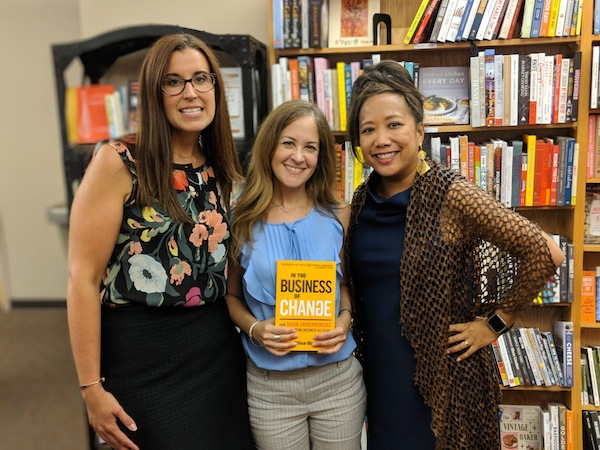
Elisa Birnbaum, centre, with Laura Zumdahl of Bright Endeavors, left, and Maria Kim of Cara Chicago. (photo from Elisa Birnbaum)

Toronto-based Elisa Birnbaum, editor-in-chief of SEE Change magazine, aims to inspire and give hope in many ways. Her book In the Business of Change: How Social Entrepreneurs are Disrupting Business (New Society Publishers, 2018) is but one of those ways.

“I’m a lawyer by training, but was always a writer on the side, enjoying writing and storytelling,” said Birnbaum, who was born and raised in Montreal in an Orthodox Jewish family. “I decided to try writing out for a little bit and to go back to law after. That was 15 years ago. I never went back to it.

“I was writing a lot about the nonprofit and charitable sector in Canada, as well as in the U.S., and I was also writing a lot about business, a strong interest of mine, too. I noticed how there was a melding of the two – how a lot of challenges in the nonprofit and charitable sector … how they could be helped through business and through business savvy…. So, when I saw what social enterprise was all about and how it was using business to solve social challenges, I realized the importance of that. I became really intrigued and interested. It was an area that, I thought, ‘Hey, this is something I really want to explore further.’”

Birnbaum started pitching stories about social enterprises to any editor who would listen. While some of her work went out via mainstream media, Birnbaum felt more was needed, so she co-founded SEE Change, which is devoted to telling the stories of social and environmental enterprises.

“I thought they symbolized a new way at looking at business,” she told the Independent. “I really felt this was the future, with how we work with business and how communities can tackle social challenges through business, and these types of savvy-ness and skills.”

After years of publishing the magazine, Birnbaum wanted to put together a book of such stories, both to delve more deeply into the phenomenon and, hopefully, to inspire and teach readers how to take on the task of starting a social enterprise.

“A lot of times, I’d get some young people or even older people who were interested in social entrepreneurship themselves, and they’d like advice and tips, and were constantly looking for more information from anyone who’d done it before,” she said. “So, I thought, I could also provide lessons learned, tips, advice and resources … so, a bit of storytelling, as well as a resource for those who are starting up or looking to start their own.”

As far as the response to the book so far, Birnbaum said she has been asked by schools and organizations to speak about the topic. “There were people who had never heard about it before and are now really inspired by the storytelling, which is great,” she said. “There are other people…. I was at a couple of universities recently, and some students there said they picked up the book and were now interested in starting their own social enterprise.”

According to Birnbaum, a very broad definition of a social enterprise is a business, whether nonprofit or for-profit, that has a social or environmental mission at its core, as opposed to a business that has profitability and sustainability at its core. The unique aspect of social entrepreneurship, she said, is that it approaches business in a new way.

In her book, Birnbaum makes a point of highlighting a large array of social enterprises from around the world, including a few in British Columbia. For example, Saul Brown’s Saul Good Gift Co. (itsaulgood.com) creates gift boxes filled with locally made artisan food that people can give their loved ones across Canada, and Reena Lazar’s Willow (willoweol.com) helps with end-of-life planning.

photo - Fresh Roots offers students experiential learning opportunities.
Fresh Roots offers students experiential learning opportunities. (photo from Fresh Roots)

Marc Schutzbank, director of Fresh Roots (freshroots.ca), grew up in the United States and moved to Vancouver to finish his education at the University of British Columbia 10 years ago on a Fulbright scholarship, looking at the economic viability of urban farming. This line of study led him to an organization called Plant to Plate, in Pittsburgh, Penn., where he attended University of Pittsburgh.

“As part of my research, I was looking at urban farms in Vancouver – if they were growing, how much food they grow, who they’re sharing it with,” Schutzbank told the Independent. “I have a finance degree, so I was looking at if they were making any money. As I was doing that, there were a couple of people who were doing work in the social space. So the goal wasn’t to grow and sell food; the goal was to share it or to reduce barriers to employment. And so, as I was getting to know them, Fresh Roots was moving from backyards into school grounds.”

One particular backyard caught Schutzbank’s attention. He wanted to know how much food was being grown in such a small space. He discovered, to his amazement, that this one backyard could feed three families. As they expanded to eight backyards, they could feed 35 families.

One of those backyards was adjacent to an inner-city elementary school with a rundown garden plot. The school invited Fresh Roots to develop the plot. As they did, the students, teachers and parents became increasingly interested. The teachers began using the garden as part of their curriculum, as a place to build learning capacity.

“It turns out that, when kids are outside growing food, their academic confidence increases,” said Schutzbank. “They are able to find some success, and this is often in places with kids that are having a hard time finding success inside the classroom [in straight rows]…. Learning like that doesn’t work for everyone.”

photo - Marc Schutzbank, director of Fresh Roots
Marc Schutzbank, director of Fresh Roots. (photo from Fresh Roots)

Another benefit of this was that bullying decreased at the school, as kids had a positive physical outlet. As well, Schutzbank found that, as the saying goes, “If you grow it, you eat it.”

Other schools picked up on what was happening and asked Fresh Roots to do the same at their schools. Fresh Roots is now at four high schools and one elementary school.

Fresh Roots also started a salad bar program for students – twice a week, all of the students get to eat the produce from the garden.

“In Canada, we are the only G7 nation that doesn’t have a federal meal program,” explained Schutzbank. “It’s a bit crazy that Canada doesn’t have that. All those kids without lunches are hungry, regardless of how much food is at home. It’s really critical for learning, to have food…. So, at Fresh Roots, our vision is good food for all – so everybody has access to healthy land, food and community.”

In addition to the food they grow, Fresh Roots supports and encourages teachers to have classes outside in the garden. “They need to touch, taste and feel,” said Schutzbank of the students. “Those are really critical parts of our senses and a really important way of learning.”

As well, Fresh Roots provides employment – especially in the summer – for youth who are struggling.

Schutzbank said you can’t grow food without eating and sharing it, so Fresh Roots’ philosophy is “around sharing all the food back through the programs and everything we are doing.”

Rebeca Kuropatwa is a Winnipeg freelance writer.

Format ImagePosted on April 12, 2019April 10, 2019Author Rebeca KuropatwaCategories Books, WorldTags business, Elisa Birnbaum, Fresh Roots, Marc Schutzbank, social enterprise, tikkun olam
Synchronizing rhythms

Synchronizing rhythms

Dr. Shimon Amir researches circadian rhythms and clock genes. (photo from Shimon Amir)

When our circadian rhythm is disrupted, it can cause a brain disorder that manifests in a series of detrimental conditions too numerous to list, but that includes insomnia, depression and Parkinson’s disease.

“Circadian rhythms are daily observations in behavioural, physiological and metabolic processes,” explained Dr. Shimon Amir, professor of psychology, Concordia University in Montreal, and director of the university’s Centre for Studies in Behavioural Neurobiology. “In fact, everything you can measure in an organism follows a daily rhythm – a 24-hour cycle generated by internal clocks present in each and every cell in our bodies. And they are synchronized with the environmental light cycle. So, there is tuning between the internal rhythms and the solar cycle. Those are the rhythms.

“Most people might think that rhythms are driven by the light-dark cycle, but that’s not the case. They are generated by a clock that is present in every cell. The clocks are made of a set of genes called ‘clock genes’ and they oscillate – form feedback logs that last each cycle, with each cycle lasting about 24 hours.”

Amir was born and raised in Israel and moved to Montreal for his PhD. He went back to Israel to work at the Weizmann Institute of Science, but later returned to Montreal to teach and do research on circadian rhythms and now, too, clock genes.

According to Amir, circadian rhythms allow organisms like flies, rats, monkeys, humans and even plants to anticipate and respond to the demands of their environment.

“Rhythms can be disrupted by various means,” he said. “Ones that are most common are traveling across time zones, working shift work and eating at the wrong times. But, the main reason for the disruption is movement across time zones. Your clock is synchronized to your location. So, if you move from, say, Vancouver to Montreal, the clock has to be advanced, as you’ll wake up in Montreal three hours earlier, right? That takes time and the mismatch between environment and internal cycles causes various metabolic, behavioural, cognitive and other problems.”

While there are clocks in every cell of the body, all these clocks report to the master clock in the brain. That clock receives input from the eyes – light information that resets the master clock daily.

When we use lights at night, the master clock gets disrupted. “The clock is very sensitive to light at night,” said Amir. “Say you’re asleep and you want to go to the bathroom in the middle of the night. You turn on the light and that causes a disruption of the clock. Another way to disrupt the clock is the time that you eat. Eating should occur during the day.

“The reason light is so disruptive at night is that one arm of the clock is a hormone called melatonin. Melatonin is exceedingly sensitive to light. It is secreted during the night and is suppressed during the day. But, if you turn on the light at night – even very brief exposure to light at night – it suppresses the melatonin rhythm.”

Amir suggested using a sleep mask to keep light away, as well as learning to use the washroom at night without turning on a light. “You can adapt to the dark very quickly and be able to see,” he said.

While Amir’s initial research interest was in circadian rhythm, over the last 10 years, he has expanded his focus to other clocks in the brain – those that control different types of behaviours and pathological conditions, such as depression, anxiety, drug addiction and diseases like Parkinson’s.

Through experiments with mice and rats, Amir has been working to configure which brain clock controls, or affects, how the rodents handle stimulation and what happens if these clocks are turned off or disrupted.

“So, the clocks are made of several particular genes called clock genes,” said Amir. “We have various molecular, genetic and viral tools to manipulate those genes directly … in different regions of the brain…. We’re seeing what happens when an animal that has a brain region that doesn’t have a clock or particular clock gene that stops the clock … how the animal behaves and what are some of the pathological consequences of this condition.”

Amir and team use various animal models of disease, looking into what happens when you take out the clock and if it correlates with enhanced depression and anxiety.

“The circadian rhythm is really a very fundamental system that you can say controls everything,” said Amir. “When the system is disrupted, it has important implications for varied disorders.”

photo - Dr. Shimon Amir
Dr. Shimon Amir (photo from Shimon Amir)

The main goal is to understand the evolutionary function of the clocks and what they do to enable adaptation of organisms to their surroundings. But, also, the hope is that, by having better understanding, it will help in identifying new avenues of therapies.

With jet lag being such a hot topic in regards to circadian rhythm, Amir suggested a few ways to keep it at bay. “There are some ways to shorten jet lag, but there’s no way to avoid it,” he said.

“When you go east, you have to be exposed to light in the morning, in order to readjust to the new time zone. When you are exposed to light early in the morning, it induces in the clock a ‘face advance,’ it advances the clock. But, if you go west, you have to be exposed to light at night, early night. The transition between the evening and night, that’s where you have to be exposed to light, and that’s where it is ‘face delay.’ It will delay the face of the clock, because you have to wake up later when you go west.

“You need to be intentionally exposed to light in the evening or have light exposure a bit longer before you go west … or wake up very early, be exposed to light early in the morning, if you go east.

“Going through jet lag is very unhealthy,” he said. “If you do it very often, it will affect you in various ways, negatively, of course. Except, you can’t avoid it … as you go see family and grandchildren, and others, in Israel.”

Rebeca Kuropatwa is a Winnipeg freelance writer.

Format ImagePosted on April 12, 2019April 10, 2019Author Rebeca KuropatwaCategories WorldTags circadian rhythm, science, sleep
Milestones … Shapira, Or Shalom, Baumel Joseph, Respitz & Krug

Milestones … Shapira, Or Shalom, Baumel Joseph, Respitz & Krug

Adi Shapira brought home a silver medal for British Columbia in the 2019 Canada Winter Games. (photo by Peter Fuzessery Moonlight Canada)

From Feb. 15 to March 3, Red Deer and central Alberta hosted the 2019 Canada Winter Games. Among those taking home a medal was Adi Shapira.

Winning the silver in the archery recurve, individual female event, Shapira said in a Team BC article, “It is an amazing reward for all the training I have been doing and it is just an amazing accomplishment.”

photo - Adi Shapira prepares for a shot
Adi Shapira prepares for a shot. (photo from Team BC)

According to the Canada Winter Games website, Shapira, “who had taken up archery following a school retreat in grades 8 and 9, fought hard in the gold medal match, but Marie-Ève Gélinas, came back to win the gold for Quebec.”

Shapira, 16, is part of the SPARTS program at Magee Secondary School, which is open to students competing in high-performance athletics at the provincial, national or international level, as well as students in the arts who are performing at a high level of excellence. Last November, she won the qualifying tournaments against other female archers ages 15 to 20 to represent the province of British Columbia in the February national games.

* * *

photo - The 2019 Stylin’ Or Shalom fashion models
The 2019 Stylin’ Or Shalom fashion models. (photo from Or Shalom)

Stylin’ Or Shalom on Feb. 20 was not just a beautiful evening: the event raised $1,600 for Battered Women’s Support Services so that they can continue their important work.

Models for the fashion-show fundraiser were Ross Andelman, Avi Dolgin, Val Dolgin, Carol Ann Fried, Michal Fox, Dalia Margalit-Faircloth, Helen Mintz, Ana Peralta, Avril Orloff and Leora Zalik. About 50 people attended and, between cash donations and purchases from the My Sister’s Closet eco-thrift store, this year’s show raised about $600 more than did the inaugural Stylin’ Or Shalom event held in 2017. In addition, many people brought clothing donations, which will be sold at the store, generating further funds for the organization.

* * *

The Association for Canadian Jewish Studies has announced that Dr. Norma Baumel Joseph is the 2019 recipient of the Louis Rosenberg Canadian Jewish Studies Distinguished Service Award. Joseph brings together the highest standards of scholarship, creative and effective dissemination of research, and activism in a manner without rival in the field of Canadian Jewish studies, as well as being a respected voice in Jewish feminist studies more broadly.

photo - Dr. Norma Baumel Joseph
Dr. Norma Baumel Joseph

Joseph’s scholarship is remarkable for her mastery of both traditional rabbinic sources and anthropological methods. Her work on the responsa of Rabbi Moses Feinstein, including an award-winning article published in American Jewish History 83,2 (1995), is based on a close reading of some of the most technical and difficult halachic texts. Her mastery of these sources is also apparent in articles on women and prayer, the mechitzah, and the bat mitzvah. She has used her knowledge of halachah in her academic work on Jewish divorce in Canada, including an article in Studies in Religion (2011) and is a collaborator in a recently awarded grant project, Troubling Orthopraxies: A Study of Jewish Divorce in Canada.

As a trained anthropologist and as a feminist, she realizes that food is also a text and she has made important contributions to both the history of Iraqi Jews in Canada and to our understanding of the history of food in the Jewish community. Her Social Sciences and Humanities Research Council of Canada (SSHRC)-funded research has resulted in recent essays such as “From Baghdad to Montreal: Food, Gender and Identity.” Her ongoing reflections on Jewish women in Canada, first appearing as early as 1981 in the volume Canadian Jewish Mosaic, are foundational texts in the study of Jewish women in Canada.

Joseph has chosen to disseminate her research and wisdom in a variety of ways. Her undergraduate and graduate students at Concordia praise her innovative student-centred teaching. Recently, she instituted a for-credit internship at the Alex Dworkin Canadian Jewish archives, which has been beneficial to both the student and the archive. She is in demand as a lecturer in both professional and lay settings. Her work in film has reached a wide audience. In Half the Kingdom, a 1989 NFB documentary on Jewish women and Judaism, she explores with sensitivity the challenges – and rewards – of being both a feminist and an Orthodox Jew. She served as consultant to the film, and was a co-author of the accompanying guidebook.

Since 2002, Joseph has also committed herself to public education by taking on the task of writing a regular column on Jewish life for the Canadian Jewish News. Her views are based on a deep understanding of Judaism and contemporary Jewish life and are worthy of anthologizing.

Joseph is a founding member of the Canadian Coalition of Jewish Women for the Get and worked for the creation of a Canadian law to aid and protect agunot. As part of her Women for the Get work, she participated in the educational film Untying the Bonds: Jewish Divorce, produced by the Coalition of Jewish Women for the Get in 1997. She has also worked on the issue of agunot, as well as advocated for the creation of a prayer space for women at the Western Wall among international Jewish organizations.

Joseph helped in the founding of the Institute for Canadian Jewish Studies at Concordia, and convened the institute from 1994 to 1997, when a chair was hired. She was also a founder and co-director of Concordia University’s Azrieli Institute for Israel Studies. In 1998, she was appointed chair of the Canadian Jewish Congress National Archives Committee, and has remained in the position since then, under the new designation of chair of the advisory committee for the Alex Dworkin Canadian Jewish Archives (CJA). In this capacity, Joseph has been a forceful and effective advocate for protecting and promoting the preservation of Canadian Jewish archival material and for appreciating the professionalism of the staff. She has lent her time and experience to multiple meetings and interventions at various crucial junctures in the recent history of the CJA, during which she has balanced and countered arguments that would have led to the dissolution or extreme diminishing of the archives as we know it. Her work on behalf of the archives has drawn her into diverse committees and consultations. Notably, she contributed her expertise to the chairing of a sub-committee convened by Parks Canada when their Commemorative Places section was in search of Canadian Jewish women-related content. Her suggestions made during the 2005 meetings have resulted in several site designations over the course of the past 12 years.

Joseph has had a unique role in Canadian Jewish studies and Canadian Jewish life, and is richly deserving of the Louis Rosenberg Award.

* * *

photo - Janie Respitz of Montreal won the prize for best interpretation of an existing Yiddish song at the final Der Idisher Idol contest in Mexico CityIn February, Janie Respitz of Montreal won the prize for best interpretation of an existing Yiddish song at the final Der Idisher Idol contest in Mexico City. She performed “Kotsk,” a song about a small town in Poland, which was the seat of the Kotsker rebbe, the founder of a Chassidic dynasty in the 18th century. The win included $500 US.

Respitz holds a master’s degree in Yiddish language and literature and, for the past 25 years, has performed concerts around the world. She has lectured and taught the subject, including at Queen’s University and McGill University, and is on the faculty of KlezKanada, the annual retreat in the Laurentians.

Respitz was among nine finalists, both local and foreign, who were invited to perform at Mexico City’s 600-seat Teatro del Parque Interlomas before a panel of judges and a live audience.

The competition is in its fourth edition, but Respitz only heard about it last year. She submitted a video of her performing “Kotsk” in September and received word in December that she was in the running.

A Yiddish song contest in Mexico City may seem odd, but the city has a large Jewish community, many with roots in eastern Europe, much like Montreal. The winner for best original song was Louisa Lyne of Malmo, Sweden, who’s also a well-established performer of Yiddish works.

– Excerpted from CJN; for the full article, visit cjnews.com

* * *

On March 14, at the New School in New York, the National Book Critics Circle (NBCC) announced the recipients of its book awards for publishing year 2018. The winners include Nora Krug, who was given the prize in autobiography for Belonging: A German Reckons With History and Home (Scribner). “Krug creates a stunningly effective, often moving portrait of Krug’s memories and her exploration of the people who came before her,” said NBCC president Kate Tuttle.

image - Belonging book coverKrug’s drawings and visual narratives have appeared in the New York Times, Guardian and Le Monde diplomatique. Her short-form graphic biography Kamikaze, about a surviving Japanese Second World War pilot, was included in the 2012 editions of Best American Comics and Best American Nonrequired Reading. She is the recipient of fellowships from the Maurice Sendak Foundation, Fulbright, the John Simon Guggenheim Memorial Foundation, the Pollock-Krasner Foundation, and of medals from the Society of Illustrators and the New York Art Directors Club. She is an associate professor at Parsons School of Design in New York and lives in Brooklyn with her family.

The National Book Critics Circle was founded in 1974 at New York’s legendary Algonquin Hotel by a group of the most influential critics of the day. It currently comprises 750 working critics and book-review editors throughout the United States. For more information about the awards and NBCC, visit bookcritics.org.

Format ImagePosted on March 29, 2019March 27, 2019Author Community members/organizationsCategories Local, WorldTags ACJS, Adi Shapira, archery, art, Association for Canadian Jewish Studies, books, Canada Winter Games, Janie Respitz, music, National Book Critics Circle, NBCC, Nora Krug, Norma Baumel Joseph, Or Shalom, sports, tikkun olam, women, Yiddish
Raising Jews with Israel literacy

Raising Jews with Israel literacy

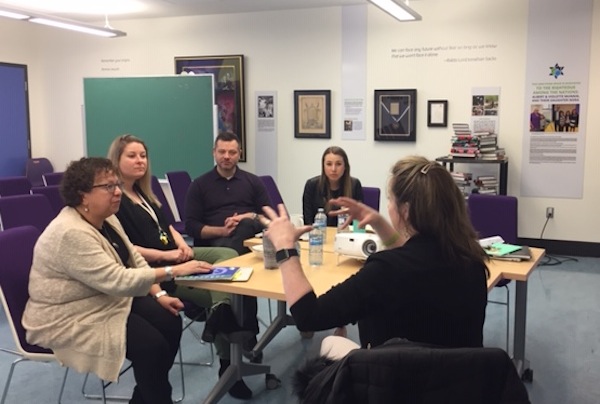
Tal Grinfas-David of the Centre for Israel Education speaks with educators at Vancouver Talmud Torah last month. (photo from VTT)

Educators at Lower Mainland Jewish day schools had the opportunity to consider the relevance of Israel literacy last month, when Tal Grinfas-David, the Centre for Israel Education’s day school specialist, was in town the week of Feb. 18 to deliver a talk on the subject and work with local teachers and administrators. Her keynote speech, titled Teaching Modern Israel – Challenges and Opportunities, was part of a community professional development day.

The CIE, which is based in Atlanta, Ga., received a grant for a three-year initiative to work with nine Jewish day schools across North America and help them enhance their Israel education efforts. Vancouver Talmud Torah and King David High School are two of the nine schools and Grinfas-David spent a day coaching educators at each of them. She will return for the next two years to reinforce the changes CIE is promoting.

The issue, she said, is that, across North America, many graduates of Jewish day school education don’t have enough Israel literacy to grapple with the world, to justify a strong connection to Israel and to inform their Jewish identity.

“The concept we’re promoting is to turn Israel education into something all teachers can support, not just Jewish studies faculty,” she told the Independent. The desire is there, she added. “The Vancouver community is very supportive and wants to see Israel education boosted and incorporated into different subject areas. But it’s going to be a long-term process.”

photo - Tal Grinfas-David
Tal Grinfas-David (photo from Centre for Israel Education)

No stranger to education, Grinfas-David comes to her role with a PhD in curriculum and instruction and 25 years as an educator in Israel and the United States. Over the next three years, she will move between Jewish day schools in Denver, Los Angeles, Detroit, New Jersey and Vancouver, coaching their educational teams.

“We’re thrilled to have this grant to visit the individual sites and get to know the different schools’ cultures,” she said. “Each school is different and unique, with strengths and challenges, and this grant allows us to customize and tailor our offerings to specific communities.”

The goal of Israel literacy is to graduate Jewish students who understand the relevance of Israel in their lives and feel confident in their knowledge. They need this, she said, because understanding Judaism means understanding it’s not solely a religion.

“It’s also a belonging to a peoplehood, a nation with a Jewish homeland,” she said. “To understand modern Israel today, we have to see it as a continuation of our Jewish history.”

Grinfas-David said she would need three days to address all the ways that Israel literacy counts significantly in the life of a Jew.

“Israel impacts how Jews live in other countries, like the U.S. and Canada, where we are free. Students at our Jewish day schools have never experienced powerlessness or persecution, as they have the good fortune of being born here and now, with many freedoms. But that’s all the more reason to have them understand it was not always like this for Jews.

“Being part of a nation means there is an obligation to support your people, because of your fortune,” she continued. “There’s a calling to engage and to reflect on what Israel means for these students in their lives. Israel literacy is about having a repertoire of primary sources under your belt, so that when students leave the school setting and hear different narratives, they’ll be critical consumers of information, and they’ll know the facts they need. At CEI, our goal is to give them the ability and the opportunity to have the confidence to be critical consumers.”

Lauren Kramer, an award-winning writer and editor, lives in Richmond. To read her work online, visit laurenkramer.net.

Format ImagePosted on March 8, 2019March 6, 2019Author Lauren KramerCategories WorldTags CIE, Diaspora Jews, education, Israel, King David High School, Tal Grinfas-David, Vancouver Talmud Torah
Local CTeens join Shabbaton

Local CTeens join Shabbaton

A contingent from Richmond Chabad CTeen joined the 11th annual CTeen International Shabbaton that took place in New York last month. (photo from Chabad Richmond)

Teens from around the world celebrated Jewish unity, heritage and pride at the 11th annual CTeen (Chabad Teen Network) International Shabbaton. The convention, which took place Feb. 22-24, drew more than 2,600 participants. From world-class speakers to a closing ceremony with a surprise appearance by WeWork founder Adam Neumann, the Shabbaton left the teens exhilarated and ready to share their Jewish pride with others.

The weekend included a traditional Shabbat experience in the heart of Crown Heights, the Chassidic neighbourhood of Brooklyn, hands-on workshops and lectures about Judaism, and the Times Square takeover, featuring Jewish pop star Yaakov Shwekey.

photo - The 11th annual CTeen International Shabbaton took place in New York last month
(photo from Chabad Richmond)

The theme of the Shabbaton was I-Matter. The theme was meant to empower teens to recognize and use their inherent, true value, which is not dependent on achievements or status. It’s a message that has resonated with many teens, who have found their voices and personal missions through their involvement in CTeen.

“The highlight of the CTeen International Shabbaton was getting to know fellow Jewish teens from around the world, and learning about their Jewish communities and what it’s like to be a Jew in their area. It was an experience of a lifetime and I can’t wait until next year,” shared Richmond teen Sarah Aginsky, Grade 10.

“The most meaningful part of my experience at the Shabbaton would be when we spent Saturday night in Times Square,” said fellow Richmond teen Aidan Wessels, also in Grade 10. “It really makes you feel at home, being surrounded by Jewish people, and you don’t have to be ashamed or anything to be who you really are. It really touched my heart when we were introduced, via video, to Rabbi Yitzy Horowitz, who has been diagnosed with ALS and chose to live with such a disease and still try to look on the bright side of everything.”

“The CTeen International Shabbaton was so meaningful to me,” added Jordan Wessels, Grade 12. “This is because we all have such a great Jewish experience, and meeting Jewish teens from all over the world. The amount of energy of so many people like you is truly amazing.”

photo - A contingent from Richmond Chabad CTeen joined the 11th annual CTeen International Shabbaton
(photo from Chabad Richmond)

Over the weekend, 15 teen speakers shared personal stories of struggle, triumph and strength in the face of adversity. The stories ranged from students who fought for Jewish rights at school, to those who dealt with alopecia (spot baldness) and subsequent bullying, to teens who lost family members to drug addiction.

Priest-turned-rabbi Yaakov Parisi shared his inspiration for living a Jewish life with teens in an animated story during Shabbat dinner. Prof. Binyamin Abrams, who lectures on chemistry at Boston University, answered questions about Torah and science, and ecouraged teens to seek knowledge while living Jewishly.

“The secret of my life and success is keeping Shabbat,” declared Neumann during the closing. “Disconnecting from the world for 25 hours and connecting to something greater than myself makes me who I am. There has never been a more relevant time in history to celebrate being Jewish. If you come away with one thing today, I hope it’s that you disconnect to connect.”

“You may find yourself alone, the only Jew in your public school, or you may feel like a minority, but remember: there is no such thing as a small Jew,” said Rabbi Moshe Kotlarsky, chair of CTeen. “I hope you take the energy you gained this weekend and carry it into every aspect of your lives back at home.”

“Our intrinsic worth is not based on achievements,” said Chabad Richmond’s Rabbi Yechiel Baitelman. “Every individual can connect to G-d, no matter the circumstances. It is because of this connection that every individual, in any situation, can make a significant difference. That is what CTeen is all about.”

With more than 500 chapters in 23 countries, CTeen Network’s mission is to empower tomorrow’s generation of leaders through Jewish education and by providing a strong Jewish network across the globe. Teens develop awareness and confidence, while connecting with individuals who share similar experiences and beliefs. They become an integral part of a group that focuses on building core values and stresses positive character development. CTeen is open to Jewish teens regardless of affiliation.

For more information, visit chabadrichmond.com/cteen or contact Baitelman at 604-277-6427 or [email protected].

Format ImagePosted on March 8, 2019March 6, 2019Author Chabad RichmondCategories WorldTags Chabad, CTeen, education, Judaism, youth
Personal robots help at home

Personal robots help at home

Can’t be home for bedtime? Temi lets you read a story to your child remotely. (photo from Temi)

In the fourth season of the sitcom The Big Bang Theory, theoretical physicist and all-around nerd Sheldon decides that he no longer wants to physically interact with his friends and colleagues. He cobbles together a telepresence robot with his face on its screen, which navigates around his home and office and turns toward whomever Sheldon is speaking. This fictionalized glimpse of a future filled with personal robots is simultaneously hilarious and creepy.

“We took the creepy factor into account when we designed our robot,” said Danny Isserles, chief executive officer of the U.S. division of Temi, an Israeli robotics firm that is building an almost functionally identical (but a whole lot spiffier) version of Sheldon’s telepresence unit.

Temi has a sleek, semi-rounded body – it looks a bit like a high-tech vacuum cleaner with a subtle human presence – and stands three-feet tall on its four wheels. Inside Temi are two main computers. The first comprises Temi’s “face,” made from a customized version of an Android tablet.

“It’s nothing special,” Isserles conceded in an anything but robotic conversation with Israel21c. As with most Android-based mobile devices today, the Temi tablet can display video, play music or call up the internet by voice command.

“We’ve done a demo of Temi controlling a smart home. It can turn the lights on and off,” Isserles said. Any Android developer could add other apps; for example, to make Temi control a smart home thermostat.

Temi’s “body” has a full Linux-based computer inside plus an array of sensors – LiDAR, 2D and 3D cameras, encoders measuring the wheel’s movements – that help Temi navigate smoothly.

“In order to get from one side of the room to the other, we humans instinctively choose the easiest path to follow with no effort, passing over small obstacles and around bigger ones,” explained cofounder and Temi Israel CEO Yossi Wolf. But this is a complex task for robots and the shortest way is not necessarily the fastest.

“For example, when you move from the kitchen to the living room, you can pass through sofas and slalom through all the kitchen chairs or you can bypass them the long way, which will be the fast and natural way.”

Temi’s sensors ensure it won’t fall down the stairs or run over your small dog. “We had a live case study in our office – my dog,” said Isserles. “I said, the first time this robot touches my dog, the robot is going out the window.”

Temi’s designers “built an algorithm to connect all the sensors together and enable Temi to construct a path through a space,” said Isserles. “Because of the navigation, we have a platform with abilities no one else has yet achieved.”

That may not last for long. Amazon reportedly is developing a robot known as Vesta, which follows users around like a mobile Alexa. Other home robots in the works include LG’s Hub bot, Mayfield Robotics’ Kuri, and Jibo out of technology powerhouse MIT.

Isserles said competition is good “because this will build the market, take the robot out of the niche and bring it into the mainstream.”

Temi formally launched sales at CES 2019 in January and expects first deliveries to be made this month. The robot can be ordered now on Temi’s website and through select retail outlets in the United States.

A half-dozen immediate applications for Temi come to mind.

In the office, a staffer on the controlling side of the robot can make like Sheldon and attend a business meeting without actually being there. A manager can stroll around chatting with colleagues and, unlike video conferencing, there’s no need to interrupt anyone’s workday to assemble in a meeting room.

Temi can serve as the host at a restaurant (“Hello, I’m Temi. Welcome to Applebees”), a hotel concierge, a sales clerk, an airport check-in agent, a museum docent, a remote yoga teacher, a playmate for the kids (imagine hide-and-seek with a robot), an aid for home-bound seniors and a remote-care physician. But the main idea is to provide a telepresence in the home.

“It’s not the same as being there, of course, but think of a deployed soldier in Afghanistan who can hop into a robot and hang out with his family for a couple of hours.”

“If you’re stuck at work, you can hop into your Temi, press ‘Bobby’s room,’ and Temi will go there so you can read Bobby a bedtime story,” Isserles said. “It’s not the same as being there, of course, but think of a deployed soldier in Afghanistan who can hop into a robot and hang out with his family for a couple of hours.”

But why do you need a robot for that? Couldn’t you just Skype from the computer or an iPad?

“This is a much better experience,” contended Isserles. “It’s more like hanging out. If I’m on a Skype call with my nephews, they say hi, then run away and my sister has to chase them to come back. The robot can hang out, explore, wander around, talk to different people.”

You can also ask Temi to initiate the video by tapping Temi on its head or saying, “Hey, Temi, call Mom.” Temi will lock on your position, plan an efficient path to get to you wherever you are in the house, initiate the call and then follow you around while you talk.

Isserles said Temi’s aim is to appeal to busy families where the parents work long hours, travel a lot and love technology.

It still sounds a bit creepy – would you want your robot father sitting at the dinner table with you, turning its Android head from side to side to keep the conversation flowing?

“My experience is that everyone who came in thinking it’s creepy, after a minute or two of demonstrating how it works, they ask, ‘How much is it?’” said Isserles.

The price is cheap by robot standards – just $1,500 US. That’s partly because Temi was not built, like most other robots, for defence purposes, where a single robot could run up to $200,000.

That said, Temi got its start from the defence industry. CEO Wolf previously cofounded Roboteam to build tactical robotic systems for reconnaissance, intelligence gathering, search-and-rescue and delivering payloads to soldiers in the field. Temi was originally part of Roboteam, but the companies decided to split, with Wolf going full-time to Temi and cofounder Elad Levy remaining at the helm of Roboteam.

Temi employs 65 people, most in the Tel Aviv research-and-development centre plus 10 people in New York and 20 in China, where the robots are manufactured. The company has raised $82 million, including $21 million in December 2018 from former Alibaba chief technology officer John Wu, Italy’s Generali Investments and Hong Kong-based internet-of-things company Ogawa. Temi and Ogawa have established a strategic partnership with an emphasis on selling in China.

“We could build a mechanical arm with an accurate and gentle grip, no problem, but then it would be a $20,000 product, not a $1,500 one.”

While Temi is being initially positioned as a roaming telepresence device, the robot can work without someone on the other side. Ask it to play a song and Temi will call it up using its built-in wi-fi connection, then blast out the tunes via 20-watt Harman Kardon speakers. Temi’s 10-inch touchscreen is great for playing YouTube videos, too.

Temi gets eight hours of continuous use per charge and has a docking station for repowering.

Temi has one more unique selling point: a tray. Tell Temi to fetch some tea from the kitchen and the robot will return with the chai, although a human has to load and unload the teacups.

“We could build a mechanical arm with an accurate and gentle grip, no problem,” said Isserles, “but then it would be a $20,000 product, not a $1,500 one.”

The tea tray turns out to have been the genesis for what would evolve into Temi. Wolf was visiting his grandmother and she offered him some tea.

“But her hands were shaking and he was worried,” Isserles recalled. Wolf asked her if she’d like a walking cane. “She said, ‘No, I’m not old.’ So he asked her, ‘Would you like a robot?’ That, she would go for. She wanted something cool.”

Every Jewish start-up “starts from the grandmother,” Isserles quipped. Even those building personal robots.

For more information, visit robotemi.com.

Israel21c is a nonprofit educational foundation with a mission to focus media and public attention on the 21st-century Israel that exists beyond the conflict. For more, or to donate, visit israel21c.org.

Format ImagePosted on March 8, 2019March 6, 2019Author Brian Blum ISRAEL21CCategories WorldTags home, Israel, robots, technology, Temi
IsraAID helps around world

IsraAID helps around world

This picture of Molly Bernstein, right, was taken last year at the School of Peace, a program run in partnership by IsraAID and the Israeli Hashomer Hatzair Youth Movement on Lesbos, Greece. (photo from IsraAID)

“I say crisis with air quotes because I think that’s a bad attitude,” Molly Bernstein told the Independent. “It’s an opportunity.”

In discussing the number of displaced people in the world, usually referred to as “the refugee crisis,” Bernstein said, “I strongly believe that diversity is a social good for our societies. When we integrate new people into our communities, we learn more about ourselves and others, build bridges between communities, and build relationships that breed positivity in the world.

“When we open our doors and our hearts to refugees, we’re doing exactly this,” she said. “That’s why it’s an opportunity to expand our worldview and the spectrum of opportunities for doing good that stands before us.”

Bernstein, a 27-year-old resident of south Tel Aviv, works for IsraAID, an Israeli nongovernmental organization that works in emergency and long-term development settings in dozens of countries. The humanitarian aid organization responds to conflict, natural disasters, acute poverty, discrimination and displacement.

Bernstein, currently working in the communications department at IsraAID headquarters in Tel Aviv, spoke to the Jewish Independent during a recent trip to Vancouver, Jan. 31-Feb. 3.

“My parents were longtime members of Habonim,” she said, referring to the Zionist youth movement. “We lived in Israel for a time and I became interested in learning Arabic, so as to have a deeper understanding of the conflicts in Israeli society and how to address them. Learning Arabic opened up a lot of doors for me.”

Bernstein completed a bachelor of arts at the University of Maryland, College Park, then lived in Morocco, Jordan and Tajikistan. She began working with an Arab-Jewish Israeli NGO in Israel, the Abraham Fund Initiatives, which focuses on the creation of a shared society, and then landed a job with Ha’aretz.

It was while she was working at Ha’aretz, combing through pictures of the Syrian military’s chemical attacks on Syrian civilians, that she decided she wanted to do relief work. She had heard of IsraAID and considered working for them “an item from my bucket list.” So, when a job opportunity with the organization arose, she jumped at it, and got it. She was sent to the Greek island of Lesbos as head of missions, where she oversaw programs supporting refugees. Six months later, she was promoted to the NGO’s headquarters in Tel Aviv.

“IsraAID started when a group of buddies who were connected and had networks of doctors, nurses [and] engineers, and search-and-rescue folk would organize themselves and fly out and get some work done,” explained Bernstein. “When [the 2010 earthquake in] Haiti happened, they realized they needed a long-term response plan and so they started an NGO to develop that capability. They were in Haiti for eight years.”

Founded in 2001, IsraAID has an annual budget of about $10 million and has worked in emergency and long-term development missions in 46 countries, including the United States. Volunteers with IsraAID, for example, continue to work in Reno, Nev., with evacuees from the wildfires in Northern California. In 2017 alone, IsraAID worked in 20 countries.

As an Israeli aid organization, IsraAID sometimes finds itself in the crosshairs of those who want to view their work through the framework of either Zionist or anti-Zionist ideology. Bernstein said IsraAID is having none of it either way. “We are really just focused on the work,” she said. “Other people may want to raise other questions about it, but we’re just like, OK, you have that conversation, there’s a person I have to help over here.”

That said, the organization’s Israeli base means they have unique contributions to offer. “We are proud to bring technologies from the country we come from,” said Bernstein. “And it’s not a coincidence that we’re really good at water management and trauma processing. Those are two things Israelis have needed to become good at it.”

Bernstein is continuing her academic studies at Tel Aviv University, pursuing a master’s degree in Middle Eastern history, while working for IsraAID. Meanwhile, the NGO is looking to expand the ranks of their volunteers. They’ve opened a headquarters in Los Angeles and Bernstein said another North American base may follow, possibly even in Canada. In Vancouver? “It’s not impossible,” she said.

Matthew Gindin is a freelance journalist, writer and lecturer. He is Pacific correspondent for the CJN, writes regularly for the Forward, Tricycle and the Wisdom Daily, and has been published in Sojourners, Religion Dispatches and elsewhere. He can be found on Medium and Twitter.

Format ImagePosted on March 1, 2019February 27, 2019Author Matthew GindinCategories WorldTags humanitarian aid, Israel, IsrAID, Molly Bernstein
Intergenerational connection

Intergenerational connection

Grandparents and grandchildren discover their roots in Jerusalem with the G2: Global Intergenerational Initiative. (photo by David Salem / Zoog Productions)

The G2: Global Intergenerational Initiative is a new yearlong program being offered by the Jewish Agency. It helps bring grandparents and grandchildren closer with activities and conversations. It is spearheaded by Jay Weinstein, a rabbi from New Jersey who now lives in Israel.

“I work in the partnership unit, trying to build relationships between Jews around the world and Israelis,” Weinstein told the Independent. “I bring my connections from North America and also am exposed to Israeli communities here … trying to build bridges with Israel and overseas.”

The project stems from findings gleaned from meetings that the Jewish Agency held in a few prominent Jewish communities, which pointed to a lack of programming provided to older adults and a lack of an Israel connection among the young.

“We went to our partners on the ground, saying, ‘Let’s come up with something together’ … versus coming up with the idea ourselves and then trying to sell it or take it somewhere,” said Weinstein. “We wanted to do it in collaboration.

“Much of what we do in the Jewish community is for the younger generation,” he continued, “but, here, you have … people who spent their lives building up the federations, schools and synagogues. They’re usually the ones volunteering and donating, [yet] we’re failing to have something to really offer to them.”

Certainly, grandparents can be a positive influence in creating a Jewish identity in their grandchildren.

“When they’ve done studies asking young adults why they are involved in Jewish life or Jewish programming, what came back involved Jewish grandparents,” said Weinstein. “That’s even truer in interfaith marriage, [where] the role of the Jewish grandparent passing down values to their grandchildren is of even greater importance.”

The G2 initiative brings grandparents and grandchildren together over the course of a year through activities and creative projects.

“It gives grandparents the chance to think about what is important to them, about what they want their grandchildren to know about, how their family narrative makes them unique, and special things they care about,” said Weinstein.

Participating grandkids should be in Grades 5 and 6, preteens old enough to have deeper conversations, while still under the guidance of their parents “and they aren’t yet too cool to be with Grandma and Grandpa to do the activities,” said Weinstein.

“It’s not a text-based study. It’s more experiential,” he said. “And, at the monthly meetings, we give the grandparents and grandchildren things to do on their own time without a facilitator, like a little mesima (activity) or venture to do in the community.”

Each month has a different focus, such as discussing the most important Jewish gem of a place. This particular theme gives grandparents the opportunity to take their grandchildren to one of their favourite places and explain why it is important to them. Then, the grandchildren guide the grandparents to the most important Jewish gem to them, also sharing why it is important. If the grandparents and grandchildren so choose, they can record the visits on a two-minute podcast to share with others.

“Based on the partnership platform, we have communities overseas doing it with communities in Israel,” said Weinstein. “And, over the course of the year, they’ll connect with each other digitally. Sometimes, they’ll be synchronized and do a Zoom call, sometimes unsynchronized. One of the bigger goals of the unit is to connect Jews from around the world to Israel and, on the other hand, to teach and educate Israelis about what Jewish life is like outside of Israel.”

photo - grandparents and grandchildren in Israel on a G2 trip
(photo by David Salem / Zoog Productions)

Many larger Jewish communities can run G2 on their own, in-house, connecting with their sister city in Israel, but most communities won’t be able to carry it out on the same scale as that of the Jewish Agency.

“We believe there is power in the global Jewish community,” said Weinstein. “To be part of a worldwide network of people is a wonderful experience. I don’t think, oftentimes, that a fifth or sixth grader in Vancouver is connected with another Jewish fifth or sixth grader in Miami and Sydney … and we believe that is a very powerful experience. We’ve been in touch with the Jewish Federation in Vancouver and they are interested in G2.”

The partnership unit needs a local organization to launch the program in a region.

“In most cases, [the partner] is the federation, as they are our national partner, but, that being said, we’ve designed this program to be brought to any organization,” said Weinstein. “So, if there’s a synagogue that wants to participate in G2 or a JCC, we can work with them.

“I’ve gotten a tremendous amount of interest from communities all around North America and the world. People understand that grandparents and grandchildren have this special and unique bond. When we can build meaningful Jewish experiences around the grandparent and grandchild relationship, it’s just very powerful.”

The yearlong program includes an eight-day visit that the grandparents and grandchildren take to Israel – traveling about the country, learning and meeting their Israeli partners. They also get the opportunity to stay in the homes of their Israeli partners for part of the trip, getting a firsthand glimpse at everyday life in Israel.

While there is a cost for the program, G2 works with the different community partners to subsidize some of that, and is also looking for philanthropic partners.

“We’d love to have a partner to help us bring this around the world and not have a barrier of prices and expenses prohibiting families from participating,” said Weinstein. “We truly believe … sometimes we use the language of Birthright … that it’s a birthright of every grandparent to have meaningful Jewish experiences with their grandchild, including traveling with them to Israel.”

For more information, visit g2family.org.

Rebeca Kuropatwa is a Winnipeg freelance writer.

Format ImagePosted on February 22, 2019February 21, 2019Author Rebeca KuropatwaCategories WorldTags Diaspora Jews, family, G2, Israel, lifestyle

Standing under the chuppah

Adir under the wedding canopy with his bride, Liat. (photo from UPnRIDE)

Forty days before his marriage, a wheelchair-bound Israeli man named Adir wrote to UPnRIDE Robotics, sharing his dream to stand under the chuppah with his bride, Liat. Chief executive officer Oren Tamari invited Adir to company headquarters in Yokne’am Illit to try the UPnRIDE 1.1 mobility device, now in transition from research-and-development to market.

“We saw he managed well with it, and we arranged for him to use the device during his wedding” on Nov. 12, Tamari told Israel21c.

The day after his wedding, Adir posted on UPnRIDE’s Facebook page: “Thank you all for [the] wonderful experience and magnificent night. Our chuppah was so amazing, people cried when [they] saw me standing and praying. My wife and I just want to say that you made our night as close as possible to perfection!!!”

UPnRIDE was invented by Amit Goffer, whose ReWalk robotic exoskeleton allows paraplegics to stand, walk, navigate steps and even run marathons. Goffer, who has a PhD in electrical and computer engineering, could not use ReWalk himself because he is a quadriplegic, paralyzed from the neck down. So he and Tamari formed a new company to develop an upright mobility solution enabling any wheelchair-bound person – quadriplegics, paraplegics, people with multiple sclerosis, cerebral palsy, ALS and traumatic brain injury – to recline, stand and navigate indoors and outdoors.

Jointed braces and harnessing straps provide support, while advanced motion technology and real-time computing ensure automatic balancing and stability on uneven terrain. Goffer said other types of standing wheelchairs can’t be used outdoors because of the danger of tipping over.

UPnRIDE is now raising funds, working toward U.S. Food and Drug Administration clearance and doing usability studies with all kinds of wheelchair users. A major study has begun at the U.S. Veterans Health Administration’s Centre of Excellence in New York to determine the benefits for UPnRIDE users. Many health problems are associated with long-term wheelchair sitting, from muscle atrophy to cardiovascular disease.

Goffer, chief technology officer and president of the company, doesn’t yet have his own UPnRIDE because the sample models are for testing. He borrows one on weekends and for special events, such as his daughter’s wedding last July.

Like Adir, he was able to stand under the chuppah and with his family for photos.

“My son and middle daughter were already married years ago,” he said, “and it was a very different feeling at the wedding of my ‘baby’ because I was standing like the rest of the family. I was also able to mingle with guests as never before.”

Eventually, Goffer expects UPnRIDE to become his everyday wheelchair. “I enjoy it because I can stand and sit easily whenever I want; I don’t have to be moved and lifted by someone else. It can recline, too, so it’s better for napping or receiving medical treatment.”

The smart wheelchairs are to be manufactured in a northern Israel factory run by Sanmina, an American electronics manufacturing services provider. Tamari said the company plans to use proceeds from the current funding round for marketing, establishing mass production and developing advanced and new models.

For more information, visit upnride.com or email [email protected].

Israel21c is a nonprofit educational foundation with a mission to focus media and public attention on the 21st-century Israel that exists beyond the conflict. For more, or to donate, visit israel21c.org.

Format ImagePosted on February 22, 2019February 21, 2019Author Abigail Klein Leichman ISRAEL21CCategories WorldTags Amit Goffer, disability, high-tech, innovation, Israel, ReWalk, UPnRIDE, weddings
Israeli designer’s star appeal

Israeli designer’s star appeal

Best known for couture wedding gowns, Galia Lahav is one of the major players in the wave of Israeli designers making a mark on the international bridal industry. (photo from Instagram)

With fashion accessible at our fingertips via e-commerce, shopping apps and social media, the past few years have seen the rise of emerging designers from around the world. Along the way, a number of Israeli designers have won favour with the international fashion crowd, particularly celebrities and their stylists.

“I always say that talent has no geographical boundaries. If your vision is strong, the quality of your work is high and you know how to work with international markets, then your way to success is quick,” Israeli fashion blogger and Instagram influencer Roza Sinaysky told Israel21c.

Sinaysky, known on Instagram as @moodyroza, said she has seen a change in the Israeli fashion scene over the last two to three years, where more people are interested in fashion and willing to support young designers. The designers, she said, also are more aware of trends and the needs of the industry thanks to social media.

“The rise of social media made a huge difference in the fashion industry. For designers, it opened a lot of doors. When everyone can see your work, you never know who might reach out,” said Sinaysky.

Over the past few years, Israeli designers have been approached by Kensington Palace, Beyoncé, Serena Williams, Lady Gaga and many others to create custom pieces.

“I think it’s so great that Israel is recognized as a place of talents, not just technology. It makes me very proud to see local designers do so well abroad,” said Sinaysky.

Below are eight Israeli fashion and accessory designers making their mark internationally.

  1. Shahar Avnet

screenshot - Shahar Avnet Instagram postWhat do Beyoncé and Eurovision winner Netta Barzilai (who was just in Vancouver for a concert) have in common? They both wear Shahar Avnet. The young Israeli designer made headlines last year when her custom-made, nude-coloured tulle gown was worn by Beyoncé on stage during her world tour with Jay-Z.

Avnet also designed the multicoloured kimono famously worn by Barzilai on the cover of her hit song “Toy.”

“My garments are for confident women who are fearless, intelligent and chic; women who are not afraid to be the centre of attention and making a statement,” Avnet told Vogue Italy.

The Tel Aviv-based designer’s tulle creations walk the line between art and fashion, often combining techniques such as drawing, embroidery and collage into a single dress.

Avnet graduated from Shenkar College of Engineering, Design and Art in 2016, receiving her first international exposure when her final project was chosen to represent the school at the International Catwalk during Graduate Fashion Week in London, England.

Avnet’s bold colours and unusual, feminine silhouettes have caught the attention of celebrity stylists and magazines. Other celebrities who have worn Avnet’s dresses include American actresses and singers Zendaya and Kelly Rowland, and members of the Israeli band A-WA.

  1. Marei1998

Designer Maya Reik launched Marei1998 several seasons ago, almost immediately earning praise from the fashion world for her classic-modernist design sensibility – an unusually subdued approach for a designer her age (1998 refers to the year Reik was born).

Drawing upon Reik’s love for European cities and vintage nostalgia, Marei1998 offers a twist on classic luxury, reviving traditional styles like the robe coat and wrap dress. The brand’s claim to fame is its faux fur coats, which have become a celebrity-approved go-to for a sustainable statement. Last year, Marei1998’s eco-fur was spotted on model Bella Hadid and actress Priyanka Chopra.

Marei1998 has presented its collection in Milan the past few seasons and has had several successful trunk shows with online retailer Moda Operandi, which says “the young Israeli is living proof that elegance doesn’t come with age.”

  1. A by Anabelle

Anabelle Tsitsin, the 26-year-old designer behind celebrity-approved shoe brand A by Anabelle, drew upon her background in fine arts to launch a collection of luxury footwear in 2016 that features unexpected and playful embellishments like crystals, feathers and fur. All the shoes are made of Italian leather and fabrics in Parabiago, a town just outside Milan known for its history of footwear craftsmanship.

The brand’s signature style features an architectural A-shaped heel, worn by celebrities like Victoria’s Secret model Josephine Skriver and actresses Katharine McPhee and Logan Browning. In 2017, Halle Berry wore A by Anabelle’s lace-up “starlette” shoes during an interview with Ellen DeGeneres on The Ellen Show.

Although based in Israel, the brand has started to make its rounds on the international style scene and social media thanks to influencers and fashion bloggers like Maja Malnar, Camila Carril and Cristina Musacchio.

  1. Nili Lotan

Israeli-born, New York-based designer Nili Lotan launched her namesake brand in 2003. The label, which revolves around timeless slip dresses, simple cargo pants and elevated basics, is tomboy meets luxury, making it a go-to for model-off-duty style.

Though Nili Lotan has been a mainstay in Tribeca since the store opened in 2006, it has been pushed toward the spotlight in the last several years thanks to an ever-expanding list of celebrity followers, like Gigi Hadid, Rihanna, Jennifer Lawrence, Gwyneth Paltrow and Kaia Gerber. The brand has been referred to as Hadid’s “wardrobe secret weapon” by Vogue, with frequent images of the model in Lotan’s designs flooding Instagram.

  1. Galia Lahav

screenshot - Galia Lahav Instagram postBest known for couture wedding gowns, Galia Lahav is one of the major players in the wave of Israeli designers making a mark on the international bridal industry.

Led by head designer Sharon Sever, the brand’s embellished, forward-thinking designs have been worn by Beyoncé, Serena Williams, Ciara, Jennifer Lopez and many others – Lahav made headlines when Beyoncé chose a dress from the label’s Victorian Affinity collection to renew her vows with husband Jay-Z. Another defining moment came when the designer created six custom-made, cream-coloured gowns for Williams’ wedding party.

Dresses from Lahav’s line of evening wear have made frequent red carpet appearances, with their plunging necklines and figure-hugging sequins adorning stars like model Shanina Shaik, actress Sarah Hyland and singers Ciara and Halsey.

  1. Alon Livne

While Alon Livne opened his Soho, N.Y., atelier and ready-to-wear showroom in 2017, he has been designing under the label Alon Livne since he founded his studio in Tel Aviv in 2010.

With three separate lines – bridal, evening and ready-to-wear – Livne has gained a following of international brides, celebrities and lovers of bold, fearless fashion.

Lady Gaga is among the brand’s A-list fans, having worn several custom gowns by Livne over the last years. His avant-garde, innovative designs have also been worn by Beyoncé, Nikki Minaj, Jennifer Lopez, Naomi Campbell and many others. One of his dresses made waves when it was worn by actor Johanna Mason in the film Mockingjay, part of the four-movie Hunger Games franchise.

  1. Inbal Dror
photo - Beyoncé’s gown is from the Inbal Dror Fall 2016 Bridal collection
Beyoncé’s gown is from the Inbal Dror Fall 2016 Bridal collection. (photo from Inbal Dror)

Inbal Dror began designing wedding dresses in 2014, pioneering the style of the “red carpet bride,” with her glamorous, figure-hugging styles that were new to the bridal industry at the time.

Since then, the brand has dressed high-profile brides around the world. In 2017, Dror was contacted by the royal family about possibly making the wedding dress for Meghan Markle’s wedding to Prince Harry. Though the newly appointed Duchess of Sussex chose a different dress in the end, the famous inquiry solidified Dror as one of the biggest names in bridal.

Dror had previously dressed Beyoncé for the Grammys in 2016, proving that wedding dresses aren’t just for brides.

  1. Tuxe

When Meghan Markle wore a silk Boss bodysuit by Israeli designer Tuxe for an evening out with Prince Harry in February 2018, the style was immediately backordered until May.

Tuxe was founded by Tamar Daniel, who was born in Jerusalem, raised in London, and graduated from the Shenkar College in Ramat Gan. She founded her Philadelphia-based bodywear line in 2015, focusing on transforming the bodysuit, once a 1990s staple, into a chic, modern garment.

Her collection includes a range of bodysuits with names like Boss, CEO, Pacesetter, Game Changer and Expert, and has become particularly popular with professionals and religious communities, Daniel told Vogue in an interview. Prices range from about $80 for a simple sleeveless bodysuit to $463 for a cashmere turtleneck version.

“We’ve been royally approved!” the brand posted on Instagram after Markle was photographed wearing the bodysuit. “We absolutely love Meghan for all she has done for women’s rights and are honoured to be worn by someone who encapsulates what we stand for as a brand. She uses her spotlight to be an inspiration and she definitely is to us!”

Israel21c is a nonprofit educational foundation with a mission to focus media and public attention on the 21st-century Israel that exists beyond the conflict. For more, or to donate, visit israel21c.org.

Format ImagePosted on February 22, 2019February 21, 2019Author Rebecca Stadlen Amir ISRAEL21CCategories WorldTags fashion, Israel, weddings

Posts pagination

Previous page Page 1 … Page 10 Page 11 Page 12 … Page 33 Next page
Proudly powered by WordPress