Skip to content
  • Home
  • Subscribe / donate
  • Events calendar
  • News
    • Local
    • National
    • Israel
    • World
    • עניין בחדשות
      A roundup of news in Canada and further afield, in Hebrew.
  • Opinion
    • From the JI
    • Op-Ed
  • Arts & Culture
    • Performing Arts
    • Music
    • Books
    • Visual Arts
    • TV & Film
  • Life
    • Celebrating the Holidays
    • Travel
    • The Daily Snooze
      Cartoons by Jacob Samuel
    • Mystery Photo
      Help the JI and JMABC fill in the gaps in our archives.
  • Community Links
    • Organizations, Etc.
    • Other News Sources & Blogs
    • Business Directory
  • FAQ
  • JI Chai Celebration
  • JI@88! video

Recent Posts

  • Eby touts government record
  • Keep lighting candles
  • Facing a complex situation
  • Unique interview show a hit
  • See Annie at Gateway
  • Explorations of light
  • Help with the legal aspects
  • Stories create impact
  • Different faiths gather
  • Advocating for girls’ rights
  • An oral song tradition
  • Genealogy tools and tips
  • Jew-hatred is centuries old
  • Aiding medical research
  • Connecting Jews to Judaism
  • Beacon of light in heart of city
  • Drag & Dreidel: A Queer Jewish Hanukkah Celebration
  • An emotional reunion
  • Post-tumble, lights still shine
  • Visit to cradle of Ashkenaz
  • Unique, memorable travels
  • Family memoir a work of art
  • A little holiday romance
  • The Maccabees, old and new
  • My Hanukkah miracle
  • After the rededication … a Hanukkah cartoon
  • Improving the holiday table
  • Vive la différence!
  • Fresh, healthy comfort foods
  • From the archives … Hanukkah
  • תגובתי לכתבה על ישראלים שרצו להגר לקנדה ולא קיבלו אותם עם שטיח אדום
  • Lessons in Mamdani’s win
  • West Van Story at the York
  • Words hold much power
  • Plenty of hopefulness
  • Lessons from past for today

Archives

Follow @JewishIndie
image - The CJN - Visit Us Banner - 300x600 - 101625

Category: News

Goldstein wins 5,000km race

Goldstein wins 5,000km race

Leah Goldstein is the first woman, and the first Israeli, to win Race Across America. (photo by Vic Armijo / RAAM)

Leah Goldstein became the first woman to win Race Across America in its 38-year history. The Vernon, B.C., resident also became the first Israeli to win the cycling tournament.

The 5,000-kilometre race – from Oceanside, Calif., to Annapolis, Md. – must be completed in under 12 days, and Goldstein completed it in 11 days, three hours and three minutes, rolling past the finish line at 9:41 p.m. on June 26.

“Race Across America (RAAM) is like no other race,” Goldstein told the Independent. “I’ve done the equivalent of the Tour de France for females. I’ve done major races and other ultra endurance races of 500, 800 miles, and nothing compares – because it’s not a matter of if, but when you’re going to experience all sorts of discomforts, back, neck, knee, constipation, diarrhea, swelling, some major saddle sores.”

This was the latest in a lifetime as a top athlete. Goldstein won the 1989 World Bantamweight Kickboxing Championship and was Israel’s duathlon champion. As a youth, she was a kickboxing champion and a Taekwondo champion. Later in life, she competed in a string of professional cycling events. That toughness carried forward to her becoming an officer in the Israeli commando and elite police unit.

This year’s race was particularly extreme, during a heat wave that punished riders with temperatures of more than 40°C; not just through the desert, but for the first eight days.

“That can break people down, where they almost feel defeated before they start, but that’s the thing with RAAM, those things are going to happen whether you like it or not, and you have to prepare for them,” said Goldstein. “It’s really something that pushes you far beyond your limits. You’re going to have more bad days than good days, and that’s just the challenge.”

During certain parts, she said she had hallucinations and her “brain felt like a potato.”

“I didn’t know what I was doing on my bike. I didn’t know where I was. And then you kind of snap out of it,” she explained. “It’s that element of the mental challenge of really pushing forward, knowing that whatever you’re doing, you just can’t get off the bike, no matter what the situation, the temperature, no matter what kind of pain you are in.”

It helped that this was her third RAAM, she said, and the crew was able to analyze past performance to build on it.

“We wrote down every single mistake that we made in 2019, with weather conditions, navigational problems, bike positioning, training, with sleep patterns, and we tried to perfect it as much as possible. And because of COVID last year, I had an extra year to prepare for this. I trained as if RAAM was still going to happen.”

Her onboard crew included a medic, a kinesiologist, massage therapists and nutritionists. “I think they know how I roll, and know how to read me on the bike, when I’m starting to fade or things are going sideways, or I’m low on nutrition,” she said. “We won as a team.”
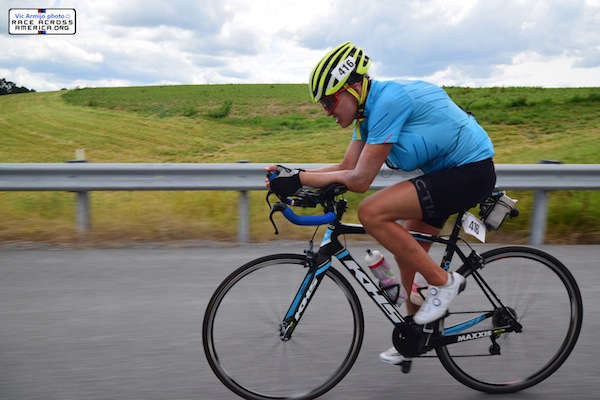
photo - Leah Goldstein during the Race Across America
Leah Goldstein during the Race Across America. (photo by Vic Armijo / RAAM)

Whereas riders fought the heat this year, they fought “uncontrollable rain and hail” two years ago. The crew prepared her with specialized clothing and pre-tested water-resistant equipment, just in case those conditions would prevail again.

“Prepare for the worst that possibly can happen, no matter how fully prepared you think you are,” she said. “It’s a matter of how badly do you want it, and how much are you willing to sacrifice.”

And Goldstein has experienced severe challenges. In 2005, during the Cascade Classic, she was involved in what she calls “the mother of all crashes” – she landed on her face at 80 kilometres an hour, “breaking practically every bone in my body, ripping my face right off.” Doctors were astonished she survived. In 2008, she was hit by a car, ejected 25 feet in the air and, in an attempt to cushion the fall, put her arms out, breaking both of them.

Neither accident kept her down. She returned to the racing circuit in 2011, winning the women’s solo category of Race Across America, breaking the previous record by 12 hours.

In 2016 she published a memoir, No Limits, outlining the triumphs and tragedies of her athletic life.

While the naysayers – who called her “insane and crazy” – said she was “past her prime,” the 52-year-old proved them wrong.

“Don’t use your age as an excuse or your past experiences as an excuse,” she said. “We don’t get second chances. What we got is what we got and, if you have a desire to do it, goddamn do it. What are you waiting for?”

Because of the high temperatures, the latest race took her a couple of days longer than expected, but she said the next one she plans on doing in under 10 days – and she’ll keep competing until she can’t anymore.

“If I’m alive at age 90 and I can still pedal my bike, I’m doing that race,” she said. “That’s my biggest goal.”

Dave Gordon is a Toronto-based freelance writer whose work has appeared in more than 100 publications around the world. His website is davegordonwrites.com.
Format ImagePosted on July 9, 2021July 7, 2021Author Dave GordonCategories LocalTags athletics, cycling, Leah Goldstein, Race Across America, Ra’am, Vernon
Hands-on learning at farm

Hands-on learning at farm

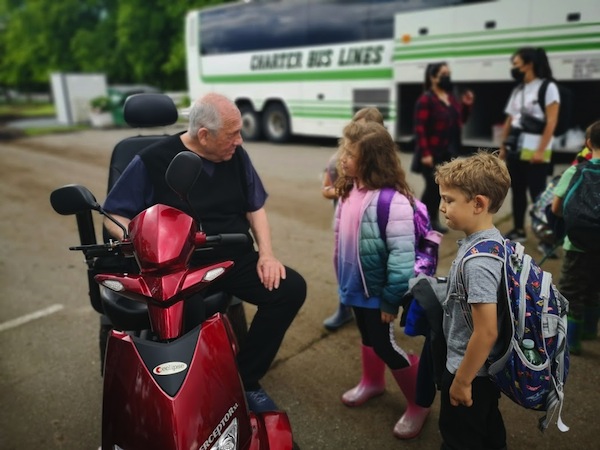
Syd Belzberg talks with Vancouver Talmud Torah kids at Stable Harvest Farm. (photo by Shira Sachs)

“The children loved to take their harvest home to share with their families. Many children helped to prepare the family meals, including washing, chopping and plating their meals. There was so much to learn – how healthy food can taste so yummy, how I can help my family make dinner, how the food can make my body feel good.”

“This is from some cute kid, and I see his picture in front of me,” Syd Belzberg told the Jewish Independent in a recent phone interview. “That’s heart-warming. That’s where it’s all at. That’s beautiful.”

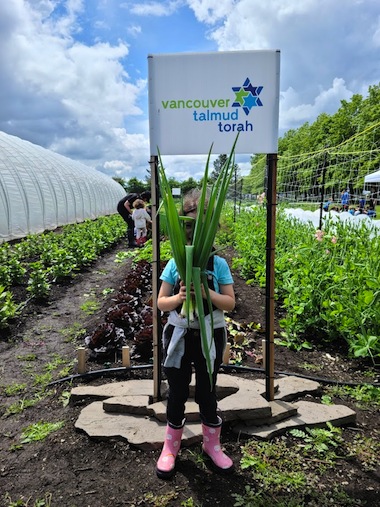
photo - Vancouver Talmud Torah Grade 1 students have a plot on Syd Belzberg’s farm, where they grew scallions and other vegetables
Vancouver Talmud Torah Grade 1 students have a plot on Syd Belzberg’s farm, where they grew scallions and other vegetables. (photo by Jessie Claudio)

The note came after Vancouver Talmud Torah Grade 1 students visited Belzberg’s Stable Harvest Farm in Langley last month.

Belzberg got the idea for the farm about a half dozen years ago. He read a newspaper article about Vancouver Sun reporters who had started a breakfast program for schoolchildren in the 1980s. “I got in touch with them and got involved a bit, supporting some of the schools with money,” said Belzberg.

But he wanted to have more of an impact and, after he retired a couple of years ago, he decided to reinvent his Langley acreage, which had been home to his many horses several decades ago, but had laid empty for some 17 years. He based his concept on that of Coastal Roots Farm, “a nonprofit Jewish community farm and education centre” located near the home he has in California. “They do a lot of wonderful things,” said Belzberg, “and I thought this would be a heck of a thing to try and copy in a way.”

He hired Kristjan Johannson to manage the farm and the first crop was planted in January 2020. Despite flooding on the property, they gave away about 90,000 pounds of organic vegetables to a half-dozen food banks, as well as to community meals programs.

“This year, we decided to try and double it,” said Belzberg. And they more than doubled it, giving away an estimated 250,000 pounds of food, while continuing to work on the property.

Belzberg established the Stable Harvest Farm Society, he said, “to make this a legacy for my family.” Of his five kids, only one lives in Vancouver, and that daughter, Tammi Kerzner, “has been a massive help to me to build this,” he said.

“There are many facets to what I want to do,” said Belzberg, “but I wanted to get the food thing right because I didn’t know what we’d have to go through to be successful.”

Belzberg’s approach with this project has been similar to that which he has taken with his other endeavours.

“When I started in the car business [Budget Rent a Car] in ’62, I had trucks and other things in mind, but I wanted to rent cars and learn about that first,” he said. “It’s the same thing here. I wanted to prove we can get the vegetables right before I started to do anything else.”

Educational programming is a main component of the farm. “David Bogoch had a lot to do with teaming up with TT. He is such a supporter of it,” said Belzberg about collaborating with the school. “And my children went there. I have a great-granddaughter now who goes there. So it was a natural [fit]. The part that really put us over the top was Emily [Greenberg], because she’s fantastic. She’s so on top of it, and she’s got Jessica [Claudio] there, who goes to another level.”

“Mr. Belzberg has been a very generous supporter of VTT,” said Greenberg, who met Belzberg for the first time when he first saw the school’s rooftop soccer pitch that he funded. That was in her second week as head of school, she said.

“And we’ve had close relationships with David Bogoch, who is quite close to Mr. Belzberg, and he kept talking to me about this farm that Mr. Belzberg was creating … that Mr. Belzberg had a dream to make this farm a centre for Jewish education and Jewish values and the Jewish community and that he would love to see children using this farm, in addition to how it supports the needy in Vancouver.”

Belzberg eventually invited Greenberg for a visit and they spoke about his vision and she “went away and thought about how we could make that happen from our end and, ultimately, bring kids out there.”

The first thing that happened, said Greenberg, was that Johannson came to the school and helped the kids plant seedlings. “Then we had, basically, a little nursery there at the school and watched them grow and supported them.” The plan was for the kids to plant the adolescent seedlings in April at the farm but COVID restrictions had increased, “so we weren’t able to bring the kids to Langley because it was cross-boundary.” But the planting was filmed and a multi-series educational video was made.

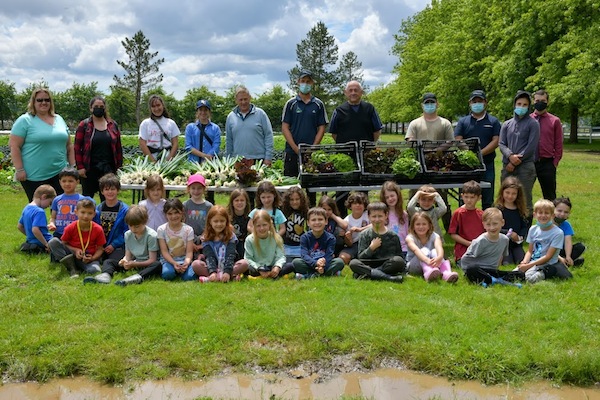
“Thankfully, the regulations changed again and we were able to go in the third week of June and send all of our Grade 1 kids out there,” said Greenberg. “They were able to help reap the harvest and they each brought home a bag of veggies from Mr. Belzberg’s farm and made the most amazing salads and soups and all sorts of things and we’ve got some great pictures of what they made that night. We had parents who were ecstatic, watching their kids eat raw vegetables – including scallions.”

The kids had grown the scallions, as well as lettuce and radishes, and their bags were supplemented with some other vegetables from the farm, such as tomatoes and carrots.

On their visit, the kids also got to see the part of the property that will become a bird sanctuary – “there’s a hundred and some odd different types of birds and owls that feed there and it became a natural habitat,” said Belzberg.

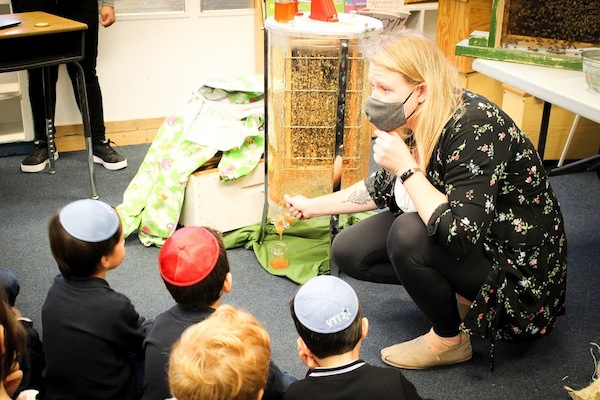
Another aspect of Stable Harvest is bees. Belzberg works with beekeeper Carolyn Essaunce, who owns the Honest to Goodness Farm Co. Essaunce also made a trip to VTT and spoke to each senior kindergarten class.

photo - Beekeeper Carolyn Essaunce speaks to VTT senior kindergarteners about bees and honey
Beekeeper Carolyn Essaunce speaks to VTT senior kindergarteners about bees and honey. (photo from VTT)

“She brought a whole honeycomb with live bees,” said Greenberg. “She helped them understand how, when you take a honeycomb and you put it in a machine and spin it, how you get the honey out…. They understood what it was to produce honey and then they all went home with some of Mr. Belzberg’s honey…. That is definitely something we hope to repeat yearly.”

Experiential learning is the future of education, said Greenberg. “For us, we want to prioritize learning through nature and to exposure to nature, but also, of course, finding ways to make sure that Jewish values are part of that…. So this has been a tremendous opportunity for us. It’s only the beginning – we look forward to bringing many more of our grades out to Stable Harvest Farm next year. There’s obviously a science aspect but we also want our kids to be shomrei adamai, guardians of the earth, and understand the power of nature. There’s an empowerment that happens when they’re part of growing a plant and the excitement that happens. And the understanding of the life cycle and how that eventually nourishes us and nourishes those in need – it’s a tremendous marriage of all of the values we have as educators, but also as a Jewish day school.”

VTT has invested a lot of time in iSTEAM over the last two years, she said, “integrating the innovations that have been coming out of Israel and using that as the platform from which to explore science, technology, engineering, art and math. A great example that you have at Mr. Belzberg’s farm is drip irrigation, which is an Israeli innovation…. We love the fact that our kids can be proud of a technology that’s come out of Israel and understand how innovation can revolutionize an entire industry and, ultimately, help people live a better, healthier life.”

photo - All the workers show off the produce reaped during the VTT schoolchildren’s visit to Stable Harvest Farm
All the workers show off the produce reaped during the VTT schoolchildren’s visit to Stable Harvest Farm. (photo by Galit Lewinski)

Greenberg’s goal is to get all of the VTT students out to the farm at least once over a two-year span. “We have a lot of ideas,” she said, “and Mr. Belzberg, thankfully, is very flexible. He just says, ‘Tell me what works for you and we’ll make it happen.’ He always says that: ‘We’ll make it happen.’”

And there is lots that Belzberg plans to make happen. Next year, for example, he hopes to build a large kitchen on the farm for cooking classes, education and other activities. Already, the farm has had its first stand, on June 19, and joined its first farmer’s market, in White Rock, on June 20.

“It’s a helluva way to give back and it fills a vast need and I can afford to do it,” said Belzberg when asked why the farm is important to him. “It’ll hopefully continue forever,” he said.

“When I sat there with the TT kids, and they’re coming up to me and shaking my hand, and when I see the letters that are coming back, the salads, the fact that these kids are into food, I give TT all the credit in the world,” said Belzberg. “It was one of the 10 happiest moments of my life when I sat there a week or so back and watched the kids being in the ground, getting their hands dirty. What could be better than that? And the smiles on their faces.”

Format ImagePosted on July 9, 2021July 7, 2021Author Cynthia RamsayCategories LocalTags education, Emily Greenberg, environment, farming, nature, philanthropy, Syd Belzberg, Vancouver Talmud Torah, VTT
Many tributes for Rabbi Bulka

Many tributes for Rabbi Bulka

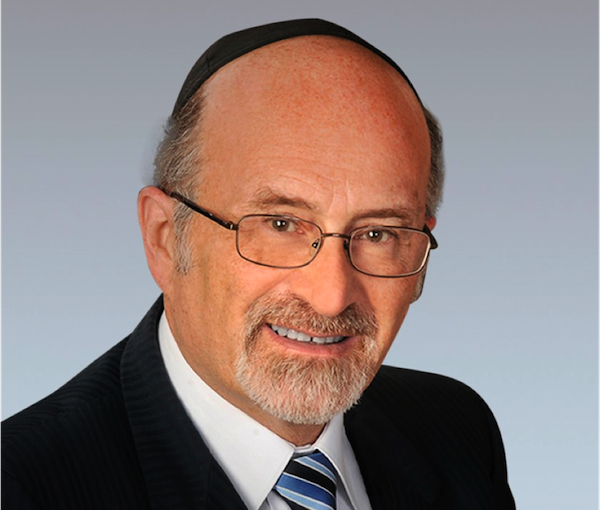
Rabbi Reuven Bulka (photo from thecjn.ca)

Rabbi Reuven Bulka, who served as spiritual leader of Ottawa’s Congregation Machzikei Hadas for 48 years, died of cancer early on June 27 in New York. He was 77.

Bulka moved to New York to be closer to his five children following a diagnosis of terminal liver cancer earlier this year. His funeral service took place there later on June 27, a video of which can be watched in its entirety online, via thecjn.ca/rabbi-bulka-obit.

Tributes to the beloved rabbi poured in.

Prime Minister Justin Trudeau praised Bulka for his commitment to his country and for inspiring parliamentarians to adopt Kindness Week.

“The Jewish community has lost a giant, the Canadian community has lost a giant and the world at large has lost an unbelievable person,” eulogized Bulka’s son, Shmuel Bulka, at the funeral service.

Shmuel Bulka noted that God “had called for the lefty” – a nod to his father’s love of baseball. “His life’s work was about making the world a better place than it was before he got here.”

He said, “A lot of people today, when they see people who are different, all they do is go toward the differences. Some people make a career out of exploiting the differences. My father was the exact opposite. He would always look for commonalities.”

Sen. Jim Munson, a close friend whose Kindness Week bill, inspired by Rabbi Bulka, received royal assent earlier this year, tweeted that his “heart aches” over Bulka’s death.

Ottawa Mayor Jim Watson praised Bulka as an outstanding community leader.

“He epitomizes kindness,” said Watson, who knew the rabbi for more than 30 years. “He was a larger-than-life figure in our community. He was a great supporter when the community needed him most.”

Andrea Freedman, president of Jewish Federation of Ottawa, told CBC that Bulka “had this amazing ability to just think through how something could be phrased that would help other people feel better.”

Retired Ottawa Police chief Charles Bordeleau said, “Rabbi Bulka was a pillar in our community and changed our country for the better. He was always there for Ottawa Police and a proud supporter of the men and women who keep Ottawa safe.”

Bulka’s passing “leaves an enormous void in our country,” tweeted CTV chief news anchor Lisa LaFlamme. “He was a man who built bridges and inspired goodness. A healer in a divided nation. I will miss our personal conversations and his public Remembrance Day benedictions.”

At a worldwide virtual prayer service for Bulka in January, former prime minister Stephen Harper said he’d had many opportunities to see the rabbi at local and national public events, and to visit with him.

“It is not for nothing Rabbi Bulka has been called Canada’s rabbi,” said Harper. “Throughout his long life, he has been a credit to his faith, to the wider community and great country.”

Harper said the main lesson he learned from Bulka is to live life from two perspectives, gratitude and hope. “Gratitude for all that we have, all that God has given us, and hope for what the future may bring,” said Harper.

Bulka was born to Rabbi Chaim Yaakov and Yehudis Bulka in London, England, on D-Day, June 6, 1944. Two years later, the family moved to the United States, where his father taught at Hebrew schools in Providence, R.I., and Rockaway, N.Y., before becoming rabbi of a synagogue in the Bronx.

Rabbi Reuven Bulka received semikhah (ordination) from the Rabbi Jacob Joseph Rabbinical Seminary in 1965, and earned a bachelor of arts degree in philosophy from City University of New York the same year.

He briefly served as an associate rabbi at Congregation K’hal Adas Yeshurun in the Bronx, before becoming rabbi of Congregation Machzikei Hadas in Ottawa in 1967. He received master’s and PhD degrees from the University of Ottawa in 1969 and 1971, respectively, concentrating on the life and work of Holocaust survivor and psychiatrist Viktor Frankl.

Bulka was an authority on Frankl’s use of logotherapy, which teaches that humans’ search for meaning in life is their prime motivational force. He later became the founder and editor of the Journal of Psychology and Judaism. He authored some 30 books and dozens of columns in the Ottawa Citizen. He was the go-to rabbi for reporters seeking a quote on a Jewish issue.

Bulka’s local initiatives included interfaith outreach and work with the United Way and with Canadian Blood Services.

A fixture at national Remembrance Day ceremonies in Ottawa for many years, Bulka’s name was “synonymous” with Remembrance Day, Maj.-Gen. Guy Chapdelaine, chaplain general of Canada’s Armed Forces, told last January’s prayer service.

He also noted Bulka’s support for Armed Forces chaplains and the Royal Canadian Legion.

Bulka was also awarded the Canadian Forces Medallion for Distinguished Service “for inspiring sermons, venerable presence and meaningful messages to Canadians during the national Remembrance Day ceremonies.”

The rabbi founded Kind Canada, a nonprofit that encourages kindness. In 2019, the city named Rabbi Bulka Kindness Park in Ottawa’s Alta Vista neighbourhood. The first national Kindness Week is slated for February 2022, and Canadians are called on to carry out acts of kindness in their communities during the third week of February every year.

The week could “potentially raise the Canadian consciousness of the importance of kindness, and the ensuing commitment thereto, to levels that will make our great country even greater and make a large dent in some of the critical issues we face, including mental health, the cost of health care and bullying, among others,” Bulka told the senate committee studying the kindness bill.

In 2010, the rabbi was awarded the key to the City of Ottawa. He was named to the Order of Canada in 2013.

He addressed the COVID pandemic at the prayer service for him, saying that, if anything was learned from it, “it’s that we’re all in this together, and the more together we are in this, the better we’re going to get out of it.”

He said the most important thing in life “is to appreciate each other.” Differences “fade into insignificance when we realize the blessings we have.”

Rabbi Bulka is survived by his wife, Leah, and five children: Yocheved Shonek, Rina Levy, Shmuel Bulka, Eliezer Bulka and Binyomin Bulka. His first wife, Naomi, died in 2001. He is to be buried in Israel in a private service.

– This article originally appeared on thecjn.ca.

Format ImagePosted on July 9, 2021July 7, 2021Author The CJN StaffCategories NationalTags Machzikei Hadas, memorial, Ottawa, Reuven Bulka
Help find son, brother

Help find son, brother

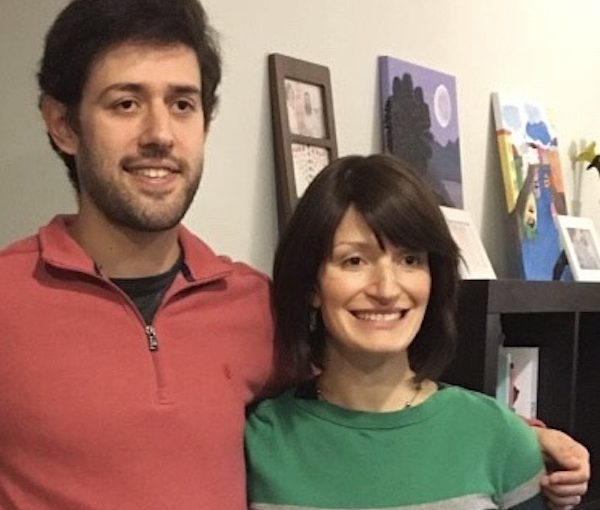
Bernard Grempel with his sister, Ettie Shurack. (photo from Grempel family)

Ettie Shurack’s life has been upside down since May 14, her emotions a chaos of desperation, pain, anxiety, frustration and grief, peppered with pinpricks of immense gratitude, appreciation and, always, a glimmer of hope.

May 14 is the date her brother, Bernard Grempel, age 28, went missing. He was last seen at 11 p.m. on the SkyTrain and on bus 340, heading towards the North Delta/Surrey area. Since that time, Shurack, her husband, her parents, friends and volunteers in the Jewish community and beyond have been searching relentlessly for any traces of the young man who mysteriously disappeared. They have scoured the bus routes, knocked on the doors of strangers in those neighbourhoods, interviewed commuters on the transit system and sought out footage from video cameras in relevant areas.

Shurack has created a Tehillim (Psalms) signup sheet with the goal of having the entire book of Tehillim recited until Grempel has been found. She has launched weekend searches, posted flyers, liaised with RCMP in multiple cities of the Lower Mainland and her family is offering a $20,000 reward for anyone with information leading to his safe return home.

She’s emerged, five weeks into the search, feeling very disillusioned with the efforts of the RCMP to help locate and bring her brother home. She noted that the photograph of Grempel initially used was more than a year old. She was also concerned that a police release requested the public’s assistance in locating a missing person who, the release stated, “is apprehendable under the Mental Health Act.”

“Yes, he has mental health problems, but he was living on his own prior to disappearing. I’m confused why they would state he should be returned to the hospital,” she said.

“A mental health diagnosis does not equate to suicide,” she said, responding to one of the theories of what might have happened to Grempel. “My brother was taking his medication daily, seeing his counselor regularly and attending appointments with his psychiatrist. His mental health team had seen him the week he went missing.”

If determination had a face and name, it would be Ettie Shurack. She, her husband and parents are deeply committed to continuing the search for their missing son and brother and thank those who share their quest.

“I ask the public to continue helping with our search parties and to share our search on social media. In Surrey, 64th and Scott Road, and 72nd and Scott Road, are our focal points but we ask that anyone and everyone in the Lower Mainland continue to keep their eyes out for him.”

She asks that anyone with information or the ability to help email her at bringbernardhome@ gmail.com or call 778-838-5095. She has a WhatsApp group at 631-320-8225 and a Facebook page called Let’s Find Bernard Grempel.

Lauren Kramer, an award-winning writer and editor, lives in Richmond. To read her work online, visit laurenkramer.net.

Format ImagePosted on June 25, 2021June 24, 2021Author Lauren KramerCategories LocalTags Bernard Grempel, Ettie Shurack, family, missing person, RCMP
Honouring women’s courage

Honouring women’s courage

Anne Petrie (photo from Maurice Yacowar)

The University of Calgary has organized a virtual exhibition to honour the efforts of Jewish women in the Canadian Armed Forces during the Second World War. Called She Also Served, it comprises a series of nine banners by various artists.

Originally scheduled to be displayed at the Military Museums in Calgary during Jewish Heritage Month in May, it has been made available online throughout 2021 and will be physically hung in May 2022. Of the 17,000 Jews who served in the Canadian armed services, more than 275 were women.

Among those selected to display their work is Anne Petrie of Victoria. For her banner, a digital print called “In the Tradition of Service,” Petrie chose to list all the known names of the Jewish Canadian servicewomen. She used a font that is reminiscent of the typewriters of the 1940s. Another layer of the banner has the names of 12 biblical heroines, confirming the tradition of Jewish women’s courage and dedication to serving their communities.

“I was immediately struck by knowing that, although they would not have had to hide their Jewish identity, it was still in those days not something that you would be comfortable being completely open about,” Petrie told the Independent. “Even if it was, at best, very casual antisemitism, it was a reality when they would have signed up. So, there you are fighting (even if it’s only at a desk) for something – a religion, a people, a culture – that you can’t really be openly passionate about.”

image - Anne Petrie’s “In the Tradition of Service,” 2021. Part of the She Also Served exhibit, now online
Anne Petrie’s “In the Tradition of Service,” 2021. Part of the She Also Served exhibit, now online.

For Petrie, She Also Served is an opportunity to reveal and contextualize the “Jewishness” of that other “them, the unsung and – worse – unidentified Jewish-Canadian women soldiers.” She said she is honouring them by naming them in “their doubly suppressed identities, as women and Jews.”

Petrie’s intention was to present the full names and rank (where available) of all the Jewish women known to have served. The collection of names fills the background layer of the 75-by-165-centimetre banner. Each name is in the colour of their respective services: olive green for army, dark navy for the navy and a lighter “air force blue” for the Women’s Army Corps. Emerging from the background in a larger, translucent Hebrew script, and in a camouflage pattern, are the names of Judaism’s biblical heroines, “themselves often subordinated by patriarchal tradition to the male heroes,” said Petrie.

“In making the banner itself, I was struck by how powerful it was to actually write out all the 279 names of the Jewish servicewomen that have so far been identified. I knew none of them personally, of course, but I felt that typing each name was a kind of acknowledgement and, strange as it sounds, I did feel a kind spirit or presence as I typed each of the names. I only wish we did know more about them, but I understand that research is continuing and, hopefully, there will eventually be stories attached to each of these women’s names,” she said.

Petrie thanked Janice Shulman and Rabbi Lynn Greenhough for their assistance with the project.

Prior to beginning her work as an artist, Petrie’s career spanned more than 30 years in radio and television, where she worked as a researcher, producer, documentary-maker, columnist and commentator in news and current affairs. She is also the author of several non-fiction books: Ethnic Vancouver, Vancouver Secrets and Gone to an Aunt’s: Remembering Canada’s Homes for Unwed Mothers.

After retiring from the CBC, she returned to school and obtained a bachelor of fine arts from the Alberta College of Art and Design in 2008. Since then, she has had a number of exhibitions. Her next exhibit, said/unsaid, is a two-person show with Jane Coomb – it opens at the errant artSpace gallery in Victoria (975 Alston St.) on July 9.

The other artists whose work is featured in She Also Served are Razieh Alba, Sophia Borowska, Alysa-Beth Engel, Lily Rosenberg, Talie Shalmon, Jules Schacter, Bev Tosh and Susan Turner. The representations exploring the servicewomen’s experiences range from naturalistic to abstract. Some works use archival photographs, while others use media include oil painting and paper-cutting.

The stories of 41 Jewish servicewomen are also featured on the website. These accounts were an impetus for the call for submissions for the exhibition, which was curated by the University of Calgary’s Prof. Jennifer Eiserman and librarian emerita Saundra Lipton. They ask for help in “completing the story” from anyone who has more information about the featured servicewomen and any of those identified in the list of names collected.

To view the exhibition, visit live-ucalgary.ucalgary.ca/she-also-serves/exhibition.

Sam Margolis has written for the Globe and Mail, the National Post, UPI and MSNBC.

Format ImagePosted on June 25, 2021June 24, 2021Author Sam MargolisCategories National, Visual ArtsTags Anne Petrie, art, Canada, memorial, Military Museums, Second World War, She Also Served, University of Calgary, women
Having the hard discussions

Having the hard discussions

Rabbi Hanan Schlesinger, above, and Noor A’wad of Roots Palestinian-Israeli Network were the featured speakers at Vancouver School of Theology’s Two Truths in One Heart; Two Peoples in One Land event May 27. (photo from friendsofroots.net)

Two Truths in One Heart; Two Peoples in One Land, a discussion on the Roots Palestinian-Israeli Network, with speakers Rabbi Hanan Schlesinger and Noor A’wad, took place on May 27 as part of the Religion and Thoughtful Activism conference organized by the Vancouver School of Theology (VST).

Formed in 2014 by peace activist Ali Abu Awwad and Schlesinger, Roots is a group based in the Gush Etzion settlements of the West Bank that believes the path towards peace between Palestinians and Israelis is through dialogue.

“In the West Bank, Jews and Arabs live completely separately with no connections at all,” said Schlesinger, an Orthodox rabbi, passionate Zionist settler and director of international relations for Roots. Everything, he explained – from legal systems to health systems, transportation to universities – is separate. The separation is so complete that Palestinians are forbidden from entering Israeli areas and vice versa.

“If I were to say that there is no common ground between Jews and Palestinians, I would not be exaggerating, and I would not be speaking metaphorically. There is literally no common ground as far as geography goes. If there had been a place for a crazy Israeli Jew and a Palestinian who wanted to meet for coffee, there would have been no place to do it,” he suggested.

At least, this was the case, he said, until seven years ago, when Roots was formed and when the Dignity Centre, a community centre where the two sides can meet with equality and mutual recognition, was created.

Schlesinger spoke of the great apprehension and trepidation each side has in coming together at such a place. Yet, often, at the end of an event at the centre, people come to Schlesinger, saying how wonderful the simple experience of conversing with a member of the other side is.

“People are amazed to discover that ‘the other’ is a lot like us. It’s hard to fathom after all the stereotypes and all we on both sides have been taught,” he said.

He likened the animosity each side has to a disease he called “the hubris of exclusivity,” which infects people with a “virus” that makes them believe that their people are the only legitimate people in the region.

Charting his own journey, Schlesinger recounted that, during his first encounters with Palestinians, he began learning that there were not one but two stories in the land where he lives. “For 33 years, I lived in my story and the Palestinians didn’t exist. They were part of the grey drab scenery that passes in the background of a movie but not part of the plot,” he recalled.

He spoke of his initial distrust of Palestinians and his profound reluctance to meet them – a distrust and reluctance shared by his Palestinian interlocutors during their first meetings. Implicit, too, in the unwillingness to meet was the fear that each side had of the other, Schlesinger said.

Noor A’wad, a licensed Palestinian tour guide based in Bethlehem, where he takes English speakers on geopolitical tours, spoke of his family’s long history in the land.

photo - Noor A’wad of Roots Palestinian-Israeli Network
Noor A’wad of Roots Palestinian-Israeli Network (photo from friendsofroots.net)

“I remember growing up during the Second Intifada – some of my family members were killed, others arrested – realizing that this is not a normal life and asking myself why am I living this abnormal life under occupation? The simple answer to the question is, because I am a Palestinian,” A’wad said.

He considered leaving the area, but that urge was outweighed by a sense of responsibility and a sense that there was no other option but to stay in order to best serve his people. Ultimately, he came to learn about nonviolent solutions to conflict.

A’wad described his change of heart upon getting involved with Roots: “When Rabbi Hanan spoke about his identity as a Jew and a settler, these are very loaded words and terminology that is connected to the conflict. For him, I was able to see how beautiful this terminology is because it is part of his identity.

For me, the same terminology is connected to the suffering my people have.”

For A’wad, as with Schlesinger, the acts of sitting and listening to the other were enormously challenging. Nonetheless, each persevered and, in the process, they discovered a partner in dialogue and perhaps the most effective way of understanding the humanity of the other – finding mutual empathy and thereby creating a means to achieve peace.

“What I discovered in Roots is the foundation for any peace process,” said A’wad.

The event was organized by Rabbi Laura Duhan-Kaplan, VST’s director of inter-religious studies. “Our students – most but not all are Christian – are very interested in news about Israel and Palestine. They see Israel as their beloved Holy Land. So, we wanted to introduce them to one of the many NGOs there doing collaborative peace-building work,” she told the Independent.

“I’ve been a supporter of Roots for some years now. Rabbi Schlesinger is a colleague and friend from Clal’s Rabbis Without Borders fellowship program. Still, this event would not have happened without the help of Quebec psychotherapist Colleen MacDougall, another Roots supporter,” she added.

For more information on Roots, visit friendsofroots.net.

Sam Margolis has written for the Globe and Mail, the National Post, UPI and MSNBC.

Format ImagePosted on June 25, 2021June 25, 2021Author Sam MargolisCategories Israel, LocalTags dialogue, Hanan Schlesinger, Israeli-Palestinian conflict, Laura Duhan Kaplan, Noor A’wad, peace, Vancouver School of Theology, VST
Stepping up to confront hate

Stepping up to confront hate

Left to right: Jewish Federation’s Shelley Rivkin, CJPAC’s Kara Mintzberg and CIJA’s Nico Slobinsky spoke at an online event June 17 on topics including how individuals can help fight antisemitism in Canada. (PR photos)

Representatives from three Jewish communal agencies spoke at an online event June 17 on topics including online hate, adoption of the Working Definition of Antisemitism, strengthening supports for the investigation and prosecution of hate crimes, and how individuals can help fight antisemitism in Canada.

Shelley Rivkin, vice-president of local and global engagement at the Jewish Federation of Greater Vancouver, Kara Mintzberg, B.C. regional director for the Canadian Jewish Political Affairs Committee (CJPAC), and Nico Slobinsky, director of the Pacific region of the Centre for Israel and Jewish Affairs (CIJA), spoke about how their agencies are confronting the surge in antisemitism, as well as a range of other topics.

Dafna Silberstein, associate director of the Jewish Federation’s Israel and global engagement department, opened the evening.

“We are here tonight to understand the Canadian political process and learn how you can become more involved, how we can become engaged with a range of issues that matters to you and to our community, and to learn what our community organizations are doing to combat antisemitism,” she said.

Rivkin described Federation’s role as “our community’s primary convener.”

“We are an umbrella organization that represents over 25 organizations locally and an additional number of organizations, approximately 10, in our partnership region [in Israel’s Galil Panhandle] and globally,” said Rivkin.

Federation is the central fundraising arm of the community and runs programs and partners with other agencies to care for the most vulnerable. About one in six Jewish British Columbians lives in poverty, she said, including 13.4% of Jewish children. Federation is also critically involved in supporting Jewish day schools and ensuring continued provincial support for those institutions, she added.

Antisemitic incidents and threats have spiked in recent weeks, coincident with the conflict between Hamas and Israel. Rivkin said the relationships Federation has built with other ethnocultural agencies and communities have proven valuable.

“We have a long history of working side-by-side with other ethnocultural communities,” she said. “These relationships and the supports that we provide are very important so that, when we stand up and speak out on behalf of other ethnocultural organizations, we’re building the bridges and relationships so that they will stand up and speak out on our behalf. Especially this past month, we’ve been very proactive in reaching out to the Indigenous community and the Muslim communities, both of whom faced significant losses over this past month.”

Rivkin also noted Federation’s substantial investment – about $1 million annually – in community security.

“Hate crimes against our community remain one of the highest reported crimes in Canada,” she said. “That was why, in 2016, we made the decision to invest in a director of security that is available and responsive to all of our community organizations, in particular those organizations that have stand-alone facilities.”

Slobinsky explained that CIJA represents hundreds of thousands of voices affiliated with Jewish federations across the country.

“Combating antisemitism, educating Canadians about the central role that Israel plays in Jewish life, strengthening the ties between Canada and Israel and ensuring that Jewish voices are represented in the discussion on a range of issues is some of the long-term work that CIJA does,” he said.

Because of CIJA’s lobbying, he said, the federal government has announced an emergency summit on combating antisemitism, to be led by former justice minister Irwin Cotler.

CIJA also promotes the adoption by governments of the International Holocaust Remembrance Alliance Working Definition on Antisemitism, which Slobinsky calls “the gold standard definition for antisemitism” and a vital tool in fighting antisemitism in Canada and around the world.

“For the first time in our history, we have a definition [of antisemitism] that we as a community champion, that the Canadian government has adopted and now Ontario, New Brunswick and Quebec have adopted,” Slobinsky said. “It’s a very useful tool to work with our elected officials, law enforcement, our partners in other communities, when they ask us what is antisemitism, how do you experience antisemitism, how it manifests.… We are defining what our own discrimination, our own oppression, looks like.”

CIJA is also calling on federal and provincial governments to increase supports for existing hate crime teams in British Columbia and to initiate teams to investigate and prosecute hate crimes in jurisdictions where investigation teams do not yet exist.

Of CJPAC, Mintzberg said: “We are all about political engagement.”

“Our focus is on getting our community interested and involved in politics through volunteering and building relationships with elected officials,” she said. CJPAC, she emphasized, is not involved in lobbying or advocacy; that’s CIJA’s job. “We create programs that reflect the mandate of engagement and highlight the importance of getting involved in Canada’s political process.”

Jewish voters have a significant presence in only about 10 of the country’s 338 ridings. Especially during elections, Mintzberg said, CJPAC acts as a “political concierge,” connecting volunteers with candidates. As Canada is currently governed by a minority government, an election could come at any time. She calls on community members to step up now and be prepared when that call comes.

Mintzberg asked that people pledge to volunteer in the next election and participate in a free, one-hour online training course, which can be accessed via cjpac.ca. Slobinsky invited participants to visit cija.ca/takeaction to find ways to mobilize against antisemitism and support other topics on CIJA’s agenda.

Format ImagePosted on June 25, 2021June 24, 2021Author Pat JohnsonCategories LocalTags antisemitism, CIJA, CJPAC, Jewish Federation, Kara Mintzberg, Nico Slobinsky, politics, Shelley Rivkin
JA’s newest laureates

JA’s newest laureates

Moderator Greg D’Avignon, left, and newly inducted laureate Gordon Diamond share a laugh at the Business Laureates of British Columbia Hall of Fame celebration May 20. (screenshot)

On May 20, Gordon Diamond – chair of West Coast Reduction Ltd. and Austeville Properties Ltd. – was among those inducted into the Business Laureates of British Columbia Hall of Fame. The ceremony, which was to have been held last year, took place virtually.

The Hall of Fame was created in 2005 by Junior Achievement British Columbia (JABC) to honour local “business leaders whose efforts have shaped our province and country.” It is housed in Vancouver Convention Centre West.

The evening’s other Hall of Fame inductees were Chief Clarence Joseph Louie, chief executive officer of Osoyoos Indian Band Development Corp., and Arran and Ratana Stephens, co-founders and co-CEOs of Nature’s Path Foods Inc.

photo - Morris Wosk, z”l, was honoured as a Pioneer Laureate
Morris Wosk, z”l, was honoured as a Pioneer Laureate. (photo from orderofbc.gov.bc.ca)

Also part of the festivities, in a belated celebration of the hall’s 15th anniversary, was the posthumous induction of 10 Pioneer Laureates. Morris Wosk, z”l, who was president of Liberty Investments Ltd. and M.J. Investment Co., as well as co-founder of Wosk’s Ltd., was so honoured for both his business and philanthropic endeavours. Wosk, who passed away in 2002, “played a significant role in the growth and development of Vancouver” and was a “revered mentor to the next generation of businesspeople.”

The gala included speeches by supporters and representatives of JABC and presentations by some young achievers. There were brief video biographies for each laureate being inducted, and the Hall of Famers spoke with moderator Greg D’Avignon, president and CEO of the Business Council of British Columbia. In that conversation, Diamond pointed to the importance in leadership of building “relationships, trust,” and of being “honourable with the people who work with you, not for you.”

One of the most satisfying aspects of his business at this point, he said, is the people who are running it. “We have family members, we have a team…. I’ll be listening to various meetings and I’m in the background but, if I wasn’t there, what the family and the team has built is that my company will continue without me.”

He said of this legacy, which includes the Diamond Foundation, in addition to the businesses, “You can’t buy that feeling that I have when I look at my plants, when I look at the buildings, and that we’re capable of doing things like this,” he said, referring to supporting JABC and “giving back” to community in general.

The JABC write-up highlights the foundation, which Diamond “set up with his late father, Jack Diamond, in 1984 as a vehicle for his philanthropic aspirations. Since inception, the Diamond Foundation, funded solely by Gordon and his companies, has made donations to hospitals, schools, the arts and other public and charitable causes.”

For more on JABC’s laureates, visit businesslaureatesbc.org.

Format ImagePosted on June 25, 2021June 25, 2021Author Cynthia RamsayCategories LocalTags awards, business, Gordon Diamond, JABC, milestone, Morris Wosk, philanthropy, pioneers
Local kids join in the Chidon

Local kids join in the Chidon

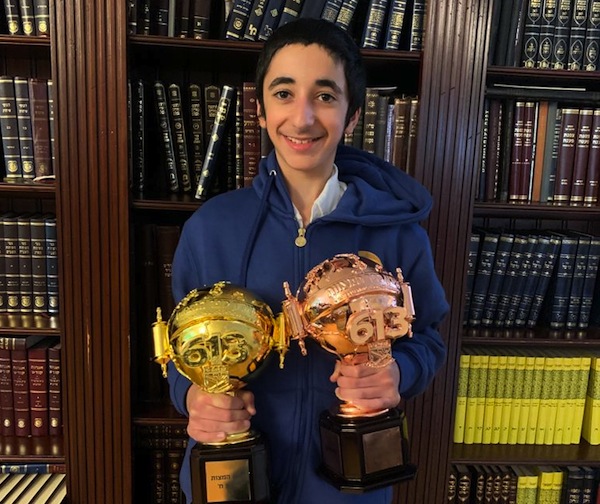
Levi Bitton (photo from Vancouver Tzivos Hashem)

The International Chidon boasts 5,000 participants from around the world and, this year, there were eight participants from Vancouver: Levi Bitton (Grade 8); Liba Baitelman (Grade 4); Yanki Baitelman (Grade 6); Menucha Prinsloo (Grade 8); Shoshana Prinsloo (Grade 5); Yonatan Prinsloo (Grade 7); Miriam Ora Yeshayahu (Grade 6); and Dovber Zhornitsky (Grade 6).

Tzivos Hashem is an international educational program for Jewish children ages 3-13, founded in 1980 by the Lubavitcher Rebbe, Menachem Mendel Schneerson. It focuses on teaching kids about kindness, good deeds and refining their character to become better people and more effective influencers in our community. The program’s goal is to increase Jewish identity and provide children with inspiring and immersive Chassidic Jewish learning through fun, informal activities.

The Vancouver chapter of Tzivos Hashem was established in 2017 as part of Lubavitch BC’s outreach activities and now has approximately 45 children registered in the Sunday morning program. The biggest event of the year and the most highly anticipated part of the program is the Chidon, usually held during a Shabbaton in New York, but virtual this year because of COVID. This event highlights the advanced knowledge and understanding of all 613 mitzvot (commandments) of the Torah, as codified by Maimonides. Kids from around the world compete, and this year’s Chidon took place on May 23. Each of the Metro Vancouver students won a plaque (indicating a grade of more than 80% on the final test) and Levi had the distinction of winning a gold trophy for his grade. He was tested on the fifth book of the Torah, and had the highest mark internationally.

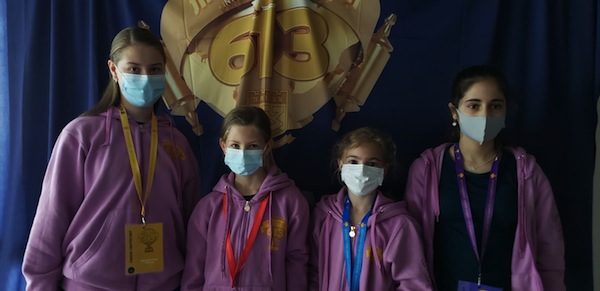
photo - Left to right: Menucha Prinsloo, Shoshana Prinsloo, Liba Baitelman and Miriam Ora Yeshayahu
Left to right: Menucha Prinsloo, Shoshana Prinsloo, Liba Baitelman and Miriam Ora Yeshayahu. (photo from Vancouver Tzivos Hashem)

Riki Oirechman, principal of Tzivos Hashem Vancouver and the local Chidon coordinator, said: “The most important thing is that the kids gain a lot of knowledge. By learning the 613 mitzvot in depth, they gain a deep appreciation and understanding of all the mitzvot, resulting in an increased excitement for, and commitment to, fulfilling them. They work super hard and really commit themselves to fulfilling the Rebbe’s direction and vision.”

Oirechman explained that all the kids in the program study and complete the five books of Torah and master the 613 mitzvot over five years. The Tzivos Hashem program uses the Yahadus curriculum created by the Living Lessons Foundation in memory of Sarah Rohr. It’s a series of textbooks explaining each mitzvah, its source in the Torah and its details.

To participate in the Chidon, students must pass multiple tests. If a child gets a 70% average, they are eligible to join the Chidon Shabbaton. The child with the highest mark in their class gets to represent their class and school at the Chidon competition. On the weekend of the Chidon, the international participants take the final test, which includes everything they learned during the year. Winners receive certificates, plaques, medals and trophies.

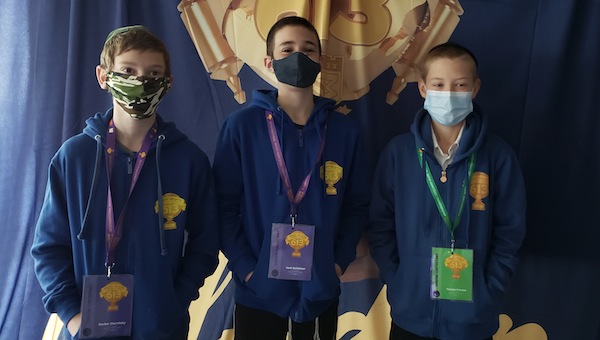
photo - Left to right: Dovber Zhornitsky, Yanki Baitelman and Yonatan Prinsloo
Left to right: Dovber Zhornitsky, Yanki Baitelman and Yonatan Prinsloo. (photo from Vancouver Tzivos Hashem)

“The Chidon includes not only the incredible game show competition, but also an exciting award ceremony. This year, over 100,000 people watched from around the world,” said Oirechman. The Chidon started in 2014 with 54 finalists and eight staff and has grown to 2,414 finalists and 375 staff this year.

Local supporters of the program include founders of the Vancouver Tzivos Hashem chapter, Rabbi Shmulik Yeshayahu of the Kollel and Rabbi Dovid Rosenfeld of Chabad Lubavitch of BC, as well as a grant from the Jewish Federation of Greater Vancouver and local community donors.

For more information about the Vancouver Tzivos Hashem program, email [email protected] or visit lubavitchbc.com/tzivoshashem.

Shelley Civkin is a happily retired librarian and communications officer. For 17 years, she wrote a weekly book review column for the Richmond Review. She’s currently a freelance writer and volunteer, including with Chabad Richmond.

Format ImagePosted on June 25, 2021June 25, 2021Author Shelley CivkinCategories LocalTags awards, Chidon, Dovber Zhornitsky, education, Levi Bitton, Liba Baitelman, Menucha Prinsloo, Miriam Ora Yeshayahu, Shoshana Prinsloo, Torah, Tzivos Hashem, Yanki Baitelman, Yonatan Prinsloo
Russian logic game popular

Russian logic game popular

Irina Zilberstein (photo from Irina Zilberstein)

Many people love the TV show Jeopardy!, which can also be played as a board game and online. There is a variation of it in Russia, which developed independently from the American version. It, too, is hugely popular, not only on television, but there are Chto, Gde, Kogda (What, Where, When) clubs all over the country, and around the world – including here in Vancouver.

“Chto, Gde, Kogda is a game played by teams of five players and a captain,” explained Irina Zilberstein, president of the Vancouver club. “It was invented in the former USSR in the 1970s. Unlike other brain games, which often require lots of factual knowledge, this is a logic game, where a Grade 12 general knowledge of the world plus logic skills are sufficient to play.”

According to Zilberstein, during a game, several teams of six players compete with one another and with the audience. When a question is presented to a team, they have 60 seconds to discuss the possible answers among themselves before they voice the one response they all agreed upon.

“The televised show was very popular in Russia,” said Zilberstein. “In order to get on a team for the televised show, students started university clubs to practise for auditions.… When the USSR fell apart, many people missed the game. It continues on TV in Russia in its original format, but, here, people began creating their own Chto, Gde, Kogda clubs, where they played in tournaments against each other rather than against the audience.”

The Vancouver club was born 15 years ago. Populated by immigrants from the former Soviet Union and played exclusively in Russian, it grew slowly. “At first, we played in community centres, then at UBC, and then we moved to the Perez Centre, as they had a large and readily available space,” said Zilberstein. “For a long time, we had a maximum of five teams, each with six or more players. One of the many challenges, as the club grew, was that crew members brought in their friends, who all wanted to play together. The teams became too large.”

Eventually, the club split into two clubs. “Certain antisemitic attitudes emerged,” Zilberstein recalled. “Some players were mad that Jewish members didn’t want to play on Jewish holidays. The use of a Jewish centre as a meeting location also caused some hostility.”

Zilberstein became the president of the Russian Jewish club. “Our clubs are multi-age, anyone can join. We have teenagers, we have seniors. The game is played in Russian, but several enthusiasts are currently trying to convert it into English. This really helps to attract kids. The English translation and English version of the game are still in pilot stages, with notable leaders in Chicago, New York and San Francisco.”

She also mentioned that the most fascinating games occur when Russian-speaking teenagers, born in North America, participate.

“They consider English their first language and, because of that, they have a unique perspective, which contributes a lot to the teams’ logic and synergy,” she explained. “When they translate the questions in their minds into English, it gives an additional slant to the teams’ problem-solving discussion. The teens’ involvement means that, eventually, they’ll find a way to play in English.”

Zilberstein was proud to say that, right now, there is at least one Chto, Gde, Kogda club in all major Western cities where Russian speakers live, with a heavy concentration in North America, the United Kingdom, Israel and Germany and, of course, in Russia and the former Soviet republics, like Ukraine, Latvia, Uzbekistan and others.

“The biggest Canadian club is in Toronto,” said Zilberstein. “The next one is in Montreal, and the third one is in Vancouver. Most major U.S. cities have a club. The states with larger populations, like California, have 10 to 15 clubs.”

All the teams of all the clubs register with a centralized worldwide governing body, which ranks them internationally. Currently, there are about 51,000 registered teams in the ranking system; this count does not include the teams that play just for fun.

To get a ranking, teams compete. “We have many tournaments of varying sizes,” said Zilberstein. “There are country championships. If your team wins, you get to go to the world championship. There are also big tournaments that are played synchronously internationally, so that teams can compare with each other and get stronger.”

The pandemic has affected the tournament schedules and gatherings, as it has affected most every other aspect of life. “Pre-COVID, we would meet once a week on Sundays and play a tournament,” she said. “Those tournaments were of the online variety. You could register online and then get two or three days to complete the tournament. You had to sign an NDA not to discuss questions online for those days, to accommodate various people’s schedules and time.”

During COVID, they moved the games exclusively online, for safety. “It has actually been a lot of fun,” said Zilberstein. “People from all over the world have joined us for our games via Zoom. After COVID, we will resume playing in person, as that is essential to the cohesive team problem-solving.”

Zilberstein described some of the procedures and how the games work. “Certified question-makers help write the tournaments. There are amazing tournament-makers out there,” she said. “Each tournament usually has 36 to 45 questions, divided into three tours.”

People pay a small fee to participate in the clubs and in tournaments, and part of that money goes towards paying the people who put in the time and effort to create and fact-check the tournament questions.

Zilberstein has enjoyed playing Chto, Gde, Kogda since she was a university student in Russia. In Vancouver, where she has lived since 1999, she works in IT and, in her free time, plays Chto, Gde, Kogda. She also volunteers with JAM, an organization that tries to unite Jewish immigrants for whom English is a second language.

“What is great about this game is that it’s logic-based. No fact memorization is required,” she said. “It’s like gymnastics for your brain, and anyone can play. Often, you only need to know where to start the logical deduction of the question.”

Zilberstein offered an example of a question and its answer. “The question: in many folk stories, tears are compared to gems or semi-precious stones. Russians compare them to pearls; Aztecs to turquoise. What do Lithuanians compare them to? The answer is derived from a following logical progression. Lithuania is on the Baltic Sea. The Baltic Sea is famous for its amber, so the Lithuanian folk tales compare people’s tears to amber.”

She is sure that, as a team game, Chto, Gde, Kogda helps people develop essential life skills. “This involves synergy between team members. I’ve seen teams with superstar individual players, but they don’t have synergy, don’t know how to listen to each other, and end up losing. A big part of creating the synergy is up to the captain. The captain participates in answering the questions, but his or her main job is to make sure the team players listen and build on each other’s ideas rather than contradict each other. A team has to work together to win, and the captain is the key to that victory.”

Zilberstein has been the captain of her team for the past five years.

Anyone who wants to learn more or to participate in the game can contact Zilberstein via email at [email protected] or visit bc-vancouver.chgk.info. The club also has a Facebook and Instagram presence.

Olga Livshin is a Vancouver freelance writer. She can be reached at [email protected].

Format ImagePosted on June 25, 2021June 25, 2021Author Olga LivshinCategories LocalTags Chto Gde Kogda, club, game, Irina Zilberstein, Russia, Russian Jewish club

Posts pagination

Previous page Page 1 … Page 98 Page 99 Page 100 … Page 314 Next page
Proudly powered by WordPress