Skip to content
  • Home
  • Subscribe / donate
  • Events calendar
  • News
    • Local
    • National
    • Israel
    • World
    • עניין בחדשות
      A roundup of news in Canada and further afield, in Hebrew.
  • Opinion
    • From the JI
    • Op-Ed
  • Arts & Culture
    • Performing Arts
    • Music
    • Books
    • Visual Arts
    • TV & Film
  • Life
    • Celebrating the Holidays
    • Travel
    • The Daily Snooze
      Cartoons by Jacob Samuel
    • Mystery Photo
      Help the JI and JMABC fill in the gaps in our archives.
  • Community Links
    • Organizations, Etc.
    • Other News Sources & Blogs
    • Business Directory
  • FAQ
  • JI Chai Celebration
  • JI@88! video

Recent Posts

  • Story of Israel’s north
  • Sheltering in train stations
  • Teach critical thinking
  • Learning to bridge divides
  • Supporting Iranian community
  • Art dismantles systems
  • Beth Tikvah celebrates 50th
  • What is Jewish music?
  • Celebrate joy of music
  • Women share experiences 
  • Raising funds for Survivors
  • Call for digital literacy
  • The hidden hand of hate
  • Tarot as spiritual ritual
  • Students create fancy meal
  • Encouraging young voices
  • Rose’s Angels delivers
  • Living life to its fullest
  • Drawing on his roots
  • Panama City welcoming
  • Pesach cleaning
  • On the wings of griffon vultures
  • Vast recipe & story collection
  • A word, please …
  • מארק קרני לא ממתין לטראמפ
  • On war and antisemitism
  • Jews shine in Canucks colours
  • Moment of opportunity
  • Shooting response
  • BC budget fails seniors
  • Ritual is what makes life holy
  • Dogs help war veterans live again
  • Remain vital and outspoken
  • An urgent play to see
  • Pop-up exhibit popular
  • An invite to join JWest

Archives

Follow @JewishIndie
image - The CJN - Visit Us Banner - 300x600 - 101625

Category: News

Mezuzah hanging at Diamond Residences

Mezuzah hanging at Diamond Residences

Gordon Diamond hangs the mezuzah at the opening of the Diamond Residences on Oct. 17, as Rabbi Levi Varnai looks on. (photo by Shelley Karrel)

At the ceremony, donors were thanked, residents welcomed and mezuzot put up; present were members of the Diamond family and representatives of Jewish Federation of Greater Vancouver, Jewish Family Service Agency, the Bayit, Kehila Society and Tikva Housing Society. The residences are part of the Storeys Complex in Richmond, and the official opening takes place Dec. 1.

Format ImagePosted on December 1, 2017November 29, 2017Author Shelley KarrelCategories LocalTags affordable housing, Diamond Residences, Richmond
Richmond’s faith groups unite

Richmond’s faith groups unite

Richmond Jewish Day School vice-principal Lisa Romalis addresses a delegation of United Nations ambassador on Nov. 13. (photo from RJDS)

India Cultural Centre of Canada / Gurdwara Nanak Niwas in Richmond hosted 11 United Nations ambassadors on Nov. 13. These diplomats represented Finland, Ghana, Guatemala, Jordan, Mali, Mauritania, Peru, United Republic of Tanzania, Uruguay, Vietnam and Canada. And they took time to meet with local residents, including representatives from Richmond Jewish Day School.

The ambassadors were in Vancouver for the Peacekeeping Defence Ministerial summit. While here, they met with the Gurdwara Management Committee (GMC) and members of the Highway to Heaven Association (HHA). Richmond’s Highway to Heaven is home to more than 20 places of worship, representing many different faiths, including Sikhism, Islam, Buddhism, Judaism, Christianity, Hinduism and others.

An outstanding feature of this event was when two educators – Sukaina Jaffer, vice-principal of Az-Zahraa Islamic Academy, and Lisa Romalis, vice-principal of RJDS, stood up, holding hands, and spoke about their students’ common activities.

The UN ambassadors, led by Marc-André Blanchard, ambassador of Canada to the UN, were keen to learn about the multiplicity of religious groups represented on this small stretch of No. 5 Road and their concerted efforts in promoting harmony and unity in diversity. They were impressed with the concept of the HHA, where people from different ethnic and religious groups come together to practise their faith and live as peaceful neighbours.

The UN ambassadors commended members of the HHA and GMC and, on behalf of cultural centre chair Asa Singh Johal, Balwant Sanghera, a member of the GMC and chair of the HHA, thanked the ambassadors for taking the time to meet.

Format ImagePosted on December 1, 2017November 29, 2017Author Richmond Jewish Day SchoolCategories LocalTags education, interfaith, Lisa Romalis, Richmond, United Nations
Chabad rabbis gather in N.Y.

Chabad rabbis gather in N.Y.

The “class photo” at the recent Kinus Hashluchim. (photo from Chabad Lubavitch)

Twelve Chabad Lubavitch emissaries to British Columbia joined 5,600 rabbis and communal leaders from all 50 U.S. states and 100 countries, hailing from as far away as Laos and Angola, Ghana and Uzbekistan, at the International Conference of Chabad Lubavitch Emissaries (Kinus Hashluchim), which took place Nov. 16-20 in Brooklyn, N.Y.

photo - Rabbi Falik Schtroks at the “class photo”
Rabbi Falik Schtroks at the “class photo.” (photo from Chabad Lubavitch)

The annual event, the largest Jewish gathering in North America, is aimed at reviving Jewish awareness and practice around the world. The rabbis – each embracing multiple roles and responsibilities – explored relevant issues, and learned from professionals and colleagues with years of experience. The topics covered ran the gamut of their concerns: combating antisemitism, stemming the tide of assimilation, understanding troubled relationships, inclusion, and a conference within the conference for rabbis who serve students on college campuses, ensuring a lasting impact on the next generation of communal leaders.

This year’s conference brought added significance as the world marks 50 years since the Rebbe – Rabbi Menachem M. Schneerson, of righteous memory, considered the most influential rabbi in modern history – initiated the Mitzvah Campaigns, an historic undertaking that took Judaism beyond the institutional walls, impacting millions of Jews with no or minimal Jewish engagement. The conference included a visit to the Rebbe’s gravesite in the New York City borough of Queens.

Additional highlights were the “class photo,” where thousands of rabbis posed for a group picture in front of Chabad Lubavitch world headquarters in Brooklyn. There was also a gala banquet, where the rabbis were joined by admirers, supporters and layleaders from their respective communities for a sit-down dinner, which set a record for being the largest in New York.

The conference serves to connect Chabad Lubavitch emissaries with one another. This gives the participants, especially those going back to far and isolated outposts, an exhilarating send-off, coupled with the sense that they are not alone.

Representing British Columbia were rabbis Yitzchak Wineberg, Yechiel Baitelman, Binyomin Bitton, Avraham Feigelstock, Mendy Feigelstock, Shmuly Hecht, Meir Kaplan, Mendy Mochkin, Dovid Rosenfeld, Falik Schtroks, Levi Varnai and Schneur Wineberg.

Format ImagePosted on December 1, 2017November 29, 2017Author Chabad LubavitchCategories WorldTags Chabad, Judaism
בול לחנוכה

בול לחנוכה

קנדה פוסט תנפיק לראשונה בול לחנוכה. (צילום: canadapost.ca)

רשות הדואר הקנדי קנדה פוסט תנפיק לראשונה בול לחג החנוכה שיחול השנה ב-12 בדצמבר. זאת במסגרת המדיניות החדשה של קנדה פוסט להנפיק בולים עבור חגים שאינם רק נוצריים. עד כה הנופקו השנה בולים עבור החגים המוסלמים ועבור החגים של ההודים. עד השנה במשך 150 השנה להיווסדות קנדה כל הבולים בנושא החגים היו קשורים רק לנצרות.

קנדה פוסט הדפיסה שלושה מיליון בולים לחנוכה ולפי התוכנית מצפים כי כמחציתם ימכרו לציבור הרחב תוך כשנה. הבולים ימכרו בחבילה של עשר יחידות במחיר 8.50 דולר. הבול לחנוכה צבעו כחול חציו כהה וחציו בהיר לסמן חושך ואור. הוא כולל ציור של חנוכיה גדולה ועל השמש מוצב מגן דוד. את הבול עיצבה אנג’לה קרטר מטורונטו, לאחר שהתייעצה מטבע הדברים עם רבנים ואנשי מפתח בקהילה היהודית.

יצויין כי ב-2011 קנדה פוסט הנפיקה שני בולים לחנוכה ועליהם תמונות של מנורה וסביבון, במסגרת הפרוייקט תמונות דואר. אז היה מדובר בניסוי והבולים הונפקו בכמות מוגבלת. ואילו ב-2010 קנדה פוסט ורשות הדואר של ישראל הנפיקו במשותף בול במלאת שישים שנה לייחסים בין קנדה לישראל.

נהיגה בהפרעה: המשטרה תפסה נהג שסלולר וטאבלט מחוברים להגה של רכבו

במשטרת ונקובר לא זוכרים מקרה כל כך חמור של נהג שהיה כל כך עסוק בדברים אחרים, בזמן שנהג. לפני מספר ימים שוטרי מחלקת התנועה עצרו נהג שנהג ברכבו רחוב קמבי לכיוון דרום, ונראה טרוד מאוד כאשר אוזניות צמודות לראשו. השוטרים הורו לו לעצור בצד הכביש וניגשו לרכבו ולתדהמתם הם ראו שמכשיר סלולר של אייפון ומחשב טאבלט של סמסונג, היו מחוברים בכבלים להגה של רכבו. עם זאת ציינו השוטרים ידיו של הנהג היו חופשיות ושתיהן הונחו על ההגה.

השוטרים הטילו על הנהג קנס של שמונים ואחד דולר בלבד לאחר שנכשל להציג להם את רשיון הנהיגה שלו (שלא היה עימו). במקום להטיל עליו קנס גדול יותר על נהיגה תוך כדי הסחה, שגובהו נאמד בכארבע מאות דולר, החליטו שוטרי התנועה כי זה יהיה הרבה יותר יעיל, להעביר את הנהג המכובד סדרת חינוך קצרה, ולהסביר לו עד כמה זה מסוכן לנהוג תוך כדי התעסקות בסלולר וטאבלט, במקום להתרכז בנהיגה ובמה שקורה בכביש שלפניו. האם הנהג האלמוני (המשטרה לא חשפה את זהותו) למד את הלקח? כלל לא בטוח.

מחלקת התנועה של המשטרה פירסמה בחשבון הטוויטר שלה את התמונה של שני המכשירים האלקטרונים הקשורים להגה רכבו של הנהג המדובר, והעניקו לה את הכותרת: “לא יכולים להמציא את זה”.

במשטרת התנועה מציינים כי לאחרונה הם תפסו מספר נהגים שנהגו תוך כדי הסחה, בהם אחד ששיחק פוקימון בסלולר שלו וקיבל קנס של כארבע מאוד דולר. לאחר מספר בלוקים אותו נהג שהמשיך שוב לשחק בפוקימון, קיבל פעם נוספת קנס דומה על אותה עבירה. במקרה אחר נהגת שיחקה פוקימון בטלפון שלה עם חברתה שישבה לידה, וגם היא קיבלה קנס בגובה כארבע מאות דולר. במשטרה אומרים עוד כי במספר מקרים ההסחה בנהיגה גרמה כבר לתאונות ולפגיעה בנפש וברכוש. לכן אגב בקורפוריישן הביטוח של בריטיש קולומביה (אי.סי.בי.סי) מעלים כל הזמן את מחירי ביטוחי הרכב. התובע הכללי של מחוז בריטיש קולומביה, דיוויד איבי, אומר כי אנו צריכים לגרום לשינוי תרבותי כאן כדי שהנהגים יבינו שנהיגה בכביש תוך כדי הסחה, דומה בחומרתה ובסכנות שצפונות בה כמו לנהיגה בשכרות, או לנהיגה במהירות מופרזת.

Format ImagePosted on November 29, 2017November 28, 2017Author Roni RachmaniCategories עניין בחדשותTags Canada Post, Chanukah, distracted driving, stamps, בולים, חנוכה, נהיגה בהפרעה, קנדה פוסט

JI gets Rockower, Shore a WIBA

The Jewish Independent is among the winners of this year’s American Jewish Press Association Rockower Awards for Excellence in Jewish Journalism. The awards were presented at the AJPA annual conference, held in conjunction with the Jewish Federations of North America’s General Assembly in Los Angeles, Nov. 13-15.

The JI won first place for excellence in editorial writing for a trio of opinion pieces: “Let’s talk about Nini …” (Feb. 26, 2016), “Much more yet to learn” (Oct. 7, 2016) and “Inspired by Standing Rock” (Dec. 9, 2016). Placing second in the same circulation category (14,999 and under) was Intermountain Jewish News, based in Denver, Colo.

About the Independent’s “Let’s talk about Nini …” submission, the AJPA’s Rockower jury commented that it demonstrated “great writing, clear intent and galvanized a call to action in support of Jewish Federation’s decision to host an Israeli singer with controversial political views. Readers took heed.”

The editorial “Much more yet to learn” was about the need for Holocaust education and “Inspired by Standing Rock” connected the story of Chanukah, “of standing for one’s beliefs (and existence) and triumphing in the end,” with that of the protesters in North Dakota, who stood up against the U.S. government’s plans to run an oil pipeline through a cemetery and under a water reservoir near the Standing Rock Sioux Reservation.

***

Jewish community member Paul Shore of Whistler won this year’s Whistler Independent Book Awards (WIBA) non-fiction prize for his memoir Uncorked, set within the rampart walls of a village in Provence. Farida Somjee of Vancouver won the WIBA fiction prize for her novel The Beggar’s Dance, set in the streets of coastal Africa.

The winners were announced by WIBA organizers Lynn Duncan and Kilmeny Denny at the Whistler Writers Festival’s improvisational Literary Cabaret at the Maury Young Arts Centre. Two-time winner of the Stephen Leacock Medal for Canadian Humour Terry Fallis said, “It is wonderful to see talented, up-and-coming, independent authors recognized. It is a challenging process to start out on your own and work to have your creativity discovered.”

“In Uncorked, Shore’s use of the game of pétanque as a point of entry to address areas of personal alienation is a great literary and narrative choice,” said J.J. Lee, one of the judges for the non-fiction award, and CBC radio host, author and Governor General’s Literary Award finalist. “This memoir made me laugh; especially Paul’s foil Hubert, who is a star. And its funny and illuminating stories contain a soul that is touching, too!”

[For the Independent’s review of Uncorked, click here.]

Posted on November 24, 2017November 23, 2017Author The Editorial BoardCategories LocalTags books, journalism, newspapers, non-fiction, Paul Shore, Rockower
Much is new at VHA

Much is new at VHA

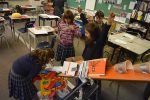
Teacher Lisa Altow’s Grade 5 students at Vancouver Hebrew Academy build a machine, using a variety of household treasures. (photo by Shula Klinger)

Vancouver Hebrew Academy has a new principal of general studies this year. As well, the school site is being upgraded, with new classrooms and a brand new playground on their way.

Rabbi Don Pacht, head of school, works with two under-principals, one for secular and one for Jewish learning. Rabbi Tzvi Goldman is principal of Judaic studies and the new principal of general studies, Adam Zalba, rounds out the team.

Zalba’s role is to ensure that the students’ work meets the requirements of British Columbia’s provincial curriculum. Pacht describes Zalba as “incredibly personable. He’s one of those people that are just meant to work with children – you can tell right away.”

Zalba told the Independent he has had a “busy and eventful couple of months” at VHA. This is the first Jewish school he has worked at, and he said he has been impressed by “the professionalism, dedication and work ethic” of the teachers, as well as the support of the parents. He finds the children to be a “bright, inquisitive and joyful student body, with a thirst for knowledge.” In taking an active interest in the students’ social and emotional development, he looks forward to helping them on their way to becoming “caring, respectful and thoughtful citizens.”

“Our vision for VHA is excellence in both Judaic and general studies,” said Pacht. “We want students to be ready for whatever they choose next. For some, it’s intensive Judaic studies; for others, it’s King David or Pacific Torah Institute.” For example, Grade 7 students Chaya Yeshayahu and Devorah Leah Yeshayahu are considering Vancouver’s Shalhevet Girls High School, but are also looking at some out-of-town options, as well.

Of the two strands to the curriculum, Pacht said, “We’ve taught them to read and decode the Chumash, but we’ve also taught them to be analytical learners, for Talmud, for social studies. We strive to give them the tools they need to grow and connect with the outside world, through independent study. At 12, they leave VHA with a really solid set of foundation skills.”

VHA has been at its current site for 15 years, during which time the only upgrade has been the addition of portable classrooms. The property is owned by the Vancouver School Board, said Pacht. “For the last four years, we’ve been on a year-to-year lease,” he said. Recent lobbying at the VSB and the ministry has resulted in a new, eight-year lease. “That’s a generation in the life of an elementary school, where kids coming into preschool now can graduate from this building.”

The portables will be replaced with new modular buildings that are set up with a fast, efficient internet network. Construction for the buildings will start off-site within the next few weeks and the structures will be brought onto the property after school ends in June.

The old wooden playground structure will be dismantled at the end of this month, to be replaced shortly afterward by new, wheelchair-accessible equipment.

To fund these improvements, the school has fundraising plans, including its annual garden party, held in the summer. Pacht describes the party – which is hosted at a private home – as “a very relaxing and enjoyable event.”

Speaking of the funds needed to complete the necessary upgrades, the rabbi said, “We want to use them for the best purpose, to create the best learning environment possible.”

Shula Klinger is an author and journalist living in North Vancouver. Find out more at shulaklinger.com.

Format ImagePosted on November 24, 2017November 23, 2017Author Shula KlingerCategories LocalTags Adam Zalba, Rabbi Don Pacht, school, Vancouver Hebrew Academy, VHA
Canadian Jewish history

Canadian Jewish history

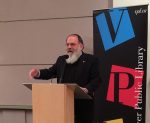
Rabbi Dr. Yosef Wosk was the keynote speaker at the Vancouver exhibit. (photo by Cynthia Ramsay)

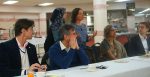
The Canadian Jewish Experience traveling exhibit opened at the central branch of Vancouver Public Library on Nov. 16. The display is presented by the Jewish Museum and Archives of British Columbia, the Centre for Israel and Jewish Affairs, Jewish Federation of Greater Vancouver and VPL.

The opening event was hosted by Michael Schwartz, JMABC director of community engagement. Kayla Epstein, VPL board chair, and Karen James, Jewish Federation board chair, said a few words, as did Tova Lynch, who led the committee that created the exhibit, which opened in April in Ottawa. The multi-panel display celebrates the history of Jews in Canada and was made for the occasion of the 150th anniversary of Confederation. The set that is on display at VPL has an additional panel dedicated to the B.C. Jewish community.

“To date, we have created 15 various sets [of the exhibit] that are traveling around the country,” said Lynch. To date, it has been to 35 places, and is scheduled for more, including a push to have it on university campuses. Among the major supporters of the exhibit, she said, are Fred Belzberg and Sam Belzberg. She thanked the Belzbergs, who couldn’t attend the event, as well as Rabbi Dr. Yosef Wosk, whose contributions, she said, made the event possible.

Wosk was also the keynote speaker. He spoke of the importance of books, of stories, of the relative youth of Canada as a nation and about the Jewish community’s participation in national life. He expressed gratitude for living in a country that is safe for Jews and other minorities, but also recalled that it wasn’t always so and that immigrants today still face problems.

The Hon. Dr. Hedy Fry, member of Parliament for Vancouver Centre, offered greetings from Prime Minister Justin Trudeau, as well as her own comments on the contributions of Jewish and other immigrants to Canadian society.

The Canadian Jewish Experience is on view at VPL until Nov. 30.

Format ImagePosted on November 24, 2017November 23, 2017Author Cynthia RamsayCategories LocalTags CIJA, Jewish Federation, Jewish history, JMABC, Vancouver Public Library, VPL
Seniors are a growing force

Seniors are a growing force

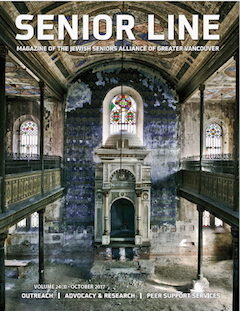
Jewish Seniors Alliance of Greater Vancouver publishes its own magazine, Senior Line, three times a year.

During the 20th century, thanks to advances in medicine, technology and quality of life, average life expectancy in the Western world increased by 30 years. Adults of the retiring age are now the fastest-growing segment of the population. The 2016 Canadian census showed more seniors (5.9 million) than school-age children (5.8 million). And the majority of these seniors are healthy and active, willing and able to share their knowledge and experience with the wider world.

Unfortunately, many people still apply the same negative stereotypes to older folks as we did decades ago: wrinkled, grumpy, fragile, forgetful, out of touch with reality, a burden and so on. Although “wrinkled” is mostly true, the rest is not, overall. We, society at large, need to change our views and policies towards the elderly, and how we treat the senior population.

“The most pressing issues seniors face are loneliness and isolation, retaining financial independence, staying involved and being physically active,” Ken Levitt, president of the Jewish Seniors Alliance of Greater Vancouver (JSA), told the Independent. He added to that list the lack of affordable or subsidized housing for seniors, inadequate nutrition, and the need to successfully manage personal health problems. He talked about protecting seniors from financial predators, including greedy relatives and unscrupulous investment counselors.

“This broad scope of issues affects all seniors, not just Jewish,” he said, “And the solutions should be all-encompassing, on the federal level. Poverty is a symptom of a greater problem, and we must address the cause. What we do now is just patchwork, temporary solutions.”

magazine cover - Senior LineJSA does what it can to ease seniors’ problems, given the limits of its budget. It has about 400 registered members and publishes its own magazine, Senior Line, three times a year. “The articles deal with issues and challenges relating to seniors,” Levitt explained. “These issues are not only discussed, but we make recommendations for their amelioration.”

The alliance also offers outreach programs, advocacy and research into the problems of seniors, and peer support services. “JSA advocates senior issues through a number of organizations, including the Council of Senior Citizens Organizations of B.C., the B.C. Health Coalition and the B.C. Poverty Reduction Coalition,” said Levitt.

About JSA’s peer support services, Levitt said, “We have 150 trained volunteers in the peer support services. Each one of them undergoes 55 hours of special training – 11 five-hour sessions. These volunteers offer friendly visits to seniors who are lonely. They answer phone calls. They can’t solve all the problems by themselves but they can help others to solve a variety of problems. They help those in need to reconnect with community. They provide bereavement support, when necessary. That they are seniors themselves adds credibility to their recommendations.”

Of course, there is always more to be done. “We have more demands for our services than we can meet,” said Levitt. “If we secured more funding, we could train more volunteers and expand the peer support services. We could hire more staff.”

He added, “We could, perhaps with a partner agency, create something similar to the Cumming Centre in Montreal. It is a dedicated community centre for seniors. Such a centre could offer comprehensive services, recreational and social programs, and rehabilitation after a stroke. It could offer a wide range of programs for persons with Parkinson’s, aphasia, arthritis, mental illness, etc. The aim would be restorative and maintenance or prevention.”

JSA is engaged in networking to start something similar in Vancouver. “We don’t have to start all these programs at once. We can start small and build up from there,” said Levitt. “Bits and pieces of such programs are already in place at different locations and organizations – we should concentrate them in one place. But, to establish such a centre in Greater Vancouver, there would need to be more cooperation amongst agencies, a willingness to share their services and resources.”

JSA’s funding comes from a variety of sources, from private donations and foundations, plus government grants. About 10% of its funding comes from the Jewish Federation of Greater Vancouver.

Shelley Rivkin, Federation’s vice-president of planning, allocations and community affairs, said that 14% of Federation’s allocations go to seniors. “We fund agencies, not individuals,” she said. “In 2016, all our partner agencies received an increase in their allocation as a result of an increase in the overall campaign. The increase to seniors was approximately two percent, which was consistent with the other increases…. Federation funding for seniors goes to the following agencies: Jewish Family Services Agency (JFSA), contribution toward their seniors department; JCC [Jewish Community Centre of Greater Vancouver], contribution toward the JCC seniors programs [and] we also cover the rent for the JCC L’Chaim program; Kehila [Society], contribution toward their seniors wellness program and the Richmond bus, which takes Richmond seniors to programs; and JSA, contribution toward their advocacy and peer counseling programs.”

Rivkin added, “We provide JFSA with funding for financial support to clients, including assistance with food vouchers and rents. A growing number of those clients are seniors.”

She explained that, while 14% of the funds “are specifically directed toward programs serving seniors, approximately 30% of our funding goes to social services. Seniors who are recipients of social services benefit through these programs also.”

And Federation is trying to help local seniors who face poverty. “According to the 2011 National Household Survey,” Rivkin said, “there are approximately 4,500 seniors in our community, and 16% of them have been identified as living below the low-income cut-off. The majority of them are older, unattached women. We are looking at issues of seniors and poverty through the Food Security Task Force and we intend to hold a forum on seniors in 2018 to gather community priorities.”

Olga Livshin is a Vancouver freelance writer. She can be reached at [email protected].

Format ImagePosted on November 24, 2017November 23, 2017Author Olga LivshinCategories LocalTags annual campaign, Jewish Federation, JFSA, JSA, Ken Levitt, seniors, Shelley Rivkin
Reuniting in Winnipeg

Reuniting in Winnipeg

Among those at the reunion were, left to right, Helen Pinsky (Vancouver), Barbara Moser (Montreal), Chana Thau (Winnipeg), Avrum Rosner (Montreal), Cecil Rosner (Winnipeg) and Zev Cohen (Israel). (photo from the reunion)

Anyone who went to a Jewish day school in Winnipeg in the 1950s and 1960s was invited to a reunion recently – and 220 former students attended.

The Oct. 6-9 reunion was organized by Avrum Rosner, who now lives in Montreal, Zev Cohen, who now lives in Israel, and Eileen Margulius Curtis and Bert Schaffer, who both still live in Winnipeg.

Rosner started posting high school photos on Facebook. A closed Facebook group followed and then Rosner created a page inviting people to share photos from Winnipeg Jewish schools.

“So, some genius – Zev Cohen – asked on the Facebook group, ‘How about a reunion?’ And he then started laying the groundwork,” said Rosner. “It went viral after that.”

Rosner and his wife, Marnie Frain, both attended the reunion.

“There were many different Jewish schools in Winnipeg in the 1950s and ’60s, of diverse languages, attitudes to religion, attitudes to Israel, left and right,” said Rosner. “And, what was a thriving community, with unique cultural and social institutions, that reached its numerical peak around 1960, has been drastically diminished by emigration ever since.”

The main venue of the October reunion was Holiday Inn West Airport, where some of the out-of-towners stayed. But, on the Sunday, Gray Academy of Jewish Education (GAJE) hosted the reunion. The academy is the entity into which nearly all the Jewish schools have amalgamated.

The first reunion event was a dinner on Friday evening that included speeches. There was a discussion on Saturday; a brunch and greetings by GAJE staff and students, as well as a bus tour and dance party, on Sunday. On Monday, there was a farewell brunch with live entertainment, performing Hebrew, Yiddish and klezmer songs and 1960s/70s rock ’n’ roll.

Participants included students, and a small number of former teachers, from Winnipeg’s Talmud Torah, Joseph Wolinsky Collegiate, I.L. Peretz School, Rosh Pina, Herzlia, Ramah, and Sholem Aleichem School.

“For me, the highlights are not hard to identify – renewing half-century-old friendships. For me, and for many, it restored my belief in magic,” said Rosner. “Personally, I think I gained the pure pleasure of reconnection with childhood friends. Also, the confirmation of the importance and ongoing vitality of the social, cultural and ethical values … and principles many of us absorbed – not solely through formal education, but by growing up in a unique-in-many-ways Jewish community in an isolated prairie city. It was what I expected and hoped for, though exponentially better.”

Vancouver reunion attendee Helen Pinsky said, “I watched the whole thing happen on Facebook. And, despite the fact that I’d heard very little from other people who I’d gone to school with, the reunion appealed to me a lot. I made arrangements to see all my cousins in Winnipeg, and booked the trip. I attended with my boyfriend, Yossi Amit, who, at that point, knew none of my Winnipeg relatives and had never been to that city.”

Pinsky and Amit stayed at the reunion’s “official” hotel and, though the schedule for the weekend had looked quite bare, that was a plus for them, as it allowed for personal visits. “In the end, most of my cousins attended the reunion, too,” said Pinsky. “Then, we made plans for spending our free time together. The programs were well-received and gave us all a structure from which to build other plans.”

Pinsky enjoyed many aspects of the weekend, including the talk about the history of Winnipeg Jewry, the music and food at Hops, the band Finjan and reminiscences at brunch. “There were lots of photos, laughter, warmth, memories sharing, good feelings and catching up,” she said.

Helen Nadel also attended the reunion. Nadel met Vancouverite Tevy Goodman in Winnipeg in 1975, and the couple were married at what was then Rosh Pina Synagogue.

“My childhood stories of growing up in North End of Winnipeg have always interested my children,” said Nadel. “I heard about the reunion when I was in Winnipeg in April for a reunion of my high school Grade 12 class [of 1952] who all turn 65 this year. I also knew I’d have a 40th-year medical school reunion this year [Sept. 15-17]. So, I decided that this was the year to make it a trifecta.”

When Nadel and her husband decided that he would accompany her, Nadel invited her daughter, Daniella, along, too.

“For me, it was fun to see the older girls who were my cousins’ age, as I was the tag-along with my cousins when I was at Peretz School,” said Nadel. “After pointing out that I was the little pisher who was with Carol and Sandi, recognition was achieved. Reminiscences were exchanged. It was remarkable that, by the end of the weekend, people no longer looked unfamiliar. I remembered them as they were some 50 years ago.

“My daughter loved seeing me with my grade school mates. She loved hearing the stories and began texting her posse about what fun this was, wondering what they might be doing when they are our age. She particularly loved seeing us reminisce when we stopped at the two schools, Peretz and Talmud Torah. I had goose bumps when a few of us spontaneously started singing the Peretz School anthem a cappella in front of the school, although only one in the group – Pam – really remembered all the words.”

Nadel was taken aback by how close Peretz School and Talmud Torah were to one another. She had remembered them as being very far apart – not only ideologically, but in distance.

“All in all,” she said, the reunion was “a chance to re-form and strengthen our bonds and ties to Winnipeg and the wonderful community we all grew up in.”

For Myron Calof, word of the reunion reached him about a year ago, when his wife, Ros-Lynn Sheps, called him at the office to say that she had just checked their voicemail and there was a message from Bert Schafer.

“Although I had not heard that name for over 50 years, I instantly put the name to a face and called Bert,” said Calof. “After confessing that, as a kid, I had routinely stolen crab apples off his parents’ crab apple tree, Bert told me a Winnipeg Jewish schools reunion was in the works and asked if I’d attend. I didn’t hesitate for a second to say that both my wife and I would be there.”

Calof anticipated that the reunion would be a positive experience, but, he said, “It was far better than that. First, although I don’t know when I’ll see them again, I feel reconnected with old friends. Second, the experience made me realize that my classmates and I played a vital role in continuing and strengthening Jewish education – not just in Winnipeg, but in the many North American, Canadian cities where we eventually settled. We carried with us the spirit, value and importance of a Jewish education which, in the raising of our children and through participation in community endeavours, we’ve helped perpetuate.”

Calof noted the similarities between his early Talmud Torah years – less than 10 years after the founding of the state of Israel and the end of the Holocaust – and the threat the world and world Jewry face today with the rise of nationalism, antisemitism, xenophobia and challenges to liberal democracy. “I hope history is not repeating itself, especially where Jews are concerned,” said Calof. “But, if it does, I hope and I truly think, we and the generations of Jewish students who have followed us will be better prepared to oppose and push back our enemies.”

The best part of the weekend for Calof was Monday morning, when so many former students from different years and schools had the opportunity to express their gratitude to teachers, parents and school founders for helping enrich the lives of thousands of students who attended a place of Jewish learning.

Anyone who attended Jewish school in Winnipeg in the 1950s and 1960s can still add their name to the organizers’ contact list by e-mailing [email protected] and can join the 800 others in the closed Facebook group facebook.com/groups/winnipegjewishschools.

Rebeca Kuropatwa is a Winnipeg freelance writer.

Format ImagePosted on November 24, 2017November 23, 2017Author Rebeca KuropatwaCategories NationalTags Helen Nadel, Helen Pinksy, Jewish school, memory, Winnipeg
Women lead way to peace

Women lead way to peace

Yael Deckelbaum is using her musical talents and connections to help Israelis and Palestinians press for peace. (photo from Yael Deckelbaum)

Yael Deckelbaum is using her musical talents and connections to help lead thousands of Israeli and Palestinian women to peacefully press for the end of the fighting between their two peoples via March for Hope.

Deckelbaum’s celebrity status in Israel and around the world – through performances with known local artists and bands such as Shlomo Artzi and Machinah, as well as her career with Habanot Nechama and solo albums – helps draw a crowd. Her involvement in the cause began when she joined forces with Daphni Leef, an Israeli activist for social justice.

“I’d sit with her and tell her she’s a better person than I am,” said Deckelbaum. “She was always talking about how we have to change things in Israel – going around in many places in Israel, meeting people, listening to them and trying to learn … what’s wrong and trying to fix things. I decided to take a caravan, go through Israel, sell CDs, maybe bring a sound system, perform … see people from a different angle. Daphni decided to join me. From this idea, it became 20 people, two caravans … a journey we did for 45 days in 40 different places across Israel.”

They met many Israelis from various cities and villages, and Deckelbaum gained a new perspective. Everywhere they went, she would sing and Leef would speak to the people after every show.

“That’s when I decided I would dedicate myself, using music as an instrument, toward change … not just be an instrument for supporting my existence … but to spread a message and how I believe this world should be. [It] was a big turning point in my path,” Deckelbaum told the Independent.

A year later, one of Deckelbaum’s friends shared an email about Women Wage Peace.

“A lot of times, us musicians, we get invited, we go, sing and leave,” said Deckelbaum. “We feel good about it. But, this time, I felt like I had to meet them. A few days later, I was sitting at a table with women from Women Wage Peace. They told me about this march they were planning – a group of mothers who, in the period of military operation, were experiencing terror at home, fear … mothers sitting at home, knowing their sons are somewhere and not knowing if they’d come home from war.

“One of the founders told me she said to herself that she would never forget this feeling of terror, that she can’t sit anymore and do nothing about it. She urged us to do something radical, extreme, because something had to change. She couldn’t live with the feeling of helplessness anymore.”

At one point, Women Wage Peace fasted for 50 days outside the prime minister’s house, demanding a mutual agreement between Israel and Palestine be made.

“They told me they were already connected with Palestinian women who feel the same,” said Deckelbaum. “And then, on Oct. 19, 2016, 1,000 Palestinian women marched with us together in the Dead Sea [area] – the lowest place of the earth. I started to cry, as it touched me in a deep place.

“Many years ago, I had this vision of women marching together … not something I can explain…. Then, I met these women [who] told me about this, and it was coming true. And, it has an energetic meaning that it happened in the lowest place on the earth – women marching to the belly of the earth. So, I cried and offered to give my music to the cause.”

Deckelbaum invited more artists to join and sing, and became the march’s artistic director. She began with songs like “Give Peace a Chance” and “Hallelujah,” and then wrote originals herself. “The melody and the lyrics just came,” she said. “And the ‘Prayer of the Mothers’ was born, directed by Astar Elkayam.”

Deckelbaum was inspired by a message that had been sent to march organizers by Leymah Gbowee. Gbowee is a Liberian woman who led a women’s peace movement, which helped bring an end to the Second Liberian Civil War in 2003, after 13 years of fighting.

“I felt something very real is happening, that I have a chance to do this,” said Deckelbaum. “I put it into the song clip, so you can hear her speaking. And she sang, ‘As the world we live in, peace is possible / Only when women of integrity and faith stand up for the future of their children.’”

This year, Women Wage Peace planned a second march, dubbed, “The Journey to Peace,” which started in the south of Israel near the Gaza border on Sept. 24 and ended in Jerusalem. Other events have followed, and will continue, throughout Israel. The peak of it was on Oct. 6 in Jaffa/Tel Aviv, with a march that Deckelbaum helped organize, “colourful with dancers, musicians, and drummers – happy and hopeful,” she said.

On Oct. 8, there was an event in the desert with Palestinian women. The previous year, 1,000 Palestinian women came. This year, there was twice that number, and the hope is that, each year, it will grow.

“These are the miracles we’re all waiting for – peace between Israel and Palestine, and between and within ourselves and amongst us as people,” said Deckelbaum. “Women Wage Peace isn’t only about making peace with Palestinian women. It’s about making peace between all kinds of women in our society and different places.”

Deckelbaum learned there is a global women’s revolution. She heard of a march in Washington, D.C., in which she participated, and another in Zurich, at which she was invited to sing.

After the video of “Prayer of the Mothers” was released, more marchers all over the world were set into motion. Deckelbaum is now working on a project called Women of the World Unite.

“I believe that women from all over the world are sharing this message, a hope for peace – a message that’s inclusive of all human beings,” she said. “We need women to be more involved in managing the ways of the world – not only by raising children, but also by engaging in the system and how things will work.”

The Jewish Independent spoke over the phone with Deckelbaum when she was in Switzerland doing concerts with an ensemble of religious and secular Jewish, Muslim and Christian women called Prayer of the Mothers Ensemble. It involves 14 women, carrying the message of female empowerment, revolution, evolution and peace.

Rebeca Kuropatwa is a Winnipeg freelance writer.

Format ImagePosted on November 24, 2017November 23, 2017Author Rebeca KuropatwaCategories WorldTags Israel, Israeli-Palestinian conflict, peace, women, Yael Deckelbaum

Posts pagination

Previous page Page 1 … Page 199 Page 200 Page 201 … Page 322 Next page
Proudly powered by WordPress