Skip to content
  • Home
  • Subscribe / donate
  • Events calendar
  • News
    • Local
    • National
    • Israel
    • World
    • עניין בחדשות
      A roundup of news in Canada and further afield, in Hebrew.
  • Opinion
    • From the JI
    • Op-Ed
  • Arts & Culture
    • Performing Arts
    • Music
    • Books
    • Visual Arts
    • TV & Film
  • Life
    • Celebrating the Holidays
    • Travel
    • The Daily Snooze
      Cartoons by Jacob Samuel
    • Mystery Photo
      Help the JI and JMABC fill in the gaps in our archives.
  • Community Links
    • Organizations, Etc.
    • Other News Sources & Blogs
    • Business Directory
  • FAQ
  • JI Chai Celebration
  • JI@88! video

Recent Posts

  • Story of Israel’s north
  • Sheltering in train stations
  • Teach critical thinking
  • Learning to bridge divides
  • Supporting Iranian community
  • Art dismantles systems
  • Beth Tikvah celebrates 50th
  • What is Jewish music?
  • Celebrate joy of music
  • Women share experiences 
  • Raising funds for Survivors
  • Call for digital literacy
  • The hidden hand of hate
  • Tarot as spiritual ritual
  • Students create fancy meal
  • Encouraging young voices
  • Rose’s Angels delivers
  • Living life to its fullest
  • Drawing on his roots
  • Panama City welcoming
  • Pesach cleaning
  • On the wings of griffon vultures
  • Vast recipe & story collection
  • A word, please …
  • מארק קרני לא ממתין לטראמפ
  • On war and antisemitism
  • Jews shine in Canucks colours
  • Moment of opportunity
  • Shooting response
  • BC budget fails seniors
  • Ritual is what makes life holy
  • Dogs help war veterans live again
  • Remain vital and outspoken
  • An urgent play to see
  • Pop-up exhibit popular
  • An invite to join JWest

Archives

Follow @JewishIndie
image - The CJN - Visit Us Banner - 300x600 - 101625

Category: News

כל הזמן ביחד

כל הזמן ביחד

זה לא ברווז עיתונאי אלה סיפור אמיתי: חברות יוצאת דופן בן כלב לברוזה משגעת עיירה שלמה. (צילום: Thorsby Pet Necessities Facebook)

הרומן הלוהט והמדובר ביותר בעיירה קטנה בשם ת’ורסבי שמחוז אלברטה, (במרחק כארבעים קילומטר מהעיר לדוק), שגרים בה בסך הכל כאלף איש, הוא בן כלב לברווז. מי שלא רואה את השניים לא מאמין. ומי שרואה אותם אחד עם השני לא מאמין למראה עיניו.

הכלב בן עשר מסוג רוטווילר בשם ברוס והברווזה האפורה בת השנתיים בשם קשיו הכירו לפני כשנתיים, ולאט לאט התהדק הקשר ביניהם וכיום הם בני זוג של ממש. הם כל הזמן ביחד. הבעלים של הזוג המוזר היא אנדרה נובקובסקי, שיש לה חנות לצרכי חיות מחמד בעיירה. היא מחזיקה בברוס כבר שנים והוא הפך לאורח קבוע בחנות שלה, כך שכל תושבי ת’ורסבי מכירים אותו היטב. בגלל הביקורים הקבועים של הכלב בחנות של בעליו, למד ברוס להכיר מקרוב חיות אחרות והוא מגלה כלפיהן יחס של חיבה וכבוד.

לפני כשנתיים נובקובסקי ביקשה בצחוק מחברים לקנות לה ברווז ליום ההולדת. אחד מהחברים לקח את האתגר ברצינות והביא לה ברווזה גוזל. להפתעת הכל הברווזה הקטנה רצה מיד לכלב הגדול שקיבל אותה כבת זוג חברה לכל דבר ועניין, למרות שיכל גם לאכול אותה בקלי בקלות. נובקובסקי אומרת כי קשיו נחמדה אליה אך אהבתה הגדולה והחידה היא ברוס. היא מוסיפה: “לפעמים אני קצת נפגעת ומקנאת בברוס, כיוון שקשיו יכולה לצרוח עלי ולאחר מכן ללכת למייד לברוס ולהתכרבל עימו”. כאמור ברוס וקשיו כל הזמן לא עוזבים אחד מן השני. השניים משחקים ביחד, נכנסים יחד למיכל מים, אוכלים ביחד, ישנים ביחד ועוד ועוד. מוזר ומדהים.

נובקובסקי מציינת שכל מה שברוס אוכל מעניין את קשיו וגם היא רוצה לאכול את זה, אפילו אם זה לא בשבילה. היא תיגש אז לברוס ותנסה לקחת את האוכל ממנו ללא פחד ומורא. אם קשיו תרגיש בסכנה אורבת היא תרוץ מייד לברוס ותתכנס מתחתיו בן רגליו, עד שתרגיש בטוחה. הוא שומר עליה מכל משמר. נובקובסקי מסבירה כי למרות הניגודים באישיות של השניים וההבדל בגודל שלהם, הקשר ביניהם רק הולך ומתחזק. היא מוסיפה עוד כי בגלל הקשר ההדוק והיום יומי עם הרוטווילר, לקשיו אין מוסג שהיא ברווז. “אני הצגתי אותה בפני ברווזים אחרים אך הם לא הזיזו לה והיא לא התייחסה אליהם, ואף לא רצתה עימם שום קשר. למרבית האירוניה קשיו מרגישה הרבה יותר נוח בחברת כלבים ומאשר עם ברווזים”.

לשתי החיות יש אופי שונה בתחליט: ברוס הוא רגוע ושלו והרבה יותר נוח. קשיו היא מאוד קולנית וצעקנית והיא תודיע לנובקובסקי מייד מתי היא כועסת או רוצה משהו. אז ללא פחד ובושה היא תמשוך במכנסיים שלה.

הזוג המוזר שהפכו לכוכבי תקשורת סלבריטאים של ממש מושכים מבקרים לא מעטים אל העיירה. אחרי שהם מתפלאים ממה שעינן רואות השאלה הראשונה, שמופנית תמיד לנובקובסקי היא: “האם ברוס לא מנסה לאכול את קשיו? “לא. בכלל לא אני משיבה”. לדבריה אורחים חדשים בעיירה שמבקרים בחנות, כשהם מבחינים בזוג כלב-ברווז, הם יוצאים החוצה וקוראים לשאר בני המשפחה להיכנס מייד פנימה ולראות את המחזה היוצא דופן הזה, ואומרים: “אנו פשוט אוהבים את מה שאנו רואים”.

אחד מהעובדים בחנות של נובקובסקי ג’ייסון דלבו מציין לסיום כי: “אם להיות כן, אין ספק שבעצם הבוס בין השניים היא קשיו. ברוס לא הראה מעולם תוקפנות אליה”.

Format ImagePosted on November 22, 2017Author Roni RachmaniCategories עניין בחדשותTags Alberta, dog, duck, Thorsby, אלברטה, ברווז, כלב, ת'ורסבי
NCJW Canada is honoured

NCJW Canada is honoured

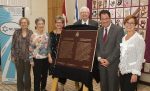
At the Oct. 23 ceremony for the unveiling of a plaque honouring National Council of Jewish Women of Canada’s 120 years of service are, from the left, Sharon Allentuck, Gloria Roden, Debbie Wasserman, Dr. Richard Alway, Councilor James Pasternak and Eva Karpati. (photo from NCJWC)

On Oct. 23, National Council of Jewish Women national president Debbie Wasserman accepted a plaque honouring the work of NCJW. It was from Parks Canada and the Historic Sites and Monuments Board of Canada and it was unveiled at the Toronto offices of NCJW Canada. The recognition came on the council’s 120th anniversary.

“NCJWC in Vancouver has an enviable track record of working with disadvantaged elementary schools, funding programs of nutrition, hygiene, cooking, farm visits and street safety,” NCJWC Vancouver’s Debby Altow told the Independent. “We have received heart-stopping letters of thanks from the kids and their teachers; they inspire us to do even more in our fight to alleviate poverty…. Our Operation Dressup delivers thousands of items of good clothing, plus shopping certificates for teens every year, and our Books for Kids program reaches into daycares, preschools, doctors’ offices and other sites…. We hope to expand these programs into other nearby communities.”

Altow said, “Vancouver section president Catherine Stoller is following in the footsteps of her mom, Sheilah, serving as president of the section for the past three years. Our section has been an integral part of the community for over 90 years, and the Heritage designation, while it rests in Toronto, really applies to every province where council has been active.”

Of the Oct. 23 event, Wasserman said, “The ceremony was very moving. We began by proceeding into the auditorium…. The Canadian flag was dominantly displayed and the plaque was draped. We all sang O Canada. The master of ceremonies then introduced all the dignitaries and all spoke about the importance of NCJWC over its 120-year history. The ceremony’s highlight was when we all came off the stage to unveil the plaque displayed on an easel.”

Wasserman and NCJWC Toronto president Eva Karpati unveiled the plaque. Ena Cord, immediate past president of the Toronto section, read the inscription in English and Dahlia Rusinek, a past Toronto section president, read it in French. There were many photos taken, and a reception followed.

“Parks Canada contacted us earlier this year to tell us that NCJWC was to be recognized as an organization of national significance to Canada, seeing that we were the first Jewish women’s organization in Canada,” explained Wasserman. “The plaque will be permanently installed at 44 St. George St. in Toronto, the former head office of NCJWC.”

Dignitaries at the ceremony included Eric Nielsen of Parks Canada (master of ceremonies), Dr. Richard Alway of the Historic Sites and Monuments Board of Canada, Toronto City Councilor James Pasternak (York Centre), NCJWC Toronto member and historian Gloria Roden, and Sharon Allentuck, NCJWC immediate past president and Winnipeg section member.

“As a passionate advocate for social justice and equality since 1897, the National Council of Jewish Women of Canada has forged an enduring legacy of community service across Canada,” Nielsen noted in his remarks. “It’s incredible to think that the council was founded right here in Toronto and has been growing steadily for over a century.

“The birth of the council came at a truly interesting time in Canadian history,” he continued. “During the late 19th century, urbanization, industrialization and immigration were causing social disruption in many cities across Canada. It was at this time that a pioneering group of Jewish women united to effect social change. Led by Meldola de Sola, wife of a distinguished Montreal rabbi, women of the Holy Blossom Synagogue in Toronto began meeting in private homes to study Genesis and the teachings of Judaism in preparation for beginning philanthropic activities in their communities.

“At the time of its founding in Toronto, the National Council of Jewish Women of Canada focused on supporting young girls and new immigrants. They provided shelter, training, and other forms of assistance, all while strengthening the Jewish community.”

Nielsen said that, through NCJW, Jewish women across the country “gained a voice in Canadian society and the women’s movement.”

The oldest Jewish women’s organization in Canada, NCJWC has evolved, said Nielsen, “to meet the changing needs of the most vulnerable in society.” And it “continues to work tirelessly to promote social justice, freedom, equality and tolerance at home. Equally concerned with the well-being of people outside of Canada, the council’s members have also collaborated with aid organizations, such as the Red Cross, to contribute to humanitarian efforts abroad.

“Thanks to their efforts, we are creating a rich mosaic portraying the greatest moments of our nation’s history. Future generations will better understand their history through this mosaic and, hopefully, better understand themselves and the values of our country.”

Nielsen congratulated NCJWC. “The council’s invaluable legacy,” he said, “is a source of inspiration for all who work to promote meaningful social change, at home and abroad.”

Noting that NCJWC “began in 1897 with 20 women studying and learning Bible,” Roden said the council “realized there was an urgent need to help immigrants arriving daily in Toronto. And so, by 1909, a place was needed for the growing group to expand their activities. Two rooms on Walton Street in the Ward were rented, but, by 1913, there was a move to new larger headquarters on McCaul Street.

“With the outbreak of the First World War,” she said, “young council members took an active part and McCaul Street was transformed into a Red Cross centre, providing hospital supplies and other necessities for wartime aid. In 1918, with the Spanish flu epidemic, council volunteers carried meals to 800 flu victims from our kosher kitchen and provided home nursing care.

“In 1919, council women became big sisters to children and working girls, and bought Fairview Cottage at Whitby Beach to provide these girls with an oasis for much-needed fresh air and sunshine. By 1937, council continued their involvement with the Jewish Camp Council to included Camp Camperdown near Orillia.”

The offices on St. George were “purchased with a modest down payment,” said Roden. “It was called Community House, with the Jewish community using the much-needed premises for a variety of activities. It operated classes, including cooking, sewing, journalism, language, dance and art. Sports teams were formed … [to help newcomers to Canada], a daycare centre, English classes, and even a legal storefront service was established. A club for handicapped girls was formed to teach sewing and social skills, and there were interpreters to translate for the newly arrived.

“The NCJW has continued with our motto of ‘Faith and Humanity,’ and the voluntary participation as our civic responsibility as citizens of our great country. We continue to study, educate ourselves and participate with pride.”

Rebeca Kuropatwa is a Winnipeg freelance writer.

Format ImagePosted on November 17, 2017November 15, 2017Author Rebeca KuropatwaCategories NationalTags National Council of Jewish Women of Canada, NCJW, tikkun olam, women
More racist activities

More racist activities

(photo from Anti-Racist Action UVic/Facebook)

On Nov. 9, the anniversary of Kristallnacht, a swastika and “Heil Hitler” were found written on a hallway blackboard in the University of British Columbia Forest Sciences Centre. The antisemitic graffiti was first reported to Hillel BC, who then contacted security.

This was one of several racist incidents that have occurred on B.C. campuses and across Canada in recent months, including pro-Nazi posters found at UBC on Remembrance Day. On Halloween night and in the days following, posters reading, “It’s okay to be white,” appeared on several Canadian university campuses, apparently based on instructions from a post which Vice Canada traced to the anonymous online forum 4Chan, a hub for the alt-right.

During the same week, antisemitic posters found at the University of Victoria read, “Those who hate us will not replace us. Defend Canadian heritage. Fight back against anti-white hatred. A message from the alt-right.” The word “those” was placed in triple parenthesis, a way of identifying Jews. When the posters were taken down, moderators of Anti-racist Action UVic Facebook page and others reportedly received a backlash of hateful messages online.

The election of Donald Trump one year ago this month is widely perceived as a triumph for the tangle of white supremacists, antisemites, misogynists, racists and ethno-nationalists who have come to be called the “alt-right.” In Kill All Normies, a book about the genesis of the group, journalist Angela Nagle describes an online world where cynicism, irony and absurd in-joke humour have combined with racism and misogyny to produce a “taboo-breaking anti-PC style” that has come to characterize the alt-right. Since then, the movement has tapped into latent racism and xenophobia, bolstered by the rise of people like Richard Spencer and Milo Yiannopoulos.

Not everyone is happy with the use of the term “alt-right.” Given their white supremacist beliefs, “alt-right” is somewhat innocuous. The Associated Press avoids the term because its editors think it downplays the movement’s racist goals.

Long before the 2016 election, the alt-right was gathering strength and allies. Trump granted the racists among his supporters visibility, lowering the social costs of bigotry and inspiring these supporters with a hope that their vision of “white identitarianism” could come to rule America once again. This has emboldened them and brought them out of the shadows.

In the days following the election of Trump, Canada saw a spate of vandalism, hate speech and pamphleteering directed against Jews and other minorities. As in the United States, this did not come to Canada overnight. In 2015, the CBC temporarily closed all online comments on stories featuring First Nations people because of the “staggering number of hateful and vitriolic comments” posted. In August 2016, the premier of Saskatchewan was forced to issue a plea for an end to hate speech following the second-degree murder of an aboriginal man on a farm. As a result, his own Facebook page was flooded with racist messages.

The posters at UVic were discovered by an anti-racist group on campus organized by Tyson Strandlund, who said the increasing activities of the alt-right in the public sphere are what led to his group’s creation in September. Strandlund said there has been heightened concern on campus since last summer, when an art installation meant to inspire conversations about resistance to racism was instead extensively defaced with racist slurs and had to be dismantled. He mentioned a meeting that was to take place in the Student Union Building on Nov. 15, for students and others to discuss anti-racist strategies.

David Blades, president of the Jewish Federation of Victoria and Vancouver Island, said they are “keeping close tabs” on the alt-right movement. “We have a good sense of who these people are,” he told the Independent. “What’s increasing is their public activity, not their numbers, which have remained pretty stable for years.

“Nevertheless,” he warned, “we have to be vigilant because they are also recruiting. There is no question that there is latent racism in Canadian society and it can be tapped into. My concern is that this was not isolated to the University of Victoria, this also happened at the University of Alberta and elsewhere. It was a coordinated national event. That’s my concern as Federation president. This is a shift in the overall organization of this group.”

Blades said he is “really happy with the response of UVic” and that there are plans in the works for “five days of activism against racism.”

“In some ways,” he said, “these incidents have been more effective at inspiring the opposite of what they intended: an increase in anti-racist activism.”

Matthew Gindin is a freelance journalist, writer and lecturer. He writes regularly for the Forward and All That Is Interesting, and has been published in Religion Dispatches, Situate Magazine, Tikkun and elsewhere. He can be found on Medium and Twitter.

Format ImagePosted on November 17, 2017November 15, 2017Author Matthew GindinCategories LocalTags anti-racism, British Columbia, David Blades, Federation, racism, Trump, Tyson Strandlund, UBC, UVic
Improving our inclusivity

Improving our inclusivity

Rabbi Becky Silverstein, left, and Joanna Ware facilitated the Keshet program held in Vancouver last month. (photos from northeastern.edu and Jordyn Rozensky Photography, respectively)

Last month, a group of Greater Vancouver Jewish organizations sponsored a Keshet program for members of the community. Keshet provides training and support for Jewish clergy, educators, youth workers, counselors, allies and lay leaders to ensure that LGBTQ+ Jews are affirmed, celebrated and included in all Jewish educational and community settings.

The Oct. 22-23 weekend of training had its genesis in the efforts of Shelley Rivkin of the Jewish Federation of Greater Vancouver and Kevin Keystone, a former board member of Temple Sholom Synagogue, who has since moved to Toronto.

After the Union for Reform Judaism passed a resolution affirming the rights of LGBTQ+ people at their biennial meeting in 2015, Keystone brought a motion to the synagogue board to pass a supporting resolution, and recommended bringing Keshet to Vancouver.

“One of the most important reasons to bring in Keshet,” said Temple Sholom Rabbi Carey Brown, “was to present this important inclusion work within the framework of Jewish values and to address specific challenges within Jewish language and culture.”

When Keystone approached Federation, he found a sympathetic ear in Rivkin, who had previously attended a Keshet program. After being approached by the Vancouver Police Department about declaring the Jewish Community Centre of Greater Vancouver an LGBTQ+ safe space, Rivkin had become interested in supporting just such an initiative as Keshet, which she felt was long overdue.

Temple Sholom and Federation met with representatives of the JCCGV, Beth Israel, Or Shalom, Beth Tikvah, Har El, the Jewish Family Service Agency, Yad b’Yad, Hillel BC, and the Centre for Israel and Jewish Affairs. An agreement was reached to sponsor a training weekend, with Federation committing to contributing a significant amount of the funding.

“One of the most heartwarming things was to see how many synagogues and institutions said, ‘We want to be there, we want to help sponsor it,’” said Brown.

The two-day program was facilitated by Keshet’s Rabbi Becky Silverstein and Joanna Ware. It featured five sessions, including Beyond the (Cis)Gender Binary, which focused on youth workers and others interested in supporting youth in a variety of settings; and (Not So) Straight Talk about LGBT Inclusion, which was for Jewish communal professionals looking to explore LGBTQ+ inclusion from a Jewish perspective, and how it applies to their work. On the last day, there was a lunch and learn with Keshet at Hillel House on the University of British Columbia campus, which was open to students, faculty and community members, and two evening sessions. The Tachlis of Inclusion was billed as a more advanced look at LGBTQ+ inclusion, focusing on how board members can make their institutions more inclusive and embracing of LGBTQ+ families and individuals – participants took home an institutional self-assessment resource for further conversation within their organization. The other session, held at Suite Genius Mt. Pleasant and open to LGBTQ+ members of all ages and allies, was titled Intersections: Sharing Stories at the Intersections of Queer Jewish identities.

The community’s response to the training was favourable, with a post-event survey garnering positive responses and many people expressing gratitude for the training, said Rivkin. “Moving forward,” she said, “one thing we want to do is figure out where organizations are on a continuum towards inclusivity, and we need to look at that inventory and see where we want to be and what are some steps we can take.”

Alicia Fridkin, who self-identifies as a Jewish, queer, white settler activist and works as LGBTQ+ counsel for CIJA, had positive things to say about the event. “It was important to make some space for queer and trans Jews in Vancouver to come together around their identities, and to see that communities are committing to having a space for them,” said Fridkin. “It was a good reminder that we all have work to do, and also that we all have come a distance. It is important to give the LGBQT+ community more visibility. Also, the different Jewish communities in Vancouver tend to operate in silos. This was a good example of people coming together.”

Participants in the program are hoping to carry what they have learned into their institutional and personal lives. A group for queer and trans youth is in the planning stages at the JCCGV. Brown said Temple Sholom has begun a review of its infrastructure and communal language, and noted how the synagogue has already made some changes, such as calling people up to the Torah for aliyot according to their preferred pronouns.

Fridkin celebrates those kinds of initiatives. “People are very interested in being in a religious place that is inclusive,” she said. She hopes that these communal discussions about LGBQT+ people can be a model for becoming more inclusive and progressive on other issues, such as interfaith marriage and Israel/Palestine.

“We need to be open,” said Fridkin, “to the experience of the hurt that people in the community have who have been excluded for any reason, and work to address that.”

Matthew Gindin is a freelance journalist, writer and lecturer. He writes regularly for the Forward and All That Is Interesting, and has been published in Religion Dispatches, Situate Magazine, Tikkun and elsewhere. He can be found on Medium and Twitter.

Format ImagePosted on November 17, 2017November 15, 2017Author Matthew GindinCategories LocalTags Alicia Fridkin, inclusion, Jewish Federation, Keshet, LGBTQ, Shelley Rivkin, tikkun olam
In the beginning …

In the beginning …

Students in Kitah Aleph at the White Rock / South Surrey Jewish Community Centre with their Bereishit (Genesis) craft that they completed after studying the parashah at the centre’s religious school. (photo from WRSS JCC)

Format ImagePosted on November 17, 2017November 15, 2017Author WRSS JCCCategories LocalTags art, Judaism, Torah
Two states viable

Two states viable

Gershon Shafir was in Vancouver Nov. 9 to discuss some of the issues he raises in his latest book, A Half Century of Occupation. (photo from pages.ucsd.edu/~gshafir)

What does it mean to have a “permanently temporary occupation” in Israel? Gershon Shafir was in Vancouver Nov. 9 to discuss this question. A guest speaker at Simon Fraser University’s School for International Studies, Shafir is an Israeli expat, University of California, Los Angeles, sociology professor and author of the recently released book A Half Century of Occupation: Israel, Palestine and the World’s Most Intractable Conflict.

It’s the 10th book for Shafir and he wrote it specifically for the 50th anniversary of the 1967 war. The permanently temporary occupation is a difficult subject to discuss, he said.

“That’s because the existence of this phenomenon – that Israel is an occupying power – is denied. But what’s going on is an occupation and is considered to be so by the Israeli government itself when arguing in front of the country’s Supreme Court, the international community and the Palestinians that live under it.”

Shafir said the word occupation is a legal term referring to the effective control of a country on a territory over which it has no sovereignty.

“Israel’s occupation is one of the longest belligerent occupations since World War Two and it’s truly exceptional because it’s going into its third generation,” he told the Independent. “In my book, I look at the nature of the occupation, the role played by the Israeli state through settlement, and radicalization by religious settlers. I also study the feasibility of alternative solutions.”

Prior to 1948, Jewish settlement occurred in areas that were least densely populated by Palestinians, allowing the possibility of a separation between the two groups. “But religiously motivated settlers prefer to have their new settlements in the heartland of the most densely populated Palestinian areas, so the settlement process has been radicalized,” said Shafir.

In his lecture, and in more detail in his book, Shafir discussed the extent to which the occupation has transformed the Israeli-Palestinian conflict. As part of his book, he conducted a study that found the built-up area occupied by Israeli settlements is two percent of the West Bank and the demographic ratio of Israeli Jews to Palestinians is 1:7. He questions the widespread consensus that a territorial partition of Palestine and a two-state solution is no longer possible.

“I’ve carefully counted the number of settlers and the places where they reside, and I’ve subdivided settlement into different categories. What you discover is that if you remove 27,000 settlers in the West Bank, a land exchange is possible, as is a territorial partition and a Palestinian state,” he said. “People who say a two-state solution is impossible don’t sufficiently study the feasibility of a one-state solution.”

Shafir added that he’s not advocating a political position in his findings. On the contrary, he’s just suggesting that, based on his research, a two-state solution is still feasible. “Let’s not give up on that idea too soon, because we don’t know what we’ll be walking into,” he advised.

The lecture at SFU was part of a book tour in which Shafir spoke on university campuses in Boston, Seattle, New York and Los Angeles. Shafir comes to this topic with years of pedigree. He was president of the Association for Israel Studies in 2001-2003, and the books he’s authored include Land, Labor and the Origins of the Israeli-Palestinian Conflict, 1882-1914, Being Israeli: The Dynamics of Multiple Citizenship (co-authored with Yoav Peled), which won the Middle Eastern Studies Association’s Albert Hourani Award in 2002, and Struggle and Survival in Palestine/Israel, a collection of life histories, which he co-edited with Mark LeVine.

Lauren Kramer, an award-winning writer and editor, lives in Richmond. To read her work online, visit laurenkramer.net.

Format ImagePosted on November 17, 2017November 15, 2017Author Lauren KramerCategories IsraelTags Gershon Shafir, Israeli-Palestinian conflict, occupation, peace, two-state solution
Giro d’Italia’s “Big Start” in Israel

Giro d’Italia’s “Big Start” in Israel

Sylvan Adams, 58, is funding the construction of the Middle East’s first Olympic velodrome, slated to open in Tel Aviv in May 2018. (photo from margolin-bros.com/en/project/Velodrom)

In Europe, the Giro d’Italia bicycle race ranks in status with baseball’s World Series or hockey’s Stanley Cup. Since the beloved Italian sports extravaganza’s initial race in 1909, the multi-stage race has never started outside Europe – until now. Next May, the annual event’s starting flag will be waved in the Holy City, thanks in big part to Sylvan Adams – the Montreal billionaire now living in Tel Aviv who himself is a competitive bicycle racer.

Adams, 58, is funding the construction of the Middle East’s first Olympic velodrome, slated to open in Tel Aviv in May 2018, in time for the Israel-based initial part of the 23-day Giro d’Italia. The Israeli team is all but guaranteed to receive one of four wildcard invitations for the race.

The bike-racing stadium, called simply the Velodrome, is part of the National Sports Centre being built by the Tel Aviv Foundation, by Mazor-First Architects. Located on Bechor Shitrit Street in the Hadar Yosef neighbourhood, the complex will gentrify a once-impoverished area. Budgeted at $11 million, the 7,100-square-metre biking facility will be jointly owned by the Olympic Committee of Israel and the Tel Aviv Municipality.

Adams, who made aliyah in December 2015, is honorary president of the organizing committee of the race’s “Big Start” in Jerusalem.

The three-week Giro is widely considered the most beautiful of cycling’s three Grand Tours, ahead of the sporting leviathan of the Tour de France and Spain’s lower-key Vuelta a España. Ministers from Israel and Italy met at Jerusalem’s Waldorf Astoria Hotel in September to sign an agreement that the opening three stages of next year’s Giro will be held in Israel.

Like the other Grand Tours, the modern editions of the Giro d’Italia normally consist of 21 daylong segments (stages) over a 23-day period that includes two rest days. All of the stages are timed to the finish, each stage’s time added to the previous. The rider with the lowest total time is the leader of the race and gets to don the coveted pink jersey, called maglia rosa, worn by the leader of the general classification.

Adams, who has until recently been publicity shy, today lives in a penthouse overlooking the Mediterranean and Tel Aviv’s sea-side bicycle path. A two-time world outdoor cycling champion in his age category, his most recent title was won at the World Masters Championship, held in Manchester, England, in November 2015. Adams, who began cycling competitively more than two decades ago, is a six-time Canadian and 15-time Quebec champion. He won four gold medals at two Pan-American meets, and a total of five golds at the 2009 and 2013 Maccabiah Games.

His dream is to turn Tel Aviv into “the Amsterdam of the Middle East,” i.e. a city as bike-friendly as the Dutch capital. He believes something similar can be done in Tel Aviv, where traffic congestion and a parking shortage are reaching a crisis, as more and more motorists come in from “satellite” cities.

“Petach Tikva, for example, is eight kilometres from the heart of Tel Aviv. That can take an hour to drive some mornings. By cycling, it is 20 to 30 minutes,” he said.

Adams first visited Israel nearly four decades ago. He and his wife of 33 years, Margaret, a native of London, England, met while volunteering on a kibbutz.

Now retired, Adams has given up his involvement with the family business, Iberville Developments Ltd., the real estate giant founded after the Second World War by his father, Marcel Adams, a Romanian-born Holocaust survivor. The younger Adams was its chief executive officer and his son Josh, one of his four children, is now running the company, one of the largest owners of commercial properties in Quebec.

Gil Zohar is a journalist based in Jerusalem.

Format ImagePosted on November 17, 2017November 15, 2017Author Gil ZoharCategories WorldTags cycling, Giro d’Italia, Israel, Italy, Sylvan Adams
ביקור חגיגי

ביקור חגיגי

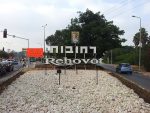
נציגי קהילת יהודי טורונטו ביקרו בשכונת אבן גבירול בעיר רחובות שאותה הם מאמצים. (צילום: Little Savage)

ראשי קהילת יהודי טורונטו קיימו בשבוע שעבר ביקור חגיגי בשכונת אבן גבירול בעיר רחובות שבמרכז הארץ (במישור החוף הדרומי), אותה הם מאמצים כבר שנים רבות. ביקור קודם של ראשי הקהילה היהודית באבן גבירול התקיים לפני שתיים עשרה שנים.

האימוץ כולל תרומות נרחבות לתמיכה בתושבי לאבן גבירול (ובשמה הקודם כבר גבירול) מכל הגילאים. הוא כולל: הקמת בית הספר בשכונה (בשנת 1988) על שם ראש הממשלה לשעבר מנחם בגין – שכולל חטיבה הצעירה וכן משמש את לתמידי המגזר החרדי, מתנ”ס, מרכז יחודי לגיל הרח, מרכז שכונתי לבני גיל הזהב וכן מלגות לסטודנטים מקומיים.

בביקור הפעם נכחה משלחת גדולה של ראשי קהילת יהודי טורונטו שמנתה שלוש מאות וחמישים איש. אותם קיבלו בברכה בין היתר ראש העיר רחובות רחמים מלול, סגניו עו”ד מתן דיל וזהר בלום, יו”ר ועדת שכונת אבן גבירול גבי גולן (המנהל קשר קבוע ומתמשך עם ראשי קהילת טורונטו) וכן חברי מועצת העיר תל אביב איטח רונן ואמיר רונן.

המשלחת מטורונטו השתתפה בטקס חגיגי לחנוכת הכיכר בצומת הרחובות יוני נתניהו ובן גוריון (במערב רחובות) על שם יהדות טורונטו. זאת כדי לבטא את הקשר החזק והעמוק בין תושבי שכונת אבן גבירול לבין קהילת יהודי טורונטו. לאחר הטקס התקיים אירוע ברחבה המרכזית של בית הספר על שם בגין, שכלל הפנינג גדול עם מאות מתושבי השכונה.

בתום האירועים אמר ראש העיר מלול: “אנו מוקירים את ראשי הקהילה היהודית בטורונטו על תרומתם הגדולה לשכונה ולעיר רחובות. הקשר הפורה הזה הביא ברכה גדולה בליבה של השכונה המתפתחת הזו. לשותפות זו בינם

לביננו יש משמעות ערכית, חינוכית ולאומית. אם בתפוצות ואם בישראל כולנו עם אחד”.

כפר גבירול וכיום שכונת אבן גבירול נקראת על שמו של הרב שלמה אבן גבירול, שהיה מגדולי המשוררים והפילוסופים היהודים בימי הביניים. לפני מלחמת העצמאות שכן במקום הכפר הערבי אל-קוביבה (בערבית הכוונה לכיפה קטנה או קציצה), שחלקו ננטש וחלקו פונה מידי תושביו (במסגרת מבצע ברק של חטיבת גבעתי במאי 1948). השכונה מורכבת מאוכלוסייה מגוונת של יהודים מהמזרח והמערב. תחילה היא אוכלסה ביהודים שעלו מבולגריה ולאחר מכן מיהודים שהגיעו מתימן. בשנות השישים הגיעו יהודים שעלו ממרוקו, בשנות השבעים יהודים שהגיעו מברית המועצות לשעבר, ולאחר מכן יהודים שעלו מאתיופיה. במשך השנים לאור עליית מחירי הנדל”ן באזור תל אביב עברו להתגורר בשכונה זוגות צעירים, בעיקר במגדלי הדיור החדשים של חברת הבנייה אביסרור.

השכונה ידעה שני פיגועים בשנת 1955: חולית מודיעין ממצריים רצחה בחודש פברואר תושב מקומי. לאחר מספר חודשים באוגוסט חוליית פדאיון רצחה אף היא תושב מקומי.

קצת היסטוריה: בני שבט היין התיישבו באזור קוביבה במאה השלושה עשר, על שרידים של כפר מתקופת הברונזה. השבט הגיע בנדודיו מחצי האי ערב. בהמשך ניצבה במקום העיר אלתקה (אחת מערי הלווים). בתקופת השלטון העותומאני רכשה קרן קיימת לישראל כששת אלפים ושלוש מאות דונם מאדמות הכפר קוביבה. האדמה חולקה לארבעה צרכים עיקריים: לגידולים חקלאיים, לגידולי מספוא, לגידולי שלחין (פרדסים וירקות) וכן לגידולי כרמים (אדמה זו התאימה אף לבנייה).

ברחובות שהוקמה בשנת 1890 מתגוררים כיום כמאה וארבעים אלף תושבים. היא נחשבת לעיר השניים עשר בגדולה בישראל. למעלה מעשרים אחוז מהתושבים הם עולים כאשר רובם (בדומה לשכונת אבן גבירול) הגיעו מברית המועצות לשעבר מתימן וכן מאתיופיה.

Format ImagePosted on November 15, 2017Author Roni RachmaniCategories עניין בחדשותTags Canada, Israel, Rahamim Malul, Rehovot, Toronto, טורונטו, ישראל, קנדה, רחובות, רחמים מלול
And the JI’s 18 Under 36 are …

And the JI’s 18 Under 36 are …

Congratulations to all of the JI’s 18 Under 36 awardees!

(in alphabetical order)

Rebecca Baron
Ezequiel Blumenkrans
Erin Brandt
Marcus Brandt
Ayelet Cohen Weil
Courtney Cohen
Aaron Friedland
Sam Heller
Talya Mallek
Ariel Martz-Oberlander
Logan Presch
Maya Rae
Mike Sachs
Allie Michelle Saks
David Schein
Rotem Tal
Carmel Tanaka
Rabbi Levi Varnai

Thank you to all of the people who submitted a nomination. We received so many incredible entries. There really are a lot of all-around awesome people under the age of 36 in our community. Choosing only 18 was a difficult task.

Special thanks to our external adjudicator Kara Mintzberg, B.C. Regional Director, Canadian Jewish Political Affairs Committee (CJPAC).

Now that the hard part is done, we hope you will come and help us celebrate these amazing young people and our community. Tickets are only $18 and the event is sure to sell out.

Format ImagePosted on November 10, 2017November 9, 2017Author The Editorial BoardCategories LocalTags JI Chai Celebration, tikkun olam
Umbrella Shop to close

Umbrella Shop to close

Corry Flader, president of the Umbrella Shop. (photo from Corry Flader)

“He went around in Toronto on a bicycle repairing people’s umbrellas,” Corry Flader told the Jewish Independent. “He would knock on people’s doors.”

Flader is sharing how her grandfather Isadore (Izzy) survived and supported his young family in the 1930s. Izzy had come to Canada in 1910 from Poland and, a couple of decades later, married Ida.

“He would sit on people’s stoop and repair their umbrellas, and then move to the next house. It just metamorphosed. He met a guy who was a train porter and he said, ‘You know, if you want to make umbrellas, there’s a city named Vancouver where it rains 365 days a year.’ So, he goes home and says, ‘Ida, pack it up, we’re going to Vancouver.’… They pack up the four kids and enough kosher salami to last the train ride, and there they went.”

Since its beginnings 82 years ago, the various iterations of the Umbrella Shop have accumulated plenty of customers. At times, Flader’s family has sold 20 different styles of umbrellas, each in a variety of colours, designs and prints. For decades, it was one of the most popular places in the city to get your hands on a quality umbrella. But now, the Umbrella Shop, a third-generation business, will close its doors at the end of December.

Flader vividly recalls her family setting up in Vancouver’s Jewish community and opening their first store. “My dad told me he remembers looking for a house, and he finally bought one slated for demolition,” she said. “So him and the two older boys, who I think were between 10 and 13, began saving the place. My dad Charlie would have been around 3.”

That first shop was Vancouver Umbrella on the corner of Pender and Howe, which lasted until 1972. “I was the delivery girl,” said Flader. “I used to go pick up patio umbrellas in my dad’s 1969 station wagon. Many of your readers may remember me coming by to pick up their patio umbrellas for a re-cover, and they would give me a cool lemonade on a hot summer day or something.”

In the 1960s, Izzy’s son-in-law, Peter Hochfelder, was brought into the business. In 1972, Izzy and his son Norman sold their shares; a few years later, Sam retired. From that time, the owners were Charlie and Hochfelder. That shop ran until 1982, on Hastings Street, and then Charlie sold his shares to Hochfelder.

Corry’s brother Glen and Glen’s wife, Nancy, started GF Umbrella Shop Ltd. Corry helped them at the beginning, after which she became a school teacher. GF Umbrella Shop was on Pender between Richards and Seymour for almost 20 years. In 2001, Glen became ill and Corry became a partner and joined him in the business. They opened the Umbrella Shop on Granville Island in 2003.

“I love umbrellas, they are in my soul,” said Corry Flader. “It was my first job and my last.”

Some people have mistaken Vancouver Umbrella, in Richmond, for the Umbrella Shop, because the two independent businesses share the same roots. Hochfelder, his wife Cheryl and daughter Shawna started up Vancouver Umbrella, and Shawna is the company’s current president. In an interview with the Georgia Straight, she assured customers that their shop is not closing down and that they will continue to make and sell umbrellas.

From humble beginnings, the Umbrella Shop became a Vancouver institution spanning three generations. Flader told the CBC that her decision to close was based on health reasons. Since she made the announcement, she has received countless appreciative letters and visits from journalists. It is an establishment that will be missed.

Matthew Gindin is a freelance journalist, writer and lecturer. He writes regularly for the Forward and All That Is Interesting, and has been published in Religion Dispatches, Situate Magazine, Tikkun and elsewhere. He can be found on Medium and Twitter.


Format ImagePosted on November 10, 2017November 9, 2017Author Matthew GindinCategories LocalTags business, Corry Flader, Umbrella Shop

Posts pagination

Previous page Page 1 … Page 200 Page 201 Page 202 … Page 322 Next page
Proudly powered by WordPress