1,300 survivors found refuge

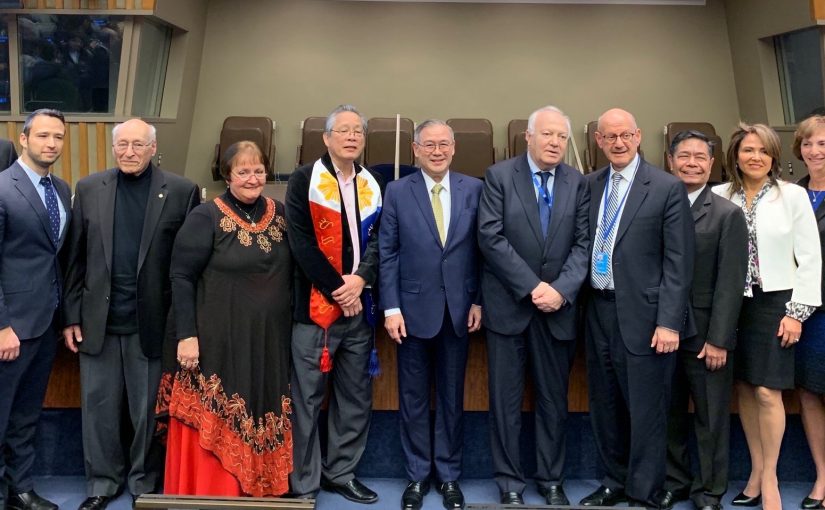
On Holocaust Remembrance Day, Jan. 27, B’nai Brith International (BBI) honoured former Philippine leader Manuel L. Quezon with a special panel discussion at the United Nations in New York City. BBI chief executive officer Dan Mariaschin is fifth from the right. (photo from BBI)

On Holocaust Remembrance Day, Jan. 27, B’nai Brith International (BBI) honoured a former Philippine leader at the United Nations building in New York, for having saved Jews during the Holocaust.

At a time when the Philippines was still under American sovereignty, the appointed Philippine president, Manuel L. Quezon, invited and welcomed 1,300 refugee Jews who were fleeing Nazi persecution.

Quezon, who was born in 1878 and died in 1944, was a statesman, soldier and politician. He served as president of the Commonwealth of the Philippines from 1935 to 1944.

According to Philippine Secretary of Foreign Affairs Teodoro Locsin, the reason why Quezon chose to help when many other world leaders refused to do so, is that he acted in the tradition of “Do unto others as you would have done unto you.”

Not only did Quezon welcome as many Jews as he could get visas for, he also offered them his private land to grow food and develop a kibbutz.

“I think it’s a case of, there are individuals who, I’m a firm believer in this, whose moment comes at the most opportune time,” said Daniel S. Mariaschin, BBI chief executive officer. “In the case of Manuel Quezon, I think he was a good-hearted individual. There was nothing in this for him.

“He really was a compassionate person who heard this story, thousands and thousands of miles away, and was moved to act. And now we are finding out, as more becomes known, that he was willing to save many, many more … and was, unfortunately, not able to do so. I think he stands very high … as one of the Righteous Among the Nations, who acted to save Jews.”

At that time, from 1937 to 1941, as news reports were revealing Hitler’s plans, Quezon secured the necessary visas from the American visa office for a Jewish-American family by the name of Frieder, who manufactured cigars in Manila.
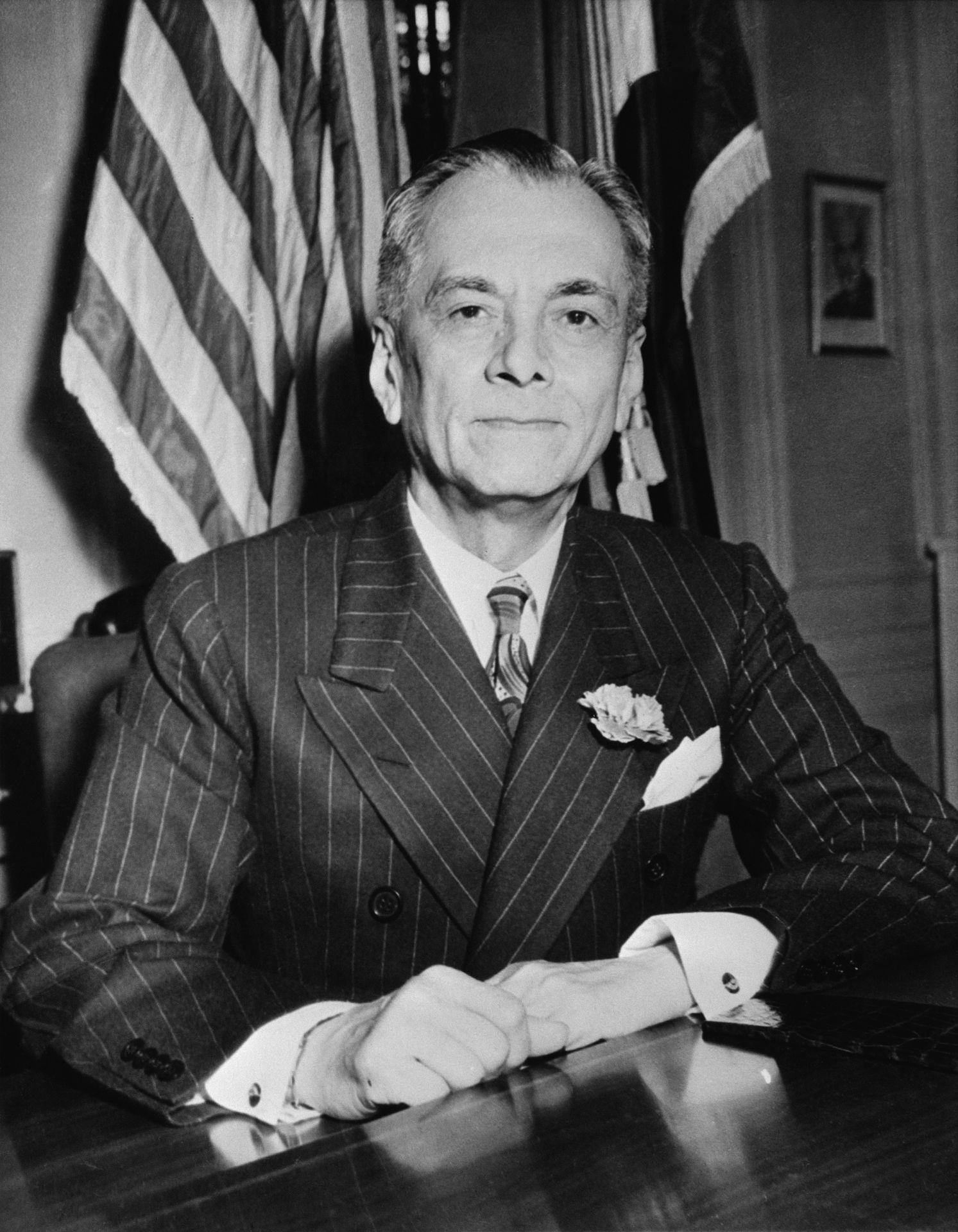
Photo - Former Philippine President Manuel L. Quezon invited and welcomed 1,300 refugee Jews who were fleeing Nazi persecution
Former Philippine President Manuel L. Quezon invited and welcomed 1,300 refugee Jews who were fleeing Nazi persecution. (photo from U.S. Library of Congress LC-USW33-019075-C)

“I think the family, together with the president, were able to get word out, they were able to get those visas … although, again, unfortunately, when he wanted to save more, the ability to get more visas was just not available to him,” said Mariaschin.

Years later, the Philippines was the only Asian nation to vote for the Partition Plan in 1947, to form the state of Israel in 1948, which continued to pave the way for the positive relations Israel has with the Philippines to this day. In 2009, in Rishon Lezion, a monument was erected to honour Quezon.

The BBI event in January was well-attended and included remarks from Locsin, Mariaschin, historian Bonnie Harris, and Hank Hendrickson, who is the executive director of the U.S.-Philippines Society and a refugee who was personally saved by Quezon.

In between the various speakers, director Noel (Sunny) Izon, who made the documentary about Quezon called An Open Door: Holocaust Haven in the Philippines, shared a clip from the film. According to Izon, some 11,000 descendants of the refugees Quezon saved owe their life to him and Izon is one of them. He explained that one of the refugees Quezon saved was a doctor who saved his father’s life soon after arriving in Manila.

Another highlight of the January event was having refugee Ralph Preiss present. Preiss had been saved by Quezon, and shared his experience with attendees.

While no one from Quezon’s immediate family attended, nearly half the attendees were of Filipino descent who now live in New York.

Mariaschin said, while the event was in recognition of Quezon, it was, by extension, “in recognition of the Philippines.”

“The books, the films, the documentaries and the stories will live on from this point, forever,” said Mariaschin about other recent recognitions of Quezon’s actions. “That’s the best tribute you can have, that, rather than have this be just considered a footnote of history, it’s now becoming an important piece of the story … of the courageousness, the humanitarian impulses, of a relatively few individuals.”

According to Mariaschin, Quezon is on equal standing with the handful of other leaders who had a hand in saving Jews during the Second World War, and he said we need to continue highlighting their stories before we lose our few remaining survivors.

“I think we have to do this while there are still survivors who are living,” said Mariaschin. “Unfortunately, the clock is running down on that. In the lifetimes of those people who they saved, it’s extremely important that we say thank you.

“And we were fortunate, as I said, to have one refugee at our program, to have them say thank you and to talk about their story. It’s something that really we need to do every year now and in between, in order to memorialize those who saved Jews.”

Five years ago, the International Raoul Wallenberg Foundation posthumously bestowed Quezon with the Wallenberg Medal, which also acknowledged the Philippines as a whole for having saved Jews during the Holocaust. In Winnipeg, the local B’nai Brith branch is working to organize an event, together with the Winnipeg Filipino community, to honour the former president.

To view the video of the BBI event in New York, visit webtv.un.org and do a search for “Safe Haven: Jewish Refugees in the Philippines – Panel Discussion.”

Rebeca Kuropatwa is a Winnipeg freelance writer.

Kind Café offers vegan food

Samantha Emerman opened Kind Café last year. While closed during the COVID-19 pandemic, they are operating a pickup service twice a week. (photo by Olga Livshin)

Kind Café is a warm, airy space, a place for friends to meet and eat together. Or, at least it will be a welcoming meeting place again, after the coronavirus pandemic is over. In the meantime, the restaurant is offering takeout service only.

Jewish community member Samantha Emerman, with her father, Marvin Emerman, opened the café in August 2019. The main idea behind it was threefold: no meat, no dairy, no waste.

“I became a vegan in 2013. I went to a nutritionist college here, in Vancouver. I learned where our meat and milk come from, so I stopped eating them,” Samantha Emerman told the Independent in a recent interview.

Initially, she opened an online business, ran some seminars on healthy eating habits and offered nutrition coaching. She supplemented her income by working at local restaurants and coffee shops.

“Do you know how much garbage Starbucks produces?” she said by way of but one of many possible examples. “In a busy location, they take out the garbage every hour. I wanted to create a space for people to enjoy their meals, while generating no garbage at all. It’s a much kinder way to feed people – kinder to the environment, to our planet.”

Emerman started doing research on what kind of restaurant she wanted. “There are other vegan restaurants in Vancouver. Being vegan has become trendy, but there is no other vegan café, except ours,” she said. “And no eating establishment in the city offers the ‘no waste’ policy, except ours.”

The next important decision was where to set up shop.

“I researched for a long time. We looked into downtown locations,” she said, “but most people in downtown rely heavily on their daily to-go coffee. We checked out the suburbs, like White Rock. In the end, we decided that the best location for our café would be Main Street, with its diverse people.”

And, last August, Kind Café opened its doors on Main Street.

“We offer a vegan menu and we don’t generate any garbage. We don’t even have a garbage can inside,” Emerman said proudly. “We don’t have any plastic or any single-use items here. Everything is reusable.”

The zero-waste initiative extends to all areas of eating, including the takeout aspect of the business. The café doesn’t have paper coffee cups or foam containers for to-go orders.

Before the coronavirus hit, Emerman said, “If people want[ed] takeout, they should come in with their own containers. It took awhile for the people to get used to that idea, but now, most of our customers who want a takeout come with their own containers.”

She called this policy BYOC (bring your own container). “We are passionate about BYOC,” she said. “When you dine inside, we have you covered with metal cutlery, ceramic plates, mugs and glasses. Otherwise, instead of the disposable plastic utensils, paper cups and single-use food containers that are polluting the environment, we kindly ask our customers to bring their own.”

Even with the COVID-19 restrictions, Emerman isn’t sacrificing her environmental beliefs. Instead, she is extending the practice of “renting” containers, which was in place before the virus. The café is temporarily suspending its BYOC policy and is now only offering customers food served in new glass containers for which there is a monetary deposit that will be returned to the customers at a later date, when they return the container so that it can be washed and reused.

“We’re trying to shift the focus away from the single-use mindset altogether,” she said. “Why use any product only once and throw it away? We are here to shake up the food industry, change people’s behaviour pattern, and to make BYOC the norm.”

The demographics of Kind Café are as diverse as the Main Street population. “About 60% of our customers are regulars who work or live in the area,” Emerman said. “Most of them are between 14 and 40, professionals and students. The rest are walk-ins. All kinds of people, really. And people are still discovering us.”

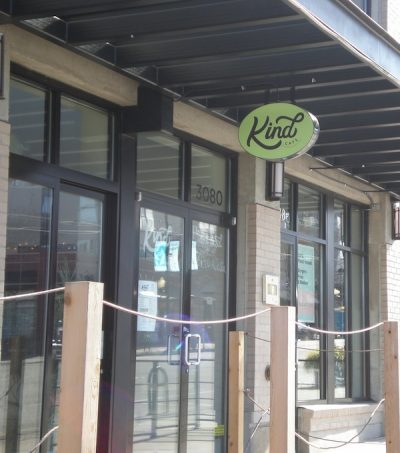
photo - Kind Café opened its doors on Main Street last August
Kind Café opened its doors on Main Street last August. (photo by Olga Livshin)

As a way for people to discover the new café, Emerman has been offering the space for events and seminars on healthy eating. One of the events that fit the café’s no-waste strategy was a clothing swap. “It’s the same principle,” she said. “You don’t want this sweater, but someone else might want it. No throwing away anything.”

The no-waste guidelines apply to the restaurant’s suppliers as well.

“We don’t accept the products in plastic bags. We have our own large containers for the supplies we use,” said Emerman. “The only bags we do accept are paper and reusable. But it took some time to find suppliers who share our beliefs. That’s why we have 11 suppliers for different products, not two or three, like Starbucks.”

The café is a family business. “My father is my partner and mentor,” Emerman said. “He taught me a lot. Most of the recipes are our family recipes or my own, although now that we hired a chef, he contributes, too. My sister is the office admin. My mom does everything that needs to be done. We are a very close family.”

Of course, they have some hired staff, all of whom happen to be, like the Emermans, vegan. “It is not a requirement for working here,” she stressed, “but our staff want to work for us. There are not too many vegan places in the city.”

The majority of work falls to Emerman herself. “Owning this café is the hardest thing I’ve ever done. I do everything. I bake. I manage front and back. I look for suppliers. I do advertising on social media – Facebook and Instagram. It’s a 24/7 job and the most rewarding I’ve ever done.”

To order takeout and for more information on the café, visit kindcafe.ca. The website notes, “We know that getting your hands on certain groceries, specifically vegan food, during this time can be challenging. Although we do not currently have a delivery service, we will be open for a small window, of three hours, twice a week, for you to come pick up orders!”

They request that customers preorder by Friday, 10 a.m., for Saturday pickup and Monday, 10 a.m., for Tuesday pickup. There is an online form to fill out, and an invoice will be provided once your order is confirmed.

Olga Livshin is a Vancouver freelance writer. She can be reached at olgagodim@gmail.com.

On brink of radical change

Prof. Shlomo Hasson was slated to bring a pessimistic forecast for the Middle East’s future to a Vancouver lecture March 31, but his visit was canceled due to the coronavirus crisis. (photo from CFHU Vancouver)

The Middle East is in a time of historical change and geopolitical shifts. The outcome is unknown and, for Israel, there may be good and bad consequences.

This is a core message from Prof. Shlomo Hasson, a professor at the department of geography, School of Public Policy, and Leon Safdie Chair at the Institute of Urban and Regional Studies at the Hebrew University of Jerusalem. Hasson was to speak in Vancouver March 31 at an event organized by the Vancouver chapter of Canadian Friends of the Hebrew University, but the lecture was canceled due to the coronavirus crisis. The Independent spoke with him by telephone about what he intended to discuss.

“We are in the midst of turmoil in the Middle East because we have this havoc with Iran and the intensifying tension between the United States and Iran,” he said. “We have the ongoing conflict within the Middle East, especially in Syria, the war now between Turkey and Syria. We have the recent events in Libya, we have a worsening situation in Yemen. I’m not optimistic about the Middle East and, when it comes to the Israeli-Palestinian case … the peace talks were stalled for a long time and now it seems that [U.S. President Donald] Trump’s initiative, in a way, helps to revive the issue but did it in such an awkward way that I’m not optimistic at all about the consequences of this initiative.”

The warming of relations between Israel and Saudi Arabia, as well as with some Gulf states, is cause for limited hope, he said.

“This is indeed a good reason to celebrate because there has been a change, even a significant change, between the Gulf states and even Saudi Arabia, and Israel because [they] are facing the same adversary, which is Iran,” Hasson said. “Israel supports Saudi Arabia because it supports them in containing Iran. In that sense, I think there is something to celebrate but this is very modest, because … the public in Saudi Arabia, for example, does not support Israel. It’s sort of an alliance between the rulers of the countries, but the public is not there yet.”

An additional crisis is climate change, which is hitting the region especially hard and will continue to do so, although this also presents opportunities for Israel to build bridges.

“We face the problem of water scarcity and droughts and flooding,” Hasson said. “I think that, especially in this crisis, Israel can help a lot because we have the technology, we’ve mastered the know-how and we can help the Middle East and Africa, while coping with this issue.”

Speaking before the most recent Israeli elections, Hasson predicted that, regardless of the outcome, they wouldn’t play a significant role in the bigger Middle East picture.

“Israel is not the central actor here,” he said. The central actors are Saudi Arabia and Iran, with China, Russia and the United States intervening from outside.

“Israel is in a position of reacting to these global, regional and intra-state developments,” he said. Even if Blue and White had won, said Hasson, it is still a right-wing party and the Israeli populace is developing a rightward consensus. “I don’t think that these elections are going to present a significant change in Israel’s political behaviour.”

He compares this moment in Middle East history to the pivotal epochs of the past.

“About 100 years ago, we still had the Ottoman Empire and, after that, we had the colonial regimes, the Sykes-Picot regimes, and then we have the nation-state regimes. The Middle East is at the brink of a change, a radical change, and nobody knows for sure what’s going to happen to the Middle East,” said Hasson. “But, in a way, it’s going to affect everything, it’s going to affect the global structure, it’s going to affect the relationships between the United States, China and Russia.”

Motivating people to change

Tzeporah Berman is international program director for Stand.Earth. (photo from Tzeporah Berman)

There is no silver bullet when it comes to responding to the climate crisis, according to Tzeporah Berman. The 25-year veteran of environmental activism and international program director for Stand.Earth said it needs a multi-pronged approach.

“A lot of people like to say it’s negotiations or policy work or protests, but, in my experience, the most effective campaigns that have made change have been the ones where there has been a diversity of tactics and approaches,” Berman told the Independent. “The most effective initiatives are the ones that are not just about educating, but are about motivating people to take action on an issue…. What we need to try and do is motivate people to make change.”

Berman was among those who started Stand.Earth (formerly ForestEthics) about 20 years ago. According to the website, the group “designs and implements strategies that make protecting our planet everyone’s business. Our current campaigns focus on shifting corporate behaviour, breaking the human addiction to fossil fuels and developing the leadership required to catalyze long-term change.”

In the 1990s, Berman was an organizer of the Clayoquot Sound logging protests that contributed to agreements to prevent clearcutting. More than two decades later, as construction of the then-Kinder Morgan-owned Trans Mountain pipeline expansion ramped up, Berman participated in the sit-ins on Burnaby Mountain.

“The War in the Woods … it was this tipping point moment on the issues and Canadian history, where people were engaged from all walks of life,” she said. “Whether or not the rainforest should be clearcut was a conversation around everyone’s kitchen table. I think that’s true today of climate change and pipelines, that it’s one of these rare moments in history where it is a populist issue, where everyone is engaged in the conversation, and I think that’s why you see, in both circumstances, such a diversity of people showing up.”

Last year, the concern reached a fever pitch in Canada and elsewhere, with unprecedented numbers of people marching in the streets calling for climate action. Asked what Berman thought of elected officials such as Prime Minister Justin Trudeau or NDP leader Jagmeet Singh participating in marches like last September’s global climate strike – that, at their heart, target leaders such as them to address climate change through policy decisions – she said she believes they show up with good intentions.

“We’re living in this strange moment where our elected officials are starting to understand the urgency and importance of climate change, but that is not yet translating into their policy proposals,” she said. “It’s like there’s a time lag and they’re saying the right words about urgency and joining marches, but their policies represent the best thinking on what climate policy should be from 10 years ago. I don’t think they’re being disingenuous when they join a protest … but one of the big problems that we have is that so many people believe that they’re doing enough and other people need to do more. We like to celebrate how progressive we are, but we have a very mixed record. Canada is among the worst in terms of G7 countries with our climate plan.”

Despite estimates of more than one million people in Canada marching in climate strikes last year, Berman said the environmental movement is sorely outnumbered resource-wise in comparison to the oil and gas industry lobby. In a tweet sent at the beginning of this year, Berman spelled out 10 tips for successful activism.

“Do stuff that makes the world respond. Don’t just respond to the world,” she wrote. She expanded, telling the Independent that advocates need to be sure they are the ones setting the agenda, not governments and corporations. “Campaigners and campaigns are not proactive enough, we just respond to what decision-makers are doing. Instead of doing that, what if, months before, you looked at what you think needs to happen in order to protect the climate, our water, the air, produced a report with recommendations for policy, and then held a press conference and a public information night. Then you’re putting a proposal out there of what you think needs to happen in the world.”

Last November, Berman presented to 400 people at Temple Sholom, giving an overview of the scientific evidence of climate change and the role of nations and individuals moving forward. She spoke of the loss of the “culture of engagement.”

“Today, we have a weak civil society engagement muscle and an overextended hyper-consumer muscle,” she said during the presentation.

“We got lazy,” she explained to the Independent. “We live in a democracy, we assume it’s functioning, and leave it up to the politicians…. I’m not exactly sure how it happened, but I think it’s a culture that was eroding over the last generation. Growing up, it was expected in our community that you volunteer – for your synagogue, for your church. We don’t really have that culture now and the result is we’re not engaging in our communities as much as I think we used to. I notice now that we’re starting to see it more as a result of the more active student movements, but I think that’s because they’re scared.”

The role of community groups such as religious institutions should not be underestimated, she added. “People are going to be more willing to engage in the issues if they feel safe, if they feel a sense of common purpose, if they trust the people they’re organizing with. It’s one thing to hear scientists, or read an article. It’s a very different thing to sit down with people in your community … and organize. A lot of people right now are searching for what they can do. [Institutions] should be providing leadership and structure.”

Berman continues to be a leader in her own right. Late last year, she was awarded $2 million US from the Climate Breakthrough Project to fund her efforts to limit new oil and gas development globally to align with the United Nations Paris Agreement goals of a safe climate. The project will be housed within Stand.Earth.

Shelley Stein-Wotten is a freelance journalist and comedy writer. She has won awards for her creative non-fiction and screenwriting and enjoys writing about the arts and environmental issues. She is based on Vancouver Island.

Modern matchmakers

YVR Yenta is the brainchild of Madison Slobin, left, Ben Eizenberg and Ariel Martz-Oberlander. Adapting to the realities of dating during the coronavirus crisis, they have introduced the online meetup Love in the Time of Covid: Virtual Single Mingle. This photo was taken before physical distancing was required. (photo by Madison Slobin)

Three young Jewish Vancouverites have set up a collective to help their friends – and their friends’ friends – find a romantic match “using old traditions to find modern love.”

YVR Yenta is the brainchild of Madison Slobin, Ben Eizenberg and Ariel Martz-Oberlander. The three believe that their old country methods, with the application of 21st-century technology, can procure a better match than any computer algorithm. Describing meaningful connections as “the antidote to capitalist alienation,” the matchmakers see a need to fill in a city where “finding the perfect view is easy, but finding someone to share it with can be challenging,” according to their introductory material.

The matchmaking collective was just getting up and running when the coronavirus crisis hit, but that hasn’t set them back. They resorted to technology to organize Love in the Time of Covid: Virtual Single Mingle, where anyone is welcome to join an online group chat, then tell the yentas of anyone they might like to be introduced to for virtual (and, perhaps later, in-person) meetups.

The idea of incorporating old world matchmaking practices with 21st-century singles is a growing trend.

“I would love to claim it as an original idea but, honestly, I spent the last three-and-a-half years on the East Coast, living in New York City, so I have been quite connected to young Jewish community there,” said Slobin. “It was something that I kind of knew was happening in different places on the East Coast. I heard that there was one happening in Minneapolis and it seemed to me like a new trend that was popping up, which is young, secular matchmaker collectives.”

In an age when Jdate and other online dating apps are a swipe away, why the need for the personal intervention?

For a certain segment of young people, Slobin said, Jdate isn’t cool. The other reality is that apps tend to be based on looks or instant attraction.

“I think a lot of people go on dates based on that and then don’t find success because they may not share anything other than that mutual attraction and so this is an opportunity to go a little bit deeper,” she said.

YVR Yenta invites clients – it’s all free and there’s no profit motive – to complete a comprehensive questionnaire about their religious affiliation and how important that is, whether they want a match of their own religious tradition, their political views, preferences, interests and a host of other attributes.

“We accept anyone into our dating pool who belongs to any religion, any race, any sexuality, any gender,” she said.

As clientele numbers increase, the yentas write to potential matches, “so will the quality of our matchmaking, seeing as we will have more match options to choose from! Please help us spread the word to your friends and family, either through word of mouth (as was done in the old country) or by sharing our Instagram page (as is done in the 21st century).” They are on Instagram at yvr.yenta.

“This is something that I would want for myself,” Slobin added. “I think it’s a very cool idea and I wanted to make it happen for all the people around me because I feel like I know so many amazing people who are looking for partners. So we decided to volunteer our time to make it happen. Really, it’s quite fun, so it doesn’t feel like work.”

Working to save our oceans

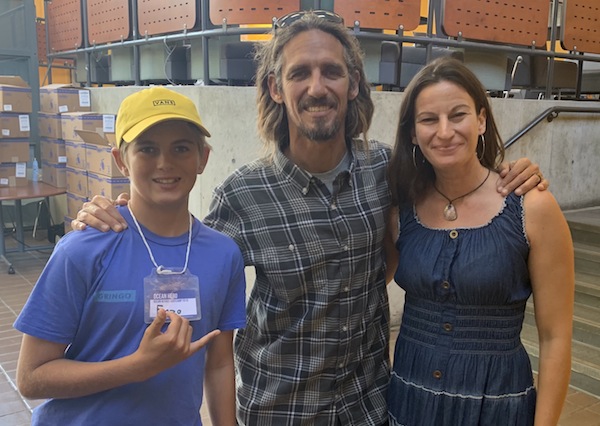
Chatting surf, water refill stations and plastic pollution at Ocean Heroes Bootcamp, left to right: Enzo Ackermann (Ocean Hero), Rob Machado (professional surfer/environmentalist) and Sondra Weiss (art educator). (photo from Sondra Weiss, Founder, Lost Art of Love Letters)

Organized and led by Captain Planet Foundation and Lonely Whale, Vancouver’s Ocean Heroes Bootcamp has a singular purpose – finding ways to save our oceans from plastic pollution.

One of the bootcamp presenters is Sondra Weiss. She offers participants a unique way to inspire action.

Having grown up in Connecticut, close enough to the ocean to fall in love with it, Weiss then went to the University of California. After graduating, she took an art museum educator position, a role she maintained for about two decades. Eventually, however, her love for the ocean drew her to start up the Lost Art of Love Letters.

“I launched this project about four years ago, thinking the world needs more love,” Weiss told the Independent. “As I listen to the news, or my students, or people in the world committing suicide, I just thought that love is a great antidote for everything happening in the world.”

Weiss lives in Santa Barbara, Calif., and was asked to come to Vancouver last year to help with the Ocean Heroes Bootcamp.

“Last year was the second year that they did Ocean Heroes, when I was in Vancouver,” said Weiss. “It brings together 250 local and international youth activists between the ages of 11 and 18, from 20 countries and 24 U.S. states, and the idea is to collaborate worldwide to fight plastic pollution.”

Based out of the University of British Columbia dorms and hosted by Ocean Wise and the Vancouver Aquarium, the next bootcamp is scheduled for June 26-29, though that may change depending on the progress made dealing with the COVID-19 pandemic. Weiss is to lead a part of it called Love Letters to the Sea.

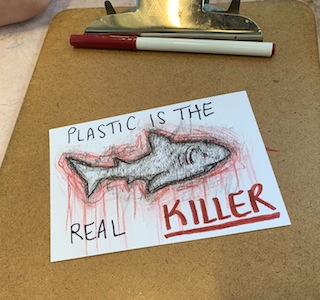
“It is an art-integrative letter-writing project that promotes positive changes for the ocean,” said Weiss. “So, rather than feeling overwhelmed by environmental issues, community members can take action and promote innovation by using their voices to drive policy solutions.

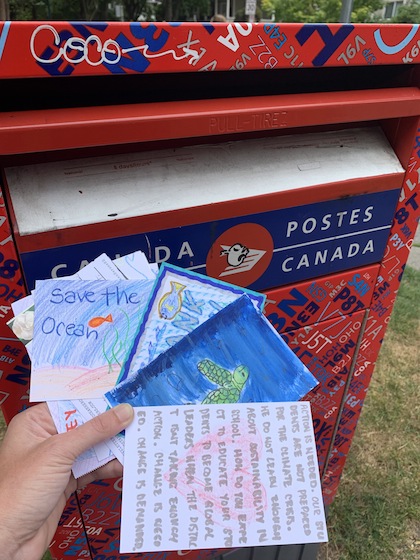
photo - A lot of the letters are sent out to local businesses, council members and political figures to say either thank you for the work they do for the ocean environment, or to ask them to make changes
A lot of the letters are sent out to local businesses, council members and political figures to say either thank you for the work they do for the ocean environment, or to ask them to make changes. (photo from Sondra Weiss, Founder, Lost Art of Love Letters)

“Participants take pen to paper and brush to paint to express their sentiments, their solutions, for ocean love. And, a lot of the letters are sent out to local businesses, council members and political figures to say either thank you for the work they do for the ocean environment, or to ask them to make changes.”

Last year’s focus was on eliminating single-use plastic bottles. Participants were tasked with developing ideas to help the community achieve this goal.

“As mentors in bootcamp, in general, we come up with ideas and have the youth collaborate, come up with campaigns and talk to experts in different fields, figuring out how to create the most change, being creative and positive the whole time,” said Weiss.

Each Ocean Heroes Bootcamp draws many different people from all around the world, she said, including youth who have created changes in their community or on a wider scale.

“There are experts leading panels, workshops and group activities … and Love Letters to the Sea, my personal activity, is more artistic-based,” she said. “So, there are writing prompts for writing, but there are also images to inspire art. There are watercolours, crayons and coloured pencils for campers to express themselves in various ways.”

While there are age gaps, some of the younger kids have inspired more change than some of the older ones. Regardless of age, all are passionate about the issues and put any age-related ego aside to learn from and with one another, said Weiss.

“One of the beautiful things is that youth from all around the world are working together toward the one topic – and the topic is plastic pollution, what plastic pollution and consumerism is doing to affect the planet as a whole,” she said.

Weiss hopes that the letters “help motivate the people doing good work and also helps the community to remain civically engaged … and be part of society, knowing we can make change and, as an educator, working with youth shows them to use their voice for change.

“We can use that same thing – the letter writing, it has been tried and true throughout the years. When someone wants to try and make a decree, the people will use a letter. Or, to really express something to a friend going through a hard time, or a family member, a lot of times, we’ll take pen to paper and write it down. It’s a great way to slow down. We live in such a fast-paced society. We need to slow down and really think about what’s in our hearts.”

Still, Weiss is well aware of the power of technology when well-used. She has worked with Jack Johnson’s band to create a song written by middle school kids who wrote love letters to the sea.

“They took lines from the letters, which became lyrics for a song,” said Weiss. “Letters are personal, but the way to reach the masses is through music and video. And, we created it into love letters, which are strong and powerful.”

Some of the lyrics produced include: “Water can’t be broken, but we can make her cry / Going to write a love letter to the ocean, let her know we are always going to try.”

“It was phenomenal that the students got to express themselves and sing it out,” said Weiss. “They wrote the notes and the music, and then we went into a recording studio and recorded a different version.

photo - Love Letters to the Sea works to create positive changes for the ocean and environment
Love Letters to the Sea works to create positive changes for the ocean and environment. (photo from Sondra Weiss, Founder, Lost Art of Love Letters)

“Letter writing is such a great way to get ideas onto paper and out of your mind and heart. The next stage is to bring music and video to a larger global audience.”

Weiss sees artistic letters as a gateway to reaching people on a different level, touching people’s minds in a different way to promote change.

“Images or music definitely help ignite that,” said Weiss. “For me, when you are talking to them and you see the light in their eyes go up, you see them drawn into the conversation.

“So, what does it takes to ignite someone to care? That’s what I ask at the bootcamp. I ask the youth if they are going to write an organization and ask them to limit their plastic packaging. And I ask them what they think would get them to consider the financial cost … and think more about the overall cost, the environmental cost. We learn so much from the kids and they inspire us as much as we inspire them – and the relationships maintain year-round.”

While Ocean Heroes Bootcamp is free to attend for accepted youth and their chaperones, including room and board, there is a $100 reservation fee and travel costs that may be waived via scholarship. All applications to attend the bootcamp are reviewed by Captain Planet Foundation and Lonely Whale. Qualified candidates are contacted by the Ocean Heroes headquarters team to complete registration.

The Ocean Heroes HQ team accepts a maximum of 300 youth leaders each bootcamp. Each attendee is paired up with a team of squad leaders, peers who guide them through the program and ensure they have the tools, support and information they need to graduate from the camp with a successful campaign plan to eliminate plastic pollution. For more information, visit oceanheroes.blue.

Rebeca Kuropatwa is a Winnipeg freelance writer.
Take time to see Maskit

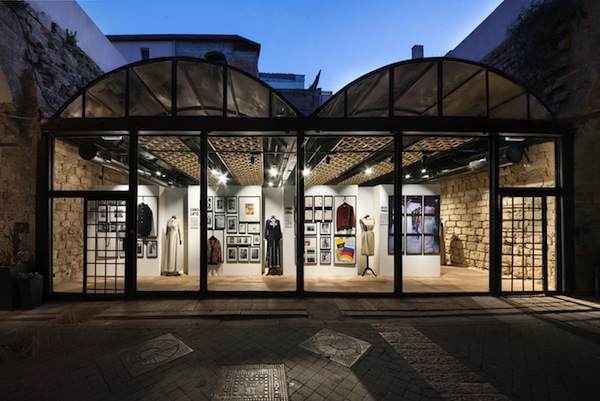
Maskit is located at 4 Auerbach St., in Jaffa. (photo from Maskit)

When next in Israel, in addition to walking the beaches of Tel Aviv, being spiritually uplifted at the Wailing Wall in Jerusalem and enjoying the food across the country, carve out some time to see the fashion houses that have put Israel on the map.

Over the last few years, Israel has been leading in the fashion industry, with numerous graduates from Shenkar College of Engineering, Design and Art landing jobs with renowned fashion ateliers in Europe. But let’s take a step back in time.

In the 1950s, post-independence, immigrants from Yemen and Morocco arrived in Israel. The government sought to train the women in textiles in order to provide for their families. At the time, Ruth Dayan (Moshe Dayan’s wife) was approached to lead the women and, seeing their talent in embroidery and weaving, she suggested that the government and a Hungarian designer, Fini Leitersdorf, initiate a designing business.

The House of Maskit became the headquarters of fashion, with Ruth Dayan as the principal designer. Maskit became famous for their signature caftan, with embellishments of embroidery, textures and the colours of Israel. At their peak, Maskit was featured in Vogue. Their tunic-style creations were considered art, gaining world recognition, enabling them to sell in Bergdorf Goodman, Neiman Marcus and Saks. As Maskit’s success grew, a higher-end line was introduced, which had buttons made from river stones, olive trees and pure silver. The fabrics were from the finest sheep’s wool, as well as silk, linen and cotton.

In the 1970s, however, the Israeli government stopped funding Maskit, shifting its spending to other priorities, notably the military. Ruth Dayan stepped down and, ultimately, Maskit closed.

Full speed ahead some 30 years, designer Sharon Tal, who graduated from Shenkar, returned to her native Israel after designing for the House of Lanvin in Paris and Alexander McQueen in London.

Although a new mother, she was still working, involved with a British lifestyle website that focused on the trends in Israel. Tal’s aha moment came when she saw Duchess of Cambridge Kate Middleton’s wedding dress, which was designed by the House of Alexander McQueen. Upon viewing the outfit, with its elaborate embroidery, she knew it was time for her to get back to design.

Together with her husband, Nil, they discovered that the House of Maskit was ready to reopen. Tal picked up the phone and called Ruth Dayan, then 94 years old. The two became friends and Maskit eventually was reborn, in 2013, melding together its history and Tal’s designs, known for their soft lines and feminine feel.

Maskit’s clients include actresses like Sarah Jessica Parker and Jamie Lee Sigler. However, one of the greatest honours was when the late first lady of Israel, Nechama Rivlin, bestowed then-U.S. first lady Michelle Obama with a coat designed by Tal on a visit to Israel.

The couturier’s home is in Jaffa, where Tal has her atelier. The décor is wondrous, with stone walls, warm natural hues and rows of heavenly designs displayed. On your next visit, do some shopping for what are sure to be lifetime classics.

For more information, visit maskit.com.

Ariella Stein is a mother, wife and fashion maven. A Vancouverite, she has lived in both Turkey and Israel for the past 25 years.

A virtual community

With COVID-19, we now must connect online.

As the world continues to grapple with the coronavirus (COVID-19) pandemic, Jewish organizations across Metro Vancouver are finding new ways to connect with the public.

Last week, schools and most businesses and places of worship closed their doors to support the provincial government’s directives for new social-distancing policies. For everyone, this change has required the adoption of different ways to address daily needs, like shopping, study and religious practice. It has put increased demand on organizations and businesses to think out of the box when it comes to staying in touch with and supporting their membership, clients and connections. Here’s some of what the community is doing.

New lesson plans

Schools have shifted their classes to online attendance and are creating lesson plans that allow students to study virtually and independently. Some schools, like Richmond Jewish Day School, have sent out private communications to parents, outlining class schedules and continued services. Others are using their websites or other online services to keep families apprised and facilitate the learning curve that students, parents and teachers will inevitably face using the technology.

Students at Vancouver Talmud Torah will have independent study periods and be able to use social media to connect with their teachers and peers. The school is using Google Classroom for study plans and assignments and its website notes that students who are experiencing problems, need to discuss study plans or want to connect with other class members will be able to do so during the teacher’s virtual office hour each day. For families that don’t have a computer available, the school says students will be able to sign out a laptop to use at home (one laptop per family, as inventory is limited).

King David High School’s new multimedia program launched a week ago, and it uses Zoom video services, Moodle and Google Classroom to connect with at-home students. According to KDHS’s website, the school is doing its best to keep schedules and study periods the same as they were prior to the shutdown. It is using classes prior to Passover break (April 3) to test and refine the online structure.

Shalhevet Girls High School is also working hard to keep schedules standardized and reflective of the lesson plans it offers, and students can still connect with one another during the “lunch and shmooze” hour.

Take-out and online

On March 21, the City of Vancouver ordered all in-house restaurant service to cease. Restaurants that provide take-out and delivery services have been permitted to remain open.

Many of Vancouver’s kosher restaurants already provide take-out or delivery services to the public. Omnitsky Kosher, Nava Creative Kosher Cuisine and Maple Grill have enhanced their takeaway and catering services. Some provide service through the DoorDash online app or Uber. Most are urging customers to order with sufficient advance notice.

A staff person at Maple Grill said that ordering ahead is necessary for very large orders, “but we always have take-out between 4 and 8 p.m. for smaller orders.” Patrons should keep in mind that seating – even while waiting for orders – will be closed in all restaurants during this time.

Nava, which has a take-out restaurant at the Jewish Community Centre of Greater, has requested 24-to-48-hour notice on all orders. According to Susie Siegel, although the JCCGV is currently closed, customers can pick up orders by calling or emailing their order ahead of time. Sabra Kosher Bakery also will be open for take-out and larger Passover orders.

Other restaurants that have relied largely on their in-house service have found it challenging to meet the requirements of the city’s precautionary ban. Café FortyOne has announced that it has “made the difficult decision to temporarily close to protect the health and safety of customers and staff.”

Restaurants – including non-kosher establishments like Market Meats – are also accepting orders for Passover and most have cut-off dates for orders. While many kosher restaurants are scheduled to close on April 8 for the week of Passover, customers may wish to call ahead to confirm deadlines for orders and take-out during the current shutdown.

Meanwhile, stores are also struggling. Buchan’s Kerrisdale Stationery on West 41st Avenue, which has a selection of Judaica, among many other items, is now offering delivery service. And Olive and Wild, on Main Street, which offers a variety of Judaica, Passover items, art and home décor items, is transitioning its services to better serve customers who aren’t able to shop in-person.

Simon Zaidel, who co-owns Olive and Wild with his wife Bella, admitted that the COVID-19 alert hasn’t been easy. The owners have added an online store to their website and Zaidel said patrons can either pick up their orders, have them delivered or, for those outside the Lower Mainland, request delivery by Canada Post. He added that the store is currently providing a discount to offset any delivery costs.

Safeguarding the vulnerable

Jewish Family Services, like many organizations, is shifting its services to meet increased at-home demands. Kassidy Taylor, JFS marketing and communications manager, said the organization realizes that the current health concerns are financially and logistically difficult for people of all ages. Its Emergency Care Campaign allows families and individuals to reach out for help with food, deliveries and other social support.

“It is for anyone who needs a meal or grocery delivery, counseling, emotional support or just a friendly phone visit,” Taylor said. “We are trying to support as many people as possible.”

Taylor added that, for many seniors and other individuals, having to stay at home has cut them off from food banks and various resources that don’t deliver. “We are just trying to fill in the gaps as we can,” she said of JFS’s focus.

Individuals needing assistance can contact JFS through its website or by calling the agency’s hotline, 604-558-5719. As well, the emergency care program is in need of volunteers, and those wishing to donate are welcome to contact JFS as well. “There is a lot of need right now,” Taylor said.

On another front, healthcare facilities have been taking successive steps to address the impacts of the COVID-19 outbreak. On March 17, Vancouver Coastal Health announced the closure of all adult day centres, such as the L’Chaim Adult Care Centre at the JCCGV, in an effort to protect seniors and healthcare workers from the virus. Care workers are monitoring participants by phone to ensure that medications, food and support are coordinated as necessary through VCH case managers. More information is available by logging onto the Lower Mainland Adult Care Centre Association’s website and clicking on the appropriate care centre’s link.

As of March 17, Vancouver Coastal Health also restricted visitors to Louis Brier Home and Hospital, Weinberg Residence and other care homes to “compassionate visits” that meet specific limited guidelines for continued care and end-of-life support. VCH stresses the rules are a precautionary measure to keep patients and staff protected.

Most of the community’s organizations have instituted changes to address social distancing and other limitations brought about by the outbreak. Links to each one and an overview of temporary changes are accessible through the Jewish Federation of Greater Vancouver’s website.

Virtual davening

Few Jewish organizations have been as impacted by the call for social distancing than Vancouver’s religious institutions, which have been faced with myriad challenges. Restrictions on attendance (at press time, it was limited to 50 people) and other issues have forced synagogues to rethink how best to both continue regular religious services and provide social and educational support to their members, many of whom are seniors and required to stay at home. It’s also forced organizations across Metro Vancouver to change programs and services for Passover. Most religious institutions have already canceled or transitioned upcoming holiday celebrations to Zoom online services.

On March 21, rabbis from Vancouver Lower Mainland institutions issued a joint statement to congregants outlining the synagogues’ new guidelines for attendance. Many of the congregations have transitioned to online religious services via Zoom video to ensure that their members can stay connected, supported and engaged in religious life.

Congregations Schara Tzedeck, Beth Israel, Temple Sholom and others are providing daily and/or weekly minyanim online, along with classes and “meetings” throughout the day.

Most congregations are also working to fill the gap when it comes to much-needed social interactions for teens and younger members. Synagogues have found ways to both address concerns about halachah and ensure that members struggling with the impact of isolation are supported.

Both Schara Tzedeck and Beth Israel issued new cemetery guidelines earlier this week, calling on members and guests to adhere to practices that help safeguard both the participants and others who may be at risk from exposure to the virus. Cemetery facilities are closed to the general public. Burials are, in most cases, limited to family members, with some allowances to ensure that there will be enough attendees for a minyan so mourners can say Kaddish, and unveilings have been canceled to April 30 at least. Congregants and those interested should contact the synagogues in charge for more information on the revised guidelines.

Helping those in need

Many Jewish organizations are also finding ways to help those most vulnerable get financial aid if needed. The Hebrew Free Loan Association has announced that it will lend up to $2,000 to individuals or families impacted by loss of a job or other economic problems stemming from the coronavirus outbreak. Organizations, like Or Shalom, for example, are accepting donations within its congregation to help those struggling from illness or loss of income.

***

For the most comprehensive list of community resources and organizations, visit jewishvancouver.com/covid-19-updates.

Jan Lees articles and blog posts have been published in B’nai B’rith Magazine, Voices of Conservative and Masorti Judaism, Times of Israel, as well as a number of business, environmental and travel publications. Her blog can be found at multiculturaljew.polestarpassages.com.

Gymnast excels at her sport

At the B.C. Winter Games in Fort St. John last month, Belle David received a silver medal for her ball routine and placed fourth all around. (photo from Danica David)

Local athlete Belle David started the year off with success after success after success in her chosen sport: rhythmic gymnastics.

The 10-year-old gymnast competes provincially at level 3B (ages 9-11). At the Queen of Hearts invitational competition in Vernon Jan. 24-26, she received an all around first place, a gold medal in the ball routine, a silver medal in the free routine and a bronze in rope. At the Olympia Cup in Burnaby Feb. 7-9, she received a bronze medal in rope, as well as a special award for Miss Dance Jr. And, at the B.C. Winter Games in Fort St. John Feb. 20-23, she received a silver medal for her ball routine and placed fourth all around.

“The most fun part of rhythmic gymnastics is the competitions,” Belle told the Independent in a recent interview. “The most difficult part of rhythmic gymnastics is the long practices.”

Admitting that she gets a little nervous when she competes, she said, “but I have a lot of practise with competitions and that practise helps my nerves.”

Belle trains three times a week for four hours each time at rhythmic gymnastics and she also trains in ballet twice a week. “Altogether, I train for rhythmic gymnastics over 14 hours a week (including mandatory ballet) and, combined with my other sports, I do 25 hours a week.”

The restrictions that have been implemented by various levels of government to try and manage the spread of COVID-19 have brought changes in that regimen, however.

“Belle’s coach has set an individual stretch and strengthen program for each athlete,” Belle’s mother, Danica David, told the Independent. “The coach has sent a video, 26 minutes long, of basic training exercises she expects the athletes to follow, along with detailed plans for each gymnast. Belle is expected to film herself training and send in the film to the coach to check in daily.

“Mentally, Belle is processing the end of the season coming early. When there are still three competitions left, it’s disappointing, after all her hard work, but she will keep practising at home. She said, ‘I feel like there’s nothing to do and nowhere to go.’”

In Grade 4 at David Oppenheimer Elementary School, Belle said her favourite subject is art. Interviewed before the pandemic forced closures, she said, “I socialize at school and at practice because I don’t have time for friends outside of practice. I mostly do my homework early in the morning before school.”

photo - Belle David at her first rhythmic gymnastics competition, at age 6
Belle David at her first rhythmic gymnastics competition, at age 6. (photo from Danica David)

Belle started dance classes at the Jewish Community Centre of Greater Vancouver when she was 4 years old and began taking rhythmic gymnastics classes when she was 5.

“I love sports,” she said. “I love baseball, dance, rikudei ’am [folk dances], swimming, skating and artistic gymnastics.”

She also makes time for community and cultural activities.

“I celebrate all the Jewish holidays and I keep Jewish traditions,” she said. “Our family hosts holiday parties and I enjoy PJ Library events and books.”

After three years performing in Goh Ballet’s The Nutcracker, Belle said, “I took a break this year to really enjoy Chanukah with my ima, abba, grandma, brother and friends. When I danced in The Nutcracker, sometimes I performed in two shows a day during the run and I missed the Chanukah fun. This year, we did Chanukah bowling, skating, the party bus and menorah parade and, as always, we lit candles and opened presents each night of Chanukah.”

Belle said she wears a red-string kabbalah bracelet on her left wrist, including in competitions, that her mom blesses.

Family is important to Belle and one of her ambitions centres around her grandparents in Israel.

“I have a short-term goal to learn the apparatus hoop,” she said. “I have a long-term goal of making it to the Grand Prix Holon.

“The Grand Prix Holon takes place in my home city (Holon) in Israel,” she explained. “I would like to compete for Canada or Israel. It’s an international competition and it’s across the street from my savta and saba’s apartment. All my family could come and see me compete. This is my dream.”

Belle’s family moved from Israel to Vancouver almost seven years ago, said her mother.

“I was born in Canada and her dad was born in Israel – we met in India,” David said. “Belle was born in Israel and she has a brother born in Canada, named Omri, he is 6 years old. Their father, Ofir, has never been able to move permanently to Canada because of the nature of his work but he visits often. We live in a multigenerational household in Vancouver with my mother, who was a former competitive athlete. She finds great joy in supporting her grandchildren to pursue athletics – it’s a family passion that skipped a generation. Belle and Omri have seven cousins in Israel and a large extended family that they miss very much.”

In Israel, David said they didn’t have access to activities like they have here. “In our town,” she said, “private country clubs dominated and we had no access without costly memberships. When we came to Canada, Belle was interested in trying everything, sports, arts, activities of all kinds, and, through the JCC and local community centres, it was affordable.

“Belle’s grandmother really encouraged rhythmic gymnastics, as she was involved in the sport herself as a teacher,” continued David. “Belle participated in a rhythmic gymnastics camp at age 5 and she was hooked. When I came to pick her up, her face was red and she looked exhausted. I expected her to want to quit but exactly the opposite – she loved the challenge. The coach had been a Russian-Israeli who spoke Hebrew and Belle felt right at home. She continued camp during the summer. In the fall, she was asked by a club to enter the competitive rhythmic gymnastic training stream.”

As the parent of athletes, David said her “biggest challenge has been being a witness to the highs and lows of the sport without holding any attachments to them. The same goes for their achievements. What Belle achieves is hers alone. It is her self-discipline and motivation to grow in sport that encourages us to support her in any way we can.

“The biggest joy for me,” said David, “is to see that Belle is a wonderful sister, modeling hard work and perseverance to her brother. Belle is self-determined: she chooses her goals and achieves them in her own time. She chose to sacrifice social time and other opportunities to train two years for the winter games. It wasn’t always easy on the family or her but she followed through. I admire her drive – when I was 10 years old, I couldn’t even keep my hamster alive.”

David described herself as “hopelessly non-competitive and uncoordinated” and, therefore, said it is hard for her “to truly invest in the competitive aspect of the sport. Judging and performance can alter from competition to competition and a place on the podium is never guaranteed.

“I find my niche in the esthetic aspect of the sport,” she said, “and support Belle by adding Swarovski crystals to her bodysuits and finding the most complimentary apparatus. These athletes place a lot of pressure on themselves and, after the long hours and hard work, people question why we subject our children to the intensity of the competitive sport. In my opinion, most of the kids at this level of sport are progressing from an inner motivation and they have cultivated a sense of belonging through sport.”

NCJWC Vancouver plans, learns, noshes and welcomes newcomers

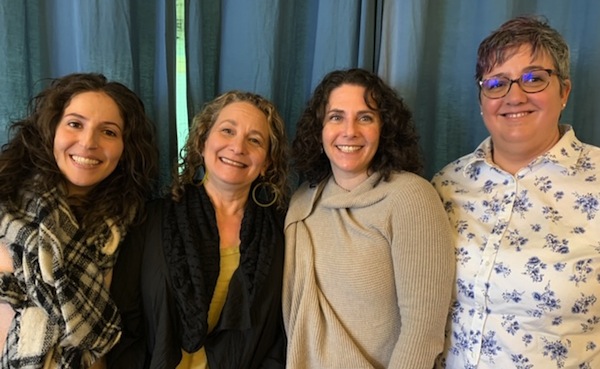
Books for Kids volunteers at NCJWC Vancouver’s 96th AGM, left to right: Jodi Seidelman, Rhea Lazar, Gail Gumprich and Tanya Hebron. (photo from NCJWC Vancouver)

On International Women’s Day, March 8, National Council of Jewish Women of Canada, Vancouver section, planned, learned, noshed and welcomed newcomers.

Sunshine was all around the room at NCJWC Vancouver’s 96th annual general meeting, which took place at the Jewish Community Centre of Greater Vancouver in the Snider Senior Lounge.

Members were welcomed by president Catherine (Cate) Stoller and the new board was installed by Shirley Hyman, Limmud Vancouver program chair and longtime volunteer for NCJWC.

The new executive board is Stoller (president), Fran Ritch (treasurer), Jackie Krystal (co-treasurer), Linda Arato (recording secretary), Anne Lerner (vice-president, social action), Ricki Mintz (vice-president, engagement), Marnie Weinstein (vice-president, marketing and administration) and Rochelle Garfinkel (member-at-large). Appointed board members are Rhea Lazar (chair, Books for Kids program) and Sandy Hazan, Sarah Morel Shaffer and Jane Stoller (co-chairs, Operation Dressup).

After the AGM, Anna-Mae Wiesenthal, a Jewish history teacher at King David High School and a PhD student in Holocaust studies, gave a presentation on the “othering” of indigenous peoples in Canada during the settler colonial period and of Jews in Germany during the Holocaust.

Stressing the strong connection between NCJWC’s social action in the Jewish and non-Jewish communities in British Columbia, council’s advocacy nationally against antisemitism, its support for family services in Israel and its international role supporting human rights, Cate Stoller cheered the passing of the baton between generations. For more information about the Vancouver section of NCJWC, visit ncjwvancouver.org.