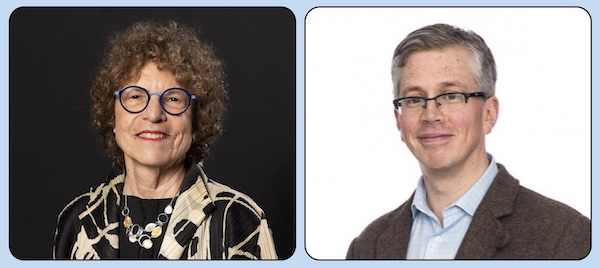
Gregor Craigie, host of CBC Radio One’s On the Island, interviews Eleanor Wachtel at Congregation Emanu-El on Sept. 15, at 2 p.m., about her career helming the CBC’s premier literary program, Writers & Company. During her 33-year tenure with the show, Wachtel spoke with a Who’s Who of authors, including Saul Bellow, Michael Ondaatje, Mordecai Richler, John le Carré and Kazuo Ishiguro.
“[Eleanor’s] sense of respect, her tact, her utter lack of obsequiousness . . . and her uncanny ability to ask difficult questions have endeared her to readers and listeners,” said Canadian writer Carol Shields, whose book, The Stone Diaries, won the Pulitzer Prize for fiction in 1995.
Craigie is both an author and an expert interviewer in his own right. A journalist for more than 25 years, his most recent book, Our Crumbling Foundation, which examines Canada’s housing crisis, is a national bestseller.
The event is part of Emanu-El’s 160th anniversary celebrations, and is a fundraiser for the synagogue, which is undergoing structural and other renovations. Tickets ($36) can be purchased at ticketowl.io/cevbc.
“Our thoughts are influenced by our core belief system. Our opinions are shaped from things we have seen and heard in the past and those opinions affect what we see. The problem is our thoughts are not always necessarily true,” writes Michelle Biton in her new book, The Instant Anxiety Solution (Hatherleigh Press).
“Our own thoughts and beliefs often cause us more anxiety than the actual emotion itself,” she writes. “And sometimes our beliefs are faulty or inaccurate. In order to get to the facts, it’s important to question your thoughts and not always believe everything you think.”
But this is jumping ahead to Step 5 of Biton’s five-step program ALARM, which starts with ways in which we can get our bodies “out of ‘the acute stress’ stage and into a calmer state so you can think properly” (activating the parasympathetic nervous system). It moves to labeling what you’re feeling, then acknowledging that emotions are temporary. Step 4 is about how to remember to avoid building narratives around your thoughts and emotions, and Step 5 is how to move forward and take action.
Originally from Vancouver, Biton is a Los Angeles-based coach, author and health educator. She has a master’s in holistic nutrition, a bachelor’s in psychology and a certificate in kinesiology, health and fitness studies. Her reasons for writing The Instant Anxiety Solution are personal.
“I had been trying to deal with anxiety as if it was logical, but anxiety is not logical. It’s primal and cannot be rationalized. My best friend helped me realize that, in order to manage mine and my daughter’s anxiety, we were going to have to look it in the eye and go through the discomfort of it,” writes Biton. “Going through the anxiety was the only way out of the vicious cycle.”
Biton’s own experiences with anxiety inform her approach. “You are re-learning ingrained patterns and behaviours that will take time to unlearn,” she acknowledges, “so be easy on yourself and give yourself time to go through the process.”
The Instant Anxiety Solution comprises a foreword by marriage and family therapist Nadine Macaluso; an introduction in which Biton lays out some of her reasons for writing the book; an overview of what anxiety is and its effects; a chapter for each of the ALARM steps; a brief conclusion; many exercises readers can do to learn how to better manage anxiety; and 20-plus blank pages for the purposes of journaling.
There are many causes of anxiety, including biological makeup, learned behaviour, lack of sleep, trauma, not eating properly, financial difficulties.
“When we get triggered by an event, our amygdala gets activated, causing the impulsive fight or flight response, and the prefrontal cortex, the logical thinking part of the brain, shuts off,” writes Biton. Our bodies focus on one thing: survival. The sympathetic nervous system is activated, “causing your heart rate, breathing and blood pressure to rise dramatically…. You’ll likely even feel shaky and nauseous.
“Many people make the mistake of trying to problem solve when anxiety hits, but it is absolutely impossible to do,” she writes. We can’t think until we have calmed down, and Biton offers many ways to shock the body out of its anxious state, such as splashing cold water on our face or putting a cold pack on the back of our neck; intense exercise, like a sprint to the end of the block or some push ups; and humming or singing.
There are ways a person can semi-instantly calm themselves, but the crux of tackling anxiety is self-awareness and, for that, there is no quick fix. Biton offers advice on how to identify and deal with feelings, but a main takeaway is to train ourselves to not act in those first moments. Apparently, an emotion lasts seven minutes max, then runs out of steam. It’s “the additional energy that is added in the form of our ‘extra’ thoughts and emotions that we ‘attach’ to the original emotion that keeps the feeling alive and the suffering occurring,” writes Biton.
“Do not act on impulse,” she warns, “you will only regret it afterwards.” But don’t numb yourself either. If you feel like crying, cry. Notice and acknowledge your emotions without judgment. When you’re calm, you can figure out what is really going on, consider both sides of the situation – what happened or was said and your reaction.
We all have pain, she notes: “It is how we ‘react’ to the pain that determines our ‘suffering.’” Suffering, she says, is a sign that you’re not accepting the here and now. Some clues that you might be fighting against reality are that you’re feeling bitter or resentful, or you’re regularly unhappy or frustrated.
“A major reason that many of us suffer from anxiety today is because we have ‘felt unheard’ or ‘dismissed’ in our lives,” she writes. “We were told that we ‘weren’t good enough’ or that we ‘shouldn’t feel a certain way.’ This negative environment taught us not to trust ourselves, and not to trust our emotions. As a result, we have a lot of self-doubt and anxiety.
“On top of that, many of us project fears from the past into the future. Very rarely do we go into a situation without the ‘baggage’ and ‘opinions’ that we have carried from past experiences.”
Biton believes it possible to “become unstuck from the past.” The advice and exercises in The Instant Anxiety Solution may not result in instant results, but they do offer tangible steps to a solution.
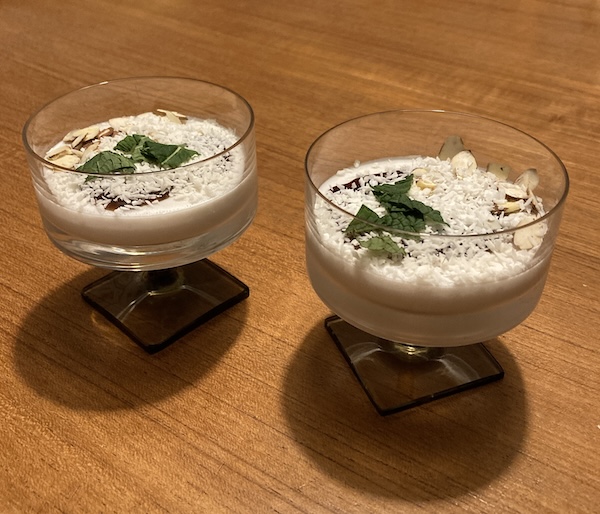
My new favourite dessert: Inbal Baum’s Coconut Cream Malabi. Baum is one of the contributors to June Hersh’s new digital cookbook, Cooking for a Cause. (photo by Ingrid Weisenbach)
I have a new favourite dessert: malabi. At least Inbal Baum’s Coconut Cream Malabi. Baum is one of more than 70 cooks, bloggers and others who have contributed to June Hersh’s new digital cookbook, Cooking for a Cause. All proceeds from the book’s sale support Leket Israel, whose focus is “rescuing healthy, surplus food and delivering it to those in need through partner nonprofit organizations.”
“By purchasing this digital cookbook,” notes Leket’s promotional material, “you will not only be supporting Leket Israel’s routine food rescue operations, distributing fresh, nutritious, surplus food to over 330,000 people in need each week, but you will also be part of Leket’s emergency relief campaign, providing much needed assistance to displaced Israelis throughout the country as well as to the Israeli farming community who has been significantly impacted by the ongoing war.”
Hersh has written several cookbooks “with a charitable flavour,” supporting various causes. She contributes to food blogs and magazines, appears on radio and TV, and gives talks on the importance of preserving Jewish food memory. Cooking for a Cause is a response to the Oct. 7 terror attacks, and Hersh and Leket Israel “reached out to everyone we could think of who has made an impact in the world of Jewish food,” writes Hersh in the introduction. “Additionally, we approached those incredibly outspoken Jewish and non-Jewish supporters who have taken a stand and used their moral compass to point the way. The response was overwhelming!”
The result is a unique cookbook that is interesting both for its recipes and its stories – each entry tells users a bit about the contributor and/or the food being presented, and there are eye-catching colour photos throughout. The cookbook “is not arranged from starters to desserts and it is not consistent in its format,” writes Hersh. “I say this not as an apology but with pride, as this book is deliberately different. It reflects a cacophony of voices that have come together to support Leket and the people of Israel. Each contributor presents their connection to Jewish food and expresses it with a different perspective, writing style and point of view. You, the reader, benefit from diverse cooking techniques, interpretations of Jewish cuisine and fresh commentary with each recipe.”
Recipes that caught my eye as I skimmed through the book included Vegetarian Stuffed Cabbage Rolls (Holishkes) by writer Joe Baur; Pandora’s Chicken with Artichokes, Oregano, Olives and Sundried Tomatoes by Joan Nathan, “award-winning ‘godmother’ of Jewish food”; Aunt Rini’s Tahini Cookies by Elise Addlem, founder of Feminists Against Antisemitism; and Olio Egg Salad by Ben Poremba, who “infuses his Israeli-Moroccan heritage into all his restaurants.”
I have bookmarked these recipes for future cooking/baking sessions, and will certainly try others as well. Between the Jewish Independent’s Passover and Israel special issues, I only had time to try out three recipes. In addition to Coconut Cream Malabi, which Baum writes was inspired by “Our Chef Sevim [Zakuto], with her Turkish-Jewish roots, [who] shared the cherished recipe from her grandmother,” I made Rachel Simons’ Fennel and Herb Salad (Simons is a co-founder of the company Seed+Mill) and award-winning chef and restaurateur Jonathan Waxman’s Steelhead Trout with Vermouth, Baby Sorrel, Chanterelles and Fingerlings.
The salad was as big of a hit as the malabi, and I enjoyed the meal part of the trout recipe but wasn’t so keen on the sauce, which contained vermouth. Not being a lover of vermouth, I had put the sauce on the side, and I thought the food was better without it. When I make the fish again, I’ll try to halve the vermouth or reduce it on the stove to see if that makes it taste less sharp.
COCONUT CREAM MALABI (by Inbal Baum)
1 can coconut cream (fat content should be greater than 14% for the best results) 3 tbsp sugar 3 tbsp cornstarch 1/3 cup of water 1 tsp of vanilla extract, or rose or orange blossom water crushed (or chopped) nuts, to taste desiccated coconut, for serving pomegranate molasses and/or silan, for serving optional toppings: chopped seasonal fruit (strawberries, apricots, mango)
In a small saucepan, combine the coconut milk and sugar. Bring to a gentle boil. Meanwhile, in a small bowl, mix the cornstarch and water until well combined. Slowly add the cornstarch to the saucepan, continuously stirring.
Over medium heat, continue stirring until the pudding thickens – this may take 3 to 5 minutes. If needed to thicken, add additional cornstarch in small amounts until the mixture begins to thicken.
Mix in the vanilla extract, orange blossom or rose water, then pour or ladle into four small bowls.
Allow to cool before serving (approximately one hour, but can be less).
When ready to serve, top with a layer of pomegranate molasses or silan (date honey), desiccated coconut and ground nuts.
FENNEL AND HERB SALAD (by Rachel Simons; 4 servings; 30 minutes to prepare)
1 fennel bulb, very thinly sliced crosswise juice of 1 lemon 1 cup cold water 1/2 cup fresh mint leaves, roughly chopped 1/2 cup fresh parsley leaves, roughly chopped 1 tbsp white wine vinegar 2 tbsp extra virgin olive oil 1 tsp flaky sea salt 1/8 tsp ground black pepper 1 cup parmesan cheese, thinly shaved (optional)
Place the sliced fennel into a bowl with the lemon juice and cold water. Let sit for about 10 to 15 minutes. Drain the fennel.
In a large bowl, mix the fennel, mint leaves, parsley leaves, white wine vinegar, olive oil, salt, pepper and parmesan (if using). Mix to combine well. Serve the salad cold.
STEELHEAD TROUT WITH VERMOUTH, BABY SORREL, CHANTERELLES AND FINGERLINGS (by Jonathan Waxman; serves 4)
4 x 4.5-ounce skin-on, boneless steelhead trout fillets 1/2 cup white vermouth 2 tbsp butter 2 tbsp olive oil 1 cup baby sorrel 1 cup cream 1 cup sliced raw fingerling potatoes 1 cup button chanterelle mushrooms
Season steelhead with sea salt and fresh ground white pepper.
Cook the potatoes in simmering salted water for 12 minutes. Set aside.
Wash mushrooms.
In a sauté pan, add 1 tbsp olive oil and 1 tbsp butter, heat to sizzling, add the trout, skin side down and sauté for 2 minutes.
When skin is crispy, turn over and add remaining olive oil and butter. Then add the potatoes and chanterelles to pan. Cook over medium heat for 5 to 8 minutes.
Remove steelhead to a warm platter. Ensure potatoes and chanterelles are cooked, add them to the fish platter.
Add the vermouth to pan and then add the cream. Turn off heat and add the sorrel leaves.
Taste sauce for seasoning and gently coat the potatoes and chanterelles with sauce. Serve hot.
* * *
To purchase Cooking for a Cause, go to chef.leket.org. For more on Leket Israel – including how you could join the organization’s approximately 54,000 annual volunteers “in gleaning, sorting and packaging rescued food for the Israelis in need” – visit leket.org.
For 20 years, on the afternoon of Yom Kippur, Prof. Chris Friedrichs delivered a lecture to the congregants of Temple Sholom on the subject of the Holocaust. It started in 2004, when Rabbi Philip Bregman, now rabbi emeritus of the shul, asked Friedrichs to speak on the most solemn day in the liturgical calendar. The rabbiasked him to reprise the lecture the following year, and it became an annual event.
After the 2014 passing of Friedrichs’ wife, Dr. Rhoda Lange Friedrichs, like her husband an historian, Rabbi Dan Moskovitz announced that the presentation would be known as the Rhoda Friedrichs Memorial Lecture.
Two decades of Prof. Chris Friedrichs’ Yom Kippur lectures at Temple Sholom have been compiled into a book, Reflections on the Shoah. (photo from Chris Friedrichs)
Friedrichs, now professor emeritus of history at the University of British Columbia, decided to end the tradition after 20 years and his friend and UBC colleague, Prof. Richard Menkis, suggested the idea of compiling the lectures in a book.
The volume, Reflections on the Shoah: Yom Kippur Sermons Given at Temple Sholom 2004-2023 is a small but irreplaceable volume offering deep and original insights on the lessons of history from a leading thinker on these subjects.
In these lectures, Friedrichs does not dwell on the facts of history so much as draw broader insights into their meaning. In 2005, he reflected on the term “martyrs,” which is often used in reference to the victims of the Nazis.
“A martyr is someone who has accepted death rather than renounce his or her Jewish faith,” he said. Yet, he noted, among the six million were many, like the Jewish-born Catholic nun Edith Stein, who were not killed because they refused to renounce their faith. Indeed, he said, renunciation would not bring redemption. It was Jewish “racial” identity, not adherence to Jewish ideas, that drove the Nazis’ murderous objectives.
In an historic sense, though, Friedrichs argues, Jews were murdered in the Holocaust because generations of ancestors had refused, against all pressures, to abandon their identities. “And, therefore, it is in fact right to honour those who died as martyrs,” he said.
In 2007, Friedrichs struggled with theologians’ explorations of the meaning of the Shoah, as though some divine purpose could be discerned from it.
“The Shoah was an entirely human event,” he said. “But that hardly removes the question: where was God while it took place? Why did God allow it to happen?”
God gave humans free will, he concluded, but this does not answer the unknowable question.
“In a world we cannot begin to understand, we can still hope for mercy, and we can pray for strength,” he said.
In a brief postscript to this lecture, Friedrichs writes that the daughter of a friend, having heard the sermon, asked her father “Where was God?” In response, the father said, “Where was man?”
In 2012, Friedrichs spoke of the first Holocaust memorial ever created, in May 1943, in the Majdanek death camp, where a group of prisoners persuaded the SS administrator that the camp could be made more beautiful if they could erect a pillar topped by a statue of three eagles about to take flight. The commandant never knew that under the base of the pillar the inmates had buried a container of ashes of the victims taken from the crematorium.
In 2013, Friedrichs addresses the problem with the very word Holocaust, which means a burnt sacrifice.
“What a meaningless term!” Friedrichs declared. “Six million Jews were sacrificed? Sacrificed to what God? Sacrificed to what end?”
In 2020, when his lecture was recorded and shared virtually because of the pandemic, Friedrichs spoke of the sanctity of life.
The next year, after unmarked graves were discovered adjacent to a former residential school in Kamloops, he spoke of the “humanitarian obligation to go beyond just our circle of Jewish concerns.” He drew parallels between the MS St. Louis, the ship of Jewish refugees turned away from ports of refuge, including Canada’s, and the Afghans clambering through the Kabul airport, struggling to escape the country before the takeover of the Taliban.
In 2022, he invoked a very different piece of history. In high school, his most memorable teacher was Anne Schwerner. When the news came, in the summer of 1964, that three civil rights workers had been murdered by white supremacists in Mississippi, one of them Michael Schwerner, Friedrichs realized this was his favourite teacher’s son. He reflected on the lessons of obligation to universal freedom and rights embodied in Jewish tradition.
In his last lecture in the series, Friedrichs spoke of how, when he speaks to audiences of high school students, as he frequently does, he makes the lessons relevant to young, multicultural Canadians.
“I tell the students that it is normal to dislike somebody because that person, as an individual, is bad or unkind or unpleasant,” he said. “But to dislike or hate somebody not because of their own characteristics but because they happen to belong to a group, to hate them just because they are Chinese or Filipino or South Asian or Black or members of any other group, is to take the first step on a path that has led and could lead again to things like the Holocaust.”
In most of his lectures, Friedrichs describes predations that are difficult to read and must have been more difficult to hear on a Yom Kippur afternoon, in a room that includes survivors of precisely such atrocities. This, though, is one of the invaluable aspects of Friedrichs’ approach. Whatever reservations might exist in this time of safe spaces and trigger warnings, one can hardly make the case that it is too burdensome to listen to a few examples of the barbarism for the sake of education, memorialization and understanding, when there are people in our community, including in the congregation Friedrichs was addressing, who experienced the cruelties themselves.
Anyone who heard these lectures when they were delivered, or has heard any of Friedrichs’ many presentations elsewhere, can hardly help but hear his deep voice and commanding delivery while reading his words. Those who haven’t had the privilege of hearing him speak are fortunate to have these lectures compiled in this new book.
Chef and dietitian Micah Siva’s new cookbook, NOSH: Plant-Forward Recipes Celebrating Modern Jewish Cuisine, proves that plant-forward meals can be bursting with flavour and colour. (photo by Hannah Lozano)
“This is really good,” said my wife, as she tasted the steaming hot Spiced Cauliflower Chraime I had made from the new cookbook NOSH: Plant-Forward Recipes Celebrating Modern Jewish Cuisine (The Collective Book Studio) by chef and dietitian Micah Siva.
“‘Plant forward’ is a way of cooking and eating that emphasizes plant-based foods without limiting one’s diet to being vegetarian or vegan,” writes Siva. “This book is meant for anyone who follows a plant-based diet or is looking to adopt a plant-forward way of eating.”
It’s also for anyone who appreciates delicious food, from what I can tell from the plates I tried. Nonetheless, Siva does offer solid advice for meat-eaters wanting to become more plant-forward. In that regard, she talks about getting enough protein and iron, what can be substituted for eggs, etc.
On the Jewish side, she gives milk and butter substitutions to make a recipe pareve (permissible for observant Jews to eat with milk or meat dishes) and offers sample holiday menus. I found the Shabbat Matrix interesting – the cooking time required (little, more and lots) is on one axis and the effort involved (low and high) is on the other. Siva offers some ideas to think about
depending on the time and effort you can put into the meal. So, you can buy store-bought challah or make your own, make spritzers or just buy a bottle of wine and/or grape juice, for example.
Given that Passover is approaching, I focused on a few of the recipes Siva highlights for the holiday. Her list comprises Turmeric Vegetable Matzo Ball Soup, Vegan “Gefilte” Cakes, the aforementioned Spiced Cauliflower Chraime, Herbed Horseradish Salad, Cast-Iron Potato and Caramelized Onion Kugel, Passover Black and White Cookies and Passover Coconut Macaroons. In addition to the chraime, I made the kugel and the macaroons. For fun, and because I have a huge bag of sumac from another cooking experience, I also made two Olive and Sumac Martinis – though neither my wife nor I are hard-liquor folks, we enjoyed our sips.
The production quality of this cookbook is high. The layouts are beautiful, with lots of colour photos and easy-to-follow instructions, which are supplemented by dietary labels (ex. vegan, gluten-free, Passover-friendly), the time required to get the food or drink on the table and clearly listed ingredients, as well as a brief introduction to each recipe and notes about certain ingredients that may be new to some cooks, or variations that could be used, possible substitutions.
NOSH includes a glossary and I learned a lot perusing it. Amba, for instance, is a “tangy, spicy, pickled mango-based condiment or sauce of Indian-Jewish origin” and toum is a “garlic sauce, similar to aioli, made of garlic, oil, salt, and lemon juice.” Siva gives some hints about measuring, choosing ingredients and shopping efficiently. There is an index at the back of the book, plus conversion charts for liquid and dry measures, and a Fahrenheit-Celsius temperature table. Acknowledgements and a bit about the author round out the publication.
In the few recipes I tried – and Passover-friendly ones at that – the expansive flavour palette on offer was evident.I look forward to making some of the 80+ other recipes in this cookbook, which illustrates the global diversity of Jewish culture. Siva may have grown up in Calgary, but her repertoire travels well beyond, to the Middle East, India, Africa, Europe and elsewhere Jews live or have lived. Her blog, at noshwithmicah.com, is worth checking out.
The cauliflower chraime was packed with spices – all of which I miraculously had in my cupboard! – and I will definitely make this dish again, as it was not only tasty but also easy to put together. According to Siva, it “is typically made with a whitefish poached in a tomato broth” and is often served in Sephardi families instead of gefilte fish during Passover. The recipe suggests serving it with couscous or rice, neither of which observant Ashkenazi Jews can eat during the holiday, so I plated it with mashed potatoes, which are OK for all Jews on Passover, and the two paired well.
It is worth sharing Siva’s note in the cookbook, acknowledging that the recipes “that are ‘Passover Friendly’ will have kitniyot,” even though “Ashkenazi Jews typically prohibit kitniyot, which includes rice, corn, millet, and legumes (beans), as they look too similar to grains. While customarily left out of Passover menus, it is not technically prohibited by the Torah.” So, “[i]f a recipe is listed as suitable for Passover, please use your discretion, and do what feels more comfortable for you and your family.”
In the recipes that follow, all of which I recommend, I don’t include (for space reasons) the informative introductions that appear in the book. I made only one adaptation, choosing not to dip the coconut macaroons into chocolate, my personal preference being to just enjoy the richness of the coconut, brightened by the splash of lime juice and zest.
SPICED CAULIFLOWER CHRAIME (serves 4, on the table in one hour)
The Spiced Cauliflower Chraime from NOSH will be an immediate favourite. (photo by Micah Siva)
2 tbsp extra-virgin olive oil 1/2 medium white onion, cut into 1/2-inch pieces 3 garlic cloves, finely chopped 3 tbsp tomato paste 4 tsp smoked paprika 2 tsp ground turmeric 1 tsp ground coriander 1 tsp ground cumin 1 tsp ground ginger 1/4 tsp ground cinnamon 1/2 tsp red chili flakes 1/4 tsp sea salt juice of 1 lemon (about 2 tbsp) 1/2 cup canned diced tomatoes 1 1/4 cups vegetable broth (low-sodium, if preferred) 1/2 cup golden raisins 1 small head cauliflower, cut into 6 wedges (if using a large cauliflower, cut into 8 wedges) 2 tsp date syrup or maple syrup 1/2 cup chopped fresh cilantro,for serving Cooked couscous or rice, for serving (I used mashed potatoes)
Heat the olive oil in a deep skillet over medium heat. Add the onion and cook until it begins to soften, 5 to 6 minutes.
Add the garlic, tomato paste, smoked paprika, turmeric, coriander, cumin, ginger, cinnamon, chili flakes, and salt, stir until combined, and cook for 2 to 3 minutes. Pour in the lemon juice, canned tomatoes, broth and raisins and stir to combine.
Place the cauliflower in the pan, cut side down in a single layer. Bring the liquid to a boil, decrease the heat to a simmer, cover and cook until the cauliflower is tender, 15 to 20 minutes.
Drizzle with the date syrup and garnish with the cilantro. serve with cooked couscous or rice.
Note: Store in an airtight container in the fridge for up to 5 days.Reheat in a pan, oven, or microwave until warmed through.
Variations: Substitute chopped dried apricots or figs instead of raisins. Looking for more protein? Add a can of drained and rinsed chickpeas along with the canned tomatoes and/or crumble some feta cheese on top.
CAST-IRON POTATO ANDCARAMELIZED ONION KUGEL (serves 10 to 12, on the table in 2 hours)
Micah Siva’s Cast-Iron Potato and Caramelized Onion Kugel can be a side or a meal. (photo by Micha Siva)
5 tbsp extra-virgin olive oil, divided 2 medium yellow onions, cut into 1/2-inch pieces 1 1/2 tsp salt, divided 2 pounds (3 or 4) russet potatoes 4 large eggs 1/2 tsp black pepper 1/4 cup matzah meal sour cream, coconut yogurt, crème fraîche or labneh, for serving (optional) fresh chives, chopped, for serving
In a 9-inch cast-iron pan, heat 2 tablespoons of the olive oil over medium heat until the oil is hot but not smoking. Add the chopped onions, spreading them evenly over the bottom of the pan. Decrease the heat to medium-low and let cook, undisturbed, for approximately 10 minutes.
Sprinkle the onions with 1/2 teaspoon of the salt and cook, stirring occasionally, until browned and broken down, 30 to 45 minutes. Once golden and caramelized, transfer the onions to a large bowl.
Preheat the oven to 350°F.
Add the remaining 3 tablespoons of olive oil to the cast-iron pan and place it in the oven to heat up while you prepare the potatoes.
Fill a large bowl with ice water.
Using a food processor fitted with the shredding disk, or a box grater on the largest hole, grate the potatoes. The potatoes will oxidize, so be sure to shred right before use.
Add the potatoes to the bowl of ice water. Let sit for 10 minutes to remove excess starch.
Drain the potatoes, transfer them to a clean kitchen towel, and wring out any excess liquid. The more liquid you can remove, the better! Add the potatoes to the bowl with the caramelized onions.
Add the remaining 1 teaspoon of salt, eggs, pepper and matzah meal and stir to combine.
Carefully remove the cast-iron pan from the oven and spread the potato mixture in the pan, pushing it down to compact the potatoes. It should sizzle on contact with the pan. Return the pan to the oven and bake for 1 hour, or until deep golden brown on top.
Serve with sour cream and chopped chives.
Note: Prepare this kugel up to 4 days in advance and store in an airtight container in the fridge.
Variation: Add 1/2 cup chopped parsley to the kugel along with the matzah meal.
Substitution: This recipe uses russet potatoes, but you can use Idaho potatoes instead.
PASSOVER COCONUT MACAROONS (makes 12 [large] macaroons, on the table in 45 minutes, including 10 minutes resting time)
Lime juice and zest make Micah Siva’s Passover Coconut Macaroons special. (photo by Cynthia Ramsay)
2 cups unsweetened shredded coconut 1/2 cup sugar 1/3 cup potato starch 1/2 cup canned full-fat coconut milk 1 tbsp lime juice 1/2 tsp lime zest 1/4 tsp sea salt 6 ounces (about 1 cup) dark chocolate chips 1 tbsp coconut oil
Preheat the oven to 325°F. Line a sheet pan with parchment paper.
In a medium bowl, combine the coconut, sugar, potato starch, coconut milk, lime juice, lime zest and salt until well combined.
Using a cookie scoop or ice cream scoop (large enough to fit approximately 2 tablespoons), scoop up some of the coconut mixture and pack it very firmly into the scoop. Use your fingers or the back of a spoon to press it into the scoop. Gently remove the coconut mound from the scoop and place it onto the prepared sheet pan. Tap the back of the cookie scoop to release it, if needed, and reform the mounds after placing them on the pan. Repeat with the remaining coconut mixture.
Bake for 22 to 25 minutes, or until golden. Let cool on the sheet pan. Once cool, remove them from the pan and place them on a plate. Line the sheet pan with wax paper.
While the macaroons are cooling, combine the chocolate chips and coconut oil in a microwave-safe bowl and microwave in 30-second increments, mixing well between each increment, until smooth.
Once the macaroons are cooled, dip the bottoms into the melted chocolate and place them on the prepared sheet pan. Refrigerate the macaroons until the chocolate is set, about 10 minutes.
Note: Once the chocolate has set, store the macaroons in an airtight container at room temperature for up to 5 days or in the refrigerator for up to 2 weeks. Store them in the freezer for up to 3 months.
Variation: Add 1 teaspoon of vanilla extract or 1/4 teaspoon of almond extract to the mixture in place of the lime zest and lime juice. Fold in 2 tablespoons of rainbow sprinkles and dip them into melted white chocolate.
OLIVE AND SUMAC MARTINI (serves 1, on the table in 10 minutes)
An Olive and Sumac Martini is one of the unique drink options in NOSH. (photo by Cynthia Ramsay)
1/2 ounce olive juice, plus more to rim the glass 1/2 tsp sumac, plus more to rim the glass 2 1/2 ounces gin or vodka 1/2 ounce dry vermouth ice 2 or 3 olives, pitted
Pour a little olive juice into a shallow dish. Place some sumac in another shallow dish. Dip the rim of a cocktail glass into the olive juice and then into the sumac. Gently shake off any excess sumac and set aside.
In a cocktail shaker or a jar with a lid, combine the gin, vermouth, 1/2 ounce olive juice and 1/2 teaspoon sumac and fill with ice. Stir or seal and shake until well chilled, 20 to 30 seconds. Strain the liquid into the rimmed cocktail glass and garnish with olives.
The historic milestones that led to the creation of the state of Israel are well known: Theodor Herzl’s Zionist congresses, the Balfour Declaration, the Partition Resolution, the War of Independence. Oren Kessler – who participates in the Cherie Smith JCC Jewish Book Festival on Feb. 13 – believes that a significant chunk of history has been largely overlooked and he sets out to right that wrong in his new book, Palestine 1936: The Great Revolt and the Roots of the Middle East Conflict. The Arab uprising of 1936 to 1939 in Palestine, he writes, “was the crucible in which Palestinian identity coalesced.” It also set in stone the intransigence toward Jewish self-determination in the region.
An Arab reaction to increased Jewish migration to Palestine – presaging both the potential for an eventual Jewish majority in the British-controlled Mandate and an even more alarming political outcome, a Jewish national homeland – inspired three years of Arab terror and British colonial repression, with the Jews inevitably caught between, argues Kessler.
Beginning with a series of strikes and protests in April 1936, the haphazard opposition to British rule and Jewish immigration was soon corralled and led by the notorious Grand Mufti of Jerusalem, Hajj Amin al-Husseini, into a mass movement of terror and anti-colonial (and anti-Jewish) violence.
While the British, on the one hand, hammered the Arab guerrillas – and plenty of civilians – they also rewarded that violence with policies such as those emerging from the 1937 Peel Commission report and the 1939 White Paper, both of which effectively caved to Arab demands by massively reducing Jewish immigration just as the Nazis were closing their fists across Europe. At the same time, the British left the Arabs unsatisfied by throwing tiny offerings to the Jews as a sign of compromise.
So unyielding was the mufti’s opposition to even considering Jewish migration that his Arab Higher Committee boycotted the various commissions’ hearings.
“Amid Hajj Amin’s boycott, no Arabs came forward,” writes Kessler. “Jerusalem Vice Mayor Hassan Sidqi Dajani, the mufti opponent who had once contemplated testifying, was found along the train tracks outside the city with two broken hands and two bullet holes in his forehead.”
In the end, the revolt was a disaster foreveryone.
“The great revolt had exacted a withering toll on Palestine,” writes Kessler. “About 500 Jews had been killed and some 1,000 wounded. British troops and police suffered around 250 fatalities in their ranks. But the most onerous price of all was paid by the Arabs themselves: at least 5,000 – perhaps more than 8,000 – were dead, of whom at least 1,500 likely fell at Arab hands. More than 20,000 were seriously wounded.”
The Arab economy in Palestine was ruined, even as the Jewish economy hummed along.
Kessler’s thesis is that the events of 1936-1939 deserve to be recognized more as pivotal to the history of the region as a whole. There are also voluminous parallels and lessons for contemporary times in his review of that era.
The uprising did not, in the end, prevent Jewish national self-determination in Palestine. What it did prevent was a refuge for the Jews of Europe when they needed it most – and, for at least some of the players in this tragic drama, like the Hitler-allied mufti, perhaps that was a reward in itself.
They both made headlines in their day, and then were more or less forgotten. A social climber who ends up convicted of killing his wife in one instance, an inventor-turned-money launderer in the other. Two very different men living in different eras who achieved the wealth and lifestyle they sought, then lost it all in spectacular fashion.
Historian Allan Levine and filmmaker David Rabinovitch close the Cherie Smith JCC Jewish Book Festival on Feb. 15, 8 p.m., at the Jewish Community Centre of Greater Vancouver with the event Jewish True Crime Stories, moderated by SM Freedman, who spent years as a private investigator in Vancouver before becoming a bestselling author of psychological thrillers. Levine will talk about his latest book, Details Are Unprintable: Wayne Lonergan and the Sensational Café Society Murder (2020), and Rabinovitch will talk about : The Mob and the Dark Side of the American Dream (2023), his first book.
Both true crime publications have a similar structure. They both have a cast of characters at the beginning, followed by a prologue or preface, then the narrative proceeds chronologically, beginning with each protagonist’s origin story, and following the circumstances and decisions that led to their headline-grabbing lives. Both books have extensive notes and bibliographies. Levine and Rabinovitch each read more than a thousand pages of court transcripts and related documents, like witness testimonies and letters, as well as newspapers of the day. These types of resources, written as events were unfolding, allow both authors to tell their stories with an immediacy that propels readers along. In both books, it feels as if what we’re right in the midst of what is happening.
For Levine, the idea of exploring Toronto-born opportunist Wayne Lonergan’s conviction for the Oct. 23, 1943, murder of his wife, Patricia Burton Lonergan, the daughter of a wealthy German-Jewish family in New York City, came from reading a 1948 Cosmopolitan article by Raymond Chandler. The renowned detective fiction writer listed Lonergan’s case as #9 in his list of the “10 greatest crimes of the century.” There have been a couple of novels based on the case and, writes Levine, “Over the years, the story of the murder, with the requisite number of theories about Lonergan’s sexual identity, has been told and retold in countless tabloid newspapers and magazines and remains a favourite topic of crime and mystery bloggers.”
Lonergan’s bisexuality plays an important part in the story, including his initial alibi, and Levine adds social context in this and other instances, such as describing the mores of the café society into which Lonergan married. Levine takes the tabloid aspect out of the telling, in that he seems to have harnessed the facts and his conclusion as to Lonergan’s innocence or guilt seems solid.
Rabinovitch’s ability to step back and tell the story of Wolfe Rabin in an apparently unbiased way is even more impressive, given that Rabin is his uncle. Granted, Rabinovitch never met Rabin, but still, family is family.
“How did my father’s brother, raised in an immigrant Jewish family in a remote Canadian prairie town [Morden, Man.], become a jukebox tycoon, a crony of gangsters and the mastermind behind an audacious and complex international money-laundering scheme?” writes Rabinovitch. “My investigation would reveal his world and a tale of jukeboxes, money laundering and organized crime.”
Rabin was a smart, creative and resourceful person. “He invented the car radio. He was a wartime profiteer. He designed the first jet-age jukebox. He was an international bonds trader,” writes Rabinovitch. “Wolfe and his sexy wife Trudy were a glamorous couple.”
But, early in his career, Rabin makes a deal with the proverbial devil, a mobster, and it’s a deal that makes him rich at first. But a competitor – fellow Manitoban David Rockola – successfully sues for patent infringements in the late 1940s, putting Rabin out of business and in need of money to pay back his criminal investors. It is fascinating to read of the mob connections to the jukebox industry, an industry that pulled in millions a week because, as Rabinovitch writes, “Even at the nadir of the Depression, anyone could afford a nickel for a song.”
And Rabin’s story becomes even more incredible after his jukebox business fails. In pursuit of much-needed cash, he becomes involved with stolen bonds, in what the U.S. Department of Justice called “the largest money-laundering scheme in history.” Eventually, the law does catch up with Rabin and some of his associates. Jail time is served. But Rabin’s biggest secret was only revealed long after his death in 1967, after Rabinovitch completed the draft of this book. It is one of the sadder elements of Rabin’s story. Despite all his achievements, there is much Rabin missed out on in his quest for wealth.
“If there is one thing we learn during difficult times, it’s that community plays a crucial role, fostering unity, resilience and offering emotional support,” writes Dana Camil Hewitt, director of the annual Cherie Smith JCC Jewish Book Festival, in her introduction to this year’s event, which will once again bring community members together to share stories and conversations – and in a difficult time.
The festival opens Feb. 10 with playwright, journalist and author Michael Posner in conversation with Alan Twigg, founder and editor for 33 years of BC BookWorld, about Posner’s three-volume biography of musician, composer and poet Leonard Cohen. The opening night includes a live musical performance with Harriet Frost and Martin Gotfrit, which illustrates perfectly how the influence of books extends beyond the printed page.
The world around us and how it shapes who we are, and vice versa, is front and centre in the Feb. 11 festival event Essays as Life Stories, featuring Vancouver’s Yosef Wosk and Hamilton’s Gary Barwin.
Traveling beyond the world
In his new book, Naked in a Pyramid: Travels & Observations, scholar, rabbi and philanthropist Yosef Wosk brings readers along on his extraordinary journeys throughout the world. But this is no Rick Steves guidebook. There are no hotel recommendations or Top 10 must-see lists. Far from it. Rather than inspiring wanderlust, in fact, some of Wosk’s adventures will make the reader happy to be home in an easy chair experiencing vicariously rather than accompanying him on these not-always-alluring quests.
Wosk acknowledges that travel for him is not about R&R but always about adventure, challenging himself to discover not only the world but his place in it. Travel, for him, is “more of an intuitive imperative, a pilgrimage to the ends of the earth so that I might know both the planet and myself better.”
To these ends (literally), Wosk has traveled to both the north and the south poles. His reflections on being – within a little more than a year of each other – at the figurative top and bottom of the planet, lead to fascinating metaphysical contemplations. He is also provoked to contest mundane assumptions when he sees, at the South Pole, an upside-down globe. Why, he realizes he has never contemplated, should north be on top?
Wosk does not just see stuff, or even experience it, like an ordinary traveler, but finds himself transported beyond even the remote locales he visits to some supernatural planes. Near the North Pole, for example, he alarms travel-mates by laying down, albeit densely insulated, on the frozen Arctic ground “like some marooned sapien seal.” Becoming one with the planet’s most northerly extremity, he recalls, “I was seized by this unanticipated epiphany of transcendent unity.”
The intensity with which he lives the places he encounters makes for a fascinating read and those of us who lack his depth of connection with the ethereal may feel pangs of jealousy, if not inferiority, at failing to experience as profoundly.
He visits Venice, the birthplace of Marco Polo – well, one of the reputed birthplaces – and finds resolve from the “Master of Travelers, the one who dared.” But Venice, as magnificent as it is, seems to be among the least remarkable of Wosk’s destinations.
“I have explored caves and caverns in Israel, Thailand and deep within the Rock of Gibraltar where Neanderthals lived for over 100,000 years, and also entered the coastal caves along the cerulean Na Pali coast in Kauai,” he writes. “Gazing into the luminous waters of the Blue Grotto in Capri, one of the most enchanting islands on the planet, one senses its womb of wonders.”
Claustrophobia is a recurring theme (for the reader, if less so the writer), with reminiscences of crawling on his back into a sarcophagus, descending into the bowels of a Soviet-era nuclear-powered Arctic icebreaker, or meditating (naked) in the subterranean hollows of the pyramid that gives the book its title.
The book is deeply personal, including revealing insights into his deepest thoughts, as well as the sorts of travel nightmares to which anyone can relate, such as being stuck together with a sulky travel companion who he had considered a potential love interest, but who turns out to be the roommate from hell. He seems to recognize that his well-intentioned psychoanalyzing of her behaviour may not have been the remedy he had hoped.
His sense of being an outsider is not merely social but otherworldly.
“I have always felt like a fool, somewhat awkward in an unfamiliar world – as if I have just awakened from a distant dream and been planted, like Adam, in a strange Garden of Gaia. I spent most of my life as an unrepentant pilgrim, exploring often exotic and embarrassing sensations of mind, body and soul.”
He openly admits that some of these sensations are enhanced by herbal or chemical assistance.
“On a beach off the road from Pafos to Limassol, in southern Cyprus, a friend and I took LSD at the fabled birthplace of Aphrodite,” he writes. “The beach was gravel and the waters rough but as the long, foaming waters born of the massive surf around the Rock reached the shore, one could easily imagine the earth being impregnated by the semen-bubbled surf and picture the goddess of love emerging from the sea.”
The book is about travel, but Wosk also covers voyages more broadly defined, such as the process of moving through life itself, including the reflection that a great rabbi imparted to him.
“One of my teachers, Zalman Schachter-Shalomi, used to tell us that you don’t have to wait until you’re dead to die; that one can be involved in a succession of deaths and rebirths, that there is non-mortal death and resurrection while still alive,” writes Wosk.
In a harrowing experience while illicitly climbing the Egyptian pyramid of the title, he seems to have exactly this sort of non-mortal death, which may well have been entirely mortal had things turned any further awry.
Wosk has rubbed shoulders (or, more accurately, minds) with greats like Buckminster Fuller, Marshall McLuhan and Joseph Campbell. He worked at the right hand of Nobel laureate Elie Wiesel as his teaching assistant and calls the late humanitarian author “one of the most influential mentors in my life.”
If Wosk sometimes seems a figure remote from the ordinary human, he yanks himself back down to earth in numerous segments, such as explaining how he overcame his intimidation at applying for Harvard’s divinity school. He eventually conquers his resistance and completes the graduate school application in the mechanic’s anteroom while his car is being serviced nearby. Even by the standards of a vegetarian, which he is, Wosk’s culinary tastes are decidedly and literally down to earth. (Favourite food? The potato.)
He refers modestly to his extensive philanthropy, which includes the Beit Wosk Community Centre, in Ashkelon, Israel, and the Dena Wosk School of Performing Arts at the Jewish Community Centre of Greater Vancouver (named for his late mother), but elides hundreds of other contributions over the years.
He pays tribute to his late father Morris (“MJ”) and late uncle Ben, who arrived as children in this country. The brothers did odd jobs before starting a business collecting and repairing used pots and pans, which they shined up and sold around town using a horse and buggy. From this, they graduated to a storefront and later a furniture chain. Eventually, the brothers reshaped the city’s skyline with some of Vancouver’s most recognizable high-rise residential towers. To say the family came a long way from rural Ukraine is an understatement. MJ Wosk is estimated to have donated $50 million to a variety of causes.
It is difficult to sum up this book as this or that genre. While one section is an extended poem, much of the rest reads as prose poetry. Moreover, it is travel journal, philosophy treatise, theological tract and memoir of a person who curates and collects not just fascinating objects (which he does) but ideas, experiences and memories. Perhaps the book could be best described as an exhibition, a retrospective of a just a few of the intangible treasures Wosk has amassed in a lifetime that seems more unique than every life, by definition, is.
As fellow thinker John Ralston Saul said of this book, “He brings us a life intensely lived.” To appreciate how intensely, one really needs to immerse oneself in these pages.
– Pat Johnson
Exploring language’s many facets
Gary Barwin’s Imagining Imagining is reflective, sentimental, intellectual and absurd. His facility with the English language is remarkable and he is more well-read than most of us, but there are various levels of understanding of any text, and everyone will take away something of value from this imaginative and mind-expanding collection of essays.
The multiple-award-winning author of some 30 books, including the bestselling Yiddish for Pirates, Barwin is also a musician, composer and artist. He draws upon all his varied skills and interests in his imaginings. He begins with reflections on the Hebrew alphabet, where the Book of Genesis says the world began: “the earth was without form and void until God gave shape or reality to it, all with words. With the letters that form the Hebrew alphabet.” He talks of the letters’ sounds and shapes, even illustrates the letter shin with an extra arm on the left that looks like it is topped with a crown, the image of which appears on the tefillin box that Orthodox Jews place on their forehead for morning prayers. According to a kabbalist text, there is a letter missing from the Hebrew alphabet and some think this four-armed shin might be it. “So, the thinking goes, we might already know what it looks like. But we don’t know what new sound it might make, this new sound that might heal the universe.”
While lauding language and its potential as a cause for hope, Barwin warns that language can also lull and trick us. “We must always look very carefully at language. At its beauty, its mystery. Its power to make us think and feel things. Its power to make and remake the world,” he writes.
If it’s not obvious already, Barwin is a big thinker. And he has a big vocabulary. Imagining Imagining might be a book to read as an ebook, for easy access to a dictionary. For the most part, however, his skill as a writer means that we get the gist if not the whole idea, that our curiosity is piqued and we continue to revel in our own thoughts long after we finish reading an essay.
Those who have read Barwin’s novels will know that he has a great sense of humour, and there are many smiling, even laugh-aloud, moments in these essays. One essay is entirely devoted to humour, and it’s fascinating – and funny. In it, he shares his favourite poem, “Modern Poem,” written by Martin Laba: “one, two, / three, four, / five, you idiot.”
“I like it because we can empathize with the feeling of having read something, perhaps a modern poem, something that is so hard to understand, that appears to be saying something willfully inaccessible or that appears so entirely pointless that it seems to be deliberately trying to make you feel like an idiot,” writes Barwin. “I like the poem because of the nice twist, the surprise at the end, the shock of recognition. Oh yes, I know poems like this. And I know that feeling.”
There are many shocks of recognition in Imagining Imagining, as there are shocks of non-recognition. Barwin is a smart, accomplished person and his views on things – from Hebrew letters, to insomnia, to ampersands, to his grandfather’s moustache, and more – will have you thinking about yours in new ways. For example, that chapter on humour stresses the immense value in laughter, not the least of which is that it “gives us an alternative to despair,” it allows us “the ability to frame our experience.”
“Through humour, we are able to stand outside what’s happening and look at it philosophically. Through humour, we find a way to engage, to think about what is happening and still have agency,” writes Barwin.
Engagement, community, the interconnectedness of all things. Barwin challenges readers to think outside the box, to reconsider what is a box, whether a box can ever truly exist. Speaking “mostly but not entirely metaphorically,” Barwin asks about the need for (cell) walls, “don’t things morph into one another, if only eventually? The same is true of concepts and abstractions. One person’s manbun is another’s mantra. Is it true that someone’s pain is my pain and it is only the self and society which create reasons to keep them at a distance? I want my thinking and feeling to reflect the fundamental unipanrhizomatubiquity between/of things.”
After reading Imagining Imagining, you should have a notion of what “unipanrhizomatubiquity” means, even though Prof. Google doesn’t. That feeling of getting it, not getting it, is an unsettling sensation perhaps, but it’s one that propels questions, discovery. That makes what seems impossible potentially possible. That makes reading – and so many other things – exciting and worthwhile.
For all intents and purposes, it shouldn’t work, but Steven Mayoff’s The Island Gospel According to Samson Grief is a grand work of, let’s say, magical fiction that uses humour in large measure to elicit some very serious thoughts about art, politics, law, love, faith, community and more.
Mayoff takes part in two events during the Cherie Smith JCC Jewish Book Festival: on Feb. 11, he presents at Burquest Jewish Community Association in Coquitlam and, on Feb. 12, he is at the Jewish Community Centre of Greater Vancouver, along with Jeffrey Groberman, author of Globetrotting Strikes Again! Groberman also presents at Har El in West Vancouver on Feb. 11.
It is hard to describe simply the plot of The Island Gospel According to Samson Grief. The title character is a middling artist who, when we meet him, is struggling to finish a painting. Outside his window, he has just seen – after a break of 13 years – three figments of his imagination. The Figs, as he calls them, present themselves in the forms of Judas, Fagin and Shylock, and they have returned with an important mission for Grief.
“The Supreme One,” who the Figs represent, was impressed by Grief’s scandalous, and most famous, painting of Prince Edward Island icon Anne of Green Gables as a Holocaust survivor, which Grief described in an interview as a statement “on the post-911 world we’re living in, where nobody is safe anymore and the primary victim is the delusion of our collective innocence.” Despite that Grief has not had much artistic or other success in the years since that painting – and that he is not actively involved in the island’s Jewish community – the Supreme One wants Grief to build PEI’s first synagogue. Once complete, the province will be consecrated as the new Promised Land, according to the Figs.
Among Grief’s many challenges – once he decides to take on the mission – is that the Supreme One has decreed that the synagogue must be built on a particular plot of land, a once-sacred place that has become a garbage dump and the focus of much political intrigue. It is hard to keep track of all the political manoeuvrings in this novel, but they sadly resonate, with some reality in their self-serving and unscrupulous nature.
It takes Mayoff awhile to set up the many pieces of his narrative puzzle. The characters are numerous, and quirky only begins to describe them. The societal issues that arise as Grief tries to achieve his mission, the role played by the media – both conventional and unconventional – in what ends up happening, the reliability and unreliability of friendship and love … so many factors are up in the air and changing as the story progresses. Somehow Mayoff juggles them all in a way that allows readers to follow along, discovering various elements as Grief does, and losing our naiveté as he does.
The Island Gospel According to Samson Grief is an ambitious novel that delivers beyond its promise.
The immigrant experience is rarely if ever easy. It is hard to imagine sending a 13-year-old girl from Russia to the United States on her own, but, in 1913, the year that Pearl (“Polly”) Adler came through Ellis Island, “the Hebrew Sheltering and Immigrant Aid Society estimated that 13,588 ‘unaccompanied Jewish girls’ came through the port of New York, out of the 101,330 Jews who immigrated from eastern Europe,” writes Debby Applegate in Madam: The Biography of Polly Adler, Icon of the Jazz Age.
The revelations abound in Madam and most do not centre around statistics, though there are some intriguing ones, like the fact that, in 1925, New York’s White Light District, with Times Square at its core, had “more than 2,500 speakeasies and 200 nightclubs, up from 300 saloons before Prohibition, all vying to offer the youngest girls, bawdiest songs, and hottest dance bands.”
Polly Adler was a major part of this scene, having entered the world of prostitution when she was 17. She had managed to avoid the lechers who recruited girls coming off the boats, and even got a couple years of education living with extended family in Springfield, Mass. But, once the minimum amount of schooling required was reached – a fourth-grade level of English – she had to work. And working in a factory wasn’t a way to get oneself out of poverty. So, with a little help from unscrupulous men, she started on a different career, one that would have her become the most well-known madam in New York, with clients that may even have included President Franklin Delano Roosevelt.
It was a harsh world, though, filled with gangsters, crime, violence, and it wasn’t even that lucrative because of all the payoffs and the immense levels of corruption at every turn: police, lawyers, judges, politicians. But Adler could literally take the punches, and she was “determined to be the best goddam madam in all America.” She achieved her goal and was successful, if measured by fame and money. However, she never achieved the approval and acceptance she sought, having been cared for as a child but never really loved.
Applegate’s biography of Adler is a page-turner, which is an accomplishment given its comprehensiveness and the amount of detail she covers: there are 33 pages of notes and the bibliography runs 13 pages. Readers will really feel as if they’ve met Adler and walked a few feet in her shoes.
Applegate will talk about Madam in the Cherie Smith JCC Jewish Book Festival event on Feb. 11, which she shares with Roberta Rich, author of The Jazz Club Spy (see jewishindependent.ca/mysteries-to-be-solved).