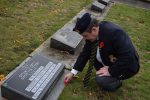
Danny Redden places a poppy at a family grave. (photo by Shula Klinger)
Royal Canadian Legion Shalom Branch #178 paid their respects at Schara Tzedeck Cemetery. (photo by Shula Klinger)
With Remembrance Day falling on a Saturday this year, members of Royal Canadian Legion Shalom Branch #178 paid their respects on Monday, Nov. 13. They met at Schara Tzedeck Cemetery in New Westminster. Legion president Ralph Jackson was in attendance with vice-presidents Alan Tapper and Mark Perl, along with legion members.
The group sang O Canada and Hatikvah, and the Last Post was sounded, before poppies were placed at veterans’ graves. Danny Redden laid a poppy at the grave of a former neighbour. He later emailed the man’s son and daughter, who do not live locally. “I told them, we remembered him and laid a poppy at his grave. They were so appreciative. When you hear that, you need to continue doing it. It’s the honourable thing to do.”
After the service, attendees went on to lunch at Louis Brier Home and Hospital. Redden described it as “a lovely lunch, followed by live piano music and songs from the war years. They did a wonderful job.” Redden credited Rachel Worth at Louis Brier for coordinating the afternoon’s entertainment.
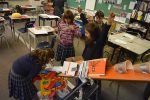
Teacher Lisa Altow’s Grade 5 students at Vancouver Hebrew Academy build a machine, using a variety of household treasures. (photo by Shula Klinger)
Vancouver Hebrew Academy has a new principal of general studies this year. As well, the school site is being upgraded, with new classrooms and a brand new playground on their way.
Rabbi Don Pacht, head of school, works with two under-principals, one for secular and one for Jewish learning. Rabbi Tzvi Goldman is principal of Judaic studies and the new principal of general studies, Adam Zalba, rounds out the team.
Zalba’s role is to ensure that the students’ work meets the requirements of British Columbia’s provincial curriculum. Pacht describes Zalba as “incredibly personable. He’s one of those people that are just meant to work with children – you can tell right away.”
Zalba told the Independent he has had a “busy and eventful couple of months” at VHA. This is the first Jewish school he has worked at, and he said he has been impressed by “the professionalism, dedication and work ethic” of the teachers, as well as the support of the parents. He finds the children to be a “bright, inquisitive and joyful student body, with a thirst for knowledge.” In taking an active interest in the students’ social and emotional development, he looks forward to helping them on their way to becoming “caring, respectful and thoughtful citizens.”
“Our vision for VHA is excellence in both Judaic and general studies,” said Pacht. “We want students to be ready for whatever they choose next. For some, it’s intensive Judaic studies; for others, it’s King David or Pacific Torah Institute.” For example, Grade 7 students Chaya Yeshayahu and Devorah Leah Yeshayahu are considering Vancouver’s Shalhevet Girls High School, but are also looking at some out-of-town options, as well.
Of the two strands to the curriculum, Pacht said, “We’ve taught them to read and decode the Chumash, but we’ve also taught them to be analytical learners, for Talmud, for social studies. We strive to give them the tools they need to grow and connect with the outside world, through independent study. At 12, they leave VHA with a really solid set of foundation skills.”
VHA has been at its current site for 15 years, during which time the only upgrade has been the addition of portable classrooms. The property is owned by the Vancouver School Board, said Pacht. “For the last four years, we’ve been on a year-to-year lease,” he said. Recent lobbying at the VSB and the ministry has resulted in a new, eight-year lease. “That’s a generation in the life of an elementary school, where kids coming into preschool now can graduate from this building.”
The portables will be replaced with new modular buildings that are set up with a fast, efficient internet network. Construction for the buildings will start off-site within the next few weeks and the structures will be brought onto the property after school ends in June.
The old wooden playground structure will be dismantled at the end of this month, to be replaced shortly afterward by new, wheelchair-accessible equipment.
To fund these improvements, the school has fundraising plans, including its annual garden party, held in the summer. Pacht describes the party – which is hosted at a private home – as “a very relaxing and enjoyable event.”
Speaking of the funds needed to complete the necessary upgrades, the rabbi said, “We want to use them for the best purpose, to create the best learning environment possible.”
Shula Klingeris an author and journalist living in North Vancouver. Find out more at shulaklinger.com.
Aiden Cumming-Teicher celebrated his bar mitzvah by organizing Our Voices. (photo from Aiden Cumming-Teicher)
Aiden Cumming-Teicher got his start in acting at the age of 9. In the four years since then, he has played leading roles in numerous films and documentaries, receiving several Joey Awards nominations for his acting and winning a Young Entertainer Award in Los Angeles. For Beyond the Sun, he spent two months shooting in Argentina last year. He describes the film as “a religious adventure movie for kids.” The film – which features Pope Francis – was a highlight of his career so far, he said.
This year, Aiden celebrated his bar mitzvah in a novel way: by organizing Our Voices, a film festival that put child and youth filmmakers in the spotlight. Said Aiden of his unusual choice, “I wanted something that wasn’t all about me, something that gave back to other people, gave them the chance to express themselves and the opportunity to be heard and celebrated.”
Our Voices received more than 200 submissions from around the world and the contest culminated in a screening at Hollywood 3 Cinema in Pitt Meadows on Nov. 4. The entries represented a wide range of
genres and narrative styles: documentaries, films about relationships, films about giving kids the tools to deal with anxiety, music videos, comedies. The selections were judged by a panel that included professionals in the movie industry, with Aiden having the final say on the winners. His favourite movie was A Pencil, a satire on Apple. “It didn’t really fit in the categories so we created a Wildcard Award,” said Aiden. “We also made a Tikkun Olam Award for another wonderful film from Australia, Today?, which was about giving kids the tools to express themselves, finding solidarity against bullying.”
Admission for the screening of the 60-plus films was by donation, with the proceeds being donated to B.C. Children’s Hospital. Aiden presented a cheque for $610 to the hospital on Nov. 7, to show his gratitude for the care they have provided him, his friends and family.
“A big part of my life is finding ways to give back, because I know that I have been blessed,” said Aiden. “My family has faced difficult times – such as my mom’s cancer diagnosis a few years back – but we have always found ways to make it through.”
With his parents, Chris and Apis, Aiden helps others, despite whatever adversity he might be facing. “When my mom was sick, we made a kids book to help others going through the same thing. It’s available as a free PDF to anyone that needs it, and some printed copies have been given away too.”
Regarding his approach to tzedakah, he said, “A big part of this is feeling that we are helping to heal the world, even a little. I can’t fix everything, but being a kid doesn’t mean I’m helpless. I can still make a difference, even if it’s a small one.”
He credited his family for his sense of agency. “I am really thankful that I have a very strong, loving family, and that we tackle all challenges together, perform mitzvot together.”
This was certainly the case with a documentary he made on Vancouver Island, about saving at-risk salmon fry during a brutal drought.
Some of Aiden’s philanthropic work has brought him into contact with the harsh potential realities of life as a young adult. In 2016, he received an award at the Wall of Stars, an annual event that celebrates excellence in entertainment, with an emphasis on mutual support among artists. “The best part was that it was presented by Ms. Carol Todd, mother of Amanda Todd,” he said, referring to the teen who committed suicide in 2012 after relentless bullying. “My mom was there to see it,” he said.
Reflecting on the personal rewards of his work, Aiden said, “Making this film festival made me very happy. We got to see so many perspectives from around the world and see so many different lives.”
The big picture, though, is the impact of all this on the world around him. “I have been lucky,” he said, “to be in projects that all have a positive message.”
Shula Klingeris an author and journalist living in North Vancouver. Find out more at shulaklinger.com.
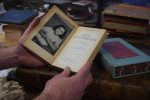
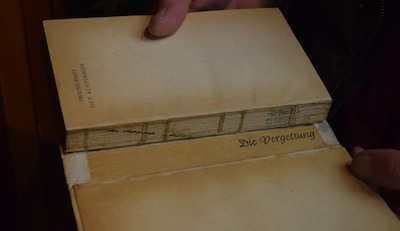
Hidden in the spine of a 1947 edition of Anne Frank’s The Diary of a Young Girl, in its original Dutch, is a piece of paper with the German words, “Die Vergeltung,” or retribution. (photo by Shula Klinger)
I ran into Richard Smart in North Vancouver in early September. It was at Urban Repurpose, a nonprofit store that sells used building materials and an eclectic mix of donated household items. Many of these items are vintage and, if you’re interested in local history or looking for artistic inspiration, it’s also a treasure trove.
Employing skills handed down over three generations of his family in England, Smart restores and sells antique books using tools that have “barely changed for centuries.” And, since a homeschooling mom never misses an opportunity to educate the children, I asked him if we could come by the Old English Bindery to see him at work. In mid-October, he invited us to see how a broken book could be repaired.
Smart showed us book presses, tools for applying gold leaf to the bindings of books, piles of ancient, beautifully decorated papers and, of course, the books themselves – travel writing, fiction, nonfiction, massive tomes of human anatomy, bigger than any book you’d see in print nowadays. He also applied gold leaf to the kids’ index fingers, which delighted us all.
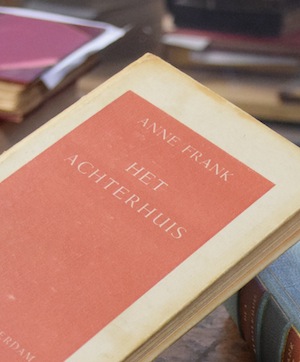
Het Achterhuis. Anne Frank’s The Diary of a Young Girl. (photo by Shula Klinger)
Just before we left, Smart showed me a small, bubble-wrapped book. I looked down as he held it out. Its title: Het Achterhuis. Anne Frank’s The Diary of a Young Girl.
“It’s a first edition,” he said. There was a pause, to let this information seep in. He pointed to the front left edge. “I only did minor repairs on it, here.”
I stared at my hands, holding this 1947 edition of The Diary of a Young Girl, in its original Dutch. Looking down, just breathing. Thinking about how, a mere two years before this book was published, Anne and her sister Margot were still alive. In captivity, but alive. Anne was still writing, contemplating the nature of the human soul.
A moment later, Smart pointed to the inside of the spine, where it had separated from the contents. “Look at that,” he said, and pointed to some words in German: “Die Vergeltung.”
“I looked it up,” he said, and here he became animated. “It means retribution. Or payback.”
I was already choking back the emotion of holding this 70-year-old edition of The Diary, but now this?
I asked how the text had gotten there, when the book had come apart, if it had been placed there during the original binding.
“Bookbinders often used scraps of paper to pad the inside of a spine,” he explained. “But to choose this particular piece of paper? Just think about that.”
By then, my head was full of questions, all competing for my attention. Unfortunately, my two children were also competing for my attention. The little one was extremely curious about the book presses, but the big one was edging toward the door. Also, as interested as they are in world history, this wasn’t the time to tell them about the Holocaust, so we left.
Over the next few days, I learned more about the book’s earlier life and Smart’s plans for its future. “This book needs to go back to its community,” he said. When asked if it there had been any fanfare at the Dutch auction, he said, “It was just an ordinary estate sale.”
Since the original dust jacket was missing, Smart has made a case for it. Working to match it to the cover’s original colour, he chose a pale blue leather inlay for the lid and patterned, or “paste,” paper for the sides.
In the spine of this 1947 edition of The Diary of a Young Girl is a piece of paper with the German words, “Die Vergeltung,” or retribution. (photo by Shula Klinger)
I also wrote to Anne Frank House in Amsterdam. Gertjan Broek replied, saying, “There are still a few mysteries around the first edition of Anne Frank’s Het Achterhuis.” He agreed that “randomly available” pages from other books were often used to pad spines – “paper was a scarce resource in those years,” he noted.
This was probably the case with the page used in Smart’s edition of Het Achterhuis. Die Vergeltung was published in Bayreuth, Germany, in 1941 and reprinted in 1944. In Broek’s view, the typefaces were a match. Broek didn’t know if this was true for all of the 3,000 books in this first run, but he said he’d ask his colleagues.
A few days – and a good deal of anxious email-checking – later, Broek wrote again. “Three experts in book restoration have told me they have never seen a first edition copy of Het Achterhuis with this kind of print.”
And that is where the story rests, for now. I would love to paint a more detailed picture of the bookbinder at a workbench in 1947. I picture hands cutting out a page of that German book, laying it into the backbone of Anne’s book. Was the bookbinder just doing a job, or taking a degree of satisfaction in leaving a deliberate, but hidden, commentary inside this now-iconic piece of work?
There’s another layer to the tale.
In an age where people are rushing around permanently plugged into an online world, bookbinders like Smart have an unusual job. Every day, instead of racing ever forwards, he steps into worlds that have passed, touches books first purchased by people who haven’t lived for centuries. As he preserves their books, it’s as if he offers a passage between their time and ours.
Amid all of these remarkable works, Anne’s stands out as a beacon. “Books like Anne’s make this work worthwhile,” said Smart, who is keen to sell his copy of Het Achterhuis, but to an organization, not a private individual. “I had an offer on it but I refused it,” he said. “I have my heart set on it going into an institution that will display the story.”
So, in preserving precious books, Smart is doing far more than simply offering a service, repairing material goods. He is acting as a guardian of history.
Smart also wonders about the binder of this copy of copy of Het Achterhuis, “the moment of looking for a spine liner and putting that particular one in. What was going through his mind, in 1947?” On reading this in Smart’s email, I replied that, really, the book was priceless.
Later that day, he emailed again. “This one copy is priceless, as you say. Not financially but historically. Just imagine the story told by everyone that sees this book in a museum. It would bring people in, just to see this, and talk about it. That is worth so much for everyone in this world.”
Responding to my expression of gratitude for his professional conscience, he said, “Faith is everything.”
Shula Klingeris an author, illustrator and journalist living in North Vancouver. Find out more at niftyscissors.com.
Joel Harrington chats with Ande Axelrod from Tagua, who makes jewelry from nuts grown in the Amazon (treatsdesigns.com), at a gathering of B.C. artisans at the North Shore Jewish Community Centre (Har El Congregation) on Oct. 16. (photo by Shula Klinger)
Paul Harnett shows off his wares at the recent open house and market at the Jewish Community Centre of Greater Vancouver. (For more on Harnett, see jewishindependent.ca/time-for-new-shofar.) The JCC Rosh Hashanah Marketplace took place Sept. 12-14 and 18 and featured several vendors – of jewelry, art, glassware, clothing, hats and more – and some community organizations also had stands.
Left to right: Bernard Bressler, Bill Barrable, Prof. Yaakov Nahmias, the Hon. Jody Wilson-Raybould, Jonathan Miodowski, Dina Wachtel, the Hon. Bruce Ralston and Rick Glumac. (photo from Rick Hansen Institute)
On Aug. 25 in Vancouver, the Rick Hansen Institute (RHI) announced a new partnership with the Hebrew University’s Alexander Grass Centre for Bioengineering. The first of its kind in the world, this partnership will fast-track the development of products designed to improve the lives of people who have been devastated by spinal cord injuries (SCI).
Bioengineering uses scientific concepts and methods to find practical, cost-effective solutions to problems in the life sciences. Researchers investigate ways to regenerate damaged tissue, grow new organs or mimic the systems and processes of the human body with synthetic tools. In the case of individuals with SCI, this means combating the paralysis caused by a serious injury.
According to the RHI, in British Columbia alone, there are 12,000 people living with an SCI. “The economic burden is an estimated $372 million a year for new traumatic spinal cord injuries: this figure includes direct healthcare (59%) as well as indirect morbidity and mortality related (41%) costs,” says the RHI. “Secondary complications such as pressure ulcers, neuropathic pain, urinary tract infections and pneumonia cost an estimated $70 million in direct costs to B.C.’s healthcare system annually.”
The Grass Centre’s Biodesign program teaches researchers, business and bioengineering graduates how to make medical innovations commercially available. Recent innovations at the centre include a device that inserts chest tubes. The device prevents lung collapse in under a minute and saves lives in the battlefield and the emergency room. The centre also has developed pressure-sensing socks that can tell when patients with diabetes are in pain, prevent foot ulcers and communicate health data to smartphones. More than 130 million people suffer from diabetes-related pain worldwide.
Bill Barrable, chief executive officer of the RHI, described Rick Hansen’s long association and warm relationship with Israel. Hansen traveled there on his Man in Motion tour many years ago and he also received an honorary degree from the Hebrew University. Barrable accompanied Hansen on that latter visit.
Barrable spoke of the new partnership as being designed to “grow the next generation of medical research entrepreneurs.” These entrepreneurs will create intellectual property that can be sold commercially within one year, a goal he described as “extraordinary.” In addition to the profound impact it will have on patients, Barrable sees the project as a way to strengthen innovation in British Columbia.
Prof. Yaakov Nahmias is the director of the Grass Centre. After co-founding the Biodesign program at HU with Hadassah Medical Centre and Stanford University, four new medical devices were launched under his leadership – in the program’s first year. Referencing Israel’s reputation as a “start-up nation,” Nahmias touched on the 2009 book Start-up Nation by Dan Senor and Saul Singer, which explores how it is that a small, embattled country like Israel has more tech start-ups than any other. Speaking of the student body at the Grass Centre, Nahmias described a population that is mature, self-sufficient and has a rich life experience. Having completed school and their mandatory military service, Israeli grads also have traveled the world and worked while pursuing their undergraduate studies. He described a group that did not want to continue their research work as academics, but as entrepreneurs. The Biodesign program enabled them to do this. Its multi-disciplinary, team-based approach to medical innovation is also unique, according to Nahmias, “because it leverages the diversity we see in Israel.” The program is host to groups led by Palestinians from East Jerusalem and ultra-Orthodox rabbis alike, he said. The program’s success, he added, was owed to the creativity and talent of this diverse group.
In concert with the fiery, boundary-pushing Israelis, Nahmias said Canadian researchers would bring “people with vision, people who would set the course and know how to treat patients and solve problems in everyday life. But we also want to have agitators, people who would rock the bridge and say, ‘that’s not good enough!’ These are the people we have in Israel. And this is why this partnership is unique.”
B.C. Minister of Jobs, Trade and Technology Bruce Ralston spoke highly of Israel’s capacity for innovation. Looking forward to seeing stronger ties develop between the technology sectors of Israel and British Columbia, Ralston said he sees this partnership as a way to “restore and bolster our commitment to research in a way that attracts top-flight talent back to B.C.”
Also joining in the announcement, which was made at the Blusson Spinal Cord Centre, at Vancouver General Hospital was the Hon. Jody Wilson-Raybould. In her capacity as federal justice minister, she applauded the new initiative, describing SCI patient care as “a human rights issue.”
Also in attendance was Bernard Bressler, director of the board of Canada-Israel Industrial Research and Development Foundation. Bressler praised the partners for going beyond academic research to make life-altering technologies. “The partnership creates an environment where creative ideas, difficult problems and entrepreneurial mentorship can interact in a structured way,” he said.
Speaking after the event, John Chernesky, RHI’s consumer engagement lead, commented, “What excites me most is the prospect of new devices that allow people with paralysis to complete ordinary tasks, even something as simple as using an arm to manipulate their environment. Spinal cord injuries can affect every part of a person’s body. The implications [of a program like this] are tremendous.”
Dina Wachtel, executive director of Canadian Friends of Hebrew University, Western Region, said the program created “a living bridge upon which a scientist from Canada will spend time in Israel with the start-up nation and, once they trigger the process, as a team, and have the beginning of a device, they can bring it back to B.C. for further development.”
Shula Klingeris an author, illustrator and journalist living in North Vancouver. Find out more at niftyscissors.com.
Vancouver Talmud Torah head of school Cathy Lowenstein Lowenstein addresses those gathered for the closing of this year’s Mitzvah of Valuing Philanthropy program. (photo by Jennifer Shecter-Balin)
On June 15, Grade 7 students at Vancouver Talmud Torah celebrated the close of the year’s Mitzvah of Valuing Philanthropy (MVP) program. Started by the late Sari Zack Weintraub Greenberg nine years ago, MVP integrates a curriculum of tikkun olam (repairing the world), rooted in traditional Jewish teachings, into the students’ educational experience.
Head of school Cathy Lowenstein said Greenberg’s work “revolutionized the school’s tikkun olam curriculum.” Greenberg encouraged the students to “lovingly expand their universe of obligation,” said Lowenstein. The program is something that the kids look forward to in their Grade 7 year, she continued, noting that “tikkun olam is a cornerstone of the school.”
Since its inception, the MVP program has raised a total of $220,000. This year’s 39 Grade 7 students raised an impressive $27,000. On top of this fundraising record, this year’s Tzedakah Project has also contributed $10,000 as a grant to “motivate and inspire” the kids to develop their passion for tzedakah (charity/justice) and chesed (loving kindness).
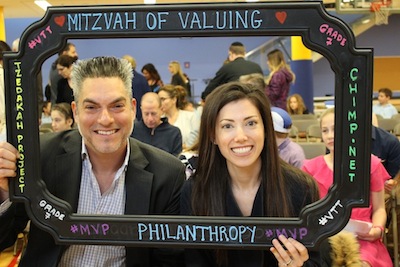
VTT MVP Ariel Lewinski and Judy Boxer of Chimp. (photo by Jennifer Shecter-Balin)
The MVP group expressed thanks to Cambridge Uniforms for their ongoing support of the program. This year also saw the involvement of Chimp representatives Judy Boxer and Ariel Lewinski, who offered support via the company to this generation of philanthropists. Boxer and Lewinski gave gift cards totaling $10,000 out to the members of the audience on June 15. Each card could be used to donate $100 to a charity of the recipient’s choice.
The MVP program is support by the Irma Zack MVP Endowment Fund, established by Dr. David Zack – Greenberg’s father – in memory of his late wife, and the original seed funding was donated by Sylvia and the late Lorne Cristall. It is through these funds that the school has been able to run MVP and other such initiatives.
The MVP students followed a careful process of selection of charities to support. They picked ethical commandments to work with, such as healing the sick, helping others in difficulty, or feeding the hungry. They researched the agencies that satisfied these criteria and found contacts with whom to work. Having interviewed these contacts, the kids then had 20 minutes to convince their class to contribute to their agencies, turning classrooms into boardrooms for allocation meetings.
Funds were donated to 24 different organizations this year, including household names like UNICEF and Magen David Adom, and local beneficiaries like the Vancouver Aquarium and Big Sisters. Students also selected Down Syndrome Research and CEASE, an agency that supports women victims of sexual exploitation and domestic violence.
Several students offered their perspectives on the MVP initiative to the Jewish Independent.
Asher Teperson described how “we assumed the roles of principal researchers, primary investigators, bankers and lawyers to assess the needs in our community and respond to them in concrete ways.” For the MVP students, this was a rite of passage. “We had a taste of what it means to become an adult in the eyes of the Jewish community,” said Asher.
Estie Kallner echoed these sentiments: “How often are 12- and 13-year-olds asked to make phone calls to strangers, conduct interviews in corporate offices, request clarification on financial matters and pester agency executives on their overhead costs?”
Julia Huber closed the program remarks with a reflection on how much they had grown through the experience. She described a group of “restless, nervous and confused” kids at the start of the program. However, she said, “with support and encouragement, not only did we embrace the challenge, but we exceeded even our own ambitious goals.”
As another student, Isabella Leipsic, observed, the program left them with a profound sense of their own “strength” in “moral decision-making.” She added, with thanks to the program, “our lives will never be the same.”
Shula Klingeris an author, illustrator and journalist living in North Vancouver. Find out more at niftyscissors.com.
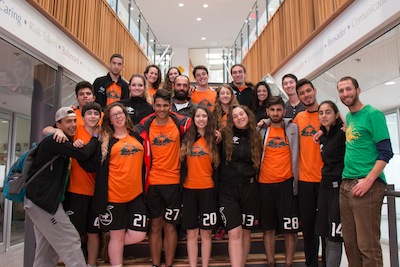
Stratford Hall Sabres and Ultimate Peace leaders-in-training in action this past April. (photo from Ultimate Peace)
Ultimate Peace uses team sports – specifically Ultimate Frisbee – as a vehicle for peace education in the Middle East (and beyond). It starts with throwing a Frisbee but leads to friendship, trust, shared leadership opportunities and powerful life lessons in communities where conflict is rife.
Founded on the core principles of mutual respect, friendship, non-violence, integrity and fun, a group from Ultimate Peace embarks on a North American Friendship Tour every year. Karym Barhum is the Middle East regional director for UP. Originally from Ein Rafa, an Israeli Arab village about 15 kilometres northwest of Jerusalem, he described this year’s cohort of 14 Israelis as “Arab, Jewish, Muslim and Christian youth living in very close proximity. They don’t go to the same schools, they just live in [separate] communities: Arabs with Arabs, Jews with Jews.”
This year, Ultimate Peace added a Vancouver leg to their usual itinerary. Following a stop in Seattle, a group of 15-to-18-year-olds was in Vancouver April 11-16. This part of the tour was made possible by Danie Proby and Ari Nitikman, co-founders of and head coaches at UltiPros; both are alumni of Stratford Hall school on Commercial Drive. Working with their connections, Proby and Nitikman set the ball rolling for an extraordinary experience for both the visitors and their hosts.
Ultimate Peace leaders-in-training and staff. (photo from Ultimate Peace)
UP alumni and leaders visit schools, community centres, places of worship, homes and universities to spread awareness of UP’s Leaders-in-Training program. Barhum said it is a tremendous opportunity to see people “accepting everybody no matter who you are. We hope they’ll come back to the Middle East as ambassadors of UP, so they can educate others on how to accept differences.”
Samantha Gayfer, director of community development at Stratford Hall, said the school teaches students “they have a responsibility to give back and make a difference.”
Having arranged for Stratford Hall to host the UP event, families from the school billeted the 14 visiting students, who also spoke at other schools during their time here.
Gayfer described the billeting experience as “outstanding.”
“Arrangements were made for kosher and halal diets,” she said, “and the Jewish players had Passover while they were here. They organized a full meal with cultural and religious understanding.”
The impact of this gesture was not lost on her. “These are kids from families who live three miles from each other but never visit each other’s homes. Now they’re good friends.”
Naturally, there were questions. Gayfer asked the Arab students what their parents thought about their involvement in Ultimate Peace. The answer was always, “My family supports this.”
While she conceded that liberal parents are the most likely to enrol their kids in programs like this, it doesn’t take away from the power of showing Canadian kids what is possible, even in troubled regions. If such friendships are possible among Arabs and Jews in Israel, what can’t we achieve here in peacetime? she asked. “The more families you touch, the better,” she said, “to show that it’s not an insurmountable challenge, that we could live cohesively together.”
During their stay, Ultimate Peace won a tournament – a highlight of their trip. Gayfer said it was “an amazing experience for the kids.”
UP is an opportunity for youth to educate others about life in Israel. In talking about how one can be part of positive change by learning about multiple perspectives, they are also modeling new kinds of relationships: relationships that are necessary before conflict can diminish on a larger scale.
Stratford Hall student Matthew Chiang said he had an “awesome and unforgettable” experience with Ultimate Peace. “The kids were awesome, super-enthusiastic, funny and kind,” he said. “Personally, the two kids that stayed over at my house, Ohad and Faris, had a lot of common interests with me, such as ping pong, Rubik’s Cubing, playing cards, Ultimate, and even shopping. I had never met a person from Israel and I had no idea that they were so similar to me.”
Asked what he thought of the group as a whole, he described it as strong and cohesive. “The Jewish and Muslim students seemed like great friends who got along really well…. My family and I talked to them about their culture and religion. They seemed open and spoke without conflict,” he said.
“Kids involved in this program can send a message to adults that, although there is heavy conflict and anger here, in the end, we are all people who share interests and hobbies,” he said. “Ultimate really breaks the barrier in that conflict and embraces two different ideas and shares one common goal – to have fun.”
He added, “I think Ultimate Peace has strengthened the bond between Jewish and Muslim people and has started to break the barrier between them.”
As well as promoting physical and mental fitness, Ultimate Peace teaches life skills like leadership and communication and reinforces the importance of hope, kindness and collaboration.
“I thoroughly enjoyed how kind they were and how many common interests we had,” said Chiang. “Ultimate Peace is such a great organization with such an important purpose. I’m glad that I had the opportunity to be a part of their journey and I hope that I see them again.”
Barhum is already seeing the impact of UP’s tour on the students. “Many of them are making plans for a twinning program between schools in North America and schools in Israel. This would allow the Israeli kids to take turns playing host to overseas students.” Not satisfied with a single trip to Canada, he said, “They are looking to develop a stable program.”
None of this would be possible with the UP infrastructure behind it. Barhum described a spirit of openness and optimism in the leadership of the program.
“The board of directors trust and allow me and my staff to do things differently, always trying out new ideas,” he said. “They allow us to be open, to learn from others and to be able to change if necessary. This is one of the big things that inspires me and keeps me doing my job.”
The Vancouver stop, he said, was “a highlight – seeing our kids learning new stuff, recognizing that it is possible to live and share their lives with others from a different culture or religion.”
To learn more about and to contribute to Ultimate Peace, visit ultimatepeace.org.
Shula Klingeris an author, illustrator and journalist living in North Vancouver. Find out more at niftyscissors.com.
Levi Mochkin celebrated his third birthday and his first haircut last month. (photo by Shula Klinger)
On March 26, Mendy and Miki Mochkin of Chabad North Shore celebrated their son Levi’s upshernish (or “cutting”). This occasion marked both Levi’s third birthday and his first haircut.
In the Orthodox tradition, a boy’s hair is not cut until his third birthday. This is because the Torah compares the little boy to a tree – the tree does not bear fruit until it has grown for three years. The upshernish is a community affair; all of the guests are invited to cut off a section of the child’s hair.
With the start of his formal education, the 3-year-old can begin to share his unique gifts with his family and community. And, just like the tree, a child must be nurtured consistently if he is to flourish in later life.
This is the time when the son receives his kippah and tzitzit. He also begins his Jewish studies in earnest. Along with learning the aleph-bet, he is taught to recite blessings and say the Shema.
At Levi’s upshernish, a booklet shared Torah passages from Deuteronomy and Genesis. These were a selection from the 12 verses that the Lubavitcher Rebbe taught children to recite each day. According to Rabbi Mochkin, “they contain many of Judaism’s foundational beliefs and principles.”
The Mochkins hosted the upshernish at their West Vancouver home, with members of their extended family from New York. Members of the Chabad community from Vancouver, East Vancouver and the University of British Columbia were also present, along with many local families.
Shula Klingeris an author, illustrator and journalist living in North Vancouver. Find out more at niftyscissors.com.